
 Jewish Breaking News
Marathon Hearing Turns Explosive Over NYC Worship-Site Protest Bill
A package of bills designed to protect places of worship and schools turned into a contentious hearing at City Hall in Manhattan on Wednesday, in a session that drew more than 100 speakers and dragged on for over 10 hours.
The original bill, proposed by City Council Speaker Julie Menin, who is Jewish, established a 100-foot buffer zone around houses of worship and medical facilities, but the draft was revised in response to misgivings expressed by NYC Police Commissioner Jessica Tisch. The revised bill did not name a specific distance but left that up to police discretion to determine on a case-by-case basis.
The hearing drew opponents and supporters alike.
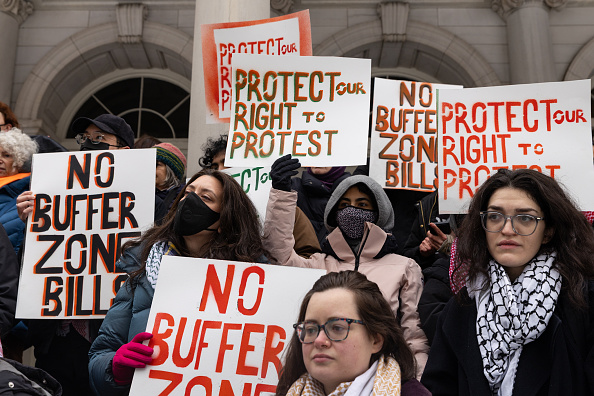
Anti-Israel groups said the bill infringes on their First Amendment right to scream at, intimidate and harass Jews who are just trying to go to shul (although not in those words). Activists held up signs before the hearing at the entrance to City Hall bearing the slogan, “Protect our right to protest,” while chanting “Free Palestine.”

One protester accused lawmakers of “prioritizing Zionist interests over the needs of the city,” saying that “the tactics that they test on colonized land always come home to suppress us here.”
“These bills are not about protecting worshipers or students,” he added. “They are about making sure the machinery of empire runs without interruption.”
But leaders across the religious spectrum came out in support of the proposed legislation.
“I have seen firsthand how deeply incidents of hate impact families and entire communities,” said Imam Maaz Ali of Iqra Masjid. “Our masjids, like all places of worship, should be spaces of peace, prayer, safety. Protecting one community ultimately protects us all.”
Menin, who proposed the bill, sought to clarify what she said are “misconceptions.”
“We’re not forgetting that our country was built on the protections of the First Amendment,” she said. “It is a freedom that these bills will uphold. What we will not allow is for people to abuse that freedom.”
Michael Gerber, an official from the New York Police Department, explained the initial concern about the 100-foot buffer zone.
Putting a restriction on distance “limited our ability to do frozen zones,” he said. “Any time you’re going to put a number on these things, it’s really going to create problems,” he said. While protesters have the right to be seen and heard by those they are protesting against, the amount of distance that needs to be maintained has to be determined on a case-by-case basis, he explained. But while the protesters have the right to be heard, the bill does not address “fighting words,” words that are meant to provoke a violent reaction and are not protected speech.
“At the same time, the protesters will not be permitted to obstruct, impede or interfere,” Gerber said, adding that he approved the revised bill.
Jewish speakers talked about their experiences with harassment in these spaces and expressed the desire to enter their synagogues and schools openly and without fear, especially as the bill was a response to recent protests at synagogues that got out of hand.