
 Jewish Breaking News
Israeli Court Challenges Ban on Female Foreign Construction Workers, Opening New Path to Ease Housing Shortage and Build Delays
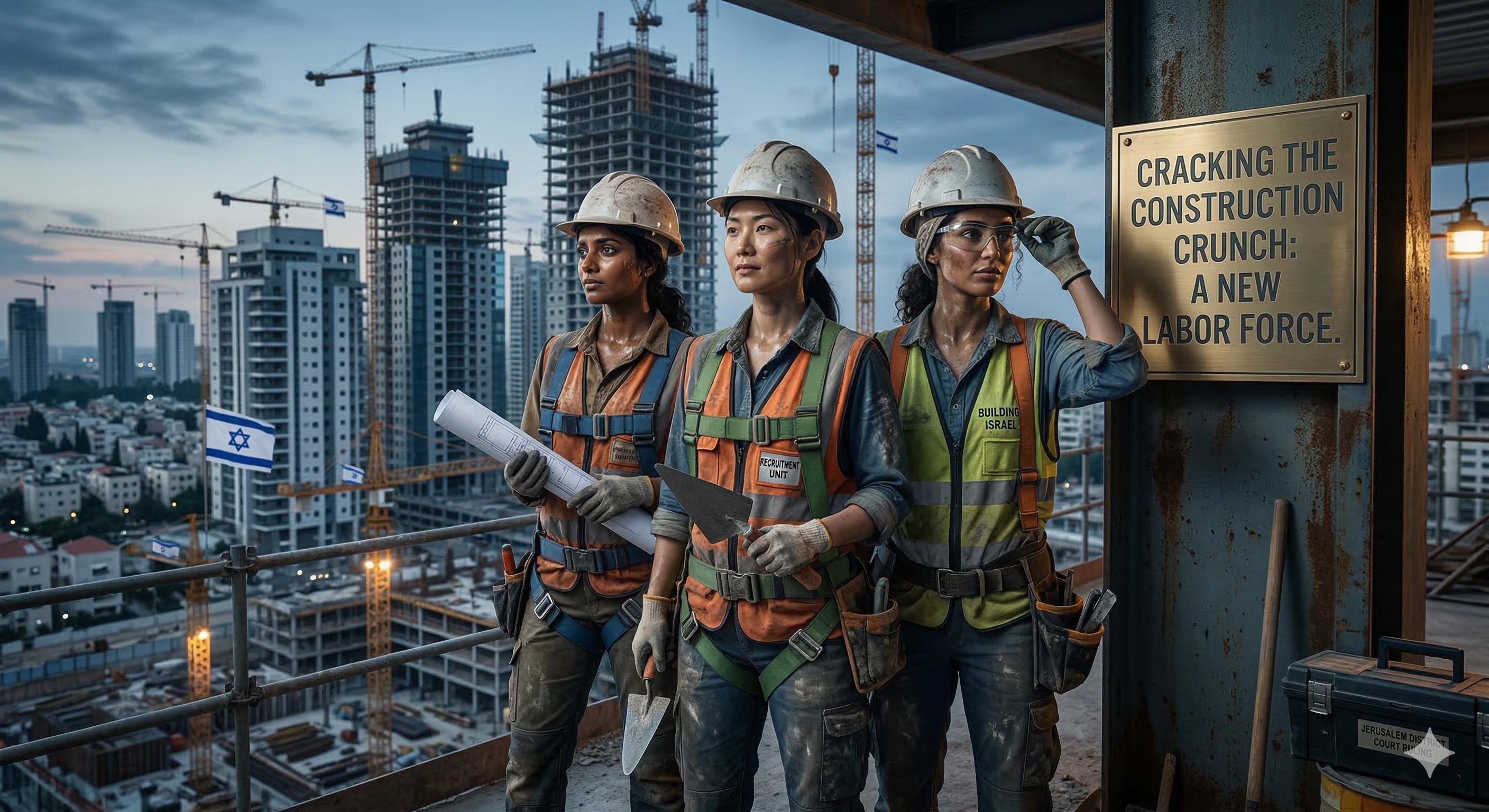
Israel’s housing market may have just gotten an important, if still fresh, jolt from an unexpected direction. In Israel’s current market, the central problem is no longer only planning homes. It is building them on time, at scale, and with enough manpower to keep projects moving. Courts have held that the sweeping prohibition against foreign female construction workers was discriminatory and sent the issue back to the Population and Immigration Authority and the Ministry of Construction and Housing to formulate conditions under which women could be recruited for construction work, particularly in “wet works” such as steelwork, formwork, plastering and flooring.
That matters because the labor shock that hit Israeli construction after the war has still not fully cleared. Bank of Israel data show that before the war the industry employed about 365,000 people, including roughly 109,000 Palestinians and 32,000 foreign workers. After Palestinian entry was cut off, the workforce fell by more than a third. By the end of 2024, foreign workers had risen from about 29,000 to roughly 63,000, and the quota had been expanded from 42,000 to 110,000, but the industry was still about 10% below its prewar labor level. In other words, Israel has been adding labor, but not fast enough to fully replace what it lost.

From a property-market perspective, that gap is critical. The Bank of Israel said the construction sector’s labor shortage lengthened timelines, slowed completions and raised financing costs for contractors. It also noted that housing demand recovered while home prices rose 7.3% in 2024, partly because buyers were worried future supply would remain constrained. Even a modest widening of the labor pool could help relieve pressure where Israel’s market is most fragile, which is not land allocation alone but the conversion of approved units into actual delivered apartments.
On one hand, Israel’s planning machine has been aggressive. National planning bodies approved 223,164 housing units in 2025, well above target, according to a year-end Planning Administration report cited by Ynet. On the other hand, approvals do not pour concrete. The OECD has warned that increasing housing supply over the medium term requires fixing the construction-worker shortage, and the Bank of Israel has made much the same point that planning can move, but execution still collides with labor constraints, site bottlenecks and slower completions.

Israel has already leaned heavily on foreign labor and foreign construction capacity. A government tender published late last year said ten foreign construction companies already operating in Israel were employing about 10,000 foreign workers, and the state has continued expanding foreign-worker channels to support residential building. But if ministries now design a workable framework for female foreign labor, the impact could be larger than the immediate headcount. It would give manpower corporations and contractors another recruitment lane in trades where shortages remain acute, while signaling that the state is finally treating labor supply as a flexible economic variable rather than a fixed administrative category.
In court, the state argued that construction sites pose unique risks for women, especially where a small number of women would work alongside large numbers of men, raising concerns about harassment and exploitation. Those concerns are serious, and they are exactly why the next phase matters more than the headline. Israel’s own foreign-workers handbook says non-Israeli workers are generally entitled to the same working conditions as Israelis, and that employers must provide a written contract, private health insurance and proper housing. If female foreign workers are brought in, the market will need more than a court win. It will need enforceable transport, accommodation, supervision and reporting standards that developers and manpower firms can actually implement.

The market is not uniformly overheated. Recent CBS-linked data showed housing prices edging up again at the end of 2025, with the national average home price at about NIS 2.36 million, while a record 86,090 new homes remained unsold at the end of December. That means Israel’s developers are operating in a split market as demand is still there, but financing pressure is high, inventory is heavy, and buyers are more selective. In that environment, anything that helps finish buildings faster matters. Faster delivery reduces carrying costs, frees capital, and improves the odds that planned supply actually reaches the market before demand shifts again.
The ruling does not instantly solve Israel’s housing crunch, and it does not guarantee that female foreign construction workers will arrive in meaningful numbers soon. But it does expose a deeper truth about the market. Israel’s housing challenge is no longer just about approving more neighborhoods, marketing more land or drafting another national plan. It is about building capacity on the ground. If the government turns this ruling into a serious regulatory framework rather than a symbolic review, it could open a new labor channel at exactly the point where the real estate sector remains most vulnerable, the distance between permit and handover.
