
 Jewish Breaking News
Judge Orders Penn to Provide Names of Jewish Employees in Federal Antisemitism Probe as University Prepares Appeal
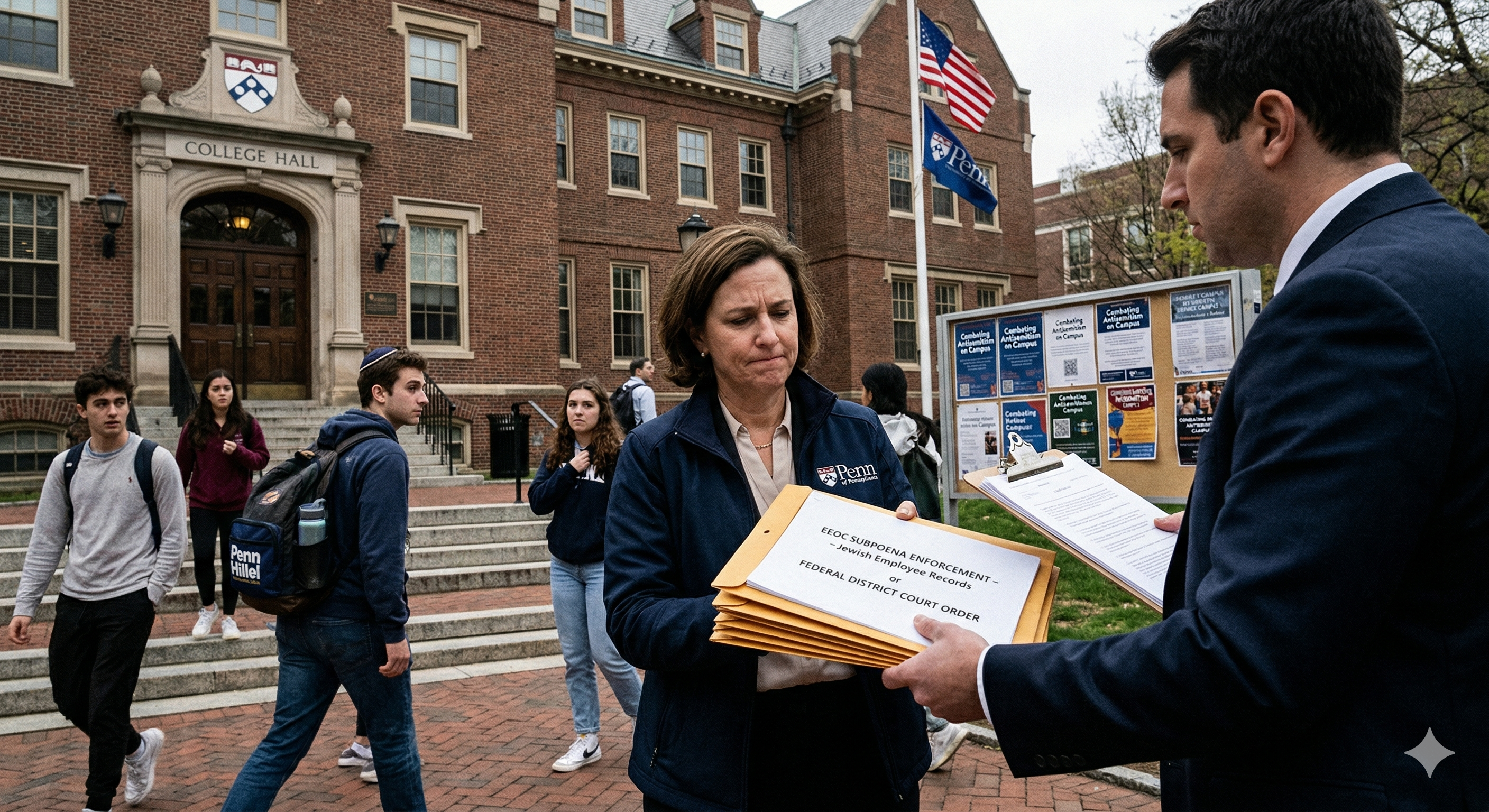
A federal judge has ordered the University of Pennsylvania to comply with a subpoena from the U.S. Equal Employment Opportunity Commission in its antisemitism investigation, a major ruling in one of the most closely watched campus discrimination fights in the country. Judge Gerald Pappert said the EEOC has a legitimate interest in identifying possible witnesses and victims, but he did not give the government everything it wanted: Penn does not have to reveal any employee’s affiliation with a specific Jewish group, and AP reported the ruling also excluded information tied to Penn Hillel, Chabad Lubavitch House and MEOR. The university has until May 1 to comply.

The case exploded because Penn and several Jewish faculty and student-linked groups argued the subpoena would effectively force the university to build government “lists of Jews,” exposing the very people supposedly being protected. Pappert rejected that argument and said comparisons between the EEOC’s probe and Nazi-era lists were “unfortunate and inappropriate.” Penn said it will appeal, insisting that being forced to compile lists of Jewish faculty and staff and hand over personal contact information raises serious privacy and First Amendment concerns.

At the center of the fight is the EEOC’s claim that Penn has not turned over enough information for investigators to determine whether Jewish employees were subjected to a hostile work environment. The agency says it needs names and contact details so it can directly reach people who may have witnessed or experienced antisemitic conduct and assess whether the university’s response was adequate. In its enforcement action, the EEOC said Penn allowed antisemitic harassment to persist and escalate across its Philadelphia campus.
The ruling lands in a much larger post–October 7 reckoning at Penn. Federal investigators cited alleged antisemitic obscenities and vandalism at a Jewish student life center, a swastika painted on an academic building, and hateful graffiti outside a fraternity, alongside broader tensions tied to Gaza-war protests and the university’s response to them. Penn says it has already cooperated extensively, turning over roughly 900 pages of material, and had offered to notify employees about the investigation rather than disclose private information without consent.