
 Jewish Breaking News
CENTCOM Chief Visits USS Tripoli in Arabian Sea Days After Briefing President Trump on Potential Iran Strike Options
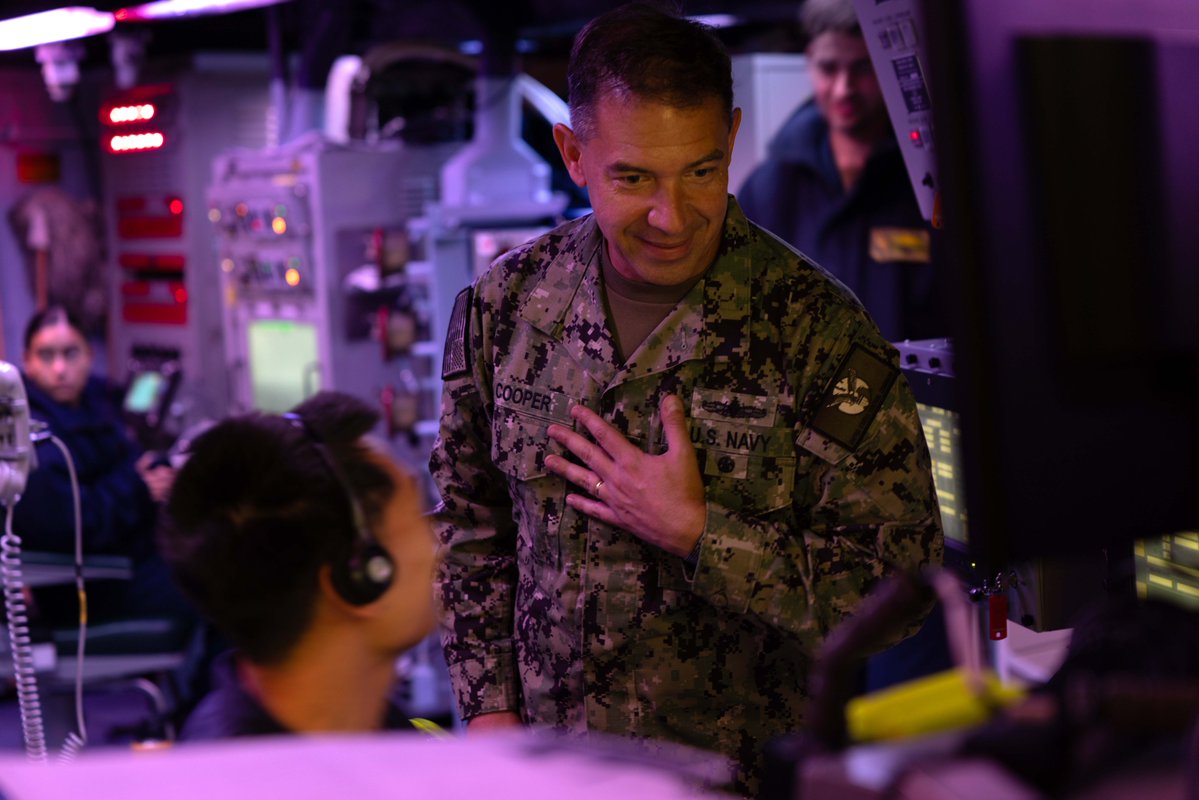
Adm. Brad Cooper, the commander of U.S. Central Command, has moved from the White House Iran briefing room to one of America’s most important forward platforms in the region. CENTCOM said Cooper visited sailors and Marines aboard USS Tripoli (LHA 7) in the Arabian Sea, recognized top performers, and toured operational spaces including the ship’s Combat Information Center. The timing is impossible to ignore: this is the same commander who briefed President Donald Trump this week on military options against Iran.

The USS Tripoli is not a ceremonial backdrop. It is an America-class amphibious assault ship carrying Marines and aviation power into a theater where the United States is trying to keep pressure on the Iranian regime, preserve freedom of navigation, and deter a renewed round of fighting. USNI has reported that the Tripoli Amphibious Ready Group includes USS Tripoli, USS New Orleans, elements of the 31st Marine Expeditionary Unit, and USS Rushmore.

Tripoli’s Marines have already been part of active blockade enforcement. CENTCOM said Marines from the 31st MEU departed USS Tripoli to board M/V Blue Star III, a commercial ship suspected of attempting to transit to Iran in violation of the U.S. blockade, before releasing it after confirming no Iranian port call. CENTCOM also said Marines departed Tripoli to board M/V Touska after USS Spruance disabled the Iranian-flagged vessel’s propulsion when it failed to comply with repeated U.S. warnings.
The visit comes as Washington sends two messages at once. Trump has told Congress that direct hostilities with Iran have “terminated” under the ceasefire, but his letter also said the threat from Iran to U.S. forces remains significant and that the Pentagon is continuing to update force posture in the region. In other words, the legal language in Washington is calm; the military posture in the Arabian Sea is not.


Reuters reported that Cooper, Defense Secretary Pete Hegseth, and Joint Chiefs Chairman Gen. Dan Caine were expected to brief Trump on actions that could pressure Iran into negotiations. Axios reported that CENTCOM had prepared options including a short, powerful wave of strikes and a possible Strait of Hormuz operation, though those remain military options, not an announced order. Trump later confirmed he had been briefed by Cooper and framed the choice bluntly: make a deal or “blast the hell out of them.”
For Israel, the signal matters. The Iranian regime and its proxies are watching whether America’s pressure fades after the ceasefire headlines. Cooper’s appearance aboard Tripoli says the opposite: CENTCOM’s top commander is in the region, the Marines are positioned, the Navy is enforcing the blockade, and Trump’s Iran options are not just sitting on paper in Washington. They are floating in the Arabian Sea.