

 Jewish Breaking News
New York Times: Israel Operated Two Secret Bases in Iraq During the Iran War Before a Shepherd Exposed One of Them
For months, one of the most sensitive pieces of Israel’s Iran campaign may have been hidden in plain sight, deep inside Iraq’s western desert, far from Baghdad, beyond the populated cities, and close enough to Iran to matter.
A New York Times report, cited by Israeli and regional outlets, says Israel operated at least two covert military sites in Iraq’s western desert to support operations against the Iranian regime. The reporting expands earlier claims that there was only one secret site, suggesting a broader Israeli footprint used intermittently for air support, refueling, medical treatment and operational reach during the campaign against Iran.

The story reportedly began to unravel when Awad al-Shammari, a 29-year-old Iraqi shepherd, came across soldiers, helicopters, tents and what appeared to be a makeshift landing strip near al-Nukhaib. According to his family and witness accounts cited in regional coverage of the NYT report, al-Shammari contacted Iraqi military authorities before he was later killed; witnesses said a helicopter pursued his pickup truck and fired at it until it stopped in the sand and burned.
That discovery appears to have triggered a wider Iraqi scramble. Iraqi forces sent to inspect the area came under aerial fire, leaving one Iraqi soldier dead and two wounded, according to Iraqi and AP reporting. AP, citing Iraqi and U.S. officials, reported that the unauthorized force in the Nukhaib desert was Israeli, though Iraqi authorities have not officially identified it as such. A senior U.S. military official described the site not as a permanent base, but as a temporary staging area or camp for operations connected to Iran.
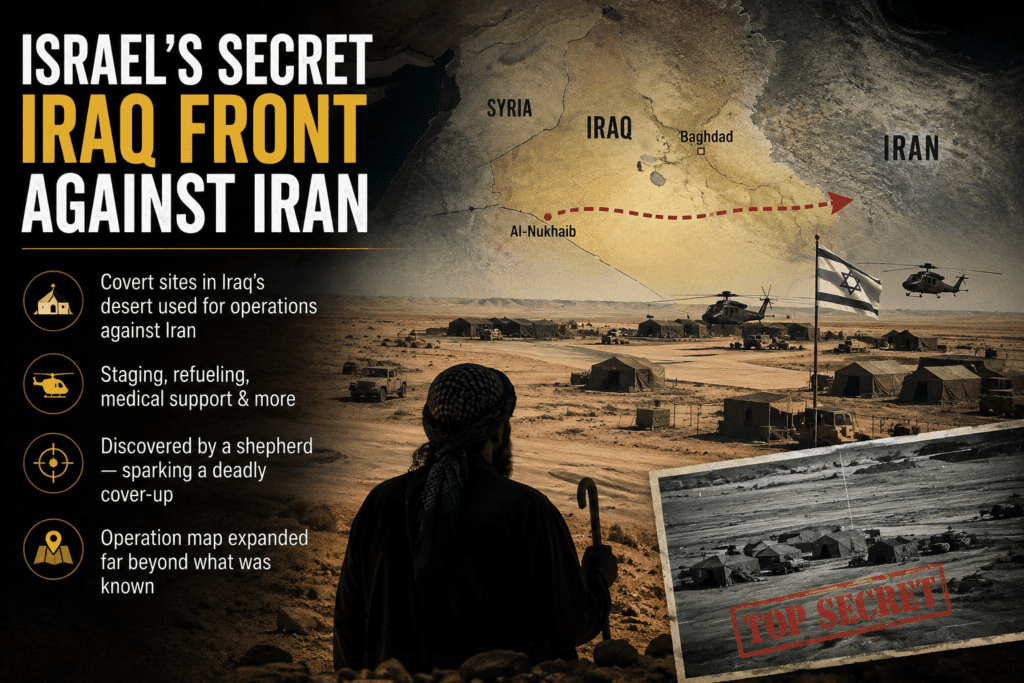
The key dispute now is not whether something happened in the desert. It is scale. Iraqi officials have publicly tried to narrow the incident, saying there are currently no unauthorized bases or foreign forces on Iraqi soil and that the March clash involved unidentified detachments backed by aircraft. But NYT-linked reporting says the discovered site was part of a larger Israeli network, with at least one location prepared as far back as late 2024 and used during Operation Rising Lion against Iran.
From Israel’s perspective, the strategic logic is obvious. Iran is far, heavily defended and surrounded by proxies. A discreet desert site in western Iraq could shorten flight routes, support aircrews, provide emergency medical or rescue options, and give Israel a forward operating edge against a regime racing to rebuild its nuclear and missile capabilities. Previous Israeli reporting already highlighted the central role of air-ground coordination, deception and commando activity in giving the IDF freedom of action over Iran during Operation Rising Lion.

For Baghdad, the exposure is humiliating. Iraq has no diplomatic relations with Israel, hosts Iran-backed militias, depends heavily on Washington for security cooperation, and is still trying to prove it controls its own territory. Iraqi officials previously complained at the U.N. that Israeli warplanes violated Iraqi airspace during the Iran conflict, with Baghdad saying dozens of aircraft crossed over areas including Basra, Najaf and Karbala.
Israel is unlikely to confirm any of it. That is the nature of operations designed to keep Iran off balance and Israeli pilots alive. But the emerging picture is clear enough: the war with Iran was not fought only from Israeli airbases, intelligence rooms and skies over Tehran. It also appears to have run through a harsh, empty stretch of Iraqi desert, where one hidden site exposed a much larger question.
How far will Israel go to stop Iran? According to the latest reporting, farther than Tehran expected and deeper than Baghdad is comfortable admitting.