

 Jewish Breaking News
Israel’s Housing Crunch Hits a New Breaking Point as Builders Warn of 30,000-Worker Shortage Delaying Projects Nationwide
Israel’s real estate crisis has a new pressure point, and it is not just prices, interest rates or demand—it is manpower, as the construction industry remains short tens of thousands of workers, with one industry estimate putting the gap at around 30,000. The shortage began after Israel shut the door on most Palestinian construction workers from Judea & Samaria and Gaza for security reasons following the October 7 massacre, causing the old labor model to collapse almost overnight. Israel has tried to replace it with foreign workers from countries including Sri Lanka, China, India and others, but the flow has not caught up with the country’s building needs.
For Anglos buying in Israel, making aliyah, investing from abroad or trying to understand why a promised apartment is taking longer than expected, this is one of the biggest hidden forces in the market. A delayed crew does not just slow a crane. It delays delivery, pushes up labor costs, complicates financing and can leave buyers paying rent, mortgages and contractor-linked payments longer than planned.
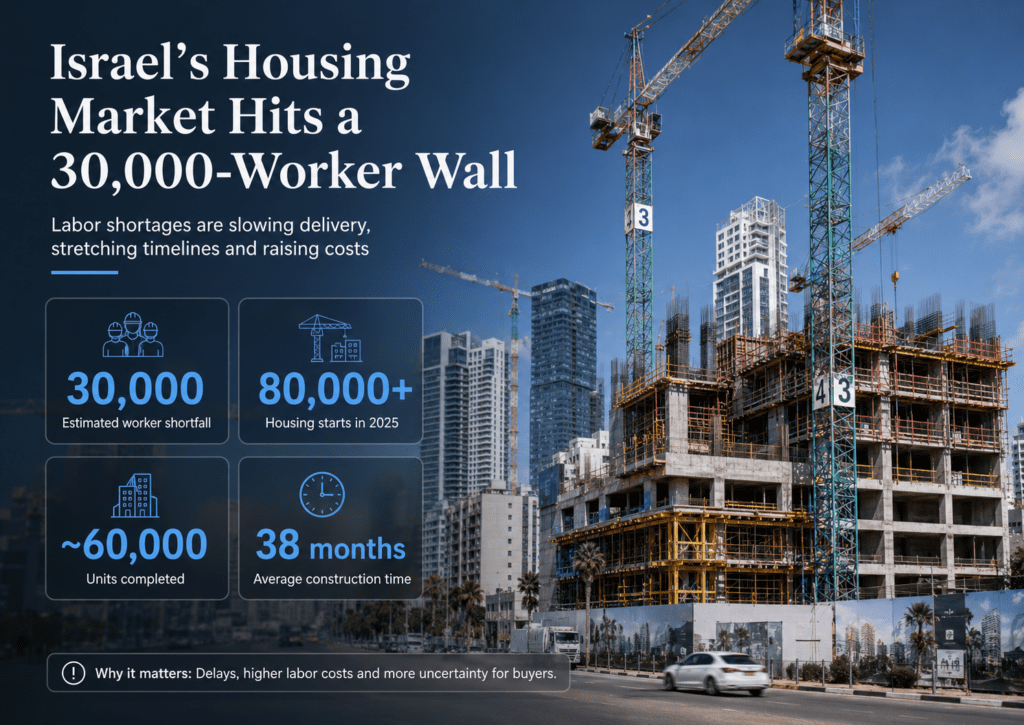
The official data tells the same story. Before the war, Israel’s construction sector depended heavily on non-Israeli labor, including more than 100,000 Palestinians and tens of thousands of foreign workers. When that workforce disappeared, the industry lost more than a third of its manpower. The government raised foreign-worker quotas, opened new recruitment tracks and tried to push more Israelis into construction, but the replacement has been partial, uneven and slow.
The result is a strange market as Israel is building more, but not always faster. CBS figures show construction starts jumped sharply, with more than 80,000 apartments begun in 2025. Completions also rose, reaching nearly 60,000 units. But the average weighted construction time also stretched to almost 38 months, meaning the headline number of new projects does not automatically translate into keys in buyers’ hands.

For overseas buyers, this is the detail that gets missed in glossy project brochures. A tower in Tel Aviv, Jerusalem, Beit Shemesh, Netanya or Ashdod may be marketed as part of Israel’s next housing wave. But the real question is whether the developer has enough workers, enough cash flow and enough operational strength to deliver on schedule. In Israel’s current market, manpower is becoming a due-diligence issue.
The shortage is also feeding directly into prices. Labor costs have climbed, construction-input costs have risen, and developers are already under pressure from financing expenses. Even after recent interest-rate relief, many builders are carrying expensive debt on land they bought years ago. Some are forced to keep building despite weaker demand because sitting on land is too costly and government land contracts often require progress within set timelines.
That pressure can cut both ways for buyers. In some projects, developers may offer aggressive financing terms to move inventory. In others, higher labor and input costs can be pushed into prices, payment schedules or index-linked balances. For buyers purchasing “on paper,” the risk is not only whether prices rise or fall. It is whether delays quietly add tens or hundreds of thousands of shekels through rent overlap, financing costs and construction-index exposure.
Israel does not just need new apartments for population growth. It needs reconstruction in the north and south, urban renewal in older neighborhoods, stronger buildings, protected spaces and faster infrastructure. The Tel Aviv Metro alone is expected to put new pressure on trucking, materials movement and heavy construction logistics. If Israel cannot staff the building sector properly, the bottleneck becomes a civilian resilience problem.
Industry voices are now pushing two solutions at once: bring in more foreign workers, and modernize how Israel builds. That second point may be the more important long-term story. Israel still builds too much on-site, by hand, under difficult conditions, instead of shifting more work into industrialized, factory-based production. As one construction-tech executive put it, Israel has to stop building like the last century and start manufacturing buildings.