
 Jewish Breaking News
ALL YOUR QUESTIONS ANSWERED! Everything You Wanted to Know About the MOU Between the U.S. and Iran
The whole world is buzzing, it seems, over the new deal signed this week between the United States and Iran. Months of listening to President Donald Trump seesawing back and forth between dire threats against Iran and promises of an amazing deal very soon has caused whiplash to those who follow the news closely and sowed confusion among both supporters and critics of the deal.
Enter our explainer that, well, explains everything you ever wanted to know about the deal. This guide clarifies the difference between a memorandum of understanding (MOU) and a treaty. You’ve been wondering, haven’t you?
Our tutorial also walks you through what each party stands to gain from the deal and breaks down a comparison between this MOU and the Joint Comprehensive Plan of Action (JCPOA), as well as the main points of criticism and support. Finally, our overview goes back and lists the war aims at the start of the campaign and the goals of the talks at the beginning of the ceasefire so you can see for yourself what has changed.
But first, a quick summary of this week’s events:
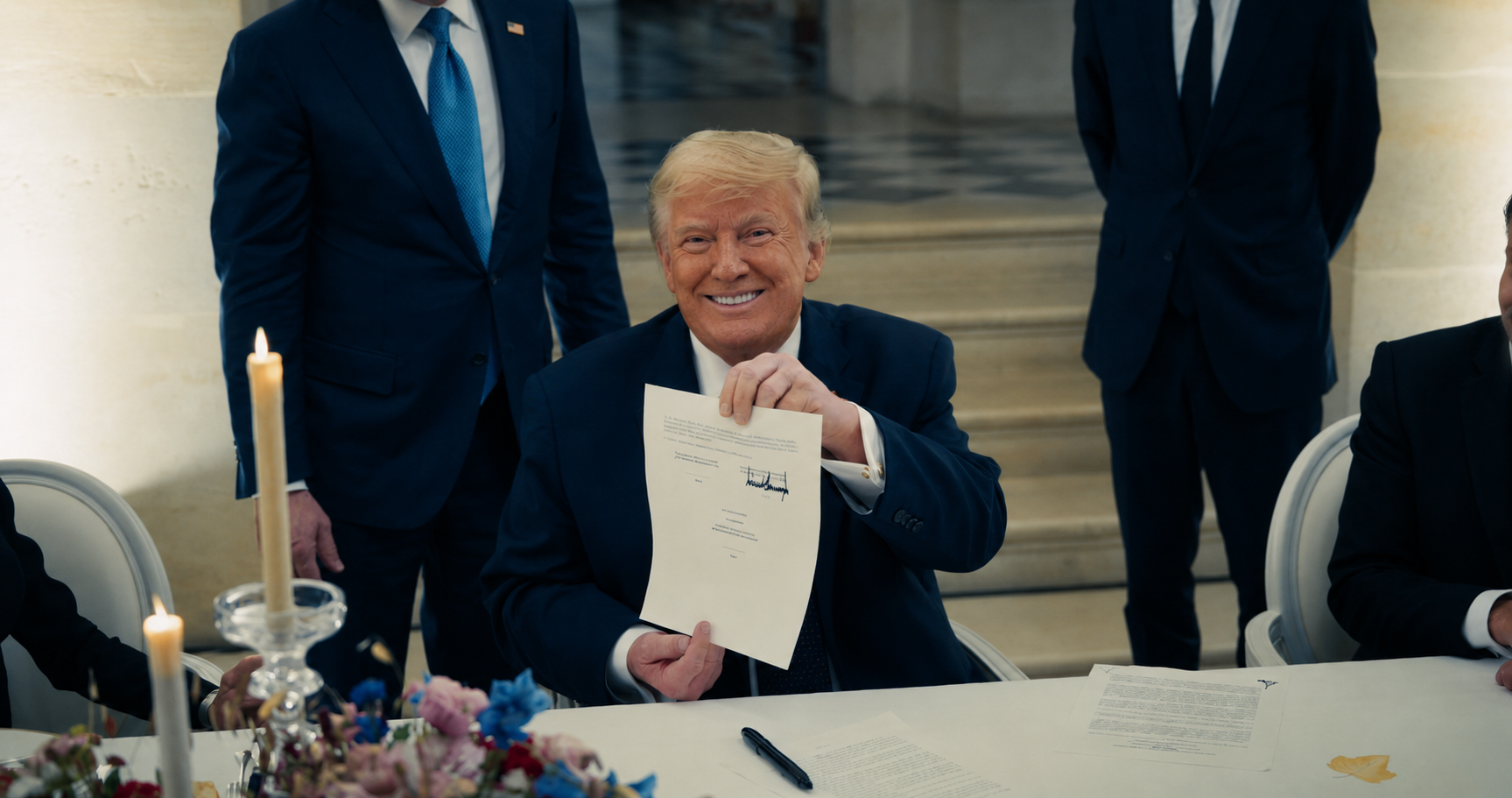
Since the April 8 ceasefire between the United States and Iran, the two countries had engaged in on-again, off-again talks to reach a permanent agreement, concluding Wednesday when President Donald Trump signed a hard copy of the memorandum of understanding (MOU) at the Palace of Versailles in France. Meanwhile, Iran’s President Masoud Pezeshkian signed his own digital copy in Iran. The MOU had already been signed electronically on June 15 by Vice President J.D. Vance and Iran’s chief negotiator, Mohammad-Bagher Ghalibaf.
So … what is the difference between an MOU and a treaty?
An MOU is a formal document that is used as a springboard for a more lasting framework. While it states the intentions of all the parties, it’s non-binding and unenforceable. A treaty, on the other hand, is a binding contract that is enforceable under international law. Because an MOU does not need to be ratified by a government body like Congress, it allows an agreement between parties to take effect quickly. An MOU relies on good faith and trust, whereas a treaty requires formal authorization from a legislative body like Congress and results in a much longer process.
The language used in MOUs is softer than treaties, using words like “will,” “intend to” and “jointly determine.” Treaties use language that is more binding and mandatory, like “shall” and “agree.”
Finally, courts resolve disputes over treaties, while the parties to MOUs resolve their disagreements among themselves.
In practical terms, because an MOU carries no legal weight, its terms are easier to violate than a formal treaty because there are no legal repercussions.

The MOU between Washington and Tehran runs slightly longer than two pages and lists fourteen points.
What does Iran get out of the deal?
- The U.S. and its allies (i.e., Israel) cease all hostilities immediately in every region in the Middle East (i.e., Israel ceases operations in Lebanon).
- The U.S. and Iran agree not to meddle in each other’s internal affairs. This means, for example, that the U.S. cannot meddle in Iran’s human rights violations, such as the executions of protesters.
- The deal defers discussion of the nuclear framework until certain conditions are met. A final deal will be reached in 60 days, with mutually agreed-upon extensions. This means that a final deal can be postponed indefinitely.
- The U.S. lifts its naval blockade and removes its military forces from the region.
- Iran can start charging for passage through the Strait of Hormuz after 60 days.
- Iran gets $300 billion for reconstruction without that payout being contingent on its good behavior.
- All sanctions against Iran are lifted in a phased manner.
- Iran maintains the status quo on its nuclear program without incurring new sanctions.
- Iran can immediately start exporting crude oil, receiving waivers to do so from the U.S. while the process of lifting sanctions is ongoing.
- All of Iran’s frozen funds and restricted assets will be immediately unfrozen and available.
What does the United States get out of the deal?
- Iran will immediately open the Strait of Hormuz and will not charge “service fees” for 60 days.
- Iran agrees not to procure or develop nuclear weapons. It agrees to “down blend” its enriched uranium, instead of relinquishing it to the U.S. as the U.S. had originally demanded.
What else is in the deal?
- Both countries agree to establish a method to implement the terms of this deal, as well as the future terms of a final deal between the two parties.
- Once both parties sign the deal and implement the permanent ceasefire, lifting of the blockade, reopening of the strait and unfreezing of Iranian funds and assets, the U.S. and Iran will begin to negotiate the terms of a final deal regarding the remaining points.
- The United Nations will pass a binding resolution on the deal once it is finalized.
Following is a comparison of the current MOU and the JCPOA that former President Barack Obama signed with Iran:
- Both deals ban Iran from acquiring nuclear weapons. While the JCPOA laid out a specific plan to prevent the acquisition of nuclear weapons, it’s unclear how the MOU will enforce this, as that has not been negotiated yet.
- The JCPOA put in place specific restrictions on Iran’s nuclear production. For example, it allowed Iran to enrich uranium up to 3.67%, an amount used for electricity but well below the amount needed for nuclear weapons. It capped this restriction at 15 years. It required Iran to consolidate all its nuclear production into one facility in Natanz. And it also restricted the number and types of centrifuges Iran could produce. By contrast, the MOU doesn’t directly address nuclear production, which is expected to be addressed in future talks; but it does suggest some restrictions, such as down blending its enriched uranium.
- A major criticism leveled at the JCPOA is that it contained 10- and 15-year sunset clauses. The MOU does not have any such clauses, and it’s unknown if a final deal will include one. Trump has said both that he wants to implement a 15- to 20-year cap and to impose permanent restrictions, so this remains to be seen.
- Both agreements include phased sanctions relief, but the MOU grants immediate waivers to Iran so it can immediately start exporting oil and petroleum. A key difference lies in the number of parties to the agreement. The MOU has been signed only by the U.S. and Iran, while China, Russia, Britain and Germany were party to the JCPOA and therefore to sanctions relief. It’s unclear what sanctions relief will look like without these countries’ involvement.
- The JCPOA did not include economic funding for Iran, while the MOU grants a $300 billion infusion into Iran’s economy to help with postwar reconstruction efforts.
- Both agreements did not place restrictions on Iran’s ballistic missile program.
- Neither agreement mentioned Iran’s funding of terrorism.

Praise for the MOU
- Leaders of the G7 nations and Asian nations praised the MOU for the immediate end to strikes, the reopening of the Strait of Hormuz, and the relief from high oil prices.
- The deal has also been lauded, especially by some Democratic lawmakers, for ending what they say was a catastrophic war. They conclude that even a flawed deal is better than dragging out such a conflict.
- The deal was praised for not allowing Iran to procure or develop nuclear weapons.
- Some Jewish groups expressed cautious optimism, saying the deal will stabilize the region as negotiations proceed for a hoped-for stricter final outcome on Iran’s nuclear program.
Criticism of the MOU
- Both Democratic and Republican lawmakers have criticized the deal as appeasement of Tehran. Republicans have compared it unfavorably to Obama’s JCPOA.
- Critics argue that the $300 billion in economic aid is not only surrender but also offers the hardline regime an economic lifeline, whereas before it was teetering on the verge of collapse.
- The MOU defers negotiations on nuclear enrichment, potentially indefinitely, kicking the can down the road, a phrase that has also been used to describe the JCPOA.
- The terms of the MOU are unenforceable. The terms are also weakened by the fact that deep-seated conflicts, such as between Israel and Hezbollah, remain unresolved.
- Some argue that Iran has emerged more emboldened, more dangerous, more radicalized and more powerful than before, directly resulting from what they say is U.S. capitulation to Iran, in contrast to the initial terms the U.S. had laid out at the beginning of the April 8 ceasefire.
How does the MOU differ from the original goals of the United States?
The goals of the U.S. changed significantly from its initial war aims to its initial goals for a ceasefire agreement and then, finally, to the deal that has just been signed.
Vance and Secretary of State Marco Rubio contradicted each other on what they promoted as the war goals, but a consensus had emerged at the beginning of the war that listed four aims.
- Destruction of Iran’s nuclear program.
- Dismantlement of its ballistic missile program.
- Choking off of its ability to fund its proxies.
- Creating the conditions for regime change.
Once a ceasefire agreement was reached, the White House insisted, and indeed promised Israeli Prime Minister Benjamin Netanyahu, that a final deal must include the following conditions:
- The immediate, unconditional reopening of the Strait of Hormuz.
- The complete cessation of funding of Iran’s proxy terror network throughout the Middle East, including Hamas, Hezbollah, and the Houthis.
- The relinquishment of its entire stockpile of enriched uranium.
- The dismantlement of its ballistic missile program.
The Republican Jewish Coalition told its followers Thursday to “trust in Trump.” Meanwhile, in Israel, trust in Trump has plummeted thanks to the deal. Previously, he had enjoyed higher approval ratings in Israel than any Israeli politician. But his support plummeted in just the past three weeks from plus 16 percent to minus 23 percent as Israelis express their disapproval of what they see as a deal that will harm them in the end.