
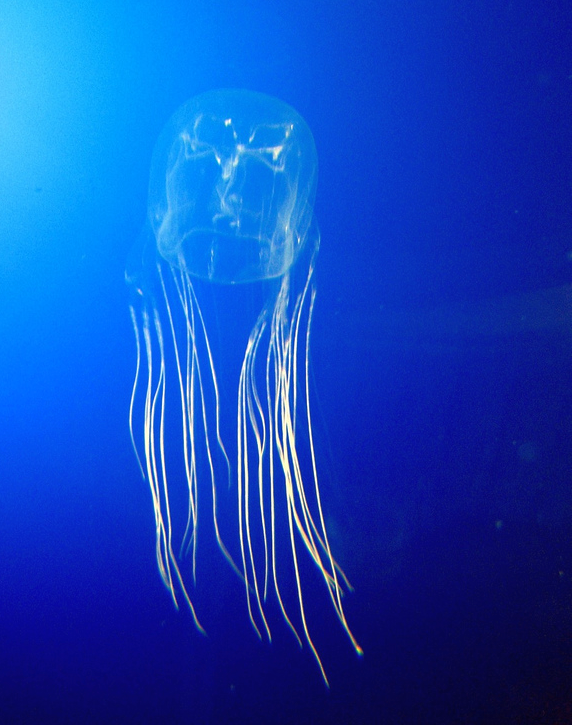

A rare box jellyfish has been spotted in the Gulf of Eilat, giving Israeli marine researchers an unusual look at one of the sea’s most striking and misunderstood creatures.
The Israel Nature and Parks Authority said only a few Alatina grandis jellyfish were documented, stressing that this is not a jellyfish bloom and there is no instruction for swimmers to avoid the sea. The species is rarely seen in the northern Red Sea and usually appears under unusual current and wind conditions.
The jellyfish was confirmed by Dr. Tzafrir Koplik and Prof. Tamar Guy-Haim through DNA testing and a physical examination of its distinctive features, including its cube-shaped bell and tentacles. That square, almost transparent body is what gives box jellyfish their name, but it also makes them difficult to spot in open water.
Dr. Assaf Zevuluni, the Nature and Parks Authority’s Gulf of Eilat ecologist, said the public should keep the sighting in proportion. “This is not a jellyfish bloom,” he said, adding that the chance of encountering one in the water is very low.

Box jellyfish are famous worldwide because some species, especially Australia’s Chironex fleckeri, are among the most dangerous marine animals on earth. Israeli officials emphasized that the Eilat specimen is different. Its sting can be painful and, in some cases, medically significant, but it is not considered comparable to the deadly Australian species.
For Eilat, the sighting is more than a beach warning. The Gulf is one of Israel’s richest marine ecosystems, with coral reefs, reef fish, invertebrates and other wildlife packed into a narrow strip of Red Sea water. Scientists say unusual appearances like this can be linked to changing currents, wind patterns and broader environmental shifts that alter where marine species travel.
One of the jellyfish was collected and sent to research laboratories for further analysis. Researchers hope the specimen will help clarify the species’ distribution and add to the scientific record of the Gulf of Eilat’s unique ecosystem.
The authority’s guidance is simple, do not touch it, keep a safe distance, warn nearby swimmers and report sightings to the Israel Nature and Parks Authority hotline at *3639. There is no reason to panic, but in Eilat’s waters, beauty and danger can sometimes drift in the same current.