 Cleveland Jewish News44 minutes ago
Stephen H. Turk, beloved father of Sam (Allison) Turk and Sydney (Chase) McIntosh, passed away Oct. 21, 2026.
Adored grandfather of Oskar and Wilson Turk. Dear brother of Laurence and David (Bren) Turk. Cherished son of the late Pauline and Milton Turk.
Steve attended Bexley High School and after graduation attended The Ohio State University, where he was a proud member of Sigma Alpha Mu Fraternity.
He enjoyed a long career working in the menswear industry before venturing out into his own business. Steve was able to enjoy a relaxing retirement in Florida, where he looked forward to morning games of bocce, spending time with friends and reading on the beach.
Above all, he was deeply proud of his children and adored being a grandfather to Oskar and Wilson.
Graveside services will be held Oct. 28 at 11 a.m. at Mount Olive Cemetery in the Jewish war veterans section.
Friends who wish may contribute to Coast Guard Mutual Assistance at mycgma.org.
 Cleveland Jewish News2 hours ago
On a day that was supposed to celebrate the diversity of Solon Middle School, students were the target of antisemitic behavior on Oct. 22.
In a letter to parents sent on the afternoon of Oct. 23, Solon Middle School principal Rocco Sciarabbas called the incident “especially disappointing “because it happened on SMS Cultural Awareness Day and during Unity Week,” a time where the school “recognizes and celebrates all of our students and their family backgrounds, religions and cultural heritage.”
The school did not specify what type of antisemitic behavior occurred, however the Jewish Federation of Cleveland said in a statement to the Cleveland Jewish News that it received reports that there was usage of Nazi salutes and antisemitic language.
One community member, Stacey Rubenfeld, commented under a post by Solon Schools on Facebook that it was directed at children “who wore their Jewish symbols.”
Rubenfeld was commenting on a Oct. 22 post containing photos from the middle school on Solon Middle School Cultural Awareness Day, showing children of different backgrounds holding their flag, wearing clothing that represents their heritage or pointing on a map of where their family is from. None of the photos was centered around a Jewish or Israeli student, and a parent commented that the lack of that was a “glaring omission.”
“Many kids wore shirts that said ‘Shalom’ (peace) and they were reporting that multiple photos were taken,” Sasha Rabinovich said in a comment. “I understand that they can’t include every single culture, but considering yesterday’s events, they can easily edit the post and add a photo representing these kids as well.”
Taryn Isaacs, who said in her comment that they are a Jewish family living in the community and had a daughter “proudly” wearing her Jewish heritage shirt on Oct. 22, said she was “disheartened” to hear about the incident and about “not having the representation in this album.”
“I appreciate that SMS took swift action in private,” Isaacs said.
She said that there is a big opportunity to educate the students about antisemitism, what the symbolism means and how it affects others.
“This was a clear act of blatant antisemitism,” she said.
“Solon Schools serves and supports all students,” Sciarabbas said in the message to parents. “Messages of hate and discrimination do not reflect the values of our schools or our community. We address all instances of hateful speech or discrimination in accordance with our student handbook and district policy, including in this case, but it is also important that we use this as a learning opportunity for everyone. Students often encounter these images and phrases online, in memes or videos, without understanding the deep-rooted antisemitism behind them or the hurt they cause their friends and classmates.”
Sciarabbas said the school has reached out to the Anti-Defamation League and the Jewish Federation of Cleveland to receive further guidance on additional education for its students, which will address the impact of antisemitism and the harm of hateful language, gestures and actions of any kind.
As part of this work, the district is looking to implement the ADL’s No Place for Hate program, a student-led anti-bias and anti-bullying initiative in place in more than 1,600 schools, including several in neighboring communities.
In a statement to the CJN, the Jewish Federation of Cleveland said that it “is deeply troubled by reports of antisemitic behavior targeting Jewish students at Solon Middle School.”
“We have been in direct communication with Solon Schools Superintendent Fred Bolden, who informed us that the district has taken appropriate disciplinary action in response to these incidents,” it said. “In partnership with school leadership, we are providing educational resources to help foster understanding, respect, and inclusion within the school community. Our priority remains ensuring that Jewish students, and all students, can learn in an environment free from hate and discrimination.”
“Our students do their best learning when they feel safe at school and know they belong,” Sciarabbas said. “Any student can become the target of bullying or bias, whether because of their race, religion, ability or something else that sets them apart, real or perceived. We encourage you to talk with your child about what they see and share online and about how words and gestures affect others.”
The principal encouraged parents to have their children talk with their counselors and staff if they have been affected or have concerns by the incidents, and it provided linked resources to ADL material at the end of the message, geared toward empowering young people in the aftermath of hate, bias and antisemitism on social media and antisemitism today, to help them “start the conversation at home.”
“Our school community does not tolerate hate of any kind directed at any student,” he said. “We remain committed to a school where every student, staff member and family is treated with dignity and respect.”
In an email to the CJN, Tammy Strom, communications director for the Solon City School District, said that the schools believe “conduct of this type is hurtful and that was clearly communicated to the students and families involved. We never treat this type of conduct as joking among friends and we ensure that our students understand exactly why it does harm.”
“While yesterday’s incidents were explicitly antisemitic, upcoming programming will address that specifically as well as other types of hate speech,” Strom said. “It is critical that all of our students feel safe and a sense of belonging in our diverse school community. “
Solon School Board of Education’s next regularly scheduled meeting is at 6 p.m. Oct. 26.
Cleveland Jewish News5 hours agoA senior Iranian lawmaker threatened on Saturday night that Israel could be made "uninhabitable" in less than an hour.
Ebrahim Azizi, head of the Iranian parliament's National Security and Foreign Policy Committee, posted the threat on X in English, Hebrew and Persian.
"A single miscalculation is all it takes: the 'occupied lands' rendered uninhabitable in under an hour," he wrote in English.
The Hebrew and Persian versions of Azizi's post tied the threat to "any action against our national security and interests."
The post included a map of critical Israeli infrastructure and marked desalination plants, power plants, oil refineries and fuel storage facilities.
The map also marked bridges and interchanges in Haifa, Tel Aviv and Jerusalem, as well as the Eilat-Ashkelon oil pipeline.
A single miscalculation is all it takes: the occupied lands rendered uninhabitable in under an hour. pic.twitter.com/X8wuAXnKO5
— ابراهیم عزیزی (@Ebrahimazizi33) October 24, 2026
Cleveland Jewish News5 hours agoUnidentified individuals spray-painted Nazi symbols on a wall of a synagogue in Blackpool, north of Liverpool, on Tuesday night, police said.
"We received a report that racist graffiti had been sprayed on an outside wall of the Jewish Synagogue, Raikes Parade, Blackpool. It is believed the graffiti was sprayed in the early hours of Tuesday, October 20," a spokesperson for Lancashire Police told the Blackpool Gazette on Friday.
The bishop of Blackburn, Philip North, was among the prominent officials who condemned the incident, which police are investigating as a hate crime, the report said. North called the incident "an assault on the values of respect, dignity and freedom of religion," and called for an "unwavering rejection of antisemitism."
Rachel Tax, president of the Blackpool Reform Jewish Congregation, told the paper: “My feelings when I first saw it were horror, disbelief and sadness. The Reform Congregation has been in Blackpool for 65 years and we have never had any trouble like this before."
The graffiti also included two lightning bolts, resembling the Nazi SS insignia, and the number 1488, a neo-Nazi code combining the white supremacist “14 Words” slogan with “88,” representing “Heil Hitler,” according to the Blackpool Lead.
Cleveland Jewish News5 hours agoIranian Foreign Minister Abbas Araghchi said on Sunday that Tehran continues to insist in its talks with the United States that the war end on all fronts, the state-run ISNA news agency reported.
"In all our negotiations with the American side through Pakistan, Qatar or other friends, we have emphasized that the end of this war must be on all fronts," Araghchi said at the opening of a museum in Tehran.
Iran has repeatedly sought to link negotiations toward an agreement with the Trump administration to a halt in Israeli military operations against its terrorist proxies in Lebanon and the Gaza Strip.
"All issues in the region are intertwined," Araghchi said. "One cannot have war and conflict in one corner of the region and expect peace and tranquility in another."
He called the recent war a "turning point in the history of the region" and claimed Israel is "the sole factor of instability and warmongering" in the Middle East.
Tehran's top diplomat also called for the presence of foreign forces in the region to be "reduced to zero."
Cleveland Jewish News5 hours agoRiyadh’s King Khalid International Airport said on Sunday it had reopened for domestic and international flights after being closed for two weeks due to missile and drone hits, the Associated Press reported.
Two of the airports’ five terminals have resumed service, according to Bloomberg.
Meanwhile, the Houthis continued to fire missiles at the kingdom, as the Saudi-led coalition in Yemen said that several were intercepted on Sunday over Riyadh and other areas. A ballistic missile was fired at Riyadh, a cruise missile at the southern city of Khamis Mushait, and 10 ballistic missiles toward the southern region, Saudi-led coalition spokesman Maj. Gen. Turki al-Maliki was cited by state-run Saudi Press Agency as saying.
On Oct. 10, a Houthi attack on Riyadh’s main airport killed 13 people and wounded 308 others, leading to its total shutdown.
Cleveland Jewish News5 hours agoA 32-year-old Brooklyn woman has been arrested following the stabbing of a Jewish man in Manhattan’s Diamond District, an NYPD spokesperson told JNS during a phone inquiry on Sunday.
Anna Mochalova was arrested at 6:30 p.m. on Saturday, within the confines of the Midtown North Precinct, the spokesperson said. She was charged with eight counts of assault, eight counts of menacing, two counts of aggravated harassment and two counts of criminal possession of a weapon.
The spokesperson did not specify whether any charges included hate-crime enhancements. Police previously told JNS that the stabbing was being investigated as a potential hate crime.
The woman wanted in connection with the stabbing of a Chabad bochur in Midtown Manhattan earlier this week has been arrested. The suspect is accused of carrying out two separate assaults being investigated as hate crimes on the same day.https://t.co/sbaQlsBxPF
— CrownHeights.info (@CHInfoNews) October 25, 2026
Officers responded to a 911 call at about 6 p.m. on Wednesday near West 47th Street and Fifth Avenue. An assailant approached a 26-year-old man and stabbed him in the back with an “unknown sharp object,” police told JNS. The victim was taken to Bellevue Hospital in stable condition.
Surveillance footage viewed by JNS appeared to show the attacker approaching the visibly Jewish victim from behind, stabbing him and fleeing.
Manhattan Shomrim announced on Saturday evening that a suspect wanted in connection with two assaults in Midtown on Wednesday was in custody, CrownHeights.info reported. The Jewish volunteer safety patrol credited cooperation with the NYPD Hate Crimes Task Force, Shomrim groups in Crown Heights in Brooklyn, and Queens, and tips from the public.
CrownHeights.info identified the victim as Yosef, a 26-year-old Chabad rabbinical student from Crown Heights, and reported that he returned to the Diamond District the following day to help Jewish merchants and workers put on tefillin.
The attack comes amid continued antisemitic hate crimes in New York City.
Jewish New Yorkers were the targets of 245 of the city’s 463 confirmed hate crimes in the first nine months of 2026, or 53%, according to NYPD figures released on Oct. 6 and previously reported by JNS. Anti-Jewish hate crimes rose 1.2% compared with the same period in 2025, even as major crime citywide fell 6.6%.
“Even with a lower crime rate, it is hard to feel safe and secure when Jews see police cars stationed in front of their synagogues and schools, and support for terrorist groups on signs in their streets,” Scott Richman, the Anti-Defamation League’s New York and New Jersey regional director, told JNS.
Cleveland Jewish News5 hours agoThe Israel Police arrested two people on Saturday evening on suspicion of security offenses, after they were allegedly caught photographing the entrance to Damon Prison near Haifa, the force said on Sunday.
Officers from the Nesher police station were called to the scene. They located the suspects and arrested them, according to the statement.
The two were questioned at the station. Police will ask a court on Sunday to extend their detention.
Ynet reported that the suspects are German citizens. According to the report, a search of their mobile phones found footage of security installations and activities.
 Cleveland Jewish News5 hours ago
Before founding their own business, Gwenn Groedel and Suzy Stone were high school classmates and college roommates.
The women founded Sugr Pop Candy two years ago, but worked together as boutique event planners before getting into the candy business.
Their lifelong friendship lends to creating the product they deliver to customers as they work together by hand to create the bags and trays of candy.
Stone described the business as “an elevated gifting and mobile experience that features Swedish and European candies.”
Groedel and Stone create curated candy bags and trays, selecting each candy piece by piece, choosing flavors, colors and shapes that are aesthetically pleasing to the eyes.
Swedish candy is known for its distinctive textures and often cleaner ingredient lists, according to Stone.
The women saw Swedish candy while traveling to destinations such as Miami and New York City and wanted to make it available in the Cleveland area.
“We recognized the experience people who love Swedish candy have,” Groedel, a Pepper Pike resident, told the Cleveland Jewish News. “It is not just about eating the candy, it is the experience of picking out each piece of candy.”
Most of the bags and trays the women create are for celebrations such as graduations and weddings or corporate events.
Some bags and trays are made in advance but pick-and-mix carts allow customers to build their own.
“Every blend is designed to taste as good as it looks: fruity, sour, fizzy and chewy, with something new to discover in every handful,” Stone, a Moreland Hills resident, told the CJN. “People see a tray and immediately want to know what everything is. Then they start tasting, finding favorites and telling someone else which piece to try. That’s the fun of it.”
Sugr Pop also offers kosher and gluten-free candy options.
“We make elaborate designs that are eye-catching,” Stone said. “We work to appeal to all of the senses.”
Stone grew up in a Jewish household and raised her children at The Temple-Tifereth Israel, now known as Congregation Mishkan Or in Beachwood.
“The temple holds a special place in our family, and celebrating Jewish traditions together remains deeply important to us,” she said.
Groedel raised her children while attending Park Synagogue in Pepper Pike.
Customers can order directly from Sugr Pop at sugrpopcandy.com. The candy is also available at Mulholland & Sachs in Woodmere and Sanity in Chagrin Falls.
Sugr Pop Candy also has pop-ups at various locations in Northeast Ohio where customers can build their bags and trays from candy carts.
These are announced on the company’s Website and Instagram. Follow @sugrpopcandy on Instagram for the event calendar.
Groedel and Stone are graduates of Cleveland Heights High School and the University of South Florida.
Anthony Corvo is a freelance journalist.
Cleveland Jewish News6 hours agoBritish Airways and Iberia resumed flights to Tel Aviv on Sunday, after an eight-month pause caused by the regional conflict with Iran.
The move by the British and Spanish national flag carriers, which restarted daily non-stop service from London and Madrid respectively, comes amid a summer rebound in tourism, and as thousands of Israelis living abroad return to Israel to vote in Tuesday’s general election.
Most international carriers that flew to Israel before the regional violence have already restarted service to Tel Aviv, with American Airlines being one of the last remaining holdouts.
Flights to and from Dubai remain suspended, however, following last month’s cockpit attack on a flight to Tel Aviv, amid disagreements over aviation security measures between Israeli and Emirati authorities.
Cleveland Jewish News7 hours agoA group of Christian pilgrims began a five-day journey from the ancient port city of Jaffa to Jerusalem on Sunday, retracing the route religious visitors to the Holy Land have used for centuries.
The “Way to Jerusalem” initiative, sponsored by the Israeli Ministry of Tourism, comes as more visitors began returning to the Holy Land this summer after steep drops following regional wars over the last couple of years.
The group included about a dozen Christians, many of whom are also religious-affairs journalists, from around the world.
“I think it is marvelous to be with people of different cultures and different religions,” Maria Diaz-Ripoll, a Spanish pilgrim with Tierra Santa, the publication of the Franciscan Church, told JNS at the start of the journey at Jaffa port. “I think people love Israel and want to come to be a pilgrim in Jerusalem in the land of Jesus, but are afraid of the situation.”
Many of the visitors said that the Israel they see in the media is entirely different than the one they are experiencing firsthand.
“It has been an eye-opener to learn so much of the Jewish history and culture and way of life,” said Father Joshan Rodrigues, a Catholic priest of the Archdiocese of Bombay (Mumbai) who was on his first visit to Israel.
“You get a very different impression of Israel than you see back home; because of the political biases on TV, you see a very narrow view of Israel,” the Indian cleric, who led an impromptu mass at the ancient city of Magdala on the Sea of Galilee over the weekend before the walk began.
“It’s a great idea for coming together,” said Austrian pilgrim Gabriella Reichkendler, who writes for the Austrian Travel Gazette. “We are from the land of the Nazis, so some in our generation look to blame Israel.”
The pilgrimage from Jaffa to Jerusalem retraces the traditional 111-kilometer (69-mile) journey on foot taken over the centuries by Christian, Jewish and Muslim pilgrims who arrived by sea at Jaffa Port and traveled inland on foot, on mules or by camel.
This week's journey from the Mediterranean port to Israel’s capital combines walking with bus-driven visits to historic pilgrimage routes, religious landmarks and cultural heritage sites, bringing together a mix of pilgrims from France, Germany, Hong Kong, India, Italy, South Korea, Spain and the United Kingdom.
The pilgrimage, which will include stops at Ramle, Latrun, Abu Ghosh and Ein Kerem, will conclude Thursday at the Jaffa Gate to the Old City of Jerusalem.
The number of tourist arrivals to Israel jumped nearly 20% last month, compared to the period in 2025, according to figures from the Israeli Central Bureau of Statistics.
Never the less, international visitor arrivals for January-September 2026 were around 788,500, about 15% lower than the same period in 2025.
French pilgrim Martial R. from Montpellier, who works with a media website in Brittany and is on his first visit to the Holy Land, said: “We have this idea of the country based on the media, which focuses on all the negatives, and when you arrive you see different things and the day-to-day lives.”
Cleveland Jewish News7 hours agoIsrael's Foreign Ministry said on Sunday that Palestinian attackers had "deliberately targeted" livestock in Judea and Samaria for the 17th time this year.
The ministry said the aim was to "harm Jewish shepherds and destroy their livelihoods."
"This is calculated cruelty. Poisoning innocent animals to inflict suffering on the people who care for them," it wrote on X. "A vicious act of violence. No excuses. No justification."
The latest poisoning targeted a flock at Or Nachman Farm in the Binyamin region of Samaria on Saturday, according to the Judea and Samaria Situation Room.
The farm is located near al-Mughayyir, the group said, adding that most of this year's poisonings originated from the Arab village.
Sheep poisoned and left to die.
For the 17th time this year, Palestinian attackers have deliberately targeted livestock in Judea and Samaria in an attempt to harm Jewish shepherds and destroy their livelihoods.
This is calculated cruelty. Poisoning innocent animals to inflict…
— Israel Foreign Ministry (@IsraelMFA) October 25, 2026
Cleveland Jewish News7 hours agoIsrael returned to standard time early Sunday, Oct. 25, moving clocks back one hour from 2 a.m. to 1 a.m.
The change temporarily narrows the time difference with the United States, putting Israel six hours ahead of the East Coast instead of seven, and nine hours ahead of the West Coast instead of 10.
The usual seven- and 10-hour differences will resume on Sunday, Nov. 1, when daylight saving time ends across most of the United States. Clocks will move back one hour at 2 a.m. local time.
Most of Europe also turned clocks back one hour on Sunday, ending daylight saving time.
PSA from @yadlolim
⏰ Don't forget – Israel's clocks go back this weekend!At 2AM on Sunday morning, October 25, clocks move back one hour to 1AM
That means an extra hour of sleep!
Most smartphones will update automatically, but don't forget to adjust your clocks and watches. pic.twitter.com/ZreJfCMUEU
— Dov Lipman (@DovLipman) October 22, 2026
Cleveland Jewish News7 hours agoU.S. President Donald Trump on Sunday attacked former U.S. President Barack Obama for campaigning for Abdul El-Sayed, Michigan's Democratic Senate nominee, labeling him a "Muslim Brotherhood Jihadist."
In a post on Truth Social, Trump said El-Sayed "hates Jews and Blacks and Americans and Trump.
"Michigan doesn’t want an arrogant, open borders, fake doctor, jihadist," Trump wrote. He urged voters to back Republican nominee Mike Rogers.
Trump also called Obama "a grossly incompetent President," saying he "paid off Iran with $billions" and gave the Islamic Republic "a road to a nuclear weapon."
Obama was a grossly incompetent President! He paid off Iran with $Billions, and gave them a road to a Nuclear Weapon. He said that Crooked Hillary Clinton was going to WIN, he campaigned hard for her, and she lost in all directions and ways. He then campaigned full out for… pic.twitter.com/2iN0jZsNhJ
— Commentary Donald J. Trump Truth Social Posts On X (@TrumpTruthOnX) October 25, 2026
Cleveland Jewish News7 hours agoThe Israel Defense Forces on Sunday morning launched a large-scale military exercise in the country's north and central region, including Judea and Samaria.
The drill involves the 877th Judea and Samaria Division, the 98th Paratroopers Division, the 96th "Gilead" Division, the 210th "Bashan" Division and the Israeli Air Force, the military said in a post on X.
Heavy movement of security forces, aircraft and vehicles is expected on Sunday and Monday in the Central Command and Northern Command areas.
"There is no concern of a security incident," the IDF said.
The exercise is part of the IDF Operations Directorate’s 2026 training schedule and seeks to "maintain the forces' alertness and readiness, strengthen the ability to defend communities and make full use of aerial capabilities for defense in the area," the military added.
Cleveland Jewish News7 hours agoFormer Prime Minister Naftali Bennett’s B’Yachad party told JNS on Sunday that it is optimistic about this week’s Knesset election, “in part because we know the people of Israel are the best in the world.”
The campaign said the Jewish state needs “better leadership that will put the needs of the public first.
“We are offering the unity the country wants and needs not as a slogan—we’re doing it. It’s in our very name,” it said. (B’Yachad is Hebrew for “Together.”)
It pledged to put “the people who have carried the burden of defending this country first.”
Bennett and former Prime Minister Yair Lapid announced the merger of their “Bennett 2026" and “Yesh Atid” factions on April 26. Bennett heads the joint slate, and Lapid holds the No. 2 spot.
The party’s platform calls for a state commission of inquiry into the Oct. 7, 2023, attacks that started the ongoing war. It also proposes an eight-year term limit for prime ministers and a universal conscription law.
“I’ve been through many elections, and so I know. It is clear the momentum is with us. After four years of chaos and destruction, what Israelis want and need is a government of proven professionals who will manage the country,” Lapid told JNS.
“Israelis hear this loud and clear, they want change—and on Tuesday, they’re going to bring it,” he said.
Bennett and Lapid formed a prime-ministership rotation agreement to lead Israel’s 36th government in 2021. Bennett took the first term, but the coalition dissolved just a year and a half after it was established. Bennett served as prime minister from June 2021 to June 2022, and Lapid replaced him for just under six months during the transitional period to the next election.
Cleveland Jewish News7 hours agoDefense Minister Israel Katz on Saturday night denied that he and Prime Minister Benjamin Netanyahu were planning military moves against Iran ahead of the Oct. 27 Knesset election.
"We have not initiated and are not initiating a campaign in Iran before the election," Katz told Channel 11's Ayala Hasson in an interview.
The defense minister said the opposition had "invented" the claim that Israel would strike Iran ahead of the vote.
However, he said Jerusalem has intelligence indicating that enemies want to carry out strikes and terror attacks to influence the election results.
"Therefore the Israel Defense Forces is prepared through prevention, with intelligence and with powerful responses should it happen," he said.
Katz accused the opposition of acting irresponsibly instead of backing the government and the IDF on security matters.
"The outcome of the elections will determine whether Israel will complete the job in Iran," he said. "Will it complete the job of toppling this regime? We did 80-90%. We hit them terribly, but it needs to be completed."
שר הביטחון ישראל כ"ץ בריאיון ל@AyalaHasson: אנחנו לא יוזמים מערכה באיראן לפני הבחירות, זו המצאה של האופוזיציה#חדשותהשבת pic.twitter.com/FoEYLhqtm5
— כאן חדשות (@kann_news) October 24, 2026
Cleveland Jewish News8 hours agoThe Israel Defense Forces eliminated two terrorists in Gaza last week who helped move millions of shekels from Iran and Turkey to Hamas, the IDF and Israeli Security Agency (Shin Bet) said on Sunday.
Alaa Ibrahim Nimer Arshi, a Hamas cell commander, was killed in a strike in the Gaza City area on Wednesday, while Karam Riyad Hassan Abu Butaihan, a Palestinian Islamic Jihad terrorist involved in transferring funds to Hamas, was killed in in the Nuseirat area on Tuesday, according to the statement.
צה"ל חיסל שני מחבלים שהעבירו מיליוני שקלים לארגון הטרור חמאס והשמיד מחסן אמצעי לחימה
צה"ל תקף במרחב העיר עזה בשבוע שעבר וחיסל את המחבל עלאא' אבראהים נמר ערשי, מפקד חולייה בזרוע הצבאית של ארגון הטרור חמאס.
בתקיפה נוספת במרחב נוציראת בשבוע שעבר, צה"ל חיסל את כרם ריאד חסן אבו… pic.twitter.com/VVrh0KzoqW
— צבא ההגנה לישראל (@idfonline) October 25, 2026
“These funds were recently used to support Hamas’s efforts to rebuild its military capabilities and plan terrorist attacks against IDF troops and Israeli civilians, constituting a systematic violation of the ceasefire,” it said.
On Thursday, the IDF and Shin Bet also destroyed a Hamas weapons storage facility in an airstrike in central Gaza. It held Kalashnikov rifles, a launcher and rockets, the military said.
The IDF said it issued advance warnings to nearby noncombatants, and used precision munitions and aerial surveillance.
In a separate statement, the IDF said troops killed two terrorists who crossed the Yellow Line in two incidents in the northern and southern Gaza Strip on Friday.
Israeli forces remain deployed under Southern Command in accordance with the ceasefire agreement and will continue to act against immediate threats, the military said.
Cleveland Jewish News9 hours agoIsrael’s Special Envoy to the Christian World George Deek said on Friday he was “deeply saddened” by the terror attack that claimed the lives of seven Christians attending a funeral at a Greek Orthodox Church in Karak, Jordan.
“Israel strongly condemns this horrific terror attack against innocent worshippers. Our heartfelt condolences go to the families of those murdered, and our prayers are with the wounded and the entire Christian community in Jordan,” he tweeted.
We are deeply saddened by today’s deadly terror attack on Christians attending a funeral at a church in Karak, Jordan.
Israel strongly condemns this horrific terror attack against innocent worshippers.
Our heartfelt condolences go to the families of those murdered, and our… https://t.co/gLj3TyOnoq
— George Deek (@GeorgeDeek) October 23, 2026
Cleveland Jewish News10 hours agoThe Israeli embassy in London on Saturday denied a British newspaper report that Prime Minister Benjamin Netanyahu had ordered the Jewish state's diplomatic corps to back Argentina's position on the Falkland Islands.
"I categorically deny this allegation. No such directive exists," embassy spokesman Alex Gandler wrote on X.
Argentine President Javier Milei, a close ally of Netanyahu, has launched a renewed diplomatic push for Buenos Aires's claim to the islands.
The Telegraph reported earlier on Saturday that Netanyahu told diplomats to join Argentina in calling for direct talks on the islands' future.
Citing unnamed Israeli government sources, the paper said he also told them to recognize Argentina's "historical connection" to the territory.
The Telegraph linked the move to British Foreign Secretary Ed Miliband's decision last month to impose economic sanctions on Jewish communities in Judea and Samaria.
It also pointed to a speech at the United Nations last week by Israeli envoy Danny Danon, who called for direct negotiations between Britain and Argentina.
I categorically deny this allegation. No such directive exists. pic.twitter.com/VI2T9u5T9f
— Alex Gandler (@AlexGandler) October 24, 2026
Cleveland Jewish News10 hours agoThe Israel Defense Forces decided to implement a two-day entry ban on Palestinian workers into Israeli communities in Judea and Samaria and the Jordan Valley that will start on Sunday, the military said.
Industrial zones and a limited number of other approved areas are excluded from the ban, the IDF added. In addition, a ban was approved by the political leadership on the entry and exit of Palestinian workers throughout Judea and Samaria and the Jordan Valley, including industrial zones, as well as the closure of all land crossings between Judea and Samaria, and Green Line Israel, throughout Election Day on Oct. 27, the military said.
The bans come in the wake of a situational assessment held by the defense establishment after two IDF soldiers were killed in a terrorist attack on Friday in the Hebron area in Judea.
Cleveland Jewish News10 hours agoA Montreal man arrested while holding an Israeli flag at a cycling race is suing the city and four police officers, alleging excessive force and a fabricated account of his conduct, CTV News reported on Friday.
Daniel Bercovici, 47, seeks $86,301 in compensatory and punitive damages over his arrest at the Grand Prix Cycliste de Montréal on Sept. 14, 2025.
His lawsuit says he attended peacefully to support the Israel-Premier Tech team. Pro-Palestinian demonstrators were protesting its participation.
Officers confronted him without provocation, took him to the ground, unlawfully searched him and arrested him, the suit alleges. Demonstrators allegedly tried to strike him with flagpoles as he was escorted away.
Bercovici was charged with obstructing a peace officer three days later. According to the lawsuit, a prosecutor reviewed defense video evidence and injury photographs on July 9, 2026, then withdrew the charge on July 28, expressly citing the video.
The suit, filed in late August, alleges officers accused him of taunts, insults, aggressively brandishing his flag and ignoring warnings and orders. It claims their account was written from memory hours afterward, without notes of the arrest.
None of the allegations has been proven in court. CTV said the video shows officers escorting a man holding an Israeli flag away from protesters, but not his arrest.
“I went to a cycling race to support an Israeli team. I should have been able to do that peacefully and safely,” Bercovici told the outlet.
The team subsequently rebranded as NSN Cycling Team for the 2026 season.
Montreal police declined to comment to CTV because the case is before the court.
“His obstruction charge was withdrawn after the prosecutor reviewed video evidence. Who answers for that?” Bercovici's lawyer, Neil G. Oberman, wrote on X on Friday.
“Jewish expression, including the peaceful display of an Israeli flag, is entitled to the same protection as any other lawful expression,” said Benjamin Ryberg, chief operating officer of The Lawfare Project. “The Lawfare Project is supporting this case because the answer to hostility toward that expression cannot be to silence or remove the person exercising those rights.”
Cleveland Jewish News10 hours agoIsraeli security forces arrested some 40 Palestinian suspects across Judea and Samaria over the weekend in counterterrorism operations that spanned over 400 areas, the Israel Defense Forces said on Saturday night.
Among those detained are Palestinians affiliated with the terrorist organizations Hamas and Palestinian Islamic Jihad, as well as suspects involved in incitement, public disorder and rock-hurling, the military said.
In Judea, Israeli forces continue to operate “extensively” at dozens of locations in Hebron and Halhul, from where a terrorist attack was carried out on Friday, claiming the lives of two IDF soldiers. Some 20 suspects have already been apprehended in this area, the IDF said.
A brigade-level operation executed in the Gush Etzion region, in the Judean Mountains north of Hebron, resulted in the arrest of suspects involved in planting explosive devices and advancing terrorist activity, including Hamas operatives, according to the army.
In Samaria, IDF soldiers and Border Police officers dismantled memorials commemorating terrorists who took part in attacks in which Israeli civilians were killed, the military continued.
The forces apprehended two suspects involved in a terrorist attack against Israeli civilians in the area of Burin and confiscated a hunting rifle used by suspects in the area of Silat al-Dhahr, southwest of Jenin.
In the Binyamin area of Samaria, north of Jerusalem, IDF soldiers detained Palestinian terrorists affiliated with Hamas and individuals involved in public disorder in some 15 different locations, the IDF went on to say.
Troops moreover apprehended several suspects in the Ephraim region, which roughly stretches from Ramallah to Nablus in central Samaria.
“The security forces will continue to operate with determination to prevent the entrenchment of terrorism in the area and thwart any threat to Israeli civilians,” the IDF stated.
‘Daring’ counterterrorism plan for Judea and Samaria
Prime Minister Benjamin Netanyahu said on Saturday that he instructed the IDF and the Israeli Security Agency (Shin Bet) to draw up a “daring and comprehensive” plan unlike anything seen since the Six-Day War in 1967, aimed at uprooting terrorism in Judea and Samaria.
He spoke during an interview with broadcaster Channel 14, in which he was asked about the deadly shooting attack on Friday.
Explaining his directive to the IDF and the Shin Bet, Netanyahu said that his government knows that “the Palestinian Authority is a body hostile to the State of Israel that seeks to eliminate us in various ways.”
לאחר הפיגוע הקשה בחברון | רה"מ נתניהו בהכרזה דרמטית: "הנחיתי על תוכנית נועזת ומקיפה של צה״ל והשב״כ שכמוה לא הייתה מאז מלחמת ששת הימים" #מהדורת_מוצש @Litalsun pic.twitter.com/U7a6wHuXuH
— C14 (@C14_news) October 24, 2026
On Oct. 6, Defense Minister Israel Katz told ministers at the weekly Cabinet meeting that the IDF been ordered to prepare for a scenario in which P.A. security forces and the Fatah-affiliated Tanzim organization “turn their guns” against Israeli civilians and IDF troops in Judea and Samaria.
“In such a case, war would be declared against the Palestinian Authority, and the IDF would launch a comprehensive offensive in accordance with a detailed plan formulated and approved by Prime Minister Netanyahu and by me,” Katz said, adding that the campaign “would be short and forceful” and modeled on the Gaza and Lebanon campaigns.
Meanwhile, on the backdrop of heightened security tensions in the region, the IDF decided to implement a two-day entry ban on Palestinian workers into Israeli communities in Judea and Samaria and the Jordan Valley that will start on Sunday, the military said.
Industrial zones and a limited number of other approved areas are excluded from the ban, the IDF added.
In addition, a ban was approved by the government on the entry and exit of Palestinian workers throughout Judea and Samaria and the Jordan Valley, including industrial zones, as well as the closure of all land crossings, throughout Election Day on Oct. 27, the military said.
Cleveland Jewish News14 hours agoAs Israel’s Oct. 27 national election swiftly approaches, members of Prime Minister Benjamin Netanyahu’s ruling Likud party are hitting the campaign trail to explain why they believe they best represent voters’ interests.
“We can feel the pulse on the ground. There was an event with the prime minister in Dimona—a large number of people packed into a small space,” Knesset candidate Almog Cohen told JNS on Wednesday.
Cohen, formerly a lawmaker for Itamar Ben-Gvir’s Otzma Yehudit party and currently a deputy minister in the Prime Minister's Office, is ranked 13th on the Likud list and is well-positioned to enter the Knesset, with most polls projecting the party will win more than 20 mandates.
“We have people of all kinds and backgrounds. We are a right-wing faction whose leader is one of the most prominent figures in Jewish history," said Cohen. "When the world, including U.S. President Joe Biden, told him to stop [the war against Hamas], imposed an arms embargo, urged him not to enter Rafah [ in southern Gaza], said he would not bring back the hostages and told him not to strike Iran, he persevered."
In a wide-ranging interview with JNS last week, Netanyahu outlined his ambitious agenda for another term: bringing down Iran’s regime and further weakening its regional terror proxies, expanding the Abraham Accords to include additional Muslim-majority countries, and preventing the establishment of a Palestinian state.
Netanyahu also addressed sanctions, restrictions on arms supplies and hostile international opinion by outlining strategies to expand domestic weapons production, develop alternative partnerships and counter outside pressure.
The prime minister also discussed domestic politics, including the possibility of reintroducing judicial reform legislation, as well as building on decades of economic gains despite the war.
Cohen, who hails from southern Israel, said another commitment is to strengthen Israel’s presence in the Negev and Galilee. His vision includes building an international airport in the Negev to serve Israeli travelers, supported by a unique ecosystem that could generate 14,000 high-quality jobs.
“I am deeply driven to focus on the front lines of the fight against crime and terrorism—a mission to which I have devoted my entire life. With God’s help, I wish to continue serving the nation with dedication and integrity,” he told JNS.
'Zionism, nationalism, tradition and responsibility'
Eti Hava Atia, ranked 20th on the Likud list, told JNS on Thursday that the week had been exciting and intense, with a packed schedule of activities and meetings with the public.
“I am entering the home stretch with strong faith in our path and a desire to continue working on behalf of Israeli citizens,” she said.
The possibility of forming a broad, right-wing national government rests with the voters, she added.
“Likud represents Zionism, nationalism, tradition and responsibility. It is committed to the State of Israel, its resilience and the well-being of its citizens, all guided by Zionist values,” she said.
Atia said her priorities include supporting disadvantaged communities, women and the elderly, reducing social and economic inequality, and ensuring that all citizens have equal opportunities and can live with dignity and security.
Knesset member Amit Halevi, who is 33rd on the Likud list, described the election as neck-and-neck but argued that the opposition would need only 48 seats to form a government, provided it could secure outside support from Arab parties.
He told JNS that Likud was best positioned to lead Israel from a national security perspective. “Israel is in the middle of a war, and winning it depends on one’s strategic outlook, understanding of the enemy and grasp of what is needed for victory,” Halevi said, arguing that opposition leaders remained stuck in the pre-Oct. 7 past and maintained an “Oslo mindset.”
Last Sunday, Netanyahu presented a new national security doctrine, stressing the necessity for “an upgrade of fundamental principles."
The two-page document published by the Prime Minister’s Office in Jerusalem calls for "giving priority to prevention and offense over containment and defense, including launching preemptive strikes to thwart evolving threats, and strengthening home front defense against new threats."
The doctrine outlines the need for "cementing Israel’s status as a regional power; building maximum independence in munition production; ensuring superiority in the most advanced technologies; and intensifying the fight against global waves of antisemitism. Concurrently, opportunities have been created for forging new alliances in our region and beyond.”
The document lists 10 essential principles, first and foremost that the State of Israel must ensure military superiority over its enemies.
The doctrine also stresses preventing Israel’s adversaries from acquiring nuclear weapons; establishing deterrence via the capacity to launch massive and precise firepower, including the disruption of military and civilian systems; preventing cross-border invasions via security zones, home front protection and constant readiness for war; technological innovation and independence in weapons manufacture; and fighting anti-Zionist and antisemitic perceptions on the international stage.
Moshe Saada, ranked 17th on the Likud candidates list, told JNS that the election comes down to a choice between Netanyahu and Eisenkot, who hold fundamentally different worldviews.
“Netanyahu has a worldview centered on victory. We saw the strategic policies he implemented and how he changed the reality in Gaza, Lebanon, Syria and Iran. We eliminated their political, scientific and military leadership,” he said.
Saada added that Netanyahu is the only leader capable of coordinating with U.S. President Donald Trump at such a high level. “Trump himself said Netanyahu is the only one he is willing to go to war with because he trusts him,” he said.
Saada said that, if re-elected to the Knesset, he would focus on judicial reform, tying state benefits to IDF service and preventing doctors who graduated from universities he considers incubators of terrorism, such as Al-Quds University in Abu Dis, on the outskirts of Jerusalem, from practicing medicine in Israel.
Cleveland Jewish News14 hours agoA robot that tends bee colonies. An AI model that scans medical images for urgent findings. A car seat that converts into a stroller. Time magazine’s Best Inventions of 2026 span almost every corner of modern life.
These, and more, are some of the entries that are connected to Israeli-linked companies.
Other entries from this year’s list come from multinationals that run engineering and research operations in Israel, which raises deeper questions: Where is the line between Israeli startup and corporate presence, and what impact did Startup Nation have on some of the year’s greatest technological achievements?
An Israeli company, a local R&D office, and components built by an Israeli employee are all different things. Time recognizes finished products under company names. So tracing the work behind those names requires a closer look.
Six very different inventions
In healthcare, Aidoc’s CARE clinical-grade AI foundation model analyzes medical images and information to help clinicians identify urgent findings and prioritize cases. Time describes it as an AI model intended to recognize a range of findings rather than perform one narrow detection task. Aidoc has engineering leadership and operations in Tel Aviv, although the geographic division of work on CARE itself is unconfirmed.
Nanox.Arc X addresses access to medical imaging. The system uses X-rays taken on a patient to produce three-dimensional views. Time reports that it received Food and Drug Administration clearance in 2025 and is in use at dozens of U.S. facilities. The company is headquartered in Petach Tikvah and has an active clinical collaboration with the city's Beilinson Hospital.
SpotitEarly’s Lucid, meanwhile, combines breath samples, trained dogs, sensors and AI to detect signs associated with lung, breast, colorectal or prostate cancers. The company says its tests remain under development and validation and have not received FDA approval.
The other three Israeli-linked companies show how varied the list is. Bria’s Fibo is a generative imagery model built with attention to source attribution and compensation for the creators whose work informs it; Beewise’s ROBI is a mobile robot designed to tend bee colonies; and Doona X is Doona’s latest car seat that converts into a stroller, with additional seating positions and adjustments.
These six offer a picture of Israeli-linked innovation that extends beyond one sector. Some products are already being used by customers or clinicians; others, especially in medical testing, remain subject to validation.
The multinationals
Time’s list also features products from some of the world’s largest technology companies: Apple’s iPhone Duo, Nvidia’s NemoClaw, Meta’s Omnilingual ASR and Google’s SynthID.
Each company has significant operations in Israel. Apple recruits engineers there, Meta has identified Tel Aviv as a major regional AI research hub, Google operates a research center in Israel, and Nvidia’s acquisition of Mellanox gave it a substantial Israeli engineering base.
Those investments can be read as a vote of confidence in Israeli technical talent and in the country’s high-tech ecosystem. They do not, on their own, show that Israel-based teams worked on these specific products.
JNS sought clarification from all four companies on Oct. 22. At the time of writing, none had provided substantive confirmation of Israeli participation in the recognized products. Until the work can be identified or documented independently, their presence in Israel should not be treated as proof that these inventions were developed there.
Other entries invite similar questions. Samsung’s Galaxy S26 Ultra, IBM’s Nanostack and HP’s EliteBoard G1a come from companies with Israeli operations, while a custom AI chip from OpenAI and U.S. fabless semiconductor company Broadcom, which has several R&D hubs across Israel, received a “special mention.”
From Mazor to Medtronic
Perhaps the clearest multinational connection on the list is Medtronic’s Stealth AXiS surgical system. Medtronic acquired the Israel-based Mazor Robotics in 2018 for roughly $1.7 billion. It now describes Stealth AXiS as building on both its StealthStation navigation and Mazor’s robotic guidance, and JNS located its FDA filing, which names Mazor X as “a primary predicate device” for the newer system.
An important caveat: This does establish a technological lineage, but does not identify which of Stealth AXiS’s newest features were engineered in Israel.
Regardless, this can equally illustrate how an Israeli company’s work can become part of a broader product sold under a global name, making it part of an invention that Time has deemed among the most significant of the year.
Two pathways to global recognition
Time’s 2026 list captures two ways Startup Nation reaches a global audience. One through Israeli-linked companies building products under their own names, and another through the R&D teams that multinational companies have established or acquired in Israel.
The six recognized companies demonstrate the extent of that ambition. And alongside them, investment by global giants shows confidence in the country’s ability to contribute to technological progress across a variety of sectors.
The combination of homegrown ventures and multinational investment gives Israel a strong chance of developing the products that could appear on future lists and improve lives well beyond its borders.
Cleveland Jewish News14 hours agoMore than 7.3 million Israeli citizens are eligible to vote in the upcoming election for the Knesset on Oct. 27, with some 810,000 of them living abroad, according to data released on Wednesday by Israel’s Central Bureau of Statistics.
A national holiday by law, schools, kindergartens and most workplaces are expected to be closed for Election Day, as millions of citizens will take to more than 11,000 polling stations operating across the country to elect the 26th Knesset.
Proportional representation
Israeli democracy is based on a parliamentary system of proportional representation. This means that Israeli citizens do no vote directly for a prime minister or district representatives. They vote for a party that runs in a single, nationwide constituency, where the legislative body—the Knesset—has 120 seats.
A vote for a party is a vote for a list of Knesset candidates. The 120 Knesset seats are divided proportionally to the number of votes that each party wins. Thus, if a single party won 50% of the valid votes, it would secure 60 Knesset seats.
No party has ever won a majority of the votes, so every government has been formed by a coalition of parties.
In addition, parties must receive at least 3.25% of the valid votes to enter the Knesset; votes cast for parties that fail to reach this electoral threshold are discarded.
Choosing a prime minister
According to Israeli law, the prime minister is the leader of one of the parties that enter the Knesset.
Although typically the leader of the largest party becomes prime minister, this is not always the case. The law stipulates that the Israeli president designates the member of the Knesset who has the best chance of forming a coalition with the task of forming a government.
The designated member of Knesset must present the proposed government and its policy guidelines to the Knesset and win its approval before taking office as prime minister.
If the designated member of Knesset is unable to do this, the president designates another member of Knesset to try.
The prime minister must moreover hold a Knesset seat while serving as the head of the government. Other ministers are not required to be lawmakers.
The Israeli president is elected by the Knesset for a seven-year tenure. Israel’s current president, Isaac Herzog, is scheduled to end his term in July 2028.
Who can run?
Any Israeli over the age of 21 can stand for election to the Knesset, unless he or she has been disqualified from being elected by the courts.
Candidates or factions can also be disqualified if they are found to violate Section 7A of Basic Law: The Knesset, which prohibits a candidate or a political party from negating the Jewish and democratic identity of the State of Israel, inciting to racism, or supporting an armed struggle against the Jewish state.
How does the voting work?
Every citizen over the age of 18 can vote for the Knesset.
Each voter is assigned to a specific polling station near his or her place of residence, as listed in the Population Registry, and may vote only at that station.
Exceptional cases allow for alternate polling stations. These, for example, include soldiers who may vote at polling stations on IDF bases, hospital inpatients, prisoners and detainees, and certain Israeli officials and representatives serving abroad. In some cases, police officers, prison guards and on-duty security personnel may vote at designated stations where their duties prevent them from voting at their regular station.
Polling-station committee members and secretaries may vote at the station where they are working, subject to the applicable rules.
People with restricted mobility may vote at a special accessible polling station rather than their assigned station.
Women staying in domestic-violence shelters can vote through special arrangements intended to protect their safety.
Israelis abroad, other than certain officials and representatives, and in some cases their spouses, cannot vote.
Behind the voting booth
Behind the voting booth, the citizen selects a paper ballot with two or three letters that symbolize a political faction and seals it in a blue envelope.
The regular ballot boxes are subsequently counted at the regular stations across the country while the special ballot boxes are transported to the Knesset and undergo a series of processes to verify the eligibility and integrity of the votes.
The vote-counting process is carried out under the close supervision of the Central Elections Committee, as well as observers who represent the outgoing Knesset factions, the Knesset Guard, and Election Integrity Inspectors, with professional guidance from the Central Elections Committee’s Legal Office and dozens of attorneys and legal experts hired for this purpose.
How do elections work in Israel? Who gets to vote? And how is Israel's prime minister chosen? 🇮🇱🗳️
Here's a simple guide to Israeli democracy, from casting a ballot to forming a government. pic.twitter.com/RUs8EJkjSv
— Israel ישראל (@Israel) October 23, 2026
More than a century of democracy
On Thursday, Israel’s Foreign Ministry posted on X an explainer with historical background about Israel’s democratic nature.
It states that decades before the state's establishment, “the Zionist movement had already established a political culture rooted in vigorous debate, competing ideas and democratic decision-making. Delegates elected to Zionist congresses debated the future of the Jewish people, voted on policies and built the institutions that would transform the dream of Jewish self-determination into a national reality.”
Decades before women gained the right to vote in many other countries, the Second Zionist Congress in 1898 granted female delegates full voting rights.
“Israel’s Declaration of Independence promised complete equality of social and political rights to all citizens, regardless of religion, race or sex. It guaranteed freedom of religion, conscience, language, education and culture,” the ministry continues.
Despite the war that ensued after Israel’s formation, the leaders of the state kept their word to uphold the declaration’s principles and held the first official national election on Jan. 25, 1949, eight months after independence.
A World Economic Forum ranking from 2019 places Israel among the world’s 20 oldest continuous democracies.
Although since its inception Israel has faced “wars, terrorism, security threats, political upheavals and profound social change,” it has always maintained its commitment to parliamentary democracy, the Foreign Ministry states.
“Israel’s democracy was born in adversity. Its endurance is one of the country’s greatest achievements,” it adds.
“Jewish, Muslim, Christian and Druze citizens, from cities and countryside, religious and secular, from every background and community, will participate [on Oct. 27] in the same democratic process. They may disagree profoundly about Israel’s future, but each has an equal vote in determining it,” the ministry says.
On October 27, Israel’s biggest decisions begin with one small slip of paper. 🗳️🇮🇱
In a region where many cannot choose their leaders, Israelis of all backgrounds and faiths cast their votes.
Discover Israeli democracy in action. Read more below. https://t.co/DP9bFPzGbW
— Israel Foreign Ministry (@IsraelMFA) October 22, 2026
Cleveland Jewish News20 hours agoDENVER – Israeli-Arab social media entrepreneur Nuseir Yassin, of the viral vlog “Nas Daily,” said he believes “anti-Zionism is a form of antisemitism” and stressed his commitment to overturning “misguided hate” against Jews, at a conference devoted to the subject this week.
Yassin, 34, was speaking with the Jewish Telegraphic Agency on the sidelines of the conference, hosted by the David Merage Foundation for Confronting Antisemitism. A self-described “village boy” from the Lower Galilee town of Arraba in Israel, he achieved massive success through viral short-form videos that attracted viewers from all over the world. Today he boasts more than 68 million followers across numerous social networks.
Yassin is a Muslim of Palestinian origin, although he said he is not religious. Asked why it was important for a non-Jewish person to participate in a conference about combatting antisemitism, Yassin equated this battle to fighting for his family, noting that “the success of Israel and the Jewish people is also my success as an Israeli citizen.”
“I’m not a fan of the Israeli government, and I’m not here to defend it, just like I’m not a fan of many governments,” Yassin noted, but he asserted that the reaction to the government “is absolutely fueled by antisemitism.”
“I do believe anti-Zionism is a form of antisemitism,” he added.
He said he views Zionism as “the most vanilla thing in the world – a group of people wanting a place to live,” and has therefore concluded that Israel’s detractors “just really don’t like Jews.”
Yassin, who first broke through in 2016, has become increasingly outspoken in recent years about his combined Israeli and Palestinian identity. During the conference, he recalled that he grew up labeling himself Arab-Israeli. After the Hamas attacks of Oct. 7, 2023, he started listing Israeli first and Palestinian second.
“I could not relate to the extremism that I saw, and I wanted to distance myself from it without erasing my identity connected to it,” Yassin said. “I’m not just Israeli because I think it removes a little bit of spice, but I’m also not just Palestinian anymore.”
“A lot of Israeli culture is inside me,” he continued. “I never agree with people. I’m always disagreeable. That’s Israeli. I speak up.”
Yassin noted that he was “the first guy to go study in the United States out of my entire lineage,” graduating from Harvard University in 2014 with a degree in economics and a minor in computer science. Despite having grown up in Israel, Yassin said that Harvard was the place where he made his first Jewish friend.
After working as a software developer for Venmo in New York, Yassin left his job in 2016 to travel and document his journeys. Ultimately, he launched a Facebook page called Nas Daily – using the word for “people” in Arabic – where he posted one-minute videos for 1,000 days, telling the stories of communities around the world.
What was once a personal brand has since expanded into the parent Nas Company, which offers platforms for solo entrepreneurs to build and monetize their online businesses.
Yassin earned an honorary degree from Ben-Gurion University of the Negev in 2025 in recognition of his advocacy work for Israeli and Palestinian coexistence. This past August, he also joined the advisory board for the Genesis Prize Foundation, which each year celebrates inspiring Jewish individuals for their achievements.
“I do not relate to hundreds of men on the street shouting ‘Allahu Akbar,’” Yassin told JTA, adding that there needed to be more women and fewer religious fanatics participating in the Israeli-Palestinian conversation.
Yassin argued that he’s “not a weird Arab for saying this” and that “the entire country of the UAE says the same thing,” referring to one of the Gulf countries that signed onto the Abraham Accords normalizing relations with Israel. He also challenged “Free Palestine” activists to envision a concrete future for Palestinians rather than fixating on Israel’s transgressions.
“We should all be ‘Free Palestine’ – but from what?” Yassin asked. “We disagree on the solution, not on the problem. We don’t want suffering. Nobody wants suffering.”
“I’m a free-Palestine-from-Hamas guy,” he continued. “Just free Palestine,” he said, ”is not an answer. I’m free-Palestine-from-extremism.”
Yassin affirmed that there is room for criticism of Israel’s government, noting, for example, that he would like to see an Israeli-Arab presence in the government.
But he marveled at the notion that an alien visiting Earth would likely guess that the most hated country in the United Nations is North Korea, when in fact “It’s not – It’s Israel.”
That struck him as absurd because “the Israel-Palestine conflict is not a big deal when you compare it to everything else that’s happening on planet Earth. The only thing that makes it a big deal is that we, as Palestinians, have the perfect enemy.”
That enemy, he continued, is “the most hated type of enemy, which is the Jews.”
The post Israeli-Arab influencer behind ‘Nas Daily’: Anti-Zionism is antisemitism appeared first on Jewish Telegraphic Agency.
Cleveland Jewish News1 day agoThe Iranian regime has increased efforts to target U.S. officials in the Middle East and elsewhere, Director of National Intelligence Jay Clayton said in an unclassified memo sent to Secretary of State Marco Rubio on Friday and obtained by Axios.
“The lethal plotting efforts by Iranians against U.S. citizens have reached advanced stages in both the Middle East and certain other countries,” the memo reads.
The underlying intelligence concerning Tehran’s plotting has already been shared with senior U.S. State Department officials, according to the memo.
As the director of national intelligence, Clayton oversees 18 member agencies of the U.S. Intelligence Community and he serves as the primary intelligence adviser to the president.
Separately, CNN reported on Friday that the U.S. has rushed to reduce its staff in Saudi Arabia, Jordan, Bahrain, Kuwait, Qatar, the United Arab Emirates and Lebanon.
A State Department official told the U.S. network that these countries “will see temporary changes to staffing levels under restricted operations.”
The departures of some diplomats and their family members are described in the report as “chaotic déjà vu” as many of them have only recently returned to their posts in the wake of their previous departures during the war with Iran earlier this year.
“This echoes the chaos families experienced earlier this year. Some had barely settled back in before being told to leave again,” Nikki Gamer, the spokesperson for the American Foreign Service Association, told CNN.
“They are understandably upset, confused, and angry,” she added.
U.S. officials are concerned that the Iranian-backed Houthis in Yemen could expand their attacks beyond Saudi Arabia to other states in the region, Axios reported.
The State Department on Wednesday denied a report that it was preparing to order diplomatic personnel and family members to leave several Gulf countries, saying the departure order applied only to Saudi Arabia.
“This is inaccurate,” spokesman Tommy Pigott wrote on X, confirming that the order covered non-emergency U.S. government employees and their families in Saudi Arabia.
“Iranian-supported Houthis have increasingly engaged in hostilities against Saudi Arabia, including attacks on civilian airports and other critical infrastructure resulting in civilian casualties and severe travel disruptions,” Pigott tweeted.
“The safety and security of Department personnel and their families remain our highest priority, and we will continue to take all necessary steps to protect and support them,” he added.
This is inaccurate. The U.S. Department of State issued an ordered departure for non-emergency U.S. government employees and their family members in Saudi Arabia only.
Iranian-supported Houthis have increasingly engaged in hostilities against Saudi Arabia, including attacks on… https://t.co/yNrCwDcfIg
— Tommy Pigott (@statedeptspox) October 21, 2026
Also on Wednesday, NBC News reported that that the U.S. military has been quietly scaling back its troops’ presence throughout the Middle East, citing two U.S. officials and two individuals familiar with knowledge on the subject.
Similar reductions in the Middle East took place before the start of “Operation Epic Fury” against Iran on Feb. 28.
‘Little Operation Epic Fury’
On Friday, President Donald Trump spoke at a rally in Florida about whether he will restart strikes against Iran or settle on a deal to end the conflict.
“We may do another little Operation Epic Fury, or they’ll agree,” he said.
“If they’re smart, they’ll just say, ‘Let’s get down to business.’ But I doubt they’ll do that because, perhaps they’re not smart,” Trump added.
POTUS on the leaders of the Mullah regime:
“We may do another little Operation Epic Fury, or they will agree.
If they're smart, they will just say, ‘Let's get down to business.’
But I doubt they will do that because perhaps they're not smart.” pic.twitter.com/T4FlREX1SH
— Israel War Room (@IsraelWarRoom) October 23, 2026
U.S. media reported earlier in the week that several options regarding the resumption of a military confrontation with Iran were presented to Trump and his national security team in recent weeks.
Among these options are strikes on Pickaxe Mountain or against Iran’s strategic islands, such as its chief sea port for oil exports Kharg Island in the Persian Gulf, according to information relayed to NBC News by an anonymous U.S. official.
Netanyahu orders security bodies to overthrow Iranian regime
Israeli Prime Minister Benjamin Netanyahu on Thursday denied a Financial Times report that the Jewish state recently planned to attack Iran but was stopped by his American counterpart.
“This report is not true,” Netanyahu said in an interview with Israel National News. The premier declined to elaborate further.
On Wednesday, the prime minister said that he had directed the security services to pursue the overthrow of the Iranian regime, calling it the only way to eliminate the nuclear threat from Tehran.
“There is only one way to remove this threat once and for all: overthrow the regime in Iran. And that is my directive to the IDF, the Mossad and the security branches,” Netanyahu told an IDF officer course graduation ceremony.
“As long as they are here, as long as they strive to acquire horrific weapons, the State of Israel faces an existential threat,” Netanyahu said. “And our duty, the duty of all of us, is to save the nation.”
Prime Minister Benjamin Netanyahu, today, at the IDF officer course graduation ceremony at Bahad 1:
"The regime in Iran has still not learned its lesson. Mojtaba Khamenei, the tyrant du jour, has decided to follow in his father’s footsteps. He has pulled the safety pin, and Iran… pic.twitter.com/KbZoFFO2DT— Prime Minister of Israel (@IsraeliPM) October 21, 2026
Cleveland Jewish News1 day agoAn agreement to incorporate Albanian troops within the International Stabilization Force slated for deployment in the Gaza Strip was announced by the Board of Peace on Friday.
The international organization, chaired by U.S. President Donald Trump, labeled the agreement “important” and said that it provides “additional security operations support” for the mission in Gaza.
Albania is the third country to commit to contribution of forces to the ISF following Morocco and Kosovo.
Important agreement between the International Stabilization Force and Albania that provides additional security operations support and operations planning capabilities for the mission in Gaza. Albania’s contributions add to those of Morocco and Kosovo, and will be critical in… pic.twitter.com/sozc93EYdA
— Board of Peace (@BoardOfPeace) October 23, 2026
Board of Peace High Representative Nickolay Mladenov on Saturday welcomed the addition of Albania, saying that its “support will be critical in advancing governance, security, humanitarian efforts, the rule of law, and reconstruction under the Comprehensive Plan and U.N. Security Council Resolution 2803.”
I warmly welcome #Albania’s agreement with the International Stabilization Force, which provides additional security operations support and operations planning capabilities for the mission in Gaza. #Faleminderit for this important contribution. Together with Morocco and Kosovo,… pic.twitter.com/Gcd0sdSU7V
— Nickolay E. MLADENOV (@nmladenov) October 23, 2026
Resolution 2803 was adopted on Nov. 17, 2025, accepting Trump’s 20-point plan to end the conflict in the Gaza Strip, while authorizing the Board of Peace as a transitional governing body, including the International Stabilization Force, until such a time that the Palestinians can govern themselves.
Since then, the parties have established the Palestinian-led National Committee for the Administration of Gaza (NCAG) and have advanced talks with the Hamas terrorist organization about its disarmament. Hamas has shown no signs of willingness to lay down its weapons.
On Sept. 7, Mladenov said that the Board of Peace is making “good progress” on the International Stabilization Force, but is “a little bit stuck” on Israel’s commitments. He said the Israeli election campaign was “making things perhaps a bit complicated for domestic political reasons.”
Mladenov said political leaders and the international community face only three choices: continuing the current policy, an Israeli reoccupation of Gaza, or the Board of Peace road map, which he said was the only reasonable one.
Kushner cites editorial urging Israel to help implement Gaza plan
U.S. Special Envoy for Peace Missions Jared Kushner on Tuesday shared a Wall Street Journal editorial urging Israel to take interim steps in Gaza to help the Board of Peace advance Trump’s plan before the Jewish state’s Oct. 27 election.
“A durable peace in Gaza requires an end to Hamas rule, security for Israel, and a better future for the Palestinian people,” Kushner wrote.
He labeled the column an “important perspective.”
The Journal Editorial Board's editorial, titled “How Israel Can Help the Board of Peace” and published on Oct. 20, identified three measures: allowing a new Gaza police force to train in Egypt and return to the Strip, signing an agreement authorizing international forces to operate in Gaza, and finalizing arrangements for water and sanitation services.
“Israelis are united on the end goal. Getting there will likely require doing more to help a friendly Board of Peace,” the editorial stated.
On the other hand, it noted that the Board of Peace has not pressed Netanyahu for “controversial moves,” which could “backfire” before the Oct. 27 elections.
In August, Israel's Finance Minister Bezalel Smotrich and Settlements and National Missions Minister Orit Strook urged Prime Minister Benjamin Netanyahu to immediately convene the Security Cabinet to revoke its decision approving the entry of the International Stabilization Force into Gaza.
The ministers wrote in a letter that the ISF must not enter Gaza until its “purpose, legal authority, and missions” are properly amended and clearly delineated.
Netanyahu has since insisted that there will be no reconstruction or deployment of external forces into Gaza until its terrorist groups disarm.
Cleveland Jewish News1 day agoIsraeli security forces launched a counterterrorism operation in the Hebron area of Judea on Friday in response to the terrorist attack earlier in the day in which two Israeli soldiers were killed and three others were wounded, the Israel Defense Forces said.
IDF troops, the Israeli Security Agency (Shin Bet), Border Police officers, and personnel from the Israel Police Judea District Coordination and Liaison Administration have begun conducting thorough searches throughout the area to locate and dismantle terrorist infrastructure and weapons, while questioning suspects, the military said.
“The operation is targeted and limited to the area from which the terrorists operated, and is expected to continue for several days,” the IDF said.
People living in the area will be given the opportunity to leave through three designated exit points, following a security screening process, the military said.
In addition, the residences of the two terrorists who carried out the shooting attack have been mapped in preparation for their demolition and a cordon on the Hebron and Halhul areas has been imposed, the IDF said.
Moreover, preparations are underway to demolish illegal Palestinian structures in the area that could pose a security threat.
The military meanwhile continues to operate at dozens of locations throughout Judea and Samaria to prevent terrorist attacks, address security threats and protect Israeli civilians, the army added.
Two Ari Battalion soldiers KIA
Friday's shooting attack took place near the Yehuda Junction in the Hebron area.
The IDF identified the slain soldiers as Staff Sgt. Ron Yonatan Roytman, 23, from Ashkelon, a squad commander in the Home Front Command’s Ari Battalion, and Sgt. Yuval Shai Svilem, 20, from Hod Hasharon, a combat soldier in the same battalion.
The two Palestinian terrorists were killed after a gun battle with IDF troops that lasted more than 20 minutes, according to an initial military investigation.
The terrorists, both 27-year-old Hebron residents, arrived by car at a temporary military checkpoint near an exit from Hebron at around 7:30 a.m.
According to the IDF’s preliminary assessment, the gunmen had intended to reach Route 35 and attack Israeli civilians but realized that they would be unable to get past the checkpoint.
The terrorists, armed with an M16 rifle and a handgun, got out of their vehicle and opened fire on the troops, using nearby buildings for cover.
Soldiers from the Ari Battalion, who were manning the checkpoint, returned fire. The battalion’s deputy commander and a company commander, along with an officer from the Paratroopers Brigade’s 101st Battalion who rushed to the scene, killed the two terrorists.
Hamas later claimed responsibility for the attack. The IDF and Shin Bet said they were investigating whether the terrorists acted independently or were part of a broader network.
Later on Friday, Israeli Prime Minister Benjamin Netanyahu said during a visit to the area that the IDF will apply a more aggressive counterterrorism model in Hebron and is prepared for a much broader operation across Judea and Samaria.
“We are going to implement the successful and aggressive model that we used in the refugee camps, which are essentially terrorist strongholds,” Netanyahu said.
“That is exactly what we will do here, inside a neighborhood in Hebron from which the terrorists came,” he continued. “We will evacuate the residents, we will go house to house, remove the weapons there, and all terrorist infrastructure will be dealt with and destroyed.”
Cleveland Jewish News1 day agoLess than 24 hours after he was stabbed in midtown Manhattan, Yosef, a Chabad-Lubavitch man from Crown Heights, was back on the same street where he’d been assaulted, popping into Diamond District businesses as usual to help employees wrap tefillin.
Yosef, 26, who did not share his last name to maintain his privacy, told the Jewish Telegraphic Agency that he was back on 47th Street on Thursday afternoon, the day after the stabbing, without missing a beat in his Monday-through-Thursday rounds even as police investigate the incident as a possible hate crime.
A number of the people he visited pieced together that the widely circulated footage of a man being stabbed the previous night was of him.
“They were in shock. They were obviously scared for me,” said Yosef, who has been wrapping tefillin and distributing Shabbat candles to Jewish Diamond District employees for about three years. He started that routine when his father, a Chabad Jew who works in the jewelry business, realized he needed his son’s help to handle the demand for those acts. Yosef told Chabad.org that he was “still shaken” by the attack a day later.
Still, he told JTA, “We can’t allow some hate to stop us.”
Yosef said he felt it was important to communicate that message because “we need more mitzvahs in the world, we need more light in the world.”
Yosef was taken to Bellevue Hospital on Wednesday evening around 6 p.m., where medical staff assessed that he had no internal bleeding and would not need stitches. No arrests have been made, but the assailant has been described as a woman in her 40s.
The attack has renewed concerns about security that have faced Chabad adherents and institutions, which often host public events and maintain a visible street presence. But the threat didn’t diminish their presence in midtown Manhattan on Friday.
Multiple Chabad men stood under a bright yellow tent on the sidewalk wrapping tefillin for a steady stream of workers in the heavily Jewish Diamond District.
“The Rebbe says that the way to defeat darkness is only through the addition of light,” said Shmuel Cohen, who was handing out small photographs of the movement’s late leader, the Lubavitcher Rebbe Menachem Mendel Schneerson.
Cohen told JTA that he had not heard about the attack that took place just down the block two days earlier, though his partner under the sidewalk tent had. Cohen said that the best way to respond is through “the observance of Torah and mitzvot without being ashamed of our Judaism but presenting it to everyone.”
Also on Friday, Chabad officials met with New York Police Department representatives for their annual meeting about security ahead of Chabad’s international conference in Crown Heights, the Brooklyn neighborhood where the movement is headquartered. The conference begins on Nov. 5.
Chabad has been targeted in multiple high-profile attacks in the past year, including the deadly Bondi Beach shooting in Australia in December. The following month, a man rammed a car into the doors of the Chabad-Lubavitch headquarters in Brooklyn, raising further questions over how the movement should balance its commitment to making its events accessible with security.
Meanwhile, Jews have been targeted in more than half of hate crimes committed in New York City in 2026, despite making up about 12% of the city’s population.
“Security is our top priority. Our goal is to provide an environment where every participant feels safe and can fully experience the purpose and spirit of the gathering,” said Rabbi Mendy Kotlarsky, a top organizer of the upcoming conference.
In the wake of the attack, Yosef said he is not concerned about going out in public as a visibly Jewish person and doesn’t plan to change how he approaches the world.
“I was wearing the same clothes on Tuesday and Wednesday and Thursday,” he said. “I didn’t change my routine.”
--
The post A Chabad Jew was stabbed in NYC. He returned the next day to continue wrapping tefillin. appeared first on Jewish Telegraphic Agency.
 Cleveland Jewish News1 day ago
Different buyers are looking for different things, and at different times, when looking to buy a house, but there are some commonalities, according to some Realtors.
“From first-time buyers to early-career professionals aiming to capture a broad spectrum of essential features and desires, many of my (clients) prioritize move-in ready homes,” said Jennifer Woomer, a Realtor and associate broker for The Maven Team at VSD Realty LLC.
“There is a strong desire for turnkey properties among Cleveland families,” Woomer said. “Many young professionals value their time, making move-in ready homes a logical preference over fixer-uppers.”
There is a strong inclination toward move-in ready properties due to time constraints and busy lifestyles, explaining why turnkey is so appealing now especially when combined with desirable community features like good schools and proximity to employment centers, according to Woomer.
“However, there are some young families that love the charm and character of the older, beautiful homes,” Woomer said. “They are fine slowly improving the home over time,” such as installing a central air conditioner or updating kitchen and bathrooms.
Homebuyers also consider hardwood floors, moldings, high ceilings and large yards a house on the market can provide, according to Woomer.
“Another trend I see is multiple generations in one home,” she said. “They are looking for finished basements and third floors so that they can have plenty of space for everyone.” “In summary buyers run the gamut but many play it safe with move in ready homes or those that have good bones and just need a little updating.”
But as every Realtor, and most sellers and buyers know these days, “the most important factor is location, location, location,” Woomer said.
Susie Loparo, a Realtor with RE/MAX Crossroads Properties in Cleveland Heights, concurs that turnkey houses are typically among the most desirable on the market.
“Most buyers don’t want to have to remodel or update to their liking and are willing to concede some things, such as the square footage of the house, to have a home that is updated,” Loparo said.
Still, some buyers will focus on another desire, such as space, and plan ahead for some changes to make at a later time, according to Loparo.
Specific amenities can also create a particular demand for a house.
“Home offices were not much of a thing before COVID, but now having a room set aside for use as a home office is a selling point,” in the hybrid, work-from-home business model that remains nearly seven years after the pandemic, Loparo said.
Mud rooms, a secondary entrance into a house where soiled shoes, raincoats, or other outdoor wear be-fore stepping into a living room or kitchen, is another desirable feature that if already added onto an older house, elevates its demand above similar size and aged houses, according to Loparo.
“Families are most often looking for houses that already meet their needs and what they want in a house, without requiring any investment to make those changes after they buy it,” Loparo said.
Anthony Corvo is a freelance journalist.
 Cleveland Jewish News1 day ago
The 22nd annual NW Ohio Jewish Book Festival will return from Oct. 26 to Nov. 15, presented by the Jewish Federation & Foundation of Greater Toledo.
The festival will feature a lineup of authors and stories, including in-person author appearances discussing a generation of Jewish immigrants who helped shape the American childhood experience through iconic toys and brands; true stories of mobsters, money and mystery; a Toledo-native’s journey to a remote Italian mountain village after the loss of his beloved dog; and the traditions and sweet inspirations behind plan-based recipes from the iconic William Greenberg Desserts bakery in New York City.
For more information on each event and for tickets, visit tinyurl.com/mr4xwe9w.
Cleveland Jewish News1 day agoYehuda Peer, 30, an Israeli citizen who lives in Merion Station, Pa., was one of nine people charged in U.S. District Court, in Pennsylvania's eastern and middle districts, with voting illegally in U.S. elections.
Peer was charged with a count of "voting by an alien," the U.S. Justice Department said. "The information alleges that the defendant, a citizen of Israel and lawful permanent U.S. resident, illegally voted in the 2024 general election."
He and each of the others faces up to a year in prison and a fine for each time they allegedly voted illegally.
The nine range in age from 21 to 80. A Polish citizen and a Russian citizen are each accused of voting illegally in 2022 and 2024. A Greek citizen was accused of voting illegally in 2022, and in 2024, two Cuban citizens, a Kenyan citizen and a Dutch citizen allegedly voted illegally.
“Upholding the integrity of our elections, and the right of American citizens to determine the outcome, is non-negotiable,” stated David Metcalf, U.S. attorney for the Eastern District of Pennsylvania. “Our democracy depends on it.”
Brian Miller, U.S. attorney for the Middle District of Pennsylvania, stated that “these cases are important, because the crime of illegal voting undermines the integrity of our elections and harms citizens by stealing the power of our votes.”
“Illegal voting is not a victimless crime but a serious affront to the principles of our democratic republic,” he said.
Homeland Security Investigations identified the accused offenders.
Cleveland Jewish News1 day agoIsraeli actress and model Sarai Givaty has filed a defamation lawsuit against Francesca Albanese, United Nations special rapporteur on what the global body considers “occupied” Palestinian areas, accusing her of falsely portraying Givaty as justifying the killing of children and comparing her remarks to arguments used by Nazi officials during the Holocaust.
The suit, filed on Tuesday by the Israeli legal advocacy organization Shurat HaDin, accuses Albanese of sharing a “selectively edited” clip from a 2025 television interview with Givaty.
The complaint alleges that the U.N. official falsely portrayed “Givaty’s warning about extremist indoctrination as justification for killing children” and compared Givaty’s remarks “to Nazi justifications for murdering children during the Holocaust.” Givaty is seeking $160,000 in damages in Jerusalem Magistrates’ Court.
In the 2025 interview, Givaty discussed the need to confront growing extremism following the Hamas-led attacks of Oct. 7, 2023.
“I feel sad for every child in the world who cries. I do,” Givaty said. “But I also understand that if we don’t act, that child will grow up to be a terrorist.”
According to the lawsuit, the 23-second clip Albanese shared lacked context and included a partial English translation. The suit says the post garnered more than 2 million views and tens of thousands of shares.
Albanese shared the clip on social media last month and wrote, “The children will grow up.” She added, “This was also the argument that Nazi officials gave, during the Nuremberg Trials, to justify why they had killed children during the Holocaust.”
Givaty argues that she was speaking specifically about the dangers of extremist indoctrination among children, not advocating that children be targeted in counterterrorism operations. She says Albanese’s post prompted death threats and damaged her career prospects in Israel and abroad.
“As a mother, I am appalled by this false comparison. One may disagree with my opinions, but one cannot attribute statements to me that I never made, nor portray me to millions of people as someone who justifies the killing of children,” Givaty stated. “I will not remain silent in the face of those who seek to harm the State of Israel and defame it globally.”
Shurat HaDin founder Nitsana Darshan-Leitner said, “We are fighting back against this international campaign of lies.”
“Albanese is waging a vitriolic, antisemitic campaign against Israel and is responsible for spreading yet another libelous fabrication regarding its citizens,” she said.
Albanese has since removed the video clip, but her comments remain online.
Albanese has repeatedly drawn criticism for statements about Israel that critics have described as antisemitic. She has also faced scrutiny over her public remarks about Israel, her professional credentials and questions about travel allegedly funded by pro-Hamas supporters. She has disputed these allegations and criticisms, and they are separate from the claims in Givaty’s lawsuit.
The Trump administration imposed sanctions on Albanese in July 2025, citing her efforts to prompt the International Criminal Court to pursue action against Israeli and U.S. officials. A federal judge temporarily blocked the measures in May 2026 on free-speech grounds, but the U.S. Court of Appeals for the D.C. Circuit later allowed them to be reinstated while the legal challenge proceeds.
Cleveland Jewish News1 day agoAt least six people were killed and 28 injured on Friday after unidentified gunmen opened fire on a funeral at a Greek Orthodox Church in Hmoud, Jordan, government officials said.
Jordanian King Abdullah II said that those responsible for the terrorist attack near the city of Karak would meet “the harshest penalties.”
“Whoever imagines that the bullets of treachery can divide the ranks of Jordanians will fail in his endeavor before our steadfastness and unity,” Abdullah stated. “The blood of Jordanians is precious, and we will strike with an iron fist against anyone who attacks this country.”
The assailants reportedly remain at large. The BBC published video footage of the attack that appears to show at least three gunmen opening fire on the church.
The Jordanian prime minister declared three days of mourning in response to the attacks and said that flags would fly at half-mast throughout the country.
Christians make up about 2% of the population of Jordan, according to the 2025 edition of the CIA World Factbook.
Mohammad al-Momani, the Jordanian government spokesman, wrote on Friday that Christians are “an authentic and indivisible part of our national fabric” and “partners in Jordan’s history, present and future.”
Terrorist attacks in Jordan are rare. In 2016, ISIS claimed responsibility for an attack on the Crusader fortress in Karak that left 14 people dead, including a Canadian tourist.
Mike Waltz, the U.S. ambassador to the United Nations, called Friday’s news “devastating.”
“Praying for the victims, their families and all those affected by this depraved and brutal attack on a house of worship,” he wrote. “Attacks on Christians continue to escalate worldwide and must be stopped.”
Cleveland Jewish News1 day agoPittsburgh Public Schools, which has about 18,000 students in about 55 schools, told JNS that it stands by its ethnic studies curriculum but didn’t comment on an assigned reading comparing Gaza and Judea and Samaria to the Warsaw Ghetto.
A syllabus for a college-credit course at Pittsburgh Science and Technology Academy, a public school in the district, assigns a 20-year-old academic article that suggests that Gazans are trapped in the Strip like Jews were in the Warsaw Ghetto during the Holocaust, JNS reported on Wednesday.
The North American Values Institute, which obtained materials from the district in a records request, told JNS that it was concerned about that article and about a unit titled “whiteness, privilege and antisemitism” and an assignment that says that “antisemitism, like other forms of racial oppression, has been used to divide marginalized communities and maintain systems of power.”
The public school district told JNS in a 550-word statement that it “strongly disputes the inaccurate and misleading characterizations of its ethnic studies curriculum presented in a recent report by the North American Values Institute.”
“The report draws sweeping conclusions from materials that do not represent the full district curriculum and mischaracterizes the purpose, content and instructional approach of the course,” the district said.
It told JNS that its 12th grade ethnic studies course is “grounded in inquiry-based learning and designed to expand students’ understanding of history, culture, identity and the diverse experiences that have shaped American society.”
The district says that it doesn’t aim to “promote a particular political or ideological viewpoint” and wants to “equip students with the knowledge and critical thinking skills necessary to examine complex issues, evaluate evidence, consider multiple perspectives and develop their own informed conclusions.”
It said that its ethnic studies curriculum “does not categorize Jewish Americans as oppressors or reduce Jewish identity to questions of race or privilege.”
“Rather, it recognizes the complexity and diversity of Jewish experiences and includes instruction on Jewish history, culture, resilience and contributions to American society,” it told JNS. “Importantly, students examine the devastating impact of antisemitism through Pittsburgh’s own history, including the Oct. 27, 2018, attack at the Tree of Life synagogue.”
The district said it teaches oral histories of survivors of the attack and has “lessons exploring Jewish traditions, cultural identity and historical memory.” It also engaged local Jewish community members, it said.
Steve Rosenberg, Philadelphia regional director of NAVI, told JNS that “Pittsburgh Public Schools has issued a lengthy statement defending its Ethnic Studies program,” but “remarkably, it has managed to do so without meaningfully addressing the actual curriculum documents and syllabus uncovered by the North American Values Institute.”
Cleveland Jewish News1 day agoThe American Civil Liberties Union of Indiana is defending its incoming executive director Nikkita Oliver, an activist who blamed Israel for Oct. 7. It did so after four of its five principal lawyers reportedly resigned.
The attorneys alleged that Oliver questioned if Jewish lawyers could be fair toward Palestinian clients.
Oliver, who is originally from Indiana, spent years as an activist in Seattle with the Black Lives Matter movement and has called for anti-Israel boycotts and divestment.
On Oct. 18, 2023, soon after the Oct. 7 attacks, Oliver wrote that “if we want the violence to stop, we must stop the root cause. This means ending the occupation of Palestine by Zionist Israel, supporting Palestinian liberation and ending the apartheid state.”
In the same social media post, Oliver called for violent resistance and said that Rev. Martin Luther King Jr. “began to see the limits of non-violent protest in the face of an immoral and violent oppressor, who does not see and does not want to see those they brutalize, oppress and occupy as human.”
In November 2023, Oliver wrote that “being pro-Palestinian liberation is not a phase or a fad. It’s not the cute progressive thing to do.”
“It is a commitment to the liberation of all oppressed peoples and stopping the genocide of Palestinians being funded by our U.S. tax dollars that matters right now,” Oliver wrote.
Oliver has accused the Jewish state of “perpetuating the same classist, racist, sexist, ableist system that brutalizes black, indigenous, brown peoples and workers in the United States and globally.”
ACLU of Indiana’s legal director Ken Falk, deputy legal director Gavin Rose and attorneys Stevie Pactor and Josh Bleisch reportedly plan to leave the organization, according to an Oct. 22 Indianapolis Star report, with at least two other employees submitting resignations.
Neil Hudelson, the organization’s philanthropy director, complained about Oliver’s response to learning that the affiliate had declined to represent a Palestinian student.
“What I did experience was the chosen leader of this organization insinuating repeatedly that the Jewish legal director of this organization could not be trusted to treat Palestinian applicants fairly,” Hudelson wrote to board president Melinda Messineo, according to the Star.
Oliver denied suggesting that Jewish attorneys were biased and told the Star that “I did not intend or insinuate anything beyond providing an example of a meritorious case the affiliate did not take.”
In a statement, the board said that it had hired an outside human resources consultant to review conflicting accounts and that Oliver’s start date had been postponed during the review.
“The board has received contradictory accounts from a few individuals on staff and there have been anonymous online attacks and rumors spread about the incoming executive director,” the board stated.
The board stated that Oliver participates “in pro-Palestinian advocacy” and had support from 79 Jewish community members, including 21 rabbis, who signed a letter backing the incoming director.
“It is the position of the ACLU that pro-Palestinian advocacy does not equate to antisemitic beliefs,” the board stated.
Cleveland Jewish News1 day agoThe president of Congregation Brith Sholem, a Reform synagogue in Ogden, Utah, which was the target of a foiled bombing plot, told JNS that she urges all synagogues that don’t have security “to act immediately to correct that deficiency.”
“Jews can no longer hope for the best and ignore the rampant antisemitism in the world today,” Janice Ward, president of the city’s only synagogue, told JNS.
Ogden is located about 40 miles north of Salt Lake City.
Secure Community Network, the North American Jewish community’s official safety organization, notified police after discovering threatening posts made by Skyler Rose, according to Ward, who said that police responded to the news “rapidly.”
Rose, 22, who prosecutors said used Google Maps to search for the closest synagogue, was indicted on Wednesday. Officers also found pipe bombs in his bedroom and material to make more bombs, two rifles and ammunition.
“The indicted man has been in state custody since last December when the plot was foiled,” Ward told JNS. “The support of the Ogden police and mayor were fantastic along with support from the entire community, the FBI, the Department of Public Safety and other community partners.”
“We have had security at our synagogue for the past three to four years, well before this threat appeared,” she told JNS. “In the past year, we have added security to all our advertised events, either on our campus or off.”
Cleveland Jewish News1 day agoFirst Lady Melania Trump brokered a ceasefire between Russia and Ukraine in the Ukrainian city of Oleshky, the White House said on Friday.
The city just south of the Dnieper River across from the much larger city of Kherson was severely flooded after the 2023 destruction of the Kakhovka Dam and has been largely depopulated. According to the Institute for the Study of War, it is under Russian control, near the line of contact.
“Oleshky is a front-line war city on the brink of disaster,” the first lady stated. “Oleshky’s remaining population is comprised primarily of elderly residents, who urgently need medical attention, medicine, food and clean water.”
The White House said that Trump and her representative “worked directly with Russian and Ukrainian leadership to define the terms of the localized ceasefire.”
“The first lady initiated discussions with both nations and aligned the parties on the agreement’s objectives, technical procedures, timing, processes and terms in her formal role as exclusive intermediary,” the White House stated.
Ukrainian President Volodymyr Zelenskyy has called for an unconditional ceasefire since 2025, which Russian President Vladimir Putin has rejected.
Putin agreed on Wednesday to resume trilateral talks between Moscow, Kyiv and Washington in November.
U.S. President Donald Trump told reporters at the White House on Friday that there are no plans to involve the first lady in those talks.
“No,” he said, before adding that “it’s not the worst idea I’ve ever heard.”
 Cleveland Jewish News1 day ago
If all goes according to plan, the former Regina High School on South Green Road in South Euclid could be filled with students again as soon as the start of the 2027-28 school year.
The plan belongs to Yeshiva Derech Hatorah, an Orthodox Jewish school that seeks to relocate its boys’ elementary school serving grades pre-K to 8 from its Warrensville Center Road campus in Cleveland Heights to the former Regina building.
To do so, the school is requesting to rezone the property from the current single-family residential to conditional use.
According to South Euclid Planning and Development Director Michael Love, the property had reverted from Regina High School’s conditional use to its original single-family residential zoning once the school was vacant for six months. Regina closed in 2009.
YDT purchased the building for $2.2 million in late July from Akron Children’s, which outbid YDT for the nearly 50-acre former Notre Dame College campus, which includes Regina High School.
Because YDT’s purchase includes the building, but not the 7.7 acres on which it sits, the South Euclid planning commission delayed making a recommendation on YTD’s rezoning request last month until after a public hearing on Oct. 8 regarding Akron Children’s request to rezone the property in order to move forward with a master plan.
Brian Lapolla, Akron Children’s vice president of operations, said at that public hearing that YDT will likely have the option to purchase Regina’s 7.7-acre parcel once Akron Children’s firms up and determines how to include in its master plan an access drive on the Regina parcel on the northwest portion of the L-shaped property.
“It’s a great complement to the campus,” Dinger told the planning commission. “When the lot split is completed, Yeshiva Derech Hatorah can have the opportunity to take full ownership.”
YDT Executive Director Rabbi Sender Stoll did not speak at Akron Children’s public hearing, but told the Cleveland Jewish News when the school was purchased that it was “kind of a square that sits on its own.”
Regina’s 120,000 square feet is triple that of YDT’s boys’ school, which is 40,000 square feet. Stoll said its enrollment forecast to reach 750 students “over the next handful of years” necessitates a larger building.
Stoll said that YDT’s “extensive renovation” for the Regina building is on hold pending the outcome of its conditional-use zoning application.
YTD’s first business transaction with the city of South Euclid occurred in 2019, when it purchased the former St. Gregory the Great School at 1545 S. Green Road for its pre-K to 8 girls school.
Stoll told the CJN that as soon as Akron Children’s outbid YDT for the Notre Dame property, he began discussions about the Regina building, and that YDT and Akron Children’s had come to a “mutual agreement” on the sale price. Akron Children’s paid $8 million in late June and YDT paid $2.2 million for the school in late July.
At last month’s public hearing regarding YTD’s conditional-use application, a few neighbors expressed concern about the impact of 750 students and employees on local traffic during school bus and parent drop-off and pickup times. The school will be open six days a week, Stoll said, four full days and two half-days.
The planning commission was to vote on Oct. 22 on YTD’s conditional-use application along with Akron Children’s application. It seeks to rezone its Notre Dame property from single-family residential to mixed-use transit-oriented development.
Dinger told the planning commission that the MU-TOD designation would allow the hospital’s master plan to “create the most diverse range of uses.”
Planning commission acting chair Daniel Monroe reminded those present at the hearing that the planning commission is an advisory body, not legislative, and that the final decision will rest with South Euclid City Council.
Keith Benjamin, city of South Euclid director of community services and development, said that YDT already has a strong presence in the city.
“They are good neighbors and a valued community partner,” he told the CJN. “Its students, families and leadership are part of the fabric that makes South Euclid such a diverse, inclusive and thriving community and we look forward to learning more about their plans.”
Akron Children’s provides update on its purchase of former Notre Dame College. Page 54.
Cleveland Jewish News1 day agoThe Nassau County Police Department said that Azzm Khan, of Lakeview, N.Y., was arrested for allegedly trying to burn an Orthodox synagogue in West Hempstead early Thursday morning.
Officers searched for a suspect accused of breaking the side mirror of an official police vehicle, when someone stopped them and said that he “saw a person lighting a fire nearby,” the department said.
When officers arrived at the Young Israel of West Hempstead, they found Khan, 29, “and a bush actively on fire,” the department stated.
“During the investigation it was determined that Khan had taken a lawn sign from the area and set it on fire,” it said. “He attempted to shove the lit sign under the door of the synagogue. He then took the sign and put it in the bush, causing it to ignite and went back to the synagogue door and repeatedly kicked it, causing damage.”
According to the department, Khan was also responsible for the damage to the police vehicle.
“The investigation is ongoing. At this time there are no known active threats to the community,” it stated.
Khan was arrested without incident, according to the department, and has been charged with two counts of criminal mischief and two of arson.
Cleveland Jewish News1 day agoDr. Eric L. Gordon, age 78, died on Oct. 22, 2026. Beloved husband to the late Cathy Lynn Gordon (nee Latta); devoted father of Heather Barbera, Matthew Gordon and late David Gordon and brother to Aubrey Gordon.
Services will be held at 2 p.m. on Sunday, Oct. 25 at Mt. Olive Cemetery, 27855 Aurora Road in Solon.
Family will receive friends at the Gordon residence, 36025 Pepper Dr. in Solon after services until 8 p.m.
 Cleveland Jewish News1 day ago
The race to be New York state’s top law enforcement officer appears to be unexpectedly close in what is otherwise likely to be a difficult year for Republicans.
A poll released last week suggests that a strong debate performance and lingering concerns about crime have pushed Saritha Komatireddy, a partner at Holtzman Vogel and a former federal prosecutor, within striking distance of New York Attorney General Letitia James, a Democrat.
JNS spoke with Komatireddy, the Republican nominee, on Thursday about what she would do differently as the chief lawyer for the Empire State.
“On day one, I will declare a state of emergency on antisemitism in New York City,” she told JNS. “I would make sure that in the attorney general’s office, we are directly prosecuting hate crimes. That is something that our current attorney general has never done.”
Anti-Jewish hate crimes account for more than half of all such crimes committed in New York City despite Jews making up about 10% of the city’s population, according to New York City Police Department data.
James argued during the Oct. 8 debate with Komatireddy that the primary responsibility for prosecuting those crimes lies with local district attorneys, and that the attorney general’s office focuses primarily on civil litigation.
Komatireddy told JNS that those district attorneys have failed.
“The attorney general, under New York state law, has the power to step in and enforce and prosecute hate crimes when a D.A. is being ineffective in doing so,” she said. “The data shows that the D.A. in Manhattan, the D.A.s in New York City, are ineffective in combating hate crimes.”
“That’s why hate crimes are surging and particularly antisemitic hate crimes are surging,” she said.
The child of immigrants, Komatireddy, 42, was born in Brooklyn.
“My dad is from a small village in India,” she said. “He had no running water. No electricity.”
She said that she went to law school to “fight terrorism through the law.”
“9/11 happened my first week in college, so for me, for everyone, for every New Yorker, for every American, that was a hugely important moment in their life,” she told JNS. “I felt strongly that I needed to do my part to fight terrorism, and I thought that the best way that I could do that was through being a prosecutor.”
Komatireddy served as an assistant U.S. attorney for the Eastern District of New York from 2013 to 2025.
“I prosecuted terrorists in al-Qaeda and ISIS,” she said. “My U.S. attorney then asked me to take over and become chief of the international narcotics and money laundering unit.”
“In that role, I prosecuted narcoterrorists in the Sinaloa cartel and several of the other cartels in Mexico and Colombia,” she told JNS. “Then I became chief of staff of the Drug Enforcement Administration, under President Biden.”
New York state hasn’t voted for a Republican for president since 1984, but the state has long waxed and waned in state and local races between tough-on-crime politicians and progressives.
James was arguably the moderate choice in the Democratic primary for attorney general when she was first elected in 2018. But her time in office has coincided with efforts like the abolition of cash bail for misdemeanors and non-violent felonies that many New Yorkers blame for issues like crime on the subway.
“The overriding issue right now in New York, in terms of the attorney general’s race, is public safety,” Komatireddy told JNS. “When you talk to New Yorkers today, they’ll tell you they feel less safe than they did five years ago.”
Komatireddy pointed to the example of Yogesh Sayrange, who was charged in federal court in July for a string of arson attacks after being released without bail in two local criminal cases.
“He threatened someone with a metal knuckle knife,” she said. “He was released because of the bail laws. Charged as a misdemeanor.”
“Two weeks later, he’s arrested again, because he’s seen waving around an axe and threatening to cut off someone’s head,” she said. “Arrested, sees the judge, released. Unsurprisingly, days later, he then goes around Brooklyn and Queens and throws Molotov cocktails at businesses and churches.”
“Broken bail laws mean that known, dangerous individuals keep returning to our communities, and that feeds into the rise in crime and terrorism and hate,” Komatireddy told JNS.
Many Jewish New Yorkers attribute the rise in antisemitic violence in recent years in part to an anti-Israel political climate since Oct. 7 that is perhaps best exemplified by the election of New York City Mayor Zohran Mamdani.
Mamdani campaigned on arresting Israeli Prime Minister Benjamin Netanyahu and has frequently accused the Jewish state of “genocide.”
Komatireddy said that Mamdani’s comments have been “concerning.”
“Over the course of this year, the mayor has dabbled in international politics and has called for unrest,” she told JNS. “Speech is protected by the U.S. Constitution, so is the free exercise of religion, and we need to make sure that we protect both of those things.”
“Violence is not protected and that’s where you draw the line,” she said.
In November, Mamdani’s press secretary said that synagogues “should not be used to promote activities in violation of international law” after anti-Israel protesters reportedly shouted “death to the IDF” and “globalize the intifada” at a demonstration that the World Jewish Congress said was “reminiscent of Kristallnacht.”
In April, Mamdani issued his first veto over city council legislation designed in part to create a “buffer zone” around schools to prevent similar protests and claimed that he would “allow” the passage of a similar bill to create a buffer around houses of worship that had a veto-proof majority in the chamber.
The City Council later passed a new version of the vetoed bill.
Komatireddy said that, if elected, she would impose those buffers unilaterally.
“The attorney general has independent authority to establish safe buffer zones,” she said. “Our current attorney general has used that authority for other buildings but not for synagogues. I will use it to protect synagogues and other houses of worship.”
“The attorney general has authority to enforce federal civil rights law—Title VI—and protect Jewish students at schools,” she said. “Again, our current attorney general has used that authority to protect other groups of students, but not Jewish students.”
“I will use the criminal and civil authorities of the attorney general's office to protect Jewish New Yorkers,” she told JNS.
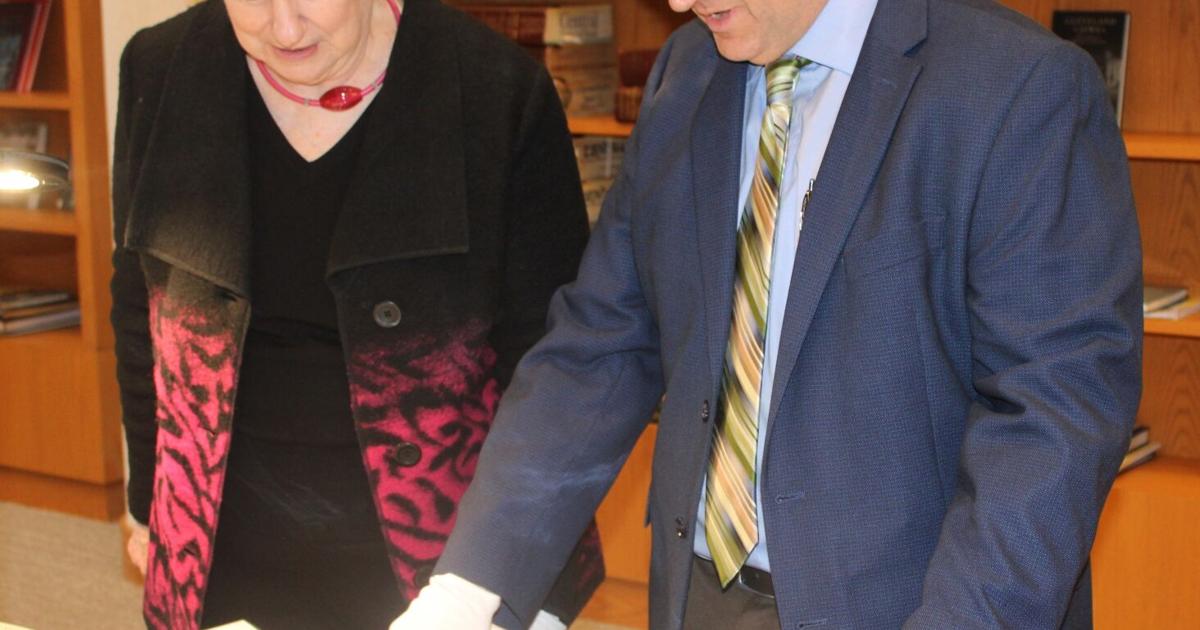 Cleveland Jewish News1 day ago
Attendance at the White Glove Brunch celebrating the 50th anniversary of Cleveland Jewish Archives at the Western Reserve Historical Society on Oct. 18 exceeded initial expectations, according to event co-chair Amy Kaplan of Lyndhurst.
Close
“When we started planning, we had no idea how it would turn out,” she said as guests filled the Crawford Auto Aviation Museum gallery for food and drink. “But people responded. We were hoping for 100, and we have 250. It’s thrilling.”
While all came to support the anniversary of the Cleveland Jewish Archives, some came away with the realization that they have a new repository for their family histories.
That was the mission of the morning, themed “Then. Now. Next” to celebrate and raise awareness of 50 years of Cleveland Jewish Archives and encourage contributions to the $4.2 million five-year initiative, “Securing the Future of Jewish Cleveland’s Past,” to complete the collection’s digitization.
Sean Martin, Western Reserve Historical Society curator for Jewish History, welcomed brunch guests with a brief history of Cleveland’s Jewish Archives, which dates to the 1950s after a local group chose to take a decentralized approach and break away from the American Jewish Historical Society’s national archives effort.
The move was welcomed by the Western Reserve Historical Society because it viewed Cleveland’s Jewish community as “under-represented” in its collection, according to Martin.
The Jewish Federation of Cleveland partnered with the Western Reserve Historical Society in 1976 to establish the Cleveland Jewish Archives and is its primary funder.
A half-century later, as new technologies have emerged, additional funding is needed to complete the digitization of the massive collection of materials, both print and non-print documents such as photographs, film and audio recordings.
“’Materials’ is a vague word, but the stories of laughter and sorrow are accurate,” Martin said. “’Materials’ teaches others.’”
Federation President Erika B. Rudin-Luria in her remarks to attendees said that the $4.2 million campaign has been jump-started by a $2 million gift from the Jack, Joseph and Morton Mandel Foundation of Cleveland.
“Their support is always transformative,” Ann Freimuth, event co-chair and Cleveland Jewish Archives advisory committee member, said. “It validates to those who know nothing about the Cleveland Jewish Archives that it’s something worth considering.”
Cindy Bruml, event co-chair and member of the Jewish Archives advisory committee and Western Reserve Historical Society board, told attendees that the $4.2 million campaign will “spread the word and heighten awareness of these treasures.”
“The archives are not just a repository,” she said. “They are a recognition that the past matters, teaching us today and into the future. They must be accessible to scholars and teachers if they are to help guide us into the future. Digitizing is important to give access. It is essential in today’s world.”
Kaplan said that digitizing involves far more than scanning materials. Archives must be made “searchable” to scholars and teachers and the process is time-consuming.
In addition to digitizing the Cleveland Jewish Archives, the funds will enable Martin – whom Freimuth called ““the heart-and-soul scholar of the Jewish Archives of Cleveland” -- to write a third volume of Cleveland’s Jewish history, picking up where current volumes end in the mid-1990s.
“So much has changed that the people need to understand,” Kaplan said.
Following the program, guests were invited to the museum’s first-floor library, where they were given white gloves and encouraged to peruse the collection of Jewish archives material that Martin had curated specifically for this one-time event, including paintings, photographs, speeches, audio recordings, and high school yearbooks with pictures of Jewish fraternity Beta Alpha Tau members.
“People loved seeing everything,” Martin said.
Some attendees accepted rides on the historic Euclid Beach carousel, housed in the museum due in part to generous donations from Cleveland’s Jewish community.
Miriam Rosenblum, who grew up on Cleveland’s west side and attended Beth Israel-The West Temple in Cleveland, flew back from her home in Boston to attend the White Glove Brunch.
She told the CJN that she came to see the collection because her father, Lou Rosenblum, was among the first to raise awareness of the plight of Soviet Jews in what became known as the American Jewry movement, founding in 1963 the nationally recognized Cleveland Council on Soviet Anti-Semitism.
Jack Bialosky of Chagrin Falls told the CJN that he was not certain when his family arrived in Cleveland from the Bialystock region northeast of Warsaw, but it was likely during the second wave of Jewish immigrants in the 1860s, not the first wave of the late 1830s. His family founded the Cleveland architectural firm Bialosky.
“My dad designed synagogues,” he said. “And a lot of his papers are still in the office.”
He and his wife, Ronni, said that it would be an honor to have them in the Cleveland Jewish Archives.
The event was the first of two sponsored by the Federation celebrating Cleveland Jewish Archives’ 50th anniversary. The second, “Archives Alive,” on May 16, 2027, will feature breakout sessions on aspects of past life, culture, religious leaders and institutions in Cleveland’s Jewish community, including the local rock-and-roll movement.
“History is more than a record of what happened,” Rudin-Luria said. “It tells us who we are and where we came from. Cleveland’s Jewish Archives help us meet the present with perspective and the future with purpose. We must make the collection accessible to tell Cleveland Jewish community’s evolving story.”
 Cleveland Jewish News1 day ago
Gregg Lurie, who embraced a never-ending quest for excitement and fun, died Oct. 22, in Miami, Fla. after a long battle with cancer. He was 74.
Gregg was born Sept. 2, 1952, in Cleveland, Ohio, the first-born son of Jerry and Joyce Lurie. They lived in Beachwood, then Shaker Heights, where Gregg graduated from high school in 1970.
Gregg attended The Ohio State University. He spent most of his time at the campus airport, where he learned to fly airplanes. He became an accomplished pilot, and over the years owned several airplanes, his favorite of which was a King Air E90, which he piloted even in the final year of his life.
In 1974, Gregg married Debbie Berkson, whom he met at Ohio State. Their 25-year marriage produced two children, Kevin and Jessica, and four granddaughters, who remained the center of their parents’ lives.
After college, Gregg came to work in the family business, Florian Fashions, eventually succeeding his father as CEO.
After closing the family business, which he managed with his twin brothers, Keith and Kenny, Gregg moved into commercial real estate, where he successfully developed properties for 32 years.
In the late 1990s, he moved to South Florida, where eventually his two children, Kevin and Jessica relocated when they completed college.
Gregg was particularly attracted to things and people who enjoyed his brand of “go,” a non-stop pursuit of fun and funky fulfillment – be it in clothing, cars, relaxation or holidays. His favorite car was a canary yellow Jaguar XKE, which he drove in the early to mid-1970s – much to the amazement, admiration and envy of every college sophomore and junior at Ohio State.
He loved skiing, scuba diving in the Bahamas, and dining at The Palm restaurant – and often shared these joys with his family.
Gregg was gracious, generous and always sought to be in a social whirl. He eagerly shared his joie de vivre with those he loved.
He is survived by his children, son Kevin Lurie and his wife Jill, their daughters Olivia (13) and Violet (10); daughter Jessica and her husband Terry Dowling, and their daughters, Charlotte (12) and Quinn (10); Gregg’s brothers, Keith and Kenny Lurie and Kenny’s wife Sunny; and Gregg’s ex-wife, Debbie Berkson Lurie; as well as two nephews and four nieces, and numerous friends who were graced by his lifelong love of fun and frolic.
The family has asked that donations in Gregg’s memory be made to Healing Hearts Florida Hhflorida.com or Hatzalah South Florida hsfems.org or the charity of your choice.
Services will be held at 1 p.m. on Oct. 25 at Berkowitz-Kumin-Bookatz Memorial Chapel, 1985 S. Taylor Road in Cleveland Heights, Ohio, 44118. Interment at Mt. Sinai Cemetery.
Family will receive friends at the residence of Jill and Ken Lurie, 2780 Chesterton Road in Shaker Heights, Ohio, 44122, following services and interment until 8 p.m.
Friends who unable to attend the service may view it on Sunday, October 25 at 1 p.m. by going to bkbmc.com, scroll down to obituaries, select the obituary of Gregg Lurie, click on his obituary, scroll down to join live stream and click on join live stream.
Cleveland Jewish News2 days agoA version of this piece first ran as part of the New York Jewish Week’s daily newsletter, rounding up the latest on politics, culture, food and what’s new with Jews in the city. Sign up here to get it in your inbox.
What you need to know today
Jewish institutions in NYC are facing pressure from increased security costs. A survey by the UJA-Federation of New York’s Community Security Initiative found that 39 institutions, including synagogues, Jewish schools and community centers, have more than doubled their annual security spending since the Hamas attacks on Israel on Oct. 7, 2023, reported Haaretz. The surveyed institutions saw their median security spending rise from $50,000 before Oct. 7 to $152,470 afterwards.
High Line Publishing launched a line of Jewish-focused books. The international publishing house unveiled Odessa Editions, which it’s calling the “new global home for Jewish and Israeli fiction and non-fiction,” this week at the Mediterranean restaurant Port Sa’id in Manhattan, reported The Jewish Chronicle. CBS news editor and Free Press founder Bari Weiss was among the attendees.
Billy Crystal’s one-man show has opened on Broadway. The beloved Jewish actor and comedian’s show “860,” named after the street number of the house that Crystal lost during the Palisades Fire in 2025, opened at the Imperial Theatre this week. It’s running through Jan. 3, 2027.
The Jewish indie comedy “Yaniv” is coming to NYC. The film, about two teachers who break into an underground gambling circle run by Hasidic Jews to win money at the Israeli card game Yaniv, is opening at New Plaza Cinema on Sunday.
--
The post Jewish institutions face pressure from increased security costs appeared first on Jewish Telegraphic Agency.
 Cleveland Jewish News2 days ago
TOLEDO, Ohio (AP) — Officials in Ohio said Friday that a chemical tank leak earlier in the week was caused by a chemical reaction resulting from an employee error and lifted all remaining evacuation orders.
Toledo Mayor Wade Kapszukiewicz said during a news conference that the venting of the tank that ruptured at MC Tank Terminal on Tuesday was finally completed late Thursday night, allowing a hazmat team to enter the site and test safety levels.
“At this time, we do feel confident that the site is safe," Toledo Fire and Rescue Battalion Chief Blake Molnar said.
The rupture happened late Tuesday night. MC Tank Transport, the owner of the site, said the tank contained glycidyl methacrylate, which it described as “an industrial chemical used to make certain plastics, paints and coatings perform better.” Hundreds of people were initially forced from their homes and 57 were treated at hospitals.
The chemical leak happened when an employee of the company “introduced a temperature level to the tank in the process of trying to transfer the liquid" that caused a chemical reaction, the mayor said. The company has “accepted responsibility” for what happened, he said.
“There was no fire, there was no explosion. There was a very serious chemical reaction, which now happily has run its course, and we’re now finally able to return to some level of normalcy here in our community," Kapszukiewicz said.
There are questions that remain unanswered, and the investigation is ongoing, he said.
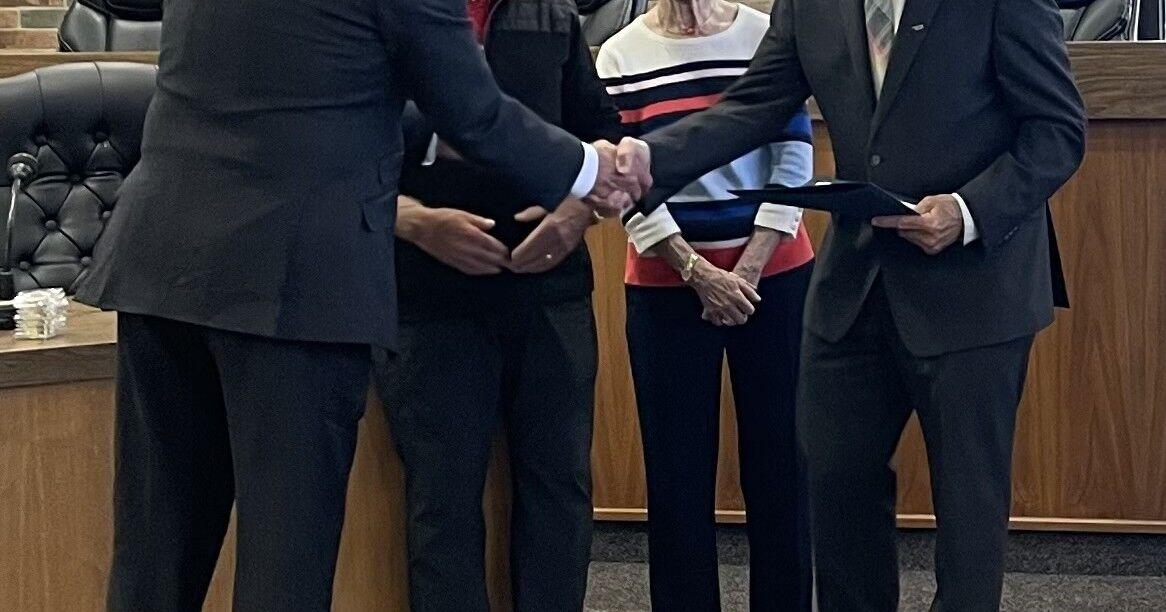 Cleveland Jewish News2 days ago
The remembrance service inside Lorain City Council Chambers on Oct. 7 may have been the only one in America with both Jews and Muslims reflecting on the tragedy.
That comes as no surprise to Arnie Milner, president of Agudath B’nai Israel Synagogue in Lorain, who said that Lorain may be the most forward-thinking city in the country when it comes to Jewish-Muslim dialogue.
The longtime friend of Lorain Mayor Jack W. Bradley has been committed to building an interfaith community in the city for some time.
Local Imam Paul Hasan, president of the Lorain Interfaith Association, also took part in the ceremony.
Milner told the Cleveland Jewish News that Bradley called him a few weeks earlier and said he was thinking of the victims of Oct. 7, and for the first time, wanted to present a proclamation to Lorain’s Jewish community on behalf of the city.
“He wanted me to come get it in his office,” Milner said.
The remembrance ceremony and proclamation presentation were set for 2 p.m., with Milner accompanied by about a dozen synagogue members.
Then at the last minute, it changed.
Attorney Robert Gary, author of the 2025 book, “I Am the Other: Debating the Role of Islam in a Divided America,” heard about the ceremony and wanted to be part of it. He had been so moved by a portion of his book written by its co-author and nationally known Imam Azhar Subedar, who was part of President Joe Biden’s 2021 inauguration, that he sent Bradley a copy and asked that it be read at the ceremony.
Gary said that according to Subedar, Hamas, which carried out the surprise attacks against Israelis at the Nova music festival on Oct. 7, 2023, doesn’t represent Islam, and that both sides are suffering because of it.
“He basically wrote that, OK, Gaza is going on, and Oct. 7 happened, and Jews and Muslims need to talk at this time of rising white nationalism in America,” Gary told the CJN. “So, when I heard that the mayor was going to make the presentation, I asked if I could read the statement from the co-author because it was coming from a Muslim.”
Gary said that after requesting to see the statement, Bradley said he found it “so incredible’ that he asked not only that it be read at the ceremony, but invited Hasan, a good friend and “imam of Lorain,” to attend with the Muslim community.
The statement read, in part, “We are Americans. And as Americans, our responsibility is to help build the solution. That solution will not come from avoiding our differences; it will come from having the courage to address them ... We don’t have to agree. But we do have to recognize one another’s humanity ... Let us mourn Israeli lives lost, let us mourn the Palestinian lives lost, and let us stand unequivocally against terrorism, antisemitism and Islamophobia.”
Bradley remarked at the ceremony that Lorain is a city of humanity, that “we believe in each other, that we work together, and if we don’t do that, then we’re doomed.”
He also said that the “growing amount of antisemitism and anti-Muslim hate in this country” has to stop.
Then he presented Milner the proclamation “for the city of Lorain to remember the victims, honor the survivors, and families, and stand with our Jewish neighbors against antisemitism and hate.”
Bradley passed out challenge coins he had made to mark the occasion. One side read “Lorain: an international city,” and the other noted the 250th anniversary of the signing of the Declaration of Independence.
“At the top of the coin it says that Lorain stands together,” Bradley said. “Today is an example of how Lorain stands together.”
Milner called it a “great ceremony.”
“It was more than a ceremony about a proclamation,” he told the CJN. “Very emotional. Different from what I thought. I’m very grateful to the mayor for stepping up.”
Milner, who was a member of the CJN class of 2025 18 Difference Makers said it’s important to start a dialogue between Muslims and Jews.
“It has to start somewhere, so why not in Lorain, Ohio?,” he said. “I hope we’re a pebble in a pond with triple effect.”
Gary told the CJN that while no one can change Oct. 7, they can look forward.
“There’s a lot of craziness, but we have to get some dialogue going,” he said.
 Cleveland Jewish News2 days ago
The spooky season is upon us. And no, that is not a reference to Halloween, but instead it is a nod to the musical that is creeping people out at Blank Canvas Theatre in the historic 78th St. Studios on Cleveland’s west side. And if the crisp fall air and the crunchy leaves give you a yen for some campy horror drama, “Carrie The Musical,” based on the novel by Stephen King, is your best bet for weekend plans.
The makeup of the audience on Oct. 17 was a reminder that Blank Canvas is one of the theaters in town that attracts a younger crowd, so it is very possible that only a small percentage of audience members were traumatized as kids by the 1976 film starring Sissy Spacek as the title character. Who can unsee the image of poor tortured Carrie with the whites of her eerie eyes peering through the pig’s blood as she burns down the prom? (Oops…spoiler alert.)
If all this is unfamiliar to you, don’t worry … the plot of the musical is basically the same.
With a book by Lawrence D. Cohen, music by Michael Gore and lyrics by Dean Pitchford, the story begins with mousy high school senior, Carrie White (McKenna Hassel), being bullied and tormented by the girls in her class after she menstruates for the first time and thinks she’s dying. That is also the moment when her telekinetic powers become evident. When she gets angry, she lashes out and destroys things with her mind.
Margaret White (Amber Michalak), Carrie’s religious-fanatic, overprotective single mom who lives by the word of the Bible, locks her in a prayer room to repent, and keeps her naive. When Carrie questions why her mother hasn’t taught her the facts of life, Margaret yells that she is cursed, and makes her pray.
Chris Hargensen (Liza Dwyer) is one of the biggest bullies and counts on her bestie Sue Snell (Nat Harper) to go along with the cruelty against Carrie, but Sue feels so guilty, she tries to make amends instead. She has the idea that her boyfriend Tommy Ross (Reed Randall Kruger) should take Carrie to prom to help her feel more included. In an English class, Carrie had expressed that she liked one of Tommy’s poems, and they connected, so Sue thinks Tommy could give Carrie one happy night to remember.
Sue and Tommy mean well, but Chris and her boyfriend Billy (Kareem Mchaourab) use the prom as an opportunity to carry out a cruel prank. They fix the votes to ensure that the prom king and queen are Tommy and Carrie, and just when Carrie is finally having one moment of glory, a bucket of pig’s blood is dumped on her head. Carrie is so humiliated, she breaks. Her powers are unleashed, and she ignites a fire that torches the school and kills all of the students.
Sue, who didn’t attend the prom, tries to find Carrie after the carnage, arriving at her house just after Margaret stabs Carrie with scissors and Carrie kills her mom. Carrie ultimately dies in Sue’s arms.
Those of us that grew up on the film, or King’s novel, won’t be bothered by the updates to the story, like the fact that it is set in current times where cell phones and social media are at everyone’s fingertips…literally. In fact, sadly, the story holds up.
What doesn’t necessarily hold up is the musical itself. The music is clunky, unmemorable and sometimes just kind of weird, although this cast can sing the heck out of it. In fact every cast member is strong vocally, while the acting is more of a mixed bag.
Hassel is incredible as “the timid turned tyrant, Carrie White.” She takes us through all the “feels” as she comes of age before our eyes. She embodies shy Carrie, curious Carrie and the Carrie who is pushed beyond the brink. Her stellar vocals give her songs the life they need.
Hassel’s duets with Michalak, who is the perfect choice for Margaret, are haunting and beautiful. Michalak’s voice is clear as a bell, with a powerful and tender classical tone that compliments Hassel’s voice beautifully. The chemistry between the two of them makes every one of their scenes appropriately uncomfortable and tragic.
Harper wins us over as Sue Snell, whose conscience redeems her character. She is so natural, making Sue much more likable, and her voice has a really unique, pretty quality that adds some interesting color to her songs.
There is absolutely nothing likable about the character of Chris, but there is nothing but love for Dwyer’s portrayal of this villain, and her big, belty voice.
As Tommy Ross, Kruger’s vocals are his strength. His rendition of the song “Dreamer in Disguise,” is beautiful. This role is not necessarily a perfect fit for him, but he makes it work because of his strength as an actor.
Mchaourab does a nice job as Billy, John Travolta’s role in the film. His character isn’t really developed in this musical version, but he has some nice vocal moments, and he plays the sleazy sidekick well.
Autumn Vinciquerra plays PE teacher Miss Gardner, and while she started out a bit stilted during this performance, she settled in as the show went on, and really owned the role with her singing voice.
The ensemble is energetic, vocally strong and executes Luke Scattergood and Justin Bilewicz’s quirky choreography with ease, adding the campy fun to a really dark show.
Scattergood had a daunting task directing this musical that flopped in 1988 and got mixed reviews for its revival in 2012, but this scaled down version at Blank Canvas Theatre, with its committed cast and production team, is loads of freaky fun, befitting audiences full of both “Carrie” fans and “Carrie” first-timers.
Sheri Gross is the CJN theatre critic. She is a performer, director and freelance writer from Solon. She was the director of the Mandel JCC Playmakers Youth Theatre and Pilloff Performing Arts Camp for over 20 years and is the director of creative programs at Gross Schechter Day School in Pepper Pike. To read more from her, visit cjn.org/gross.
 Cleveland Jewish News2 days ago
In Central Ohio, several Bexley residents reported finding swastika stickers placed on political campaign signs outside their homes.
Todd Applebaum said five political signs outside his home were vandalized with Nazi symbols. He said that he later learned that other homes in the community had experienced similar incidents.
Applebaum said he first learned about the vandalism in the morning of Oct. 19, after seeing a post on Bexley Buzz, a local community Facebook group.
“Someone posted on the Bexley Buzz, which is the communication website for my city, and another woman and husband got Nazi symbols on their political signs,” Applebaum told the Columbus Jewish News.
He said he responded to the post to express his sympathy and offered to provide the couple with replacement signs, not realizing that his own property had also been targeted.
Later that afternoon, Applebaum said a representative from the Jewsh Columbus’ Community Relations Council approached his home and asked whether he had noticed what happened to his signs.
After checking his property, Applebaum discovered that five of his campaign signs had been vandalized.
According to Applebaum’s Facebook post, the affected signs supported Republican statewide candidates Vivek Ramaswamy, Frank LaRose and Jon Husted. He also reported that his American flag had been vandalized with swastika stickers.
Applebaum said he contacted police and filed a report. He later learned from officers that four other homes were known to have been affected.
He said police were investigating the incidents and had collected the signs to examine them for fingerprints.
Bexley Police Chief Gary Lewis confirmed that a report had been filed and said officers were working to obtain video footage as part of the investigation.
“There’s really nothing to comment on.” Lewis told the CJN. “They’ve placed it, we took a report, and we’re trying to pull video and see if we can take any investigative steps.”
In a Facebook statement, Bexley Mayor Mike Price said he had been in discussions with the police department and several residents about the incidents over the past 48 hours.
“This defacement included the placement of stickers bearing the swastika symbol, an act that is far more shocking and threatening than mere vandalism,” Price wrote.
He said the swastika represents a regime founded in bigotry and violence and described the use of the symbol as a hateful and threatening act that would not be tolerated in Bexley.
Price said police would continue investigating and encouraged anyone with information to contact the department’s nonemergency line at 614-559-4444.
“Let’s work together to make sure every resident in our City feels welcome, accepted, and safe,” Price wrote.
Applebaum called the incidents a reminder of the importance of respect and civility among neighbors, regardless of political differences.
“What happened in Bexley last night is appalling, disgraceful, illegal, hateful and should serve as a wake-up call to return to civility and respect,” he wrote on Facebook.
Cleveland Jewish News2 days agoTony Watlington, superintendent of the School District of Philadelphia, told the House Education and the Workforce Committee in a Sept. 18 interview that the Council on American-Islamic Relations is “authentically interested” in supporting district students.
The superintendent of the public school district, which has about 200,000 students in 330 schools, was talking about a group that blamed Israel for being attacked on Oct. 7 and which the Biden administration dropped after initially including it in an advisory role on the national strategy to combat Jew-hatred.
According to a transcript of the interview, which the House panel released this week, Watlington said he was unaware of any Jewish leaders on his transition team, even though the then-executive director of CAIR’s Philadelphia office was part of the team. The superintendent also said that he was not aware of CAIR’s reputation of Jew-hatred.
He told the House panel that he found “the individuals representing CAIR to be authentically interested in the well-being and support of our students and interested in helping the School District of Philadelphia to become the fastest-improving large urban school district in the country.”
He told the committee that he needed to know more context to know if a workshop that the CAIR leader offered, titled “American Jews and political power: myth or reality?” was concerning.
Democrats on the panel suggested that because the CAIR regional leader is Jewish that he was a Jewish leader on the transition team.
Monique Braxton, a spokeswoman for the district, referred JNS to a public statement in which she said that the committee’s report “distorts and mischaracterizes our record.”
“The district has taken serious steps to combat all forms of hate in our schools, including a new record management system, revised policies, mandatory annual training for staff and appropriate disciplinary actions,” she said. “We remain committed to fostering a safe and welcoming environment for our students and staff.”
'Highly problematic organization'
On Wednesday, the George Washington University Program on Extremism released a report detailing what it said are CAIR’s attempts to influence K-12 education.
The council is “in many ways, a highly problematic organization,” and it is “troubling to think CAIR has any sway on shaping school curricula,” the report stated.
It noted that CAIR was an unindicted co-conspirator in the Holy Land Foundation terror financing trial. The report added that the Biden administration removed CAIR from its strategy on Jew-hatred and that the council’s executive director had said that he was “happy to see people breaking the siege” on Oct. 7.
Shortly after Oct. 7, CAIR Philadelphia circulated letters to parents asking them to challenge their schools for expressing support for Israel after the attacks, per the report. The letters, which CAIR California created, accused Israel of being an “apartheid state” engaged in “war crimes” and said that Gaza is an “open-air prison,” the report stated.
“Palestinians, the letter said, had been ‘occupied, brutalized and terrorized’ for more than seven decades,” it stated. “Hamas was not identified. Neither were the decades of Hamas’s suicide bombings and attacks against Israeli civilian population. Nor were enumerated the killings, kidnappings or attacks on Israeli communities that had prompted the school statements CAIR wanted parents to challenge.”
The letters stated that CAIR does not endorse violence against civilians, but the disclaimer got lost in the council’s “wider California resource package,” which included accusing Israel of illegally occupying “Palestine” since 1948, the year the State of Israel was established, according to the report.
CAIR Philadelphia co-sponsored an event with Philadelphia Parents for Palestine that had a panel titled “Zionism is racism.”
Philadelphia Parents for Palestine is a parent group seeking to remove “Zionist teachings and agenda” from school curriculum and add Palestinian, Arab and Muslim voices, the report stated.
CAIR was supporting “an education network no longer arguing only over Israeli policy, Gaza or the conduct of a particular government,” the report said. “The target had become Zionism.”
The Program on Extremism report also examined CAIR’s activities in K-12 schools in other states and found that the council’s efforts have produced “uneven” results. Washington state was “arguably the strongest evidence in this report of CAIR’s access inside a state education process bearing fruit.”
According to the report, CAIR Washington pushed back against the Washington Office of Superintendent of Public Instruction’s 2024-25 school year guidance on Jew-hatred and student activity.
CAIR Washington’s objections included the guidance referring to “from the river to the sea” as Jew-hatred and relying too much on the Anti-Defamation League, the report stated.
Following CAIR’s pressure campaign, the state agreed to rewrite the guidance, and CAIR claimed it received drafts of the guidance and edited them in “back-and-forth revisions” with the state until the two sides agreed on a final document, per the report.
The revised guidance, released in June 2025, is currently the official guidance used for the state’s K-12 schools and does not credit CAIR, the report stated. (JNS sought comment from the Washington Office of Superintendent of Public Instruction.)
The report also said that CAIR New Jersey and the group Teaching While Muslim developed a curriculum in September 2022 about how schools should teach the Sept. 11 attacks. That curriculum stated that 9/11 was “directly influenced by U.S. foreign policy” and included a copy of Osama bin Laden’s “Letter to America,” which CAIR’s national office said shouldn’t have been part of the curriculum.
CAIR New Jersey claimed it sent the curriculum to nearly 30 school districts, but the report noted no public record confirms that any schools in the state adopted it.
David Collins, a retired FBI agent and a co-author of the report, stated on LinkedIn that “CAIR has spent years building access to the people and institutions that shape American public education.”
“The question is, how many people are paying attention?” he wrote.
Cleveland Jewish News2 days agoTherese Helene Boosin, known affectionately to family and friends as “Terry”, passed away peacefully in White Plains, N.Y. on Aug. 21 at the age of 83.
Born in Niagara Falls, N.Y., Terry grew up in Shaker Heights, a place she called home for nearly her entire life. For decades, she dedicated her wisdom and intellect to shaping young minds as a middle school Spanish and English teacher in Garfield Heights. Known fondly as Señorita Boosin, she touched the lives of more than 5,000 students – many of whom she remarkably kept in touch with for decades. She is remembered by all who knew her as patient, judicious and kind.
Terry fiercely protected the beauty of a simple, comfortable life. She was famously resistant to embracing modern technology, remaining delightfully clueless to computers, iPads, emails and text messages. Instead, she filled her world with familiar pleasures: she was an avid fan of "Jeopardy!", a master of crosswords and a true connoisseur of sweets, particularly Lindt truffles and Panera cookies.
Behind her quiet exterior was a legendary, desert-dry sense of humor. She loved to goof around and possessed a brilliant deadpan wit. In her final months, when family visited and greeted her with "Hola, Señorita," she would quickly respond with a smirk and a classic, commanding: "Get out the snacks."
In May, Terry made the brave move to New York to be close to her sister, nieces, grand-nieces and grand-nephew. Though her health challenges turned her time in New York into an unexpected journey, she faced her final months with clarity and grace to the very end. Terry will be remembered as the kindest, most generous person her family has ever known.
She was preceded in death by her beloved parents, Morris Benjamin Boosin and Edith Leah Hanson.
Terry’s wise, yet playful spirit lives on through her devoted sister, Barbara Davis; her cherished nieces, Marisa McMahon and Abbe Reese; and her adored grand-nieces and grand-nephew, Elayna, Caden and Shailey. Terry was profoundly loved, and all who knew her are entirely better for it. Te queremos, Tía.
A celebration of life honoring Terry's beautiful legacy will be held Nov. 22 from 1-4 p.m. at The Diplomat at 18975 Van Aken Blvd. in Shaker Heights, where she lived for most of her adult life.
Cleveland Jewish News2 days agoMichael Trager is glad that Dawood Faisal, the man whose actions resulted in the death of his wife of 47 years, has been indicted on hate crime charges for vandalizing a Jewish-owned bagel shop in his Queens neighborhood. But that isn’t the only hate crime he should be charged with, as far as Trager is concerned.
After two incidents of alleged destruction of Jewish-owned property, Cara Trager was killed by a car that Faisal hit after he sped down the street at 75 miles per hour in a 35-mile-an-hour zone, ran a red light and crashed into a car, which then struck the Tragers as they crossed the street.
Faisal, who is 22 and Muslim, and was reportedly born in the United States to Pakistani parents, allegedly knocked over plant stands, pulled plants out of their pots and threw dirt at the wall of the then-closed kosher bagel shop. He did so twice, according to the criminal complaints against him.
The first time was on the night of May 15, and the second on May 23, the Queens district attorney’s office said.
Two days later, he is accused of speeding down a usually quiet street at 75 miles per hour, running a red light and starting the domino effect of cars that careened into Michael and Cara Trager, who were crossing the street.
Faisal was indicted on Oct. 19 on hate crimes charges for allegedly destroying the bagel store property because it displayed Israeli flags.
On July 31, Faisal was arraigned on the same charges, according to the criminal complaint. Indictment is the next step in escalating the case up the legal ladder, a spokesman for the Queens district attorney told JNS.
“This defendant repeatedly targeted a Jewish-owned business and destroyed property in a vile act of antisemitism,” Queens district attorney Melinda Katz stated at the time. “Incidents such as this extend beyond one target and spread fear to an entire community.”
According to Trager, Faisal should also be charged with hate crimes in connection with his wife’s death.
Cara Trager was killed on the evening of Memorial Day this year, May 25, as she and her husband walked home from a date night dinner at one of their favorite restaurants, a kosher dairy restaurant called Cafe Muscat. They planned to watch an old movie once they got home, Michael Trager told JNS.
As they crossed the street within the designated lines and with the walk signal, a car came barreling into them. It knocked Cara unconscious and injured Michael, separating his shoulder, he said. Months later, it still hurts.
“But compared to the loss of my wife, I don’t want to make a tzimmes,” he told JNS, using a Yiddish expression meaning a “big deal.”
Emergency medical technicians from Hatzalah, the Jewish volunteer emergency corps, restarted Cara’s heart when they arrived at the scene on May 25. But she never regained consciousness, her husband told JNS. She died on May 29.
The criminal complaint brought against Faisal by the Queens district attorney for that event indicates that he has been charged with an armed felony offense, with his car being the weapon, and with leaving the scene of an incident involving serious physical injury.
When his car died, Faisal allegedly got out the passenger door and ran away until he was stopped by three police officers.
Faisal has also been charged with speeding, with reckless driving and with driving through a red light.
'Never anticipated this level of antisemitism in New York'
Asked why hate crime charges have not been brought against Faisal in the case that resulted in Cara Trager’s death, the spokesman for the Queens district attorney declined to comment.
“It is so sad that a maniac can take a life and get maybe five years if he’s convicted, and she dies from it,” said Trager, a certified public accountant, who told JNS that he remains so distraught that he cannot concentrate at work.
Cara Trager was 71. She was a devoted volunteer at their Conservative synagogue, Congregation Etz Hayim, was a freelance writer and leaves behind two adult children and four grandchildren.
Her son, Eric, 43, works for the Senate in Washington, D.C. He and his wife have two children, as does the Tragers’ daughter, Rachel, 40, who lives in Tel Aviv with her husband and children.
In her obituary in Newsday, a newspaper for which she often wrote, Cara was remembered as someone who “spent decades chronicling the lives of Long Islanders as a freelance journalist.” She was “driven by an endless curiosity, keen instincts and a gift for putting people at ease,” it said.
Michael Trager feels ignored and disrespected by New York City’s leaders, he told JNS.
He appealed to Mayor Zohran Mamdani and New York City Police Department Commissioner Jessica Tisch for meetings, he said.
“They rebuffed me,” Trager told JNS.
He met with Phylisa Wisdom, executive director of the mayor’s office to combat antisemitism. He also met with Fred Kreizman, an NYPD commissioner of community affairs who is also an observant Jew.
Trager was told Tisch couldn’t see him because, at the time, she was visiting Manhattan’s Central Synagogue, which had just experienced an intruder at Friday night services. Nobody was hurt.
“It’s so weird to me that she couldn’t reach out to someone whose wife actually died. She should have done that,” Trager told JNS. “Why can’t she reach out to me?”
The next step in the cases against Faisal is a court appearance on Nov. 12, Trager said. The date was confirmed by the Queens district attorney’s office.
“It seems that the pendulum is swinging in the direction of justice,” said Trager, though Faisal “could get bail on Nov. 12. From my and my children’s standpoint, we want the police and DA to look at his past acts” as part of the prosecution for Cara Trager’s death.
“I never anticipated this level of antisemitism in New York,” said Trager, who grew up in Queens and whose late wife was raised in the Bronx. “Never.”
“I learned that Mamdani watched the World Cup with inmates on Rikers Island, possibly with my wife’s killer,” Trager told JNS. “He can watch whatever sporting event he wants at my house, with victims of antisemitism.”
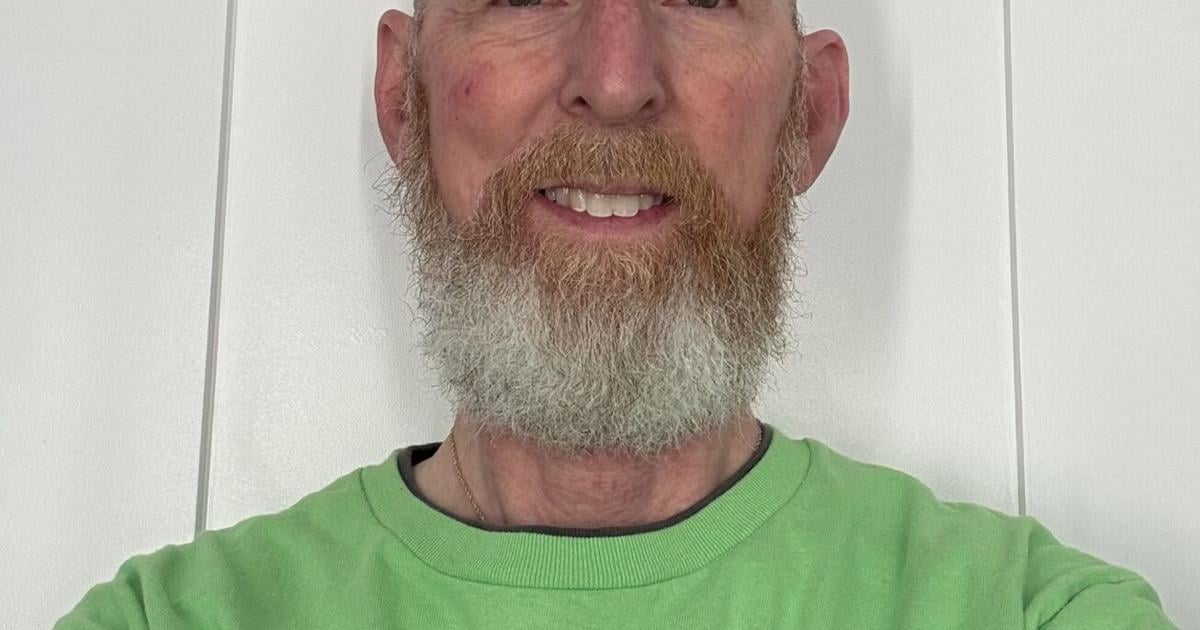 Cleveland Jewish News2 days ago
After retiring in December 2024, Lyndhurst resident Robert Destanik decided to go shopping. Shopping, that is, for a nonprofit to fill his time.
“I went to a couple of different nonprofits when I first started volunteering,” Desatnik told the Cleveland Jewish News. “I finally decided that the Greater Cleveland Food Bank was where I wanted to spend my time, and I found it very rewarding.”
Finding his “niche,” Desatnik now spends up to five days, or 20 to 25 hours a week, volunteering at the Nourishing Beginnings program or checking in neighbors at the Healthy Choice Market on South Waterloo Road in Cleveland’s Collinwood neighborhood.
“I like the fact that I get to interact with what we call our ‘neighbors,’ or the people that we serve,” he said. “I get to welcome them into the markets, and I just find that they’re very appreciative.”
Why did you get into volunteering?
During my career, I was fortunate to have been able to volunteer with my former company at several mobile pantries on the near west side of Cleveland. The mobile pantry would run for about three hours, and I recall vividly cars being lined up on the street for hours, each waiting for their boxes of food so they could make it through the week. Those experiences made me realize that there was significant food insecurity out there.
When I thought about what I wanted to do during my retirement, I realized that I wanted to help those less fortunate than I. I had had a successful career and my family and I were very fortunate to have never had such a need. I also believe in tikkun olam – repairing the world. Volunteering and giving back to our community is my way of doing that.
What has been the most rewarding part of your volunteer work?
At the food bank, we refer to the patrons that shop in the market as “neighbors.” My work at the market revolves around welcoming and checking neighbors into the market – whether they are new or not, each neighbor is treated with dignity and respect. I enjoy interacting with each neighbor and getting them checked into the market so that they can do their shopping and receive the food that they need. I also enjoy interacting with the other volunteers that I’ve come to know – we each share something in common which is a desire to help our fellow citizens.
Neighbors are usually very grateful for the assistance that we provide and it’s nice to know that the work we do is appreciated. The staff is also very appreciative of our time –
they realize that, without the volunteers, they could not function.
As far as the program for expectant women and their families, I enjoy being able to pack fresh foods and knowing that they and their newborn children are receiving healthy foods that will allow them to get the best start in life.
What advice would you give people who are unsure about getting involved?
There are many organizations in our community that need volunteers to keep their operations going. Whether it’s a physical activity, administrative role or an activity where you can use your expertise, look for something you like and want to do on a continuous basis. Once you find what suits you best, you will be rewarded in what you get back from those experiences.
What has volunteering taught you about your community?
There are a huge number of people in our community in need of food. With the current economic conditions and cuts to Federal SNAP / Medicaid benefits, we’re seeing an increase in food insecurity. The number of neighbors shopping at the market has increased in the time that I’ve been volunteering. Living in the east side communities, we often don’t see this need, but it is definitely there.
There are a lot of folks in our community that care about helping others and it’s very inspiring to see that. Similar to myself, there are many others who volunteer on a regular basis. Additionally, many companies allow their employees to volunteer on a regular basis. Without these volunteers, it would be difficult for these organizations to provide the services that they provide.
Cleveland Jewish News2 days agoPennsylvania Gov. Josh Shapiro leads his opponent, state treasurer Stacy Garrity, by 23 points among likely voters in a recent poll that showcases the Jewish Democratic incumbent’s advantages if he seeks the Democratic presidential nomination in 2028.
Shapiro leads Garrity, a Republican, 59% to 36% in the latest Franklin & Marshall College poll of the most populous swing state and a must-win for any Democrat hoping to take the White House.
Pennsylvanians’ dissatisfaction with the economy could benefit Shapiro. Economic concerns reportedly helped drive voters away from Joe Biden in 2020 and toward Donald Trump in 2024. Trump’s job approval rating fell to 29% in the latest poll, down from 41% in October 2025.
More than half of Pennsylvanian voters, 58%, said they are worse off economically now than a year ago, and 59% said that Trump’s policies hurt them, compared with 37% who said they have helped.
“Pennsylvania voters rate the economy as the biggest issue, and they overwhelmingly believe that Democrats will do a better job than Republicans on that issue,” said Berwood Yost, director of the poll. “That’s the same issue that mattered in 2024, when people thought that Trump would be able to do better. That’s largely why he was able to win re-election.”
Republicans have rallied behind Garrity, but she has struggled to raise money or close the gap with Shapiro ahead of the 2026 midterm elections.
Shapiro has raised $55 million. Garrity brought in less than one-tenth of that amount, $5.3 million.
In the poll, 44% of Republicans said they didn’t know enough about Garrity to express a favorable or unfavorable opinion of her. Among Democrats asked the same question, 38% said they didn’t know enough about her.
“That’s even more telling, I think, than the horse race stuff, where more Democrats recognize her than Republicans,” Yost told JNS.
“That’s because Josh Shapiro has advertised about his opponent, and they’ve paid attention to that,” he said. “She’s just not known. She hasn’t raised any money. I think those are the most telling numbers in the whole survey for that race.”
Shapiro is using his financial advantage to help Democrats unseat Republican members of Congress, take control of the state Senate and retain their majority in the state House.
“The more of those he can accumulate, the stronger his case for being a presidential candidate,” Yost told JNS. “You’ve got to win Pennsylvania to win the presidency. Presumably, if you can win Pennsylvania, you can win Wisconsin and Michigan as well.”
“I still think he has an uphill fight within the Democratic Party,” he said.
In an era of rising antisemitism and declining support for Israel among some Democrats, Shapiro has been outspoken about his Jewish faith and support for Israel’s right to exist and defend itself. He condemned Hamas for its Oct. 7 attack.
He has criticized some anti-Israel protests on college campuses and objected to questions about Israel posed during his vetting as a potential running mate for Kamala Harris in 2024.
At the same time, Shapiro has criticized Israeli Prime Minister Benjamin Netanyahu, continued to endorse a two-state solution, called for more humanitarian aid to Gaza and opposed Trump’s decision to go to war with Iran.
“The people of Israel in another couple of weeks will determine who their leader should be,” Shapiro said earlier this month during a debate with Garrity. “I hope it’s not Benjamin Netanyahu.”
Yost said that the anti-Israel feelings among the left wing of the Democratic Party could be an issue as they are the voters most likely to show up in primary elections.
“All you have to do is look at the reaction to his being considered by Kamala Harris for running mate, and there are factions in that party that are going to fight, that he’s just not going to be acceptable to,” Yost told JNS. “We’ll have to see what faction wins out.”
Guy Ziv, a professor at American University and associate director of its Center for Israel Studies, told JNS that it is too early to know whether Shapiro’s Jewish faith and support for Israel could hurt him in a presidential bid.
“We do not yet know whether or not this is going to turn out to be a liability or a nothing-burger,” Ziv said. “I think that part of it will depend on kind of how he handles himself, but so far, notwithstanding his public support for Israel and his openness regarding his religion, his Jewish faith, he is extremely popular in Pennsylvania.”
He added, however, that it is unclear “how it will play out on the national scene.”
“We don’t know whether or not he is actually planning on running for president,” Ziv told JNS. “We don’t know what the national mood will be if and when he does run, but yeah, it is a potential vulnerability.” (JNS sought comment from Shapiro’s campaign.)
One potential strength is Shapiro’s standing among white voters without college degrees, a working-class demographic that has helped elect Trump twice. Shapiro had a 39% job approval rating among those voters, compared with 36% for Trump.
Shapiro’s efforts to open more state jobs to people without college degrees and expand training for skilled workers, including electricians and plumbers, have helped him with that demographic, Yost said.
Another potential strength is the pool of voters who skipped the 2024 election but say they plan to vote in 2026. They account for 13% of likely voters this fall, and most support Democrats, according to the poll.
“Winning elections in a state like this is about coalition building,” Yost said. “It certainly would bode well for him if you can do that.”
Shapiro’s ability to help elect Democrats up and down the ballot in November could also bolster his presidential prospects, he said.
“Has he helped flip those congressional seats? Has he helped take the state House? Has he flipped the Senate?” Yost told JNS. “The more of those he can accumulate, the stronger his case for being a presidential candidate.”
The poll of 808 registered voters was conducted Oct. 7-18 and had a margin of error of plus or minus 4.1 percentage points. A subset of 433 likely voters had a margin of error of 5.6 percentage points.
 Cleveland Jewish News2 days ago
JERUSALEM (AP) — Gunmen opened fire during a funeral at a church in Jordan on Friday, killing seven people and wounding 34 others, authorities said.
The shooting took place at a Greek Orthodox church in Karak, about 180 kilometers (110 miles) south of the capital, Amman.
Images being broadcast on Jordanian state television show two gunmen who appear to be holding pistols approaching the church and firing shots. A third man who appears to be holding a semiautomatic rifle then appears and opens fire, and all three then run toward the church.
A government statement said that the attack was “carried out by unknown assailants,” but didn't say whether any gunmen were captured or killed. It said that “investigations are underway at full speed.”
Karak is home to a minority Christian population. In 2016, gunmen ambushed police in a series of attacks in Karak, including at a Crusader castle popular with tourists, killing 10 people, including seven officers, and wounding dozens. Jordanian security forces killed those gunmen after a long standoff.
Jordan’s director of public security, Maj. Gen. Obeidallah Maaytah, said at a news conference that 27 of the wounded in Friday's shooting were still being treated.
King Abdullah II said on X that Jordan “will confront the terrorist act that targeted Karak with the harshest penalties” and offered his “deepest condolences to the families of the martyrs, and our wishes for recovery to the wounded.”
Lebanese President Joseph Aoun and Syria’s Foreign Ministry issued statements denouncing the “terrorist attack” and offering condolences to the victims' families and the people of Jordan. Iraqi Foreign Minister Fuad Hussein called his Jordanian counterpart and “affirmed Iraq’s solidarity with Jordan in the face of terrorism,” Hussein’s office said in a statement.
Cleveland Jewish News2 days agoFor American Jews who follow Israel closely, one of the hardest things to understand about Israeli politics today is the gap between the severity of settler violence in Judea and Samaria, also known as the West Bank, and the relatively limited role it plays in the election campaign.
The phenomenon is not being ignored altogether. Israeli politicians across the political spectrum condemn acts of violence by Jewish extremists, and security experts have warned that Jewish terrorism and nationalist crime have become a serious threat to Israel’s security and democratic institutions. Yet the issue has not emerged as a major dividing line in the elections.
Why? Part of the answer is that Jewish violence in Judea and Samaria is politically inconvenient for both major blocs. On one side stands Prime Minister Benjamin Netanyahu’s coalition. On the other stands the loosely aligned “change bloc” seeking to replace it. That bloc includes parties with markedly different ideologies: Naftali Bennett’s B’Yachad, Avigdor Lieberman’s Yisrael Beiteinu, Gadi Eisenkot’s Yashar and Yair Golan’s Democrats. They agree on the need for political change, but they do not share a common position on the future of the settlements, Palestinian statehood or the long-term status of Judea and Samaria.
The reason settler violence has not become a defining campaign issue becomes even clearer once two different questions are separated. The first is straightforward: How should Israel deal with violence committed by Israeli Jews against Palestinians? The second is much broader: What should Israel do about the settlements, its control over Judea and Samaria and the long-term future of the territory? These are not the same question.
Distinguishing between these two lines of thought matters because the Israeli opposition may be united in its condemnation of settler violence, but it remains deeply divided over the settlements themselves. Yashar does not advocate for a general evacuation of settlements. B’Yachad supports Jewish settlement and opposes the establishment of a Palestinian state. Yisrael Beiteinu supports strengthening Jewish settlement and Israeli control in parts of Judea and Samaria. The Democrats take a substantially different position, including opposition to illegal settler outposts and an explicit commitment to fighting what they call “Jewish terrorism.”
There is, however, potentially a much broader consensus around law, order and state authority. That is where the political framing becomes important.
The Netanyahu camp does not entirely deny the existence of Jewish violence. After recent incidents in Samaria, Netanyahu condemned what he called a “handful of rioters” and called on law enforcement authorities to prosecute them. Foreign Minister Gideon Sa’ar described those responsible as criminals who should be dealt with severely.
This framing treats the problem primarily as one of law enforcement: Extremists are committing crimes, and the state must enforce the law against them.
That approach is also reflected in a significant proposal by Defense Minister Israel Katz. In August, Katz instructed the IDF to prepare a plan for transferring civilian enforcement involving Israelis in Judea and Samaria to the Israel Police, in part to reduce the military’s involvement in civilian law-and-order incidents.
This position is coherent: If Israel regards itself as sovereign over the territory, Israeli civilians who violate the law should be dealt with by the police, while the military should concentrate on security threats.
But this logic is not inherently a right-wing argument. It can serve the change bloc just as well. The change bloc can describe Jewish violence as evidence of governmental failure, loss of control and the erosion of state authority. That allows parties with very different views about the future of Judea and Samaria to agree on an immediate principle: The state must enforce its laws.
For politicians such as Bennett, Lieberman and Eisenkot, this is a much easier political proposition than making the future of the settlements and their legal status the central issue.
This is where Yair Golan, leader of the Democrats, stands out. Golan does not limit himself to terms such as “rioters,” “criminals,” “extremists” or “lawlessness.” He repeatedly uses the term “Jewish terrorism.” While the change bloc party leaders have on occasion used that phrase in English, they do not often use it in Hebrew. Golan is the one who uses the term repeatedly.
In August, Golan said explicitly: “What we are seeing today is Jewish terrorism that is receiving legitimacy from the Israeli government.” He has also presented the fight against Jewish terrorism as one of the issues on which he believes the change bloc can agree.
This choice of language is more consequential than it may initially appear. Once the phenomenon is called terrorism, difficult questions follow: If this is terrorism, should Israel not fight it with some of the tools it uses to fight other forms of terrorism? If Palestinian terrorism is understood as a national security threat requiring intelligence, organized investigation and preventive measures, what should happen when the perpetrators are Jewish Israelis?
Israel has developed extensive counterterrorism mechanisms for dealing with Palestinian terrorism: intelligence gathering, investigations by the Shin Bet internal security and counterintelligence service, administrative detention, military and security operations and other exceptional legal tools.
That does not mean those tools should automatically be applied identically to Israeli citizens. There are important legal and practical differences. But calling settler violence “Jewish terrorism” inevitably raises the question of whether it should be treated as more than ordinary criminality, and is important to harnessing the attention and power of the state to address it even as it labels it something that is an outlier.
The future of Judea and Samaria may be one of the most consequential questions facing Israel, but voters appear to be focusing more immediately on security, the economy, military service and Netanyahu’s political future. Here’s the dilemma all the parties are facing: The issue of settler violence can be important enough to condemn, but too politically complicated to campaign on.
For the Netanyahu bloc, emphasizing the systemic nature of settler extremism risks highlighting failures within a political constituency that is central to its coalition. For the change bloc, emphasizing it as a distinct political problem risks reopening the much larger argument over the settlements — an issue on which the change bloc itself remains divided.
Nevertheless, ahead of the elections, politicians can demand vigorous enforcement against violent settlers without supporting the dismantling of settlements. One can oppose illegal outposts without opposing the settlement enterprise as a whole. And one can regard Jewish violence primarily as a security, governance and even terrorism problem without having a position on the ultimate political status of Judea and Samaria, as important as that may be.
--
The post Why both sides are ducking settler violence ahead of Israel’s elections appeared first on Jewish Telegraphic Agency.
Cleveland Jewish News2 days agoWhen neighborhood children wanted to learn baseball, Theodore (“Ted”) Weintraub taught the whole block. The boys he coached in Baltimore’s Howard Park neighborhood became the core of a little league team, the Howard Park Giants.
Later, after moving to Randallstown, he started another neighborhood league and helped organize street lighting and a community swimming pool.
For Weintraub, a police officer who rose to the rank of major and helped bring 911 service to Baltimore, public service also meant attending to the needs just outside his front door.
“Getting things done that need to be done was something that my father was very good at,” said his son, Ron Weintraub.
Weintraub, a longtime Baltimore-area resident whose career included leading emergency communications operations in Baltimore, Baltimore County and Montgomery County, died on Oct. 8. He was 97 years old.
His sons, Larry and Ron, and daughter-in-law Jan remembered a man whose dedication to work existed alongside a deep attachment to family and Jewish community.
Survived a shooting
Raised in Philadelphia during the Depression, Weintraub was the son of Benjamin and Vera Weintraub. His father worked in a clothing store. Childhood games included halfball—played with half a rubber ball and a broomstick, a game he later taught neighborhood children himself.
He met his future wife, Anita, when she and a friend were visiting Philadelphia from Baltimore. His Coast Guard service brought him to Baltimore’s Curtis Bay, helping the relationship continue. They married in 1951, Larry Weintraub said.
Before entering police work, Weintraub worked for Social Security. According to Larry, he applied for several jobs and planned to accept whichever came through first. The police department offered him a position.
Weintraub survived a shooting while transporting a prisoner, his sons recalled. The prisoner grabbed another officer’s service revolver, killed that officer and shot Weintraub. Larry said his father was wounded just above the knees.
Over 29 years, his assignments included patrol, detective work, mounted traffic duty and communications. He commanded the Northwest District and eventually led the department’s communications division as a major.
Larry Weintraub said an assignment to study emergency communications at Northwestern University in Evanston, Ill., helped establish his father’s expertise in the emerging 911 system. He returned to Baltimore and helped introduce the service locally in the 1980s.
After retiring from the city department, he became chief of Baltimore County’s 911 system. He later served as director of 911 and commander of the Montgomery County Police Communications Division.
Managing those operations demanded technical understanding and an ability to work with people. Ron Weintraub remembered his father as a leader who cared about employees across racial and religious backgrounds.
“My dad was highly respected,” he said.
He remembered the demands of his father’s early police schedule, including days when he slept after working overnight. Later, commanding the Northwest District held particular meaning because it included the Jewish neighborhoods his family knew well. Ron viewed that assignment as an opportunity for his father to serve a community to which he felt closely connected.
That commitment extended to the neighborhoods where he lived. Larry Weintraub said his father helped establish the Stony Brook Swim Club when nearby clubs excluded Jewish members. The new club welcomed everyone.
A family man who welcomed all
At home in Randallstown, Jewish communal life was literally next door. When the neighboring shul, Winands Road Synagogue Center, needed enough men for a minyan, someone would knock at the Weintraubs’ house.
Weintraub served as Brotherhood president, helped with the synagogue’s construction and handled High Holiday seating, Ron Weintraub said. He wore a mezuzah pendant and took pride in his Jewish identity.
For Jan Weintraub, who was not Jewish when she met Larry Weintraub in the mid-1980s, that identity was expressed through a welcoming environment. The family did not pressure her to convert. She eventually did, after years of study, influenced in part by her father-in-law’s example of service and lovingkindness.
He was also someone with whom she could discuss Jewish feminism and religious questions.
“He didn’t talk the talk. He walked the talk as well, both personally and professionally,” Jan Weintraub said.
His family remembered fishing outings, Orioles games, duckpin bowling and low-stakes poker with friends. He and Anita traveled widely and maintained a close circle of longtime friends.
They also traveled to visit their sons, keeping close contact as military service and overseas life took family members away from Baltimore.
When Anita developed dementia, he became her primary caregiver. After she moved into a care facility, Jan recalled him visiting more than once a day.
His affection for his grandchildren appeared in gestures large and small. He attended her rowing events at George Mason University, Larry Weintraub said. His wife remembered his support for Katie’s high school trip to Japan.
From childhood into adulthood, Katie tousled her grandfather’s hair as part of their goodbye ritual. He remained a willing participant.
Ron’s three younger daughters brought another kind of energy to his later years. During visits to his assisted-living community, they sometimes sang and danced at lunchtime, entertaining their grandfather and other residents.
Larry Weintraub, who spent 20 years performing in military bands, remembered his father taking a recording of his clarinet playing to Philadelphia to share with his sister. Although his father could be reserved in expressing pride, that gesture stayed with him.
Jan Weintraub said her father-in-law’s example continued to influence both her and Katie’s commitment to helping others. Remembering him, she returned to the comfort of his dependable presence.
“It was always comforting to know he was there,” she said.
Originally published in the Baltimore Jewish Times.
 Cleveland Jewish News2 days ago
Shaker Heights High School’s Noa Hollander was already due to take on an important leadership role as she entered her senior season as a member of the girls’ soccer team, but that duty only intensified when several of her senior teammates went down with injury.
“There’s been a few times that I’m the only senior left, and that definitely pushed me into a position where people look up to me,” Hollander told the Cleveland Jewish News. “I help get them organized before the coach talks and make sure they are not doing anything silly to get injured. I make sure they’re on time to practice. I’ll send reminder texts to each player or our group chat – and respect the coach, telling them it’s time to be quiet when he is talking.”
And Hollander isn’t just a strong leader, she’s a force to be reckoned with on the field as well.
Through 17 games, she has scored seven goals and added eight assists, bringing her point total to 22.
For her stellar performance, Hollander is the Cleveland Jewish News-Les Levine High School Player of the Week.
Coming off a steady junior campaign, Hollander focused on little aspects of the game that sometimes go unforgotten – such as hydration – to help improve herself.
“I drink so much water, and I make sure that the team is hydrated because that’s an area where we needed to work on from last year,” she said. “For me, having a routine on game day of drinking a lot of water helped me. I make sure to really remember our plays and passing patterns we walk through in practice to translate them into games. Doing those on repeat has really helped ingrain them in my brain, so I know what to do with the ball.”
The senior noted that repetition at practice has helped Shaker Heights be cohesive as a whole, and the Red Raiders got to work on improving as a squad well before the season started.
“This summer we had morning practices, which is different from last year, and it helped us a lot because we got straight to work in the morning with no distractions before soccer,” she said. “It also wasn’t super hot out. And that schedule brought us closer as a team because after practice we could go get brunch or Starbucks. It was a difficult change from having off days last year in the summer, but it worked us really hard and made us a lot more conditioned than before.”
The attacking midfielder credited her teammates’ great passing abilities with allowing her to score goals, and she said she tries to return the favor.
“I’ve had a lot more space and time on the ball, so it’s made me more comfortable on the field and helped me know when to pass and when to shoot,” Hollander said. “I try to be as selfless as I can and not shoot as much, but my teammates have helped me score a lot because of their great assists. We’re more creative as a team this year, and we have more options with each player gelling together nicely.”
The Red Raiders finished the regular season 6-10-1 and were set to face Wooster (7-10) on Oct. 22 in the opening round of the Ohio High School Athletic Association Division II sectional tournament.
“After each game, our coach says, ‘Any thoughts?’ and allows us to speak, and a lot of times we have players saying that we never give up,” Hollander said. “Each person recognizes that Shaker Heights doesn’t give up, and we don’t let teams walk all over us. We have three practices before our playoff game, and we’re going to watch film and study. Hopefully, all of our hard work pays off and gets us into the next round.”
Upon graduation from high school, Hollander said she is undecided on a college but would love to keep playing soccer, but won’t let it dictate where she goes.
“I would love to continue, though, possibly with a club,” she said.
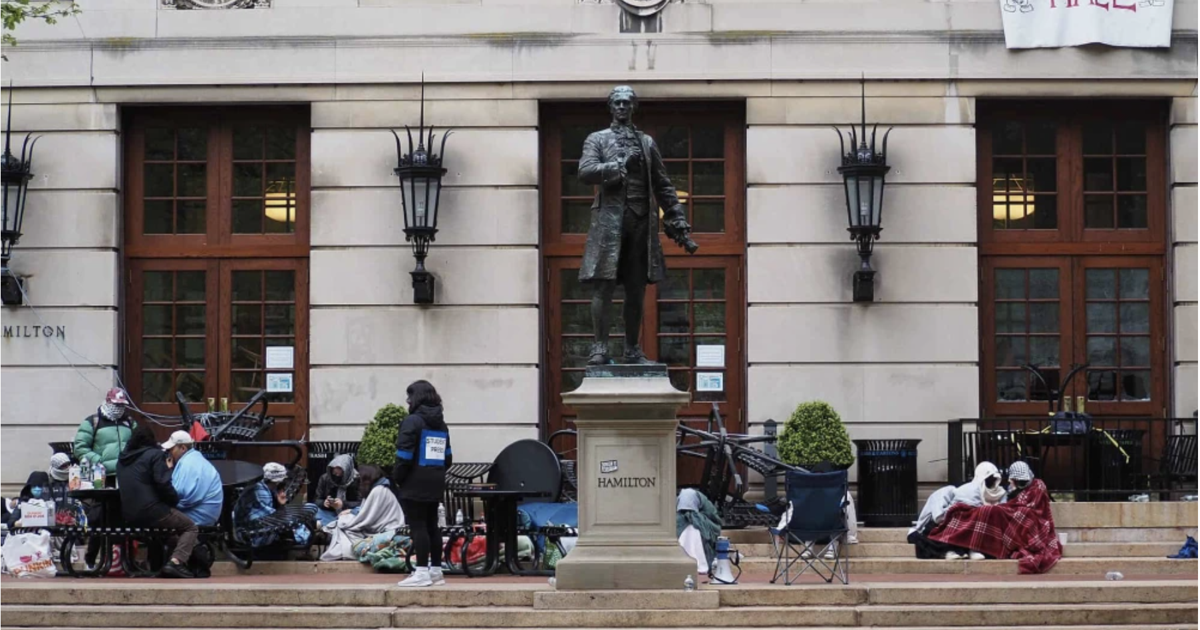 Cleveland Jewish News2 days ago
Three legal scholars urged a federal appeals court on Oct. 20 to revive civil rights claims made by two Columbia University janitors, who say protesters assaulted them and hurled anti-Jewish slurs during their takeover of Hamilton Hall in April 2024.
The friend-of-the-court brief, filed in the U.S. Court of Appeals for the Second Circuit, supports janitors Mariano Torres and Lester Wilson, whose claims the court dismissed initially, because it said that they couldn’t prove that they were victims of discrimination and that the protesters had political motives.
“The suggestion that people can’t be guilty of discrimination if they have political motives is profoundly wrong and, if accepted by the Second Circuit, would imperil civil rights protections for all groups,” Matthew Segal, an affiliated practitioner at Yale Law School’s Brodie Center for Jewish and Israeli Law, told JNS.
“People engaged in discrimination often have political motives, too,” he told JNS. “The KKK surely did.”
Segal joined University of California, Los Angeles law professor Jon D. Michaels and George Mason University law professor David E. Bernstein in submitting the brief.
The janitors alleged that protesters used anti-Jewish slurs during their takeover of the building. Torres was called a “Jew-lover,” while Wilson was told that “you work for the Jews,” according to allegations cited in the brief.
Colleen McMahon, a judge on the U.S. District Court for the Southern District of New York, dismissed their federal claims on June 1. The amicus brief argues that she improperly resolved disputed questions about the protesters’ motives before the workers could obtain evidence through discovery.
They also challenge the court’s reliance on disagreement among Jews over whether anti-Zionism is inherently antisemitic.
“Federal district courts simply cannot summon the Jewish people, at the pleadings stage, to serve as an imagined expert witness for defendants accused of anti-Jewish animus,” the brief states.
Cleveland Jewish News2 days agoWhen Rosie Fellig, 21, stepped up to pitch her business idea to Ronnen Harary, the Canadian billionaire entrepreneur who co-created the children’s television show “Paw Patrol,” she expected to walk away with, at the very least, some practice presenting to a successful businessman.
Instead, minutes later, the University of Pennsylvania junior secured what she called her “first-ever business investment,” $500 from Harary himself.
“I’m always gonna remember his first investment in me, because it helped with my momentum and helped propel me forward,” Fellig, who runs an online sketch-comedy account that she hopes to turn into a production company, told JNS.
“He gave me a lot of confidence,” she said.
Fellig, who is Modern Orthodox, is among dozens of students to receive startup funding from Harary, who is Jewish, as part of his “No Experience Necessary” tour of North American universities.
The tour, which gets its name from Harary’s book published in July, began on Oct. 8 at the University of Pennsylvania and is scheduled to visit 22 campuses across the United States and Canada through Nov. 18.
It was created to inspire young people “to start their own businesses and to bet on themselves,” Harary told JNS.
At each campus, students have 60 seconds to pitch their ideas, followed by another minute of questions. Those selected receive $500 and seven days to use the money to develop their proposals.
Students get to pitch their ideas in a “very quick, rapid-fire format,” Harary said.
JNS spoke to him about two weeks into the tour, at which point he had heard about 400 pitches. Those ranged from a woman with a doughnut business to a young man developing a camera system that uses artificial intelligence to analyze physical movements.
A lot of proposals focused on food and beverage, he said.
“It’s all turned into a bit of a blur,” he told JNS. He remembers the faces of all the students who pitched him, he said.
Roughly 40 to 50 students have already received funding.
Those selected must then submit receipts documenting how they spent the money, along with a more detailed pitch. Thirty finalists will compete for 10 grants of $25,000 each.
Harary, who is funding the competition personally, told JNS that the grants come with “no strings attached” and that he will not take equity in businesses.
“I think the thing that dawned on me is, it’s less about the specific idea, and it’s more about someone believing in them,” he said.
For some of the students, “this is the first money they’ve ever received in their life for an idea that they want to bring into the world,” he told JNS. “But I think it’s more about that. It’s about someone believing in them, someone they don’t even know.”
Harary has spent more than three decades in the toy and entertainment industries. He is co-founder and chairman of Spin Master, which, according to his LinkedIn profile, has had a portfolio of “world-changing toys and shows since 1994 including Paw Patrol, Bakugan, Air Hogs, Hatchimals, Etch A Sketch, Swimways, GUND and more.”
He told JNS that he knew he wanted to go into business for himself at age 10 despite struggling in school with dysgraphia, a learning disability that affects writing.
At 20, he started a business with his partner, Anton Rabie, selling Earth Buddies, small novelty products that, when watered, grew grass resembling hair. The pair eventually expanded into the toy industry and, years later, began producing children’s television shows.
“If you would have asked me in university, when I was younger, like these people, these students, I would have never dreamed about going into the toy industry,” he told JNS. “But for some reason it found us.”
The road to “Paw Patrol” was not without setbacks. The company’s first television series was successful, but the next three failed. “Paw Patrol,” its fifth series, was produced in the company’s 19th year of business.
“It wasn’t something that we just did,” Harary told JNS. “It was a result of really learning the toy industry and understanding the entertainment animation industry.”
Those experiences helped shape his book, which encourages young people to take risks and pursue their ambitions before they feel fully prepared.
“A lot of times it’s not risk,” he said. “It’s just resistance that holds people back.”
Harary told JNS that he views the tour as an expression of his Jewish values.
“It’s really expensive to put on,” he told JNS, of the costs of traveling between cities with a silver Airstream trailer, from which he hears students’ pitches and awards prize money.
“I look at it as a form of tzedakah,” he said, using the Hebrew word for charity. “It’s not just giving back from writing a check. It’s giving back my time and my energy and my thoughts to the kids.”
Harary visited Yeshiva University on Oct. 12. Seeing the flagship Modern Orthodox university in the Manhattan neighborhood of Washington Heights and meeting its students was a highlight, he said.
“I went to the beit midrash,” he told JNS, of one of the university’s religious study halls. “That was really cool to see.”
The YU students were “super switched on,” he said.
Among them was Jacob Hoschander, a senior studying economics, who nearly missed his opportunity to pitch Harary.
Hoschander and his business partner, Oriel Atias, were scheduled to present their idea during the final slot of the day, but time ran out before their turn. Rather than give up, the pair ran outside and caught Harary as he was leaving the building.
“We asked his media team to mic us up, and instead of 60 seconds, we had about 15, walking from the door to his car,” Hoschander told JNS.
“It was nerve-wracking, but he gave us his full attention, and those 15 seconds got us into the next round,” he said. “He’s a rigorous audience, which made the whole experience feel real and exciting.”
Their proposal, “Project Joshua,” is a platform designed to connect different therapists working with the same child with special needs, allowing them to collaborate on the child’s care.
“The current system is fragmented, and it makes coordination across a child’s care team incredibly difficult,” Hoschander told JNS. “The tools to support that collaboration simply haven’t existed.”
If they win the $25,000 grand prize, the pair, which Hoschander told JNS has worked with children with special needs for more than eight years, plan to finish developing the platform, incorporate privacy protections that comply with federal health-information standards and launch a pilot program with a care provider.
The experience “was meaningful,” Hoschander said.
“Ronnen has built a lot, and it says something that he came to YU and invested his time in student founders,” he told JNS. “For us, it was a chance to show that young people in the Jewish community are building real solutions to real problems, including ones in our own community.”
For Fellig, who spent the $500 on a director of photography and microphones to shoot higher quality short films, the experience was less nerve-wracking than she thought it would be.
Harary “was really, really nice,” she told JNS. “I was super nervous, but I gave him my pitch, and he asked a bunch of follow-up questions. Interestingly, his follow-up questions were mostly about my passion and zeal for the whole project.”
“He was asking me why I wanted to do this, what my ultimate goal was and what attracted me to it, which I wasn’t expecting,” she said.
Having the support of someone like Harary means a lot to Fellig, who told JNS that there isn’t much support for Orthodox women who want to do comedy.
“I’ve definitely faced pushback in my own community pursuing performance arts and comedy and, you know, unladylike things,” she said. “I actually brought that up, and it was nice knowing even somewhat that he could understand a little about Jewish culture and what that looks like.”
If she wins the grand prize, Fellig plans to produce more comedy sketches and eventually “create longer narrative short films, put them in the festival circuit, get buzz” and build her company’s reputation.
Her ultimate goal is developing and selling original projects.
“I think more people should take chances on kids,” Fellig told JNS. “They have really good ideas.”
 Cleveland Jewish News2 days ago
The Ahuja Foundation donated $10 million to Cleveland State University to transform the school’s business college, which will be renamed the Ahuja College of Business and Entrepreneurship.
The gift was announced on Oct. 14 by CSU President Laura Bloomberg during CSU’s annual State of the University address. The Ahuja Foundation, based in Naples, Fla., was started by the Ahuja family and will fund a comprehensive overhaul of all undergraduate and graduate business programs at CSU, while also providing advanced learning environments to reflect the advancements in AI and other emerging technologies worldwide, according to a news release.
The gift will also help financially support students as they learn, connect with employers and begin their careers, and it makes the Ahujas the largest lifetime donors in CSU’s history.
“We are truly honored by the Ahuja Foundation’s incredible generosity – and we are inspired by it,” Bloomberg said in the release. “This gift will transform business education in Northeast Ohio. The Ahuja College of Business and Entrepreneurship will prepare our students not only for the business world as it is today, but for the one being reshaped by AI and other technologies.”
CSU’s business college, which enrolls 2,200 undergraduate and graduate students, will have access to new and expanded programs, to prepare them for their future workplaces that are continually being shaped by innovations, and corporate partnerships that will grow their professional networks before they graduate.
Graduates of the college will leave with the work-based experience that shapes the trajectory of a career, and as a result, Northeast Ohio employers will gain talented employees who possess cutting-edge skills in new business trends and technologies, according to the release.
Monte Ahuja and his wife, Usha, both graduates of CSU, along with their family name, will be recognized by the university for its years of philanthropy and commitment to CSU’s business programs as the CSU board of trustees will meet to approve a plan to rename the Monte Ahuja College of Business to the Ahuja College of Business and Entrepreneurship.
“The Ahuja Foundation and the Ahuja family is proud to support Cleveland State University and its College of Business,” Monte Ahuja said in the release. “My time as a CSU student was instrumental in my career, and we want to give many more students that same transformational experience, so they can go on to lead and build businesses in Northeast Ohio and beyond.”
The Ahuja family has also pledged an annual gift of $100,000 for faculty excellence and innovation, helping CSU attract, retain and support the college’s faculty.
This gift will recognize faculty members who serve as outstanding ambassadors for the college through groundbreaking research, exceptional mentorship and academic expertise.
“When we recognize and reward excellence in our faculty leaders, we inspire others to follow their lead,” Bloomberg said.
Monte Ahuja developed the business concept that would become Walton Hills-based Transtar Industries, which he founded in 1975 and built into a global leader in transmission and drivetrain-related parts, while pursuing his MBA at CSU. He now serves as CEO and chairman of MURA Holdings, a financial service and investment company in Beachwood.
Throughout his business career, he stayed involved in the campus. He served as a member of the university’s board of trustees from 1991 to 2000, including a six-year term as board chair. In 2011, he and Usha made a personal donation of $10 million to CSU, and in recognition of their gift, the board of trustees voted to approve the name of the Monte Ahuja College of Business.
The Ahujas founded the Ahuja Endowed Scholarship Fund, which benefits undergraduate and graduate students, in 1992, and it has been awarded to over 1,500 students at CSU. The Ahujas also established the Monte Ahuja Endowed Chair in Global Business in 2019, which recognizes and supports the work of a professor pursuing groundbreaking new research areas and educational programs in the college. That position is currently held by Rama Jayanti, a CSU professor of marketing.
“Monte Ahuja and the Ahuja family have demonstrated an extraordinary commitment to Cleveland State and, most importantly, to our students,” Timothy Cosgrove, chair of the CSU board of trustees, said in the release “Their generosity over the years has changed lives, opened doors and created opportunities for generations of students. This remarkable gift builds on that legacy and is another powerful expression of their belief in our students, in Cleveland State and in the future of Northeast Ohio.”
Cleveland Jewish News2 days agoDekel Bar wears a blue-and-white wristband. For Bar, a professional pickleball player with a No. 32 world ranking, the wristband is functional but also sends a message: that he is a proud Israeli.
“Ever since Oct. 7, I’ve been wearing it,” Bar, 33, told JNS. “It’s my way of showing support wherever I am playing, and a lot of people like that. I get a lot of good comments about it. I’m sure there’s a lot of people that don’t like it, but I feel like we should always do what we think is right and show support to our people.”
Bar will be among the competitors vying for the top title at the national Pickleball World Championships beginning on Nov. 2 in Dallas. He made the finals of the tournament two years ago, and he has claimed three other titles in his professional career. His last win came in mixed doubles at the PPA Tour Red Rock Open in 2025.
When he strides onto the court, he won’t be surprised to hear cheers from fans waving Israeli flags.
“That has happened a few times,” he said. “The Jewish community has shown a lot of support wherever I go, which is very cool. There’s a little community in each place that we’ve gone to, and it’s always nice to see. And people come up to me after a match to chat. I have a lot of fans because of my Israeli heritage.”
More than 24 million Americans play pickleball, according to a 2026 Sports & Fitness Industry Association report. It is now the fastest-growing sport in the United States, a title it has held for five consecutive years. The sport is also experiencing global growth, including in Israel.
‘There are different rules’
That wasn’t the case when Bar grew up in Haifa. He took up tennis when he was 9.
“I played tennis professionally until I was 23,” he said. “Then I had some abdominal injuries, and I was out for a year-and-a-half and decided to stop. I started studying at IDC Herzliya University. I already knew about pickleball because I traveled with Collin Johns on the ATP Tennis Tour.”
ATP is the premier worldwide professional tennis circuit. Collin Johns (world ranking No. 28) and his brother Ben Johns (world ranking No. 1) also achieved success after transitioning from tennis to pickleball.
Bar went all in on pickleball in 2020. His tennis skills came in handy, but there was still a learning curve.
“There are a lot of different shots in pickleball and a lot of different tactics, but tennis was a good background and base to start with,” he said. “In pickleball, there are different rules. I had to learn a lot of new shots and new techniques. You eventually understand the patterns of the game and how to win more points.”
He also enjoyed the camaraderie of the professional pickleball community, which is far different than the nomadic life of a touring tennis pro.
‘It’s so much more social’
“Getting into pickleball after tennis, it was so much more social,” he said. “You immediately have a lot of friends. People in the community were very welcoming. And I do like the fact that you have a partner. You have travel buddies or friends that you’re training with. You have meals with them. And you get to know people on a more personal level.”
Like tennis and golf, pickleball touring pros must cover their own travel, lodging, equipment and entry fees. Bar helps offset those expenses with two other businesses he runs, Pickleball 360, an instructional video subscription service, and Pickleball Getaways.
“I started Pickleball Getaways together with Ben Johns,” Bar said. “We have trips all over the world. Now, we’re up to about 20 trips a year. It’s a full-time gig, and it’s very, very fun.”
The popularity of pickleball, Bar told JNS, is due largely to it being available to players of all abilities. Age is not a barrier, nor is physical condition. Good hand-eye coordination is definitely a plus.
Bar has that skill and, at 6-foot-3-inches, has a commanding presence. After injuries sidelined his tennis career, he didn’t initially think he would have a second chance at playing a professional sport competitively. He relishes the wins, the training, and even being recognized by fans at airports while traveling.
“I’m very blessed,” Bar said. “I don’t take it lightly, and I try to represent well.”
He told JNS that "it’s very cool that pickleball has grown so much, and to be in a position where kids and adults and people come and say how much they appreciate what I do, and to represent the country of Israel. I’ve been very, very lucky with pickleball.”
Cleveland Jewish News2 days agoThe Talmud in Tractate Berakhot includes a surprising statement: Anyone who calls Avraham (Abraham in English), ‘Avram’ transgresses a positive mitzvah. Rabbi Eliezer goes even further, arguing that doing so violates a negative mitzvah. Once God changes Avram’s name to Avraham, we are no longer permitted to call him by his former name.
What is so wrong with calling Avraham Avram? Couldn’t a nickname simply be a sign of affection?
At the end of last week’s parsha, parshat Noach, the Torah tells us that Terach, Avraham’s father, died in Haran. This is a strange place to mention his death. The Torah has not yet told us about God’s command to Avraham to leave his homeland, and the chronology seems out of order.
The medieval biblical commentator the Sforno explains that the Torah mentions Terach’s death here because Terach never made the effort to visit Avraham in the land of Canaan. He never saw with his own eyes the great name his son had made for himself there.
Perhaps this is why the Talmud prohibits us from calling Avraham by his former name. Terach could not imagine his son growing into someone new, with accomplishments of his own. For him, Avraham remained Avram. He could not see beyond the son he had known to the person his son had become.
This can also help explain God’s initial seemingly redundant command to Avraham to leave not just his homeland but also his father’s house. At home, Avraham lacked room to grow. He needed to leave behind not just his physical homeland, but also the assumptions that defined him there.
We all carry images of the people in our lives. We remember who our children were when they were young, who our parents were when we were young, and who we think those around us have always been. These memories can be reservoirs of powerful emotions, but they can also become limitations. When we insist that someone remain the person we remember, we deny them the possibility of growth. The Talmud’s insistence that we call Avraham by his new name reminds us that people are not frozen in time. We must allow others to change and to become more than simply who we imagine them to be.
Rabbi Noah Leavitt is spiritual leader of Oheb Zedek Cedar Sinai Synagogue in Lyndhurst.
 Cleveland Jewish News2 days ago
“VOTE.”
It’s one of the most powerful four-letter words in the world.
A vote can topple dictatorships. End wars. Provide food, clothing, shelter and healthcare for humanity.
In that great Declaration of Independence the founders of our country pledged their lives, their fortunes and their sacred honor. All you’re being asked to do is vote.
How hard can it be? You have from now through Election Day on Nov. 3.
Vote. Even if the lines are long.
Vote. Even if you don’t like every candidate on the ballot and hate all the commercials.
Vote. Even if every issue doesn’t affect you. It will affect someone you love.
Voting is a sacred right denied to many in this world. The right to vote is the foundation of freedom, a brick in the wall to fortify democracy.
If you don’t vote, then don’t complain. If you don’t vote, you’re letting everyone else determine your future, to decide how much property tax you are going to pay every year, how much tax will be added on every item you buy and what kind of schools, safety services and justice you’ll get in your community.
If you don’t vote, you surrender to others the best interests and the highest good of your community. In every election, the future of your community is at stake. The future of your kids is at stake.
How to vote? Many people simply vote to protect what’s in their own wallet, bank account or 401(k).
My dad taught me better. Vote for others. Vote for your neighbors. Vote for your community.
Vote for veterans. Vote for the disabled.
Vote for your children and grandchildren. What kind of world do you want to leave them?
Vote for your neighbors, for the farmers, teachers, blue collar workers, working families and small business owners.
Vote for public safety, for police, fire and paramedics.
Vote for transparency, honesty and integrity.
Vote for libraries, schools and universities.
Vote for the elderly who need protection and services to stay safe and independent.
Vote for those who need mental healthcare services to keep them and others safe.
Vote for the poor, to ease their financial burden, to keep food on their table, so their children don’t go to bed hungry.
Vote for the planet, for the environment, for clean energy, clean air, clean water.
Vote for education, for pre-K students to PhDs.
Vote for human rights and civil rights for all.
Vote to protect the rights and freedom of women, LGBTQ+, people of color and other marginalized groups.
Vote to protect children from neglect and abuse.
Vote for a better future for everyone, not just you. Vote from a place of hope, not despair. Vote out of love, not out of fear. Vote out of compassion, not out of anger. Vote as if lives are at stake, because they are.
Not sure how to vote on all those issues and judges? Do your research. Democracy depends on you. Get a sample ballot before you vote at OhioSOS.gov or from the Board of Elections. You can also head to the League of Women Voters for one-stop-shopping at Vote411.org. Read about issues and candidates at clevelandjewishnews.com/elections.
If you’re confused over all those judges, head to Judge4Yourself.com and read how they were ranked by five local bar associations. You can also vote right now at your county board of elections, or wait until Election Day on Nov. 3. Polls open from 6:30 a.m. to 7:30 p.m. Bring an unexpired valid photo ID. The Franklin County Board of Election (franklincountyohio.gov) says you need only provide one of these:
An Ohio driver’s license. It must be the actual license. A digital ID from your Apple Wallet or a screenshot is not an acceptable form of photo ID. A State ID card. An interim ID issued by the Bureau of Motor Vehicles. A U.S. passport or passport card for voting. A U.S. military ID card (including a military dependent ID card), Ohio National Guard ID card, or U.S. Department of Veterans Affairs ID card (that includes the voter’s name and photograph).
You can also call 614-525-3100 for any questions and for the hours you can vote every day from now through Election Day.
You can visit VoteOhio.gov – run by the Secretary of State – to check your registration status, find out where to vote and track your ballot after you voted.
If you already voted or plan to, thank you for pumping fuel into the engine of democracy.
And if you’re thinking of not voting, remember:
If you don’t vote, someone else will. And you don’t get to complain about how they voted.
 Cleveland Jewish News2 days ago
Students, clinicians and educators gathered for the dedication of the Akron Children’s Mandel JDS Clinic at the Joseph and Florence Mandel Jewish Day School in Beachwood on Oct. 20, celebrating a partnership between the two entities that will prioritize students’ health and advocacy.
Akron Children’s, which operates its main campus in Summit County, has partnered with the Mandel JDS to sponsor its school clinic – one of many outreach projects that the hospital has completed in an initiative to extend its reach to neighboring communities.
Jay Leberman, head of school at Mandel JDS, welcomes students and staff of Akron Children’s to the school ahead of the clinic’s unveiling.
CJN Photo / Casey Swinarski
Jay Leberman, head of school at Mandel JDS, said that the partnership reflects a shared commitment from both educators and healthcare professionals toward the health of the school’s students.
“(Akron Children’s) generosity supports not only this clinic, but also the broader work of our school, and the programs and resources that benefit our students and our whole community,” Leberman said at the event. “We’re really fortunate to be a partner with (Akron Children’s), and one that recognizes the importance of supporting children in every aspect of their development. Today’s dedication is a wonderful reflection of this shared commitment.”
The partnership kicked off with a celebration that featured mascots, refreshments and a student art activity led by the Cleveland Museum of Art Studio Go team.
Dr. Daniel Goldstein of Akron Children’s shares his excitement regarding the partnership between the hospital and Mandel JDS.
CJN Photo / Casey Swinarski
Dr. Daniel Goldstein, an anesthesiologist at Akron Children’s whose children previously attended Mandel JDS’ early childhood program, said that for Akron Children’s, the partnership reflects a commitment by the hospital to bring pediatric care and support closer to families in Beachwood.
“Our children are our most important thing in this world,” Goldstein said. “Their health, their education and their sense of security deserve our deepest attention, and caring for them is a responsibility we all share.”
Goldstein said that he understands the unique perspective that parents, teachers and clinicians have when assessing a child’s needs. The partnership will allow those voices to come together for the betterment of a child’s health, he said.
“When we listen to one another and share what we notice, we can better understand what your child needs,” Goldstein said. “Sometimes, the school nurse is at the forefront of that connection.”
To signify the partnership, a plaque outside of the clinic’s entrance was unveiled by the school’s student council members and read, “Mandel JDS Clinic sponsored by Akron Children’s.”
“I hope that when families pass it, they feel reassured that there’s a team here paying attention, working together, and keeping their children’s well-being at the center,” Goldstein said.
Cleveland Jewish News2 days agoA Utah man accused of possessing explosive devices, searching online for nearby synagogues and making online threats to kill Jews is due in court Friday to face charges including attempting to commit a hate crime.
A federal grand jury indicted Skyler AJ Rose, 22, on Wednesday, the Department of Justice said in a release.
Rose allegedly made threats on social media, including “I wanna blow up a synagogue,” leading the FBI to join the Ogden City Police Department in a search of his home, where they allegedly discovered six pipe bombs, two rifles and ammunition.
A review of a cellphone seized from the home allegedly showed that Rose had searched online for a nearby synagogue, according to the Department of Justice.
The charges Rose faces include possession of an unregistered destructive device, threats to kill and injure people and to destroy a building, and attempting to commit a hate crime.
--
The post ‘I wanna blow up a synagogue’: Online posts lead to hate crime charge against Utah man appeared first on Jewish Telegraphic Agency.
 Cleveland Jewish News2 days ago
The IDF will apply a more aggressive counter-terrorism model in Hebron and is prepared for a much broader operation across Judea and Samaria, Prime Minister Benjamin Netanyahu said during a visit to the area on Friday following a terrorist shooting that wounded five Israelis.
“We are going to implement the successful and aggressive model that we used in the refugee camps, which are essentially terrorist strongholds,” Netanyahu said.
“That is exactly what we will do here, inside a neighborhood in Hebron from which the terrorists came,” he continued. “We will evacuate the residents, we will go house to house, remove the weapons there, and all terrorist infrastructure will be dealt with and destroyed.”
Netanyahu said Israel would consider expanding the model to other cities in Judea and Samaria and would accelerate the demolition of illegal structures along roads that pose a threat to Israeli forces.
The prime minister said the IDF was also prepared for a much broader operation in Judea and Samaria.
“The defense minister and I have seen plans for a very extensive IDF operation in Judea and Samaria, the likes of which has not been carried out since the Six-Day War,” Netanyahu said. “The IDF is ready to carry it out, and we will determine the timing, but it is on the way.”
Netanyahu said Israel had warned several weeks ago of attempts by its enemies to attack Israeli civilians and soldiers ahead of the Oct. 27 election.
“That is what they tried to do here,” he said. “IDF soldiers stopped it with their bodies and were also wounded. The soldiers not only stopped the terrorists, but charged them heroically and eliminated them.”
Five Israelis were wounded, two seriously, in Friday morning’s terrorist shooting near the Yehuda Junction in the Hebron area. Two Palestinian terrorists were killed by IDF troops after a prolonged firefight.
Netanyahu said Israeli forces had imposed cordons on Hebron and nearby Halhul following the attack.
“We are going to destroy the terrorist infrastructure, and we are going to build the infrastructure of settlement,” he said, citing more than 100 communities and more than 100 farms being established or regularized.
On Thursday night, continuing into the early hours of Friday, Netanyahu visited Jerusalem’s Mahane Yehuda market as part of his electoral campaign, greeting shoppers and vendors as he toured the crowded outdoor market accompanied by security personnel.
 Cleveland Jewish News2 days ago
The Cleveland Museum of Natural History will present Museum Family Day: Owls and Howls, a Halloween celebration, from 10 a.m. to 4 p.m. Oct. 25 at 1 Wade Oval Drive in Cleveland’s University Circle nieghborhood.
Attendees can view Ohio’s native animals that live at the museum while meeting the animal ambassadors, who will present special wildlife shows. Those age 12 and under who come in costume will receive free museum admission when tickets are purchased in person.
To purchase tickets and for more information, visit cmnh.org/visit/buy-tickets.
Cleveland Jewish News2 days agoTwo Israelis were critically wounded in a Palestinian shooting attack that lasted over 20 minutes next to a West Bank checkpoint on Route 35 just outside of Hebron early Friday morning. It occurred as the Israeli army was on alert for an increase in violence ahead of Tuesday’s Israeli elections.
Three others were lightly wounded, according to Magen David Adom, Israel’s emergency medical service. The Israel Defense Forces said its troops killed the two Palestinian assailants.
IDF Chief of Staff Lt. Gen. Eyal Zamir called the incident a “serious attack” and said the actions of Israeli troops at the scene had prevented an even more serious attack.
Footage of the incident published on social media and in Israeli media shows the assailants leaving their car and engaging an IDF force stationed at a checkpoint on a road used by Palestinian vehicles.
According to the military, the assailants were carrying an assault rifle, a handgun and a large quantity of ammunition.
The exchange of fire lasted more than 20 minutes, until an IDF force stormed the scene and killed both assailants, according to the military briefing. A large quantity of ammunition was found in the assailants’ vehicle, and the IDF assessed that they had been on their way to carry out a major attack against Israeli civilians.
One of the first responders to the scene, MDA emergency medical technician Tzuriel Edri, told reporters, “We arrived at a difficult scene while gunfire was still ongoing in the area.
“We entered with MDA’s bulletproof ambulance and immediately began helping evacuate the wounded. We loaded a young man in his 20s, who was unconscious with gunshot wounds and in very serious condition, into the ambulance and provided him with medical treatment.
“We evacuated additional wounded people to MDA ambulances that had arrived at the scene and immediately began transporting them to hospitals. Another patient in very serious condition was treated by IDF medical personnel in a mobile intensive care unit.”
Israeli officials signaled that they were preparing a significant response to the attack.
Prime Minister Benjamin Netanyahu held a security assessment with senior defense officials and announced he had instructed the IDF to immediately impose a siege on Hebron and “prepare for a full shutdown of all of Judea and Samaria starting today.”
Netanyahu added that Israel would “pursue Hamas terrorists and those who send them, everywhere and at all times. You have nowhere to hide.”
The IDF briefed reporters that Hebron, a Palestinian city of over 200,000, was under a full siege, with no one permitted to enter or leave the city. Elsewhere in the West Bank, IDF forces were conducting extensive checks of Palestinian vehicles arriving at major roads..
Yisrael Ganz, head of the Binyamin Regional Council and chairman of the settlers’ political organizing body, the Yesha Council, called it “a very difficult morning.” He praised the IDF soldiers who had prevented what he described as a planned “massacre” by the assailants.
“This is not a lone terrorist and not an isolated attack, but a broadening and intensifying threat that could end in a heavy disaster,” Ganz said.
--
The post Two Israelis critically wounded by Palestinian gunfire in West Bank appeared first on Jewish Telegraphic Agency.
Cleveland Jewish News2 days agoWhether to extend military conscription to haredi men, a longstanding question fueling political tensions in Israel, has boiled over since Hamas launched the current war with Israel with its deadly raids on Oct. 7, 2023.
Hundreds of thousands of Israeli soldiers and reservists battled on Israel’s southern and northern fronts and the manpower needs, especially in combat units, increased dramatically. Reservists served for extended periods and many of those serving in the standing army were forced to remain for an extra four months or longer – at an enormous price to soldiers’ families and to Israel’s economy. For the ultra-Orthodox, the Torah study that young men carry out in place of military service provides an important spiritual defense for the Jewish state. Community leaders are extremely fearful that young men will be unable to practice or outright abandon a haredi lifestyle as a result of army service with secular and modern Orthodox Jews.
In some parts of the country, families continue to bury their dead from the battlefield, while in others Haredi protestors block roads and tussle with police to avoid the draft. The preferred political solution of kicking the can down the road on this deeply divisive issue – which has lingered in legislative limbo for decades – might finally come to an end with the Oct. 27 elections.
Which Israelis are currently drafted to the army, and what are their conditions of service?
Most Jewish Israeli men and women are subject to compulsory service at age 18. Men currently serve 32 months, and women generally serve 24, although some roles require longer service. Conscripts are generally allowed to defer service for a year or two in order to attend pre-military programs. Exemptions for service may apply for medical, religious, family or other legally recognized reasons. Druze and Circassian men are generally drafted, while Israeli Arabs are generally not. Conscripts who ignore draft orders are subject to sanctions that can ultimately lead to imprisonment.
Upon completion of compulsory service, most soldiers are placed in reserve units, and are called up periodically for training and for active duty in wartime. Reserve duty is generally mandatory until age 40 for non-officers and 45 for officers. Enforcement of a call up order for reserve duty is traditionally less severe than enforcement of compulsory service; sanctions against reservists who avoid call ups are rare.
Following the outbreak of war on Oct. 7, hundreds of thousands of reservists were called up for extended periods. Between the outbreak of war and the end of 2025, some 28% of male reservists and 20% of female reservists served for over 150 days. Current IDF policy allows for up to 55 days of reserve duty per year for combat soldiers, compared to a cap of 54 days over three years (18 days per year on average) prior to the war.
Are Haredim legally exempt from IDF service?
No. Historically, a small number of full-time haredi yeshiva students were allowed to defer service until they aged out of eligibility, amounting to a de-facto exemption. As the share of Haredim in the population grew, so did legal challenges to their exemption, on grounds of inequality. Since June 2023, there are no longer any legal exemptions in place for haredim, and all haredi men face the same legal requirement to enlist as non-haredim.
What is the mainstream haredi approach to IDF service?
Haredim generally oppose IDF service, although recently some small groups of modernizing haredim appear more open to it. Haredi officials and spiritual leaders argue the Torah study that young men carry out in place of military service provides an important spiritual defense for the Jewish state. At the same time, haredi community leaders view the IDF as a bastion of secularism and are fearful that haredi men will not be able to maintain their lifestyle during service.
Historically, how did the draft exemption for Haredi men begin?
In 1948, Prime Minister David Ben-Gurion agreed to exempt about 400 yeshiva students so Torah scholarship could be rebuilt after the Holocaust. The arrangement expanded gradually, as the military and political leadership tolerated the arrangement for practical and coalition-building reasons. In 1977, Menachem Begin’s government removed important limits on the haredi exemption. As a result, the number of draft-age Haredi men outside the army grew from roughly 7,000 in the late 1970s to tens of thousands by the 2020s.
When did opposition to the exemption first arise?
Opposition grew sharply in the 1980s and 1990s as the haredi IDF exemption grew significantly. Legal challenges to the exemption were initially rebuffed by the court, but were eventually successful, as the Supreme Court in 1998 first deemed the exemption illegal, and ruled that such an exemption needed to be anchored in legislation that met constitutional standards of equality.
Following the 1998 ruling, how did ensuing coalitions deal with this issue?
The two decades following the 1998 ruling saw various legislative and policy proposals aimed at increasing haredi enlistment. Two laws passed, in 2002 and 2014, but both were eventually struck down by the court on grounds of inequality, as they still enabled widespread haredi exemptions. The second law was struck down in 2017, but the court approved numerous extension requests by the government for the provisions of the law to continue to apply until it could come up with a new law. This left the de-facto exemption in place until the law finally expired in June 2023.
Why did coalitions keep trying to exempt significant numbers of haredim instead of drafting them?
First, haredi parties wield significant political power. In recent decades they have usually occupied 15-20 seats in the 120-member Israeli Knesset, and since 2009 have been part of Netanyahu’s right-wing bloc, save for two years (2013-2015). Governments have been wary of enlisting haredim en masse so as not to lose the support of haredi politicians.
Second, the IDF has not always been keen on drafting haredim. Haredim require special accommodations in terms of Kashrut and mixed-gender military bases. Haredim also go through an autonomous education system and special efforts are required to instill in them the motivation and sense of duty that are prevalent in general Israeli society.
So have any haredim served in the IDF in recent decades?
Yes, some specific programs have opened up for haredim, mainly in technology-oriented units. The numbers of annual haredi draftees has fluctuated, but in the years leading up to the expiration of the draft law the average was slightly over 1,000.
What changed in the IDF’s perspective and the perspective of the general public after Oct. 7?
The mass call-up of reservists for extended periods of time brought many Israelis to experience the inequality between them and the haredi public first hand. In addition, the expansion of the war to numerous fronts and new security requirements led to a manpower shortage in the IDF, especially of combat soldiers. Officials have described the shortfall as a national-security issue, and the roughly 100,000 Haredi men aged 18 to 29 are viewed as the only large available pool of potential combat recruits. Researchers have also pointed out that without a new policy the inequality in Israeli society will continue to grow – by 2050 over 40% of the 18-year-old potential male Jewish recruits will be haredi.
What was the outgoing Netanyahu government’s policy after Oct. 7?
The government did not implement significant policy changes to begin drafting haredim in significant numbers, and refrained from instituting sanctions that could have increased the price of draft evasion. The government’s inaction was challenged in court, and the Supreme Court ruled in June 2024 that barring a new law, the continued exemption was illegal. However, the government has continued to push back on attempts by the Attorney General, who leads Israel’s law enforcement apparatus, to abide by the ruling and begin taking measures to increase haredi draft numbers. The government argued in its defense that it was working on a new law which required time.
Did the government pass a new law?
No. The Netanyahu government attempted to pass a new law that would have incrementally increased haredi draft numbers while enabling the majority of haredim to remain exempt. The attempts failed due to push back from legal authorities, the political opposition, the general public, and a number of politicians from within the coalition. Instead, in July 2026, in the final weeks of parliamentary activity prior to the election recess, the Netanyahu-led coalition passed a law to freeze enforcement against haredi draft evaders until after the election. On September 3rd, the Supreme Court struck down this law as well.
So haredi draft numbers have remained at pre-war levels?
No. In order to abide by the 2024 Supreme Court ruling and the Attorney General’s interpretation of that ruling, government officials working within the different ministries removed certain subsidies and privileges from draft evaders, and the police and IDF gradually increased their enforcement efforts. The number of haredi draftees rose as a result. Between July 2025 and the end of June 2026, some 4,298 haredim enlisted, as opposed to 2,811 haredim in the parallel period in 2024-25.
How have haredi rabbis, politicians and the general public responded to growing demands that they enlist?
Leading rabbis affiliated with the three main haredi parties – the non Hasidic Degel Hatorah party, the Hasidic Agudat Yisrael party and the Sephardic Shas party – forcefully opposed IDF service, with some explicitly calling on young haredi men to ignore draft orders should they receive them. Politicians from the three parties also voiced strong opposition to a large increase in haredi draftees, and were willing only to consider minor increases.
A large majority of haredim who received draft orders ignored them, and approximately 90,000 haredi men are legally considered draft evaders, with levels of severity increasing the longer they ignore the orders. Some arrests of draft evaders were met by mass protests and disturbances, including in recent weeks. Some more modernized haredim have increasingly expressed a willingness to serve. These views are represented in two new haredi parties participating in the current election, called Hakahal (roughly translated as “the community”) and Hatzibur Haharedi (“the haredi public”).
Is the haredi draft issue prominent in the election campaigns?
Yes. In a recent poll by the Israel Democracy Institute, a proposition that the next government should draft haredim equally received the most support among a series of propositions. Nearly all of the Zionist opposition parties have made their intention to increase the haredi draft a prominent part of their campaigns. Some opposition party leaders have attempted to frame the election as a choice between the “draft evasion bloc” and the “bloc that serves.” On the other hand, some haredi rabbis and party leaders have expressed their disappointment with Netanyahu’s failure to manufacture a new exemption, and have stated that they no longer view themselves as part of the Netanyahu bloc. However, they have not stated support for any other candidate and are likely to side with Netanyahu again if he is able to form a new government.
What are the most likely scenarios after the next government is formed?
Three outcomes are plausible:
The first scenario is probably the most politically workable, but the details will determine whether the courts accept it.
--
The post Will this election end the battle over drafting haredi men into the Israeli army? appeared first on Jewish Telegraphic Agency.
Cleveland Jewish News2 days agoJERUSALEM – Yehoshua Pfeffer is a popular British-born haredi rabbi in Jerusalem. He is unusual among the religious leaders in the ultra-Orthodox world because he believes that haredim can and should integrate into and contribute more to the wider Israeli society even as they uphold their Torah observance.
Arguably the most fraught implication of this belief is that large numbers of haredi men should join the Israeli military rather than receive draft exemptions that allow them to spend their early adulthood studying instead of serving. After Israel’s High Court struck down the decades-long exemption for haredi yeshiva students in 2024, the vast majority of draft-age haredi men have refused to serve in the military.
The issue of whether to force them to do so is at the center of Israeli politics heading into the Oct. 27 elections.
When asked last month which issues will have the “greatest influence” for them at the ballot box, Jewish respondents to an August 2026 Israel Democracy Institute poll ranked haredi IDF conscription in third place. Only foreign affairs/security and the economy/high cost of living took precedence.
Another survey, by Hiddush: Freedom of Religion for Israel, found that 66% of Jewish Israelis would prefer a broad post-election government that either excludes haredi parties entirely or loudly rejects their demand for a sweeping military exemption and large government subsidies.
Pfeffer’s party could bridge that gap. He chairs the rabbinic committee of a new haredi political party called The Haredi Public. The party promotes the introduction of secular studies in haredi K–12 schools (most boys’ schools currently teach only the most basic math and English); the normalization of employment for those who seek it; and IDF conscription for men who are not full-time yeshiva students.
The party hopes to attract the unknown percentage of haredi voters who want to work full-time and not rely on public assistance or philanthropy.
An estimated 34-40% of Haredi families live at or below the poverty line, due to the community’s high birthrate and the fact that only about half of Haredi men are employed. For those who work, employment can be limited by their lack of knowledge in the secular subjects needed for an advanced degree or even jobs that require a high school education.
Israel’s long-standing haredi political parties, which promote the views of the country’s most powerful rabbis, are dead set against requiring haredi young men to serve whether or not they’re studying.
Pfeffer explained that he sees things differently, and not just because “Israel needs the haredi community to contribute more to society; we need it for our own sustainability.”
The war that followed the Oct. 7, 2023, attacks by Hamas has changed perceptions among at least some haredim, he said.
“It internalized for us that whatever was before isn’t going to continue. We have to be part of Israel,” he explained. “If the haredi community at large wants to ensure that true Torah scholars can continue to study and be great rabbinic leaders, we have to ensure that everyone else serves in the IDF, doing their part, protecting our nation.”
However, he doesn’t want draft dodgers to be arrested. That type of crackdown “plays into the hands of the extremists,” he said, referring to people who want to stop the draft of haredim at all costs. Instead, the next government “needs to establish a way to incentivize those who go into the army.”
Pfeffer’s party probably won’t receive the number of votes needed to win a place in the Knesset, according to the polls, and Pfeffer understands it’s a steep uphill climb to surpass the 3.25% of the nationwide vote that a party needs to win at the ballot box to sit in the Knesset.
As a brand new party just establishing itself, its members have only recently gotten the word out through interviews, podcasts and parlor meetings. Additionally, it’s not clear how strongly its message resonates with the haredi public, which largely continues to vote for the party their rabbis tell them to support.
But Pfeffer sees a victory just in establishing the new party, which also stands out from the established ultra-Orthodox parties by making two of its top four candidates women.
Even if they don’t get into the Knesset, he said, “We are presenting an alternative, a voice, a vision of what this new idea looks like. If we don’t make it this time, we’ll make it next time. There’s a palpable excitement.”
Pfeffer said members of his party and its mission have been “very warmly received” by greater Israeli society, and that many members of the haredi public have privately expressed support for the party and its principles.
“There is an understanding that the sheer size of our community doesn’t give us the ability to continue the way we did in the past,” he said. Today, the haredi community represents about 14% of the Israeli population. When Prime Minister Ben-Gurion granted 400 full-time yeshiva students an exemption from IDF service in 1948, he could never have imagined that in 2026, tens of thousands of haredi men would refuse to serve.
In contrast with Pfeffer, on a recent morning in the ultra-Orthodox Jerusalem neighborhood of Geula, many people refused to discuss the issue. Those who did shared radically different opinions.
Like most haredi young men, Moshe Shmaya, a 33-year-old full-time yeshiva student, rejected calls for change within haredi society, because, he said, it would expose the community to values contrary to Torah and destroy its unique way of life.
“Israel considers itself a democracy, yet forcing people into the army is anti-democratic. The government starts wars and then expects us to participate,” Shmaya said while waiting for a bus to take him from the ultra-Orthodox neighborhood of Geula to prayers at the Western Wall. “But the main issue is that army service is incompatible with a haredi lifestyle: non-kosher food, female soldiers, not having enough time to pray and learn Torah.”
In response to these concerns, the IDF has created a haredi battalion to meet the specific requirements of haredi soldiers. The battalion has no female instructors and its food abides by the highest level of kosher certification. Prayer three times a day and Jewish study are a given, except under certain combat conditions. About 1,000 active-duty ultra-Orthodox soldiers serve in the battalion, while another 2,000 or so serve in other units.
Shmaya was aware of the unit but said it didn’t ease his concerns. “I personally don’t trust the army, and it’s really all about trust,” he explained.
However, David Levy, a Hassid man wearing a black bekishe, white knee socks and a tall streimel on his head, was more open to the idea.
While he had not heard of the Haredi Public party, he said its vision for haredi conscription “sounds interesting.”
“Since the war, I’ve come to realize that we can’t take Israel’s survival for granted,” Levy, a school administrator, said. “While I think that every young man should spend a few years in yeshiva study, I understand that the army needs soldiers right now. Hopefully we can find a way to allow thousands of young men to study in yeshiva while removing the stigma of military service for those who want to serve.
“Regardless of what anyone says, we all want Israel to survive and prosper,” Levy said.
For one IDF reservist who has spent more than 600 days in uniform since the outbreak of war on Oct. 7, 2023, ensuring a haredi draft cannot come soon enough.
“It would be impossible to draft all of the tens of thousands of haredim who refuse to serve, but ensuring that more do serve would decrease the burden on those who do service,” said the reservist, a businessman whose livelihood has been impacted by his lengthy absences. He asked that his name not be published due to his position in the army.
Adding to the hardship that so many days of reserve duty have caused his family – who became temporarily homeless after their community on the Gaza border was attacked on Oct. 7, leading to its extended evacuation and their relocation to Jerusalem – is the lack of respect many haredim have for soldiers risking their lives and their families, the IDF reservist observed.
“For much of the war my wife has been alone with our children, and for a long time she didn’t know whether the next time I left home would be the last time she saw me alive,” he recalled while sitting in his home with his family in south Jerusalem. Meanwhile, “there are rabbis telling their students that military service is incompatible with being Orthodox, and to not pray for soldiers. I studied Gemorra for several years. The two aren’t incompatible.”
When Avi Losice, a Jerusalem resident, goes to vote on Oct. 27, the refusal of most haredi young men to serve in the IDF will be on the top of his mind.
Losice’s adult children have served around 700 and 400 days respectively in the IDF reserves over the last three years. While repeated stints in the military made it impossible for them to work and study for long stretches of time since Oct. 7, army-age yeshiva students who have evaded Israel’s mandatory military service have continued to study with the Netanyahu government’s blessing.
“Our reserve soldiers are stretched beyond thin,” Losice said of the dozens of reservists he knows personally, many of them married with children. “Their professional, academic and personal lives are being hammered by extensive service. The only way to give them relief is to spread the responsibility for the country’s security by including the haredi population.”
Modern Orthodox Rabbi Doron Perez, whose son, Captain Daniel Perez, was abducted and murdered by Hamas on Oct. 7, said the haredi draft issue is a “national priority” for the country, and that the need for security and unity, and not his son’s tragic death, will influence his voting choices.
Israel needs “a large and strong army,” Perez said, pointing to the long war and the toll it has taken on reservists. “We need to share the burden. With the haredi population continuing to grow, the issue must be addressed now.”
At the same time, Perez said he has “sympathy for haredim,” noting that for decades, every Israeli government, both left- and right-wing, kept the status quo. Prior to Oct. 7, the IDF itself spent years reducing personnel and shortening service.
“It’s not so easy to turn around a 75-year inertia we’ve allowed,” he said.
Losice agrees that change won’t happen overnight.
The fact that in the decade prior to the Oct. 7 attack, the military began to rely more on technology and intelligence while assuming it needed fewer foot soldiers was a miscalculation, Losice said. “We need haredi soldiers now more than ever before.”
--
The post Why a new ultra-Orthodox party supports drafting haredi men to the IDF appeared first on Jewish Telegraphic Agency.
Cleveland Jewish News2 days agoFor more than a century, Oscar Levis was hiding in plain sight.
He pitched a no-hitter and dominated the Cuban Winter League. He tallied five straight seasons without losing a game against one of the Northeast’s toughest white semiprofessional clubs. He was so dominant that W. Rollo Wilson, the preeminent Black sportswriter of his era, held him up as a benchmark of pitching excellence — the kind of player a younger star would aspire to equal.
For all of that, Oscar Levis does not appear on any official roster of Jewish major leaguers.
The reason is straightforward and ugly: the Negro Leagues — the professional leagues Black players built and played in after being barred from the White major leagues — were not recognized as major leagues until 2020. For decades, that exclusion meant that players like Levis were not considered major leaguers at all.
And there was another reason: Levis was Black, and the prevailing assumption was that Blackness and Jewishness were identities that seldom, if ever, overlapped.
But months of archival research, family testimony, and genealogical detective work have now established what Levis’ contemporaries occasionally hinted at but never fully acknowledged: Oscar Levis was Jewish. The son of a Jewish father from Jamaica whose family roots stretched through the Caribbean back to Portugal, Levis carried a Jewish identity that his world did not know how to fully accommodate — and that baseball history, until now, did not know how to find.
A clue left in the digital margins
In 2018, Gary Ashwill, the foremost authority on Negro League statistics and co-creator of the comprehensive database Seamheads, published an article identifying Oscar Levis as Jamaican by birth — a fact that had itself been hidden for decades, since Levis routinely identified himself as Panamanian, the country where he grew up and learned to pitch. Ashwill noted that Levis’ father was a man named Amos DaCosta Levy, but that beyond the name, he had been unable to learn much more about him.
What happened next was the digital equivalent of a message in a bottle. Readers who recognized the Levy name began leaving comments on Ashwill’s webpage. One, who identified himself as Amos Levy’s great-great-nephew, wrote that Amos was Jewish. Another commenter was more specific. “I’ve never heard of [Oscar],” she wrote, “but just wanted to say that Amos DaCosta Levy is one of my ancestors. He was not a black man, he was a white, yes Jewish, man.”
Those comments caught my attention. My previous foray into Jewish baseball history had already produced one meaningful discovery — the posthumous identification of one-game major leaguer Monte Pfeiffer as Jewish. But where Pfeiffer had played a single game, Levis had played and been a star for more than a decade.
The blog comments served as a starting point, not a conclusion. Tracking down their claims took months. I reviewed digitized editions of The Gleaner, Jamaica’s newspaper of record, which confirmed DaCosta Levy’s public prominence — his election to the Legislative Council, his Masonic leadership, his business dealings. Jamaican civil and ecclesiastical records, accessible through genealogical archives, corroborated the synagogue marriage record for DaCosta Levy’s parents. I contacted historians specializing in Caribbean Jewish history, including Stanley Mirvis, whose scholarship on Jamaican Jewry provided crucial context for understanding how Jewish identity operated in that world.
I communicated directly with DaCosta Levy’s descendants, who were able to confirm, from within their own family history, what the blog commenters had suggested. And I called Shaare Shalom Synagogue in Kingston — the historic heart of Jamaica’s Sephardic Jewish community — where staff were able to confirm the existence of records connecting the Levy family to the congregation. The picture that emerged from these independent sources was consistent: DaCosta Levy was a member of Jamaica’s Jewish community, and Levis was his son.
When the evidence pointing to Levis’ Jewish identity began to solidify, I reached out to Rebecca Alpert, a professor of religion at Temple University who had spent years thinking about exactly this kind of story. Her 2011 book, “Out of Left Field: Jews and Black Baseball,” examined the largely overlooked history of Jewish involvement in the Negro Leagues — and her expertise at the intersection of religion and sports made her the ideal partner for a discovery that sat squarely in both. Together, we reviewed the historical record, stress-tested the evidence and considered what Levis’ story means for our understanding of Jews in baseball — a conversation that only deepened my confidence in what the research had found.
An upbringing at the margins of Jamaica’s Jewish world
DaCosta Levy was born in 1848 in Port St. Mary, Jamaica, to parents whose marriage is recorded in synagogue records. According to family history, DaCosta Levy’s family lineage traced to Portugal, where his ancestors had been mariners — almost certainly Sephardic Jews who scattered across the Atlantic world after the Inquisition. By the late 19th century, DaCosta Levy had built a prosperous mercantile firm, Levy Brothers & Company, that imported goods from the United States and England. He was elected to Jamaica’s Legislative Council for St. Mary’s Parish. He was also a Worshipful Master of the Caledonian Masonic Lodge, helped found Jamaica’s Masonic Benevolence Association, and served as a justice of the peace. A 1919 article in the Kingston Daily Gleaner, written when DaCosta Levy was living in Panama, called him “the oldest foreign Mason on the Isthmus” and praised him for “faithful services.”
Levis’ mother, Theodosia Foreman, was a Black Jamaican woman who worked as a dressmaker. The union between DaCosta Levy and Foreman was not uncommon in the Caribbean Jewish world of the era. Mirvis has explained that relationships between Jewish men and women of color were relatively widespread in Jamaica and throughout the Caribbean, shaped by the power dynamics of the plantation economy. The children of such relationships occupied a complicated place — neither fully inside nor fully outside the Jewish community, a status scholars have described as “peripheral inclusion.” Contemporary observers, including one 20th-century American rabbi, noted that many Black Jamaicans bore Jewish surnames and took pride in their heritage. Levis was among them.
That identity, however, needs to be understood on its own historical terms — rooted in the Caribbean Sephardic world Levis was born into, not the standards prevalent elsewhere. Mirvis has explained that Jamaica’s Jewish community in this period was composed almost entirely of former Portuguese conversos and their descendants, a population that had never developed the same rigidity around matrilineal descent that characterizes Orthodox practice. Within this particular Sephardic tradition, patrilineal descent carried more communal weight than it did elsewhere — a distinction that shaped how men like Oscar were understood by those around them. In the Caribbean context specifically — where relationships between Jewish men and women of color were common and children of those unions were frequently integrated into Jewish social and economic life, however conditionally — the boundaries of who belonged were porous in ways that defy easy categorization.
Levis appears to have understood himself within this tradition. His family has confirmed that he was proud of his Jewish heritage and aware of it throughout his life, though he rarely foregrounded it publicly — a pattern consistent with Black Jews of the period, who frequently navigated skepticism from both White Jewish communities and the broader Black community. Jewish Baseball News — an independent organization that maintains the definitive roster of Jewish players in professional baseball — applies a deliberately inclusive standard. “We define the term ‘Jewish’ broadly,” the organization states. “If a player has at least one Jewish parent … does not practice another faith, and is content to be identified as a Jew, we include him.” Levis had a Jewish father, was publicly identified as Jewish by contemporaries and his family confirms he was proud of that heritage throughout his life.
Growing up on the color line
By the time Levis was a young man, his family had relocated to Panama, drawn by the economic opportunities opening up around the canal. It was a decision that shaped him as much as his father’s bloodline.
The U.S.-controlled Panama Canal Zone was a masterclass in racial hierarchy. White American workers received higher wages, better housing and superior facilities on what the system called the “gold roll.” Black workers — among them the tens of thousands drawn from Jamaica and Barbados to perform the most grueling excavation labor — were paid lower wages, housed in substandard quarters, and segregated at pay windows, hospitals, and schools. Levis, known locally as “Chick Levy,” would have understood the color line intimately before he ever set foot in the United States.
The post The discovery of a Jewish Negro League star forces a rewrite of Jewish baseball history appeared first on Jewish Telegraphic Agency.
 Cleveland Jewish News2 days ago
Keren Kayemeth LeIsrael-Jewish National Fund laid the cornerstone on Thursday for a new educational center in Kiryat Shmona as part of its efforts to strengthen northern Israel following the war.
The KKL-JNF House of Excellence will provide children and teenagers from Kiryat Shmona and surrounding communities with supplementary education in science and technology, enrichment courses, technological training and leadership programs.
The cornerstone-laying ceremony was held as part of KKL-JNF’s World Leadership Conference in the Galilee, which brought together some 100 leaders from a total of 33 countries for five days of discussions, field visits and volunteer activities focused on rehabilitating northern communities affected by the war.
The center is being established in part with support from Jewish communities in the Netherlands, Switzerland, Australia and Austria.
“Some investments bear fruit today, while others shape the State of Israel for years to come,” said KKL-JNF World Chairman Eyal Ostrinsky.
“KKL-JNF operates on both fronts: investing in strengthening communities and infrastructure in northern Israel today, while simultaneously investing in education, excellence and the younger generation who will build their futures here,” he added.
Ostrinsky said the new center reflected KKL-JNF’s view of education as “a driving force for personal and community growth and for strengthening the entire region.”
'Investing in our children'
Kiryat Shmona Mayor Avichai Stern said the center was particularly significant following the war and the challenges faced by the city.
“Investing in our children and youth is the most important investment in Kiryat Shmona’s future,” Stern said. “Every child in Kiryat Shmona deserves an equal opportunity to dream, excel and succeed, just like children anywhere else in the country.”
“We are not only rebuilding Kiryat Shmona, we are building a better future here for our children,” he continued.
KKL-JNF currently operates five Houses of Excellence, in Acre, Beit She’an, Kiryat Malakhi, Migdal HaEmek and Nof HaGalil (formerly called Upper Nazareth). The organization is also advancing plans for centers in Sderot and Ofakim.
The centers offer students supplementary instruction in core subjects and sciences, enrichment courses and technological training, as well as programs aimed at developing leadership and other skills.
Volunteering in northern Israel
Earlier this week, the approximately 100 KKL-JNF leaders taking part in the conference volunteered in northern Israeli communities.
Participants worked on community projects in Kibbutz Misgav Am and Kibbutz Manara, assisted with agricultural work alongside local youth in the Hula Valley and participated in activities with people with special needs in the Mevo’ot HaHermon region.
They also visited rehabilitation projects along the northern border to see the challenges facing communities and efforts to rebuild the region.
“This conference reflects the strength of the partnership and the bonds between Israel and Jewish communities around the world, as well as our shared commitment to turning the Zionist vision into meaningful action on the ground,” Ostrinsky said.
KKL-JNF has invested more than 1 billion shekels ($333 million) in the recovery and development of northern Israel. The World Leadership Conference opened at Hula Lake Park on Sunday with Israeli President Isaac Herzog and Ostrinsky.
Cleveland Jewish News2 days agoFifteen Israeli families moved into the new Jewish community of Halutzei Gaza (Pioneers of Gaza), in the Simhoni Forest near Kibbutz Kfar Aza, last week, viewing the community as a stepping stone toward their goal of reestablishing Jewish communities inside the Gaza Strip.
The initiative is the brainchild of the Nachala Settlement Movement, which has long advocated for the return of Jewish communities to Gaza, particularly since the Oct. 7, 2023, massacre. The movement seeks to reverse the results of Israel’s 2005 disengagement, which led to the dismantling of all of 21 Jewish communities in Gaza and four in northern Samaria.
Lital Slonim, one of the directors of Nachala, told JNS that the new community, made up of caravans, was intended as a temporary arrangement, as the Israeli government has not yet authorized Jewish civilians to return to Gaza. The location was chosen deliberately, with Gaza in full view.
Slonim said Nachala has a waiting list of 1,500 Israeli families committed to resettling Gaza once authorized.
She added that Nachala has drawn up architectural plans for future Jewish communities in Gaza and is waiting for the green light to move forward.
Slonim said that, in the wake of the Oct. 7 massacre, many Israelis came to realize that maintaining the status quo was untenable from a security perspective.
"The only way to ensure security and maintain safety is to establish Jewish communities. You must have boots on the ground," she said.
According to Slonim, more than 80% of the current governing coalition supports the renewal of Jewish life in Gaza. She said the establishment of the temporary site is intended to send a clear message to the government: "We are demanding that the government let us go in."
More than 100 people attended an opening event for Halutzei Gaza last Thursday night, followed by more than 700 Israelis who spent Shabbat at the new community the following day, Slonim said, demonstrating their support for the initiative.
Relatives of Israelis slain in Gaza during the current war, now in its fourth year, were among those who attended. Slonim said these families want to ensure their loved ones did not die in vain, but that their sacrifices lead to the renewal of Jewish life in Gaza.
"The families want to see settlement. They understand our enemies need to lose the land they are standing on," she said.
One such family was that of Staff Sgt. Yishay Fitusi, a Golani Brigade soldier who was killed fighting Hamas at the Nahal Oz military outpost on Oct. 7, 2023.
The Fitusi family has a personal connection to the campaign to renew Jewish settlement in Gaza. They lived in Gush Katif, the bloc of Jewish communities in southern and central Gaza dismantled during the 2005 disengagement.
The IDF Spokesperson's Unit clarified to JNS that, due to the presence of civilians in the area as part of Nachala’s activities, the military was forced to restrict access to certain roads, but not communities, adjacent to the Gaza border fence.
At the same time the Israel Police Spokesperson's Unit told JNS it received a complaint from the Jewish National Fund (KKL-JNF) regarding unauthorized entry into Simhoni Forest, and the construction of structures at the site without authorization.
The spokesperson said the complaint is being handled in accordance with the police’s legal authority and in coordination with the relevant authorities.
Slonim stressed that the community's physical location is only temporary and the organization has tremendous political support for its activities in the area.
'The forefront of Zionism in our generation'
Otzma Yehudit MK Limor Son Har-Melech, who attended the community's opening event, told JNS that she supports the "heroic pioneers of the Nachala" Movement and the families who moved into the community.
"These remarkable people are not content with talk and declarations," she said. "They get up and take action, erecting structures, bringing in families, and leading with their own bodies and spirits the historic movement to return to the Gaza region."
Those involved "are at the forefront of Zionism in our generation," Son Har-Melech said. "They deserve every expression of appreciation, every show of support, and every form of assistance. I salute them and am proud to stand by their side."
Religious Zionist party MK Ohad Tal also told JNS that he supports Nachala's efforts to reestablish Jewish life in Gaza.
Last Friday after the community's opening event he posted on X saying:
"Tonight, the community of 'Pioneers of Gaza' was established near the security fence.
"Mr. Prime Minister, the only way to defeat Hamas and achieve total victory is through Jewish settlement on the land that has returned to our hands through the blood of our holy sons!
"The time has come to move 'Pioneers of Gaza' into the northern buffer area [in Gaza] which unquestionably must remain in Israeli hands.
"Mr. Prime Minister, [@netanyahu]—we stand behind you in carrying out this Zionist and rightful act!"
Following last week’s events, Nachala issued a similar statement calling for the community to be relocated to Gaza’s northern buffer zone, an area currently under IDF control.
"Gaza is an inseparable part of the Land of Israel, and only taking territory and establishing settlements will firmly imprint a clear consciousness of defeat on the enemy," the group said.
Cleveland Jewish NewsCleveland Jewish News2 days agoSheba Medical Center in Ramat Gan was ranked the sixth-smartest hospital in the world in Newsweek and Statista’s "World’s Best Smart Hospitals 2026" ranking, which assesses hospitals’ use of technologies including artificial intelligence and robotics.
Sheba was the only Israeli institution in the top 10, rising from ninth place in the previous ranking. It has appeared on the list for six consecutive years alongside institutions such as the Mayo Clinic and Massachusetts General Hospital.
The ranking considers how hospitals incorporate technology into clinical practice, including AI, robotics, telemedicine, digital imaging and electronic medical records. Its methodology includes recommendations from health care experts, questionnaires on technology implementation and Joint Commission International accreditation.
Sheba attributed its performance in part to initiatives led by its Accelerate, Redesign, Collaborate (ARC) innovation center. These include an AI center backed by an investment of approximately 100 million shekels ($27 million), which works in part with OpenAI, and research combining AI and genomics in collaboration with Mount Sinai’s medical school and NVIDIA.
The hospital has also developed SmartER, a platform that provides AI tools for clinicians, and deployed systems designed to identify patients suitable for hospitalization at home and monitor them remotely. Sheba is expanding ARC’s international presence, with new centers planned or being established in Berlin and Boston, in addition to eight existing centers worldwide.
Sheba director Professor Yitshak Kreiss described advanced health care as “a strategic infrastructure for national resilience” and economic growth.
Professor Eyal Zimlichman, who heads the hospital’s AI and digital transformation efforts and leads ARC, said a smart hospital “is not measured by the number of technologies it develops” but by how effectively they are used in daily care.
Sheba also ranked first among Israeli hospitals in Newsweek’s "2026 World’s Best Hospitals" ranking, placing seventh worldwide. That ranking uses different criteria, including recommendations from medical experts, quality indicators, patient experience and patient-reported outcomes.
Cleveland Jewish News2 days agoFive people were wounded, two seriously, in a terrorist shooting attack near the Yehuda Junction in the Hebron area of Judea on Friday morning.
Two Arab terrorists who opened fire were killed, the Israel Defense Forces said. Large numbers of IDF troops were dispatched to the scene following initial reports of the shooting, setting up roadblocks and launching a manhunt for the assailants.
The attack came as the military went on heightened alert ahead of Israel’s Oct. 27 election. The IDF has reinforced its forces in Judea and Samaria with an additional regular brigade as part of preparations for the election period.
IDF Chief of Staff Lt. Gen. Eyal Zamir held a multi-front situational assessment on Monday with senior commanders on the military’s preparations for the election.
“The chief of the General Staff emphasized that the IDF’s mission is to enable the democratic elections to take place safely and as scheduled,” the military said following the assessment.
Zamir stressed that the IDF “remains on the highest state of alert and will maintain a high level of vigilance and readiness across all fronts.”
Defense Minister Israel Katz warned that Israel had identified attempts by Iran and its proxies to carry out terrorist attacks aimed at influencing the results of the election.
“We must stand united and make clear that political disagreements will not undermine our collective resolve against our enemies,” Katz said at a ceremony in Binyamina on Oct. 13.
Katz said that the political echelon would work alongside the IDF and other security agencies to protect the country and that security decisions would be made “without regard to any other consideration.”
He warned that anyone attacking Israel before or after the election, or harming Israeli soldiers or civilians, would “pay the heaviest price.”
Prime Minister Benjamin Netanyahu also warned his Cabinet on Oct. 13 that Hamas would seek to challenge Israel ahead of the election.
“Precisely because Hamas is so weak, it will try to challenge us with the remainder of its forces ahead of the elections,” Netanyahu said. “We are ready for this. First of all, we will thwart such attempts. And, in any case, we will respond to them with tremendous force if they make this mistake."
'We must not wait for an Oct. 7 in Judea and Samaria'
Otzma Yehudit Party chairman and National Security Minister Itamar Ben-Gvir said Friday's attack was a warning that Israel needed to take stronger action in Judea and Samaria.
“The terrible attack happening right now is a bloody, harsh and painful reminder of the price of the conceptzia,” Ben-Gvir said, using the Hebrew term for the mistaken assumptions blamed for Israel’s failure to anticipate the Hamas-led Oct. 7, 2023, attack.
“We must not wait for an Oct. 7 in Judea and Samaria. The next war will break out there. We have to act before it’s too late,” he said.
Ben-Gvir called for the Palestinian Authority to be “dismantled and demilitarized” and its terrorist infrastructure eliminated, adding, “The blood of our soldiers is not cheap.”
 Cleveland Jewish News2 days ago
Israel’s Tourism Ministry is launching a food truck tour across the United States, offering free tastings of Israeli cuisine in four locations from Oct. 25 to 30.
The “Taste of Israel” tour, led by Israeli chef Yossi Shitrit, will visit Boca Raton, Fla., on Oct. 25; Atlanta on Oct. 27; Nashville on Oct. 28; and the Dallas–Fort Worth area on Oct. 30.
The food truck will offer complimentary tastings, including vegetarian options, from noon to 3 p.m. at each stop, accompanied by Israeli music.
“One taste is enough to fall in love,” Tourism Ministry Director-General Michael Izhakov said. “Together with Chef Yossi Shitrit, one of the leading names in Israeli cuisine, we are bringing the tastes and aromas of Israel to American audiences: from the spice markets of Jerusalem to the beachfront restaurants of Tel Aviv, from the Galilee to the Negev.”
The United States is Israel’s largest source of incoming tourism. Some 295,000 American tourists visited Israel from January through September, accounting for 37% of incoming tourism during that period, according to the ministry. About 448,000 Americans visited in 2025, representing approximately 34% of all incoming tourists.
Shitrit, a prominent Israeli chef, is known for combining traditional Israeli and family influences with contemporary cooking techniques.
“For me, everything begins with taste and memory,” he said. “Even when I create a new dish, the flavors of home are always there.”
The food truck tour is part of the ministry’s international “I AM ISRAEL” tourism campaign, launched in June. According to the ministry, the campaign has generated more than 320 million media impressions and 105 million completed video views and has expanded to Canada and the United Kingdom.
Cleveland Jewish News2 days agoAIPAC’s critics gloated on Thursday after the pro-Israel lobby announced that it was ending direct contributions and candidate endorsements. But defenders of the storied Washington institution pushed back at that characterization, saying instead that the organization had made a smart course correction amid strong political headwinds stoked at least in part by antisemitism.
The American Israel Public Affairs Committee announced the decision in a letter to its members on Wednesday, explaining that the lobby would now shift its focus to mobilizing individual donors. The abandonment of direct PAC contributions and candidate endorsements marks a significant reversal in a strategy that AIPAC launched in 2021, ahead of the 2022 election cycle. The letter informed donors that AIPAC’s super PAC, the United Democracy Project, also launched in 2021, would continue to operate.
The move came in an increasingly tense political cycle for AIPAC, which it called “one of the most challenging environments in recent memory.” The lobby has become a target for progressive candidates, particularly Democratic Socialists of America members, who have sharply criticized candidates who receive donations from AIPAC. In turn, the organization has become a symbol of undue political influence among some voters.
The DSA responded to the lobby’s policy shift by saying that “AIPAC has realized what we all already knew: working people do not want their tax dollars to fund apartheid and genocide.”
Kenneth Roth, former executive director of Human Rights Watch and a staunch Israel critic, wrote that AIPAC’s decision shows that “candidates don’t want its backing,” while the anti-Zionist group Jewish Voice for Peace posted that AIPAC was now deeming itself “too toxic.”
Jeremy Ben-Ami, president of the liberal pro-Israel lobbying group J Street, which has frequently tangled with AIPAC on social media, argued in a statement that “AIPAC can’t save its brand by folding its PAC.” Describing AIPAC as “a once-revered organization,” he said the lobby became toxic not due to its support of candidates but “because of the policies it asks those candidates to defend.”
But those with ties to AIPAC defended the move as one that will actually help the lobby fortify its impact. “It’s a marker of institutional health when they can look around at the reality, see it for what it is and change themselves accordingly,” Jonathan Greenberg, director for combatting antisemitism at Defending Education and a former AIPAC staffer, told the Jewish Telegraphic Agency.
“They recognized that their political ground had shifted and that they needed to change with that shift,” added Greenberg, who served as AIPAC’s Midwest political director until 2011 and ran for state office in Illinois as a Republican a year later.
Calling out what he described as a “horrifying demonization campaign” against AIPAC in Washington, he said he believes that the lobbying group made this strategic decision in an effort to continue operating amid widespread antisemitism.
“The pro-Israel community is still going to be deeply involved in campaigns,” added Greenberg, who identifies as a political conservative but no longer a Republican. “AIPAC is just wisely understanding that the way the organization operates can change, so that it can still be the voice that it’s always been on Capitol Hill.”
Recognizing that the U.S. political landscape is undergoing profound changes amid deep dissatisfaction across party lines, a former AIPAC spokesperson who requested anonymity to speak freely pointed out that institutions must evolve to stay effective. Other major interest groups, such as the pharmaceutical, hospital and real estate industries, are advancing their priorities with a variety of tactics, including lobbying, direct contributions, super PACs and networks of donors, the person noted.
In fact, one point of agreement on Thursday between AIPAC’s supporters and detractors was that the 72-year-old institution wasn’t going anywhere. “Mobilizing greater resources for AIPAC, pro-Israel candidates, and our super PAC is critical,” the AIPAC letter stressed, as it pledged to reinvest in its long-standing network of members nationwide.
“AIPAC staff and local leaders will continue working with you on political fundraising efforts, recommending contributions to candidates who are worthy of your support, and ensuring your resources are deployed in the most effective ways possible,” the letter added.
Indeed, opponents of the lobby indicated that the change in approach did little to satisfy them – and potentially opened up new lines of attack. DSA charged that AIPAC would “try to bankroll the same candidates under a different name.”
“You can’t hide AIPAC,” the DSA added. “The world has woken up.”
J Street’s Ben-Ami maintained that AIPAC’s decision to keep its super PAC even as it dropped its PAC “only doubles down on the dark money politics that helped create its problem in the first place.” Traditional PACs can contribute a maximum of $5,000 to individual candidates in each race, while super PACs can spend unlimited funds to independent political communications that serve to support or oppose candidates. Both have to disclose their donors, but super PAC donors aren’t always transparent about the origins of their money.
Tali deGroot, J Street’s vice president of political and digital strategy, likewise assessed that AIPAC’s influence wouldn’t disappear in the next election cycle.
“Instead, AIPAC’s donors and its super PAC will keep spending heavily in our elections, only now voters will have a harder time seeing where that money comes from,” deGroot said.
Defending Education’s Greenberg acknowledged that AIPAC’s choice to increase its reliance on its super PAC could fuel even more opposition to the lobby.
“But I don’t think fashioning ourselves to placate antisemites gets us anywhere,” he continued. “What we know about antisemites, from thousands of years of dealing with them, is that if we don’t give them this reason, they’ll find another reason.”
The former AIPAC spokesperson said the jury was out on whether the AIPAC pivot would improve its public image. “The question is whether AIPAC’s shift reflects a broader evolution in how organizations and interest groups engage politically, and whether changing its approach will change how the public perceives its influence,” the former spokesperson noted.
--
The post While AIPAC’s critics rejoice as lobby shifts strategy, its defenders push back appeared first on Jewish Telegraphic Agency.
 Cleveland Jewish News2 days ago
COLUMBUS, Ohio (AP) — The backlash over an Ohio campaign advertisement attacking Amy Acton, the Democratic nominee for governor, spread beyond the state's borders Thursday, causing fresh headaches for Republicans with less than two weeks until the midterm elections.
The latest episode began when Gov. Mike DeWine criticized Vivek Ramaswamy, a fellow Republican that he endorsed as his successor, for running an ad featuring Acton’s estranged mother criticizing her. Acton’s mother lost custody of her children decades ago after her husband was indicted for raping Acton as a child.
But President Donald Trump took the opposite approach hours later, posting on social media that Ramaswamy’s ad was “hitting pay dirt” and questioning DeWine's loyalty to the party.
Trump's stance only hardened throughout the day. Speaking to reporters at the White House, Trump said, “Amy Acton’s mother said horrible things about Amy Acton" and “she's fair game.”
And at a campaign rally in Iowa, Trump regaled the crowd with a story about how Ramaswamy called him to ask for advice.
“You’ve got to ride with it,” Trump recalled telling Ramaswamy, a biotech billionaire and former presidential candidate. Trump expressed jealousy that he didn't have such a strong ad to run during his own campaigns.
“I told him to leave it up and look upstairs and say: ‘Thank you, God, very much. I appreciate it,’” Trump added. “I only wish I could have had an ad like that against somebody.”
Trump’s aggressive defense of Ramaswamy practically guarantees that more of his party’s candidates will face questions about the issue at a moment when they already risk being dragged down by the president’s low popularity.
Rep. Ashley Hinson, the Republican nominee for U.S. Senate in Iowa, was asked about it before appearing with Trump at the rally.
She told ABC News the ad is “absolutely terrible" and “I think they should take the ad down."
Ramaswamy's campaign has said it plans to spend $4 million to show the ad online and on television.
The controversy has became the latest test of the bounds of acceptable political discourse.
In western Michigan, former Republican Rep. Fred Upton said the ad had spread throughout his community as people heard about it on the radio and television or were asked about it by others.
“They asked me about it at the bank today,” Upton said, adding that the ad “speaks horribly of the gutter politics that some rely on.”
An influential Ohio Republican, former Rep. Jim Renacci, posted a lengthy essay on social media overnight suggesting that “the floor may have just fallen out from under the Republican campaign for Ohio Governor” and urging everyone in the party to distance themselves from it.
Ohio U.S. Sen. Jon Husted, who is being challenged by former Democratic Sen. Sherrod Brown, said he would not have run the ad. So did Republican Secretary of State Frank LaRose, who is running for state auditor.
At a gathering with reporters at the Ohio Statehouse on Thursday, DeWine recalled the painful experiences of rape victims he dealt with as a county prosecutor and state attorney general.
“It’s wrong to run this ad,” he said. “And, even at this late time — my wife, Fran, saw the ad just run this morning on TV — I would just urge the Ramaswamy campaign to take this down.”
The governor stopped short of pulling his backing for Ramaswamy. DeWine recalled that a previous line of attack by the Acton campaign had mentioned Ramaswamy's mother, and the governor said that was also wrong because “family members have always historically been off limits." However, DeWine noted that the topic was never used in a multimillion-dollar ad campaign.
Acton's criticism cited an investigative report into Geetha Ramaswamy's role at a pharmaceutical company run by her son, whom Acton and Democrats described as “hiring his own mother to manipulate clinical trial data.” The Ramaswamy campaign called those claims “slanderous.”
“Governor DeWine is correct that the first and only candidate to attack the mother of her opponent in this race was Amy Acton,” Ramaswamy spokesperson Connie Luck said in a statement, adding, "We refuse to accept the media's double standards.”
The Ramaswamy campaign video features Acton’s birth mother, Donna Arthur, calling her “a liar” and insinuating she has mental health issues.
Acton, Ohio’s COVID-19-era health director, has made no secret of facing homelessness and abuse as a child. Arthur lost custody of her children after their stepfather, Arthur's husband, was indicted on a charge of rape involving Acton.
The abuse allegedly happened from December 1976 to April 1978. Cledith Arthur failed to show for a court appearance and became a fugitive. Donna Arthur remained married to him until his death in 2004.
Acton's campaign on Tuesday posted a video of her brother, who supported her backstory about living in a tent and being abused.
Republican Vice President JD Vance, an Ohio native son, expressed disgust with Republicans “whining” about the ad while he visited the state on Wednesday.
Amid the turmoil, Ohio Republican Party Chairman Alex Triantafilou posted what sounded like a warning, or a threat.
“The final days of a tough campaign are always the best time to find out who is really with you and who just posts and pretends,” he wrote. “Yes — we are keeping score.” The quote was followed by a winking-eye emoji.
While Republicans are at odds over the ad, Democrats have rallied to support Acton.
“Child abuse and sexual assault should never be weaponized to score partisan points," Democratic Governors Association spokesperson Izzi Levy said. "Governor DeWine is right — Vivek Ramaswamy’s ad is beyond troubling, and he should take it down immediately and apologize to survivors everywhere and all those hurt by this reprehensible attack.”
Illinois first lady MK Pritzker said she donated $500,000 to Acton’s campaign because of the ad.
Associated Press reporters Joey Cappelletti contributed from Washington and Thomas Beaumont contributed from Sioux City, Iowa.
 Cleveland Jewish News2 days ago
Cleveland Clinic and Congregation Mishkan Or will host “The Power of Knowing: Breast Health Conversations” from 9:45 to 11:45 a.m. Oct. 25 at Congregation Mishkan Or at 26000 Shaker Blvd. in Beachwood.
Cleveland Clinic experts will discuss the latest information on breast cancer prevention, hereditary cancer risk, treatment and community support resources. The event seeks to raise awareness of the increased risk of hereditary breast cancer among women of Ashkenazi Jewish descent. Attendees will also hear from Rachel Gross, co-owner of Bialy’s Bagels and a breast cancer survivor, who will share her experience following a 2025 diagnosis.
To RSVP, visit clevelandclinic.org/healthconvos. The event is free and open to the public.
 Cleveland Jewish NewsCleveland Jewish News2 days ago
At 92 years old, Rina Frankel still saw the best in humanity. Despite the tragedies of her youth, her optimism and belief in the “greater good” led her to live a life of impact and importance.
But when posed with the question, “What do you still want to accomplish,” her answer revealed that her unceasing zest for life still remained.
Having already touched countless lives through her role as a community leader, philanthropist, educator and advocate, Frankel’s answer was simple – “I still have so many young people that I need to influence and educate.”
Frankel, a Holocaust survivor and longtime leader in the Cleveland Jewish community, died on Oct. 17, leaving behind a legacy of resilience, service and dedication to Jewish life and education. She was 92.
“She still felt that she had more to do, especially in light of what’s going on right now in the world,” Sharon Kotlin, Frankel’s daughter, told the Cleveland Jewish News.
Born in Poland on June 26, 1934, Frankel fled Nazi-occupied Poland with her family, only to be sent to a labor camp in Siberia by Soviet authorities. After the war, she met her husband, Samuel, in Israel and the couple made Cleveland their home, where they raised their family of five and devoted their time to Holocaust education and advancing the Jewish community, both locally and nationally.
“She learned a new language and she mastered it,” Koltin said. “She raised five children and she went to school. She got her undergraduate degree because she always felt robbed that she wasn’t able to do that as a younger person.”
Frankel received an undergraduate degree from Ursuline College in Pepper Pike and a master’s degree from the Cleveland College of Jewish Studies. She and Samuel were both awarded honorary doctorate degrees from the College of Jewish Studies and were devoted to The Hebrew University in Jerusalem, establishing scholarship programs to help underprivileged students attend and a research lab to help cure diabetes.
“Education was always important to her,” Koltin said. “Even until recently, I would call her and she would say ‘I’m in the middle of a class’ or ‘I’m listening to a lecture, I’ll call you right back.’ She just had a love for learning.”
Together with Samuel, her husband of over 65 years, who himself was a Holocaust survivor who died in 2019, Rina Frankel was a founding member of the U.S. Holocaust Memorial Museum in Washington, D.C.
“They made a point to take us to the museum and to take us to the National Days of Remembrance,” Kotlin, who recently co-chaired the museum’s Chicago luncheon with her husband, said. “It wasn’t just something they did, they really wanted us to experience and be a part of that.”
For her efforts, Frankel was awarded the National Leadership Award at the museum’s 15th annual Cleveland luncheon earlier this year, on May 7, at Landerhaven in Mayfield Heights.
“I feel very fortunate to have known Rina, and her late husband, Sam, for many years,” Sara Bloomfield, director of the U.S. Holocaust Memorial Museum in Washington, D.C. and a former Shaker Heights resident, told the CJN. “They were among the museum’s earliest supporters. Rina’s dedication to Holocaust education was inspiring and it was a privilege to honor her at our annual Cleveland luncheon this past May. She understood the importance of reaching new generations and was a uniquely powerful voice about why the lessons of the Holocaust were so critical for all Americans.”
Frankel also served as president of NA’AMAT and was on its national board, president of Cleveland Hebrew Schools and vice president of Park Synagogue and Kol Israel Foundation. She also chaired the Women’s Division of Israel Bonds and was on the boards of Cleveland College of Jewish Studies and Aaron Garber Library.
“She wanted to be involved as much as she could be,” Koltin told the CJN. “She really felt that she had something to offer and a unique perspective.”
That perspective earned her honors by Israel Bonds and recently by Hebrew University.
On Oct. 8, a little less than a week before her death, the CJN announced Frankel would be honored as a member of the 2026 class of Cleveland Jewish News 18 Difference Makers.
Described by her children as someone who always “found the good in people,” Frankel is survived by her children, Ann Abrams (Marc), Marilyn Oif (Kenneth), Steve Frankel (Dan Ricketts), Donald Frankel (Lori) and Sharon Koltin (Allan), as well as 11 grandchildren and 10 great-grandchildren.
Services were held Oct. 19 at Park Synagogue in Pepper Pike.
Cleveland Jewish News2 days agoFour Bronx officials condemned Pal-Awda for targeting Jewish community gatherings in Riverdale and said that Jewish families should be able to meet without fear.
In a joint statement, Rep. Richie Torres (D-N.Y.), state Assemblymember Jeffrey Dinowitz, Bronx Borough President Vanessa Gibson and New York City Councilmember Eric Dinowitz said the group previously boasted about forcing a Jewish community event out of Queens and had now turned its attention to Riverdale.
“Pushing anyone out of public life in our city because of their faith is nothing to celebrate,” the officials said. “The Bronx will not tolerate it.”
The statement described efforts to identify and drive Jewish gatherings out of neighborhoods as an attack on Jewish New Yorkers. It added that Riverdale is one of New York’s vibrant Jewish communities.
Cleveland Jewish News2 days agoRepublican gubernatorial candidate Bruce Blakeman pledged to confront antisemitism and challenge New York City Mayor Zohran Mamdani’s policies if elected governor. He also accused Gov. Kathy Hochul, a Democrat, of failing to confront anti-Jewish hostility adequately.
“There is no place for antisemitism anywhere in America, but especially here in New York City,” Blakeman said on Wednesday at Temple Emanu-El, a Reform congregation in Manhattan.
About 350 people, many wearing kippahs, attended the discussion, titled “Bruce Blakeman: The race for New York’s next governor.” Blakeman received loud applause at the event, moderated by Eric Levine, a Republican Jewish Coalition board member.
Rabbi Joshua Davidson, senior rabbi of Temple Emanu-El, introduced the event by underscoring the importance of the gubernatorial race to Jewish New Yorkers and the obligation for Jews to vote.
The synagogue invited both Blakeman and Hochul, but Hochul’s campaign couldn’t accommodate the invitation, the synagogue said.
A spokesman for Hochul’s campaign told JNS that “while the schedule for this event didn’t work, the governor has enjoyed numerous meetings with Rabbi Davidson and visits to the congregation over the years and looks forward to more in the future.”
The governor also looks forward to “building on her work passing a historic buffer zone bill to protect synagogues and houses of worship, investing record funding to crack down on hate crimes and launching a nation-leading plan to combat antisemitism statewide,” her campaign said.
Blakeman, the Republican Nassau County executive seeking to unseat Hochul, repeatedly criticized Mamdani’s approach to Jew-hatred and called him “the most divisive mayor in my lifetime.”
“The first thing that he did as mayor, with all the issues in the largest city in the United States, was water down the definition of antisemitism,” Blakeman said.
Blakeman said that the mayor’s approach to antisemitism reflects a broader political divide over how Jews and supporters of Israel are viewed in progressive spaces. He criticized what he said is an oppressor-versus-oppressed framework, which can cast people who are white, male, Jewish, straight and Zionist as “oppressors.”
“I guess I’m in trouble,” he said, drawing laughter from the audience.
He also accused Hochul of failing to demonstrate the leadership that he believes is needed to address anti-Jewish hostility.
“She doesn’t have the courage and the backbone to stand by convictions that every governor has had in the last 100 years,” he said.
Blakeman contrasted his approach with the state’s response to antisemitism. When anti-Israel protesters demonstrated outside an Israeli real estate expo near a synagogue in Nassau County, he deployed police units and the protest ended within 15 minutes, he said.
He would have approached anti-Israel encampments at Columbia University in the same way, he said.
“I would not have tolerated this. It would have been over,” he said. “I would have sent every asset of the state to end it immediately.”
Blakeman also discussed the economy, taxes and education and said that high costs and state policies were making New York less affordable. He criticized progressive economic policies.
“Socialism is nothing more than shared misery,” he said.
He also said that he supports school choice and charter and religious schools, as well as vocational training as an alternative path for students who do not pursue a traditional four-year college education.
He decried state policies that he believes contribute to New York’s high cost of living, including taxes and energy costs. He said that making the state more affordable would require changes to its approach to spending and economic development.
Audience members asked him how a governor could influence policy in New York City under Mamdani’s leadership.
“Actually, the governor has tremendous power over the city of New York,” Blakeman said.
Asked if he would fire Mamdani, Blakeman said that he would not remove an elected mayor. Instead, he would use the governor’s power to counter policies that he believes could harm the city’s economy, public safety and Jewish residents.
If Mamdani committed an egregious act, he would “take the drastic measures necessary to protect this city,” he said.
Cleveland Jewish News2 days agoIf Democrats take control of the House or Senate, there would likely be fewer probes of Jew-hatred on campus at the House Education and the Workforce Committee or the Senate Committee on Health, Education, Labor and Pensions, according to experts.
“A Democratic takeover would likely result in a substantial reduction in targeted congressional investigations into antisemitism,” Karen Paikin Barall, chief policy officer of the Louis D. Brandeis Center for Human Rights Under Law, told JNS.
The Brandeis Center is “concerned that legislation and initiatives specifically designed to combat antisemitism could face organized opposition, particularly when associated with Trump administration policies,” she said.
“Antisemitism enforcement and oversight could increasingly become points of partisan conflict, with efforts to combat antisemitism characterized as extensions of the administration’s political agenda rather than civil rights priorities,” Paikin Barall told JNS. “This political environment could discourage congressional committee staff and federal agency personnel from pursuing investigations or enforcement actions involving antisemitism.”
Mark Goldfeder, director of the National Jewish Advocacy Center, told JNS that “the House gavel changes everything, and the Senate gavel changes less than people assume.”
House Republicans choose committee leaders via the Steering Committee, a “leadership-weighted body that interviews the candidates and sends a recommendation to the full Republican conference, which ratifies it,” according to Goldfeder.
Republican committee leaders are typically limited to three consecutive terms, which is why Rep. Virginia Foxx (R-N.C.) relinquished the committee chair to Rep. Tim Walberg (R-Mich.) in January 2025, he said.
Gerard Filitti, senior counsel at the Lawfare Project, told JNS that “seniority counts, but does not decide committee leadership” when it comes to determining committee leaders for both parties in the House.
Goldfeder told JNS that Foxx, as committee chair, “ran the investigation that defined this period.” Her December 2023 hearing ended Liz Magill’s and Claudine Gay’s University of Pennsylvania and Harvard University presidencies, respectively, he said.
“In February 2024, she issued the first subpoena to a university in the committee’s 157-year history, to Harvard, after what she described as four unsatisfied document requests and a production that was 40% material already in the public domain,” Goldfeder told JNS.
Foxx increased the investigation to other major universities, and in October 2024, her staff released a report finding that school “administrators treated antisemitism as a public relations problem, bargained with encampments and let faculty derail discipline,” he said.
The report found that the universities likely violated Title VI of the 1964 Civil Rights Act.
Walberg expanded Foxx’s investigation to other universities and to professors and organizations like the National Education Association and American Psychological Association and student groups, according to Goldfeder.
He also marked up bills aimed at “dismantling” the U.S. Department of Education, Goldfeder told JNS.
Paikin Barall of the Brandeis Center told JNS that Foxx championed “greater transparency of foreign funding to universities” through, among other things, the DETERRENT Act, which implements lower reporting thresholds for colleges and universities to disclose sources of foreign funding.
The bill, formally the Defending Education Transparency and Ending Rogue Regimes Engaging in Nefarious Transactions Act, has stalled in the Senate.
Paikin Barall also cited Walberg’s expansion of the investigations into K-12 schools, including the School District of Philadelphia and the Berkeley Unified School District.
The committee released a report on Wednesday stating that the districts, which have 205,000 students in 350 schools combined, have become infested with antisemitism and “radical activism.”
House Democrats also select committee leaders through a steering committee, and their caucus votes to ratify them, according to Filitti.
He thinks Rep. Bobby Scott (D-Va.), the panel’s ranking member, is likely to become chair of the education panel if the Democrats win, since he has served as the Democratic ranking member on the committee since 2015.
Paikin Barall believes that Scott will have to compete with Reps. Suzanne Bonamici (D-Ore.) and Jahana Hayes (D-Conn.) for the position, she told JNS.
Scott has opposed efforts to incorporate the International Holocaust Remembrance Alliance’s working definition of Jew-hatred into federal enforcement and “prefers a broader civil rights approach and may be less receptive to advocacy focused specifically on the Jewish community without also addressing other communities, including Muslims and LGBT individuals,” Paikin Barall told JNS.
Filitti told JNS that Scott has “shown open hostility” to the committee’s Jew-hatred investigations, and the congressman has stated that “the committee may not be the appropriate venue for campus antisemitism” and criticized the committee for not holding “hearings on racism, Islamophobia or sexism.”
Scott has also opposed the Antisemitism Awareness Act and a bill opposing the movement to boycott Israel, Filitti said.
The Antisemitism Awareness Act, which passed the House during Foxx’s tenure as chair but stalled in the Senate, requires the U.S. Department of Education to use the IHRA definition of Jew-hatred.
“With Scott as chairman, expect a major setback in Congress’s efforts to enforce the civil rights of Jewish Americans, the hearings on universities and K-12 stop, the majority staff reports stop and the committee becomes weaponized against the Trump administration,” he told JNS.
Goldfeder agreed. Scott has “repeatedly” said he would not continue the committee’s campus Jew-hatred investigations and claimed that the Trump administration was “punishing universities without investigating them,” he said.
Scott wrote a letter to Walberg asking him if he would open an investigation into Jew-hatred in College Republicans chapters and stated that the U.S. Department of Education, not the committee, is the proper venue for such investigations, Goldfeder said.
Bernie Sanders likely to take over in Dem-majority Senate
In the Senate, parties elect committee members by resolution, “but each conference settles its own slate,” according to Goldfeder.
“Republicans have, since 1995, let the Republican members of each committee choose their chair by secret ballot, subject to conference approval, and they limit a senator to six years as chair and a separate six as ranking member,” he told JNS.
Sen. Bill Cassidy (R-La.), chair of the Senate Committee on Health, Education, Labor and Pensions, lost the primary in May. If Republicans maintain control of the Senate, Sen. Rand Paul (R-Ky.) would be next in seniority on the committee, but it’s “unclear” if he would give up his current position as chair of the Homeland Security and Governmental Affairs Committee, according to Paikin Barall.
Sen. Roger Marshall (R-Kan.) has “expressed interest” in becoming the chair, she said.
Paul has opposed the Antisemitism Awareness Act over free speech concerns and put forth an amendment that would have “gutted it,” Paikin Barall told JNS. Marshall came around to supporting the bill after Cassidy added an amendment addressing free speech concerns, she said.
“Marshall has demonstrated an interest in addressing campus antisemitism and holding institutions accountable,” she told JNS. “Paul’s strong emphasis on limiting federal authority and protecting speech could present challenges for advancing some of our priorities, including Title VI enforcement and stronger university oversight.”
Filitti told JNS that Cassidy, as chair of the panel, “convened the Senate hearing on campus antisemitism that Bernie Sanders had refused to hold when he had the gavel.”
“He also opened an investigation into American Muslims for Palestine and brought the Antisemitism Awareness Act to its first Senate markup,” he said.
Goldfeder credited Cassidy with convening the hearing and holding markups on the Antisemitism Awareness Act and the Protecting Students on Campus Act, the latter aimed at making it easier for students to file Title VI complaints.
But the bills didn’t make it out of committee after “Sanders, with Rand Paul supplying the decisive Republican vote, attached four amendments framed as speech protections for anti-Israel protesters” to the Antisemitism Awareness Act in April 2025, Goldfeder said.
“The committee’s two-hour clock ran out before Republicans could get back to the room,” he told JNS. Cassidy hasn’t brought the bills back to a vote since then, he said.
Senate Democrats “go by committee seniority, ratified by the caucus, with no term limits,” Goldfeder said. “The binding constraint on their side is that a senator leads only one major committee at a time.”
Sen. Patty Murray (D-Wash.) left her position as chair of the committee to chair the Senate Appropriations Committee in 2023, which led to Sen. Bernie Sanders (I-Vt.) chairing the Senate education panel.
Paikin Barall told JNS that if the Democrats take the Senate, Sanders would likely be the panel chair due to his seniority status, and Murray, despite her previous experience as chair, “would not automatically regain the position.”
If Sanders becomes the chair, he would “likely shift the committee’s focus toward free speech, academic freedom and protections for campus protesters,” Paikin Barall said.
Filitti told JNS that Sanders is likely to be the chair if the Democrats win. Sanders “failed to hold a single hearing on campus antisemitism in the 15 months he held the gavel of the HELP committee after Oct. 7, despite bipartisan requests that he do so,” Filitti said.
“He led amendments that stalled the Antisemitism Awareness Act, forced Senate votes to block arms sales to Israel and demanded an end to U.S. support for the Israeli government alongside the passage of Medicare for All,” he told JNS.
“We can expect Sanders to close the investigation into American Muslims for Palestine, continue to ignore Jew-hatred on campuses and use HELP to push medicare-for-all” and to go after Robert F. Kennedy Jr., U.S. secretary of health and human services, and the agency he leads.
When Murray was the panel chair, she was “reluctant to recognize that anti-Zionism can constitute anti-Semitism,” Paikin Barall told JNS.
Murray has also “generally emphasized broader civil rights protections, including LGBTQ rights and Islamophobia, rather than targeted antisemitism investigations and opposed efforts to incorporate IHRA into federal enforcement,” Paikin Barall said.
The Senate committee under the Democrats would “treat the campus antisemitism file as an academic freedom file, run its oversight at the administration’s funding cuts rather than at the universities and leave the Antisemitism Awareness Act, the DETERRENT Act and the Protecting Students on Campus Act where Cassidy left them, minus the pretense of a pending vote,” Goldfeder told JNS.
“Bill Cassidy leaves the Senate in January no matter who wins in November, and the HELP Committee has already shown us what it does with antisemitism bills when Bernie Sanders holds the pen,” he said.
Cleveland Jewish News2 days agoTulane University canceled an in-person lecture, slated for Thursday night, with Dr. Salman Khan, associate professor of medicine at Columbia University, titled “Israel’s weaponization of infectious diseases in Gaza.”
The event was planned by student groups. Organizers shared a letter from the private New Orleans university, in which it wrote that “due to heightened safety concerns, the university has determined that the hybrid format of your event this evening will need to shift to a fully virtual format, without an in-person, on-campus component.”
The university wrote that it received “thousands of concerns that have escalated significantly, including threats of disruption and counter-activity that could inhibit the safe delivery of your program,” according to the letter that organizers posted. (JNS sought comment from Tulane.)
The school promised to reimburse the groups for costs of food for the event, according to the letter.
Palestine Solidarity Coalition and the Minority Association of Pre-Med Students still plan to live-stream the event, according to organizers.
The lecture faced backlash for promoting Jew-hatred and antisemitic tropes about Jews spreading disease and poisoning wells in Europe, which led to pogroms and mass slaughter of Jews.
Organizers accused the school of “engaging in blatant viewpoint discrimination” and asked supporters to email the university.
On Wednesday, Susan Tuchman, director of the Center for Law and Justice at the Zionist Organization of America, asked Tulane to “publicly condemn the program with Dr. Khan as hateful, antisemitic and against the values of the university and let its sponsors know that they can host him elsewhere, without the imprimatur or support of Tulane University.”
Tuchman asked the university to “cancel tomorrow’s program, since it will encourage antisemitism, create fear and worry among Jewish students and violate Tulane’s values to build a welcoming and respectful community, engage collaboratively and pursue academic excellence.”
She also recommended the school “encourage the sponsorship of campus programs that promote the truth about Israel and the war in Gaza.”
Cleveland Jewish News2 days agoAn Orthodox Jewish man is in stable condition after being stabbed on Wednesday evening in the Diamond District of midtown Manhattan. Police are investigating the attack as a possible hate crime.
Police told the Jewish Telegraphic Agency that the NYPD’s Hate Crimes Task Force is investigating the incident as a possible antisemitic attack, and Manhattan Shomrim — the Jewish community watch group — has asked people to share footage as police search for the suspect. No arrests have been made.
The victim was identified by police as a 26-year-old man, and Orthodox Jewish outlet COLLive identified him as a resident of Crown Heights, the neighborhood that is home to the Chabad-Lubavitch Hasidic movement’s headquarters.
He was taken to Bellevue Hospital in stable condition. Police said they were called at about 5:50 p.m. on Wednesday after the man was stabbed in the back with “an unknown sharp object” on 47th Street near Fifth Avenue. ABC7 reported that the victim told investigators he believed he was stabbed with a needle or syringe.
The attack comes as Jewish New Yorkers have been targeted in more than half of the hate crimes committed in New York City this year, despite making up about 12% of the city’s population.
In July, an assailant stabbed two men on the Upper West Side, including one who was leaving a synagogue, while yelling “Allahu akbar,” and was charged with committing hate crimes.
--
The post Orthodox Jewish man stabbed in midtown Manhattan appeared first on Jewish Telegraphic Agency.
Cleveland Jewish News2 days agoThe House Education and Workforce Committee’s recent report about Jew-hatred in the Berkeley Unified School District reflects issues in the district that the community has raised for years, Bay Area Jewish groups told JNS.
The report stated that the district, which serves 9,410 students in 20 schools, has collaborated with the Liberated Ethnic Studies Model Curriculum Consortium, which the report described as “an ethnic studies consulting group that promotes politicized curricula.”
The partnership has “resulted in lessons littered with antisemitic resources along with the activist ideology that fuels contemporary antisemitism,” according to the report.
The report also stated that the district has “circulated resources that incite antisemitism” and approved a lesson set whitewashing terrorism, and district staff and students have partnered with and raised money for the Middle East Children’s Alliance, which has alleged ties to the Popular Front for the Liberation of Palestine terror group. (JNS sought comment from the district.)
Oleg Ivanov, executive director of StandWithUs Northern California, told JNS that the report highlights “issues that we have seen in the BUSD for many years, which have led many Jewish families to pull their children from the district.”
The district’s units and resource guides cite the Council on American-Islamic Relations, an unindicted co-conspirator in the 2007 Holy Land Foundation trial on terror financing.
The units and guides also cite the Arab Resource and Organizing Center, a San Francisco nonprofit, whose executive director has stated that “bringing down Israel really will benefit everyone in the world” and lauded the Oct. 7 attacks, Ivanov said.
CAIR blamed Israel for being attacked shortly after Oct. 7, and the Biden administration removed it as an adviser on the national strategy to combat Jew-hatred after initially listing it.
The district’s citations of CAIR and the center show “that radical antisemitic ideology has penetrated deep into the district's classrooms,” Ivanov told JNS.
The report “found that district employees collaborated with Middle East Children's Alliance, which has alleged ties to the terrorist organization PFLP, and used Teach Palestine, which teaches children to glorify terrorism and ‘martyrdom,’” he said.
“This mountain of damning evidence shows that there is much work that needs to be done before antisemitism is rooted out of the district and Jewish families can feel safe sending their children there again,” Ivanov told NS.
Adriana Lombard, director of K-12 education at the Jewish Community Relations Council Bay Area, told JNS that the committee’s report reflects “a repeated pattern we’re seeing at schools.”
“The erasure of Israel and Jewish historical connections to the land, minimization of the Holocaust and framing Jews as oppressors all perpetuate antisemitism,” Lombard said. “We are grateful to the Jewish families and educators in Berkeley who raised these concerns and have worked tirelessly to advocate for change.”
“It is critically important we work together to ensure Jews are accurately represented, their identities respected and all students receive an education grounded in historical accuracy and critical thinking,” she told JNS.
Tali Klima, spokeswoman for the Bay Area Jewish Coalition, told JNS that “what the committee’s report highlighted, and the community has been warning about for many years, is that on the topic of Israel-Palestine, BUSD has made no attempt to be even-handed.”
“District and school staff are fully committed to, and indoctrinating in a biased, oversimplified and dangerous ideology—that Israel is the evil oppressor and Palestinians the righteous oppressed,” she said.
“They explicitly promote student activism as young as elementary school, and collaborate with controversial groups—like CAIR and MECA—that have extremist agendas and alleged ties to terrorist organizations,” she said. “It’s no wonder BUSD has captured the attention of Congress for its flagrant and skyrocketing antisemitism.”
“It is time for radical change from the very top and all the way down the line in BUSD elected officials and staff,” she said. “If family complaints cannot make a difference, we hope that federal oversight will.”
The coalition urges Congress to “make the district fully accountable for its decisions and provide real consequences that lead to actionable change, because the practices noted in the report from several years ago continue to this day at BUSD schools,” she said.
Sarah Levin, executive director of the nonprofit Jews Indigenous to the Middle East and North Africa, told JNS that the report’s findings are “deeply disturbing.”
The “reported collaboration between Berkeley Unified School District employees and the Middle East Children’s Alliance” is particularly unsettling, according to Levin.
“The involvement of an organization facing serious allegations of connections to the Popular Front for the Liberation of Palestine, a U.S.-designated terrorist organization, in educational activities involving California public school students demands immediate intervention,” she told JNS.
“School districts must be held accountable for the organizations they partner with, the materials they present to students and the hostile environments they risk creating for Jewish children,” she said.
Levin called for “an independent investigation into these reported partnerships, full transparency about the development of these curricula and immediate corrective action wherever violations are substantiated.”
Cleveland Jewish News2 days agoThe U.S. Justice Department said that it reached an agreement with Atlantic Beach, N.Y., on Wednesday to revise zoning rules that subjected religious institutions to more requirements than it imposed on comparable secular gathering places.
The agreement resolves allegations that the violence violated the Religious Land Use and Institutionalized Persons Act, a federal law that protects religious groups from discriminatory land-use regulations.
The dispute followed a private lawsuit brought by Chabad of the Beaches, an Orthodox Jewish organization, that challenged the village’s denial of its application to use vacant commercial property for a religious facility.
The Justice Department said that the village’s zoning code required religious or educational places of assembly to obtain a special-exception permit from its Board of Appeals, but nonreligious gathering places were not subject to the same requirement.
Under the settlement, Atlantic Beach will revise its zoning ordinance to “remove the special exemption requirement for places of worship,” the department said.
The village also agreed to train officials and employees about the federal law and to establish a procedure for receiving and resolving complaints alleging violations of the Religious Land Use law.
Harmeet Dhillon, assistant U.S. attorney general for civil rights, said that the law requires religious gathering places, including synagogues, churches and mosques, to receive equal treatment under zoning rules.
Joseph Nocella Jr., U.S. attorney for the Eastern District of New York, stated that the department and his office were committed to ensuring religious institutions receive equal treatment under the law.
Cleveland Jewish News2 days agoA version of this piece first ran as part of the New York Jewish Week’s daily newsletter, rounding up the latest on politics, culture, food and what’s new with Jews in the city. Sign up here to get it in your inbox.
What you need to know today
Orthodox man stabbed in the Diamond District. The stabbing of a member of the Chabad-Lubavitch Hasidic movement is being investigated as a possible hate crime by NYPD’s Hate Crimes Task Force. The man is in stable condition after being stabbed yesterday evening in midtown Manhattan.
Ritchie Torres, Bronx leaders say they ‘will not tolerate’ planned anti-Zionist protest. Anti-Zionist group Pal-Awda announced that it will protest an Israeli real estate event being held in the Bronx’s heavily Jewish Riverdale neighborhood, prompting a handful of local officials last night to warn the groups against it. “Organizing a campaign to hunt down these gatherings and drive them out of our neighborhoods is an attack on Jewish New Yorkers,” reads the letter, which was co-signed by U.S. Rep. Ritchie Torres; City Council member Eric Dinowitz; his father State Rep. Jeffrey Dinowitz and Bronx Borough President Vanessa Gibson. Pal-Awda’s previous protests against Israeli land sale events have been a factor in the push for legislation on protests outside houses of worship.
Jew vs. Jew in South Brooklyn. Amid a tight State Assembly race between two Jewish candidates — the Republican incumbent Michael Novakhov and Democratic challenger Joey Cohen-Saban — Novakhov warned in a recent campaign video that, if he loses, the Republican Party will lose influence in Albany. “Remove one, and you strengthen the very people who work against us, against Israel and against President Trump,” said Novakhov, whose district includes large Sephardic and Orthodox Jewish communities in Brooklyn.
Robert Kraft’s anti-antisemitism gala. Jewish billionaire Robert Kraft, who owns the New England Patriots, pulled in more than $32 million last night with the inaugural gala of his group, the Blue Square Alliance Against Hate, held at the Waldorf Astoria. Guests included Tom Brady, Jon Bon Jovi and CNN’s Van Jones. A number of Jewish leaders attended as well, including NYPD Commissioner Jessica Tisch, City Council Speaker Julie Menin, Anti-Defamation League CEO Jonathan Greenblatt and former UJA-Federation of New York CEO Eric Goldstein, Jewish Insider reports.
--
The post Bronx officials blast anti-Zionist groups’ planned protest in Riverdale appeared first on Jewish Telegraphic Agency.
 Cleveland Jewish News2 days ago
About one in 40 Ashkenazi Jews carry the BRCA gene – a statistic that is 10 times higher than in the population at large. For those who inherit mutations in BRCA1 or BRCA2, the risk for a variety of cancers, including breast, ovarian, prostate and pancreatic, is heightened, according to a news release.
To further educate the community, B’nai Jeshurun Congregation in Pepper Pike will host a community breakfast and conversation about cancer awareness, heredity risk and resources from 9 to 10:30 a.m. on Nov. 1.
Attendees will hear from a genetic counselor about the BRCA gene and testing, as well as learn about prevention resources such as screening and support through organizations like Sharsharet, which supports families facing breast and ovarian cancer.
B’nai Jeshurun congregants will also share their experiences with cancer and caregiving..
The discussion is sponsored by the B’nai Jeshurun Chesed Committee in memory of Joel Schwarz, who died 11 years ago from pancreatic cancer. Rachel Schwarz, Chesed Committee chairperson and Joel’s former wife, organized the initiative to raise awareness in the Jewish community about the risks associated with the BRCA gene.
The event is free and registration is encouraged by Oct. 29 at bit.ly/3WBjYqH.
Cleveland Jewish News2 days agoSkyler AJ Rose, 22, of Ogden, Utah, was indicted on Wednesday on five federal counts, including attempting to commit a hate crime, after investigators allegedly linked him to threats against a synagogue and found six functional pipe bombs in his home.
Rose also faces charges of possessing an unregistered destructive device, threatening to kill or injure people and destroy a building with explosives, and receiving and possessing child sexual abuse material, the U.S. Department of Justice said on Thursday.
According to court documents, investigators found searches for “synagogue Ogden” on Rose’s phone from November 2025. He also allegedly used Google Maps to locate a synagogue about three miles from his home. Congregation Brith Sholem, a Reform synagogue that is more than a century old, is the only Jewish house of worship in Ogden. (JNS sought comment from the congregation.)
The following month, Rose allegedly posted multiple threats on social media, including, “Greetings from America. Death to all Jews. I will devote my life to killing you! Heil Hitler!” He also posted “Death to Israel,” according to prosecutors. Another post threatened to blow up a synagogue.
On Dec. 23, officers searched Rose’s home and discovered pipe bombs in his bedroom, prompting the evacuation of his home and neighboring residences. A subsequent search recovered six pipe bombs, an inert device, explosive materials and components that could be used to construct additional bombs, as well as two rifles and ammunition, prosecutors said.
In a detention memo filed on Oct. 21 in the U.S. District Court for the District of Utah, prosecutors argued that Rose should remain jailed pending trial. They argued that he could obtain supplies and build more bombs within days, even under home confinement.
“Defendant poses a completely unmanageable risk of danger to the community,” prosecutors wrote.
Rose was already under state court supervision after pleading no contest to charges stemming from firing a homemade shotgun in public, according to the memo.
At a press conference on Thursday, Harmeet K. Dhillon, assistant U.S. attorney general for civil rights, said that Jews have been targeted by antisemitism and anti-Israel sentiment since Oct. 7.
Rose “openly declared his hatred for Israel and his intent to kill Jews,” she said. “Today’s indictment stops in its tracks an alleged plan to carry out a violent attack on a synagogue.”
Rose’s initial federal court appearance is scheduled for Oct. 23 in Salt Lake City.
Cleveland Jewish News2 days agoTammy Caputi, a Jewish Democrat who served on the Scottsdale City Council and is now running for the Arizona state House, said on Wednesday that her campaign received antisemitic death threats.
Sergeant Allison Sempsis, public information officer for the Scottsdale Police Department, told JNS on Thursday that the department “was notified of a reported threat directed toward the Caputi campaign over the weekend, as well as an additional message received yesterday.”
“A report was taken regarding the initial threat, and the investigation remains ongoing,” she said. “Detectives are actively following up on investigative leads to help determine the source of the threat.”
Caputi stated that her campaign “received explicit death threats, including antisemitic threats against me and my entire family.”
“This has gone too far,” she said.
One message stated, “I will f***ing kill you and your entire family bloodline you f***ing understand you dumb Jew,” and another stated, “If you keep running for office, I will come to your house and you will regret it. Watch your back,” according to the campaign.
“I knew that running for public office would come with criticism and political disagreements,” Caputi stated. “What I never imagined was having to worry about the safety of my daughters, my family and the volunteers who believe in our campaign.”
“Words have consequences. When political attacks turn personal and hateful rhetoric goes unchecked, it can create an environment where threats and intimidation thrive,” she said.
Rep. Alma Hernandez (D-Ariz.), who endorsed Caputi, stated that she has also “received death threats for being Jewish” and is “angry that Tammy Caputi was targeted for daring to run and for being a Jew.”
Cleveland Jewish News2 days agoA federal magistrate judge ordered on Thursday that Duncan Fraser MacDonald, a Florida man indicted for allegedly threatening to kill Jews, be held in custody pending trial.
MacDonald waived his right to a detention hearing, after prosecutors sought to keep him jailed, according to an order filed in the U.S. District Court for the Middle District of Florida.
MacDonald, of Clay County, Fla., faces a count of transmitting a threat to injure. He allegedly posted videos on social media displaying guns and threatening to “hunt” Jews.
He also allegedly threatened to “take them out, because the Austrian painter was correct,” referring to Adolf Hitler.
A Jewish community security director alerted the FBI to the videos on Sept. 17, according to the criminal complaint.
Cleveland Jewish News2 days agoSen. Elissa Slotkin (D-Mich.) on Wednesday marked the third anniversary of the murder of Samantha Woll, a Jewish community leader and former member of her staff who was killed in Detroit in October 2023.
“Today marks the third anniversary of the senseless murder of Samantha Woll, a former member of my staff, a proud Jewish woman and a remarkable community leader whose impact continues to be felt across Metro Detroit and beyond,” Slotkin wrote.
Woll, 40, was president of the Isaac Agree Downtown Synagogue and worked to strengthen relationships between Jewish and other faith communities. She was found fatally stabbed outside her home on Oct. 21, 2023.
Slotkin remembered Woll for her commitment to bringing people of different faiths, backgrounds and perspectives together.
Quoting Woll, the senator wrote, “We do not know where we are going, but we are headed there together.”
“We have a responsibility to live up to those words and continue the work she cared so deeply about,” Slotkin added. She concluded her message with the Jewish expression, “May her memory be a blessing.”
Cleveland Jewish News2 days agoMark Levine, New York City comptroller, recently told The New York Times that the city would stop investing in Israel Bonds and later clarified that he was bound by his predecessor’s decisions. Still, he has been dropped as a Shabbat dinner speaker at the Altneu Synagogue.
The Shabbat dinner at the Orthodox congregation on Manhattan’s Upper East Side is still slated to feature Tom DiNapoli, the New York state comptroller, who has pledged to maintain the state’s investment in Israel Bonds.
JNS sought comment from Levine and from the synagogue. A source, who is not part of the Altneu leadership but who goes to the synagogue regularly, told JNS that he heard the parting was “mutual.”
Levine “was gonna get grilled” and “would have been raked across the coals,” the source, who spoke anonymously, told JNS. “Neither side wanted an uneasy dinner,” he said that he heard.
The event was originally titled “Shabbat dinner comptrollers: Off the record.” It is now billed as “Shabbat Dinner with Tom DiNapoli.”
Levine, who speaks Hebrew and often talks about his ties to Israel, had campaigned for the office of the city’s top finance executive on a promise to reinstate the Big Apple’s significant investment in Israel Bonds.
That investment had lapsed under his predecessor, Brad Lander, the Democratic nominee for what is considered a safe Democratic congressional seat.
In an interview when he was sworn in as comptroller in January, Levine said that “Israel Bonds have been an extremely solid investment, a part of a diverse global portfolio for New York City’s pension funds.”
“Paying good returns, never missing a payment,” he said. “They’ve been part of our portfolio since the 1970s.”
Yet on Oct. 14, Levine said he would not renew the city’s Israel Bonds investment, based in part on Israel’s economic outlook.
Some $300 million in New York City pension funds reportedly remains invested in Israeli equities, along with a smaller amount in Israeli real estate.
Public pension investment decisions are subject to fiduciary duties, requiring officials and trustees to act in the interests of beneficiaries. Levine’s office serves as investment adviser to the city’s five pension systems, whose boards make asset allocation decisions with input from investment professionals.
Craig McCarthy, City Hall bureau chief at the New York Post, first reported that Levine had been dropped from the synagogue dinner.
Rabbi Benjamin Goldschmidt and his wife, Avital Chizhik-Goldschmidt, a journalist, founded the Altneu in February 2022 after he was fired from nearby Park East Synagogue.
Goldschmidt had been working as assistant rabbi at Park East, and he was expected to inherit the pulpit from longtime synagogue leader Rabbi Arthur Schneier, 96. Schneier, a Holocaust survivor, maintains his position at the Modern Orthodox congregation, which has since created a partnership with Chabad.
 Cleveland Jewish News2 days ago
Tip O’Neil, the legendary speaker of the House, famously said “All politics is local.” The Gershwins said, “It ain’t necessarily so.”
The elections taking place throughout Israel next on
Oct. 27 and in the United States a week later will reverberate in distant corners of the earth.
The whole world is watching to see what direction voters will send a pair of authoritarian-leaning governments in the coming year.
The future course of the US-Israel alliance is very much on the line. One thing is certain, change is coming. We may not know where it is heading but the days when Israel enjoyed broad bipartisan support in America, when lawmakers competed to see who loved Israel more and billions in virtually unrestricted military assistance passed as if on autopilot are gone never to return.
After weeks of waiting to see which way the polls were going, President Donald Trump gave Prime Minister Benjamin Netanyahu a seemingly reluctant endorsement just nine days before the election. “Anyone” else would be “the wrong leader,” he said. Maybe that’s because, as he has said, he is confident Netanyahu “will do whatever I tell him to do.”
Trump’s rock-bottom approval ratings are largely traced to the Iran war, both for rising inflation and breaking promises to avoid forever wars. Many of his America First and MAGA cult followers blame Netanyahu for pushing him into that costly conflict, which is endangering Trump’s agenda and Republican majorities in Congress.
Change is coming. The devastating and ongoing Israeli attacks on Gaza and the deaths of tens of thousands of Palestinian civilians, have unfortunately overshadowed for many the tragedy of the Hamas massacre of Israelis on Oct. 7, 2023. That translates to calls to restrict or even halt weapons sales as well as technology and intelligence sharing with Israel.
Democrats, who are considered likely to control at least one chamber in the next Congress, have been more outspoken but are not alone in their criticism of Netanyahu and his actions. Increasing numbers have demanded restrictions, including many Jewish lawmakers and legislators with large Jewish constituencies. Expect bipartisan support in the next Congress for restrictions on aid levels and weapons sales.
The Senate is too close to call. If Democrats win, Sen. Chuck Schumer is likely to again be majority leader.
The highest elected Jew ever in American politics, he once called himself Bibi’s best friend on Capitol Hill. That ended more than two years ago when Schumer said his friend had “lost his way” by pressing anti-democratic changes at home and the Gaza war and by being an “obstacle to peace.”
Netanyahu is a strident foe of Palestinian statehood, and all his election opponents in all directions have declared their opposition as well. But the two-state solution retains considerable support on Capitol Hill, in the Jewish community and among Americans generally, who are now, for the first time, telling pollsters they are more sympathetic toward the Palestinian cause than toward Israel.
A further wedge is the spreading violence of Jewish settler terrorism against West Bank Palestinians. Netanyahu dismisses the violence as the work of a few dozen “juvenile delinquents.” He publicly condemns their actions but does nothing.
He dismissed attacks on an American photojournalist and several European diplomats in recent days as “alleged,” suggesting the well-documented reports were part of a “coordinated campaign to smear Israel.” He’s right about Israel being the victim of a smear, but the perpetrators are Bibi and the violent settlers he is protecting.
There were a few arrests of last week’s alleged attackers experience suggests they will soon be released.
A West Bank settler interviewed on CBS’ 60 Minutes said if America is “turning on us…. Israel will find other allies.”
Foreign Minister Gideon Sa’ar has instructed his diplomats to scour the planet for other allies if the United States cuts back. Under Netanyahu’s leadership Israel has plunged from popular to pariah among many nations, notably major Western democracies and those with the advanced economies, technology and intelligence that his country needs.
Israel doesn’t need new allies as much as it needs to shore up old alliances, and for that it needs a new government.
If Israel’s longest-serving prime minister returns for a seventh term, particularly with much the same cast of religious and nationalist extremists, relationships will continue to implode, particularly if Jewish terrorism spreads, the Iran war heats up again, fighting intensifies in Gaza and Lebanon, and the flow of oil remains clogged.
Challenges facing a new centrist government, if there is one, include rolling back Netanyahu’s anti-democratic judicial “reforms,” establishing an independent October 7 commission of inquiry, cracking down on Jewish terrorists and repairing relations with allies and the Diaspora.
Longtime supporters who want to see even modest change are dangerously being targeted in this year’s US elections by groups like AIPAC which demand unquestioning loyalty to Netanyahu’s version of Israel.
Sen. Ted Cruz, R-Texas, told The Wall Street Journal that he is having trouble hiring staff because many young conservatives object to his support for Israel. “I’ve seen more antisemitism on the right in the last two years than at any point in my lifetime,” he said, singling out people like Nick Fuentes and his growing white supremacy movement “Groyperism.”
The foundation of the US-Israel alliance is not, as Netanyahu has preached, white Christian evangelists and the Republican Party. It is principle of a democracy with shared values and a committed Jewish community. If the Jews don’t care about Israel, why should anyone else?
And Israel is losing the Jews. Generations of Americans grew up believing Israel is a democracy that wants to live in peace with its neighbors who just want to destroy it. Now they see many Arabs making peace but they’re not so sure Israel wants it. They see an increasingly authoritarian Israeli government moving to dismantle democracy, waging war on all fronts and losing friends at warp speed. In this election, no one talking about making peace.
The golden age of wall-to-wall bipartisan support for Israel is ancient history, and Netanyahu deserves much of the credit. One former Israeli ambassador and Washington veteran told me he “will do anything to stay in power” and “he knows the damage and simply doesn’t care.” The choice facing Israeli voters is whether they want more of the same deterioration or a leader who can repair damaged bridges and build new ones – with their fellow Israelis, with the Palestinians, with the Diaspora, with America and around the world.
I’ve heard too many Israelis tell me, “You need us as much as we need you. We can get along very well without you.” I wish it were true, but it ain’t necessarily so.
Douglas M. Bloomfield is a former Clevelander, syndicated columnist, Washington lobbyist and consultant. He holds a Bachelor of Arts degree and a Master of Arts degree from The Ohio State University in Columbus.
 Cleveland Jewish News2 days ago
At a debate this week with his Republican opponent, state Treasurer Stacy Garrity, Pennsylvania Gov. Josh Shapiro attempted to articulate a position that might appease his party’s anti-Israel left-wing base while at the same time upholding a stand that he has held throughout his life: support for Israel.
His attempt to thread that needle consisted of, on the one hand, reaffirming his strong, even emotional backing for the Jewish state and noting that while Jews were grieving the third anniversary of the Oct. 7, 2023, attacks, they were also under siege from an unprecedented surge of antisemitism. But he balanced that with a denunciation of Israeli Prime Minister Benjamin Netanyahu, who, he claimed, was making it impossible to maintain the U.S.-Israel alliance. He said he hoped that Netanyahu would not be re-elected later this month, thus removing a major obstacle to the presidency for him.
The popular governor is currently cruising toward an easy re-election victory. But most political observers are looking past November and pondering whether his plans to run for president in 2028 will be derailed by what he describes as his “love” for the State of Israel.
We won’t know the answer to that for another 12 to 18 months. But given everything happening in American politics in 2026, it’s hard to make a case for optimism for Shapiro or, more importantly, winning back the Democrats for the pro-Israel cause.
In primary after primary conducted by Democrats, a stance such as Shapiro’s or even far more lukewarm affirmations of support was a kiss of death for candidates. It even applied to those like Rep. Dan Goldman, D-N.Y.: an incumbent, reliably liberal and fervently opposed to President Donald Trump.
Even more important is how the party is rallying around the most notorious and prominent opponent of the Jewish state running in 2026 – Democratic U.S. Senate nominee in Michigan Dr. Abdul El-Sayed. In the last month, he has received endorsements and even financial support from a host of Democrats, including Jews like Minority Leader Chuck Schumer, Sen. Elissa Slotkin and Michigan Attorney General Dana Nessel.
Schumer has also taken the same line about the dispute between Democrats and Israel being about Netanyahu. But for El-Sayed and an entire rising generation of “progressives,” you hear more about the usual litany of blood libels about the Jewish state being guilty of “genocide” than the prime minister.
With El-Sayed still locked in a close race against Republican Mike Rogers, Democrats just rolled out their version of political royalty to help him: former President Barack Obama.
El-Sayed’s obsessive attacks on Israel and its Jewish supporters, as well as demonizing the AIPAC lobby as part of a plot to capture America for a foreign power, haven’t played as well among African-Americans as they do among college-educated liberal whites. And so, Obama campaigned with El-Sayed this week to help shore up that key Democratic constituency for him.
Obama’s intervention on behalf of an openly antisemitic candidate caused little surprise. But it does bring to mind when the breach between Israel and the Democratic Party became a serious problem.
Netanyahu’s domestic political foes, as well as American liberals like Shapiro, have argued for years that it was the prime minister who blew up bipartisan support for Israel. They say it can be primarily traced to the eight years when Obama and Netanyahu were locked in a long-running duel of clashing personalities and policies when the two were leading their respective countries.
That culminated in the unprecedented address Netanyahu gave to a joint meeting of Congress to oppose Obama’s disastrous 2015 nuclear deal with Iran.
Most members of his party were opposed to appeasement of Iran before Obama decided to betray his 2012 re-election promise not to allow Tehran to have a nuclear program. But even though his signature foreign-policy accomplishment would have guaranteed that Iran would eventually get a nuclear weapon rather than preventing it, he was able to make support for the measure a litmus test of loyalty to his party and himself.
Netanyahu was widely bashed for his chutzpah in going to Capitol Hill to make the case against the pact. But he alerted Americans and those in moderate Arab nations to the danger – and to the fact that Israel wouldn’t allow itself to be put in the crosshairs of an Iranian nuclear program that had been preserved by Obama. In doing so, he prepared the way for its reversal by Trump and for the joint military campaigns in 2025 and 2026 by Israel and the United States that destroyed much of Tehran’s nuclear facilities.
The problem with the thesis blaming all of this on Netanyahu’s Republican partisanship, which was laid out in a recent article in The Atlantic by Franklin Foer, is that it is largely false. Throughout the eight years of the Obama-Netanyahu duel, it was Obama and a party that he was increasingly pushing toward the left on a host of issues that was pressuring Israel to make policy moves its voters had elected the prime minister to oppose in terms of the conflict with the Palestinians.
Obama’s obsession with pressuring Israel to accept a two-state solution was always the main source of tension between Israel and the Democrats. He was determined to force acquiescence to the creation of a Palestinian state in Judea, Samaria and part of Jerusalem, while Hamas’ separate terror state already existed in the Gaza Strip. He had repudiated the promises made by his predecessor, former President George W. Bush, to Prime Minister Ariel Sharon in 2004 to help persuade him to withdraw from Gaza. That included America recognizing Israel’s right to retain the areas where Jewish communities existed in Judea and Samaria.
The blowup between Obama and Netanyahu in May 2011, when the latter supposedly insulted the former, is seen as a seminal moment in the breakup between Israel and the Democrats. But few remember that the prime minister’s insistence on defending Jewish rights and Israeli security in Obama’s presence came a day after the president ambushed Netanyahu on the eve of his visit with a speech declaring his intention to pursue negotiations intended to force Israel back to the 1967 armistice lines. That reset American policy to one in which Washington was implicitly endorsing the ethnic cleansing of hundreds of thousands of Jews in the territories to gratify Palestinian ambitions and the division of Jerusalem.
As it turned out, Obama’s efforts to tilt the diplomatic playing field in the direction of the Palestinians produced nothing but a pointless quarrel with Israel, as well as more support at home for Netanyahu from a public that recognized Obama as an unreliable ally. As was true in previous decades and in the years since he left the White House, the Palestinians – both the “moderates” of the Palestinian Authority and the “extremists” of Hamas – had no interest in a two-state solution. Their sole goal was and remains the destruction of Israel, as the support for the Oct. 7 massacre and the genocidal intent of the terrorist organization has demonstrated.
The purpose of dredging up this history is not so much to vindicate Netanyahu as to point out that the criticisms of the prime minister by Democrats like Shapiro – who, as a Pennsylvania state assemblyman in 2008, was an early supporter of Obama and personally reassured me that, if elected, he would be a great ally to Israel – are largely rooted in myths about the events of the last two decades.
At every step, it was Democrats like Obama, former President Joe Biden and others who took positions at odds with the overwhelming majority of Israeli voters, both before and after Oct. 7. Whatever critiques can be made about Netanyahu and his case for remaining in charge, few Israelis are opposing him because he fought back robustly against Hamas, Hezbollah and Iran in a war that many Democrats like El-Sayed, New York City Mayor Zohran Mamdani and others now claim was “genocide.” Nor do they want to topple him because a decade ago and more, he held the line against foreign pressure to withdraw from Judea and Samaria, let alone Jerusalem, to create a Palestinian state from which terrorists could have inflicted the same horrors on communities in central Israel as happened to those near Gaza.
Indeed, in the weeks after Oct. 7, Obama’s qualified statement of support for Israel in the wake of the slaughter of 1,200 men, women and children focused as much on its guilt – and that of its American supporters – as being “complicit to some degree” for the war Hamas started because those parties had refused to empower the Palestinians.
Other Democrats preparing to run in 2028 are listening to the chorus of Israel-bashers on the left, who claim their party lost in 2024 because it was insufficiently hostile to the Jewish state. Speaking in South Korea this week, former Vice President Kamala Harris said that Biden was wrong to tolerate Israel’s “horrific conduct” in Gaza during the war, which is to say that he didn’t save Hamas from defeat. This also ignores the fact that the Biden administration actually worked hard to hamstring the Israeli war effort, slow-walking arms deliveries as well as making false claims that efforts to root the terrorists out of crucial strongholds like Rafah would create massive civilian casualties. This pressure on Israel only strengthened Hamas’s resolve to hang on and keep fighting and undermined their own efforts to end the war and release Israeli hostages.
Harris’s statements weren’t just another instance of her second-guessing her old boss and blaming him and others in the administration for her being defeated by Trump. It was an effort to ingratiate herself with the bulk of Democratic voters who are pro-Palestinian and anti-Israel.
That trend is what made the rise of someone like El-Sayed possible. In the eyes of Israel’s Democratic critics, it isn’t just Netanyahu who is guilty of “genocide.” They view the broad consensus among Israelis, which stretches from right to left in opposing a Palestinian state and insisting on disarming Hamas in Gaza, as responsible for “genocide” and view it as an “apartheid” state.
El-Sayed made it clear this week that he regarded Israel as being as great a threat to the United States as an Iranian state that had been at war with America for 47 years.
The idea that an Israeli prime minister not named Netanyahu could fix relations with a Democratic Party that treats antisemites like El-Sayed as worthy of support is just wishful thinking on the part of people like Shapiro.
That’s because this issue is not just a matter of the positions taken by radicals like El-Sayed and Mamdani or far-left “Squad” members in the U.S. House of Representatives like Rep. Alexandria Ocasio-Cortez, D-N.Y., who is also considering a 2028 presidential run.
Democrats like Sen. Chris Coons (D-Del.), who are perceived as moderates, are also signaling that the alliance with Israel will undergo a “thorough re-examination” in the coming years. Coons, who is in line to become chairman of the powerful Foreign Relations Committee if the Democrats regain control of the Senate in November, is already planning on proposing discriminatory sanctions on Israelis similar to those already put forward by British Foreign Secretary Ed Miliband.
None of this is because, as Foer claims, Netanyahu cultivated ties with Republicans while neglecting to do the same with Democrats. To the contrary, it was the Democrats who have aligned themselves against Israel’s interests and – under the influence of a base that has swallowed the toxic ideas of critical race theory, intersectionality and settler-colonialism – view the Jewish state and Jews in general as “white” oppressors who must be suppressed. The claim that Netanyahu should have rejected the support of conservative Republicans –
who were not under the spell of these ideologies – to placate Democrats is not a serious argument.
Shapiro may hope this will all fade away if Netanyahu is defeated on Oct. 27. But his problem is not just the possibility that Israeli voters will reject his advice. It’s that the same Democratic primary voters who elevated people like El-Sayed, Mamdani and a host of other “progressive” candidates in the last year view those who express “love” for Israel, even if it is qualified with Netanyahu-bashing, as simply beyond the pale.
In the recent past, Shapiro’s combination of political liberalism, largely successful governance and record of electoral success would have put him among the frontrunners in a presidential race. But over the course of the last year, even the most enthusiastic supporter cannot have missed the shift in the opinions of Democrats.
To them, a figure like Gadi Eisenkot, the former Israel Defense Forces chief of staff who is Netanyahu’s principal opponent, is just as much of a “war criminal” deserving of sanctions as the prime minister. No conceivable concessions that Eisenkot could make to the Palestinians will be enough to win back Democratic voters indoctrinated in left-wing ideologies or the officeholders they want to send to Washington to blow up the alliance with the Jewish state.
The remnants of a once-dominant pro-Israel faction of Democrats prefer to blame Netanyahu. But the responsibility is theirs. It was Democrats like Schumer and Shapiro who abetted the rise of Obama and who looked the other way as he set in motion the train of events that created so much “daylight” between their party and Israel. They were the ones who refused to anathematize members of the “Squad,” like Reps. Ilan Omar, D-Minn., Rashida Tlaib, D-Mich., and AOC when they helped legitimize antisemitism and Israel-bashing. And they are now the ones who, in the hope of appeasing their left-wing critics, are bolstering the candidacies of Jew-haters like El-Sayed.
Democrats who are blasting criticism of El-Sayed’s radicalism and Islamist opposition to Israel’s existence as “Islamophobia” while ignoring or downplaying his bigotry aren’t open to rethinking their opposition to Israel. Nor are they likely to embrace a Democratic presidential candidate who is emotionally committed to the U.S.-Israel alliance but just wants a different prime minister in Jerusalem.
Simply put, Shapiro’s pro-Israel/anti-Netanyahu stand is not likely to satisfy a party base that now regards hostility to the Jewish state, along with opposition to enforcement of immigration laws, as the organizing principle of politics in the second quarter of the 21st century. And it’s likely that neither he nor any other Democrat is going to be able to get past that problem with the sort of nuanced position articulated at his debate. The collapse of the pro-Israel wing of the Democratic Party is a liberal failure of nerve and principle that won’t be undone, regardless of who wins the next election in Israel.
Jonathan S. Tobin is editor in chief of JNS – Jewish News Syndicate. Follow him on X (formerly Twitter) at @jonathans_tobin.
 Cleveland Jewish News2 days ago
SACRAMENTO, Calif. (AP) — Mark Zuckerberg made a deal with Meta's board to help him pay a proposed California tax on billionaires without losing his ownership stake in the company he founded, according to regulatory filings published this week.
The wealth tax is before California voters in the election that concludes Nov. 3. If passed, the measure would levy a one-time 5% tax on the wealth of Californians whose net worth exceeds $1 billion. Zuckerberg is the sixth-richest person in the world with a net worth estimated at more than $220 billion, according to Forbes. That would put his tax liability at more than $11 billion.
Actions announced by the tech giant on Wednesday will keep Zuckerberg as the majority owner of the company -- and also give him the ability to sell some of a new class of non-voting shares “for any reason,” including to pay potential bills from the wealth tax.
The compromise came after Zuckerberg told the board he was considering selling his Palo Alto home last month in anticipation of the proposed tax. But he later struck the deal and committed to staying in California for eight years, unless “material unforeseen circumstances” arise that make it “prudent or advisable for him to reside elsewhere,” according to the filings.
Meta did not immediately respond to a request for comment on the deal.
A few hundred billionaires live in California, according to the nonpartisan Legislative Analyst's Office. The tax would apply to anyone with a primary residence in the state as of Jan. 1, 2026.
Most of the money would be used to backfill federal funding cuts to healthcare, and 10% of it would go toward education and food-assistance programs. Proponents, including SEIU United Healthcare Workers West and Vermont Sen. Bernie Sanders, say it will help ensure the ultra-rich pay their fair share.
But opponents, including Democratic Gov. Gavin Newsom, have warned it could prompt the state's wealthiest to leave the state. That could cause budget problems down the line because the state relies heavily on the rich for income tax revenue.
SEIU United Healthcare Workers West said the Zuckerberg deal proves them wrong.
“This is the nail in the coffin to months of scare tactics claiming that billionaires are fleeing California," Suzanne Jimenez, the union's chief of staff, said in a statement.
Zuckerberg's deal with Meta offers a glimpse into how the ultrawealthy may be bracing for the tax, which targets the main way they make money — through their investments, instead of by raising taxes on the paycheck they receive from work. Other billionaires have taken a different approach by starting to cut ties with the state, including Google co-founders Sergey Brin and Larry Page.
Brin and other tech moguls and venture capitalists have poured millions into a political committee opposing the wealth tax proposal and backing other ballot measures designed to nullify it. The committee, Building a Better California, has raised more than $333 million, 30% of which has come from Brin. By comparison, the “Yes on 40” campaign has raised $32.7 million.
Beyond securing Zuckerberg’s future in California, Meta's new class of nonvoting shares is intended to boost the company’s ability to raise capital for its investments in artificial intelligence infrastructure, according to the filings.
Zuckerberg has taken a salary of $1 each year as Meta’s CEO since 2013. In its regulatory filings, Meta maintained that he would not receive additional compensation — and argued that Zuckerberg would “effectively be paying to serve as the Company’s chief executive officer while residing in California” if the state’s wealth tax is enacted. The company said the new stock he will be allowed to sell (representing 10% of his overall economic stake in the company) will help mitigate that.
Grantham-Philips reported from Chicago.

