
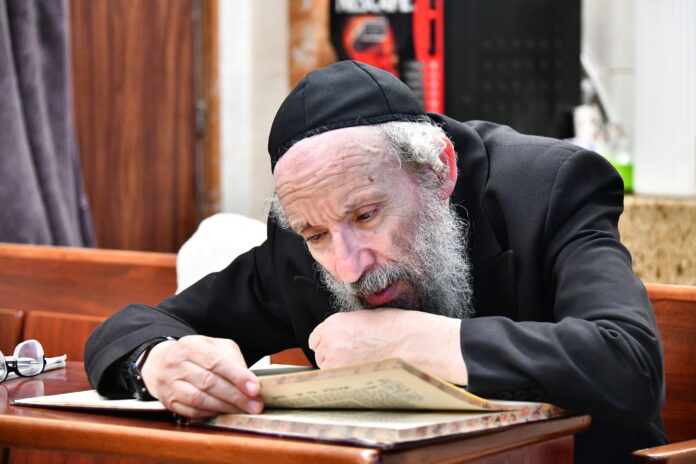

Rav Yitzchok Kolodetsky, a son-in-law of Rav Chaim Kanievsky, zt”l, is a distinguished gaon and tzaddik in his own right. Known for his asceticism and fasting daily, his brachos and counsel, particularly in matters of chinuch and shidduchim, are highly sought after. His presence leaves a lasting impression on all who encounter him.
Together with his wife, Rebbetzin Leah Kolodetsky, he provides encouragement and guidance to countless individuals. Their home is a haven for those seeking wisdom and solace.
After the October 7 tragedy, Rav Kolodetsky demonstrated extraordinary empathy for the hostages. For months he slept directly on the floor in order to share in their suffering. When winter brought illness from the cold, he continued sleeping on a thin wooden board, maintaining his austerity while safeguarding his health.
This devotion moved many families of hostages to tears. During a visit to their home, Rebbetzin Leah showed them the wooden board, underscoring her husband’s profound identification with their pain.
I recently had the merit to meet with Rav Kolodetsky. In the course of our conversation, he reflected upon—among other things—his wife’s illustrious ancestry and their enduring spiritual legacy.
Why is the Rav currently in America?
There was a shvache neighborhood that my shver, Rav Chaim, wanted to strengthen, so he decided to open a kollel there that would be l’eila u’l’eila. Baruch Hashem, it has been very successful.
Today, we have two branches, one in Pardes Katz and the other on Rechov Sokolov, with a total of 1,000 yungeleit throughout the day. This means that I am responsible for supporting approximately 6,000 children. To sustain them, we need half a million dollars every month. I have shutfim who contribute and it adds up. Once a week, I daven by the kevarim of Rav Chaim and the Chazon Ish for my shutfim to have siyata dishmaya.
That’s not a kollel, that’s a full yeshivah.
Absolutely. But I don’t give shiurim, I give shmuessen. There are many kevutzos there, and each kevutzah has a rosh chaburah.
Perhaps the Rav can share a shmuess with our readers as well.
In the beginning of Parshas Vayeishev, Rashi quotes the pasuk (Ovadiah 1:18), “V’hayah veis Yaakov eish uveis Yosef lehavah uveis Eisav l’kash—And the house of Yaakov will be a fire, and the house of Yosef a flame, and the house of Eisav straw.” Eisav has bombs. Iran has huge bombs with which they could have wiped out everyone in a single day like Haman; it could have been l’hashmid, laharog ul’abeid. But there were great nissim well above derech hateva. America, which is a non-Jewish country—there are Yidden there, but the president isn’t Jewish—threw itself into the parshah in order to help. People don’t appreciate what happened.
For 30 years Iran had been amassing terribly destructive weapons that no one could reach because they were buried so deeply, and the Israelis, with all their capabilities, couldn’t do anything about it. Why should a non-Jewish president care about that? It was derech neis, and there were several nissim involved. The commander of the Israeli Air Force, who isn’t frum, told me, “I saw Hashem in front of my own eyes. Something like this doesn’t just happen.” In the end there were no casualties even though they had to fly over a number of Arab countries to get there. After that, the Americans were able to reach those bombs and destroy them; it was mamash neis Chanukah. People don’t recognize this because they’re used to things happening, but we have to thank Hashem for the nissim. And we also have to know Who it was Who saved us.
When Yosef was born, Yaakov said that the time had come to leave Lavan and face the satan of Eisav (Rashi, Bereishis 30:25). What is the koach of Yosef that is different from his brothers? Beis Yaakov is a fire, but a fire can be extinguished. However, beis Yosef is a flame. It’s the gasoline that makes the fire too powerful to be put out. Without that power, the fire cannot destroy Eisav.
What does this mean? There are two parts: sur meira and asei tov. The sur meira of Yosef was a big chiddush. He ran away from eishes Potifar and left his cloak behind even though he knew it would be used as evidence against him. But as the lehavah, the flame, he doesn’t remain for even one extra second when there’s a possibility of an aveirah; he immediately runs away. She had been bothering him for a long time and he kept rejecting her, but now he had no other option but to flee. He was a gibbor, so he could have spent the extra second it would have taken to get his cloak away from her, but his richuk mei’aveirah was very great.
On the pasuk (Tehillim 114:3), “Hayam raah vayanos—The sea saw and fled,” the Midrash says, “What did it see that caused it to flee? It saw Yosef, about whom it says, ‘Vayanas vayeitzei hachutzah—He fled and went outside.’”
Rav Aryeh Levin, zt”l [who was Rav Elyashiv’s shver], said that when he was ten years old, the Chofetz Chaim came to their village to sell his sefarim. In those days, there were many shuls that had a sign with the words “Shivisi Hashem L’negdi Samid” hanging over the amud, and they would cover it with glass so that the smoke from the candles wouldn’t erase Hashem’s name. When the Chofetz Chaim walked into the shul and noticed that there wasn’t any glass, he asked what happened to it. The people he was talking to made gestures with their hands as if to mock the gabbai. The Chofetz Chaim realized that they might be about to say lashon hara, so he grabbed his sefarim and ran out of the shul before he could hear it, even though you’re not allowed to run in a shul.
Rav Aryeh said, “This story happened over 70 years ago, but I still remember the fear on the Chofetz Chaim’s face as he ran out. Since then, if I ever hear something that seems as if it might have even the slightest hint of lashon hara, I say, ‘Stop! Enough!’ I see the Chofetz Chaim in front of my eyes.” That’s a lehavah. It’s not enough to not do an aveirah, there has to be a flame as well. “L’olam yargiz adam yetzer tov al yetzer hara.”
In the Lederman Shul in Bnei Brak we don’t use electricity on Shabbos because it’s chillul Shabbos, so we use gas instead. As soon as the baal tefillah says Barchu on Motzaei Shabbos, all of the kids are already waiting at the electrical panel to turn it on. One time, one of the boys mistakenly turned it on right before Barchu, and the Steipler Gaon yelled out, “Mechallelei Shabbos! Mechallelei Shabbos!” We saw the lehavah of Yosef. That’s the sur meira.
What’s the asei tov? Chazal say that Yosef was an eved who obviously had to work, but he would learn Torah by heart as he was working. That’s the meaning of lehavah. He didn’t just learn when he had time; he was burning with it all day. And that’s what saved him from doing an aveirah.
The Chofetz Chaim wrote a sefer for Jewish soldiers who were serving in the various European armies and had to go through terrible nisyonos. He said that they should learn whenever they could, and just as Yosef was saved from giluy arayos in the zechus of Torah, so too would they be saved from their nisyonos.
To read more, subscribe to Ami

