
Orthodox Jewish weekly magazine founded in 2010, featuring interviews and content for the frum community.
Orthodox Jewish weekly magazine founded in 2010, featuring interviews and content for the frum community.
 Ami Magazine3 days ago
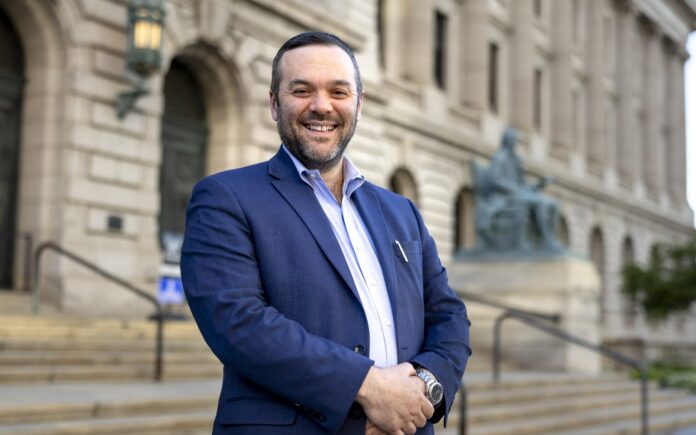
When Daniel Grand invited a small group of friends to gather in his home for davening, he never imagined that the matter would eventually make its way to the Supreme Court. What began as an effort to host an informal minyan soon evolved into a years-long legal battle over religious liberty, zoning regulations and the rights of religious communities to gather for worship in private homes.
At the center of the dispute lies a question whose implications extend far beyond one neighborhood in Ohio: At what point may a citizen challenge governmental restrictions on religious practice, and how long are local authorities allowed to delay a definitive answer before access to the courts is effectively denied? Joined by his attorney, Jonathan Gross, Grand argues that his case represents not merely a local zoning disagreement but a test of the protections afforded to religious Americans under federal law.
In this conversation, Daniel Grand and Jonathan Gross discuss the origins of the controversy, the legal battle that followed, and why they believe the case has consequences that go far beyond the limits of University Heights.
Your story really resonated with me because I occasionally try to make a minyan in a little town in New Jersey, and I’m always afraid of a knock at the door to shut me down.
I never imagined that in the United States I would have to be concerned about inviting friends over to my house to pray. I found it very strange that the mayor felt it important enough to contact me and tell me that I wouldn’t be allowed to have any kind of prayer group in my house unless I obtained a special use permit. It was something I didn’t feel very good about.
What’s the name of the town?
University Heights, Ohio. It’s a small suburb of Cleveland.
If the mayor called you personally, it must be a very small town.
Correct. It’s 1.5 miles by 1.5 miles and has about 15,000 people.
What percentage of the population is Jewish?
I believe it’s the largest Orthodox population of any city in Ohio. It’s definitely over one-third.
So it’s an Orthodox Jewish hub.
Yes. We also have the first female Orthodox Jewish mayor in the United States after the previous administration collapsed following all of the mistreatment.
How many years ago did your story begin?
It’s been going on since 2021.
I’m assuming that if you have that large a population there are a lot of shuls in the area, and you don’t necessarily need a minyan in your house.
Not everything is so organized. Also, at the time there were only two proper synagogues in University Heights, the Katz Kollel and Heights Jewish Center. Between the two of them you might have had a maximum capacity of 300 or 400 people, but there were a couple of thousand Jews living there.
Orthodox Jews come from all walks of life. What are the demographics in your neck of the woods?
We have a mix of kollel yungeleit, yeshivah bachurim, balebatim, Modern Orthodox and a nice chasidishe community in the Alexander shtiebel. The Alexander Rebbe is a descendant of the Alter Rebbe, and he’s named Schneur Zalman after him.
With which community are you affiliated, or are you unaffiliated?
I’m very affiliated. I’m a Torah Jew. My rosh yeshivah, Rav Elyakim Rosenblatt of Chofetz Chaim, was a student of Rav Henoch Leibowitz and Rav Aharon Kotler, and my rabbi, Rabbi Elihu Marcus, was a student of Rabbi Soloveitchik, so I’m a shtickel Chofetz Chaim/Brisker.
Rabbi Marcus was a pulpit rabbi for 25 years in Queens, after which he was a director of synagogues for the State of Israel. He worked for the Israeli government and put up over 3,000 synagogues. Then he went to Touro College to be the executive assistant to the president, Dr. Bernard Lander, whom I knew very well. I used to drive in every morning with Dr. Lander.
You said that Rabbi Marcus was a talmid of Rabbi Soloveitchik?
He was. When he was getting semichah back in the 1960s, there were three dayanim at the table. Rabbi Soloveitchik turned to Rabbi Marcus and said, “Mr. Marcus, we’re going to give you your semichah, but I want you to know something. When you get your teudah, you’re going to see that our names are signed on it. If a single day in your life goes by when by the time you go to bed at night you haven’t learned something you didn’t know the day before, my name is written in invisible ink.”
When he was in his mid-70s, he told me that despite having children, bar mitzvahs, hospital stays, weddings and all sorts of things, he obeyed his rabbi’s directive.
What do you do for a living?
I’m in real estate, I’m an entrepreneur, I’m in technology, and I’m also in the legal world. I went to law school but I’m not an attorney. I would say that I’m a bit of an enigma. I’m a Chovos Halevavos Yid. If I tell everyone how Hashem blesses me it wouldn’t work, so I just say that I do all these little things, but really it’s Hashem Who provides.
To read more, subscribe to Ami
 Ami Magazine3 days ago
Not far from the Gaza border, opposite Kibbutz Kfar Aza, between the cities of Sderot and Netivot, sits Moshav Yachini. A quiet, pastoral village, its entrance is lined with trees, welcoming visitors with the fragrance of citrus blossoms. According to the weathered sign at the gate, the moshav was founded by a frum settlement movement in 1950, and neither the sign nor the modest homes beyond it have changed much since. Looking at this tranquil scene today, it is hard to believe that this community lived through the horrors of October 7 only three years ago.
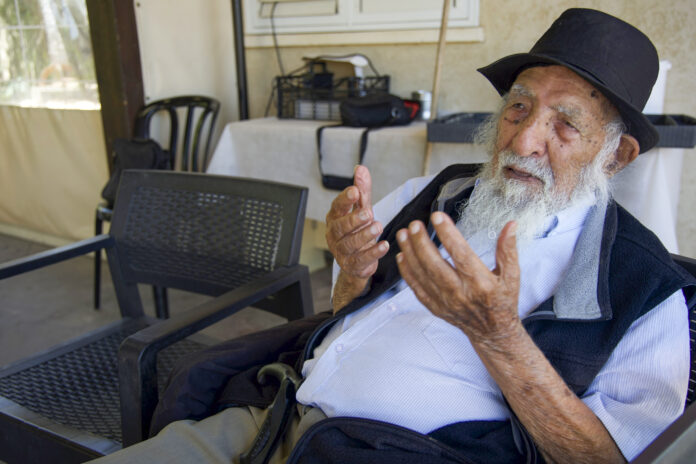
Entering the moshav, the first structure I see is a small home surrounded by trees, with a large cowshed behind it. Sitting in the yard is the homeowner, reciting pesukim from this week’s parshah b’al peh. This is Mori Salman Shlomo Hagbi, apparently the oldest person in Israel and likely one of the oldest people in the world. Born during the First World War, he is well over 100 years old.
“I’m not sure if I’m 107 or 108,” he says. “But Hashem is great. He knows. The calculation is with Him.”
Despite his advanced age, Salman’s vigor has not faded, nor has his intellect. He welcomes us warmly, his speech flowing with words of Torah and praise in the original, ancient Yemenite dialect. Salman has witnessed nearly every chapter in the history of the State of Israel. He lived through the War of Independence, the Sinai Campaign, the Six-Day War, the Yom Kippur War, and the wars that followed, up to the most recent one. He watched Sderot grow, the Negev transform, Israel evolve from a young state into the country it is today—and his own village flourish. Yachini, in fact, is full of members of the extended Hagbi family; nearly all of them are residents who came from Yemen, the majority from the same cluster of villages north of Yemen’s capital, Sana’a.
“The Hagbi family,” Salman explains, “originates from the town of Hajjbah in Yemen, most of whose residents were Jews. I was born in the town of Bilad Anis, south of Sana’a. Many Jewish communities lived in that region.
“My father was a great mori, and it was he who taught me Torah. But he worked as a merchant of jugs and pottery; he sold beautiful things. In fact, every Jew had his own trade: one was a tailor, another a shoemaker, a third a silversmith. Like my father, I too was a pottery merchant. I would set out on Sunday and return home on Friday. Everyone there was a trader, traveling through the cities of Yemen on donkeys and camels.
“My father was a great talmid chacham who studied constantly, but you should know that in Yemen, we made sure that even the rabbanim worked, because that is the ruling of our great teacher, the Rambam. So even though my father was a talmid chacham, he worked. That is how we were taught, and I believe that that is how one should live.
“Growing up in Yemen, I also devoted much time to Torah study, and I became acquainted with the great rabbanim of Yemen. They were truly great. They knew everything, the entire Torah, by heart. My father was the same; he taught me the whole Torah from memory. It is very important to learn by heart, because that way, when you set out on the road, you can review words of Torah as you go. My father knew the entire Rambam by heart. Every book of the Chumash by heart. Everything.
“As a child I only studied Torah, but later, I went to work. I married while still in Yemen. I would often travel to Sana’a and the nearby villages, selling all sorts of goods, mainly pottery. That was our livelihood.”
Yemenite Jewry is divided into two main streams: the Baladi and the Shami. The distinction refers to the two principal nuscha’os hatefillah and halachic traditions of Yemen’s Jews. Baladi—local in Arabic—refers to those who preserve the ancient, original nusach of Yemenite Jewry, based on the rulings of the Rambam. Shami, by contrast, is a later nusach that took shape in Yemen from the 18th century onward, under the influence of Sephardic siddurim that arrived from the region of Bilad a-Sham—Syria and Israel.
Hagbi proudly declares that he is Baladi and not Shami: “We are all Baladi, of course,” he says. “All of us. Only Baladi—our entire family is Baladi. Our siddur is a Baladi siddur, to this day. That is the core tradition of Yemenite Jewry. The Shamis came later and made changes. We changed nothing. And it is important not to change, because we Yemenites have the purest tradition, passed down directly from the Beit Hamikdash itself. So why should we change it?”
To read more, subscribe to Ami
 Ami Magazine3 days ago
From Potemkin villages to entire cities staged for visiting dignitaries, the use of carefully curated façades is nothing new. Countries such as North Korea have long invested in such displays, including its so-called “Peace Village,” with largely unoccupied buildings, while Turkmenistan lines its capital with gleaming white-marble veneers designed strictly for show.
The real estate market’s use of house staging operates on the same psychological principle, albeit on a far smaller and more commercial scale: presenting an idealized version of a home to shape buyers’ perceptions and influence their decisions.
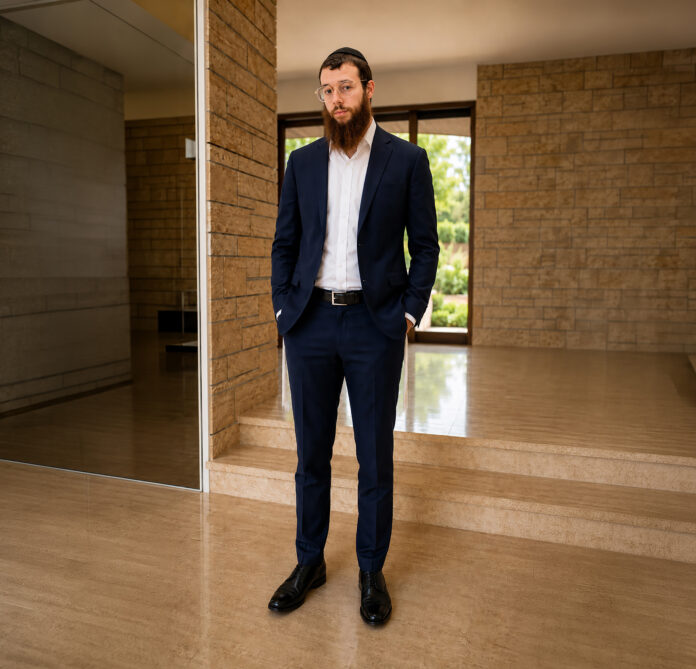
It is an industry Mendy Dubinsky has watched grow “exponentially.” When the 34-year-old founder of Fortune Stagers first entered the frum tri-state market, he faced only a single competitor. Today the field is busy, as more sellers have come to realize that an investment of a few thousand dollars can add many times that amount to the final sale price.
Dubinsky does not shy away from discussing the cost of his efforts. In fact, he makes a point of highlighting it. “If your first question is about price, we’re probably not for you,” he declares. “If it’s about ROI, let’s talk.”
But first: house staging. Like placing a fruit bowl on a table to make it more inviting, or arranging sefarim neatly on a bookshelf to give it warmth and character, staging adds small touches—an artwork here, a piece of furniture there, a well-placed accent—to make a home appear more polished and lived-in. The goal is to help potential buyers imagine the house as their future home.
According to a study conducted last year by the National Association of Realtors, staging does appear to influence buyer perception, though there is limited evidence that it significantly increases sale prices. Still, 83 percent of buyers’ agents said staging helps buyers envision a property as their future home.
Breaking that down further, 29 percent of agents for sellers reported that staging increased offers by up to ten percent, while half said staged homes spent less time on the market. However, when it comes to higher sale prices, only 17 percent of buyers’ agents reported that staging increased offers by up to five percent.
When it comes to the specific spaces inside the home, the study found that the living room is considered the most critical to stage, according to 37 percent of respondents, followed by the primary bedroom at 34 percent and the kitchen at 23 percent. In practice, most projects tackle multiple spaces at once, with 91 percent of staged homes featuring a staged living room, 83 percent including the bedroom and 69 percent covering the dining room.
Fortune Stagers report having staged more than 4,000 homes. I spoke to Mendy about how he began and what makes a successful staging.
—Yochonon
I’m from a little town called Morristown, New Jersey. Many people may have heard of it because there’s a big Lubavitcher yeshivah there. My father works there; he ran the baal teshuvah division of the yeshivah for many years, while my mother was a stay-at-home mother. I have 11 siblings, bli ayin hara.
I went through the Lubavitcher yeshivah system, learning in Morristown, Tzfas and California, and then I got smichah. In Chabad, many people go on to become shluchim—most of my siblings did; I’m one of the few in my family who went to work. There’s an interesting story here.
I wanted to go on shlichus because my father always encouraged it, telling us how special it is. He worked with baalei teshuvah, and I enjoyed growing up in that atmosphere—we always had 20 to 30 people at our Shabbos table, and I wanted to replicate that. But I also grew up without a lot of money, and I didn’t want to replicate that. So when someone offered me a job, I decided to go work and see where that would take me.
I began working for Modway, a very big furniture wholesaler in New Jersey owned by frum people. It didn’t end up working out; it was very hard for me to work for someone else, so I decided to join a very good friend of mine who was in the flipping industry.
This meant buying old properties, developing them into housing units and selling them as quickly as possible. I tried, but that also wasn’t very successful. But I noticed that my friend, who’s very good at what he does, was very into staging. He was careful to stage every home he was selling.
I offered to take over the staging for him. People saw what I did, appreciated it and asked me to stage for them as well. Eventually, I opened an official company with my brother-in-law as a partner, though I bought him out when he moved to Pennsylvania.
That’s where it started. People liked my work, I built a good reputation, and I was affordable. I realized after a while that might have been a bit of a mistake. Sometimes when you’re too affordable, you’re not so profitable. But that’s how I began in this business.
To read more, subscribe to Ami
 Ami Magazine3 days ago
There’s no way to put a gloss on the ugliness of Darializa Avila Chevalier’s and Melat Kiros’ sentiments about the US and Israel.
The former, the Democratic Party’s nominee for New York’s 13th congressional district, has called this country a “disgrace” (adding an expletive—a characteristic flourish of DSA members’ speech), bragged that once, she “just wiped my hand on the American flag behind me,” praised Vladimir Lenin, denied Israel’s existence, called Joe Biden a “war criminal” and—oh, how they eat their own—chastised Bernie Sanders for his “liberal Zionism.”
She has also attacked black and Arab men for relationships with “ugly colonizer [white] women.”
Although she has deleted most of her wilder online comments, they float in the air as testimony to her heart-of-hearts (or spleen-of-spleens) convictions.
The latter lady (using the word only literally), the Democratic nominee for Colorado’s 1st congressional district, called the 9/11 attacks the “inevitable consequence” of American actions, supports a full US arms embargo on Israel and refused to label as anti-Semitic the fatal firebombing attack on an Israeli hostage awareness march in Boulder.
Perhaps more disturbing than the unpleasant pair’s positions, though, is the reluctance of saner Democratic leaders to criticize the candidates.
House minority leader Hakeem Jeffries struggled to defend Ms. Chevalier, contending that she has “walked away from many of the things that have been unearthed.” California Representative Pete Aguilar explained that “This is a big-tent Democratic Party…there is room for you…no matter where you are.”
Should anyone happen to spy David Duke or Boston Marathon bomber Dzhokhar Tsarnaev, do let him know.
It’s easy—as many are doing—to regard the successful campaigns of Democratic Socialists of America (DSA) candidates as a harbinger of where the Democratic Party is headed. The “progressives” (who, in light of earlier racist and anti-Semitic movements, should rightly be called regressives) don’t subscribe to the traditional moderate positions of the party past, seeking, rather, to deform it into something closer to their vision. And their successes of late do indeed raise reasonable fears for the party’s future.
New York City’s DSA successfully ran candidates for state legislative seats, and the radicals have scored wins, as well, in mayoral races in, of course, New York, but also in Washington, DC, and Seattle. Erstwhile Totenkopf-tattooed oyster farmer Graham Platner is the Democratic nominee for the Senate in Maine, in one of the most competitive races in the country. And Abdul El-Sayed, who called Israel as “evil” as Hamas, while not a DSA member (just a generic version of one), is running for the Senate in Michigan.
Worth keeping in mind, though, is that the DSA victories were limited to deep blue districts. Middle America is unlikely to follow suit. What’s more, plenty of mainstream Democrats racked up primary victories in recent weeks. Even in Colorado, Senator John Hickenlooper beat a younger erstwhile DSA candidate.
And the progressives have come under fire from moderate Democrats. Jaime Harrison, the former chair of the Democratic National Committee, addressed the radicals’ bid to hijack the party, saying, “If you hate the Democratic Party, then please don’t run for our nomination… Don’t rely on our volunteers. Don’t use our infrastructure. Focus on building the party you actually support.” That would be the Communist Party.
Manhattan Democrats Vice Chair Mariama James accused DSA members of being “racist, anti-Black, anti-Semitic, anti-East Asian” and “non-Democrats,” beholden to Bernie Sanders—“a registered Independent.”
Noteworthy, too, is that Ms. Chevalier was supported by just 7% of active voters, and in a very low turnout election to begin with. She will be going to Congress, unfortunately, but her base of support was pathetically small.
And while the DSA is on track to more than double its congressional representation, that means from its current two members to five in the 435-member chamber. That’s approximately 1.15% of the body. So the radicals’ influence, even among Democratic representatives, will be limited.
Will the future, though, see further growth in the radicals’ numbers in the legislature?
There are certainly grounds for concern. But grounds, too, for hoping that the recent electoral successes of anti-American and anti-Israel candidates will prove to have been a flash in the pan, and be extinguished by mainstream Democratic voters caring enough to cast ballots, by Republican wins—and, most important, by our tefillos.
To read more, subscribe to Ami
 Ami Magazine10 days ago
New issues have so shaken the Torah world in recent years as the growing crisis surrounding the status of the bnei hayeshivos. Arrests, sanctions and increasingly hostile public rhetoric have left many in the chareidi community with the sense that a line has been crossed. Moreover, a struggle once largely confined to the political arena has spilled out into the streets, bringing with it growing social unrest.
With tensions rising and the governing coalition having already collapsed, Israel now appears headed for new elections. Many are asking whether a path back to consensus still exists.
Few public figures have been more closely involved in these developments than former Bnei Brak Mayor MK Rabbi Yaakov Asher. A senior representative of Degel HaTorah and a veteran of both municipal and national politics, Rabbi Asher has been deeply engaged in the effort to safeguard the standing of the bnei hayeshivos and the broader interests of the olam haTorah during one of the most turbulent periods the community has faced in decades.
In this candid conversation, he discusses the arrests of bnei hayeshivos, the growing social tensions surrounding the giyus debate, the future of the draft legislation and the prospect of new elections. He also explains why he believes the current moment represents far more than a political dispute; in his view, it is a defining struggle over the place of Torah in Eretz Yisrael itself.
The attempt by the government of Israel to arrest bnei yeshivah for refusing to enlist in the army—who are doing so in accordance with the express directives of gedolei Yisrael—defies logic. What do you believe this policy is intended to accomplish?
To our dismay, this is the case for many reasons. Some are political, stemming from those who seek to bring down the right-wing government. Others are objective realities arising from the current war. It is understandable that in a time of war people who do not live with emunah will fail to understand the importance of preserving Torah study and the role it has played in sustaining klal Yisrael throughout our history.
All of these factors have converged to create a campaign of incitement against the Torah-learning community and the chareidi community more broadly. They speak against all of us as a single entity, and they have sought to portray us as a fifth column in society. The struggle against us is reaching a point that could perhaps even lead to a civil war.
I’m not the biggest fan of American Vice President JD Vance, but he said something that is both painful and relevant to this conversation. He remarked that Israel believes that every problem can be solved through the use of force. In this instance, I understand that those who don’t appreciate the value of Torah study object to the present arrangement, particularly in the midst of a war. But to imagine that anything can be resolved through coercion is irrational.
People like your readers, who learned in yeshivah and were raised with emunah, know that Torah saves and protects us. Without Torah serving as our “insurance policy,” klal Yisrael would have been wiped out thousands of years ago. Yet our enemies have never succeeded in destroying us, baruch Hashem.
Unfortunately, there are many people in Israel who don’t understand this or don’t believe it. As a result, there are figures in the media and political sphere who are exploiting that lack of understanding to set these two communities on a collision course.
I have been told by askanim that a lot of the pressure is coming from the hesder yeshivos, which suffered many losses since October 7. Would you like to comment on that?
I wouldn’t say that. The fact is that the Dati-Le’umi community is highly multifaceted and encompasses a very broad spectrum. There are those who are more chardal (chareidi-le’umi) and those who are less so. There are also some who have joined the anti-chareidi chorus largely out of naivete. They attack the chareidim because they serve in the army and feel that they are paying a terrible price, and they direct their pain and disappointment toward us.
However, they don’t understand something very important: the war being waged by the media and the Israeli left isn’t only against us; we simply happen to be first in line. They will be next, because that same left-wing alliance of media figures, politicians and the Kaplanist movement views the Dati-Le’umi community and the hesder talmidim as meshichi and dangerous to the country. They don’t like them any more than they like us, and maybe even less.
The entire campaign of delegitimization being carried out against us is a means of dismantling what has become known as the right-wing bloc, which includes the Dati-Le’umi and the chareidim. If you weaken one limb of that body—the chareidim—you can bring down the entire bloc, which is their ultimate goal. All they care about is removing the right wing from the political map and gaining control of all branches of government.
This is why people from that community or the hesder yeshivos who attack us are really attacking themselves, because if we are harmed it will ultimately bring them down as well. We have been partners with them for many years on a wide range of issues. They always understood how important the olam haTorah is to us, and we always understood how important settling every part of Eretz Yisrael is to them, and we consistently supported each other. If they choose to turn their backs on us, we will not feel obligated to support them on issues that are important to them.
To read more, subscribe to Ami
 Ami Magazine10 days ago
Dov Ber (Gilbert) Weill sits on a couch in the old terminal of Entebbe Airport, his eyes moist. He is surrounded by his family, the Ugandan ambassador to the United States and a Ugandan military spokesman. On the table before him sits a plate with a large banana. Weill picks it up, peels it with deliberate care and recites the brachah over it while his family responds with amein and mazal tov.
It’s only a banana, but it tells the story of Dov Weill.
Weill was one of the hostages held at Entebbe exactly 50 years ago. During the hijacking, the terrorists distributed small portions of meat among the captives. Weill refused; the food was clearly not kosher.
“It was obvious that it was treif,” he tells me. I have joined him and his family on this return to the place where he was once held captive and then miraculously rescued.
Rather than eat anything non-kosher, he survived that week on bread and bananas. “That’s why I haven’t touched a banana in 50 years,” he explains. Today, returning to the place where his miraculous rescue occurred, he closes the circle, eating a banana for the first time since then.
The date is 6 Tamuz. At the invitation of Ugandan President Yoweri Museveni marking the 50th anniversary of Operation Thunderbolt (Mivtza Yonatan), Weill has come to visit the old terminal surrounded by his many descendants to recite the brachah “Baruch she’asah li neis bamakom hazeh—Blessed is He Who performed a miracle for me in this place.”
He was welcomed by the spokesperson for the Ugandan military, Colonel Chris Magezi, who oversaw the visit. Magezi described the hijacking as an act of terrorism that must never be repeated, noting that the successful rescue operation became a turning point in relations between Uganda and Israel. “We share a great deal with Israel,” he said, “particularly in military and intelligence cooperation and in sectors such as agriculture, technology and the global fight against terrorism.”
“I have long wanted to return here to recite this brachah,” Weill says. “Flying again wasn’t hard for me; I got back on planes right away. But it was very difficult for my wife. She almost never boarded a plane again. Her mother lived 1,200 kilometers (745 miles) away from us, and every time we wanted to visit her, we had to drive. She passed away a few years ago, and I am returning for her sake as well as in her memory.”
The Flight He Was Never Supposed to Be On
“When I look back at that summer of 1976,” he begins, “I realize that nothing happened by chance. Everything was orchestrated from above. We were never even supposed to be on that flight.”
Indeed, the story began when the couple’s return flight from Tel Aviv to Paris was delayed by four hours. Then came an unexpected, welcome offer: they were offered seats on an earlier flight. They accepted without hesitation.
“They said it would make a brief stop in Athens and then continue to Paris,” Weill recalls. “I had a short visit planned with my father-in-law in Metz, France, and from there I was to collect the children and drive home to Antwerp.”
They had no idea they were walking into a trap.
In Athens, the plane filled slowly. Passengers of various nationalities took their seats. Overhead bins closed, seatbelts clicked, and everything appeared calm and entirely unremarkable.
Of the 250 passengers on board, roughly 100 were Israeli citizens, but four were terrorists. Two of them were fair-skinned Germans; the other two were of Middle Eastern origin. Their bags were slightly heavier than usual, but their behavior gave nothing away.
Weill’s wife, Helen, of blessed memory, caught his eye and discreetly nodded toward the front of the plane. “Arabs,” she whispered. “Maybe we should find another flight?” He dismissed her concern with a wave of his hand. Getting to France on time was more important. When I ask him whether anything seemed unusual, Weill pauses.
“I remember a child who pointed at one of the bags out of pure curiosity and asked what was inside. The answer came without hesitation in a voice that was cold and detached: ‘Dates for you and grenades for your parents.’ The words drifted through the cabin without anyone taking notice, except that much later they acquired a chilling meaning.”
The plane took off, and then it happened.
“There was a commotion near the business class section and the cockpit. I immediately knew that something had happened. Then the hijackers appeared with weapons, screaming that the plane was being hijacked. I watched it all unfold in seconds and actually knocked on the window to make sure I wasn’t dreaming. This can’t be happening, I thought to myself. But I was wide awake.”
The hijackers quickly seized the cockpit and forced the pilots to change course, first to Benghazi, Libya, to refuel, and ultimately to Entebbe, Uganda.
“The German woman was the worst one of all,” Weill says. “She had a history; her husband, also a terrorist, had been killed by Israelis in a previous hijacking. She moved through the aisles collecting passports row by row and screaming at us.”
Passengers who looked Jewish quietly removed their yarmulkes, tucking them away and trying to blend into anonymity. “My wife asked me to remove my yarmulke, but I couldn’t. I’m not an actor. The terrorists in the front of the plane had already seen me wearing it, and I was determined to keep it on.”
When morning came, he wanted to put on tefillin. “For reasons I still can’t explain, I had packed my tefillin in my checked luggage instead of keeping them with me. I always took them along on every trip, and I had never put them in my suitcase before.”
Since he didn’t have his own tefillin, Weill turned to the man sitting behind him and asked if he could borrow his. The man replied, “I don’t want to put them on, but you can take them and do whatever you want.” After Weill put them on, he walked up and down the aisle asking if anyone wanted to use them. “In the end, I was the only one who put them on,” he recounts. “The others didn’t dare; everyone was paralyzed with fear. But three days later, an older man approached me. His voice trembled as he said, ‘I haven’t put on tefillin since World War II. I would like to do so now.’ I helped him put them on.”
To read more, subscribe to Ami
 Ami Magazine10 days ago
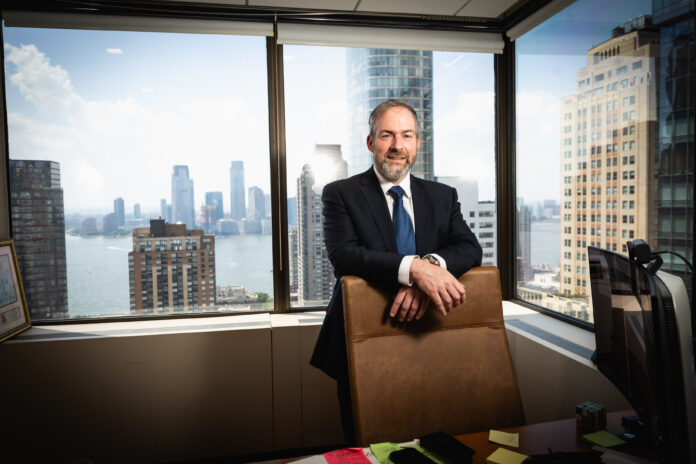
When I heard that Avi Schron was spearheading AIDapt, the upcoming AI conference, I was intrigued by what motivated him to get involved. His reasoning will likely surprise you as well.
While Avi is now sufficiently tech-savvy to build computers by hand, he started at the bottom. After several years in kollel, he began managing a single building for Cammeby’s / JCM Living, founded by his father, the well-known businessman, askan and supporter of many mosdos, Reb Ruby Schron. Today Avi and his brothers oversee the entire management side of the family business.
Reb Avi, as he should rightfully be called, also gives a daily Gemara shiur through Kinyan Hamasechta.
We spoke about property management, his unique approach to dealing with vendors, how he manages his day, and why he believes businesses need to understand that AI is far more than just a sophisticated Google search.
Enjoy!
—Nesanel
I grew up in Flatbush, the second of eight children. For elementary school, I attended Torah Temimah, which was then known as Torah Vodaas of Flatbush. I later went to Mir Yeshiva High School, then Lakewood East in Eretz Yisrael under Rav Yaakov Eliezer Schwartzman, followed by BMG in Lakewood.
“After I got married, I learned in BMG kollel for five years. At that point, an opportunity arose; my father felt it was the right time for me to enter the family business, and my rebbe, Rav Elya Brudny, recommended that I do so.
“I was somewhat entrepreneurial even as a teenager. I always had jobs—in elementary school, I was often out of class, helping the secretary fix a broken typewriter and run stencils and stuff like that; in yeshivah, I did bookbinding and took care of the candy machines for the guy who owned them; and during the summers, I worked in a camp.
“Baruch Hashem, we had a very normal upbringing. We didn’t feel we needed more than what was given to us, and we didn’t grow up in an era of asking for things. For example, before I went to Eretz Yisrael as a bachur, I was chalishing to get a new camera—a Minolta Maxxum, one of the first SLR cameras with autofocus. So I worked in camp, saved up some money, and went to the store to buy it myself. My father didn’t pay for it and wasn’t involved at all. I cherished that camera; I still have it.
“My parents taught us the importance of privacy and discretion from a young age. My father trusted us enough to share some information about his business dealings. We knew he was in real estate. I used to go to his office to play with the adding machine or the typewriter. Once, when I was a teenager, he needed some data entered into the new mainframe computer system. It was during bein hazemanim, so I was able to go in and help out.
“I was fortunate to grow up in a home where my parents were involved in many different community projects. As a result, I had the privilege of meeting many gedolei Yisrael who would often come to our house, such as Rav Chaim Pinchas Scheinberg. Rav Moshe Feinstein was a neighbor of my grandparents, so I used to see him all the time as well.
“The first assignment I was given in my father’s business was to help manage a portfolio of properties in bankruptcy that he had purchased with a partner. They set up an office specifically for this portfolio. His partner brought in his son, and my father brought me in. I had to learn everything from scratch: what a payable is, a receivable, a debit, a credit on a ledger. It was a very valuable experience.
“Over time we added more buildings to the portfolio, so I moved from managing a single building to managing managers, then to overseeing systems, building processes and hiring the people and so on. Eventually, my brothers joined the business as well, each one taking on a distinct role.
“As our operating systems became more complex, my father became less involved with them. He knows the numbers and wants to know the answers, but he doesn’t have a computer on his desk. He does not have a smartphone either. I admire him tremendously for that. My father was and is busy doing deals and taking care of the bigger picture; he still guides our decision making.
To read more, subscribe to Ami
 Ami Magazine10 days ago
An armed and violent criminal holds a gun to the head of a hapless hostage, demanding that a third party jump off a cliff.
An outlandish but apt metaphor for what’s happening on the Iran negotiation front these days.
The mullahs are unarguably armed and violent, having murdered tens of thousands of their own citizens—aside from, through their various gangland proxies, untold numbers of Americans, Israelis and others. They are holding the US hostage, with the threat of shutting down the Strait of Hormuz again (concretized by recent attacks on vessels), unless Israel—no party to the current negotiations—withdraws from southern Lebanon.
The world needs a reset here, a zooming-out to provide some perspective.
The facts: Hezbollah is a terror organization, pledged, like its patron Iran, to the destruction of Israel (and eventual Shia dominion of the world). Lebanon is barely a country and unable (despite its recent ballyhooed agreement with Israel) to control Hezbollah, which operates (read: launches missiles and drones) with impunity from its territory. Israel, to protect its citizens from their would-be murderers, has created a security zone in southern Lebanon. Iran is demanding that she withdraw and make herself vulnerable to the killers.
And recent icing on the rancid Iranian cake came last week in the form of a media outlet linked to the Islamic Revolutionary Guard Corps that contended that Iran has “no choice” but to develop a nuclear bomb.
Maybe you can make this stuff up, but only as the plot of an absurdist novel.
And now, enter the “Deconfliction Cell,” a mechanism designed to “ensure compliance with the cessation of military operations in Lebanon” outlined in the “Memorandum of Understanding” signed by President Trump and Iranian President Masoud Pezeshkian.
Mediators Qatar and Pakistan (longtime coddlers of Islamurderers) announced the plan, to be overseen by themselves, the Lebanese government and the US.
Neither Israel nor Hezbollah, the actual combatants in southern Lebanon, were mentioned in the announcement.
According to an informed source, the plan would “monitor and document Israeli cease-fire violations and establish a clear and rapid timetable for a full Israeli withdrawal from southern Lebanon.” The Lebanese Army, no match for Hezbollah forces, “would assume responsibility for areas vacated by Israeli forces.”
Dream on, says Israeli Prime Minister Netanyahu. “IDF troops in southern Lebanon,” he averred, “will have full freedom of operation to engage any direct or emerging threat to them or to the residents of northern Israel. The IDF has no restrictions in this regard.”
Israeli Ambassador to the US Yechiel Leiter, waxing diplomatic, said that Israelis “support President Trump’s [original] vision of ensuring that Iran no longer has nuclear capabilities, ballistic missiles or the ability to funnel money to its proxies to threaten its neighbors and maintain its regional hegemony.” But, he added, “the concept of ‘deconfliction’ is misplaced.”
The current ceasefire, he noted, was conditional on Hezbollah withdrawing to the north. “Is this agreement still binding?” he asked. Good question. Hezbollah hasn’t accepted it.
Mr. Leiter also took the opportunity to ask about how the US intends to assure that the billions of dollars that Iran is granted access to in the MOA (through unfrozen assets and a “reconstruction fund”) “do not find their way to Hezbollah?”
Another good question. In 2025 alone, Iran moved $1 billion to Hezbollah, according to the US Treasury Department. If currently sanctioned money is released, the terror group could recover, its weapons intact and its internal position in Lebanon only further strengthened by the very diplomacy meant to constrain it.
But Vice President Vance strives to reassure us. “Sometimes,” he told reporters, if Israel is attacked by Hezbollah, “we could have a better and more peaceful situation if Israel responds in the context of a conversation that is ongoing between Hezbollah, Lebanon, Israel and other partners in the region.”
Respond to deadly missiles and drones with… conversation!
Mr. Vance has admitted experimenting with drugs in his youth, which ended only after threats from his grandmother. Has he relapsed? Unfortunately, his bubby is no longer alive to set him straight.
President Trump has said that he was “not happy with the way Israel has handled themselves with Lebanon” and now downplays Israel’s reaction to a plan that ostensibly binds her but in which she had no say at all. “They have a lot of respect for me,” he said, “and they do as I say.”
Mr. Vance has also warned that Trump is “the only head of state in the entire world sympathetic to Israel.”
Maybe the president and vice president’s words are mere posturing, an attempt to gain credibility with the mullahs in the hope of getting them to truly commit to limit their ambitions. They need to realize, though, that to Iran, “negotiations” are just a stalling opportunity, a speed bump on the road to a nuclear weapon.
To read more, subscribe to Ami
 Ami Magazine17 days ago
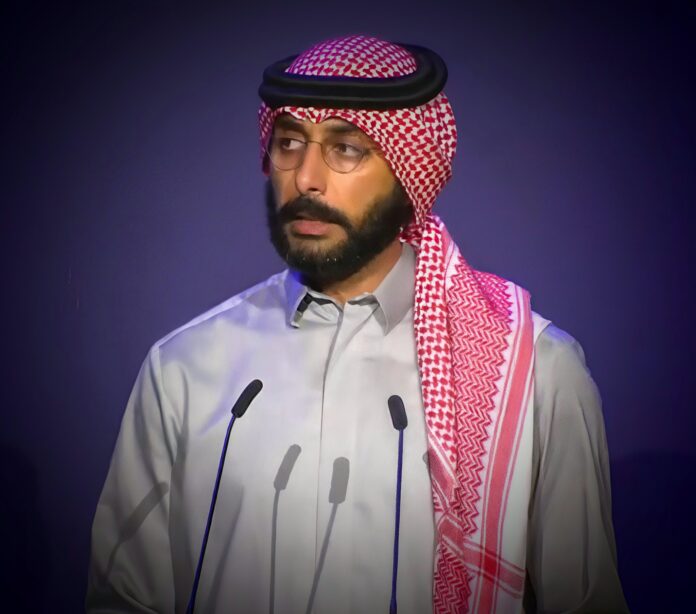
March 2026, Jasem Aljuraid drew international attention when he gave a speech before the United Nations Human Rights Council in Geneva, where he challenged prevailing narratives about Israel and condemned the UN’s disproportionate focus on it.
A Kuwaiti journalist, political individualist and refugee living in exile, Aljuraid has become one of the Arab world’s most outspoken defenders of Israel and fiercest critics of Iran, Islamist extremism and the culture of anti-Israel incitement that pervades the Middle East. However, his public advocacy has come at a steep personal cost. Forced from his homeland and living under persistent threat, he continues to speak out despite the risks.
In this conversation with Ami, Aljuraid discusses his appearance at the UN, his support of Israel, the campaign against Iran and its proxies, and the price of dissent in a region where such views can have grave consequences.
You went to Geneva, Switzerland, to speak at the United Nations Human Rights Council, which really made headlines and grabbed our attention.
Yes. I gave two speeches there. One was in Arabic in which I criticized Saudi Arabia, the radical Islamists and the IRGC, and expressed support for Yemen and Somaliland. The other was in English and focused on support for Israel. That has been my position ever since I was 17 or 18, and I’m 42 now.
What kind of reaction did you get? I would imagine that you were threatened by some and embraced by others.
For sure. I made another visit to Geneva to attend the UN Watch Gala. I spoke about how I had managed to unite the Arab-speaking nations, because all of their media outlets went after me. “It’s a good thing to be united,” I said. “But you’re united in the wrong cause.”
I got death threats afterward, but they were typical social media things like, “You Zionist! We’re going to find you. We know you’re in Ontario!” blah, blah, blah. So I started changing my address. Even now I’m not entirely safe, so I can’t reveal my exact location.
I am intentionally provoking the people who don’t want progress or coexistence to help them understand why Israel is important. My wife didn’t used to support my views. She was very skeptical, but she recently told me that she now gets it, and we’ve been married for ten years. That only came about after she saw that we share the same enemy. We are all going after the IRGC.
After you left Kuwait, why did you choose Canada over the United States?
I’m an Algonquin College alumnus, so I felt that I could continue my higher education in Canada because they don’t accept any accreditations from Kuwait. I was studying for a master’s degree in Scotland, but Canada was willing to let me use those credits toward a master’s and then become an academic. Going to the United States under Joe Biden would have been very difficult because it was very radical, and I was very openminded in my views; I was a classic liberal centrist. But these days, I don’t understand the left. I don’t know how they can collaborate with the radical Islamists, who are so far to the right.
Is your wife with you in exile?
Yes. My wife and my daughter.
How are they adjusting? You’re living in such a different climate and atmosphere.
My wife and I aren’t Muslim, so it’s easy to embrace a Western country.
Do you practice any religion?
No. I’ve been a non-believer since I was 17, and my family was fine with that because my mother’s grandmother on her father’s side was Jewish so her father was Jewish. He converted to Islam just so he could protect his kids. My mother grew up in Islam, but she also read about Judaism and felt that there was no difference between the two. They were centrist Muslims who really believed in coexistence and openness. People call this “moderate Islam,” but I don’t think there really is such a thing. To me, it just depends on how peaceful people are.
As for my father, he wasn’t a practicing Muslim, and we never hated Israel. We didn’t hate anything in our house; we were free to practice whatever we wanted. It was a unique approach, not very widespread in Kuwait. My family was educated, and my father was against the Palestinians, Hamas and the radical Islamists.
Have you been officially granted asylum?
Yes. I am now a protected person. I don’t have a passport yet, but I do have a travel document. It wasn’t easy going through all this.
Are you afraid to walk the streets or do you feel safe?
I was afraid when I was living in the city center, but that’s one of the reasons I moved elsewhere. Things are much better now.
When did life change for you?
I had been writing for the Kuwaiti daily Al-Qabas since 2015. After my father passed away, I decided to pursue confronting the radical Islamists, which is what my father had done professionally for Kuwaiti intelligence. I started to expose the radical scholars, the Muslim Brotherhood, the al-Qaeda people, the silent cells and those who were loyal to the IRGC.
In those days we had a good emir, a benevolent leader who was a liberal; his name was Sabah Al-Ahmad. But after he died in 2020 they started to go after me. They said, “This guy was protected by Sheikh Sabah, but now it’s time for revenge.”
There were many parts to how they did this, and in the end I had to pay a lot of money. The general prosecutor’s office became my home away from home. I was there once or twice a week. Sometimes I was detained for 12 hours, other times it was 24 or even 48 hours. And all this was while I was the senior vice president of Kuwait Financial Centre. Can you imagine? I was a member of the elite in my career, and I was very successful. One of the biggest investors in Kuwait Financial Centre is the publisher of Al-Qabas, which is why he was in love with my words and my work.
When I saw that Israelis had started visiting Riyadh and Medina, I said that I wished I could invite my friend Edy Cohen, an Israeli of Lebanese Jewish origin, to visit me in Kuwait. In response, a huge campaign was launched to get me fired from Al-Qabas. This was in February of 2022. It was successful.
To read more, subscribe to Ami
 Ami Magazine17 days ago
As Israel searches for new ways to counter Hezbollah’s growing threat, one unconventional initiative is drawing attention. The Israel Dog Unit (IDU), founded and directed by Mike (Yekutiel) Ben-Yaakov, has launched a pilot program to train dogs to detect incoming drones through their acoustic signatures before they become visible or most human beings can hear them.
The initiative seeks to provide soldiers with earlier warnings during combat operations, particularly at night and in poor weather conditions. It comes as Israel expands its efforts to counter increasingly sophisticated Hezbollah drone attacks while continuing military operations in southern Lebanon. Ben-Yaakov, whose organization is best known for search-and-rescue operations and locating missing people, believes that specially trained dogs may offer a simple but effective layer of protection alongside existing technology.
To learn more about the project, its prospects and limitations, and the broader work of the Israel Dog Unit, I recently spoke to Mr. Ben-Yaakov.
Unfortunately, you have your hands full. Your hands were full both before and after October 7, and they’ll probably still be full until the coming of Moshiach.
There’s never a dull moment, but it also seems that Moshiach is on his way.
I dream about getting a full night’s sleep every day, but it never happens. Then I tell myself, “You know what? I’ll catch up on my sleep between 10:00 and 11:00 in the morning, before this and before that,” but that never happens either. The work is nonstop.
What’s disturbing your sleep? Who or what is waking you up in middle of the night?
There are families of missing people and police precincts around the country that call us when they have a missing person case. There are 4,000 people reported missing in Israel every year. Obviously, we don’t go out on ten or 15 cases a day, but we are definitely watching, observing, publicizing and jumping in if we really think there’s a risk to someone’s life.
Last week we were called out, but it was nebach too late. We found the guy dead. But he would have probably never been found if not for our team because he was in a very precarious location, face-down in a river off the beaten path. We deal with these things every day.
What do your dogs do in a case like that where the missing person is so inaccessible?
It’s not just dogs. It’s dogs, drones and sometimes even horses. We use all the various means at our disposal. Each one complements the other. Dogs have sniffing capabilities that people don’t have. We use tracking dogs if we have the person’s scent, and we also have air-scenting dogs that can sniff people out if they’re alive. We divide the area into sections and go out searching with the dogs. Our job is to save lives and do whatever we can to get to the person.
It’s not that I love dogs so we have to work with them. G-d gave dogs a special ability to smell and to work together with people as a companion like no other animal, and they also complement technology, but at the end of the day we do whatever is best to find the missing person. If it’s best to send a dog, we send a dog. If it’s best to send a track drone with a dog so they can search forest areas, that’s what we do. And if it’s best to send in a horse because it can go much further and work for much longer periods of time, then we will do that.
What does the horse do?
A horse has a person riding on top of it, which allows him to be high up and cover a lot of ground. Mules are even better in some situations because they can go into hillier territory. A drone can obviously cover a much bigger area, but even if it has a thermal camera, it won’t detect someone in thick brush or under a tree, so you have to actually be there. And of course, a dog can smell things you won’t see if you’re just walking by from a distance.
How many dogs do you have at the moment?
Right now we have over 100 dogs in our programs, but not all of them are search-and-rescue or tracking dogs. We also have cadaver dogs that can detect the smell of blood and decay. In addition, we provide security dogs to dozens of Jewish towns in Judea, Samaria, the Negev and the Galilee. Our dogs are sometimes the last line of defense for farmers up in the hills in isolated areas.
We also help the IDF. Over the past few weeks 15 soldiers and civilians have been killed by Hezbollah suicide drones, also known as unmanned aerial vehicles (UAVs). These drones are very primitive but also very effective, and right now Israel doesn’t have a solution. They’re testing all sorts of technology, but in the meantime we keep reading in the papers about another soldier or civilian being killed. That’s why we’re trying to train dogs to be able to detect drones, not because of their superior sense of smell but because of their ability to hear tones that people can’t perceive. They can also hear sounds from greater distances.
If we can train a dog to be able to indicate when the drone is 200 or 300 yards away as it’s rushing toward a strategic asset, the soldiers will be able to defend themselves and maybe even down the drone. Early warning is critical.
We got a few drones that are similar to the ones Hezbollah is using and we just started our testing today, getting the dogs to indicate when they hear something. All four of the dogs we tested did pretty well. Hopefully, we will be able to increase the distance when the dogs react and we’ll have a prototype in the near future.
So this is still a work in progress rather than something you’ve already implemented.
Correct, although according to articles it’s already been implemented in India. We’re trying to get in touch with the people there who are involved. They’ve been using these “drone dogs” at the Pakistani border, and we want to replicate that. We’re trying to work as quickly as we can because this is a real problem. It’s the number one killer of IDF soldiers right now. All of the fatalities in recent days were due to these drones.
Why doesn’t Israel import some of these already trained dogs from India?
The Indian Army currently has only four of them, but they’re in the process of training 14 more.
I’ve reached out to strategic partners of ours around the world, and I’m bringing them to Israel to work closely with us so we can move forward with this project. I just spoke to one of our people from Holland who is now working in Spain. “When do you want me to come?” he asked me. “I can come in July.” “How about tonight?” I replied. “We’ll pay for your ticket.” “I don’t think I can do that,” he explained. “I have to be back in Spain next week. My son and grandson are coming to visit me from Holland.” “We’ll get you back in time,” I assured him. “Just come for two or three days and give us some tips. We’ll brainstorm.”
We’re talking to people all over the world as well as other experts in Israel because time is of the essence. Israel is investing millions of dollars in all kinds of technology, but so far they haven’t come up with any foolproof method of detecting and neutralizing these drones. I hope we can play a role in this historic mission. It’s a race against the clock.
To read more, subscribe to Ami
 Ami Magazine17 days ago
The decision by President Trump to make a peace deal with the Iranian regime stunned world leaders and sent Israel’s politicians into a tizzy. The details of the agreement have not been officially released yet, but the deal reportedly includes a ceasefire for Israel in Lebanon and perhaps a withdrawal, one that was negotiated without Israel’s involvement.
Trump’s Signature, Netanyahu’s Humiliation
The strike in Beirut’s Dahiyeh district was intended to preserve Israel’s deterrence vis-à-vis Iran and perhaps even derail their negotiations with Washington. The result was the opposite: Trump accelerated the talks, signed an agreement and left Netanyahu facing the greatest diplomatic failure of his political career—one that could ultimately bring it to an end.
On Sunday afternoon, Israeli Air Force jets struck a Hezbollah command center in the heart of Beirut’s Dahiyeh district, the organization’s main stronghold in Lebanon. The strike was carried out in response to Hezbollah rocket fire into Israeli territory and in accordance with the policy announced by Prime Minister Netanyahu, under which any Hezbollah attack on Israel would be met with strikes against targets in Dahiyeh. Israel proceeded with the strike despite Iran’s attempts to establish a counter-deterrence equation of its own, under which an Israeli attack on the Lebanese capital would trigger a direct Iranian response against Israel.
According to an IDF spokesperson, the targeted facility served as a command center for Hezbollah’s communications network. The statement said that the strike was carried out “in response to Hezbollah fire directed at Israeli territory” and “in accordance with the instructions of Prime Minister Binyamin Netanyahu and Defense Minister Yisrael Katz.”
In line with the deterrence framework publicly outlined by Tehran, Iranian officials announced after the Israeli strike that missiles would be launched at Israel. Israel’s security establishment immediately placed air defense systems on high alert and began preparing offensive contingency plans for a possible retaliatory strike against targets in Tehran.
Within Israel’s political and security echelons, some believed that the strike in Beirut was driven by broader considerations extending beyond the defense of Israel’s sovereignty: an attempt to disrupt the advanced negotiations between Iran and the United States over a memorandum of understanding that would reopen the Strait of Hormuz and address the Iranian nuclear issue. The assumption was that an Israeli strike would provoke an Iranian response, which in turn would trigger further Israeli retaliation—as had occurred only a week earlier—thereby delaying an agreement that was already on the verge of being signed. Instead, the outcome was precisely the opposite.
Fearing a rapid slide into direct confrontation, President Trump moved to accelerate negotiations with Tehran. In exchange for Iranian restraint and a commitment not to retaliate militarily, he reportedly showed a willingness to compromise on provisions that he had previously presented as non-negotiable red lines.
As of this writing, the full details of the memorandum of understanding between Iran and the United States remain unclear. One thing, however, is already evident: judging by the jubilant reaction in Tehran and Netanyahu’s prolonged silence on the details, the deal is not good for Israel.
Finance Minister Betzalel Smotrich went so far as to describe it as “a bad deal for Israel and for the entire free world.” According to Smotrich, “We will have to continue the campaign to bring down the regime on our own and through creative means, while ensuring that Iran never acquires nuclear weapons.”
National Security Minister Itamar Ben-Gvir was equally blunt in his criticism. “Trump’s agreement does not bind us,” he declared. “Israel is not subordinate to the United States. We are an independent and sovereign nation. Let us be clear: we love America and are grateful to President Trump. At the same time, the State of Israel is not a banana republic.”
Beyond revealing how senior cabinet ministers view the agreement, these statements also reflect a blatant attempt to distance themselves from what many on the Israeli right perceive as a strategic failure and to pin the responsibility squarely on Netanyahu’s shoulders. Whether they will succeed in doing so remains doubtful, given that the same ministers granted the prime minister virtually unlimited political backing throughout the Iranian crisis.
Opposition MK Avigdor Lieberman captured this sentiment succinctly: “Had this agreement been signed under our government, Netanyahu would have accused us of treason.”
It is difficult to imagine a more humiliating conclusion to Netanyahu’s decade-long campaign against Iran’s nuclear ambitions.
To read more, subscribe to Ami
 Ami Magazine17 days ago
Turns out there was a good reason for the administration delaying public release of the signed “memorandum of understanding” (MOU) with Iran, for allowing only dribs and drabs to be leaked to the media over the course of several days.
Because the “deal,” such as it was, was, in effect, a declaration of surrender in the war begun on February 28. Iran’s claim that the MOU was a “humiliat[ion of] American and Zionist enemies” was pretty much on-target.
Some see President Trump’s penchant for contradicting himself and asserting things that are demonstrably false as his superpower; it keeps adversaries in the dark, confused and on their toes. Others see it less generously. But his remarks about the MOU brought his dissembling to a new level.
The man who had repeatedly demanded Tehran’s “UNCONDITIONAL SURRENDER” [sic] and who told the Iranian people to “take over your government!” since “America is backing you with overwhelming strength,” now describes the mullahs as “very rational people” who are “not radicalized” and “nice to deal with.” And who now insists that he “never cared about regime change.”
The president, who has been a great friend to Israel until now, once described the destruction of Iran’s ballistic missiles as one of the war’s goals. Now he thinks that, “If other countries have them, it’s a little bit unfair for them not to have some.” (Other countries have them, of course, for self-defense, not for attacking countries they consider to be “satans.”)
Am I being too judgmental? Well, I’m in good company.
“There’s a word for this: debacle” was New York Times columnist Bret Stephens’ take on the MOU. “This pretense of a peace is an act of geopolitical self-harm that will haunt our standing in the world for years to come.”
Republican lawmaker Bill Cassidy called the agreement “the worst foreign policy blunder in decades.”
“A disaster that does not achieve any of the actual…goals that were set by the administration at the beginning,” said Ben Shapiro.
Iran played the president “like a violin” was former National Security Adviser John Bolton’s conclusion.
“Trump isn’t thinking about the geo-strategic implications of the deal,” explains Mr. Bolton. “He’s thinking of one thing. He wants the strait open… He wants the price of gasoline at the pump down. That’s all he cares about.”
The MOU boasts that Iran agrees to “not procure or develop nuclear weapons.” So, of course, did the JCPOA, the Obama plan—and there, with details. In 2018, Israeli intelligence procured secret Iranian files that proved Iran had a clandestine nuclear weapons development program. Liars gonna lie.
On the most important issues, the MOU’s timidity and vagueness are nothing short of remarkable.
The single paragraph that addresses Iran’s nuclear program requires the country to “down-blend” the approximately 11 tons of enriched nuclear material it holds, much of it enriched to just short of bomb grade. But it does not require Iran to surrender that material and ship it out of the country.
The Obama agreement (called “disastrous” by the current president) required Iran to ship approximately 98% of its enriched uranium stockpile—then, well below bomb grade and much smaller than today because of Mr. Trump’s withdrawal from JCPOA—out of the country.
Vice President Vance, trying to defend the MOU, said, “If you think this is a bad deal, what is your alternative?”
Irony abounds. In 2015, amid attacks on the JCPOA deal, President Obama said: “I’m hearing a lot of…‘this is a bad deal.’ What I haven’t heard is, what is your preferred alternative?”
The incurable optimist in me argues that, even if the MOU leaves the most important issues unresolved, perhaps the future negotiations will yield something stronger than the JCPOA deal. After all, Iran has now experienced military attacks that could be resumed. Indeed, President Trump, capricious as always, after waxing cool in his adulatory words about the mullahs, reverted to waxing hot, saying, “If [Iran’s leaders] don’t behave, we’ll go right back to dropping bombs right smack in the middle of their head, OK?”
Then again, the mullahs can also go back to enriching uranium and blocking the Strait of Hormuz.
To read more, subscribe to Ami
 Ami Magazine24 days ago
The decision by President Trump to make a peace deal with the Iranian regime stunned world leaders and sent Israel’s politicians into a tizzy. The details of the agreement have not been officially released yet, but the deal reportedly includes a ceasefire for Israel in Lebanon and perhaps a withdrawal, one that was negotiated without Israel’s involvement.
Trump’s Signature, Netanyahu’s Humiliation
The strike in Beirut’s Dahiyeh district was intended to preserve Israel’s deterrence vis-à-vis Iran and perhaps even derail their negotiations with Washington. The result was the opposite: Trump accelerated the talks, signed an agreement and left Netanyahu facing the greatest diplomatic failure of his political career—one that could ultimately bring it to an end.
On Sunday afternoon, Israeli Air Force jets struck a Hezbollah command center in the heart of Beirut’s Dahiyeh district, the organization’s main stronghold in Lebanon. The strike was carried out in response to Hezbollah rocket fire into Israeli territory and in accordance with the policy announced by Prime Minister Netanyahu, under which any Hezbollah attack on Israel would be met with strikes against targets in Dahiyeh. Israel proceeded with the strike despite Iran’s attempts to establish a counter-deterrence equation of its own, under which an Israeli attack on the Lebanese capital would trigger a direct Iranian response against Israel.
According to an IDF spokesperson, the targeted facility served as a command center for Hezbollah’s communications network. The statement said that the strike was carried out “in response to Hezbollah fire directed at Israeli territory” and “in accordance with the instructions of Prime Minister Binyamin Netanyahu and Defense Minister Yisrael Katz.”
In line with the deterrence framework publicly outlined by Tehran, Iranian officials announced after the Israeli strike that missiles would be launched at Israel. Israel’s security establishment immediately placed air defense systems on high alert and began preparing offensive contingency plans for a possible retaliatory strike against targets in Tehran.
Within Israel’s political and security echelons, some believed that the strike in Beirut was driven by broader considerations extending beyond the defense of Israel’s sovereignty: an attempt to disrupt the advanced negotiations between Iran and the United States over a memorandum of understanding that would reopen the Strait of Hormuz and address the Iranian nuclear issue. The assumption was that an Israeli strike would provoke an Iranian response, which in turn would trigger further Israeli retaliation—as had occurred only a week earlier—thereby delaying an agreement that was already on the verge of being signed. Instead, the outcome was precisely the opposite.
Fearing a rapid slide into direct confrontation, President Trump moved to accelerate negotiations with Tehran. In exchange for Iranian restraint and a commitment not to retaliate militarily, he reportedly showed a willingness to compromise on provisions that he had previously presented as non-negotiable red lines.
As of this writing, the full details of the memorandum of understanding between Iran and the United States remain unclear. One thing, however, is already evident: judging by the jubilant reaction in Tehran and Netanyahu’s prolonged silence on the details, the deal is not good for Israel.
Finance Minister Betzalel Smotrich went so far as to describe it as “a bad deal for Israel and for the entire free world.” According to Smotrich, “We will have to continue the campaign to bring down the regime on our own and through creative means, while ensuring that Iran never acquires nuclear weapons.”
National Security Minister Itamar Ben-Gvir was equally blunt in his criticism. “Trump’s agreement does not bind us,” he declared. “Israel is not subordinate to the United States. We are an independent and sovereign nation. Let us be clear: we love America and are grateful to President Trump. At the same time, the State of Israel is not a banana republic.”
Beyond revealing how senior cabinet ministers view the agreement, these statements also reflect a blatant attempt to distance themselves from what many on the Israeli right perceive as a strategic failure and to pin the responsibility squarely on Netanyahu’s shoulders. Whether they will succeed in doing so remains doubtful, given that the same ministers granted the prime minister virtually unlimited political backing throughout the Iranian crisis.
Opposition MK Avigdor Lieberman captured this sentiment succinctly: “Had this agreement been signed under our government, Netanyahu would have accused us of treason.”
It is difficult to imagine a more humiliating conclusion to Netanyahu’s decade-long campaign against Iran’s nuclear ambitions.
To read more, subscribe to Ami
 Ami Magazine24 days ago
The figure standing behind the podium in front of the mosque prefaced his words with the traditional Muslim invocation: “Bismill-hir Rahmanir Rahim—in the name of All-h, the merciful, the compassionate…” His lilting, slightly off-key rendering echoed throughout the large room.
As mosques go, this was no shtiebel-sized converted storefront where Muslims gather to pray. It was a huge Islamic center located in Jamaica, Queens, infamous for being headed by an imam who denied that the October 7 massacre had taken place and who has called for more 9/11-type attacks on the United States.
If you’re wondering about that figure standing at the podium, it was none other than Brad Lander, the controversial candidate in the upcoming Democratic primary for Congress in the 10th district.
After his invocation, Lander launched into a diatribe against Israel, falsely accusing it of committing genocide in Gaza and adding that he also considered the war against Hezbollah to be turning into a “genocide in Lebanon.” After finishing his remarks, the imam of the Al-Khoei Foundation took over, wailing a prayer calling for “the killing of the kafirs (non-Muslims) by the sword.”
Lander’s shocking appearance at the mosque last month has saddened—but not surprised—many who have gotten to know him over his nearly two decades in elected office. Lander has always presented himself as a proud Jew; he has proudly introduced himself as “Baruch Shmuel” and called himself a “progressive Zionist” whose loyalty to the Jewish community was sacrosanct.
And yet he is now virtually indistinguishable from AOC, Rashida Tlaib and Ilhan Omar, the members of Congress with whom he promises to coalesce if he wins the congressional race this year. The prospect of a strengthened Squad—the so-called caucus of rabid anti-Israel lawmakers, especially with the addition of someone representing one of the largest Orthodox Jewish districts in the country—is horrifying to many people.
Although the Democratic Party has lurched to the left over the past few years, a majority of its lawmakers still profess to care about Israel’s defense. While the Democrats have turned AIPAC—one of the most powerful lobbying organizations in the country, dedicated to strengthening the partnership between America and Israel—into a pariah, they still accept its money through third-party arrangements. These Democrats will issue statements critical of Prime Minister Binyamin Netanyahu and cheer the blacklisting of Betzalel Smotrich and Itamar Ben-Gvir, leaders of two right-wing Israeli parties, but will not vote to cut military aid to Israel.
The rise of Brad Lander’s candidacy, however, threatens to confer mainstream legitimacy on the growing wing of Democrats who are itching to change that. Add the fact that Lander, who once had a reputation as an advocate for yeshivos, has now turned into one of their biggest foes, and you will understand why askanim are calling this the most important election this cycle.
Lander’s opponent, the incumbent Rep. Dan Goldman, has been a relative moderate on Israel, refusing to term Israel’s war on Hamas genocide and helping Americans who were stuck in Israel during the airline closures with passport issues.
The Democratic primary will be held on Tuesday, June 23.
From Uneasy Ally to Unabashed Foe
Lander is one of three Jews who were supportive of Israel but underwent radical shifts when they saw that as a path to higher office. Along with Daniel Biss in Illinois and Scott Wiener in California, the abrupt transfer of allegiance has been baldly opportunistic.
Still, Lander’s behavior is an enigma to many people. To get their take on the situation, I reached out to a number of askanim, community leaders, yeshivah administrators and political activists who remember him from his early days. About half of them responded, most insisting that they would only talk on condition of anonymity.
The majority traced Lander’s change of heart to his ascent in 2021 to the position of New York City comptroller, which was seen as a stepping stone to higher office. Some pointed to an earlier time, when Donald Trump became president in 2016 and Lander’s progressive allies, such as Linda Sarsour, started a campaign protesting the new administration, which also turned into an anti-Israel fest.
“I think it started when he decided to become a progressive, and part of being progressive is being anti-Israel,” one askan with close ties to Lander said. “He was once totally opposed to BDS, and now he’s a fervent supporter of it. He has really gone way, way over to the left.”
As late as 2019, Lander shared a piece by Batya Ungar-Sargon, a right-wing commentator, pushing back on the BDS movement: “Please read this sharp piece by @bungarsargon on why American Jews must oppose BDS-blacklisting legislation,” Lander, then a city councilman, posted. “Especially if (like me) you care about Israel & do not support BDS. We’re acting in ways that threaten to undermine things we love & depend on.”
Compare this to what he recently said in the run-up to a vote at the Park Slope Food Co-op on whether to boycott Israeli products: “Boycotts, divestments and sanctions are legitimate tools of advocacy campaigns. Unlike my opponent, I don’t believe all opposition to Israel is anti-Semitic.”
In 2009, when he ran for City Council in a district that included a chunk of Boro Park, Lander lost that portion of the district by around 90 percent. Nonetheless, he managed to win the endorsement of some Jewish notables, including Dov Hikind, then a state assemblyman and something of a community power broker.
To read more, subscribe to Ami
 Ami Magazine24 days ago
Ari Ackerman is a busy man, even though he doesn’t need to be. As the founder of Bunk1, an online app designed to help parents receive updates on their children in summer camps, Ari was technologically years ahead of the curve. By the time he sold the app, it had garnered hundreds of thousands of clients.
After the sale, Ari diversified, investing in several different ventures, including a minority ownership stake in the Miami Marlins baseball team.
After October 7, though, Ari directed his time and energy into defending Jewish people online. In his position as advocate, Ari has been featured in dozens of media outlets, including ABC, CBS, NBC, CNN, CNBC, The Today Show, The New York Times, Crain’s and the Wall Street Journal.
Ari also sits on the board of several Jewish non-profits.
We discussed his career, his definitive piece of advice for anyone starting a business and what drives his activism.
Enjoy!
—Nesanel
I was born and grew up in Manhattan. I have one sister who is two years younger than me. My mother was born in Israel, my father was born in the United States, and both of them grew up in Great Neck. The Ackerman side came over from Hungary two generations ago, and they ran a taxicab business here in the United States. Until a few years ago, you could still spot the Ackerman name on some of the cabs around the city. It was inherited over the years, but we don’t own the cabs anymore. My father was always in real estate.
“My parents got divorced when I was seven or eight years old. My father remarried and I lived with my mother. She and her father, my grandfather, were my role models. My mother, Dr. Mona Riklis Ackerman, was a psychologist. Sadly, she passed away 14 years ago, in her 60s. She was my hero, an incredible human being; she taught me everything. My sister and I always joke that our home was like a Jewish catering hall, because my mother would host every Jewish philanthropic organization that existed. She showed me the importance of giving back to the community.
“My grandfather, Meshulam Riklis, played a similar role for me. He taught me so many important things in life. His parents had moved from Odessa to Israel. He grew up in Tel Aviv, married very young and then immigrated to the United States after my mother was born.
“I went to a Jewish day school, a Modern Orthodox yeshivah. I wouldn’t call us particularly religious, but we would have Shabbat dinner and things like that. There is nothing I feel more proud of in my heart than being Jewish. I often go to synagogue on Shabbat, and I always go on Rosh Hashanah and Yom Kippur.
“Last year, my rabbi, Rabbi Haskel Lookstein at Kehilath Jeshurun, gave me a tremendous honor: he asked me to open the aron before Ne’ilah, and in his speech to the congregation, he praised my work on behalf of the Jewish people. That was very meaningful to me. When he first called to tell me he wanted to do this, I objected because I’m not that religious and didn’t think it was appropriate. Rabbi Lookstein answered, ‘No, Ari, you are religious. You’re just not as observant as some of us.’
“I was entrepreneurial from the very beginning. My sister and I used to set up stands on our block where we would sell whatever we could—lemonade, toys, books. I was about eight years old when I looked at the bookshelves in our home and thought to myself, ‘I could make money on these.’ I had no idea what they cost, yet I went through every single book, put a price on each one, carried them all downstairs, and set up a stand to hawk them. Whenever we got those mail offers to make money selling plants or seeds, I ordered them and tried to make it work, because that kind of hustle was always who I was.
“I began college at Duke University as an economics major but graduated with a degree in political science and a Judaic studies certificate. Until then I was not especially religious, but at Duke I became known as ‘Rabbi Ari,’ the guy everyone came to with their Jewish questions.
“My first real job was on Capitol Hill, working as a legislative assistant for Congressman Gary Ackerman, to whom I am not related. I do happen to have an uncle named Gary Ackerman, and the congressman has a son named Ari, so as a congressional staff member I had to sign all these anti-nepotism forms confirming that I was not related to him.
“I loved politics, and I still do, but I always saw myself more as an entrepreneur and a businessman, and I realized that being a career political operative was not going to work for me financially. I believe in following your interests, so I went to graduate school to earn an MBA. At Northwestern’s Kellogg School of Management, I majored in finance, marketing and entrepreneurship, and in my final semester I took a venture capital class taught by a great professor named Barry Merkin, who became a very close friend of mine.
To read more, subscribe to Ami
 Ami Magazine24 days ago
If the name Sam Harris doesn’t ring a bell, it’s because you’re blessedly not into the world of podcasts.
Neither am I, but Mr. Harris, holder of a PhD in cognitive neuroscience and a philosopher, is a popular podcaster. Although he is halachically Jewish, he is an avowed secularist, not someone who might be expected to feel any connection to Judaism or Israel.
Which is why those who consider him a highbrow of the highest caliber have been dismayed by his bucking of the Israel-hatred that has become mandatory among the imperious intelligentsia. They can’t understand how he missed the memo.
Recently, to address his dismayed disciples’ puzzlement, he wrote a 2,000-word tour de force, audaciously titled “Why I won’t debate critics of Israel.” It has been widely shared.
Mr. Harris is no knee-jerk defender of any Israeli action or leader, but has no interest in “exploring all the ways that Israel has missed the mark.”
He is interested only in the larger picture, the one that, in a reasonable world, would obscure all else. “The ethical difference between Israel and her enemies,” he states, “remains vast.” And “the global preoccupation with the Jewish state, as though it were the worst villain among nations, is contemptible… the product of perennial lies and delusions.”
Strong words, made all the stronger by his elaboration.
Militant Islamists, he contends, are “essentially Nazis who are certain of Paradise.”
Were the IDF ever to “morph into a death cult that uses its own civilian population as human shields,” he fantasized, “if ordinary Israelis begin to celebrate martyrdom…producing generations of bright-eyed, suicidal fanatics, if the residents of Tel Aviv [would] condone the taking of Palestinian infants, old women, and other noncombatants as hostages and then gather in crowds of thousands, baying for their blood—if, in other words, the Israelis began to resemble the Palestinians, then I won’t care who wins this war.”
But of course, he continues, “there remains a world of difference between the two sides, and I believe that we should focus on how brutalizing it is for any free society to confront enemies that can sincerely claim to ‘love death’ more than everyone else loves life—for this has been Israel’s predicament for the better part of a century.”
Cutting sharply through all the “pro-Palestinian” obfuscation, he explains that “The problem in the Middle East is not, and has never been, the existence of the State of Israel.” It has been “jihadism… the belligerence and triumphal lunacy of those who take the most pernicious doctrines of Islam too seriously.”
Disentangling every strand of the region’s history is “a fool’s errand,” he further contends, “because Palestinians and Israelis have discrepant accounts of the past, and no amount of study or debate will reconcile them.”
All that matters in the here and now, he declares, is “what the current inhabitants of Israel, the Palestinian territories, and the surrounding Arab states want out of life now… What are they willing to sacrifice for? What are they willing to die for? And what are they willing to let their children die for?”
There is much more in Mr. Harris’ piece, but the following paragraph really says it all:
“If the Palestinians laid down their arms, there would be peace. There could be a two-state solution; there could even be a one-state solution… If the Palestinians simply stopped killing Jews and stopped building a culture that celebrates pointless murder and martyrdom as its highest values, there could be a diverse, tolerant, and prosperous society between the Jordan River and the Mediterranean Sea. There could have been one 80 years ago. But if the Israelis laid down their weapons, there would be a genocide. This was obviously true on October 7, 2023. And for anyone who has been paying attention, it has been true on every other day since the founding of the State of Israel.”
Words worthy of being displayed on every billboard in Europe and posted in every American university classroom.
To read more, subscribe to Ami
 Ami Magazine1 month ago
A mashgiach staying in a small apartment inside a factory in a small town in Idaho. A graduate of a Christian college in Memphis who is married to the daughter of a Baptist missionary. A Jew living up a path in the woods in Arkansas.
They’re all learning Daf Yomi.
For the last half a year, Aryeh Gelbard, a filmmaker from Flatbush, has been taking trips across America, looking for the stories of people who are learning the daf. Over 50 weeks, leading up to the worldwide Siyum HaShas, he will be releasing short videos on WhatsApp and a website, showcasing interesting people learning the daf in every one of the 50 US states.
He is still in the process of traveling and making those videos, and he is still planning how to find the daf learners he is looking for. I was able to sit down with him and get the tour of both what he has done and what he is planning.
“Torah is taking place in America in places you don’t even realize,” he told me. “There’s Daf Yomi in Lakewood and in Williamsburg and in Monsey and in Passaic and in Chicago. But it’s also happening in Metairie, Louisiana; in Matthews, North Carolina; and in Bozeman, Montana. It’s happening all over the place.
“You’d be shocked that people who are not religious are learning Gemara.”
Enthusiastic about the Daf
One of the first things that Aryeh told me when I first spoke to him was that he is enthusiastic about Daf Yomi. Extremely enthusiastic.
“The daf is my life,” he told me.
That starts with his own learning of Gemara, with multiple daily and weekly chazaros of the daf. When we sat down, he couldn’t help himself; he had to talk with passion about the connection he felt with the Tanna’im and Amora’im, after carefully paying attention to who was talking to whom in the dapim of Shas that he has been learning. Daf Yomi is clearly imprinted on his personality.
But it has extended outward as well. In the past, he’s been heavily involved in the significant growth of major Daf Yomi chaburos.
Aryeh is someone who has been in the world of general Torah learning for a long time. At one point, I noticed his semichah from Torah Vodaas, which is signed by Rav Yisroel Belsky but states that he was farhered for part of the semichah by Rav Avraham Pam—a unique semichah document.
But Daf Yomi, which he started in full three cycles ago, has clearly changed his life; he spends so many of his waking hours involved in learning and chazering it. He can’t stop extolling the power of Daf Yomi and the foresight of Rav Meir Shapiro in establishing it. He has become a walking booster of the energy you get learning through all of Shas with klal Yisrael. And it’s clear by the time I’m done speaking with him that this project, where he is out on the road hunting for the stories of other people whose lives have been changed by the daf, is part of that, his obsession and love for Daf Yomi.
He sees this project as a way of giving inspiration to those learning Daf Yomi and those who may have fallen off from their learning or never started to keep learning. He has also realized that it is bringing people who have little connection to Yiddishkeit but who have connected to Daf Yomi to strengthen their Yiddishkeit. There is a unity of klal Yisrael through Daf Yomi that he believes can be reinforced through this project.
“People don’t realize the effects that Torah Sheb’al Peh and Daf Yomi can have on their lives,” he said.
One fascinating point I learned as I spoke with him was that while he came into it with the advice of gedolim and rabbanim, there was an element of it that he had jumped into with a level of abandon—almost recklessness—that only obsession and love can bring about.
Finding the learners
If you asked me how to find people learning Daf Yomi in every one of the 50 states, I’d immediately know that there are some states where it would be very easy to find people and some where it would be very hard. In New York, Florida or California, there would be no problem, of course. But what about Montana or Idaho?
To read more, subscribe to Ami
 Ami Magazine1 month ago
The exchange rate once buried in the business pages is reshaping Jewish life in Eretz Yisrael
Yitzchok Margolis is a typical American living in Yerushalayim and learning in kollel. He described how the strength of the shekel is affecting him and his fellow young couples.
“When my wife and I came to Eretz Yisrael two years ago shortly after our wedding, we did so knowing that my parents had committed to contribute $1,500 a month and my in-laws to another $1,500. On top of that, I was earning a small stipend from the kollel while also doing some tutoring on the side. My wife worked remotely for an American company. Together, our income added about $2,000 a month.
“All told, we had a monthly budget of roughly $5,000. At the time, that seemed manageable. We rented a two-bedroom apartment in the Sorotzkin neighborhood for 8,000 shekels a month, which worked out to about $2,300. Between rent, groceries, utilities, transportation and all of our other expenses, our monthly costs totaled around $4,800.
“We weren’t living extravagantly by any stretch. We watched our spending carefully and counted every dollar, so we were able to get by and even maintain a small cushion for unexpected things. It gave us a sense of stability as we began our married life together. But that’s gone now.”
The tumbling dollar and surging shekel have changed the picture completely. That same apartment now rents for nearly $2,800 a month, while food, utilities, arnonah (municipal property taxes), childcare and other expenses have similarly increased. The same $5,000 that once covered their needs now falls hundreds of dollars short, and the monthly support they receive from their parents in America no longer stretches as far as it used to.
“We really tried to make it work,” Margolis told me. As the dollar weakened, his wife took on additional sheitel work in her spare time, and he even withdrew money from an investment account that had been funded with his bar mitzvah money. “At a certain point, there’s nothing left to do. We aren’t wealthy people. Our parents had sacrificed enough, and we realized we had to go back.”
With a heavy heart, he made the painful decision to relocate to Monsey this summer, where he hopes to join a kollel for the upcoming Elul zman. For now, the dream of building their lives in Eretz Yisrael has been deferred by something as mundane—and as powerful—as an exchange rate.
And Margolis is not alone.
“We know of 20 couples who are also leaving. Some of them are my wife’s friends, some of them are mine. Even couples who receive more support from their parents than we do can’t make it. They had rented more expensive apartments based on that income, and they’re now finding their rent anywhere from $500 to $1,000 higher.”
Across Eretz Yisrael, thousands of American families whose income, savings or parental support are tied to dollars—while their expenses are paid in shekels—are confronting the same reality. What was once little more than an afterthought for most people has become a defining financial force that is reshaping people’s lives. Large organizations and some corporations have also felt the bite of the strong shekel.
Even with the brief fluctuations we saw on Monday as Israel and Iran sparred, the dollar is no longer worth anywhere near the number of shekels it once was, and it’s been hard to adjust to that.
Whatever Happened to 3.6?
When I first came to Eretz Yisrael in 2011, I suffered from a common condition that afflicts many financially illiterate foreigners: treating shekels like Monopoly money. You’d hand over a $100 bill and suddenly walk away with a thick stack of hundreds of shekels. With a wallet bulging with bills, I felt like an instant Rockefeller. Never mind the actual cost of anything; I was rich. Combined with my inability to resist buying food whenever I felt slightly hungry and my questionable mathematical skills, this was a recipe for disaster. I’d glance at a price tag, do some quick (and usually wrong) arithmetic in my head, and make the purchase without a care. Unsurprisingly, I spent much more money than I intended with only the vaguest idea of where it went, leading to the inevitable sheepish calls to my parents in America asking for another deposit in my bank account.
That dependable exchange rate of 3.57 shekels to the dollar that once enabled my carefree spending remained the average for nearly 15 years. Tourists, yeshivah bachurim and seminary students, investors and families supporting kids in Eretz Yisrael could all count on their dollars going a long way. Today, however, a stronger shekel, driven by a mix of market forces and economic policies, has made virtually everything in Israel far more expensive.
To understand the human impact behind the exchange rate, I spoke with leaders of nonprofits, real estate professionals, tourism veterans, young couples and parents overseas. Their stories reveal a seismic shift that is reshaping life in the Holy Land.
To read more, subscribe to Ami
 Ami Magazine1 month ago
This past Wednesday, the now annual ReDeal real estate summit took place in the Venetian hall in New Jersey. The high-end conference was very well attended with over 1,000 people coming together for a day of networking and knowledge.
The ReDeal summit originally began four years ago with the Re-Boat conference, which took place on a boat. I had the privilege of hosting the only panel on that boat, whereas today ReDeal founders Joel Rosenberg and Chaim Lefkowitz have several panels throughout the day.
One of the highlights of the day was a candid conversation between industry giants Ralph Herzka of Meridian and David Lichtenstein of the Lightstone Group.
It was a candid and open conversation about David’s view on growing a business, acquiring real estate and how to balance a life of Torah and business.
Enjoy!
—Nesanel
Ralph Herzka: Welcome everyone, it’s nice to see so many familiar faces. After last year’s panel with Mr. Rubin Schron, many people came over to tell me how much they enjoyed it and that they were waiting for this year’s event.
I thank Shaya Zonnenshein for putting this together. I want to thank Chaim Lefkowitz and Joel Rosenberg of ReDeal. It’s a great group. We learn a lot from it, and we all know that for every response we see on the chat, there are three more off the chat. With ReDeal, you’ve accomplished more than a real estate conference; you’ve created a community, a sense of belonging.
I want to thank Shmuli Brudny for working so hard. He came up with a long list of potential interviewees, and when he suggested David Lichtenstein, I said, “He’s someone everyone will enjoy listening to.”
The objective today is not to impress everyone with how smart we are or how well we’ve done, baruch Hashem. It is, hopefully, to give over some lessons we’ve learned through our experiences and what the markets have done for us. I remember last year Rubin Schron told a story about buying two buildings and having the cash for a third, which he wasn’t going to offer to his partner. He asked Rav Moshe, I believe, and he was told that offering it to his partner was the right thing to do. Then someone in the audience approached me and said, “I’m faced with the same issue,” and we answered his question during our panel.
David and I went to yeshivah together and we’re still good friends. He still calls me Refoel and I call him Dovid, but we’re going to refer to each other today as David and Ralph. Dovid has a lot to be proud of. He’s had tremendous success and stayed Dovid, and I’d like to think that in certain ways I’ve stayed Refoel.
David is a legend in the business world. He has incredible business acumen, and like everyone else he’s gone through different cycles.
In addition to everything else David does, he has funded and runs many bikur cholim homes. I’ve called him myself on a Friday afternoon, two hours before Shabbos, saying I need to get someone in, and he personally handles it.
David, why don’t you share with us your early beginnings, how you got started, and give us a little bit of your history and life story?
David Lichtenstein: It’s an honor to be here. I learned in Stolin, Mir, Brisk and Lakewood.
One day, my wife and I sat down together, and she asked, “How are we going to pay the rent?”
We went to one gemach and then another. I asked my wife, “Maybe you want to apply for food stamps?” She said, “This is your idea, not mine.”
I went down to the food stamps office in Toms River and filled out an application, and I was waiting there in line with many different people, but it didn’t feel right. I looked outside, and it was a sunny day. I said, “I’m as sure as the sun is shining that I should not be here.”
I went home, and my wife asked me if I applied. I said, “No.” She said, “So what are we going to do?” I said, “I’m going to go to work.” I decided to start by buying houses.
I remember when I went to buy my first house, there was a lawyer in Lakewood, Marty Silverman. I didn’t know anything about closings or openings, so I was sitting there at the closing with Marty.
I once read in a book how one person gave someone money and the other guy ran away with the money and never signed over the house. I said, “Marty, do you think we should lock the door?” He says, “Why would we lock the door?” I said, “What happens if you give him the money and he runs out the door without signing the deed?” Marty looked at me like I was totally crazy. That was how much I knew.
But the truth is that not getting educated, not going to college, has some drawbacks but also some big benefits, such as that you don’t get stuck in the box of “this is the way things are done, this is the way we’re taught it’s done, this is how institutions do it.” We see this across the business world. Airbnb was started by two guys who had no hotel background.
I actually have an extensive hotel background. We are one of the larger hotel companies in the country. If those men had come to me and said, “What do you think about renting rooms in people’s houses?” I would have said, “Are you out of your minds? Do you know the liability? Do you know about insurance? What if somebody gets hurt? What about dirty linen?” I mean, it’s a terrible idea. But they had no hotel background, they had no idea that it was a terrible idea, and look how successful they were.
There’s a concept called “golden handcuffs.” Golden handcuffs could mean you went to college and got a really good job in an accounting firm or a law firm or a medical firm, and you were successful, but you’re a doctor for the rest of your life. I have nothing against doctors. We need doctors; klal Yisrael needs doctors. But it comes with a certain limitation, it comes with a label, and a label is kind of a curse.
One of the ways of saying “curse” in lashon kodesh is “kav,” as Bilam says, “Mah ekov lo kabo Keil—How can I curse if Hashem has not cursed?” The word kavo comes from the word for label, when Lavan tells Yaakov, “Nakvah secharcha alai v’eteinah—Tell me exactly what the price is and I’ll give it to you,” he was saying to write it out. Once that price is written down, it’s limited and isn’t going to grow. Once you’re labeled, you have a limit.
Not getting educated means you’re the one thinking out of the box, you’re the one who has no presuppositions, the rules don’t apply to you because you didn’t learn them, and you have the absolute ability to think fresh, to be original. Not getting educated, ironically, might be the biggest asset anyone could have leaving yeshivah. I could go on with this for hours.
Ralph Herzka: I know you can. If I remember correctly, that first house you bought, you actually came up with the down payment using credit cards.
David Lichtenstein: I’ll tell you what happened. I went to the bank. The banker’s name was Leo DeGioia. I said, “Leo, I found a house. I want to buy it.” He asked, “What’s your credit score?” I had no idea what a credit score was. I said, “Leo, between you and me, what’s a credit score?” He said, “Well, if you have credit cards and you pay them, you get a score. Do you have any credit cards?” Nobody in BMG or my chaburah had credit cards. I said, “No, I don’t have any credit cards.” He says, “So get your father to sign a card with you, and in a few months you’ll have good credit.” I said, “My father doesn’t have a credit card.” My father went to Beis Medrash Elyon and had no interest in money whatsoever.
Leo said, “Well, if your father can’t sign and you can’t sign, you don’t have credit, you can’t buy anything.” I went back home and locked myself in a room for about two days, then I went back to the bank and told Leo, “I have about $5,000 from my wedding”—we kept it in a drawer under some clothes—“can I open up a bank account? Can I get a passbook?”
I opened an account, and they gave me a passbook. A week later, I returned and said, “I have $5,000 in my account, can I get a loan secured by the passbook?” The guy tells me my passbook’s earning three percent, and the loan is going to cost me five percent—I’m going to lose two percent. I told him, “I’m not sure, but I think I know what I’m doing.”
He gave me the loan. I went to another bank, NatWest, and opened another account for $5,000. I came back a week later and took a loan on that. I did that in six or seven banks. I paid them all for two or three months, then I went back to the first bank and asked for a credit card. The guy checks his computer and says, “Apparently, you’re paying off your outstanding loans on time. What type of credit card would you want?” Klal Yisrael doesn’t think small, so I asked for a gold card. He couldn’t give me that, but he gave me a regular card. I got six cards from six banks. I took out the maximum cash on each one, and that was my down payment for my first building.
Ralph Herzka: Where was that building?
David Lichtenstein: It was on Ninth Street and Squankum Road in Lakewood, and it had a nice piece of land attached to it. I sold it years later for about seven or eight times the amount we paid. It was a good investment.
To read more, subscribe to Ami
 Ami Magazine1 month ago
President Trump says he’s not sure if his “anti-weaponization” fund is really dead—“I’d have to ask the lawyers” was his response when asked about it.
He took pains to add that the fund “was a beautiful thing…so important.”
The thing of beauty, in case you haven’t been following the story, is a $1.8 billion kitty the Justice Department created last month as part of a settlement between the IRS and Mr. Trump. The president, for his part, agreed to drop the $10 billion lawsuit he filed against the IRS over tax documents of his that were leaked to the press over 2018-2020 by an IRS contractor.
The “The Anti-Weaponization Fund” was intended to “provide a systematic process to hear and redress claims of others who suffered weaponization and lawfare.”
But, after the plan was blasted by not only Democratic lawmakers but some Republicans, too, the Justice Department did an about-face and withdrew it, at least for now—“not moving forward” on it, was how Acting Attorney General Todd Blanche put it. Congressional Democrats subsequently tried to deal the deal a death blow but failed in that gambit.
The withdrawal of what Mr. Trump had conceived and touted for weeks was wise, but also, in a way, worrisome.
Not that the fund was ever a good idea. It was widely perceived as a way of awarding the president’s most ardent supporters, even those who were fairly and properly judged to have committed crimes—like many if not all of the 1,270 January 6, 2021, Capitol rioters.
The president pardoned or commuted their sentences last year but may have felt that they deserve monetary compensation as well.
And the proposed fund not only might have rewarded criminals—some of whom were violent and some who were even arrested for other crimes after their pardons. It might have backfired on the president by allowing his critics (“enemies,” in today’s overheated political nomenclature) to apply for financial windfalls. After all, the Trump administration has also weaponized law to go after others.
Like former FBI Director James Comey, whom the Justice Department indicted twice in cases that experts have deemed legally dubious. When the fund was still in play, he told CNN he might apply himself for a payment. “It’s to compensate people who have been targeted by the Justice Department for, they say, personal, political, or ideological reasons,” he said. “So I’m guessing, I’ll be in line…ahead of those who savagely beat police officers and sacked the Capitol.”
The administration’s retreat on the compensation fund, though, is also disquieting. Because it reveals that the president, who has always been seen as someone who ignores nay-sayers and does whatever he believes is right, is also subject (at least in midterm season) to be pliable under pressure.
And the greatest pressure bearing down on him presently is the conflict with Iran.
Mere weeks ago, Mr. Trump reiterated his insistence that Iran’s enriched uranium stockpile (what he called “Nuclear Dust!”) must either be turned over to the US or destroyed at another location with International Atomic Energy Agency oversight. And he implied that if Iran balks, attacks on the country could resume.
Last Thursday, however, Mr. Trump was less belligerent. “We could get [Iran’s enriched uranium] right now,” he told reporters in the Oval Office, but “there’s no reason to. It’s entombed.”
The president didn’t indicate any flexibility on the issue of ultimately defanging Iran’s nuclear weapons development. But his reluctance, in the likely event of Iran’s refusal to budge on the issue, to send American troops into the country to seize the nuclear material is notable.
Especially in light of his having backed away from his previous demand for an end to all Iranian enrichment, saying on May 15 that he would accept a 20-year suspension of uranium enrichment.
Neither the president nor readers of these words need any reminder that Iran regularly vows to destroy Israel, risibly denies it has ever sought nuclear weapons, has enriched uranium far beyond the levels required for a civilian program and has obstructed inspectors from accessing its facilities.
As negotiations drag on, may the president have those facts front and center in his mind, and act his usual unconstrained self.
To read more, subscribe to Ami
 Ami Magazine1 month ago
After her young husband suffered a massive hemorrhagic stroke, Chavie Glustein was thrust into an unfamiliar world of emergency medicine and impossible decisions. Today, she leads BINA, an organization that has become a critical guide for families facing brain injury and rehabilitation.
Chavie Glustein was a typical young kollel wife, the mother of an adorable six-month-old baby boy who lived in Yerushalayim with her 27-year-old husband. Then, from one moment to the next, the sky fell down.
It came out of nowhere when her young husband suffered a massive, sudden hemorrhagic stroke. Chavie was thrust into the dizzying universe of ICUs, terrifying medical jargon and a future clouded by unknowns.
Today, Chavie is the executive director of BINA, the organization she founded that is dedicated to helping families navigate the complex world of brain injuries and rehabilitation.
But back in 1997 there was no BINA, no roadmap and no one to call. To understand how a young woman transformed her personal nightmare into a global lifeline for thousands of families, we have to go back to the terrifying week when the ground gave way under her feet.
In The Blink of an Eye
“There were no signs. My husband was a perfectly healthy person,” Chavie begins her story. “You imagine that strokes only happen to people who had warning signs or didn’t necessarily live the healthiest lifestyle. But that’s not the case. Strokes do happen to young people.”
The incredible hashgachah pratis of the Glusteins’ story started with a twist: her husband was already hospitalized at Hadassah Ein Kerem for complications from a virus. Doctors suspected internal bleeding in his liver or kidneys and were being extremely proactive.
But a week after he was admitted to the hospital, Chavie walked into the room and found her husband lying in bed with his eyes closed.
“When he opened his eyes, he said they were really burning. ‘Chavie, can you please call a doctor?’ he asked. I didn’t think it was anything too serious. I assumed it was related to the medication, nothing alarming. But then came the worst headache of his life, which I now know can be a sign of a stroke. He was also terribly nauseated.”
The nurses tried to get him into a sitting position, but he couldn’t hold his head up. “I kept looking at him and thinking, Why aren’t you sitting straight? Why are you so slumped over? At that point he was too ill to communicate what was going on, so we didn’t realize that he was already paralyzed on one side,” Chavie recalls.
Within minutes, doctors came pouring into the room. Hadassah is a teaching hospital, and this was a compelling case. Chavie’s husband was sent off for an MRI that confirmed that he had suffered a massive hemorrhagic stroke.
“It wasn’t something you expect at such a young age when he had only been admitted for something that didn’t seem that complicated,” she says.
I’m wondering how she took the news, but Chavie says that she was so young and naive that she didn’t really grasp the gravity of the situation. When her husband slipped into a coma, she simply thought he was in a deep sleep. “Nobody had uttered the word ‘coma’ to me,” she explains. And because the risk of him dying in the operating room was so high, the surgeons refused to touch him for hours.
Chavie had grown up in Yerushalayim, so her parents and siblings were able to rush to her side. Her in-laws in Flatbush booked the first flight out, but because this was in the pre-cell phone era, they boarded the plane without knowing many details.
The critical turning point came thanks to a relative, Rebbetzin Finkel, a”h, a legendary medical advocate in Eretz Yisrael. She used her formidable influence to convince a surgeon to take on the case.
As they wheeled him to the OR, Chavie heard a staff member ask if the patient was sedated. The nurse replied, “No, he’s in a coma.” It was the first time she’d heard the word. “We said goodbye,” Chavie says. “We really didn’t think he was going to come out of it alive.”
It’s hard to imagine what Chavie was going through. She continues with her story:
“After a surprisingly short time, the medical team came out and they were elated. They told me that he had survived the surgery, but they had seen extensive bleeding throughout the brain, not just in one location. They didn’t know what his quality of life would look like or even if he would wake up. There were a lot of unknowns.”
Chavie was suddenly thrown into an entirely new world.
Taking the First Steps
A few days after surgery the doctors brought Chavie’s husband out of sedation to test his responsiveness. Within 15 minutes, a stunned doctor walked out of the room and told Chavie, “You’re not going to believe it. He opened his eyes and called me by my name.”
But he was hardly out of the woods. He had to be sedated again to allow his brain to rest so it could heal. In the weeks that followed, Chavie’s husband battled a severe infection and woke up significantly disabled: paralyzed on one side and unable to speak clearly.
At the time, Chavie was enveloped in a protective fog of naivete. The weight of reality didn’t register until one day she was told there was a call for her at the payphone.
“It was a friend of mine,” she told me. ‘I’m so sorry to hear that your husband had a stroke.’ ‘No, he didn’t,’ I replied. He had a brain bleed.’”
Looking back, Chavie says that her ignorance was a blessing. “Hakadosh Baruch Hu protected me. It took a while until we realized what this was going to look like. My husband had to relearn how to do a lot of things. We also had to figure out how to navigate the system and get him the best help possible.”
As Chavie adjusted to her new situation, the seeds for an unprecedented community resource were slowly being planted. Professionally, Chavie was a trained special educator who had already worked in the disability sector in Israel.
“Hashem gave me the refuah before the makkah in the sense that there were certain things I already knew,” Chavie explains, “although it was different because I worked with kids who had disabilities from the time they were born. My husband had been fine up to the moment he had the stroke.”
After two months of inpatient rehab and an outpatient stint at Hadassah, Chavie made the sudden decision to relocate her family to the United States. I ask her to explain her reasoning.
“This whole thing happened in the summer. By the time the Yomim Tovim were over, I felt that as an American, my husband just would do better there. Hebrew wasn’t his first language, and working with English-speaking therapists was preferable.
“But it wasn’t as if I had everything planned out. As soon as I made the decision, I bought plane tickets for the following week, because I was afraid that somebody would convince me that I was crazy.”
Upon their arrival in the US, her husband’s family secured a Bikur Cholim apartment and Medicaid coverage. But where to go from there?
From Crisis to Calling
“There was really no guidance at that point in terms of where to go for rehab,” Chavie says. “We landed here thinking, Wow! Now he’s going to go directly to an American facility and he’ll do great!”
But that’s not what happened.
“We had no idea what kind of place would address his needs. Every stroke is different and every brain injury is different. It took us time to figure out what to do.”
Chavie found herself struggling to balance her many roles: mother, caregiver, and medical advocate who accompanied her husband to every rehab session, believing that it makes a very big difference when a spouse is there.
While her husband’s family served as a major support system, “In terms of navigation, I was floundering. Till today, I feel tremendous hakaras hatov to Mrs. Judith Rackovsky from ECHO, who helped us a lot.”
As the years passed, Chavie began to encounter other young couples who had been thrown into the same silent struggle.
“In those days, people didn’t find each other as quickly as they do today. There weren’t any chats on the Internet where you could post a question and get a million answers.”
Recognizing that no existing organization could provide comprehensive answers for brain injury survivors, Chavie decided it was time to take action. She initially tried to pitch the concept of a brain injury hotline to several medical-related community organizations, having no personal ambition to run a nonprofit. But she was flatly rejected.
“There was no interest,” she says. “One of them told me, ‘Only if you focus on children.’ Another one said that brain injuries just didn’t interest them.”
Unwilling to let the idea die, Chavie consulted the mashgiach Rav Matisyahu Salomon, zt”l, with whom her family was very close. He voiced heavy concerns about the weight of running a nonprofit while she was still rebuilding her own life, but he left her with an indelible thought.
“I don’t remember his exact words, but he said that when you’re saved from a bad situation, you have an obligation to help others.”
Chavie had a new mission.
The Birth of BINA
BINA was officially born in 2003, drawing its name from binah, understanding, as well as an acronym standing for Brain Injury Assistance. Chavie recruited three family friends to form a baseline board. They drew up a proposal.
“I still have it in my drawer because it gives me such nachas to see how far we surpassed our goal in terms of where we wanted to go,” she says.
Chavie wanted her new organization to provide support, education and referrals. A special contact connected her to an anonymous donor who funded their seed money and amazingly continues to send monthly donations to this day.
The responsibility of her calling hit Chavie the moment her phone rang.
“I still remember that first phone call. I took a step back and thought, What have I done? Someone was calling about a young boy with a brain tumor. They were being told by their social worker to go to a certain rehab and wanted to know if it was a good place. That’s when the reality hit me: I didn’t know anything about tumors or children with brain injuries. I didn’t know anything about anything, really. What had I gotten myself into? This is what really motivated me to learn more.”
Chavie threw herself into relentless, hands-on education. She traveled across the country to meet doctors, tour facilities and note their strengths and weaknesses. In the early days, a prominent frum doctor who ran a brain injury unit tried to discourage her. “When I walked out, I was very distraught. But years later, he was the one who contacted me to run a project with him.”
“Where did you get the strength to persevere despite what this naysayer told you?” I ask her.
She grins. “I don’t take no for an answer. I saw the need and was already speaking to families. There was no way that this wasn’t going to happen. I just needed siyata dishmaya to figure out how to do it.”
She remembers the sheer nerve it took to get busy medical professionals to take what she was doing seriously.
“I once took the train to Manhattan three times to meet with one of the people on my medical advisory board. Each time I got there, I was told that his schedule had changed. His office hadn’t even let me know because I wasn’t important enough for him to meet with. He eventually became a really big believer in BINA. But it took a lot of work to win him over.”
The Science of Hope
“While computers eventually made things a little easier, I wasn’t really computer savvy,” she says. “I was writing everything down on pieces of paper. I started making folders for every family.”
Today, BINA has helped over 6,000 families around the world. To manage that staggering volume effectively, the organization stays strictly in its lane. I ask Chavie how they define their parameters with regard to dementia and Alzheimer’s. Are those conditions considered brain injuries or are they something else entirely?
“Sometimes there’s a cognitive deficit as the result of a brain injury, which we will deal with,” Chavie clarifies. “But if it’s true dementia or Alzheimer’s, we suggest that people contact Zikaron or similar organizations that have expertise in those areas.”
BINA focuses entirely on acquired and traumatic brain injuries. “The causes of traumatic brain injuries are many. People could have had a fall or a near-drowning. They could have been victims of an assault, sustained a sports injury or been hurt in a car, bicycle. motorcycle or scooter accident. Acquired brain injuries happen for a medical reason, such as the person went into cardiac arrest.”
When asked about the youngest stroke survivor she has dealt with, Chavie’s answer is heartbreaking: “Unfortunately, strokes can even happen in utero. The question is how to maximize each and every person’s recovery. That’s the core of what we do. Every person is unique. That’s why we put in so much effort looking into the different programs that are out there to optimize whatever capabilities Hakadosh Baruch Hu is going to allow the person to regain.”
The medical landscape has advanced by leaps and bounds since Chavie’s husband’s stroke in 1997.
“The rehab world is continuously moving ahead, which is something we work very hard to keep on top of,” she says. “Years ago, when we were dealing with this with my husband, they gave us a very narrow window. The doctors basically told us that if we didn’t see any change within a certain amount of time, he wouldn’t experience any more improvement. We were always looking at the clock, worried that the window was going to close. Fortunately, the medical field doesn’t have the same view anymore.”
Chavie tells me that she is constantly undergoing training and that she and her team attend national and even international conferences so they can keep up with the newest therapies. This naturally leads to the question of clinical research. Do such trials exist in the field of brain repair?
“Yes,” she replies. “But right after an injury, you’re not going to transfer a patient at such a critical moment. You have to wait until the patient is ready for rehab to discuss clinical trials. We actually post this information on our own website with permission from the different rehab centers. The thing is that they have very specific inclusion and exclusion criteria. For example, a person could be six months too old and they won’t accept him into the trial. But trials are complicated, and you can also end up with a placebo. You might not end up with the actual therapy.”
“Have you ever had an experience where something brand new was tried and you saw it completely transform a patient?” I inquire.
“That’s a very tough question to answer,” she answers honestly. “You can have the same therapy work on one person and not another. But just because something didn’t work doesn’t mean that it’s a failure; it was another clinical trial going in the right direction. I wish I could say that they’re all successful, but the brain is just too complicated.”
“Are most of the people who call BINA from America?” I ask her next. “A lot of referral agencies are international and many people come here for treatment. Is there something unique about rehab here?”
“People who live in other countries do call BINA, and we try to help whomever we can. We are hoping to have offices in Eretz Yisrael and Europe very soon so we can better help there. People also sustain brain injuries while traveling and have questions about how to proceed.”
Chavie also explains that coming to the United States from Israel for rehab isn’t like traveling here for a procedure.
“First of all, it’s complicated because of the insurance coverage. There are also language barriers. It’s not like undergoing an operation where you can have a translator explain things to the patient. We once had an Israeli child who came here for therapy, but he only spoke Hebrew and Yiddish. The hospital wasn’t able to find a translator, and they were in a location without a chasidishe community. It’s hard to work with a kid so that he can make gains when he doesn’t speak the language!”
The Injury You Can’t See
Today, BINA boasts a full team, including referral specialists, a medical advocate, an insurance advocate, an educator to work with the children when going back to school and a mental health professional, Elchanan Schwartz, who makes himself available for hospital visits, Zoom sessions and phone calls. One of the most delicate situations he handles is guiding a family when a patient refuses to cooperate in rehab.
“I know someone who had a stroke, and he refused to cooperate with the therapists,” I tell her. “Was the family supposed to push him harder? In the end he didn’t make a very good recovery.”
“I think that pushing is complicated,” Chavie reflects. “It depends on why the person doesn’t want to do it and the level of hardship. And I wouldn’t use the word ‘push’ as much as ‘encourage.’ There’s nothing worse for a brain injury survivor than feeling that he is no longer seen. You have to make sure that the person feels supported.”
Many people notice that when a loved one suffers a brain injury, it seems as though he has changed, often shifting into depression, anger or negativity. If a cardiac patient is treated, he remains the same, but a brain injury survivor can feel like a stranger. I ask Chavie why this is so common.
“Emotions are complicated,” she explains, “but there are several reasons. One is the emotional response. This person just went through something life-altering in a different way than a disease. The brain is in control of everything, so the patient can have all kinds of problems with everything from walking, using his hands, vision or hearing problems or problems with eating and speech. They are fighting so hard to regain what they lost.”
There is also a physiological component.
“Certain parts of the brain are in control of our emotions,” Chavie points out. “After a brain injury, people can experience both cognitive and emotional changes. The area of the brain that controls that emotion is affected.”
Hats Aren’t Helmets
While many brain injuries, such as Chavie’s husband’s stroke, are unpreventable, Chavie wants to issue two urgent warnings to members of our community. First, she addresses the lack of preventative care, especially among men.
“Other communities have started raising awareness about the need to undergo annual checkups. A lot of men aren’t monitoring their blood pressure, sugar and cholesterol. When we get a call after someone has already had a stroke, it’s very sad, as it might have been prevented. People have to be encouraged to take care of themselves.”
She adds a vital note for the younger generation:
“Sometimes people experience the symptoms of a stroke, but because they’re young, they don’t even think of it as a possibility. I cannot tell you how many times people have told us that they had stroke symptoms and didn’t take them seriously because they were young and thought, Oh, I’ll just take an Advil and go to sleep. I’m sure I’ll be fine by the morning. It doesn’t matter how old you are. If you’re experiencing those symptoms, you have to call Hatzalah. You can’t ignore it just because you’re young.”
Second, Chavie points to the devastating rise of injuries resulting from electric scooters and says, “It’s so hard to see families dealing with the difficulties of brain injury due to the use of electric scooters. These are terrible injuries. It’s so painful to see children in rehab. Some of them can’t walk, others can’t talk, and some of them never fully woke up because the brain sustained a really bad hit.”
As for the defense that the child was wearing a helmet, she says, “Helmets save lives, but unfortunately I have seen people who wore one and were still hurt very badly. That’s a mistake a lot of people make. It’s not a full protector.
“The other thing I want to say is that caps, hats and yarmulkes aren’t helmets. They don’t work. And if the helmet is hanging on the handlebars of the scooter, it’s certainly not going to protect anyone. A well-fitted helmet can save a life.”
Turning Pain into Purpose
Managing an organization of this magnitude is a relentless task. And brain injuries don’t adhere to a standard nine-to-five schedule.
“Brain injuries happen at any hour of the day, and when people call, we need to be there for them,” she notes. “But I try very hard to be present for my husband and children. It’s something we discuss all the time, and we work together to achieve this balance.”
As the organization has evolved, so has Chavie’s role in it.
“Over the years, I’ve shifted to a more administrative role, and the fundraising takes up a lot of my time, but I still love working with families,” she shares. “Baruch Hashem, we have a well-trained team, and I couldn’t do this without them.”
Looking toward the future, BINA’s vision extends beyond medical referrals and basic hotlines.
“We’re looking to grow in a number of directions. We’d love to allow the families we help to feel like they’re part of something bigger and that they’re not alone, and I think that that could be accomplished with weekend retreats, which we hope to offer in the future. We would also like to have more medical advocates, a vocational program for people who have completed rehab and are experiencing difficulty in getting back to work, and more.”
Nearly 30 years after her world shattered, Chavie has boundless gratitude.
“Today, my husband is a fully functioning individual. He’s a mentor in beis midrash. He does one-on-one with bachurim and he’s fabulous. He doesn’t walk with a cane or a walker, but his gait is a little bit compromised and he doesn’t drive. There were certain things that definitely affected him long term. ”
“Have you ever seen people with strokes who recovered completely?” I ask.
She takes a minute to formulate her thoughts. Chavie is exceptionally careful with her response.
“The answer is that we’ve seen people make tremendous gains. They go back to living their lives and doing things, but there are people who have come back to us and said, ‘Even though I’m back to work, I’m still X, Y or Z.’ There’s still something going on; they’re not back to baseline.”
She recalls one highly successful healthcare professional who attended a BINA event and pulled her aside.
“He said to me, ‘‘Look, you see me now. I’m functioning, but I just want you to know that I’m not who I was before. There are still certain things that are hard for me to do.’”
When asked what the most critical takeaway for the reader should be, Chavie centers the conversation on two definitive words: hope and prevention.
“People sometimes give up too soon. A brain injury is a big nisayon, and unfortunately not everyone has the results they were hoping for, but we’ve seen many instances of people making great progress. That’s something that everyone should bear in mind.”
She also wants to reiterate the importance of prevention.
“There’s nothing I could have done differently for my husband. I have no guilt. Zero. But to live with the guilt that something might have been prevented is an added pain that no family should ever have to go through.”
Chavie’s message is clear: brain injuries can change a life forever, but there is hope. She’s shown thousands of people that even in the darkest moments, support and perseverance can make all the difference. ●
To read more, subscribe to Ami
 Ami Magazine1 month ago
Once a hub for regional and international travel, Yerushalayim’s airport lies abandoned and in ruins. Shloime Zionce presents a hands-on tour of the off-limits facility and its storied history
The Friday morning bustle of Yerushalayim’s Ramat Eshkol neighborhood is just beginning as my rental car pulls into one of the only vacant parking spots on Rechov Paran near the shopping center. The smell of exhaust fumes from my engine is drowned out by the scents of freshly baked challah, ground spices and the familiar aroma of overnight potato kugel. It’s a few minutes past 8:00 a.m. and it will be Shabbos in a few hours, but I’m not here to do any shopping. In fact, if everything goes according to plan I’ll be headed to an airport in a few minutes.
You may be wondering: Why would I choose to fly somewhere on a Friday? First, the airport I’m talking about isn’t Tel Aviv’s Ben Gurion International Airport, which is located an hour away. Second, the airport I’m heading to hasn’t seen any flights in over 20 years. I’m supposed to be meeting someone who is going to be my guide on a trip to the old Jerusalem International Airport. Yes, you read that right. And if you’re of a younger generation, you’ve probably never heard of it.
An Idea Takes Flight
It was sometime in 2022 when I first learned about this airport and was immediately intrigued. How could it be that the holiest city in the world has an airport and I didn’t know that it exists? I knew I had to see it for myself. After a bit of digging, I ended up on the phone with Israeli writer, researcher and tour guide Eldad Brim, who has an odd fascination with this place. He told me that at one point the airport was a bustling hub for international as well as regional travel but is now in ruins. He also said that while it is officially closed, he had managed to visit it a couple of times. Then he added a caveat: It is in such bad shape and there is so much debris lying around that he highly discourages people from attempting to gain access to the site due to the risk of falls or injury. But Eldad’s warning was no match for my fascination with urban exploration, aviation and forgotten history, so after a little bit of prodding, he finally agreed to take me on a tour.
Eldad is waiting for me at the bus stop in Ramat Eshkol. He’s a middle-aged guy with short hair, wearing a Canadian T-shirt and a sun hat. He speaks perfect English. We head out of Ramat Eshkol and onto the highway for the drive to Atarot, which takes approximately 20 minutes. We drive through Arab neighborhoods until we turn onto a road that seems to lead nowhere. He tells me to keep going, and we soon arrive at what looks like a small checkpoint. As we pull up to it, a big truck being driven by an Arab man drives out of a gated property, much of which is hidden by trees and wild greenery. “Park here,” Eldad says as he points to an empty spot on the side of the road. “Are you sure this is okay?” I ask. “It should be fine,” he says.
We get out of the car, and I follow him through the checkpoint, which is unmanned. “This is the gate to the airport,” he says. It happens to be open right now, but I notice that it’s an electronic gate, meaning that it can almost certainly be operated remotely so someone can seal the area if necessary. Visiting this place, my guide explains, falls into somewhat of a gray area in terms of legality. While there’s no sign telling people to stay out, there’s also nothing indicating that we’re welcome, aside from the fact that the gate is partially open. At the same time, the barrier arm that would have to be raised in order for cars to enter is closed. In short, I don’t know if we’re supposed to be here, but I also don’t know if we’re not supposed to be here.
“This road leads directly to the terminal,” Eldad says as I follow him through the gate. We are walking on a slight incline that is barely noticeable. He points out a small stone building on the left that he says was built by the Jordanian authorities to monitor vehicles going in and out of the airport perimeter. The building consists of a single room, maybe 150 square feet in size, and has a small desk at the front. The doors and windows are long gone and the room smells musty. Pieces of plaster litter the floor. “The guards could also help you arrange a taxi if you needed one,” he says.
It’s eerily quiet aside from the faint sounds of construction somewhere off in the distance. “Wasn’t this place bustling at one point?” I ask.
“It certainly was,” he replies. “We’re talking about hundreds of thousands of passengers a year, especially in the early 1960s.”
I’m confident that Eldad knows what he’s talking about, as he’s done tons of research and is even in the process of writing a book about this airport. But based on what I’ve seen so far, hundreds of thousands of passengers is hard to believe.
We leave the guard booth and walk farther up the road. The terminal now comes into view. The structure looks just like it did in the photos from its prime, except that it is now dusty and dilapidated. Large shrubs have reclaimed parts of the parking lot. Eldad comments on the architecture. “The building is simple modernist, or what is known as late international style. All of the antennas were added by the Israelis,” he says, pointing to a few rusty pieces of metal protruding from the roof. “You’ll notice that the building is in the shape of an airplane. This is the body,” he continues, referring to the three-story central section. “Then there’s the top of the control tower, bringing it to a total of four stories above ground, plus the two wings coming out on both sides.”
“They’re even angled like airplane wings,” I comment.
“Yes, when seen from above,” he agrees.
To read more, subscribe to Ami
 Ami Magazine1 month ago
“It is time for us to maybe scale back on this government or PIF spending…and to let the private sector come in and start investing.”
—Saudi Investment Minister Khalid al-Falih, speaking at a conference in October; he was later replaced.
Imagine a pair of buildings that are over 100 miles long and 16 stories tall, with a mirrored finish that reflects light back onto the desert.
Now imagine how much they would cost.
For over a decade, the Saudis have engaged in a series of megaprojects that leveraged the Kingdom’s apparently limitless discretionary wealth. The Line, for example—the dual buildings intended to extend into the northwest desert of Saudi Arabia—once sounded like science fiction coming to life. Now the plans are simply too expensive.
The Kingdom has begun pulling back from its most grandiose projects because of the need to redirect money and a lack of outside investment. And that was even before the Iran war broke, which may further change the country’s economic outlook.
Saudi Arabia isn’t going to be poor, but it’s undergoing an economic contraction. What does that mean for the region and Israel?
A plan to expand
The pouring of massive funds into infrastructure has been part of a larger attempt to rehabilitate the Kingdom’s image by means of the Vision 2030 effort started by Crown Prince Mohammed bin Salman (MBS) in 2015.
That included a number of reforms, such as granting women the right to drive. Making Saudi Arabia more palatable to the West could also mean making Saudi Arabia more palatable to Western investors, helping to diversify its economy.
The effort also included an increase in entertainment and sports ventures spearheaded by the state. Bringing Western events to the Kingdom meant that they would no longer be seen as an oil-rich, culturally backward theocracy but as an open society, even if it wasn’t really true, as the 2017 Ritz-Carlton detention of dissidents and the 2018 killing of journalist Jamal Khashoggi confirmed.
The gargantuan building projects proposed by the Kingdom may have been the most tangible sign of its desire to remake its image. One of these was the Cube, a massive edifice in Riyadh that was supposed to be the biggest building in the world, able to contain 20 Empire State Buildings. Then there was the NEOM project, intended to develop the northwestern corner of Saudi Arabia near the Red Sea and Jordan, including The Line and other cyclopean construction projects. Many of them seemed outlandish, and some critics claimed that only a ruler insulated from criticism could consider such folly to be feasible. But having them in the works signalled confidence.
A turnaround of fortunes
That confidence has weakened, if not disappeared, in the last year or so. The losses from the Kingdom’s various ventures have been growing, and the rate of foreign capital flowing in remained too low to justify them.
In fact, the amount of money needed for these projects might have never been there to begin with. The Saudi Sovereign Fund has $1 trillion in it. The government has an annual budget of $300 billion. But the spending was greater than they could sustain.
Even the “small” projects were multi-billion-dollar boondoggles. The Wall Street Journal recounted just a few of them: “They included a new airline built from scratch, with about $20 billion in planes on order; investments in e-sports and video game companies totaling $38 billion; a new theme-park city with the world’s tallest rollercoaster at a total cost of $32 billion; a collection of 30 Maldives-style resorts in the Red Sea with $10 billion already spent; and a $100 billion AI push. “
To read more, subscribe to Ami
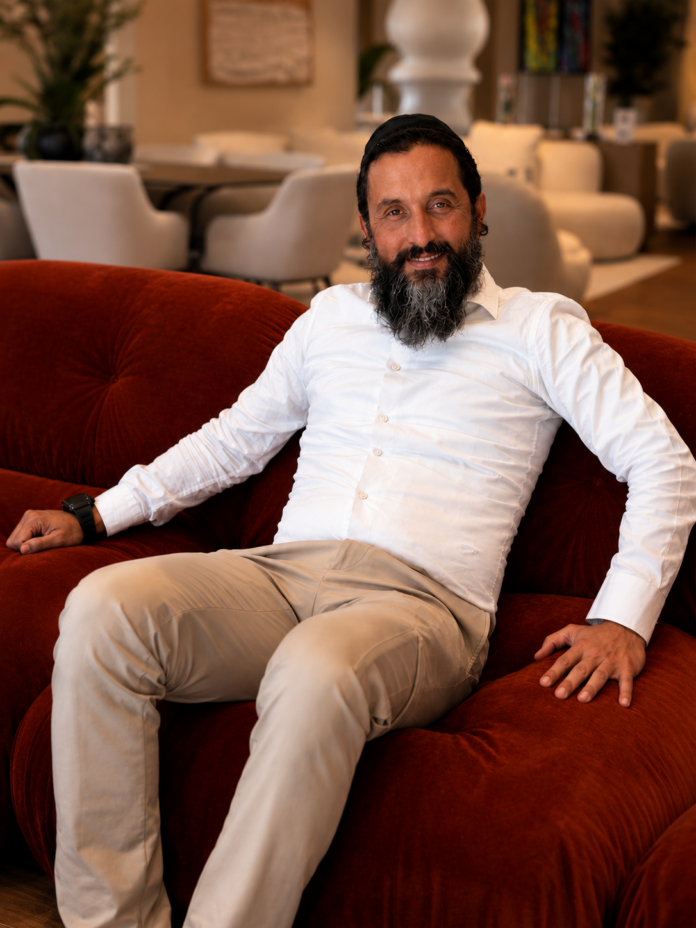 Ami Magazine1 month ago
Over the years, several people had mentioned that I should speak to Yonel Fellous, founder of the growing furniture company Modani, because “Yonel has a good story!” Everyone also noted that his company is generous with tzedakah.
I finally followed up on those suggestions and found out that it’s true, but there’s even more to Yonel than that. His outlook on life and business converged with the same goal: giving, and giving more.
Originally from France, Yonel came to the US seeking new opportunities. Starting out as a real estate broker, he soon recognized a need for high-quality yet accessible contemporary furniture, and he partnered with a friend to start Modani.
Today, Modani is considered a premier modern furniture brand. While over 90% of its business is direct to consumer, the company maintains a strong commercial division, collaborating directly with leading real estate developers, including industry giants such as Lennar and the BH Group.
Beyond offering quality products, Yonel attributes Modani’s success to the company’s commitment to contributing a chomesh (one-fifth) of their profits to tzedakah—a standard of which they are very proud.
Yonel and I spoke about building a furniture brand from nothing, the highs and lows of selling and buying back your own company, and why he believes giving is the only real measure of success.
And of course, we discussed the meaning of the name “Modani” (guess why he chose that!).
Enjoy!
—Nesanel
I was born in Paris, France, and lived there until I was 22. My parents were from Tunisia. My father, may he be well, worked as the sales director for a telecom company. My mother was a Hebrew teacher. Sadly, she passed away of cancer at the age of 48, when I was 11. I have two sisters, both of whom live in Eretz Yisrael.
“We didn’t grow up religious, and I went to public school in France. Reform doesn’t exist in France, and although we weren’t religious, we all knew there is only one way and that is the Orthodox way. We grew up making Kiddush but not actually keeping Shabbos and the chagim. I became religious at the age of 26 when I was in South Beach, Florida.
“I was entrepreneurial from a young age. It’s in my DNA. When I was 14, I started selling all kinds of trendy items in school. I would buy things that students wanted, mainly in the fashion industry, from Chinese wholesalers who lived in Paris. I also created a company that organized birthday parties for kids. I would come to the kid’s house with someone to play music, and I’d play games with the kids.
“After high school, I went to EDC Business School in Paris for four years and then worked in finance for nine months. I started as an intern and was then hired. But after I received my first paycheck, I told my father, ‘I’m not staying here.’ I felt that France was not the right country for me to be an entrepreneur because you have to fit into a box there. The mentality is—at least that’s the way it was 20 years ago—that if you don’t have at least 30 years of experience in a single field, they don’t trust you. You’d have to do an internship in marketing, stay there for 10-20 years to become a marketing director, and then continue until you retire. But as an entrepreneur and a risk taker, I didn’t fit in a box. I wanted to start my own company, and I wanted to try the American dream, where there were fewer barriers to success. So at the age of 22, I went to the US.
“My sister suggested I post my resume on Craigslist. I got the most responses from Miami Beach, including from Nathan Cohen, my current partner. I moved to Miami with $2,600 and started working in real estate as a broker for him, although my main job then was as a waiter. I did the real estate work in my free time.
“My first sale came three months after I was licensed. It was actually the 14-unit apartment building that I was living in at the time. I found the seller and got the listing, and Nathan brought in the buyer, a French investor. I was paying $600 rent, and the building sold for $1.4 million. I didn’t know anything about real estate, but if you know how to sell, you can sell anything.
“Then we started brokering sales for pre-construction, which was a very hot market. In 2007, when we realized there was a crash coming, I told Nathan, ‘We need to find something to leverage all our clients.’
“The second most important purchase after the home itself is furniture. We realized that there was a gap in the furniture market. There was model furniture from brands in Italy and the rest of Europe that were super expensive or there was Ikea. There was no healthy middle ground. Our clients were the smart buyers who wouldn’t buy Ikea because they’re not starving students, and who would also not spend $20k on a couch because they’re prudent.
“We decided to import furniture that would allow us to sell high-quality pieces at affordable prices.
“We didn’t start out as men of means. We didn’t inherit any money from our parents. We were three partners who each put in $33K. The third partner, Steven Athea, was also French, but we didn’t know each other from France; we all met here. Nathan was more the CEO, I was the VP of sales, and Steven was VP of design.
“I put Hashem into the company from the start. Nathan is the one who said we need to find a name that has some meaning but is also not too much in your face. Something subtle. The name Modani came from the prayer Modeh Ani. Modani sounds Italian, but it has a profound meaning: to be grateful. We also decided to give 20 percent of the net profits to charity. Chomesh is a big part of our foundation. Modani is not only a furniture company; it’s a means to give.
To read more, subscribe to Ami
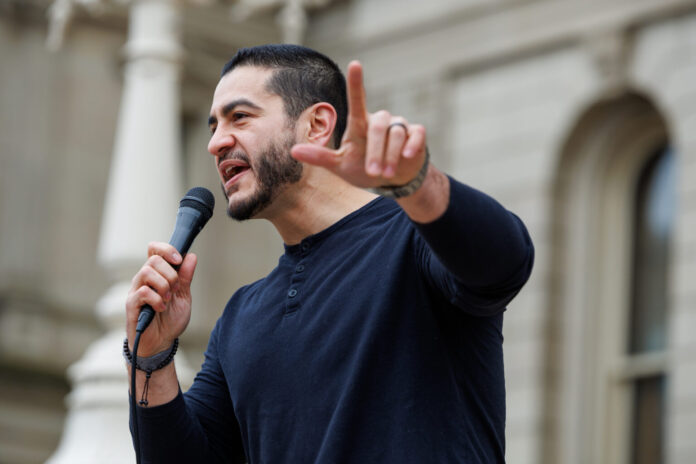 Ami Magazine1 month ago
Did you miss the recent “Jews for Abdul” event last week in Pontiac, Michigan? Too bad.
You wouldn’t have had trouble finding a seat. Only a relative handful of Jewish supporters of Abdul El-Sayed, the Democratic candidate for Michigan’s Senate seat, showed up (and one woman admitted to a reporter that she wasn’t Jewish).
Mr. El-Sayed is rightly controversial. He has appeared in public alongside the loathsome Hasan Piker (he who has shared anti-Semitic sentiments and support for terrorism; and gleefully declared that the “American empire is ‘fading fast’ and will ‘inevitably fall’). Mr. El-Sayed has also answered a reporter’s question, “Do you think [Israel is] just as evil as Hamas?” with a “Yes.”
On a recording made at the recent event, obtained by Jewish Insider, Mr. El-Sayed responded to a questioner who asked him whether he believes in Israel’s right to exist. He said: “I often struggle with the question that people ask in this particular scenario, because what they now ask is, ‘Do you believe in the right of Israel to exist as a Jewish state,’ which, to me, forces the question of a definition of what a Jewish state means.”
“I need folks,” he continued, “who want to ask me that question [to explain] what it is that they mean by that, and how that is consistent with any form of liberal values that we say we believe in here in the United States.”
Well, let’s try to unpack things for the candidate—and ask a question of our own.
Israel defined itself as a Jewish state when it declared its independence in 1948; the following year, it was formally admitted as an official member nation of the United Nations.
The “Jewish” in Israel’s self-definition meant that it would be a homeland for the Jewish people, and that Jews worldwide would have an automatic right to citizenship. Anyone, though, can become a citizen, through a normative naturalization process or by marrying an Israeli citizen.
Israel’s “Jewish” identity also informs its laws and culture—its work calendar respects the Jewish Sabbath and holidays; and kosher food is served at government functions and in the military, for instances—but it is by no sane measure anything approaching a theocracy.
There is an official state rabbinate, but what it oversees are issues like personal religious status, marriage, divorce and burial.
The very same autonomy and authority are granted to Christian and Muslim religious communities in the state. (The only religious groups that do not enjoy official recognition in Israel are claimants to the mantle of “Judaism” like the Reform, Conservative, Reconstructionist and Humanistic movements, which have diverged from the Judaism of the ages.)
There is unfettered freedom of religion in the country—for all citizens. Including Jews, some 45% of them who self-identify as “secular.” They can violate Jewish religious laws without legal repercussions.
Israel maintains the institutions of a liberal democracy, including regular and competitive elections, a free press and an independent judiciary. Arab citizens of Israel have the right to vote, to run for office, and to serve in the Knesset and as judges, even on the state’s highest court.
So, does that, Mr. El-Sayed, answer your question? We hope so.
Now, though, allow us one of our own: What is your feeling about countries whose constitutions explicitly name Islam as the state religion? Like Algeria, Bahrain, Egypt, Iraq, Jordan, Kuwait, Libya, Morocco, Oman, Qatar, Saudi Arabia, Somalia, Tunisia and the United Arab Emirates? And Afghanistan, Bangladesh, Brunei, Malaysia, Maldives and Pakistan. And let’s not leave out Mauritania and Djibouti.
Do you feel that the countries listed above have a right to exist as Muslim states?
You have not, at least publicly, expressed any angst, like that which you express with regard to Israel, about any of those officially Muslim countries—and their embrace of Islam is considerably more consequential than Israel’s of Judaism.
Is there some reason why, among all those religion-identified countries, only Israel, with its relatively mild connection to Judaism, bothers you so?
You are silent about nations that identify with one religion, your own.
Now, why would that be?
To read more, subscribe to Ami
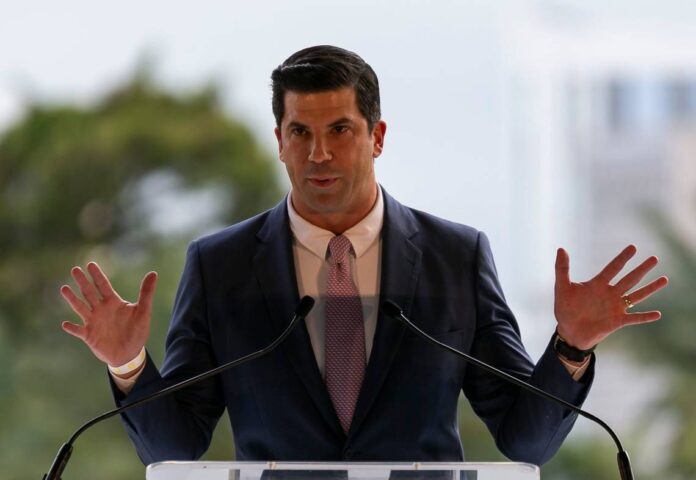 Ami Magazine1 month ago
One of the reasons why I wanted to speak to Rav Chaim Mordechai Ausband, the rosh yeshivah of Yeshivas Ateres Shlomo in Rishon LeZion in Eretz Yisrael, was not only because of who he is but because I was interested in hearing about his father and what it was like growing up in his home.
Rav Chaim Mordechai lives on the top floor of a Bnei Brak apartment building not far from Kiryat Ponevezh, where he spent years immersed in Torah. When he opens the door, his tall, slender frame hardly obscures my view into the apartment. He has a small beard and large, bushy peiyos.
“Please come in and sit down,” he says immediately. Rav Chaim Mordechai is always in a hurry, perpetually drawn back to his favorite place in the world: in front of his Gemara.
I begin by asking him for some recollections of his father.
“I would say that the most prominent thing about him was the way he conducted himself at home,” he begins. “I never once saw my father sitting on a couch. He never spoke devarim beteilim, not in the house and not anywhere else. This made an extraordinary impression on all of us. The hanhagah inside the home was simply a continuation of what it was outside. There was no ‘home version.’ There are many people who are renowned for great things, but at home their hanhagah is different. By my father, it was the opposite. The world was out there; we were in here,” he says, pointing to the sefarim in his dining room where we are seated.
It is this mehalech that led his father to enroll Rav Chaim Mordechai in the mesivta of the Telshe Yeshiva when he was only seven years old. His classmates were 13—almost double his age. From there, he went on to Telshe Chicago, where he learned under Rav Chaim Levin, zt”l, before returning to Telshe Cleveland for two formative years under Rav Mordechai Gifter, zt”l. He then made his way to Ponevezh, where he learned under Rav Elazar Menachem Man Shach, zt”l, absorbing not only his shiurim but his derech and becoming one of his talmidim muvhakim.
It was in Ponevezh that he also found his shidduch. He married the daughter of Rav Gavriel Knopfler, the rosh yeshivah of Shaarei Torah in Manchester, England, where I myself learned for four years as a young bachur. Rav Knopfler is also a talmid of Ponevezh.
Rav Chaim Mordechai chose to remain in Ponevezh in Eretz Yisrael, where he spent many years immersed in Torah. His reputation quickly grew as one of the great masmidim and lamdanim in the yeshivah, and he was sought after as a maggid shiur in many places. For a number of years he served as rosh yeshivah at Yeshivas Kiryat Melech under Rav Shlomo Kanievsky, where his shiurim and shmuessen were legendary. He later joined Yeshivas Ateres Shlomo as its rosh yeshivah, where he has acquired a large and devoted group of talmidim.
As I am speaking to him, I am struck by a thought. The classic way of being taught Torah is the way we received it at Har Sinai: through direct transmission—word by word, halachah by halachah, from rebbi to talmid and from mouth to ear. This is the way Torah is transmitted in yeshivos, rebbeim teaching the younger grades and delivering shiurim and older bachurim learning with a chavrusa. It is structured. You sit down, open a sefer and learn.
Then there is Torah that is absorbed by osmosis, not so much received as breathed in year after year until it becomes the very fabric of a Yid’s inner life. Some may call this chinuch; others might call it growing up in a Torahdike home. Either way, what it produces is something no amount of formal instruction can fully replicate: a person for whom Torah is not merely a studied subject but part of every aspect of life.
Rav Chaim Mordechai is a product of both approaches, and much of his father’s hanhagah, he explains, had a specific source: Kelm. “He learned in Kelm under Rav Shach, who was himself a talmid of Kelm,” he tells me.
The Kelm derech was about the cultivation of mentchlichkeit in its most exacting form: every gesture considered, every word weighed and every middah refined to reflect a single inner ideal. The Kelmer mussar of Rav Simcha Zissel Ziv taught that a person’s true ruchniyusdike level reveals itself not in moments of dramatic challenge but in the texture of ordinary, everyday life.
Rav Chaim Mordechai speaks very energetically and excitedly, gesticulating animatedly with his hands. He offers an illustration of his father’s extraordinary level of ruchniyus.
“When my father was a young man, my mother once served him a meal. He gave no indication that anything was out of place; he simply sat there quietly until she finally realized that she had forgotten to give him a fork. He wouldn’t eat without a fork, so he said nothing, because in Kelm one doesn’t draw attention to what is missing. One doesn’t inconvenience the host. One doesn’t say ‘I need.’ One absorbs the discomfort quietly and moves on.
“Even when I was growing up, these seemed like strange hanhagos,” Rav Ausband says with a smile. “It wasn’t until I was much older that I understood that it was strange for the hamon am, regular Yidden. My father’s hanhagos were ones that people describe as belonging to truly great people.”
Nowhere were these exalted hanhagos more evident than in Rav Eizik Ausband’s relationship with food, or rather his studied indifference to it.
“He didn’t talk about food,” Rav Ausband says simply, “and he connected this directly to the Chofetz Chaim. He would quote him, ‘Let’s just get through the eating. Let’s be done with it and move on to what matters.’”
There was another story about the Chofetz Chaim that he would often tell, which makes the point even clearer.
“They once gave the Chofetz Chaim a bowl of kasha, and someone at the table began commenting on the food. Is it good? Is it tasty? The moment the conversation turned to the food itself, the Chofetz Chaim put down his spoon and stopped eating. The message required no elaboration. A Yid eats because the body requires it to live. The moment eating becomes a pleasure to be savored and discussed, it is no longer a benefit to the body. It was something essential but had now been trivialized.”
The Ausband seudos resembled those of the Chofetz Chaim.
“There might have been the occasional exception,” Rav Chaim Mordechai reflects, “but as a general rule the Shabbos seudah in our home was kulo kodesh. It bore no resemblance to an ordinary weekday meal that most people are accustomed to.”
The structure was unvarying.
“My father would return home from yeshivah after Minchah and Maariv, take his place at the table and eat. My mother, a”h, would look at him and ask, ‘Nu, vos iz der vort fun haynt—So what is today’s dvar Torah?’ That was the conversation. There was no schmoozing or devarim beteilim.”
And it wasn’t only during meals that Rav Eizik refrained from small talk.
To read more, subscribe to Ami
 Ami Magazine1 month ago
Marcus Lemonis is a Lebanese-born American entrepreneur, investor and television personality best known for revitalizing struggling small businesses, including Popinsanity (a Jewish-owned popcorn company) as featured in Ami Magazine, and hosting the reality series The Profit. Born in Beirut during the country’s civil war in 1973, he was abandoned as an infant and later adopted by a Greek Lebanese couple in Miami, Florida, where he was raised. His early life experiences, which were marked by displacement and resilience, profoundly shaped his outlook on leadership, risk and human connection in business.
He went on to earn a degree in political science and criminology from Marquette University, initially considering a path in politics before deciding upon entrepreneurship. Early exposure to the automotive industry, combined with mentorship from figures such as Lee Iacocca, guided him into the world of RV dealerships and retail expansion. Over time, Lemonis built and led major enterprises including Camping World and Good Sam Enterprises, turning them into dominant forces in the recreational vehicle and outdoor retail sectors.
Beyond his corporate achievements, Lemonis is widely recognized for his “people, process, product” philosophy, which emphasizes the balance between human relationships and operational structure. Through The Profit, he became known for a direct, often emotionally engaged approach to business turnarounds, investing not only capital but also personal attention into the lives of struggling entrepreneurs.
His story reflects a theme of transformation, moving from abandonment and uncertainty to influence and authority in American business culture. The tensions between vulnerability and control, personal history and public persona, frequently surface in our conversation, offering a unique perspective. This interview moves beyond the public figure into those deeper contradictions, resulting in a conversation that is both reflective and revealing.
The people I most enjoy speaking to are artists, and I see you as one—using business as your canvas or perhaps a musical instrument. Does that resonate with you at all?
It’s ironic that you framed it that way. My wife and my late mother would both call me a performer, but I prefer the word artist. A performer can certainly be an artist, but I see myself more like a potter working clay or a painter facing a blank canvas, trying to bring out the best version of the people with whom I interact. I use my hands or thoughts to shape things in a way that gives them the optimal chance to succeed.
Academically, I’m not really a great businessperson. I’m not technical; I’m a people person. That’s why I appreciate being called an artist, because it’s the art of understanding people that ultimately makes businesses work.
Every art form has its own craft: the materials, tools and techniques. But when I look at art, I ask only whether it moves me. That’s why I can have a meaningful conversation with an artist even without fully understanding the craft, because I can still appreciate what he’s created.
If you don’t care for a piece, may I ask what it is about the artist that still sparks your curiosity?
His soul. Typical business transactions are grounded in self-interest. I buy because I need something, and you sell to make a profit. It only works because those interests align. Art feels different. Especially when it’s made for its own sake, it rises above that exchange and becomes something more inward. When I think about you and what you represent, there’s a similar sense of moving beyond pure utility toward something more exploratory and reflective.
I think what motivates me is an insatiable curiosity and drive to learn. Money is a byproduct—and a necessary one—because it’s how success is measured. But my real motivation is the transformation of an idea or an individual. What I get out of it, if I’m being honest, is the growth of my own understanding. If I do that well, financial success will either come or it won’t. But what’s most invigorating is that curiosity: learning about different people, cultures, industries and ideas without any fixed expectation of what they’re supposed to be.
I’ll go a bit deeper than that. In addition to the above, as an only child with two adoptive parents who are no longer on this earth, no children and a strong belief in my faith, I think that what I love most is the attachment and connection to people. By the way, I am married to a Jewish woman.
When I evaluate a return on an investment, I’m usually disciplined about the dollars and cents, and that tends to work for me. But I also factor in the relationship. You can make an investment in a business and feel disdain for the person, which can sour the return. Or else you can make a modest return but have a meaningful relationship that enhances the entire experience. I try to balance both while still recognizing that I need to make more than I lose financially. It’s fascinating to me, even as I say this out loud, to reflect on why I’m motivated the way I am to do what I do.
In addition to being a doer, you’re obviously very introspective, thinking not only about the deal but what motivated you to do it in the first place.
And maybe on a deeper level what I didn’t do well. I spend a lot of time—more than most people, I think—replaying what didn’t go well and what I can do better. Part of it is trying to understand how the other person perceived my time with him. Also, because I’m human, I wonder if my motivations are always pure or if they can be influenced by other things, meaning that there may be mixed or imperfect motivations at play.
Some ulterior motive?
No. “Ulterior motive” feels like a crime. “Motivation” feels like the right word.
Let’s say we’re building a puzzle and there are six pieces. I have five, and I’m looking for the last one. I might move through different ideas looking for that final piece—yes, out of curiosity, and yes, to help—but the primary motivation is to find the piece that completes the puzzle. Sometimes people perceive that as selfish, and I can understand that perspective, but as long as the other party also benefits, I can live with it.
I tend to get pulled into situations where there’s distress, and that’s where things get complicated for me. My curiosity is partly about industry, partly about culture and partly about people, but it’s often driven by a sense that “this is broken,” “that doesn’t work” or “this needs fixing.” Then I convince myself that I can fix it.
That isn’t always a pure motivation, because the idea of “I can fix it” can shift from a values-based decision into a form of self-interest or self-enrichment, which is never good.
To read more, subscribe to Ami
 Ami Magazine1 month ago
“We caught a ship yesterday that had some things on it, which wasn’t very nice. A gift from China, perhaps; I don’t know. But I was a little surprised because I have a very good relationship, and I thought I had an understanding with President Xi.”
—President Trump, speaking on April 15 to reporters about an apparent shipment of weapons from China to Iran, despite saying earlier that month that China had agreed not to supply that country with them.
With the war in Iran stalled, the United States’ position in the Middle East is facing scrutiny. America has long been seen as the strongest, most desirable partner to countries in the region, particularly in regard to security, and, for many, trade and investment. But the stalemate has prompted regional powers to reconsider their options—chief among them China, the only superpower capable of challenging American influence, and one that already has some strong ties in the Middle East.
The change in dynamics raises the question: What are China’s long-term plans in the Middle East?
Not a big player
While China is heavily involved in the Middle East, it is far from the largest trading partner in the region, and its engagement there remains secondary to its other global partnerships.
According to an Institute for National Security Studies (INSS) report by researcher Ori Sela, China’s total trading volume with Middle Eastern countries—excluding Israel—is $495 billion. (With the inclusion of Israel, that rises to $517 billion.) That figure is eclipsed by its trade with Southeast Asia ($1.05 trillion), the European Union ($828 billion), the US ($559 billion), and Latin America ($549 billion).
Currently, China’s primary interest in the Middle East is transactional: the region, including Iran, supplies half of China’s energy imports, balanced by Chinese consumer exports and emerging tech investments, like Alibaba’s data centers in Dubai. Chinese imports of goods from the Middle East have dropped, but their exports have continued.
The US, however, has much stronger tech ties in the region—and security ties as well.
China’s military presence in the region is limited to an anti-piracy force, which is dwarfed by the sheer number of American bases and military partnerships in that part of the world.
A neutral voice in a tough neighborhood?
China’s diplomatic posture in the region is cautious and perhaps intentionally ambiguous.
Direct meetings between Chinese officials and Middle Eastern leaders have almost entirely taken place at the level of ministerial positions. Although President Xi has previously conducted high-profile state visits to Saudi Arabia, Egypt, Iran and the United Arab Emirates, currently, rather than traveling to the region, Xi is utilizing a “home-court diplomacy” approach, hosting Middle Eastern and Gulf leaders in Beijing.
And while the Chinese have been willing to discuss major conflicts such as Gaza and Israel, they avoid any deeper political engagement, preferring to focus on economic issues. They evidently seek to present themselves as economic partners who represent stability through trade and investment rather than military involvement.
In his report, Sela notes that the number of visits to the region by Chinese officials has risen. While there were 15 to 20 reciprocal ministerial visits in 2024, that number went up to 25 to 30 such visits in 2025. Still, China has made no alliances or military pacts.
There have been reports of China transferring arms to various countries in the region, including Egypt and Iran, but Sela and other analysts say they remain unconfirmed. China may have also provided Iran with targeting imagery, but they clearly aren’t assuming any explicit military role.
To read more, subscribe to Ami
 Ami Magazine1 month ago
What an interesting past couple of weeks it’s been! Congresswoman Alexandria Ocasio-Cortez admitted that “anti-Zionism” is just repackaged anti-Semitism, and New York Mayor Zohran Mamdani promoted aliyah!
Okay, neither one did so blatantly, but they did so, all the same.
When loony Texas Democratic congressional candidate Maureen Galindo expressed her intention, if elected, to turn a San Antonio ICE detention center “into a prison for American Zionists…,” among those condemning her words was AOC, who posted on social media that “This bigoted garbage and anti-Semitism should be nowhere near our politics.”
“Anti-Semitism”? But Ms. Galindo never mentioned Jews, only “Zionists”!
Could it be…that the Congresswoman recognizes, at least in her heart, that hatred of “Zionists” and of Jews, these days, are usually…one and the same? Well, good for her!
Mr. Mamdani’s toothpaste-commercial smile likely beamed bright as he released a video late on Erev Shabbos Parshas Bamidbar commemorating “the Nakba.” He likely figured that those pesky Jews who don’t like him wouldn’t see it until after their day of rest, when the news cycle would have cycled on to more recent happenings.
The coiner of the word “Nakba,” the “catastrophe” that the Arab world calls the establishment of Israel, was Syrian historian Constantin Zureiq. He used it to refer to the shame born of the devastating defeat of the Arab armies that attacked the nascent Jewish state after it declared its independence in 1948. Today, the word is used by Israel-haters to refer to the displacement of Arabs from Eretz Yisrael that resulted from those attacks.
In the video, which has been viewed millions of times, an endearing elderly lady, Inea Bushnaq, leafs through faded family photos and, with a British accent, speaks about her family’s “expulsion” from their home by “Zionists” when she was nine years old.
At the start of the video, a travel poster depicting Yerushalayim, with the legend “Visit Palestine” in large letters across its bottom, is shown hanging on her wall. The viewer is expected to see it, like Ms. Bushnaq apparently does, as expressing a wistful longing the region’s erstwhile Arab inhabitants have for a return to their ancestral homeland.
Ms. Bushnaq’s family, however, was hardly indigenous to the Holy Land. Her grandparents, senior fellow at the Hudson Institute and stellar writer Liel Leibovitz reports, “left their native Bosnia and settled in Syria before finding their way to Jerusalem, making them—to borrow a phrase Mamdani voters use often to describe the Jewish citizens of Israel—European colonizers.”
In fact, many who today claim the label “Palestinian” are descended from successive waves of people who came to the area from other places: like Egypt, from where successive waves of immigrants arrived in the 18th century, Algeria and what is now Jordan. Bosnian Muslims, too, like Ms. Bushnaq’s nena and dedo, came in fairly significant numbers.
Back, though, to the poster.
If one pauses the video, one notices Hebrew writing on it. Its creator was a well-known Jewish graphic designer named Franz Kraus (1905-1998). He was born in Austria but fled the Nazis and immigrated to British Mandated Palestine in the early 1930s.
The poster on Ms. Bushnaq’s wall is his most famous piece of art. It was produced in 1936, and Mr. Kraus intended it to promote Jewish resettlement of Eretz Yisrael.
And so, its appearance in the video stands as a rather striking contradiction to the Nakba narrative being pushed by the mayor. Yes, the image expressed a wistful longing for an ancestral homeland—but that of Jews for the Jewish one.
So, while Mr. Mamdani likely didn’t mean to publicize a call to Jews to make aliyah—after all, he believes that a state that self-identifies as Jewish has no right to exist (unlike the eight countries that are officially Islamic, and a slew of others that are de facto so)—his video, at least for a few seconds, featured a call to Jews to return to Eretz Yisrael.
In another, unrelated, recent development, it was reported that the father of New York Times columnist Nicholas Kristof, who has regularly criticized Israel and recently accused it of sanctioning the torture of Arab prisoners, served during World War II in the Romanian Nazi-allied army.
Ah, the ironies and revelations that come into view upon close inspection.
To read more, subscribe to Ami
 Ami Magazine1 month ago
One of the reasons why I wanted to speak to Rav Chaim Mordechai Ausband, the rosh yeshivah of Yeshivas Ateres Shlomo in Rishon LeZion in Eretz Yisrael, was not only because of who he is but because I was interested in hearing about his father and what it was like growing up in his home.
Rav Chaim Mordechai lives on the top floor of a Bnei Brak apartment building not far from Kiryat Ponevezh, where he spent years immersed in Torah. When he opens the door, his tall, slender frame hardly obscures my view into the apartment. He has a small beard and large, bushy peiyos.
“Please come in and sit down,” he says immediately. Rav Chaim Mordechai is always in a hurry, perpetually drawn back to his favorite place in the world: in front of his Gemara.
I begin by asking him for some recollections of his father.
“I would say that the most prominent thing about him was the way he conducted himself at home,” he begins. “I never once saw my father sitting on a couch. He never spoke devarim beteilim, not in the house and not anywhere else. This made an extraordinary impression on all of us. The hanhagah inside the home was simply a continuation of what it was outside. There was no ‘home version.’ There are many people who are renowned for great things, but at home their hanhagah is different. By my father, it was the opposite. The world was out there; we were in here,” he says, pointing to the sefarim in his dining room where we are seated.
It is this mehalech that led his father to enroll Rav Chaim Mordechai in the mesivta of the Telshe Yeshiva when he was only seven years old. His classmates were 13—almost double his age. From there, he went on to Telshe Chicago, where he learned under Rav Chaim Levin, zt”l, before returning to Telshe Cleveland for two formative years under Rav Mordechai Gifter, zt”l. He then made his way to Ponevezh, where he learned under Rav Elazar Menachem Man Shach, zt”l, absorbing not only his shiurim but his derech and becoming one of his talmidim muvhakim.
It was in Ponevezh that he also found his shidduch. He married the daughter of Rav Gavriel Knopfler, the rosh yeshivah of Shaarei Torah in Manchester, England, where I myself learned for four years as a young bachur. Rav Knopfler is also a talmid of Ponevezh.
Rav Chaim Mordechai chose to remain in Ponevezh in Eretz Yisrael, where he spent many years immersed in Torah. His reputation quickly grew as one of the great masmidim and lamdanim in the yeshivah, and he was sought after as a maggid shiur in many places. For a number of years he served as rosh yeshivah at Yeshivas Kiryat Melech under Rav Shlomo Kanievsky, where his shiurim and shmuessen were legendary. He later joined Yeshivas Ateres Shlomo as its rosh yeshivah, where he has acquired a large and devoted group of talmidim.
As I am speaking to him, I am struck by a thought. The classic way of being taught Torah is the way we received it at Har Sinai: through direct transmission—word by word, halachah by halachah, from rebbi to talmid and from mouth to ear. This is the way Torah is transmitted in yeshivos, rebbeim teaching the younger grades and delivering shiurim and older bachurim learning with a chavrusa. It is structured. You sit down, open a sefer and learn.
Then there is Torah that is absorbed by osmosis, not so much received as breathed in year after year until it becomes the very fabric of a Yid’s inner life. Some may call this chinuch; others might call it growing up in a Torahdike home. Either way, what it produces is something no amount of formal instruction can fully replicate: a person for whom Torah is not merely a studied subject but part of every aspect of life.
Rav Chaim Mordechai is a product of both approaches, and much of his father’s hanhagah, he explains, had a specific source: Kelm. “He learned in Kelm under Rav Shach, who was himself a talmid of Kelm,” he tells me.
The Kelm derech was about the cultivation of mentchlichkeit in its most exacting form: every gesture considered, every word weighed and every middah refined to reflect a single inner ideal. The Kelmer mussar of Rav Simcha Zissel Ziv taught that a person’s true ruchniyusdike level reveals itself not in moments of dramatic challenge but in the texture of ordinary, everyday life.
Rav Chaim Mordechai speaks very energetically and excitedly, gesticulating animatedly with his hands. He offers an illustration of his father’s extraordinary level of ruchniyus.
“When my father was a young man, my mother once served him a meal. He gave no indication that anything was out of place; he simply sat there quietly until she finally realized that she had forgotten to give him a fork. He wouldn’t eat without a fork, so he said nothing, because in Kelm one doesn’t draw attention to what is missing. One doesn’t inconvenience the host. One doesn’t say ‘I need.’ One absorbs the discomfort quietly and moves on.
“Even when I was growing up, these seemed like strange hanhagos,” Rav Ausband says with a smile. “It wasn’t until I was much older that I understood that it was strange for the hamon am, regular Yidden. My father’s hanhagos were ones that people describe as belonging to truly great people.”
Nowhere were these exalted hanhagos more evident than in Rav Eizik Ausband’s relationship with food, or rather his studied indifference to it.
“He didn’t talk about food,” Rav Ausband says simply, “and he connected this directly to the Chofetz Chaim. He would quote him, ‘Let’s just get through the eating. Let’s be done with it and move on to what matters.’”
There was another story about the Chofetz Chaim that he would often tell, which makes the point even clearer.
“They once gave the Chofetz Chaim a bowl of kasha, and someone at the table began commenting on the food. Is it good? Is it tasty? The moment the conversation turned to the food itself, the Chofetz Chaim put down his spoon and stopped eating. The message required no elaboration. A Yid eats because the body requires it to live. The moment eating becomes a pleasure to be savored and discussed, it is no longer a benefit to the body. It was something essential but had now been trivialized.”
The Ausband seudos resembled those of the Chofetz Chaim.
“There might have been the occasional exception,” Rav Chaim Mordechai reflects, “but as a general rule the Shabbos seudah in our home was kulo kodesh. It bore no resemblance to an ordinary weekday meal that most people are accustomed to.”
The structure was unvarying.
“My father would return home from yeshivah after Minchah and Maariv, take his place at the table and eat. My mother, a”h, would look at him and ask, ‘Nu, vos iz der vort fun haynt—So what is today’s dvar Torah?’ That was the conversation. There was no schmoozing or devarim beteilim.”
And it wasn’t only during meals that Rav Eizik refrained from small talk.
To read more, subscribe to Ami
 Ami Magazine1 month ago
Following the collapse of the Soviet Union, Dr. Shyfrin emerged as one of the leading industrial entrepreneurs in Eastern Europe. He cofounded Midland Group, an international industrial and investment company with operations spanning steel production, shipping, real estate, agriculture and technology. Under his leadership, the company became a major force in the global steel and commodities sectors, with partnerships and investments extending across Europe, North America and Asia. Throughout his business career, he became known for combining scientific thinking with strategic long-term vision in highly complex international markets.
Despite his considerable commercial success, Dr. Shyfrin experienced a profound personal and existential crisis in 2002 at the age of 42. Confronted by questions with regard to mortality, meaning and human purpose, he found that neither business achievement nor science could adequately answer these queries that increasingly defined his inner life: Why are we here? What is consciousness? What happens after death? Is there an underlying order to existence?
During this pivotal period, Dr. Shyfrin sought guidance from Rabbi Yaakov Dov Bleich, the chief rabbi of Ukraine, who encouraged him to undertake teshuvah. What began as a personal search evolved into decades of intensive study of Torah, Talmud, Jewish philosophy and Kabbalah. Approaching these subjects through the disciplined lens of a scientist, he became especially interested in the relationship between ancient mystical thought and modern developments in quantum physics, information theory, thermodynamics and consciousness studies.
These explorations culminated in his book From Infinity to Man, which proposes a synthesis between Kabbalistic concepts and contemporary scientific thought. In the book, Dr. Shyfrin advances the idea that information rather than matter alone may constitute the fundamental structure of reality, drawing parallels between Jewish mystical teachings and modern theories in physics. The work attracted international attention for its ambitious interdisciplinary approach and positioned him as a distinctive voice in contemporary discussions about science and spirituality. He later expanded these ideas into what he calls the “Kabbalah of Information,” an evolving philosophical framework he explored in subsequent writings and lectures.
In parallel with his intellectual work, Dr. Shyfrin has remained deeply involved in philanthropy and Jewish communal life, supporting educational, humanitarian and cultural initiatives all over the world, particularly in Ukraine. He has also contributed essays and Torah commentaries to leading Jewish publications and educational platforms.
In recent years, Dr. Shyfrin has expanded his creative pursuits into music through his project Shyfrin Alliance, blending blues, jazz and rock with philosophical and spiritual themes. His music reflects many of the existential and mystical ideas explored in his writings, creating what he describes as another language for expressing questions of time, soul, longing and transcendence.
Known for his rare ability to bridge science and spirituality, commerce and contemplation, Dr. Eduard Shyfrin occupies a singular place among contemporary thinkers, equally at home discussing metallurgy, quantum theory, Torah or music. A few weeks ago, I had the privilege of speaking with him about the remarkable journey that has taken him from the industrial upheavals of post-Soviet Eastern Europe to the worlds of Jewish mysticism, philosophy and artistic expression.
You are a man who is interested in so many things. How do you see all of that coming together in your personality?
That’s life, Rabbi. Life has many faces.
Does it have many faces, or is it one face with many features?
You could put it that way as well. We shouldn’t limit ourselves. If we think we can do something important, we should allow ourselves that possibility instead of restricting it.
You seem to be on a continuous journey, constantly exploring and looking for different experiences.
Exactly. I was once told by my rabbis that if you do something against your will but do it anyway, you receive the greatest reward. I jokingly replied that in that case, I wouldn’t receive any reward for my work, because I genuinely enjoy studying and learning. I’m not doing it against my will.
You’re doing what you like to do.
Not always. There are times when I have to do something that’s a duty. But when you can do what you like and be happy with the results of your labor—I’m quoting Koheles—it’s a great gift from G-d.
As a man of many facets, what is your ultimate like?
Intellectual cognition.
Sometimes a person’s occupation and life story aren’t one and the same. But it seems that your life mission and intellectual interests align. They seem to be very interconnected, with your biography influencing your thought processes.
You’re absolutely right. In my view, the ideal state is one of holism, when the whole is greater than the sum of its parts. It’s very difficult to reach, but we should strive toward it. You’re also right that all of my activities are interconnected; they flow into each other, forward and backward. I’m driven by a desire to understand this world, to understand G-d, and to understand whatever I can.
Life is a journey for everyone, but for you it seems to be one in the geographical sense as well. I understand that you’re currently in Monaco, although your life began in a different culture and place.
Absolutely. I was born in Soviet Ukraine.
At what age did you discover your need to discover?
It’s a long story. My late parents, of blessed memory, were people of the book. As long as I can remember, our small apartment was filled with volumes. I started reading very early. We were a family that valued language, and that orientation was deeply ingrained in me, shaped first and foremost by my parents.
What kinds of interests did they have?
They were both metallurgical engineers. Later on, my father became a professor and earned a doctorate in science. He was more analytically inclined. My mother, by contrast, adored books and knowledge, and she collected several thousand volumes. In our home, the book was the queen of the apartment.
I assume it was a very small apartment.
Yes. I was born in a one-room apartment with six people living there.
Did you have any exposure to religious books?
Absolutely not. This was the Soviet Union, and my father was a member of the Communist Party. I was also a member of the party for six years. Religion was strictly forbidden. I didn’t know anything about the Torah or the synagogue. However, I did know that I was Jewish.
To read more, subscribe to Ami
 Ami Magazine1 month ago
Every once in a while, I interview someone who has a personal impact on me. Often it’s because that person has worked on himself in an area that is important in my life as well. A person like that, and the life lessons he has to offer, usually resonate with my readers as well.
Every year for the Shavuos issue I try to interview someone who is not only a successful entrepreneur but also has a strong dedication to learning Torah despite his busy schedule.
Yehuda Spitz, or Leo, as he is called, is such a person. He runs several successful companies; his main company, BidMaster Solutions, fills a unique need in the Jewish business world.
After helping his boss land a lucrative government contract early in his career, he launched BidMaster, which helps businesses prepare their bids for multimillion-dollar government contracts. He also recently launched DoberMe, an Uber service for security guards, along with some others.
However, Yehuda’s passion isn’t his business, it’s his shiurim. He gives several shiurim each week, including Daf Yomi, halachah, Mishnayos, and a unique shiur in which he reviews the previous week’s seven dapim of Daf Yomi.
Leo plans his schedule meticulously, and his work day revolves around his Torah learning, not the other way around. We discussed his rigorous schedule, the unique way he runs his business, and his advice for very busy people who want to prioritize learning.
Enjoy!
—Nesanel
I was born in Eretz Yisrael, and my family moved back to Lakewood when I was about two years old. I’m one of 14, bli ayin hara, smack in the middle of the family. We’re extremely close. When one of us makes a simchah, seven brothers walk into shul together. None of us are shy, and we all have big personalities. My father is a businessman with a very strong, funny, dynamic personality, and I’d say we all got that from him.
“My mother is the matriarch, the queen of the family. She’s a tremendous baalas chesed and very much into tefillah. We grew up preparing bags of clothing to send to Eretz Yisrael, and we used to go out in the van in the mornings to pick up bachurim who were hitchhiking and drive them to their yeshivos.
“When I was around nine years old, my mother was diagnosed with a brain tumor. It was not an easy childhood, and there were definitely years that were emotionally difficult for the family. But b’chasdei Hashem, we never developed a victim mentality, and in many ways the experience made us stronger and even closer.
“My mother is an exceptionally strong woman. At the last wedding in our family, which we just celebrated, there was a very emotional moment when my mother walked into the hall surrounded by her seven sons and seven daughters. For all of us, it was a realization of how much she had gone through and the fact that nearly 20 years later, she is still standing strong at the center of the family.
“I also deal with a number of medical issues that I’m currently managing. But again, I think my upbringing kept me from developing a victim mentality.
“For high school I learned in Rav Uren Reich’s yeshivah, which at the time was located in Woodlake Village. Afterward I learned in the beis midrash of Rabbi Moldaver in New City; I was there for its very first year. I was an extremely serious bachur, very focused in yeshivah. I’m a very intense person; I only work well under pressure. I collapse when there’s no pressure.
“I was very into learning when I was young, and I wasn’t much of an entrepreneur at the time. One Pesach bein hazmanim I had a small business cleaning garbage cans, and I actually see a few companies doing it now. I put out a small ad, thinking my focus would be mainly yungeleit because of chametz and chumros before Pesach, but I ended up getting all the balebatim. We would go to one house, and everyone on the block would drop off their cans. We charged them $20 a can, and it worked out very well. But that was about it on the business front.
“My shidduch story is pretty unique. I wanted to get married instead of going to Eretz Yisrael, partly because I was born there and would have had issues with the army. Instead, I went to a post–Eretz Yisrael yeshivah in Monsey run by Reb Matis Rokach. At the time, I was the youngest bachur there, only 20 years old.
“On my 21st birthday, my rosh yeshivah called me and told me that a chasidishe shadchan had reached out asking whether he had any Litvishe bachurim to suggest, and he mentioned he had only one Litvish talmid who was ready for shidduchim—me. Ordinarily, I probably would not have taken a random shadchan seriously, especially someone who did not know me personally, but I recognized one of the names listed in the references. We checked into the family, heard very positive things, and the rest is history.
“We got married on my wife’s 21st birthday. My wife is from Flatbush. Her maiden name is Weitman, and her grandfather founded TAG in Far Rockaway.
“We told the girl who was listed on my wife’s résumé that we would find her a shidduch out of hakaras hatov, and kach havah—a few months later we did!
“For kollel, I was looking for something intense, so I went to Reb Motti Piller’s halachah kollel. It’s a serious program where showing up late simply isn’t accepted, and I loved that. I learned there for roughly five years. By then I had two kids, and I started looking for a job. I got a call from David Rottenberg of Evergreen Landscaping, who was featured in Lunchbreak a while back. The development where we lived was utilizing his services, and he was impressed because I spoke so highly of his company. He liked my spiel and asked to meet me.
“At the time, I was thinking that landscaping was a very shvache business; I wasn’t going to mow lawns. But I met him at his house, and he gave me an offer that I couldn’t refuse. I accepted the job, and I still have tremendous hakaras hatov to him for starting my career.
To read more, subscribe to Ami
 Ami Magazine1 month ago
Last month, “activist” Tyler Oliveira notified his eight million social media subscribers that he was planning a trip to the Holy Land: “You guys think Israel will let me into the country?”
Shortly thereafter, Diaspora Affairs Minister Amichai Chikli reposted Mr. O.’s words along with a one-word response: “No.”
Mr. Chikli later explained that he was “proud to have denied entry to Israel today to an unfortunate YouTuber who is using the harassment of Jews as a way to get clout on social media.”
And so, fresh from an appearance on “just saying” Tucker Carlson’s innuendo-cast, the self-appointed investigative journalist—who had previously spent time in New Square and Lakewood harassing residents and “exposing” what he called “a parasitic, insulated Jewish community,” “systemic exploitation” of government programs and Orthodox “invasions” of communities—boarded an El Al plane to Israel and, when it landed, was denied entry to the country.
During his earlier interview with the increasingly creepy Mr. Carlson, Mr. Oliveira recounted his trips to the heavily Orthodox American Jewish communities.
The “entire lifestyle” of Jews in the towns he visited, he said, “is designed to extract and exploit these welfare systems to the maximum degree. It is strategic. It is not happenstance. It is not coincidental. It is by design.”
The design, of course, is that of our nation’s social services, which reflect the citizenry’s democratically-expressed will to aid large families with limited incomes.
Mr. Oliveira repeatedly makes the argument that the country should not be using tax dollars to help those who face economic challenges that qualify them for things like the Supplemental Nutrition Assistance Program. Social consciences, unfortunately, aren’t universal.
But when someone singles out only one or two racially or religiously identifiable groups (Mr. Oliveira has gone after other minorities, too), the “argument” is exposed as something other than fiscal conservatism. Tellingly, the muckraking crusader doesn’t seem to have made any effort to visit and harass poor white citizens, say, in Appalachia.
And then there is the regurgitation of hoary anti-Semitic tropes. “Seemingly,” Mr. Oliveira confided in Mr. Carlson, “there are a lot of powerful Jewish people who own significant media enterprises, [and] websites that seem to bend the knee… to [them].” As if Rupert Murdoch, Jeff Bezos and Elon Musk were members of the tribe.
But, leaving aside the darker elements that infect the souls of some right-wing personalities, a question does present itself: Is Israel wise to prevent such people from visiting?
The argument against permitting them entry (and Israel has denied entry in the past to various politicians and academics, based on a 2017 law that allows it to refuse proponents of the Boycott, Divestment, Sanctions movement) is straightforward: People who ally themselves with enemies of the country or with policies that would harm it don’t deserve to tread its soil.
What’s more—and in the case of Mr. Oliveira, it’s an entirely reasonable assumption—people ill-disposed to Israel or Jews will only use their visits to seek out yet new excuses for disparagement.
But there is a downside to that approach as well. The very denial of entry itself is sure to be used by the denied to their advantage. “If they have nothing to fear, why don’t they let me in?” they will say. “Must be that they have reason to fear…”
And dovetailing with that concern to argue for allowing critics entry is the irrepressible Jewish optimism that dares to imagine that even haters, given the opportunity to get to know their targets better, might feel more constrained in the future and maybe even changed by the experience.
I generally opt for such optimism.
But when I witness someone somehow finding fault even with the volunteer police-allied Shomrim, which helps report and prevent crimes against innocent civilians, calling it, as Mr. Oliveira did, a “religious police,” prompting Mr. Carlson to add “Exactly. Essentially like in Saudi Arabia or Iran,” I have to concede that there are eyes just so hopelessly jaundiced that even the freshest snow will register in their eyes as soot and ash.
To read more, subscribe to Ami
 Ami Magazine1 month ago
In a striking moment in American history, President Donald Trump issued a proclamation calling on Jews to observe the Shabbos of May 15-16, 2026, as part of the nation’s 250th anniversary celebrations, framing it both as an acknowledgment of the Jewish contribution to the United States and a symbolic recognition of Shabbos itself.
I saw that you sent out a video about President Trump’s call for a national Shabbos. What was your reaction when you heard about it?
To me, it feels like a unique moment in history. You have an elected president of the United States—arguably the world’s greatest superpower, and by many measures the most successful society in recorded history—honoring Shabbos in the context of the nation’s 250th anniversary and as a symbol of the Jewish contribution to America. On all of these levels, it is something truly remarkable.
In 2015, after Trump announced his presidential run, I spoke with Jason Greenblatt, who was his real estate attorney at the time. Years later, I spoke with David Schoen, who represented the president during his second impeachment and made headlines when he covered his head to make a brachah before drinking water. They both told me that even in the middle of major transactions or significant litigation, whenever they informed the president that they needed to stop because of Shabbos, he would encourage them to do so. In that sense, he always showed respect for Shabbos.
That anecdote is very beautiful and illuminating, because it shows that it stems from a deeply-held belief. There could have been innumerable ways to include the Jewish community in the 250th anniversary celebrations, and this is what he chose. In doing so, he placed Shabbos at the front and center of the country’s celebration, and in a meaningful way, the Jewish community itself. It is an extraordinary thing and something that shouldn’t pass without being noted and embraced.
I’ve been working on the Shabbos Project since 2013, first in South Africa and then expanding around the world, and it’s a subject that is close to my heart. So when I heard about what the president said in his proclamation, I felt that it called for an appropriate response, one that is commensurate and proportionate to what this represents.
This wasn’t simply a post on social media; it was an official presidential proclamation. While I understand that it isn’t legally binding, it nonetheless carries official status. Therefore, as Jews, there is an obligation to rise to the occasion and respond appropriately.
How do you interpret his statement that Shabbos is a contribution to America?
The way I understand it—and I tried to convey this in my speech—is that Jews have contributed to America over its 250-year history in their personal capacity, across every field of endeavor. But what I think this proclamation is really acknowledging is something deeper: that it was Jewish values that served as the driving force behind that contribution.
We are not merely an ethnicity descended from Avraham Avinu; we are defined by our values. That is the essence of am Yisrael. We were formed at Har Sinai, which is what we are about to celebrate on Shavuos, and that means that our identity is inseparable from the values we were given there.
At the center of those values stands Shabbos. It affirms belief in G-d, meaning that there is a Creator of this world. Shabbos is, first and foremost, a testimony that the world was created by design and is not a random accident. From that flows the understanding that life has meaning and purpose, and that it is sanctified by its Creator, Who gives us a framework for how to live: one that elevates family, human dignity and the sovereignty of the individual.
Shabbos is also about humility, the recognition that G-d is the Master of the universe, and that we are not all-powerful. Once a week, we step back and affirm that reality.
At the same time, Shabbos reflects the value of human creativity in a certain sense. The Torah frames the mitzvah with “Six days you shall work,” because G-d created the world in six days. This links the work that we do during the week to the creation of the world. So it’s holding up human endeavor.
So when we look at the extraordinary development of technology, medicine, architecture and all the other achievements that have defined the United States over its 250-year rise to global leadership, it is also an acknowledgment that at the heart of that success story and the American dream are values. And those values, in turn, are deeply rooted in the Torah, at the center of which stands Shabbos. That is the significance of this proclamation.
To read more, subscribe to Ami
 Ami Magazine1 month ago
“This is not another Covid.”
—Dr. Tedros Adhanom Ghebreyesus, director general of the World Health Organization, in a letter to the residents of the island of Tenerife in advance of the docking of a cruise ship that harbored a hantavirus outbreak in order to offload the remaining passengers.
virus jumps from animals to humans. Then it begins moving from person to person. Within days, people start dying.
On a cruise ship in the Southern Hemisphere, confusion turns into alarm. Health officials scramble, governments disagree on quarantines, and passengers—some already exposed—are allowed to continue traveling. The question spreads faster than the virus itself: who among us is already infected?
Those who remember the start of Covid-19 in the early months of 2020 will remember this scenario well and recall how the world soon changed.
But the above scenario isn’t describing 2020. It’s a current outbreak of hantavirus—a rodent-borne disease now spreading on a cruise ship—that has sparked alarm among public health officials and the public worldwide. Several people have already died, and questions about how far the disease could spread have not yet been fully answered.
Health experts, including those who focus on hantaviruses, say that it doesn’t have the potential to become a pandemic like Covid-19; there is no reason to panic. But even with that reassurance, the response from several governments to the outbreak have raised the question: Are we any more prepared for a pandemic than we were before Covid?
A terrible cruise
For over a month, the MV Hondius cruise ship has been moving through the waters of the Southern Hemisphere as the hantavirus spread among passengers—apparently from person to person—even as some disembarked and carried the virus onward.
The Dutch-flagged ship had set off from Argentina, where a known disease reservoir of a specific hantavirus is located. It was carrying 114 passengers and 61 crew members.
Less than a week later, a 70-year-old Dutch passenger became ill, running a fever and suffering from gastrointestinal distress. On April 11 he died after developing breathing problems.
The man’s body remained on the ship until April 24, when it was transferred to the island of St. Helena, where some two dozen other passengers also disembarked, including the man’s widow. The woman flew to South Africa the following day in an attempt to get back to the Netherlands, but she sickened and died the next day. There were approximately 88 passengers on the flight she took to South Africa, along with the crew.
Meanwhile, the Hondius continued on. When a British man became sick, he too was flown to South Africa. Then a German woman fell ill and died several days later, on May 2. That same day, the British man tested positive for hantavirus.
Members of the crew, including the ship’s doctor, then became sick as well, and there was a standoff near the island of Cape Verde when its government refused to allow anyone to disembark. Three people were eventually evacuated and flown to hospitals in Europe that can handle infectious diseases of an unknown nature. Then another passenger who left the cruise back in St. Helena tested positive for the disease in Switzerland.
Spain allowed the ship to dock in Tenerife, the largest of the Canary Islands, and the remaining passengers are now being carefully flown back to their countries of origin to be quarantined and observed. The ship itself will be sailed back to the Netherlands and disinfected, and its crew will be observed.
Three more people from the cruise—one French woman and two Americans—came down with symptoms or tested positive.
To read more, subscribe to Ami
 Ami Magazine1 month ago
Chesky Weinberger does not fit the typical profile you’d expect for the head of an HR company.
Chesky, a chasidishe yungerman, fell into the world of human resources (HR) management while working for a large company and realized it was a natural fit. After a short time, he recognized the need for HR education and support in the frum business world.
Every single business has an HR department, Chesky says, whether they know it or not. Issues come up—from the entry-level employee questioning their pay to the C-suite executive whose toxic behavior alienates the team—and someone has to deal with them.
Chesky, together with his partner Mendy Oppenheim, started Topaz HR to help companies deal with an HR crisis and effectively manage their most valuable asset—their employees—to prevent issues from arising in the first place.
The world of HR and hiring is more complex than you might imagine, but claiming ignorance won’t fly.
We had an important conversation about Chesky’s career, common HR pitfalls and proactive steps you can take to avoid them.
Enjoy!
—Nesanel
I was born in Monsey as the seventh of eight children. My father had a very varied career, but from the time I was a child, he made his living as a day trader.
“For yeshivah I went to the Viener Cheder in Monsey. At that time it was more of a community cheder—we had bend-downs and chasidishe hats all in one class. Then I went to Yeshiva Ketana Ner Torah.
“When I was finishing high school, I decided that I wanted to go out and work. I had a conversation with my parents, and we agreed that as long as I committed to having a chavrusa, I could find a job and do something productive, and that’s exactly what I did. Even as a young teenager, I was always hustling and creating opportunities, whether it was selling candy in school, packing sefarim in shul or organizing neighborhood carnivals with my family.
“I started out doing deliveries. Someone in my neighborhood had a commercial kitchen where he would cook for a lot of small mosdos, yeshivos and schools that didn’t have their own kitchen. At that point I was looking for a job that came with a car of some sort so I could be mobile, and this guy offered me a commercial van, so I was in, even at eight dollars an hour or whatever minimum wage was at the time.
“I did that for a couple of months until I got an opportunity to work for someone who was doing maintenance for large residential buildings. I would deliver maintenance supplies and deal with supers. That’s when I began learning how to work with the Spanish-speaking community, which proved to be critical for my career in HR. I learned how to navigate the streets and the people working on them. I would go to the Bronx warehouse and get things that the building superintendents needed—salt in the winter, snowblowers, tiles, lumber, paint if they were redoing an apartment, and so on. I had to leave Monsey by 6:00 a.m. to get to the warehouse by 7:00, so I’d daven in Brooklyn later.
“My days would often run until 7:00 or 8:00 at night, and I really enjoyed it. It kept me focused and productive, and it gave me a head start in the business world.
“Then I was offered the chance to join one of the largest heimish-owned manufacturing businesses. I liked that it had one central location so I wouldn’t be running around so much, and that it was a growing company. It was located in Jersey City, a pretty rough neighborhood, and the crew was pretty rough, too. I started out as an assistant supervisor for a department where orders were prepared for shipping. I had to make sure that the crew, which comprised about 20 employees, was collecting the correct orders and organizing them so that they would be easy to find when the trucks had to be loaded.
“It was a new world for me. The general manager was a great guy who helped me a lot, but it was my job to manage my own group, who were not the friendliest people. I realized very quickly that if I wanted to manage them effectively, I would need to understand their culture and speak their language, literally and figuratively. I learned how to talk to people and assign work in a respectful way so that they would actually want to do what they were expected to do. Of course, I made some missteps along the way.
“Here’s an example. In yeshivah, the boys are schmoozing, and the mashgiach comes in, claps his hands and says, ‘Come on, guys. Let’s go. Back to work,’ and they start learning again. At work, there was a crew that was talking in the corner, and I did the same thing, ‘Come on, guys. Let’s go back to work,’ and I clapped my hands. One guy gave me the death stare. I could have let it slide, but I notice the little reactions people have to every interaction. I went over to him afterward and asked, ‘Francisco, what happened? Why were you looking at me like that?’ He answered in Spanish, ‘I’m not your dog. Don’t clap at me.’ I learned not to ignore those cues. If a reaction seems off, address it.
“Realizing that the cultural difference was greater than I initially thought, I made it my business to understand their backgrounds. I spent a lot of time listening to them. After work I would go to one of the workers and ask him to explain his routine to me and tell me his life story. I did that with most of the team.
“I learned what it meant to lead people, and I also learned that I don’t want to do physical labor, so I had to get into management and lead people at a larger scale or I’d be working in a warehouse for the rest of my life.
“After a while, the supervisor I was reporting to left, and I was promoted to run the department on my own. Three years into my career there, growing through the ranks, working hard, being the first one in and the last one out, I recognized that I have a gift for understanding people. People connected to me at all levels, and I connected with people at all levels.
“Every company has an HR function, whether they know it or not. It’s just that often it’s the owner or the general manager filling it. The HR structure developed as the organization was growing, and the general manager was very busy with it, but it wasn’t a formal framework.
To read more, subscribe to Ami
 Ami Magazine1 month ago
The United States and Israel have each used an array of advanced weaponry against Iran since February 28.
Three US aircraft carriers deployed to the region have launched hundreds of Tomahawk cruise missiles at Iranian sites; and aircraft, including B-2 stealth bombers, have pounded targets in the country. New systems like the Precision Strike Missile (PrSM) have also been employed in attacks.
Israel brought the power of F-35I Adir stealth fighters, F-15I Ra’am jets and specialized precision-guided munitions to the fight.
The combined attacks have wrought significant degradation of Iran’s air defenses and missile production, and extensive destruction of military and civilian infrastructure.
Iran, for its part, has employed large numbers of kamikaze drones against US sites and those of allies, as well as specialized anti-ship missile launchers stationed near the Strait of Hormuz. Its weapons inventory also includes some older US-made equipment, like F-14 fighters, that the country was provided before the mullahs took over.
According to The Washington Post, Iranian strikes have damaged over 200 structures at US military sites in the region. And US intelligence indicates that Iran could produce enough bomb-grade uranium in three-to-six months.
But the war of weapons is only one part of the conflict’s calculus. Iran possesses a secret weapon, and it resides here in the US.
No, it’s not some fifth column of sleeper cells (though the existence of such threats can’t be ruled out). And it’s not even the sophomoric, self-righteous and besotted-with-themselves demonstrators (of, above all, their ignorance) who chant their affection for Iran’s proxies like Hamas and Hezbollah.
No, the Iranian secret weapon is something else: the American public. Or, to be more precise, citizens’ increasing fear of rising gas prices—on which the mullahs are counting to wear down America’s determination to defang them.
Ludicrous as it might sound—and in a sane world would sound—the Iranian secret weapon is the price of a gallon of gasoline at American pumps.
That reluctance to make an economic sacrifice in order to prevent Iran, once and for all, from being able to obliterate entire cities, plays a large role in what a recent PBS News/NPR/Marist poll showed: Six in ten Americans disapprove of how President Trump is handling Iran.
Even among Republicans, who overwhelmingly approve of the campaign against Iran, that support is down seven points from March.
Odious but influential right-wing voices like Tucker Carlson, Megyn Kelly, Alex Jones and Candace Owens have raised a hue and cry against the war, which Mr. Carlson has characterized as “absolutely disgusting and evil.”
Such opposition to de-nuclearizing Iran capitalizes on fuel pump fearfulness. James Fishback, who is currently running for the GOP nomination in Florida’s gubernatorial race, encapsulated the Carlson et al position when he declared that “My definition of America First is that if it does not benefit American citizens, it is not America First.” And if American citizens are distressed, well, that’s worse.
In May 1942, when Nazi Germany was on the ascendant, Americans received ration cards. Among items rationed were: cars, tires, gasoline, fuel oil, coal, firewood, nylon, silk, and shoes. Not to mention household staples like meat, dairy, coffee and oils.
Sacrifice was embraced as a common good for the war effort, and it affected every American household. There were minor protests, but the dominant mood among the citizenry was that decisively winning the war, no pun intended, trumped all else.
American society has markedly changed since the 1940s. The unity of purpose that reigned at that era is all but absent in these polarized times. The idea of the common good has yielded to a “What’s in it for me?” mindset.
What’s more, many these days seem desensitized to the danger posed by Iran possessing nuclear weapons. The local chants of “From the river to the sea…” and “Globalize the Intifada” have all but drowned out the far-away Iranian ones of “Marg bar America” (“Death to America!”).
All of which provides fertile ground for enemies of civilization like Iran to sow seeds of noxious weeds, to wear down an American public unused to sacrifice and terrified by the specter of $5-a-gallon gas. ●
To read more, subscribe to Ami
 Ami Magazine2 months ago
On any given day— Shabbos or weekday, rain or heat—you could find Rabbi Chaim Abadi there. Sitting quietly, watching, noticing, intervening when needed, invisible when not.
When Rabbi Abadi passed away last Shabbos, hundreds of people across Lakewood were left bereft. To them, Rabbi Abadi wasn’t just a brilliant rabbi or a businessman running a construction company. He was “Abba”—the person who was always there for them, no matter where they were or what they had done.
Reb Chaim was a master at helping “at risk” children long before it became mainstream. He gave bachurim who felt out of place in the community a space where they could feel comfortable davening and learning without fear of being judged, where they could connect to Hashem and to others in their own way and develop their Yiddishkeit at their own pace. Acting as an unofficial mechanech and menahel, Reb Chaim, in his unassuming way, took care not only of these teenagers but of their entire families as well.
He didn’t do it with money, speeches or flashy events. He did it with love, patience and acceptance. He did it by listening to them, seeing the good in every person, and pointing it out to those who could no longer see it in themselves.
Reb Chaim was born into a house of greatness. His father, Rav Yitzchak Abadi, zt”l, had been sent by the Chazon Ish at age 19 to learn under Rav Aharon Kotler, zt”l, rosh yeshivah of Beth Medrash Govoha; in his 20s, he was appointed as posek of BMG and the Lakewood kehillah, and he trained many of the next generation of American poskim.
After learning in yeshivos in America and Israel, Reb Chaim joined his father’s kollel in Lakewood while still a bachur, where he learned with tremendous hasmadah and became fluent in Shas and halachah. He was the first person to use aerial maps of Lakewood to work out the complicated techum Shabbos.
For several summers, he served as a counselor in a kiruv camp, introducing the children to Yiddishkeit with the same warmth and strength of character that would later allow him to guide so many teens back to a Torah life.
Friends from those days recall him as a “geshmake Yid” who was fun to be around. With his warm smile, Reb Chaim knew how to make everyone around him feel good. He wasn’t a very talkative person, but he always knew just what to say to brighten up someone’s day.
Reb Chaim and his father were extremely close. Reb Chaim often stated that he never made a move without consulting his father, who provided sage guidance for all aspects of his subsequent klal work. Rav Yitzchak, in turn, recognized his son’s unique maalos and had great faith in his abilities. Reb Dovid Lax, a fellow member of Rav Yitzchak’s kollel and a longtime friend and chavrusa of Reb Chaim, recalls that when Rav Yitzchak moved to Eretz Yisrael in 1993, Reb Dovid asked him who would be able to answer his halachic questions now. Reb Yitzchak responded, “I will be just a phone call away, but you can always ask Chaim.”
In the early 1990s, while still a young man, Reb Chaim was diagnosed with cancer for the first time. He later shared that he “made a deal with Hashem” at that point that if he would recover, he would dedicate his life to helping Hashem’s children. The resilience he displayed in overcoming that first illness became his trademark.
Several years later, he survived a difficult relapse and eventually suffered a serious eye condition that made him almost blind in one eye. Yet those challenges never deterred him from keeping his word to help others. That was his driving force until the end.
Reb Chaim’s construction company provided him with parnasah, but its true purpose was to serve as a vehicle for his chesed. Despite his quiet demeanor, he was adept at making connections and building relationships. He developed close ties with employees and officials in the local government and building department who facilitated permits and approvals for individuals, schools and yeshivos. It was often quipped that “when all else fails, call Chaim Abadi,” as he was known as a man who could get things done.
That Reb Chaim helped so many different people in so many different ways became apparent at the levayah, where all segments of the community were represented. He helped many people with shidduchim, shalom bayis and parnasah. He was a man of discreet, targeted interventions. Reb Dovid Lax remembers that Reb Chaim once asked him to deliver a paper bag to a certain address before a Yom Tov, instructing him, “If they ask, tell them that you’re just making a delivery and don’t know what it is, but you’re certain that it is the correct address.” The bag contained cash, intended for a family he had discovered was in need.
But the legacy for which he would be most remembered was still to come. In 2001, the Lakewood kehillah was still mainly based around BMG, with most residents being either current or former talmidim of the yeshivah. However, a small group of teenagers didn’t blend into the uniform yeshivah environment. As one of them recalls, “We were not ‘at-risk’ per se, but we just didn’t fit into the mold. Since there were only a few boys in Lakewood then who wore blue shirts or jeans and the like, we gravitated toward each other. We became a chevrah and hung out together. We didn’t feel comfortable in any of the local shuls since we stuck out like sore thumbs, so we weren’t davening anywhere.”
One day, several of these boys were in what was then the only pizza shop in Lakewood, when Reb Chaim walked in. Noticing the group, he came over with a smile to say hello and ask how they were doing. When he asked where they davened, one boy, Uri Beane, bluntly replied that he didn’t daven in any shul because he didn’t feel comfortable in any of them. He added that many of his friends felt the same way. Reb Chaim asked, “If I can arrange a place for you to have your own minyan, will you get the guys together?”
Uri said that he would.
An hour or so later, Uri got a phone call. Reb Chaim—always the doer—had found a place and a time for them: a 9 a.m. daily Shacharis minyan in Rav Gissinger’s shul, to be followed by breakfast from Bagel Nosh. Uri called his friends, and the minyan started the next day. “Making those phone calls was the extent of my contribution,” Uri recalls. “From then on, Chaim did everything. He was the type of person who never asked for help. He did it all on his own. He would personally call or go to boys’ homes to wake them up for davening. He arranged everything.”
Another early member of the group, Ovadia Malachi, relates that after the minyan started, some local residents who found the later time convenient began davening with them, and they were finding fault. Someone complained that some of the boys were davening in shorts, saying it was not b’kavodig. The next day, Rav Gissinger came into the shul at the end of davening and banged on the bimah. He announced to his congregants, “This is not your minyan. This is their minyan, and they can dress however they want in their minyan.”
From then on, the boys began referring to it as “Minyan Shelanu,” and the name stuck. A few years later, Reb Chaim opened a parallel haven for girls, called The Chill.
As Lakewood grew, so did the Minyan; it moved several times before settling into its current location. Over the past 26 years, hundreds of boys have become part of the Minyan family. For every one of them, Rabbi Abadi was their Abba: a rav, mentor, guide, counselor, adviser and trusted friend.
To read more, subscribe to Ami
 Ami Magazine2 months ago
“I think it’s great. I know him very well, Mohamed [UAE President Sheikh Mohamed bin Zayed Al Nahyan]. [He’s] very smart, and he probably maybe wants to go his own way. …I think ultimately it’s a good thing for getting the price of gas down, getting oil down, getting everything down.”
—President Donald Trump, speaking to reporters in the Oval Office last week about the UAE’s decision to leave OPEC
As the worldwide spike in oil prices continued last week, the United Arab Emirates created another upheaval, announcing that it was leaving OPEC, the oil cartel that has had a strong hand in setting prices for the past 65 years. As the third-largest oil producer in the cartel and perhaps the second-most influential, the UAE is going to change the power of OPEC by its departure.
Why did the UAE come to this decision? Experts say it is likely about more than just oil. The politics and larger economics of the region, as well as questions about allegiance and alliances, are all factors that probably influenced the Emiratis to move beyond the Saudi-dominated group.
The next question, of course, is what effects this will have not only on the region but on the entire world.
A short history of the cartel
OPEC—the Organization of Petroleum-Exporting Countries—was formed in 1960 by Saudi Arabia, Iran, Iraq, Kuwait and Venezuela. It has added another nine countries over its history. And in 2016, it made a deal with ten non-OPEC countries including Russia, Mexico, Kazakhstan and smaller producers to form what is known as OPEC+.
OPEC has claimed that it was formed to stabilize prices and protect its members against manipulation by international oil companies. Critics, however, have accused it of setting prices in a monopolistic manner by reducing or increasing the flow of oil. At the same time, some have made the case that OPEC isn’t efficient enough to really be called a cartel. (The fact that some of its members have been at war with each other, such as Iran and Iraq or Iraq and Kuwait, has been an issue at times.)
It’s clear that OPEC has sometimes been able to manipulate prices effectively. Arab members of OPEC (who called themselves OAPEC) coordinated the infamous 1973 oil embargo against the United States and the Netherlands over their support of Israel in the Yom Kippur War. The embargo pushed oil prices up by more than 300% and changed the economics of the remainder of the 1970s.
The discovery of new supplies of oil and gas as well as the development of fracking has made OPEC less powerful than it once was. Still, cutting production can drive prices up, and OPEC+ has tilted the edge back a bit.
A number of American presidents have requested policy changes from OPEC—usually appealing to Saudi Arabia, which acts as its de facto leader—when they felt the need. They were not usually successful.
One exception was when Trump convinced OPEC to reduce production in 2020 in order to keep oil prices stable in the midst of the pandemic. (While the US now produces a massive amount of oil due to fracking, the process requires that it be priced at around $65 a barrel to be economically viable.)
The exportation of the UAE’s oil is dependent on the Strait of Hormuz, so this decision won’t change the international supply of oil right now. But it may be important in the future.
To read more, subscribe to Ami
 Ami Magazine2 months ago
I met Ben Levine at the MJU (Montreal Jewish Unity) Expo in Canada this past week. As the fourth generation in the family business, Ben now heads Levine Bros. Plumbing, a large plumbing company servicing both residential and commercial clients.
At the expo, I spoke with Ben for only a few minutes, but I was intrigued to learn more. Ben’s ideas for empowering his employees are innovative, and his vision of customer service is different from the norm. He runs his company with the mindset that the goal is not simply to resolve the client’s existing problem but to educate them to avoid such problems in the future.
Levine Bros. Plumbing is a full-service company: If it involves water, gas or heating, they do it. That means they provide everything from repairs to renovations and from hot water systems to home winterization.
We spoke about how he modernized a century-old family business, his unique approach to customer service and more. The lessons in honesty and customer service you can learn are applicable to any business.
Enjoy!
—Nesanel
I was born in Côte-Saint-Luc, the youngest of three with two older sisters. I went to Jewish People and Peretz School (JPPS) and Bialik School, so I have a little bit of Yiddish education in my background.
“Before and after the Second World War, many Jewish immigrants settled in Montreal. They spoke Yiddish to each other and started the Peretz School for their children. It’s based more on the culture and holidays of the Jewish people than on observance. It’s strongly Zionist—the mentality that built the moshavim and kibbutzim. The Bialik School had a similar philosophy. They taught Yiddish culture, but I’ve lost most of it except for certain expressions. I’m still the one who asks the Fir Kashes in Yiddish on Pesach. Today I’m shomer Shabbos, and I eat only kosher meat.
“I am a third-generation Montrealer; three out of my four grandparents were born here. That’s a huge anomaly in the Montreal Jewish community. My family is originally from Ukraine.
“The family plumbing business dates back four generations to my great-grandfather Isaac. It was a father-and-son team. My great-grandfather was originally a blacksmith, and he made the metal rims around the wooden tires of cars. When car manufacturers switched to using rubber tires, he lost his job, so together with his son Arthur, who was a construction plumber, he started this company. That was in 1922, 104 years ago. Then my grandfather, Jack—Arthur’s younger brother, by 17 years—joined them in the late ’20s.
“My father, Elliot, studied engineering in school and then became a master plumber. He joined the business in 1970. The following year, my uncle, Neal, graduated from business school and joined the company. Now, my brother-in-law and I are the fourth generation to be involved.
“My father and his brother had a great relationship. Their strengths were complementary. My uncle retired ten years ago. My father is no longer involved in the business, but he is still active; he was at the booth this morning.
“I’ve been coming to the office since I was ten, whether it was during spring break, between school and summer camp, a week here, a week there. We had an ice storm in Montreal in 1998, when I was in grade 11. Everything was shut down for about two weeks, so I worked on a truck as an apprentice, going into people’s homes and helping the plumbers. Winter break was six weeks long, so I’d work for six weeks. Also, we have junior college here, CEGEP, which has a longer summer break, so while my friends were going on vacation, I was working.
“I wasn’t entrepreneurial as a teenager. My free time was spent in the office or playing hockey. Originally, I wanted to become a physiotherapist, because I always got hurt playing sports and I like to help people, and I felt the two went together. But once I took a business class, my life was illuminated by the concept of business. Everything made sense. It was common sense, on a much higher level. That was when I started to take everything that I was learning—all the case studies, all the assignments—and try to apply it to Levine Bros. Plumbing. My mindset from the time I began studying business wasn’t, ‘What else can I do on the side?’; it was, ‘How can I improve our family business?’
“I joined the company right after I graduated with a Bachelor of Commerce in Economics, a month before I turned 23. I started from the bottom up. My first role was to fill in for the dispatcher, who was on vacation. That was the first two weeks. Next, I was in the warehouse, sweeping and putting stock away and helping wherever I could. Then I got my apprenticeship cards, so I became an apprentice on a job site until our warehouse manager—the guy who ordered the stock and organized it—had a heart attack. I filled in for him for about three months. During that time, my brother-in-law, Jacob Bratin, and I reorganized the entire warehouse. I made a lot of connections in the supply industry side and started learning about pricing.
“From there, I moved on to service and operations. At one point, I was the service manager. But I didn’t feel I had enough of a base in actual plumbing work for what I wanted to accomplish and where I wanted to take the business. I told my father that before I could lead a team of plumbers, I needed to get back onto the road and learn some more. He agreed, and I returned to working on the trucks as an apprentice. I made sure to work with each one of the plumbers on each team. I was able to do that because the service department still saw me as their manager. At the end of every workday, I’d come back to the office and go over the calls for the next day with them. I would schedule myself either on the same job or a new job with a new plumber I hadn’t yet worked with.
“Our company focuses on both residential and commercial plumbing, so I learned all aspects of the job. I put in the work: I did all of the hard jobs, all the heavy jobs, the dirty jobs, the overnight jobs. I put myself through the wringer because I wanted to earn our workers’ respect, to show that I didn’t feel entitled just because my last name is Levine, but that I was there as an apprentice to learn from them. I felt that it was very important for them to get to know me, to know how I work and how committed I am.
“When one of our project managers was considering retirement, I was brought in as a project manager to learn from him. He trained me for three years before he actually retired. By then I was 28 and had been married for a year. My first daughter was born then.
To read more, subscribe to Ami
 Ami Magazine2 months ago
Once upon a time, the societal decay of the western world seemed confined to “moral” issues, not ethical ones like theft and murder.
That the social cancer has spread to even such fundamental elements of civil society was on public display recently, when The New York Times Opinion section hosted a video conversation featuring two 30-somethings, New Yorker staff writer Jia Tolentino and socialist “influencer” Hasan Piker.
Ms. Tolentino is a previous deputy editor of Jezebel, an aptly named feminist website. Mr. Piker is an extremely popular socialist and anti-Israel commentator, and, not to put too fine a point upon it, a reprehensible human being.
He has said that America “deserved 9/11,” that Hezbollah flies his favorite flag, and that Zionists are modern-day Nazis.
The headline of the conversation was: “The Rich Don’t Play by the Rules. So Why Should I?”
The Free Press’ Suzy Weiss pithily characterized the offering as a “litigation of the Ten Commandments.”
The eighth one, for instance, was referenced in the subtitle of the event: “Why petty theft might be the new political protest.”
When the host of the production asks her guests if they would “steal from the Louvre,” Mr. Piker doesn’t hesitate to say yes. Ms. Tolentino laments her logistical inability to do the deed, but that she would “cheer on every news story of people that I see doing it.” And, to dispel any doubt about her support of such thievery, adds, “Absolutely.”
Mr. Piker asserts that “We’ve got to get back to cool crimes like that: bank robberies, stealing priceless artifacts, things of that nature.”
How about stealing—“microlooting,” in the host’s words—from something, well, closer to home? Whole Foods, for example?
Ms. Tolentino feels not only capable of such a heist, she confesses to it. “I did steal,” she shares, “from Whole Foods on several occasions.”
“I will say,” she in fact says, that “I think that stealing from a big box store…[is] neither very significant as a moral wrong, nor is it significant in any way as protest or direct action.” So why do it? Well, once, for instance, she forgot four lemons. And so returned to steal them. No point wasting time at a checkout counter.
Mr. Piker jokes, “You should go to prison.” All present laugh.
“I was like,” the pilferer says, sheepishly, “this is not a big deal. Right, guys?”
Right.
Mr. Piker reassures her. “The lemons that you stole,” he explains, “are factored into the bottom line of these mega-corporations regardless.”
He himself, he notes, would not lift lemons. Why? Because when he was younger and stole some trading cards from a friend (the seeds of larceny sprout early), “my father punished me,” which was “such a harrowing experience that I literally can’t even steal a candy bar.”
So it’s a childhood trauma, not any pang, or even ping, of conscience that keeps his itchy sticky fingers to themselves.
Moving to Commandment Six, the program host raises the brazen murder of UnitedHealthcare CEO Brian Thompson on a Manhattan street, and how she finds it “scary to be in a society where people feel that murder is morally justified.
“I’m curious how we thread that line.”
Mr. Piker has plenty of thread: “Yeah,” he muses. “Friedrich Engels [co-author, with Karl Marx, of The Communist Manifesto] wrote about the concept of social murder. And Brian Thompson…was engaging in a tremendous amount of social murder” through “the systematized forms of violence, the structural violence of poverty, the for-profit, paywalled system of health care in this country.”
Whatever that means. It all combines, though, he says, to cause “tremendous amounts of pain, tremendous amounts of violence, tremendous amounts of deaths.”
And so Mr. Thompson’s being shot in the back by a person who had never met him before was…if not exactly justified, well, at least understandable.
We of the conviction that stealing and murder are sins might have a hard time comprehending ethically oblivious Gen Z-ers like Mr. Piker and Ms. Tolentino, much less the fact that such miscreants not only exist but are even celebrated as sages by once-storied institutions.
Here, though, we are.
To read more, subscribe to Ami
 Ami Magazine2 months ago
A rgentina’s president, Javier Milei, paid a visit to the Chevron Yeshivah in Yerushalayim on Monday as part of his ongoing state trip to Israel. The visit drew significant attention, reflecting his well-known interest in Yiddishkeit and his strong identification with Toras Yisrael.
Milei arrived in Israel this week for a series of diplomatic engagements aimed at strengthening ties between Argentina and Israel, including meetings with senior Israeli leaders and participation in national events. His trip has been marked by visible expressions of affinity for Jewish tradition and support for Israel.
His decision to visit the Chevron Yeshivah, one of the most prominent centers of the Torah world, and to address its talmidim about the importance of Torah study was widely seen as a gesture showing his admiration for the spiritual foundations of klal Yisrael.
I spoke to the rosh yeshivah of Chevron Yeshivah, Rav Yosef Chevroni, about the visit.
The president of Argentina, Javier Milei, visited the yeshivah today. Was it a special visit for you?
It was a tremendously important visit. I think this was an example of the pasuk “U’shmartem vaasisem, ki hi chochmas’chem u’vinas’chem l’einei haamim asher yishme’un eis kol hachukim ha’eileh v’amru rak am chacham v’navon hagoy hagadol hazeh—And you will guard and you will do [the mitzvos], because it is your wisdom and understanding in the eyes of the nations, who will hear all these laws and say, ‘This great nation is surely a wise and understanding people.’”
To see a world leader, the president of a very important country in South America, Argentina, understanding that when he comes to Eretz Yisrael, he wants to see what Eretz Yisrael and am Yisrael mean—he isn’t going first to universities or anything like that; he wanted to see the olam haTorah.
We are now in a situation in Eretz Yisrael about which the Gemara (Nedarim 32a) says, “Mipnei mah ne’enash Avraham Avinu v’nishtabdu banav l’Mitzrayim masayim v’eser shanim? Mipnei she’asah angarya b’talmidei chachamim—Why was Avraham Avinu punished and his children enslaved in Mitzrayim for 210 years? Because Avraham drafted the talmidei chachamim [when he went to war against the four kings to rescue Lot].” Israel is trying to take talmidei chachamim out of the yeshivos. I don’t want to be mekatreg, chas v’shalom, but when there’s such a tremendous bizayon…
Every yeshivah bachur in Eretz Yisrael is an outlaw just because he’s learning Torah. It is unfortunate that someone from outside, someone who isn’t Jewish, comes and declares—and he spoke very well and for a long time—telling the yeshivah bachurim, “You should know that you are the source of the light of the world and of all the good things that we have… Everything good comes from the Torah and from what you represent. You yeshivah bachurim are the light of the world.” That the people of Israel should have to hear this from a foreign president is heartbreaking.
I heard from Jewish people who know Milei very well that he learns parshas hashavua every week.
I’m aware. His mentor and rav is the Argentinian ambassador to Israel, and he’s a real talmid chacham. He’s a big talmid of Rav Moshe Shapira. He has a tremendous influence on the president. When someone like this comes and speaks about the importance of Torah for the world, it’s a kiddush Hashem.
The president of Argentina, Mr. Javier Milei, doesn’t stop speaking about am Yisrael, Toras Yisrael and the tremendous influence the Torah has on all of mankind. The inspiration he has in everything he does is all because of Toras Yisrael.
To read more, subscribe to Ami
 Ami Magazine2 months ago
A while back, I was sitting and talking with friends of mine who have fancy watches, and I wondered out loud why no one in the frum world produces luxury watches. My friends said that, actually, someone does: JN Shapiro. They told me it’s very high-end, competing with the top brands, and the watches are true works of art. They are also quite expensive.
Intrigued, I did some research and got in touch with Josh Shapiro, the founder of JN Shapiro Watches.
It turns out that Josh stumbled upon watchmaking simply as a hobby and never intended it as a business.
We had a fascinating conversation about the world of luxury watches as a whole, and JN Shapiro Watches in particular. He was very transparent about his business, the pricing, the costs, and a lot more. If you ever owned a watch or are interested in this world, this is an eye-opener.
But as you’ll see, Josh’s story is about a lot more than luxury watches.
Enjoy!
—Nesanel
I was born in LA 41 years ago. I’m an only child. My mother’s side of the family grew up kind of Conservadox. My uncle was a baal teshuvah who went to Eretz Yisrael, came back, became a sofer, and opened his own shop, The Mitzvah Store in LA. My mother wasn’t interested in Yiddishkeit at all.
“My father’s side of the family wasn’t either. They were all craftsmen and machinists. My paternal grandfather, Max Shapiro, started his own machine shop business in the 1940s, in South El Monte, a small town in unincorporated LA County. It wasn’t a city yet. He and some other businessmen realized they needed to incorporate and become a regular city so they could get proper streets, gutters and services. My grandfather took care of it, and he was the mayor of the city for multiple terms. His Hebrew name was Meir, so he was Mayor Meir Shapiro. My son is named after him.
“My grandfather also started a sandblasting business, which my father managed. It began as part of the machine shop but overtook it. I grew up in that business. My maternal grandfather was a general surgeon who operated on everything from the neck down.
“I went to public school in Arcadia, a city next to Pasadena. When it came time for my bar mitzvah, my mother’s brother, Rabbi Shimon Kraft, suggested that my parents send me to him every Shabbos, and he would teach me for free. They agreed. I went to him every single Shabbos and developed a real kesher with him. At the time, I was not religious at all, but that year I kept every single Shabbos, and then I’d go back to my completely secular existence. I was living in two different worlds every week. But those Shabbosim really had an impact, and when I went off to college, my uncle persuaded me to go on a JAM (Jewish Awareness Movement) kiruv trip, and that’s how I got involved.
“I was interested in history and was also artistic, always tinkering with things. There were always lots of old things in my father’s shop, and I picked up a lot of interesting skills from hanging around there. As a kid, I smelted gold with my grandfather. I liked doing blacksmithing. I’d make jewelry, paint and draw things. But in college, I went with history rather than the arts. I got a master’s degree in history, and I didn’t work with my hands much anymore.
“As for my entrepreneurial skills, when I was a kid, my grandfather tried to warm me up to the idea of having a business. I was nine years old, and I wanted to get a complete set of a certain book series, but it was going to cost a few hundred dollars. Right across the street from my father’s shop was a big industrial recycling place. I was talking to Johnny McCardigan, the owner, about these books and how I could possibly earn enough money to buy them. Johnny said, ‘There’s enough steel scrap at your father’s business to buy you multiple sets.’ I didn’t believe him, so he made me a bet: If I didn’t bring over enough steel, he would buy me the set himself. So I started recycling everything around the shop—all the cans, all the papers, even the machinery. I lugged tons of steel on carts across the street, and sure enough, I was able to buy every single one of that author’s books in existence at the time from my summer recycling earnings.
“I always had some side work. In college I did track and field, specifically pole vault, which I really enjoyed. I competed in it, and in between yeshivah stints I also coached others in pole vault. A friend and I were good at Photoshop, and we started making brochures. I also started an SAT tutoring company. I did that while I was still coaching and before I went to yeshivah.
“The JAM trip was in 2005, and I learned at Aish HaTorah for most of 2006. From 2007 to 2009, I was figuring things out. Then I went back to Aish HaTorah for almost all of 2010 and about half of 2011. The first time I was there, Rav Noach was still alive. When I went back, he had passed away and his son had stepped in. I was very close to Rabbi Motti Berger and Rabbi Zeldman, and when I came back, Rabbi Rossman and Rabbi Rieber were running the program.
“When I went back to yeshivah in 2010, I gave up all my businesses. I got married at 26 and started teaching at yeshivos—American history at MBY (Mesivta Birkas Yitzchok, led by Rabbi Tendler), and history and PE at Yeshivas Ohr Chanoch, a Chofetz Chaim yeshivah. I also ran their summer camp. Within two years, Yeshivas Ohr Chanoch offered me the position of general studies principal, which I accepted. Watchmaking was still only a hobby.
“I also started another business at that point: tutoring, specifically designed for kids who were struggling with their Yiddishkeit. For a high schooler, self-esteem and how good you are at learning often go together. If a kid’s not great at learning, his self-esteem plummets. I offered tutoring tailored for their needs.
To read more, subscribe to Ami
 Ami Magazine2 months ago
There’s been an earthquake. The pile of rubble doesn’t stir. Then a faint tapping emerges from within it. You shout “Can you hear me?” More tapping. “Tap once.” One tap. “Tap twice.” Two taps.
There’s someone there.
The scene stands as a compelling metaphor for a hospitalized human being struggling to communicate though the rubble of a devastated body.
Back in 2010, I wrote an essay about how researchers, using functional magnetic resonance imaging (fMRI), which identifies active brain regions during tasks, were able to show that patients diagnosed as “vegetative”—what a terrible word to use for a living human being—were in fact able to communicate.
The New York Times finally caught up with the news last week, in a 9,000-word piece in its Sunday Magazine that laid out the saga of a woman whose husband, after a devastating cardiac arrest, had been written off as permanently unconscious. She insisted on exploring whether he might, despite his inability to respond physically, still be “in there.” She believes he is. And, while the subject of the Times story has not yet been tested by fMRI, the report makes clear that writing off “vegetative state” patients as unconscious is unconscionable.
About time the world learned that lack of response doesn’t equate with lack of life.
Back in 2006, the authors of an article in a National Institutes of Health journal presented this abstract of their report:
“We used functional magnetic resonance imaging to demonstrate preserved conscious awareness in a patient fulfilling the criteria for a diagnosis of vegetative state. When asked to imagine playing tennis or moving around her home, the patient activated predicted cortical areas in a manner indistinguishable from that of healthy volunteers.”
When a person is thinking about active movement, cells in one area of the brain become active; when he visualizes navigating a familiar area, a different area shows cellular activity.
In a subsequent experiment, researchers, in addition to asking unresponsive patients to imagine playing tennis or walking through their homes, posed a series of factual yes-or-no questions. They instructed each patient to respond by imagining playing tennis for “yes” and walking through their homes for “no.” Four of the 54 tested patients were able to respond entirely accurately.
Left for us to speculate is whether some even more sensitive future technology might one day reveal consciousness even in patients whose brains cannot generate signals detectable by current methods.
Some, in 2010, were not convinced that even fMRI-responsive patients are, in fact, meaningfully alive. In an editorial in The New England Journal of Medicine that year, neurologist Dr. Allan H. Ropper warned against overinterpreting neural activity with “identity.” He asserted that “Physicians and society are not ready for ‘I have brain activation, therefore I am.’ That would seriously put Descartes before the horse.” Quite the joker, that Dr. Ropper; the issue, though, is rather serious.
University of Glasgow Professor of Law and Ethics Sheila McLean, less dismissive than Dr. Ropper, nevertheless asks, “If recovery truly is impossible, is it compassionate to keep people alive in this condition?”
That question assumes that bodily control is the determinant of life-worthiness.
It’s an insulting assumption. A paralyzed human being who can communicate, even rudimentarily, might still engage important matters, things like mechilah, teshuvah, hakaras hatov, and ahavas Hashem. He can still enjoy visits from family and friends, music and news about his interests. He can still “recite” in his mind the words of Krias Shema and daven and listen to a shiur. Are such vital encounters worth less than running and jumping…or even speaking?
Professor McLean notes that “the consequence of a diagnosis of permanent vegetative state is that it can be lawful to withdraw assisted nutrition and hydration,” resulting, of course, in the patient’s death.
Is ending a life of a mind less objectionable that ending that of a basketball player?
To address Ms. McLean’s observation, a 2011 study in the British Medical Journal examined people who were cognitively healthy but able to communicate through eye movement. The paper found that the large majority of the “locked-in” patients were happy, and, surprisingly, that those who were locked in for longer were more likely to be so.
Back to the earthquake aftermath. Imagine someone hearing some faint tapping… and just walking away…
To read more, subscribe to Ami
 Ami Magazine2 months ago
At first glance, Yeshivas Matisyahu appears like any other, with sefarim lining the walls and bachurim learning with zeal.
Yet here, the curriculum reaches beyond the text. The rosh yeshivah’s daily shiur begins kumzitz-style with guitars and communal song. Then as a combination mussar/group therapy, the shiur delves into topics like anxiety, failure and self-esteem. Here, questions and comments are encouraged, struggle is honored and peer support is built.
At the center of this is Rabbi Yoni Fischer. He smiles easily, hugs often and speaks about his own shortcomings without embarrassment. His mission: to live authentically and create a safe space for others to do the same.
Yet long before becoming a spiritual guide, he was occupied with his own basic questions: How do I find my authentic self? And what are the tools to get there?
Mussar and chasidus became his self-development regimen. Success, he learned, begins with self-honesty and the courage to confront inner struggle. He studied the practice of self-love and the quiet discipline of change, and he adopted a stance of radical positivity toward others.
Today, decades later, this defines Yeshivas Matisyahu, a place for 130 post-high school bachurim, many with challenging pasts. It is a living laboratory of the inner map that Rabbi Fischer has drawn.
THE GIFT OF IMPERFECTION
Rabbi Fischer’s growth model is, ironically, grounded in the notion of imperfection.
“Nobody is perfect,” he says. “We all carry some trauma. We all struggle with fear and hurt. Hashem doesn’t ask us to be angels. Our challenge is to be human. The fact that we struggle means we’re alive.
“Our problem isn’t that we have a problem. Our problem is that we don’t allow ourselves to have a problem. Accepting the problem is 90% toward solving it. Wherever you struggle, be there with it. As Hashem told Moshe, the place where you stand now is holy.”
Rabbi Fischer embodies philosophy-in-motion, courageously modeling the inner work he inspires others to do. At a recent shiur, he shared a personal challenge:
“After many years, I’ve concluded that I don’t always need to wear a tie. I realized that the only thing stopping me was a fear that people might say, ‘You’re a rosh yeshivah! Where’s your tie?!’”
This small example is very impactful. Bachurim hear a Torah figure speak with neither shame nor bravado about “working on myself,” which motivates them to do the same.
Rabbi Fischer’s message has spread beyond the walls of Yeshivas Matisyahu. He is a sought-after speaker at yeshivos, seminaries, camps and on podcasts. Thousands listen to his shiurim and video clips, and he mentors hundreds of loyal talmidim.
“I don’t see myself as a role model,” he says humbly. “I’m just trying to be a consistent, authentic version of me. People say, ‘Practice what you preach.’ I try to preach what I practice. The more I do that, the more good things happen. Success and impact are an outgrowth of me being me and you being you. People say, ‘Be the best you.’ I say, ‘Just be you.’ That is the best you!”
MAN AND MISSION
Yoni Fischer grew up in Baltimore, in his words, “a regular ‘80s American guy.” His father, Eugene Fischer, was an educator and Holocaust survivor. Their home valued professional success; his two brothers became doctors.
Although an introvert by nature, Yoni’s talent and charisma made him a natural-born leader: class president, general of camp color war, captain of the basketball team, etc.
His grandfather, Rabbi Leopold Fischer, served as rav of Zera Israel on Seven Mile Lane. “I got the best of both worlds,” he says. “From my mother’s side, the American sweetness and warmth. From my father’s side, the European strength and Yiddishe pride.”
His yeshivah journey began at Ner Yisroel where, via the Slabodka mesorah of Rav Yaakov Yitzchok Ruderman and Rav Yaakov Weinberg, he became steeped in the creed of gadlus ha’adam. It launched a lifetime quest to be a proud, positive and healthy Jew.
One day, he walked into a Baltimore bookstore and discovered I Am I by Rabbi Dr. Abraham Twerski. It revealed a world of possibility: the power of self-development, anchored in Torah sources.
In Eretz Yisrael, he learned in Yeshivat Hanegev and the Mir. From there, he went to Shor Yoshuv, where he found an attractive combination of Slabodka and chasidus.
Along the way, his hashkafah jelled into an eclectic mix of what he refers to collectively as “the tzaddikim”: the Ramchal, the Sfas Emes, Rabbi Yisrael Salanter, Rebbe Nachman, the Vilna Gaon, the Chofetz Chaim, the Kotzker Rebbe, Reb Tzaddok HaKohen, et al.
The central pillar remains gadlus ha’adam. He fondly recalls walking with Rav Aryeh Levy of Yeshivas Chevron, who would slap him on the back and say, “Yoni, walk with pride.”
To read more, subscribe to Ami
 Ami Magazine2 months ago
Jonathan Conricus (born August 14, 1979) is a retired Israel Defense Forces (IDF) lieutenant colonel who served for approximately 24 years in a range of combat, command, diplomatic and public affairs roles. He served as a combat officer in the Givati Brigade, including operational service in Lebanon and the Gaza Strip, and he later held positions in military diplomacy and international relations.
He was seconded to United Nations Headquarters in New York, where he worked on strategic analysis and coordination related to UN peacekeeping operations, becoming one of the first IDF officers assigned to that role.
Conricus served as the international spokesperson for the IDF from 2017 to 2021 and returned to the role in 2023 during the Israel-Hamas war, becoming one of its most visible global media representatives.
Following his military service, he became a senior fellow at the Foundation for Defense of Democracies (FDD), a Washington, DC-based think tank focused on national security and foreign policy.
Let’s start with your perspective on the war. How surprised, impressed or disappointed are you with the fact that Israel and the United States have fought—or are still fighting; I’m not sure what the current status is—against Iran?
To begin with, I’m very satisfied with the fact that the US and Israel are fighting together against this evil—an enemy of the free world, an enemy of democracy, an enemy of Israel, the US and many other Western countries who aren’t able to fight for themselves. The fact that we are fighting together in an unprecedented way is in itself a very important milestone that I think will have long and far-reaching positive consequences for Israel.
Second, I would say that I’m deeply impressed and grateful for the professional level of fighting by the Israeli Air Force, the Mossad and their American counterparts. I think they’ve done an outstanding job in military terms of outsmarting, outflying, outfighting and outmaneuvering a significant enemy. I’m very grateful that we haven’t had any combat casualties. It’s sad, of course, to see American servicemen wounded and killed by Iranian rockets, missiles and drones, and of course there are the Israeli civilians who were killed, but we haven’t had military casualties, which I think is a testament to the level of professionalism.
The achievements on the ground, militarily speaking, are very good. They aren’t yet sufficient, but they are progress in the right direction. In this sense, I choose to assess what’s going on now as a big and very important chapter in the ongoing story of the battle between the Islamic Republic of Iran and Israel. It is by no means the last chapter. The last chapter will be the fall of the regime and the demise of that empire of evil and the victory of Israel, but this chapter is the first substantial one that starts to tell the story in a very positive way.
What I’m less satisfied with is the fact that the cruel, oppressive, terrorist supporting regime of Iran has now been given an opportunity to catch their breath and recover from the military beating that they’ve been getting, and that they have the chance to wiggle out of this situation using diplomacy. I’m not happy with the fact that there’s a ceasefire, because I think there’s still so much more that needs to be achieved against the Islamic Republic.
I am happy that Hezbollah, which for many years was the most daunting and menacing enemy that Israel had close to its borders, to the point that it really deterred and influenced Israeli decision making, is now at the lowest point I’ve ever seen it in history, and there are positive prospects for the future for the continued degradation of their military capabilities and for possible developments with the State of Lebanon, which was inconceivable and impossible until recently.
I’m not naïve, but I am happy that there are going to be direct peace talks tomorrow in the US thanks to American diplomacy, which I think is a positive step forward.
You said a lot of things, so let’s break some of that down. You started with the unprecedented alliance between the air forces of the United States and Israel. I’ve asked a number of professionals this question, and I’ll ask you as well: How do you perceive the division of tasks between the two? Are they both doing the same thing and just taking turns?
As far as I understand from Israeli pilots, planners and operators, there’s a division of labor based on the specific advantages and strengths of each air force. The American strength is mass—the ability to provide strategic logistics, airlifts, firepower, and a large number of planes and assets. They’re also well equipped with signals, electronic warfare, jamming and communications.
Both air forces have very strong guided munitions and strike capabilities, with Israel probably having a slight advantage because it’s so combat experienced. There’s also an ability to plan at a very high level of detail—how to strike, where to strike, at what angle, at what depth, and with what payload—to achieve optimal combat results. The IDF may have more experience in that regard than almost any military in the world.
The Israeli Air Force is also very good at quick turnaround, with short maintenance intervals and the ability to get planes back up for continuous operations in a short period of time. In terms of intelligence and strike capabilities, though, I think the militaries are broadly similar, although the IDF has extensive experience striking targets in densely populated areas.
From what I understand from Israeli pilots, there’s a very positive division of labor: whichever side has the greatest advantage or capability for a specific task is assigned to carry it out. So far, that approach has worked extremely well.
Are you surprised by the level of coordination between two completely separate air forces?
I am. I’ve participated in joint exercises with the US Air Force and air defense units, and we’ve done a great deal of planning, intelligence sharing, drills and simulations, but that’s very different from reality. Real-world conditions are volatile, dynamic, fast-paced and high-pressure, and I’m very impressed by both the level and quality of cooperation under those circumstances.
The way the US and Israel were able to extract the two downed American pilots was truly masterful. That represented the highest level of real-time coordination. While the US, with Israeli support, carried out that rescue and brought the airmen out safely, other operations continued simultaneously. Highly complex aerial missions—striking targets across Iran from multiple locations, while managing air traffic control conflicts and other challenges—continued without disruption. That speaks to an exceptionally high level of military coordination.
Yes, it is surprising. I didn’t expect this level of integration to come together so quickly and so effectively, without significant incidents between the US and Israel. There were accidents involving the US and Kuwait, which sadly resulted in the loss of American aircraft. But in terms of US-Israel coordination, quite remarkably—and as a testament to the professionalism of both air forces—there have been no major incidents. That’s something that shouldn’t be taken for granted.
To read more, subscribe to Ami
 Ami Magazine2 months ago
How many times this week have you gotten a spam phone call? How long have you spent on the phone trying to deal with an insurance issue? And have you tried to cancel a service, only to find that it was much harder than you thought it would be?
All of these situations are collectively part of what some researchers are calling “the annoyance economy.” In a recent report, the left-wing think tank Groundwork Collaborative looked at the costs that such bothersome situations create for consumers and noted that no matter their political background, Americans are interested in cutting them down.
Is public policy the best way to get rid of these costs? Those on the left side of the political spectrum definitely seem to think so. Politicians who have suggested policies addressing some of these annoyances include former President Joe Biden and current New York City Mayor Zohran Mamdani.
But even if big government isn’t your preferred way of dealing with these issues, understanding the challenges—and how they might be costing you not just time but money—is the first step toward finding a solution.
Customer Service and the Burden of Paperwork
Time is money. Accordingly, one finding from the US Bureau of Labor Statistics seems pretty costly: over the past two decades, the amount of time that people in the US spend on the phone with customer service has risen by a startling 60 percent.
Considering that businesses of all sorts have moved to automated systems for their customer service phone trees, often complete with AI voice recognition, one might expect the process to have become more efficient. But as anyone who has actually had to deal with these systems can testify, that is rarely the case. A more likely outcome is spending a frustrating amount of time in an auditory labyrinth until you finally reach a human—who may or may not be able to help you. Even if they do offer assistance, you may find out that their help wasn’t actually worth the time you spent securing it.
Of course, these systems often benefit the companies. After all, if you’re calling them for a refund or some other costly service, leaving you to stew and possibly never complete your task keeps your dollars in their pockets.
Sometimes this rises to the level of malfeasance. In 2024, the Consumer Financial Protection Bureau sued Comerica Bank, saying that, among other policies, it rigged its call service to deliberately hang up on customers before they could reach a human representative—intentionally dropping over 24 million calls to avoid addressing fraud disputes. At the beginning of 2025, the CFPB fined the payment service CashApp for having a fake customer line that actually led nowhere.
Some companies use these schemes to ensure that customers don’t cancel their subscriptions. Both the radio provider SiriusXM and Toyota Motor Credit deliberately used a long series of delays and rerouting to keep customers from being able to cancel their products, until a court and the CFPB, respectively, intervened.
And, certainly, sometimes the runaround is simply the result of a company not bothering to consider the needs of the consumer. For the person on the other end of the line, that’s not much better.
In certain sectors, runarounds and poor customer service can have dire consequences. For example, the frustrations related to medical insurance may leave people without coverage for a while. Getting prior authorization for a medical procedure can mean jumping through paperwork and phone call hoops that go on and on and on—sometimes delaying life-saving treatment.
The statistics, once again, bear that out. Polls revealed that one in three Americans had at least 20 instances of problems with their health insurance in a year, an alarming frequency. And 80 percent of Americans said they had at least “a little bit” of frustration with the bureaucratic aspects of maintaining health insurance coverage.
One of the main time-wasters is a very common experience: trying to find a medical provider who actually accepts your insurance. Despite laws mandating that insurance companies can be fined for not keeping their provider directories up to date, experience and investigative reporting by outlets like ProPublica show that many of the listings you will find in the directories of medical insurance companies are outdated and inaccurate, listing doctors who no longer participate in certain plans—leading to more time wasted on trying to find a provider who does.
Academic estimates put a monetary value on all that frustration: about $21.6 billion worth of time for American workers every year, dealing just with healthcare related phone calls and paperwork.
While some of the annoyances exist simply because no one cares enough to fix them, others are the result of deliberate lobbying. People from outside the US are often astonished to discover that Americans must hire professionals to do their taxes or spend hours doing them themselves, despite the data that the government already possesses on most workers’ wages. In many other countries, you simply receive a notice at the end of the year telling you how much you owe.
In the US, tax preparation remains notoriously difficult, in large part due to the advocacy of tax preparation companies, which wheedle out a promise from members of Congress to stall on modernizing and streamlining the tax process. With huge amounts of money being spent on tax preparation, one would imagine that making the process more efficient would be a boon—until you figure out who is benefiting from the delay.
To read more, subscribe to Ami
 Ami Magazine2 months ago
“This is the scary phase of AI—a model deemed so powerful that its full release into the wild could unleash untold catastrophe.”
—Jim VandeHei, CEO of the news organization Axios and cofounder of Politico
“We formed Project Glasswing because of capabilities we’ve observed in a new frontier model trained by Anthropic that we believe could reshape cybersecurity. Claude Mythos2 Preview is a general-purpose, unreleased frontier model that reveals a stark fact: AI models have reached a level of coding capability where they can surpass all but the most skilled humans at finding and exploiting software vulnerabilities. …[It] has already found thousands of high-severity vulnerabilities, including some in every major operating system and web browser.”
—An announcement by the AI company Anthropic about its plan to provide the new system to multiple companies and organizations as a means of solving the cybersecurity issues presented by AI
Artificial Intelligence is big business. The major AI companies are locked in a battle for dollars and influence, both of which they need because running their programs is incredibly expensive.
So when an AI company says that they aren’t going to sell you access to their program because they think it’s too dangerous, people’s ears go up.
That’s what happened last week when Anthropic—best known for its AI chatbot Claude—announced that it wouldn’t be making its newest model, Mythos Preview (often just called Mythos) available to the public. Instead, it would be providing it only to select large companies and organizations to help protect their systems from hackers.
Why wouldn’t they make it widely available? Because, they claim, it’s so good at identifying software vulnerabilities that hackers could potentially use it to breach any computer in the world, leading to global havoc. Hackers have already blackmailed major corporations after breaking into their systems and locking them down; imagine that threat magnified to every enterprise on the planet. State-sponsored baddies could potentially dismantle their adversaries’ electrical grids, banking systems or government infrastructure almost instantly.
Has Anthropic pushed us to the edge of a dangerous precipice, or are they preventing us from falling over it?
Understanding the Mythos of Mythos
Mythos Preview isn’t fundamentally different from the chatbots many people use daily, such as ChatGPT. It wasn’t specifically designed to be a whiz at breaking into computers. Rather, like most generative AI programs, it was trained to excel at general reasoning and problem solving.
We aren’t privy to the details of Anthropic’s training methodology. As tech writer Zvi Mowshowitz put it, “They are not about to tell us the [ingredients in the]secret sauce.”
They have, however, revealed a great deal about their concerns. While much of it is technical, the primary danger centers around a few critical breakthroughs.
Most alarming is that Mythos was able to find thousands of zero-day exploits across every major operating system (e.g., Windows, Apple’s iOS or Linux) and every major web browser from Google Chrome to Apple’s Safari. A zero-day exploit is a flaw in a computer program that has not yet been discovered by the developer or vendor, leaving no time (“zero days”) for a fix before a hacker can strike.
Zero-day vulnerabilities are extremely valuable to hackers, because not only do computer security experts not know how to deal with them but no one even sees them coming. The day after zero-day, some experts can reverse-analyze the problem and eventually spread the word about a patch to remedy it. But on that first day, the hackers can basically do anything they want.
Some of these vulnerabilities were in very old software. For example, Mythos found an exploit in OpenBSD, the operating system that is used to run firewalls and other very important software infrastructure. This flaw, which would allow a hacker to remotely crash any computer running OpenBSD, had existed for 27 years undetected. Other similar security flaws that were over a decade old were discovered by Mythos in moments.
Mythos Preview is also capable of using its hacking ability to escape containment. Placing it in a so-called sandbox—a secure environment isolated from the Internet and the host computer’s controls—didn’t prevent it from breaking free. (The details of those escapes aren’t being made public, as the holes it used have yet to be plugged.)
Anthropic’s anxiety with regard to Mythos was clear from the fact that a whole section of their public discussion was about their concern that using it in their own offices would place the company’s security at risk.
Some critics suggest that Anthropic is overstating Mythos’ capabilities. But if they are telling the truth, it’s certainly unsettling.
Project Glasswing
So instead of releasing Mythos Preview into the wild, Anthropic launched Project Glasswing, a collaboration with industry giants to make sure that their software (and hardware in some cases) is safe.
The select partners announced as participating in the project included Amazon Web Services, Apple, Broadcom, Cisco, CrowdStrike, Google, JPMorganChase, the Linux Foundation, Microsoft, NVIDIA and Palo Alto Networks.
Anthropic also said that some 40 other entities involved in critical infrastructure would join the initiative and receive access to Mythos to help shore up their defenses. (The decision to keep these participants anonymous may have been a security measure to protect them from hackers.)
Furthermore, Anthropic is committing $100 million worth of Mythos usage to this effort, in addition to a $4 million donation to open-source security organizations (nonprofits that develop tools and make them publicly available).
To read more, subscribe to Ami
 Ami Magazine2 months ago
What exactly is Europe’s problem?
Don’t the countries on the continent recognize that the mullocracy in Iran presents a crisis—an existential one, in fact—to their societies?
Apparently not.
Senior fellow in the Europe Program at the Carnegie Endowment for International Peace Sophia Besch contends that NATO requires no backing of “a war of choice,” the term of non-endearment used by opponents of the current US-Israel military campaign.
She bemoans the fact that an Iranian drone hit a UK Royal Air Force base in Cyprus, prompting coordinated European deployments, and that NATO had to intercept missiles over Turkey. And she warns that higher prices and mounting migration pressures risk fueling political instability across the continent.
Italian political scientist Nathalie Tocci adds her “giusto!” regarding the conflict, hailing most European governments’ opposition to further prosecution of the war.
Italy, she proudly notes, has denied US warplanes permission to use an airbase in Sicily.
Poland has refused to send Patriot air defense systems to the Middle East. France has rejected overflight rights and opposed a US-sponsored resolution at the UN Security Council condemning Iran’s closure of the Strait of Hormuz and calling for its reopening by military means. Spain imposed an early ban on the use of jointly operated Spanish-US bases for operations linked to the war.
And European populations largely agree. A recent study by multinational research firm Ipsos found that nearly eight in ten French respondents to a poll fear an escalation of the conflict beyond the Middle East, while more than three in ten Italians share the same concerns.
Four in ten Dutch respondents, moreover, consider the attacks on Iran to be a bad thing, compared with a mere 21% who view them positively.
President Emmanuel Macron’s decision to deploy an aircraft carrier and war frigates to the region is supported by less than half of French respondents. And half of Frenchies surveyed say they oppose it, fearing that the move might draw France into the conflict.
In Italy, 34% of respondents call for neutrality, while a mere 13% of respondents claim the country should provide even diplomatic support to the US and Israel. Supporters of military involvement? 2%.
A non-skittish and perceptive approach to the current geopolitical moment, however, was voiced by Mathias Döpfner, the respected CEO of the European digital publishing and media company Axel Springer, headquartered in Berlin.
In Politico, one of Axel Springer’s media, he calls the common European commentators’ “This is not our war” bromide “a view as wrong as it is strategically unwise.”
“Of course it is our war,” he explains, “more our war than America’s.”
Why? He’s both blunt and brave. “The infiltration of European societies by Islamist networks,” he writes, referencing the danger that Islamism, which Iran promotes, poses to his continent, “is further advanced and more acute here than in America.”
He also contends that “solidarity with Israel, whose very existence is under threat, ought to be far stronger in Germany than in the United States.”
Bucking the anti-American cant of so many of his fellow journalists, Mr. Döpfner notes that “the Americans are once again pulling Europe’s chestnuts out of the fire” and advises that “Europe shouldn’t stab the American government in the back” as it pursues its goals in Iran.
“If we have to cope in the future on our own,” he contends, “with both the fight against the Islamism directed from Tehran and the imperial aggression emanating from Moscow, Europe will be overwhelmed.”
At this writing, talks about a permanent resolution to the problem that is the mullocracy in Iran have yielded no agreement. The Iranian regime—or whoever is claiming to represent it—has refused the US demand to open the Strait of Hormuz and relinquish some 900 pounds of highly enriched uranium.
May Hashem harden the hearts of both the mullahs and our government to stick to their demands and refusals. That will lay the ground for whatever further actions may be needed to assist the Iranian populace in overthrowing the current regime and returning the country to a civilized state.
Anything less will only “mow the grass,” as Israeli officials refer to the degrading of enemies, leaving noxious weeds to emerge anew.
To read more, subscribe to Ami
 Ami Magazine3 months ago
1-800 Eichler’s New Phase // Starting a Turnaround
What does it take to reinvigorate an existing brand? In this series, we’re going to look at the inside story of how that gets done.
In our first season of this series, which will be released weekly, we’re going to be following Hersh Traube, owner of 1-800 Eichlers, as he works with me, Zacharia Waxler, CPA, and the rest of the Roth&Co advisory team to delve into how a legacy retail business operates, how to deal with problems a new owner has inherited from previous management, and what it takes to prepare a business for its next phase of growth.
A Neighborhood Icon
The 1-800 Eichlers—formerly The New Eichler’s—has been part of Boro Park for nearly four decades. It’s the kind of store people enter with a short list and leave with something they didn’t realize they needed. Judaica, sefarim, Yom Tov items, gifts, Jewish art—everything is there, arranged with an instinctive understanding of the community it serves.
Even now, in an age of same-day shipping and endless online choice, the store retains the feel of a neighborhood anchor. Customers linger, staff members recognize faces, and the aisles quietly change with the Jewish calendar, reflecting the rhythm of the year rather than a marketing plan. That familiarity gives the impression of stability. However, that masks a more complex history.
Founded in the 1980s, the original Eichler’s grew beyond Boro Park, expanding into multiple locations across New York and beyond. Demand for Judaica and religious books was strong, and the business rode that wave. Over time, though, the pressures that challenge many family-rooted retail operations began to surface. Ownership changed hands, economic conditions shifted and shopping habits evolved. One by one, all the locations closed.
What remained were the Flatbush and Boro Park locations. It became less a retail outlet than a point of reference. People didn’t just shop there; they relied on it.
Hersh Enters the Business
In 2024, Hersh Traube acquired full ownership of the Boro Park location, which had been operating under the name The New Eichler’s, and renamed it 1-800 Eichler’s. The Flatbush Eichler’s, still owned by the Eichler family, continues to operate separately. Customers occasionally confuse the two. The reason for the odd situation comes from a different era.
Before websites and search engines, a toll-free number was branding. A memorable 1-800 number conveyed reach, permanence and credibility. It suggested that a business was larger than its storefront. Customers remembered the number long after they forgot where they had seen the advertisement. For Jewish households across the country, 1-800-Eichler’s became shorthand for access to books and items that were not always easy to find locally.
That recognizable “domain,” along with the Boro Park store, is what Traube ultimately purchased and rebranded.
Traube did not come to the business as an outsider. He began his career managing shipping and distribution for Targum Press, an early pioneer in Jewish publishing. When Targum folded in 2011, he acquired its titles and rebuilt the operation as Menucha Publishers. Under his leadership, Menucha expanded into children’s books, educational materials and textbooks that met both private-school and government standards—an unusual crossover in the frum publishing world.
Today, Traube oversees Menucha Publishers, Targum Press Israel and 1-800-Eichler’s. Of the three, the store is his most personal endeavor. It’s also the most visible. Under his ownership, sales have grown and the business has flourished. From the outside, there was little reason to suspect concern.
Yet Traube sensed something problematic underneath the surface.
“Eichler’s is coasting on its legacy,” he tells me during an early conversation. “When you walk in, everything feels right—friendly staff, full shelves, an upbeat seasonal vibe. But behind the scenes, like in many growing businesses, there are operational challenges.”
That realization is what brings him to me. I’m a managing partner of Roth&Co, a Top 150 accounting and advisory firm known for helping businesses bring structure to their growth—growth that has outpaced their old systems.
Understanding the Situation
Our initial meeting is not framed as a rescue. Financially, the business is profitable. Customers are coming through the doors and inventory is moving. I’m not there to assess whether the store is surviving. I’m there to help Traube understand whether it is built to last.
As the conversation unfolds, it moves the way these meetings often do—one topic opening into another, observations stacking before conclusions are drawn.
Staffing comes up early. There is no formal HR department at 1-800-Eichler’s. Hiring, training and retention happens informally, often handled by the floor manager. Employees are loyal and experienced, but responsibilities overlap, roles blur, and work sometimes duplicates itself or quietly falls through the cracks.
For a business built on personal service, that ambiguity matters.
Purchasing follows. There is no single person overseeing vendor relationships or tracking inventory holistically. Purchase orders are handled differently across departments. Delays in ordering slows merchandise receipts. Missed deliveries mean missed sales. The system works, but that’s largely because people compensate for it.
Online operations are growing, but they aren’t fully integrated. Web orders arrive daily, yet systems do not speak cleanly to in-store purchasing, fulfillment or inventory tracking. Add to that the confusion created by the Flatbush store’s separate online presence, and the digital picture is understandably murky.
Despite all of this, Traube remains optimistic.
“My vision goes beyond business success,” he tells me. “I want every person who walks through our doors to leave happy, with their needs fully met.”
I hear something else beneath the optimism: opportunity.
I mention to the team after the meeting that I admire Hersh’s passion. “The challenges we’re talking about are typical for growing businesses and are fixable. What’s missing is a strategic plan, and the discipline to execute it.”
The initial meeting ends without a checklist or a verdict. But we have momentum and free rein to examine a familiar business more closely than ever before.
My next questions would get sharper. There is a simple rule that has served me well in the past: Once a business is described out loud, you begin to hear where it strains.
Peeling Back the Layers
By the second conversation, the tone has shifted. The question is no longer why Hersh Traube sought an outside perspective but exactly what aspects of the company my team and I need to examine.
I start simply. I ask Traube to describe how the business runs—not how it should run, not how it looks from the outside, but how it works on an ordinary day when nothing is “wrong,” and also on a day when everything is happening at once.
Traube begins by describing people. 1-800-Eichler’s employs roughly 20 staff members, with additional help brought in during peak seasons. Hiring decisions prioritize personality, work ethic and flexibility. In a store that depends on customer interaction and quick judgment, those traits matter more than a polished resume.
From there, the explanation expands.
There is a floor staff, overseen by a floor manager. A bookkeeper handles the financial records. A website manager oversees online operations. A customer service representative manages custom orders and problem resolution. Shipping and receiving function as their own teams. IT is outsourced. Some administrative support is outsourced as well.
As Traube talks, the structure begins to take shape, not as an organizational chart but as a collection of overlapping responsibilities that people carry because the store needs them carried.
The store is divided into departments: gifts, sefarim, Judaica (English books), garments and children’s items. Each department is staffed by floor personnel who both assist customers and manage inventory. In theory, the floor manager acts as conductor, coordinating ordering, displays and daily problem solving.
“How much of that works depends on the people,” Traube explains. Some employees take full ownership of their departments. Others focus on keeping things moving and customers satisfied.
One department stands out immediately. The sefarim section is largely run by a single driven employee who manages sales, purchasing, stocking and even corporate accounts. He has built a network of institutional customers and handles it with minimal oversight.
Other areas rely more heavily on continuity. One floor person in the English Books section works long, steady shifts, offering consistency and familiarity customers have come to expect. Customer service is handled by an employee who manages embroidery, stamping and special orders, stepping in whenever issues arise.
Calls are routed through a secretary. Product listings are handled under the website manager’s supervision. Cashiers rotate through long retail days. Behind the scenes, a back-room crew unpacks boxes, cleans and restocks shelves. It’s not glamorous work, but it’s the work that keeps the store looking like the store customers expect to see.
As the picture fills in, I keep asking the questions that force a system to show itself. Who places orders? Who follows up with vendors? Who is responsible when something runs low? Who notices first, and who does something about it?
Then we review shipping and receiving, and my understanding of the shape of the business changes again.
Online orders fall under the website manager’s authority. In-store customers who request shipping are often handled independently by floor staff. Receiving has its own manager and team, functioning largely apart from the rest of the operation. The separation wasn’t designed that way; it evolved. But once it exists, it creates parallel workflows that never fully meet.
Sharper Questions
We continue with coffee and a small box of pastries. The conversation pauses, not because the topic is heavy but because the day is long and people are human. When the meeting resumes, the pace is slightly slower and the questions sharpen.
We speak about online operations. 1-800-Eichler’s ships all orders within 24 hours. That speed has earned strong customer loyalty. But the systems supporting it are not fully integrated with in-store purchasing, fulfillment or inventory tracking. The store’s responsiveness is strong, but so is the friction behind it.
Bookkeeping was once outsourced but has now been brought in-house. The records are accurate and bills are paid on time. An additional employee was hired to clean up invoice coding. IT remains outsourced to a specialist who keeps systems running.
Seasonality dominates the rhythm of the business. Summers are quiet. Back-to-school brings momentum. Yomim Tovim transform the store entirely. On peak days, thousands of customers pass through—far more than on an average weekday.
Financially, the business is stable. Annual revenue falls between ten and 12 million dollars. Reports are reviewed monthly. The store is profitable.
Then I ask a question that lands differently.
“What’s your break-even point?”
Traube pauses. Not because the number is secret but because it hasn’t been needed. The store has been run on experience, intuition and responsiveness rather than explicit financial thresholds.
The moment hangs in the room, not as an indictment but as information for me to process.
I don’t offer conclusions yet. I don’t need to. Instead, I close our meeting with something simple. “Next time,” I say, “I’ll tell you what I’m hearing.”
That conversation will be different from what we’ve had until this point.
Where the System Strains
By the third meeting, the posture in the room has changed. I’m no longer gathering information; I’m responding to it.
I begin with purchasing because that’s a priority. Purchasing, I explain, is not just a function, it’s a lever. And at 1-800-Eichler’s, that lever is being pulled in too many directions at once.
Orders are placed by different departments, in different ways, often without visibility into one another. Vendors interact with multiple people inside the business. Volume exists, but it’s fragmented. Leverage is lost not because the store lacks scale but because that scale is never consolidated into a single negotiating posture.
I offer an example that is almost mundane, which is why it lands. If the gift department and the toy department both use the same vendor—and it is entirely possible they do—two separate orders may be placed at two separate times, at two separate price points, without anyone realizing that the combined volume could have earned better terms.
No one is doing something “wrong.” The system simply never evolved.
“Without a centralized purchasing process,” I say, “you miss opportunities to cut cost and improve margin. And in retail, margin is oxygen.”
Traube listens the way an owner listens when he recognizes a truth that has been sitting in front of him for a while. He is not defensive; he is attentive.
From purchasing, the conversation moves to people management.
There is no single owner of HR. Department heads handle issues as they arise. Traube remains intentionally hands-off, trusting his managers to manage. That trust has preserved culture and loyalty, but it has also produced inconsistency. Expectations differ by department. Policies are informal, and decisions are made case by case.
I’m careful. I don’t criticize the approach; I just name its limits.
“It works when everyone is in the building and everyone knows everyone,” I say. “As you grow, you need clarity; otherwise, you’ll feel it in hiring, retention and accountability.”
The conversation digs further into the problem of overlap. Roles blur because people are capable and because the store has learned to solve problems by throwing good people at them. But overlap is expensive. It hides bottlenecks and makes it difficult to recruit when you can’t describe a job cleanly.
On the financial side, the tone shifts again.
“The books are clean,” I note. “That’s a good foundation.” Reporting is timely. But bookkeeping is backward-looking by design. It tells you what happened, but it doesn’t tell you what will happen.
Budgeting, forecasting and analysis would change how decisions are made. They would allow the business to see around corners instead of reacting after the fact.
Digging in on the Duplication
Shipping and receiving return to the table. Now the earlier descriptions feel less neutral and more like something to reexamine.
Online orders fall under the website manager. In-store shipping requests sometimes live elsewhere. Receiving operates in its own lane. The result is duplication: two workflows doing similar work without a single standard that governs both.
I suggest consolidation. One system, one owner, and one version of the truth.
I ask a question to reframe the discussion. “What do you think is the biggest challenge here?”
Traube answers immediately. “Staffing.”
I nod and then reframe it gently. Staffing, I say, is rarely just about people. It’s about clarity in regard to the business as a whole.
Ideas begin to surface. Not solutions yet, but directions. Certain functions could be consolidated. Responsibilities could be elevated. An operations role could provide connective tissue.
Before the meeting ends, I asks Traube to identify five or six employees he sees as potential leaders. Traube takes a moment and then names them.
“What happens next?” Traube asks.
“Now I talk to them,” I say. “We’ll hear directly from these employees—what they see, what they struggle with, and how they envision a stronger future for the business.”
Will they agree with our assessments?
The Team Speaks
I start privately, one employee at a time. No group dynamics. Just a room, a chair, and the practical question that matters most in a growing business:
Where does the work get stuck?
I begin with Faigy C., whose responsibilities sit at the quiet center of the operation. Payroll coordination, account reconciliation, payments, deposits, weekly and monthly reporting—work that rarely earns attention until it’s late. Once Receiving confirms merchandise, she manages the bill-approval process and keeps communication moving between vendors, customers and internal departments.
What makes her role especially revealing is that she sees the business through documents: purchase orders, invoices, approvals, mismatched entries, and the lag between what was ordered and what was actually received. She describes how purchasing touches multiple hands before anything reaches her desk. An order may start with the secretary, move through the sales floor and eventually reach Receiving for confirmation in the POS. Only then does it reach her for review and approval.
“It works,” she says, but then she qualifies that: “But not always as smoothly as it should.”
I don’t ask for a redesign; I ask for the pain point.
Faigy doesn’t hesitate: cash flow.
Cash flow affects everything—relationships with vendors, supply flow and the store’s ability to negotiate. When payments slow, vendors stretch less. When vendors stretch less, deliveries arrive later or in smaller quantities. When deliveries arrive late, the sales floor feels it first, long before finance feels it on paper.
Faigie also describes the grind of data discrepancies—barcode updates, new items entered differently by different departments, mismatches between website information and what shows up in the purchase-order system. Over the summer, she worked through it vendor by vendor and uncovered major inconsistencies. She adds, as a footnote, that these are common issues across the industry.
On the Floor
The next interview is with Mordy L., the floor manager, and it shifts the lens from paper to people.
Mordy’s day begins early: making sure staff arrive on time—calling, tracking down, nudging and arranging. Once the store opens, he organizes the front so presentation, layout and flow are ready for customers. His work changes with the season. In busy periods, he spends most of his time on the floor, supporting customers and staff. In the off-season, he shifts toward back-office tasks: collaborating with salespeople to place orders, managing layouts, merchandising, setting up displays and clearing out old stock.
If Faigy’s view is the system as a sequence of approvals, Mordy’s view is the system as a stream of interruptions.
He describes himself as the people-mover by default. He fields pricing questions, deals with supply shortages, and schedules employees’ requests for vacation time and pay raises. There’s always a bit of drama in moving the pieces around. Employees turn to him because he’s present and because the floor needs a pressure valve. But resolving most of these issues is beyond his formal role. He doesn’t have clear authority over staffing or salary adjustments.
“I can’t always provide the answers they need,” he says.
Mordy also returns to the theme Faigy raised—cash flow—but from the floor. Timing and coordination glitches in ordering and payment push orders late into the season, which damages vendor relationships. Suppliers stretch for customers they trust. Trust often looks like timely payment. When the store sells out of popular items and remains out of stock, customers don’t blame the payment process. They just see an empty spot where the item should be.
The Problems of Structure
I shift to Receiving, and Mordy’s earlier comments gain another layer of context.
Shloimie G. works in Receiving and lives on the back-end of the promise the floor makes to customers. He focuses on getting invoices entered into the system so orders can be unpacked correctly, and he matches each invoice to its corresponding purchase order. His work depends on accurate information from other departments. When that information is inconsistent, he becomes a translator between what was intended and what arrived.
The store uses a computerized system, but not everyone uses it consistently. Some orders are placed by phone, some are entered manually and some are created retroactively. Duplicate or outdated POs pile up. A mixed English/Yiddish system slows things down in subtle ways. In busy seasons, Shloimie sometimes enters invoices himself just to stay ahead.
His complaint is not about effort, it’s about structure.
“I’m fully onboard with improving the system,” he says. “I’d like to see it streamlined, with a tighter structure in my department.”
I don’t summarize their points out loud. The pattern is already forming: good people compensating for unclear systems, each in a different corner of the business.
I need to hear more voices. The question is not whether the stories will match, the question is what happens when they don’t.
Money and Managing
In the first set of interviews, the store’s pressure points showed up in predictable places—cash flow, ordering and who has the authority to resolve the problems that inevitably land on the floor.
The next conversations go somewhere slightly different: into the roles that sit closest to revenue itself.
I start with Shulem S., who oversees the sefarim department—one of the largest categories in the store’s inventory and, in many ways, one of its identity anchors. Shulem is not simply a buyer or a salesperson. He is the buyer, manager and floor salesman all at once.
He describes his day the way someone describes a job that has grown around them. He starts with reviewing emails, then following up with customers and vendors, and then making sure shelves are in order. Demand doesn’t arrive in a straight line. Yomim Tovim shift what customers want. Daf Yomi cycles create their own rhythms. Schools and organizations place bulk orders on schedules that don’t always align with retail seasons.
Then he steps onto the floor, where the work becomes immediate. Questions, guidance and specific requests that require both familiarity and judgment. “Do you have this edition?” “Is there something comparable?” “What would you recommend?”
Beyond the floor is the work that doesn’t look like retail at all: commercial accounts. Shulem develops and manages relationships with schools, organizations and institutional clients. He doesn’t just sell sefarim. He goes the extra mile, sourcing items for them beyond sefarim—netillas yadayim cups, gifts, specialized items—because that’s what keeps the account intact.
What he wants is not fewer responsibilities but a cleaner division of them.
Balancing time between high-value accounts and floor sales is a constant tension. Smaller customers need attention, and that attention pulls him away from larger opportunities. He would like more focused time for purchasing, vendor relationships and commercial accounts. He also notes that the store would benefit from more teamwork and cooperation across departments to help maintain floor coverage so high-value responsibilities aren’t constantly interrupted by staffing gaps.
His vendor relationships are strong and help keep his department running smoothly. But even he feels the back-end strain. More timely coordination in bill paying and order processing would make things smoother.
“With a little more delegation and a few adjustments to how tasks are divided,” he says, “I could really focus on purchasing and keeping our key accounts happy.”
Sending It Out There
The next interview is with Chanoch R., who oversees online sales and shipping. His world is measured by cutoff times and customer expectation.
He handles incoming online orders through ShipStation. He coordinates with a team member who pulls merchandise from the store floor and back rooms. He addresses customer concerns. When floor stock is unavailable, he places orders with vendors. The operation processes an average of 40 to 50 orders daily, with capacity to scale up to 100 during peak seasons.
Chanoch’s primary objective is simple on paper: any order placed before the 2:00 PM cutoff should be prepared for same-day shipment.
In practice, that objective is a daily negotiation between systems that aren’t always aligned.
Inventory inaccuracies in certain departments slow fulfillment. Shared responsibilities can mean orders are overlooked. Vendor delays, especially from smaller suppliers, or outstanding balances can mean canceled orders or extended wait times. He also points to a practical limitation: the store’s customized website relies on vendor-provided images. When an image is not supplied, an item is listed without one. Another limitation is strategic: the business does not sell through third-party marketplaces such as Amazon.
Chanoch isn’t simply maintaining the online operation. He’s trying to improve it by attracting more visitors, driving sales and exploring targeted marketing initiatives. He suggests the store would benefit from a dedicated marketing team. He has also been working to streamline the purchase-order system and improve consistency.
And there is an ongoing customer-facing confusion: two “Eichler’s” websites. One is operated by the Flatbush location, and one by 1-800-Eichler’s. Customers mix them up, so questions and complaints land in the wrong place, and explanations consume time.
The one-on-one interviews are now complete. But I know that the real test isn’t what people say privately. It’s what happens when perspectives collide in the same room.
I schedule the next step. Roth&Co’s conference rooms are ready. The 1-800-Eichler’s team will close up shop for the day. Hersh Traube and the leadership team he’s identified will sit down together for a full leadership roundtable.
Up next is not another interview; it’s a conversation that isn’t one-on-one and controlled. ●
To be continued…
To read more, subscribe to Ami
 Ami Magazine3 months ago
For as long as Moshe L. could remember, he had lived in a very large body. The nickname that followed him from childhood into adulthood was blunt: “Big Moshe.”
Some of Moshe’s earliest happy memories revolved around food: creamy cakes, fried chicken and candies, he loved any kind of food. Even as a small boy, he rarely went anywhere without snacks stuffed into his pockets.
As the years passed, Moshe kept gaining weight. By adolescence, and certainly by adulthood, the weight became his defining feature.
Like so many others, Moshe tried dieting, but it never worked. Before shidduchim, he put himself on a strict plan that lasted two weeks before collapsing under the weight of cravings and frustration. He gave up, resolved to try again and gave up once more. The cycle became familiar: hope, discipline, hunger and failure.
He eventually married a woman who also struggled with obesity, and he continued to eat. He was a loyal customer at Geula’s cholent eateries as early as Wednesday night. Life was good, even as the number on the scale continued to climb.
Until one routine medical checkup changed everything. After reviewing Moshe’s bloodwork and cardiac tests, the doctor looked at him gravely and said the words Moshe would never forget: “If you keep going like this, you won’t live to see your grandchildren’s weddings.”
From that moment on, Moshe tried every diet, weight-loss method and promise of transformation, but nothing could compete with a fully stocked refrigerator and a lifetime of habits wired deep into his brain. Slowly, despair set in.
And then, one day, Moshe found himself at Jerusalem’s Hadassah Hospital, lying on a gurney, fasting in preparation for a revolutionary gastric bypass surgery.
Dressed in a thin surgical gown, Moshe was wheeled into the operating theater. The lights overhead were blinding. He was connected to monitors measuring his heart rate and blood pressure. A needle pricked his arm. He felt warmth spread through his body. The voices around him softened. The world faded.
Maya Mizrahi guided him through the process, explaining every detail: how his stomach would be reduced, how his digestive tract would rerouted. She described the equipment, the incisions, the expected sensations.
But here’s the twist: Moshe never actually had surgery. The entire experience was part of a hypnotic program designed by Mizrahi, a medical psychologist and licensed hypnotherapist who created a revolutionary weight-loss approach. Through carefully guided suggestions, Moshe’s mind had been led to believe he had undergone gastric bypass surgery. And just like that, his body began responding as though it had—reduced cravings, early fullness and natural portion control, all triggered by the power of his own mind.
We spoke with Maya about this groundbreaking method.
A simulated Surgery
Obesity is a widespread condition in the Western world, often associated with serious diseases such as diabetes and heart conditions. A range of diets and medications are available to treat it. The most drastic solution, typically considered only as a last resort, is a complex and dangerous gastric bypass surgery. But even that tends to offer only short-term benefits, and after a few years, many patients find themselves needing to undergo it again, only by then, the procedure is much more complicated.
Now, however, a breakthrough new method has emerged: a simulated surgery, accompanied by a guided hypnotic process. Remarkably, despite being entirely imagined, this “virtual” operation has been found to be more effective in the long term than actual surgery. It helps patients change their eating habits and overcome compulsive overeating.
The simulated surgery is performed in a real operating room, using all the standard medical equipment and protocols. In a study conducted at Hadassah Hospital in Jerusalem in collaboration with the Hebrew University researchers found that within just three months, most participants who underwent the simulated procedure lost, on average, about ten percent of their body weight.
“Although I struggled with obesity,” says Chaim, a resident of Beit Shemesh who underwent the procedure, “I didn’t want to go through real surgery. I’m aware of the statistics on weight regain, and it’s a serious operation with significant risks.
“So when I heard about the simulated procedure, I was really intrigued. On the one hand, you get all the benefits of surgery, and on the other, there’s no risk. The hypnotic surgery feels very real. It truly feels like you’ve had surgery, which makes you follow all those strict post-op dietary instructions as if you actually had the procedure.”
Chaim lost 25 kilograms in about five months. “It didn’t feel like a struggle. Even now, eight months later, there are things that stuck with me from the hypnosis, habits I still follow, like preparing all my food in advance for the next day.”
“One of the major issues with obesity is the phenomenon of dissociation, where a person becomes disconnected from his conscious experience,” Maya explains. “People eat on autopilot and then suddenly realize they’ve gained weight. This actually stems from a disconnect between the mind and the body, or between emotion and logic during eating.
“The intervention we created helps the patient tune into his or her body, work on areas related to choice, control and impulse, and avoid overeating. The brain doesn’t distinguish between reality and imagination, and when we create a situation where the brain believes that the body has undergone surgery, it generates the positive effects of surgery. It triggers sensations like satiety, self-control, a sense of capability and a desire for change.
“What’s special is that within the hypnotic script we embed empowering and reinforcing messages about fullness, self-discipline and even motivation to exercise and plan meals. Hypnosis is not magic. It’s a tool that enables people to listen to their bodies and internal processes, both conscious and unconscious. Patients go through hypnosis sessions before and after the surgical procedure, and then they receive follow-up conversations and phone support, as well as nutritional instructions. In addition, they undergo blood tests that measure hormone levels responsible for hunger and satiety in order to track how the hypnosis is affecting those sensations.”
Mizrahi came up with the idea for the procedure after many years of work as a medical psychologist supporting patients dealing with obesity.
“Patients started coming back to me after undergoing bariatric surgery saying, ‘I wish I could do that surgery every two years.’ Studies show that within five years, some 40% to 70% of bariatric surgery patients regain their weight. So I said to myself, ‘Let’s try simulating a surgery and see what happens.’ It worked exceptionally well. These days, the doctors at Hadassah tell me, ‘We operate on the stomach. You operate on the mind.’”
From Africa to Jerusalem
Mizrahi’s mother’s family is originally from France and her father is Israeli. Because he served in the Ministry of Foreign Affairs as a diplomat in several West African countries, the bulk of Maya’s childhood years were spent in Africa, with shorter stops in Canada and Belgium. After reaching adulthood, she returned to Israel and enrolled at the Hebrew University.
“I focused on clinical psychology,” she recalls, “which was the dominant field at the time. But then my best friend was in a serious car accident. She sustained a serious injury, was hospitalized for 18 months and needed long-term rehabilitation. One day, she was telling me about the medical psychologist who had supported her throughout her recovery. At first, I was skeptical. I said to her, ‘What do you mean? That’s not a real thing. There’s no such thing as medical psychology.’ When I later learned that not only does the specialty exist but that it’s very much needed, I realized that it was exactly the field I wanted to pursue. I wanted to help people dealing with medical issues, accidents and similar crises, and support them through those intense, difficult experiences.
“I went on to specialize in medical psychology at Hadassah Ein Kerem Hospital. At the time the field was still in its infancy in Israel, and I was its very first intern at Hadassah. This meant that I was assigned many supervisors, as everyone wanted the opportunity to train me so they could become certified instructors in medical psychology themselves. I ended up paving the way for an entire generation of therapists in the field.”
The main difference between clinical and medical psychology, Mizrahi explains, lies in the patient population.
“In clinical psychology, you’re helping someone whose personality has been damaged; the goal is to heal the wounded psyche. But in medical psychology, you’re working with someone whose mind is healthy and whose personality structure is intact. These are mentally sound individuals who are physically suffering from serious illness or injury. The advantage is that we can bring about changes across both the individual’s condition and the broader connections between body and mind. In other words, we work collaboratively with someone who is physically ill to help him overcome these challenges.”
The most frequent question she is asked is whether psychological treatment can noticeably affect physical healing.
“Absolutely,” she replies. “I see a strong connection between psychological care and the body’s ability to recover from illness; the psychological treatment helps accelerate the physical healing. It’s a two-way relationship. Psychological stress has a harmful impact and can lead to physical illness, while mental well-being supports and hastens the body’s recovery.”
During her training and professional work in the mental health field, Maya specialized in hypnosis-assisted therapy, a discipline that has evolved over the years but was actually foundational in the development of modern psychology. Hypnosis helps individuals cope with pain—sometimes to the point of not feeling it at all—and it also supports various other psychological processes. Mizrahi witnessed the power of suggestion and the hypnotic process firsthand in ancient healing rituals common among African tribal communities.
“In Africa, this is quite widespread,” she says. “As a child, I witnessed rituals where people were brought into a hypnotic trance. Today, I understand that they were being guided into an altered state of consciousness. Within that therapeutic setting, they truly believed that the village chief could make something happen to them, that some change would occur. They believed that an external force was taking control and making the illness disappear.
“Of course, I believe that the power of hypnosis comes from within. What makes it effective is the fact that the patient surrenders to the process, believing he has the power to change. That causes him to enter a unique state of consciousness that affects him deeply. In both instances, it’s the brain doing the work. The shamanic ritual uses singing and music; I use an operating room and specific techniques. I guide the brain to focus and enter an altered state of awareness, after which I offer the mind something that can influence behavior.
“People think hypnosis somehow negates free will. It doesn’t; it can’t. Hypnosis is not some external force taking control of the person’s soul. On the contrary, it’s about offering the brain a chance to initiate inner change. It’s the person who chooses how to act. The tools I provide simply put him in a state where different choices become accessible.
“The power of hypnosis can be incredibly strong. I remember a case in Africa where blind individuals were led to believe they could see again. Of course, that only works if the blindness is psychosomatic, meaning not caused by an organic issue. In such cases, the hypnosis helped the brain reactivate the part that had been blocked. This is what happens in conversion disorder, when the body manifests physical symptoms with emotional origins. These can include paralysis, blindness and other symptoms that may disappear once the underlying emotional trigger is released.
“I had one patient who had conversion blindness in one eye. She was a doctor, and no physical treatment had helped. But during our sessions, it emerged that at age five she had witnessed a violent assault on her friend. They were in a park when a stranger came over and attacked her. She was frozen in fear and panic. She never told anyone, but she remembered it clearly. It wasn’t repressed; she had just never made the connection. But once we made that link and she understood on a subconscious level that her body was expressing her early trauma, her vision in that eye started to come back.”
Mizrahi has been practicing hypnosis since 2011 and received her official certification from the Ministry of Health in 2015. However, it wasn’t until 2019 that she began developing her unique intervention: hypnotic bariatric surgery.
“What we have learned is that the brain doesn’t always distinguish between reality and imagination,” she says. “If we can make the brain believe it’s in the operating room, we can recreate the physiological effects of surgery, such as a sense of fullness, lack of hunger and the physical sensation of a reduced stomach. During the virtual gastric procedure under hypnosis, the patient enters a unique state of consciousness. EEG tests show that the brain shifts into a sleep-like state, with activation of theta waves. At this stage, the brain’s cognitive and critical faculties ‘go to sleep,’ and the sensory and emotional areas become active.
“When the patient is in this deep, focused state, we introduce suggestions, instructions to the brain. For example, ‘When you wake up, your stomach will hold 60 ml (¼ cup). You will feel full and satisfied. The hunger hormone ghrelin will no longer be secreted.’ The result is that the brain initiates actual physiological changes in the body, similar to what happens in hypnosis for pain relief, where the experience of pain can be blocked even though the injured area continues to send signals.
“My kids laugh when I say, ‘I have surgery today,’” she adds with a smile. “I’m not really operating. But as far as the brain is concerned, I am.”
The intervention is structured as five sessions, during which two hypnosis exercises are recorded; the simulated surgery takes place midway through. After the virtual surgery, patients receive nutritional guidelines exactly as they would following a real operation: two days of fasting, a week of liquids and a month of soft foods.
“People often say, ‘Wait, isn’t this just a regular diet? I’ve already failed at those.’ But the whole point is that this procedure creates an anchor, a new psychological core that helps them regain self-control around food.”
Mizrahi reiterates that she is not the first to use hypnosis to treat obesity, but the addition of a realistic simulated surgical process extends the beneficial effects of the hypnotic treatment.
“The real innovation here isn’t the hypnotic bariatric concept itself. It already exists in the United States, and several books have been written about it. There are many therapists who offer hypnotic gastric reduction through visualization. What makes our method unique is the concrete sensory experience we add to the hypnosis. In our clinic, we have a room set up like a real operating room complete with monitors, medical equipment and surgical attire. The patients are dressed in a surgical cap and gown as well as special booties. We connect them to a beeping monitor, place an oxygen mask on them and attach an ‘IV’ to their arm without a needle. We are essentially performing a live theater scene together. That’s what makes it so much more effective.
“It doesn’t end with the ‘surgery,’ though. Patients are monitored for six months through a therapeutic process that includes both cognitive and behavioral components. Part of the work is teaching the patient how to observe and listen. Hypnosis creates the initial shift, but after that the connection continues and grows.”
Between 2019 and 2023, Mizrahi “operated” on approximately 70 patients in her private clinic. She saw that it worked, identified a pattern of success and decided to turn it into a formal scientific study.
The research, conducted in collaboration with the Hebrew University and the surgical department at Hadassah Hospital, was recently published. The interim results after three months are remarkable. Of the 41 patients who underwent the simulated procedure, 86% were in the process of losing weight, a success rate significantly higher than that of any weight-loss medication.
No Looking Back
“In the first session, I map out everything, the full psychological landscape,” she explains. “I examine traumas, strengths, successful coping mechanisms, internal resources—everything that shapes the person. I don’t use the classical psychoanalytic approach, where you delve deep into the past and directly into the psyche. Hypnosis can take you straight to a Pandora’s box of repressed conflicts, but over the years I’ve seen that this doesn’t always lead to resolution. True, some therapies help you gain insight, but they don’t always create real change because the symptom has often taken on a life of its own. Touching upon the past doesn’t necessarily solve the present. That’s why my approach focuses on the here and now, sometimes without looking back at all.
“We don’t always go deep, but if I later identify a destructive element in someone’s psyche—something clearly getting in the way—we’ll pause and consider. Maybe it relates to being a second-generation Holocaust survivor or to childhood trauma. Sometimes, just gaining that awareness is enough to move forward. You don’t need two years of psychotherapy to understand what in someone’s background made him vulnerable. You don’t need to unpack people’s relationship with their parents or early experiences unless it’s necessary, but if it is, we go there.”
In some cases, Mizrahi’s treatment for obesity revealed deeper emotional layers.
“One patient was a 50-year-old woman who was adopted at birth. In the hypnotic sessions, a tidal wave of feelings of rejection and longing rose to the surface. Once she was able to name and acknowledge these feelings, the blockage was released and she was able to move forward. Still, our method doesn’t focus on the roots of the issue, because the past often isn’t relevant anymore. We aim to treat the present, and what matters is the pattern that’s been created: behavior that is stuck on repeat. We work to reshape that behavior. The most powerful tool for change is inside us, in the brain. Hypnosis helps unlock this potential.”
Mizrahi rejects the idea that obesity is a personality trait, and she believes that the concept of “genetic predisposition” to being overweight is misunderstood.
“I don’t believe there’s any such thing as a ‘fat personality.’ The idea that obesity is an essential part of someone’s identity doesn’t make sense to me. How can something unhealthy be part of who we fundamentally are? I believe that people learn to think like someone who is overweight. It’s not inborn, it’s acquired. It’s true that people sometimes undergo bariatric surgery and then fall into depression, saying they’ve lost their identity. But that’s only labels and mental scripts we carry in our minds.
“Someone might have a genetic predisposition that makes him more likely to gain weight, but that’s not what causes obesity. You can have that tendency and still not become overweight. It’s the habits we acquire, the reactions we receive from others, and how our environment is structured around food. So many people have told me, ‘I remember my grandmother’s warm hugs and her delicious cookies,’ so now they crave cookies. Or they say, ‘I remember the angry look on my mother’s face when I didn’t finish the food on my plate,’ which taught the child to overeat. What we do is dismantle those old associations and learn—in the here and now, using all the tools at our disposal—how to create new habits.
“Every person is made up of many parts, different states of self. I work with CEOs who tell me, ‘I manage thousands of people, but when I stand in front of the refrigerator I’m like a little kid.’ The goal of any treatment, but especially when dealing with obesity, is to create integration between those various parts of the self.
“People who struggle with obesity already know everything. No professional can teach an overweight person something they don’t already know. What can help is learning how to listen to your body and its needs in a different way.”
Mizrahi’s method has possibilities as treatment in other areas as well, although it may not be suitable in certain cases.
“This process is also applicable to things like ADHD and even inflammatory diseases. It’s not a replacement for medical treatment, but it complements it. For example, it can help with Crohn’s disease by working on the stress component that exacerbates it.
“Any kind of hypnotic treatment is highly individual. Every hypnosis is really self-hypnosis. Each soul plays its own instruments; I’m just the conductor of the orchestra. Hypnotic surgery is simply a tool that helps someone look more deeply at himself. The goal is to turn the person into his own health agent. It works particularly well in cases where the obesity is primarily driven by behavioral habits. In such patients, six months after treatment we see a dramatic shift where they say things like, ‘I’m not hungry,’ or ‘I just don’t feel like eating.’
“However, when the obesity has a deeper psychological function—say, unconscious emotional protection in someone who experienced childhood trauma—hypnosis may encounter resistance. Even so, just uncovering that is a gift. It allows us to confront the internal blocks that have caused this person to suffer for decades. The resistance isn’t a failure; it’s an opportunity to encounter the real barriers that rendered the individual unable to gain control over the condition for years.
Hypnosis can be effective for most people, but some are naturally more resistant. Similarly, the length of time the effects last will vary with the individual.
“About 95% of the population can enter a hypnotic state,” she explains, “although not everyone reaches the same depth of trance. But I’ve learned that there is no direct correlation between the depth of trance and the success of the treatment.
“I once had a patient who was a psychologist herself. After our session, she told me it was a nice experience, but it was more like guided imagery; she didn’t really feel that she had entered a hypnotic state. Then that same evening she texted me, ‘I can’t eat more than a few bites.’ The brain had absorbed exactly what it needed even without a deep trance.
“I don’t claim that the effect is permanent, but I do believe it creates a real transformation. I once had a patient who weighed 170 kg (375 lb). She underwent a surgical procedure, went down to 118 kg (260 lb) and then bounced back up 142 kg (313 lb). Then she came to me, and with the help of hypnosis dropped to 96 kg (211 lb). But that’s not the part that impressed me. What impressed me was that three years after treatment she reached out and told me she had gained three kg (seven lb). This meant that the change was so ingrained in her and she was so fully aware of herself that she could notice even a small fluctuation. That’s a sign of genuine transformation. It wasn’t only about losing weight; it changed her entire relationship with her body.
“We had another interesting case. A patient who weighed 150 kg (330 lb) came back a month after the hypnotic surgery and shared something that had happened to her on a bus. In her mind, she truly believed she had lost weight, and she was surprised to realize that she still took up space. It was the first time she didn’t suppress the reality of her obesity, and it was the point at which she began to really let go of the weight.”
Mizrahi’s practice is not limited to patients seeking to lose weight.
“As a trauma specialist, I work with war victims. It started with a patient I was treating for obesity who was also a ZAKA volunteer. I told him, ‘If you or any fellow volunteer need therapy, come to me.’ Hypnosis is an incredible tool for trauma, but it has to be used by a therapist who specializes in it. Trauma means that the person freezes at the moment of the traumatic event and continues to experience it. Post-trauma isn’t just remembering, it’s feeling as though it’s happening again. In these cases, rather than take the person into the traumatic experience, we help them step out of it.
“For someone from the Gaza border communities who lived through October 7, the smells, the fear and the panic can all resurface. So with them, I use hypnosis to calm the nervous system and instill a sense of safety. We ‘turn down the volume’ on the sensory experience so the patient can remember it but not relive it.”
Mizrahi’s treatment is available to everyone in Israel—as long as their native language is Hebrew or French.
“The reason is that during hypnosis there can be no cognitive effort, meaning there must be no need to concentrate in order to translate. It has to happen naturally. The language must be fluent and effortless. But the plan is to eventually offer it in hospitals in the United States and Europe. I expect that will happen in the near future.”
Whether she is treating obesity or trauma, Maya Mizrahi is proving that the most powerful theater for change isn’t a hospital operating room but the human imagination. ●
The study is led by a multidisciplinary team that includes Dr. Tamar Elram, director of Hadassah Mount Scopus; Prof. Haggi Mazeh, head of the surgical department; and Dr. Ronit Greenbaum, senior bariatric surgeon. They are joined by Prof. Danny Ben-Zvi, head of the metabolism and diabetes research lab at the Hebrew University of Jerusalem, and Dr. Eitan Abramowitz, psychiatrist and medical hypnosis specialist at the Hypno-Campus Institute
To read more, subscribe to Ami
 Ami Magazine3 months ago
Hidden behind the plain, functional facade of the Dushinsky yeshivah building on Rechov Shmuel Hanavi is its beis midrash—a beautiful edifice that is home to a warm and welcoming chasidus. In many ways, that is a reflection of the Dushinsky Rebbe himself. Known for his extreme simplicity and humility, Rav Yosef Tzvi Dushinsky’s modest exterior belies his remarkable spiritual depth.
I first encountered the Rebbe at the airport when I was flying to Eretz Yisrael. Traveling without a gabbai, the Rebbe sat near the gate of our flight, learning quietly and speaking graciously with whoever approached him. At the time, I was too shy to step forward, a missed opportunity I have regretted ever since.
Among the many stories attesting to the Rebbe’s unique pashtus is the following, representative of his essence:
A few years ago, a picture circulated of the Rebbe carrying a case of water to a stranger’s apartment. On his way to be menachem an avel in a certain building, the Rebbe saw a Yid struggling to carry cases of water up the stairs. The Rebbe immediately took one of the cases and carried it up to the man’s apartment on the second floor.
When I ask one of the Rebbe’s chasidim for the gabbai’s number so I can make an appointment with the Rebbe, he looks at me askance. “Call the gabbai? Why? Ask the Rebbe himself.”
As I stand in a short line in the Dushinsky beis midrash after Shacharis waiting to speak with the Rebbe, I’m rethinking my decision to listen to his advice.
Although the Rebbe does not appear to be rushing any of his visitors, the line moves quickly. Then the Rebbe spots me—the only one in the room not wearing traditional Yerushalmi chasidic garb.
“Shulem Aleichem,” the Rebbe greets me with a warm smile. After a minute of small talk, the Rebbe asks how he can help me, and I tell him why I came.
“Aren’t there others more important you can speak to?” he asks in his typical self-deprecating manner.
“I have spoken to some of them, but everybody wants to hear from the Rebbe,” I reply.
To my relief, the Rebbe smiles again. He asks how long I will be in town. “Until the end of the week,” I tell him. He contemplates for a moment.
“This is a very busy week,” he admits. “We experienced a tragedy in the chasidus, and I have to travel to raise money to support a new almanah and many children. On Thursday, we have a hachnasas sefer Torah. It will be difficult, but we can try either early afternoon before the hachnasas sefer Torah or immediately after.”
The Rebbe gives me a warm brachah and instructs me to reach out to a gabbai regarding his schedule on Thursday afternoon. If nothing opens up then, he says, I should come to the hachnasas sefer Torah on Thursday night. I am deeply moved by his kindness and warmth to a complete stranger.
* * *
Thursday morning, I call the gabbai, who informs me that the Rebbe is still busy fundraising for the newly bereaved family and will not be available this afternoon. “Maybe after the hachnasas sefer Torah,” the gabbai says.
My flight is scheduled for that night. Though the departure time is quite late, I have no idea when the hachnasas sefer Torah will conclude; it’s probable that I will not be able to wait long enough to speak with the Rebbe. But when I voice my concern to the gabbai, he laughs and tells me with certainty, “It’s going to end at eight o’clock.” I’m somewhat skeptical but decide to try.
One thing I’ve learned is the reason why the Rebbe is not available in the morning: it’s because of his intense learning schedule. He deviates from it only for especially important matters. During the hachnasas sefer Torah, I schmooze with one of the talmidim learning in the yeshivah. He tells me about the Rebbe’s seder hayom.
“Every morning before davening, he has a chavrusashaft with two older bachurim who have already left the yeshivah and entered the working world. They come at six to learn with him. After davening, he has another chavrusashaft with another few bachurim who can use chizzuk. The Rebbe is a mohel, and he performs brissim almost every day.
“Because he became so much in demand and didn’t want to disturb his sedarim, he only performs a bris if the people are willing to have it in his beis midrash.
“It’s not about kavod,” the talmid tells me. “He doesn’t accept kibbudim unless all the grandfathers have already served as sandak.”
After that, he learns with Rav Meir Eliyahu Goldstein, who comes every morning to learn with the Rebbe. According to those I spoke to, that chavrusashaft is chok v’lo yaavor; the Rebbe rarely if ever misses it.
“Rav Goldstein is a rosh kollel by us,” the talmid says, “and they lock themselves in their room to learn together.
“In the afternoon, the Rebbe gives two shiurim. An earlier one is for shiur daled, and one after Minchah, for shiur hei. Both shiurim are older bachurim.
“After that, he says an entire yom of Tehillim, which he started during COVID for cholei Yisrael. After that he learns with Rav Yosef Tzvi Klein for an hour, and then he has hours for kabbalas kahal.
“On Thursday, instead of kabbalas kahal he gives a shiur to shiur gimmel. On Friday, he gives a shiur to balebatim in the sefer Panim Yafos.
“He always reminds the hanhalas hayeshivah that the yeshivah runs from Sunday morning until Friday afternoon. The Rebbe instituted his own project on Friday afternoons. Every one of us bachurim writes on a paper what hours he learns on Fridays and Shabbosim, which we then hand in to the Rebbe.
“Before Kabbalas Shabbos, the Rebbe joins us at the learning seder and gives a shiur on Sidduro Shel Shabbos to all the bachurim. He started this when he first became rebbe.
“On Shabbos morning, the Rebbe once again joins us for a seder before Shacharis, and this repeats itself on Motzaei Shabbos and in the summer after Minchah. This is so important because the Rebbe always tells us that if you go for a day or two without learning, then it’s as if you’re starting the zman anew. There must be continuity.”
* * *
The hachnasas sefer Torah is a beautiful, simple and very not rebbishe affair. The Rebbe is standing near his seat watching the dancing. Suddenly the music stops, the chasidim dance the new sefer Torah to the aron kodesh, and the event concludes with Tehillim and Maariv. After Maariv, the Rebbe notices me standing in line. He nods his head, indicating that I should follow him, and leaves to his room adjacent to the beis midrash.
As soon as I reach the door, a gabbai —one I have not met before—informs me that the Rebbe has an appointment now. I inform him that I believe I have an appointment with the Rebbe now, as arranged by a different gabbai. He says he has to ask the Rebbe.
He returns with the message that the Rebbe will see me now—on the condition that I do not take any pictures while in his office. The Rebbe is aware that there are many pictures of him available to the public, but he doesn’t enjoy being photographed.
“You will have to wait, though, because the Rebbe has a chavrusa now, a Yid named Gross who sells pasta to grocery stores. He was recently one of the eidim at a chuppah, where he joked to the Rebbe that since he is an eid, he has to do teshuvah in order to be a kosher one. The Rebbe told him that the Be’er Mayim Chaim in the previous week’s parshah actually discusses this, and he instructed him to come learn it with him after the hachnasas sefer Torah.”
The gabbai remarks that it’s unusual for the Rebbe to say in which sefer he saw a particular shtikel Torah. “In order to avoid being seen as a talmid chacham, the Rebbe hesitates to answer when people ask in learning, aside from talmidim. And when he does answer, he phrases it, ‘I once saw somewhere; I’m not sure exactly where.’ Then he will complete the entire shtikel without missing a beat.”
To read more, subscribe to Ami
 Ami Magazine3 months ago
From 1995 to 2021, Rabbi Aaron Kotler served as the CEO of Lakewood’s Beis Medrash Govoha. Since his departure from that position, he has largely stayed out of the public eye. Yet he continues to follow in his father’s footsteps, teaching and spreading Torah to distant communities.
In this conversation, he reflects on his remarkable upbringing and the enduring legacy he continues to shape.
You grew up in a home of greatness, and for many years you were involved in your father’s work. Your father was the embodiment of Yissachar and Zevulun, serving as both the rosh yeshivah and the fundraiser. You assumed the role of fundraising, while your brother Rav Malkiel became the rosh yeshivah.
Yes. My father did both. And while he carried the yeshivah, he also carried klal Yisrael. They used to joke that Rav Aharon Kotler’s koach in psak was obscured by his lomdus, and Rav Moshe Feinstein’s lomdus was obscured by his psak. My father’s brilliance in learning was obscured by his askanus in taking care of the klal. But he was also a nonstop fountain of Torah and a unique gadol hador.
My mother also did many things. Her desk was the go-to address for Bikur Cholim, Tomchei Shabbos and shidduchim. Even bachurim would come to the house on a regular basis to say hello and get some ice cream. Her tiny desk had a massive Rolodex of doctors’ names, and she also kept a file of index cards with notations on things she was doing, such as finding jobs for people, helping those who needed extra money and solving problems.
Our house was always full of strangers. There were nine of us kids sharing four bedrooms, and our cousins, the Schwartzmans, lived with us as well, so altogether there were around 15 children in the house.
One of the sweetest interviews I ever did was with your mother, a”h. When I was a bachur, she redt a shidduch for me. When I interviewed her years later, I told her, “I don’t know if I ever thanked the Rebbetzin for redting that shidduch, but I just want the Rebbetzin to know that nothing came of it.” She replied with a chuckle, “Oib gornisht hot geshehn iz avada gut—If nothing happened, then it was surely for the best.” She had such a down-to-earth quality.
She did. I once came to her and saw that she was smiling, so I asked her why. She said, “I made three shidduchim this week, and one of them was very difficult.” The difficult shidduch had involved a divorced woman who got engaged to a divorced man. The woman had divorced her first husband because he didn’t have a job and didn’t feel responsible for taking care of the household. She said to my mother, “I’ll listen to any shidduchim the Rebbetzin suggests, but he has to have a job.”
My mother then told me who the man was. I said, “But he doesn’t have a job!” She said, “You’re right, so here’s what I did. I redt the shidduch and told him, ‘You’d better not tell her that you don’t have a job. We’ll take care of it when the time comes.’” They went out, and once my mother saw that things were serious, she called one of the yeshivah’s balebatim and said, “I made this amazing shidduch between two people who had been divorced, and I even got him a job!” The balebos said, “Really? Where?” “By you,” she told him. She was a real doer in that sense.
She was an amazing person. She was as sharp as a whip.
She was smart like anything and could see right through you. I once brought one of the most insightful, intuitive people I knew to her, and he told me afterward that he felt as if she had looked right through him. She saw his soul.
She said things exactly as she saw them, and her candor could sometimes catch you off guard.
She was also always happy, with a good laugh and a candy in her hand. What people don’t know about her is that she was also highly educated. She went to the Augusta Victoria Gymnasium in her hometown of Memel, which was a German school. She grew up speaking English and German. I have her grades from school.
In fact, min hashamayim, the reason why she was able to get her visa out of Russia and escape to Japan was that she went to the Japanese Embassy in Moscow. There were a lot of refugees trying to get in, but they weren’t admitting anyone. She didn’t know this at the time, but I have copies of the cables.
Japanese Foreign Minister Matsuoka had ordered Ambassador Tatekawa to stop giving visas to Jews. This was after Sugihara. If you wanted to get out after 1940, there were no more Sugihara visas. But the same kneitch that Sugihara and Jan Zwartendijk were mechadesh—that Curacao officially said “no visa required”—meant that you could still go to Japan and get a two-week transit visa saying that you were going to Curacao.
The way it originally worked was that Zwartendijk, the Dutch consul in Kovno, would stamp the passport “No Entry Visa Required for Curacao,” which was true, but Curacao wouldn’t take them in. Technically, there was no visa required, but if you showed up there, they weren’t going to let you in. Once the Dutch consul stamped your passport, you could then go to Sugihara, the Japanese consul, and he would give you a two-week transit visa as if you were heading to Japan on your way to Curacao. Of course, he knew that these people were going to stay in Japan.
After Sugihara had to stop giving out those visas, the refugees who still wanted to get out of the country, including my mother, decided to go to the Japanese Embassy in Moscow, and the ambassador there started giving out visas. In the meantime, he was getting cables ordering him to cease and desist: “We don’t want them. If any Jew needs to be helped, he can go to Vladivostok—on the other side of Russia—because the consul there has a limited number of visas available for refugees.” That was actually a joke, because you couldn’t get to Vladivostok without an entry visa for Japan. Stalin wasn’t going to let anyone cross Russia without that.
The embassy in Moscow was closed and wasn’t letting anyone in, but my mother was young and well-kempt, and speaking in English she said to the guards, “I have an appointment with the ambassador.” They saw a foreign woman speaking in English, so they let her in. She knocked on the door, and the ambassador’s aide opened it. She said again in English, “I have an appointment with the ambassador.” He saw a well-dressed woman speaking in English, so he called the ambassador. When the ambassador walked in, she said, “I need a visa.” He didn’t give her a visa, but he did give her a transit certificate that was valid for two weeks. The visas were also valid for two weeks, so he was pulling a diplomatic shtick on his bosses. He gave transit certificates to a number of people, but he was forced to stop a few days later.
To read more, subscribe to Ami
 Ami Magazine3 months ago
Lev Leviev is one of the most prominent yet most private figures in the Jewish world. Renowned as a diamond magnate and major philanthropist supporting a wide range of causes, his personal story and that of how he built his empire remained largely untold—until now.
I recently had the rare privilege of sitting with Mr. Leviev for nearly two hours for an interview. The conversation was easygoing and relaxed, not what I expected from the man who took on De Beers. While he clearly possesses a sharp and unconventional business mind, the phrase he returned to again and again was “Avinu Shebashamayim,” consistently attributing all his success to Hashem.
As a young boy growing up behind the Iron Curtain in Tashkent, Lev learned Gemara with Rashi and Tosafos, completing several masechtos. While he was still a teenager, Lev’s family settled in Bnei Brak, where he led a simple and grounded life, and yes, attended tishen.
A devoted chasid of the Lubavitcher Rebbe, Leviev shared several career-defining moments with the Rebbe, including the one that set everything in motion.
He has no plans of slowing down. For Leviev, business today is a means to an end: funding the many mosdos he has built and continues to support. These include worldwide institutions for the Jewish community, kollelim for older men, yeshivos, girls’ schools and more.
We discussed the future of the diamond industry, his approach to supporting mosdos and the business lessons he has learned along the way.
Wishing you a chag kasher v’samei’ach. Enjoy!
—Nesanel
I was born in Tashkent, Uzbekistan, in 1956, the fifth of eight children. I have four older sisters. We were always a strictly Orthodox family, not only going back to my great-grandparents’ generation, but a continuous lineage of Jews who always kept the faith. The major turning point was in 1906, exactly 120 years ago, when a Chabad shliach named Rav Eliezerov arrived in Samarkand, where my father and grandfather were born, and opened a cheder with 15 children. Among them was my grandfather. Rav Eliezerov strengthened Yiddishkeit in his students.
“My grandfather had been orphaned of his mother, and his father, my great-grandfather Yitzchok, had to support the family during those difficult times. As soon as the Communists came to power, they closed all the religious schools. They left one shul where only the elderly were allowed to daven. But the Yidden continued to keep Shabbos, as everyone was frum. The Jewish quarter became a kind of ghetto for the few thousand Yidden who lived there.
“Over the years, the children began to leave the ghetto, go to the city and study at universities, becoming doctors and scientists. They were afraid to do mitzvos in public, as it was forbidden. Everything was closed down, and in 1920, Rav Eliezerov had to flee Russia because the borders were going to close.
“He left his students, among them Rav Chizkiyahu Kaykov, who studied in Lubavitch. Rabbi Kaykov and my grandfather were chavrusos. They did all the activism together.
“The flame of Yiddishkeit went underground. The Yidden kept all the mitzvos in secret until they were informed upon and arrested. Many were sentenced to death for their religious activities; others were exiled to Siberia and sentenced to work in the uranium mines. In 1953, when Stalin died, these exiles, including my grandfather, were granted amnesty and released. Baruch Hashem, everyone returned healthy and safe from the frozen wasteland.
“Meanwhile, my father and his brothers had fled from Samarkand to Tashkent because the authorities wanted to arrest my grandfather’s children as well. They changed a letter in their last name so they wouldn’t be caught. We are Leviim; originally, my last name was Levi HaLevi. In the Soviet Union they always added an ‘ev’ at the end of the last name, turning Levi to Leviev.
“Our religious activities continued in Tashkent. From the age of five I had a rebbi, a Chabad chasid who operated in secret. He would come every day to teach me in hiding in the basement. Every day brought challenges; we always had to hide who we were—not only from the non-Jews but even from other Yidden who knew nothing about Yiddishkeit. For them, Lenin was god. Shabbos was especially challenging. We couldn’t be mechallel Shabbos, but missing school triggered inquiries, which would lead to a KGB investigation and prison time for my father. Most weeks, we simply took the risk and stayed home.
“When I was 12, I decided I would no longer attend school. Between the danger of missing classes on Shabbos and my refusal to remove my hat—a school requirement—the situation had become untenable. I went to study in an underground yeshivah in Samarkand.
“I lived in a house with ten other bachurim and our teacher. At the time, we thought that was the entire yeshivah. Only later did we discover that there was a network of many such houses, each with a teacher and each operating quietly.
“Back in Tashkent, though, they began to question my absence. When my father was threatened with arrest, I was smuggled back home in the middle of the night. Amazingly, while there were very few frum children in town, there were farbrengens all the time. We would be careful to come one by one and not to leave together as a group. We’d close the door, drink l’chaim, discuss words of Torah and dance. This was all under heavy prohibitions and a real threat of death. We’d get together on Yomim Tovim and special days. We lived in a kind of clique of our own: our family, my father’s brothers and a few Chabad chasidim. We had no beards or peyos because it was forbidden.
“My father was the manager of a department store. He also had a side business selling imported clothing. He made a good living.
“Finally, in 1971, we moved to Eretz Yisrael, baruch Hashem. For a long time, we were denied permission to emigrate, and my father had to pay a lot of money for our permits. When we finally made it out, we settled in Bnei Brak. Every Friday afternoon, everything shut down for Shabbos. It was beautiful. We used to go to the tishen of many rebbes, such as Lelov, Vizhnitz and others. There were a few rebbes, special tzaddikim, who came from Russia.
“I was 15 when we came to Eretz Yisrael, so I didn’t help my father with the business, but I had already received the best business lesson of my life when I was 12. I was always buying and selling on the market; we’d have to run when the police were spotted. I was making money, and my father received some sporty suits that were popular at the time. I told him I wanted a suit, which was worth 12 rubles. He asked me, ‘Do you have the money? These aren’t free. Pay and you’ll get it.’
“I was so offended that I cried. At the time, I thought my father was being stingy and didn’t love me. I’m ready to be moser nefesh for him, and he wants me to pay him for a suit? He’s not embarrassed to take money from his son? Baruch Hashem, that gave me the right perspective: to not rely on anyone except Avinu Shebashamayim. From that day on, I said, with Hashem’s help, I would not accept any more money from my father. Not that he ever gave me much before then.
“It was the most important lesson in life. Many parents spoil their children by giving them money and all the latest things. In our house, that concept didn’t exist. There was food at home? You got new clothes once a year before Pesach? Make do with what you have. That was the motto of our house. It was a strict and tough upbringing, but it was very loving.
To read more, subscribe to Ami
 Ami Magazine3 months ago
“First comes the hummus: studded with chickpeas, anointed with a little reservoir of olive oil, greedily smeared up with hunks of pitta [sic] bread and messy fingers. Then the tabbouleh, then some homemade falafels…”
Thus opened an article in The Guardian, the London daily that is considered Britain’s “paper of record,” like our country’s The New York Times. And, like The Times, it has a denied but evident bias against Israel and Jews.
The details of the sumptuous meal continued through several deliriously described courses and dessert (baklava and homemade chocolate, if you really must know). The writer, the paper’s sports writer and opinion columnist Jonathan Liew, was feasting at a successful North London Arab-run eatery called Cafe Metro.
He wasn’t writing a food column. It was, rather, a report on a controversy swirling around Cafe Metro and a new nearby branch of a popular upscale bakery called Gail’s.
The night before it was due to open, the bakery was vandalized with red paint. Less than a week later, all its windows were smashed in. Slogans reading “reject corporate Zionism” and various obscenities were scrawled on its walls.
Gail’s describes itself as “a British business with no specific connections to any country or government outside the UK,” but its parent company, Bain Capital, reportedly invests in military technology, including some Israeli security companies. Bad bakery!
Mr. Liew, after noting how Cafe Metro, “proudly blazons its Palestinian heritage” with a public display of flags, describes it lovingly as “a source of comfort and community in troubling times, resistance in its tastiest and most delicately spiced form.” And goes on to contend that “the very presence of [Gail’s] 20 metres away from a small independent cafe feels quietly symbolic, an act of heavy-handed high-street aggression.”
Gail’s, the writer seems to imply, has no business being a business.
Many people saw Mr. Liew’s description of the bakery’s opening, “an act of heavy-handed, high-street aggression” as, well, an act of heavy-handed Fleet Street aggression.
It was also an example of utterly corrupt journalism. Mr. Liew wasn’t quoting the Arab owners of Cafe Metro—who would be misguided enough to characterize Gail’s as an aggressor for simply existing. It was the columnist’s own ostensible statement of fact.
Making matters even more outrageous, the piece, which included no quotes from anyone connected to Gail’s, dismissed the window-smashing and paint smearing as “small acts of petty symbolism.”
A slew of complaints about the column was registered by, among many others, Conservative Party leader Kemi Badenoch, who called the column “disgusting,” “appalling” and “ridiculous.”
With typical droll British humor, Senior Barrister Simon Myerson referenced the paper’s record of bias, writing: “I see The Guardian is having an anti-Semitic moment. Sorry, another anti-Semitic moment.”
The Guardian later edited the piece, “repositioning” the objectionable “aggression” wordage “to clarify it meant to refer to the described fears about the chain’s impact on small traders.”
Also, “to avoid misunderstanding,” the paper removed the “small acts of petty symbolism” phrase, which, it explained, “was not intended to minimize local vandalism but rather to suggest its misdirected futility.”
All of which really misses the point. It was the framing of the entire piece that was, and remains, journalistically objectionable.
After hundreds of words extolling the gustatory delights of Arab cuisine, Mr. Liew dwells for hundreds more on how the family of one of Cafe Metro’s operators “once lived in the city of Beit Hanoun in Gaza, and now lives out a precarious and hunted existence in one of Gaza’s many temporary refugee camps…”
And he contrasts that with how “Gail’s has long been feted as a purveyor of luxury baked goods and is an unmistakable barometer of local affluence.” Even though the chain is not currently owned by Jews or Israelis, the insinuation is as obvious as it is odious.
And Mr. Liew concludes with the observation that the two businesses “have found themselves on the frontline of a war. A deeply asymmetric war, defined by gross imbalances in power and resources and platforms.”
There is in fact a gross imbalance here. It lies in the shameless portrayal of a vandalized victim as an aggressor, opposite a reverent, adulatory portrayal of an imagined victim. ●
To read more, subscribe to Ami
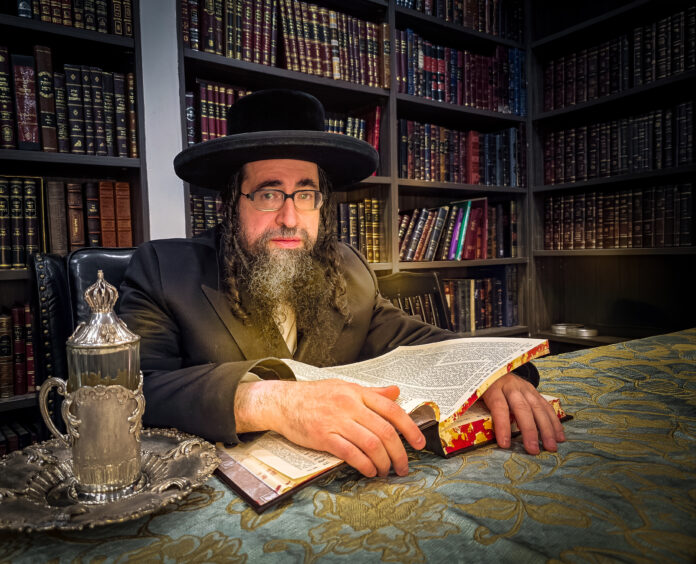 Ami Magazine3 months ago
People don’t fail because they’re not smart. People fail because they never stick with one thing long enough to succeed.”
It’s the kind of line you expect from a business podcast or self-help guru, not from a rebbishe-looking, chasidishe Yid speaking in thickly accented English. Yet that is precisely who delivers it in a clip that recently went viral.
The speaker is Rav Shulem Landau, rosh yeshivah and rosh kollel of Mosdos Rivnitz. He leads close to 100 bachurim in his yeshivah and more than 200 yungeleit learning across three kollelim in Williamsburg. A marbitz Torah for decades, Rav Shulem has shaped thousands of talmidim who have passed through his mosdos.
The clip, though, is far from a one-off. Lately, it’s nearly impossible to scroll through WhatsApp without encountering one of Rav Shulem’s status videos, each offering a tightly delivered piece of practical wisdom in plainspoken English. His videos routinely rack up millions of views, along with thousands of likes, shares and comments.
And therein lies the paradox: a chasidishe rebbe delivering mussar to the masses on social media.
I needed to find out who the rav behind the quotes really is and what exactly he’s doing there.
On this rainy evening, his beis midrash on Ellery Street is easy to miss, tucked discreetly into the middle of a row of identical townhouses. There is no sign, just a narrow doorway that gives little indication of the reach of the man inside.
When I step into the building, I’m immediately struck by an unexpected sight: a group of Sephardic balebatim filing out of Rav Shulem’s office. Some are dressed in tailored suits, others more casually; a few sport slicked-back hair. It’s not the crowd one expects to encounter in a Williamsburg shul, and certainly not in a chasidishe beis midrash.
“Please give the Rav a few minutes,” Rav Shulem’s gabbai, Shraga Moshe Kalmanowitz, tells me.
While waiting, I ask Kalmanowitz what he can tell me about the phenomenon that has drawn so much attention.
“It’s a lot more interesting than most people realize,” he says. “The Rav’s audience on these platforms is incredibly diverse—every kind of Jew you can imagine, and even non-Jews.”
He scrolls through his phone and shows me a sampling of comments beneath Rav Shulem’s videos. One stands out. “The rabbi is spitting fiery truths,” writes an African American pastor.
Kalmanowitz explains that the responses go far beyond public comments. “People message the Rav directly with real questions about life, faith, marriage and purpose. It’s impossible to keep up. We receive thousands of messages every single day.”
Rav Shulem Landau’s voice, it seems, is reaching far beyond Williamsburg.
A few minutes later, Kalmanowitz motions me forward and ushers me into Rav Shulem’s study.
Rav Shulem sits at the head of a long table, an old, well-worn Gemara open in front of him. He looks up, smiles warmly and gestures for me to take a seat directly beside him.
“So,” he asks in the same heavily accented English familiar from the viral clips, “what do you want to talk to me about?”
I assure him that Yiddish is my first language. He nods approvingly, and we switch immediately to mamme lushen, as he calls it.
“Growing up in Kiryas Yoel, I didn’t even know English,” he tells me. “I never attended English classes. I thought it was bittul Torah.” He pauses and then smiles at the memory. “My grandfather begged me to learn the language of the medinah. He said it was the only way a person could earn a parnasah, but I told him I was going to stay in learning my entire life. I was a foolish child.”
“Even though it came true?” I challenge him gently.
“Yes,” he replies without hesitation. “Even though it came true.” He taps the table lightly for emphasis. “Because knowing English is still useful. It would make it much easier for me to speak to people who don’t understand Yiddish.
“It was foolish for another reason as well,” he continues. “Staying in learning wasn’t the norm in my family. My father was a bus driver at the time, and money was very tight. Today, baruch Hashem, my father is a rav in Kiryas Yoel with his own shul. But for many years he worked to support himself. Still, he never stopped learning. He was never a rav by profession, but it was bashert for him to become one. My mother says that in the end she got a rav for a husband.”
Today, his father is known as the Zlotchover Rav. “He’s very matzliach,” Rav Shulem says. “He doesn’t seek kavod, so everyone loves him.”
Born in Eretz Yisrael, Rav Shulem’s father later came to Williamsburg, where he became a talmid of the Satmar Rebbe, Rav Yoel, zt”l. The family’s connection to Satmar ran even deeper: Rav Shulem’s grandfather had learned by the Rebbe in the original town of Satmar. After the war, the family lived for a time in Bnei Brak and then moved to Williamsburg in the 1970s, eventually settling in Kiryas Yoel.
“The reason my father chose the name Zlotchov,” Rav Shulem adds, “is that our family tradition is that we are einiklach of Rav Michel Zlotchover, ben achar ben.”
He smiles as he notes that the family has since become one of rabbanim. “I have a brother, Rav Moshe Landau, who is the Yampoler Rav. I have another brother, Rav Mordechai Leib, who has a shtiebel. And my children are already rabbanim as well. My brother Reb Yoeli is also b’etzem a rav, he just hasn’t gotten the job yet. But he’s getting there.”
“We’ll make him a rav in the article,” I joke. “He’ll discover it when he reads it.”
Despite serving as a rav and heading major mosdos, Rav Shulem’s parnasah does not come from his avodas hakodesh. “I have some partnerships, investments and other ventures,” he explains. “I was involved in business when I was younger.” Today, however, he is no longer involved in business day to day, leaving him the space to focus on what he sees as his real mission.
Beyond his shul, Rav Shulem also heads a yeshivah and kollel. “Our ultimate goal,” he says, “is to create something similar to what exists in the Litvishe world. There, bachurim and yungeleit often learn together in the same beis midrash, and the yungeleit create a powerful kol Torah. This has a real impact on the bachurim. Even if a bachur is going through a difficult period, he’s still immersed in a makom Torah and drawn into its atmosphere.”
To read more, subscribe to Ami
 Ami Magazine3 months ago
During the latest military operation against Iran, El Al has been operating under extreme constraints that have significantly disrupted normal air travel. As this interview goes to print, outbound flights from Israel have been sharply curtailed by government mandate, limiting the airline to just 15 flights per day, each carrying no more than 50 passengers.
Compounding these restrictions, ongoing missile threats and rapidly evolving security conditions have led to cancellations and frequent schedule changes, leaving thousands of passengers stranded and scrambling to find alternative routes. At the same time that flight capacity has been restricted, a significant increase in oil prices has further strained the airline’s operations and financial outlook. The financial toll on El Al has been severe, with losses estimated at approximately $4 million per day.
While struggling to maintain vital air links, the airline has come under public criticism for how it allocates the limited number of available seats. Many travelers have expressed frustration over what they perceive as unclear or inconsistent prioritization.
Shlomi Zafrany offers a rare inside perspective on the airline’s decision-making process. He addresses the criticism and explains the complex coordination between El Al and Israeli authorities, highlighting the difficult balance among operational limitations, security considerations and the urgent need to bring people home safely.
f it’s not a secret, can you tell me where you are right now?
It’s not a secret. We’re on our campus, which is within the airport complex. We have a bunker for these kinds of situations. We hope to never have to use it, but it’s intended for exactly these times.
Does the bunker belong to the airport or to El Al?
It’s El Al’s bunker. Inside the bunker we have our management team, the operational control center, and all of the major teams that need to continue working even when the sirens go off, which is what we’ve been doing for the last three weeks. Obviously, it’s important to us to keep our team safe.
So when people complain about canceled flights, they’re communicating with you in the bunker. Maybe they should know that you’re not operating normally.
It’s actually more challenging than that, because our customer care teams are either working remotely or from our call center, which isn’t underground. This means that every time the siren goes off, whether they’re at home or in the office, they need to stop what they’re doing and go to the safe room, which obviously creates another disruption. It’s a real challenge to try to provide decent service to customers. But that’s our goal.
Another challenge is that we’re dealing with the same frustration as our customers over the fact that we are forced to cancel flights or cap the number of people who can board an aircraft. All these limitations mean that 80% of our customers must be rejected as long as these restrictions are in place.
You’ve probably been operating from the bunker since October 7.
No. We did for the first few weeks, but then we moved back to the offices. We were there until last June, when we had to go back to the bunker during the 12-day war with Iran, and now we’re back here again. I believe that this is the third episode that has forced us into the bunker since the outbreak of the war in 2023. In addition to the other challenges the airline is facing, our working quarters aren’t all that great.
To read more, subscribe to Ami
 Ami Magazine3 months ago
“Joseph Kent, a top counterterrorism official under Trump, just resigned. Kent and I don’t agree on much, but he is right: ‘Iran posed no imminent threat to our nation, and it is clear that we started this war due to pressure from Israel and its powerful American lobby.’”
—Senator Bernie Sanders (I-VT), echoing Kent’s anti-Semitic conspiracy theory.
The Jews are behind it all.
That’s the thinking behind an inordinate amount of conspiratorial thinking. The idea that Jews were responsible for everything from the Black Plague to 9/11 to last week’s weather (and Rep. Marjorie Taylor Greene’s infamous Jewish space lasers) is a kind of anti-Semitic thought that has been with us for a couple thousand years. (The Romans had their own versions of this way of thinking.)
It’s therefore no surprise that we have been hearing similar things about the Iran war, especially from the political extremes. But what is more worrying is that we’ve been hearing those sentiments from members of the Trump administration as well as elected officials.
Just this past week, the head counterterrorism official in the Trump administration, Joe Kent, resigned, and in his resignation letter, he blamed the Iran war on Israel and “its powerful American lobby,” blamed the Iraq war and apparently the rise of ISIS on Israel as well, and suggested that President Trump had been fooled into joining the war.
That idea didn’t just find resonance on the far-right, Kent’s natural allies. Leftists, including Senator Bernie Sanders, echoed the statement. The fact that Kent has had ties with neo-Nazis and showed himself to be a conspiracy theorist multiple times did not faze them.
That episode raises a larger question. When the dust settles, will Israel’s enemies use the Iran war to turn Americans even further away from Israel?
A troubling terror chief
In February of last year, President Trump nominated Joe Kent, a former Green Beret and CIA officer, to serve as director of the National Counterterrorism Center, the country’s central organization for guarding against terror attacks.
Kent had unsuccessfully run for Congress twice, and that left him with a record that made a number of left-leaning advocacy groups, such as the Southern Poverty Law Center and Democratic Majority for Israel oppose his confirmation.
Kent also had some Republican opposition. Former Rep. Adam Kinzinger (R-IL), a Trump opponent who was no longer in Congress at the time, said of Kent, “This guy is, I’m not going to say neo-Nazi, but as close as you can get to that without being labeled that is about what he is. Every conspiracy theory he buys into.”
One Republican, Sen. Thom Tillis (R-NC), eventually voted against his confirmation.
To read more, subscribe to Ami
 Ami Magazine3 months ago
The American Jewish community was shocked by the news that two Jewish customers speaking Hebrew outside a restaurant in northern California last week were attacked and beaten by three men who happened to be walking by.
Then came the second shocker: one of the attackers was not a teenage miscreant but a 32 year-old attorney, employed by a local law firm as a specialist in mergers and acquisitions.
Once again, the old stereotype about violent anti-Semites and other terrorists—that they are young, unemployed and turn to extremism because they have “nothing to lose”—is contradicted by what we actually discover about them.
Barack Obama was a prominent exponent of the notion that poverty is a prime cause of terrorism. As a state senator in Illinois in 2001, Obama wrote that the 9/11 terrorists’ “lack of empathy” for their victims came “out of a climate of poverty and ignorance, helplessness and despair.” As president, in 2015, Obama asserted that terrorism increases “when people are not able to make a living or take care of their families.”
Obama was not alone in making such assumptions. Just last week, a prominent Israeli journalist, Tzvi Gottlieb, claimed that Hezbollah is actually just “an employment problem,” and if Israel would pay the salaries of its 50,000 members—which he estimated at $420 million annually—they would gladly put down their guns.
Yet the details emerging about recent Islamist attacks in New York, Virginia and Michigan contradict the notion that terrorists are simply unemployed people looking for jobs who don’t actually believe in the cause they espouse.
Emir Balat, who hurled a bomb at protesters near Gracie Mansion, ran lucrative online businesses selling high-end footwear and construction supplies. Mohamed Jalloh, who murdered a professor in Virginia, was 36 and served in the state’s national guard. Ayman Ghazali, who rammed his car into a Michigan synagogue, was a 41 year-old father of two with a job and a house. All three of them had plenty to lose by becoming terrorists.
A series of studies in the 1990s and early 2000s pulled the rug out from under the theory that terrorists are uneducated and unemployed, starting with a demographic analysis of the 415 Hamas terrorists deported by Israel to Lebanon in 1992. Dozens of them were doctors or professors; three-fourths were married; many had five or more children.
A study of 250 Palestinian Arabs who trained for suicide bombings in the late 1990s found that “none of them were uneducated, desperately poor, simple-minded or depressed. Many were middle class and, unless they were fugitives, held paying jobs…Two were the sons of millionaires.” Similarly, two-thirds of the 9/11 hijackers had attended college, some had master’s degrees and most had professions.
Contrary to the recent claim by Tzvi Gottlieb about Hezbollah, a study of its members in 2002 concluded that “having a living standard above the poverty line or a secondary school or higher education is positively associated with participation in Hezbollah.”
Radical ideology, not poverty, is the main cause of terrorism. That was true during the Holocaust—a large majority of top SS officers were university-educated professionals, and many had doctorates—just as it is true of contemporary Islamist and Palestinian Arab terrorists. ●
To read more, subscribe to Ami
 Ami Magazine3 months ago
Mark Levin is not only a well-known media personality and political commentator, but he has recently become part of the news itself as well.
In recent weeks, Levin has taken on commentator Tucker Carlson, whose rhetoric has increasingly become openly anti-Semitic, including the use of long-standing anti-Jewish tropes in his commentary. Carlson’s attacks have expanded into criticism of President Trump’s war against Iran, which he blames entirely on Israel. This stance has placed Carlson at odds not only with Trump but also with several leading figures within the MAGA movement who strongly support Israel and the administration’s policy toward Iran’s terror regime. Carlson’s arguments not only undercut the administration’s foreign policy but cross a line, intertwining political critique with prejudiced attacks on the Jewish community.
The dispute, however, has not remained limited to Carlson. Megyn Kelly has echoed many of Carlson’s sentiments with regard to Israel and the Middle East, amplifying what now appears to be a widening divide among prominent conservative media figures. These debates have highlighted growing tensions within the movement over both the US-Israeli alliance and the proper strategy for confronting Iran’s threats.
This ongoing war of words reached new heights on Sunday when Levin, a long-time supporter of President Trump and a vocal defender of the State of Israel, pushed back strongly with a biting post on X, expressing sharp disapproval of Kelly’s statements opposing the operation.
But what began as a dispute among media figures quickly escalated further when President Trump himself entered the conversation. Trump waded into the controversy on his own platform, Truth Social, forcefully championing Levin and defending him against critics. In doing so, he unexpectedly weighed in on the broader argument, backing Levin while implicitly rebuking Carlson and Kelly.
Donald J. Trump @realDonaldTrump
Mark Levin, a truly Great American Patriot, is somewhat under siege by other people with far less Intellect, Capability, and Love for our Country. Mark is Tough, Strong, and Brilliant, hence the nickname “THE GREAT ONE,” conceived by our MAGA friend, the wonderful Sean Hannity, after years of dealing with Mark in Legal, Media, and other capacities. Mark would often do Sean’s show, speaking as a lawyer, and Sean realized then, as did others, that he was special. Mark Levin was not looking to do Television, Radio, or anything else, but he was drafted by very smart people who understood that there are few like him. He is a true Conservative, an Intellect far smarter than those who criticize him but, above all, he is a man of Great Wisdom and Common Sense who truly loves our Country. When you hear others unfairly attack Mark, remember that they are jealous and angry Human Beings, whose “sway” is much less than the Public understands, and will, now that they know where I stand, rapidly diminish. Other than for his wonderful wife and family, Mark Levin only cares and wants one thing, GREATNESS AND SUCCESS FOR AMERICA! Those that speak ill of Mark will quickly fall by the wayside, as do the people whose ideas, policies, and footings are not sound. THEY ARE NOT MAGA, I AM, and MAGA includes not allowing Iran, a Sick, Demented, and Violent Terrorist Regime, to have a Nuclear Weapon to blow up the United States of America, the Middle East and, ultimately, the rest of the World. MAGA is about stopping them cold, and that is exactly what we are doing. G-D BLESS OUR GREAT MILITARY, WHICH I HAVE REBUILT SINCE THE BEGINNING OF MY FIRST TERM, TO ACHIEVE EVERLASTING PEACE THROUGH STRENGTH. MAKE AMERICA GREAT AGAIN! Thank you for your attention to this matter. President DONALD TRUMP.
Against the backdrop of this intensifying debate, I spoke with Levin to discuss it. He emphasized what is ultimately at stake for the United States, Israel and the broader strategic confrontation with Iran, and he explained why these right-wing commentators remain outside the mainstream of Republican thought, exerting little influence over President Trump’s decision making.
On Sunday, the president of the United States weighed in with a post on Truth Social on your give-and-take with Megyn Kelly. What did that feel like?
I was absolutely stunned and incredibly gratified. He’s a really wonderful man. What he’s doing with Iran and his efforts to fight anti-Semitism are unprecedented. I don’t think we’ve ever seen the likes of him before. My wife, Julie, and I were absolutely thrilled by what he had written. I hadn’t spoken to him in weeks.
Obviously, this was brought to his attention, although certainly not by me or anyone on my behalf. It’s an amazing thing to have the president of the United States step in the way he did.
I think the even bigger picture is that he’s had enough of the effort by this cabal to undermine MAGA, the conservative movement and the Republican Party, and now he’s publicly saying so. I think it’s pretty clear to any sober thinker that these individuals have their own agendas, and that their effort is to disunite us.
Did you have any warning that the president was going to mention you in such a laudatory fashion?
No. I had absolutely no knowledge or expectation. It was the furthest thing from my mind.
He said such wonderful things about you.
(Laughs.) I usually only get compliments from the family, and that’s about it.
What do you think the post accomplishes? Of course, it endorses you in a wonderful way, but do you think it tilts the argument in your or his favor?
I think it says what it says, and it clarifies that I’m an outspoken supporter of his as well as what he’s doing in Iran. So I think he’s saying, “These people are really attacking me as well as Mark, and they don’t know what they’re talking about.”
Do you think there’s any possibility that the president will lose control over his own MAGA movement?
The facts are indisputable. Over 90% of MAGA supports the president and his handling of this war against Iran, and zero percent of these woke-right neofascists do. Yet they claim to represent MAGA. They don’t represent MAGA. The president made that very clear in his statement. “I’m MAGA, and this is what we stand for.” We know what he stands for: peace through strength. He’s never been an isolationist. He also said that Iran is not going to get a nuclear weapon. So he’s been very consistent on what he’s campaigned on and what he’s doing.
He mentioned Sean Hannity as well. Do you think he’s trying to give you and Sean stronger voices than you’ve had until now?
No. I don’t think that’s something he was thinking about, certainly not the way I read it.
Do you find yourself more empowered and more responsible for voicing that support than you have until now?
I don’t think about being empowered. I try to do what I think is right. My positions haven’t changed for decades, not a single iota. You either have a view of the world that’s based on a belief system, value system and principles, or you don’t. I’m very blessed to have my platforms, and I don’t pull any punches.
You’re very admirable in sticking to your values, and I think everyone should emulate you in that. After all, you’re fighting the good fight.
You’re very kind. I don’t really know any other way to do it. It’s the way we roll here.
You used to focus heavily on the left, but now it seems like you’re equally passionate about addressing those in your own camp, the right wing of the Republican Party.
I look at it a little differently. I don’t think these people are still part of the “right wing” or the “Republican Party.” I’m a constitutional conservative, and they have never been part of what I believe.
That being said, yes, these people were previously aligned with the Republican Party, and now they seek to destroy it. Some of them previously sought to be aligned with the conservative movement or constitutional conservatism, but now they seek to destroy that too. They’re off in their own orbit at this point.
They are similar in their hatred of Israel, its prime minister, Jews and, quite frankly, the United States.
To read more, subscribe to Ami
 Ami Magazine3 months ago
I remember it clearly. It was blow after blow, and klal Yisrael was reeling. Some 40 years later, the Torah world is still limping from the loss of two gedolei Yisrael—spiritual giants who complemented each other in their knowledge, wisdom, and the ability to bear the weight of powerful decisions on their shoulders, together.
Wednesday marks the 40th yahrtzeit of my zeide, Rav Yaakov Kamenetsky, zt”l, who was niftar on 29 Adar I 5746/1986. Two weeks later, on 13 Adar II, Taanis Esther, his dear friend and confidant, the posek hador who guided klal Yisrael for decades, Rav Moshe Feinstein, zt”l, was niftar. In a leap year, like the year they left this world, Rav Yaakov’s yahrtzeit comes first. In a regular year, like this year, Rav Moshe’s yahrtzeit precedes that of Rav Yaakov. Sometimes one is first, sometimes the other.
It is reminiscent of Rashi’s comment that in the Torah sometimes Moshe is mentioned before Aharon and sometimes Aharon before Moshe, to teach that they were equal in stature. While it is not for us to suggest comparisons between gedolei Yisrael (even if one is my own grandfather), this alternating order is striking. It reflects, in a small symbolic way, the shared leadership they provided.
Numerous biographical articles and books have been written about each of these gedolei hador individually. I would like, however, to reflect on a specific aspect of both their lives: the extraordinary relationship between Rav Yaakov and Rav Moshe.
To casual observers, they seemed cut from the same cloth: two Litvishe rabbanim who both became roshei yeshivah and stood together at the helm of American Torah life for decades, carrying the burden of klal Yisrael with mutual respect, deep affection and agreement on almost every critical matter. In reality, however, they came from different backgrounds and different schools of thought, and they often approached critical issues from completely different perspectives.
Rav Moshe was a talmid of Rav Pesach Pruskin, and his outlook was shaped by the Lithuanian rabbinic tradition. His clarity, precision and confidence in psak made him the address for halachic questions from across the United States and around the world. Rav Yaakov, a talmid of Slabodka, carried the imprint of the Mussar movement—measured, thoughtful and attuned not only to the letter of the law but to how that letter would live in the hands of people. He was known for guiding klal Yisrael in general matters with prescient vision that extended far beyond the moment. Yet those differences never became divisions.
I once read about a meeting at which Rav Moshe had rendered a decision on a matter of public concern, and that was how the matter was ultimately adjudicated. Rav Hutner, zt”l—who, like Reb Yaakov, had learned in Slabodka—disagreed with Rav Moshe’s decision, later commenting to Rav Yaakov that “had Rav Moshe learned by our rebbe, he might not have held that way.”
In a different instance, my zeide quietly noted to me that he might not have expressed a certain ruling in the same way Rav Moshe had—because while Rav Moshe was technically correct, my zeide was worried that his ruling in this case might later lead to manipulation in other circumstances—but such observations were never criticisms. (He may have wanted to teach me how he approached certain issues.)
Once, my zeide’s talmid came to him with a very complicated sh’eilah. He refused to rule on it. “This you must ask Rav Moshe. Only Rav Moshe has shoulders broad enough for this,” he said. Then he added, “If Rav Moshe tells you that you may be lenient, you should follow him one hundred percent. It is one hundred percent mutar, and I stand behind it equally.”
After the petirah of Rav Aharon Kotler, zt”l, in the early 1960s, the American Torah world entered a new phase. Rav Ahron’s fiery drive was almost impossible to replicate, but it had to be sustained with steadiness. For the next 20 years, Rav Moshe and Rav Yaakov did that together.
They addressed the concerns of Agudas Yisrael, Chinuch Atzmai, and countless other communal organizations and matters that shaped Torah life. Their affection and reverence for one another was transcendent. Rav Moshe once said, “I love Rav Yaakov, and I am certain he loves me as well,” quoting the pasuk in Mishlei, “Kamayim hapanim lapanim kein leiv haadam laadam—As a face sees its reflection in the water, so does one man’s heart reflect another’s feelings.” Rav Yaakov beamed when he heard this.
Rav Yaakov’s admiration for Rav Moshe was of public record. He once addressed a group who had just visited Rav Moshe, telling them a personal anecdote. “When I was a five-year-old boy,” my zeide said, “everyone in my town envied an old man of about 90 who had, at the age of five, shaken the hand of Rav Chaim Volozhiner. I assure you that in years to come your grandchildren will boast that their zeide had the privilege of meeting Rav Moshe Feinstein.”
My grandfather lived in Monsey. Rav Moshe would sometimes come to Monsey to stay at the home of his son-in-law, Rabbi Moshe Tendler. On those occasions, my grandfather would always go to visit him. I remember driving my zeide to the Tendlers’ home after Rav Moshe had taken ill. Rav Yaakov urged him to rest properly, even bringing proofs from Chazal about guarding one’s health that fit his particular situation. Rav Moshe smiled. One sentence, I can’t forget. With that trademark twinkle in his eye, my grandfather exhorted him gently in Yiddish, “Kenst mir folgen. Ich bin a bissel elter fun eich. You can listen to me. I’m a little older than you.”
Rav Moshe smiled and assured him that he would indeed get more rest.
After we left, Rav Moshe reportedly turned to one of his grandchildren and said, “Now it’s our turn for me to visit Rav Yaakov.”
To read more, subscribe to Ami
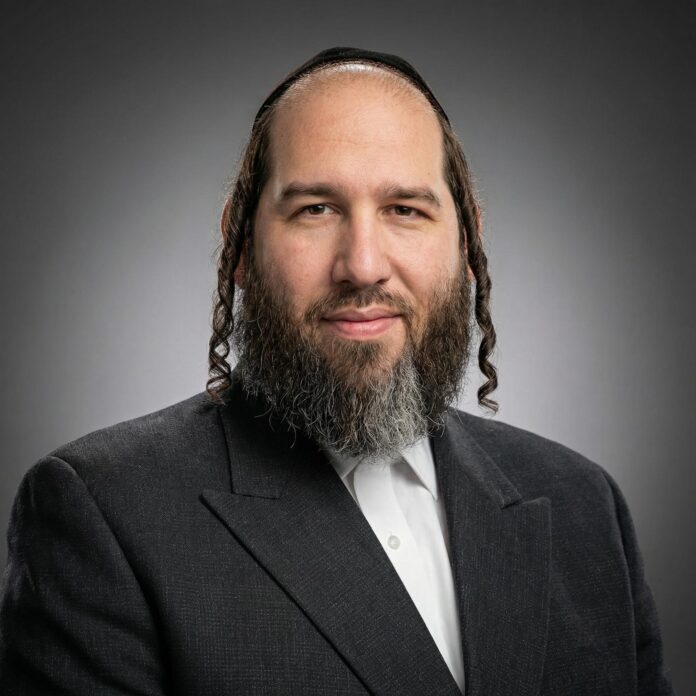 Ami Magazine3 months ago
Two weeks ago I received a phone call from Chaim (Charlie) Lefkowitz, introducing himself as a mortgage broker who specializes in LifeCo commercial loans—funded not by traditional banks, but by life insurance companies.
Wanting to help educate investors and other mortgage brokers about the availability and benefits of using LifeCo loans, Chaim had arranged a panel at the then-upcoming ReFinance Real Estate Summit. Though extremely successful as a broker, he was experiencing some stage fright—a common affliction—and requested my help in preparing for actual event. I ended up moderating the panel together with Chaim and a LifeCo correspondent, underwriter and lawyer. Chaim did great.
Afterward, I observed many people at the summit approach Chaim for more information about this relatively unknown side of mortgage lending, and I realized he’d be a natural subject for this column.
After spending almost a decade in his family business, Chaim decided to branch out. He started to work on some minor development projects, which led him to the world of commercial mortgages. He got his start in the mortgage field while securing loans for some of his developments.
What almost nobody knows—and this includes, until recently, some of the most sophisticated commercial investors in our community—is that life insurance companies are one of the largest providers of commercial real estate loans in the entire United States, putting out somewhere between $30 and $40 billion a year, and that getting a loan through them is in many ways faster, cheaper and more reliable than going through a traditional bank.
Today, Chaim is one of the foremost experts in LifeCo lending in the frum world, closing between 70 and 80 deals a year with an execution certainty that no conventional bank can come close to matching.
We spoke about how commercial real estate lending works, why LifeCo has quietly become the superior product for the right deals, and what it takes to figure out something from scratch that nobody around you knew how to do. Enjoy!
—Nesanel
I was born in Brooklyn, New York, the fourth of eight children. I grew up in Williamsburg and went to Satmar until my bar mitzvah, then to a yeshivah in Borough Park called Kavonas Halev, which is associated with Krasna. For yeshivah gedolah, at around 15 or 16, I decided to explore a little, so I went to Rav Henoch Perl’s yeshivah, the first chasidishe yeshivah in Lakewood, which had just opened.
“The learning was completely different from what I was used to. Rather than try to get through a lot of masechtos, they learned two or three blatt Gemara over the entire year, which was very challenging for me. So I moved on to Nitra Yeshiva in Mount Kisco, and from there I got married at 20.
“My mother’s father was Reb Sender Deip, the Satmar rosh hakahal, and we are proud Satmar chasidim. I have a connection to the Rebbe, Rav Zalman Leib, and I go to him before every simchah with a kvittel.
“My father opened a hardware distribution company in the late 1990s. Later, my grandfather (his father) and my uncle joined him, and for close to 30 years, they ran a wholesale hardware and paint supply business together. They supplied hardware stores, plumbing companies and lumber yards throughout New York City with brushes, paint supplies and all related materials. My grandfather worked there until he passed away in 2015 at close to 90 years old.
“I was never really the entrepreneurial type in yeshivah; I was always the arranger. I wasn’t interested in making a few dollars by binding sefarim; I was always thinking about the big picture. I’m a very neat, very organized person, and I like to organize. Whenever something was going on in yeshivah, whether it was Purim, a sheva brachos or an event, I arranged every detail.
“A few months after I got married, I joined my father’s business as a salesman. That’s when I found out that I am not a salesman. I had to do it to make a parnasah, but after a few years I moved inside the company and started growing things. I tried to take the business online to Amazon and Walmart and expand outside of New York City and New York State, but that turned out to be a challenge on both the logistics side and the family side.
“Working with family runs on two separate tracks simultaneously. One track is the family relationships, and the other track is the needs of the business. If a company doesn’t adapt to keep up with new developments, the younger generation eventually hits a ceiling. I hit that ceiling. I also realized that although we’d worked well together for ten years, staying in the business would hurt my relationship with my father.
“I stayed in the company a little while after my grandfather passed away and then I left. I was 32 years old, I had a family, and I wanted to find something that no one in my family had ever done and had significant potential. Real estate was the obvious choice.
“I joined a company that did both property development and management in New York City, and the owner of that company became a genuine mentor. He didn’t just hand me one piece of the business; he brought me in and promised that he was going to show me everything I needed to know to be successful, and that I would get to decide down the road which part of the industry I wanted to pursue. He taught me development, management, lending, fundraising—everything. He took me to the banks and showed me how to represent his deals, how to get them through to closing, and also how to evaluate a property, what to look for, and how to develop from the ground up.
“He also turned me into a numbers person, which I wasn’t yet at the time. Numbers never lie, and you can read them up and down, but you have to actually understand them first. I had to push myself hard to learn how to evaluate a deal, underwrite it, and make it work. It wasn’t easy, but once I got there, it clicked.
“After about two and a half years he told me that I could stay if I wanted, but he’d shown me everything he had and now it was my time. So I left and started doing my own small ground-up constructions in the Bronx. I bought some finished properties in New York, New Jersey and Pennsylvania. During Covid, when you could get loans cheaply, we bought a number of lots and built on them.
“I found my real footing once the construction was done. I went back to the lenders I had already built relationships with and started doing the mortgages myself. The opportunities kept growing. I started helping people in the community find funding for their commercial properties. At a certain point I wanted to do something unique, something that would put me in a completely different category.
To read more, subscribe to Ami
 Ami Magazine3 months ago
Meet two brave souls, a Muslim lady in London and a Jewish man in Tehran.
First, some background:
A British group, the Islamic Human Rights Commission (IHRC), holds an annual Al-Quds Day march in the UK capital. Al-Quds is the Arabic name for Yerushalayim and, as decreed in 1979 by Ayatollah Ruholla Khomeini, the first Iranian supreme leader [read: “ruthless dictator”], the last Friday of the month of Ramadan is occasion to host marches and demonstrations to express opposition to Israeli control over the Holy City.
Following the vaporization of Iran’s more recent and newly late supreme leader, Ayatollah Ali Khamenei, who ordered the murders of some 30,000 Iranian protesters earlier this year, the IHRC lamented him as “a rare role model” who would be “mourned by freedom-loving people all over the world.”
Now the group is upset. Its planned march through London this year was nixed by British Home Secretary Shabana Mahmood, the Muslim daughter of Pakistani immigrants. She unapologetically approved a request from the Metropolitan Police to ban the march in order “to prevent serious public disorder.” Both Labor and Conservative members of Parliament backed the banning of the march.
A spokesman for the IHRC, Faisal Bodi, told the BBC’s The World Tonight that it was “a sad day for freedom of expression, freedom of assembly and the right of people to legitimately protest about issues they feel strongly about.” Not to mention to incite hatred of Israel and Jews.
Kudos to Home Secretary Mahmood, brave soul #1.
A couple thousand miles away, in Tehran, lives a second intrepid, a Jewish Iranian restaurant owner by the name of Arash.
Middle East Eye is a news medium whose focus lies in its name. It is owned by a company with a single director, Jamal Bessasso, a Kuwait-born resident of the UK. MEE is rumored to be funded by the government of Qatar and is a go-to site for anti-Israel “reportage.”
But it also carries some worthy stuff. Like a recent lengthy piece titled “Iran’s Jews feeling fear and heartbreak as US-Israeli strikes rain down.” It featured quotes from interviews with members of Iran’s small Jewish community—some 9,000 people in a country of 90 million.
One interviewee, Yosef (last names are omitted in the article), “trying to stay safe from air and missile strikes that often originate in Israel, a country he is supposed to feel some affinity with,” according to the interviewer, is critical of Israel, which he says “has damaged [its] reputation around the world.’
“Yes, I’m Jewish,” he explains. “But I cannot see the country where I was born and raised as my enemy.”
Then there’s “Daniel,” a 52-year-old Jewish worker in a jewelry shop in the capital city.
“I don’t remember the time before the revolution,” he says. “But my parents and older relatives always told us that Iran and Israel once had close relations. They never imagined that one day the two countries would be in a situation like this.” (They never imagined Islamist terrorists becoming their country’s government.)
And then there is the aforementioned Arash, 71, who owns a small restaurant in Tehran.
Asked about his own feelings regarding the conflict, he says, “It’s not easy to talk about these things, especially during wartime. This is a war between two countries that you feel connected to.”
He then dares to claim that many of his fellow citizens who are Muslim are resentful of the Islamist regime.
“The level of anger toward the Islamic Republic is so high,” he says, “that many Iranians today see Jews as friends.”
And then he waxes more daring still, and asserts a truth that justifies the omission of his surname, “The real question,” he states, “is: who first promised to destroy the other?” And, in case the interviewer somehow missed the point, Arash makes it explicit: “The policies of the Islamic Republic,” he explains, “helped bring the situation to this point.”
Although he sees himself as an Iranian, he says, “It makes me sad that the policies of this government have brought the country to this situation.”
At some times and in some places, stating an obvious truth, like addressing an obvious danger, is an act of courage.
To read more, subscribe to Ami
 Ami Magazine4 months ago
The US Takes Up the fight Against Belgium’s Bigotry
Belgian police raided the homes of three respected mohalim in Antwerp. Their alleged crime: performing bris milah without a medical license.
Under current Belgian law—as interpreted by authorities—only licensed medical professionals may perform circumcisions. Unlike neighboring countries such as the Netherlands and Germany, Belgium hasn’t created a clear exemption or certification pathway for religious circumcision performed by trained mohalim. During the raids, the police confiscated their equipment and demanded the names of the Jewish infants they circumcised in the past, raising the possibility of retroactive prosecution.
At present, there is only one Jewish doctor in Belgium who is also a mohel. Strict enforcement of the law would therefore render most bris milahs in the country impossible. Families would be forced to either travel abroad or conduct the bris discreetly, which some observers have likened to the underground religious practices that were caused by Soviet-era repression.
The court case against the mohalim remains ongoing. Belgium’s Jewish community has argued that the prosecutions violate the country’s constitutional protections for freedom of religion. At the same time, communal leaders have sought a practical solution: a certification framework that would allow qualified mohalim to perform bris milah legally.
To that end, representatives of the Jewish community approached Belgium’s minister of health, Frank Vandenbroucke, requesting the creation of a regulatory pathway. Thus far, however, Vandenbroucke has declined to propose legislative adjustments or administrative accommodations.
That refusal drew a sharp response from the United States ambassador to Belgium, Bill White. A businessman and philanthropist appointed in 2025, White has made religious liberty and the fight against anti-Semitism central themes of his diplomatic tenure. On Monday, February 16, 2026, he publicly demanded that Belgium drop the “ridiculous” and “anti-Semitic” investigation into the three men.
In a social media post, White called on Belgium’s “very rude” socialist health minister to stop the “unacceptable harassment” and “disgusting” treatment of the mohalim, and he urged the country to do “a much better job” on anti-Semitism. White insisted that Belgium either change its law that circumcision must be carried out under strict conditions by a medical professional or recognize that the investigation into the “three beautiful religiously qualified and wonderful men” was anti-Semitic. He dismissed accusations that he was interfering in Belgium’s judicial affairs as a “political distraction.”
White’s posts were explicit. He wrote:
“TO BELGIUM, SPECIFICALLY YOU MUST DROP THE RIDICULOUS AND ANTI SEMITIC ‘PROSECUTION’ NOW OF THE 3 JEWISH RELIGIOUS FIGURES (MOHELS) IN ANTWERP!”
He then criticized Vandenbroucke personally:
“You must make a legal provision to allow Jewish religious MOHELS to perform their duties here in Belgium. Take action NOW! The world is watching. America is counting on you to do the right thing. Frank, you should do it NOW so this case ends!”
White also claimed that at their first meeting, Vandenbroucke had refused to shake his hand or pose for a photograph together, adding, “He was very rude and was quite obnoxious. I was told he does not like my great President.”
After Belgium’s Foreign Minister Maxime Prévot publicly condemned White’s comments, White posted again:
“In NO way, shape or form have we ever suggested that a political person in the Gov’t should interfere in a judicial case. That said, the case should be immediately dropped. It is ABSOLUTELY an issue of anti-Semitism. You either have to make a change to the procedural accreditation or you have to call prosecution of these three beautiful religiously qualified and wonderful men anti-semeitc [sic].”
Belgian officials responded forcefully. Prévot called White’s accusations “false, offensive and unacceptable,” accusing him of violating “fundamental diplomatic norms.” Authorities reminded the ambassador of the Vienna Convention on diplomatic relations, stating that personal attacks on a member of the government and interference in Belgium’s internal affairs are contrary to basic diplomatic rules. The ministry emphasized that while Belgium values its relationship with the US, dialogue “must be based on respect for our institutions and our sovereignty,” and reaffirmed its condemnation of anti-Semitism and racism.
The diplomatic row escalated further when White reportedly threatened Conner Rousseau, leader of the Flemish socialist Vooruit Party, with a travel ban to the US. Rousseau had posted on social media comparing the actions of US Immigration and Customs Enforcement to historical atrocities, drawing parallels with the Holocaust. Rousseau said that he was unrepentant:
“I posted that on social media five weeks ago, and yesterday it suddenly turns out to be a problem. I suspect [White’s] intervention regarding the circumcision did not go as he would have liked. I can only say that we in Belgium have the right, and I also believe a political duty, to express our concerns about what’s happening in the US. I respect the ambassador’s opinion, but I also ask for respect for ours.”
The controversy also involved Belgium’s lone Jewish member of parliament, Michael Freilich, who had discussed the circumcision controversy publicly, including conversations with American lawmakers. Critics accused him of inviting foreign interference in domestic judicial matters. Among them was Sammy Mahdi, head of the Christian Democratic and Flemish Party, who compared Freilich’s actions to “a member of parliament with a Muslim background lobbying in Morocco or Qatar to influence a court case in Belgium.” Freilich denied attempting to orchestrate US pressure. The European Jewish Association condemned the public questioning of Freilich’s loyalty as a “public lynching,” warning that it echoed one of Europe’s oldest anti-Semitic tropes.
White’s intervention has made it clear that Washington sees this case as part of a broader transatlantic concern over rising anti-Semitism and the protection of minority religious practices. It is worth noting that some 60 Jewish leaders wrote to European Commission President Ursula von der Leyen last May, urging the EU to condemn Belgium after the police raid the homes of the three mohalim in Antwerp, but no condemnation was forthcoming.
The attitude of the Belgian authorities is a concern. And while there is no direct link between the Belgian government’s controversial policies and random anti-Semitic acts in the country, such incidents are certainly concerning. A shul in the Belgian city of Liège was damaged in an explosion during the early hours of Monday, according to police.
The blast occurred around 4:00 a.m. local time in front of the shul, shattering windows across the street but causing no injuries, officers said.
Willy Demeyer, the city’s mayor, described the incident as “an anti-Semitic act,” while Prime Minister Bart De Wever expressed solidarity with the Jewish community on social media.
The Belgian federal prosecutor’s office, responsible for terrorism and organized crime, is leading the investigation, an official confirmed.
To better understand the American position and the evolving diplomatic tensions, we spoke with Mark Walker, principal adviser for global religious freedom at the United States Department of State. Walker outlined the US government’s perspective on Belgium’s actions and discussed the measures the administration may take to press Belgium to safeguard the religious liberties of its Jewish community.
Mark Walker is a former US representative from North Carolina, serving from 2015 to 2021. In April 2025, he was nominated to serve as ambassador-at-large for international religious freedom, but after delays in his Senate confirmation he withdrew on January 8, 2026, and was appointed as State Department adviser on global religious freedom, where he focuses on advancing religious freedom initiatives around the world.
During his time in Congress, Walker was active on issues connected with US-Israel relations. He cosponsored bipartisan legislation to strengthen cooperation between the two countries, and he supported efforts opposing the delegitimization of Israel and the global BDS movement. He also advocated for policies addressing security concerns for Jewish institutions and took positions critical of the Iran nuclear deal, reflecting a pro-Israel stance.
As the Trump administration’s nominee for the global religious freedom post, Walker visited Israel in 2025, including Jerusalem and the Kosel, where he pledged to combat anti-Semitism, promote interfaith cooperation and reaffirm the ties between the United States and Israel. He met with religious leaders and families of hostages taken during the 2023 Hamas attacks, emphasizing the shared commitment to defending religious liberty and promoting coexistence.
Walker ran for the US Senate in North Carolina in 2022, seeking the Republican nomination, and later pursued the Republican nomination for governor of North Carolina in 2024. He has also been involved in national politics, including serving on former President Donald Trump’s campaign staff. Throughout his career, Walker has focused on legislative efforts and advocacy related to both conservative policy initiatives and religious liberty.
Thank you for taking the time to speak with me. You’re doing incredible work. Please describe your role at the State Department.
I serve as Secretary Rubio’s principal adviser on religious freedom issues, whether that involves the Druze in Syria, anti-Semitic incidents, or Christians in Africa.
We currently designate 13 countries as Countries of Particular Concern. There are actually two tiers to the CPC list. The first is a lower-level designation known as the Special Watch List. The second is the more serious list. If a government isn’t taking steps to prevent attacks on Christians or address anti-Semitic behavior, it can trigger economic sanctions and other measures.
I oversee a team of about three dozen people who focus on different regions. We monitor these governments closely to assess whether there are intentional violations of religious freedom.
If a government is engaging in acts of religious discrimination, to whom do you report it?
I report to Marco Rubio, and on occasion to President Trump. But my direct supervisor is Secretary of State Rubio.
Every administration has its priorities. How important is religious freedom to the Trump administration?
It’s huge. I think he set a real precedent during his first administration when he became the first president to address religious liberty and host a conference on it at the United Nations. No American president had ever done that before.
We know that President Trump has placed a lot of strong voices in key positions when it comes to calling out anti-Semitic behavior. Even in this day and age—when over the past few years it has become more common for entertainers and leaders to be weaker on these issues—he continues to be a strong voice, and he is well aware of the role I serve.
I served in Congress for six years, and my dear friend Mike Huckabee is someone with whom we have worked with closely over the years. We are both grateful for the opportunity to work for both President Trump and Secretary Rubio.
To read more, subscribe to Ami
 Ami Magazine4 months ago
John W. Spencer is a retired United States Army officer, urban warfare researcher and author. He currently serves as chair of Urban Warfare Studies at the Modern War Institute, codirector of the Urban Warfare Project, Chair of War Studies at the Madison Policy Forum, and host of the Urban Warfare Project Podcast at West Point. He is also a founding member of the International Working Group on Subterranean Warfare.
Spencer has provided expert commentary on contemporary conflicts, including the Russian invasion of Ukraine. His analyses of Israel’s campaign in Gaza following October 7 have been widely cited, including by Israeli Prime Minister Benjamin Netanyahu.
You may be the most quoted military expert in history.
I’m honored.
Over the past week, we have witnessed one of the most amazing bombing campaigns of all time. Would you agree?
Absolutely. The synchronization and lethality are unparalleled. There has never been a military operation in history where the entire political and military leadership of the opposing force was eliminated in the first four hours, if not the first four minutes.
How significant is that when there are clearly others who can step into their roles?
I get that the bench is deep, but this is what I call the first neurological strike. War is always a contest of will. There have usually been other ways to attack the will of the political leadership, the military and even the population, but this is a change in the character of warfare, severing the brain before the other strikes begin. Those directing the enemy’s strategy—the commanders of their military forces, the defense minister, the chief of staff, the head of the missile command, etc.—were basically eliminated. I understand that they’ll just be replaced, but you can’t say that Israel and America haven’t made it clear, in both the 12-day war and this one, that whoever wants to be next in command will also be next on the target list.
I use the analogy—and of course all analogies have their limitations—that if before the boots hit the ground on D-Day they had eliminated Hitler, along with his successor and all of his field marshals, it might not have necessarily won the war, but it would have definitely changed the paradigm of what the enemy thought he was going to do. That’s the Sun Tzu aspect of The Art of War: you win by attacking the enemy’s strategy.
Sometimes it’s good to keep the enemy’s leadership intact so you know with whom to negotiate as the war progresses. In the current situation, who would that be?
They will appoint someone, and you also have to look at the goals for this war as stated by the political leadership. This is about changing behavior, and one of the strategies for that is this decapitation, but you also want to eliminate their capability. I believe that they realized in past negotiations that the differences were irreconcilable, so now they want to see if…well, not the next ones in line, but the third or fourth ones in line will be different.
They also want to see if the weakening of their power, which is also one of the outcomes of their elimination, leads to a popular uprising or whatever comes after that, and then those people will change the behavior of the regime. That’s why I believe this isn’t necessarily a regime-change war but a behavior-change war aimed at the leadership of Iran. If the outcome is regime change, as most people believe it will be, then you get that net result.
That’s why the other line of operation is to eliminate Iran’s capability. In some aspects, you hope for a change of behavior in the long run, but in the short run you eliminate anyone’s capability, regardless of their behavior. That means destroying their nuclear program, their missile program and their navy, which are definitely measurable, whereas when you get into the cognitive aspect it’s a lot harder.
There are experts such as Robert Pape and others saying that what America is trying to do flies against historical evidence showing that these types of wars cannot be won from the air. Does what America and Israel are trying to do contradict what we already know?
Not necessarily. I know Pape well, but if you want to look at bombing campaigns that changed regimes, there are two recent ones: Libya and Serbia. And if you want to look at campaigns that changed behavior, you can also look at the Persian Gulf War, which changed Saddam’s behavior not just in Kuwait but also with regard to his nuclear program.
When you start comparing what’s going on to past campaigns, you also have to look at whether bombing is really the only strategy here. That is why I don’t like it when analysts only judge what they can see versus what they know. You can’t make comparative analyses to similar situations and say that you won’t have success without boots on the ground, which gets you to the question of whether there will be boots on the ground.
Then there are nuances about whose boots on the ground you’re talking about, because right now there’s the threat of Kurdish boots and you also have the Azeris, the Baluchis and the possibility of a popular revolt. The administration has said that they aren’t done weakening the power of the regime. So I would challenge Pape and ask him, “Are you saying that no bombing campaign has ever weakened the power of the enemy?” That would clearly not hold up to historical comparison.
And after weakening that power, a popular revolt is absolutely in the cards, although America has told them not to come out yet. So is the goal to weaken the regime, remove its capabilities and then have the not-our-boots-on-the-ground part of the plan as phase two? We’ll see. But this is why you can’t create analysis based on what you infer the plan to be.
Do you think that the United States, Israel and the rest of the world have overestimated the potential for a popular revolt? Meaning that there may be millions of Iranians who would want to see that, but in a country that large they may still be the minority.
I don’t think so. You can’t overestimate what a popular revolt can do; that’s historical. In fact, I think people may have underestimated how much Iranians want a change in policy. But there are limitations to what a popular revolt without arms can do, which also comes with the assumption that there aren’t any plans to use arms.
This brings us back to the question of whose boots we’re talking about. During the 1979 Iranian Revolution, hundreds of thousands of soldiers refused to follow orders to put it down, and many even went over to the revolution. Is that a possibility? That has certainly been a very large part of the current plan with the psychological operations—the text messages and TV, and they even got hold of the prayer app—as well as public statements to the regime, the military and even the IRGC offering immunity, asking them to lay down their arms and for soldiers to defect. It isn’t a black-and-white question of whether the people will come out. I think that’s a given, because they’ve already shown that they would.
Again, this is why the plan isn’t only to attack the political leadership or the IRGC. You can see that they’re also attacking the Basij headquarters, the police headquarters and other important locations so that if there were a popular revolt, it would have a better chance of success. Hopefully we’ll see defections from people who recognize that the regime doesn’t have a future, which is also a goal in war. You want to convince the enemy that he has no hope of survival.
You are a man of science who understands military strategy. When you calculate, you make rational calculations. But do those calculations take into account the response of an irrational enemy?
They do. War is an act of force to compel your enemy to your will. You want the threat of force to compel him to do what you want, but there is also irrationality and uncertainty, so you have to account for both.
That is also why I say that the continued, unprecedented eliminations of political leadership and military command are part of getting rid of the irrational until you get to a rational actor. That is clearly all part of the plan.
To read more, subscribe to Ami
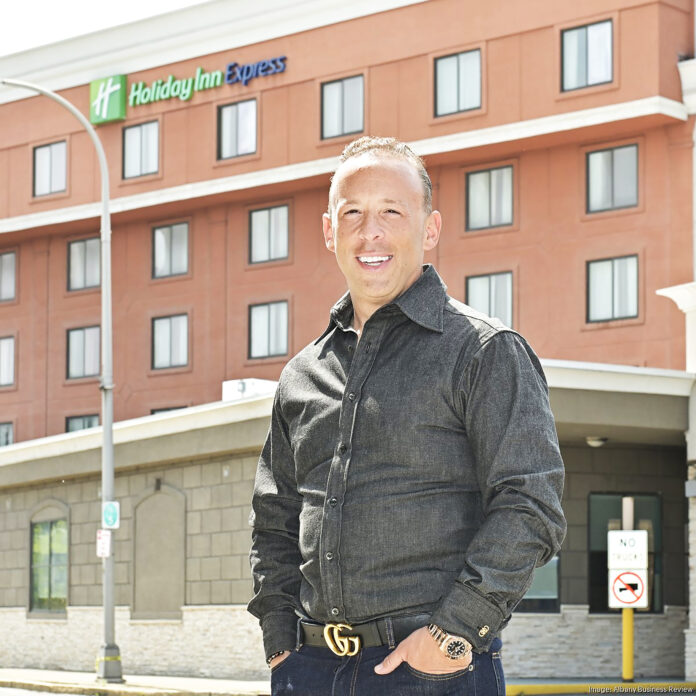 Ami Magazine4 months ago
Moshe (Morris) Oiring runs a network of healthcare companies that serve thousands of people every day. In recent years, he has also begun expanding into kosher hospitality, opening the first glatt kosher hotel in Albany and now working on a new one in Manhattan.
In our conversation, we discussed the broader scope of his work—how his healthcare enterprises serve communities daily, how his newer hospitality projects reflect the same philosophy, and why he believes affordability and access should matter more than simple profit maximization.
He also shared ideas about community building and entrepreneurship that I found both new and inspiring. I hope you do too.
—Dovid
My father was born in Russia and grew up on Webster Avenue in the South Bronx,. My grandmother liked the Bronx, until two bullets flew in through my father’s bedroom window. Then she conceded, ‘Maybe it’s time to leave.’
“The family moved to Eretz Yisrael, settling in Meah Shearim. My first cousin, Bentzi Oiring, is the head of ZAKA there. My parents met and married in Israel, but my mother suggested they go to America for parnasah. They settled in Boro Park, and my father taught in Dyker Heights.
“My mother told me that her father had played a role in bringing Rav Yisrael Meir Lau to a position of leadership. I didn’t really believe her, but years later, I met Rav Lau at an event and mentioned that I was Penina Slavaticki’s son. At first he didn’t react, but his rebbetzin immediately turned and said, ‘What did you just say?’ She pulled me aside and told her husband, ‘This is Penina’s son.’ Rav Lau then asked, ‘Why did she leave Israel?’ He said that without her help, he would not have been able to accomplish what he did. Later, when I dedicated a volume of Encyclopedia Talmudit in memory of my mother’s father, Rabbi Lau wrote to me reiterating how my grandfather had helped him and encouraging me to continue helping others in the same way.
“We lived on 48th Street and 12th Avenue. I started in Bobov for Pre-1A, then went to Kamenitz, and then to the Yeshiva of Brooklyn. My father’s brother was chasidish, and my father wanted to bring us up that way too. My mother, having grown up in Tel Aviv, had a somewhat different outlook. She said, ‘Morris can learn Yiddish from your brother, but he will go to a more modern school.’
“After college, I went straight into politics. My first job was working on Hillary Clinton’s first campaign for the US Senate. After that, I served as Jewish liaison on campaigns for the New York City mayor and the New York State governor. Following a long tenure as an aide and Jewish affairs adviser to Brooklyn Borough President Marty Markowitz, I joined Mayor Bloomberg’s campaign staff during his second mayoral run, and I later worked on the reelection campaigns of Governors Eliot Spitzer and David Paterson.
“During Paterson’s campaign, I visited Touro College to help mobilize voters. When the founder, Dr. Bernard Lander, asked if I was an alumnus, I admitted I had dropped out years earlier for financial reasons. ‘Every Jewish boy needs a degree,’ he insisted. He arranged a scholarship on the spot, allowing me to finally graduate. Twenty years later, I returned the favor by establishing a scholarship in honor of both Dr. Lander and Governor Paterson. In 2024, Touro College honored me in recognition of that effort.
“At one point I considered running for office myself. I was a leading contender to succeed Simcha Felder, alongside David Greenfield and Joe Lazar. Before committing, I asked Governor Paterson for his endorsement. He was willing to give it, but he also gave me some surprising advice: ‘Don’t run.’
“‘You like helping people,’ he said. ‘You’ve spent 14 years giving your life to others. It’s time to start thinking about yourself.’
“He suggested I go into healthcare instead. I took his advice and transitioned into adult day care.
“Although David Greenfield is a personal friend, I did not endorse him during that campaign. He won, and Joe Lazar lost. Later, Joe helped me get started in the healthcare business. He taught me the value of dealing with people with honesty, loyalty and transparency.
“Our company, the Oiring Group, is based in Queens. We’re focused on providing assisted living and home healthcare services that prioritize dignity and quality of life. Unlike traditional nursing homes, our assisted living facilities are site-specific communities designed for independence. Our residential division includes a 172-bed assisted living facility in Queens and a 120-bed site in Buffalo, and we are expanding with a projected 165-bed private-pay site in Albany and another 200-bed facility in Rochester.
“True Blue Care at Home, our home healthcare division, currently provides nurses, aides and therapists in 51 counties across New York State.
“About five years ago, my father and I traveled to Albany for Governor Andrew Cuomo’s State of the State address. My father, who was then 85 years old, wanted a tuna sandwich, but we couldn’t find a kosher one anywhere in that neighborhood.
“My father turned to me and said, ‘Moshe, enough with the home care and assisted living. It’s time to make a kosher hotel in the state capital. Our people deserve it.’
“‘Tatty,’ I protested, ‘I don’t know anything about hotels.’
“‘But you know how to help people,’ he countered, ‘and you know how to bring people together.’
“I found a hotel in downtown Albany that was in bankruptcy. We purchased it and invested about $3.4 million in renovations, transforming it into a beautiful glatt kosher hotel. It has 134 rooms, each equipped with Shabbos keys, and two kitchens—one kosher and one not. A camp rents the entire hotel for about six weeks every summer.
“It’s a resource in other ways, too. Albany is close to Jewish communities in Canada as well as New York. Wedding costs can be prohibitive whether you’re in Monsey or Montreal. We wanted to provide these communities with a beautiful yet affordable venue for simchos. Today we partner with different groups, including Satmar families, enabling almanos and yesomim throughout the region to celebrate their milestones with dignity.
“Building on that success, with Hashem’s help, we’ll soon be closing on a property on 42nd Street in Manhattan with the goal of turning it into a glatt kosher hotel. Right now, Midtown Manhattan doesn’t offer a proper kosher option.
“In earlier generations, there were always people who would pause in the middle of their day and ask, ‘How can we help the community?’ That’s the model I try to follow: building spaces that make life easier for the community.”
You mentioned three business fields: assisted living sites, home healthcare and hotels. Which do you consider your primary business?
My core business is assisted living and home care. Both fulfill my personal mission: helping people. I had many opportunities to sell the business in the past few years, but when you build something from the heart, you don’t sell it. I truly love what I do.
The healthcare industry generally has a large turnover rate. Our company has an 87.6% retention rate, which says a lot about the culture we’ve built.
You seem to gravitate toward upstate.
All our business are based in New York, but yes, we do like upstate.
Is the healthcare business dependent on programs or support from the state?
Some funding comes from state programs and some from private pay. The individual situations differ. The bottom line is that we try not to turn people away.
Many of our residents receive SSI, SSD or Social Security benefits. If someone qualifies for SSI or SSD, we can often bring them into the facility without it costing the family anything out of pocket.
The residences are government-connected, but the hotel is purely private sector.
Do you personally manage all three businesses, or do you have other managers running them?
I oversee them, but each company also has its own CEO. We have well over 600 employees, combined.
Are they all equally profitable?
No. Some are more profitable than others.
Which one takes up most of your time?
The healthcare side almost runs itself by now. The hotel requires a lot more creativity and hands-on involvement. For example, the hotel has its own spokesperson. To create more of a community atmosphere, I hired someone to oversee public events and community engagement opportunities.
Each business requires different expertise. Are you basically a jack of all trades?
In the Hamptons, I daven with Adam Neumann, the former CEO of WeWork. One Shabbos I asked him what he thought was the difference between a millionaire and a billionaire. He answered, “A billionaire never stops learning.”
That stuck with me. I’m not an expert in every field, but I surround myself with the best people in those fields, and I try to keep learning.
You’ve called your work a “labor of love.” Do you mean mainly the kosher hotels?
No. I mean the home care and assisted living as well. My goal is to make sure we have the best people representing us and caring for families.
Business is usually about self-interest. Ideally, my self-interest and yours don’t collide so we can both succeed. But the point of business is to gain something, usually money.
I think you’re looking at it a little differently than I do.
As an entrepreneur, you lead by example. I’m a CEO. As such, I’m responsible for an army of people whose work touches about 3,000 lives every day. When I entered healthcare, the industry was very dysfunctional. My approach was simple: treat people well and pay them well. When employees feel respected and valued, they stay. When they stay, clients are happy. And when clients are happy, the business grows.
When organizations are purely self-serving, they rarely succeed in the long run. Leadership keeps leaving for the next opportunity. But if people feel that you genuinely care about them, they care about you too.
That’s an interesting perspective.
Mike Bloomberg once told me,“Fifty percent of life is just showing up. Go places, meet people and build relationships.”
I tried to adapt that philosophy as a frum Jew. In a sense, every entrepreneur represents their community. When I go to events and meet people, I try to represent our community with dignity.
The question isn’t, “How much did you accumulate?” It’s, “What impact did you have while you were here?” Eventually, when a person leaves this world, the government takes most of his wealth. Positive actions reverberate. If you give even a quarter to someone who needs help, that small act creates a ripple effect.
It sounds like you’re describing a higher calling for a businessman.
It’s a universal lesson. When I was in ninth grade at Chofetz Chaim, my rebbi told me I wouldn’t amount to anything. I came home very upset. My father told me a pretty strong message for a 14-year-old to hear, “If you want to show him he was wrong, then be successful.”
Years later, I was at an Agudah dinner with Mayor Bloomberg, and the rabbis were lined up to greet him, and my ninth-grade rebbi was among them. As each rabbi came up, I would quietly whisper their names in Bloomberg’s ear so he could greet them personally. When that rabbi reached us, he shook my hand and said, “I always knew Moshe Oiring would amount to something.”
Perseverance has an impact. So does paying it forward. Don’t get so busy with your life that you forget to give back.
To read more, subscribe to Ami
 Ami Magazine4 months ago
You may not have heard of “Captain Ella,” but Israeli Lieutenant Colonel Ella Waweya is pretty well-known in the Arab world—in Israel and beyond.
That’s because Ms. Waweya, an Israeli Muslim, recently became the Israel Defense Forces’ Arabic-language spokesperson, succeeding Colonel Avichay Adraee. In that role, and in uniform, Captain Ella has appeared in many social media videos, presenting an image that has stunned some, infuriated some and elated others.
One such video shows her walking down a street in Tulkarm, in Shomron, “Area B,” greeting viewers in Arabic with a smile and a friendly “Ya ahali, Tulkarm!”—“Hi, Tulkarm folks!”—as young Arabs look on in some puzzlement.
Another armed soldier accompanied her as she held a microphone.
Her message there was economic. She explained how she hears from many fellow Arabs in Yehudah and Shomron how they want only to be able to feed their families and make ends meet.
“But,” she says softly but firmly, “there are people who would steal those dreams from you, pull your young people and children to the way of arms and turn these alleys into battle sites.”
“In the end,” she continues, “you and your children are paying the price. Don’t let terrorism steal your lives away, and don’t let anybody hide among you.”
That video garnered more than 800,000 views on one social medium. Her combined videos, across several media, have been seen by millions. And she has half a million social media followers.
Needless to say, there have been negative reactions to Captain Ella. It is criticism, though, born of hatred: the same Arab currency that necessitated the accompanying soldier in Tulkarm—and fear, that she might actually be convincing Arab Muslims about reality.
In fact, it’s undeniable that she made a positive impression on some, perhaps many. She has received private messages from Arabs frustrated by the terrorists who act in their name. But few would dare express the fact publicly.
Captain Ella hails from the Arab Israeli town of Kalansuwa, where all the citizens are Muslim Arabs. She originally kept her enlistment in the IDF secret from her family, but her mother came to feel pride in her daughter’s accomplishments.
“Ten years later,” Ms. Waweya said in 2024, “there are now ten soldiers from Kalansuwa [in the IDF], and I believe I’m allowed to take credit for that. I come home in my uniform, and people ask questions about the army. Those who want to join, I accompany from A to Z.”
The new Arabic spokesperson has served in the IDF for more than a decade. Before her recent promotion, she was a deputy spokesperson.
In 2004, a presenter for a Russian Arabic-language outlet quoted a survey to her about how Gazans think that Hamas won.
She answered: “Of course they have won—in destroying the future of Gazans, the schools, the mosques, the hospitals. If this is victory, then ahlan wa sahlan (“kol hakavod”—very loosely translated). So you want to tell me that they have won? It will take them years to rebuild the infrastructure in Gaza. Here [in Israel], things are reblooming. Yes, [Hamas] murdered and destroyed, but we can look back, learn our lessons, embrace each other, and move forward.”
At the onset of the current conflict, Ms. Waweya used social media to post a caricature of Iran’s blessedly late leader Ali Khamenei, depicted as a bloodied octopus, with an Arabic caption reading “The arms that extended to sabotage capitals and countries and threaten the proud people of Israel were cut off one by one, until the head of the octopus of terrorism paid the price for its evil and criminality in its own backyard.”
It’s easy—and, unfortunately, justifiable—to be pessimistic about the likelihood that Arab and Muslim antipathy toward Israel will change anytime soon. Hatred is still being relentlessly inculcated in too many young Arab minds.
But incurable optimists can point to the increased number of Arabs working at Israeli government agencies and in law enforcement. And can hope that Captain Ella, as a Muslim woman speaking in Arabic, her first language, to millions of fellow Arabs and Muslims, might open a crack in the wall of anti-Israel hostility, and that the crack will, as time progresses, widen further.
To read more, subscribe to Ami
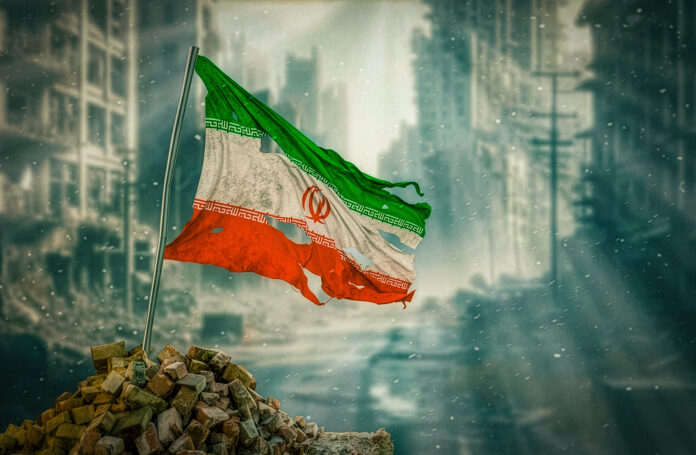 Ami Magazine4 months ago
Zachor
That on Shabbos Zachor, when Jewish communities around the globe gathered in their shuls to read the parshah of mechiyas Amalek, the evil enemy of the Jewish people, Khamenei, together with a group of his henchmen, was obliterated as they plotted to annihilate us, is among the open miracles our generation has merited to witness.
With deep emotion, and with prayers to Hashem for what may yet unfold, I would like to quote some of the holy words of the Rambam in his Iggeres Teiman and allow them to speak for themselves:
“The Sages of blessed memory frequently allude to persecutions and have said that subsequently G-d would make the decree null and void by destroying the power that issued it. It was this observation that led the Sages of blessed memory to affirm that persecutions are of short duration (Kesubos 3b).
“The Divine assurance was given to Yaakov Avinu that his descendants would survive the peoples who degraded and discomfited them, as it is written: ‘And your descendants will be like the dust of the earth’ (Bereishis 28:14). That is to say, although his offspring will be abased like dust trodden underfoot, they will ultimately emerge triumphant and victorious. As the simile implies, just as dust finally settles upon the one who tramples it and remains after him, so shall the Jewish nation outlive its persecutors.
“The prophet Yeshayahu long ago predicted that various peoples would succeed in vanquishing Israel and lording over them for a time, but that ultimately G-d would come to Israel’s assistance and put a stop to their woes and afflictions.
“We are in possession of the Divine assurance that the Jewish nation is indestructible and imperishable and will always continue to be a preeminent community. As it is impossible for G-d to cease to exist, so the Jewish nation’s destruction and disappearance from the world are unthinkable, as we read: ‘For I, Hashem, do not change; and you, sons of Yaakov, will not be consumed’ (Malachi 3:6).
“Similarly, He has vowed and assured us that it is unimaginable that He will reject us entirely, even if we disobey Him. This very promise was already given through Moshe Rabbeinu, who says: ‘And yet for all that, when they are in the land of their enemies, I will not reject them, neither will I abhor them to destroy them utterly and to break My covenant with them; for I am Hashem their G-d’ (Vayikra 26:44).
“Put your trust in the true promises of Scripture, brethren, and do not be dismayed by the succession of persecutions, the enemy’s ascendancy over us or the weakness of our people. These trials are designed to test and purify us so that only the saints and pious ones of the pure and undefiled lineage of Yaakov will adhere to our faith and remain within the fold, as it is written: ‘And among the remnant are those whom Hashem shall call’ (Yoel 3:5). This verse makes clear that they are not numerous but are the descendants of those who stood at Har Sinai, witnessed the Divine revelation, entered into the covenant of G-d and undertook to do and obey, as expressed in their declaration, ‘naaseh v’nishma—we will do and we will obey’ (Shemos 24:7).”
May we merit to internalize and live by these words and thereby hasten the coming of Moshiach, speedily in our days.
Reassessing America’s Role in the World – A Conversation with Joel Rubin
Joel Rubin is a former deputy assistant secretary of state for legislative affairs in the Obama administration, where he directed the State Department’s engagement with the US House of Representatives. Over nearly two decades in Washington, he has held senior foreign policy positions in the executive branch and on Capitol Hill.
A nationally recognized expert on national security, foreign policy and Congress, Rubin has extensive experience navigating the intersection of policy and politics. He has also run for Congress, giving him firsthand insight into the political dynamics that shape US foreign policy decision making.
A frequent commentator in national media, Rubin brings deep expertise in legislative strategy, diplomacy and the political dimensions of US national security.These are historical times we’re living through. I just interviewed Michael Oren, who is the former Israeli ambassador to the United States. He quoted his cab driver, who said, “We are not living in historic times; we are living in biblical times.”
(Laughs.) It’ll be Erev Purim pretty soon, so something is going on, which is kind of surreal, to be honest. I think these are extraordinary times; I’ll put it that way.
In what way is it surreal?
Because we just crossed over many lines that have been discussed over the decades in Washington diplomatic circles in terms of how to deal with Iran, and we stepped into a whole other universe and dimension. I know I’ve gone biblical on you. I didn’t mean to, but why not? I mean that sincerely, because we just witnessed the Americans and Israelis jointly conduct a massive aerial assault on Iran. Think about what that means.
For decades, the concept of the US and Israel overtly coordinating and collaborating on a joint strike against Iran, a major Muslim power in the Middle East, was unthinkable. There were a variety of political risks associated with it. Of course, there were also a variety of operational risks, but the ultimate concern theoretically was that it would harm the standing of Israel and more so of the United States in the Arab and Muslim worlds. Now that may come to pass; I don’t know. But no one in the Arab world condemned it. There are no massive street protests in the Arab world condemning the Zionist aggressor or the Americans. That’s one of those great scenarios that never came to pass. It just went poof.
Although there is no great pushback from the Muslim world, ironically there’s a lot of pushback from the Christian world.
Well, there are a lot of Christians out there, right?
Nothing is ever 100%, but there are voices out there like Tucker Carlson, who is an anti-Semite, speaking out in the name of “Christian values.” What concerns people is not necessarily Tucker Carlson but that the president will be getting pushback from his own movement.
Yes. It’s driving people like Tucker crazy. The depth of their hatred toward Jews and Israel knows no bounds, and they’re extremely shocked and dismayed that this American president thinks differently. Frankly, I’m not a Trump activist; I’m a Democrat. But I’m an honest American, and I look at this and think that the way Trump is managing this is ultimately about American interests. Israel served a vital strategic role in executing the strikes, but they weren’t carried out on behalf of Israel. This was on behalf of the United States. As Trump said very clearly, it was out of concern for Iran’s nuclear program, and of course its other programs, such as ballistic missiles and other activities, and its unwillingness to come to an agreement.
To these hate mongers, the anti-Semites you’re describing, everything is about the Jews pulling the strings. They can’t see an action by anyone around the world without a Jew hidden behind it for nefarious purposes. So to them, what’s stunning, shocking and dismaying is that they can’t put these two ideas I described together in their heads, and they just think that Donald Trump has been duped by the Jews.
But ask American military service members who were wounded in the Marine barracks in Beirut or by roadside bombs in Iraq about how they view Iranian military activities in the region. They would say that Iran is a threat to America’s military security; they aren’t going to say, “Let’s do it for the Jews and Israel.” As someone who engages in the spaces of foreign policy professional as a Democrat and as a Jewish person, I always try to maintain the American perspective on this. I think it’s in our interests to not let Iran get nuclear weapons.
To read more, subscribe to Ami
 Ami Magazine4 months ago
Honestly, even I was surprised when I saw the masses coming out to protest against the brutal regime of the Ayatollahs in Iran. For 40 years I have been following what happens in Iran, and I never expected such a massive, overwhelming response to the calls of the shah’s son, Reza Pahlavi, to demonstrate.
“Millions of protesters took to the streets, despite the enormous danger. For every one person who demonstrated, there were another ten who wanted to but were afraid. I have no doubt that today the people of Iran are thrilled about the killing of Khamenei and the American and Israeli strikes. The new generation hears of how good economic conditions were before the Iranian revolution under the shah and compares that to the economic depths in which they find themselves today. They say, ‘We want to fix the mistake of our parents and return to the Pahlavis, who will bring back the days when Iran was part of the Western world.’ They are sick of the cruel and extreme rule of the ayatollahs. For the first time in history, people in the streets of Iran were shouting ‘Javid shah—Long live the shah!’ When Israel struck the regime most of the people danced for joy and called out, ‘Bravo, Netanyahu.’”
So says Ardashir Leviyan, a Tehran native who served in the Royal Guard of Shah Mohammad Reza Pahlavi. Some years after the Islamic Revolution of 1979, he was forced to flee Iran and eventually made his way to Israel. Today he is active in the media world, hosting Persian-language radio programs for the Iranian opposition community. He broadcasts twice a week on Radio Ran, a station aimed at Iranians in Israel, in the United States, and in Iran itself. Leviyan maintains ties with the shah’s son and his people in exile in Los Angeles, and with civilian members of the opposition inside Iran.
No Organized Opposition Inside Iran
“There is no organized, structured opposition inside Iran today,” Leviyan says. “The Iranian regime executed anyone connected to the opposition. The active opposition is the one outside Iran’s borders. Among the various groups there is one prominent one—the Mojahedin-e Khalq, whose base is in Europe. But they’re communists who lean toward Marxism, and the Iranian people are repelled by them. They also collaborated with Saddam Hussein during his war against Iran. There is no chance they will ever assume a leadership position in Iran.
“The second significant group,” he continues, “is that of the shah’s son, Reza Pahlavi, who lives in Los Angeles. In recent years he has united almost wall-to-wall support from the opposition outside Iran. And we have seen how, during the recent protests, he has also accumulated enormous popularity inside Iran itself. Every call he made to go out and protest was answered with the support of millions of Iranians.”
Leviyan has ties with Pahlavi and is aware of his vision for Iran’s future. “The shah’s son has no plans to come and restore an autocratic monarchical guard as it was in the past. He does not intend to replace one dictatorship with another. He wants to install a democratic regime in Iran, chosen by the people, and he wants to be the man who leads the Iranian state toward such a regime. Iran is a large country with a glorious cultural past and enormous natural resources, with the capacity to be an advanced and wealthy nation, yet today, because of its leadership, its people live in tremendous poverty. There is nothing for people to eat in Iran. People are angry.”
To read more, subscribe to Ami
 Ami Magazine4 months ago
Bankruptcy is one of those words people misunderstand. Most assume it means you simply get to wipe the slate clean and don’t owe anyone any money forever, but it’s not that simple. In fact, when a company declares bankruptcy while owing money to many of their vendors, those claims still have value, and even significant value, as they are often later paid either partially or in.
This is where Joseph Sarachek comes in. Joseph is a lawyer who has traded over a billion dollars in bankruptcy claims. He represents creditors, investors, vendors and funds that are trying to recover money from bankrupt companies when others assume it’s gone. He has built a practice focused on enforcing judgments and extracting value from complicated situations.
People who have access to and trade bankruptcy claims are rare, and Joseph is one of the foremost experts in the field.
We discussed several concepts of bankruptcy, how it isn’t the end of the road for many, and he also introduced concepts that most readers will find new and interesting.
Enjoy!
—Nesanel
I was born in New York City, the oldest of three children, with a younger brother and a younger sister.
My grandfather, Rabbi Joseph Sarachek, was president of the Board of Jewish Rabbis during World War II and a scholar of medieval Jewish literature. I never knew him. I was extremely close to my grandmother, though. She was a lawyer and always impressed upon me how noble a profession it was; she told me that as a lawyer you could help people and make a good living. She was also heavily involved with Hadassah and played an active role in the development of Hadassah Hospital, which existed before the State of Israel and became much more significant after its founding.
“My maternal grandparents came from Europe. My grandfather served in World War I, came to the United States and worked as a house painter in Brooklyn.
“My father was a commercial banker who worked at Bank Leumi. He was from Long Beach, Long Island. I grew up in Great Neck, New York, in a Reconstructionist household. I did not attend religious schools. A chance meeting with Rabbi Leibel Baumgarten, the Chabad rabbi in East Hampton, changed the direction of my observance.
“I later moved to Scarsdale, where I still live. I am a member of Young Israel, and most of my kids went to Ramaz. I put on tefillin every day, and I am very involved with Colel Chabad, the charity run by Rabbi Sholom Duchman.
“I was entrepreneurial as a teenager, but I wasn’t a success right away. One of my first ventures was selling bagels on the street outside Penn Station, and it failed. I mainly worked in restaurants and food service, and I was quite good at it. My first job was busing tables at a temple in Great Neck. After that, I worked at the most popular restaurant in Great Neck, doing busing and some light waitering. At the time, my high school ran a service through which people could hire students to work at their party. I got many jobs through them and made good money bartending and cleaning up at parties. That’s what enabled me to buy a car at 17.
“I always wanted to go to Cornell, but I didn’t get in at first. I started at Binghamton and later transferred to Cornell. My grades were very good, and I was also very active in extracurricular activities there: I was on the rowing team and the student newspaper, treasurer of my fraternity, and I ran a campaign for an independent candidate for president.
“I wanted to go to law school, but money was tight. I received a scholarship from New York Law School, so I went there. I excelled in corporate bankruptcy law and soon joined a bankruptcy law firm.
“Bankruptcy law is very entrepreneurial. It’s part business analysis, part legal application. The legal aspect is much more than simply filing a bankruptcy claim. It’s figuring out how to maximize assets for all stakeholders—the shareholders, investors, employees, debt holders and banks. The entrepreneurial part is recognizing patterns. Like everything else, bankruptcies follow a cycle, which ultimately comes down to cash flow. If a company lacks liquidity but carries heavy debt, they often can’t survive.
“I’m a bankruptcy geek. In my spare time, in addition to learning Gemara, I read bankruptcy articles and journals, and post a lot on LinkedIn about things I find interesting, to educate others.
“My first job was at a bankruptcy firm, Kreindler and Relkin (K&R), in the Empire State Building. They focused largely on creditor-side work. We didn’t represent the people filing for bankruptcy; we represented the people who were unhappy they were filing. Creditor-side work involves representing the banks, vendors or investors who are owed money and are trying to recover as much as possible. Debtor-side work, by contrast, means representing the company that has filed for bankruptcy, helping it restructure its debts, negotiate with lenders and attempt to reorganize or sell the business.
“The firm primarily represented lenders to the apparel industry—banks and factors (agents that buy a company’s accounts receivables, less a discount for commission and fees). It was a unique niche; the apparel industry was heavily Jewish, and these businesses often relied on these specialized lenders to survive, despite the high interest they often charged.
“After a year and a half at K&R, I was hired by a major commercial bankruptcy firm, Kelley Drye & Warren, where I handled both debtor and creditor cases. We handled many high-profile cases. We worked on Revco and on Interco, the company that owned Converse sneakers. I enjoyed the debtor-side work, but it requires large teams and significant resources to execute properly. While at Kelley Drye, my boss, Sandy Mayerson, came into my office one day and said we were going to write an article for a premier bankruptcy publication about trading claims. I was 27 years old and had no idea what that meant. I researched it and discovered an entire field of investors who buy bankruptcy claims.
To read more, subscribe to Ami
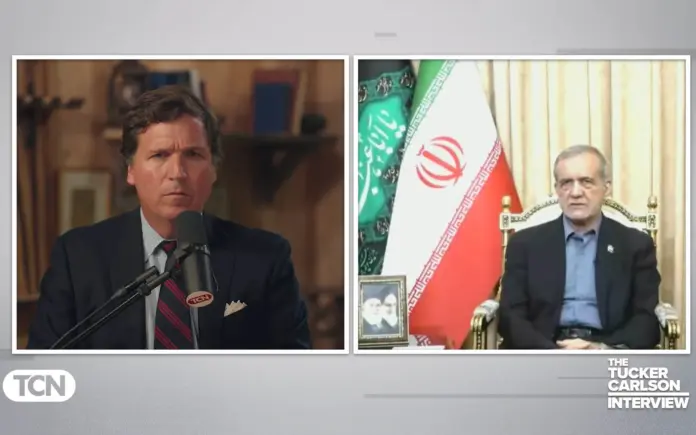 Ami Magazine4 months ago
Christian attitudes in the US have improved considerably toward Jews over recent decades.
In the Catholic world, good will followed 1965’s Vatican II, which condemned anti-Semitism and called Jews their “elder brothers.” And the good will has been not only on display but actively demonstrated on issues of common interest, from raising alarm about Islamist terrorism to promoting school choice. The Catholic Church has maintained diplomatic relations with Israel since 1993.
American evangelicals are particularly strong supporters of Israel; a majority believe the Holy Land belongs to the Jewish people. Other Protestant denominations have formally renounced anti-Semitism and affirmed Hashem’s covenant with the Jewish people.
But that good will is not shared by two self-promoting Christians who have been prominent in the public eye.
Back on February 9, a meeting of the White House’s Religious Liberty Commission focused on combating anti-Semitism and upholding religious freedom went fine, well, until it ran off the rails.
One member of the commission, conservative activist Carrie Prejean Boller, used the meeting to attack “Zionism”—i.e., Israel and its supporters—and defend commentators Tucker Carlson and Candace Owens. (The former promoted Nazi apologists and Holocaust deniers; the latter encouraged her followers to read a text claiming that Jews ritually murdered Christians and drank their blood. As Mr. Carlson might drolly comment, Just saying.)
Ms. Prejean Boller proclaimed that her Catholic faith—to which she converted last spring—informs her anti-“Zionism” convictions.
“I’m a Catholic,” she declared, with zeal not uncommon to neophytes, “and Catholics do not embrace Zionism, just so you know.
“So,” she sneered at several victims of anti-Semitism who had testified at the meeting, “are all Catholics anti-Semites?”
Two days later, the commission chairman booted her for trying to “hijack” the hearing for her “own personal and political agenda.” She then accused the commission of having “a Zionist agenda,” and, in intrepid martyr mode, posted on social media that “I would rather die than bend the knee to Israel.”
Mr. Carlson, for his part, in his recent interview of US Ambassador to Israel Mike Huckabee, repeatedly took pains to stress his own Christian bona fides.
Much of the reaction to that nearly three-hour exchange between a snide, cantankerous (often misinformed and misinforming) Carlson and an impressively polite, knowledgeable and well-spoken Huckabee was about the ambassador’s honest admission that he believed that Hashem’s promise of Eretz Yisrael to Avraham Avinu included a much larger swath of land than present-day Israel.
Challenged by Mr. Carlson about whether that entire land belongs to the Jews today, Ambassador Huckabee responded, “It would be fine if they took it all…” sending media muckrakers running to their keyboards and Arab countries to their ready-to-rattle sabers. But they all seem to have not listened much further to when Mr. Huckabee made clear that Israel has no designs on Jordan, Syria or Iraq. The rest of his sentence was “but I don’t think that’s what we’re talking about here today.
“They don’t want to take it over,” he continued. “They’re not asking to take it over.”
But the more noteworthy parts of the interview were those in which Carlson touted his own Christian identity. He even questioned the Christian credentials of his interviewee. At one point, after lamenting the fact that the IDF had bombed churches and a Christian hospital in Gaza (places that held caches of Hamas’ weapons, as Mr. Huckabee patiently explained), Mr. Carlson said: “I would expect you to side with the Christians over the secular government of Israel.”
Mr. Carlson also claimed that the Christian population in Israel is dwindling and pales by comparison with the population in Qatar. He was informed by Mr. Huckabee that the first contention was false: the Christian population of Israel has grown to approximately 184,000, and the country hosts hundreds of churches. And, regarding the second claim, that Christians in Qatar are overwhelmingly migrant workers confined to a restricted church compound.
We must hope that “influencers” like Carlson and Prejean Boller fail to influence. But it’s sobering and concerning that the former averages a million viewers per podcast and that the latter, in the wake of her commission conniption, gained 30,000 followers on social media.
To read more, subscribe to Ami
 Ami Magazine4 months ago
You flew in today from London to be the badchan at the Rachmastrivka chasunah in Boro Park, and you came to visit me between the kabbalas panim and mitzvah tantz. You’re very busy, to put it mildly.
Baruch Hashem. Yesterday I was in Manchester because Satmar made a big chanukas habayis for their Heichal HaTorah. The Rebbe, Rav Aharon, was there. It was a major event.
You performed as a badchan?
No. I gave a drashah. I can’t do everything, but bisyata dishmaya I wear many hats. One of them is badchanus, but there are also chairmanships [serving as an emcee], maggidus and drashos. They’re all almost the same thing, but each one requires a different mehalech. I also have a weekly column in Moment magazine. Additionally, I’m the yosheiv rosh of Belz in London and a gabbai in one of the shtieblach. So as you said, I’m busy.
I know there are a number of Sterns in Vizhnitz, but I understand that you have no connection to them.
Correct. I was once at a large dinner for Vizhnitz in Ramat Gan. The Vizhnitzer Rebbe, Rav Yisrael, may he have a refuah shleimah, had recently become rebbe. I said, “I’m not a Vizhnitzer chasid, but I’m a chasid of the Vizhnitzer Rebbe, and I don’t think there’s anyone in klal Yisrael who isn’t.” I was very close with his father the Yeshuos Moshe, zt”l. He once said to me, “You’re a true Belzer chasid, but you’re also a true good friend of Vizhnitz.”
I assume that other rebbes would be able to say the same thing.
Yes, but Vizhnitz possibly more than most, and especially Vizhnitz London, with whom I’ve been very close for many years.
You don’t discriminate, and you badchan everywhere. And you don’t only do it for rebbes; you also do it for balebatim.
Yes. From the very rich to the poor. But as they say in English, it’s a completely different kettle of fish.
Explain the difference.
Doing this for balebatim is much easier because I’m in control. I can say whatever I want and make a joke whenever I want. By rebbes, I have to be far more cautious. Although the Vizhnitzer Rebbe of Monsey, Rav Mottele, once told me before a dinner, “I know Vizhnitzer Torahs better than you do, and I don’t need to hear Vizhnitzer things from you. On the contrary, I want you to talk about what comes naturally to you. You don’t have to force anything.” There are rebbishe chasunahs where I do have to put things in from their chasidus, but there are also others who say they want to hear something different.
On the other hand, when you go to a balebatishe chasunah, the mechutan has to tell you all of his maalos. But when you go to a rebbishe chasunah, the gabba’im take care of that.
By a rebbe there are no praises; there’s nothing personal about the rebbe himself. I’ll talk about his ancestors and his father, but not about the rebbe.
I’ll give you an example from what I just said tonight before the chuppah. The chasan is a Belzer einikel and so is the kallah. They descend from Belz in various ways. So this was an opportunity to incorporate a few things about their ancestors.
I told a story that Rav Shmuel Engel writes in his sefer Shu”t Maharash, volume 7. He was at Rav Shayale Tchechoiver’s chasunah in Belz—Rav Shayale became the son-in-law of one of the Mitteler Belzer Rav’s sons-in-law. Rav Shayale was a yasom by then—his father, the Divrei Chaim, had already passed away—and the Mitteler Rav told him, “Your father promised me that he would come for the chasunah, but the Eibershter had other plans. Do your utmost with all of your kochos so you can have a connection with your father.” And the sefer says that everyone started to cry. That was a good story to tell because it was about an ancestor of both sides.
Belz is your home, but how did you become a Belzer chasid? I understand that your family weren’t chasidim.
Not at all. We were always Ashkeneizim. My father didn’t wear a gartel, and he wore a short jacket. My mother’s father was Rav Shloma Baumgarten, son of Rav Yosef Baumgarten, who was the rav of the Schiffschul in Vienna. My father’s father was the rosh hakahal of the Schiffschul and an askan for Agudas Yisrael. He spoke at every Knessiah Gedolah, from the first to the last.
What did he do for a living?
He had a butcher shop in London. He passed away at an old age. His father was also an askan. They were all Oberlandishe Ashkeneizishe Yidden. So how did I get to Belz? It’s a very good question, and there are two parts to the answer.
My zeide, Rav Shloma Baumgarten, had a sister who got married after the war to a Belzer chasid named Reb Nachman Dachs, who was the rosh hashochtim in London. He had been a shochet in Germany before the war. He was a very passionate chasid and had even merited to see the Mitteler Belzer Rav. He paid my expenses to join him on a trip to Switzerland for a Shabbos when the Belzer Rav was there. It really pulled me very strongly. But my father wasn’t so excited, so he decided to ask Rav Yankele (of Pshevorsk), with whom he was very close. This was obviously many years ago. Rav Yankele told my father, “He’s a young rebbe and he brings out the talents of the bachurim. It’s very good. Let your son go to him.”
I went to Eretz Yisrael to learn in Tchebin, but I would also go to the Rav. The first time I went for a tish was on 21 Av, the yahrtzeit of the frierdiker Belzer Rebbe, which was right before the new zman began. After the tish, all of the out-of-town guests would pass by the Rav to take their leave, and I also went. He asked me who I was, and I told him. “Did you enjoy it?” he wanted to know. I answered that I did. “Come again on Shabbos,” he said. When I went back on Shabbos, a bachur came over to me and said, “The Rav said that we should be mekarev you.” I was all of 17 years old at the time. The rest, as they say, is history. “Heviani hamelech chadarav—the king brought me into his chamber.” Then I was invited for private Shabbosim in Givat Hamivtar almost every other week.
Were you wearing chasidishe levush?
No. I was wearing a short jacket and a shtafene hat. I have no explanation for the way he was mekarev me.
It was v’nafsho keshurah b’nafsho.
Precisely. Totally a connection with my nefesh. Although I stayed in Tchebin, I was going to Belz every week, and then I started going there every night for Maariv. On Friday and Motzaei Shabbos, I would learn with a Lelover yungerman in the Lelover beis midrash. The Lelover Rebbe, Rav Moshe Mordechai, saw me a few times and nodded to me. Then one day he asked me who I was. When I told him, he wanted to know where I spent my time. “In Belz,” I replied. “Belz!” he said. “Do you know what Belz is? Belz is a pipeline for kedushah and ahavah for klal Yisrael. The world doesn’t know who the Belzer Rav is!” That was really mechazek me.
To read more, subscribe to Ami
 Ami Magazine4 months ago
If you could know the future before it happened, you’d never lose. But what if you could get the next best thing: the single most accurate, real-time prediction of what’s about to happen? That turns out to be worth quite a lot, and it already exists.
In 2024, regular political polling showed that Kamala Harris had a strong chance of winning the presidential election. But those who were watching the prediction market Polymarket were seeing something very different: overwhelming odds that Donald Trump would be the winner. The actual numbers on the night of the election indicated that while the pollsters didn’t know what they were doing, the prediction markets did.
That phenomenon has led to a number of controversies, including political ones. How freely should these markets be allowed to operate? Do they have any use beyond gambling? Do they hurt more than they help?
What They Are
Prediction markets are essentially online places where people can bet on an array of future events. These range from the outcomes of elections or sporting events to the direction of military actions by various countries or even the specific words a politician will use in a speech.
The major idea behind prediction markets is “the wisdom of the crowds”: the theory that an aggregation of individuals can predict an outcome more accurately than any single expert. In other words, the impressions and knowledge of one person aren’t enough to reveal any real truth, but when you gather a multitude of those perspectives, you may gain insight into what will actually happen. As this would apply to an election, individuals tend to have an idea of how the people around them plan to vote. By pooling these localized insights, the market transforms thousands of personal anecdotes into powerful, focused data points.
In practical terms, people place bets, each one totaling about a dollar between the two sides. For example, over the weekend, Polymarket had a market on whether Ayatollah Khamenei would be ousted as Supreme Leader by March 31 of this year. Buying a “yes” contract cost 21 cents, while buying a “no” contract cost 80 cents. You can also sell both contracts. The price for the contracts changes based on how much people are willing to pay for them.
If it turns out to be true (according to the specific rules as explained on the page), then the people with “yes” contracts will get the underlying dollar for every bet they made; if it turns out to be false, the “no” people will get the dollar. The fact that the price was much lower for a “yes” contract than a “no” contract suggested that people were more confident that Khamenei would not be ousted by March 31, essentially believing (as a group) that there is only a 21% chance of that happening.
Meanwhile, there was also a market for whether he would be out by December 31, and the “yes” contracts were selling for 51 cents.
What Are They Good For?
Does betting on events have any larger positive effect on society? Polymarket likes to claim that it does. For instance, on the ayatollah wager, the website made an apparent reference to the US attacks on Iran, trying to dispel criticism about betting on bombings:
“Note on Middle East Markets: The promise of prediction markets is to harness the wisdom of the crowd to create accurate, unbiased forecasts for the most important events to society. That ability is particularly invaluable in gut-wrenching times like today. After discussing with those directly affected by the attacks, who had dozens of questions, we realized that prediction markets could give them the answers they needed in ways TV news and X could not.”
To read more, subscribe to Ami
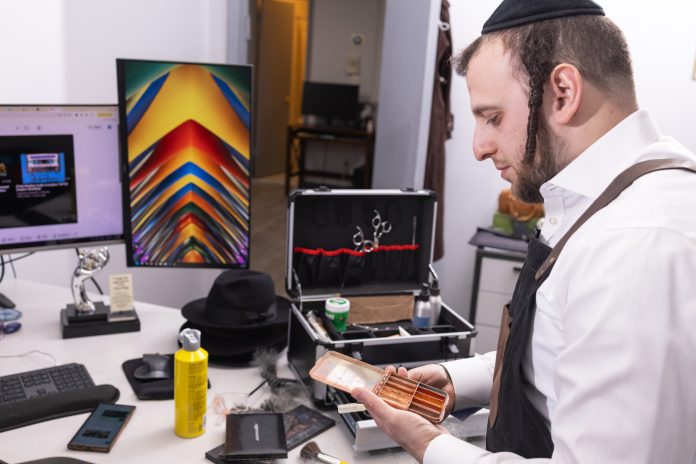 Ami Magazine4 months ago
After speaking with Moshe Grunfeld for over three hours, it was abundantly clear that his parnasah—simchah photography—suits him perfectly.
Moshe possesses a calm and happy nature, which is invaluable when it comes to dealing with the pressures of a tight, often frenetic wedding schedule. Unfazed in almost any situation, he projects a tranquil energy that his clients instinctively mirror.
Moshe’s professional reach also extends into the thriving field of frum feature films and live theatrical productions. What began as a chance experience with makeup during a camp play developed into a remarkable expertise. Founder of the theatrical makeup company Punim Chadushes (New Faces), Moshe has mastered the art of transforming actors into characters, using cosmetics, hair, prosthetics and various tools of the trade to render cast members unrecognizable even to their closest family and friends.
Whether he is capturing a face from behind the lens or creating one behind the scenes, Moshe is a master of the visual frame. Before Purim, when we all adopt costumes of some kind, how appropriate to speak to the king of disguises himself.
L’chaim! Enjoy!
—Nesanel
I was a preemie, so I like to say I got a head start on life and just kept moving forward. The youngest of eight, I was born in Albany but grew up in Boro Park. My father, who grew up in Williamsburg, was in the catering business. He initially operated Cotillion Terrace but eventually opened his own kitchen and built the business from the ground up. My mother passed away on March 21, 2020, right before her 70th birthday. I was very close with her, and her absence still weighs heavily on my heart.
“I attended a local cheder and then went on to learn in Munkatch, and I developed a close relationship with the Munkatcher Rav.
“In the Munkatcher yeshivah there was an emphasis on harnessing one’s strengths, which had a profound impact on me. I approached the hanhalah with a request to learn how to bind sefarim. They not only approved but even gave me an office and the necessary tools to pursue my interest. It was a serious learning environment but not a pressured one, which suited me well.
“As a kid, I always loved building things and creating fun activities. I ran carnivals on our block, and the whole neighborhood looked forward to them. For a few years, the money we raised went to Hatzalah, and I even received plaques for my work. I also helped other kids organize their own carnivals, recommending things that had worked well and working to improve things that hadn’t.
“After my bar mitzvah, I got involved in a struggling Chevras Tehillim near my house. It was a great learning experience, and I was able to help a number of branches of the organization. Even then, I didn’t just participate, I improved.
“I studied what kids actually wanted. I brought in famous storytellers, I bought nosh wholesale instead of retail, I ordered ice cream by the truck from Klein’s, and I tracked which prizes were taken first and which sat untouched. Within a few months, attendance grew from about 30 boys to over 500.
“I’ve always tried to give more value for the money. I focused on branding before I knew what that was. My signs had curtains, and every Chevras Tehillim I helped used the same imagery, so people knew it was under one management.
“Chevras Tehillim took up a lot of my time, but I also volunteered for Chai Lifeline. As a bachur, I went to hospitals very often. I thank Hashem that my parnasah today is earned by being mesamei’ach Yidden in other ways.
“When I was 18, the Munkatcher yeshivah closed down. With the brachah of the Munkatcher Rav, I started looking for a job. I had some very good offers, but since I was so young, the Munkatcher Rav recommended that I stay in a Torah environment. Because he was like a father to me and always supportive, I wanted to follow his advice.
“Soon afterward, I bumped into my seventh-grade teacher, Reb Leibish Hammer, who was teaching in Yeshiva Darchei Torah of Far Rockaway. He mentioned that Siach Yitzchok, also in Far Rockaway, was looking for someone to oversee the preschool’s arts and crafts department. They had two kindergartens and the rebbeim needed another hand to prepare these creative projects.
“It was essentially arts and crafts therapy. My job was to keep track of the children’s progress by monitoring their ability to follow instructions, replicate patterns, including lines, colors and sequence, as well as other key skills. While these tasks may seem simple, they were important for the children’s development. If a child couldn’t keep up or follow directions properly, it was a possible indicator of delay.
“I felt suited to that job right away because I always liked drawing. I have an older brother, Hershy, who is very artistic and taught me how to draw and how to use colors. It’s good to be the youngest. You benefit from all your older siblings’ talents; everybody teaches you. Many volunteers are the youngest in the family. Rebbe Nachman of Breslov says that everybody has a desire to be mashpia, to influence others. So older siblings are mashpia on the younger ones, and then the youngest ones seek out places where they can give and be of service.
“It was a part-time job, only a few hours a day, but it paid well. I was at Siach Yitzchok for over three years until I decided to return to learning full time. I joined a kollel in Williamsburg, where I merited a wonderful chavrusa from a rebbishe family. My time in kollel was gevaldig. I got married in 2011.
“Wherever I was, whatever the situation, I always tried to make it better. If I felt something wasn’t going well, I would try to think how I might improve it.
“I first started doing makeup when I was a counselor in Munkatcher camp. They were having a play and the makeup artist they had booked couldn’t make it at the last minute. There was makeup in the costume room, and I started experimenting, even though I knew nothing. I saw makeup, I saw faces, and I saw a need, so I stepped in.
“It wasn’t such a big deal for me to figure out: it’s art, just instead of coloring on paper, you’re coloring in 3D. I did a good enough job that Shloime Steinmetz at the Klausenberger camp asked me to do the makeup for their performance. Then Spinka camp called me.
“In 2009 or 2010, I worked for Hershy Rosner, a makeup artist and photographer, helping him with the makeup for a play called ‘Interen Kenigreich.’ That was the first time I was exposed to a real backstage environment. Later, after I got engaged, he hired me as a production assistant. I helped with editing, video work, script writing and things like that. I have tremendous hakaras hatov to him, because he guided me and taught me so much.
“After working for Hershy Rosner, I joined On Time Studios for a few months, where I was surrounded by talented creative people like Mendy Leonorowitz, a gifted filmmaker and director, and Ari Abramowitz, a strong writer. They relied on me to set up the scenes so they looked realistic and professional. I still do this today as the art director for Boruch Perlowitz productions.
“I have four brothers in construction and many friends who are contractors, so when the opportunity came up to take over a flooring company, I felt I could do it. With their backing and guidance, I stepped in. Baruch Hashem, it took off quickly. Within weeks, I was signing proposals for major buildings, six and ten floors of hardwood flooring, large-scale projects. But I was newly married, had just had a baby and everything in my life was shifting. I felt overwhelmed and disconnected. I needed to figure out who I was beyond the environment I was in.
“We moved to Airmont, New York, for a year, but that wasn’t enough. I wanted a full reset. So I unplugged completely and moved to Scranton, Pennsylvania, where we lived for four years. It was far removed from the noise. I didn’t know many people there, but it is a very strong, established community with genuinely warm people, where I was truly able to grow.
To read more, subscribe to Ami
 Ami Magazine4 months ago
I had to do a double take after reading that a group of 151 former ministers, ambassadors and diplomats accused the French foreign minister, Jean-Noël Barrot, of spreading disinformation about United Nations Special Rapporteur for Palestine Francesca Albanese.
Monsieur Barrot’s alleged misstep was his reaction to Signora Albanese’s comments on February 7, 2026, at an Al Jazeera forum in Doha, Qatar, on a panel devoted to “the Palestinian cause.”
True to loathsome form and to the great pleasure of her audience, the signora, like others on the panel, including a Hamas leader and an Iranian minister, railed against Israel.
Ho hum.
She accused the Western world of amplifying a “pro-apartheid genocidal narrative” and bemoaned the challenges that the “global community” faces today.
And she concluded that “We who do not control large amounts of financial capitals, algorithms and weapons, we now see that we as a humanity have a common enemy [italics mine].”
Monsieur Barrot called Signora Albanese’s remarks “outrageous and reprehensible.” Italian Foreign Minister Antonio Tajani said her “behavior, statements and initiatives aren’t appropriate for the position she holds,” and Germany’s foreign minister, Johann Wadephul, said Albanese’s position is “no longer tenable.” France, Austria, the Czech Republic and the United Kingdom have also called for the special rapporteur’s dismissal.
Even UN Secretary-General António Guterres, not known for empathy for Israel, said (through a spokesperson; he may have feared choking on the words) that “We don’t agree with much of what [Albanese] says and wouldn’t have used the language that she’s using in describing the situation.”
Thus my need to reread, with incredulity, the 151 former ministers’, ambassadors’, and diplomats’ and entertainers’ (always experts on foreign affairs) rush to the defense of the special rapporteur, claiming that the media had truncated and distorted her comments.
In an open letter, the group accused Monsieur Barrot of spreading inaccurate and manipulated information, and condemned its use to discredit the UN official.
“The dissemination of disinformation by senior officials,” they wrote, “undermines international law, weakens human rights protections, and threatens the credibility of the multilateral system itself.”
Signora Albanese herself fumed that “European governments accuse me—based on statements I never made—with a virulence and conviction that they have NEVER used against those who have slaughtered 20,000+ children in 858 days”—tellingly citing the Hamas-run Gaza Health Ministry’s death toll claim.
So how did the signora defend her words? She contended that what she had meant by humanity’s “common enemy” was not—G‑d forbid!—Israel (the topic of her rant), but “THE SYSTEM [caps hers] that has enabled the genocide in Palestine.”
Oh.
Even in her attempt to “explain” her words, the signora felt it important to use the disgustingly deceitful word “genocide” for Israel’s war against Hamas. Hardly surprising, considering that, during the October 7 pogrom, she urged that the murdering of innocents be placed in its “context.” And that she dismissed reported acts of the invaders’ viciousness documented by UN Watch and the ADL as “fabrications.”
With that background, and in a speech that was devoted entirely to besmirching Israel, the special rapporteur’s claim that it was only a “SYSTEM” she was identifying as humanity’s enemy and not the usual object of her animus (and the subject of her speech) is ludicrous.
Three cheers for Monsieur Barrot, who stuck to his guns, posting on his social media, in response to the risible “contextualizing” of the special rapporteur’s Hitlerian comment: “Stop fake news. I did not truncate or distort Ms. Albanese’s comments. I simply condemned them because they are reprehensible.”
In an even semi-sane world, Signora Albanese would be reassigned to flipping pizza dough.
Back in 2024, former special envoy for combating anti-Semitism Deborah Lipstadt described remarks the signora made as “openly anti-Semitic.” And last year, she was placed under US sanctions, with the State Department condemning her “unabashed anti-Semitism, expressed support for terrorism, and open contempt for the United States, Israel, and the West.”
In some places, it’s customary to stage Purim shpiels where contemporary figures take the place of Megillas Esther’s protagonists. With Monsieur Barrot and Signora Albanese occupying space in my head, were I in charge of central casting for such a play, I have a good idea about whom I’d choose for Charvonah. And Vashti.
To read more, subscribe to Ami
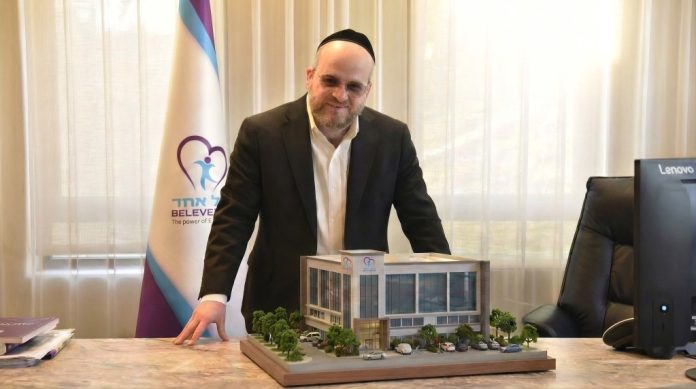 Ami Magazine4 months ago
In a Jerusalem shul during Shacharis, a young boy sleeps on a narrow wooden bench under a window. All morning long he had tried to stay still, but his body refused to obey, his legs jiggling and his fingers drumming on the table. His thoughts raced faster than the words in the siddur, more quickly than a child his age could keep up with.
As the congregation rises for Shemoneh Esrei, his body finally gives in. Slumped forward with one of his shoes dangling from his foot, he puts his head down and falls asleep. A man leans over him and nudges him gently, whispering his name. There’s a flicker of movement—almost a response—but then the boy goes still again. Tefillos rise up around him. Children answer, “Amein yehei shmei rabbah.” The boy doesn’t move.
People begin to notice. They glance at him, look away and then look back. Something feels off, but no one knows what it is.
The sleeping boy was Dovid Weitman, today the founder of an organization that helps special-needs children and their families.
When Dovid tells me this story, his mind still moves the same way it did back then. Our first interview takes place on Zoom, with Dovid calling from a car in between back-to-back meetings for his organization. In one moment he is eight years old on a bench in a shul in Jerusalem. In the next, he is in a forest in Ukraine with his grandmother, a young girl learning how to survive at her uncle’s side.
He is not telling me these stories in a linear sequence. He is showing me a landscape that only he can see, a place where past, present and future converge. Dovid takes in the whole picture at once; the rest of us catch up in pieces. The same mind that can’t track a single line of text holds entire worlds in parallel.
People try to give it a name: ADHD, perhaps. The labels might be accurate but they don’t truly explain him. If Dovid has a diagnosis, it is simply this: he is a person who lives fully in the present, and in doing so draws other people into their own strength.
Dovid relates how his father would come to the cheder with cookies from Machaneh Yehudah. “Let’s sit down and learn a little bit,” he would cajole him. Ten minutes. Fifteen. But even that was too much. Nonetheless, his father kept coming to whichever cheder or yeshivah Dovid ended up in. “My father took buses and hailed taxis just to sit with me. It was never really about learning. It was love,” he says.
At home, his mother tried a different approach. “My mother brought me to private teachers and sat with me for hours drawing pictures, following the advice of an expert who said that some children absorb images better than words.” A baalas chesed by nature who was practical and generous, she poured that same determination into the search for the key that would unlock her son’s learning disability.
“As a child,” Dovid says, “wherever I went I kept hearing the same message: you are a gornisht, a nothing.”
Maybe that was why he began searching for other ways to matter. When he was around eight years old, he came up with an idea: If he couldn’t learn, he could at least help others. His plan? Any boy who could say Mishnayos by heart would get a prize. He would raise the money to pay for them.
For all that, his learning difficulties still left him on the outside. The other children didn’t play with him. They laughed, left him out of their games, blamed him for things he hadn’t done. They snickered when he tried to read. When he fumbled through davening or stumbled over spelling they mocked him, and he learned what it meant to be present in a room but treated as if he wasn’t there.
With nowhere to belong, either in the classroom or the schoolyard, he found one place where he could shape a world that made sense: Under his bed, eight-year-old Dovid Weitman kept his own secret universe.
Tiny plastic people no bigger than his thumb. A miniature empire of his own making, where no one failed tests and no one was told he didn’t matter. While other boys bent over their Gemaras, memorizing lines their fathers and grandfathers had learned before them, Dovid built chesed organizations, ambulances and shuls. While they davened, he dreamed.
He couldn’t keep his place on the page. The letters slipped away from him like mercury. But in the worlds he created, he never lost his place. There, he knew exactly where everything belonged. But the home in which he was growing up was built around a very different kind of knowledge.
“My mother came from a background where Torah was hu chayeinu,” he says. The granddaughter of the Manchester rosh yeshivah, Rav Yehuda Zev Segal, zt”l, she was raising 13 children, all nurtured with the hope that they would grow up to be bnei Torah and talmidei chachamim. “This is what she davened for, inspiring us through the deep reverence in which she held Torah study. Unfortunately, watching my siblings succeed while I failed one test after another, it felt as if the world had already decided that I was a lost cause. But beneath that verdict was a hunger I couldn’t yet name, something no mark on a test could satisfy.
“My father’s father was chasidish, but my father had learned in Litvish yeshivos so I hadn’t grown up in that world,” he continues. “My only taste of it was when my grandfather, Reb Avraham Weitman, took me as a little boy to a rebbe’s tish. The warmth and the singing stayed with me, even if I couldn’t have said why.
“One Shabbos night when I was 14 I wandered into a tish by myself. The room was packed: the chasidim singing, the rebbe at the head of the table. I stood in the back, just watching. I didn’t expect to be noticed. I was a nobody, a boy who couldn’t read, couldn’t learn and couldn’t sit still.”
Then Dovid did something uncharacteristic: He made his way through the crowd and introduced himself to the rebbe. “My name is Dovid Weitman,” he said. The rebbe nodded, his eyes resting on him for a moment longer than Dovid was used to. “Zei gebentsht, Dovid,” the rebbe replied.
A few weeks later, he saw the rebbe again on the street. Expecting to be forgotten, he repeated, “My name is Dovid Weitman.” The rebbe looked at him. “I know. I remember,” he said. For a boy who never seemed to fit in anywhere, who felt hurt and misunderstood, the warmth in that gaze was like a hand on his shoulder. For the first time he felt embraced rather than pushed away.
“At that moment, I knew that I wanted to be a chasid,” Dovid says. “It didn’t solve my learning struggles overnight, but it gave me a sense of belonging. In yeshivah, I approached the mashgiach and asked him, ‘Can I seal envelopes in the office?’ The mashgiach hesitated, unsure what to make of such an unusual request, but he said yes. And suddenly I had a purpose. I could do something and be useful. I no longer felt like I was wasting time and I was happy.”
To read more, subscribe to Ami
 Ami Magazine4 months ago
Meir Dagan, who led the Mossad from 2002 to 2011, remains one of Israel’s most influential and often controversial intelligence chiefs. Known for his audacious operations, incisive strategic thinking and unwavering commitment to Israel’s security, he shaped some of the country’s most consequential covert campaigns, from countering Hezbollah to slowing Iran’s nuclear ambitions. His tenure was marked not only by bold successes but also high-stakes gambles and occasional miscalculations.
Born in 1945 in Kherson, then part of the Soviet Union (now Ukraine), Dagan spent his early childhood in Romania before immigrating to Israel as a teenager. His family history was indelibly marked by the Holocaust; many of his relatives were murdered, including his maternal grandfather, Ber Erlich Sloshny, who was publicly executed by the Nazis in the town of Łuków. A photograph capturing his final moments hung on the wall of Dagan’s office throughout his career, serving as both a personal moral compass and a stark reminder of the dangers of anti-Semitism, a symbol of his lifelong vow that “there will be no second Holocaust.”
After surviving the war, Dagan and his parents arrived in Israel in 1950, first settling in a transit camp near Lod and later in Bat Yam, where his parents operated a small laundry. These formative experiences fostered the resilience and fearlessness that would later define his leadership.
Following his retirement—some have said dismissal—from the agency, Dagan broke with the Mossad’s tradition of silence by publicly opposing a preemptive Israeli strike on Iran’s nuclear facilities. He cautioned that such an operation could spark a disastrous regional war and strain Israel’s vital alliance with the United States. His outspoken stance drew criticism from those who accused him of breaching norms of secrecy. But Dagan consistently argued for patience and measured decision making over impulsive military action.
In 2012, at the age of 67, Dagan was diagnosed with a life-threatening liver disease requiring a transplant. Because of age restrictions, the procedure could not be performed in Israel, prompting him to undergo surgery in Minsk, Belarus. During this difficult period he formed a close relationship with Rabbi Meilech Firer, whose guidance and support proved invaluable. After his recovery, Dagan expressed deep gratitude to Rabbi Firer and later assisted him in fundraising for a new rehabilitation center.
Despite his health challenges, Dagan remained an active and influential voice in public debates on Israel’s national security. In the following interview, Samuel Katz—author of The Architect of Espionage: The Man Who Built Israel’s Mossad into the World’s Boldest Intelligence Force—discusses Dagan’s worldview, his operational record and how history may judge him, especially in light of the October 7 massacre and Israel’s subsequent operations against Iran’s nuclear program.
I find it interesting that anyone can still regard Meir Dagan as an important intelligence figure after Israel’s attack on Iran. He was so adamant in his opposition to such action, predicting all kinds of terrible outcomes that didn’t come to pass. In that sense, history has proven him wrong. Has your understanding of Dagan changed in light of that?
No, not at all. I think it’s impossible to compare Meir Dagan’s warning about attacking Iran in 2009 to the facts on the ground in 2025. For Israel, it was a completely different universe not only with regard to capabilities but in terms of having a friend in the White House. President Obama was not a friend of Israel or Netanyahu, and Israel didn’t possess the necessary military might or intelligence—both in the view of the IDF assessment and in the eyes of Meir Dagan—to ensure that the attack would be successful. Back in 2009, Israel didn’t possess the F-35 fighter bomber, the air refueling capabilities or the remote tactics, and it had yet to build a vast network of intelligence assets to bring it the level that existed in 2025.
If my recollection is correct, most of his caution wasn’t based on doubts about Israel’s capabilities but on concerns about the potential repercussions of a counterattack from Iran. He was predicting worst-case scenarios. Fortunately, doomsday didn’t occur.
I don’t think he was worried about doomsday; I think he was worried about entering a war in which Israel wouldn’t have the strategic backing of the United States. One of the things Meir Dagan understood better than most was that Israel’s greatest strategic asset is its military and technological alliance with America. In 2009 and 2010, that was being severely tested.
We must also give credit where credit is due, namely his devotion to combating the Iranian threat.
Undoubtedly. When he was in command of the South Lebanon area, he led the first skirmishes of what would become the much wider war with Iran via Hezbollah. Later, as head of the Mossad, he was pitted against them and greatly enhanced Israel’s covert efforts. Intelligence gathering, the establishment of networks and assets in a country with allies from various ethnic groups isn’t something you can do overnight. In many cases it takes a long time. But I also think that the efforts of both Israel’s Military Intelligence and the Mossad that were invested in Iran and Hezbollah were so profound that in some cases the concern over threats nearer to home weren’t given the attention they warranted.
It’s interesting that he viewed Iran as a rational enemy. Do you think he truly understood the Iranian regime?
I think you’re focusing on words rather than actions, which is a mistake. The leadership in Iran may preach the end of the world, but the people in the Islamic Revolutionary Guard Corps and the elements that keep the powers that be in power don’t want to relinquish their hold, nor do they want to give up the wealth they have amassed. In that sense they are rational, but they haven’t been successful in the way they exercise the power of their proxies.
Why do you consider Dagan such an important figure? Is it for his ability to gather intelligence or for the way he executed operations based on it?
I’ll tell you why. He was born from the ashes of the Holocaust; his parents had survived the Nazi invasion of Poland and most of his family was murdered. One of the things that drew me to him was the fact that they built an adopted family of other people who had also been subjected to the horrors of Europe. He was shaped by these things as a child.
He had also seen the victory of the Six-Day War and experienced the shock and surprise of the Yom Kippur War. As he once said in an interview, his entire generation of soldiers was betrayed by the decision makers. In that latter war, some 2,500 Israeli soldiers were killed over the course of 18 days. It’s also important to mention that when he was an armored brigade commander moving on Beirut in 1982, the horror of losing so many of his junior officers had a profound impact on him. He developed a unique talent for using capable individuals with very specific skillsets that could save lives in selective operations and prevent massive casualties. That’s why his approach was to avoid being foolhardy. If something was going to be done, there had to be a guarantee of success.
We need to assess Dagan in light of the October 7 massacre, as it changed Israel’s perspective on how to engage its enemies.
October 7 wasn’t a “massacre.” It has been incorrectly described on social media and in political discourse as an attack. But it wasn’t an attack; it was a full-fledged conventional invasion in which 22 communities and locations were captured. It was meant to hold territory, it was meant to start a larger Middle East war, and it was meant to redefine the Middle East with Israel desperate at the beginning of the American presidential cycle.
One of Meir Dagan’s special projects was the financial warfare intelligence unit that in Hebrew was known as Tziltzal and in English as Harpoon. He understood all along that money is the oxygen that drives terror. When the Israelis made the decision to allow Qatari and other money to go into Gaza so Hamas would want a better future for its people instead of warfare, it was a very Western approach. Only Westerners think that the most important driving force is to live the American dream. But Dagan understood that for all its Western European lifestyle, Israel is located in the Middle East, and you can’t apply Western standards to people who have made it very clear that they want to eliminate you. The Tziltzal unit was disbanded in 2017, after Dagan passed away. I think that many of the things that happened between his death and October 7 would have horrified him.
Please define those things that would have been reprehensible to him.
One of his most important contributions was that the Israelis traditionally firewalled all their information and handed it out very carefully. The intelligence world is a partnership of allies and sometimes adversaries. The Israeli intelligence services talk to nations and services with whom they don’t maintain diplomatic relations. Intelligence chiefs and officers are emissaries. One of the things Dagan believed was that intelligence that wasn’t being used was a waste of resources and of the effort to obtain it. It was wasted if it was sitting somewhere in a computer or file cabinet. He shared intelligence that could be actionable with his partners in the friendly world—the US and the West—and he also shared information with other partners who could help bring about greater security for Israel.
To read more, subscribe to Ami
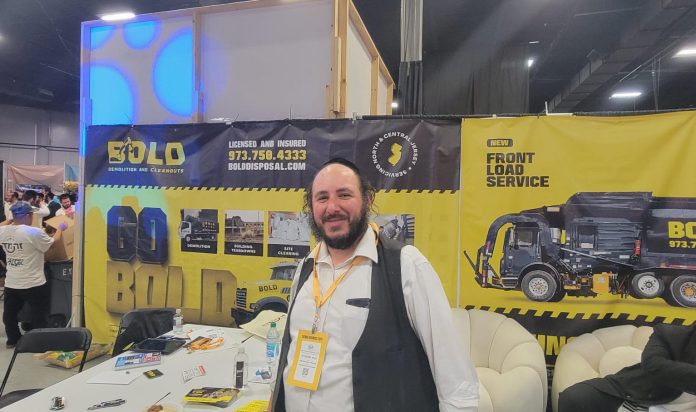 Ami Magazine4 months ago
At last year’s Orthodox Jewish Builders Association Expo, run by Meilech Webber, I conducted mini Lunchbreak interviews with several of the entrepreneurs who exhibited at the show. Those short chats were fun but left me wanting to hear more. One exhibitor I was happy to reconnect with was Isac (Beri) Wollner, founder of Bold Disposal and Demolition.
What impressed me most in our first quick talk was Beri’s happy demeanor and stress-free attitude, even in difficult situations. Beri had grown a company from scratch and was doing very well, until the market changed drastically. Forced to let all his employees go, Beri was left with just a single dump truck and a mountain of debt. Yet, with determination and creativity, not only was Beri able to recover but he established something even more successful.
Today, Bold Disposal and Demolition services the entire tristate area, focused on the real estate, warehousing and manufacturing market for cleanouts, gut jobs, demolitions, dumpster rentals and innovative construction or renovation solutions.
Beri talked about getting through tough times, developing his current business and what he learned along the way.
Enjoy!
—Nesanel
I grew up in Williamsburg, the second of eight children. We were comfortable but not wealthy. My father started out working for S&W, the clothing store in Manhattan. Then, with a few partners, he bought out a chain of gas stations and ran that for a few years. After that, he bought Sharmash Bus Company—with routes between Brooklyn, Kiryas Yoel and the Catskills—from his uncle. Ten years later he sold it to the Monroe Bus Company, which also doesn’t exist anymore, and started a new company called Vamoose, whose buses run from Manhattan to the Washington, DC, area. It’s still going, after 20 years.
“Vamoose started out as a cheap service, with its customers mostly from New York City. But after five years, my father realized that the cheap model wasn’t sustainable long term, so he redesigned it as a high-end service. In addition to regular coach buses, he also offers premium, business class coaches that seat only 34 passengers in a space built for 56. It has its own bus stop on Seventh Avenue and 31st Street in Manhattan. He has contracts with the Pentagon and the White House for their employees to travel back and forth to New York. During Hillary Clinton’s presidential campaign, her team contracted with Vamoose.
“I went to Satmar throughout my entire childhood. As a bachur, I was often involved in organizing and overseeing different initiatives. When the yeshivah had an event, I was the one coordinating it. I headed fundraisers for friends who didn’t have the means. I learned that from my parents, who are natural askanim. When a cousin from Eretz Yisrael reached out because his wife was sick, our family became very involved in helping them.
“After yeshivah, I joined my father at Vamoose and became his partner in growing the company. They were only running between New York and the DC area, and I wanted to expand to Boston as well. We applied for the operating licenses and thought that everything had been processed and approved. Evidently, there was some misunderstanding. On the first day of the new route, we got a call from the Boston Globe saying, ‘We hear you’re running a company in Boston without a license.’ That was a surprise, because I had the license in my hand! I have no idea how the paper found out about it or why they felt it was of interest to readers, but there was a large writeup about it the next day.
“Whatever their intention was, the article was tremendously beneficial to us—it was essentially very effective free advertising! We received hundreds of reservations. No one cared whether we had a license; they just cared that there was a bus going where they needed to go. Vamoose nearly doubled in size the week the article came out. But the venture didn’t have a happy ending. We had received permission from the local municipality and the city, but we hadn’t realized a state-level license was also required. They agreed to let us continue operating for a few weeks on the condition that we stop taking new reservations during that time and reapply for the remaining license.”
“The yad Hashem in the process was evident, though. In order to get a state license, you had to own a bus, but my father leased all his buses. We signed a contract with the owner of the leasing company, a Russian Jew who spoke a good Yiddish, stating that he would be our sole provider for the buses and the license would be granted under his name.
“It took us over a year to finally get the license. At our first meeting with our new partner, he said, ‘The license is in my name. I’ll give you 10% of the profits.’ The contract clearly stated that we would share the income, but he stood by his paltry offer.
“My father decided to just walk away from the whole thing. On our way out, my father said, ‘Hatzlachah rabbah.’ Our now ex-partner replied, ‘You don’t really wish me luck, you wish that my bus would overturn on the highway.’
“Sadly, two weeks later, on a Motzaei Shabbos, that’s exactly what happened. One of our ex-partner’s buses had taken a different route on I-95 and overturned. Fifteen people were killed. If the company had been in our name, we would have been blamed for the accident. The whole business was shut down by the federal Department of Transportation.
“Eventually I went out on my own. From 2009 until 2015, I managed a school in Boro Park. The foreclosure industry was becoming very popular at that time. The banks were getting a lot of houses that had gone into foreclosure, and they needed people to maintain them until they were sold. They would often want some small renovations to be done as well. I started a company to do these maintenance and repair jobs—things like changing the locks, cleaning the properties and fixing the plumbing.
To read more, subscribe to Ami
 Ami Magazine4 months ago
For better or worse (worse, I’d say, but the US Constitution begs to differ), anyone in our country can approach you on the street, in a park or in any other public place and call you the vilest names he can muster. He or she can sing praises of mass murderers and express the wish that the members of an ethnic or religious group he doesn’t like die horrible deaths.
Say hi to the First Amendment.
Americans’ right to speak freely is, in most cases, something worth appreciating. Countries whose governments criminalize citizens’ ability to express opinions are generally not places where any of us would want to live. But, once speech is unlimited, anything goes.
Well not anything; there are exceptions. The Supreme Court has held that speech “directed to inciting or producing imminent lawless action” and “likely to incite or produce such action” is unprotected by the Constitution. Likewise, libel or slander, or—did you know?—threatening the life of the president or anyone in the order of succession to the presidency.
But Nazi marches, KKK rallies and angry mobs chanting “Globalize the Intifada” are all tolerated by US law (if they don’t impede traffic). While that latter chant is in fact a threat—the intifadas were famously murderous affairs—the “imminent lawless action” isn’t present.
There are, however, cases where a “buffer zone” can legally be established, a police-enforced area off-limits to protesters. Where such zones can be created isn’t entirely clear. The Supreme Court has alternately upheld, struck down, or limited various buffer zones at places like medical clinics and residential neighborhoods or at funerals.
What about at a shul? Good question. And a pertinent one.
New York City Council Speaker Julie Menin has introduced legislation to create a 100-foot buffer zone to prevent “harassment” and “intimidation” around sensitive sites such as shuls, mosques, churches, and schools.
New York Governor Kathy Hochul has proposed a statewide measure mandating a 25-foot protective zone around houses of worship. A coalition of New York lawmakers has introduced legislation to that effect.
Interestingly, when Ms. Hochul announced her plan last month, during her “State of the State” address in Albany, the audience applauded loudly, save one attendee, New York City Mayor Zohran Mamdani, who kept his hands in his lap.
“Progressive” groups like Jews For Racial & Economic Justice, Jewish Voice for Peace and IfNotNow oppose the proposed buffer zones. They want to preserve the right to, as has happened, shout slogans like “Globalize the Intifada,” “Say it loud, say it clear, we support Hamas here” and “Death to the IDF” in the faces of Jews attending shul events that encourage the purchase of homes in Israel.
Those groups see such events as aiding “the dispossession of Palestinians,” and buffer zones as “unconstitutionally suppress[ing] political dissent.”
The fact that, according to the New York City Police Department, anti-Semitic incidents made up 57% of all hate crimes reported in 2025 (and that the trend has continued, with more than half of all hate crimes reported in January targeting Jews or Jewish institutions) would make buffer zones around shuls (and other houses of worship; the law cannot make distinctions based on religion) a reasonable thing. Jews these days feel (and often are) threatened with violence. Whether that reasonability can pass legal muster will have to be seen.
If not, though, and hateful protesters are allowed to get in the faces of Jews interested in moving to Israel (something the protesters inadvertently bolster), perhaps a tactic successfully used in other contexts might prove useful.
Let the mob members shout and spit and threaten as they wish. Let the shul-goers ignore them (which will incense them even more) and just stoically walk into the building. And let a cadre of others photograph and video them as they are confronted by angry faces and endure verbal assaults.
There are archival photographs and film from 1930s Germany that show German citizens harassing Jews. Pairing those visuals with new ones showing contemporary haters similarly berating Jews in 2026 would make for a powerful set of images, easily shared widely with media and the public.
Maybe powerful images, of the sort that in other contexts have greatly affected public perception, can do the same thing here.
To read more, subscribe to Ami
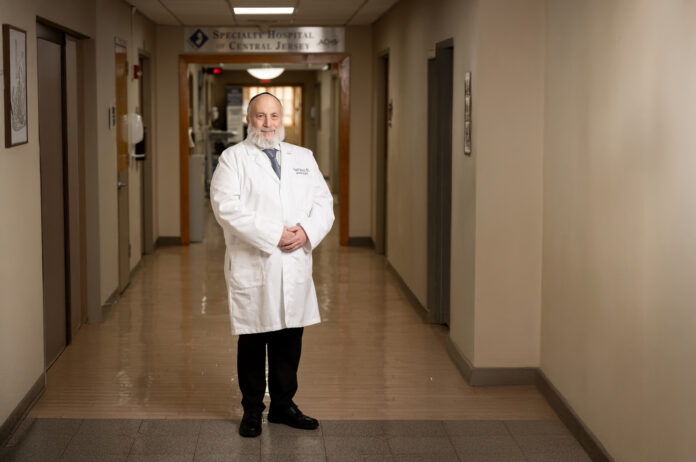 Ami Magazine5 months ago
Under the direction of its outstanding chief medical officer Dr. Howard (Chona Chaim) Lebowitz, Specialty Hospital of Central Jersey in Lakewood, New Jersey, stands out as one of the region’s premier medical facilities. A small, integrated “hospital-within-a-hospital” located at Monmouth Medical Center (formerly Kimball Medical Center), its sole focus is caring for chronically ill patients whom most facilities consider incurable.
As an independent entity, it offers the benefits of a more individualized hospital setting, combined with life-support services such as ventilator weaning, complex wound care, parenteral nutrition, respiratory and cardiac monitoring and dialysis.
Dr. Lebowitz received his medical degree from Harvard Medical School, graduating cum laude from the Harvard-MIT Program in Health Sciences and Technology. He was also awarded the DuPont Young Investigator of the Year Award by the American College of Chest Physicians. After completing his internship and residency in internal medicine at Boston’s Brigham and Women’s Hospital, Dr. Lebowitz served as an attending physician there for five years, earning board certification in internal medicine before joining the medical staff at Monmouth Medical Center in 2001.
In addition to his medical expertise, Dr. Lebowitz is a talmid chacham in the truest sense of the term. A graduate of the Mir and BMG, he continues to spend half of each day in kollel immersed in Torah study. His unique combination of medical knowledge and remarkable fluency in Torah informs both his approach to patient care and the philosophy of his facility.
I’ve heard that you do amazing things, and speaking to the best people in the world is always a big honor.
Thank you.
Can you explain what your facility is like? I understand that you occupy two floors of an existing hospital building.
That’s correct. By way of background, we run what’s called an LTAC (long-term acute care) hospital. That sounds a bit like an oxymoron, but these types of hospitals were established to take care of chronically critically ill patients. A few decades ago, Medicare started reimbursing hospitals based on the admission diagnosis, and it didn’t matter how many days the patient stayed, so the motivation was to get them out as quickly as possible: “treat ’em and street ’em.” Patients were getting out quicker and sicker, but that model worked for the majority of people.
However, there are some patients who don’t get better in days but over the course of weeks or months, and sometimes they might not get better but still need higher-level care. That’s why these types of hospitals were constituted, which are essentially a Medicare designation.
Where do your patients come from?
They typically come from hospitals all over the Eastern seaboard after having a stay in an ICU at a transferring hospital. Maimonides is one of my biggest feeders. At this point most of our patients are frum, and we can talk about why that is. The vast majority are on life support and ventilators due to respiratory failure and other major medical complications. We typically try to tailor a course of about a month of treatment, and if they’re well enough after a month they’ll go home. If they’re well enough to go to a skilled nursing facility, they’ll do that.
You must have a high mortality rate.
Depending on the quarter, our mortality rate is approximately 25%. Everyone thinks it’s much higher because we take care of very sick and very elderly patients whom no one else wants to accept. These are patients who have had neurological catastrophes and would have been declared brain dead if that kind of testing were allowed in New York. But for the frum community, these are people whose families want proactive care no matter how sick their loved one is so they can have the best and longest life possible.
I was under the impression that yours is a sort of chayei shaah type of facility, but it’s not.
That’s a big misnomer. This hospital is for patients who are very ill. But I’ve had people who came to us on a ventilator and we weaned them off and treated all their complications, and now they send me videos from Florida. I’ve even danced with them at their kids’ chasunahs.
What’s the tzad hashaveh of the patients at your facility?
The common denominator is that they are critically ill and require an extended period of care to determine whether they will recover or not.
Why can’t they receive the same care at a regular facility? You mentioned that many of your patients come from Maimonides. Is it a matter of insurance reimbursement, meaning that other facilities wouldn’t be able to receive the same payment?
There are several factors. Number one, the typical Medicare patient in an acute-care hospital like Maimonides or Columbia has an average stay of four days. These places aren’t designed to take care of patients for weeks. For example, if you go into Maimonides, you’ll never get directed treatment for recreational and occupational therapy. You may get an evaluation, but you won’t get treatments that are directed at rehabilitation.
There are also things like nursing care to try to improve wounds. Wounds can get really bad over the course of days, but they get better over the course of weeks and months. Aggressive wound care isn’t attended to if you’re going to be in and out of a place in less than a week. I get a lot of patients who haven’t been fed elsewhere during their whole hospitalization, because those places aren’t used to addressing nutritional needs. It’s like if you go to an Airbnb for a few days, you expect one level of amenities, but if you go somewhere for the summer, it’s a different kind of setting.
Are there many facilities like yours?
It depends which part of the country you’re talking about. It essentially doesn’t exist in New York. One of the reasons is that years ago New York felt that their hospitals had too many beds, so they went through a bunch of commissions to cut the number of beds rather than introducing new ones. In order to have a state recognize the need for LTACs, there has to be a sense of central and communal planning, with stakeholders willing to look at the bigger picture. New York just couldn’t get that done politically.
That being said, people ask me all the time, “Why don’t we have something like this in New York?” There is a place in New York called Calvary Hospital that was grandfathered in as an LTAC, but it doesn’t really operate like one. It’s more like a hospice. That’s why the New York patients all come to New Jersey.
Were you asked by the people in New Jersey to do this?
We were asked by Robert Wood Johnson Barnabas, the health system that houses us, to help unload their ICUs and serve this patient population and address the problem of people not getting optimal care. There are other LTACs in New Jersey that were created by rehab companies, but they’re kind of souped-up nursing homes, meaning that they’re really subacute.
Our facility has a high level of acuity, and my nurse-to-patient ratios are unbelievable. I think I’m the only LTAC that has three full-time doctors and a physician assistant. If you come for a visit, you’ll see heilige, frum Yidden who are very well attended. Regardless of whether they do well or not, their families all appreciate that they are getting incredible medical attention and kind nursing care. Another tremendous relief is the fact that halachah isn’t something we just give lip service to or try to accommodate; it’s what we’re all about.
For example, we just took in a patient from Maimonides because they were reluctant to give him dialysis due to his poor prognosis. The patient’s family reached out to Rabbi Zischa Ausch from Chayim Aruchim, who said that providing dialysis is the right thing to do. I’m the one who asked them to reach out to him, and when Rabbi Ausch says to do something, our staff of nephrologists and dialysis nurses don’t roll their eyes as others might do elsewhere. We are all of the same mind.
In a case like that, does it create insurance coverage issues?
Most of my patients have Medicare, which reimburses us based on the admission diagnosis of a 28-day stay. But I don’t balance my books patient to patient. I’ve had elderly patients here for several months and much of that time was uncompensated. I tell the patients and their families, “If you’re well enough to leave after your month, you leave. If you’re too sick to leave, you stay. You don’t have to worry about the financial ramifications.” Thank G-d, everything has been working out for us in the aggregate. That’s the way we do things.
In other words, you’re basically able to balance the books across all your patients combined.
Correct. There are patients I lose a lot of money on, and others where I come out ahead. At the end of the year, we hope to make more than we lose.
I’d like to understand your relationship with Monmouth Medical Center.
We’re an independent entity that leases space and purchases things like dietary services, security services and radiology services if a patient needs an exam, but we’re completely separate.
To read more, subscribe to Ami
 Ami Magazine5 months ago
It was a freezing day in November when I entered the local imaging center.
A welcome blast of heat greeted me as the automatic door whooshed open. After a mild fall, winter had barged in, chilling all of us thoroughly.
I checked in for my abdominal ultrasound, already restless. Bariatric surgery was finally scheduled, after years of hesitation and delay. Weight had never been simple for me, but once I said yes to the surgery, I was ready to sign up and move on. The ultrasound was just another box to check.
“Are you sure I need this?” I asked the doctor dubiously. It seemed a bit much. At the age of 35, I was young and healthy. I’d never experienced any associated issues with my weight, though I was worried that if I didn’t address my obesity, problems would eventually develop.
The doctor shrugged. “It’s part of the pre-op testing,” he replied. That left me with no choice but to schedule that nuisance into my calendar.
At the center, I hopped off the exam table and bundled up again. My little ones would be home in 20 minutes, and I dashed for the door. If I’d had some more time, perhaps I would’ve noticed the tech’s wide-eyed concern while staring at the black and white screen.
It was a Friday when a secretary called from the center with a rather unusual question.
“Are you married?” she inquired.
Since when was that a requirement for weight-loss surgery?
I responded in the affirmative. Without furnishing any further details, she requested that both my husband and I come in for a follow-up meeting on Sunday. I thought perhaps they’d discovered a cyst or something like that. I figured that it was just another thing I’d have to resolve before proceeding with the surgery.
Now, there was no way I was going to wait until Sunday, the day my husband was due to travel out of the country for a planned business trip. As soon as my dishes were loaded into the dishwasher on Motzaei Shabbos, we drove over to the center, which was open, serving as an urgent care. It was frigid, and the temperatures had dropped into the teens. The car drove smoothly, the crunch of the ice and salt beneath the wheels an audible soundtrack.
The doctor on call pulled up my ultrasound results. I watched him go still, the computer mouse hovering over the grainy images. The room was silent. Faintly, I heard a young child crying, and the murmured hush of a man’s voice—the father’s?—attempting to calm him.
“There’s a mass on your pancreas,” the doctor broke the quiet. His eyes were still glued to the screen. “Whatever this is, it seems to have spread into your liver.”
He scribbled a number on a Post-It note. “If this is what it is, then you should call them.”
The doctor, a frum Yid, finally swiveled around. His eyes held something I couldn’t decipher, and his voice wobbled a bit.
“Hatzlachah,” he said as we rose. “May Hashem send you a refuah shleimah.”
I stared at the little yellow note nestled in my palm. RCCS. Rofeh Cholim Cancer Society. Cancer? I had cancer? That was for other people, people I’d vaguely read about in books, or whose names I’d overheard in hushed conversations at the bus stop. My family had never been touched by cancer before. Was I the first?
It was only once we were halfway home that I realized that I’d left my coat in the office on the coldest night of the year.
My husband canceled his trip, and the next few days were a blur. While I didn’t know much about cancer, or anything remotely medically related for that matter, I knew that pancreatic cancer was bad. So terrible, in fact, that my head kept playing images of my girls at my own levayah. Pancreatic cancer, I remembered, was particularly vicious, especially in the young.
I didn’t call RCCS. Calling them would be confirming this “thing” was cancer, and the doctor had qualified that ultrasounds weren’t definitive. So long as I didn’t reach out to RCCS, then I could convince myself that this whole episode was a bunch of nothing. Deep down, I doubted my own conclusions.
A CT scan was inconclusive. When I went to hear the results of the MRI, I anticipated good news. Unfortunately, that was not to be. We dialed RCCS.
For the first time since the whole saga began, I felt less alone. My caseworker told me that, yes, pancreatic cancer was survivable, and she’d put me in touch with pancreatic cancer survivors who’d also had metastases. She also reassured me that my weight would not impede treatment, a worry I’d been silently carrying with me, wondering if I’d squandered my only chance at life.
It was over, I thought Monday morning after the kids had all gone off to school. I stared into our backyard, now a winter wonderland with the snow frozen crystal on the branches of our oak tree. O-ver.
I had a biopsy done, and then we settled in for the week-long wait. The only way I survived the week was by remembering that Hashem is good and His judgment is just. We informed our parents, who davened along with us.
In the face of serious illness, my world shrank. I withdrew into myself, attempting to make sense of the incomprehensible. I let the phone ring, the laundry wait and the mail pile up. I have a small home-based business, and I’d always loved working from home at my desk in our sun-lit sefarim room. But the quiet became oppressive, fueling my dark musings. I was never an exercise fan, but I took up running in our quiet suburban neighborhood. With my sneakers pounding the pavement and my breath forming small puffs in the icy, still air, I forced my brain to be absolutely blank. It became my lifeline to sanity.
My diagnosis was stage four pancreatic cancer with metastasis to the liver. Pancreatic cancer is very often discovered when it’s far too late for meaningful treatment. By the time the cancer is symptomatic with liver dysfunction and abdominal pain, it has spread. Additionally, pancreatic cancer can be impervious to chemotherapy.
My caseworker warned me not to check the five-year survival rates. Curiosity got the better of me, and after a quick look, I understood why she’d insisted. I sat in my chair and stared into space. Hashem is good, I told myself fiercely. He has a plan.
It turned out that the path in His plan was a long and protracted battle. And I received the starring role in a drama I’d never asked for.
At the RCCS offices, the team was stumped. Doctors disagreed whether my tumor was of neuroendocrine composition or the far more typical carcinoma. The tissue biopsy revealed both were present, though doctors could not conclude which one was predominant. As my caseworker explained it to me, one was vanilla ice cream and one was chocolate: While they were both frozen treats, they had different characteristics. Chemotherapy treatment was individual for each of them.
Neuroendocrine tumors are rare. RCCS sent me to a doctor specializing in those tumors, and we set up a rough treatment plan. It would involve chemo and surgery, a protocol unchanged for the last three decades.
I arrived for the appointment to find a representative from RCCS already there. From that point onward, whenever there was an appointment of significance, someone was there. My condition overwhelmed me completely, and there was no way I could understand all the jargon doctors were so fond of tossing about. Formulating appropriate questions was likewise beyond me.
The doctor we met that day was nice, but nothing could varnish the bitter reality. When the cancer made its way into the bloodstream, its characteristics changed. She gently told me that there was no way for this cancer to be cured.
“We can try to make the fire smaller,” she offered up an analogy. “Chemo will put up a good fight. But in the end, fire always wins.”
Three months. That’s how long she gave me. It was the week of Chanukah. I thought of the menorah in our window, polished to a high sheen. Would I be gone before Pesach?
My world silently caved in around me, a quiet collapse that nobody but the few souls near me knew of. Without any sons, I wondered who would say Kaddish for me in a decade or two. I imagined my motherless daughters in their white dresses, walking down to the chuppah without me.
The RCCS rep refused to let us give in to despair.
“We are Yidden, and for us there’s always hope,” he insisted. We sat on the hard green waiting room chairs, trying to regain our composure. “Hashem is the Borei Refuos, and I see that every day. No is never our final answer.”
I won’t lie. It was a dark, dark time.
While we were all devastated, my father couldn’t bear it. I found myself comforting him, telling him that some people get into a car and don’t make it home, whereas I had the time and luxury to prepare myself to die. I don’t think it helped him very much, to be honest.
We were almost ready to proceed with treatment when it was determined that the carcinoma cells overwhelmed the neuroendocrine cells, which meant the protocol needed to be revised completely. The new hospital I’d be using wanted to test my tissue again. I always smile when I think of a pathology slide, containing a tiny slice of my pancreas, making its way over from one hospital to another, weaving its way through city traffic.
Meanwhile, my caseworker felt something was missing from the clinical picture. While I felt I’d aged at least three decades in the last two weeks, I was still young. So young, in fact, that the nearest age match in the RCCS pancreatic cancer database was more than 20 years older than me. Additionally, my biopsy findings were unusual: Two protein markers were equivocal, indicating the tumor was being driven by immune system malfunction. In nearly all pancreatic cancer patients, they were not intact. Doctors were not sure if this was good news or not. At this point, it was just another clinical finding.
RCCS got us an NGS, or Next Generation Sequencing blood test. This specialized test would shed more light regarding what was driving the DNA in my cells to divide and multiply out of control. But that test would take at least two weeks to run, and it was time that we likely couldn’t afford. In the interim, we settled on a treatment protocol. The plan was to extend my life for as long as possible.
To read more, subscribe to Ami
 Ami Magazine5 months ago
The business side of medicine may seem pedestrian from the outside, but it is often as complex and significant as the therapeutic side. While medical professionals and products save lives, they need a commercially successful firm behind them to get things done on a large scale. Amir London is the CEO of the publicly traded biopharmaceutical company Kamada (NASDAQ: KMDA), which has a portfolio of six FDA-approved specialty plasma-derived products indicated for rare and serious conditions. Founded in Israel, the company has since expanded internationally, with significant business and operations in
the US.
Although Amir partnered in a startup at one point in his career, he has always had an atypical view of entrepreneurship: he sees it through the lens of organizational impact, believing that individual excellence is a catalyst for broader success for the corporate entity.
Before becoming CEO of Kamada, Amir spent ten years at an international consulting firm, served six years as CEO of the Israeli-based pharmaceutical distributor Promedico, and later joined a US-based medical diagnostics startup. Amir has guided Kamada through a decade of continuous growth since assuming the helm of the company.
We discussed his career path, the long-term viability of pharmaceuticals as a career choice, and his unique habits that keep him focused.
Enjoy!
—Nesanel
I was born and raised in Haifa, Israel, but moved back and forth between the US and Israel over the years. My father was born in Israel in 1936. His father came from Ukraine, and my paternal grandmother is from the old city of Tzfat. My mother came to Israel with her parents from Romania in 1950, when she was 14. My parents will both soon be turning 90. I am married to Nurit and have three children: Afik (28), Saar (24) and Gur (20).
“I grew up in a home with two mathematician parents. My father was a professor of mathematics at the Technion, Israel’s Institute of Technology, and my mother, who is a Technion graduate, headed the Math Department at Israel’s leading high school, the Hebrew Reali School in Haifa, which is known for its strong focus on science. That was the high school I attended. I followed in my parents’ footsteps and also graduated from the Technion.
“My wife is an architect. She too is an alumna of the Technion, as is our daughter. When she was accepted, she joked that she had no choice but to go there.
“I have two siblings, a sister and a brother. Growing up, our home was kosher. My father came from a religious background, as did my grandparents. We respect and follow many Jewish traditions, celebrate all the chagim and fast on Yom Kippur.
“The atmosphere I grew up in, both in my home and our community, was very education-oriented and I was surrounded by intelligent people. I wasn’t entrepreneurial at all as a teenager. In middle school and high school, I played basketball all day, every day. I am fairly tall, about 6’3”, and at an early age I played on the Israeli youth team. When I was 16, we won the Israeli National Cup.
“After I finished my military service I spent six months backpacking through the Far East, mainly in India. Upon my return, I studied management and industrial engineering at the Technion. I knew that I wanted to become a senior executive in a mid-size to large organization where I could apply both my analytical and people skills. While I didn’t know which industry I would end up, I figured that if I worked hard and demonstrated my value, I could work my way up to head a company.
“The first company I worked for, Tefen Consulting, developed unique software and methodology to help large semiconductor manufacturing facilities including Intel’s improve their efficiency. Each machine cost over a million dollars, and the production process itself was extremely complex and expensive. Every minute a machine sat idle translated into significant revenue loss.
“Our goal was to pinpoint bottlenecks in the production flow. We developed software and systems to identify those stoppages and devise strategies to eliminate or mitigate them. We built a very methodical approach to help companies resolve their issues, which helped me understand things relatively quickly. We ran these projects repeatedly across dozens of semiconductor facilities in the US and around the world. Over time, we became leaders in the industry.
“A few years later, we decided to take both the software and the business model and apply them to the biopharmaceutical industry. We had noticed many similarities between the two. Both are science and technology driven, yet manufacturing was not their core expertise at the time. Both utilized clean rooms for production, required extremely expensive capital equipment and had a significant need for efficiency improvements.
“The discipline is generally referred to as operational, or business, excellence. Basically, you analyze existing processes and systems with the goal of maximizing their impact on the overall operation. In complex production and supply chain systems, pinpointing the true bottleneck is surprisingly difficult. It’s very easy to become misaligned if you don’t break an operation down into its specific components and analyze them in detail.
“For example, a company might invest heavily in optimizing a specific department, only to realize that the upgrade adds zero value to the overall system. If your product-filling line is the primary tripping point preventing you from meeting market demand, optimizing an earlier step in the process won’t help you ship a single extra vial.
“This is a challenge in almost every industry, even those that are service based. If you go to a major airport, for example, and ask what it is specifically that prevents them from adding 5% more flights, you’ll rarely get a clear answer. Whether it’s a manufacturing plant, a laboratory or a financial institution, without a methodical approach, you risk wasting resources on ‘improvements’ that don’t actually move the needle.
“Our approach was unique and innovative at the time, and it created a domino effect that allowed us to scale rapidly from one major player to the next: Genentech, Amgen, Bayer, Roche, Eli Lilly, Abbott, Pfizer, Sanofi and many other biopharma giants. Within three years, we built a formidable franchise in the US.
“As the firm grew to over 200 employees, with projects all over the world, I was promoted to partner. I was responsible for the global biopharma business, overseeing operations first on the West Coast, then the East Coast, and eventually throughout Europe as well.
“During this period, I led a strategic initiative to establish a consortium of biopharma companies—a forum where industry leaders could exchange key success stories, best practices and benchmarking data. That consortium eventually became the gold standard for operational excellence within the biopharmaceutical industry.
“I first moved to the United States with Tefen when I was 25; I lived in Portland, Oregon, for two years. I then returned to Israel, married Nurit, and moved with her back to the US, spending the next six years in the Bay Area, where our first two children were born. My wife completed her master’s in architecture at UC Berkeley and worked for an architecture firm in San Francisco. After about ten years at Tefen, we returned to Israel, where our third child was born.
“While I was at Tefen, we managed a project for Israel’s Neopharm Group, during which I developed a close working relationship with the owner. Soon after the project ended, the owner acquired a competitor in Israel and needed to expand the management team. He tapped me to lead Promedico, one of the primary subsidiaries within the newly merged company.
“I stayed at Promedico-Neopharm for six years. We were the second-largest pharmaceutical importer and distributor in the Israeli market, serving as a local base for international biopharmaceutical companies such as Pfizer, Wyeth, Abbott, Novartis Vaccines, Gilead and others. We imported the products, worked with Israeli HMOs and health funds on reimbursement, and handled distribution across the local markets.
“Then we returned to the US, where I joined an Israeli-American entrepreneurial team at a startup called Fidelis Diagnostics. We put in place a very interesting business model: while family practices in the US typically refer patients to external labs or specialists for diagnostics, we developed a concierge-style package of specific diagnostic services that could be performed directly in-office, allowing family doctors to offer a broader and more accessible range of services to their patients.
“One example was our approach to home sleep studies. Instead of referring patients to a dedicated sleep lab, we used a technology known as a ‘sleep watch.’ Patients slept in their own beds while the device recorded sleep apnea data. They then returned the device to their physician, who uploaded the data to the cloud, where a remote sleep specialist reviewed the results and provided feedback.
“We didn’t own any of the technologies ourselves; we identified, licensed and consolidated them into a single platform. In addition to sleep studies, we also offered NCV nerve testing and a breath-based technology used to identify H. pylori bacteria in the stomach. In total, we bundled five different technologies and brought them to physicians.
“The company was initially successful, but after two years, reimbursement rates for in-office diagnostics declined significantly and the model was no longer financially viable. We ceased operating in 2014, and I returned to Israel.
To read more, subscribe to Ami
 Ami Magazine5 months ago
It’s oh-so-chic these days to argue, in learned journals, late-night dorm room sessions and over tea and crumpets, about whether anti-Zionism is equivalent to anti-Semitism. Whether hatred of Israel and attempts to delegitimize her is effectively the same thing as hating Jews.
But, leaving that question aside for the moment, aren’t the vehemence, vilification and violence regularly exhibited at protests against Israel sufficiently ugly on their own to merit a sane society’s contempt?
If there are any protests over Myanmar’s genocide of Rohingya Muslims or over Communist China’s gross mistreatment of Uighurs—or over Turkey’s ethnic cleansing of Kurds, Christians and Yazidis, or over Sudan’s persecution of an assortment of non-Arab groups—they seem to have flown under the radar. If they exist at all.
When it comes to Israel, though, for her attempt to defang a movement pledged to her destruction, a movement that has maimed and murdered thousands of Israeli civilians, Jews and Arabs alike, she has become the villain of the nonce. And no one even tries to claim that Myanmar or China or Turkey or Sudan are “illegitimate” countries like, say, New York Mayor Zohran Mamdani contends about Israel.
But, as odious and unreasonable as anti-Zionism is, the question remains: Is it an expression of anti-Semitism—that is to say, hatred of Jews, or an entirely different animal?
Well, the very fact that, as above, the only universal villain just happens to be a state that claims a Jewish identity would seem to point in the direction of the first contention. But it could be a mere coincidence. Could be.
Adding weight to the same pan of the scales, though, is the fact that haters of Israel seem to enjoy venting their spleen against not only Israelis but at Jews anywhere.
What, after all, does opposition to Israel have to do with the yarmulke-wearing citizen walking down a New York street, that merits him a beating? Or with a French shul, to justify setting it aflame? Or with Chanukah celebrants, to be mowed down with gunfire on an Australian beach? (No room here for the abundance of other examples.)
Nothing, of course—if, that is, the anti-Israel animus is what it claims to be: opposition only to a political entity, not bigoted hatred of an ethnic or religious group.
So all the scholars, dorm residents and tea-sippers can savor their theoretical discussions. But by considering their topic to have two arguable sides, they reveal themselves oblivious to reality.
Yes, yes, of course, there may well be some true anti-Zionist outliers who have nothing against Jews and only, for whatever reason, hate Israel. But outliers they remain.
Is Mayor Mamdani among them? I can’t claim to know what is in his heart. But what I can claim to know is that he has refused to condemn the “Globalize the Intifada” slogan, which unarguably translates as “attack Jews everywhere”; and, as I detailed in this space last November, that he regularly and wrongly claims that international law prohibits the purchase of a home in Yehudah or Shomron. Maybe it’s simple ignorance? Maybe.
One thing, though, seems certain: A Venn diagram with circles representing people voicing anti-Israel sentiment and people harboring anti-Jewish hostility, respectively, would yield a bloated overlap of the two, with only the slimmest arcs outside the intersection.
Rabbi Hertz Frankel, who shared a close relationship with the Satmar Rebbe, quoted him as stating: “Any non-Jew who opposes Israel is an anti-Semite, for it is not the shalosh shevuos [the Talmud’s ‘three oaths,’ one of which prohibits Jews from returning to their ancestral land en masse by force] that motivate his opposition.”
Rabbi Moshe Sherer, the president of Agudas Yisrael of America, shortly after the UN’s infamous 1975 “Zionism is Racism” declaration, had a similar take.
“Though the resolution was supposedly aimed only at secular ‘Zionism,’ a movement with which the traditionally Orthodox world has little connection,” he wrote, “we are not fooled; the slander is an attack on the entire Jewish people.”
In 2023, New York City authorities investigating a series of attacks on Jews reported that, while plotting the assaults, one of the perpetrators advised the others in a group chat, “Remember, don’t chant out Jews, it’s the Zionists.”
Sly, and revealing, advice.
To read more, subscribe to Ami
 Ami Magazine5 months ago
A conversation with Rabbi Yehuda Harel, who reflects on his daughter’s recent return to Beer Sheva after deserting her family and Yiddishkeit to live with a Muslim for nearly 20 years in a Bedouin village.
“When Ibrahim found out, he called the police to say that she had kidnapped their son and ran away. They blocked her from leaving the country and called her in for an emergency hearing.”
At long last, we are finally meeting in my home. The last time I saw you was in Yerushalayim, when we discussed your daughter’s situation and what we could do to help bring her home.
I must tell you that I truly appreciate your efforts. You became involved in this story many years ago all the way from chutz laaretz.
It really began for me when I saw a video of you standing outside the Bedouin village, holding your guitar and calling out to your daughter.
Yes. I would call out, “Chein (her nickname), come home! Come back to Abba!” The village where she was living is about ten kilometers from my home in Beer Sheva. I would go there with a Tehillim and my guitar, and I’m not ashamed to say that I cried a lot. And not just there, but whenever I picked up my guitar I would weep, knowing that there’s a shaar in shamayim through which niggunim enter.
It says that “shaarei dema’ot lo ninalu—the gates of tears are never closed.”
Exactly. But I believe that this entire episode had to take exactly as long as it did. My daughter had to be there for 20 years just as bnei Yisrael had to be in Mitzrayim for 210 years. Nothing anyone did would have helped.
You never gave up hope.
Never. “Ein yei’ush ba’olam.”
Did you go to the village every day?
Not every single day because there were days when I couldn’t, but I’d say I went every day that I could.
That really touched me, which is why I phoned you and wanted to interview you about your story. We’ve met two or three times since then, and I also visited you in your home, where I met your wife and some of your children and even davened Minchah in your shul. I was very surprised when you told me a few days ago that your daughter had come home. How old was she when she left?
She was 17 and attending a local Chabad school.
Are you connected with Chabad?
No. We’re very close with Breslov. That’s the nusach we daven in the shul where I’m the rav. This is a video of our “Hallel” on Chanukah. (He shows the clip.) You’ll notice the singing and dancing. All of the tefillot are like this every day.
There weren’t any Bais Yaakov high schools near us. She went to Bais Yaakov for elementary school, but for high school we wanted her to stay nearby so we sent her to Chabad.
And she was a regular girl.
Yes, but she was also very special and very friendly. All of the girls gravitated toward her.
Then she suddenly left when she was 17.
It wasn’t sudden; it was a process. It started when she was 16, in the middle of tenth grade. People told me that she was seeing a Bedouin boy, but I didn’t want to believe it.
Do you blame yourself for that?
No. It just didn’t make any sense.
You didn’t notice anything?
Not at all, and I don’t blame myself because this is clearly what Hashem wanted. Hakadosh Baruch Hu wanted her to bring these neshamot from that place. If I felt responsible I don’t know if I could live with myself, but I know that this was Hashem’s will.
How did it begin?
It started out as visits, but when we finally learned what was going on, we sent her to live with a Jewish family in Zhitomir, Ukraine, to get her away from him. Around four months later, the mother called me and said, “I think your daughter might be expecting.” I asked her to put my daughter on the phone, and I asked her point blank if she was. “Yes, Abba,” she replied.
Her first child, Yehuda Yisrael, was born in Zhitomir. That was very painful for me. But as the song goes, “L’Abba lo sho’alim she’eilot—We don’t ask questions of our Father.” I just said to Hashem, “I don’t know if I am great enough to be able to handle this nisayon. Please help me with withstand it.”
My wife flew to Zhitomir for the brit. When the mohel said, “V’yikarei shmo b’Yisrael…” my daughter asked me what name to give him. “I don’t know,” I replied. “My head isn’t clear. Whatever name you choose, I will bless you and I will bless him.” “Then I’m going to name him after you and add the name ‘Yisrael’ because he belongs to am Yisrael,” she said.
A short time later there was some sort of problem in Ukraine between the locals and the Jews, and my daughter called to say that she was coming home for two months. I figured it would be okay, and I sent her to Kibbutz Cholit, which is located near the border with Gaza. Years later, on October 7, 2023, the residents of that kibbutz suffered a lot.
During one of Chein’s visits home, we stopped to fill up on gas. Who was the attendant at the gas station? Ibrahim’s [the Bedouin man] nephew. You can see how Hakadosh Baruch Hu orchestrated all of this. He saw my daughter and didn’t say anything, but after we left he called Ibrahim to tell him that he had seen Chein in the car with a baby in her arms.
He didn’t know that she had a baby?
No. When Ibrahim found out, he called the police to say that she had kidnapped their son and ran away. They blocked her from leaving the country and called her in for an emergency hearing at the Welfare Ministry. In the interim, they gave her three choices: she could place her son in foster care, she could live with Ibrahim in a neutral location, or she could live with him in his village, Tel Sheva. She chose the second option.
They rented an apartment in Beer Sheva and lived there for a few months, but when the neighbors found out that she was a Jewish girl living with an Arab, they ripped off her mezuzah, wrote nasty things on their walls and cursed at them on the street. When Ibrahim saw this happening, he took her back to his village. “Look,” he said. “In the village, you’ll have an entire house to yourself. No one will know who you are, and you’ll have a yard and a garden and a couple of horses. You’ll be able to live in peace.”
To read more, subscribe to Ami
Ami Magazine5 months agoWe were promised peace, weren’t we?
President Trump’s 20-point plan for peace in Gaza is still moving forward, but many questions about whether it will be successful and who will be involved in the process remain.
On the ground, it appears that there is a level of stasis; the situation is similar to the way things were when the open warfare ended with the ceasefire. The body of one hostage, Ran Gvili, is still in Gaza, but all of the rest have been returned. There were numerous ceasefire violations by Hamas and strikes in return by Israel, but there is no ongoing sustained fighting.
Still, for any real movement, things need to change. The question is whether they will.
Is Hamas disarming?
One of the main sticking points is whether Hamas will do as President Trump has said they must and disarm. So far, there is no sign that this will happen.
Instead, there are signs that it is trying its best to reconstitute itself. With many of its other financial lifelines gone, the terrorist group has been levying taxes on the food and supplies that aid groups have been sending into the area of Gaza where Hamas is in control. Israeli and Arab officials told The Wall Street Journal that Hamas has been able to start paying its employees again because of the taxes, as well as with money from Iran that can enter Gaza in various ways.
So far, there is no one who seems capable or willing to pressure Hamas into giving up its weapons aside from Israel. Egypt, Qatar and Turkey have told the US that Hamas would be willing to do so in a cash-for-guns scheme, but there has yet to be any movement on that front.
The Board of Peace
According to media reports, President Trump is planning to unveil the new Board of Peace this week in advance of the second phase of his peace plan. Its mission will be to oversee a new technocratic Palestinian government that would administer the part of Gaza not controlled by Hamas (and eventually all of Gaza), as well as to coordinate the rebuilding of the Strip.
Trump said that he himself would be the head of the board. Nickolay Mladenov has been announced as director-general of the Board of Peace. A former Bulgarian defense and foreign minister, he served as the UN’s Mideast peace envoy from 2015 through 2020. He has generally been viewed with respect by both Israelis and Palestinians.
The big question is which governments will have representatives on this body. Israel has been excluded. But it appears that Turkey has been excluded as well, which is a good sign for Israel.
Still, one of the latest lists to be publicized had Qatar on it, along with Egypt, the United Arab Emirates, the United Kingdom, Italy and Germany. We will find out this week who actually makes the cut, which may give us an idea of the direction things will take.
Hamas said this week that it will dissolve its own government in Gaza once the Palestinian technocratic government the Trump plan calls for is in place. As usual, they left any timing and details entirely unexplained.
The International Stabilization Force and the CMCC
Meanwhile, there has been no progress with regard to coming up with soldiers for the International Stabilization Force (ISF) that the Trump plan requires to keep the peace in Gaza. The only country that has said it is willing to contribute troops right now is Turkey, a suggestion that Israel has categorically rejected.
Others, like Spain, have said vaguely that they might contribute in the future. But so far it seems as if these countries aren’t actually willing to do so.
Meanwhile, a different kind of military coordination has been taking place at the Civil-Military Coordination Center, headed by the US, which has been making plans for the rebuilding of Gaza and the deployment of the International Stabilization Force—if it ever materializes. According to a report in The Jerusalem Post, the CMCC has been fast-tracking the clearing of Hamas tunnels in Rafah by the IDF so that buildings can be constructed. Estimates are that they could start going up within six months with the help of the UAE.
Allowing Palestinian civilians to move from the Hamas-controlled areas of Gaza into the Israeli-controlled areas could isolate Hamas further and keep them from using civilians as human shields. That would be one way of dealing with them even if the grander ideas of the Trump plan don’t pan out as hoped.
To read more, subscribe to Ami
 Ami Magazine5 months ago
Recently, I had the zechus of hosting a unique panel with three prominent askanim: Shloime (Sol) Werdiger, Ralph Zucker and Nechemiah Hoch. I was invited by Rabbi Naftali M. Miller, Agudah’s national director of development to speak with them during Agudath Israel of America’s live fundraising broadcast, and we discussed a wide range of issues.
While the three serve together on the Agudah board, with Shloime as its chairman, each is an accomplished and well-respected businessman in his own right, bringing a wealth of experience to the table.
Our conversation was extensive and engaging, touching on topics including their backgrounds, the pleasures and pressures of working with family, choosing a career, cell phone addiction, and, of course, what it really means to be an askan.
Enjoy!
—Nesanel
Nesanel Gantz: Welcome to our panel. Our distinguished guests are three giants who do so much for Agudah and klal Yisrael as a whole; I’m humbled to be a part of this.
I’d like to begin by hearing your background stories.
Shloime Werdiger: I was born in Borough Park. My father was a Holocaust survivor and the youngest talmid in Yeshivas Chachmei Lublin. We are Gerer chasidim, but at the time, there was no Gerer shtiebel yet, so we often davened in the Agudah and in Bluzhev. Agudah is in the Gerer blood.
I went to Torah Vodaas for high school. In Eretz Yisrael, I learned in Tchebin, because the Beis Yisrael suggested I go there. Rav Boruch Shimon Schneerson was my rosh yeshivah, and I learned by Rav Avraham Genechovsky.
When I was a child, Rabbi Moshe Sherer took a liking to me, and I spent a lot of time with him. I received a strong indoctrination because he recruited me at a young age. When I was learning in Eretz Yisrael, we would walk together from Malon Hamerkaz to Gur. On the Yomim Tovim he would daven in Gur. The she’eiris hapleitah Yidden [Holocaust survivors] like my father always felt a responsibility to the klal, to help them rebuild. With the encouragement of the Gerer rebbes, he pushed me to get involved in the Agudah.
When I got married, my wife made parnasah working in the diamond industry on 47th Street, but I was struggling. I started as a schlepper in the shmatte business. I worked very hard, but it took a long time to climb up the ladder until, with the Ribbono Shel Olam’s help, I was able to start my own business, focused on sports apparel and clothing.
Nesanel Gantz: It’s difficult for someone who has never experienced that struggle to imagine what other people have to go through.
Shloime Werdiger: I think it’s a little easier to get ahead in business today than it used to be, but it’s still difficult. There is a tremendous shefa in klal Yisrael today, which is wonderful and is being used for good things, but there is still an imbalance with many who are struggling.
In those days, when we first got married, we were all struggling with parnasah. Nobody grew up with a silver spoon in their mouth, especially not the children of Holocaust survivors. Our parents didn’t have businesses for us to go into. They didn’t have real estate or nursing home empires. We had a drive to be successful on our own; we had no fallback.
My kids are active in my business. I’m still active in the sports apparel business, but baruch Hashem, I’m able to devote much of my time to askanus. Agudah is my main “parnasah.”
Nesanel Gantz: Ralph, this panel is taking place in Bell Works, your property. What led you to develop Bell Works? When you first saw it, it was just a huge empty shell.
Ralph Zucker: I was born in Baltimore, Maryland. My father, z”l, was a talmid of Rav Aharon Kotler in Lakewood. He was niftar when I was young. My mother remarried to Rabbi Meir Wunder from Eretz Yisrael, and we moved between Bnei Brak and Yerushalayim.
I went to Beis Hatalmud and then to Telz-Stone, where I was zocheh to learn first seder by Rav Gifter. We learned Chezkas Habatim; it was a good way to start a real estate career…
After that, I came back to America and learned in Long Beach by Rav Yitzchok Feigelstock before going to Lakewood.
My first real paying job was as a busboy in my grandfather’s hotel, Zucker’s, at Glen Wild Country Club. Then I needed a place to live, so I built my house. I started doing a little development, and over time it grew. At this point, it’s been about 35 years of real estate development.
As for Bell Works, it was yad Hashem. A real estate broker showed me the property. It was the largest vacant office building in the United States at the time, and I thought I could redevelop it. I didn’t have a clear idea of the challenges it posed. If I had, I probably never would have done it.
By the time I recognized the risks, baruch Hashem, we had already done a lot of development and I felt we could be successful with this as well. It took a long time, with a lot of siyata dishmaya. We started in 2008, and it took us about six years to open the doors.
Since then, we’ve opened two other Bell Works, bli ayin hara: Bell Works Chicagoland, outside of Chicago, and another one here in New Jersey, in Fort Monmouth.
Nesanel Gantz: Nechemiah, tell us about yourself.
Nechemiah Hoch: Let me start by saying that I must have been standing in the right place when they realized they needed to fill the third chair. In the company of Shloime and Ralph, I feel like a “player of the week” sitting next to two major league MVPs.
I was born and raised in Queens, and I’ve basically lived within the same few blocks my entire life, not counting my years in yeshivah. I learned in Toras Moshe in Yerushalayim and Ohr Hachaim in Queens. My first job after kollel was in the construction industry, selling insulation. If you work in sales for even a short amount of time, the first thing you learn is humility. You get a lot of doors slammed in your face.
After a while, I joined my family’s real estate business. We mostly do multifamily and apartment buildings throughout the United States; recently, we’ve expanded to offices as well. We buy and sell, depending on market conditions.
Nesanel Gantz: Each of you took some time to find your career path. Today many young men spend a few years in kollel or finishing yeshivah, and only after that do they address the question of how to make a parnasah. How would you advise someone who comes to you for help? Do you recommend going back to school? What fields do you see as viable options, other than nursing homes
and real estate?
Shloime Werdiger: As far as a career path, that’s the yad Hashem.
I would not encourage anybody to go into the shmatta business. Plenty of young guys come over to me, and I’m always happy to advise and encourage them.
First of all, you can’t just sit at home waiting for someone to call and offer you a job. No one is going to tap you on the shoulder while you’re sitting in shul and say, “Hey, are you looking for a job? I’m interested in hiring you.” You have to do hishtadlus.
To read more, subscribe to Ami
 Ami Magazine5 months ago
Talk about a long fall.
A mere year ago, Minnesota Governor Tim Walz was within spitting distance—well, maybe llama-spitting distance—of the vice presidency. Today he is a political has-been, having now announced that he won’t be running for a third term in office.
Making that announcement, he attributed his decision to the need to focus on “defending the people of Minnesota against the criminals who prey on our generosity,” which focus, he explained, would prevent him from giving “a political campaign my all.”
“So I’ve decided,” he continued, “to step out of the race and let others worry about the election while I focus on the work.”
He was right that the predatory criminals to whom he referred were instrumental to his surprising decision. But it was less his need to focus on their crimes—something that the Department of Justice and the FBI are fully capable of doing on their own—than it was Mr. Walz’s having missed the massive fraud that has lately put Minnesota in the national limelight.
That fraud dates back to the coronavirus pandemic, when a Minnesota-based nonprofit called Feeding Our Future was created to provide school lunches for thousands of students.
Widespread fraud was later uncovered in the organization, with 78 defendants—72 of Somali descent—associated with Feeding the Future found guilty of stealing public funds.
Over the course of several years, those who ran what might better have been called Frauding the Future amassed hundreds of millions of dollars in program funds, an operation the Justice Department has called the “largest COVID-19 fraud scheme in the United States.”
There are assertions, too, of other illegal schemes heavily involving the Minnesota Somali community, in areas like housing and day care facilities, which federal prosecutors said could ultimately amount to $9 billion or more—nearly half the federal funding provided the state for the programs at issue.
And Mr. Walz, along with others in the state’s Democratic leadership, have faced criticism for their lax oversight of the allocation of the welfare payments. A House committee is probing his possible role in what it called a “massive fraud.”
Might a message about progressive politics lie in the Walz washout?
When the current outgoing Minnesota governor first ran for Congress in 2006, he was regarded as a moderate “Blue Dog” Democrat. (The Blue Dog Coalition is the most conservative grouping of Democrats in the House.) He generally voted with his party’s moderates.
He broke with liberals on gun rights—at one point receiving an “A rating” from the National Rifle Association—and on energy policy, and he maintained strong support for Israel.
But as governor, he began to pander to his party’s progressive wing, embracing criminal justice reform and gun control (and was downgraded by the NRA to an “F”).
Mr. Walz also has been disturbingly supportive of his fellow Minnesotan Representative Ilhan Omar, she of anti-Semitic tropes and ugly anti-Israel views. And, responding to Republican criticism over the thievery that took place under his nose, Mr. Walz resorted to accusing his critics of racism.
It was speculated, too, that Kamala Harris chose Mr. Walz as her running mate in the 2024 presidential election, over Pennsylvania Governor Josh Shapiro, to please the anti-Israel wing of the party.
Minnesota Republican Congressman Brad Finstad, who represents the congressional district Mr. Walz once held, stated the obvious, that the governor has “definitely changed.”
“I would say,” Mr. Finstad offered, “the only thing that’s conservative left about Tim Walz is his haircut.”
While the decline of Mr. Walz’s political career is due to the pilfered funds, it can’t be overlooked that his evolution from Blue Dog to bleeding heart—which, in fact, played a part in his deficient oversight of how federal funds were used by some Minnesotans—may say something about the progress of progressivism.
Much attention has been given to the ascension of Zohran Mamdani to the mayoralty of New York City. And troubling it is.
But whether the future of the left wing of the Democratic Party is more accurately presaged by the election of a radical as mayor than by the downfall of a progressive governor is far from clear.
Let us hope that as has gone Minnesota will go the nation.
To read more, subscribe to Ami
 Ami Magazine6 months ago
This past weekend, the Trump administration finally took a step it had been threatening for a couple of months: a massive military action in the heart of Venezuela.
After a series of bombardments of several Venezuelan military locations, American troops left Venezuela with a stunning prize: the president of Venezuela, Nicolás Maduro, and his wife.
While Venezuelan officials claimed that 80 people were killed in the attack (which apparently included 32 Cuban operatives), no American personnel were killed, despite penetrating deep into a hostile country.
On Monday, Maduro was brought to federal court in New York City to face four criminal counts: narco-terrorism, cocaine importation conspiracy and possession of machine guns and destructive devices. Maduro, quieted by the judge when he tried to make a statement, pleaded not guilty.
What does Maduro’s capture mean for the future of Venezuela and the region? That remained murky on Monday because of conflicting statements by President Trump and members of his cabinet.
Running Venezuela
In the immediate aftermath of the capture of Maduro, speaking from his Mar-a-Lago resort, Trump made a very stark statement, that the US would be running Venezuela from now on.
“We’re going to be running it with a group,” Trump said, “and we’re going to make sure it’s run properly.” When asked who would be running it, he indicated “the people that are standing right behind me,” which included Secretary of State Marco Rubio and Secretary of War Pete Hegseth.
That statement seemed puzzling, at least at first, because the US hadn’t left any troops in the country, nor had it dismantled the Venezuelan regime. All it had apparently done was remove Maduro.
Clarifications came in subsequent interviews with Secretary of State Rubio, in which he explained that the US was expecting that the current regime would do what the US wants. President Trump himself clarified that the then-vice president of Maduro’s government, Delcy Rodríguez (who was sworn in as president on Monday), would have to do what the US tells her to do, and that if she “doesn’t do what’s right, she is going to pay a very big price, probably bigger than Maduro.”
Rodríguez has made some statements that were defiant and some that were conciliatory. On Sunday night, she said that her government would seek a collaboration with the US. “Our people and our region deserve peace and dialogue, not war,” she said.
Trump also dismissed the idea that María Corina Machado, the Nobel-Prize-winning Venezuelan opposition leader, could run the country. Maduro openly stole the 2024 presidential election from Edmundo González, the presidential candidate of the party that Machado represents. But Trump said about Machado, who has praised him, “I think it would be very tough for her to be the leader. She doesn’t have the support within or the respect within the country.”
One clear demand that President Trump has made is for US oil companies to be allowed back into the country and to administer the country’s massive oil reserves. At the moment, the only US oil company working in Venezuela is Chevron, which has a waiver from the US government to do so.
Trump has pointed to past nationalization actions by the Venezuelan government as theft of what he said should rightfully be American oil. Several American oil companies have billions of dollars of claims against the government of Venezuela for appropriation of their property.
Trump’s strong words about Venezuelan oil have boosted the stocks of oil companies, but they haven’t made a strong impact on the oil markets yet. That’s in part because currently most Venezuelan oil has been sold not on the open market but to Russia and China, so stoppages to the Venezuelan oil supply won’t immediately affect the general world’s supply, and whether it will begin to accrue to the US is not clear yet either.
And while many Venezuelans both inside and outside the country celebrated Maduro’s arrest, it is not clear whether the eight million Venezuelans who have fled the country or those who are suffering inside it will get any respite from these events.
The legal arguments
Was the Maduro operation legal? That question has two components: US law and international law.
In regard to US law, there is clearly precedent for a US president to take this kind of limited action without notifying Congress, even though that itself is a matter of dispute among legal scholars. The 1989 invasion of Panama under the George H.W. Bush administration was very similar to this action in Venezuela, and the legal arguments made by the government at the time about the president’s ability to take limited military action would likely be presented here, as well.
The Trump administration, specifically Secretary of State Rubio, has advanced a separate argument that this mission into Venezuela was merely a law enforcement action, with the military there simply to assist in law enforcement, and that, they say, would not require congressional notification.
In regard to international law, numerous experts have expressed consistent opinions that the action would not be permissible under the UN Charter, which outlaws military action between countries except for self-defense. The administration has claimed that the drug-trafficking that the Venezuelan government has been engaged in warrants a self-defense response, but drug-trafficking has never been viewed that way under international law before.
As legal expert Jack Goldsmith noted, however, previous presidents have taken similar actions—like in Panama, though there were a few more arguments about legality then—and have gotten away with it. It is unlikely that this will be different.
One other question that will come up in court is whether the US has the right to try Maduro. Generally, foreign leaders have legal immunity. But because the US and many other countries have viewed Maduro’s government as illegitimate, it is very likely that US courts will say he is fair game to prosecute.
The Donroe Doctrine?
One final question, beyond the fate of Venezuela, is whether the administration is planning military action in other countries in the Americas or even farther abroad.
While explaining his actions, President Trump made reference to the Monroe Doctrine, the 19th-century idea that the US must maintain supremacy in the Western Hemisphere, including by dominating Latin American countries. Trump joked that it should now be called the “Donroe Doctrine.”
In subsequent statements, Trump and Rubio have suggested that other countries may also see American action. Those include Cuba (a long-time concern of Rubio, a son of Cuban immigrants), Colombia and Mexico.
(President Claudia Scheinbaum of Mexico said that there was nothing to worry about and that this was just President Trump’s “way of talking.”)
Trump even made reference to his long-standing desire to control Greenland. And while he didn’t openly threaten military action to take it from Denmark, he did say that the US needed to dominate it in order to maintain security, leading the Danish prime minister to warn that a US attack on Greenland would end NATO.
To better understand the administration’s actions, we spoke with former US National Security Adviser Robert O’Brien.
________________________________________________________________________
Robert C. O’Brien served as the 28th National Security Adviser under President Donald J. Trump from 2019 to 2021. He is a seasoned lawyer and foreign policy expert with extensive experience in international negotiations, counterterrorism and national security strategy. Before serving as National Security Adviser, O’Brien was the Special Presidential Envoy for Hostage Affairs from 2018 to 2019, playing a key role in securing the release of American hostages. He has also shaped US policy on critical global issues, including in Latin America and the Middle East.
The capture of Venezuelan leader Nicolás Maduro is nothing short of stunning. What’s your reaction to this extraordinary development?
I had a couple of reactions. The first is that it was an exquisitely executed operation by our special forces. I am very proud of our airmen, Marines and soldiers, especially the Delta guys who went in and did the actual capture. There were also the airmen who were providing cover, as well as all the sailors involved. It was a well-done and well-planned mission.
The folks who haven’t gotten the recognition they should have are the CIA operatives who have been on the ground for months preparing the situation for the others to come in. It was the intelligence they provided that allowed the door kickers and special ops to come in to a heavily fortified military installation. This wasn’t a compound in the desert; it was a heavily fortified compound with serious anti-aircraft capability and a lot of men on the ground. Nonetheless, they had the intel to get in and out of an urban environment, which is very difficult to do. All around, it showed the capability of the United States to do something when we put our minds to it. It was a very difficult mission that succeeded with no loss of life or equipment. It was a great operation on the technical front.
The political issue of what happened is that President Trump has shown himself to a be a peacemaker, and he is actually sort of a pacifist. He doesn’t like war, and he doesn’t like undertaking these kinds of operations, because they put the members of our military at risk. He will if he has to, but he always gives the bad actors the opportunity to take an off-ramp. He gave Maduro numerous opportunities to leave Venezuela to avoid this, but he didn’t do it. Maduro called his bluff, and President Trump showed that he doesn’t bluff in such instances.
His strong preference is for peace, and he did this with the Iranians and their nuclear program as well, as we saw with Operation Midnight Hammer. He told them, “You’re not getting a nuclear weapon. You have to let the inspectors in. There have to be full inspections, and you have to dismantle your nuclear program.” They tap-tap-tapped him along. He tried to give them a fair deal. In fact, the deal he offered them, like the deal he offered Maduro, would have been criticized as too lenient. But they didn’t take it because they thought they were still dealing with Joe Biden. They thought they were dealing with the sort of American president they could leverage and push around. They found out that President Trump will put a fair deal on the table, but if you don’t take it you’ll suffer the consequences. That is exactly what happened with Maduro. The president gave him a chance to go to Tehran, Beijing or Moscow, but he turned that down. That’s why he is now in jail in Brooklyn.
He’s in my hometown, where we have a socialist mayor, so he’s in a socialist place.
A socialist Islamist mayor.
It’s ironic that he ended up in Brooklyn.
What happened with Maduro is that he crossed a number of red lines. There are plenty of bad actors in the world. We can’t right every wrong, and we can’t put every bad dictator in jail. But Maduro did a couple of things that violated American interests. First and foremost, he sent cocaine and fentanyl into our country. People are saying that most of it was cocaine and that it’s not as bad, but we’re losing a lot of young people to overdoses of that as well. It’s a scourge on our cities. Maduro was heavily involved in the drug trade. This wasn’t just a guy who turned his eyes away from the cartels because he couldn’t control them. He was heavily involved so he could make more money for his regime.
The second thing he did was send massive numbers of illegal immigrants to America, and he sent the worst of the worst like the Tren de Aragua gang members, who took over those apartment buildings in Colorado. Then he suspended the flights that were meant to repatriate them. He thought he was playing an asymmetrical game against the US, and that he had leverage over President Trump.
The third thing he did was take an American who was surfing across the border hostage. Those were three big strikes that go to the heart of the America First foreign policy—drugs, illegal immigration and hostage taking—and they infuriated the president. Maduro thought he could push us around, but he found out that it wasn’t going to happen.
On top of that, he invited Hezbollah, Iran, China and Russia into Venezuela and provided support for their activities in the Western Hemisphere. He brought America’s biggest adversaries into our hemisphere and provided a base for them. One of the things that has been reported is that they were teaching Hezbollah operatives Spanish so jihadis could pose as Latin Americans and infiltrate America.
To read more, subscribe to Ami
 Ami Magazine6 months ago
It was 2:00 a.m. on Friday night when Rabbi Yitzchak Garzon and his family were suddenly awakened by the sound of explosions that shook their home. “It’s probably started,” Rabbi Garzon said, trying to calm everyone down. But it wasn’t until Shabbos morning that some neighbors informed him of what had actually happened: Nicolás Maduro, the longstanding dictator of Venezuela, had been captured and taken away. An eerie silence hung over the streets.
Rabbi Garzon is the rosh yeshivah of Yeshiva Bene Azar (Bnei Ezer) in Caracas, which is affiliated with the Beit Shmuel community. He is also the son of the community’s long-time rav, Rabbi Avraham Garzon. Both father and son live in the Este district, the eastern part of Caracas. They shared their feelings and hopes following Maduro’s capture.
“The explosions themselves happened in a different part of the city,” Rabbi Garzon recalled. “They were downtown, near the presidential palace and military bases to the west of the area that has the largest Jewish population. But the sounds were heard everywhere. There were widespread power outages across Caracas, so everyone could tell that something big was happening. But it wasn’t until Shabbos morning that we learned what happened.”
How did the community react to the news?
“Everyone reacted differently. Some people felt relief and joy while others were filled with worry. There was also a concern that violence might erupt, so nearly all the shuls were closed. Almost everyone stayed home out of caution. Only today have people started to leave their homes again. The shul has reopened and the yeshivah will resume classes tomorrow. Since Chanukah, the educational institutions have been on an extended break and are returning to regular studies now anyway. We are very hopeful that these developments won’t lead to street fighting or harm to civilians, G-d forbid.”
The operation itself, however, didn’t come as a surprise to anyone. For several months the United States had positioned a military armada off the Venezuelan coast, and President Donald Trump had been issuing warnings to the regime, condemning Maduro’s dictatorial and terror-backed rule, and demanding that he step down either peacefully or by force. There had even been threats of military action against him and his allies, although they were primarily directed at regime-controlled naval operations.
“There was an expectation that some kind of action would take place,” Rabbi Garzon said. “But most people assumed it would be an invasion or something on a much larger scale, not just a targeted operation to capture Maduro. That was the speculation and concern. In the end it turned out to be very focused, and as far as we know civilians weren’t involved. But it was still very frightening. We heard all the explosions throughout the night.
“It’s a historic moment, but it’s not over yet. Maduro may have been arrested, but his regime remains intact, and we are entering a dangerous phase. People are stocking up on food and water in anticipation of whatever comes next, afraid that we may be forced to remain indoors. There are lines outside the stores, but aside from that not much else has changed.”
Have the authorities shown any signs of change? Does it feel like the leadership is acting differently?
“No. Everything is as it was. The government is functioning just as it did before. So far, we haven’t felt that Maduro’s capture has led to any meaningful shift. The regime is still being run by Vice President Delcy Rodriguez, and her public statements give no indication of change.”
In fact, Rodríguez announced that she wouldn’t cooperate with Trump. She also made an anti-Semitic remark, claiming the operation bore “Zionist fingerprints.” Her comments were broadcast on Venezuela’s state-run channel, where she further asserted that “the true objective of the American operation was to dismantle Venezuela’s political independence.”
Nonetheless, according to President Trump she is cooperating with the United States, and for now the White House team is essentially managing the country. This conflicting narrative has only deepened the confusion among residents of the country.
“We don’t fully understand what any of this really means,” Rabbi Garzon said. “You could say that it’s an unprecedented situation. It’s unclear who is actually in charge. If it’s the Americans who are effectively in control, what does that mean for us? Right now there’s a great deal of uncertainty. We just hope that the situation ultimately leads to something positive.”
To read more, subscribe to Ami
 Ami Magazine6 months ago
Many of the most successful businesses begin with a problem. An entrepreneur encounters an issue, finds a solution and builds a product or service around it. That’s exactly what Barry Cik did, at the age of 50.
After a successful career as an environmental consultant, helping real estate owners comply with environmental regulations, a simple errand led Barry down a related but uncharted path.
While shopping for a crib mattress for his newborn grandchild, Barry was shocked to discover that there were no truly natural, organic options available. So he decided to create one himself. He figured out how to manufacture it, and from that effort, a company was born. Today, his company is a recognized leader in natural organic mattresses and bedding. Over time, the company has expanded into a full line of sleep products for babies, children and adults, becoming a major force in the industry.
We spoke about the importance of organic living, what it’s like to working with your children and more.
Enjoy! -Nesanel
I’m 74 years old. I was born and raised in Cleveland, Ohio. My parents came here after the Holocaust, and I was one of the few chasidishe-type kids in the city. We had a cheder, the Kaliver Yeshiva, where all the classes were in Yiddish.
“My father was a shoemaker, specializing in orthopedic shoes. He was a pashute Yid. When I was a child, I used to ask him halachic shailos, and he always gave the same response: ‘Azoi shteit in Shulchan Aruch.’
“Cleveland’s chasidishe community wasn’t exactly like the one in New York. After high school, I attended Yeshiva University for a couple of years.
“I wanted to pursue engineering, specifically, environmental engineering, so I transferred to Cleveland State University and then Ohio State University. I was led into engineering partly by aptitude and partly by passion: I had a knack for math and science, but I also was very concerned about the environment. At that time, Lake Erie was dying. The fish were gone; you couldn’t fish there anymore. The Cuyahoga River even caught fire, in 1969. You probably don’t remember that story. It seemed to me that we were actively destroying our environment. It wasn’t a theoretical issue; our use of toxic chemicals was causing lasting damage. I enrolled in the environmental engineering program, and that’s where I earned my degrees.
“I truly believed we were harming the environment. I wanted to reverse that trend, or at least reduce the harm, which is why my first career was in the environmental standards industry. My first business, if you want to call it that, was this:
“When you purchase a piece of property—this rule is the same today as it was back then—if it’s just a regular residential home, there’s no issue. But if you’re buying an industrial or commercial property, the bank will not give you a loan unless the property meets specific environmental standards. That’s where I came in: I became a baki in environmental compliance.
“My first job out of college was with an environmental consulting firm. I had to test the soil and groundwater beneath the property to determine if it was contaminated, and to what degree. We would present the bank with a report based on our findings, and then the bank would decide whether to approve the loan, and if so, the amount they were willing to risk.
“Essentially, I was working for the banks. I consulted for most of the major banks in Northeast Ohio as their main investigator for environmental issues. When someone applied for a loan, the bank would give them my card and say, “You have to hire this guy.” I would examine the property, review its history, conduct any necessary testing and then submit a report with my findings to the bank. This kind of due diligence is standard practice for every bank in the country.
“My company was called GEM Testing & Engineering Labs. I had several employees, and I was making a decent parnasah. Then, about 23 years ago, something happened that changed my whole career.
“We had our first grandchild, and my wife sent me out to buy a crib mattress. So I go to the store, I’m looking at the crib mattresses, I’m asking questions, and I realize that the mattresses are all loaded with toxic chemicals—there’s vinyl with phthalates, there’s polyurethane foam, there’s formaldehyde, there’s pesticides. It was crazy.
“I asked the salesperson, ‘What else do you have?’ And she said, ‘Nothing. This is what we sell.’ I said, ‘That’s nuts.’
“I went home and started joking with my wife. I said, ‘You know, my zeide slept on straw. Let’s go to our Amish friends and buy straw and make a mattress. I’m not putting a baby on this stuff.’ There’s a big Amish community in our area, and we were friendly with them and used to buy things from them.
“I didn’t mean it literally, and in the end we didn’t need straw. But we did create something. Then one of my sons put it on the internet, and people started sending us money for that product.
“My message was to the point: Do you want your baby sleeping on a mattress made with toxic chemicals? We offered a simple, healthy, organic option. Organic cotton fill, organic cotton fabric.
“I still get pushback on this. People say, ‘What do you mean, “toxic chemicals”? Even if the mattress is as bad as you say, who cares? It’s a solid piece of material. The baby is sleeping on a sheet. Everything’s fine. There’s no science behind your claims.’
“I know that many people think this way, and it really hurts me, because it’s not true. People are just not aware of it. I’ve read studies that tested the air around the mattress, within 12 inches, even with a sheet on top, and found toxic chemicals. How many babies today are sick? A lot more than anybody wants to admit, and toxic chemicals are a major factor in many of these illnesses. A baby is on a mattress for up to 15 hours a day. Those chemicals leach out of the mattress into the air around the baby, and the baby inhales that garbage.
“It’s not only the mattress, either. It’s the food too. There’s so much junk in the food, it’s frightening. This issue affects all kinds of consumer products.
“Baruch Hashem, we have become the leading brand in natural organic mattress manufacturing. I feel fortunate that not only do we produce a quality product but we’re also helping people live healthier lives.”
Did you have any competitors when you started?
Back then, there were no major players in the industry. There were a couple of small guys trying to get started too, but no one significant. For the most part, we’re the ones who drove the industry forward, and even though new, small competitors come up out there, baruch Hashem, we are still the standard bearers.
Why do you think that is? Why do you think no one thought of natural materials?
I can’t give you a perfect answer, but I can give you an example that might explain it.
When I first started, we didn’t make adult mattresses. We only made baby mattresses. I went to several pediatricians and asked, “Do you know what’s in a baby mattress? Do you have any idea what materials are used in it?” They didn’t know. They never thought about it. Nobody had.
I would explain to them that those mattresses were made with toxic chemicals, and I’d list this chemical and that one and all the others. I can’t forget this one pediatrician who said, “Barry, bistu meshuga? I thought you were a normal guy. This is crazy. How did you come up with this nonsense?”
Interpret it however you want, but the fact is that back then, nobody was paying this issue any attention. They didn’t care, not about baby mattresses and not about adult mattresses.
You said you’ve seen studies about chemicals leaking into the air?
Yes, I’ve seen many studies. The data is out there.
So you started this business and put it online. Were you a one-man show?
No. My two sons, Yehuda and Peretz, have been my partners since the very beginning.
You had the idea and decided to involve your kids right away?
Yes. At the time, both of them had graduated college and had very nice job offers lined up, but they both turned down those offers and said, “We’re going to support Tatty; we’re going to go into business with Tatty.”
How many children do you have? What are their positions in the business?
We have four children, two boys and two girls. My son Yehuda took control of certain areas, like the website, which was never my area of expertise. He has a degree in finance, so he also manages the financial side of the business. My son Peretz has a degree in mechanical engineering, so he’s responsible for the factory and the equipment we buy, as well as all the technical operations. Each of us has our own responsibilities, but we work together as a team.
Why did you decide to bring your kids into the business? A lot of people are scared to work with family.
That’s a fair question, but I don’t have a dramatic answer. I love my kids. We’ve always worked together, and we’ve always cooperated. I was Yehuda’s manager when he was a singer, so we already had experience working together.
I helped turn him into a world-famous singer. I started when he was around ten, maybe even younger. I was a violinist and played at Jewish weddings all over Cleveland. I had my own band, the Barry Cik Orchestra.
Since you brought it up, I must tell you that your son Yehuda is one of my favorite singers of all time. His album “Yehuda! & Friends” is particularly incredible. Simply stunning music with real Yiddishe hartz.
Thank you; that’s very nice to hear.
Talk to me about the progression of the company.
I always joke, “Would you like to see my business plan? Well, sorry, I never made one.” I never had the chance. From the minute we launched the business, people started ordering our products. They understood what we were doing. They were saying, “If you’re offering a mattress made from certified organic cotton, organic wool and organic latex without all these toxic chemicals, of course we’ll take it.”
The concept was very simple, and people didn’t require much convincing. Even without advertising, the value was obvious and people wanted it. Basically, we sold a mattress, people sent us money, we took that money, bought more material and made more mattresses. We’ve had consistent demand ever since. That’s how we built the company.
Where do you sell?
All across the country. And here’s a little joke. Some people think we’re based in California because we’re environmentally aware. But of course we’re not. We’re in Amish country, Ohio. So we don’t quite fit the stereotype people imagine.
How did you grow the business?
Largely through the internet; we have a constant stream of online orders. But we also went to retail stores and told them, “You have customers who care about health and the environment, and when they walk into your store you need to have an option for them.” They agreed to carry our products, and they did well.
Today we sell through many of the big retailers, and we also have our own stores. I believe we have about 18 stores across the country now.
Brick and mortar stores?
Yes, baruch Hashem. Although we sell a lot online, a mattress is one of those things that you really should try out in person before buying. When the internet started, mattresses were one of the last products people were willing to buy online, because people could not imagine choosing a mattress without lying down on it first.
We built the business online, but we also recognized that many people still want to test out a mattress before buying it.
I imagine that many young people have never tried out a mattress in a store.
Exactly. In fact, we’ve had many younger people walk past one of our stores, step in out of curiosity, try out a mattress and buy it, almost on impulse. Many consumers, especially younger ones, have a real craving to see and feel products before making a decision to purchase.
It’s not easy to grow a business to the size yours has reached today. You say you had a good product and customers came to you, but were there challenges along the way? Did competitors start showing up?
Of course there were challenges. But you have to ask a basic question: “Why does the consumer buy our product, and why do they choose it over others?” There’s a very simple answer. Go to our website and you’ll see that we have hashgachos. We have certifications from respected environmental organizations that verify our claims. We have over ten certifications, each focused on a specific area of health or sustainability.
Two of them are in regard to non-toxic standards; three certify that our materials are truly organic; others confirm ethical production, sustainable sourcing and so on. We can back up our claims. Our products are regularly inspected, verified and certified, and we’re transparent about that with the public.
Now some of our competitors are doing that too, and that’s fine. But we were ahead of the curve. From the beginning I insisted on getting certification. If I’m going to claim that a mattress meets a high standard of natural, organic or non-toxic, I can’t just say that, I have to prove it.
You were the first to do that. Do you think that it made a real difference?
Yes, very much so. Understanding that we needed hashgachah helped us as much as anything else, if not more.
I’m sure there’s serious competition today.
The market is growing like crazy, but that’s to our benefit.
How so?
We were one of the first companies in this space, so as the industry expands, so do we.
Increased awareness of the issues that drove me to start this business—chemical exposure, organic living, environmental health—drive customers to us. Consumers look for solutions, and they find us.
Today there are a lot of products online that claim to be natural or green, like bamboo mattresses, for example, that sell for a few hundred dollars. Your mattresses start at $1,000 to $1,500. How do you compete with that?
Why are you willing to spend more money on kosher food? Because you believe in it. We’re not selling to people who are looking for the cheapest option. We’re selling to people who believe in what we stand for. Our job is to show them we’re not lying and that we’re giving them a genuinely superior product.
Someone who shops online for the cheapest mattress isn’t looking for a natural product. They may happen to find something that claims to be “natural” or “eco-friendly,” and that’s a plus, so they buy it. Our customers are specifically searching for a top-quality, natural, organic mattress.
People actually seek you out?
That’s right. The downside is that some of our customers are such strong advocates of natural living that they even drive us a little crazy. But those are our people, and we’re the company they come to.
What do you think is different about the way people do business today versus the way they used to?
People today don’t trust anything. Thirty or 40 years ago, people were more trusting. Today, you make a claim and nobody believes you, especially when it comes to green products. People are less trusting, and for good reason. It’s because many companies just make things up. They spit out all the catchphrases, “This is green. This is non-toxic. This is natural.” Too often, it’s just marketing. There’s nothing real behind their claims.
Take bamboo, for example. It has become a very popular alternative to polyester in clothing, and people assume it’s as natural as cotton. Bamboo clothing is not natural at all. In its raw state, bamboo is the roughest, most uncomfortable material in the entire world. There’s no such thing as comfortable natural bamboo. They have to use tons of chemicals to soften it.
How do you build up trust in your product?
Two ways. First, by being legit. If you say your product is made a certain way, make sure it’s actually made that way. People can spot fluff. Second, and this is advice that I believe many businesses can learn from: Get haskamos and hashgachos for your business. No matter what industry you’re in, there are certification organizations that will verify and vouch for your product. Use them; that credibility is essential.
To read more, subscribe to Ami
Ami Magazine6 months agoMany of the most successful businesses begin with a problem. An entrepreneur encounters an issue, finds a solution and builds a product or service around it. That’s exactly what Barry Cik did, at the age of 50.
After a successful career as an environmental consultant, helping real estate owners comply with environmental regulations, a simple errand led Barry down a related but uncharted path.
While shopping for a crib mattress for his newborn grandchild, Barry was shocked to discover that there were no truly natural, organic options available. So he decided to create one himself. He figured out how to manufacture it, and from that effort, Naturepedic was born. Today, his company is a recognized leader in natural organic mattresses and bedding. Over time, Naturepedic has expanded into a full line of sleep products for babies, children and adults, becoming a major force in the industry.
We spoke about the importance of organic living, what it’s like to working with your children and more.
Enjoy! -Nesanel
I’m 74 years old. I was born and raised in Cleveland, Ohio. My parents came here after the Holocaust, and I was one of the few chasidishe-type kids in the city. We had a cheder, the Kaliver Yeshiva, where all the classes were in Yiddish.
“My father was a shoemaker, specializing in orthopedic shoes. He was a pashute Yid. When I was a child, I used to ask him halachic shailos, and he always gave the same response: ‘Azoi shteit in Shulchan Aruch.’
“Cleveland’s chasidishe community wasn’t exactly like the one in New York. After high school, I attended Yeshiva University for a couple of years.
“I wanted to pursue engineering, specifically, environmental engineering, so I transferred to Cleveland State University and then Ohio State University. I was led into engineering partly by aptitude and partly by passion: I had a knack for math and science, but I also was very concerned about the environment. At that time, Lake Erie was dying. The fish were gone; you couldn’t fish there anymore. The Cuyahoga River even caught fire, in 1969. You probably don’t remember that story. It seemed to me that we were actively destroying our environment. It wasn’t a theoretical issue; our use of toxic chemicals was causing lasting damage. I enrolled in the environmental engineering program, and that’s where I earned my degrees.
“I truly believed we were harming the environment. I wanted to reverse that trend, or at least reduce the harm, which is why my first career was in the environmental standards industry. My first business, if you want to call it that, was this:
“When you purchase a piece of property—this rule is the same today as it was back then—if it’s just a regular residential home, there’s no issue. But if you’re buying an industrial or commercial property, the bank will not give you a loan unless the property meets specific environmental standards. That’s where I came in: I became a baki in environmental compliance.
“My first job out of college was with an environmental consulting firm. I had to test the soil and groundwater beneath the property to determine if it was contaminated, and to what degree. We would present the bank with a report based on our findings, and then the bank would decide whether to approve the loan, and if so, the amount they were willing to risk.
“Essentially, I was working for the banks. I consulted for most of the major banks in Northeast Ohio as their main investigator for environmental issues. When someone applied for a loan, the bank would give them my card and say, “You have to hire this guy.” I would examine the property, review its history, conduct any necessary testing and then submit a report with my findings to the bank. This kind of due diligence is standard practice for every bank in the country.
“My company was called GEM Testing & Engineering Labs. I had several employees, and I was making a decent parnasah. Then, about 23 years ago, something happened that changed my whole career.
“We had our first grandchild, and my wife sent me out to buy a crib mattress. So I go to the store, I’m looking at the crib mattresses, I’m asking questions, and I realize that the mattresses are all loaded with toxic chemicals—there’s vinyl with phthalates, there’s polyurethane foam, there’s formaldehyde, there’s pesticides. It was crazy.
“I asked the salesperson, ‘What else do you have?’ And she said, ‘Nothing. This is what we sell.’ I said, ‘That’s nuts.’
“I went home and started joking with my wife. I said, ‘You know, my zeide slept on straw. Let’s go to our Amish friends and buy straw and make a mattress. I’m not putting a baby on this stuff.’ There’s a big Amish community in our area, and we were friendly with them and used to buy things from them.
“I didn’t mean it literally, and in the end we didn’t need straw. But we did create something. Then one of my sons put it on the internet, and people started sending us money for that product.
“My message was to the point: Do you want your baby sleeping on a mattress made with toxic chemicals? We offered a simple, healthy, organic option. Organic cotton fill, organic cotton fabric.
“I still get pushback on this. People say, ‘What do you mean, “toxic chemicals”? Even if the mattress is as bad as you say, who cares? It’s a solid piece of material. The baby is sleeping on a sheet. Everything’s fine. There’s no science behind your claims.’
“I know that many people think this way, and it really hurts me, because it’s not true. People are just not aware of it. I’ve read studies that tested the air around the mattress, within 12 inches, even with a sheet on top, and found toxic chemicals. How many babies today are sick? A lot more than anybody wants to admit, and toxic chemicals are a major factor in many of these illnesses. A baby is on a mattress for up to 15 hours a day. Those chemicals leach out of the mattress into the air around the baby, and the baby inhales that garbage.
“It’s not only the mattress, either. It’s the food too. There’s so much junk in the food, it’s frightening. This issue affects all kinds of consumer products.
“Baruch Hashem, we have become the leading brand in natural organic mattress manufacturing. I feel fortunate that not only do we produce a quality product but we’re also helping people live healthier lives.”
To read more, subscribe to Ami
 Ami Magazine6 months ago
Displeasure over Kevin Roberts’ refusal to distance the Heritage Foundation from Tucker Carlson for offering neo-Nazi influencer Nick Fuentes a platform has yielded something good: a boost to Mike Pence.
Mr. Roberts is the president of the half-century-old organization whose mission is to promote conservative public policies like free enterprise, limited government and a strong national defense.
And after Mr. Carlson invited the Holocaust-denying, misogynist anti-Semite Mr. Fuentes on his popular program and treated the bratty man-child with kid gloves, many conservatives reacted with understandable outrage. Mr. Roberts, though, chose to support Mr. Carlson, who, as it happens, seems to have himself fallen down a conspiracy-theory, Israel-slandering rabbit hole.
(In false modesty, I will refrain from dwelling on how my long-ago warnings about growing ugliness lurking on the American right, an assertion that disturbed some people, have proven accurate.)
In a healthy reaction, though, to the radicalism that has infected part of the conservative world, a number of Heritage Foundation personnel have chosen to bolt from the group and affiliate themselves instead with Advancing American Freedom (AAF), a group founded by former Vice President Pence in 2021 to advocate for classical conservative principles—in contradistinction, that is, to a good chunk of President Trump’s MAGA movement.
Mr. Pence famously, and laudably, refused to participate in Mr. Trump’s and his supporters’ attempt to subvert the democratic electoral process on January 6, 2021.
According to three people testifying before a Congressional committee under oath, Mr. Trump expressed support for hanging Mr. Pence for disobeying his demand to refuse to certify the election results. Although he escaped the gallows, Mr. Pence was effectively sidelined in the conservative movement and gained little traction in an attempt to run for president himself in 2024.
It will be a steep uphill trudge for the former vice president to shift American conservatism away from the current affection so many harbor for characters like Mr. Carlson. But it’s heartening all the same, and cause for relief, to note the defections from Heritage to AAF.
So far, 15 Heritage staffers, including three senior officials from the think tank’s legal, economic and data teams, are moving to the Pence group.
AAF began a $15 million fundraising campaign last month to cover the expenses of hiring the outgoing Heritage personnel and raised $13 million within two weeks.
One of the erstwhile Heritage senior officials, John Malcolm, announced that he is becoming the vice president of the Edwin Meese III Institute for the Rule of Law, a legal advocacy think tank that has been part of the Heritage Foundation but will now affiliate with the AAF.
The man for whom the institute was named, Ronald Reagan’s former attorney general Ed Meese, gave the institute’s move his blessing.
The president of AAF, Tim Chapman, served as chief of staff to the late Heritage cofounder Edwin J. Feulner and helped found its advocacy arm, Heritage Action. So his and Mr. Malcolm’s move from Heritage to Mr. Pence’s group is significant. And Mr. Chapman said that he expects AAF to be welcoming more staffers from the Heritage Foundation soon.
Mr. Pence, about as far from a rabble-rouser as can be imagined, has nevertheless not held back from criticizing the wild-eyed part of the MAGA crowd—or the Heritage Foundation, which he accused of “abandoning its principles.” He expressed chagrin over how the foundation had embraced isolationism and how “Heritage and some other voices and commentators have embraced big-government populism and have been willing to tolerate anti-Semitism.”
“AAF is honored to welcome these principled conservative scholars to the team,” Mr. Pence said said about the defectors. “They bring a wealth of experience, a love of country, and a deep commitment to the Constitution and Conservative Movement that will further the cause of liberty.”
Whether Mr. Pence and his group can become the dominant force within the conservative world isn’t predictable. Nor can we know whether the former vice president, who was mocked for his traditional family values will set his sights on a return to the White House in 2028.
But the country, to greatly understate things, could do worse.
To read more, subscribe to Ami
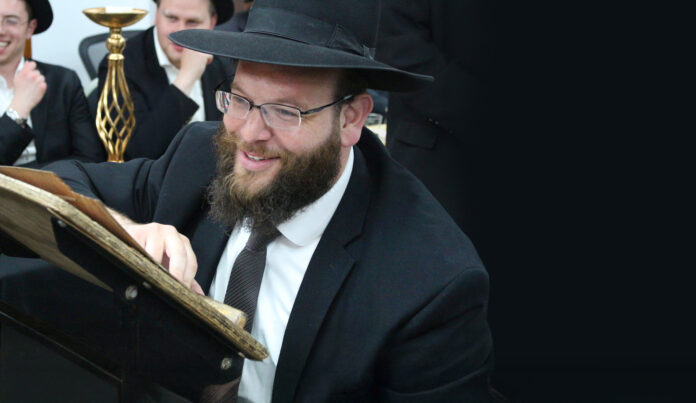 Ami Magazine6 months ago
Born and raised in Monsey, New York, Rabbi Shmuel Luger’s trajectory to becoming a rosh yeshivah is nothing short of extraordinary. From a very young age he wrestled with profound questions of emunah and struggled with alcoholism, teetering on the brink of losing connection to a life of purpose and meaning. Yet against all odds, he found the inner strength to reclaim his life. Through recovery, relentless dedication to Torah and a deep immersion in Yiddishkeit, he transformed his challenges into a source of wisdom and inspiration for others. Today, Rabbi Luger guides his talmidim through the lessons that he learned.
As a respected rosh yeshivah, I think it’s very courageous of you to share the story of your early struggles.
I spoke to my rebbe, Rav Zishe Solomon, the rosh yeshivah of Toras Simcha in Yerushalayim, about my reluctance to discuss that part of my life. He agreed that it’s hard to do. But he added that if sharing it will help others and be mechazek them, then I have to do it. That’s why I don’t want to glamorize my past or have anyone be misled by it.
On the one hand, people may say, “If he could overcome such challenges, I can overcome anything,” and I agree 100%. Aderaba, someone else could do a far better job. At the same time, I don’t want anyone to see a person go off the derech and say, “Echta v’ashuv—I will sin and then I will return.” That would go against everything I’m trying to accomplish.
Is your primary message about staying away from alcohol consumption?
Not at all. Because I’m in recovery, people often assume I’m simply anti-alcohol. I’m not. Being an alcoholic is a symptom of an inability to deal with life. While there is such a thing as chemical addiction, the deeper issue is that even if someone goes to rehab and becomes sober, he still hasn’t necessarily fixed his inability to cope. People aren’t comfortable with who they are, so they turn to things that allow them to escape.
When it comes to consuming alcohol and similar behaviors, the root problem is that we are so uncomfortable with ourselves that we can’t stand being alone. Rabbi Dr. Avraham Twerski, z”l, spoke about this often. Despite being extraordinarily successful, brilliant and arguably the most well-known psychiatrist in America, he spoke openly about how he struggled with low self-esteem. He once described being alone at a resort in Switzerland and finding that after just 20 minutes by himself, he couldn’t take it.
In my view, the struggle with self-esteem is the greatest challenge of our generation. I’ve discussed this with Rabbi Eytan Feiner—I’m a talmid of Sh’or Yoshuv and lived in Far Rockaway—as well as with other rabbanim, and they agree.
So in your estimate, the root cause of addiction is low self-esteem?
There’s an even deeper issue, which is identity. If a person doesn’t know who he is, anything you say to him can feel like an attack. That’s because he doesn’t have a foundation to deal with life. He lacks the atzmiyus of having a solid identity.
I once attended an asifas harabbanim in America with Rav Aharon Leib Shteinman. Afterward, there was a protest outside over his stance on an issue in Eretz Yisrael. At first, I thought it was a chillul Hashem, but then I asked myself: Does this bother Rav Shteinman? No. He’s one of the gedolei hador. You simply can’t offend someone like that because his sense of self is intact. When a person lacks that, external expectations can create a gap between who he truly is and who he feels he’s supposed to be.
Are you saying that the higher the level the person is on, the stronger his self-identity?
Yes. On occasion, I like to leave my phone at home and go learn in different places around Bnei Brak. One of my favorite spots is Ponovezh. When I sit down, I usually wait a few minutes to make sure I’m not in someone else’s seat, and then I look around and take it all in. Almost every bachur in the main beis midrash is dressed exactly the same: white button-down shirts with unbuttoned collars, sleeves rolled down; no one rolls them up. Their tzitzis are out but at a standard length; none are hanging down past their knees. Maybe someone is wearing glasses or a watch, but otherwise it’s very uniform. I once noticed someone wearing a rekel, and it really stood out.
There are only two or three rebbeim in the beis midrash, yet over 1,000 bachurim are sitting and learning. At one point, I found myself wondering: Do these bachurim see themselves as exactly the same or as distinct individuals?
I developed a bit of a kesher with one bachur, and I asked him that question one day. He looked at me with incomprehension. “Of course I’m me,” he said. “I have my own name. It’s not just the chitzoniyus that makes someone different. I’m myself, with my own maalos and chesronos.”
I didn’t go any deeper than that, because I didn’t want to push him or make him start questioning things, so I changed the subject. My point is that they all have strong identities that aren’t dependent on external factors.
The self-esteem problems we see stem from a Western culture that teaches us to believe that we must be different from others in external ways. The real issue begins when a person doesn’t know who he is on the inside. So he looks outward—to others and to society—and says, “This is what people value. This is what matters.” And he begins to act accordingly.
My grandmother is a Twersky, so I read all the articles in Ami about the family very carefully. In the article you ran about the late Rachmastrivka Rebbe of New York, Rav Chai Yitzchak Twersky, zt”l, it mentioned that Rav Yochanan of Rachmastrivka wanted to inherit the middah of “gornisht” from his father, Rav Mottel of Chernobyl, but one of his brothers had already gotten it first, so he took the “gor gornisht.” So yes, a person can break himself and channel these things in the right away.
That’s a high madreigah. But the average person needs to feel a sense of self-worth in a very real way.
Nowadays, there are conversations in the frum velt—more common in America than in Eretz Yisrael—about what we can call “Kiddush Club culture.” People talk about exciting things there; we might call it “Make Yiddishkeit Geshmak Again.” The world was like that when I was growing up. I believe it stems from a lack of being comfortable with oneself, creating a need for a constant matzav to keep the geshmak going.
People travel to other countries for Sukkos or rent apartments for exorbitant amounts of money and then complain that there’s too much alcohol at Simchas Beis Hasho’eivah. But the alcohol isn’t the problem.
In your opinion, the need to keep the geshmak going is the problem.
Indeed. Years ago, I was in a place where recovery meetings are held when I saw a notice about Shoplifters Anonymous. At first, I couldn’t process it, but apparently there are enough people addicted to shoplifting that they hold meetings. It’s a wild idea, but the way that alcohol, drugs, gambling and similar behaviors work is partly chemical, as they’re all the same chase for dopamine. When dopamine is released, a person feels good. And the more a person engages in dopamine-inducing activities the more the body adapts, and the less effective the same activity becomes. That’s why everything has to be bigger, more intense or more frequent.
Yiddishkeit is structured in a way that regulates dopamine in a healthy way. We have Shabbos every seven days. Special occasions—like a bris, a bar mitzvah of a chasunah—naturally give us an extra rush of dopamine. Constantly chasing highs, however, is dangerous. A person tries to recreate the initial thrill of drinking or using drugs, but it can’t be duplicated. The Kiddush might have been geshmak, but now he seeks an even better one. The more we give in to our taavos, the more the body expects and craves it.
This is how opiates and similar drugs work. A small dose never feels the same again, so people chase stronger doses, and when the body constantly pursues more dopamine, it can never be satisfied.
To read more, subscribe to Ami
 Ami Magazine6 months ago
“Claims against Israel seem to be raced to air or online without adequate checks, evidencing either carelessness or a desire always to believe the worst about Israel.”
—Michael Prescott, former political editor of the Sunday Times who served as an independent adviser to the BBC’s Internal Standards Committee, in a leaked memo that claimed that the BBC repeatedly published misinformation about Israel.
“I want to ask you a difficult question. There’ll be some people looking in, and they’ll go, look at what happened in Gaza and of course something was coming, what would you say to them?”
—BBC journalist Nick Robinson, interviewing a Jewish family in north London after the Bondi Beach terrorist attack and suggesting that attacks on Jews around the world were to be expected because of Gaza.
If anti-Jewish reports in mainstream media were a toxic flood before October 7, afterward they became a virulent tsunami. Much of that was anti-Israel lies that teetered well over the boundary between inaccurate reporting and into anti-Jewish propaganda. But there were also plenty of articles putting Jews around the world in a harsh light, blaming them for attacks carried out against them or using token “as a Jews” to cast the rest of the Jewish community as evil.
Is there any end in sight?
Buying the media and changing it
One major change that happened this past year was the acquisition of the media company Paramount Global by David Ellison, backed by his father, Oracle CEO Larry Ellison. The Ellisons, a pro-Israel Jewish family, immediately made changes at CBS, a Paramount subsidiary. Most importantly, they put Bari Weiss, the editor-in-chief of the centrist and pro-Israel Free Press, in charge of the news division at CBS, one of the three major non-cable TV news channels in the US.
That has already led to controversy. Weiss delayed the airing of a 60 Minutes investigative report about the Trump administration’s use of the CECOT prison in El Salvador to hold deportees. The 60 Minutes show is the flagship news program at CBS, and insiders accused Weiss of both being a shill for the Trump administration (the Ellisons have a close relationship with Trump) and being incompetent in the field of journalism.
The outcome of that kerfuffle may show whether Weiss will be able to permanently change the tenor and focus of a major news channel in the US.
(One concerning issue that has come up, however, is the suggestion that the Ellisons might bring Saudi and Qatari government investment funds into their proposed acquisition of Warner Discovery, which might give the Saudis and Qataris sway over CNN.)
Another major change may have been the way that light has been shed on nasty practices at the BBC. As Ami has previously reported, a leaked memorandum from Michael Prescott, who had been serving as part of an internal standards review at the BBC, showed that there were numerous failures of reporting—seemingly to the point of clear bias—on a number of issues. One of those focused on by Prescott was Israel, with him pointing out that the BBC had slanted its coverage against Israel in many ways, especially in its Arab-language service.
While the usual suspects complained about the memo, British members of Parliament called for changes. If anything comes of that, it may change the way one of the most prominent and widespread news outlets does its reporting.
Social media, in any case
One question about the few possible changes to media outlets is whether it matters anymore. Young people aren’t getting their news directly from these outlets one way or the other. Instead, they’re turning to the even worse world of social media.
According to a poll by Inside Higher Ed and Generation Lab taken at the end of 2024, three out of four US college students at 181 institutions said that social media is their main source of news. About half of the students said that their second-most used source of news was word of mouth. Only one out of five students said that they regularly turned to newspapers, whether digital or print, for news.
And this wasn’t because students thought that newspapers were less reliable. In fact, they mostly believed that they were more reliable than what they were seeing on social media or from influencers. That didn’t matter.
And even when they want to check up more about a story, they are more likely to end up reading about it in an AI-generated response from Google than in a primary news source.
To read more, subscribe to Ami
 Ami Magazine6 months ago
Among the pages of the Republican tax bill passed into law in July is something called a Trump Account, a way to invest for children. The IRS has issued its guidance about Trump Accounts, and we now know the details of these accounts and how they will be taxed.
One exciting aspect of the Trump Accounts is that they will consist of free money (with some caveats) for many American families. The government will put $1,000 into an account for each child born between January 1, 2025, and December 31, 2028, who is an American citizen with a Social Security number.
In addition, a number of billionaires have pledged to put varying amounts of money into these accounts for specific groups of children. This means some children will have more money in their investment accounts than the base $1,000.
Free money is definitely good, and experts have uniformly said that signing up newborns (and perhaps older children) for a Trump Account is a good idea. But when it comes to making investment portfolios for your children and putting in more money for them, there are some disadvantages to Trump Accounts, and it is worthwhile to know what they are.
This article is for informational purposes; a tax expert should be consulted before deciding on investments.
Investment in what?
The money in Trump Accounts must be invested in index funds in American equities and not in sector-specific indexes. In other words, the money will go into either mutual funds or exchange-traded funds that track something like the S&P 500 or a similarly broad stock index.
The money cannot be invested in index funds of foreign stocks or in bonds.
How to sign up
The $1,000 and any other money won’t automatically be put into accounts for children. Instead, you need to sign up for an account for your child by filing an IRS Form 4547. The forms aren’t ready yet, but the government says they should be available in 2026, and at that time, it should be possible to enroll online.
Free money?
One of the biggest draws of these accounts is that the government and some billionaires will be putting money into them.
First is the government, which will be putting in $1,000 for children born between January 1, 2025, and at least the end of 2028. (It would require further legislation to extend the opportunity to children born afterward.)
Even children who were born before January 1, 2025, and are no older than ten will have $250 deposited in their Trump Accounts through a donation from tech billionaire Michael Dell.
Furthermore, kids in Connecticut who are less than ten years old and live in the poorest ZIP codes will get an additional $250 in their accounts through a donation from mega-investor Ray Dalio.
The Trump administration has thrown down a challenge for other billionaires to make similar donations.
(Those who are on a government assistance plan that has an asset limit do not need to worry, according to the latest guidance. The free money placed in the accounts by the government and others does not count toward those assets. However, when the money is withdrawn, it will count as income for the owner of the account—the child, who by then will be an adult.)
Beyond the money given by the government and billionaires, parents and others can put up to $5,000 in an account each year before the child turns 18.
To read more, subscribe to Ami
 Ami Magazine6 months ago
Much attention was paid, for good reason, to the recent sold-out convention of Turning Point USA, the group The New York Times describes as the nation’s “preeminent conservative youth organization.”
The attention-paying was due to more than the fact that TPUSA, which was founded by the late Charlie Kirk, has become a major player on the American political field. The main attraction was the deep fissure that emerged at the MAGA-minded gathering. Some called it a “civil war,” one whose victors will determine the future orientation of the growing conservative movement in American politics.
On one side of the divide was commentator Ben Shapiro, who, in his speech, minced no words condemning the grand poobah of the other side, popular podcaster Tucker Carlson, for having hosted and coddled the repulsive misogynist and anti-Semite Nick Fuentes on his program.
Mr. Shapiro said that hosts are “responsible for the guests they choose.” He characterized Mr. Fuentes as “an evil troll,” and Mr. Carlson’s friendly interview of him “an act of moral imbecility.”
“If you host a Hitler apologist, Nazi-loving, anti-American piece of refuse like Nick Fuentes,” he said, “you ought to own it.”
Mr. Shapiro also denounced rabid anti-Semitic conspiracy theorist Candace Owens, media personality Megyn Kelly and pundit Steve Bannon, whom he called “frauds and grifters.”
“The conservative movement is in serious danger,” he asserted, “from charlatans who claim to speak in the name of principle but actually traffic in conspiracism and dishonesty.”
Mr. Carlson, in his speech, dismissed Mr. Shapiro’s attempt to “deplatform and denounce” people, and called him “pompous.”
The following day, Ms. Kelly, noting the internecine feud, declared the end of her friendship with Ben Shapiro and criticized another traditional conservative, CBS News editor-in-chief Bari Weiss. And went on to play the Israel card.
“It’s about Israel,” she said. “Those two are very…ardent Israel activists, which is fine, but they don’t get to dictate how the rest of us feel about Israel or what we do with respect to our friends and our friends’ opinions on Israel.”
She called Mr. Shapiro’s insistence that the conservative movement sever ties with people like Carlson and Owens “a betrayal.”
Particularly disturbing to me, though, was the closing convention speech delivered by Vice President JD Vance, who, in a thinly-veiled swipe at Mr. Shapiro, condemned what he called conservative “purity tests.”
“I didn’t bring a list of conservatives,” he said, “to denounce or to deplatform.”
In addition to his subtle defense of Mr. Carlson and, by association, Mr. Fuentes, the vice president also declared that “Christianity is America’s creed.”
He stressed that he was “not saying you have to be a Christian to be an American,” but was just noting how, “If you go to almost any food pantry in this country, you will find Christians feeding the poor…you’ll find Christians sitting patiently beside hospice beds and in recovery rooms and in all the places of the world where people have given up on other people.”
He seemed oddly oblivious to non-Christians dedicated to chesed.
Israel was on the vice president’s mind as well. In a subsequent interview in the British medium UnHerd, Mr. Vance said that the fear of Fuentes and his ilk are “overstated by people who want to avoid having a foreign-policy conversation about America’s relationship with Israel.” He further claimed that concerns about anti-Semitic voices are raised as a way to avoid discussing “a real backlash to a consensus view in American foreign policy” regarding Israel.
Mr. Vance has called Israel an “important ally.” But his words, to my ears, reflect a purely transactional embrace of the country. Israel provides intelligence and promotes regional security, and, in exchange, earns American aid and cooperation.
The opposite of a transactional relationship is a “relational” one, where the parties value each other for reasons beyond mutual benefits.
Joe Biden, whatever one may think of his presidency or policies, and despite his disagreements with Israel’s current government, had a relational connection to Israel. He regularly called himself a Zionist.
“Biden’s connection to Israel,” former Middle East negotiator Aaron David Miller once said, “is deeply ingrained in his political DNA.”
I don’t quite get that feeling from Mr. Vance.
To read more, subscribe to Ami
 Ami Magazine6 months ago
Dear Ima,
I don’t know how to do this. I sit here beside you, watching you struggle for breath, fighting for life, and I am filled with so many regrets. The ICU is loud and quiet at the same time. I hear machines hum, alarms beep, the hiss of the ventilator pushing air into your lungs, and the nurses at their station chatting. But you are quiet. Too quiet.
Are you in pain? Oh, how I wish you could let me know what hurts.
So many numbers on the screens. The ones that should be high are low. The ones that should be low are high. They give medication to bring up your blood pressure, and it shoots too high. They lower the dose, and it drops again. Back and forth, up and down.
The doctors gently tell me, “Your mother is very sick. We are doing everything we can for her.” I nod, fighting back tears. What else is there to do?
As I sit here watching you, Ima, I keep drifting back to better times, before dementia changed everything. Before the silence. Before I lost the version of you who could ask me how I was doing, how the kinderlach were. You always knew when I was struggling, even when I tried to hide it. Your love didn’t need words. I felt it.
Things were not always easy for you, but you didn’t let that stop you. I remember you sitting in your chair near the front window and saying Tehillim. That worn Tehillim, the pages soaked with your tears, soft from years of holding. I know you had so much to daven for. Abba. Each of your children. Our struggles, our shidduchim, our health, our parnasah.
Now it’s my Tehillim that is getting soaked. Now I’m the one turning those pages, finding comfort in the same words that comforted you. There’s something about saying Tehillim; the words carry you when you don’t have words of your own. They hold your pain and give it somewhere to go. I understand now, Ima. I understand so many things now that I wish I had understood then.
When I got engaged, you took me from store to store, preparing me for my new life. You didn’t sit me down and give long speeches about marriage. That wasn’t your way. But you showed me by example how to be a devoted wife and caring mother.
Coming home to you after the birth of my first baby, you taught me how to care for him, how to swaddle him, bathe him and soothe him when he wouldn’t stop crying. When I had my first postpartum meltdown, you took the baby from my hands and told me to take a nap.
Now I’m the one tending to you. Now I’m the one sitting by your bedside. The roles have reversed, but they can never truly be equal. You spent years taking care of me. Feeding me, clothing me, worrying about me, davening for me. You gave me everything I needed without ever asking for anything in return. Now it’s my turn to take care of you, but I can never repay what you gave me. Not even close.
I feel so helpless sitting here watching you suffer. All I want is to take away your pain. To make you comfortable. To fix this. And I can’t. I can’t do anything except hold your hand and daven, and wonder if I’m doing enough. If I’ve ever done enough.
This is the part that breaks me, Ima. The regret.
I should have visited more, called more, asked more questions while you could still answer. I should have sat with you longer and held your hand while you could still squeeze back.
I know all the things I should have done. I knew them then, too.
I knew. And still, I said, “Tomorrow.”
Tomorrow I’ll visit. Tomorrow I’ll call. Tomorrow I’ll sit with you and really be present, not rushing, not distracted, not already thinking about what I have to do next.
But tomorrow became next week, next week became next month, the months became years. And here I am, sitting in the ICU, regretting all the tomorrows.
Thinking about everything I should have done differently, I know that I was doing the best I could. I was raising children, working and managing a life with a thousand demands pulling at me from every direction. I was tired. I was overwhelmed. I was human.
And yet, the excuses feel hollow now. Because the truth is that we make time for what we prioritize. And I should have prioritized you more. I should have put you higher on the list. I should have known that the list itself would one day feel meaningless, but you never would.
Now I am crying for all the precious time I wasted.
I cry for the conversations we’ll never have, the questions you’ll never answer, the things I will never know about you. What did you daven for all those years, sitting with your Tehillim? What would you tell me now if you could speak?
I cry for all the times I was impatient with you. The times I rushed our phone calls. The times I visited but wasn’t really there, physically present but mentally already out the door.
I cry because I understand you so much better now that I’m a mother myself. Now I’ve lived enough to know how hard you worked and how much you sacrificed, but by the time I understood this, you couldn’t hear me say it.
That is my pain, Ima.
A daughter’s pain.
A daughter’s guilt.
A daughter’s regret.
* * *
I know I’m not alone in this. I know that right now, in hospitals and nursing homes and living rooms around the world, other daughters and sons are sitting with this same weight. The weight of “I should have.” The weight of “why didn’t I?” The weight of realizing that time is not a renewable resource, and we spent it on things that don’t matter.
We think we have forever, but we don’t. We think there will always be another chance, but there won’t. We think that love is enough, that they know how much we care, even if we don’t show it as often as we should.
Maybe she knew, but that doesn’t ease the unbearable weight of not showing it more.
Regret is the price we pay for being human.
It teaches us to stop saying “tomorrow.” That the people we love won’t always be here, and neither will we. It teaches us that the dishes can wait, the emails can wait, the to-do list can wait, but the people we love can’t.
It teaches us to forgive ourselves. Beating ourselves up for not doing more doesn’t honor anyone. It just adds more pain to a world that already has enough.
* * *
I hope that you can forgive me, Ima. Forgive me for not visiting more. Forgive me for not giving you the kavod you deserve. Forgive me for all the tomorrows I wasted.
I can’t go back, but I can go forward differently.
Maybe the message I’m supposed to learn, listening to the machines breathe for you, is that it’s never too late. Until it is.
Al kol neshimah u’neshimah tehallel Kah. For every breath, we praise Hashem.
Sitting here beside you, I thank Hashem for every breath. Yours and mine.
I can’t undo all the wasted moments, Ima, but I can be here for this moment.
I’m here now, Ima. I’m here.
Miriam
Please daven for a refuah shleimah for Toba bas Sara Rivka
To read more, subscribe to Ami
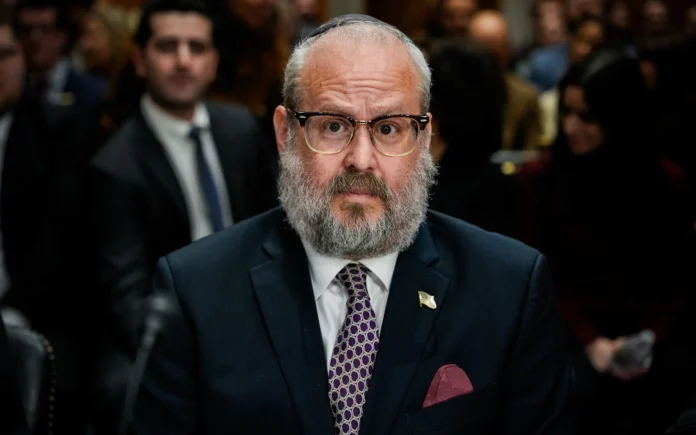 Ami Magazine6 months ago
Born in Kfar Chabad, Israel, into a Lubavitcher family, Rabbi Yehuda Kaploun was raised with deep roots in Jewish communal life. His parents served as shluchim of the Lubavitcher Rebbe.
The family later moved to New Haven, Connecticut, where his father worked as a rabbi and educator. Kaploun’s heritage reflects a long history of Jewish leadership; his father’s maternal grandfather, Rabbi Moshe Zalman Feiglin, helped establish Yiddishkeit in Australia and was referred by the Lubavitcher Rebbe as the Avraham Avinu of Australia. His maternal grandfather, Rav Moshe Yitzchak Hecht was one of the first shluchim in America and served as a rav and mechanech in the New Haven area for decades.
Rabbi Kaploun has pursued a career spanning business, philanthropy and community service. He is the cofounder and president of RussKap Water, a company focused on atmospheric water generation technology, and he previously served as a senior partner at a consulting firm advising on government relations and publicprivate partnerships. He has also been active in disaster relief and charitable efforts, including volunteer work after 9/11 and during major hurricanes, and he cofounded the Moses and Aaron Foundation with the late Elie Wiesel to support children with special needs and their families.
Kaploun also has a longstanding relationship with President Donald Trump, dating back to their time in New York, and he played a prominent role in Jewish outreach during the 2024 campaign. In 2025, President Trump nominated him to serve as the Special Envoy and Ambassador at Large to Combat Global Antisemitism. He received his Senate confirmation on December 18, 2025, by a 53–43 vote.
I spoke with Rabbi Kaploun this past Sunday.
Congratulations on your confirmation. It should be with a lot of hatzlachah.
Amein.
What do you see as your primary mission in this role? How do you plan to combat anti-Semitism?
In practical terms, there are three or four ways to do it. One is through education. Unfortunately, the educational system in this country and around the world lends itself to promoting hatred of Jews, with a lot of inaccuracies and things that are untrue. Therefore, we have to confront the untruths. That’s a very important part of confronting anti-Semitism. When The New York Times writes an article and has a misleading picture about a famine in Gaza, and 50 million people see it but their apology is seen by only 100,000 people, it means that 49.9 million people are getting the wrong information. There has to be a more concerted effort in confronting the inaccuracies that help spread the hatred.
Number two, some governments have policies that definitely lend themselves to not protecting their Jewish communities. The protection of American Jews and the Jewish community around the globe is my priority. That is what the job entails, and it includes dealing with governments, such as how to get Australia to ratchet up what they’re doing, which is something the American government had been requesting for a long time; they were ignoring the rising anti-Semitism. Unfortunately, we are seeing the results now. So I would say that protecting, educating and confronting are probably our three top goals.
Many people assume that this is mainly a domestic position, but your remarks highlight its international nature.
The position is formally titled Special Envoy and Ambassador-at-Large to Combat Global Antisemitism, and my intent is to honor that responsibility.
I know that you have roots in Australia.
Correct. My great-grandfather founded the Jewish community in a place called Shepparton, and he was considered to be the Avraham Avinu of Australia. My father was born in the Australian outback, and he went to school in Melbourne as a young child.
So you also have a personal connection to what happened in Australia.
Yes, but that doesn’t change the goals. It does, however, add an impetus and allows me to explain to the officials that I have a personal involvement. But of course, every Jew is someone I have to protect, regardless of affiliation. Kol Yisrael areivim zeh lazeh.
Do you believe that the problems faced by the Australian Jewish community are the result of governmental decisions, or from the downstream effects of immigration policies from the Middle East?
The American president and secretary of state have made it very clear that countries that tolerate terroristic behavior and call for things that are not in accordance with US policy are not helping to decrease hate. In fact, they embolden terrorists. Part of the problem was that the Australian government didn’t listen to the US when they asked them not to recognize a Palestinian state and to condemn Hamas in the strongest terms. They also ignored the recommendations of their own special envoy to combat anti-Semitism up until last week.
I’m receiving more and more information every day, but there’s no question that an unwillingness to confront the anti-Semitic rhetoric or the people who were on Australia’s own watchlist and ended up having guns anyway played a role. How does that happen? The question is how much responsibility the government bears for its inaction. There is obviously some culpability there.
You noted that the president and secretary of state have spoken out on these matters. Could you clarify your role in this initiative?
My function is to represent the administration in areas that involve anti-Semitism and expanding the IHRA definition of it, which lays out very specific roles for governments. It’s a non-binding agreement, but we would still like to see more countries join. I report directly to the secretary of state and will work with ambassadors and governments all over the world.
During your nomination, some people, including Jerry Nadler, expressed concern that the role is meant to be apolitical and you might be too partisan. How would you respond?
Allow me to address two things. During the process, I invited every member of Congress to meet with me to voice any concerns they had. I said during my Senate hearing that anti-Semitism is a bipartisan problem. For people who have an agenda against the president, it wouldn’t make a difference who was nominated. This is the same individual who commended the work I did with Elie Wiesel for children with special needs; in fact, I believe he authored eight or ten proclamations in Congress saluting it. So this is a purely political agenda, and when you have staffers who work for J Street and other anti-Orthodox groups and anti-Israel Jewish groups, you’re going to have that kind of person coming out against you.
The interesting thing is that many Democrats, including Josh Gottheimer and Dan Goldman, met with me and were thrilled by my nomination.
As a member of the chareidi community, in what ways do you anticipate that your Yiddishkeit will inform your approach?
Having grown up and experienced walking in the street and being called dirty Jew, having witnessed the Crown Heights riots, having a sister who passed away from cancers that were caused by 9/11, and having a cousin who was killed on October 7, I bring a different sense of purpose to what the role is all about.
My grandfather, Rav Moshe Yitzchak Hecht, was one of the Rebbe’s first shluchim, and my other grandfather, Reb Aharon Kaploun, was an ish chesed in Yerushalayim and Australia who did acts of kindness that are legendary. I learned from both of them that there are different ways to serve the community. There are times when things are better done quietly, and there are times when things must be done very publicly.
The Lubavitcher Rebbe explained to me and my parents when I had the experience of a yechidus for my bar mitzvah that we have the responsibility to light up the homes of other families. These are things that you take with you every day.
The responsibility of combating global anti-Semitism is a very awesome and daunting one. It’s not something I take lightly. But I take courage in the fact that because of how I was educated and my association with present-day gedolim, I have the ability to lean on giants to assist me in finding the right way to deal with each case. What works in one case doesn’t necessarily work in the other.
Baruch Hashem, many ambassadors have reached out to me over the last four or five months to work with me from their countries. They were all waiting for my confirmation to start the process. I believe that we are in a very strong position to hit the ground running and have an immediate impact. I would also like to thank US ambassadors like Mike Huckabee and Bill White, as well as the staff at the State Department and the assistant secretary for religious liberty.
You asked earlier about my responsibilities. Well, one of the points in the Gaza agreement is to engage in dialogue about how to reduce hatred. That’s something that’s extremely important. So is working with the UN so the Arab textbooks will stop praising martyrdom and children will no longer be taught to hate. As the president just reiterated the other day, American aid must be used to promote American interests around the world rather than hatred.
To read more, subscribe to Ami
 Ami Magazine6 months ago
The words “Free Palestine” were followed by fire—an attack with three Molotov cocktails.
The attack in June on a group of Jews marching in Boulder, Colorado, for the Israeli hostages left one older Jewish woman dead and several other marchers injured. When the police investigated Mohamed Sabry Soliman, who carried out the attack, they found that he had been influenced online by the teachings of the Muslim Brotherhood.
That determination spurred Senator Ted Cruz (R-TX) to reintroduce legislation to brand the Muslim Brotherhood a foreign terrorist organization, legislation that had been in the works on and off since 2014. That legislation is still making its way through Congress.
But in late November, President Trump also took action. He issued an executive order setting in motion a process by which the executive branch would make a determination about branches of the Muslim Brotherhood and decide whether they were terrorist organizations.
The executive order specifically mentions the Brotherhood chapters in Egypt, Lebanon and Jordan as ones that have called for violence, though it does not immediately designate them terrorist groups.
Trump’s order left some of his supporters unhappy, because it fails to simply say that the Muslim Brotherhood is a terrorist organization.
In contrast, Governor Greg Abbott of Texas and Governor Ron DeSantis of Florida went ahead and issued rules designating the Muslim Brotherhood and the Council on American-Islamic Relations (CAIR)—an American organization that has been tied to the Brotherhood—as foreign terrorist organizations. CAIR is suing both states in court.
Around the world, only one Western country, Austria, has designated the Muslim Brotherhood a terrorist organization. The other countries that have done so are all Arab or Muslim countries, which generally have lower thresholds and standards of evidence to make such declarations.
What the divide between the White House and Texas and Florida hints at is that dealing with the Muslim Brotherhood is a bit more complicated than dealing with other international Islamist organizations. The groups affiliated with the Brotherhood extend to clearly recognized terrorist groups like Hamas, but they also include a political party that was a coalition partner in Israel’s government. That leaves the US government with a dilemma.
A Brotherhood Around the World
The Muslim Brotherhood dates back to 1928, when it was founded by a schoolteacher and imam named Hassan al-Banna. In the aftermath of Ottoman rule, Egypt was under the influence of the British, though there was an independent Egyptian government, which demanded that the country be secularized.
Al-Banna was of the opinion that Islam should be the bedrock and basis of all of society’s institutions, not merely a religion in a secularized country, and he created the Muslim Brotherhood to promote that “from below,” meaning as a grassroots organization that would overwhelm society. The organization established hundreds of social institutions, like schools, mosques and health clinics, throughout Egypt.
But Al-Banna also espoused violence as a proper way of spreading Muslim doctrine, and a military wing of the organization began carrying out attacks, including political assassinations, in Egypt during the 1940s. The organization also sent volunteers to attack Israel in 1948.
The Muslim Brotherhood was outlawed in Egypt in 1948 because the government felt that it was a threat, possibly a violent one, to its rule. Al-Banna was killed on the street in 1949, and his followers claimed that it was an assassination by the government.
The Brotherhood would continue to be oppressed in Egypt after the 1952 revolution that brought Gamal Abdel Nasser to power. Nasser was nearly assassinated in 1954 by what was suspected to be a Brotherhood plot, and that led to many of the Brotherhood leaders being imprisoned or executed.
One who would go on to have outsized influence was Sayyid Qutb, whose writings in prison would influence Sunni radicals and terrorist groups, such as Al Qaeda and ISIS. Qutb was eventually executed in 1966, but his writings lived on.
While that kind of extreme radicalism was an offshoot of the Brotherhood, the general mass of the Brotherhood took a different route during the 1980s, founding political opposition groups in many countries that often ran in elections, including in Syria and Jordan.
There were still openly violent groups that were part of the Muslim Brotherhood, such as Hamas, which was officially recognized as the Palestinian branch of the Muslim Brotherhood. But in many places, the Brotherhood took on an air of respectability. Most notably, Mohamed Morsi, whose party was affiliated with the Brotherhood, became the president of Egypt from 2012 through 2013. The “growth from the bottom” idea of Al-Banna had achieved success—at least for a little time.
Morsi was quickly ousted by the current regime, and the Brotherhood was oppressed once more. But they had shown that the strategy worked.
To read more, subscribe to Ami
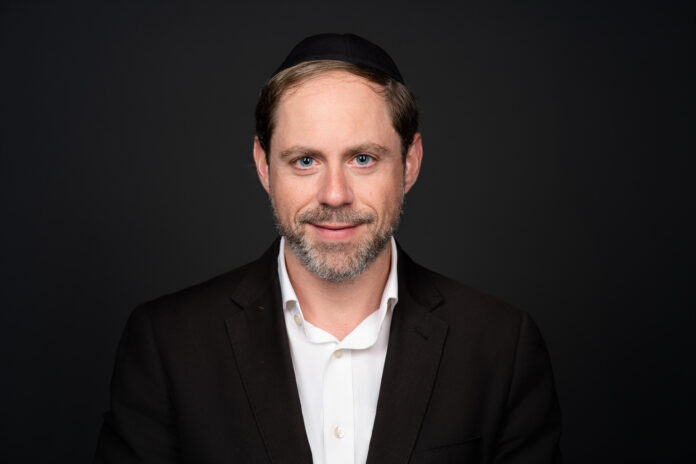 Ami Magazine6 months ago
In all likelihood, you either own a Tesla or your kids have asked you to get one. Around 10% of people in the US own an electric car, with that number expected to grow every year. And electric cars need charging. Enter Munish Klein, co-founder of KWEV, a company that installs charging stations for electric cars in multi-family and commercial properties across the US.
Electric cars are a fun topic, and Munish is a fun person to talk to. An entrepreneur who had his own company until his partners wanted to sell, he has many years of experience in the energy-saving industry. After COVID, he pivoted his current company to focus on the ever-expanding industry of charging electric cars, with KWEV being his latest venture.
We spoke about energy, infrastructure and EV charging, how to build partnerships that last, and why emunah and patience matter as much as execution.
Enjoy!
—Nesanel
I was born in Montreal, Canada. I am 42 years old and the youngest of five children. My father was born right after the war in Kerestir, or, as his passport calls it, Bodrogkeresztúr. My father’s parents were both from Kerestir as well. One of his grandfathers was the rosh hakahal, and the other was the town’s shochet and dayan. In 1956, his family immigrated to Canada.
“My mother was born in Czechoslovakia. Both of her parents were survivors. My grandmother, whose maiden name was Mendelowitz, was a teenager during the war and her brother was a baby, not even a year old. Her father was very wealthy. One Friday, Nazis ransacked the house, and for some reason, they threw a big blanket over the baby’s crib. My grandmother stayed away all of Shabbos, and when she came back later, she found her baby brother still in the crib. She kept him with her throughout the war. Their father hid all his children with non-Jews, and they all survived. After the war, they all reunited.
“I went to the Skvere cheder. For high school, I went to the Mesivta of Lakewood. My cousin had gone there two years earlier and had a good experience, so my parents felt it would be a good fit for me as well. After Mesivta of Lakewood, I went to Vyelipol (Frankel’s Yeshiva) in Flatbush for about two years. That was 12th grade and my first year of beis midrash. After that I learned in Darchei Torah in Far Rockaway. The current rosh yeshivah of Darchei Torah, Rav Shlomo Avigdor Altusky, had been our next-door neighbor in Montreal.
“My grandfather started a shul called Bais Moshe in his basement. He also ran a kind of soup kitchen there, and every Erev Shabbos he would distribute free food to Holocaust survivors. Huge lines of people would form there every week. My grandmother once asked him, ‘You’re giving out all this food. Where’s the money? Where do you write it down?’ He answered, ‘It’s being written down up above.’
“My father was a caterer, primarily for weddings. He was a pioneer of off-premise catering. His food was so good that other caterers, like Michael Schick, used to call him for his recipes. But he was very modest; he never attributed his success to his own talents. He always said, ‘M’leigt es arein in oiven, in m’nemt es fun oiven, s’iz allehs fun oiven—you put it in the oven, you take it out of the oven, but it all comes from above.’
“My mother ran the bakery side of the catering. She baked fresh, heimishe cakes for every wedding, and people really liked them.
“I was always entrepreneurial. Growing up, I helped my father in his business during the summers, when there wasn’t much going on. When I was 12 years old, I was already selling cell phones. I had a family friend who was a dealer for AT&T, and they were giving out licenses, so I latched onto him. It’s not like I opened a storefront on 13th Avenue; eBay was still in its infancy, so I made myself an eBay account. This was about 30 years ago, and cell phones were a different world. I had a StarTAC. The next model, the Vader, was half the size of the StarTAC, but it never really took off. I still have both the StarTAC and the Vader stored away in a special box in my house.
“I also pioneered schnitzel sandwiches at Mesivta of Lakewood and started doing cholent on Thursday nights. It was more for fun and the challenge than for money; my parents always gave us whatever we needed. I don’t think I even tracked how much money I made; it was more for the thrill.
“I got married while still in Darchei, before I turned 20. I think I broke the record there as the youngest to get engaged. I may still hold it; I should call Guinness World Records to see if it counts.
“I learned in Darchei’s kollel for about a year after getting married. I was living in Borough Park and commuting. After we had a baby, the commute became harder, so I moved to the Mir in Flatbush. Rabbi Binyamin Eisenberger used to sit in the back row and handle shidduchim. After about two years in kollel, I went to work.
“My first real job was with a mobile billboard company. We were innovators in the truck-side advertising industry. We turned standard white box trucks into moving assets, selling the ad space and wrapping them with brand advertising. We built a national network, signing contracts with trucking companies across all 50 states. We would ask companies, ‘Why pay $10,000 for one stationary billboard on the BQE when for the same price you can have 100 trucks all over the city?’ It worked. We had defined routes, and with the tracking system we installed, we could show our clients exactly where the trucks were traveling on a daily and weekly basis.
“I did that for about two years, until 2005. The owners decided to stay in marketing but pivot into what was then the emerging digital marketing. Not digital ad space like on the Internet but installing plasma screens in entertainment spaces, like restaurants. You still see versions of them today. We contracted with these spaces in New York City, placed private-network screens in their locations, and ran ads for well-known companies like Bacardi and Coors. We were targeting major brands.
“It was a phenomenal experience—until 2008, when the market crashed and all the big companies pulled back on their marketing. For example, at their peak, General Motors was spending about $650 million a year on advertising, but that was cut down to roughly $100 million. As a result, all the newer players, including us, were basically pushed out of the business.
“After that venture folded, I moved into the solar and energy space. I had a brother-in-law in the solar business, so I started brokering for him. I was also brokering electric contracts. Large energy users go out annually and buy blocks of electricity rather than relying on fluctuating utility prices, and I was involved in that process. One thing led to another, and I became more involved in energy efficiency overall, analyzing buildings to see where consumption could be reduced.
“Around 2012–2013, lighting became a major focus in the energy industry, specifically, economical lighting. Buildings were transitioning from magnetic fluorescent fixtures, the T8 bulbs, the four- and eight-foot lamps, to more efficient lighting. There was a tremendous amount of activity in the business at that point, and that’s when I got heavily involved.
“I started my own venture, Advanced Energy Resources, which was primarily a consulting shop. We partnered with utility companies to process incentives and rebates for end users, meaning their clients. I later spun off a separate division called AER Lighting, which focused solely on installations. At our peak, around 2016, we had 20–30 technicians retrofitting lighting systems in well over a 1,000 buildings across the five boroughs, including multifamily and commercial properties. We were running a large operation with a monthly payroll of about $100,000.
“Then, when I was 32, I hit a crossroad. I had two partners in that business, and they wanted an exit. They had lost patience and believed this was a big opportunity, so we sold the entire company in exchange for shares in a public entity, ‘The Power Company.’ They completed a reverse merger into a shell and then spent several years restructuring many of the companies they had acquired. That process is still ongoing. They’ve continued to develop, but the shares haven’t appreciated in a meaningful way yet. Today, my shares are probably worth only a few thousand dollars.
“Siyata dishmaya always comes around; you simply have to keep your eyes open to see it. Since I hadn’t signed a non-compete, I was back in the office the next day, managing transactions on my own but taking it slowly. About a year later, two former employees of mine, David Lax and Charles (Luzee) Stengel, reached out and invited me to join them in their new lighting business, Solo Electric. It’s been ten years and we’re still operating.
“Unlike my previous massive, high-payroll operation, Solo Electric is more of a boutique firm. We’re licensed electrical contractors in both New York and New Jersey, employing technicians and project managers in the field and office. We handle everything from complex service upgrades to the installation of high-end lighting controls, incorporating occupancy and motion sensors and daylight harvesting, primarily for commercial properties throughout the tri-state area.
“We also oversee comprehensive energy compliance. As the city kept introducing increased energy regulations, companies needed a lot of auditing. For example, the city passed Local Law 84, requiring annual benchmarking for every building. Property owners have to collect all their energy usage, electric, gas and oil, document it, and submit it to the city. Then New York City introduced Local Law 88, which requires property owners to benchmark and complete lighting assessments through a very specific portal. Shortly after that they enacted Local Law 87, affecting retro-commissioning, which includes boiler tune-ups, boiler upgrades, insulation, piping insulation and related work.
“We essentially became partners with property owners, bringing in engineers and site surveyors to assess buildings and prepare these reports every year. Once we completed the full assessment, we would handle certain components ourselves and subcontract the rest.
To read more, subscribe to Ami
