
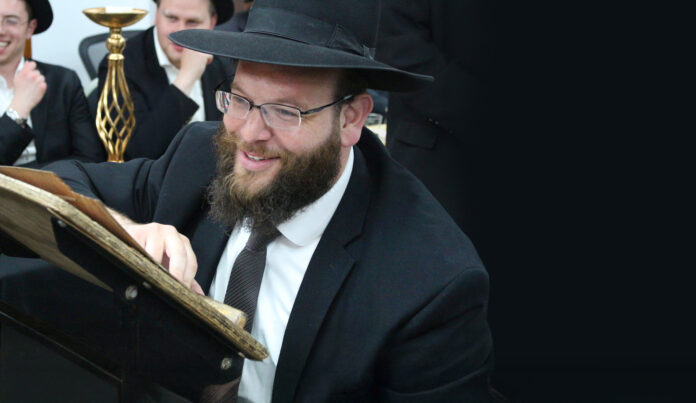

Born and raised in Monsey, New York, Rabbi Shmuel Luger’s trajectory to becoming a rosh yeshivah is nothing short of extraordinary. From a very young age he wrestled with profound questions of emunah and struggled with alcoholism, teetering on the brink of losing connection to a life of purpose and meaning. Yet against all odds, he found the inner strength to reclaim his life. Through recovery, relentless dedication to Torah and a deep immersion in Yiddishkeit, he transformed his challenges into a source of wisdom and inspiration for others. Today, Rabbi Luger guides his talmidim through the lessons that he learned.
As a respected rosh yeshivah, I think it’s very courageous of you to share the story of your early struggles.
I spoke to my rebbe, Rav Zishe Solomon, the rosh yeshivah of Toras Simcha in Yerushalayim, about my reluctance to discuss that part of my life. He agreed that it’s hard to do. But he added that if sharing it will help others and be mechazek them, then I have to do it. That’s why I don’t want to glamorize my past or have anyone be misled by it.
On the one hand, people may say, “If he could overcome such challenges, I can overcome anything,” and I agree 100%. Aderaba, someone else could do a far better job. At the same time, I don’t want anyone to see a person go off the derech and say, “Echta v’ashuv—I will sin and then I will return.” That would go against everything I’m trying to accomplish.
Is your primary message about staying away from alcohol consumption?
Not at all. Because I’m in recovery, people often assume I’m simply anti-alcohol. I’m not. Being an alcoholic is a symptom of an inability to deal with life. While there is such a thing as chemical addiction, the deeper issue is that even if someone goes to rehab and becomes sober, he still hasn’t necessarily fixed his inability to cope. People aren’t comfortable with who they are, so they turn to things that allow them to escape.
When it comes to consuming alcohol and similar behaviors, the root problem is that we are so uncomfortable with ourselves that we can’t stand being alone. Rabbi Dr. Avraham Twerski, z”l, spoke about this often. Despite being extraordinarily successful, brilliant and arguably the most well-known psychiatrist in America, he spoke openly about how he struggled with low self-esteem. He once described being alone at a resort in Switzerland and finding that after just 20 minutes by himself, he couldn’t take it.
In my view, the struggle with self-esteem is the greatest challenge of our generation. I’ve discussed this with Rabbi Eytan Feiner—I’m a talmid of Sh’or Yoshuv and lived in Far Rockaway—as well as with other rabbanim, and they agree.
So in your estimate, the root cause of addiction is low self-esteem?
There’s an even deeper issue, which is identity. If a person doesn’t know who he is, anything you say to him can feel like an attack. That’s because he doesn’t have a foundation to deal with life. He lacks the atzmiyus of having a solid identity.
I once attended an asifas harabbanim in America with Rav Aharon Leib Shteinman. Afterward, there was a protest outside over his stance on an issue in Eretz Yisrael. At first, I thought it was a chillul Hashem, but then I asked myself: Does this bother Rav Shteinman? No. He’s one of the gedolei hador. You simply can’t offend someone like that because his sense of self is intact. When a person lacks that, external expectations can create a gap between who he truly is and who he feels he’s supposed to be.
Are you saying that the higher the level the person is on, the stronger his self-identity?
Yes. On occasion, I like to leave my phone at home and go learn in different places around Bnei Brak. One of my favorite spots is Ponovezh. When I sit down, I usually wait a few minutes to make sure I’m not in someone else’s seat, and then I look around and take it all in. Almost every bachur in the main beis midrash is dressed exactly the same: white button-down shirts with unbuttoned collars, sleeves rolled down; no one rolls them up. Their tzitzis are out but at a standard length; none are hanging down past their knees. Maybe someone is wearing glasses or a watch, but otherwise it’s very uniform. I once noticed someone wearing a rekel, and it really stood out.
There are only two or three rebbeim in the beis midrash, yet over 1,000 bachurim are sitting and learning. At one point, I found myself wondering: Do these bachurim see themselves as exactly the same or as distinct individuals?
I developed a bit of a kesher with one bachur, and I asked him that question one day. He looked at me with incomprehension. “Of course I’m me,” he said. “I have my own name. It’s not just the chitzoniyus that makes someone different. I’m myself, with my own maalos and chesronos.”
I didn’t go any deeper than that, because I didn’t want to push him or make him start questioning things, so I changed the subject. My point is that they all have strong identities that aren’t dependent on external factors.
The self-esteem problems we see stem from a Western culture that teaches us to believe that we must be different from others in external ways. The real issue begins when a person doesn’t know who he is on the inside. So he looks outward—to others and to society—and says, “This is what people value. This is what matters.” And he begins to act accordingly.
My grandmother is a Twersky, so I read all the articles in Ami about the family very carefully. In the article you ran about the late Rachmastrivka Rebbe of New York, Rav Chai Yitzchak Twersky, zt”l, it mentioned that Rav Yochanan of Rachmastrivka wanted to inherit the middah of “gornisht” from his father, Rav Mottel of Chernobyl, but one of his brothers had already gotten it first, so he took the “gor gornisht.” So yes, a person can break himself and channel these things in the right away.
That’s a high madreigah. But the average person needs to feel a sense of self-worth in a very real way.
Nowadays, there are conversations in the frum velt—more common in America than in Eretz Yisrael—about what we can call “Kiddush Club culture.” People talk about exciting things there; we might call it “Make Yiddishkeit Geshmak Again.” The world was like that when I was growing up. I believe it stems from a lack of being comfortable with oneself, creating a need for a constant matzav to keep the geshmak going.
People travel to other countries for Sukkos or rent apartments for exorbitant amounts of money and then complain that there’s too much alcohol at Simchas Beis Hasho’eivah. But the alcohol isn’t the problem.
In your opinion, the need to keep the geshmak going is the problem.
Indeed. Years ago, I was in a place where recovery meetings are held when I saw a notice about Shoplifters Anonymous. At first, I couldn’t process it, but apparently there are enough people addicted to shoplifting that they hold meetings. It’s a wild idea, but the way that alcohol, drugs, gambling and similar behaviors work is partly chemical, as they’re all the same chase for dopamine. When dopamine is released, a person feels good. And the more a person engages in dopamine-inducing activities the more the body adapts, and the less effective the same activity becomes. That’s why everything has to be bigger, more intense or more frequent.
Yiddishkeit is structured in a way that regulates dopamine in a healthy way. We have Shabbos every seven days. Special occasions—like a bris, a bar mitzvah of a chasunah—naturally give us an extra rush of dopamine. Constantly chasing highs, however, is dangerous. A person tries to recreate the initial thrill of drinking or using drugs, but it can’t be duplicated. The Kiddush might have been geshmak, but now he seeks an even better one. The more we give in to our taavos, the more the body expects and craves it.
This is how opiates and similar drugs work. A small dose never feels the same again, so people chase stronger doses, and when the body constantly pursues more dopamine, it can never be satisfied.
To read more, subscribe to Ami

