
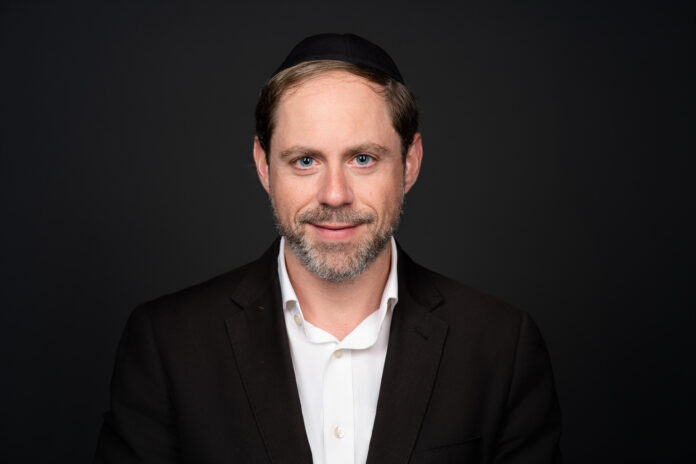

In all likelihood, you either own a Tesla or your kids have asked you to get one. Around 10% of people in the US own an electric car, with that number expected to grow every year. And electric cars need charging. Enter Munish Klein, co-founder of KWEV, a company that installs charging stations for electric cars in multi-family and commercial properties across the US.
Electric cars are a fun topic, and Munish is a fun person to talk to. An entrepreneur who had his own company until his partners wanted to sell, he has many years of experience in the energy-saving industry. After COVID, he pivoted his current company to focus on the ever-expanding industry of charging electric cars, with KWEV being his latest venture.
We spoke about energy, infrastructure and EV charging, how to build partnerships that last, and why emunah and patience matter as much as execution.
Enjoy!
—Nesanel
I was born in Montreal, Canada. I am 42 years old and the youngest of five children. My father was born right after the war in Kerestir, or, as his passport calls it, Bodrogkeresztúr. My father’s parents were both from Kerestir as well. One of his grandfathers was the rosh hakahal, and the other was the town’s shochet and dayan. In 1956, his family immigrated to Canada.
“My mother was born in Czechoslovakia. Both of her parents were survivors. My grandmother, whose maiden name was Mendelowitz, was a teenager during the war and her brother was a baby, not even a year old. Her father was very wealthy. One Friday, Nazis ransacked the house, and for some reason, they threw a big blanket over the baby’s crib. My grandmother stayed away all of Shabbos, and when she came back later, she found her baby brother still in the crib. She kept him with her throughout the war. Their father hid all his children with non-Jews, and they all survived. After the war, they all reunited.
“I went to the Skvere cheder. For high school, I went to the Mesivta of Lakewood. My cousin had gone there two years earlier and had a good experience, so my parents felt it would be a good fit for me as well. After Mesivta of Lakewood, I went to Vyelipol (Frankel’s Yeshiva) in Flatbush for about two years. That was 12th grade and my first year of beis midrash. After that I learned in Darchei Torah in Far Rockaway. The current rosh yeshivah of Darchei Torah, Rav Shlomo Avigdor Altusky, had been our next-door neighbor in Montreal.
“My grandfather started a shul called Bais Moshe in his basement. He also ran a kind of soup kitchen there, and every Erev Shabbos he would distribute free food to Holocaust survivors. Huge lines of people would form there every week. My grandmother once asked him, ‘You’re giving out all this food. Where’s the money? Where do you write it down?’ He answered, ‘It’s being written down up above.’
“My father was a caterer, primarily for weddings. He was a pioneer of off-premise catering. His food was so good that other caterers, like Michael Schick, used to call him for his recipes. But he was very modest; he never attributed his success to his own talents. He always said, ‘M’leigt es arein in oiven, in m’nemt es fun oiven, s’iz allehs fun oiven—you put it in the oven, you take it out of the oven, but it all comes from above.’
“My mother ran the bakery side of the catering. She baked fresh, heimishe cakes for every wedding, and people really liked them.
“I was always entrepreneurial. Growing up, I helped my father in his business during the summers, when there wasn’t much going on. When I was 12 years old, I was already selling cell phones. I had a family friend who was a dealer for AT&T, and they were giving out licenses, so I latched onto him. It’s not like I opened a storefront on 13th Avenue; eBay was still in its infancy, so I made myself an eBay account. This was about 30 years ago, and cell phones were a different world. I had a StarTAC. The next model, the Vader, was half the size of the StarTAC, but it never really took off. I still have both the StarTAC and the Vader stored away in a special box in my house.
“I also pioneered schnitzel sandwiches at Mesivta of Lakewood and started doing cholent on Thursday nights. It was more for fun and the challenge than for money; my parents always gave us whatever we needed. I don’t think I even tracked how much money I made; it was more for the thrill.
“I got married while still in Darchei, before I turned 20. I think I broke the record there as the youngest to get engaged. I may still hold it; I should call Guinness World Records to see if it counts.
“I learned in Darchei’s kollel for about a year after getting married. I was living in Borough Park and commuting. After we had a baby, the commute became harder, so I moved to the Mir in Flatbush. Rabbi Binyamin Eisenberger used to sit in the back row and handle shidduchim. After about two years in kollel, I went to work.
“My first real job was with a mobile billboard company. We were innovators in the truck-side advertising industry. We turned standard white box trucks into moving assets, selling the ad space and wrapping them with brand advertising. We built a national network, signing contracts with trucking companies across all 50 states. We would ask companies, ‘Why pay $10,000 for one stationary billboard on the BQE when for the same price you can have 100 trucks all over the city?’ It worked. We had defined routes, and with the tracking system we installed, we could show our clients exactly where the trucks were traveling on a daily and weekly basis.
“I did that for about two years, until 2005. The owners decided to stay in marketing but pivot into what was then the emerging digital marketing. Not digital ad space like on the Internet but installing plasma screens in entertainment spaces, like restaurants. You still see versions of them today. We contracted with these spaces in New York City, placed private-network screens in their locations, and ran ads for well-known companies like Bacardi and Coors. We were targeting major brands.
“It was a phenomenal experience—until 2008, when the market crashed and all the big companies pulled back on their marketing. For example, at their peak, General Motors was spending about $650 million a year on advertising, but that was cut down to roughly $100 million. As a result, all the newer players, including us, were basically pushed out of the business.
“After that venture folded, I moved into the solar and energy space. I had a brother-in-law in the solar business, so I started brokering for him. I was also brokering electric contracts. Large energy users go out annually and buy blocks of electricity rather than relying on fluctuating utility prices, and I was involved in that process. One thing led to another, and I became more involved in energy efficiency overall, analyzing buildings to see where consumption could be reduced.
“Around 2012–2013, lighting became a major focus in the energy industry, specifically, economical lighting. Buildings were transitioning from magnetic fluorescent fixtures, the T8 bulbs, the four- and eight-foot lamps, to more efficient lighting. There was a tremendous amount of activity in the business at that point, and that’s when I got heavily involved.
“I started my own venture, Advanced Energy Resources, which was primarily a consulting shop. We partnered with utility companies to process incentives and rebates for end users, meaning their clients. I later spun off a separate division called AER Lighting, which focused solely on installations. At our peak, around 2016, we had 20–30 technicians retrofitting lighting systems in well over a 1,000 buildings across the five boroughs, including multifamily and commercial properties. We were running a large operation with a monthly payroll of about $100,000.
“Then, when I was 32, I hit a crossroad. I had two partners in that business, and they wanted an exit. They had lost patience and believed this was a big opportunity, so we sold the entire company in exchange for shares in a public entity, ‘The Power Company.’ They completed a reverse merger into a shell and then spent several years restructuring many of the companies they had acquired. That process is still ongoing. They’ve continued to develop, but the shares haven’t appreciated in a meaningful way yet. Today, my shares are probably worth only a few thousand dollars.
“Siyata dishmaya always comes around; you simply have to keep your eyes open to see it. Since I hadn’t signed a non-compete, I was back in the office the next day, managing transactions on my own but taking it slowly. About a year later, two former employees of mine, David Lax and Charles (Luzee) Stengel, reached out and invited me to join them in their new lighting business, Solo Electric. It’s been ten years and we’re still operating.
“Unlike my previous massive, high-payroll operation, Solo Electric is more of a boutique firm. We’re licensed electrical contractors in both New York and New Jersey, employing technicians and project managers in the field and office. We handle everything from complex service upgrades to the installation of high-end lighting controls, incorporating occupancy and motion sensors and daylight harvesting, primarily for commercial properties throughout the tri-state area.
“We also oversee comprehensive energy compliance. As the city kept introducing increased energy regulations, companies needed a lot of auditing. For example, the city passed Local Law 84, requiring annual benchmarking for every building. Property owners have to collect all their energy usage, electric, gas and oil, document it, and submit it to the city. Then New York City introduced Local Law 88, which requires property owners to benchmark and complete lighting assessments through a very specific portal. Shortly after that they enacted Local Law 87, affecting retro-commissioning, which includes boiler tune-ups, boiler upgrades, insulation, piping insulation and related work.
“We essentially became partners with property owners, bringing in engineers and site surveyors to assess buildings and prepare these reports every year. Once we completed the full assessment, we would handle certain components ourselves and subcontract the rest.
To read more, subscribe to Ami

