
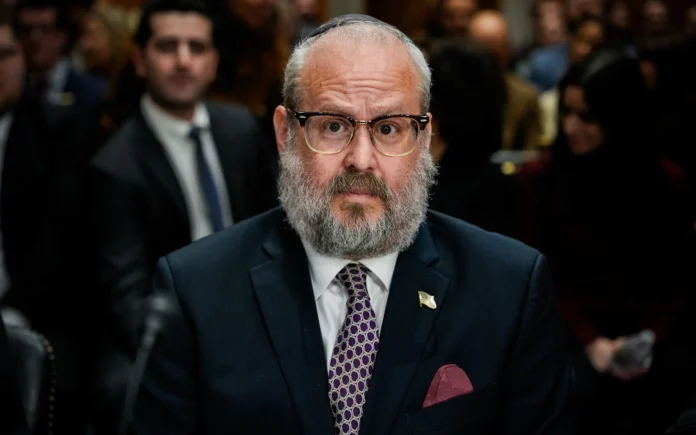

Born in Kfar Chabad, Israel, into a Lubavitcher family, Rabbi Yehuda Kaploun was raised with deep roots in Jewish communal life. His parents served as shluchim of the Lubavitcher Rebbe.
The family later moved to New Haven, Connecticut, where his father worked as a rabbi and educator. Kaploun’s heritage reflects a long history of Jewish leadership; his father’s maternal grandfather, Rabbi Moshe Zalman Feiglin, helped establish Yiddishkeit in Australia and was referred by the Lubavitcher Rebbe as the Avraham Avinu of Australia. His maternal grandfather, Rav Moshe Yitzchak Hecht was one of the first shluchim in America and served as a rav and mechanech in the New Haven area for decades.
Rabbi Kaploun has pursued a career spanning business, philanthropy and community service. He is the cofounder and president of RussKap Water, a company focused on atmospheric water generation technology, and he previously served as a senior partner at a consulting firm advising on government relations and publicprivate partnerships. He has also been active in disaster relief and charitable efforts, including volunteer work after 9/11 and during major hurricanes, and he cofounded the Moses and Aaron Foundation with the late Elie Wiesel to support children with special needs and their families.
Kaploun also has a longstanding relationship with President Donald Trump, dating back to their time in New York, and he played a prominent role in Jewish outreach during the 2024 campaign. In 2025, President Trump nominated him to serve as the Special Envoy and Ambassador at Large to Combat Global Antisemitism. He received his Senate confirmation on December 18, 2025, by a 53–43 vote.
I spoke with Rabbi Kaploun this past Sunday.
Congratulations on your confirmation. It should be with a lot of hatzlachah.
Amein.
What do you see as your primary mission in this role? How do you plan to combat anti-Semitism?
In practical terms, there are three or four ways to do it. One is through education. Unfortunately, the educational system in this country and around the world lends itself to promoting hatred of Jews, with a lot of inaccuracies and things that are untrue. Therefore, we have to confront the untruths. That’s a very important part of confronting anti-Semitism. When The New York Times writes an article and has a misleading picture about a famine in Gaza, and 50 million people see it but their apology is seen by only 100,000 people, it means that 49.9 million people are getting the wrong information. There has to be a more concerted effort in confronting the inaccuracies that help spread the hatred.
Number two, some governments have policies that definitely lend themselves to not protecting their Jewish communities. The protection of American Jews and the Jewish community around the globe is my priority. That is what the job entails, and it includes dealing with governments, such as how to get Australia to ratchet up what they’re doing, which is something the American government had been requesting for a long time; they were ignoring the rising anti-Semitism. Unfortunately, we are seeing the results now. So I would say that protecting, educating and confronting are probably our three top goals.
Many people assume that this is mainly a domestic position, but your remarks highlight its international nature.
The position is formally titled Special Envoy and Ambassador-at-Large to Combat Global Antisemitism, and my intent is to honor that responsibility.
I know that you have roots in Australia.
Correct. My great-grandfather founded the Jewish community in a place called Shepparton, and he was considered to be the Avraham Avinu of Australia. My father was born in the Australian outback, and he went to school in Melbourne as a young child.
So you also have a personal connection to what happened in Australia.
Yes, but that doesn’t change the goals. It does, however, add an impetus and allows me to explain to the officials that I have a personal involvement. But of course, every Jew is someone I have to protect, regardless of affiliation. Kol Yisrael areivim zeh lazeh.
Do you believe that the problems faced by the Australian Jewish community are the result of governmental decisions, or from the downstream effects of immigration policies from the Middle East?
The American president and secretary of state have made it very clear that countries that tolerate terroristic behavior and call for things that are not in accordance with US policy are not helping to decrease hate. In fact, they embolden terrorists. Part of the problem was that the Australian government didn’t listen to the US when they asked them not to recognize a Palestinian state and to condemn Hamas in the strongest terms. They also ignored the recommendations of their own special envoy to combat anti-Semitism up until last week.
I’m receiving more and more information every day, but there’s no question that an unwillingness to confront the anti-Semitic rhetoric or the people who were on Australia’s own watchlist and ended up having guns anyway played a role. How does that happen? The question is how much responsibility the government bears for its inaction. There is obviously some culpability there.
You noted that the president and secretary of state have spoken out on these matters. Could you clarify your role in this initiative?
My function is to represent the administration in areas that involve anti-Semitism and expanding the IHRA definition of it, which lays out very specific roles for governments. It’s a non-binding agreement, but we would still like to see more countries join. I report directly to the secretary of state and will work with ambassadors and governments all over the world.
During your nomination, some people, including Jerry Nadler, expressed concern that the role is meant to be apolitical and you might be too partisan. How would you respond?
Allow me to address two things. During the process, I invited every member of Congress to meet with me to voice any concerns they had. I said during my Senate hearing that anti-Semitism is a bipartisan problem. For people who have an agenda against the president, it wouldn’t make a difference who was nominated. This is the same individual who commended the work I did with Elie Wiesel for children with special needs; in fact, I believe he authored eight or ten proclamations in Congress saluting it. So this is a purely political agenda, and when you have staffers who work for J Street and other anti-Orthodox groups and anti-Israel Jewish groups, you’re going to have that kind of person coming out against you.
The interesting thing is that many Democrats, including Josh Gottheimer and Dan Goldman, met with me and were thrilled by my nomination.
As a member of the chareidi community, in what ways do you anticipate that your Yiddishkeit will inform your approach?
Having grown up and experienced walking in the street and being called dirty Jew, having witnessed the Crown Heights riots, having a sister who passed away from cancers that were caused by 9/11, and having a cousin who was killed on October 7, I bring a different sense of purpose to what the role is all about.
My grandfather, Rav Moshe Yitzchak Hecht, was one of the Rebbe’s first shluchim, and my other grandfather, Reb Aharon Kaploun, was an ish chesed in Yerushalayim and Australia who did acts of kindness that are legendary. I learned from both of them that there are different ways to serve the community. There are times when things are better done quietly, and there are times when things must be done very publicly.
The Lubavitcher Rebbe explained to me and my parents when I had the experience of a yechidus for my bar mitzvah that we have the responsibility to light up the homes of other families. These are things that you take with you every day.
The responsibility of combating global anti-Semitism is a very awesome and daunting one. It’s not something I take lightly. But I take courage in the fact that because of how I was educated and my association with present-day gedolim, I have the ability to lean on giants to assist me in finding the right way to deal with each case. What works in one case doesn’t necessarily work in the other.
Baruch Hashem, many ambassadors have reached out to me over the last four or five months to work with me from their countries. They were all waiting for my confirmation to start the process. I believe that we are in a very strong position to hit the ground running and have an immediate impact. I would also like to thank US ambassadors like Mike Huckabee and Bill White, as well as the staff at the State Department and the assistant secretary for religious liberty.
You asked earlier about my responsibilities. Well, one of the points in the Gaza agreement is to engage in dialogue about how to reduce hatred. That’s something that’s extremely important. So is working with the UN so the Arab textbooks will stop praising martyrdom and children will no longer be taught to hate. As the president just reiterated the other day, American aid must be used to promote American interests around the world rather than hatred.
To read more, subscribe to Ami

