

This past weekend, the Trump administration finally took a step it had been threatening for a couple of months: a massive military action in the heart of Venezuela.
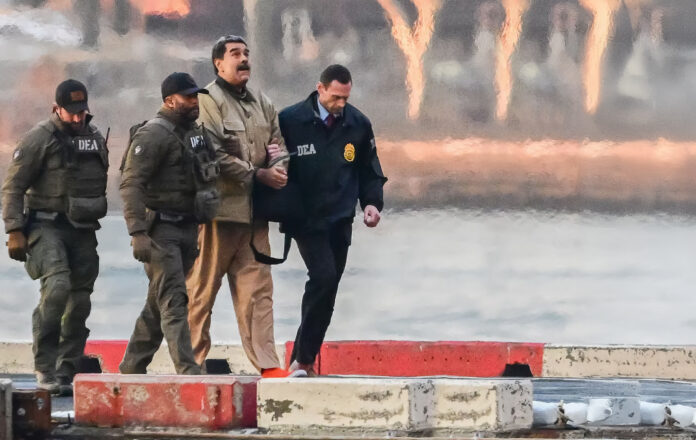
After a series of bombardments of several Venezuelan military locations, American troops left Venezuela with a stunning prize: the president of Venezuela, Nicolás Maduro, and his wife.
While Venezuelan officials claimed that 80 people were killed in the attack (which apparently included 32 Cuban operatives), no American personnel were killed, despite penetrating deep into a hostile country.
On Monday, Maduro was brought to federal court in New York City to face four criminal counts: narco-terrorism, cocaine importation conspiracy and possession of machine guns and destructive devices. Maduro, quieted by the judge when he tried to make a statement, pleaded not guilty.
What does Maduro’s capture mean for the future of Venezuela and the region? That remained murky on Monday because of conflicting statements by President Trump and members of his cabinet.
Running Venezuela
In the immediate aftermath of the capture of Maduro, speaking from his Mar-a-Lago resort, Trump made a very stark statement, that the US would be running Venezuela from now on.
“We’re going to be running it with a group,” Trump said, “and we’re going to make sure it’s run properly.” When asked who would be running it, he indicated “the people that are standing right behind me,” which included Secretary of State Marco Rubio and Secretary of War Pete Hegseth.
That statement seemed puzzling, at least at first, because the US hadn’t left any troops in the country, nor had it dismantled the Venezuelan regime. All it had apparently done was remove Maduro.
Clarifications came in subsequent interviews with Secretary of State Rubio, in which he explained that the US was expecting that the current regime would do what the US wants. President Trump himself clarified that the then-vice president of Maduro’s government, Delcy Rodríguez (who was sworn in as president on Monday), would have to do what the US tells her to do, and that if she “doesn’t do what’s right, she is going to pay a very big price, probably bigger than Maduro.”
Rodríguez has made some statements that were defiant and some that were conciliatory. On Sunday night, she said that her government would seek a collaboration with the US. “Our people and our region deserve peace and dialogue, not war,” she said.
Trump also dismissed the idea that María Corina Machado, the Nobel-Prize-winning Venezuelan opposition leader, could run the country. Maduro openly stole the 2024 presidential election from Edmundo González, the presidential candidate of the party that Machado represents. But Trump said about Machado, who has praised him, “I think it would be very tough for her to be the leader. She doesn’t have the support within or the respect within the country.”
One clear demand that President Trump has made is for US oil companies to be allowed back into the country and to administer the country’s massive oil reserves. At the moment, the only US oil company working in Venezuela is Chevron, which has a waiver from the US government to do so.
Trump has pointed to past nationalization actions by the Venezuelan government as theft of what he said should rightfully be American oil. Several American oil companies have billions of dollars of claims against the government of Venezuela for appropriation of their property.
Trump’s strong words about Venezuelan oil have boosted the stocks of oil companies, but they haven’t made a strong impact on the oil markets yet. That’s in part because currently most Venezuelan oil has been sold not on the open market but to Russia and China, so stoppages to the Venezuelan oil supply won’t immediately affect the general world’s supply, and whether it will begin to accrue to the US is not clear yet either.
And while many Venezuelans both inside and outside the country celebrated Maduro’s arrest, it is not clear whether the eight million Venezuelans who have fled the country or those who are suffering inside it will get any respite from these events.
The legal arguments
Was the Maduro operation legal? That question has two components: US law and international law.
In regard to US law, there is clearly precedent for a US president to take this kind of limited action without notifying Congress, even though that itself is a matter of dispute among legal scholars. The 1989 invasion of Panama under the George H.W. Bush administration was very similar to this action in Venezuela, and the legal arguments made by the government at the time about the president’s ability to take limited military action would likely be presented here, as well.
The Trump administration, specifically Secretary of State Rubio, has advanced a separate argument that this mission into Venezuela was merely a law enforcement action, with the military there simply to assist in law enforcement, and that, they say, would not require congressional notification.
In regard to international law, numerous experts have expressed consistent opinions that the action would not be permissible under the UN Charter, which outlaws military action between countries except for self-defense. The administration has claimed that the drug-trafficking that the Venezuelan government has been engaged in warrants a self-defense response, but drug-trafficking has never been viewed that way under international law before.
As legal expert Jack Goldsmith noted, however, previous presidents have taken similar actions—like in Panama, though there were a few more arguments about legality then—and have gotten away with it. It is unlikely that this will be different.
One other question that will come up in court is whether the US has the right to try Maduro. Generally, foreign leaders have legal immunity. But because the US and many other countries have viewed Maduro’s government as illegitimate, it is very likely that US courts will say he is fair game to prosecute.
The Donroe Doctrine?
One final question, beyond the fate of Venezuela, is whether the administration is planning military action in other countries in the Americas or even farther abroad.
While explaining his actions, President Trump made reference to the Monroe Doctrine, the 19th-century idea that the US must maintain supremacy in the Western Hemisphere, including by dominating Latin American countries. Trump joked that it should now be called the “Donroe Doctrine.”
In subsequent statements, Trump and Rubio have suggested that other countries may also see American action. Those include Cuba (a long-time concern of Rubio, a son of Cuban immigrants), Colombia and Mexico.
(President Claudia Scheinbaum of Mexico said that there was nothing to worry about and that this was just President Trump’s “way of talking.”)
Trump even made reference to his long-standing desire to control Greenland. And while he didn’t openly threaten military action to take it from Denmark, he did say that the US needed to dominate it in order to maintain security, leading the Danish prime minister to warn that a US attack on Greenland would end NATO.
To better understand the administration’s actions, we spoke with former US National Security Adviser Robert O’Brien.
________________________________________________________________________
Robert C. O’Brien served as the 28th National Security Adviser under President Donald J. Trump from 2019 to 2021. He is a seasoned lawyer and foreign policy expert with extensive experience in international negotiations, counterterrorism and national security strategy. Before serving as National Security Adviser, O’Brien was the Special Presidential Envoy for Hostage Affairs from 2018 to 2019, playing a key role in securing the release of American hostages. He has also shaped US policy on critical global issues, including in Latin America and the Middle East.
The capture of Venezuelan leader Nicolás Maduro is nothing short of stunning. What’s your reaction to this extraordinary development?
I had a couple of reactions. The first is that it was an exquisitely executed operation by our special forces. I am very proud of our airmen, Marines and soldiers, especially the Delta guys who went in and did the actual capture. There were also the airmen who were providing cover, as well as all the sailors involved. It was a well-done and well-planned mission.
The folks who haven’t gotten the recognition they should have are the CIA operatives who have been on the ground for months preparing the situation for the others to come in. It was the intelligence they provided that allowed the door kickers and special ops to come in to a heavily fortified military installation. This wasn’t a compound in the desert; it was a heavily fortified compound with serious anti-aircraft capability and a lot of men on the ground. Nonetheless, they had the intel to get in and out of an urban environment, which is very difficult to do. All around, it showed the capability of the United States to do something when we put our minds to it. It was a very difficult mission that succeeded with no loss of life or equipment. It was a great operation on the technical front.
The political issue of what happened is that President Trump has shown himself to a be a peacemaker, and he is actually sort of a pacifist. He doesn’t like war, and he doesn’t like undertaking these kinds of operations, because they put the members of our military at risk. He will if he has to, but he always gives the bad actors the opportunity to take an off-ramp. He gave Maduro numerous opportunities to leave Venezuela to avoid this, but he didn’t do it. Maduro called his bluff, and President Trump showed that he doesn’t bluff in such instances.
His strong preference is for peace, and he did this with the Iranians and their nuclear program as well, as we saw with Operation Midnight Hammer. He told them, “You’re not getting a nuclear weapon. You have to let the inspectors in. There have to be full inspections, and you have to dismantle your nuclear program.” They tap-tap-tapped him along. He tried to give them a fair deal. In fact, the deal he offered them, like the deal he offered Maduro, would have been criticized as too lenient. But they didn’t take it because they thought they were still dealing with Joe Biden. They thought they were dealing with the sort of American president they could leverage and push around. They found out that President Trump will put a fair deal on the table, but if you don’t take it you’ll suffer the consequences. That is exactly what happened with Maduro. The president gave him a chance to go to Tehran, Beijing or Moscow, but he turned that down. That’s why he is now in jail in Brooklyn.
He’s in my hometown, where we have a socialist mayor, so he’s in a socialist place.
A socialist Islamist mayor.
It’s ironic that he ended up in Brooklyn.
What happened with Maduro is that he crossed a number of red lines. There are plenty of bad actors in the world. We can’t right every wrong, and we can’t put every bad dictator in jail. But Maduro did a couple of things that violated American interests. First and foremost, he sent cocaine and fentanyl into our country. People are saying that most of it was cocaine and that it’s not as bad, but we’re losing a lot of young people to overdoses of that as well. It’s a scourge on our cities. Maduro was heavily involved in the drug trade. This wasn’t just a guy who turned his eyes away from the cartels because he couldn’t control them. He was heavily involved so he could make more money for his regime.
The second thing he did was send massive numbers of illegal immigrants to America, and he sent the worst of the worst like the Tren de Aragua gang members, who took over those apartment buildings in Colorado. Then he suspended the flights that were meant to repatriate them. He thought he was playing an asymmetrical game against the US, and that he had leverage over President Trump.
The third thing he did was take an American who was surfing across the border hostage. Those were three big strikes that go to the heart of the America First foreign policy—drugs, illegal immigration and hostage taking—and they infuriated the president. Maduro thought he could push us around, but he found out that it wasn’t going to happen.
On top of that, he invited Hezbollah, Iran, China and Russia into Venezuela and provided support for their activities in the Western Hemisphere. He brought America’s biggest adversaries into our hemisphere and provided a base for them. One of the things that has been reported is that they were teaching Hezbollah operatives Spanish so jihadis could pose as Latin Americans and infiltrate America.
To read more, subscribe to Ami

