
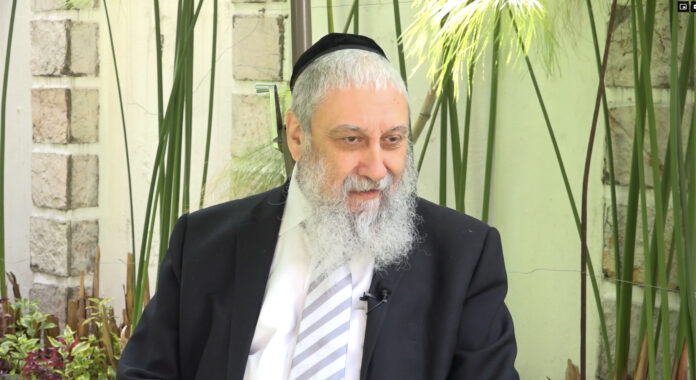

It was 2:00 a.m. on Friday night when Rabbi Yitzchak Garzon and his family were suddenly awakened by the sound of explosions that shook their home. “It’s probably started,” Rabbi Garzon said, trying to calm everyone down. But it wasn’t until Shabbos morning that some neighbors informed him of what had actually happened: Nicolás Maduro, the longstanding dictator of Venezuela, had been captured and taken away. An eerie silence hung over the streets.
Rabbi Garzon is the rosh yeshivah of Yeshiva Bene Azar (Bnei Ezer) in Caracas, which is affiliated with the Beit Shmuel community. He is also the son of the community’s long-time rav, Rabbi Avraham Garzon. Both father and son live in the Este district, the eastern part of Caracas. They shared their feelings and hopes following Maduro’s capture.
“The explosions themselves happened in a different part of the city,” Rabbi Garzon recalled. “They were downtown, near the presidential palace and military bases to the west of the area that has the largest Jewish population. But the sounds were heard everywhere. There were widespread power outages across Caracas, so everyone could tell that something big was happening. But it wasn’t until Shabbos morning that we learned what happened.”
How did the community react to the news?
“Everyone reacted differently. Some people felt relief and joy while others were filled with worry. There was also a concern that violence might erupt, so nearly all the shuls were closed. Almost everyone stayed home out of caution. Only today have people started to leave their homes again. The shul has reopened and the yeshivah will resume classes tomorrow. Since Chanukah, the educational institutions have been on an extended break and are returning to regular studies now anyway. We are very hopeful that these developments won’t lead to street fighting or harm to civilians, G-d forbid.”
The operation itself, however, didn’t come as a surprise to anyone. For several months the United States had positioned a military armada off the Venezuelan coast, and President Donald Trump had been issuing warnings to the regime, condemning Maduro’s dictatorial and terror-backed rule, and demanding that he step down either peacefully or by force. There had even been threats of military action against him and his allies, although they were primarily directed at regime-controlled naval operations.
“There was an expectation that some kind of action would take place,” Rabbi Garzon said. “But most people assumed it would be an invasion or something on a much larger scale, not just a targeted operation to capture Maduro. That was the speculation and concern. In the end it turned out to be very focused, and as far as we know civilians weren’t involved. But it was still very frightening. We heard all the explosions throughout the night.
“It’s a historic moment, but it’s not over yet. Maduro may have been arrested, but his regime remains intact, and we are entering a dangerous phase. People are stocking up on food and water in anticipation of whatever comes next, afraid that we may be forced to remain indoors. There are lines outside the stores, but aside from that not much else has changed.”
Have the authorities shown any signs of change? Does it feel like the leadership is acting differently?
“No. Everything is as it was. The government is functioning just as it did before. So far, we haven’t felt that Maduro’s capture has led to any meaningful shift. The regime is still being run by Vice President Delcy Rodriguez, and her public statements give no indication of change.”
In fact, Rodríguez announced that she wouldn’t cooperate with Trump. She also made an anti-Semitic remark, claiming the operation bore “Zionist fingerprints.” Her comments were broadcast on Venezuela’s state-run channel, where she further asserted that “the true objective of the American operation was to dismantle Venezuela’s political independence.”
Nonetheless, according to President Trump she is cooperating with the United States, and for now the White House team is essentially managing the country. This conflicting narrative has only deepened the confusion among residents of the country.
“We don’t fully understand what any of this really means,” Rabbi Garzon said. “You could say that it’s an unprecedented situation. It’s unclear who is actually in charge. If it’s the Americans who are effectively in control, what does that mean for us? Right now there’s a great deal of uncertainty. We just hope that the situation ultimately leads to something positive.”
To read more, subscribe to Ami

