
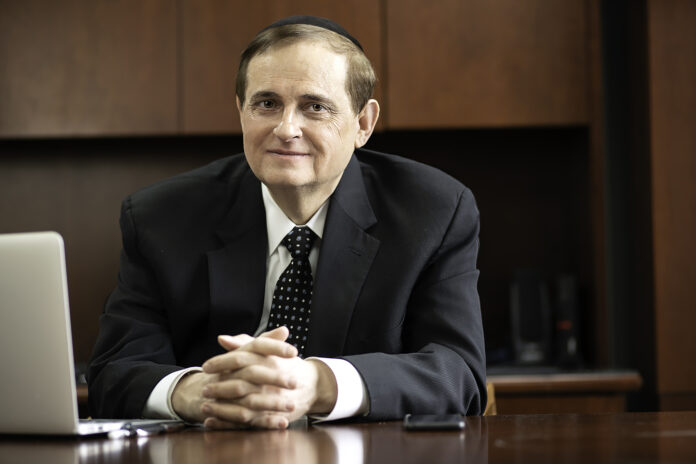

Many of the most successful businesses begin with a problem. An entrepreneur encounters an issue, finds a solution and builds a product or service around it. That’s exactly what Barry Cik did, at the age of 50.
After a successful career as an environmental consultant, helping real estate owners comply with environmental regulations, a simple errand led Barry down a related but uncharted path.
While shopping for a crib mattress for his newborn grandchild, Barry was shocked to discover that there were no truly natural, organic options available. So he decided to create one himself. He figured out how to manufacture it, and from that effort, Naturepedic was born. Today, his company is a recognized leader in natural organic mattresses and bedding. Over time, Naturepedic has expanded into a full line of sleep products for babies, children and adults, becoming a major force in the industry.
We spoke about the importance of organic living, what it’s like to working with your children and more.
Enjoy! -Nesanel
I’m 74 years old. I was born and raised in Cleveland, Ohio. My parents came here after the Holocaust, and I was one of the few chasidishe-type kids in the city. We had a cheder, the Kaliver Yeshiva, where all the classes were in Yiddish.
“My father was a shoemaker, specializing in orthopedic shoes. He was a pashute Yid. When I was a child, I used to ask him halachic shailos, and he always gave the same response: ‘Azoi shteit in Shulchan Aruch.’
“Cleveland’s chasidishe community wasn’t exactly like the one in New York. After high school, I attended Yeshiva University for a couple of years.
“I wanted to pursue engineering, specifically, environmental engineering, so I transferred to Cleveland State University and then Ohio State University. I was led into engineering partly by aptitude and partly by passion: I had a knack for math and science, but I also was very concerned about the environment. At that time, Lake Erie was dying. The fish were gone; you couldn’t fish there anymore. The Cuyahoga River even caught fire, in 1969. You probably don’t remember that story. It seemed to me that we were actively destroying our environment. It wasn’t a theoretical issue; our use of toxic chemicals was causing lasting damage. I enrolled in the environmental engineering program, and that’s where I earned my degrees.
“I truly believed we were harming the environment. I wanted to reverse that trend, or at least reduce the harm, which is why my first career was in the environmental standards industry. My first business, if you want to call it that, was this:
“When you purchase a piece of property—this rule is the same today as it was back then—if it’s just a regular residential home, there’s no issue. But if you’re buying an industrial or commercial property, the bank will not give you a loan unless the property meets specific environmental standards. That’s where I came in: I became a baki in environmental compliance.
“My first job out of college was with an environmental consulting firm. I had to test the soil and groundwater beneath the property to determine if it was contaminated, and to what degree. We would present the bank with a report based on our findings, and then the bank would decide whether to approve the loan, and if so, the amount they were willing to risk.
“Essentially, I was working for the banks. I consulted for most of the major banks in Northeast Ohio as their main investigator for environmental issues. When someone applied for a loan, the bank would give them my card and say, “You have to hire this guy.” I would examine the property, review its history, conduct any necessary testing and then submit a report with my findings to the bank. This kind of due diligence is standard practice for every bank in the country.
“My company was called GEM Testing & Engineering Labs. I had several employees, and I was making a decent parnasah. Then, about 23 years ago, something happened that changed my whole career.
“We had our first grandchild, and my wife sent me out to buy a crib mattress. So I go to the store, I’m looking at the crib mattresses, I’m asking questions, and I realize that the mattresses are all loaded with toxic chemicals—there’s vinyl with phthalates, there’s polyurethane foam, there’s formaldehyde, there’s pesticides. It was crazy.
“I asked the salesperson, ‘What else do you have?’ And she said, ‘Nothing. This is what we sell.’ I said, ‘That’s nuts.’
“I went home and started joking with my wife. I said, ‘You know, my zeide slept on straw. Let’s go to our Amish friends and buy straw and make a mattress. I’m not putting a baby on this stuff.’ There’s a big Amish community in our area, and we were friendly with them and used to buy things from them.
“I didn’t mean it literally, and in the end we didn’t need straw. But we did create something. Then one of my sons put it on the internet, and people started sending us money for that product.
“My message was to the point: Do you want your baby sleeping on a mattress made with toxic chemicals? We offered a simple, healthy, organic option. Organic cotton fill, organic cotton fabric.
“I still get pushback on this. People say, ‘What do you mean, “toxic chemicals”? Even if the mattress is as bad as you say, who cares? It’s a solid piece of material. The baby is sleeping on a sheet. Everything’s fine. There’s no science behind your claims.’
“I know that many people think this way, and it really hurts me, because it’s not true. People are just not aware of it. I’ve read studies that tested the air around the mattress, within 12 inches, even with a sheet on top, and found toxic chemicals. How many babies today are sick? A lot more than anybody wants to admit, and toxic chemicals are a major factor in many of these illnesses. A baby is on a mattress for up to 15 hours a day. Those chemicals leach out of the mattress into the air around the baby, and the baby inhales that garbage.
“It’s not only the mattress, either. It’s the food too. There’s so much junk in the food, it’s frightening. This issue affects all kinds of consumer products.
“Baruch Hashem, we have become the leading brand in natural organic mattress manufacturing. I feel fortunate that not only do we produce a quality product but we’re also helping people live healthier lives.”
To read more, subscribe to Ami

