
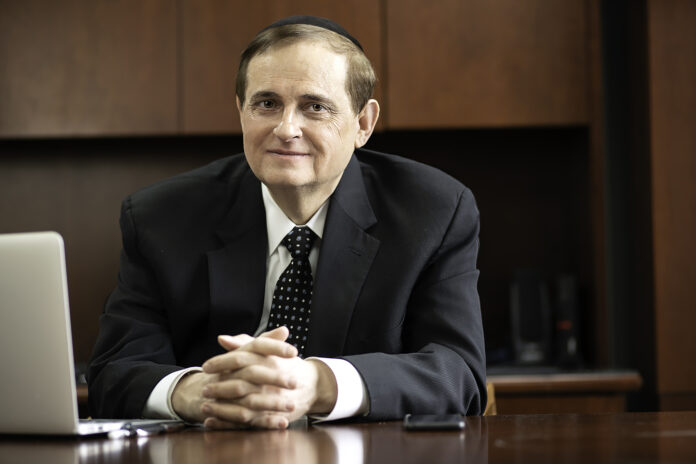

Many of the most successful businesses begin with a problem. An entrepreneur encounters an issue, finds a solution and builds a product or service around it. That’s exactly what Barry Cik did, at the age of 50.
After a successful career as an environmental consultant, helping real estate owners comply with environmental regulations, a simple errand led Barry down a related but uncharted path.
While shopping for a crib mattress for his newborn grandchild, Barry was shocked to discover that there were no truly natural, organic options available. So he decided to create one himself. He figured out how to manufacture it, and from that effort, a company was born. Today, his company is a recognized leader in natural organic mattresses and bedding. Over time, the company has expanded into a full line of sleep products for babies, children and adults, becoming a major force in the industry.
We spoke about the importance of organic living, what it’s like to working with your children and more.
Enjoy! -Nesanel
I’m 74 years old. I was born and raised in Cleveland, Ohio. My parents came here after the Holocaust, and I was one of the few chasidishe-type kids in the city. We had a cheder, the Kaliver Yeshiva, where all the classes were in Yiddish.
“My father was a shoemaker, specializing in orthopedic shoes. He was a pashute Yid. When I was a child, I used to ask him halachic shailos, and he always gave the same response: ‘Azoi shteit in Shulchan Aruch.’
“Cleveland’s chasidishe community wasn’t exactly like the one in New York. After high school, I attended Yeshiva University for a couple of years.
“I wanted to pursue engineering, specifically, environmental engineering, so I transferred to Cleveland State University and then Ohio State University. I was led into engineering partly by aptitude and partly by passion: I had a knack for math and science, but I also was very concerned about the environment. At that time, Lake Erie was dying. The fish were gone; you couldn’t fish there anymore. The Cuyahoga River even caught fire, in 1969. You probably don’t remember that story. It seemed to me that we were actively destroying our environment. It wasn’t a theoretical issue; our use of toxic chemicals was causing lasting damage. I enrolled in the environmental engineering program, and that’s where I earned my degrees.
“I truly believed we were harming the environment. I wanted to reverse that trend, or at least reduce the harm, which is why my first career was in the environmental standards industry. My first business, if you want to call it that, was this:
“When you purchase a piece of property—this rule is the same today as it was back then—if it’s just a regular residential home, there’s no issue. But if you’re buying an industrial or commercial property, the bank will not give you a loan unless the property meets specific environmental standards. That’s where I came in: I became a baki in environmental compliance.
“My first job out of college was with an environmental consulting firm. I had to test the soil and groundwater beneath the property to determine if it was contaminated, and to what degree. We would present the bank with a report based on our findings, and then the bank would decide whether to approve the loan, and if so, the amount they were willing to risk.
“Essentially, I was working for the banks. I consulted for most of the major banks in Northeast Ohio as their main investigator for environmental issues. When someone applied for a loan, the bank would give them my card and say, “You have to hire this guy.” I would examine the property, review its history, conduct any necessary testing and then submit a report with my findings to the bank. This kind of due diligence is standard practice for every bank in the country.
“My company was called GEM Testing & Engineering Labs. I had several employees, and I was making a decent parnasah. Then, about 23 years ago, something happened that changed my whole career.
“We had our first grandchild, and my wife sent me out to buy a crib mattress. So I go to the store, I’m looking at the crib mattresses, I’m asking questions, and I realize that the mattresses are all loaded with toxic chemicals—there’s vinyl with phthalates, there’s polyurethane foam, there’s formaldehyde, there’s pesticides. It was crazy.
“I asked the salesperson, ‘What else do you have?’ And she said, ‘Nothing. This is what we sell.’ I said, ‘That’s nuts.’
“I went home and started joking with my wife. I said, ‘You know, my zeide slept on straw. Let’s go to our Amish friends and buy straw and make a mattress. I’m not putting a baby on this stuff.’ There’s a big Amish community in our area, and we were friendly with them and used to buy things from them.
“I didn’t mean it literally, and in the end we didn’t need straw. But we did create something. Then one of my sons put it on the internet, and people started sending us money for that product.
“My message was to the point: Do you want your baby sleeping on a mattress made with toxic chemicals? We offered a simple, healthy, organic option. Organic cotton fill, organic cotton fabric.
“I still get pushback on this. People say, ‘What do you mean, “toxic chemicals”? Even if the mattress is as bad as you say, who cares? It’s a solid piece of material. The baby is sleeping on a sheet. Everything’s fine. There’s no science behind your claims.’
“I know that many people think this way, and it really hurts me, because it’s not true. People are just not aware of it. I’ve read studies that tested the air around the mattress, within 12 inches, even with a sheet on top, and found toxic chemicals. How many babies today are sick? A lot more than anybody wants to admit, and toxic chemicals are a major factor in many of these illnesses. A baby is on a mattress for up to 15 hours a day. Those chemicals leach out of the mattress into the air around the baby, and the baby inhales that garbage.
“It’s not only the mattress, either. It’s the food too. There’s so much junk in the food, it’s frightening. This issue affects all kinds of consumer products.
“Baruch Hashem, we have become the leading brand in natural organic mattress manufacturing. I feel fortunate that not only do we produce a quality product but we’re also helping people live healthier lives.”
Did you have any competitors when you started?
Back then, there were no major players in the industry. There were a couple of small guys trying to get started too, but no one significant. For the most part, we’re the ones who drove the industry forward, and even though new, small competitors come up out there, baruch Hashem, we are still the standard bearers.
Why do you think that is? Why do you think no one thought of natural materials?
I can’t give you a perfect answer, but I can give you an example that might explain it.
When I first started, we didn’t make adult mattresses. We only made baby mattresses. I went to several pediatricians and asked, “Do you know what’s in a baby mattress? Do you have any idea what materials are used in it?” They didn’t know. They never thought about it. Nobody had.
I would explain to them that those mattresses were made with toxic chemicals, and I’d list this chemical and that one and all the others. I can’t forget this one pediatrician who said, “Barry, bistu meshuga? I thought you were a normal guy. This is crazy. How did you come up with this nonsense?”
Interpret it however you want, but the fact is that back then, nobody was paying this issue any attention. They didn’t care, not about baby mattresses and not about adult mattresses.
You said you’ve seen studies about chemicals leaking into the air?
Yes, I’ve seen many studies. The data is out there.
So you started this business and put it online. Were you a one-man show?
No. My two sons, Yehuda and Peretz, have been my partners since the very beginning.
You had the idea and decided to involve your kids right away?
Yes. At the time, both of them had graduated college and had very nice job offers lined up, but they both turned down those offers and said, “We’re going to support Tatty; we’re going to go into business with Tatty.”
How many children do you have? What are their positions in the business?
We have four children, two boys and two girls. My son Yehuda took control of certain areas, like the website, which was never my area of expertise. He has a degree in finance, so he also manages the financial side of the business. My son Peretz has a degree in mechanical engineering, so he’s responsible for the factory and the equipment we buy, as well as all the technical operations. Each of us has our own responsibilities, but we work together as a team.
Why did you decide to bring your kids into the business? A lot of people are scared to work with family.
That’s a fair question, but I don’t have a dramatic answer. I love my kids. We’ve always worked together, and we’ve always cooperated. I was Yehuda’s manager when he was a singer, so we already had experience working together.
I helped turn him into a world-famous singer. I started when he was around ten, maybe even younger. I was a violinist and played at Jewish weddings all over Cleveland. I had my own band, the Barry Cik Orchestra.
Since you brought it up, I must tell you that your son Yehuda is one of my favorite singers of all time. His album “Yehuda! & Friends” is particularly incredible. Simply stunning music with real Yiddishe hartz.
Thank you; that’s very nice to hear.
Talk to me about the progression of the company.
I always joke, “Would you like to see my business plan? Well, sorry, I never made one.” I never had the chance. From the minute we launched the business, people started ordering our products. They understood what we were doing. They were saying, “If you’re offering a mattress made from certified organic cotton, organic wool and organic latex without all these toxic chemicals, of course we’ll take it.”
The concept was very simple, and people didn’t require much convincing. Even without advertising, the value was obvious and people wanted it. Basically, we sold a mattress, people sent us money, we took that money, bought more material and made more mattresses. We’ve had consistent demand ever since. That’s how we built the company.
Where do you sell?
All across the country. And here’s a little joke. Some people think we’re based in California because we’re environmentally aware. But of course we’re not. We’re in Amish country, Ohio. So we don’t quite fit the stereotype people imagine.
How did you grow the business?
Largely through the internet; we have a constant stream of online orders. But we also went to retail stores and told them, “You have customers who care about health and the environment, and when they walk into your store you need to have an option for them.” They agreed to carry our products, and they did well.
Today we sell through many of the big retailers, and we also have our own stores. I believe we have about 18 stores across the country now.
Brick and mortar stores?
Yes, baruch Hashem. Although we sell a lot online, a mattress is one of those things that you really should try out in person before buying. When the internet started, mattresses were one of the last products people were willing to buy online, because people could not imagine choosing a mattress without lying down on it first.
We built the business online, but we also recognized that many people still want to test out a mattress before buying it.
I imagine that many young people have never tried out a mattress in a store.
Exactly. In fact, we’ve had many younger people walk past one of our stores, step in out of curiosity, try out a mattress and buy it, almost on impulse. Many consumers, especially younger ones, have a real craving to see and feel products before making a decision to purchase.
It’s not easy to grow a business to the size yours has reached today. You say you had a good product and customers came to you, but were there challenges along the way? Did competitors start showing up?
Of course there were challenges. But you have to ask a basic question: “Why does the consumer buy our product, and why do they choose it over others?” There’s a very simple answer. Go to our website and you’ll see that we have hashgachos. We have certifications from respected environmental organizations that verify our claims. We have over ten certifications, each focused on a specific area of health or sustainability.
Two of them are in regard to non-toxic standards; three certify that our materials are truly organic; others confirm ethical production, sustainable sourcing and so on. We can back up our claims. Our products are regularly inspected, verified and certified, and we’re transparent about that with the public.
Now some of our competitors are doing that too, and that’s fine. But we were ahead of the curve. From the beginning I insisted on getting certification. If I’m going to claim that a mattress meets a high standard of natural, organic or non-toxic, I can’t just say that, I have to prove it.
You were the first to do that. Do you think that it made a real difference?
Yes, very much so. Understanding that we needed hashgachah helped us as much as anything else, if not more.
I’m sure there’s serious competition today.
The market is growing like crazy, but that’s to our benefit.
How so?
We were one of the first companies in this space, so as the industry expands, so do we.
Increased awareness of the issues that drove me to start this business—chemical exposure, organic living, environmental health—drive customers to us. Consumers look for solutions, and they find us.
Today there are a lot of products online that claim to be natural or green, like bamboo mattresses, for example, that sell for a few hundred dollars. Your mattresses start at $1,000 to $1,500. How do you compete with that?
Why are you willing to spend more money on kosher food? Because you believe in it. We’re not selling to people who are looking for the cheapest option. We’re selling to people who believe in what we stand for. Our job is to show them we’re not lying and that we’re giving them a genuinely superior product.
Someone who shops online for the cheapest mattress isn’t looking for a natural product. They may happen to find something that claims to be “natural” or “eco-friendly,” and that’s a plus, so they buy it. Our customers are specifically searching for a top-quality, natural, organic mattress.
People actually seek you out?
That’s right. The downside is that some of our customers are such strong advocates of natural living that they even drive us a little crazy. But those are our people, and we’re the company they come to.
What do you think is different about the way people do business today versus the way they used to?
People today don’t trust anything. Thirty or 40 years ago, people were more trusting. Today, you make a claim and nobody believes you, especially when it comes to green products. People are less trusting, and for good reason. It’s because many companies just make things up. They spit out all the catchphrases, “This is green. This is non-toxic. This is natural.” Too often, it’s just marketing. There’s nothing real behind their claims.
Take bamboo, for example. It has become a very popular alternative to polyester in clothing, and people assume it’s as natural as cotton. Bamboo clothing is not natural at all. In its raw state, bamboo is the roughest, most uncomfortable material in the entire world. There’s no such thing as comfortable natural bamboo. They have to use tons of chemicals to soften it.
How do you build up trust in your product?
Two ways. First, by being legit. If you say your product is made a certain way, make sure it’s actually made that way. People can spot fluff. Second, and this is advice that I believe many businesses can learn from: Get haskamos and hashgachos for your business. No matter what industry you’re in, there are certification organizations that will verify and vouch for your product. Use them; that credibility is essential.
To read more, subscribe to Ami

