
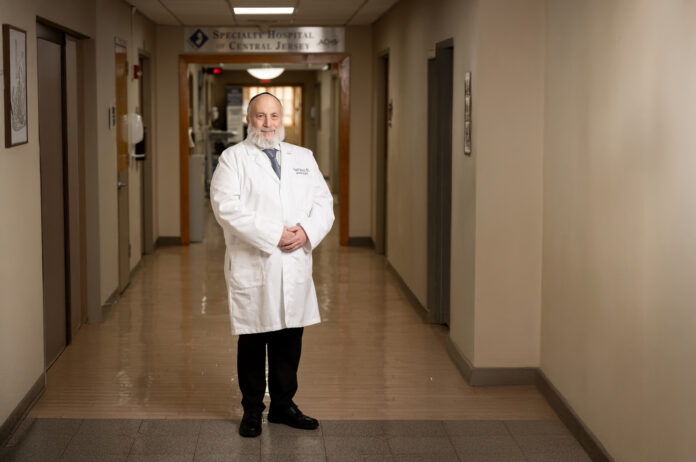

Under the direction of its outstanding chief medical officer Dr. Howard (Chona Chaim) Lebowitz, Specialty Hospital of Central Jersey in Lakewood, New Jersey, stands out as one of the region’s premier medical facilities. A small, integrated “hospital-within-a-hospital” located at Monmouth Medical Center (formerly Kimball Medical Center), its sole focus is caring for chronically ill patients whom most facilities consider incurable.
As an independent entity, it offers the benefits of a more individualized hospital setting, combined with life-support services such as ventilator weaning, complex wound care, parenteral nutrition, respiratory and cardiac monitoring and dialysis.
Dr. Lebowitz received his medical degree from Harvard Medical School, graduating cum laude from the Harvard-MIT Program in Health Sciences and Technology. He was also awarded the DuPont Young Investigator of the Year Award by the American College of Chest Physicians. After completing his internship and residency in internal medicine at Boston’s Brigham and Women’s Hospital, Dr. Lebowitz served as an attending physician there for five years, earning board certification in internal medicine before joining the medical staff at Monmouth Medical Center in 2001.
In addition to his medical expertise, Dr. Lebowitz is a talmid chacham in the truest sense of the term. A graduate of the Mir and BMG, he continues to spend half of each day in kollel immersed in Torah study. His unique combination of medical knowledge and remarkable fluency in Torah informs both his approach to patient care and the philosophy of his facility.
I’ve heard that you do amazing things, and speaking to the best people in the world is always a big honor.
Thank you.
Can you explain what your facility is like? I understand that you occupy two floors of an existing hospital building.
That’s correct. By way of background, we run what’s called an LTAC (long-term acute care) hospital. That sounds a bit like an oxymoron, but these types of hospitals were established to take care of chronically critically ill patients. A few decades ago, Medicare started reimbursing hospitals based on the admission diagnosis, and it didn’t matter how many days the patient stayed, so the motivation was to get them out as quickly as possible: “treat ’em and street ’em.” Patients were getting out quicker and sicker, but that model worked for the majority of people.
However, there are some patients who don’t get better in days but over the course of weeks or months, and sometimes they might not get better but still need higher-level care. That’s why these types of hospitals were constituted, which are essentially a Medicare designation.
Where do your patients come from?
They typically come from hospitals all over the Eastern seaboard after having a stay in an ICU at a transferring hospital. Maimonides is one of my biggest feeders. At this point most of our patients are frum, and we can talk about why that is. The vast majority are on life support and ventilators due to respiratory failure and other major medical complications. We typically try to tailor a course of about a month of treatment, and if they’re well enough after a month they’ll go home. If they’re well enough to go to a skilled nursing facility, they’ll do that.
You must have a high mortality rate.
Depending on the quarter, our mortality rate is approximately 25%. Everyone thinks it’s much higher because we take care of very sick and very elderly patients whom no one else wants to accept. These are patients who have had neurological catastrophes and would have been declared brain dead if that kind of testing were allowed in New York. But for the frum community, these are people whose families want proactive care no matter how sick their loved one is so they can have the best and longest life possible.
I was under the impression that yours is a sort of chayei shaah type of facility, but it’s not.
That’s a big misnomer. This hospital is for patients who are very ill. But I’ve had people who came to us on a ventilator and we weaned them off and treated all their complications, and now they send me videos from Florida. I’ve even danced with them at their kids’ chasunahs.
What’s the tzad hashaveh of the patients at your facility?
The common denominator is that they are critically ill and require an extended period of care to determine whether they will recover or not.
Why can’t they receive the same care at a regular facility? You mentioned that many of your patients come from Maimonides. Is it a matter of insurance reimbursement, meaning that other facilities wouldn’t be able to receive the same payment?
There are several factors. Number one, the typical Medicare patient in an acute-care hospital like Maimonides or Columbia has an average stay of four days. These places aren’t designed to take care of patients for weeks. For example, if you go into Maimonides, you’ll never get directed treatment for recreational and occupational therapy. You may get an evaluation, but you won’t get treatments that are directed at rehabilitation.
There are also things like nursing care to try to improve wounds. Wounds can get really bad over the course of days, but they get better over the course of weeks and months. Aggressive wound care isn’t attended to if you’re going to be in and out of a place in less than a week. I get a lot of patients who haven’t been fed elsewhere during their whole hospitalization, because those places aren’t used to addressing nutritional needs. It’s like if you go to an Airbnb for a few days, you expect one level of amenities, but if you go somewhere for the summer, it’s a different kind of setting.
Are there many facilities like yours?
It depends which part of the country you’re talking about. It essentially doesn’t exist in New York. One of the reasons is that years ago New York felt that their hospitals had too many beds, so they went through a bunch of commissions to cut the number of beds rather than introducing new ones. In order to have a state recognize the need for LTACs, there has to be a sense of central and communal planning, with stakeholders willing to look at the bigger picture. New York just couldn’t get that done politically.
That being said, people ask me all the time, “Why don’t we have something like this in New York?” There is a place in New York called Calvary Hospital that was grandfathered in as an LTAC, but it doesn’t really operate like one. It’s more like a hospice. That’s why the New York patients all come to New Jersey.
Were you asked by the people in New Jersey to do this?
We were asked by Robert Wood Johnson Barnabas, the health system that houses us, to help unload their ICUs and serve this patient population and address the problem of people not getting optimal care. There are other LTACs in New Jersey that were created by rehab companies, but they’re kind of souped-up nursing homes, meaning that they’re really subacute.
Our facility has a high level of acuity, and my nurse-to-patient ratios are unbelievable. I think I’m the only LTAC that has three full-time doctors and a physician assistant. If you come for a visit, you’ll see heilige, frum Yidden who are very well attended. Regardless of whether they do well or not, their families all appreciate that they are getting incredible medical attention and kind nursing care. Another tremendous relief is the fact that halachah isn’t something we just give lip service to or try to accommodate; it’s what we’re all about.
For example, we just took in a patient from Maimonides because they were reluctant to give him dialysis due to his poor prognosis. The patient’s family reached out to Rabbi Zischa Ausch from Chayim Aruchim, who said that providing dialysis is the right thing to do. I’m the one who asked them to reach out to him, and when Rabbi Ausch says to do something, our staff of nephrologists and dialysis nurses don’t roll their eyes as others might do elsewhere. We are all of the same mind.
In a case like that, does it create insurance coverage issues?
Most of my patients have Medicare, which reimburses us based on the admission diagnosis of a 28-day stay. But I don’t balance my books patient to patient. I’ve had elderly patients here for several months and much of that time was uncompensated. I tell the patients and their families, “If you’re well enough to leave after your month, you leave. If you’re too sick to leave, you stay. You don’t have to worry about the financial ramifications.” Thank G-d, everything has been working out for us in the aggregate. That’s the way we do things.
In other words, you’re basically able to balance the books across all your patients combined.
Correct. There are patients I lose a lot of money on, and others where I come out ahead. At the end of the year, we hope to make more than we lose.
I’d like to understand your relationship with Monmouth Medical Center.
We’re an independent entity that leases space and purchases things like dietary services, security services and radiology services if a patient needs an exam, but we’re completely separate.
To read more, subscribe to Ami

