
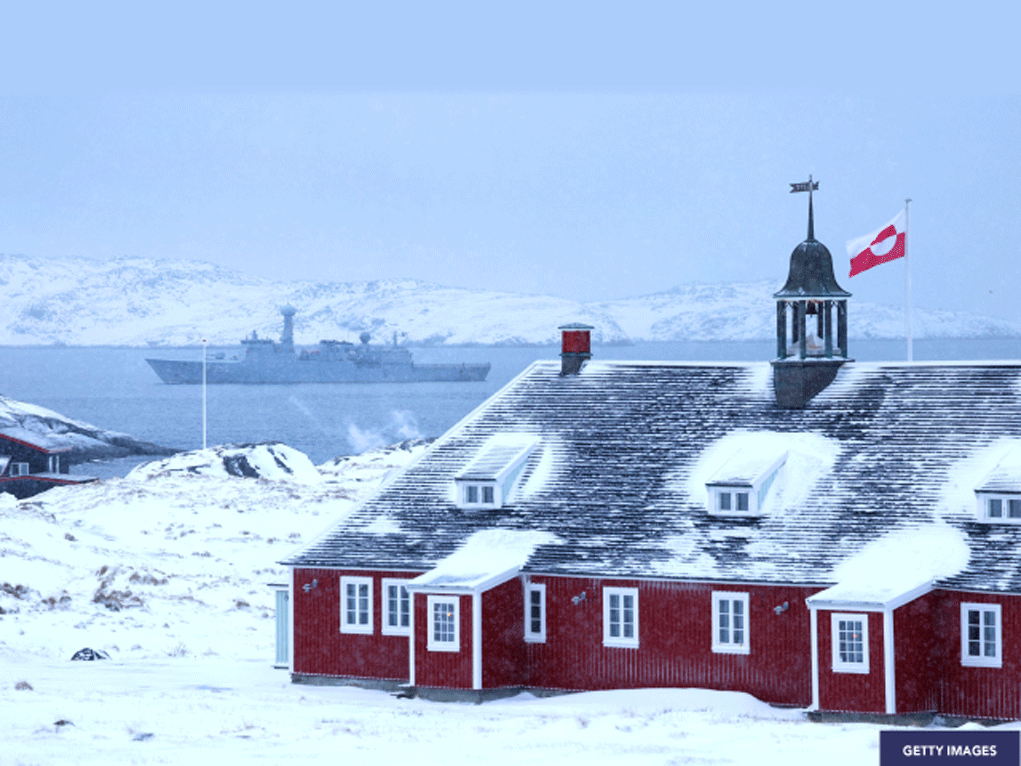

President Donald Trump said that he would charge a 10 percent import tax starting in February on goods from eight European nations because of their opposition to his demands for American control of Greenland, in a confrontation that will test the strength of U.S. partnerships with its NATO allies in Europe.
In a social media post, Trump said that Denmark, Norway, Sweden, France, Germany, the United Kingdom, the Netherlands, and Finland would face the tariff, which would climb to 25% on June 1 if no deal was in place for “the complete and total purchase of Greenland” by the United States, Trump said.
“The United States of America is immediately open to negotiation with Denmark and/or any of these Countries that have put so much at risk, despite all that we have done for them,” Trump said on Truth Social.
Trump contends that China and Russia have their own military designs on Greenland, which is very sparsely populated. It has vast untapped reserves of valuable, strategically important minerals, including diamonds, graphite, lithium, copper, nickel, and gallium. It also has rich deposits of rare earth minerals, such as neodymium and dysprosium, which are essential for the production of powerful magnets and other defense applications, and whose global supply is currently controlled by Russia and China. For these reasons, Trump has said that anything less than the enormous Arctic island winding up being completely in U.S. hands would be “unacceptable” to him.
White House press secretary Karoline Leavitt has also said that President Trump considers the acquisition of Greenland to be a “national security priority” for the United States to serve as a deterrence to American adversaries in the Arctic region.
The strategic value of Greenland to the United States was further explained by Secretary of the Interior Doug Burgum in an interview with Breitbart News Daily. Burgum likened the acquisition of Greenland to previous U.S. territorial expansions through the purchase of large pieces of land from foreign powers, These include the 1803 Louisiana Purchase by President Thomas Jefferson from French emperor Napoleon for $15 million, the 1867 purchase of Alaska from the Russian Empire for $7.2 million, negotiated by then-Secretary of State William Seward, and the 1819 acquisition of Florida from Spain negotiated by then-Secretary of State John Quincy Adams in exchange for the U.S. assuming about $5 million of Spanish debts to the residents of Florida.
Greenland’s Resources May Be as Valuable as Alaska’s.
Secretary Burgum said, “President Trump understands that the same way that Thomas Jefferson understood this was going to change the course of our country.” Burgum also said that Greenland could be as valuable a resource to the United States as Alaska “is for us today.”
To explain Greenland’s military value, Burgum recalled his experience growing up in North Dakota during the Cold War with the Soviet Union. “We had missile silos practically everywhere because we were the front line in defense of a Russian attack. The shortest distance [of attack between the Soviet Union and the United States] would have come over the poles. And in [the upcoming] era of the Golden Dome [the ballistic missile defense system Trump has promised to build for the U.S.], having our ability to defend our country, early detection is key, and Greenland will be just as important as Alaska.”
In reaction to Trump’s fresh demand that the U.S. take over Greenland, hundreds of people in Greenland’s capital city, Nuuk, marched in a rally to demonstrate their support for their own self-governance under Danish rule. In addition, thousands of people also marched in protest against Trump’s demand through the Danish capital city of Copenhagen, many of them carrying Greenland’s flag.
Burgum, who, as head of the Department of the Interior, would be the cabinet member responsible for Greenland if it became a U.S. territory, suggested that the Danish reluctance to turn Greenland over to the United States might be due to “a holdover of colonial pride.” He added, “I’m guessing that the vast majority of people in Denmark have never been to Greenland and have no plans to go.”
With a land area of 836,000 square miles, Greenland is about three times the size of Texas and is the largest island in the world. It has a population of about 57,000 people, 90% of whom are members of the Inuit, an indigenous circumpolar people who live throughout the Arctic regions of Alaska, Canada, and Siberia. The capital city of Greenland, Nuuk, is located on the southwestern coast of Greenland and has a population of about 20,000 people.
A Brief History of Greenland
Though it was always considered geographically to be a part of the adjacent North American continent, Greenland was originally claimed and explored by the kingdom of Norway, going back to the year 986. Following the union of Denmark and Norway in the 18th century, Greenland gradually became more closely associated with Denmark. The first Danish colony in Greenland was established in 1721. When Denmark and Norway became separate kingdoms in 1814, control of Greenland was formally transferred from Norway to Denmark. Since 1979, Greenland has been an autonomous, self-governing territory. In 2009, Denmark granted Greenland’s elected government control over all of its affairs except for foreign policy and defense.
Greenland’s economy is heavily dependent on exports from its fisheries, attracting cruise ship and independent tourism, and block grants from the Danish government. Greenland’s rich natural resources have gone largely underdeveloped due to a lack of transport infrastructure in the island’s interior and labor shortages due to its small and aging indigenous population.
Greenland’s people are recognized as citizens of Denmark and the European Union. Polls taken last year found that an overwhelming majority of Greenland’s residents were opposed to a U.S. takeover. The same polls also found that a majority of residents also want complete independence from Denmark.
Greenland’s Prime Minister Jens-Frederik Nielsen said last week that if forced to choose, he believed that most residents of Greenland would opt to remain under the rule of Denmark rather than be controlled by the United States.
“Greenland does not want to be owned by the United States. Greenland does not want to be governed by the United States. Greenland does not want to be part of the United States,” he said. “We choose the Greenland we know today, which is part of the kingdom of Denmark.”
Trump Determined to Get Greenland “Whether They Like It or Not”
But Trump does not care. He has said that he is determined to have the U.S. take control of Greenland, “whether they like it or not,” claiming that it is needed to protect “world security.”
Reportedly, Trump first became interested in acquiring Greenland for the United States during his first term as president due to a suggestion from businessman Ronald Lauder, who wrote in a New York Post opinion column last year, “To know Greenland is to understand that it is not just another strategic asset: It is America’s next frontier.” In 2019, Trump ordered his national security advisor at the time, John Bolton, to meet with the prime minister of Denmark to discuss the idea, but that effort went nowhere.
Ever since Trump began to show interest in acquiring Greenland for the U.S., Danish officials have frequently reiterated that Greenland was not for sale. But they have also expressed their commitment to working in good faith to bolster the U.S. security presence on the island and increase U.S. investments in mining its mineral resources. Danish leaders also said that in response to Trump’s criticism that Greenland was not being properly defended, their government increased its spending on Arctic security by $13.7 billion last year.
But Trump has argued that Denmark, even with the help of its European allies, was not strong enough to defend Greenland from an attempted takeover by Russia and China. In response to the perceived increase in the threat from Russia and China, Denmark announced last week that it was increasing its military presence in Greenland in cooperation with its European NATO allies.
Trump has also questioned Denmark’s “right of ownership” to the island. However, U.S. State Department records show that in a declaration attached to the 1916 agreement for the U.S. purchase of the Virgin Islands in the Caribbean, including St. Croix, St. John, and St. Thomas from Denmark for $25 million, the government of the United States of America stated that it “will not object to the Danish government extending their political and economic interests to the whole of Greenland.” That agreement was subsequently ratified by the U.S. Senate and signed by President Woodrow Wilson, making it binding on the U.S. government according to the U.S. Constitution.
Trump Pressed His Greenland Agenda at the Davos Meeting
Trump’s renewed demand that Denmark sell Greenland to the United States, combined with his tariff threat against Denmark and its European supporters for rejecting that demand, were a major topic of concern at the annual World Economic Forum in Davos, Switzerland, this week.
Shortly after his arrival at Davos, Trump posted on his Truth Social account that after a “very good” call with NATO Secretary-General Mark Rutte to talk about Greenland, he had “agreed to a meeting of the various parties” in Davos to discuss the issue.
“As I expressed to everyone, very plainly,” Trump wrote, “Greenland is imperative for national and world Security. There can be no going back — On that, everyone agrees!”
Ursula von der Leyen, the president of the European Commission, said to the world leaders attending the forum on Tuesday, in reference to the Greenland issue, “When it comes to the security of the Arctic region, Europe is fully committed, and we share the objectives of the United States in this regard.”
She then declared that, for the members of the European Union, the “full solidarity of Greenland and the Kingdom of Denmark, the sovereignty and integrity of their territory, is non-negotiable.”
While emphasizing that “We consider the people of the United States not just our allies but our friends,” von der Leyen warned that, “plunging us into a downward spiral would only aid the very adversaries [Russia and China] we are both so very committed to keeping out of the strategic landscape.”
She also said the EU is preparing a major investment package to support Greenland’s local economy and infrastructure, and plans to strengthen security partnerships to defend Greenland with non-U.S. partners like the U.K., Canada, Norway, and Iceland.
EU President Says Trump Has Changed the World Permanently
She concluded her remarks by observing that, in light of Trump’s Greenland demands and threats, “The world has changed permanently, and we need to change with it.”
During his speech at the Davos meeting, French President Emmanuel Macron bemoaned “a shift towards a world without rules where international law is trampled” and “imperial ambitions are resurfacing.” He also said that while President Trump openly aimed to “weaken and subordinate Europe,” the French response would be to double down on the concept of multilateralism and push for more European sovereignty and autonomy.
Macron also called Trump’s latest threats of raise tariffs on France and other European states as nonsensical, and warned that Europe could reluctantly retaliate against the United States with a group of drastic measures, including $108 billion worth of retaliatory tariffs and punitive economic counter-measures which are together called an “Anti-Coercion Instrument,” and is more popularly known as the “trade bazooka.”
Macron then added, “I do regret that, but this is a consequence of just unpredictability and useless aggressivity [by President Trump].”
Macron also remarked to Trump in obvious frustration that, “I do not understand what you are doing on Greenland.”
Trump Clashes with the Leaders of France and Norway
In a social media post on X, French President Emmanuel Macron seemed to equate Trump’s desire to take over Greenland to the threats by Russian leader Vladimir Putin that ultimately resulted in the war in Ukraine.
“No intimidation or threats will influence us, whether in Ukraine, Greenland, or anywhere else in the world when we are faced with such situations,” Macron said. “Tariff threats are unacceptable and have no place in this context.”
Trump’s often rocky relationship with the French president was strained even further Tuesday when he threatened to impose 200% tariffs on French wines and champagne imported into the United States. The new tariffs are in retaliation for Macron’s rejection of Trump’s invitation for the French president to join his Board of Peace, which will oversee the implementation of the next stage of Trump’s peace plan for Gaza.
Trump also had a harsh exchange with Norway’s prime minister, Jonas Gahr Store, after he and Finland’s president, Alexander Stubb, sent Trump a joint message asking for a phone call with him to discuss ways to de-escalate the Greenland dispute.
Trump responded with an angry message telling the Norwegian prime minister, “Considering your country decided not to give me the Nobel Peace Prize for having stopped 8 wars plus, I no longer feel an obligation to think purely of peace, although it will always be predominant, but can now think about what is good and proper for the United States of America.” Trump then reiterated, “The world is not secure unless we have complete and total control of Greenland.”
Trump has repeatedly tried to use trade penalties to pressure American allies and rivals alike to give in to his demands, generating investment commitments from some nations and pushback from others, notably China.
Danish Foreign Minister Lars Lokke Rasmussen said the tariff threats were a “surprise” given the “constructive meeting” he had with top U.S. officials last week in Washington.
In an interview with British television Channel 4, Rasmussen said that with Trump’s latest threats growing out of his demands for U.S. control over Greenland, he has become, “a real threat to world peace. “I think the time for flattery has ended. [Trump’s] unpredictability is actually now shaking the whole world.”
To British Prime Minister Keir Starmer, Trump’s announcement was “completely wrong.” He insisted that Britain’s position is that Greenland is part of Denmark.
Trump Blasts Britain for Giving Up a Strategic Base
Trump also offended British sensibilities when he said in a media post that he strongly objected to the United Kingdom’s decision to give up control of the Chagos Islands in the Indian Ocean to Mauritius. The Chagos chain includes the jointly operated U.S.-British naval and air base on the island of Diego Garcia, which has long been regularly used by long-range U.S. military aircraft, such as B-52 bombers, and naval warships, as a strategically placed staging, logistics, and refueling site.
Trump wrote about that decision, “Shockingly, our ‘brilliant’ NATO ally, the United Kingdom, is currently planning to give away the island of Diego Garcia, the site of a vital U.S. military base, to Mauritius, and to do so for no reason whatsoever.
“The U.K. giving away extremely important land is an act of great stupidity, and is another in a very long line of national security reasons why Greenland has to be acquired [by the United States].”
On the other hand, visiting House Speaker Mike Johnson gave a conciliatory speech to members of the British parliament in which he emphasized the importance of maintaining the “special relationship” between the U.S. and Great Britain.
Johnson recalled that traditionally, “We work through our differences calmly and as friends, and I want to assure you this morning that is still the case.”
Speaker Johnson also commended the U.K. and Europe for “stepping up as faithful allies” by substantially increasing their defense spending to ensure their collective security in light of the increased threat from Russia. “America first will never mean America alone,” Johnson said, and added that a “strong America is good for the entire world.”
Denmark and Greenland Taking Trump’s Threats Seriously
In response to Trump’s suggestion that the U.S. could seize Greenland by force if all else fails, Danish Prime Minister Mette Frederiksen said, “If the United States chooses to attack another NATO country militarily, everything will stop — including NATO and thus the security that has been provided [by the alliance] since the end of World War II.”
Lars-Christian Brask, deputy speaker of the Danish Parliament, said Denmark was taking Trump’s comments “seriously,” while emphasizing that the U.S. and Denmark have been long-term partners and allies for more than 80 years.
Brask also said in an interview with Bloomberg News that, “One NATO country doesn’t go and require territory of another NATO country. It’s unheard of, and it’s disrespectful.”
Similarly, Greenland’s prime minister Nielsen said at a press conference Tuesday that while it was “not likely” that Trump would use military force to seize Greenland, that scenario cannot be ruled out. Therefore, he concluded grimly, “We must be prepared for all the things that may happen.”
Former Danish prime minister and NATO secretary-general Anders Fogh Rasmussen told the Wall Street Journal that Trump’s threat to put new “tariffs on allies makes no sense. Deals do.”
He suggested that a new security agreement between the U.S., Denmark, and Greenland, together with a joint investment program, “would be far more profitable — economically and strategically — than trade wars.”
The leaders of several European countries and Canada also offered their support to Denmark by issuing a joint statement that said “the inviolability of borders” is a universal principle and that “Greenland belongs to its people. It is for Denmark and Greenland, and them only, to decide on matters concerning Denmark and Greenland.”
Ulrik Pram Gad, a senior researcher at the Danish Institute for International Studies, said in an interview that he believes many Danish people feel a sense of “betrayal” due to Trump’s aggressive rhetoric, given the fact that Denmark sent its soldiers into combat, and 43 of them were killed, to support the U.S. forces in the Middle East and in Afghanistan.
“We were loyal allies to the U.S.,” Gad emphasized.
Gad also said that, while in theory, European nations could use trade or taxation policies to apply pressure on Trump to drop his demands for Greenland, in practice, such a move could lead to the disintegration of the NATO alliance.
Trump intensified his public calls for U.S. ownership of Greenland the day after the January 3 U.S. military operation that ousted Venezuela’s president, Nicolás Maduro.
No Progress in Latest U.S. Negotiations with Denmark
Secretary of State Marco Rubio told congressional lawmakers in a January 5 closed-door briefing that the escalation in White House rhetoric about Greenland was part of a wider strategy to ramp up pressure on Denmark to sell the territory to the U.S. But Greenland and Denmark have stood firm in response to pressure from the Trump administration in refusing to negotiate the terms of such a sale. After a high-stakes meeting at the White House with Vice President JD Vance, Denmark’s foreign minister, Lars Lokke Rasmussen, said there remained “a fundamental disagreement” between the two NATO allies over Greenland’s fate.
Trump’s decision to announce new tariffs was apparently in retaliation for last week’s deployment of troops from the various European countries to Greenland.
Trump has said he considers Greenland to be essential for deployment of the “Golden Dome” missile defense system, utilizing Israeli-developed technology, that Trump has ordered to be developed for the U.S. He has also argued that U.S. ownership of Greenland is necessary in order to deter an attempt by Russia or China to take over the island. Greenland has become much more strategically important because of the recent warming temperatures in the Arctic waters that surround it, which break the ice and make the northern shipping routes much more accessible on a year-round basis.
The U.S. Military Presence in Greenland
The U.S. built 17 military installations and stationed thousands of troops in Greenland during World War II, when the island served as a base for fighting the Battle of the Atlantic against the German submarines, which were sinking the ships carrying vital U.S. weapons and supplies to Great Britain. After the end of World War II, the U.S. offered to buy the island, but Denmark rejected the offer. Instead, Denmark signed a defense agreement with the United States in 1951, giving the U.S. military broad authority to build and operate military facilities in Greenland.
Greenland is strategically situated at the western end of the GIUK Gap, the heavily traveled water passage between Greenland, Iceland, and the United Kingdom. The U.S. and Denmark, as founding members of the NATO alliance, used their bases in Greenland during the Cold War era to monitor Russian submarine and other naval movements into the North Atlantic through the GIUK Gap.
The current American military presence in Greenland has been reduced to just 200 soldiers stationed at the remote Pituffik Space Base located in the northwest section of the island. It was built during the early years of the Cold War to monitor Soviet military operations in the Arctic. The base currently supports missile early warning, missile defense, and space surveillance operations for the militaries of the U.S. and its NATO allies.
The Danish military organized a meeting in Greenland last week with NATO allies, including the U.S., to discuss Arctic security in the face of a potential Russian threat to the alliance’s northern flank. The Americans were also invited to participate in an upcoming Danish-hosted military exercise, Operation Arctic Endurance, to be held in Greenland.
Expressing his opposition to Trump’s strong-arm tactics in an effort to bully Denmark into agreeing to his demands for Greenland, Chris Coons, the Democrat U.S. Senator from Delaware, declared during a visit to Copenhagen with other members of Congress, that, “There is almost no better ally to the United States than Denmark. If we do things that cause Danes to question whether we can be counted on as a NATO ally, why would any other country seek to be our ally or believe in our representations?”
The End of an Era in American Foreign Relations
Clearly, President Trump’s aggressive second-term initiatives to pursue what he perceives to be essential American national interests, at the expense of both hostile regimes, such as Nicolas Maduro’s Venezuela, and even longtime NATO allies, such as Denmark, are clearly a major departure from America’s post-World War II foreign policy approach.
Charles Kupchan, a professor of international affairs at Georgetown University, told the New York Times that in the postwar era, “[America] took the lead in de-legitimating colonial rule and ending the age of empire. Those days may be coming to an end. If the United States were to use economic and military coercion to take control of Greenland, it would be an unabashed act of imperial aggression against a democratic ally,” Kupchan said.
Instead, Trump is reverting to a 19th century view of America’s essential national interests, as epitomized by his embrace of the Monroe Doctrine, which Trump has used to justify the flawless U.S. military action that seized Venezuela’s corrupt president, Nicolas Maduro, on January 3.
Trump’s willingness to use all necessary means of persuasion, up to and including the use of military force, if necessary, in the pursuit of America’s national interests, is reminiscent of the attitude of President Theodore Roosevelt. On the one hand, Theodore Roosevelt, like Trump, was eager to project American power around the world when he sent the Great White Fleet, consisting of 16 American battleships, on a 43,000-mile cruise.
Trump Emulating Theodore Roosevelt
Also like Trump, Theodore Roosevelt was eager to serve as a global peacemaker. He received the Nobel Peace Prize in 1906 for mediating the treaty that ended the 1905 Russo-Japanese War. But Trump, despite an equally impressive record, having halted the Israel-Hamas war in Gaza and seven other bloody conflicts around the world, is clearly frustrated that he has not yet received that level of international recognition for his peacemaking accomplishments.
There is an even closer parallel in Theodore Roosevelt’s presidential record to Trump’s current efforts to assert U.S. national interests in Venezuela and Greenland. That is in the ruthless tactics that Theodore Roosevelt used to build the Panama Canal, in which he overcame the objections to the project by the government of Colombia, which owned the Isthmus of Panama at that time. Roosevelt’s response was to actively help stage the revolution, which resulted in the creation of the new country of Panama, which then agreed to permit the United States, under Roosevelt’s leadership, to build the canal, which turned out to be both strategically and economically vital.
Due to his audacity and persistence, Theodore Roosevelt was ultimately successful in his goal of enabling America to fulfill its “Manifest Destiny,” turning it into an up-and-coming global superpower. More than a century later, President Donald Trump is using the same kind of ruthless tactics to put national interests above all other considerations, in order to achieve his stated goal of “Making America Great Again.”