
Independent Orthodox Jewish weekly newspaper founded in 1987, providing news and Torah-based commentary.
Independent Orthodox Jewish weekly newspaper founded in 1987, providing news and Torah-based commentary.
 Yated Ne'eman1 day ago
There are moments when life feels settled, when the world seems to be moving along familiar tracks and even its difficulties feel manageable because they fit into patterns we recognize. And then there are moments when that sense of order begins to loosen, when events seem to arrive faster than they can be processed, and the future feels less predictable than what came before it.
For the Jewish people, that feeling is not new.
It is the story of our history.
As we proceed through the Three Weeks, reflecting on the destruction of the Bais Hamikdosh and the long journey of golus that followed, we learn Parshiyos Mattos-Masei, which, at first glance, appears to be little more than a detailed record of travel stations in the wilderness. The Torah lists, one after another, the places where Klal Yisroel encamped during their forty-year journey from Mitzrayim toward Eretz Yisroel, seemingly offering a geographical itinerary that records where the nation stopped along the way.
Sifrei Kabbolah and drush explain that the forty-two encampments listed in the parsha correspond to the Sheim Mem-Bais, the Divine Name of forty-two letters, indicating that each stop was part of a deeply structured spiritual process, carefully guided and precisely arranged by Hakadosh Boruch Hu to prepare the Jewish people for their ultimate entry into Eretz Yisroel.
What appears to be a travel log is, in truth, a map of destiny. This explains the teaching of Chazal (Brachos 8b) that we are obligated to read and study the parsha each week shnayim mikra v’echod targum. Chazal add that this obligation extends to “afilu Ataros v’Divon,” the names of the places where the Jews camped in the midbar. Though the names of these places have no apparent significance and no targum, we are nevertheless obligated to recite them, because every stop and every name carries profound meaning.
Our ancestors were not wandering aimlessly in the desert for forty years. They were engaging in a Divinely orchestrated sequence of stages through which Klal Yisroel had to pass in order to become the nation capable of entering the Land promised to Avrohom Avinu. Some of those stages were elevated and uplifting, while others were marked by complaint, failure, or punishment. Yet, all of them together formed the continuous process of national formation.
One of the most profound messages of this week’s parshiyos is that life is not defined by isolated moments, but by movement through stages, each of which contributes – even when not immediately understood – to the unfolding of a larger story that becomes visible only when viewed in its entirety.
A person often imagines his life as a series of disconnected events – some meaningful and some confusing, some successful and others disappointing – as though each stands alone without necessarily being part of a unified structure. The Torah, however, teaches otherwise. Every stage is part of a journey, every experience is part of a direction, and every passage through life is part of an overarching design that is guided by the Ribbono Shel Olam with purpose and intention.
We are not static beings. We are travelers, and travelers, by definition, are always in motion, even when that motion is not immediately visible.
This is why Chazal emphasize that adam l’umal yulad, man was created for work, for effort, for striving, for movement toward something beyond his present state. The goal is not to stagnate, not to become too comfortable in one place for too long, but rather to pursue continual growth, continual refinement, and continual advancement through the various stages of life.
There are times when progress is visible and satisfying, and there are moments when it feels as though nothing is moving at all. There are times when a person feels elevated and inspired, and times when he feels weighed down by uncertainty or failure. Parshas Masei reminds us that the journey does not cease during those moments, even if it is no longer perceptible in the same way, because we are always in transit. Always moving.
This idea takes on deeper meaning when we consider one of the most frequently misunderstood descriptions of Klal Yisroel in the Torah: the phrase am k’shei oref, a stiff-necked people, used by Hakadosh Boruch Hu after the chet ha’Eigel. At first glance, it appears to be a rebuke, a criticism of stubbornness that led the nation to sin. Yet, Moshe Rabbeinu, in his plea for forgiveness, transforms this description into a defense, arguing that the same trait that can lead to rebellion can also be the source of extraordinary resilience and unwavering loyalty when directed toward the service of Hashem.
What appears to be a negative – obstinacy – becomes, in the context of Jewish survival, an essential strength.
It is this stubborn continuity that has carried Klal Yisroel through every stage of golus. History is filled with civilizations that rose and fell, empires that dominated the world only to vanish, and cultures that once seemed unshakable but ultimately disappeared into obscurity. Yet, Klal Yisroel, despite having been exiled repeatedly, persecuted relentlessly, and dispersed across continents, has continued forward without interruption.
The Romans thought that they had ended Jewish history with the destruction of the Bais Hamikdosh.
The Crusaders thought that they had broken the spirit of Klal Yisroel.
The Cossacks thought that they had extinguished Jewish life in Eastern Europe.
The Nazis declared with chilling confidence that they were implementing the “Final Solution.”
Each generation of our enemies believed that it had brought about the end of our story, and each time, boruch Hashem, they were mistaken.
What they perceived as endings were really transitions. They were simply another station in a journey that continued regardless of how final things appeared at the time.
This becomes particularly evident when we study the accounts of the Holocaust through the lens of those who lived through it with a world of emunah. While secular historians often emphasize helplessness and victimhood, the testimonies of frum survivors reveal something far more complex and far more profound. They describe Jews who clung to mitzvos under the most impossible circumstances, who risked their lives for tefillin, and who never gave up their emunah and bitachon, even under the most trying conditions.
They were not passive. They were defiant in their faith.
And when the war ended, their response was not to remain defined by destruction, but to begin again. Survivors rebuilt families, reestablished yeshivos, revived communities, and laid the foundations for the Torah world that exists today. They did so not because they had recovered from trauma in any conventional sense, but because they understood that Klal Yisroel does not remain in any one place indefinitely.
We move forward.
This pattern can be traced throughout Jewish history.
Take Telz, for example. To describe Telz merely as a town is to miss its significance. It was one of the great centers of Torah in Lithuania, home to a yeshiva that shaped generations of Torah leadership. Sunday was the 20th of Tammuz. On that date, in 5701 (1941), the Jews of Telz were murdered in the Rainiai Forest, and it appeared, at that moment, that an entire world of Torah had been extinguished.
The Nazis were driven not only to destroy lives, but to eradicate an entire spiritual civilization.
But they did not understand the nature of Klal Yisroel. Telz was not extinguished. It was relocated.
Its Torah was carried forward and rebuilt in new places by its leaders, who understood that destruction is never the final word.
Today, the sound of Torah in Yeshivas Telz is loud and strong. On Sunday, Selichos were recited and special shiurim were delivered l’illui nishmos the kedoshei Telz. Their memory lives on. Their sanctified lives are not forgotten.
Similarly, on Tisha B’Av, we mourn the loss of the residents of the ancient city of Beitar. The Rambam describes a city filled with tens of thousands of Jews, led by Bar Kochva, who was believed to be the potential Moshiach, a moment in history when Klal Yisroel stood at the threshold of geulah. And yet, that moment collapsed into catastrophe.
As the Rambam (Hilchos Taanis 5) writes: “A great city by the name of Beitar was captured. Inside it were many tens of thousands of Jewish people. They had a great king whom all of Yisroel and the rabbis believed was the king Moshiach. He fell into the hands of the gentiles and they were all killed. It was a great tragedy, as great as the destruction of the Bais Hamikdosh.”
Rav Moshe Shapiro explains that the depth of Tisha B’Av lies not only in what was lost, but in what could have been – in the recognition that Klal Yisroel has stood at the edge of redemption more than once, only to find that the moment slipped away.
And that realization becomes part of the mourning, for we mourn not only the destruction, but also the missed opportunities.
And so, the question naturally arises: How many times in history have we been closer than we realized? How many moments could have unfolded differently? And how often do we fail to recognize the significance of the place we are currently in while we are still standing within it?
These days, we are experiencing many moments that feel historically charged. It is easy to become overwhelmed by the pace of change, to gasp in awe as we perceive Hashem arranging the world for the period of the ultimate geulah.
The Satmar Rebbe would say that after the devastation of the Holocaust, Klal Yisroel stood at the precipice of the geulah. Hashem granted us a glimpse of what redemption would look like – a partial restoration of Jewish life in Eretz Yisroel that was not yet complete, not yet governed by Torah, and not yet accompanied by the rebuilding of the Bais Hamikdosh. It was, in that sense, a station along the way, but not the destination itself.
The Bais Hamikdosh was not returned. Halacha did not rule. It was merely a taste of what was to come.
However, the rebbe would say that because the Jewish people were satisfied with that small taste, Hashem determined that we were not yet deserving of the redemption, and therefore we were left with only a semblance of what could be.
And once again, we were left with yet another stop along the road, another station on the way to geulah.
And that is where we still are today. Moving. Waiting. Building. Continuing along the journey with clarity and faith.
This is the message of Ataros v’Divon, the reason we study every one of the stops in the midbar on the way to Eretz Yisroel. That is the message of Parshas Masei. Until the geulah, no place is the final stop. It is merely a station, and we are not meant to mistake the station for the destination.
We are not meant to settle where we are. We are meant to move. To climb. To grow. To improve. Not to become stationary, apathetic, or content.
People can cycle for miles on a stationary bike, sweating, raising their heart rate, feeling the strain in their legs as though they are accomplishing something significant, and yet they remain in exactly the same place where they began. There is motion, there is effort, there is even exhaustion, but there is no forward movement.
It is possible for a person to be very busy, very active, even very tired from all he is doing, and still remain essentially unchanged. He may feel that he is progressing because he is exerting effort, but if all that effort doesn’t translate into forward movement, then he is still standing in the same place where he started.
This is one of the subtle dangers of spiritual life as well. A person can become accustomed to his routines, his habits, and the way he goes about life, and, without realizing it, begin to mistake activity for advancement. If he becomes too comfortable with where he is, then his entire life can resemble a stationary bike: a great deal of motion without actually going anywhere.
The Torah carefully records each masa, each journey, each departure, and each arrival, emphasizing that the defining feature of those forty years was movement. Not permanence. Not settling. Not remaining in one place for too long, but constant transition from one stage to the next, in a precisely structured process of growth under the direct guidance of Hakadosh Boruch Hu, moving forward until Klal Yisroel reached Eretz Yisroel.
That is the fundamental difference between a journey and a routine.
A routine repeats itself. A journey goes somewhere.
And that is why the Torah does not refer to them merely as encampments, but as masa’os – journeys, departures, movement.
The Torah is telling us that life must always be measured not only by intensity, but by direction. Are we moving forward or are we circling in the same place? A person is not meant to define success by being busy or engaged, but by moving toward a higher destination. It is what yeshivos refer to as shteiging. We must always strive to shteig – not just to learn, not just to go through the motions, but to become better and to grow.
When a person understands that every stage of life is meant to move him forward, then even effort, struggle, and challenge become part of a forward-moving journey rather than an illusion of progress.
Even when we slow down in the summer and take a break for bein hazmanim, we don’t stop. We don’t lose sight of our goals and don’t take a vacation from Torah.
The parshiyos of Mattos-Masei teach us that we are not meant to become spiritually stationary, even if we are spiritually active. We are meant to be in motion, progressing from one masa to the next, never confusing where we are with where we are meant to go.
Because the difference between pedaling and a journey, between merely learning and shteiging, is not how much energy is expended, but whether you are actually going somewhere.
Klal Yisroel, from the midbar until today, has never been a people standing still. We have always been a people moving forward toward the fulfillment of the Divine promise that one day all of these journeys will be seen not as wandering, but as a single path leading home.
May we merit coming home with the geulah sheleimah bekarov.
 Yated Ne'eman1 day ago
The Three Weeks, the period during which we reflect on the churban Bais Hamikdosh, is also a time to think about the churban of the Yiddishe shtub, the Jewish home, which is akin to a miniature Bais Hamikdosh.
Before we get to that, I have a couple of thoughts about the Three Weeks to share.
I don’t know if I’m allowed to say this, but I really don’t like the Three Weeks. The Three Weeks are the time of year when we are supposed to face reality and realize that we are still in golus. “Kala kayitz v’anachnu lo noshanu — The summer has ended, but we have not been saved” (Yirmiyahu 8:20).
This time of year is when we contemplate the idea that all the tzaros we experience, both collectively and individually, are ultimately rooted in the churban haBayis. When we see such difficulties unfolding in Eretz Yisroel, it isn’t because of the attorney general or the Supreme Court. It isn’t because of this party or that party. It is really about the churban.
Rav Matisyohu Salomon would often say that the difficulties we experience are all the result of the hester ponim that came about because of the churban.
All the difficult news we hear, all the agmas nefesh that Klal Yisroel experiences, both collectively and individually, is rooted in the churban.
Feeling the Pain of Your “Eigener Churban”
There is a famous vertel, said in the name of the Chiddushei Harim, that cites the Shulchan Aruch, which states that a person must feel pain and worry over the churban Bais Hamikdosh.
Someone once asked the Chiddushei Harim, “What happens if a person doesn’t feel pain over the churban?”
The Chiddushei Harim answered that he should instead feel pain and worry over his “eigener churban,” over his own personal churban, because if he doesn’t feel the pain of the churban, he has much greater problems.
In other words, if he doesn’t feel the pain of the churban, that means that there is something in his Jewish heart and neshomah that has been extinguished—and that is something he had better deal with right away.
The Guilt of Yiddishe Parents
This brings me to a very painful topic. Chazal teach us that if a chasunah is like rebuilding one of the ruins of Yerushalayim—”kol hamesameiach chosson v’kallah,” etc.—then we can derive that the opposite is also true: When a Yiddishe shtub is destroyed, it is as if part of Yerushalayim has been destroyed.
Over the past several months, or perhaps over the past year or two, I have sadly heard about several young couples who have gotten divorced.
This is not a column in which we will discuss why there may be a higher proportion of divorces in our communities today than there once was. Perhaps it is true, perhaps it isn’t. I don’t have empirical data on that. (If someone really wants to explore that topic, they are welcome to read the few columns that have appeared in these pages over the past month or two on middos and mentchlichkeit.)
Today, I want to speak from the perspective of the parents of a young man or woman who has gone through a divorce.
In my conversations with parents, what I have been hearing—aside from the sheer pain, sadness, and shame that come with the territory—is that many of them carry an overwhelming sense of guilt.
“Maybe I should have known better. Why didn’t I see the red flags? Why did I encourage her despite some of the misgivings she had? Why did I tell him to continue, assuming he would stop noticing what was bothering him? Why was I enticed by the glamour of the shidduch instead of looking beneath the surface?”
Yes, it is perfectly normal for parents to feel guilty, and far be it from me to tell people what they should or should not feel.
“Even What We Do to Ourselves Is Also From Hashem”
What I can say is that, all of a sudden, a story I heard about four years ago came back to me, and I feel it is well worth sharing with Yated readers.
I heard this story from a distinguished Yid from Beit Shemesh named Rav Osher Zelig Margulies, a prominent mashpia who is close to Rav Yaakov Meir Schechter. He heard the story directly from Rav Yaakov Meir himself.
By way of introduction, unless someone knew Rav Yaakov Meir’s circumstances, there was no way to realize that he was carrying enormous challenges, because he was always smiling, always calm, and always radiated warmth and bitachon.
In truth, however, Rav Yaakov Meir Schechter endured an extremely difficult life. His wife was ill and could not care for their large family. Several of the children faced significant challenges, and many would be classified today as having special needs. Few people knew that the entire burden of running the household—from changing diapers to preparing meals—rested on his shoulders.
He also had other children who were healthy, stable, and thriving in every way.
When the oldest of those children reached shidduchim, Rav Yaakov Meir faced a painful dilemma. On the one hand, who would want to marry into his family? Given the mother’s illness and the challenges of some of the siblings, people would naturally assume there were hereditary issues that could affect future generations.
Reluctantly, he concluded that he would have to forgo pursuing the finest shidduch for his son and instead seek a girl who came with her own “peckel.”
That is exactly what he did.
Sadly, the girl’s peckel brought with it very real difficulties. It did not take long before both Rav Yaakov Meir and his son realized that her issues were not conducive to shalom bayis. As time passed, his son concluded that the marriage simply could not continue. The only option was divorce.
A day was arranged for them to appear before bais din. Rav Yaakov Meir was walking there with his son, weighed down by tremendous anguish. He felt deeply responsible. After all, he had been the one who urged his son to settle for what he believed was a less-than-ideal shidduch, and now his son was suffering terribly and had to give a get.
As they walked, they passed the home of Rebbetzin Feige Mintche Alter a”h, the rebbetzin of the Imrei Emes and mother of the Pnei Menachem. She happened to be outside and noticed a yungerman who looked utterly broken.
“Yungerman,” she asked, “why do you look so sad, so tzubrochen?”
“I am on the way to bais din,” Rav Yaakov Meir replied, “to write a get for my son, and I feel terribly guilty that this shidduch didn’t work out. After all, it was my fault that he agreed to such a shidduch. I have buried my son with my own hands!” he concluded emotionally.
“Yungerman,” the rebbetzin exclaimed, “I have a kabbolah from my husband, the rebbe: Afilu vos men tut tzu zich alein iz oich fun der Ribbono Shel Olam—Even that which we do ourselves is also from Hashem.”
Decades later, Rav Yaakov Meir said that the rebbetzin’s words gave him tremendous chizuk and nechomah, filling him with renewed emunah. At that moment, he realized that this, too, was the Yad Hashem. Yes, he had been the shliach through whom it all came about, but, in reality, it was Hashem Who was guiding every step.
Eventually, that son remarried and built a beautiful family.
When it comes to the churban of a Yiddishe shtub, it is only natural for people to feel guilty. But the lesson that Rav Yaakov Meir Schechter learned from Rebbetzin Feige Mintche Alter is one that we should all internalize:
“Afilu vos men tut tzu zich alein iz oich fun der Ribbono Shel Olam—Even that which we do ourselves is also from Hashem.”
 Yated Ne'eman1 day ago
Last week, our editor and many of the esteemed columnists wrote about what has been called the Semiquincentennial. My good friend and neighbor, Rav Mordechai Kamenetzky, facilely called it in these pages the “Birth-Dud” of America, meaning that the celebrations have been disappointing at best. I would like to share a particular perspective that I have on this subject.
In 1975, with the Bicentennial looming ahead, Torah Umesorah, upon the urging of the great mechanech Rav Yosef Elias, decided to devote an evening to share the Torah perspective upon this event. I was then a young menahel (of RJJ in Staten Island) and deeply involved in Torah Umesorah. Our group of menahalim decided that, like all Torah-based events, we must have a respected daas Torah hashkafah from a gadol who could speak articulately and authentically in English about Klal Yisroel and the two hundredth birthday of the United States.
After quite a bit of discussion, it was unanimously agreed that we should invite Rav Shimon Schwab, rov of Khal Adas Yeshurun, to give the keynote address. Several other historians were also lined up to present various aspects of our joint history, and one of them prepared a beautiful slideshow about certain presidents and Jewish leaders of the past two centuries.
For some reason, I was chosen to be the chairman and emcee, and I had the privilege of introducing Rav Schwab. I wasn’t sure if this was because I am an immigrant to the United States or because I was born in Germany, but I was both honored and nervous about the opportunity.
Rav Schwab was, as always, eloquent, diplomatic and extremely kind to the young fellow struggling to introduce him properly. The presentation is now recorded in Rav Schwab’s collected writings (Selected Writings, pp. 154-58), but the emotions and teachings he shared are both timeless and a lesson in daas Torah. Some of his words from half a century ago are quite prophetic, yet the nagging feeling remains that he might not have been able to give the same speech today.
Rav Schwab did not disappoint. He gave us all a panoramic overview of how a Torah Jew should view “secular governments which rule over us in the diaspora as divinely appointed and not as mere historical accidents.” He reminded us of Shlomo Hamelech’s teaching that “a king’s heart is in the hand of Hashem” and added something amazing. He stated that “this is irrespective of the attitude of those ruling powers towards our people. If we are oppressed by some rulers, we must actively seek out every legitimate path to redress the wrongs perpetrated against us. But we must realize that discrimination and persecution as well as benevolence and tolerance are willed by the ‘Guardian of Israel,’ Who does not sleep or slumber.”
Nevius? Perhaps, but certainly the long-distance clear-eyed vision of a true manhig Yisroel.
But there is yet more. Rav Schwab took us back to the first journey to these States, when Columbus left Spain on the day after Tishah B’Av in 1492, the day after the Expulsion. In Rav Schwab’s own words, “a new world was destined to be opened for the oppressed of many nations, where millions of Jews, among others, were to find a home under the protection of laws which were unthinkable to most minds almost 500 years ago.”
The rov added a lesser known fact that Columbus’ first sighting of the New World, while flying the Spanish flag, was on October 12, Hoshanah Rabbah. Today, Spain has once again joined the ranks of the most anti-Semitic countries in the world. If I may paraphrase, we must look back and be grateful for what we have received from presidents and this medinah shel chesed, but take nothing for granted and ask Hashem to once again point His surrogates in the right direction.
A few more salient facts from Rav Schwab’s history lesson. A committee of famous Founding Fathers comprising Benjamin Franklyn, John Adams and Thomas Jefferson was appointed to prepare a Great Seal of the new United States of America. Franklyn proposed an image of Krias Yam Suf with Moshe Rabbeinu holding his mateh. Jefferson liked this so much that he used it on his private seal. However, the future president preferred for the official seal an image portraying the Ananei Hakavod leading Klal Yisroel in the midbar. He went on to quote the Gemara (Shabbos 11a), which teaches that “if all the oceans were made of ink and all the reeds were writing pens and all the heavens were parchment and all men sofrim, it would not suffice to describe the wisdom of statecraft,” echoed, as we all know, in the beautiful tefillah of Nishmas. Rashi explains that running a country requires an incredible level of sagacity. We must question whether any of those currently vying to attain this stature of leadership would even come close to this level of competence.
Rav Schwab summarizes a lengthy excursion into the ideal relationship between Klal Yisroel and the secular rulers with whom we are often forced to coexist. “The political power of the government is nothing but the hidden works of the King of kings.” More importantly, he quotes from Mishlei (26:10): “The Master employs fools and transgressors to bring all His plans to fruition.” Again, these are not only eloquent words, but a motto and modus operandi for us to conduct our dealings with governments of all kinds.
For all who live in New York under a new administration, the following words resonate as if they were written today rather than 50 years ago. “In contradistinction to the communistic regimes which oppress Jews and Judaism, this country has the immense zechus to be the host of thousands of Torah Jews who enjoy the freedom to serve Hashem without restrictions. All this imposes upon us an ever mounting debt of gratitude, which we repay by loyalty and concern for this nation and by the strict adherence to the laws of the land.”
It seems that although Rav Schwab said many prophetic things, we are clearly now at a different point than when he spoke those eloquent words fifty years ago. We would do well to heed his exhortations to be patriotic Americans, but also to be vigilant about two things. We must remember that all of this ultimately comes from Hashem. Secondly, we must do what we can, b’derech hateva, to oust and replace those who would do us harm, even based upon their very own words. This can be done in many ways, but most effectively by beseeching the true Master of the World to give us benevolent and moral leaders. Yes, things have changed since 1976, but in the larger historical picture, they have not changed that much at all.
I would like to close on a personal note about Rav Schwab. I checked with reliable members of the Schwab family, one of whom, Reb Gavriel Schwab, I am now privileged to have as a member of my shul, who validate what happened with me personally. The rov had to leave after he finished his brilliant drosha and I walked him out, in accordance with halacha and my profound hakoras hatov. Although it was warm outside, it was drizzling and Rav Schwab reached for his raincoat. Having learned in Yeshivas Rabbeinu Chaim Berlin, where we were injected with kavod haTorah from the earliest years, I tried to help him on with his coat. Although he was somewhat frail, he practically knocked me down, explaining apologetically that he doesn’t allow anyone to help in this way. I did apologize for any offense, but he explained with a story.
“When I was a bochur in the Mir,” he began, “there was an elderly gentleman who used to help us in many ways, including rushing to help us put on our coats, boots or whatever we needed. To us, including me, it felt good to be treated in this way, and he explained that since he could not learn Torah like us, this was his way of honoring the Torah. After he was niftar, I found out that he was a tzaddik and talmid chochom nistar, who had left numerous writings in many areas of Torah. I decided that for my personal teshuvah, I needed to make a decision that, other than my immediate family, I would never again allow anyone to help me with my coat, hat or anything else.”
Wow! I left that night thinking that this was a man who was na’eh doresh vena’eh mekayeim — he acted as beautifully as he spoke. And that is ultimately the message. As Rav Schwab said, even if we are mistreated by governmental officials, we should never forget that the Ribono Shel Olam is calling the shots. Of course, as he alluded, our hishtadlus requires us to vote properly and do our legal best to elect decent, honorable people who are not anti-Semites. But we must always remember that we are, after all, in golus. Even if others have lost their minds and any shred of integrity, we must maintain our composure and be rigorous in our middos. Rav Shimon Schwab was the perfect messenger to convey these eternal sentiments and goals.
May we soon be zoche that our only King will be the Melech Malchei Hamelachim Hakodosh Boruch Hu.
 Yated Ne'eman1 day ago
My father took me for a ride once. I’m not sure why. Maybe he wanted to share his own memories with me, or wanted me to see a world that once was his world. But it was a good 40-minute ride until we arrived. It was a real ride, in an old Buick, not new, not fancy. It was not the sort of car that would stick out in the neighborhood he was about to show me. But he did not leave it parked. It might have gotten stolen. He drove me to the ’hood. His old neighborhood. It was called East New York.
It was, once, the home of a yeshiva he taught in, which later merged with the yeshiva he himself founded. The original building stood on a street called Belmont Avenue. He parked across from it. It was no longer majestic. Broken windows. Litter piled against a door that mispallelim once pushed open before Shacharis. “That,” he said, “was Yeshiva Toras Chaim.” The neighborhood was home to dozens of shuls, large and small, and some shtieblach as well.
Then he drove me around the block, narrating a neighborhood like a seasoned historian who gave the tour dozens of times. It was as if they had never vanished. That was the New Lots Talmud Torah. That was Magen Avos. That was Ahavas Achim, Ahavath Israel, a half dozen shtieblach whose names I don’t remember, tucked into streets called Vermont, Pitkin, Belmont, Levonia. Crosses had replaced Mogen Dovids on some buildings. On others, the Mogen Dovid was still there, half chiseled, as if someone had started the job and lost interest, or lost his nerve. Stained glass with unmistakably Jewish motifs sat above aluminum signs bearing Spanish words for a different kind of house of worship. Synagogues became service stations. Botei medrash became storefronts. It happened, apparently, without any official declaration.
It was not like tonight we change our clock, and we turn a shul into a church. No one wakes up in the morning and says, “Today the community ends.” The grocery closes. The butcher moves. The cheder merges the classes into one. The shul cannot get a weekday minyan. The old men still come, but the young couples do not. The elders go to a nursing home. The younger ones go to suburbia. The few that remained held a meeting. They will hold on as long as they can. Then there is another meeting, then a sale, then a padlock.
Years later, I returned with my own children, on the way to my grandfather’s kever in Mount Judah. The symbols are fainter still, chiseled by weather now instead of by hand. There’s nobody left for the inhabitants to harass; there are no more shul windows at which to throw stones. Not because the streets got safer. Because the Yidden left, for other corners of Brooklyn, for Lakewood, for the Five Towns, for wherever felt, at the time, like it would last.
I’ve stood, too, in the demolished Jewish cities of Lita and Poland. But that was different. There was a clear and definitive timeline of events; it was not an evolution. I understand why the Telz building sits empty. I understand why Slobodka Yeshiva is a warehouse. That story has a clarity and a definitive enemy to it. Armies. Soldiers. Lithuanian Nazis. Polish antisemites. Collaborators. It was a war of aggression with a beginning and, eventually, an end.
But East New York was not emptied by the Wehrmacht. Brownsville was not abandoned because Cossacks rode through Pitkin Avenue. Newark, Detroit, and other once-flourishing Jewish neighborhoods did not lose their shuls because a foreign army bombed them. Something else happened. It was not one day. It was not one decree. It was not one announcement nailed to a pole.
It was a feeling.
A little fear. A little crime. A little more discomfort. A little sense that maybe this street was not what it had been. A little concern that maybe Jewish children should not walk alone. A little worry that the next neighborhood was calmer. A little sense that the old place was slipping. And then, one day, the Jewish world had moved.
I remember the camp plays at Torah Vodaas. Nearly every summer, the same plot rotated with minor variations: thugs storm a yeshiva, boys scatter, someone hides a sefer Torah under a floorboard. Twenty years after the liberation of the camps, and we were still being scared half to death by teenagers in mock World War II Stormtrooper costumes. It worked, because it wasn’t so far-fetched. As we felt more at home, as yeshivos multiplied and Jewish visibility became a settled fact of American life rather than a daily risk, those plays quietly disappeared from the night activity and color war marquee. They would have felt like science fiction. Nobody wanted to be scared by something that couldn’t happen here.
Hemingway has a line, when asked how a man goes bankrupt: “Slowly, slowly, then suddenly.” I keep circling back to it, because I think it describes more than money.
Look at what happened this past election cycle in parts of Manhattan and beyond. Popular, entrenched candidates, not exactly conservative, not exactly out of step with their party’s own platform, lost races they were supposed to win easily. Not because they stopped being progressive enough for their district. Because they were Jewish, or because they hadn’t sufficiently distanced themselves from a Jewish state. Even in neighborhoods with real Jewish populations, candidates who were friendly to us had to work overtime to get elected. That’s the leftist antagonism. I wonder, will the people we’ve comfortably assumed are on our side, on the right, decide we’re no longer worth the friendship either? I don’t ask that to be dramatic. I ask it the way you’d ask about a foundation crack you’ve been telling yourself is just cosmetic.
We’re in the Three Weeks now, which has a way of making these questions feel less abstract. We say we’re waiting for Moshiach the way you wait in an airport lounge in a distant city. You are comfortable. There are complimentary snacks, and a screen is telling you your gate hasn’t changed. And your flight will leave soon. Golus, at its most tolerable, feels like that lounge. But then, something happens. The flight gets delayed. It gets delayed long enough that they close the lounge and send you out to the terminal floor. Maybe they tell you, “I’m sorry, your pass is no longer valid here.” You leave the lounge and spend the night on a hard chair, still waiting for the same plane, except now there are no snacks, and there is no couch, and the riff-raff who are also frustrated choose you upon whom to vent their frustrations. You are stuck with the hard chair, maybe the floor, and hour upon hour, when you realize the plane keeps getting delayed for one reason or another.
I’m not writing this to frighten anyone, and I’d be lying if I said I’ve fully worked out what to do with the unease myself. I’m not a Novi, and I distrust anyone who claims to be. But I think there’s a difference between worrying and paying attention, and I think we’ve gotten very good at telling ourselves that noticing a slow shift is the same as panicking about it. It isn’t. My father just wanted me to see it while it was still visible enough to learn from.
Toras Chaim didn’t die in East New York. It moved on to Long Island. But it packed up and moved, the way so much of what we are has packed up and moved before, generation after generation, always finding another Belmont Avenue to plant itself on. Stone Avenue becoming Coney Island Avenue.
But I keep thinking about those half-chiseled Mogen Dovids. Nobody smashed them in a single night. Someone came with a chisel, made a few strokes, and then, for reasons of his own, put the tool down and walked away, satisfied that the job was started. I wonder, some nights, whether the comfort we’ve built here, this Belmont Avenue we currently call home, has already had its first few strokes taken out of it, quietly, while we were busy being comfortable. I wonder if somewhere, someone is waiting, patiently, the way those aluminum signs waited above the doors, for the day the building is finally, formally, no longer ours to daven in.
The alternative is something we often forget about. And its no where here in these United States. It’s across the ocean. And it comes with Moshiach. And let us not forget it. Even if we do not have politicians subtly reminding us.
Just Saying.
 Yated Ne'eman1 day ago
Decades of Cover-up Torn Aside
A House Oversight Committee held an explosive hearing last Tuesday focused on new revelations concerning the CIA’s notorious MK-Ultra program. This was a Cold War-era project that explored ways to master mind control with drugs and hypnosis and to program behavior—all as a means of combating Communist Russia, North Korea and other hostile regimes.
Partial information about the clandestine project seeped out in 1977, following a NY Times front-page story accusing top scientists working for the government of having conducted medical experiments on unwitting subjects with the mind-altering LSD drug, electroshock and hypnosis.
A Congressional probe at the time uncovered key facts about the CIA’S mind-control program—which by then had been shut down. The hearings were very disturbing. A public uproar erupted over the disclosure of the 1953 suicide of Dr. Frank Olson, an Army scientist who jumped out of a hotel window after consuming a drink spiked with LSD.
The investigators were hampered, however, by the fact that the official records of the MK-Ultra program had been ordered destroyed in 1973 by CIA Director Richard Helms, days before he left office.
When the government investigations produced no indictments or arrests, the furor eventually died down. From the disclosures at last week’s hearing, it now appears that the earlier allegations about MK-Ultra were but the tip of the iceberg.
The hearing, led by Rep. Anna Paulina Luna, R-Fla., focused on newly surfaced records, as well as testimonies from experts that shone a light on the unprecedented scope of MK-Ultra’s criminal and morally debased activities in the United States and overseas.
MK-Ultra, led by biochemical genius Sidney Gottlieb from the 1950s to 1960s, involved 149 subprojects across 80 institutions, including many universities, hospitals, prisons and research facilities, using human guinea pigs in a wide range of criminal medical experiments.
‘Some of the Worst Crimes Against Humanity’
In her opening remarks, Luna stated that the newly unearthed files are now in the process of being declassified.
“The intelligence community has covered up the nature of the MK-Ultra experiments for decades,” Rep. Luna said. She revealed that the secret project was a “deliberate governmental operation that subjected American citizens and others to dangerous drugs and torture without consent, including electric shock, sensory deprivation, as well as inducing psychosis and mental collapse leading in some cases to death.”
“That, in my mind, constitutes some of the worst crimes against humanity in the twentieth century,” the Florida congresswoman said. “The CIA committed these notorious acts, and then the Director of the CIA ordered the destruction of evidence.”
The objective of last week’s panel, Rep. Luna said, was to investigate the full reach of the mind-control program as well as why the CIA’s files remained classified so many years later.
“Americans have been misled repeatedly and deserve transparency and accountability from the CIA,” said Rep. Luna, pledging to secure further declassification in a bid to restore public trust.
She introduced two witnesses whom she said “have spent years unraveling the cover-up our government ordered:”
“Stephen Kinzer documented the life and crimes of top CIA agent Sidney Gottlieb in his book, “Poisoner in Chief. How the CIA Searched for Mind-Control.” And journalist Tom O’Neill, author of The CIA and the Secret History of the Sixties, spent over 20 years investigating the secret project the CIA buried,” the Florida congresswoman said in her introduction.
CIA Rode Wave of Paranoia
From its inception, Project MK Ultra was a program shrouded in mystery. At its peak in the mid-1950s, only a handful of CIA personnel even knew of its existence, O’Neill told the panel.
Fear of brainwashing, dubbed a new kind of “brain warfare,” terrified and fascinated the American public throughout the 1950s, spurred by stories of “brainwashed” G.I.’s returning from China, Korea, and the Soviet Union, the author told the panel.
The New York Times had published a startling story asserting that American POWs returning home may have been “converted” by “Communist brain-washers.” Some GI’s were confessing to war crimes, like carrying out germ warfare against the Communists—a charge the U.S. categorically denied. Other American soldiers were reportedly so brainwashed that they had refused to return to the United States at all.
To many Americans, Communist brainwashing seemed to explain the astonishing rise of communism in that era. They believed the Soviet Union had mastered the art of manipulating minds—not only those of captured enemies but of its own people. Otherwise, they reasoned, how could so many nations willingly embrace an ideology so backward and evil?
CIA Director Allen Dulles rode the wave of paranoia by launching MK-Ultra and handpicking biochemist Sidney Gottlieb to run it. If hostile nations were using brain-warfare, the United States could not afford to be left behind.
“Gottlieb operated almost completely without supervision,” asserted biographer Stephen Kinzer. “He had sort of a blank check from his bosses, first CIA director Allen Dulles and then Richard Helms. But none of them really wanted to know what he was doing.”
Kinzer alleged that Gottlieb in effect “had a license to kill.” “He was allowed to requisition human subjects across the United States and around the world and subject them to any kind of abuse that he wanted, even up to the level of it being fatal.”
“In the early 1950s, Gottlieb arranged for the CIA to pay $240,000 to buy the world’s entire supply of LSD. He brought this to the United States and spread it around to hospitals, clinics, prisons, and other institutions. He would ask them, through bogus foundations concealing the CIA’s role, to carry out research projects testing how the drug might be used for mind-control purposes.’
“He never had to file serious reports to anybody,” Kinzer said. “I think the mentality must have been that this project is so important, it needs free reign. That mind control, if it can be mastered, is the key to global world power.”
Nazi Experiments Supplied Foundation for MK-Ultra
MK-Ultra was in some ways a continuation of work that began in Japanese and Nazi concentration camps, O’Neill and Kinzer revealed to the House Oversight panel. Not only was it roughly based on those experiments, but the CIA actually hired the torturers who had worked in Japan and in Nazi concentration camps to come to this country and explain their findings, so that U.S. officials could build on their research.
For the Agency’s top brass, the program held huge promise: the potential to yield the tools for victory in the Cold War by mastering the keys to manipulating a person’s memory, identity and loyalties. The overall goal was to succeed, with the combined use of drugs and hypnosis, in persuading a subject to switch allegiances and to act against his or her own will and inclinations.
It is now known, O’Neill said, that Gottlieb and the CIA established secret detention centers throughout Europe and East Asia, particularly in Japan, Germany and the Philippines. “These countries were largely under American control in the period of the early ‘50s, and Gottlieb didn’t have to worry about any legal entanglements in these places.”
CIA officers in Europe and Asia were capturing enemy agents and others who were what they called “expendable.” They would imprison these people and use them to test all kinds of drug potions and techniques like electroshock, extremes of temperature, and sensory isolation. All while bombarding them with questions, trying to see if they could break down resistance and find a way to destroy the human ego.
“So these were projects designed not only to understand the human mind but to figure out how to destroy it,” Kinzer said. “And that made Gottlieb, although paradoxically in some ways a compassionate person, certainly the most prolific torturer of his generation.”
‘Congress Was Fed Pure Fabrication’
Tom O’Neill, investigative journalist and author of ‘The CIA and The Secret History of the Sixties,” used his opening statement at the House Oversight hearing about the MK-Ultra program to underscore his belief that “Congress was never told the truth about what this program actually achieved.”
“I believe the agency misled Congress in 1977 when it characterized MK-Ultra as a failure,” O’Neill continued. He explained the grounds for his conviction by filling in some little known history about Dr. Louis West, one of the most influential psychiatrists in America in Gottlieb’s day.
In 1977, West was one of seven academic researchers named in a front-page New York Times story alleging that the CIA had used American universities, hospitals, and prisons as secret laboratories for experiments involving LSD and other drugs on unwitting human subjects.
West vigorously denied the allegations. He acknowledged that the agency had approached him, but insisted he had refused because LSD was “too dangerous and unpredictable” to be used on humans. He added that he limited all of his research with LSD to animals.
West’s denials were believed. He was never investigated, and his name never came up at the congressional hearings held that year.
The truth would emerge only decades later, when O’Neill learned that UCLA had inherited West’s papers following his death in 1999. Combing through more than 200 boxes of papers, O’Neill found the evidence he was searching for: correspondence between West and Dr. Sidney Gottlieb, the mastermind of MK-Ultra.
According to O’Neill, the letters begin in 1953, just two months after CIA Director Allen Dulles authorized MK-Ultra. In his first letter to Gottlieb, West proposed conducting experiments on unwitting human subjects, including military personnel, prisoners, and psychiatric patients at the base hospital.
“He then outlined the experiments themselves in six more pages that could have been written by Joseph Mengele, the ‘Angel of Death of Auschwitz,’” O’Neill said.
Using LSD in combination with hypnosis, West proposed inducing confusion, amnesia, and specific mental disorders in people who would remember nothing of their interaction with him afterward.
He discussed techniques he was developing to extract true information and implant false information and beliefs in unwilling subjects, thereby completely switching their allegiance from one group or leader to another.
“These experiments,” he wrote, “must eventually be put to the test in practical trials in the field.” In other words, we need to use human beings as guinea pigs.
Gottlieb’s response gushed with enthusiasm. “My good friend,” he wrote, “I had been wondering whether your apparent rapid and comprehensive grasp of our problems could possibly be real. You have indeed developed an admirably accurate picture of exactly what we are after.”
West replied that there was “no more vital undertaking conceivable in these times.”
Smoking Gun Evidence
After detailing this correspondence to the panel, O’Neill cited a 14-page report that West wrote in 1956, just three years after he began working with Gottlieb. This letter, 70 years later, has turned out to be a retroactive “smoking gun” exposing West’s brazen lies and the CIA’s cover-up.
In the report, West described administering LSD and other drugs in conjunction with hypnosis on unwitting human subjects, declaring that with these experiments, he had found the key to replacing true memories with false memories in people without their knowledge.
If West’s report was truthful, this was far from the “failure” the CIA described to Congress in 1977. Quite the opposite. It was, in fact, the core aim of the MK-Ultra operation—to seize control of a person’s perceptions, memories, and ultimately his behavior.
But this report was never seen by Congress.
According to O’Neill, who plumbed through the CIA’s MK-Ultra records which were released to Congress after the 1977 hearings, West’s 1956 14-page report had been replaced by a 4-page summary that appears to have been written by someone else.
This paper makes no mention of West’s claims regarding replacing memories by using LSD to “speed the induction of the hypnotic state and deepen the trance” in people, as he had detailed in the first report.
The revised version makes the sweeping statement that the effects of LSD and similar drugs on people had “never been studied.”
“The cover-up could not be more stark,” O’Neill told the congressmen.
“The 1977 congressional committee believed it had been given the truth about MK-Ultra. In place of the truth, it was fed pure fabrication.”
Mind-control Technology in our Own Day?
In the wake of last week’s hearing, lawmakers began calling for transparency, recognition and justice for victims of past experiments, alongside speculation about possible modern applications of mind-control technology in our own day.
Rep. Anna Paulina Luna stated that the committee is actively pressing the intelligence community to declassify the remaining heavily redacted files and to determine whether additional hidden records about MK-Ultra still exist at the CIA.
The debate now hinges on whether public pressure and political will can uncover the full truth about both historical abuses committed by the agency and any current clandestine programs.
“In addition to searching for unknown documents, this Committee could do a tremendous service by simply asking for the end of redactions on the documents that we now have,” Dr. Stephen Kinzer pointed out to the panel.
“There are reams of documents about MK-Ultra that still have huge sections redacted from the 1970s. This was justified by the argument that it had been only 20 years since these terrible events, and that revealing details might affect national security. Now 70 years have passed. That argument can no longer be valid.”
“That being the case,” Kinzer said, “I would urge this committee to try to fill out all the blank spaces in the documents that we have, because we know that important information is there.”
***
The Man Who Sold His Soul
Historians have tried to unravel the deeper motivations that drove Sidney Gottlieb in his grotesque mind-control experiments on unaware victims.
In his 2019 biography Poisoner in Chief: Sidney Gottlieb and the CIA Search for Mind Control, Stephen Kinzer wrote that Gottlieb suffered from two visible challenges from childhood through adulthood. One was a clubfoot; the other was his lifelong stuttering. By one account, his schoolmates “viciously harassed” him for his disabilities. During his high school years, he was virtually ostracized.
Psychologists have theorized that relentless bullying can foster suppressed rage and a desire to exact vengeance on the society that inflicted the wounds. In Gottlieb’s case, that impulse may have found its outlet in his bizarre quest to achieve mind control—the ultimate revenge.
He became obsessed with finding a way to bend human minds to his will—to erase a person’s identity, replace it with one he deemed politically desirable, and ultimately wield power over others.
By his own admission in 1977 hearings before Congress, Gottlieb had taken LSD, the mind-altering drug, hundreds of times himself. As his biographer Stephen Kinzer speculated, it is possible that its mind-expanding hallucinatory effects convinced him he was some kind of world savior.
Gottlieb’s saga carries another chilling message: it shows the profound depths of moral corruption to which a person can sink when he trades his spiritual foundations for the political ideology of the day.
According to biographical accounts, he was raised in an Orthodox Jewish home, the son of Hungarian Jewish immigrants. He abandoned his faith as an adult, choosing to experiment with various cults and religions, even running a leper colony in India for 18 months in a quest to find meaning in life.
Yet, as he advanced in his career as an expert in biological warfare, it became ever easier for him to rationalize evil as a necessary means to a supposedly noble end. For him, that end was securing American supremacy over the Soviet Union by whatever means necessary
To achieve it, he was willing to sacrifice not only the lives and sanity of countless unsuspecting victims but his own humanity. Collaborating with Nazi and Japanese war criminals, conducting horrific human experiments, and trampling every moral boundary—none of it was too high a price to pay.
In surrendering his conscience to the political crusade of his age, he became the very kind of monster he believed he was fighting.
 Yated Ne'eman1 day ago
Two Bills for Lomdei Torah in the Works
The chareidi public is focused on two bills on the Knesset table, which they would like to see passed before the Knesset goes on recess next week.
The first is the Basic Law: Torah Study. The anti-religious elements have made a huge fuss over this law, which serves to demonstrate how important it is. After all, if they are so fiercely opposed to it, then there is some actual benefit to the law. Last Wednesday, the law was approved by the Knesset in its first reading by a vote of 63 to 53. The Arabs abstained, unwilling to become involved in the Jews’ internal conflicts. Even the prime minister entered the Knesset chamber to vote in favor of the bill. Several members of the coalition, however, voted against it: Yuli Edelstein, Sharren Haskel, and Dan Illouz. It is perhaps not surprising that they broke ranks; Edelstein will no longer be in the Likud party in the next Knesset (more on that below), and the other two will not be in the next Knesset at all. After it passed its reading, the law was returned to the House Committee to be prepared for its second and third readings (which are conducted at the same time). On Sunday, the committee approved the law by a majority of nine to six, and it will be brought for its second and third readings next week.
Another bill supported by the chareidim is meant to halt the arrests of yeshiva bochurim and kollel yungeleit. The original idea came from the cabinet secretary, Yossi Fuchs, who wrote to MK Boaz Bismut, the chairman of the Foreign Affairs and Defense Committee, and asked him to advance the bill. His letter explained that the criminal enforcement would be halted by the bill for “anyone who is proven to be a yeshiva student (not a chareidi who does not learn in yeshiva) along with effective oversight.” At first, many doubted that the bill would pass, but it is still progressing. Aryeh Deri was the first to embrace the idea, on the grounds that the current situation, in which every yeshiva bochur faces the threat of arrest, is intolerable. When Rav Dov Landau endorsed the idea, everyone else joined him in supporting it.
Bismut has already begun moving the law through the process. First, he published the text of the law, which was somewhat long. I will quote the first line: “Out of recognition of the importance of Torah study, a temporary special arrangement shall be put in place for yeshiva students for whom Torah study is their occupation.” In essence, the law calls for the brutal, inhumane arrests to be halted. The Foreign Affairs and Defense Committee has already begun its deliberations, and if nothing unusual happens, the law should pass all of its readings by next Wednesday. The main opposition, as usual, comes from the legal advisors. The legal advisor to the Knesset argues that the law will never be accepted by the court because it does not include sanctions. To that, the chareidim respond: Let the law pass, and let petitions be filed with the Supreme Court, and there will be a simple response—that nothing is changed during an election period. This will buy us at least half a year of quiet, if not a full year. It is even possible that the frozen government funding for yeshivos and kollelim will be renewed. Let us daven for the bill to succeed!
If the Reform Movement Is Against It, It Must Be a Good Thing
In case anyone had any doubt about the urgency and importance of the Basic Law: Torah Study, one need only take a look at the pile of objections that landed on the House Committee’s desk to understand just how significant it is. Just take a look at who is behind those objections: the Center for Judaism and State Policy at the Hartman Institute (whose members argued that Torah learning is important only when it is used for practical benefit, but the study alone is worthless), the Movement for Quality Government (which denounced the bill as an assault on the principle of equality and an effort to bypass the Supreme Court rulings on that subject), Brothers and Sisters in Arms (which called the bill “a moral and political capitulation”), and the deputy attorney general, who decried the accelerated legislative process. The only one who sounded somewhat fair and not driven by preconceived bias was the Knesset legal advisor, who wrote, “You will have to be especially careful to maintain a high standard of propriety in the legislative process.”
There is a certain disingenuity in the attacks on the bill from some of these sources, who are busy decrying the original text of the bill when it has already been changed. This might point to the fact that their arguments against the bill in its current form are weak. The first clause states that Torah study is a “foundational value in the heritage of the Jewish people”; to this, the words “and the State of Israel” were added. The second clause, which originally equated lomdei Torah with IDF soldiers as citizens performing a significant service for the state, sparked angry reactions from many quarters and has been erased. In its place, the bill now states, “The purpose of this law is to recognize Torah study as a foundational value in the State of Israel to create a counterweight to other Basic Laws.” But in spite of the changes to the text, the bill’s opponents continued railing against its original form.
In case there was any doubt—and there really was no doubt—a position paper from the Reform movement has made it absolutely clear. The Reform movement will always oppose anything that is good for religious Jews, and anything that they endorse should be seen as a massive red flag. They are destroyers of the Jewish nation, invaders in Hashem’s vineyard, and enemies of the Torah and those who study it. They are so absurd and so obsessed with their battle against Judaism that their warped logic can be almost amusing. In a document expressing their opposition to the law, the Reform petitioners add that it should include their own “Torah” as well: “In light of the principles of equality and freedom of religion, the Torah study mentioned in the proposed law should be interpreted as applying not only to the Torah study of the chareidi community but also to that of all streams of Judaism, including the liberal sects.” It is hard to be certain whether this is more comical or tragic.
The Treasury Opposes the Law
As soon as the Knesset committee finished approving the new Basic Law for its second and third readings, an unnamed official in the Treasury released a vehement statement against it: “The Treasury warned today [Sunday] about the potential repercussions of the Basic Law: Torah Study that was approved last week in its first reading in the Knesset and clarified that the approval of this law will lead to a 16-percent increase in taxes. According to a position formulated by professionals in the government, the law being advanced by the coalition will increase the burden on the serving and taxpaying public, perpetuate a situation in which chareidi men do not enlist, and cause additional funds to be diverted for the benefit of the chareidi public.”
Now, I have a few questions. First of all, who is this unnamed official in the Treasury, and who are the government professionals warning about this dire outcome? Was this leaked statement backed by the finance minister? Betzalel Smotrich, the minister of finance, released his own statement claiming that the warnings and concerns are unfounded. In principle, though, the chareidim are leery of the minister of finance, who hasn’t been doing anything to put the brakes on malicious acts by the Treasury, such as the Tax Authority’s move against yeshivos this week.
On Sunday, the secular media reported the following: “Dozens of yeshivos attended by draft dodgers [as the media cynically refers to yeshiva bochurim] received notice from the Tax Authority last week, on the instructions of the attorney general, that they would no longer be able to receive tax credits on donations. This refers to millions of shekels in donations that make it possible for these yeshivos to operate. In the notices to the first yeshivos, which will be followed this week by dozens more Torah institutions that will receive similar letters from the Tax Authority, their administrations were asked to clarify whether any of their students haven’t regulated their legal status with IDF authorities. Some of the institutions that have already received tax benefits will have to commit to refrain from accepting any more students who are evading IDF service.”
I mentioned this malicious idea to you before it was put into practice, and I commented that it is unlikely to have too much of an impact on yeshivos, since they are supported primarily by foreign donors, mainly in America, who receive their tax credits from their own governments. As I noted in the past, the warped logic in this directive is unfathomably evil. Why should a small number of students classified as draft evaders cause an entire yeshiva to lose its status? In any event, these are the facts, and this move by the Finance Ministry is part of the reason that the chareidi community is very uncomfortable with Betzalel Smotrich, despite the yarmulke that sits on his head.
“A Little Faith Won’t Hurt”
The United States of America is celebrating its 250th birthday, and far be it from us to belittle the importance of the festivities, the date, or the country itself. Even Toras Avigdor, the weekly publication of Rav Avigdor Miller’s teachings, mentions America and Columbus this week. I would also not belittle President Trump.
The Knesset joined in the festivities, lighting its building with the colors of the American flag. Those colors appeared on the Chords Bridge at the entrance to Yerushalayim as well.
Prime Minister Netanyahu called President Trump to wish him well on the occasion, and the two decided to schedule a meeting in the near future. In America, it was reported that Trump hung up the phone and said with satisfaction, “Bibi knows who the boss is.”
Personally, I was moved by an event that you might not have heard about. The event was held on the aircraft carrier USS Nimitz and attended by high-ranking officials in the American army and government. Now, the reason for my emotional reaction was that the event featured a piano performance by Alon Ohel, a former captive in Gaza. I spoke with Alon’s mother in March 2025, when she was visiting Washington, and I wrote about our conversation in this newspaper. I was thrilled at the thought that Alon Ohel, who has since been released from captivity in large part due to President Trump’s efforts, made it to one of the farthest places imaginable from the tunnels of Gaza—an American aircraft carrier in Washington. The guests at the event included the commander of the US navy and the American ambassador to the United Nations. During the reception on the ship, Alon put on a joint performance with an American singer before an audience of thousands.
Many Israelis identified strongly with Alon Ohel when he was in captivity, perhaps because he was very young or because he lost his vision in one eye during his abduction, or possibly because he is a gifted pianist. Many people davened fervently for his return. Personally, I remained in contact with his parents. Since his return, Alon has played the piano at several events, including one in the president’s residence. At one event, Alon related that he often hummed a song by Israeli singer Alon Eder in captivity. The song is titled “Ketzat Ahavah Lo Tazik—A Little Love Won’t Hurt,” but Alon modified the words slightly for himself and murmured, “A little emunah won’t hurt.”
Shifting Alliances in the Political System
The world of Israeli politics never lacks excitement. I gave up long ago on getting any useful information from the polls, which are a mess of contradictions and rapidly changing results. There is only one thing on which all the polls agree right now: Bennett and Lapid are plummeting. What seemed to be a winning merger has turned out to be a bizarre arrangement that is dragging both of them down. Some have postulated that the merger is failing because they announced it too early in the game, but I feel that the explanation goes beyond that. It is, in fact, a completely illogical alliance between a man who has always defined himself as part of the far right and another who aligns with the far left. There seems to be nothing to unite them other than their shared bid to deceive the voters.
There are all sorts of new alliances under discussion right now, most notably one between Yuli Edelstein and Ayelet Shaked (and possibly Gilad Erdan as well). The basic idea is to establish a right-wing party that will not automatically rule out sitting with Netanyahu but will provide an alternative to the Likud for voters who aren’t particularly fond of the current prime minister, or even those who despise him. Edelstein, who was one of the senior members of the Likud party and often ended up at the top of its slate in the primaries, is one of the most reviled people in the Likud today. He announced officially on Friday that he would resign from the Likud and embark on a new path. It is no secret that he is referring to a joint venture with Ayelet Shaked, the former partner of Naftoli Bennett who has since become his political opponent and has a certain appeal to the right. As the minister of justice, Shaked succeeded in appointing several conservative judges. She and Edelstein hope to recruit some other well-known politicians from the past, such as former Israeli ambassador to the United Nations Gilad Erdan, another former member of the Likud who recently admitted that he is examining the possibility of returning to politics.
Another union potentially in the works is between Benny Gantz and Dedi Simchi. A few words are in order here about Simchi, who is currently being sought after by multiple parties, including the Likud; in fact, Netanyahu has considered placing him on a reserved spot on the party list. For one thing, he is Yemenite, which is always a draw. Second, he retired from the army after years of outstanding service at the rank of brigadier general and then served as commander of the Firefighting and Rescue Service, where he was also highly successful—although the chareidim remember him most for his stubborn insistence that all firefighters, including chareidim, must shave their beards. Today, with a political playing field crying out for new blood, Simchi has become a phenomenon. One thing that is unique about the alliance between Gantz and Simchi is that they will not hesitate to appeal to right-wing voters. They are also not prepared to boycott Netanyahu or the chareidim. In fact, former communications minister Yoaz Hendel, who has positioned himself as an enemy of the chareidim, is debating whether to join the two, but they are not prepared to accept his insistence on announcing in advance that they would never sit in a government with the chareidim.
Eizenkot Welcomes Edelstein’s Departure from Likud
Another political figure who might be staging a comeback is former finance minister Moshe Kachlon. Kachlon has been examining a number of possibilities but hasn’t yet decided for certain whether he will return to political life in the current election. If he does so, it will most likely not be as a teammate of Shaked and Edelstein. The polls suggest that he is worth five to six mandates in the Knesset, which has led him to be viewed as a coveted political asset. However, no one should hold their breath at this point. Kachlon has a close friend named Yoav Raphael, who formerly served as head of the Beer Yaakov Council and, of course, is a personal acquaintance of mine. Raphael has told me with complete certainty that Kachlon will not run in the upcoming election.
Meanwhile, the chairman of the Yashar party, Gadi Eizenkot, is the one who is in the best position to laugh, as the polls show him running neck and neck with the Likud party. He can take credit for attracting voters away from the party of Bennett and Lapid. And while they previously hoped to entice him to join them, the tables have turned and Eizenkot now has the upper hand, which means that they are now waiting to see whether he will call upon them to enter his party. But that seems unlikely; Eizenkot has no need for them.
For the time being, Eizenkot is playing to the right and the left at once; he is both in favor of chareidim and against them, and in favor of Netanyahu and against him. Upon hearing about Yuli Edelstein’s departure from the Likud, Eizenkot said, “I hope Yuli Edelstein will be a role model for others in the Likud who are not willing to endanger the security of the state to promote draft dodging for the sake of petty politics, and who are sick of the culture of lies and intimidation. I sat next to Edelstein when he was chairman of the Foreign Affairs and Defense Committee in dozens of committee sessions, as we worked to advance a true draft law that will strengthen the IDF. Together we passed one of the most important laws in the current Knesset: the National Security Strategy Law. We didn’t see eye to eye on everything, but his decision to prioritize what is best for Israel deserves all possible admiration and respect. The time has come for our leadership to look at nothing other than what is good for Israel.” Will these two politicians form an alliance? Only time will tell.
Meanwhile, all the polls still show the Likud in the lead with 28 mandates, followed closely by Yashar with 19 or 20. What is infuriating about these polls is that they are somewhat disingenuous; they constantly tell us that the bloc of Netanyahu’s opponents is poised to overtake the bloc of his supporters. This, however, is a manipulation of the numbers, since it takes the Arabs (who are worth 10 to 15 mandates) into account in the anti-Netanyahu bloc. While the Arabs might support that side of the political map, it would be a very complicated proposition for Netanyahu’s opponents to put together a government that rests on Arab support. In light of that basic fact, Netanyahu’s proponents always beat the opposite bloc in any poll.
Supreme Court Calls for Repeat Election for State Comptroller
As I always say, it’s never boring here in Israel. Every week has its own surprises, and this week was no exception. The greatest bombshell last week was probably the Supreme Court’s decision to order a new election held for the position of state comptroller. I’ve written about this story in the past: The election was a contest between Netanyahu’s favored candidate, an attorney named Michael Rabello, and former Supreme Court Justice Yosef Elron, who is considered a conservative judge but was favored by the opposition. In the first round of voting, Elron received the votes of 60 members of the Knesset. Since there was a minimum threshold of 61 votes for the first election, and Elron fell short of that minimum by a single vote, a second vote was held, with surprising results: This time, Rabello received 61 votes and Elron received only 57. This resulted in accusations that the Likud party ordered its Knesset members to document their votes behind the curtain; since the vote was required to be conducted by secret ballot, this evoked calls to overturn the results. At first, no one thought this would actually happen. It seemed unlikely that the judges would intervene in a parliamentary matter that was outside their purview; in fact, even the attorney general asked the Supreme Court not to overrule the results and explained why, after all was said and done, the proceedings were conducted properly.
Nevertheless, on Thursday, the judges dropped a bombshell by ordering the Knesset to repeat the election for the state comptroller. The decision was made unanimously by a panel of five judges, who explained that the fact that several MKs had taken pictures of their ballots impaired the secrecy of the vote, making it necessary for the election to be overturned and repeated. The reason they released their verdict on Thursday was that Rabello was scheduled to enter his position on Sunday, and they wanted to disqualify the election before he took office.
The coalition called for the Supreme Court’s decision to be ignored. Ben-Gvir declared, “Those who elected themselves, in violation of the law, are disqualifying the legal election held by the Knesset of Israel. The Supreme Court tramples on the Knesset in anti-democratic behavior that has already become routine. My most important task in my next term will be to promote sweeping judicial reform.” Knesset speaker Ochana met with Netanyahu’s staff to determine how to respond to the court verdict, while Netanyahu himself remained silent. This is the first time in the history of the country that there has been no state comptroller, with Rabello disqualified by the court while his predecessor has already completed his term. There is much talk of a constitutional crisis, and much speculation as to what will happen if the government chooses to ignore the court and to relate to Rabello as the state comptroller, just as the government does not recognize Attorney General Gali Baharav-Miara, who was fired but reinstated by the Supreme Court.
Another Court Ruling Disregarded
Putting aside the furor over the court’s ruling in the state comptroller case, if you thought that a head-on clash between the government and the judges hasn’t actually taken place yet, think again. This week, the government made an active decision to refrain from implementing a Supreme Court decision. It happens to concern a relatively trivial issue, but the principle of the matter is earth-shattering: The government has decided to reject a decision made by the judges.
Perhaps a little explanation is in order: There is an official entity in Israel known as the Second Authority Council. The government decide to change the composition of this council after several of its members resigned, leaving less than the two-thirds of its 15 members required by law. The court was petitioned against the government’s decision, and a panel of three judges ruled two weeks ago that the council appointed by the previous government will remain in place, and the government’s new appointments were invalidated.
At the cabinet meeting this Sunday, the government decided unanimously to ignore the court’s ruling. “You have no authority to violate the law; a ruling in opposition to the law will not be recognized, and any decisions made on that basis are void,” the official statement from the cabinet informed the Supreme Court. The government also approved a proposal by Communications Minister Shlomo Karai and Justice Minister Yariv Levin to refuse to recognize any decision, approval, appointment, or official act carried out by the Second Authority Council. The statement added, “This decision follows the Supreme Court’s ruling on June 17, which reinstated the Second Authority Council appointed by the previous government even though the number of serving members had fallen below the minimum required by law. The government has determined that the rule of law binds all branches of government, including the judiciary. A judicial ruling that directly contradicts the clear provisions of the law cannot confer authority that does not exist under the law, and therefore the government will not recognize actions taken pursuant to that ruling.”
Communications Minister Karai added, “The justices of the Supreme Court are not the Knesset, and being drunk on power does not grant them the authority to erase an explicit statutory requirement, even if it is inconvenient for them. The rule of law does not mean the rule of judges. Today, the government is making it clear that when the Supreme Court steps on the law, the state will not go along. The requirement of two thirds is a legal requirement, not a recommendation; a council that does not meet the threshold established by the legislature does not exist legally, and its decisions are worth as much as a garlic peel. This will be true in the future as well, for every attempt by the Supreme Court to violate the Knesset’s laws.”
Justice Minister Levin added, “The rule of law means that the law binds everyone, including the court. In a democratic state, the Knesset legislates the law and the court is obligated to implement it. When a court ruling stands in direct contradiction to the language of the law, it isn’t judicial review; it is an assault on the principle of separation of powers. The government has a duty to insist that the law, and only the law, will be the source of governmental authority. We will continue to use all legal means to restore the rule of law.”
Of course, brutal attacks on the government were heard from the other side as well. But my point is simply that the constitutional crisis and the power struggle between the branches of government is far from theoretical. The battle is here, and it is taking place before our eyes. Now we have only to wait and see what happens in the case of the state comptroller.
Judges Repeat Call to Drop Bribery Charge Against Netanyahu
As far as the residents of Israel were concerned, however, an even more explosive development took place last Monday, when Prime Minister Netanyahu entered the courtroom along with the prosecutors, with both sides preparing for a conflict over the question of how many weekly hearings to expect in the trial. To their surprise, however, Judge Rivka Friedman-Feldman announced, “We didn’t plan to say this, but now that we have heard the prime minister’s testimony, our position expressed in June 2023 remains the same.” In June 2023, the judges advised the prosecution to drop the charge of bribery against Netanyahu, and the court repeated that recommendation. This, of course, quickly became a hot topic of conversation. The attorney general hasn’t responded yet, but there is no doubt that she will have to come up with some sort of response. Meanwhile, the prosecution is in a very weak position.
Netanyahu’s attorney, Amit Chadad, said, “We announced in the past that we are not capable of holding five days of hearings in a week. This would force us to work on every Shabbos and holiday, in violation of the Law of Hours of Work and Rest.” Of course, this was an appeal to the sensitivities of the judge, who is observant. Chadad added, “The Eichman trial was held five days a week, but we are discussing private people. What do you want the prime minister to do? I said to him, ‘You have no real defense; you are facing a miscarriage of justice.’”
Netanyahu took advantage of the discussion to attack the prosecution again. “Out of thousands of hostile articles, they chose 315 articles [to make a case that he received favorable news coverage], and even those claims are being shattered now,” the prime minister said. “And now the Pegasus story has come to light as well…. They committed crimes out of their desire to unseat me. This is demonization that is a danger to the State of Israel and a danger to democracy. They have done things that should never be done; there were severe miscarriages of justice here.”
This week, someone published a list of criminal actions committed by the prosecution and police in the Netanyahu case: An investigation was opened without written authorization from the attorney general, the investigators examined things that they were not authorized to investigate, property was unlawfully seized, unlawful wiretapping was performed while the investigators lied to the court about it, the police eavesdropped on confidential consultations between an attorney and his client, written materials were changed retroactively, fake power outages were staged to prevent interrogations from being recorded, women in their eighties were summoned to testify needlessly and at least one of them had her banking activities blocked, Nir Chefetz was interrogated in a brutal fashion, searches were conducted in violation of the law, and the prosecution and police deliberately lied to the Knesset and the public in the spyware case.
And that isn’t even the end of the list.
A Visit to Rav Ovadiah Yosef
There is much more to report, but I am running out of space. For instance, there is an American youth who was arrested on suspicion of spying for Iran. He is widely described as an innocent, naïve young man, and I believe that this story will not end quietly; the Americans surely will not allow the Shin Bet to abuse him.
Israel has marked the passage of 1000 days since the October 7 massacre, and there is much to be said about that topic. Tens of thousands of people still suffer from PTSD from those events.
But this column has grown long enough, and I would like to end on a more upbeat note. Last week, there was a festive event celebrating the 40th anniversary of the founding of Yechaveh Daas, the institute for Torah and halacha established by Rav Dovid Yosef, the Sephardic chief rabbi of Israel. It was an outstanding event that paid tribute to lomdei Torah, and there were thousands of them in attendance, both past and present members of the kollel. Rav Amir Krispel, who was in the kollel’s first group, said to me, “Rav Dovid has achieved the unbelievable. He took the best bochurim, paid them twice as much as any kollel, and placed extraordinary demands on them. Anyone who scored below 90 on a test was required to transfer to a different kollel. The institute was first established in Yeshivas Lev Bonim, run by Rav Aryeh Weinberg. We moved from there to Rechov Shaulson in Har Nof and then opened our current location at Rechov Agassi 1.”
Rav Krispel spoke highly of the director-general of the kollel, a son of Rav Dovid Yosef who shares his grandfather’s name. “Rav Ovadiah Yosef is exceptional,” he said. “Ever since he took over the management of the institution, Yechaveh Daas has been catapulted to new heights. Today, the institution runs 36 kollelim around the country, with almost 600 yungeleit and a rigorous program of study. The Rabbinate recently administered a test on the laws of aveilus, and 500 yungeleit from Yechaveh Daas took the exam. They needed to set aside a separate hall just for those talmidim. The yungeleit write compositions and publish seforim, and all of this is thanks to Reb Ovadiah’s efforts. After ten years, Rav Dovid took a pioneering step and founded the bais horaah. Until that time, there was no Sephardic bais horaah anywhere.”
Rav Amir Krispel used to oversee Rav Ovadiah’s hours for receiving the public on Fridays in his office in Yechaveh Daas. When I asked him if he could share an interesting story from those days, he replied, “Before Rav Ovadiah moved from Rechov Jabotinsky to Har Nof, he would receive questioners in the yeshiva on Rechov Chizkiyohu Hamelech. It moved from there to Yechaveh Daas. One day, Rav Mordechai Eliyahu and Rav Avrohom Shapiro showed up for a surprise visit, accompanied by the Bostoner Rebbe and Menachem Porush. They asked Rav Ovadiah to do something to combat the government’s plan to cede Chevron to the Arabs. Rav Ovadiah listened and said, ‘Call Avraham’ [his driver, Shlomi Avraham]. I said, ‘He is shopping in Machaneh Yehuda.’ Undeterred, Rav Ovadiah said, ‘Bring your own car.’ I had a rundown Subaru fit for a yungerman, but we got into the car and Rav Ovadiah said, ‘Drive us to Aryeh.’ We drove to Aryeh Deri’s house, and he came downstairs and entered the car. The rov asked me to step out, and they sat and talked for a while before we returned to the office. When we got there, Rav Ovadiah wrote a letter to the prime minister warning him that if the plan was carried out, the Shas party would leave the government.”
 Yated Ne'eman1 day ago
Some things change gradually. One phase in life merges seamlessly into the next. Like the sun rising in the morning, there’s a gentle strengthening of the light that banishes the darkness. You can’t put your finger on the exact moment when night turns into day, because there are so many imperceptible stages in between.
In fact, I heard an explanation of the words we say in our daily tefillah regarding sunrise. The words praise the One Who illuminates the earth and those who dwell upon it with compassion. With our eyes accustomed to the night’s darkness, it would pain them to be assailed with the sun’s full brightness all at once. Giving them a chance instead to adjust gradually to the growing light of day is a sign of Hashem’s compassion.
Then there are moments in life when reality changes from one pole to its opposite in an instant. One minute you’re in dire straits, floundering in deep waters of distress… and the next, you’re on solid ground again. Hashem’s salvation can come in the blink of an eye. And it often does!
After years of fruitless dating, a single girl wakes up one morning and remembers with a jolt of joy: “I’m a kallah!” For what felt like an eternity, she plodded through her days doing her hishtadlus, davening her heart out, and struggling with the twin demons of loneliness and longing. Perhaps she was part of a group of young women in the same position, all of them encouraging each other to hold tight to their optimism. Maybe there were times when she came perilously near to losing hope. She felt cemented into her persona: an unmarried girl who had yet to meet her bashert.
And then, in a heartbeat, all that changes. Overnight, she switches to a different status. The sun of a new day shines on her, and it’s as if the night never happened at all.
Fresh Ink
Many salvations come about this way. When they do, they have the immediate effect of erasing what was and writing firmly over it with fresh ink.
When a baby is born to a childless couple, that old identity drops off in an instant and a whole new one takes its place. Likewise, when a longtime prisoner is released at last, he turns instantaneously from unfree to free. The shackles of prison life simply cease to exist. And with them go the memories.
Once the longed-for change occurs, it becomes hard to relate to the difficult era that came before. We know we went through a hard time, but the memories grow fuzzy. For example, Hashem gave women the ability to “forget” the pain of childbirth as soon as the experience is behind them. Other ordeals, once so pressing, when relegated to the past feel as if they happened to someone else. Forgetfulness comes easy.
That’s why one of the first mitzvos we were given after leaving Mitzrayim was the command to be kind to a ger. You’d think that after suffering so much as strangers in a strange land, we’d naturally be extra compassionate toward others who share our former plight. But human nature dictates the opposite.
When our status changes, so does our mindset. We are all too apt to forget what we suffered when we were in their position…. so much so, that we may not only refrain from treating them with kindness but may actually act in a manner that verges on uncaring or even cruelty. That’s why the Torah makes such a point of reminding us that we were once them.
In a similar vein, that group of older singles who met to offer each other chizuk still exists even after one of their number leaves to get married. And the leagues of couples waiting for a child are still waiting after one happy couple passes through the golden gates of parenthood. It’s incumbent upon the fortunate ones to remember, even as their hearts urge them to move on and forget.
As we bask in our joy at an altered status, we need to embrace those who are still waiting to hit the jackpot.
Lagging Behind
There are times, however, when the rule about sudden altered states doesn’t work. When that happens, it’s called denial.
A classic example is when a tragedy occurs, r”l, but the victim can’t quickly or easily come to terms with his loss. This is more likely to happen when the darkness descends with unexpected swiftness. There was no time to prepare for pain.
Unlike the radiant kallah or happy new parents whose former suffering mindset vanishes at once, the mourner may need more time to come to terms with the new reality. Emotionally, we are far more prepared to embrace a positive change than a painful one.
When our emotions lag behind reality, we can find ourselves seriously out of sync with the world around us. We need plenty of space, time, and understanding from our loved ones to help us reach the altered state of mind that should automatically follow an altered status.
Traps and Tripwires
Interestingly, the same pattern applies in spiritual matters as well. I’m referring to the ongoing battle we wage against our baser instincts.
Much as we want to be good, the yetzer hara often makes it hard for us to do the right thing. It offers cogent arguments in favor of laziness when it’s action that’s needed. When we try to walk a straight path, it sets up tripwires to make us stumble. It lays traps that look too sweet to pass up. The evil inclination is indefatigable.
Each battle feels monumental at the time that it’s taking place. But the moment we rise above, the moment we reject the yetzer hara’s blandishments and make the correct choice, it’s as if the battle never was. All the uncertainty we experienced evaporates like a puff of smoke. Once we’ve chosen to do the right thing, the ambivalence disappears.
The instant we take that decisive step we move into a new status, the old one drops away like an old coat when the seasons change. Once we’ve made our decision, the whole argument suddenly seems ridiculous. The rightness of our choice feels so correct, so inevitable, that we can scarcely relate to the person who had to struggle to get there.
It’s helpful to remember this the next time we engage in battle with our personal yetzer hara. In the moment, with the cannons roaring and plumes of smoke obscuring familiar landmarks, we can begin to lose ourselves. There really seems to be a choice involved, and we fight the good fight to make the right one.
And then, with the decision falling on the side of the angels, the smoke is suddenly gone. The cannons fall blessedly silent. Where once there was a battleground there is now only an open field with a clear, clean path winding through it. The path of the just.
Your status instantly changes, from embattled to victorious. And it’s as if the decision you fought so valiantly to reach was never even a question at all.
 Yated Ne'eman1 day ago
Nearly six years ago, during one of my frequent visits to the home of Rav Chaim Kanievsky, a matter of considerable halachic depth was being discussed. The subject was not merely a technical point in issur v’heter, but a yesod in the very structure of Torah authority: how does a hachra’ah shel Torah come into being, and from where does its binding force emerge? Is Torah decided by intuition, by spiritual certainty, by the seeming clarity of emunah peshutah, or even by an os min haShomayim; or must the conclusion always be drawn from the mekoros themselves, from Chazal, from drosha, from raayah, and from the disciplined seder of Torah as it was given to Klal Yisroel?
The sugya under discussion was intricate, and Rav Chaim, in his characteristic clarity and precision, related to me the following remarkable episode. He said that he was once sitting in the home of his uncle, the Chazon Ish, on the night of bedikas chometz. A Yid entered with a question. At the end of Perek Eilu Treifos, Chullin 67b, the Gemara states: “Tanya, Rabi Yosi ben Dormaskis omer, ‘Livyoson dog tahor hu, shene’emar, “Ga’avah afikei moginim, tachtov chadudei choresh.” Afikei moginim, eilu kaskasim shebo; tachtov chadudei choresh, eilu snapirin sheporei’ach bohen.’” The visitor asked: why was such a proof necessary? Do we not know the maamar Chazal in Bava Basra 75a: “Osid Hakadosh Boruch Hu la’asos seuda latzaddikim mibesoro shel livyoson”? Is it conceivable that Hakadosh Boruch Hu would feed the tzaddikim something which is not kosher?
Rav Chaim added that, in truth, the Maharsha already discussed this kashya, and explained that there was room to be unsure regarding the very classification of the livyoson. Perhaps the livyoson is not a fish at all, but some other creature, such as “of hador bamayim kemo bar avza.” Therefore the Gemara proves from the posuk that it has fins and scales, “sheharei yesh lo kaskasim vesnapirim keshar dogim tehorim.” But Rav Chaim said that the words of the Maharsha themselves require iyun. For if so, how does the Gemara resolve from the posuk of “Ga’avah afikei moginim” that it has fins and scales, and that therefore it is a fish? After all, all kosher sea creatures are permitted only through the simanim of fins and scales, as is clear from the poskim, and this matter itself has already been discussed at length.
In any event, the questioner who came to the Chazon Ish did not know the words of the Maharsha. He asked the kashya on his own. Rav Chaim related that the Chazon Ish answered him with these unforgettable words: “Dem’eatah shenitnah Torah, afilu fun Borei Olam tor men nit essen ohn a raayah fun Torah alein.” Meaning: now that the Torah has been given, even from the Creator of the world Himself, one may not eat without a proof from the Torah itself. These words are awesome. They contain within them an entire hashkofah of psak, an entire definition of Torah, and an entire understanding of the greatness of “Torah lo baShomayim hi.”
Rav Chaim then added that he said to his uncle, the Chazon Ish, in the spirit of those days of erev Pesach, that he now understood the words of the Baal Haggadah. The Haggadah says: “Omar Rabi Elozor ben Azaryah, “Harei ani k’ven shivim shonah, velo zochisi shetei’omer yetzias Mitzrayim baleilos, ad shedarsha Ben Zoma, shene’emar, ‘Lema’an tizkor es yom tzeis’cha mei’Eretz Mitzrayim kol yemei chayecha. “Yemei chayecha,” hayomim; “kol yemei chayecha,” haleilos.’” Rav Chaim said that all his life he had been troubled by this. For in the sugya in Brachos it is clear that Rabi Elozor ben Azaryah had, as it were, a kesav rabbonus min Shomayim. In one night his hair turned white, so that he appeared like a man of seventy, and so that his words would be accepted. Could there be a greater heavenly approbation than that? From Shomayim it was revealed that he possessed the qualities necessary to be Nasi.
And yet Rabi Elozor ben Azaryah says: “Velo zochisi shetei’omer yetzias Mitzrayim baleilos.” The Chachomim did not accept his position that there is an obligation to mention yetzias Mitzrayim at night, until Ben Zoma expounded the posuk. The explanation is now luminous. Even if there is an os and a mofes that Rabi Elozor ben Azaryah is fit to be Nasi, nevertheless, “Torah lo baShomayim hi.” In Torah, one must bring a raayah from Torah itself. Without such a raayah, even the words of the greatest person, even one bearing a heavenly sign of greatness, are not yet accepted as the binding maskonah of Torah. Only when Ben Zoma darshened the posuk did the matter become established.
See the koach of Torah. See the mighty koach of Klal Yisroel. Torah is not decided by wonder, by impression, or by celestial indication. It is decided through the mesorah of Torah, through drasha, through raayah, through the words of Chazal, and through the disciplined avodah of those who stand within the bais midrash. This is also the language of the Rambam in the ninth perek of Hilchos Yesodei HaTorah: “Moshe Rabbeinu lo he’eminu bo Yisroel mipnei ha’osos she’asah, shehama’amin al pi ha’osos yesh b’libo dofi, she’efshar sheya’aseh ha’os b’lat uve’chishuf.” Rather, why did they believe in him? The Rambam continues that it was because of Maamad Har Sinai: “She’eineinu ra’u velo zor, ve’ozneinu shom’u velo acher, ho’eish v’hakolos v’halapidim.”
When Rav Chaim said this vort to the Chazon Ish, the Chazon Ish smiled and nodded in agreement. The story is not merely a sharp observation. It is a window into the essence of Torah authority. The Torah, once given, is not suspended in the heavens. It lives in the bais midrash. It is entrusted to Klal Yisroel. The Ribbono shel Olam Himself gave us a Torah which demands raayah from within Torah. That is not a limitation of Torah; it is the very grandeur of Torah.
Even a seuda prepared by Hakadosh Boruch Hu for the tzaddikim, even a heavenly transformation upon Rabi Elozor ben Azaryah, even the clearest sign from above, does not replace the need for a raayah min haTorah. And perhaps this is the deepest lesson of that bedikas chometz night in the home of the Chazon Ish. Before Pesach, when a Yid searches his home by candlelight, the lomdei Torah are taught to search also the sugya by the light of Torah itself. No assumption may enter without bedikah. No conclusion may be consumed without a siman. No truth, even one that appears to descend from heaven, becomes Torah Shebaal Peh until it is rooted in Torah Shebichsav and clarified by Chazal.
“Dem’eatah shenitnah Torah, afilu fun Borei Olam tor men nit essen ohn a raayah fun Torah alein.”
These words remain a yesod gadol. The heavens may inspire, but the Torah decides.
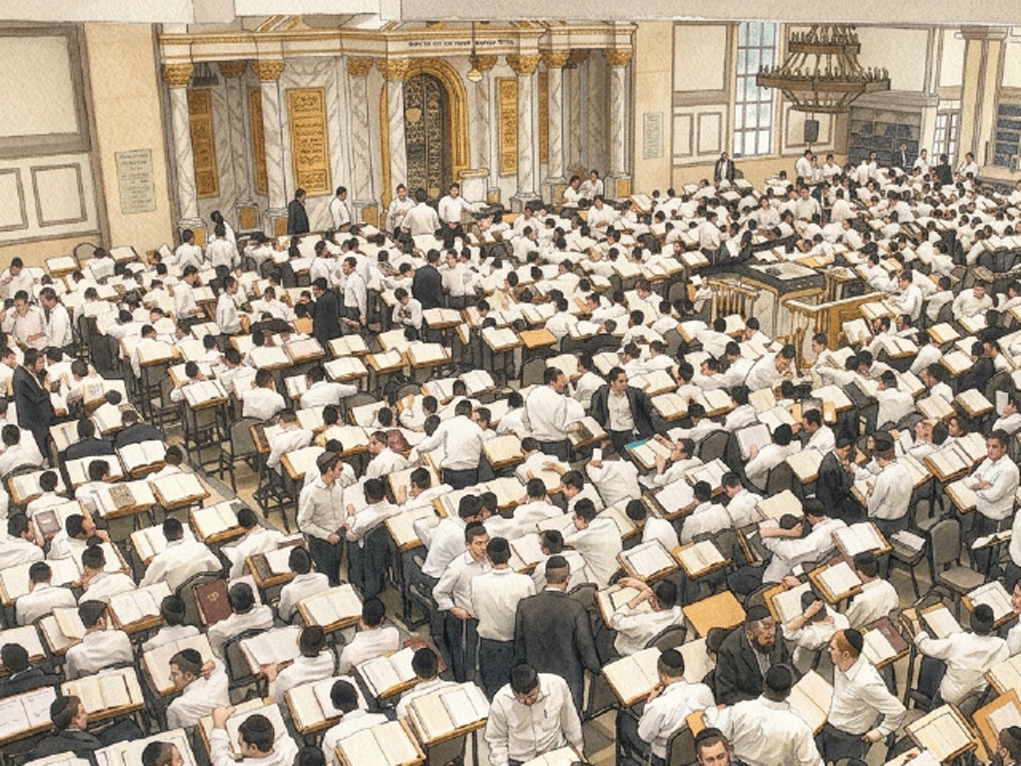 Yated Ne'eman7 days ago
This week, we enter the Three Weeks, a period unlike any other on the Jewish calendar, a time of mourning for events that took place centuries ago. It is a time to remember what we have endured as a people, to miss what we no longer have, and to recognize that the absence we have grown accustomed to was never meant to be normal.
The Bais Hamikdosh was the place where Heaven and earth met. It was where the Shechinah rested openly among Klal Yisroel, where every korban expressed our yearning to draw closer to Hashem. The Bais Hamikdosh was where tefillos ascended with a clarity we can scarcely imagine. It was the beating heart of the Jewish people, the place from which holiness radiated to the entire world.
Its destruction marked the beginning of a long exile in which Hashem’s presence became hidden and our nation was scattered across the globe. We have built communities, yeshivos, and homes of Torah that are sources of great pride. Yet, every simcha remains incomplete, every home bears a zeicher l’churban, and the center of Jewish life remains in ruins.
Perhaps the greatest tragedy of golus is not merely that we have lived so long without the Bais Hamikdosh, but that we have become accustomed to living without it. We have learned how to navigate golus. We have learned how to flourish in foreign lands. We have become comfortable in a world that our ancestors never mistook for home.
The Three Weeks insist on awakening us from that complacency. They remind us that no matter how secure we feel, no matter how prosperous our communities become, no matter how much Torah is learned and how many beautiful shuls are built, something essential is still missing. We are a people waiting to come home.
Lately, we have received several reminders of this reality. We became comfortable in our golus in Western Europe, in the United States, and, dare we say, even in Eretz Yisroel. Each of these places has recently reminded us of the true nature of golus, leaving us shaken and concerned.
There was a time, not very long ago, when support for Israel was one of the few issues that united Democrats and Republicans. From President Harry Truman’s recognition of the Jewish state in 1948 through decades of bipartisan congressional support, standing with Israel was viewed as both a moral obligation and an American strategic interest. Republicans and Democrats disagreed on taxes, spending, foreign policy, and countless domestic issues, but support for Israel remained a bipartisan constant.
For decades, New York stood at the center of that consensus. It was home to some of America’s strongest pro-Israel Democrats. Men such as Senators Daniel Patrick Moynihan and Jacob Javits defended Israel unapologetically on the world stage. The city’s large Jewish population helped create a political culture in which support for Israel was considered both morally right and politically prudent.
Those days are changing. Last week’s Democratic primary elections in New York may ultimately be remembered as a turning point. A slate of socialist candidates defeated established Democrats while campaigning on democratic socialism, class warfare, and promises of dramatically expanding government.
More importantly, woven through nearly every successful campaign was a common thread of hostility toward Israel.
These candidates were not merely critical of Israel. They attacked their opponents for supporting Israel. Progressives have created a political environment in which, to survive Democratic primaries, candidates increasingly feel compelled to distance themselves from support for Israel.
That is an extraordinary political reversal.
Ultra-liberal Congressman Dan Goldman was condemned for being too close to Israel and for his relationship with AIPAC. His victorious challenger, Brad Lander, repeatedly attacked those ties, making opposition to AIPAC a defining issue of his campaign.
Lander accused Israel of committing genocide in Gaza, pledged to oppose American arms sales to Israel, and declared after his victory that he intends to become “one of the Jewish members of Congress most willing to stand up for Palestinian human rights,” while insisting that American taxpayers should no longer finance “Netanyahu’s wars.”
Elsewhere, Darializa Avila Chevalier defeated veteran Congressman Adriano Espaillat after campaigning on ending military aid to Israel. Her political résumé includes organizing Columbia University’s pro-Palestinian encampments and participating in anti-Israel activism dating back to her years as part of Students for Justice in Palestine.
Her victory celebration was punctuated by chants of “Free Palestine” as she proudly repeated her promise to block military assistance to Israel.
These were not isolated races.
They were victories by candidates backed and promoted by New York City Mayor Zohran Mamdani, whose political rise has become emblematic of a movement that increasingly views opposition to Israel not as a liability but as a badge of ideological purity.
Only a few years ago, rhetoric of the type these people employ would have ended a mainstream political career. Today, it helps build one.
But something deeper is taking place.
When these people talk about Israel, they do not merely mean Israel. They mean us. They mean the Jews – the rich Jews, the greedy Jews, the Jews who throughout history have been made the scapegoats for society’s ills. Yet, they cloak their antisemitism in language that denies the Jewish people’s right, after centuries of persecution, exile, expulsions, pogroms, and the Holocaust, to live safely in their ancestral homeland.
We do not need to agree with every decision of the Israeli government – and we don’t – to recognize that relentlessly portraying the world’s only Jewish state as uniquely evil both feeds, and is fed by, antisemitism.
The line between anti-Zionism and antisemitism becomes increasingly blurred when Jewish students are harassed, Jewish businesses are targeted, and elected officials are ostracized simply because they support Israel’s existence.
Moreover, politicians, as well as podcasters and media talking heads, have discovered that attacking Israel energizes activists, excites donors, dominates headlines, and increasingly wins elections in urban districts.
As hostility toward Israel becomes a reliable path to clicks, ratings, and higher office, more politicians and media figures will adopt similar rhetoric. It is noteworthy that virtually none of the Democratic Party’s leaders or elected officials has condemned the statements and beliefs of these progressive candidates. You can count on the fingers of one hand those who have declared that such individuals do not belong in the Democratic Party, in Congress, in the Senate, or in any position of public responsibility.
As America celebrates its 250th anniversary as the bastion of liberty, this trend should concern not only Jews, but all freedom-loving people, both in the United States and around the world.
History has repeatedly shown that societies that normalize hostility toward Jews rarely stop there. Antisemitism has often served as an early warning sign of broader civic and moral decline.
The issue facing America is larger than foreign policy.
It is whether we remain capable of distinguishing between a democratic ally defending itself against terrorists and organizations that openly celebrate the murder of civilians.
It is whether ideological purity will replace moral clarity.
These elections, together with the recent primaries that have produced similar candidates in Maine, Michigan, New Jersey, and elsewhere around the country, should serve as a warning.
Ideas once confined to the political fringe have steadily entered the mainstream.
Language once universally condemned is now increasingly accepted and applauded.
Hostility toward Israel is no longer merely tolerated in parts of American politics. It is rewarded.
Chazal tell us, “Halacha hee b’yodua she’Eisov sonei l’Yaakov.” Throughout history, that hatred has worn many disguises. Sometimes it came draped in the robes of religion. Sometimes it marched beneath the banners of nationalism. Today, it often presents itself clothed in the language of human rights, anti-colonialism, and social justice.
The vocabulary changes. The animosity remains the same.
History teaches another lesson. Every empire, every ideology, and every movement that sought to marginalize or erase the Jewish people eventually passed into history.
Klal Yisroel endured.
We do not place our trust in political parties or election returns. We appreciate our friends, recognize dangers when they arise, and speak honestly about the challenges confronting our community. But ultimately, our confidence rests where it always has – in the Ribbono Shel Olam, Who has sustained His people through every generation.
During this period of the Three Weeks, we think of the churban of the Botei Mikdosh and of the many Jewish communities that existed for centuries, only to vanish almost overnight.
If you travel today to Vilna, you will find weathered gravestones whose inscriptions are slowly disappearing beneath layers of moss. You will see a vast, historic cemetery with a sports complex at its center, and you will read about plans to further develop the resting place of thousands of our ancestors. It is not enough that they did their best to destroy Jewish lives, torturing and tormenting them beyond imagination. They now feel compelled to disturb them even in death, denying them the most basic human dignity of resting in peace.
And in Vilna, and all across Europe, on streets where every Friday afternoon women once hurried home carrying fish, where fathers returned from the market and children ran to greet them, today there is only silence. Where there were once shtieblach, shuls, and botei medrash pulsating with life, filled with the sounds of Torah and tefillah that sustained the world, today there is emptiness and desolation, as many locals have done their best to ensure that those places are – and remain – Judenrein.
The Nazis, their collaborators, and all those who sought to erase Jewish existence succeeded in destroying bodies and buildings. They succeeded in emptying streets and silencing communities. But they did not succeed in silencing the Torah.
Auschwitz, Birkenau, and the forests of Ponary and Kelm, as well as Bialystok and Babi Yar, where the voices of Jews were cut short, still stand as haunting reminders of that destruction. But in cities and towns throughout the world, those voices are once again heard, loudly, proudly, and unmistakably.
Today, young people sit in botei medrash, struggling over the very same difficult line of Gemara that a child in Tashkent, Brody, or Warsaw struggled with a hundred years ago. Mothers light Shabbos candles, covering their eyes and swaying with emotion as they recite the same tefillah their grandmothers whispered in small wooden homes across Eastern Europe. Jews everywhere are opening seforim and continuing conversations that tyrants tried to bring to an end.
There is a profound thought from Chazal (Taanis 5b) that offers a powerful response to the tragedies of our history: “Rabi Yitzchok said in the name of Rabi Yochonon, Yaakov Avinu lo meis – Yaakov Avinu did not die.” The Gemara explains that just as Yaakov’s children are alive, he, too, is alive. The continuity of his descendants, their loyalty to Yiddishkeit, and their commitment to Torah and mitzvos are themselves a form of eternity.
Nowhere is that more evident than when we reflect on the Jewish communities of the Diaspora that have been lost since the churban.
Think of the men who sat in little shtieblach in Kishinev and Galicia, worrying whether their grandsons would know a Tosafos. Think of the mothers in Germany, Spain, and Portugal who recited Tehillim, praying that their children remain faithful Jews. Think of the millions of simple Yidden who owned little, endured much, and measured success not by wealth or honor, but by whether their children would continue the chain that stretched back to Har Sinai.
Their worlds were consumed by fire. Their homes were burned. Their botei medrash were emptied. Entire towns, cities, and even countries were emptied of Jews. And yet the chain was never broken.
The bochur wrestling with a difficult Rambam. The father walking to shul on a Shabbos morning with his little son. The family gathered around the table singing zemiros. The child in cheder reciting, “Torah tzivah lanu Moshe morasha kehillas Yaakov.” These are not merely echoes of the past. They are the answer to those who believed they could erase us.
Our president is fighting with his opponents over the construction of a giant arch at Arlington National Cemetery. Civilizations build their monuments out of stone and marble. Ours are built of children, Torah, and memory.
The great cities of Europe once contained magnificent shuls whose walls seemed to touch the heavens. Many are now museums, ruins, or empty shells.
The enormous botei medrash in Lakewood, the crowded shtieblach in Boro Park, and the yeshivos in Eretz Yisroel, filled with thousands of people learning Torah, are our memorials to the generations that came before us.
The signs of the churban are everywhere. You can walk through Yerushalayim and still see walls scorched by the Romans as they destroyed the Bais Hamikdosh. You can see the massive stones they hurled from the walls surrounding the Bais Hamikdosh. You can walk along the very paths trod by millions of olei regel. And, of course, you can daven at the only remnant we have of the Bais Hamikdosh, the Kosel, from which the Shechinah has never departed. It still stands, beckoning us to come home, to return to what we once were and what we can once again become.
We have lost so much. We are a wandering people, and now we enter three weeks of mourning, three weeks of aveilus, to reflect upon what we have lost and what we continue to lack.
The headlines change. Political parties rise and fall. Empires come and go, just as they always have. But the Jewish story has never truly been about them. It has always been about a people carrying the memory of their true home, refusing to mistake golus for geulah.
As the Three Weeks begin once again, we remember what was destroyed and what still must be rebuilt. We remember that we are a people waiting to come home, and that we can never be comfortable until we do.
I remember as a young child, we would be playing outside by a neighbor and my mother would call for us and say, “It’s time to come home. It’s time to have supper and do homework.”
The Three Weeks is like that call, reminding us that we have work to do and we have to come home.
Every day, we await the arrival of Moshiach. Every day, we daven for him and hope that this will be our final day in golus. May these be the last Three Weeks we observe in mourning, and may we soon merit to witness the fulfillment of the tefillah we recite three times each day: “Vesechezenah eineinu beshuvcha l’Tzion berachamim.”
Amein.
 Yated Ne'eman7 days ago
I’m going to take my cue from Rav Chaim Shmulevitz, who used to give his famous sichos mussar in the Mir on the parsha that had just been lained the day before. One of his talmidim once shared with me that the rationale was that the parsha had just been absorbed, was still fresh in everyone’s mind, and could be applied as needed. In my case, I presented the following concept in my Shabbos drosha, but I certainly believe the message is still quite relevant and current.
The world often calls this by various phrases such as carpe diem, literally meaning “seize the day,” and clichés such as “strike while the fire is hot.” However, as usual, the Torah anticipated all of these with the word and middah of zerizus. Contrary to popular mistranslation, this concept is not necessarily related to doing something fast (see Pachad Yitzchok, Pesach, Maamar 1) as much as doing it correctly at the appropriate moment. In Parshas Chukas, this relates to the sin of what is called the mei merivah, “the waters of contention.” Instead of speaking to the stone, Moshe Rabbeinu hit it. Although the miracle was great, bringing forth enough water for the millions of people and animals, Moshe Rabbeinu and Aharon Hakohein were henceforth forbidden to enter Eretz Yisroel. As the Ohr Hachaim Hakadosh points out, that error changed the world immediately. Had this not happened, we would have entered Eretz Yisroel and built the Bais Hamikdosh, which would have avoided all the future tragedies of churban and golus.
Although the explanation for the lapse of these great tzaddikim is beyond the scope of this essay, meforshim are unanimous that the sin was infinitesimal. In the words of Rav Eliyohu Eliezer Dessler (Michtav M’Eliyohu 1:100), it was indeed microscopic. Rav Leib Bakst goes even further, saying that the dire consequences were not the result of sin, but of a missed opportunity. In other words, despite the constant availability of teshuvah, some things can simply not be instantly restored. They may require a lengthy process of healing and rectification. He cites the Gemara (Brachos 7a) that when Hashem first appeared to Moshe Rabbeinu, he “hid His Face” (Shemos 3:6). Later, when Moshe requested, “Show me your glory” (ibid. 33:18), Hashem responded, “You will not be able to see My face” (33:20). The Gemara explains pithily that Hashem was telling Moshe Rabbeinu, “When I wanted, you did not; now that you want, I do not.” As Rav Bakst concludes, this is not tit for tat or even middah keneged middah. It is a missed opportunity.
I would like to suggest that this has been the saga of mankind from the beginning. Adam and Chava sinned and were banished from Gan Eden. They did an incredible teshuvah for over 130 years (Eruvin 18b and see Dorash Moshe, Drosha for Shabbos Shuvah, page 197), but were not readmitted to Paradise. The great return is still waiting after almost 6,000 years. The Tosafos HaRosh asks why Moshe was punished for a moment’s hesitation by never being able to see the Shechinah. But according to Rav Bakst, it is not a punishment at all, but sometimes, once the moment has been lost, it is irretrievable.
The Piaseczna Rebbe, in his guide for yeshiva students, Chovas Hatalmidim, written under horrific circumstances during the Holocaust, cites a striking Medrash (Bamidbar Rabbah 18:22): “A man was traveling from Eretz Yisroel to Babylonia, stopped to eat a bit, and saw an incredible sight. Two birds were fighting, one actually killing the other. Apparently regretting its action, it flew away, returning with a certain herb. He placed it upon the mouth of the dead bird, which came back to life. The herb fell from the bird’s mouth as he flew away. The traveler picked up the precious grassy prize, planning to awaken the human dead, but first came upon a dead lion. He gingerly placed the magic herb on the lion’s mouth, which promptly jumped up and swallowed his benefactor. The Medrash concludes its homily with the warning: “Don’t do kindness to something evil (i.e., dangerous) so that no evil come upon you. Shaul took pity upon Agag [the king of Amaleik] and what was the result? We inherited Haman and his evil decree.”
The Piaseczna Rebbe urges us to consider: “Imagine that someone has the power to revive the dead. He can bring back Moshe Rabbeinu, the Arizal, Rabi Akiva, Rav Shimon Bar Yochai, and bring the geulah sheleimah. But someone convinces him to sell the precious herb for a billion dollars. He does the deed, but later tears his hair out in remorse. The man in the Medrash could have saved humanity but instead revived a lion. His action can only be self-destructive and futile. If he had at least resurrected his parents or one human being, perhaps the act would have been justifiable. But to waste it all on a lion is both criminal and tragic.
The Gemara (Avodah Zarah 17a) tells us the inspiring tale of Elazar ben Durdaya, who committed many horrible sins. Finally, however, he repented powerfully, dying in the process. A voice rang out from heaven declaring, “Rebbi Elazar ben Durdaya is destined for Olam Haba.” When Rabbeinu Hakadosh heard this, he began to cry. “There are those who require many years to gain entrance into the World to Come and there are those who acquire access in a moment.” The question is asked: Why did Rebbi cry? Shouldn’t he have been happy for this amazing baal teshuvah’s successful journey?” The answer given by many is that Rebbi was crying for all of us who have missed opportunities to gain our own entry and accomplish so much.
To return to the lion-slayer, the Radal comments that this man was not interested in doing something unprecedented for mankind. No, all he wanted was to be seen as a Redeemer and Moshiach. If that is what you want, I will send you a lion. When given the chance to help a person, let alone all of mankind, you must jump and do the deed. If not, it is you who will be swallowed alive.
I couldn’t help but think that after all the wonderful things President Trump has done for Klal Yisroel, he was granted an incredible opportunity. We had Iran — Malchus Poras — by the neck. Their nuclear arsenal had been destroyed. Their army and navy were decimated. Don’t stop now. Seize the moment. Like Avrohom Avinu, act with zerizus. But sadly, bad advice prevailed, pettiness replaced foresight, and the focus turned to votes and midterms instead of eternity and gaining infinity. The lion won. The president and we lost.
Let us not fall into the same old game. It is not politics. We get what we put in. One of my members said it best. If chareidim are being beaten up in our own country of Eretz Yisroel, if yeshiva bochurim are being imprisoned for learning Torah, do we not expect the lion to bite us as well?
We are now in the period of the Three Weeks, when Chazal remind us that “whoever is alive when the Bais Hamikdosh is not rebuilt, it is as if it was destroyed in his time as well” (Yerushalmi, Yoma 1:1). It seems that we are all granted that one chance to win the geulah lottery. But if we don’t even buy in, it is our own fault. This is the time of year when we are all given the opportunity to mourn over the churban, but also to explore what we can — what we must — do to rebuild it. We use technology at our peril, but we can all take a virtual trip though the Bais Hamikdosh and awaken our gaaguim gene, which may have taken a nap. In Daf Yomi, we have been toiling in Seder Kodshim for hundreds of dafim. Surely something has aroused our yearning for its momentary return to reality. The Chofetz Chaim instituted the learning of Kodshim because he felt that the time was ripe. We, too, have the magic herb in our hand. Let’s not awaken the lion. Let’s awaken the dormant veshochanti b’socham inside every one of us, which the Alshich Hakadosh and others say is our internal Bais Hamikdosh.
At this time of year, many of us learn the Gemara (Gittin 56b) about Rav Yochanan ben Zakai, who was given the once-in-a-lifetime ability to ask for whatever he wanted. He opted to request the rescue of “Yavneh and its scholars.” Vespasian assented and the result was the revival of Torah, purity and sanctity in Eretz Yisroel. This is not an appeal for money or funds, which are obviously needed by Keren Olam HaTorah. But perhaps even more importantly, when we contemplate the plethora of antisemitism, the loneliness once again of Klal Yisroel amongst the seventy — actually much more — wolves who would devour us, this is a moment of challenge and ability for us all. Let’s resurrect our own innate love of geulah and not awaken the lion.
It is well known that Albert Einstein eventually regretted having provided the magic equation which would result in the nuclear bomb. We, too, should learn from the failure of even our best secular leaders and do what we can to be mechayeh the meisim within ourselves and our people to love Torah and each other, and to bring the geulah sheleimah rapidly be’ezras Hashem.
 Yated Ne'eman7 days ago
Sometimes we can explore an issue without having clear-cut answers or solutions. That is what we are about to do now.
Summer is here, and with it has come a fair amount of anxiety—an anxiety that seems to be especially acute during the days or weeks that are considered “no man’s land”: the weeks when school is over but camp hasn’t yet started.
The most common refrains are comments like, “Oy! What am I going to do with my kids?” “How am I going to keep them entertained?” or, “All I am going to hear all day is, ‘Mommy! I am bored!’”
Another common refrain is, “When the kids are home, all they want to do is shop, shop, shop, because they need _________ (fill in the blank yourself) for camp.”
This time of year has become an overwhelming ordeal for many parents as they try to juggle keeping their children happy and entertained, filling their children’s needs and/or wants, regular housework, and, for those who actually work during the summer, work!
Yes, there are solutions, such as the “in-between” camps established by some entrepreneurial young men and women. The in-between camps are just that—camps to occupy children between school and camp.
For very young families, the in-between camps might be a lifesaver, but they also come with a price tag, just one more extra expense that harried parents must somehow come up with.
Now, I get it. I really do, especially for families where the father is learning or working and the mother is also working straight through the summer.
A Sign of the Times?
And yet, I wonder: Is it also a sign of the times? Is it possible that we have reached a point where it is almost assur to just let kids be and have an unstructured week or two? (Obviously, I am talking about kids who are old enough to take care of themselves.)
The question is why. Why are parents so anxious about their kids being home for a few days, or even a week or two, without structure? And why are kids so “bored”?
I don’t know the answer, but I do know that it wasn’t always like this. I recently had a discussion with some people of my generation, and we were reminiscing about what we did during the summer when we had eight to ten weeks off from school.
Pastimes from the Past
Yes, some went to camp, although most went for only one month. Many (particularly those who lived in Brooklyn) also went to bungalow colonies, but many others just did “nothing.”
Yes, I mean it. They played in the streets with other kids from the neighborhood who were home “doing nothing.” Parents would occasionally take the kids on an outing or to a park, but there were weeks when children more or less took it easy and entertained themselves.
For some children whose parents were teachers and also had the summer off, perhaps they worked on joint family projects. All those repairs, paint jobs, furniture-building projects, and organizing pictures into albums that no one had time to tackle during the school year got done as a family effort during the summer.
That has changed drastically.
In today’s world, very few children are left to entertain themselves, very few children are roped into projects, and very few children are happy to have unstructured time.
The Shift…
Now, there could be a number of reasons for this phenomenon.
First, the world is a scarier and more dangerous place, and unstructured time can often lead kids to places and things that are not good for them, both spiritually and materially.
Second, today’s kids need more structure. They are accustomed to highly structured environments, much more so than children of past generations.
The school day is long, and nearly every pocket of unstructured time has been tranasformed by one program or another. There are Avos Ubonim programs for the long Motzoei Shabbosos, Chol Hamoed learning programs for Chol Hamoed, and all types of side programs and incentives to keep kids occupied.
There was even a junior Adirei HaTorah program during the Adirei HaTorah event to keep the boys occupied with learning and watching the event so that their mothers wouldn’t be stuck trying to entertain them for the entire afternoon and evening.
I can bear witness to this simply by observing the way my own older children dealt with free time compared to my much younger children.
Two decades ago, when I was raising my older children, they were much better able to cope with “being bored” and with a lack of structure than those growing up today. Whether they threw themselves into baking honey cookies for Rosh Hashanah during the summer and hamantashen for Purim during midwinter vacation, whether they simply relished a good book, or whether they got together with friends to go biking or play games, they managed.
…And Its Possible Reasons
That is simply the reality. Again, the reason remains somewhat unclear.
In truth, today’s kids need more structure and more stimulation. They become “bored” much more easily from simply hanging out with friends on the block. They crave much more action. Perhaps it is because the nature of life today is constant action. Everything is a “breakout” and a “matzav.” As a result, simply sitting around playing, shmoozing, or doing nothing makes kids nervous and antsy.
There is another reason why parents become so anxious when their kids do not have structure.
Sadly, we live in a society where most mothers, in addition to undertaking the klalah of Chava—the pain, trials, and tribulations of bearing children, along with the tzaar gidul bonim—are also taking upon themselves the klalah of Adam, “bezeias apecha tochal lechem.”
When fathers are away either in yeshiva or at work and mothers also have to work, they are simply not able to let their children roam around without some kind of general supervision. Thus, these weeks, when there is no official structure or person to take responsibility for their children, leave parents—and especially mothers—feeling overwhelmed.
That being said, there is something wholesome and healthy about giving a boy or girl some time just to be—not to have to run, not to have to accomplish something, not to have to reach a goal, but simply to be.
Yes, I know that this may sound almost like kefirah, but many children could benefit from a slower pace for a few days each year. Many children might actually discover new skills and new ways to occupy themselves that could stand them in good stead later in life.
It might not be such a bad idea for kids to learn how to figure things out even when they are soooo bored.
They might even enter the new school year with renewed vigor and return to the structured environment of school with genuine simcha.
Are We Healthier?
Putting everything else aside, I am worried that there is another component to this that is somewhat troubling.
It does seem that some parents are actually scared of spending time with their kids. They simply don’t know what to do when left with their children for long periods of unstructured time.
On the other hand, there are mothers who, for economic reasons or otherwise, create something called “Camp Mommy,” where they become their child’s counselor, head counselor, cook, and camp director all in one. They put together a basic schedule of davening, learning, outings, and playing, and the mother runs the camp.
To do this, a mother must first of all be home and not working. Second, she needs to have the personality to become a counselor, head counselor, and everything else on the list. That said, the mothers who have actually managed to implement such a camp usually come out of the summer exhilarated by having truly connected with their children in ways they simply are never otherwise able to.
The bottom line is that, for better or for worse, both children and parents are less equipped today to deal with even a small empty gap in their schedules to the extent that both become anxious and a bit discombobulated by the lack of structure, even for relatively short periods of time.
It wasn’t always this way, and something tells me that we aren’t necessarily healthier as a result.
 Yated Ne'eman7 days ago
It was the summer of 1976. Early in Tammuz. I was in bais medrash and the zeman was almost over. For the Philadelphia Yeshiva, it was the last “off Shabbos” before bein hazemanim. It was also one of the most celebrated weekends in America in the twentieth century. It was the July 4th weekend, 200 years after the Declaration of Independence was read, only a couple of miles from where I would now sweat over an Avnei Miluim. And we were not oblivious to the fact that the country was celebrating its 200th anniversary.
There were flags everywhere, from big cities like Philly to little shtetlach like my native Woodmere and Cedarhurst, where my home was nestled on the border of both of those Five Towns. There was talk of parades and marches, fireworks and celebrations. Patriotism was palpable. Everybody was cheering for the red, white and blue. America had defeated the evil Axis only 30 years earlier and was glad to finally have gotten out of Vietnam about a year earlier, but still loathed communism. The riots of the late 1960s were behind them, and Gerald Ford, the current president, was a voice of moderation after a turbulent Nixon resignation. It was 1976, and the entire country had essentially been drunk on its own birthday for the better part of two years.
The government was deeply invested in the celebration as well. Flags flew everywhere. Bunting draped storefronts and homes. The Post Office issued commemorative stamps honoring the Declaration of Independence, Revolutionary heroes, the Spirit of ‘76, state flags, and scenes from the founding of the Republic. The Mint redesigned the nation’s circulating coins with images of Independence Hall, the Liberty Bell, and the colonial drummer. There was a train that went across America where people could board and view the Declaration of Independence, Washington’s copy of the Constitution, a moon rock, and other historic treasures through forty-eight states. Tall ships from around the world filled New York Harbor. People painted their mailboxes red, white, and blue. There were Bicentennial beer cans with Revolutionary War imagery on them. Schools devoted months to the Bicentennial. Communities organized parades, historical reenactments, colonial fairs, concerts, and exhibitions. The Smithsonian mounted special displays, and the new National Air and Space Museum opened during the Bicentennial year.
I remember driving up to a bungalow colony in Monroe to visit my Uncle Avrohom and Tanta Ruthie, aleihem hashalom. We took a short detour into the newly established community of Kiryas Yoel, which was then still tiny. Homes were being built, infrastructure was minimal, and it remained largely a rural enclave adjacent to Monroe. But the Satmar Rebbe had a home there, and in front of it, an American flag waved proudly.
Fifty years later, the 250th anniversary of American independence is upon us. Maybe it’s because they gave it a long fancy name, the Semiquincentennial, or maybe it’s because idealism is dead. Maybe the country is too fractured and parochial to even believe in one common theme. Whatever the reason, to me it seems dead. You hardly hear about it or see anything celebratory. It’s a muffled hurrah said almost apologetically. It just seems like a big dud.
It’s no longer about freedom or the recognition of the liberties that soldiers died for. I went into the post office today and asked for the celebratory stamps produced in honor of the revolution. All I got for $10.14 was a sheet designed by the famous designer Ralph Lauren depicting what now represents America: a pickup truck, a baseball mitt, a teddy bear, and a cheeseburger.
My rebbi, Rav Mendel Kaplan, was unique. On his weekly drive from Philadelphia to Brooklyn and back, he would pick up hitchhikers and make conversation. Often, he would relay those conversations to us bochurim. He once told us that he picked up a backpacker and asked him if he was Jewish. The fellow replied, “Half and half.”
The rebbi sighed, lamenting that the situation of Yiddishkeit had boiled down to a soda. (“Half and Half” was a popular half-grapefruit, half lemon-lime soda by Cornell Beverages — some of you may remember it from seudah shlishis at your local shtiebel.)
I thought about what he said. Fifty years later, the national symbol of American Independence Day has become a pickup truck and a cheeseburger.
There is something worth pausing over here, though. The ephemeral things — the pride, the principles, the memory of what soldiers bled for — erode. Ideology fades. Sacrifice gets summarized. And eventually, you are left with a teddy bear on a postage stamp.
But we are different. We celebrate events that happened not 250 years ago but thousands of years ago, be it Pesach, Shavuos, or Sukkos, with no less fervor than the generations before us. Every Yom Tov is graced with new seforim, more mesibos, more learning, more avodah. Because they represent not history, but eternity. And eternity never fades into a cheeseburger.
The Three Weeks are upon us now. And yes, the raw pain of the churban is harder to feel with two thousand years of distance. But we don’t simply let it slip by. We don’t allow it to become symbolic. There are hundreds of shiurim, divrei chizuk, asifos, and calls to action, all ensuring that the wound stays open enough to heal. We feel the churban not because we remember it, but because we are still living it. The exile is not a historical footnote. It is the present tense.
America’s icons, fifty years from now, will probably be something even more forgettable than a cheeseburger. Because when the ikkar is gone and the founding principles are erased, all that remains is the tofel. The side dishes. Not even the burger. Just the French fries.There is an apocryphal story about Napoleon, who, while busy conquering Europe, stopped in a shul on a summer’s eve in August. His visit coincided with the night of Tisha B’Av and he walked into the shul while the kehillah was reciting Kinnos. As he entered the shul, he saw men without shoes on the floor lamenting while holding candles while crying over from books. The shul was dim, with only a few candles burning. The raw wood of the holy Aron was exposed, the paroches removed and set aside. The amud and bimah were bare, exposing the pockmarks, knotholes and splintered grain of wood that seemed to have absorbed the tears of many a supplicant. The only light came from a few candles stuck to the floor. The lamps on the wall were extinguished.
In his quest to grant equality to all his new subjects, he wondered what tragedy had befallen this
community and asked how he could rectify the situation. The rov explained that the mourning was not for a recent tragedy, but rather for one that occurred almost two thousand years prior. He explained that on this day centuries ago, in a land thousands of miles away, a Jewish Temple was destroyed and we were expelled from our land. He explained that every year on the anniversary of the destruction, we sit on the floor and we mourn. To which Napolean responded, “A nation that still cries and fasts for nearly 2,000 years after their Temple has been destroyed will surely be rewarded with their Temple.”
We do not have icons for the Bais Hamikdosh. We do not commemorate it with a pickup truck or a teddy bear or a collector’s stamp. The Bais Hamikdosh is not an icon. It is the makom of the Shechinah. It is the place and embodiment that we have not stopped trying to return to for nearly two thousand years.
America, sadly, has lost its direction. Klal Yisroel, however, will never forget where we came from and where we are headed. We will never diminish the significance of our past and we will never forget the focus of our yearning, and thus we will never diminish the ultimate celebration.
Yehi ratzon that we see the geulah sheleimah and that the only thing we’ll say about this long golus is that we never, not for a single Tisha B’Av, forgot where our home was.
 Yated Ne'eman7 days ago
Israeli President Herzog’s visit to Romania this week, to attend a state ceremony marking 85 years since the Iași (pronounced Yash) pogrom of June 1941, reopened a largely forgotten chapter of the Holocaust which saw one of the most barbaric massacres of World War II.
In an orgy of savagery orchestrated by Romanian dictator and Hitler ally Ion Antonescu, 13,000 to 15,000 Iasi Jews—nearly a third of the city’s population—were murdered by Romanian and German forces, police, and local mobs.
The pogrom predated the Nazi mass extermination camps and demonstrated to Hitler the devastating efficiency of state-sponsored mass murder.
This week’s commemoration, which included a religious burial ceremony, was held at the city’s Jewish cemetery, where the remains of many of the pogrom’s victims lie in a mass grave discovered only recently.
“We are at the square where it all started, the massacre in Iasi 85 years ago, where thousands and thousands of Jews were butchered, slaughtered, and tortured both on-site, in pits, in common graves, and in the death trains,” Herzog stated.
“This memorial ceremony for the tens of thousands of Jewish women, men, children and elderly people murdered on this soil, in Iasi and its surroundings, between June 28 and July 6, 1941, does not erase the suffering of the victims,” he said.
“Nor does it lessen the moral stain of the perpetrators of the crimes. It does not undo the murders, humiliations, beatings or death train horrors that were planned at the highest levels, but carried out by all layers of society in those terrible summer days, 85 years ago.”
Herzog said the ceremony also does not answer the most painful question left by the massacre.
“How? How can one even begin to understand cruelty on such a scale, stretching across an entire society? How could it be that in a great European city, which for centuries served as a thriving center of Jewish life, the image of G-d was erased?
“The only answer to this shattering question is deafening silence,” Herzog said.
Others have offered a different answer. In Romanian society, where anti-Semitic outbreaks repeatedly erupted long before the Nazis arrived, particularly from the 19th century onward, Jews had never truly been safe.
“It cannot be denied that there is a strong anti-Semitic feeling in our country. That is an old question in our history,” Romanian King Carol II infamously admitted in January 1938.
The Iasi pogrom and the massacres, expulsions, deportations and murder of Jews across Romania and all of Eastern Europe during the Holocaust were the ultimate expression of a relentless hatred that had stalked Europe’s Jews for generations.
An Atrocity Preserved on Film, Official Documents
What makes the Iasi massacre seem unique is that it is extraordinarily well documented. Unlike other Holocaust events about which no written or precise orders have been found, or whose documents were burned at the end of the war, countless eyewitness testimonies, official communiqués, photos and films—many taken by the perpetrators themselves–document the monstrous inhumanity, almost hour by hour.
Many of these records, along with documentation of Romanian collaboration with the Nazis in countless other cities and towns, were hidden away for years in dusty archives during the Communist period. The regime’s leaders downplayed Romania’s role in the annihilation of almost half its Jewish population of 757,000.
In 2004, an international panel led by Holocaust historian Elie Wiesel found, based on copious documentation, that approximately 380,000 Romanian and Ukrainian Jews were murdered in territories under Romanian rule.
A great deal of this shocking and heartbreaking documentation can be viewed today in Bucharest, in the National Museum of Jewish History and the Holocaust in Romania.
Historian Radu Jude has lifted the veil on the horrors of the Iasi pogrom in his documentary “The Exit of the Trains,” which documents the eradication of almost the entire Jewish community. In the video, the author recounts his own reaction to discovering the truth about Romanian culpability in the annihilation of Romanian Jews.
“After the 1989 revolution [against the Communist regime], my generation experienced a great shock in finding out, from history books, about Romania’s participation in the Holocaust,” the historian relates. Throughout our youth, we had been repeatedly taught that we Romanians were a special people, that we had always been the victims of others, never perpetrators. And then you suddenly read books about the pogroms, the Holocaust … I, for one, had a meltdown discovering the lies and cover-up.”
Scapegoating the Jews
Before the outbreak of WWII, the Jews had been a presence in Iasi for over 400 years, becoming over the centuries an important center of Jewish religious life. Between 1930 and 1940, despite outbreaks of virulent anti-Semitism in the city where the Jews were physically attacked, expelled from the university, and maligned for being “Bolsheviks,” the Jewish population grew from approximately 30,000 to over 50,000.
For all the pain and hardship that the community had endured, nothing prepared it for what was to come on June 28, 1941.
Under dictator Antonescu, a rabid anti-Semite and trusted ally of Hitler, the government scapegoated the Jewish community, accusing it of collaborating with the Soviets who were fighting with the Allies against Nazi Germany.
False rumors were circulated by Romanian agents that Jews had “signaled” Soviet planes, aiding the pilots in conducting air raids over Iasi. This provided the pretext for a government-ordered “cleansing” of the Jewish population.
The terror began on June 28, 1941. At 9:00 p.m., a flare was shot from a German aircraft above Iasi, signaling the beginning of the pogrom. Immediately shots were fired from the streets, from houses, and from rooftops in almost every quarter of the town.
German soldiers began rampaging through the city, pounding on doors, arresting Jewish men and killing many indiscriminately. Once-friendly neighbors turned on the Jewish people, joining in the wave of vicious brutality.
“Our Christian neighbors, whom I considered my friends, came out of their homes with iron bars, hoes, spades and guns” and began to attack, recalled Lazar Leibovici (Times of Israel).
Thousands of Jews, mostly men and boys but women and children as well, were dragged to the central police headquarters. The round ups continued throughout the night, until midday on June 29, when a total of 5,000-6,000 Jews had been assembled.
Then, between 2:30 and 3:00 p.m., a false air-raid alarm was sounded, at which point the assembled Jews were fired on from all directions by the Romanian soldiers guarding them. The massacre continued for several hours, until less than half of the Jewish prisoners remained alive.
Death Trains Drove in a Circle for Days
The survivors were then marched to the local train station and crammed into cattle cars whose air vents were sealed. These “death trains” were sadistically driven in a circle for several days, while the trapped Jews died agonizing deaths from thirst, suffocation, and complete mental and physical collapse in the scorching summer heat.
The first train carried roughly 2,500 people before it stopped. More than 650 dead were removed to a mass grave. Soldiers denied water to survivors, and the journey continued. At each of several stops, hundreds more Jewish people were discovered dead. Local troops hired Gypsies to remove the bodies; their payment was anything of value they could plunder from the dead.
Fewer than 1,100 survived the Iasi death train that arrived in Calarasi on July 6. The second train carried 1,902 Jewish people compressed into 18 cars, and only 708 arrived alive.
The Iasi pogrom foreshadowed the reign of terror that continued through the summer of 1941. Over three weeks, in July and August of 1941, approximately 50,000 Jews were murdered in areas under Romanian control, as documented by historian Avigdor Shachan in “Burning Ice: The Ghettos of Transnistria.”
In return for Antonescu’s support of the Nazis’ invasion of the Soviet Union in 1941, Hitler gave the Romanian dictator the strip of land between the Dniester and Bug Rivers, and it is here that in September of that year, the Romanians began deporting Jews from the Bukovina and Bessarabia districts.
The region had been dubbed Transnistria, the name the Romanians gave to their new territory – ‘trans’ meaning ‘beyond,’ and ‘nistria’ for the Dniester River.
From 1941 to 1944, 300,000 Jews were killed at the hands of Nazi death squads and Antonescu’s troops before, during and after deportation to Transnistria, writes British historian Dennis Deletant in Hitler’s Forgotten Ally.
Unlike the industrialized killing machinery of Auschwitz, Romanian death camps used the more primitive methods—genocide by shooting, clubbing and starvation, and by exposing tens of thousands of people to a slow death by freezing and disease.
Of the 360,000 Jews deported to Transnistria, historians estimate that less than one-fifth survived. For decades, the survivors’ stories were rarely told and the annihilation of Romanian has faded from awareness.
Although Antonescu was tried as a war criminal in 1946 and executed by firing squad along with three of his top henchmen, parts of the Romanian people continued to extoll him as a great patriot who won back chunks of Romanian land from the Soviets.
Romania Today
Antisemitism in Romania remains a prominent issue driven by far-right political groups like the Alliance for the Union of Romanians (AUR). AUR has sought to downplay the wartime atrocities of Ion Antonescu, engages in baiting and intimidating Jewish leaders, and habitually minimizes the Holocaust.
Despite this, Israel and Romania today maintain strong diplomatic relations, based on a long tradition of cooperation going back to 1948, when Romania recognized the State of Israel immediately after its founding. Between 1967 and 1989, Romania was the only Warsaw Pact country that did not sever ties with Israel after the Six-Day War.
Romania generally maintains a friendlier posture toward Israel than many European Union members, but it also follows broader EU positions on many diplomatic issues. These include the endorsement of a “two-state” solution and adopting a critical position toward Israeli military actions in Gaza.
***
Dangerous Gambles for A Mitzvah
Rabbi Ahron Twersky was 16 when he was deported to Transnistria in 1942, then under Romanian control. In a lengthy oral testimony, quoted by Holocaust historian Esther Farbstein in her landmark Hidden in Thunder (pages 226–227), he describes the terrible suffering he endured but also moments of spiritual triumph.
One such moment took place shortly before Pesach 1942. He and some friends scraped together a bribe to persuade a non-Jew to procure some wheat for them.
“He brought us the wheat, we gave him his payment and hid the wheat in the cellar. Before Pesach, we went down to the cellar, secretly ground up the wheat and baked a bunch of small matzos…enough to give to several Jewish families, in addition to ourselves. I felt real happiness. Who would ever dream such a thing would be possible in this dreadful place!”
Rabbi Twersky reflected on another incident when he took a dangerous risk to observe a yom tov, but a gamble that ended badly.
“That Shavuos, I decided to hide and not go to work to honor the yom tov, but I was caught,” he related. “The Romanians dragged me out and beat me severely until blood gushed from my ears and nose. I was sure my life was over. But they threw buckets of water on me and ordered me to go to work. Somehow, despite my injuries and the terrible pain, I managed to do the road work.”
The Gravediggers
Rabbi Twersky went on to relate a terrifying experience in 1944 when a gang of Nazis entered the Mogilev ghetto and rounded up 1200 Jews, including himself. The Nazis ordered them onto a bunch of trucks, with the pretext of bringing them to a nearby town to work. Instead, the Jews were driven to a clearing in the forest about an hour from Mogilev, where machine guns ringed the area.
They were ordered off the truck at gunpoint. The stronger-looking men were given shovels and instructed to dig a mass grave.
“We were frightened to death,” Rabbi Twersky recalled. “We started to dig with the guns pointed at us, knowing these were our last moments on earth, that our bodies would soon fill this gigantic pit. The Germans were partying around, celebrating. Nothing made them as happy as knowing they were about to murder Jews.
“After we finished, one of them called out, ‘Juden schwein, your execution will take place in ten minutes!’
“The leader glanced at the watch on his wrist and called out ‘Ten minutes….’ As the seconds flew by, he’d call out ‘Nine minutes…Eight minutes… Seven minutes…Six minutes…Five…’ , smirking at us as the final minutes ran out.
Suddenly two German limousines pulled up and some officers got out. There was a lot of arguing in German—I couldn’t make out what it was about. It went on for ten minutes as we stood around the giant pit, praying silently for a miracle.”
“The Nazis suddenly turned to us, screaming, ‘Raus! Raus! Out! Everyone back on the trucks!’”
No explanation was given for the last-minute reprieve from death. But the prisoners needed none. Their prayers had been answered, igniting fresh hope in their anguished hearts. The war would surely end soon and with Hashem’s mercy, they would survive.
***
Eyewitness to the Pogrom
Chaim Solomon and his family lived through the Iasi massacres of June 28-July 6. Below are gripping excerpts from his oral testimony in an interview with the United States Holocaust Memorial Museum, October 1993:
On June 21, 1941 Germany invaded the Soviet Union and German tanks with soldiers singing were marching all over the city. We stayed indoors, shaking in fear, glued to the windows. On June 26th, the Soviet Union Air Force bombed the train station in Iasi, killing a number of people
The Romanians insisted that Jewish Communists in the city were signaling to the Soviets to drop bombs on the train station. They launched a vicious pogrom in Iasi, using a ruse to get the Jews to turn themselves in. On June 29, they instructed the Jews to come to the city hall to exchange their old identification cards for new ones. Many Jews complied. Others were brought there by force.
The police station and city hall were connected. The police station had a big courtyard surrounded by a stone wall. German soldiers and Romanian policemen kept bringing in waves of Jews. They were led into the courtyard, supposedly to continue on to the city hall. But lined up on both side of the courtyard were Romanians and Germans.
As the Jews passed this line of police and soldiers, these barbarians smashed their heads with their weapons. Or shot them in the temple. The courtyard of that police station filled up with dead or dying Jews. My two older brothers, Reuven and Henry, who had decided to go to the city hall together to get their new identification cards, should have been among these victims.
In the end, Henry went alone. It was nighttime as he entered the courtyard and realized something terrible was happening. He was near the back of the stone wall and he and a friend managed to jump over it without being spotted. They found a house with a big cross painted on it, saying “Christians live here, no Yidoni (Jews).” Which is a sign that the whole thing was planned ahead of time with the Christians in on it.
The boys hurried to the back of the house and found a shed filled with firewood, stacked all the way to the ceiling. They removed the top layer and crawled into the pile and replaced the layers so that when Germans or Romanians came to search for Jews, they saw the wood up to the ceiling and left.
They lay there quietly for several days, listening as the police and the Germans continued shooting people in cold blood. In one day, on June 29, between one o’clock and six, seven o’clock in the evening, they killed about 4 thousand people coming into that yard.
Meanwhile, we were hiding in the basement of our house which had several exits, as it was situated at the intersection of three streets. Which is how we managed to avoid the soldiers and guards. When they came in from one entrance, we slipped out another. Romanians were doing the roundups, the Germans did the shooting. We could see out of tiny windows and froze in horror as Jews were being marched away, or kicked and shot if they didn’t move fast enough.
A block or two down the street there was a famous shul…I saw a sight I can never erase from my mind: the rabbi of our town being dragged, beaten and killed. He was left in the street for a couple of days until some brave neighbors dared to run outside and bring him in.
Yated Ne'eman7 days agoNetanyahu: Arrests of Yeshiva Bochurim Do Not Contribute to Progress
This past Shabbos was a sad day in Eretz Yisroel, as almost 50 yeshiva bochurim and kollel yungeleit spent Shabbos behind bars in military prison. And just to be clear, the fact that they are serving brief prison sentences now does not mean that they will be able to move on with their lives after they are released. Even after they are let out of prison, they will still have the legal status of draft evaders and will continue to face the threat of arrest. Moreover, every ben Torah who is released from prison is forced to sign a document in which he promises to enlist in the IDF. They sign the documents because it will make no difference regarding their problematic legal status; nothing would be gained by refusing to sign.
In general, after an arrest, the detainee is brought before a military judge after a few days, and the judge decides on a prison sentence as a penalty for ignoring his draft order. In some cases, the sentence matches the number of days that the prisoner has already been held, and then he is released immediately. In other situations, the prisoner is returned to prison to complete his sentence.
Meir Horowitz, a bochur who I know, is a case in point. Meir lives in my apartment building and is a great-grandson of the renowned maggid Rav Sholom Schwadron. He was arrested one month ago, and his parents told me after visiting him in prison that his mental state was very poor. He was unable to acclimate to detention—and, in fact, why should he? On Sunday, he was finally brought before a military judge. His parents were present at the hearing and tried to lift their son’s spirits. Now, what do you think the judge decided? He ruled that Meir should meet with a mental health officer in the army within a week for an assessment of the family’s claim that he is not mentally fit to remain in detention. If the officer decides that the claim is correct, Meir will be released immediately, but if the officer feels that he is indeed fit to remain behind bars, then he will be kept there for another 30 days and will then be released (albeit retaining his status as a draft evader). When I asked the parents why the judge wants him in jail for two months, they explained that he has been considered a draft evader for ten years.
Please recite a perek of Tehillim for Meir ben Hadassah.
Even Prime Minister Netanyahu recently weighed in on the ongoing arrests. At a press conference dealing with the agreement with Lebanon (see below), Netanyahu was asked about the arrests and responded, “You do not gain anything when you cause the chareidi hesder yeshivos to send me the message, ‘Mr. Prime Minister, when you send people into the yeshivos to arrest Torah learners and take them to prison, no one is going to enlist.’” Netanyahu made a small mistake in this response; although yeshiva bochurim are being arrested, the police aren’t entering yeshivos (yet). Netanyahu claimed that there is significant interest in IDF enlistment among the chareidi public, but the arrests of bnei Torah are causing a decrease in enlistment. And he added, “If I were to tell you that the police were entering yeshivos in a European country, arresting young men learning Torah, and putting them in prison, you would be horrified. The policy of arrests needs to stop,” he continued, referencing a law that is currently in the works. “It isn’t achieving the desired effect. I would impose an immediate halt to bring about the broad agreements. That is what I hope to achieve.”
At the same time, Netanyahu said that anyone who is not learning in a yeshiva should face the full weight of sanctions for his failure to enlist in the army—including arrest.
Man Points Gun at Chareidim and Is Released
The arrests of yeshiva bochurim are dominating the headlines. For one thing, the phenomenon has caused many protests in the streets. I presume that you heard about the protest convoy of slow-moving cars organized by the Gerrer chassidus to create traffic congestion throughout the country. I won’t get into the questions of whether this is the right way to oppose the arrests, whether a protest of this nature achieves the goal of freeing arrested bochurim, and whether it might simply stoke more hatred for the chareidi community. I will tell you only that there were two incidents of violence against chareidim during that protest. In one case, an Arab truck driver tried to attack chareidi motorists with a metal club; the police showed up, but they refused to intervene. In the other incident, a Jewish motorist from Maale Adumim pointed a gun at the chareidim. He was arrested, but the judge released him to house arrest, a leniency that the religious public found infuriating.
A police representative revealed in court that the suspect admitted to his actions, but his version of the events had changed over the course of his interrogation. He first claimed that the gun had been pointing at the ground, but after he was shown a video in which it was clearly aimed at the protestors, he changed his story. The police representative added, “The danger of this behavior speaks for itself. Driving a car while holding a gun and aiming it at protestors is dangerous behavior, to put it mildly.” At the same time, the police officer confirmed that the suspect had no criminal record and said that there was no concern that he would tamper with the investigation. The suspect’s lawyer claimed that his client understood that his behavior was unusual and that he hadn’t been in danger. He claimed that the gun wasn’t removed from its case and the suspect didn’t even put his finger on the trigger. “It is apparent that this was a momentary act of a person who might have been taking out his anger or perhaps acted out of despair,” he said. The weapon was confiscated, which makes the danger level low. Therefore, the lawyer argued that there was no justification for keeping him in custody.
All these things may be debatable, but the judge’s statement was outrageous. “There is a reasonable suspicion that a crime was committed,” he said, “and there is no doubt that threatening others with a weapon is a dangerous act. At the same time, the suspect may be kept under house arrest.” The judge explained that the suspect has no criminal record and his gun has already been confiscated, so there is no concern that he might threaten anyone with it again. Furthermore, he added that the incident took place “in a situation of tension and confusion, without a response from law enforcement. Blocking a road creates severe harm and itself poses significant danger to the public.”
Now, why is this outrageous? Because when the secular protestors staged their demonstrations on Rechov Kaplan, no one uttered a word against them or found fault with them at all. No one complained about the “severe harm and significant danger” involved in their disruptive activities. Yet in this case, when the protestors were chareidim, their actions suddenly represented severe and dangerous harm.
Meir Porush responded, “The release of the man who brandished a gun against the participants in the demonstration yesterday sends a message that the blood of the chareidi community is cheap. There is no doubt that the judge derived his inspiration from the mentality of Justice Sohlberg, the attorney general, and Police Commissioner Levi, which is spreading through the system. Last week, we saw through the cameras how police officers beat chareidim until their blood flowed. It seems that officials in the Justice Ministry who consider themselves guardians of the law are displaying the same evil, simply cloaked in robes and neckties and in back rooms without cameras. All of these people consider themselves gatekeepers, yet there are those among them whose malice and hatred toward lomdei Torah leads them to harm the chareidi community, whether with physical blows, through their legal decisions, or by cheapening their blood.”
It is a sharp statement, but it seems to be accurate as well.
A Violent Police Officer Is a Criminal in Uniform
The images of police violence against chareidi protestors have united everyone against the police force. As much as we all deplore violence and reject protests that are fraught with spiritual dangers and chillul Hashem, we are all opposed to police brutality. A police officer who strikes a civilian is a criminal, regardless of what sort of officer he is and who the civilian is. He is a criminal despite his uniform; he is simply a thug with a badge. For instance, there is a video that shows a yungerman attempting to free a yeshiva bochur from the grasp of an undercover policewoman. A police officer chased him down and rained blows on him, and after he was handcuffed, the policewoman came over and struck him in the face several times. That was no longer policing; it was revenge. At that point, she was no longer acting as a police officer but as a criminal taking the law into her own hands. There were also the three brutes who used truncheons to beat a yeshiva bochur who was lying on the road. How could this happen? Is this a lawless country? Had this incident occurred somewhere else or under different circumstances, the three of them would have been publicly condemned. There was also a case of the police officer who punched a bochur who had already been dragged onto the sidewalk and was lying on the ground. The policeman struck him at a point when he wasn’t offering resistance or posing a threat to anyone. That policeman was simply a bully behaving like the lowest criminal.
Everyone who has been exposed to these videos felt terrible for the victims’ experiences. The problem is that this isn’t merely a localized problem or an isolated failure. There are brutal thugs on the police force who unleash their inner animals whenever possible. This happens regularly at protests, mainly when the protestors are chareidim, hilltop youths, or Ethiopians, and it also happens in places where they cannot be seen by the public. Not long ago, a distinguished yungerman in Bnei Brak named Rav Chananel Tiran happened to pass by a protest taking place outside a cell phone store. The police seized him and pulled him into a store, where they presumed they would not be seen, and proceeded to beat him viciously. The beating continued even after he was lying wounded on the floor. What does that make them, if not criminals in uniform?
Lest you think that innocent civilians can be protected by the official oversight body, the Department of Internal Police Investigations, I can tell you from many years of experience that the DIPI does nothing but cover up the misconduct of the police. Even after the horrific incident in the store in Bnei Brak, the case against the violent police officers was closed. The Shas party has a long track record of filing complaints over incidents of police brutality, with almost no results. The party’s files contain hundreds of parliamentary queries concerning violent police officers, and the party has also introduced laws on the subject, but nothing came of these initiatives. How many police officers actually faced criminal charges, and how many were dismissed? Even in the three cases of horrific violence in Meron three years ago, all of which were caught on camera and shocked the members of the Public Security Committee, the cases were closed. The police and the DIPI take advantage of the fact that the people of Mea Shearim do not recognize the state and therefore will not file appeals when a case is closed, even if it was outrageous and utterly unjustified.
The Case of Yosef Chaim Lugasi
Does the police force protect violent police officers? Absolutely! Are the police capable of lying and denying their acts of violence? Again, the answer is yes. I will never forget the case of Yosef Chaim Lugasi, in which I was personally involved. The incident took place thirty years ago, in July 1996, when I served as an aide to then-Interior Minister Aryeh Deri.
Lugasi was arrested during what became known as the “Bar Ilan Shabbos demonstrations,” and I was asked to help him. The state subjected him to relentless mistreatment. Judge Yonasan Adiel of the District Court ordered him held in custody until the conclusion of the proceedings against him, and Dalia Dorner of the Supreme Court rejected the Shas party’s appeal against the ruling. Yosef Chaim Lugasi, who was 16 years old at the time, was a refined yeshiva bochur who was praised by everyone for his character and temperament. When he was brought to court, he entered the courtroom trembling and in shackles. The police accused him of throwing stones at cars and policemen, but everyone who knew the boy asserted vigorously that he couldn’t possibly have done anything of the sort. For the appeal to the Supreme Court, I solicited the aid of attorney Sefi Alon, who later became a judge on the District Court. At the hearing, two members of the Knesset whom I brought along, Dovid Azulai and Itzik Cohen, informed the court that they were prepared to host the boy in their homes (Azulai lived in Akko and Cohen lived in Ashkelon) during the proceedings, but Dorner insisted on keeping him behind bars. A short time later, Dorner ordered an Arab teenager released from imprisonment when he was arrested for throwing Molotov cocktails; she explained at the time that it was unconscionable to keep a youth in prison throughout the criminal proceedings against him. The blatant double standard was not addressed.
The lesson I learned from this story is that there is no place for faith in either the police or the court system, and the DIPI is no different. Here is another shocking element of the story: One day, at the entrance to the District Court, I overheard a high-ranking officer in the police force telling a policeman to testify that he saw Lugasi throwing stones. “But I didn’t see that,” the junior police officer protested.
“That doesn’t matter,” his superior said. “You are going to testify to it.”
I repeated my story during a polygraph test, which proved that I was telling the truth, and I filed a complaint with the DIPI. This should have been an open and shut case, but the file was closed instead. “The witness probably did not understand what he heard,” the investigators wrote to explain their galling decision, which was the most blatant cover-up imaginable. And that is why I do not trust the DIPI.
To make a long story short, the police have never changed. The blood of chareidim is still cheap today, just as it was thirty years ago, and the community is still vulnerable and oppressed. What can be done about it? Apparently, just as the chareidi community needs a public advocacy organization, it also needs some sort of entity that will fight its battles.
The Bill to End Arrests
Everyone has been claiming that the chareidim and Netanyahu have made a deal. I can add that there was a recent meeting between Deri, Gafni, Netanyahu, and the cabinet secretary. The group quickly reviewed four new bills, two of which are important to the chareidim while the other two are important to the Likud. For the chareidim, the important bills are the Basic Law: Torah study and another bill that will halt the arrests of yeshiva bochurim and possibly restore government funding for yeshivos as well. The Likud, meanwhile, is interested in a bill to split the attorney general’s position in two, which has already passed its preliminary reading in the Knesset, and another bill that calls for the formation of an investigative commission suited to Netanyahu’s interests.
The Basic Law: Torah Study has already been discussed by the relevant Knesset committee, and the debates in the committee on Sunday and Monday were fraught with tension. I will write about this in greater detail at a later date. At this point, the law is being prepared for its first reading. As for the law that will make it possible to halt arrests of yeshiva bochurim, the cabinet secretary asked MK Boaz Bismut, chairman of the Knesset Foreign Affairs and Defense Committee, to prepare a text for the bill to be read in the Knesset. This measure, too, seems to be advancing. The idea was first proposed by MK Aryeh Deri, and the other members of the Knesset scoffed at him at first. However, it does seem to be taking shape at this time. We will have to wait and see if it succeeds.
On Sunday, Bismut publicized the draft of the new law, which many believe to be intended as more than just a stopgap measure. It is framed as a temporary measure for 90 days in which all enforcement proceedings would be frozen and anyone engaged in Torah learning would have his military service deferred for that period. Even though it is written as a ninety-day measure, it will likely remain in effect for half a year. The reason for this is that section 38 of the Basic Law: The Knesset stipulates that any law that expires within four months of a time when the Knesset dissolves will be automatically extended until three months into the following Knesset’s term. The temporary bill does not mention sanctions or draft quotas, for a very simple reason: It is temporary. As soon as the law is approved, criminal proceedings against lomdei Torah will be frozen for half a year.
From a chareidi perspective, there is a very clear advantage: For six months, Torah learners will not be considered draft dodgers or criminals. This will be a major relief to the 90,000 bochurim and yungeleit who live with the constant fear of being arrested at any moment. If the law is passed, the arrests will stop and anyone already in detention will be released. The law will apply to anyone who declares that he has been meeting the criteria of full-time Torah learning since July 1, 2023; the individual requests will be evaluated by specially designated military committees headed by senior IDF officers. Any youth who is approved by the committee will not be placed on trial, and any criminal proceedings already underway against him will be halted immediately.
The problem, as usual, is the opposition from a legal advisor. This time, it is the Knesset’s legal advisor who is trying to stand in the way of the bill’s passage. She has raised a series of legal and substantive objections to Bismut’s bill. Among other things, she questioned how it is possible to advance a law that provides relief to Torah learners, freezes arrests, and restores the legal standing of yeshiva students without including draft targets, criminal or economic sanctions, or enforcement mechanisms to guarantee equality. She also raised the question of why chareidi draft evaders should receive immunity from arrest while others from the general public remain subject to criminal enforcement. Bismut responded, “As the cabinet secretary mentioned, the continuation of the arrest policy will only harm the efforts to promote enlistment and will actually lead to a decrease in recruitments. This policy has created an unprecedented rift and tensions between the chareidi sector and the general public, as we have seen in events such as the blocking of main highways. Those who are championing this hardline approach are, in effect, giving encouragement to those who foment division and are enabling the deepening of the fractures within Israeli society.”
Will Hezbollah Be Dismantled?
An agreement with Lebanon was signed under American oversight on Friday afternoon. The State Department published the full text of the agreement, which reveals the principles on which the new security arrangements on the northern border are based. Washington described the agreement as a declaration of intent aimed at achieving long-term stability and laying the groundwork for peaceful neighborly relations between the two countries. At the center of the understanding is a mutual agreement between Israel and Lebanon to act to put an end to the conflict between the two countries. According to the agreement, the Lebanese government will act to restore its full sovereignty over all of its territory by disarming the terror groups that do not operate on behalf of the state (in plainer terms: by dismantling Hezbollah, which poses a threat to Israel). The IDF, for its part, is expected to retreat gradually from areas in southern Lebanon, in accordance with the progress of the plan and its implementation.
One of the main components of the document is the establishment of pilot areas in south Lebanon. In these areas, which were previously under Hezbollah’s control, responsibility for security would be transferred to the Lebanese army after they have been cleared of terrorist infrastructure and weapons. After these conditions have been met, the Lebanese army will take full responsibility, the areas will be rebuilt with international assistance, and residents will be permitted to return to their homes. Under the agreement, Lebanon commits to reestablishing the state’s exclusive authority over the use of force within its territory and to ensuring that no armed organization outside state control continues to maintain military or security capabilities. To achieve this, Beirut has requested international aid, mainly from the United States and Arab countries, with the goal of completing the dismantlement of armed organizations within the country and returning full control to the state. On the other side, Israel has clarified that it will undertake military activity in Lebanon solely in response to threats, attacks, or hostile intentions by Hezbollah. The document states that as the threat posed by the organization is eliminated and the disarmament process is completed, the need for Israeli military operations inside Lebanon will diminish accordingly. Israel also emphasizes that it does not intend to hold on to Lebanese territory.
The agreement stipulates that both countries retain the right to self-defense in accordance with the United Nations charter and international law. In addition, a joint military coordination group will be established under the sponsorship and with the participation of the United States. Its role will be to oversee implementation of the understandings, prevent friction between the parties, and ensure that both sides fulfill their commitments. The United States has also committed to coordinating a broad international effort to rebuild Lebanon. The plan includes mobilizing humanitarian aid, investing in infrastructure, promoting economic development projects, and supplying construction materials. At the same time, the United States and Lebanon pledge to prevent funds from reaching any organization or entity identified with armed groups that do not operate on behalf of the state, and to ensure that reconstruction funds do not end up in the hands of such groups.
Netanyahu Hails Agreement as a Historic Achievement
Everyone in Israel is trying to determine at this point whether the agreement with Lebanon is a good thing, and whether it is a surrender to American pressure or a stunning diplomatic achievement. When the agreement takes effect, a team will be formed to draft a comprehensive peace and security agreement between Israel and Lebanon. In addition, a permanent channel of dialogue, mediated by the United States, will be created, and both countries have committed to continuing negotiations in good faith until a permanent arrangement is reached. At the same time, implementation of the pilot program in southern Lebanon hasn’t yet been scheduled, since the American army will first have to train the Lebanese army for the tasks that will be assigned to it. The success of the plan, according to individuals involved in the talks, largely depends on American involvement and the progress on disarming Hezbollah.
Netanyahu is touting the agreement as a major accomplishment. “Citizens of Israel,” he announced, “I would like to inform you about a great accomplishment of the State of Israel. You know that we are conducting negotiations in Washington between representatives of Israel, Lebanon, and the United States. It is an ongoing negotiation, and today it has borne fruit. The most important thing is that Israel will remain in the security strip in southern Lebanon. That is a great achievement, and we will maintain our presence as long as Hezbollah hasn’t been disarmed and there is still a threat to the State of Israel. It is also a major blow to Iran. Iran is trying to force us into retreating from south Lebanon, and Israel, Lebanon, and the United States are basically telling them that it is none of their business. They have no place in Lebanon, nor does Hezbollah or any other terror group.
“The other thing,” the prime minister continued, “is that we are enabling the Lebanese army to begin organizing itself to take control of its territory. We are creating two pilot zones, both on the IDF’s recommendations. One of those areas is outside the security zone, south of the Litani River, while the other is north of the Litani. A small part of it lies within the expanded security zone that we secured over the past two weeks, and that the IDF has clearly stated that it no longer needs. We are constantly maintaining the original security zone, outside the range of anti-tank missiles. We will not allow Hezbollah or the population to enter it. The most important thing is that Israel is declaring that our security is above all.”
Netanyahu sounds triumphant, but if you ask Lieberman, Bennett, or Eizenkot, they will tell you that the much-touted agreement is really a capitulation.
Bennett and Lapid Sink While Eizenkot Rises in Polls
There isn’t much new on the political front, other than the fact that Netanyahu announced in a speech to the nation about the agreement with Lebanon that he intends to create a “national government” after the election. Does that mean that the chareidim will be excluded? Or the right-wing extremists? This little comment drew fierce reactions from his rivals on the center-left and from Ben-Gvir. Other than that, the only political development is one that I have discussed already: Bennett and Lapid’s new party, B’Yachad, is continuing its decline, to the point that some believe that Bennett will soon back out. And in this situation, there is no reason to believe that Eizenkot, who is rising in the polls, would have any reason to join them.
Speaking of Eizenkot, here is a textbook example of media manipulation. The media is determined to unseat Netanyahu, and as far as they are concerned, it makes no difference who will replace him. As long as the prime minister disappears from our lives, they will be satisfied. As long as they thought that Naftoli Bennett had the greatest chance of defeating him, every journalist in the country supported him, even though they also agree that he is a serial fraudster. That is why they celebrated the merger between Bennett and Lapid. But now that Eizenkot is rising in the polls while Bennett and Lapid are sinking, that makes Eizenkot the media’s “savior,” and he has become their latest darling.
None of that, however, is especially underhanded. But on Friday, the day of its weekend edition, Yediot Acharonot ran the following headline: “While Israel is held captive in Netanyahu’s trap of fear, Gadi Eizenkot, the opposing bloc’s candidate for prime minister, returned to the Gaza envelope this week with a promise to crush Hamas politically and militarily.” While Yediot tried to depict Eizenkot as the candidate for prime minister of the entire left-wing bloc, his colleagues Lapid, Lieberman, and Bennett have yet to designate him as such. But Yediot isn’t concerned with the facts. They are part of the campaign to bring down Netanyahu, and since Eizenkot is their greatest hope, they have no qualms about prematurely crowning Eizenkot as the new leading candidate and almost the next prime minister. The next step will simply be calling on everyone to vote for him.
The other media outlets aren’t much different. For instance, take this news blurb: “Former chief of staff and head of the Yashar party Gadi Eizenkot toured the Gaza envelope today and met with captivity survivor Doron Steinbrecher in the neighborhood from which she was abducted.” The entire article is essentially promotional material for Eizenkot, but that isn’t the worst part. The real question is why Eizenkot is billed as a former chief of staff, a description that isn’t used when Benny Gantz is mentioned, even though he held the same position. For that matter, Netanyahu could also be described as “former member of Sayeret Matkal” to invoke his service in an elite IDF unit. But if the newspapers can subtly shift their readers’ sentiments to favor Eizenkot, why not?
Terror Tunnel Discovered Near Yerushalayim
In case you thought that our enemies were taking a break from scheming against us, I will sadly have to disabuse you of that notion. This week, two suspects were arrested on suspicion of digging a tunnel near the A’zaim checkpoint and carrying out terror activities. The arrests took place after the discovery of a tunnel dug from the West Bank toward Yerushalayim at a depth of about 25 meters. The tunnel was first detected by the Civil Administration, which reported it to security forces. Police officers and Border Guard officers who arrived at the scene confiscated digging equipment, water bottles, gloves, face masks, and other equipment. The suspects are a Palestinian and an Arab resident of East Yerushalayim, both in their thirties. They were arrested early in the morning in a joint operation of the Border Guard and Yerushalayim police and then were placed in custody for questioning. The police are examining the suspicion that the tunnel was dug recently and was intended to be used for carrying out security crimes, including terror operations and smuggling illegal residents into Israel.
In another incident, the IDF spokesman reported on Sunday that forces from the 91st Division and the 551st Brigade Combat Team are operating approximately ten kilometers inside Lebanon, in the area of the village of Majdal Zoun. According to the report, the operation uncovered a major terrorist installation, including a large, heavily fortified underground tunnel system. The findings indicate that the village was saturated with terrorist infrastructure. Among the discoveries was an underground passage more than 200 meters long and over 25 meters deep. Inside the tunnel were four missile launch shafts aimed at Israel, along with twelve rooms used as living quarters and stores of explosive devices, anti-tank missiles, and unmanned aerial vehicles. During the operation, over 20 Hezbollah terrorists were eliminated, including more than ten terrorists from the Radwan unit. Over 50 terrorist installations were destroyed, including observation posts and weapons depots.
And then there was a third development: Officers from the Gidonim Unit of Lahav 433, working together with the Shin Bet and under the direction of the Shomron Brigade, arrested a Tanzim operative in the Balata Refugee Camp who was identified by Israeli security officials as an arms dealer. The terrorist was planning a terror attack against security forces and civilians in the immediate future and has evaded several capture attempts in the past. After intelligence information was received indicating that he had returned to his home, the security forces raided the building, arrested him, and transferred him to Shin Bet custody.
Thousands Visit the Kever of the Ohr Hachaim
On Monday night, thousands of people traveled to Har Hazeisim to visit the kever of the Ohr Hachaim on his yahrtzeit. Credit for the preparations for the event must be given to the Ministry of Religious Affairs, led by Yehuda Avidan; the Cemetery Council, headed by Tzuriel Krispel; and the city of Yerushalayim and Mayor Moshe Lion. The event proceeded without a hitch, with no violence from police officers or injuries to mispallelim.
The Torah of the Ohr Hachaim, Rav Chaim Ben-Atar, continues flourishing many years after his passing. Rav Chaim was born in Morocco and moved to Eretz Yisroel at the age of 43, residing in Teveria, Pekiin, and Tzefas. Three years later, he made his way to Yerushalayim, where he passed away at the age of 47. Learning his peirush on the Torah, while it isn’t always easy to understand, is a delightful experience. I have the privilege of attending a weekly shiur on the Ohr Hachaim, which I find utterly fascinating.
An Exchange Between Gedolei Yisroel
One can only be awed by the gedolei Yisroel who have traveled abroad to raise money to support the Torah world. One delegation returned before Shabbos last week_,_ and another has just returned. Seeing Rav Dov Landau travel from place to place in America, I was reminded of the story about the Chofetz Chaim traveling to a faraway city to express his objections to a dispute that had erupted there. “I am an old man and I am weak,” he said, “but I have come here so that you won’t say that there was a Yid in Radin who didn’t protest.”
The delegation of gedolei Yisroel stands as evidence of the Torah’s power to rejuvenate and invigorate a human being. This was true of their previous journeys as well, but none of them have become younger, and my awe and amazement has therefore only increased. People who attended the various fundraising events in Lakewood and Deal, told me that philanthropists opened their hearts and their pockets, recognizing the importance of the cause. They heard Rav Dov Landau’s cries over the suffering of bnei Torah in Eretz Yisroel, they observed Rav Don Segal weeping over the oppression of bnei Torah, and they saw Rav Bunim Schreiber in his weakened state pleading for their assistance—and they could not help but be moved to support the cause.
Before Rav Dov Landau set out on his trip abroad, Rav Moshe Hillel Hirsch, his fellow rosh yeshiva at the Slabodka yeshiva went to wish him much success. “May your trip be with great hatzlocha and brocha. Everything should go well, you should be healthy, and you should succeed,” Rav Moshe Hillel said.
Rav Dov replied, “Amein. Yasher koach.” Then he added, “Have I told you the Tchebiner Rov’s vort about the words yasher koach? Someone once did a favor for him, and the Tchebiner Rov said, ‘Yasher koach.’ The man replied, ‘It was nothing.’ The Tchebiner Rov said, ‘Had I thanked you, it would have been possible for you to tell me that it was nothing, but the phrase yasher koach is a brocha, and one doesn’t respond that way to a brocha.’” Rav Dov then took leave of his colleague and added, “Yasher koach on the brocha.”
 Yated Ne'eman7 days ago
The sweeping victories by socialist candidates in last week’s Democrat Party primary elections in New York City have intensified a growing internal debate over the leftward shift of the national Democrat Party, and whether more mainstream Democrat candidates and elected officials across the country will be replaced by candidates whose first allegiance is to a Marxist organization that calls itself Democratic Socialists of America (DSA).
In a political analysis by Allysia Finley, a member of the Wall Street Journal editorial board, she wrote, of a similar purge of traditional Democrat from the ranks of elected officials across the country in the November midterm elections, “Who knows how the civil war [in the Democrat Party] ends, but many Democrats are likely to lose their heads if the socialist purge in New Yorks Democratic primaries last week is a portent.”
“Nine of 10 candidates endorsed by the DSA won primaries for the state Legislature and Congress,” Finley reminds us. “All three insurgent socialist candidates for Congress who were endorsed by New York City Mayor Zohran Mamdani won, and two of them defeated left-wing incumbent congressmen whose re-election bids were backed by the local and state Democrat Party establishment.”
The New York primary results have prompted opposite reactions from the leaders of the mainstream and progressive wings of the Democrat party. The party’s progressive activists argue that last week’s New York victories demonstrate growing voter support for radical socialist-inspired initiatives addressing the issues of housing affordability, economic inequality, labor rights, and expanded government social and welfare programs. This was the DSA-inspired platform upon which the formerly unknown Mamdani won the election for mayor last year, shocking the political world.
Last week’s primary victories also enhanced the prestige and influence of the leaders of the progressive movement, including its inspirational elder statesman, Vermont Senator Bernie Sanders; Squad leader Congresswoman Alexandra Ocasio-Cortez (AOC), and Mayor Mamdani, whose successful endorsements have turned him overnight into the national Democrat Party’s newest political kingmaker, and a “poster child” against which GOP candidates will run in the campaign leading up to the November election.
Endangering the Democrats’ Golden Opportunity in November
But conventional liberal Democrats worry that their Republican opponents will seize upon these progressive victories as evidence that the national Democrat Party as a whole is moving too far to the left, and is too obsessed with elitist issues to win the support of enough independent and working-class voters to win the November midterm general election. The liberal shift could endanger a golden opportunity for the Democrats to pick enough seats to take over both the House and Senate for the last two years of President Trump’s second and last term in the White House, totally stifling his legislative agenda and turning him into a true lame-duck president.
The concerns about the political liability created by too many socialist Democrat candidates running for office in November have already led several moderate Democratic elected officials, led by Long Island Congressman Tom Suozzi, to publicly separate their much more conventional policy positions from those associated with the party’s socialist wing led by Sanders, AOC and Mamdani.
A Moderate Democrat Declaration of Political Independence
In a public letter titled “The Promise to America,” signed by Suozzi and 14 other prominent moderate Democrats, they emphasized their support for free market capitalism under suitable government controls, the institutions of public safety including local police forces and the criminal justice system, and mainstream principles of Democrat governance, while rejecting what they characterized as the ideological extremes and impractical utopian policies promoted by the DSA and the leadership of the party’s progressive wing.
The moderate Democrat signatories declared in the letter that “politics forces false choices between extremes on right and left. We reject them.
“We are capitalist, not socialist,” the letter continues. “We want safety, not lawlessness [and] we are proud, not ashamed of America. These basic concepts of American democracy and political governance had long been supported universally by members of both major national political parties. But the fact that a small group of Democrat moderates now feel their position to be so endangered by Democrat socialists who reject these principles that they need to recommit themselves publicly to them is convincing evidence of how far the progressive wing of their party has strayed from this country’s mainstream political norms and assumptions.”
The initial signers of “The Promise to America” said that their immediate goal is to recruit 20 Democrat candidates, 200 state and local Democrat elected officials, and 2,000 moderate Democrat activists as a foundation upon which to build a movement to take back control of their party.
Moderate Democrats Fighting for Political Survival
For the sake of their own political survival, these more moderate Democrats felt the need to challenge the growing influence of the DSA and progressive activists over the policies of the Democrat party as a whole. They fear that the extremely liberal candidates that the progressives choose will not be able to compete effectively against their Republican opponents at the ballot box in the cities, states, and congressional districts that are different from the deep blue New York City, California, and Washington, D.C., where the Democrats hold an overwhelming numerical advantage in voter registration. Their goal in publishing their policy statement endorsing a more traditional liberal approach to national issues is to help similarly minded moderate Democrat candidates, running in competitive districts across the country, avoid being linked to the much more extreme positions taken by progressive candidates running in urban districts and big cities where liberal Democrats make up the vast majority of registered voters.
Speaking personally, Congressman Suozzi said, “that [the progressive] message from [the New York primary last week] is not the message that I embrace.” He argued that the more traditional wing of the Democrat party needs to do a better job of making it clear to the voters “what we do believe in.”
However, Suozzi also conceded that, “you have to give the DSA and you have to give MAGA credit, because they’re organized. The people [in their political parties] that don’t agree with their philosophies wring their hands at cocktail parties, but they’re not organized. So we [moderate Democrats do] have to get organized.”
Tapping Into Voter Frustration With Economic Conditions
Suozzi also acknowledged that the progressive candidates have successfully tapped into widespread voter frustration over economic conditions and the affordability crisis.
He argues that while progressive candidates have correctly recognized growing voter frustrations over their current economic challenges, Democrats should pursue solutions through intelligent government regulation of free market capitalism rather than the inefficiencies and waste inherent in top-down government-controlled socialist economic approaches.
The moderate Democrat alternative approach to dealing with these economic challenges is outlined in the “Promise to America” initiative, which emphasizes: support for capitalism rather than socialism; public safety and law enforcement; patriotism and support for classic American institutions; and a pragmatic approach to governance rather than strict adherence to ideologically driven policies which don’t always work as intended or expected.
On the need for new national economic policies, Suozzi is in agreement with former New York Democrat Congressman Steve Israel, who represented competitive congressional districts on Long Island from 2001 to 2017. In an interview with the Washington Post, Israel said that Democrats “need to develop economic policies that resonate with a younger generation that believes the American Dream has been stolen away from them.” Israel believes that these young voters are looking for a chance to become homeowners, for less expensive child care and health care, and for more economic security. But they are frustrated because, Israel said, “they believe that the system is rigged [against them], and it is.”
New York Democrat Preferences May Not Reflect the National Party
Israel also said that, “Democratic primaries in a handful of the most progressive districts in the country do not define Democrats in Congress, or Democrats across the country. I’m more interested in what’s going on in Brooklyn, Iowa, [which is in] a state that is going to be competitive, and is much more representative than Brooklyn, New York, of the political mood in the rest of the country.”
Matt Bennett is the leader of the centrist political organization called the Third Way, which seeks to find ways to bridge the wide political gap between the left-wing and right-wing of American politics. He also said that the outcomes of the primary election in New York last week were “dangerous for Democrat candidates nationwide.”
“What we’ve seen Republicans do very successfully before is weaponize the craziest ideas of the activist left,” Bennett said. “And now the ammunition they’ve got [from the New York Democrat primary outcomes] is much, much more powerful.”
He predicted that Republican candidates will remind independent and swing voters of the most unpopular socialist policies and slogans associated with the DSA candidates, such as “defund the police” and “abolish ICE.” The slogans might convince the crucial swing voters that even mainstream Democrat candidates will wind up forced to support the extreme agenda that the progressive activists have been able to impose on the Democrat Party as a whole. “This is like [a] super-crazy [political] land we are in now,” Bennett said to the Washington Post, referring to the current state of the party.
Democrats Can’t Win Nationally on Promises They Can’t Deliver
Other prominent Democrat voices have also made it clear they are concerned that the party’s candidates in the midterm elections running in more competitive districts and states around the country will be negatively stereotyped by the more extreme ultra-liberal candidates who won their primaries in New York by making attractive but ultimately impossible to fulfill promises of benefits to the voters.
Governor Josh Shapiro of Pennsylvania, who is widely considered to be a potential 2028 Democrat presidential candidate, told CNN that “We as a party need to find our way toward candidates who actually can deliver for people.”
According to an analysis of the deepening split within the Democrat party by Jeet Heer, writing for The Nation, the moderates are “freaking out, sometimes even openly threatening to tear the party apart rather than work within a party dominated [by] a robust wing of democratic socialists. Some of the moderates have said, “If the left isn’t stopped, they [would] prefer to sit out the [November midterm] election or expel the left” entirely from the party.
The analysis suggests “that if enough centrist Democrats [decide to] split the party [rather than cede the party’s leadership to the progressives], the GOP might still win the midterms and elect a MAGA successor in 2028 despite President Trump’s historically low current job approval ratings.”
A CNN report quoted “one Democratic lawmaker sitting in a battleground district [said] that [he and his moderate colleagues] are so concerned about the rise of the Democratic Socialists of America that they have recently begun having serious conversations with donors about leaving the party altogether.”
Is There a Role Waiting for Moderate Democrats in the House?
That seems unlikely. Even if the Democrats do win back majority control of the House in the November midterm election, the size of that majority will be crucial to its legislative effectiveness. If that majority is no more than 10 or 15 seats, the remaining Democrat moderates in the House could band together to block some of the most extreme progressive legislative agenda items. They could then force the progressives to drop their most extreme demands to secure the number of moderate Democrat votes they need to pass any legislation that the House Republicans are united in opposing.
There is already a small group of pragmatic, fiscally conservative, and centrist Democrats in the House, generally representing moderate to conservative congressional districts, who proudly call themselves members of the Blue Dog Coalition. The group was founded in 1995 and has traditionally supported fiscal constraint by the federal government and a strong national defense. They have also been dedicated to reducing the national debt, championing pay-as-you-go (PAYGO) budget rules, and working across the aisle to find bipartisan compromises with like-minded, relatively moderate Republican House members.
Democrat Leaders in the House and Senate Running Scared
Another reason for concern that moderate Democrats like Suozzi and Shapiro have expressed is the behavior of House Minority Leader Hakeem Jeffries and Senate Minority Leader Chuck Schumer. They have both fallen into line with the socialist wing of the Democrat party, in an apparent effort to maintain their leadership positions in the face of growing criticism of their tactics from outspoken critics who have openly called for their replacement by more progressive House Democrat leaders.
Over the weekend, Jeffries, who hopes to become the next Speaker of the House, celebrated the victories of the four Democrat congressional primary winners in New York City, including the three DSA insurgents.
“Congratulations to our newest members of the NYC congressional delegation. From public servants to union organizers to community activists, the path is different, but the work is the same,” Jeffries wrote, assuming that their victory in the November general election over their Republican opponents is an inevitable fait accompli.
Jeffries is painfully aware that if the Democrats are successful in capturing majority control of the House in November, thanks to the victories of progressive candidates, their future support for him in his current positions, both as the leader of House Democrats and as the Democrat congressman from his Brooklyn district, cannot be taken for granted.
Jeffries Is Warned by Progressives That He Could Be “Next”
There was a reminder of Jeffries’ political vulnerability during one of the DSA post-primary victory parties last week. When a picture of Jeffries appeared on a giant cable-TV screen, the crowd of DSA supporters in the room began to chant “you’re next.”
The phrase was interpreted as a political threat to Jeffries on two different levels. On one level, it could be understood as an effort by the increasingly powerful progressive caucus in the House to seize formal control of the chamber by replacing Jeffries with a progressive House Speaker who would be even less cooperative with House Republicans than Jeffries would be.
On the other hand, the progressive crowd at that victory rally may have been warning Jeffries that he may also be subjected to a primary challenge from the left by a DSA-affiliated socialist candidate in 2022 when he must stand again for re-election to his seat in the House by the liberal voters in his “deep blue” Brooklyn congressional district.
Pelosi Was Able to Leave the Speakership With Her Reputation Intact
In recent years, Jeffries’ predecessor as the leader of House Democrats, Nancy Pelosi, had more than her share of run-ins with progressive activists who harshly criticized her for making bipartisan deals with House Republicans to achieve bipartisan goals. But somehow, Pelosi always managed to find a way to keep the revolting progressives in line when the time came for them to cast their votes. As a result, Pelosi was able to step down voluntarily with her dignity and her reputation as one of the most effective and successful House Democrat leaders in history still intact. But Jeffries may not be so fortunate.
Writing an opinion piece for The Hill, conservative constitutional and legal expert Jonathan Turley noted that, “For years, Jeffries has joined other Democrats in fueling the rage on the left in the hopes of becoming the next House Speaker. Whether calling for supporters to ‘fight in the streets’, denouncing the Supreme Court as ‘illegitimate’ or posting an image of himself brandishing a baseball bat, Jeffries sought to portray himself as a class warrior worthy of the mob’s support.”
Turley then compares Jeffries to establishment figures during the French Revolution in the 18th century, who followed the same “self-destructive pattern. . . [thinking] that they could use mobs against their opponents while hoping that they would be overlooked.”
Turley notes that “the French Revolution was not some spontaneous uprising of the proletariat or underclass. It was led by relatively affluent figures on the [French political] left, from aristocrats to journalists to lawyers [such as] Maximilien Robespierre. . . who helped organize the revolutionary Jacobins. . .”
A French Revolution Lesson About the Dangers of Leading a Mob
“These educated and affluent figures turned to working-class [French] radicals as their muscle to terrorize their opponents. And not long after executing [all of the French] aristocrats and clergy [they could find], the radicals turned on the Jacobins themselves. [Their fellow French] moderates were sent to the guillotine by Robespierre and his henchmen as they clung to power. But eventually, the mob came for them, too,” Turley observed.
The same historical analogy applies to Senator Schumer, who has also tried to downplay the dangers implicit in the growing split between the moderates and the socialist progressives in his party by praising the diversity within Democrat ranks as an end in itself.
“Were seeing tremendous energy from all different areas of our party,” Schumer told reporters the day after the New York primary last week, ignoring the predictions that the success of the socialists in defeating the Democrat congressional incumbents in New York City will only further encourage progressives to put up AOC as their preferred replacement for Schumer two years from now, both as a Senator from New York and the leader of other Democrats in the Senate.
Schumer’s Shameful Threat Against Supreme Court Justices
Schumer was also guilty of trying to organize and lead the liberal mob a few years ago in its attempts to intimidate and threaten the members of the majority block of six Supreme Court conservative justices that was put in place at the end of Trump’s first term as president. Those justices then began issuing landmark legal rulings that eventually overturned many previous liberal court rulings, including the controversial Roe v. Wade decision. In March, 2020, Schumer personally went to a pro-Roe v. Wade rally on the steps of the Supreme Court building where he warned those conservative justices, “You have released the whirlwind, and you will pay the price. You won’t know what hit you if you go forward with these awful [conservative] decisions.”
The uproar generated by Schumer’s clearly implied threat to the physical safety of the justices earned him a rare public rebuke from Chief Justice John Roberts. He condemned Schumer’s threatening statements as “not only inappropriate, they are [also] dangerous.”
Schumer later apologized for his statements on the Senate floor, lamely claiming that “the words I used. . . didn’t come out the way I intended.” But they still served Schumer’s larger purpose, establishing him, at least for that moment, as the leader of the liberal Democrat mob, which is still intent on undermining the legal authority of the Supreme Court by packing its bench with new liberal justices to overrule the court’s current conservative majority.
Progressive Democrats Want to Repeat FDR’s Big Mistake
It is the same tactic that Franklin Delano Roosevelt tried to use in 1937, after the Supreme Court of that era had struck down some of his liberal New Deal economic programs. But Roosevelt’s effort was foiled by a bipartisan nationwide outcry against his proposal, because it would have disturbed the delicate balance of powers in the U.S. Constitution, which requires the political independence of the Supreme Court as a check on the power of the executive and legislative branches of government. The same objections are still relevant today in response to current progressive Democrat proposals that would turn the Supreme Court and its control over this country’s legal system into their partisan political tools.
But Schumer’s popularity with the radical left wing of the Democrat Party was short-lived. He came under bitter criticism from progressive Democrats for enabling the passage of a continuing resolution crafted by Trump and the Republicans to fund the federal government through the end of fiscal year 2025 and avert a government shutdown in March of that year.
Schumer’s Struggles to Retain His Leadership Role
Many political observers believe that in order to restore his leadership credibility with the progressives, Schumer deliberately instigated the longest federal government shutdown in history. It lasted for 43 days in October and November of 2025, followed by an extended shutdown of the Department of Homeland Security (DHS) from February through April of this year in reaction to Trump’s crackdown on criminal illegal aliens in this country through raids conducted by DHS agencies including the Border Patrol and the Immigration and Customs Enforcement (ICE). Nevertheless, one of the standard talking points of progressive Democrat senatorial candidates in this election cycle is a call for Schumer’s replacement as the leader of Senate Democrats.
Legal commentator Turley notes the irony in the fact that, much like the Jacobin leaders of the French Revolution who were eventually consumed by the fire of revolution that they started, including Robespierre and his right hand man, Louis Antoine de Saint-Just, and Georges Danton, Democrat leaders Jeffries and Schumer are likely to suffer political execution by the progressive mob in their party that they have been trying so hard to appease.
Turley writes that, with Democratic voters now expressing support for socialism in record numbers and politicians pledging radical changes to our political system, they have proven again to be what Soviet communists called [during the 1930s and 1940s] the “useful idiots” of the American left.
More opportunities for DSA-endorsed candidates and other socialist-leaning “fellow travelers” to demonstrate their growing political strength in Democrat primaries are coming soon. They are running in a Senate race in Michigan, a House and gubernatorial race in Colorado, and a mayoral race in Los Angeles.
In addition to the progressive socialist sweep in last week’s New York primary, Janeese Lewis George, a Democrat socialist, won the nomination to become the mayor of Washington, D.C., defeating a centrist candidate in a primary held on June 16.
The Victory of the Columbia Campus Activist Who Hates Israel
Of the three winning socialist congressional candidates backed by Mamdani in the New York primary last week, perhaps the most disturbing for Jewish New Yorkers was Darializa Avila Chevalier, whose only prior political experience was as a protest organizer on the Columbia University campus for Students for Justice in Palestine and the Gaza Solidarity Encampment. She helped to stage a 13-day sit-in demonstration against Israel and the organized harassment of Jewish students on the Columbia University campus in April, 2024. She has also boasted about her participation in a rally held in Times Square that had been organized by the Party for Socialism and Liberation on October 8, 2023, to celebrate the heinous attack Hamas launched from Gaza into southern Israel the previous day. Chevalier joined the DSA in 2025, and said that her political views were “informed by the writings of Angela Davis,” the notoriously violent Black activist. She also cited as a source for her hatred of Israel her experiences as a student intern teaching English to Palestinian children living in the West Bank town of Nablus (Shechem) in 2014. During her primary campaign, Chevalier repeatedly questioned Israel’s legitimacy while describing it as an apartheid state.
In the primary, Chevalier defeated incumbent Democrat Congressman Adriano Espaillat, the chairman of the Congressional Hispanic Caucus, who represents a district covering the large Hispanic voter communities in Upper Manhattan and western portions of the Bronx, in one of the most significant defeats for a senior House Democrat during this election cycle.
James Carville Calls Chevalier Unacceptable as a Fellow Democrat
In a podcast, James Carville, the famously outspoken former campaign advisor to Bill Clinton, ranted about the radical leftist and intolerant policy positions that Chevalier had taken previously that were so extreme that she had to disavow them when she decided to run in the Democrat primary. Carville gave her no credit for announcing that she had changed her position on these issues in the hope that Democrat primary voters would forget or ignore them.
Instead, Carville said of Chevalier, “Lady, I ain’t [sic] in the same party as you. I’m sorry. I’m just not.”
Carville also said that it was time for more moderate Democrats to “talk the ‘s’ word: schism. I really do. Everybody’s always said, ‘No, no. We’re a coalition. Were a big tent.’ But Carville then declared that when considering whether someone like Chevalier could be an acceptable Democrat candidate for a seat in Congress, “There’s just some [people] I can’t be in the same tent with.”
He was, no doubt, concerned that, among other things, Chevalier’s incendiary posts on social media, calling President Joe Biden a “war criminal” and the U.S. a “disgrace” for supporting Israel in its war against Hamas in Gaza could hurt other Democrat candidates running in swing districts across the country in November’s midterm election where hatred of Israel is not yet the accepted Democrat norm.
Carville went so far as to suggest that if Avila Chevalier does win the House seat for New York’s 13th Congressional District in the November general election, other Democrat members of the House “should not seat her in the caucus [because] her views are totally against the Democrat Party’s traditional platforms and the basic principles of American democracy that Democrats” have always believed in.
Liberal Candidates Competing Over Who Is Furthest Left
In the race to fill the vacant seat left by retiring Democrat Congresswoman Nydia Velazquez, who represented New York’s 7th Congressional District, covering neighborhoods in northern Brooklyn and western Queens, State Assemblywoman Claire Valdez defeated Brooklyn Borough President Antonio Reynoso despite his support from several prominent Democratic establishment figures, including New York State Attorney General Letitia James and his own progressive policy platform.
The main difference between Reynoso and Valdez was the greater degree of her leftist militancy. DSA member Valdez campaigned on the organization’s socialist policy agenda, including the expansion of social programs and labor union organizing. She was also known for her outspoken criticism of Israel’s conduct of the war in Gaza against Hamas.
Reynoso also sought to win the support of progressive Palestinian supporters in the primary by accusing Israel of committing “genocide” in Gaza while at the same time trying to moderate his image by stressing the need to “tone down this antisemitism that we’re seeing in our city.” But Reynoso’s DSA opponent, Claire Valdez, saw no need to protect the one million members of New York City’s Jewish community from the sharp spike in antisemitic attacks which they have suffered since the October 7 Hamas attack on Israel.
Valdez Criticizes NYPD Cops for Protecting Endangered Jews
Instead, Valdez criticized NYPD cops for restraining the organized progressive mob chanting “Globalize the Intifada” and waving Hezbollah flags outside of the Young Israel of Midwood on May 11, in one of Brooklyn’s most concentrated Orthodox Jewish neighborhoods. The demonstrators were protesting against a program called “The Great Israeli Real Estate Event” going on inside the shul, which was sponsored by several Israel-based real estate firms as well as the Israeli-American Council and the Brooklyn-based Jewish Press newspaper. Valdez praised the participants in the antisemitic protest by saying that, “New Yorkers don’t just have the right to protest the sale of stolen Palestinian land. They have a responsibility to [do so].”
Former New York City Comptroller Brad Lander defeated incumbent Congressman Dan Goldman, who represents New York’s 10th Congressional District encompassing most of Lower Manhattan and western Brooklyn neighborhoods.
Although Lander is not a member of the DSA, he identifies himself as a democratic socialist, emulating Bernie Sanders. During the primary campaign, he received significant support from the same loose coalition of leftist activist groups that helped Mamdani to win the mayoralty election last year.
Two Jewish Candidates Compete Over Criticism of Israel
The was a bitter irony in the contest between two liberal Jewish candidates running to represent a district which includes the Jewish communities on the Lower East Side and the western half of Boro Park, and who were competing with one another over which of them could be more critical of U.S. support for Israel and its prime minister as the country fought for its survival in its simultaneous post-October 7, 2023, wars against Hamas, Iran, and Hezbollah.
As a congressman, Dan Goldman’s record in support of Israel’s security was mixed. He cast votes in the House to fund Israel’s defense and consistently supported the U.S.-Israel alliance against Iran-backed proxies. He was an advocate for securing the return of 251 hostages that Hamas had kidnapped from Israel on October 7 and held in Gaza, and he also supported fighting global terrorism.
Like most liberal Democrats, Goldman was a supporter of the now obsolete and thoroughly impractical two-state solution to the Israeli-Palestinian conflict. He strongly opposed Prime Minister Netanyahu’s government and condemned its pro-settlement West Bank policy. He also frequently pushed the U.S. government to insist on an Israeli government crackdown based upon liberal media accusations of incidents of unprovoked settler violence against Palestinians.
Goldman avoided inflammatory terms like “genocide” or “apartheid” that other progressives used routinely to condemn Israel for the IDF’s conduct of the military campaign against Hamas in Gaza. Goldman’s complex record on Israel was a highly debated issue during the primary campaign, drawing support from moderate Democrats and pushback from pro-Palestinian progressive activists.
Following his victory in the primary, Lander called for Democrats to “spend more time building a unified Democratic message” than on “factional infighting” between progressives and moderates. He also said that New York’s Democrat primary voters had made it clear that they want to see people who fight harder for working families.
Meanwhile, political observers note that last week’s outcomes in New York’s primaries are part of a broader national pattern in Democratic primaries. Progressive candidates have performed well during recent months, particularly in heavily Democrat districts where the party primary almost always determines the eventual winner of the general election in November.
Perhaps the time has come for more people to show up and vote in primaries. Doing so would prevent Socialists from continuing to win low turnout primaries and subsequently the elections in November.
Progressive Candidates Now Running Across the Country
Several upcoming primary races feature progressive or democratic socialist candidates challenging more established Democrats, and incumbents including: Michigan’s Democratic Senate primary, where Abdul El-Sayed is seeking the nomination; Colorado’s First Congressional District, where Melat Kiros is running; Los Angeles’ mayoral election, where City Councilmember Nithya Raman has emerged as the progressive alternative to the notoriously incompetent but equally liberal incumbent mayor, Karen Bass; as well as several additional House races in several safely Democrat districts where progressive challengers are attempting to unseat traditional Democrat incumbents.
The growing prominence of democratic socialist candidates presents both opportunities and risks for Democrats heading into the November midterms.
Progressive activists argue that their candidates and leaders, including Mamdani, Bernie Sanders, and AOC, have energized younger voters and successfully addressed concerns over housing costs, health care, wages, and economic inequality. Their primary victories may also increase voter turnout in progressive Democratic strongholds in November, enabling progressive leaders to drive the party’s policy agenda even further left.
Moderate Democrats Highlighting Their Policy Differences
On the other hand, the moderate Democrats who signed “The Promise to America” letter have begun a political publicity campaign emphasizing their policy differences with the party’s left wing while reaffirming support for free market economics, promoting public safety, and supporting more center-left governing and economic policies and goals. Their objective is to preserve the electoral competitiveness of more moderate and traditional Democrat candidates running for election in suburban and swing districts where the values and concerns of most general-election voters are far more conventional and mainstream than the ideologically more motivated electorate in Democrat Party primaries.
The same moderate Democrats who are critical of the party’s progressive wing contend that Republicans will use the primary victories of avowedly socialist candidates to portray the Democrat party as a whole as increasingly aligned with extreme liberal and elitist positions that most independent and swing voters view as too far outside the political mainstream to consider supporting.
Republicans Will Remind Voters About Extreme Progressive Issues
Republican candidates are expected to highlight these issues during their midterm election campaigns against both progressive and more moderate Democrat candidates. The issues include Democrat progressive support for socialism and opposition to free market capitalism; systematically reducing the level of law enforcement through policing, and avoiding the arrest and imprisonment of convicted criminals; opposition to any form of immigration law enforcement, including the deportation of convicted immigrant criminals; and progressive support for rabid antisemitism thinly disguised as anti-Zionism or support for the so-called Palestinian national cause.
President Trump explained the Democrat socialist strategy in a speech last week to his supporters in which he said, “They want to completely destroy the traditional American way of life.”
When a reporter asked Trump about Mamdani’s recent statement that he has no objection to being used as “the poster child” for Democrats, and then asked the president if he was worried about more Democratic Socialist candidates running for office across the nation, the president agreed that it is a serious problem.
Trump Explains the Difference Between Socialism and Communism
“I think it’s a big threat to our nation, actually, because it’s not socialism, it’s really communism. They use the [phrase] Social Democrat because it sounds so nice, but it’s really [Soviet-style] communism you’re talking about.
“I think it’s the biggest threat to our nation. . . maybe since our founding. That includes World War I, World War II, September 11, and the Pearl Harbor attack.”
Trump continued, “People will smile when I say that, but the smart people are going to say, ‘You know, it’s probably right.” It’s basically introducing communism into the United States of America. There’s never been anything so dangerous,” Trump warned.
In an earlier comment on the same issue, Trump noted that communism has failed everywhere that it has been tried. “Communism is very easy to sell,” Trump observed because of the promises that its supporters make, but historically, wherever communism has been applied to govern a country, “It destroys everything.”
Steve Scalise, the Republican House Majority Leader from Louisiana, similarly explained the seismic shift to the left revealed by the results of last week’s Democrat primary in New York by saying, “You could call it the Bolshevik Revolution of 2026, but the Mamdani takeover of the Democrat Party is official now.”
Whether those efforts successfully insulate moderate Democrats or whether the New York primary results become a defining national narrative may become one of the central political questions that will be resolved by the outcome of the 2026 midterm election.
 Yated Ne'eman7 days ago
You know the feeling. You’re flying high, enjoying life, feeling pretty good about yourself. And then someone says something to shoot you down.
The flying high feeling may be because you’re happy about something specific. It could be because you feel justified in something you did or believe. It could even be a simple matter of being generally content with how you’re running your life. And then someone comes along, aims a gun of criticism, and pulls the trigger to burst your balloon.
You will probably feel bad even if the comment in question was merely an envious or malicious blow with no power behind it. Any negative remark can produce an unhappy reaction. But such a reaction doesn’t have to last long. If the negative comment arose from the speaker’s personal bias or neurosis, you can tell yourself that she doesn’t know what she’s talking about. Or that she clearly has an axe to grind on this subject. Even if you feel temporarily discombobulated, it’s not hard to regain your balance and reacquire that high-flying feeling again.
What makes it much worse is if the comment is true.
When a remark with some truth behind it shoots a hole in the balloon of your contentment, it’s a bullet that hurts.
To protect yourself from the hurt, you may still tell yourself that the speaker doesn’t know what she’s talking about. Or that she’s just jealous. Or any of the justifications we use to assure ourselves that we’re still okay. But the little truth meter inside each of us may have a different take on the subject. It will recognize the emes that underlies the comment and be unable to argue or wish it away.
An example:
A harried young mother tells herself that her child’s anti-social behavior is normal for a kid his age. So what if he’s a little aggressive now and then? He just needs to grow up a bit. To become more civilized. At this point in time, there’s absolutely nothing to worry about, right?
Now, suppose her mother-in-law hears about the little tyke’s latest escapade and is horrified. She doesn’t buy into her daughter-in-law’s rosy spin on the matter. With brutal frankness, she tells our harried young mother that little Yankel’s got a serious problem which needs some serious looking into. That most boys his age don’t go around regularly hitting people or breaking their belongings. That the hopeful thinking which is helping Yankel’s mother feel good about him and about herself is nothing more than a wishful fantasy.
Boom! The mother-in-law’s aim was right on the mark. The rosy balloon is punctured, and the hapless daughter-in-law is shot down. Devastated.
Another example:
An ambitious young man decides to invest in a project that seems to him highly promising. He does his due diligence and feels optimistic about the outcome of his investment… until someone comes along and points out, not without a certain amount of gleeful relish, one or two points that the would-be investor’s “due diligence” overlooked. Points which have the effect of letting the air out of the investor’s balloon and making him feel both foolish and embarrassed.
Sometimes it’s not so much what is said as how it’s said. If a well-meaning mother-in-law wants to help a grandchild onto a better path, there are more productive, not to mention kinder, ways of doing it than figuratively bashing the child’s mother over the head with harsh truths.
Similarly, an unwise financial investment doesn’t reflect badly on the investor if he acted responsibly and in good faith. There’s no need to embellish the facts with your opinion of his ineffectuality as an investor. The facts alone, if presented to him in a neutral way, are enough to show him the error of his ways. No need to rub his face in his ignorance.
It’s the assumption of superiority on the speaker’s part that’s so galling to the recipient. The unspoken message which says, “I know better than you, not because I’m older or have more experience, but because your opinions just aren’t worth much.” That kind of thing can cut like a knife.
If the criticizer is speaking off the top of his head, we can dismiss his remarks. It’s knowing that the facts and opinions the speaker presents are true which leads the recipient to so easily swallow the rest of the message. The part that says he or she is basically worthless at whatever is under discussion. The part that leaves them feeling dumb and unsuccessful and ashamed.
Good Intentions
There are certainly times when a well-meaning push in the right direction is called for. Times when someone has information or a point of view that would be useful or even vital for someone else to hear. Once we’ve honestly ascertained that our motives are pure and that it’s our job to say something, that’s when we need to get to work figuring out exactly how much to say, and how. Not everything that’s on our minds needs to be aired. And nothing needs to be aired harshly!
There’s more. If what we say and how we say it can be bullet-like in their power to smash a person’s self-esteem, when we speak is also important. Timing is everything if we want our well-meant commentary to be received in the spirit in which it’s offered.
The time to express concerns over a grandchild’s aggressive behavior is not when the child’s mother is reeling with exhaustion after the birth of a new baby. It’s not when she’s feeling overwhelmed with worry over her husband’s lost job or a parent’s illness. The speaker needs to bide her time, waiting until the moment is right for the recipient to have open ears and an open heart. After all, the goal is not to drive home a sense of her inferiority as a mother, or her son’s unacceptability as a child. The goal is to identify a problem and then try to solve it in the most efficient and compassionate possible way.
That will happen when the harried young mother is feeling at least somewhat relaxed, cherished and appreciated. In such a context, if raised tactfully and presented lovingly, the topic of her son’s negative behavior will feel like a solvable problem rather than an ego-threatening weapon of destruction.
Ditto for our eager investor. It’s important for a young man starting out to build a marriage, a family, and a career to have a reasonably strong self-image. Shooting him down for making a mistake will not help him trust his instincts in the future and may hobble his ambitions in general. A good friend or wise mentor can use the investment’s failure as a teachable moment.
As we all know, no one ever learned much from being shot down. The goal is to explain things that need to be explained, while leaving the balloon of optimism intact. If that takes more tact and care than you’re used to employing, so be it. The results are worth the effort.
If we believe that we need to say something which we’ve determined someone else really needs to know, let’s spend some time figuring out the best way of dishing out that home truth. A way that will leave the recipient grateful and thoughtful rather than bristling and hurt.
It’s human nature to feel a bit superior when we see someone else messing up. In such a case, it’s useful to remember Hillel’s dictum: “What is hateful to you, do not do unto others.” We hate to be shot down with unpleasant home truths. Let’s be kind enough to keep the people in our lives—even those who need a gentle nudge now and then—flying high!
 Yated Ne'eman15 days ago
For many people, this Shabbos marks the beginning of the “Country Season.” Tens of thousands of Yidden head for the hills, to their summer homes, to what we used to call bungalows, although, by now, most are anything but.
That got me thinking. Do you ever think about where you would go if you wanted to run away from everything?
Not a vacation. Not a weekend getaway. But a place where the noise of the world cannot reach you. A place where the pace of life is measured not by deadlines and headlines, but by the rising and setting of the sun.
I have heard people say that if they ever had to run away for some reason, chas veshalom, they would head to one of those small, picturesque towns tucked away in the hills of Vermont.
I can imagine being holed up in a modest farmhouse at the end of a winding dirt road, surrounded by acres of trees, with a stream running nearby and a porch where I could sit with a sefer and a cup of coffee as the world passes by unnoticed.
I have only been to Vermont a couple of times, but each time I was there, I thought that there was something almost mythical about the place. The rolling green mountains, the village greens, the family farms that have existed for generations, the maple trees that explode into brilliant shades of red and gold every autumn. It represents a kind of America that seems to have been frozen in time – a simpler, quieter place where neighbors know each other, children play outdoors until nightfall, and people still wave as they pass on country roads.
Of course, I am not planning on moving there anytime soon. Aside from the issue of finding kosher food and a minyan, I suspect that I would miss the noise and energy of our communities more than I realize. A Jew was never meant to live alone on a mountain, disconnected from a kehillah and the warmth of other Yidden.
In any case, the pipe dream went up in a puff of smoke when I read an article from The Free Press about an Israeli woman who moved to Bristol, Vermont, a tiny town of 3,782 residents, the kind of place where, as she described it, “you let your kids run outside barefoot and leave your doors unlocked.”
As a child of the Second Intifada, she had lived with the fear of terrorism and violence. She believed that by moving to a quiet corner of rural America, she had left those anxieties behind. Vermont was supposed to be her refuge; a place far removed from the conflicts and hatred of the Middle East.
But then she found herself sitting on a folding chair at a local gathering, hearing accusations of “land theft” and chants about the “occupied land of Palestine.” In that moment, she said, she no longer believed that she was safe.
Think about that for a moment.
If antisemitism can make its way to a tiny Vermont town hidden among forests and mountains, a place where the biggest concerns should be the coming winter or the next maple harvest, then there is no corner of the world untouched by this ancient hatred.
The Jews of Europe once thought that they had found enlightened societies where they were accepted. Jews fled from one country to another searching for peace and security. In every generation, we have searched for a place where we could finally exhale and say, “Here, we will be left alone.”
History has repeatedly shown us that our ultimate security cannot come from geography. A beautiful landscape can soothe the soul. A quiet town can offer peace of mind. A mountain retreat can provide silence. But no place on earth can guarantee safety.
The only true refuge of the Jewish people has always been our connection to Hashem, our Torah, and our communities. We can appreciate the beauty of Vermont’s mountains, but our real shelter has never been found in the shadow of any mountain. It has always been beneath the wings of the Shechinah.
When we imagine escaping, we usually imagine subtraction. Fewer people. Fewer obligations. Less noise. Less tension. A small house at the edge of a forest where the only sound in the morning is the wind rustling through the trees and birds announcing the arrival of a new day.
There is something very alluring about that image. The world has become so loud. In an era of constant connection, we yearn for some time to disconnect.
While the quiet country road may be beautiful, it cannot replace the sound of a child reciting a posuk. The solitude of a mountain sunrise is inspiring, but it cannot replace the warmth of a “Gut Shabbos” exchanged between neighbors walking home from shul. A field of maple trees changing colors in autumn is breathtaking, but it cannot replace the sight of a bais medrash filled with Yidden bent over their Gemaros.
That is why there is something almost poetic about the Vermont dream collapsing under the very reality it was trying to escape. It was not only that antisemitism followed the Jewish people there. It was that the dream itself had overlooked an essential truth: A Jew does not find safety by becoming invisible.
We have tried that throughout our long golus. We have moved from country to country, from one enlightened society to another, hoping that perhaps here we could simply be another citizen, another neighbor, another person left in peace. Yet, the story has repeated itself too many times.
And yet, we endure, not because we have found the perfect corner of the earth where trouble cannot reach us, but because wherever we have gone, we have carried our home with us. A sefer on a table. A mezuzah on a doorpost. A minyan in a shul. A mother lighting Shabbos candles. A father learning with his child.
Perhaps that is the greatest irony of all: The little Vermont farmhouse hidden among the mountains seems like a refuge because it is far away from everyone. But a Yid’s greatest refuge has never been found in isolation. It has always been found in connection – to Hashem, to Torah, and to other Yidden.
The forests of Vermont may offer silence. But the sound of Torah is what has allowed us to survive every storm.
Think about the irony of what the Israeli woman was seeking. She went to Vermont because she wanted a place where her children could run barefoot on the grass and where doors remained unlocked. She was searching for innocence, a world that felt untouched by hatred and conflict. A world that would not bother her for being Jewish.
That longing is profoundly human. After centuries of wandering, persecution, and uncertainty, who could blame a Jew for dreaming of a quiet little corner of the world where history finally leaves him alone.
But perhaps that is the great lesson of our journey through golus. We do not survive because we find a place where there are no storms. We survive because we have learned how to build homes that can withstand storms wherever they arise.
Whether it is a Jewish home in a crowded apartment building in Boro Park, a small house in Monsey, a village in Europe centuries ago, or even a remote farmhouse surrounded by Vermont mountains, the walls do not protect us. What protects us is what is behind those walls: Torah, tefillah, emunah, and the generations of mesorah that we carry with us.
Last week, I found myself in Boro Park, having gone there to be menachem avel the Rubashkin family upon the passing of their dear mother. Having grown up and lived in Monsey for most of my life, and now residing in Lakewood, walking down the streets of Boro Park felt a bit jarring.
The streets were alive with noise, traffic, and construction, with people of all ages moving in every direction, all close together, all in motion.
As I walked, I noticed a sign indicating a bais medrash and stepped inside, simply to sit for a moment and look into a sefer. The sign read “Fultichan.” I pulled the door, expecting it to be locked, but it opened immediately – no combination, no multiple locks.
Inside was a small room with two people learning.
I had never been there before, and I do not know if I will ever be there again. But I walked in and felt at home.
A Yid walks into a bais medrash and feels at home, wherever it is, whatever its size, whether it holds multitudes or just two chavrusos learning a sugya. There is a familiarity there that transcends place and circumstance.
And that reminded me that I do not need to go to Vermont or the country or anywhere else to find stillness. All I need to do is step into a bais medrash, open a sefer, and I am transported to the eternal Yiddishe place of solitude, comfort, and safety.
A person can build a house at the edge of the forest and believe that he has finally escaped the world. But a Jew has never been tasked with finding a place where he can hide from history. Our task has always been to carry eternity with us as we walk through history.
There is something about a Vermont or country summer that speaks of innocence and simplicity, where life is uncomplicated and peaceful, formed from a combination of deep green mountains, wildflowers growing along the fence lines, the old country store where everyone knows each other, the gravel road disappearing into the hills, and the old pickup truck moving slowly because there is nowhere to rush.
But even a place where time seems to move more slowly, a place that looks like it belongs in a Norman Rockwell painting, cannot promise an escape from the darker currents that run through the world.
The winds blow through the valleys of the Catskills or Vermont just as they blow through every other place on earth. The difference is not whether there is a storm outside. The difference is whether there is a flame burning inside.
And perhaps that is why, after all the centuries of exile, a small shtiebel in a noisy city can be a greater refuge than a cabin on a dusty country road.
Perhaps every person has his own Vermont.
For some, it is a bungalow in the mountains. For others, it is an apartment at the edge of Geulah, a house on a lake, or simply the dream of a different life where the burdens and anxieties of the present somehow cannot find us.
And perhaps every generation has its Vermont as well.
A time when it believes that the storms have finally passed. A moment when all the pieces appear to have fallen perfectly into place. The right people are in power. The dangerous enemies have been weakened. The future seems secure. We tell ourselves that the battles are behind us and that we can finally sit down on the porch, open a sefer, pour the coffee, and rest.
But history has a way of knocking on the door of even the quietest farmhouse.
Because no matter how far we run, we cannot run away from the world that Hashem placed us in. The purpose of a Jew is not to escape history, but to live through it with emunah. We are commanded to build homes, raise families, learn Torah, and serve Hashem not in a world free of uncertainty, but in a world where uncertainty is the stage upon which our bitachon is tested.
And that is a lesson we have been reminded of once again in recent months.
Everything was falling into place. Donald Trump won a landslide victory, doing away with Kamala Harris with historic flourish. He was Israel’s friend, the best anyone could hope for. He stood at Israel’s side during his first administration and promised to do so in his second. He was surrounded by Jewish people, conservative ones, and friends of the Jewish nation. As far as friends of Israel were concerned, he could do no wrong. He said and did all the right things. He was a welcome change and relief from the Biden and Obama years and their anti-Israel administrations.
Binyomin Netanyahu’s life mission has been to derail Iran’s push for nuclear weapons, but despite his many efforts and hard work, he found no allies in his campaign. And then Trump bought in. Following his reelection in November 2024, Netanyahu flew to the president-elect’s mansion in West Palm Beach and discussed with him how they would jointly attack Iran and its nuclear project.
Working together, last year at this time, the United States and Israel attacked Iran’s nuclear facilities. Trump and Netanyahu were jubilant. The Iranian threat had finally been removed. After lying about their nuclear ambitions for decades, Iran would finally not be able to continue production of a bomb. Trump was proclaimed an Israeli hero, and Jews the world over were thrilled.
But by February, Iran appeared to be on the cusp of enriching its uranium to levels necessary for bomb-making, and the Trump-Netanyahu coalition went to war against Iran once again. Commencing with the assassination of the Iranian Supreme Leader and dozens of members of the country’s leadership, their goal was to cause regime change and spark a transition to a post-theocratic government. Trump had promised the Iranian people as much, and he was coming now to make good on that pledge.
The other goals were to prevent Iran from obtaining nuclear weapons, destroy its ballistic missile capabilities, and end Iran’s ability to maintain and support its terror proxies.
Netanyahu was thrilled. He was finally achieving his life’s ambition. The American president was his best friend. They spoke every day or two and things were looking up. He was planning his reelection campaign, preparing clips of himself and Trump working together, and gathering Trump’s many complimentary quotes about his greatness, military leadership, and importance to Israel. Trump was even going to travel to Israel before the elections to campaign for his friend, Bibi.
And then, after months of bombing and achieving military victories, decimating Iran’s nuclear capability along with its navy and air force, Trump decided that he had had enough. What he thought would be a quick war was dragging on. Iran was blocking ships from transporting oil through the Strait of Hormuz, causing the price of gasoline to rise along with inflation. His threats and bravado were not cowing the Iranians, and the war was quite unpopular in the United States and elsewhere. He and his administration had done a poor job of selling it and explaining to the American people the need for the war.
The whole thing fell apart. All the words of Chazal cautioning us not to trust in governments or people came back to haunt us. All the lessons we have learned over the years once again became so real. Everything we have learned about lev melochim vesorim b’Yad Hashem is smacking us in the face. Eretz asher Hashem Elokecha doresh osah, tomid einei Hashem Elokecha bah, meireishis hashanah v’ad acharis shanah. If you follow Hashem’s directions, His chukim umishpotim, He will be there for you, protecting you, suppressing your enemies, and keeping your friends your friends.
But when you disrespect Him, when you do not follow His laws, when you mock His Torah and those who dedicate their lives to it, then things begin to crumble. And that is exactly what happened. When you take credit for military miracles, when you say, “Kochi v’otzem yodi asah li es hachayil hazeh,” then He says, “I will leave you to your own devices and see how far you will get.”
And as the world found out on October 7, that is not too far. And now that lesson has been repeated again. Your best friend, colleague, ally, and protector now mocks you, criticizes you, and curses you, and his vice president speaks with open contempt, if not outright hatred, toward you and your country.
President Trump tells you that if not for him, the State of Israel would not exist. If you do not acknowledge Hashem’s role in your state, then you leave a vacuum, and the American president is as eligible to fill that role as anyone else. He has been a good friend and dependable ally, and he deserves appreciation.
Israel is the land of the Jews, our haven in a sea of hatred, but when its leadership turns its back on Hashem, His Torah, and those faithful to Him, things begin to collapse.
Overnight, the man who fashions himself as master of the art of the deal was out-negotiated by a couple of lunatics with their backs against the wall, quickly running out of money and power. Overnight, the best friend of Israel, the commander-in-chief whose army worked shoulder to shoulder in unprecedented unity with Israel’s forces, jointly confronting the world’s pariah state, which views them as the Big Satan and the Little Satan, was convinced that Iran’s leaders wanted to turn over a new leaf and function as a rational country.
After dropping tens of thousands of bombs across Iran, and annihilating its navy and air force, most of its drones and missiles, and the capacity to manufacture more of them, and causing hundreds of billions of dollars’ worth of damage, the United States gave the regime a lifeline.
What happened? What changed? Observers wondered. Israel and its supporters scratched their collective heads. Commentators commented and pontificators pontificated. Republicans bit their tongues, and Democrats gleefully wagged theirs in a fit of “I told you sos” over the president’s seeming capitulation.
It is only a memorandum, not a deal. There is much negotiating ahead and nothing is definite. But a few things are clear: We are not in charge, nothing happens by itself, and nothing can be taken for granted.
When the war began, people the world over were fearful, and everyone immediately began davening and saying Tehillim. As time went on, they got used to the situation. Besides, Trump and Netanyahu were in charge. Their armies, the two most powerful in the world, were doing what they do best and crushing Iran. What could go wrong?
We slackened off. We lost sight of the One Who really runs everything and thought that the ruination of the Iranian regime was a done deal. Israel would be granted years of peace. Iran’s days as a terror paymaster would be ended, and its proxies would collapse. The Arab Gulf states would have nothing more to fear and would line up to make peace with Israel.
Well, it is not yet over, but the war seems to be heading toward a surprise ending. Our tefillos have the ability to change the outcome. Our devotion to Torah can bring about the change. Our mesirus nefesh for Torah has the power of the parah adumah to result in taharah and kedusha.
This week, we lain, “Zos haTorah, odom ki yomus b’ohel.” The secret of our existence, the secret of our success, is to go beyond our abilities, to stretch ourselves physically and financially for Torah. By doing so, we succeed, and our people succeed along with us.
Perhaps, one day, I will still make my way to that little farmhouse in Vermont.
Perhaps I will still sit on that porch as the morning mist rises from the stream, a cup of coffee warming my hands, a sefer open before me, listening to the whisper of the trees as they sway in the gentle breeze.
But the peace I imagined finding there was never hidden among the hills or waiting for me at the end of some forgotten dirt road.
A Yid can sit in the middle of a city, surrounded by noise and commotion, with enemies gathering at his borders and the nations of the world changing their loyalties overnight, and he can still possess a tranquility that no mountain retreat can provide. Much the same, a person can sit in the most beautiful corner of the world and be filled with fear if he believes that his fate rests in the hands of presidents, generals, and governments.
The lesson of these days is one our people have learned and relearned throughout thousands of years of history. We appreciate those whom Hashem sends to help us. We express gratitude to friends who stand by us. We use the tools that Hashem places in our hands – diplomacy, military strength, wisdom, and strategy.
But we must never confuse the messenger with the One Who sent him.
The same Hand that directs the flow of a quiet Vermont stream directs the currents of history. The same Creator Who paints the leaves in the forests of New England decides the fate of empires, moves the hearts of kings, and determines whether a friend remains a friend and whether an enemy loses his power.
“Zos haTorah, odom ki yomus b’ohel.” The secret of Yiddishe existence is not our ability to find a place where the world cannot touch us. It is our ability to enter the ohel of Torah, to live by it, and to sacrifice for it.
After thousands of years of wandering through every kind of landscape – deserts and ghettos, palaces and prisons, prosperity and persecution – the Jewish people are still here. We never found our Vermont.
We found something far greater.
The ohel of Torah.
The nations search for their security in treaties and alliances. Empires trust in their armies and economies. We have our own refuge.
Not a farmhouse at the end of a winding road.
Not a president in Washington.
Not a military coalition or a diplomatic victory.
Our refuge has always been, and will always be, the Ribbono Shel Olam.
He is always available to us, wherever we are. We do not have to run away anywhere. We do not need to find quaint towns and cottages. “Ki karov eilecha hadovor me’od beficha uvilvovcha.” Personal tranquility is a choice that can be achieved by stepping into the ohel haTorah, the Ohel Hashem, figuratively and literally. It is always open, always available.
The light is always on.
May we all be zoche to the ultimate tranquility and peace with the coming of Moshiach Tzidkeinu bekarov mamash.
 Yated Ne'eman15 days ago
I would like to tell you a story about a Yid who meant well. Let’s call him Reb Yankel.
Reb Yankel was a dreamer. He dreamed of making it big. He had all kinds of plans to buy real estate and assemble a group of investors to invest in a massive building project in downtown Manhattan. In his mind’s eye, he could already see the glass buildings standing tall, shimmering in the sunlight. His dreams were filled with majestic skyscrapers already built and fully rented, with money pouring in to cover the mortgage and still leaving enough to reap a handsome profit for both his investors and, more importantly, for himself.
In his dreams, Yankel also saw himself being honored at a massive dinner on behalf of his chassidus as “Harabbon Hanoggid Hachossid Rav Yankel.” He imagined all the rabbonim and roshei yeshiva seeking appointments with him and asking his advice on all kinds of matters. And in his mind’s eye, he was impressed with himself!
Look, he put up a few buildings in Manhattan and, presto, people now consulted with him not only on real estate, but on chinuch, on running schools and yeshivos, and so on. Everyone was seeking his advice, and he loved it.
Yankel, however, was not only a dreamer. He was a planner. He meticulously planned how he would attract investors, borrow money from the bank at low interest rates, and hire the best architects and designers to create a mixed-use building with both office space and residential apartments in the heart of Manhattan.
It was a foolproof plan…or so he thought.
Yankel would never undertake a project of such magnitude without consulting his rebbe. After Reb Yankel had put together a game plan to realize his dream, he decided that the time had come to approach his rebbe and tell him about his plans so that he could receive the rebbe’s brocha to proceed.
One fine day, Reb Yankel was waiting on line at kabbolas kahal. It was a long line.
Reb Yankel couldn’t help but think, “I can’t wait until I am matzliach on this project. Once I am matzliach, I will never again have to wait on this terribly long line with all the commoners. The head of the fundraising committee of our kehillah will notice me when I walk in and immediately come over with a smile and a vigorous handshake, exclaiming, ‘Reb Yankel, stand here,’ and he’ll take me right to the front of the line and wink to the gabbai, ‘Reb Yankel’s time is very precious. He cannot afford to wait…’”
Just thinking about that sweet scene made Yankel feel so good.
Reb Yankel walked in to the rebbe and began telling him about his plans for the new project. He explained how he would secure investors and bank financing, and how, according to his calculations, he could be making tens of millions of dollars within a matter of years.
The rebbe listened and replied, “Don’t jump into something as big as this. Check well before you do anything.”
Reb Yankel walked out somewhat confused. The rebbe did not seem nearly as excited about the plan as he was.
He wondered, “What is the rebbe telling me? I already checked into everything and didn’t jump in. I did a lot of homework already.”
One part of him was saying, “I have done exactly what the rebbe said, so I think I can move forward.”
Another voice, however, argued, “Lemaaseh, the rebbe didn’t give me a clear answer telling me that I should go ahead. He didn’t even give me a brocha for hatzlocha. What should I do?”
He couldn’t bear to throw away his plans and dreams. He decided that he would go in again and ask more specifically what the rebbe meant.
Let us not go into the details of what ended up happening after Reb Yankel decided that he could embark on the project.
Let us just say that he is still standing on line with all the “commoners” when he goes in to the rebbe.
Reb Yankel’s “Rebbi”
If you would ask me, I think Reb Yankel had a very good rebbi regarding how one asks a question and distills an answer. I think his rebbi was Bilam.
What happened at the beginning of Parshas Balak?
Balak sends distinguished emissaries to Bilam, asking him to use his special ability and power to curse the Bnei Yisroel. Balak is afraid that the Bnei Yisroel will swallow up Moav “like an ox chews up the greenery of a field.”
The messengers go to Bilam and make their request. Bilam does not answer them right away. He tells them to stay overnight and that, in the morning, he will tell them what Hashem said to him.
What does Hashem tell Bilam in his dream that night?
“Don’t go with them and don’t curse them because he [the nation] is blessed.”
This is what we would call a very clear answer saying, “NO!”
Not only was it a very clear answer, but it came directly from the Aibishter Himself.
What does Bilam do?
He doesn’t take no for an answer. He asks Hashem again.
What does Hashem tell him this time?
“Okay, you can go with them, but you can only say what I tell you that you can say.”
We learn a lesson from Bilam. He asked Hashem the first time and Hashem said no. Bilam wasn’t satisfied with that answer, so he asked again, and this time Hashem sort of said yes.
“B’derech she’odom rotzeh leileich molichin oso — Hashem guides a person in the way that he wants to go.”
How to Accept an Answer
This applies to the way we ask questions of rabbonim, roshei yeshiva, rebbes, and others.
When a person receives an answer, whether he likes it or not, he should not ask again. If he does, the answer may ultimately become what he wants to hear rather than what is good for him.
A person should allow himself to be guided in the way he is being guided min haShomayim. Let Hashgocha Protis guide you.
There are times when a person does not understand how he is being guided from Heaven. He should not try to push against the direction in which he is being led.
Look at Bilam. Even when he refused to listen and went anyway, Hashem placed obstacles in his path. His donkey kept moving to the side and kvetching him. When that didn’t work, the donkey stopped altogether.
What did Bilam do?
He hit the donkey. He beat the donkey.
He should have allowed the donkey to go where it wanted. He should have gotten the hint. He should not have tried to go against the way in which he was being led.
The Real Question: How to Ask
We live in a generation in which it is very popular to ask shailos of rabbonim, and it is wonderful. It demonstrates that we understand that those who are steeped in Torah and halacha have a better understanding of what Hashem wants.
Yes, even in our generation, when we do not have the same level of talmidei chachomim and tzaddikim as previous generations, we must still seek the guidance of the rabbonim of our time, as the Gemara in Maseches Rosh Hashanah teaches, “Ein lecha ela shofet shebeyomecha,” that the rabbonim in each generation possess the koach to pasken and guide their generation just as those of earlier generations guided theirs.
The question, however, is how we ask the question.
Do we ask with negios and try to frame the question in a way that will elicit the outcome we want?
If we do that, we are emulating Bilam.
And what happens when we receive the answer?
Do we try to twist the words of the answer so that they fit our preconceived notion of what we wanted the answer to be?
We sometimes crave a sense of control, and even when Hashem clearly shows us and guides us down one path, we sometimes think that we know better.
When that happens, we risk becoming like poor Yankel, who is still walking around with his grandiose plans that are going nowhere.
Or, even worse, we risk becoming like Bilam.
 Yated Ne'eman15 days ago
This coming Thursday, we will be fasting in commemoration of the churban Bais Hamikdosh and several other national tragedies. I believe that at the moment, we find ourselves at a similar time when, on this day, Moshe Rabbeinu broke the Luchos. On this day, when we made the Golden Calf, the Torah was forgotten and the nations of the world became ascendant against us (see Eruvin 54a), the Zohar Hakadosh (Parshas Ki Sisa) reveals that it was not really the authentic members of Klal Yisroel who caused these calamities. It was the Eirev Rav. What we did was remain silent. We didn’t protest; we were strangely taciturn. And we have paid for this muteness dearly. For millennia, and we are not finished yet, we have been paying for that sin (see Rashi, Shemos 32:34, from Sanhedrin 102a). We know that it was our reticence that sealed our fate from, amongst others, the Bais Halevi (Parshas Bo, page 34; Derosh Umili D’aggadata, Bo, page 120). In other words, it was passivity, not action, that ruined our grandeur and sent into us exile. It was “shetikah kehoda’ah — silence is acquiescence” that soiled our pristine souls.
In the past week or so, we have been faced with a similar test — though not identical, to be sure — of our reaction toward others who utter kefirah and denial of Hashem’s total dominion over the world and every single one of us in it. In ancient times, this would have required our hearing heresy with our own ears, but today, when even with the most minimal technology we read and hear such apikorsus in the prevailing media and do not react, we reenact our ancient sin of silence. Although I often speak and write with tremendous hakoras hatov about the president’s chassodim, we dare not ignore his present lapses. I refer to the universally promulgated statement of the president of the United States that if not for him, there would be no State of Israel. Let us not be foolish or puerile enough to differentiate here between Eretz Yisroel, Am Yisroel and the State of Israel. That is fine when we are being careful about separating kodesh from chol in our national lexicon. But when it is apparently our best — perhaps only — friend on the world scene, we must speak out in horror and pain at the insult to our Creator and Father in heaven.
The words of the novi (Yirmiyahu 51:51) are clear, especially when explicated by the Medrash: “We were shamed, for we heard words of disgrace.” The Medrash there teaches that this refers to the words of blasphemy we heard from the Eirev Rav and didn’t even react. We all realized that the president had also humiliated his ostensible friend and colleague, Prime Minister Netanyahu. Last Shabbos in shul, I shared with my listeners in the Shabbos morning drosha that it is impossible to sever this insult to the titular head of the Jewish state from the fact that our beloved Land has been arresting young talmidei chachomim for the sin of learning Torah. Something that was hitherto associated solely with anti-Semitic regimes, such as the former Soviet Union and Nazi Germany was suddenly misappropriated as the law of the Land we love. While I will certainly confess that “lo novi anochi — I am no prophet,” not to perceive a connection between the humiliation of lomdei Torah and that of the prime minister is a form of spiritual blindness or willful denial.
I write these words with no malice and many tears. But they must be written and spoken, at the very least not to be guilty of our ancient sin of speechlessness upon the actions of the Eirev Rav. It also cannot be coincidental that all of this is playing out on the world stage as we enter the Three Weeks. As the Bais Halevi taught us, these weeks, which usher in the worst days on the Jewish calendar, also remind us to speak up when the ultimate heresy is spoken, that Hashem does not run the world. We, who are all “believers the children of believers” (Shabbos 97a), know that Hashem did not just create the world to abandon it. He constantly runs even the tiniest aspects of His universe, all the more so the major events of His children and nation.
So what should we do at this point?
Let’s borrow from the soothing words of the Sefas Emes (Balak, 5648, page 245). He points out that Chazal (Bava Basra 14b) tell us that the pieces of the broken Luchos were in the holy Aron together with the second Luchos that were never severed. “Our task,” the Gerrer Rebbe teaches, “is to fix all of these shards, which is akin to the dispersal of Klal Yisroel in golus all over the world, so that they could be collected, restored and received again whole and perfect.” He goes on to quote the Arizal that when Aharon Hakohein declared to Klal Yisroel that “tomorrow will be a Yom Tov for Hashem” (Shemos 32:5), this meant that in the future world, Shivah Assar B’Tammuz will become a great Yom Tov. As he explains, when the Luchos were first presented, it was a wonderful moment for Klal Yisroel, which it will be once again when they are restored.
To return to the president, as we have mentioned, he has already sustained much debasement from his faux pas. Even some of his hitherto loyal admirers — our own pundits in the frum world — have categorized him in the most derogatory of ways, some deserved, some perhaps not. The prime minister, too, who has surely not done enough to protect lomdei Torah from being humiliated in prison, has himself now been cast into the dust-heap of history as a loser and a quitter. The lessons are so obvious that they require no elaboration. However, as a bit of cheshbon hanefesh and self reproach, we should revisit Shlomo Hamelech’s famous teaching that “the hearts of kings are in the Hands of Hashem” (Mishlei 21:1). Rav Elchonon Wasserman (Kovetz Maamorim 1:168) long ago taught us that “the fate of Eretz Yisroel will be decided in heaven not by the Arabs or the British government.” We just saw how the prime minister of England, another ruler who spoke disparagingly about Eretz Yisroel, was forced to resign in utter disgrace. Although that may not have been the official reason, we know better, and all world leaders should take note that there is a Creator Who decides all, despite, not because of, them. Many of us engage too much in the game of politics and too little remembering Who is actually in charge.
Perhaps the Chasam Sofer (Teshuvos, Orach Chaim 234) said it best. Speaking of Eretz Yisroel and its place in the universe of Divine decision-making, he explained that although there is a disagreement if the kedusha — sanctity — of Eretz Yisroel remained intact after the churban, all agree that “when it comes to its importance to those alive and to those who have passed away, that has never changed.” In other words, spoken to Jews and gentiles alike, to leaders and the rest of us, don’t mess around with the Holy Land. Don’t use it as a pawn, don’t ever disparage it, and, perhaps most important of all at the moment, don’t hinder its ultimate purpose of being a home for the Torah and those who learn it constantly.
May Hashem guide our leaders, both Jews and gentiles, always to be kind to Klal Yisroel and to its Land. It is to their benefit to do so, as Hashem has so clearly demonstrated.
 Yated Ne'eman15 days ago
Over the last few years, whether because of the proliferation, R”l, of illness, or simply the swelling membership of shuls, something has quietly changed about the mi shebeirach for cholim.
I am not criticizing it. I am just commenting.
In the traditional version, the gabbai begins the mi shebeirach and a small line forms. People shuffle toward him, leaning in close as he lowers his head to catch the name being whispered. Something important is being transferred from one person’s worry to another person’s tefillah. The person would say the name and the gabbai would repeat it, inserting it into the proper place. In many shuls today, that line no longer forms. Instead, the gabbai reads the words aloud, and when he reaches “es hacholeh,” he simply stops. At that moment, everyone with a name on their list mumbles it quietly, privately, into the pause. It’s like a “fill in the blank” on a puzzle. A few seconds later, the gabbai continues, “Ba’avur she…,” and in unison, the room answers amein.
Where I daven, at the Yeshiva Gedolah of the Five Towns, they still do it the old-fashioned way. It takes longer. People approach the gabbaim with lists, sometimes five or more names deep, and there are four or more mi shebeirach zuggers working in parallel to move through what can be scores of names without finishing the davening at the same time as the local shteibel that started an hour later.
It also lends itself to lessons. One of the most striking comes when a fellow approaches the gabbai with no paper in hand. No list. No folded note. He simply begins, from memory, rattling off six or seven names in rapid succession. And these are not the Dinah bas Leah variety of names, the placeholders people use when they can’t remember. These are full names. Chaya Devorah Malka bas Aliza Shaindel Sarah. Chaim Alter Yehoshua ben Miriam Fraidel Devorah. He goes on for a good forty-five seconds, name after name, none of them seemingly related to him or to each other, delivered without hesitation, without notes, as if these people’s tzaros are embedded in his memory as permanently as the names of his own children.
The last time I encountered that kind of memory born entirely from caring was at my uncle Rav Shmuel Kamenetsky’s table, where the l’chaim before a meal was never just a l’chaim. He and his rebbetzin, zichronah livrocha, would precede it with a litany, “L’chaim, refuah sheleimah to…,” and then the names would come, one after another, refuos, shidduchim, the whole spectrum of what Yidden carry and bring to the gedolim who carry it with them. Always. Without being asked. Without a list.
Recently, I was standing near the bimah, waiting to submit my own names, when I overheard someone submitting theirs. The name was familiar, though it was a different person entirely, someone who shared the name of a relative of mine. I began to think about it. About the hundreds of names out there that are not really names, but people. People like my own relative, who are seeking a refuah, a yeshuah, or whatever form of salvation fits their particular need.
It got me thinking about a few things. Three, to be precise.
The first was a story with the Bluzhever Rebbe. A fellow in the Bluzhever Shteibel had yahrtzeit, walked up to the amud, set the large siddur aside, and reached for his own smaller one. The Bluzhever Rebbe stopped him.
“You see that siddur on the shtender. Open it. Inside there is a name. Someone dedicated that siddur in the zechus of the person whose name is inside it. Everyone who davens from that siddur is giving that person’s neshomah an aliyah. Use that siddur.”
That story has resonated with me for a very long time. So much so that I make a point of looking at the dedication page of every sefer I use. I always wonder, for instance, who Yitzchok Yair, whose name appears on the standard Nusach Ashkenaz ArtScroll siddur used in botei knesses the world over, was. What zechus did he have to be associated with tefillah so ubiquitously in this modern era? What zechus does he continue to accumulate from the countless tefillos emanating from a siddur that bears his name?
We forget, far too easily, that behind every name, there is a neshomah. A real person.
In many day schools, and even in some public schools, there is a program called Names, Not Numbers. For the broader world, it aims to combat antisemitism by connecting students with Holocaust survivors and veterans. For Jewish children, it tries to make the point that behind the number tattooed on an arm, there was a person, a story, a life. But truth be told, it goes deeper than names. There was a neshomah behind the name. A person who endured nisyonos, mesirus nefesh, loss, and pain. It is not even about names. It is about neshamos.
I once spoke for mechanchim after Shacharis in a hotel that had its own shul. The aron kodesh had a paroches with an inscription in English. It was quite explicit: The aron had been dedicated in memory of a young man—I will call him Jack Bergerman—who had been killed in a car accident.
Everyone in that room had walked past that aron kodesh. Everyone had seen the inscription. When I began my remarks, I asked: “Has anyone here ever heard of Jack Bergerman? Does anyone know how he died?”
They looked at me as if I had lost my mind.
Of course, I went on to explain. But the silence in that room said everything. We had all been davening in front of an aron kodesh given in this young man’s memory, and not one of us had paused long enough to wonder who he was.
There are millions of names out there. On plaques and dedications, on the inside covers of siddurim, on parochos in hotel shuls, mumbled into the pause of a mi shebeirach on Shabbos morning. Each one has a neshomah and a story behind it. We cannot adopt them all. But maybe the next time you hear or see a name, a random name, the name of a stranger, you can pause for a moment. Hold it. Wonder about it. Carry it a little further than the parking lot.
You may not get a public acknowledgment for caring about a neshomah you never knew. But somewhere, a siddur is sitting on a shtender, quietly waiting for someone to open the cover. Open it and think about the one whose name is the reason that the siddur is in the shul.
Just Saying.
 Yated Ne'eman15 days ago
Rav Zalman Sorotzkin, the Lutzker Rov, stood between the ruins of European Torah and the future of Klal Yisroel. With the fire of a gaon, the vision of a builder, and the heart of a father, he helped raise an entire Torah world from destruction.
A Gadol Whose Measure Was Klal Yisroel
There are gedolim whose greatness is revealed in the beis medrash, where a sugya opens beneath their gaze, and the words of the Rishonim fall into a luminous new order. There are gedolim whose power is heard from the pulpit, where a nation’s sleeping heart is stirred by a single sentence. There are gedolim whose shoulders are fashioned for the burden of the tzibbur, men capable of entering government chambers, crossing oceans, confronting ministers, sustaining institutions, and carrying the anguish of thousands without allowing their own private pain to impede the work.
Rav Zalman Sorotzkin, the Lutzker Rov, stood between the ruins of European Torah and the future of Klal Yisroel. With the fire of a gaon, the vision of a builder, and the heart of a father, he helped raise an entire Torah world from destruction.
To describe him merely as a distinguished rov would be to diminish the sweep of his life. To call him a renowned darshan would capture only the majesty of his dibbur, not the depth of the daas that animated it. To remember him only as the founder and leader of great institutions would overlook the fiery talmid chochom whose every public endeavor issued from a Torah vision. And to portray him only as an askon would miss the rarest quality of all: his askonus was itself a form of avodas Hashem, disciplined by halacha, refined by yiras Shomayim, and nourished by a heart that could absorb the suffering of both the individual and the klal.
He belonged to that now vanished generation of Torah leaders who stood with one foot in the great botei medrash of Lithuania and the other upon the shattered stones of postwar Jewish history. He had seen the old world in its strength. He had learned in Volozhin and Slabodka, entered the family of Telz, served kehillos in Eastern Europe, stood before ministers and military officials, and labored beside the Chofetz Chaim, Rav Chaim Ozer Grodzinski, the Chazon Ish, and the Brisker Rov. Then he came to Eretz Yisroel and helped build the infrastructure upon which the reborn Torah world would stand.
Sixty years after his petirah, his institutions remain, his seforim remain, and his imprint remains upon the very architecture of Torah life. Yet perhaps the most urgent task of this yahrtzeit is not merely to enumerate what he built, but to recover the inner figure who built it: the mind that saw farther, the voice that awakened multitudes, the courage that refused intimidation, and the rachmonus that never allowed the needs of Klal Yisroel to become an abstraction.
The Tears of Ahavah Rabbah
Rav Zalman was born in 5641 (1881) in Lithuania, the son of a village rov. His earliest chinuch was not merely rigorous; it was saturated with feeling. His father would say, “How can you expect to learn Torah on a day in which you did not shed tears during birkas Ahavah Rabbah?”
In that sentence lies an entire world.
Torah was not approached as a field of intellectual conquest. It was received as a gift that must be begged for. Before the mind could analyze, the heart had to plead. Before a young boy could become a lamdan, he had to understand that “v’sein b’libeinu” is not poetic language but the condition upon which Torah enters a person.
That fusion of intellect and tears became the signature of Rav Zalman’s life. His Torah was brilliant, but never cold. His speeches were majestic, but never theatrical. His communal leadership was practical, but never bureaucratic. He could calculate, negotiate, organize, and outmaneuver opponents; yet behind the sharpness stood a heart that had learned, in childhood, to cry for Torah.
He studied in the great yeshivos of Volozhin and Slabodka, absorbing not only the depth of Torah but the responsibility that Torah places upon its bearers. He once remarked that when he prepared himself to become a moreh horaah, he did not see only the “Reuven and Shimon” who would one day stand before him in a din Torah. He also saw those Reuvens and Shimons who first had to be elevated, educated, and drawn closer before they would ever care enough about Torah to seek a din Torah.
That observation reveals the unusual breadth of his vision. A rov is not merely one who answers the questions that arrive at his door. A rov must help create the Jew who will know that there is a door to knock upon.
Torah as the Hidden Alef of Creation
He explains the well-known Midrash that every letter sought the privilege of beginning the Torah. The beis was chosen for Bereishis, while the alef was told that it would open the Aseres Hadibros with “Anochi.” Rav Zalman discerned in this not merely a charming Midrashic dialogue but a hierarchy of existence. Creation begins with beis because the created world, magnificent though it is, is only the second thing. The alef, the first and ultimate reality, is Torah, revealed at Sinai. Bereishis describes the means; Anochi reveals the purpose.
Yet he was equally attentive to the enlarged beis of Bereishis, which proclaims the grandeur of the visible creation. The world is not dismissed; it is placed. The task is not to deny the world but to understand that its splendor is meaningful only when it serves the hidden alef of Torah.
This was no abstract motif. Rav Zalman himself moved through the visible world of governments, budgets, armies, schools, refugees, and political decrees. But he never mistook the beis for the alef. The machinery of public life was always a means. The purpose was Torah.
His comment regarding the ketores offers another glimpse of his method. The Written Torah explicitly names only several ingredients, while Torah Shebaal Peh identifies eleven. The Braisa recited daily also mentions Melach Sedomis, although it is not counted among the eleven spices. Tosafos explains that it is not an ingredient of the ketores itself but serves a preparatory function. Rav Zalman returned to the word “memulach” in the posuk and showed how the halachic tradition compels a renewed understanding of the Written Torah. He was not content to quote the Gemara and Tosafos. He asked how their teaching reshapes the very reading of the posuk.
Telz: Rebuilding Before the World Knew It Would Need Builders
Rav Zalman married the daughter of Rav Eliezer Gordon, the famed rosh yeshiva of Telz. Even after his marriage, he returned to Volozhin to continue learning, remaining there until the birth of his first child. His attachment to Torah was total, yet it did not produce withdrawal from responsibility. On the contrary, his earliest years already displayed the combination that would define him.
When Rav Eliezer Gordon became ill and left Telz to recuperate, a fire destroyed the yeshiva. Despair spread through the town. The institution appeared ruined, and with it the economic and spiritual center of the community. Rav Zalman stepped into the breach. He assumed administrative responsibility and used the remaining funds not to preserve what little was left, but to begin building. The yeshiva rose again, and the town revived with it.
At the age of approximately thirty, he became rov in Voronova, near Vilna, where he developed a close relationship with Rav Chaim Ozer Grodzinski. His first response to the needs of the town was to establish a yeshiva ketana. Once again, his instinct was immediate and unmistakable: the most urgent communal need is chinuch.
From Voronova, he moved to Zhetel, the birthplace of the Chofetz Chaim, where he served for eighteen years. The Chofetz Chaim affectionately referred to him as “my rov.” The saintly elder of Radin thereby expressed a rare measure of affection and trust.
In Zhetel, Rav Zalman transformed the Talmud Torah. Although hundreds of children were enrolled, disorganization had led many families to hire private melamdim. He improved the building, strengthened educational standards, and restored confidence until the community once again entrusted its children to the communal institution.
For Rav Zalman, chinuch was never a peripheral department of rabbonus. It was the front line upon which the Jewish future was decided.
Minsk: A Rov in Exile Becomes a Defender of Rabbonim
The First World War displaced Rav Zalman and his family to Minsk. Exile did not suspend his leadership; it enlarged its field. There, he became close to the Chazon Ish and threw himself into the needs of the vast refugee population.
The Russian war effort was consuming lives on a terrifying scale. Earlier military exemptions were canceled, and refugee rabbonim and talmidei chachomim suddenly faced conscription. Rav Zalman traveled to St. Petersburg and confronted the machinery of the empire.
A minister challenged him: how could he seek exemption for so many able-bodied men while the country fought for its survival?
Rav Zalman did not shrink. He turned the accusation back upon the government. Why were thousands of priests exempt while rabbonim were sent to the front? When officials answered that the priesthood was a sanctified status while the rabbinate was merely a profession, Rav Zalman produced a sharper argument. The government continued to recognize and even pay mayors of cities that had been evacuated or occupied, because their continued office affirmed that those cities would one day be restored. The same principle, he argued, must apply to the rabbonim of displaced Jewish communities. They were the enduring representatives of kehillos that expected to return.
The argument was accepted, and hundreds were saved.
This was Rav Zalman’s shtadlonus at its finest. He did not plead vaguely for mercy. He entered the opponent’s own conceptual world, identified the governing principle, and compelled the authorities to apply it consistently. His courage was not recklessness; it was disciplined chochmah.
Among those protected was the Chazon Ish.
At the same time, he founded a refugee committee supplying food, medicine, and educational facilities. He organized fifty avreichim, trained them in public speaking, and dispatched them to the shuls of Minsk to strengthen the broken spirits of the refugees. In one day, a hundred botei knesses could hear words of chizuk.
The Rov Who Read the Human Heart
His Torah often revealed the same insight into human nature. Regarding Pharaoh’s daughter, Rashi teaches that she descended to the Nile to cleanse herself from the idolatry of her father’s house. Rav Zalman noted that the posuk does not say she washed “in” the Nile, but “upon” or “by” the Nile. She was cleansing herself from the Nile itself, from the Egyptian cult that identified Pharaoh with the river and made political power into divinity.
A grammatical nuance becomes an anatomy of moral rebellion.
Elsewhere, he asked why the Torah leaves the parents of Moshe Rabbeinu unnamed at the beginning of the second perek of Shemos. His answer was characteristically elevating: to teach that any Jewish father and mother, if they refine themselves, may merit to raise the redeemer of Klal Yisroel. Greatness is not announced by pedigree alone. Redemption may emerge from a home whose names are, for the moment, hidden.
Zhetel Under Fire: Courage Tempered by Calculation
After the war, Zhetel became a dangerous frontier through which armies and irregular forces passed. Political authority shifted repeatedly. Soldiers entered Jewish towns with little discipline and
less mercy.
Rav Zalman organized a Jewish militia and procured weapons to deter pillage. Yet force alone was not his strategy. He forbade the sale of liquor to soldiers while ensuring that they could obtain food and cigarettes. Before Pesach, word arrived that Polish soldiers would pass through on Seder night. The townspeople considered locking their doors and abandoning their Sedarim. Rav Zalman chose another course. A large supply of cigarettes was placed in his home, and soldiers were told that free rations would be distributed there.
Throughout the first Seder night, Rav Zalman personally supervised the line until after midnight. While Jewish families recited the Haggadah, he stood at his post, diverting armed men from the homes of the town.
Lutsk: The Rov of a Region
In 1930, Rav Zalman assumed the rabbonus of Lutsk, the position by which he would become known to generations as the Lutzker Rov. His influence quickly extended far beyond the city. The Chofetz Chaim and Rav Chaim Ozer relied upon him to translate great ideas into effective action.
His first priority was once again the Talmud Torah. Secular teachers with maskilic leanings threatened to capture its leadership. Rav Zalman became principal himself. When an embittered teacher informed the authorities that a principal was required to teach, Rav Zalman simply accepted the burden and delivered a daily shiur. He would not allow technical inconvenience to surrender the school’s soul.
When Polish legislation threatened shechitah, Rav Chaim Ozer appointed him to head the international committee defending it. Rav Zalman recognized that parliamentary argument alone would not suffice. He declared a ban on meat consumption. Millions of Polish Jews stopped buying meat, the cattle trade collapsed, and non-Jewish commercial interests demanded that the decree be removed. Within weeks, it was repealed.
He served on committees responsible for orphanages established after the war. When secular elements sought to deny the orphans a Torah education, Rav Zalman cried out: “Is it not enough that these children have been deprived of their earthly fathers? Do you wish to rob them of their Father in Shomayim as well?”
When funding for mikvaos appeared destined to fail in a hostile committee, Rav Zalman proposed a secret ballot. He understood that some who publicly opposed “outmoded customs” did not truly possess the courage of their declared hostility. In private, enough voted in favor, and the mikvaos received support.
On one Yom Kippur, Jewish prisoners were denied a chazzan. Rav Zalman persuaded the authorities that a prison dedicated to reform should encourage inmates to engage in repentance on their holiest day. Permission was granted, but there were only eight prisoners; even with the chazzan, they lacked a minyan. Rav Zalman went to the prison and became the tenth man.
The head of a great kehillah, burdened by regional and international affairs, entered a jail on Yom Kippur because eight forgotten Jews needed a minyan.
This was not an anecdote beside his greatness. This was his greatness.
Before the NKVD
When the Soviets entered Lutsk, Rav Zalman was summoned by the NKVD. He knew that rabbonim were natural targets and that the invitation could end in Siberia. He recited Tehillim and went.
The officials demanded that he surrender the beis medrash of the Novardok Yeshiva for use as a school building.
“The yeshiva is not my private property,” he answered.
“Aren’t you the rov?” they demanded.
“There are fifty-five shuls in Lutsk,” he replied. “Do you imagine that they all belong to me?”
A Jewish communist present at the meeting conceded that the argument was correct.
From Vilna to Eretz Yisroel
With the outbreak of the Second World War, the danger deepened. Rav Zalman fled to Vilna, where Rav Chaim Ozer immediately charged him with caring for the yeshivos that had gathered there. The Vaad Hayeshivos of Vilna emerged from this emergency.
Soon, Soviet control reached Vilna, and Rav Zalman merited to escape with members of his family to Eretz Yisroel. He arrived not as a retiree from a vanished world, but as a builder summoned to a new front.
During the terrifying advance of Rommel’s forces toward Eretz Yisroel, Rav Zalman delivered a major drosha in Yerushalayim. For hours, he called the assembled community to teshuvah, moving the crowd to tears. The danger was real; North Africa had fallen, Egypt had been penetrated, and fear gripped the Yishuv. Shortly afterward, the Allied victory at El Alamein broke the advance.
Rebuilding the Yeshiva World From Ashes
After the churban of Europe, the magnitude of the loss could scarcely be comprehended. Entire Torah centers had vanished. Yeshivos that had shaped generations were destroyed, their roshei yeshiva and talmidim murdered, their botei medrash silenced.
Rav Zalman looked upon the handful of struggling yeshivos in Eretz Yisroel and understood that commemoration alone would not answer destruction. The response to a burned beis medrash is another beis medrash. The response to murdered talmidim is a new generation of talmidim. The response to the silencing of Torah is to amplify Torah until its voice again fills the land.
He established Vaad Hayeshivos in Eretz Yisroel on the model he had known in Vilna. The first challenge was financial stability. He traveled from town to town, creating local committees and awakening ordinary Jews to the collective obligation of sustaining Torah. But the Yishuv was poor, and local resources could not meet the needs.
Rav Zalman traveled to England, where Rav Yechezkel Abramsky assisted him. For a year, he traversed communities, speaking, pleading, organizing, and collecting. Places that had been dismissed as unpromising sometimes responded with astonishing generosity. In Bournemouth, where he had been warned that only a small sum could be expected, he raised more than a thousand pounds. At a luxury hotel on Rosh Hashanah, he described the destruction of European Torah and the desperate needs of Eretz Yisroel until the guests wept. The manager complained that people had come to relax.
Rav Zalman had never crossed an ocean to help people relax.
He returned having raised forty thousand pounds sterling, a vast sum at the time, and with it helped secure the foundations of the emerging yeshiva world.
The Captain of the Moetzes
When the Moetzes Gedolei HaTorah was established in Eretz Yisroel, Rav Isser Zalman Meltzer served as chairman and Rav Zalman as vice chairman. After Rav Isser Zalman’s petirah, Rav Zalman assumed the chairmanship and remained at the helm until his own passing.
He possessed the temperament of a captain: calm before danger, alert to currents unseen by others, and capable of deciding under pressure. Yet he never became detached from those below deck. He remained accessible to individuals and responsive to private distress.
All the gedolim who worked with him recognized not only his brilliance, but his extraordinary capacity. The Brisker Rov, Rav Chaim Ozer, the Chazon Ish, Rav Aharon Kotler, Rav Moshe Feinstein, Rav Yechezkel Abramsky, and others saw in him a rare instrument for Klal Yisroel: a man whose Torah judgment, eloquence, organizational genius, and fearlessness could be entrusted with matters of the highest consequence.
Chinuch Atzmai: The Battle for the Jewish Child
Of all his undertakings, Chinuch Atzmai became the crowning labor of his later years.
The emerging state sought to consolidate educational systems in a manner that would have placed chareidi children under ideological supervision fundamentally alien to Torah. The issue was not a detail of the curriculum. It was the right of Torah parents to transmit Torah without interference from those who rejected its authority.
Under the leadership of the gedolim and with the decisive involvement of Rav Aharon Kotler, Chinuch Atzmai was established in 1953. Rav Zalman was chosen to lead it.
The Minister of Education once asked why the chareidim insisted upon separation. Why should government supervision be objectionable?
Rav Zalman replied with devastating clarity: “Would you expect a person like me to supervise your secular schools? Can a man supervise something to which he is fundamentally opposed?”
Supervision is never neutral. The one who defines standards defines purpose. Rav Zalman understood that control of education is control of destiny.
He embarked upon extended fundraising missions in America, carrying the burden of salaries, buildings, transportation, and expansion. The trip lasted so long that he missed the wedding of his own son in Eretz Yisroel. This was not indifference to family; it was a sacrifice whose pain only deepened its meaning. Thousands of Jewish children had become, in a real sense, his children.
Rav Aharon Kotler regarded the budget of Chinuch Atzmai as a personal responsibility. After Rav Aharon’s passing, Rav Moshe Feinstein continued to stand behind the cause. Their partnership testified to the trust they placed in his judgment, integrity, and total devotion.
Letters remain upon which the stains of his tears are visible. He did not write fundraising appeals from the cool distance of an administrator. He poured a Jewish heart onto the page.
When his rebbetzin passed away, the crowd waited outside Shaarei Zedek for the levayah to begin. Rav Zalman was delayed because he was in urgent discussion with the directors of Chinuch Atzmai regarding a matter that could not wait. Even at the threshold of his own bereavement, the needs of Jewish children pressed upon him.
It was the revelation of a soul in which private and public grief had become inseparable: his wife’s levayah awaited him, yet somewhere a school, a teacher, or a child faced danger.
A Palace of Pashtus
Visitors who came to the chairman of the Moetzes Gedolei HaTorah, the head of Vaad Hayeshivos, and the leader of Chinuch Atzmai were astonished by the simplicity of his small apartment. There was no furniture befitting power, no atmosphere of institutional grandeur, no private comfort purchased by public prominence.
His tefillah possessed the same authenticity. The Brisker Rov is reported to have said, “Who knows whether my tefillos reach the level of Rav Sorotzkin’s Tehillim?” From the Brisker Rov, such words are almost beyond comprehension. They return us to the child whose father demanded tears during Ahavah Rabbah. Decades of leadership had not dried those tears. Power had not made him self-sufficient. The man who could outargue ministers still stood before the Ribbono Shel Olam as a supplicant.
“This Is My Last Telegram”
As his strength failed, Rav Zalman continued to labor for the monthly salaries of Chinuch Atzmai’s teachers. His body was weakening, but the burden did not loosen its hold.
His final telegram to America carried words that seem to contain his entire life:
“This is the last telegram I will send. Save Chinuch Atzmai!”
Rav Zalman Sorotzkin was niftar on 9 Tammuz 5726 (1966). He left behind Oznayim LaTorah, Moznayim Lamishpot, HaDeah V’Hadibbur, Hashir V’Hashevach on the Haggadah, and Chut Shel Chesed on Megillas Esther. He left behind Vaad Hayeshivos, Chinuch Atzmai, and decades of Torah leadership. He left behind institutions that have educated generations and a public path that helped shape Torah Jewry in Eretz Yisroel.
But beyond every sefer and institution, he left behind a definition of gadlus.
The Architecture of His Greatness
What made Rav Zalman so singular?
It was not merely that he possessed many talents. History has known gifted men. His uniqueness lay in the fact that all his kochos were governed by one center.
His lomdus served emes. His eloquence served to awaken. His political acumen served Torah independence. His organizational genius served yeshivos and children. His courage served the defenseless. His compassion served both the klal and the forgotten individual. His tears served his tefillah, and his tefillah nourished everything else.
There was no contradiction between the Rav Zalman who reinterpreted “memulach” through Tosafos and the Rav Zalman who engineered a meat boycott across Poland. The same mind operated in both realms: identify the underlying principle, distinguish essence from accessory, and apply truth with precision.
There was no contradiction between the man who confronted the NKVD and the man who became the tenth Jew in a prison minyan. The same heart produced both acts: Torah cannot be surrendered, and no Jew can be abandoned.
There was no contradiction between the chairman of the Moetzes and the father who wept over Chinuch Atzmai letters. His authority came precisely from his vulnerability to Jewish pain.
He was a kabrinit, a captain, but not one who commanded from a protected cabin. He stood in the wind, felt the storm, and knew the names of those aboard.
The Sixtieth Yahrtzeit: Not Memory, but Mandate
His life issues a claim upon us.
He teaches that Torah scholarship must sharpen responsibility, not narrow it. That askonus without daas Torah becomes mere activism, while Torah that remains indifferent to the suffering of the klal has not yet revealed its full grandeur. That chinuch is not one communal concern among many, but the battlefield upon which the next generation is won or lost. That institutions do not sustain themselves through sentiment, but through sacrifice. That courage means neither shouting nor surrendering, but seeing clearly and standing firmly. That one can oppose an ideology without despairing of the Jew trapped within it. That a leader must know how to speak to ministers, merchants, refugees, prisoners, children, and gedolim, and must remain the same eved Hashem before them all.
Above all, he teaches that rebuilding is a sacred Jewish instinct.
When Telz burned, he rebuilt. When Zhetel starved, he fed it. When rabbonim faced the army, he defended them. When orphans faced spiritual theft, he cried out. When shechitah was threatened, he mobilized a nation. When European Torah was destroyed, he established Vaad Hayeshivos. When chareidi education faced absorption, he led Chinuch Atzmai. When his own life neared its end, he sent one more telegram.
Fire was never, for him, the conclusion of the story.
Sixty years have passed since the Lutzker Rov returned his soul to its Maker. The children saved by Chinuch Atzmai became parents and grandparents. The yeshivos he sustained became cities of Torah. The institutions whose survival once depended upon his journeys and tears now appear permanent.
But permanence is an illusion. Every generation receives the world of Torah on condition that it be rebuilt anew. Budgets again strain. Children again stand at ideological crossroads. Yeshivos again require defenders. The tzibbur again needs leaders who can combine daas, courage, dignity, compassion, and unwavering subordination to Torah.
We may not possess Rav Zalman’s stature. But we can refuse to admire him passively.
We can learn that tears during Ahavah Rabbah belong together with responsibility after davening. We can learn that a vort must become a worldview, and a worldview must become action. We can learn to ask not only what Torah says to us, but what Torah now requires of us.
And perhaps, on the sixtieth yahrtzeit, one sentence should reverberate through every beis medrash and every Jewish home:
The world of Torah standing before us was rebuilt by men who did not believe that someone else would build it.
Rav Zalman Sorotzkin, the Lutzker Rov, stood between the ruins of European Torah and the future of Klal Yisroel. With the fire of a gaon, the vision of a builder, and the heart of a father, he helped raise an entire Torah world from destruction.
Yehi zichro boruch.
Yated Ne'eman15 days agoA National Mood of Despondence
If an entire country can be said to have a national mood, then one would have to say that the State of Israel is approaching a national state of depression. This is true of the general public, and it is certainly true of the chareidi community.
For the general public—which does not exclude the chareidim—the general solemnity has much to do with the ongoing deaths of soldiers. Whenever a radio broadcast begins with the words “it has been cleared for publication,” which typically introduce the news of a soldier who was killed and whose family has been informed of his death, our hearts tend to skip a beat as we realize that another Jew has been killed al kiddush Hashem; another soldier has been murdered by the enemies of Israel. Lately, the deaths have taken place in Lebanon, at the hands of Hezbollah terrorists. Despite the oft-repeated claims that Israel succeeded in eliminating Hezbollah, the terror group has proven itself still capable of killing—and with primitive drones, no less. Unfortunately, the Israeli army hasn’t yet developed a countermeasure to combat the drone threat, other than placing a net above the soldiers to block the drones from reaching them.
On erev Shabbos last week, we received the painful news that four Israeli soldiers had been killed in a tank in southern Lebanon on Thursday night. One of the fatalities was a 32-year-old battalion commander named Dor Gedaliah Ben-Simchon, who held the rank of lieutenant colonel. A few hours later, five other soldiers in the same area were wounded by a drone strike, including an officer in the reserves who was left in serious condition. The soldiers who were killed in the tank were almost certainly hit by an explosive drone as well. Ben-Simchon entered his current role only two months ago, replacing another lieutenant colonel who had been seriously wounded in southern Lebanon.
The bottom line is that southern Lebanon, with its deadly drones, has turned into a veritable death trap.
Every one of these incidents is met with a response from the IDF. After one such incident, the IDF spokesman reported, “The IDF attacked terrorists and terror infrastructures of Hezbollah in several areas in southern Lebanon overnight, and the attacks are continuing. These attacks were carried out after repeated violations of the ceasefire by the Hezbollah terror group.”
To the residents of the settlements on the front lines in the north, the IDF announced, “We have just been through a very complicated night, during which Hezbollah committed severe violations of the ceasefire. As a result, we were required to respond with great force. The IDF will continue its attacks, and explosions will be heard in the area. At this time, there have been no changes to the Home Front Command instructions.”
As the fighting in Lebanon continued, we received another update from the IDF: “On Friday night, around 1:30 a.m., Hezbollah terrorists launched a mortar shell and an explosive drone at a fortified position of the Commando Brigade’s soldiers. As a result of the attack, one soldier was killed, two additional soldiers were seriously wounded, an IDF officer was moderately wounded, and another soldier sustained light injuries. The fallen soldier was Nir Ben Ari, 21, from Kerem Maharal.” The IDF later reported that Israeli forces responded by attacking additional Hezbollah targets.
Media Malice
Another word about the soldiers who were killed: Yediot Acharonot is the most widely read newspaper in Israel and often manages to shape the public agenda. On Sunday, the newspaper’s front page was dedicated to the soldiers who had been killed in Lebanon, and rightly so. There was a large picture of Ben-Simchon, along with pictures of two other murdered soldiers, followed by two headlines about related stories—Trump’s agreement with Iran and the connection between Iran and Hezbollah. But then, at the bottom of the front page, was a teaser that drew a baseless link between the soldiers’ deaths and a very different phenomenon: “While the news arrived of soldiers’ deaths, celebrations erupted over the release of a draft evader.”
To be fair, the writer himself didn’t actually draw a connection between the two events. Instead, he wrote, “Dancing, celebrating, and cheering. This is how chareidi protestors were recorded outside Prison 10, the military prison on a base in the Sharon region, at a festive reception held for their friends who were released from detention after being caught by the police and transferred to the military police for draft evasion.” This story concerns the release of Aviel Cohen, a yungerman from Netivot, and Nachman Toledano, a talmid in the Breslov yeshiva. The correspondent went on to describe the protest of Sephardic rabbonim, who were joined by the Knesset members of the Shas party, and a protest held by Gerrer chassidim on the previous night. The article ends by noting that Breslov chassidim fought with police officers and shouted insults at them. I would have written the article in a much more sympathetic tone, although the writer is entitled to his feelings. What is more important, though, is that the article doesn’t mention a single word about the soldiers who were killed—which, indeed, has nothing to do with the chareidi community’s protests over the draft.
It is with the editor of the newspaper that I have a bone to pick. He chose to title the piece, “‘Die, scoundrels!’ shouted chareidi protestors outside the military prison,” as if that was the main issue in the story. The subheading added, “While news of the deaths of soldiers in Lebanon was received last week, chareidi protestors were recorded outside Prison 10 celebrating when their friends were released from prison after being held for draft evasion.” As I mentioned, the teaser on the newspaper’s front page is even more brazen and infuriating. There is no connection between the deaths of the soldiers in Lebanon and the festivities outside the prison, and the body of the article correctly does not draw any link between them. In fact, I am nearly certain that most of the protestors celebrating outside the prison weren’t even aware at the time of the tragedy in Lebanon. It is the newspaper’s editor who chose to draw a connection between the events that doesn’t truly exist.
Any link between these two events is artificially created with the purpose of sowing hatred for chareidim. Think about it: Did the tragedy in Lebanon prompt the cancelation of performances in Tel Aviv? Did the restaurants empty in response to the soldiers’ deaths? What about the massive screens displaying soccer games before a roaring crowd? Did they go dark when the soldiers were killed? If everyone else was able to go about their lives as usual despite the tragedy, how can the chareidim be maligned for celebrating the release of yungeleit from prison? What is the basis of this hypocrisy? While the entertainment industry continues producing its empty drivel and the lowliest events in Tel Aviv go on, the chareidim are somehow faulted for greeting lomdei Torah who are released from prison with song and dance.
In fact, I might have written a very different teaser if I were the editor: “While dozens of yeshiva bochurim languish in military prison, the secular media continues dancing on chareidim’s blood!”
Yeshiva Bochurim’s Plight—No Solution in Sight
But let us move on to the cause of the despondence in the chareidi community. Last Shabbos, 46 lomdei Torah were incarcerated in military prison. Two massive protests took place outside the prison last week, one held by Gerrer chassidim with the participation of the Gerrer Rebbe and the other held by the Sephardic community and attended by Sephardic roshei yeshivos. This week, a huge demonstration is planned with a convoy of cars; it will be interesting to see if it has any effect.
The story of the arrests of yeshiva bochurim is a sad and painful story, and it is also a severe stain on this country. Many people feel that the government’s treatment of Torah learners is the reason that President Trump’s attitude toward Israel changed so dramatically, in a form of midah k’neged midah. We believe that everything that occurs in the world is decreed in Shomayim. As a result, no one can really believe that Trump’s turnabout is a random fluke. It must have been orchestrated from Above.
On that note, I might add that America’s agreement with Iran is yet another reason for the somber national mood.
The plight of bnei Torah in this country has reached the point of being intolerable. The chareidi community has already been through many tribulations since the day the judges called to step up the sanctions against bnei Torah and the attorney general decided to take that directive as far as possible. First, kollel yungeleit lost their right to subsidized day care, which was a severe economic blow; the full cost of day care is 3500 shekels a month per child, and many mothers, especially those with two or three children in day care programs, found that it was no longer worthwhile for them to work at all if it meant footing the full cost of child care. Next, the yeshivos were stripped of government funding, which prompted gedolei Yisroel to set out on fundraising missions overseas. It is now believed that the property tax discount for kollel yungeleit, which can be as much as 90 percent of the tax, is next on the chopping block. The attorney general has already written to the Interior Ministry, demanding that the tax discount be canceled for draft evaders, but the director-general of the ministry, Yisroel Uzan, a Shas party appointee, rejected her demand, using professional considerations to justify his decision.
The tense situation is compounded by the unfathomable police brutality against chareidi protestors. Last week, the talmidim of Rav Tzvi Friedman (a subgroup within the Peleg Yerushalmi) held a protest, and the police response was so horrifying that even the secular community was outraged. One police officer was seen kicking a boy in the face after he had already been dragged onto the sidewalk (and beaten and kicked in the process). What could possibly have been the reason to kick him in the face when he was already out of the way of traffic? The police were also seen viciously beating a young man with clubs while he lay on the sight of the road and tearing the pants of adult protestors. The scenes of police brutality at this protest were disturbing. I believe that there will be a vigorous effort to ensure that the offending police officers are punished this time. At this point, however, the community is still in shock. And this is yet another reason for the general mood of despair.
To make matters even worse, there isn’t even a sign of a light at the end of the proverbial tunnel. Even if Netanyahu truly wants to pass the draft law, he may not be capable of doing anything at this time. And even if the chareidim manage to receive the full support of the coalition, it will be difficult to overcome the hurdles presented by the judges and the attorney general. For now, the community is voicing its outrage and visiting the bnei Torah held in military prison, but there seems to be little else that they can do.
For Those Who Said “We Told You So”
There are some who have been saying, “We told you so.” In other words, the religious community was ostensibly warned that this would happen, that the day would come when the government would persecute bnei yeshivos and wage a relentless battle to draft them into the army. These voices subtly imply that the chareidim were somehow mistaken for cooperating with the authorities in the past. However, I find these complaints difficult to understand. The Chazon Ish told us seventy years ago that we should grab the apples as long as they were rolling in the streets, to borrow the imagery from a famous moshol. In other words, even if we anticipated the day when we would no longer be able to avail ourselves of draft exemptions sanctioned by the government, we should still take advantage of the opportunity as long as it existed. This ruling was echoed by the Brisker Rov, Rav Shach, and other gedolei Yisroel who followed them. Do the critics of the chareidi community claim to be wiser than the leading Torah giants of the past few generations?
Indeed, it certainly seems that the dire predictions have come true. Perhaps our generation is experiencing the end of an era. But what do they think? That the community shouldn’t have taken advantage of the exemptions while they lasted? Should they have brought the crisis upon us even earlier than it took place? Should lomdei Torah have been hunted in the streets already in 5774 or 5778? Do they have some sort of solution to the impasse in which the entire Torah world finds itself? Besides, why are they gloating over this situation? What satisfaction can they possibly derive from it? Aren’t we all in the same boat—a boat, I might add, that is thoroughly riddled with holes?
The mainstream chareidi position is the following: We are opposed to protests in the streets, and violence is a foreign growth in our camp. At the same time, we support the protestors who have been persecuted and beaten. The videos of police beating innocent protestors have an impact more than anything else leading to closing ranks within the community and prompting all of us to turn our backs on those responsible for the beatings. The attorney general and the police commissioner are healing the rifts within the chareidi community. But internally, we must admit that we haven’t seen the demonstrations prevent further arrests, although the fact that we have not seen it is not evidence of anything.
A distinguished person once approached Rav Shimshon Dovid Pincus, the master of all solutions, to discuss a serious personal issue. In the course of their conversation, he exclaimed at one point, “So what is the solution?”
Rav Pincus replied simply, “Sometimes there is no solution.” Sometimes, the only thing a person can do is hand his burden to Hashem and pray to Him to resolve the problem.
In a similar vein, Rav Moshe Hillel Hirsch recently declared, “We can win this war [against the enemies of the Torah world] only through Hashem. There is no other way…. We have no pathway out of this situation without special siyata d’shmaya from Hashem.” Therefore, we must simply daven with fervor and recite the words “let all wickedness be destroyed in a moment” with exceptional kavanah. In a conversation with mashgichim, Rav Moshe Hillel added that we are living in a period of challenges and mesirus nefesh, and it will be necessary to suffer for Hashem.
A wise person remarked to me this week, “This isn’t the first time that lomdei Torah have been subject to persecution. It has happened in many of our exiles, and even in the places where we weren’t oppressed and no one barred us from learning Torah, those who did learn Torah suffered from starvation and lived under unbearable conditions. They suffered from heat in the summer and cold in the winter, they relied on local baalebatim to support them and sometimes went hungry on various days of the week, and in some cases they had no food at all. Rav Shach always used to describe how he washed his only shirt in the river from time to time. All we can do is daven to Hashem to hear our voices, to have mercy on us, and not to leave us in the hands of our enemies. We have been through so many ordeals, yet we have survived and carried on, and the Torah has never been forgotten. The greatest kitrug is the fact that our oppressors in this generation are members of our own nation, but that, too, has occurred in the past. A thousand like them will disappear, but no student of the Torah will forgo even a single letter of his studies.”
Will Netanyahu Decide to Dissolve the Knesset?
Meanwhile, there is plenty of drama in the Knesset.
Until now, the chareidim were the ones threatening Netanyahu that they would dissolve the Knesset if he failed to stand with them. There are a few issues that must be resolved. First, there is the Basic Law: Torah Study, which has already passed its preliminary reading; the chareidi parties want it to go through all the readings and to be passed into law. As for how it will benefit anyone, for one thing, it will be a clear statement on the part of the Knesset that the State of Israel considers the value of Torah study to be a basic value on a par with the other Basic Laws (such as the Basic Law: Equality and the Basic Law: Human Dignity). In addition, it might indirectly support the passage of some sort of draft exemption law that will prevent further arrests of bnei Torah. The chareidi parties are also pressuring Netanyahu to pass a law eliminating the arrests. There is also the day care law, which is intended to restore subsidies for day care for children whose fathers have chosen to learn in kollel. This law, too, passed its preliminary reading already, and the chareidim would like to see it pass completely (even though they have already been warned that there will be immediate appeals to the Supreme Court, and the judges will certainly strike it down).
For the time being, Netanyahu has had a hard time putting together a majority in the Likud party to support these bills. The party includes some insubordinate members who are bucking his authority and refuse to go along with his directives. (That is one reason that Netanyahu wants to cancel the primaries in the Likud party, which have turned out to introduce all sorts of rogue elements into the party slate over whom he has no control.) Last week, the chareidim decided to flex their muscles and announced that they will not support the coalition’s bills. Consequently, the Knesset agenda for this past week was dramatically shortened, as dozens of bills were pulled from the docket.
For Netanyahu, one would imagine that the most intimidating prospect is the possibility of moving up the election. The Likud has several important laws that the party wants to pass—including a bill splitting the position of attorney general in two and several other laws curbing the judges’ authority—and if the Knesset goes on recess, it will not be possible to enact any laws. This motzoei Shabbos, however, Netanyahu hinted that he has already decided to dissolve the Knesset, and on Wednesday the Likud party itself will introduce the bill for its dissolution. The move took the chareidim by surprise, and the religious parties are currently weighing their response.
The Merger Between Bennett and Lapid
I should really tell you a bit about the political moves taking place as the election approaches. Every week, fascinating new polls are released, but what is even more fascinating is the stark differences between the polls. One must wonder if the results of a poll are determined by who orders it. And that may give rise to the conclusion that one should never believe a poll. At this point, one poll indicates that Netanyahu is still winning and the right-wing bloc is still poised to overpower the left, whereas other polls show Netanyahu and the right-wing bloc in severe decline. Given these contradictions, I have decided that there is no way to believe any polls.
What is most interesting now is that the combined party of Naftoli Bennett and Yair Lapid, which has taken on the ironic name of B’Yachad, has been sinking further and further with each successive poll. While it started out as an ostensible alternative to the Likud and Netanyahu, it now seems to have become much less of a serious contender. This merged party is galloping in the direction of a single-digit showing, while it received 23 mandates in the polls at its peak. Of course, this is not happening in a vacuum; it seems that the mandates that Bennett and Lapid would have received have been transferred to Gadi Eizenkot and his party, Yashar. Netanyahu isn’t particularly worried about that, since Eizenkot, for some reason, is viewed as a potential full partner in a future government led by Netanyahu. But as could be expected, this situation has led to a rift between the two leaders of B’Yachad themselves, Bennett and Lapid. According to leaked reports from Bennett’s inner circle, he has already decided that the alliance with Lapid can only be damaging to him. Lapid drives away right-wing voters, while Bennett is banking on the support of right-wing voters who are tired of Netanyahu. In short, I would not be surprised if Bennett decides to break his alliance with Lapid.
Beyond that, not much is happening. Benny Gantz, as usual, is failing to cross the electoral threshold. The Arabs are gaining strength, and if they decide to run jointly, they appear poised to receive a record number of mandates. There are several members of the Likud who know that they will not make it into the next Knesset (such as Dan Illouz, who voted against the Basic Law: Torah Study) and are searching for a different party to take them in, such as Yoaz Hendel’s party, the Reservists. (For the time being, Hendel does not seem likely to pass the electoral threshold.) Moshe Solomon of Religious Zionism, who voted against his party’s position, likewise knows that he will not be on their slate in the next Knesset and is seeking an alternative placement. All in all, however, the general situation hasn’t changed very much, and everyone is simply waiting to see what will happen in the coming days. It’s also logical to assume that the relations between Trump and Netanyahu are likely to have an impact on the Israeli election as well. I would not be surprised if Trump makes a dramatic move at some critical moment to help his friend Netanyahu (if they are indeed still friends) win the election.
“Is This a Police State?”
Netanyahu’s trial has reached a decisive stage. The cross-examination in Case 2000 (the charges that Netanyahu received positive coverage from Yediot Acharonot in exchange for making an effort to close down Yisrael Hayom) has drawn to a close, and another cross-examination took place in the process that included some final questions regarding Case 4000 (in which Netanyahu was accused of receiving positive coverage from the Walla web site, under the control of Shaul Elovitch, in exchange for benefits for the Bezeq telecommunications company). Netanyahu took advantage of the last hearing during the cross-examination to respond to the prosecution’s questions with accusations against them. “The investigator leaked the recordings of the questioning to the press,” Netanyahu asserted.
“That is the defendant’s belief,” the prosecutor, Tadmor, replied.
Netanyahu responded, “There is no other possibility, unless I took the recordings and worked against my own interests. It is the obvious logical conclusion.”
Netanyahu also asserted, “This has been an effort to convict an innocent person.” He added, “The decision to file the indictment while I was standing on the White House lawn cannot have been a coincidence…. It could have waited…. There were criminal leaks, each of which would be punishable by three years in prison. And they generally added details such as the claims that I was always perspiring or always losing my wits.”
“You claimed that everyone associated with you was summoned for questioning,” the prosecutor said. “Some of the people you named weren’t interrogated as suspects.”
“You questioned almost everyone in my surroundings, whether as a suspect or otherwise,” Netanyahu replied. “You used a spyware program on a huge circle of people surrounding me. The rights of Israeli citizens were violated in the course of this campaign to incriminate the prime minister.”
“Sir, the suspicions were investigated,” the prosecutor said.
“You exploited the entire system and broke all the laws,” Netanyahu said. “I am permitted to say something: You pretended that you weren’t questioning everyone who was close to me, but you trapped them all in a net of terror and intimidation.”
“Mr. Netanyahu,” the prosecutor said, “some of the people you have mentioned were also brought to justice, such as Ari Harow, Mrs. Netanyahu, who was convicted, and Natan Eshel, who was convicted in a disciplinary hearing.”
“You are using your authority in a manner that terrorizes others,” Netanyahu said. “You haven’t seen anyone who stood up to you and didn’t give in. You aren’t collecting evidence; you are colleting targets. Nothing like this has happened in the past. What other public figure received this treatment? It is embarrassing. Legal experts around the world are demanding, ‘Is this a police state?’ You are extorting people close to me. That is what you have done! It is a blatant injustice. This is nothing but political persecution, just like in a police state.”
Indeed, Netanyahu is quite convincing.
Instead of Pursuing Justice, the Attorney General Pursues People
Last week, the Knesset approved a new law placing the Department of Internal Police Investigations (DIPI) under the aegis of the minister of justice rather than the state prosecution. The law was presented by MK Moshe Saada, while the opposition spoke strongly against it. The bill was passed by a vote of 43 to 39 and was incorporated into the book of law.
MK Moshe Saada is a former deputy director of the DIPI. He is a member of the political right and claims that he was persecuted by his colleagues for that reason. He also claimed that he has evidence that the DIPI partnered in a conspiracy to use its power to incriminate Netanyahu and that there were orders from above to refrain from investigating the investigators in the Netanyahu cases who were guilty of misconduct. Saada was picked for the Likud slate by Prime Minister Netanyahu and has been fighting against the DIPI ever since he was elected to the Knesset. This law was part of his efforts and received the support of the chareidim as well.
Saada’s speech to the Knesset presenting the bill makes the case very clear: “The DIPI today is a militia belonging to Gali [Baharav-Miara, the attorney general]. She doesn’t pursue justice; she hounds people. She persecutes Force 100, she persecutes Prison Service commissioner Kobi Yaakobi, she persecutes Avishai Muallem [the police superintendent who refused to comply with illegal orders from the Shin Bet to act against settlers], and she persecutes Kahlon, Zini, Gofman, and Tally Gotliv. Anything that is reminiscent of the right is hounded, trampled, and obstructed by this establishment, and any means to that end are deemed acceptable. This law will make a change. No longer will there be criminals in law enforcement. All those criminals, including Gali, Amit Aisman [the state prosecutor], Altman, and her deputy, Gil Limon, will be investigated under the new DIPI. There will be no more groundless investigations of right-wing people. This law will prevent crimes of the police or prosecution. We understand that if this law had existed in the past, there would have been no spyware cases [he was referring to the unlawful wiretapping used against hundreds of people, a subject that hasn’t yet been investigated at all]. Today brings good news for the people of Israel, who know that the DIPI does not function, that it covers up misconduct and persecutes the people of the right.”
But do not make the mistake of thinking that Moshe Saada stands with the chareidi victims of the DIPI’s corruption. When he held his position in the agency, he often seemed to be covering up the misconduct of police officers who had shown cruelty to chareidim or had actually abused them. Complaints submitted to the DIPI by chareidim never bore fruit, even when Saada was there.
State Comptroller Election Triggers Clash Between the Judges and the Knesset
I mentioned previously that the Knesset has elected the next state comptroller. The election was a race between two candidates: former Supreme Court justice Yosef Elron, who was the opposition candidate, and attorney Michael Rabello, who was supported by Netanyahu and the coalition. It was a great drama. In the first round of voting, Elron received 60 votes while Rabello received 57. However, in order to win the first round, one of the candidates would have had to receive a majority vote of at least 61 members of the Knesset. Elron fell short of that threshold by a single vote, and the Knesset was forced to hold a second round. This time, the results were surprising: Rabello received 61 votes, while Elron got 57. What led to this turnaround? There are many theories, but that is not our topic now. Yesh Atid suspects, for instance, that one of its members voted for Rabello as revenge for the fact that he was going to be removed from the party slate for the following Knesset. Others suggested that the chareidim cut a deal with the Arabs. In short, rumors and speculation abound, but no one can actually prove any of these theories.
As anyone could have predicted, the Supreme Court was petitioned against the outcome of the election. The petitioners claimed that the Likud party had required its members to take pictures of their ballots and had thus contaminated the election process, which is supposed to remain secret. The judges had a problem, since the petitions concerned an election in which one of the candidates was one of their own, a man who, until recently, had sat on the bench alongside them. They became even more entangled in potential bias when Elron announced that he would join the petitioners. In case you thought that the judges would recuse themselves due to their bias, however, I must disabuse you of that notion; they did no such thing.
After a court session in which Justice Sohlberg claimed that there was a cloud of suspicion over the election, the judges decided last Thursday that they would offer a “compromise”: They recommended holding a repeat election in the Knesset. Why this is considered a compromise remains a mystery. In any event, the judges asked for the Knesset’s response before issuing their final decision. They could have ruled outright that the election was disqualified and the Knesset was required to repeat it; however, at this stage, they decided only to make a recommendation rather than forcing the matter.
The Knesset legal advisor announced her position even before the court released its recommendation. She claimed that it was proven that no one had forced the Knesset members to take pictures of their ballots, that anyone who had documented himself with a ballot did so of his own accord, and that there is no legal impediment to showing one’s vote to others even in a secret election. Moreover, following a dispute that erupted in the Knesset at the time, a recess was called and then an agreement was reached that the voting would resume, while the Knesset speaker announced that the members had no obligation to document their ballots. Nevertheless, the judges rejected the legal advisor’s position and recommended repeating the vote. Netanyahu, however, is far from eager to see the vote repeated, since he fears that some members of the Knesset, including the chareidim, will make new demands in exchange for voting for his candidate of choice.
The response to the judges’ recommendation came from Knesset speaker Amir Ochana, who rejected the compromise. “The Knesset has had its say,” Ochana wrote, directing the judges’ attention to the response of the Knesset’s legal advisor. At this point, the judges will have to make a decision. If they choose to invalidate the vote and its result despite Ochana’s stance, it will mean that the power struggle between the two branches of government will reach yet another peak. We will have to wait and see what they decide.
The Torah’s Revitalizing Effect
In my article about my brief visit to America, I mention a paragraph in a sefer by my rebbi, Rav Elya Ber Wachtfogel. Let me take this opportunity to quote another passage from that same sefer: “The resurrection of the dead will take place only due to the power of the Torah, as the Gemara states (Kesuvos 111b) that amei haaretz who do not learn Torah will not be resurrected…. If the Torah brings life to the dead, it certainly gives life to the living. Therefore, people who are spiritually ‘dead’ and are considered dead even while they are alive can surely be resuscitated by the Torah…. A baal teshuvah once described to me how he became religious. He told me that he had initially been one of the lowly people who behave like animals, and he had an urge to leave his place of residence in New York. He roamed the country, going from place to place until he arrived in Denver, where he happened to pass a shul one day and went inside to rest. The rov of the shul was delivering a shiur on daf yomi, on the sugya of slaughtering or selling a stolen cow in Perek Merubah, and after about ten minutes had passed, the visitor felt that a new soul had entered him and he began to feel a sublime feeling. He approached the rov and said, ‘I will not leave this place until you learn with me.’ He sat with him for several weeks and learned Torah until he became a true baal teshuvah. This is certainly something that has no natural explanation; the shiur dealt with a halachic concept rather than matters of emunah. But the Torah has the power to revitalize even people who are spiritually ‘dead.’”
The Gemara asks, “Techiyas hameisim min haTorah minayin—What is the source in the Torah for the resurrection of the dead?” But with this introduction, perhaps we can make a slight change to the text and read it as follows: “Techiyas hameisim minayin? Min haTorah—Where does the resurrection of the dead come from? From the Torah!” The Torah brings life to those who seem to be beyond hope.
 Yated Ne'eman15 days ago
New Disclosures on Fauci, CIA And Wuhan
On her final day in office, outgoing Director of National Intelligence Tulsi Gabbard made good on a promise, unveiling a trove of explosive documents that were meant to stay hidden. The release included more than 1,600 pages of Covid-related emails exchanged across the intelligence community in the opening months of the pandemic.
Gabbard said that by declassifying the internal correspondence, briefings, and whistleblower complaints, she was exposing a cover-up aimed at shielding higher-ups from accountability.
Powerful people have spent years trying to keep these Covid documents out of public view, she said in a televised video. After years of “lies, censorship and cover-ups, the American people deserve transparency, truth and accountability.”
Gabbard’s ‘document dump’ is the culmination of her year-long effort to declassify records from the full spectrum of the intelligence community, including from the Office of National Intelligence, CIA, FBI, Department of Homeland Security, and multiple branches of the Defense, State, Treasury and Energy Departments.
Only days earlier, her office had released a list of files concerning more than 100 U.S.-funded biolabs operating overseas, including facilities working with dangerous pathogens, as reported in these pages.
Taken together, the disclosures point to a far-reaching problem that cuts across major branches of the federal government: a sprawling biological research apparatus, entangled with deeply troubling ethical and legal concerns.
All this is largely hidden from the public despite being financed by American taxpayers, the former National Intelligence chief said.
The once-secret files tell a shocking story that even now—judging from the near news blackout on the subject—will probably never see the light of day in most mainstream media.
Serial Liar
In her televised video, Gabbard took scathing aim at pandemic “expert” Dr. Fauci, saying the documents prove he provided millions in U.S. taxpayer dollars to fund dangerous gain-of-function research on bat coronaviruses at the Wuhan Institute. That research is widely believed to be responsible for a lab leak that sparked the pandemic.
“He blatantly lied to Congress under oath during his 2024 testimony,” Gabbard said. Then she added, “Dr. Fauci funded dangerous gain-of-function coronavirus research linked to Big Pharma and their pursuit of universal vaccines, worth trillions of dollars. He became the nation’s pandemic pundit, and he publicly pushed lies, disinformation, and censorship using every platform available.”
Gabbard said the files expose how Fauci lied to Congress in 2024 when he was repeatedly asked whether the agency he headed funded viral research. He also allegedly lied when he was asked whether he had spoken to the FBI, CIA, DIA (Defense Intelligence Agency), or any U.S. intelligence agency regarding viral research before, during, or after the pandemic.
“Not to my knowledge,” he replied.
These questions from the Senate Committee were pivotal to understanding how it came to be that, during the pandemic, the above-mentioned intelligence agencies officially adopted the narrative Fauci pushed about Covid’s origins stemming from a natural animal source, rather than a lab accident.
The documents released by Gabbard include records of his interactions with the Intelligence Community (IC). One of them describes a June 2021 briefing with Fauci “concerning the origins of SARS-CoV-2,” proving that his testimony denying these communications was clearly untrue.
Intelligence Community Took Their Cues from Fauci
We now know, thanks to the released documents, that many scientists immediately recognized that the Wuhan lab was the most obvious source of Covid’s origins. Yet, when the CIA and other intelligence agencies launched an investigation into the origins, these were not the experts they turned to.
Instead, they followed Fauci’s referrals. Emails show the NIAID director providing the intelligence community with names of scientists to consult, many of whom had received funding from him through NIAID. They also show intelligence officials accepting those recommendations.
One senior official explained why they followed Fauci’s guidance, describing him as the person who “knows better than most who the real Coronavirus experts are.”
The outcome of all this maneuvering is obvious. Fauci’s trusted allies helped shape the scientific assessment about the pandemic’s origins. That assessment was then presented to the public as the independent judgment of the intelligence community, and cited as evidence against a laboratory origin.
Gabbard’s office describes this as a “self-serving reporting loop” that shut down any dissenting opinion and falsely presented the analysis as a scientific “consensus.” As the documents show, claims of a consensus were wholly untrue.
Whistleblowers Faced Retaliation
According to the declassified files, Gabbard’s office received testimony from whistleblowers within the intelligence community who faced threats and retaliation for challenging the “consensus” narrative.
“Tactics straight from the deep state playbook,” Gabbard described the blowback in the televised video, “once again revealing a clear pattern of suppressing dissent, silencing critics, and burying the truth.”
One agent alleged that he was fired days after coming forward to ODNI (Office of National Intelligence), then headed by Avril Haines, as a whistleblower on the matter. Other intelligence analysts reported that efforts were made to undermine the whistleblower process by removing the customary anonymity granted to those who came forward with complaints, thus exposing them to retaliation.
Gabbard decried the “atmosphere of intimidation” this situation created, and that was exacerbated by Fauci and a compliant media branding these individuals as “conspiracy theorists.”
Critics ascribed the media blackout about Wuhan’s possible culpability to its drive to protect government elites who were worried that their alleged funding of experiments at the Wuhan Institute would be exposed. They had used American tax dollars to fund reckless experiments in China that in the end, likely created Covid-19.
If that fact were to become public, they would be shamed, and ridiculed – possibly even indicted. Their professional lives would be ruined.
It became clear by 2025 that the analysts whose views were marginalized were not advancing a fringe belief or conspiracy theory. They had reached a conclusion that was ultimately adopted by multiple intelligence agencies and Congress, and supported by a growing body of evidence.
By 2023, both the FBI and the Department of Energy had concluded that a laboratory origin was the most likely explanation. By early 2025, the CIA had reached the same judgment, as had a congressional investigation that spent two years reviewing the evidence.
In retrospect, Fauci and his allies were asking people to believe a wildly improbable scenario: that although all the ingredients for a catastrophic lab accident were present at the Wuhan lab—including genetically altered coronaviruses and inadequate biosafety safeguards—the virus responsible for the pandemic somehow did not emerge from the lab?
Instead, people were being asked to believe that an identical never-before-seen virus arose naturally –by sheer coincidence—from an animal in a wet market just a mile away?
As far back as June, 2021, a late-night comedian famously ridiculed the mental contortions required to sign on to the latter theory. “Oh my gosh,” he quipped. “There’s been an outbreak of chocolate spills near Hershey, Pennsylvania! What do you think happened? It couldn’t possibly be the chocolate factory, could it?”
The joke struck a nerve because it exposed a prevailing mindset; the willingness among experts to suspend common sense when a government-approved narrative demands it.
IC Botched Investigation
Despite the growing gap between the conclusions of CIA analysts and Fauci-backed experts, “the intelligence community almost always incorporated Fauci’s recommendations,” Gabbard attested. The agencies charged with rigorous analysis and inquiry appeared willing to forget their professional standards to comply with the establishment narrative.
Critics say the declassified material exposes how the Intelligence Community botched one of the most burning intelligence questions of our lifetimes. What was more important in 2020 than for the country’s intelligence agencies to quickly figure out the origins of the pandemic? And yet, when the interests of a powerful insider like Fauci collided with the need for an honest, leave- no-stone-unturned investigation, the whole IC system folded around him.
How could this happen? Critics say it was because Fauci was their main virus expert. But he was also a suspect because of the suspicion that gain-of-function research, which he was caught funding, had caused the pandemic.
How did one of the pandemic’s main suspects somehow become the lead expert in a sweeping federal investigation spanning the entire Intelligence Community? Shouldn’t it be obvious that if NIAID’s director potentially funded one of the core targets of the investigation—gain-of-function research—that same individual cannot also be the main expert on the case?
“I am the Science,” Fauci had boasted. Whether the Intelligence Community fell for his self-aggrandizement, or for reasons yet unknown, simply pretended to, is impossible to fathom. Even after more than 1,600 pages of disclosures, important pieces of this tragic saga remain hidden from view.
Did Fauci Escape Justice?
Although he survived a five-year legal deadline to face criminal charges for allegedly lying to Congress about funding risky research in Wuhan, China — the former NIAID chief isn’t out of the woods, a NY Post article asserted.
Despite the statute of limitations having run out on potential charges against Fauci,” the DOJ is not necessarily calling it quits, the article said.
Pressure to prosecute Fauci intensified last month when his former senior adviser, David Morens, was indicted for allegedly breaking the law to conceal the origins of Covid-19. Morens faces one count of conspiracy, two counts of destruction or falsification of records, and two counts of concealment of records.
“Fauci also destroyed records. He would send emails to others and say, when you read this, destroy it. He’s at least as guilty as Morens. He needs to be investigated,” said Sen. Rand Paul, R-Ky.
Sen. Paul has written a book called “Deception: The Great Covid Cover-Up.” In it, he argued that Fauci knew early in the pandemic that the virus was linked to Wuhan and funded by the National Institutes of Health.
Among the explosive memos released by former ODNI director Tulsi Gabbard are documents that allegedly support these claims. They also reveal that Fauci and the CIA knew that multiple workers at Wuhan had fallen sick with Covid symptoms, and were hospitalized prior to the pandemic being identified as such.
Yet Fauci and his cronies continued to sideline lab leak evidence, and instead pushed the “natural origins” arising from a wet market animal.
The senator has repeatedly demanded that the Justice Department charge Fauci for lying to Congress, testifying that he did not fund “gain of function” research in Wuhan.
Sen. Paul told The NY Post that Fauci’s preemptive pardon from former President Joe Biden before leaving office should be challenged in court.
President Trump in December declared Fauci’s pardon, and others signed by autopen, “null and void,” but the Justice Department has not yet tested that assertion. It hinges on an argument that Biden was so mentally diminished that he could not have authorized the pardon.
In the meantime, Fauci has been subpoenaed to testify publicly in July, before the Senate Homeland Security and Governmental Affairs Committee, according to an online post by Senator Rand. The decision to subpoena the former NIAID director came after Fauci said he would not voluntarily testify despite previously agreeing to do so, Paul said.
Among the key questions Fauci is expected to face is whether he misled Congress about NIAID’s funding of gain-of-function research at the Wuhan lab in China. He will likely be asked when he first learned that Wuhan laboratory workers had become ill with a Covid-like virus.
He will also face questioning about whether he stands by his earlier testimony denying that he discussed the matter with the CIA, FBI, and other intelligence agencies.
After years of denials, evasions, and unanswered questions, Fauci is running out of places to hide. What happens next may determine his legal and historical fate.
***
‘Conspiracy Theorists’
Back in 2020, only a few publications, Yated among them, treated the lab-leak theory seriously, earning the ridicule reserved for “conspiracy theorists.”
It’s worthwhile to recall how the media ganged up on anyone who dared to dissent, maligning them for spreading misinformation. One paper even ludicrously suggested that people with dissenting opinions were harming people by “intensifying the pandemic.”
Below are excerpts from a 2020 Yated article that details the media marching in lock-step with Fauci, only to reverse course with the doctor himself, when evidence pointing to a lab accident became impossible to ignore.
“Following Fauci’s cues, media attempts to squelch evidence pointing to a lab leak were successful for over a year,” the article said. “A Washington Post reporter mocked the lab-leak speculation as a “fringe theory” that “has been repeatedly disputed by experts.”
“New research explores how conservative media misinformation may have intensified the severity of the pandemic,” the Washington Post wrote.
_“CNN’_s headline from May 5, 2020 was perhaps most brazen, declaring Fauci had “crushed” then-President Trump’s theory on the lab leak. The article went on to note that, as leading European media began reporting on emerging evidence of Wuhan’s likely role in the pandemic, “British intelligence re-assessed the theory and upgraded its probability from ‘remote’ to ‘feasible,’ according to the Sunday Times.
“This was followed by the startling May 2020 announcement by President Biden that he was ordering a review of the pandemic “lab leak” theory, after he shut down a previous probe into its origins,” the Yated article noted.
“As public opinion shifted, Fauci once again flip-flopped, telling reporters that he was ‘not convinced the coronavirus developed naturally, despite insisting on this explanation for over a year.
“On the heels of this reversal came the incriminating email dump, when more than 3,200 of Fauci’s emails from January to June 2020 were released through FOIA,” the article noted. “Those who plowed through the emails say they exposed his arrogance, propensity for talking out of both sides of his mouth, and withholding vital information about the possible origins of Covid-19.”
Media Reverses Course
In the face of mounting evidence pointing to a lab accident, mainstream media in the United States, including prominent liberal voices, began to quietly reverse course.
A June 2022 article in Yated reported on this extraordinary flip-flop in the mainstream media. The article quoted ABC News saying that “reporters who mocked statements by former President Trump and former Secretary of State Mike Pompeo that linked the virus’s origins to Wuhan now have egg on their faces.”
“Even if Trump did make the statement, it might turn out to be the truth,” ABC news correspondent Jonathan Kurl said.
“The Washington Post’s Josh Rogin sounded a rare note of journalistic integrity for the paper when he blasted reporters for their sudden about-face,” the Yated article continued. “Rogin accused journalists of bias, general incompetence and even “TDS,” –short for Trump Derangement Syndrome.
Left-wing outlets, including The New York Times, CNN, and NPR, went from ridiculing the possibility of a laboratory accident to treating it as a credible theory. To explain their abrupt reversal, they pointed to what they called “new information” that Wuhan lab workers had fallen ill with a Covid-like disease in the fall of 2019.
The declassified documents, however, reveal that this “new information” was actually old news being used as a pretext for changing course.
The NY Times Discovers Humility
“If it turns out that the Covid pandemic was caused by a leak from a lab in Wuhan, China, it will rank among the greatest scientific scandals in history,” wrote an extraordinary 2020 New York Times op-ed. “[This] dangerous research… carried out in a poorly safeguarded facility, thuggishly covered up by a regime more interested in propaganda than human life, was catastrophic for the entire world.
“But this possible scandal obscures an even deeper one,” the writer said, emphasizing the “long refusal by too many media gatekeepers to take the lab-leak theory seriously.” The silence of the media when these issues cried out for investigation and exposure is an enduring scandal, the writer argued.
House Minority Whip Steve Scalise, R-La. captured the irony best, noting the dichotomy between Fauci and his media allies trashing the lab leak theory in public, and Fauci emails expressing his private fear that the world would find out the truth.
“Big Tech was censoring posts about the Wuhan lab leak. The media was calling people who talked about the Wuhan lab leak conspiracy theorists,” Scalise posted online. “All while Fauci himself was emailing about Covid-19 possibly leaking from the Wuhan lab. Let that sink in.”
 Yated Ne'eman22 days ago
Among the many tragic episodes recorded in the Torah, few are as perplexing as the story of Korach. Korach was no ordinary man. Chazal tell us that he was exceptionally wealthy, exceptionally wise, and among the distinguished leaders of Klal Yisroel. He witnessed the greatest revelations in history. He stood at Har Sinai, accepting the Torah and hearing Hashem’s voice call out. He experienced Yetzias Mitzrayim. He lived among a generation that saw open miracles daily.
We learn the parsha and wonder how a person such as he could fall so low.
The Mishnah in Pirkei Avos teaches that any dispute conducted lesheim Shomayim, for the sake of Heaven, will endure, while one that is not for the sake of Heaven will not endure. The Mishnah then presents the ultimate example of a dispute not for the sake of Heaven: “The dispute of Korach and his congregation.”
What was the root of Korach’s rebellion?
The Torah hints at the answer. Korach could not accept the position that had been given to others. Moshe Rabbeinu was chosen as the leader of Klal Yisroel. Aharon had been selected for the kehunah. Elitzofon ben Uziel was appointed nosi. Korach looked around and saw honor bestowed upon others, and he was sickened.
People possess many different types of taavos and desires. Some are relatively harmless, while others can be profoundly destructive. The Mishnah in Pirkei Avos teaches, in the name of Rav Elazar Hakappar, that “hakinah v’hataavah v’hakavod, jealousy, lust, and the pursuit of honor, remove a person from the world.”
Of the three, the pursuit of honor is often the most destructive. A person recognizes physical temptations and understands the dangers they pose, but the desire for honor is so blinding that it often disguises itself as virtue. People convince themselves that they seek leadership for the sake of a worthy cause, to enable them to influence for the public good, or recognition to advance an important goal. In reality, it is the craving for honor that becomes all-consuming, blinding a person to reason and driving him to sacrifice everything in its pursuit.
Korach is a perfect illustration. He possessed virtually everything a person could desire, yet he could not accept that the honor he coveted was instead bestowed upon others. His obsession with attaining a position that was not his clouded his judgment and led him to challenge Moshe Rabbeinu. The honor he sought became the cause of his destruction, dragging him down along with his followers and leaving Korach as the Torah’s enduring symbol of how the lust for power can consume even the greatest of men.
Korach convinced himself that his rebellion was noble. He spoke in the language of equality and justice. “For the entire congregation is holy,” he declared. Yet, beneath the lofty rhetoric was a personal grievance. He wanted the position that had been given to someone else.
The Torah demonstrates how destructive this impulse can become. Korach did not merely challenge Moshe. He turned people against one another. Ultimately, the earth itself opened and swallowed him and his followers.
Chazal ask, “Korach, who was wise, what did he see to pursue this foolish endeavor?” The question itself is telling. His downfall was not due to ignorance. It was due to desire. Once a person’s ambitions take control, wisdom becomes powerless, and the desire becomes all-consuming.
The Mesillas Yeshorim addresses this taavah in the eleventh chapter, where he discusses the trait of nekiyus, the obligation to cleanse ourselves of subtle character flaws that ensnare people without them realizing it. Among the most dangerous of these flaws, he writes, is the pursuit of honor.
At first glance, honor seems harmless. Unlike wealth or physical pleasures, it appears noble and refined. A person may convince himself that he seeks a position of influence only to help others, leadership only to serve a worthy cause, or prominence only to advance a noble goal. Yet, the Mesillas Yeshorim warns that the desire for honor possesses extraordinary power to distort judgment and destroy people.
He writes that countless people have been destroyed by their quest for authority and recognition. The craving for honor can be so overwhelming that a person will sacrifice wisdom, relationships, principles, and even his spiritual wellbeing in order to satisfy it.
The Mesillas Yeshorim states that the desire for honor can never be satisfied. No matter how much a person possesses, he focuses on what remains beyond his reach. Instead of appreciating his blessings, he becomes consumed by the success of others. Instead of serving Hashem with joy, he becomes preoccupied with status and recognition. He says that a person can overcome his yeitzer hora for money or other enjoyments, but someone who desires honor can never overcome the awful feeling he experiences when he sees someone else possessing more than he does.
To illustrate the point, the Mesillas Yeshorim cites Korach. He had everything a person could want, yet it wasn’t enough. There was someone with a higher position than his, and that drove him past the breaking point.
The Mesillas Yeshorim’s words are as relevant today as they were when they were written centuries ago. Careers, families, communities, and institutions have been fractured because individuals became more concerned with prominence than purpose. The desire to be important becomes more important than doing what is right—or anything else.
Moshe fled from honor. Korach pursued it. Moshe became the greatest leader our nation has ever known. Korach became a symbol of the destruction that results when ambition is allowed to eclipse humility.
The person who seeks honor rarely finds satisfaction, while the person who seeks to serve Hashem discovers a greatness far beyond anything honor can provide.
There is a well-known, oft-repeated story about the Chofetz Chaim that captures the Torah’s perspective on leadership and greatness.
A visitor once came to Radin and entered the humble home of the Chofetz Chaim. Looking around, he was astonished. The furnishings were sparse. There was little evidence that one of the most revered Jews in the world lived there.
“Rebbe,” the visitor asked, “where is your furniture?”
The Chofetz Chaim responded with a question of his own.
“And where is yours?”
The man explained that he was merely traveling and had only temporary accommodations.
The Chofetz Chaim smiled and replied, “I, too, am only traveling.”
The Chofetz Chaim understood something that Korach had forgotten. This world is temporary. Positions are temporary. Titles are temporary. Influence is temporary. A person can spend his life fighting for honor and authority only to discover that both disappear with the passage of time. The only lasting achievements are the Torah, mitzvos, and maasim tovim that accompany a person into eternity.
The Chofetz Chaim fled from honor, viewing it as a poison that must be avoided. So many of our gedolim were exceedingly humble, and many stories are told of their remarkable humility.
Nations have been plunged into war because leaders could not relinquish authority. Families have been torn apart over questions of status and inheritance. Communities have been divided because individuals sought positions of prominence.
The pursuit of honor has toppled countless people who otherwise possessed remarkable talents and virtues.
Chazal teach that honor pursues those who flee from it and flees from those who pursue it. The more desperately a person seeks recognition, the more elusive it becomes. The less he thinks about himself, the more genuinely respected he becomes.
Moshe Rabbeinu embodied this principle. No one ever sought leadership less than Moshe. When Hashem appeared to him at the sneh, he repeatedly resisted accepting the role. He viewed himself as unworthy and begged Hashem to send someone else. Yet, no leader in history attained greater stature than Moshe. Because he did not seek greatness for himself, Hashem entrusted him with the greatest responsibility imaginable.
Korach was the exact opposite. He pursued greatness relentlessly, subjecting all of Klal Yisroel to a bitter machlokes in his bid for honor. In the end, not only did he fail to attain honor, but he lost everything.
Every person has a unique mission in this world that only he can fulfill. Hashem provides each individual with the talents, strengths, and abilities necessary to accomplish that mission.
Rav Yisroel Bunim Schreiber, whom we featured in these pages several weeks ago, is currently visiting the United States on behalf of Keren Olam HaTorah. Wherever he goes, he captivates bnei Torah with his remarkable shiurim, delivered with astonishing mastery and clarity, seemingly without preparation and often without opening a single sefer.
Following one such shiur last week, Rav Schreiber shared a powerful message of chizuk. He said that if every person would focus on becoming the best version of himself, everyone would succeed. The problem, however, is that people spend their lives trying to become someone else. Since they can never truly be that other person, they end up frustrated and disappointed.
To illustrate the point, Rav Schreiber related a story about the Chazon Ish.
Someone once approached the Chazon Ish and remarked that it was well-known that the Vilna Gaon slept only two hours a day, taking a series of brief naps of fifteen minutes each over the course of twenty-four hours. The man then asked, “If that was the case, how much did the great Amoraim Abaye and Rava sleep?”
To most of us, that sounds like a reasonable question.
The Chazon Ish’s response, however, was profound.
“I don’t know,” he replied. “Maybe they slept eight hours a day.”
The point is that every person is given the particular strengths, abilities, and circumstances he needs in order to fulfill his unique purpose in life. One person’s path is not another’s. One person’s strengths are not another’s. Success comes not from imitating someone else, not from trying to be someone else, but from developing the gifts Hashem has given us and using them to accomplish our own mission.
Korach’s mistake was that he stopped focusing on his own mission and became consumed with Aharon’s mission. Instead of appreciating the extraordinary role that Hashem had given him, he obsessed over the role that had been given to someone else.
A person receives Hashem’s brachos but cannot enjoy them because he is focused on what someone else has. He is blessed with wealth, but it’s not enough, because the person down the block has more than he does. The person down the block isn’t happy with his wealth because further down the block is someone with even more money, a bigger house, and a nicer car. And it never ends, because that person also isn’t happy. He can’t get over the fact that Elon Musk is worth a trillion dollars and he only has fifty million.
Hashem blessed each of them with more success than they ever dreamed they could achieve, but they aren’t happy because they covet someone else’s prominence. A person has unique gifts, but fixates on talents that belong to someone else.
Comparison is too often the thief of contentment.
Perhaps this is why the Torah places such emphasis on humility. Humility does not mean that a person denies his talents. It means recognizing that every gift, every position, and every opportunity comes from Hashem. A humble person is able to celebrate another person’s success because he understands that every individual has a unique mission. He does not view life as a competition, but rather as a lifelong mission to maximize the strengths Hashem gave him in pursuit of the proper purpose.
Korach could not accept that lesson. He saw another person’s appointment as his own demotion. He measured his worth by comparing himself to others. Once he adopted that perspective, resentment became inevitable.
This challenge is not limited to leaders or public figures. It exists within everyone who doesn’t study mussar and whose life doesn’t revolve around Torah. People seek recognition, honor, and respect. People compare themselves to neighbors, colleagues, relatives, and friends.
The story of Korach reminds us that such thinking is spiritually dangerous. Happiness begins when a person embraces the role Hashem has assigned him rather than coveting the role assigned to someone else.
The greatest people in Jewish history were not those who sought power. They were those who sought purpose. They were willing to lead when necessary, but they never confused leadership with personal honor and glory.
The gedolei hador throughout the generations have demonstrated this. Rav Elazar Menachem Man Shach became the gadol hador after spending decades cocooned in the bais medrash, struggling over sugyos of Shas. Similarly, Rav Yosef Shalom Elyashiv spent his days and nights learning in a small locked bais medrash in Meah Shearim. The furthest thing from their minds was assuming power and control or seeking kavod and recognition for their Torah greatness.
As we learn Parshas Korach, we are reminded that the desire for power can blind even the wisest of men. It can transform talent into destruction and potential into tragedy. The antidote is humility, gratitude, and the recognition that every person has a place uniquely designed for him.
Korach wanted someone else’s position and lost his own. Moshe accepted his mission with humility and became Moshe Rabbeinu.
The earth swallowed Korach, but his message remains buried beneath the surface of every human heart. Whenever we feel jealousy at another’s success, resentment at another’s prominence, or frustration that we have not received the recognition we think we deserve, the challenge of Korach reappears.
And whenever we respond with humility, gratitude, and faith that Hashem has given us what we need for the role we are meant to play, we achieve what Korach never could.
May we all be zoche to fulfill our missions in life, to help others pursue theirs, and thereby find success and happiness in our lives while helping prepare the world for the coming of Moshiach, speedily in our day.
 Yated Ne'eman22 days ago
Since I attended the deeply inspiring Keren Olam HaTorah event in Lakewood on Thursday, I have been thinking a lot, and my thoughts are telling me that I really need to improve. I am not happy with myself.
Let me explain.
I came back from the event amazed. Amazed by Klal Yisroel, amazed by all my neighbors in the wonderful community of Lakewood, where I have been privileged to live for more than thirty-five years.
It was hot. Boiling hot. Closer to 100 degrees than 95. Yet, many tens of thousands of men, women, and children stood outside for close to two hours in that scorching heat, sweating away, just to be able to see and hear from senior gedolei Yisroel. Just to be part of a rabbim, a large gathering declaring that they want nothing more than to see gedolei Yisroel, hear divrei Torah from the einei ha’eidah, and be inspired by matters of the spirit.
Looking around, I saw fathers standing with their sweaty toddlers, placing children on their shoulders and pointing to Rav Dov Landau, Rav Don Segal, Rav Avrohom Salim, and the other gedolim. It was clear that they wanted nothing more than for their sons’ eyes to catch a glimpse of that light, the light of Torah and yirah from previous generations.
It was so deeply inspiring to look at my fellow Lakewood Yidden, residents of this burgeoning city, and see what really defines them.
There were older people with white beards, younger yungeleit, throngs of bochurim, and thousands of children. And then I noticed something fascinating. While we were waiting for the gedolim to arrive, I saw so many yungeleit with small seforim in hand, learning in the blistering heat.
When I walked away from the event with my son, who doesn’t like excessive heat very much, I asked him if he was happy that we had come. His expression said it all. He didn’t even understand the question. And truthfully, what is the question?
And that is why I am not happy with myself.
The Cause of Annoyance
Despite knowing how amazing and inspiring the gathering was, despite realizing that I have the privilege of living in a town together with so many other Yidden for whom Torah living and Torah learning are paramount, part of me was really upset and bothered at the same time.
I couldn’t help but notice so many young peoplekids and teens between the ages of eleven and eighteenrunning around, pushing, shoving, making noise, and seeming almost unaware that we were in the middle of a historic occasion.
The einei ha’eidah were right there in front of us, and they were tearing through the crowd, pushing, shoving, shmoozing, making a matzav, not caring who they were bumping into, not caring whose view they were blocking, and having a good time doing it. And it really bothered me.
I began to wonder: Who are their parents? Did their fathers and mothers not teach them anything about basic _mentchlichkeit_about how to live among others? Did their rabbeim in yeshiva never speak about middos, about bein adam lachaveiro? Is the shmuess only about Torah or is it also about basic mentchlichkeit? We are not talking about refined points of bein adam lachaveiro found in some mussar seforim. We are talking about conduct that even a gentile living in Iowa, Montana, or Wyoming would never engage in publicly.
Lessons in Basics
I did not learn in the Philadelphia Yeshiva, but my in-laws lived in Philadelphia for a time, and I had many opportunities to hear Rav Shmuel Kamenetsky address the bochurim, both in public settings and in more private ones. He almost always spoke about middos and mentchlichkeit. Basics. Things that perhaps today’s bochurim would view as “nerdy,” or whatever adjective is used today. He would talk about the importance of saying good morning with a smile, something that he himself embodied. He would encourage the bochurim to fill up the washing cup after they had washed for hamotzi or come out of the bathroom, explaining, “In this way, you are doing a chesed for someone else, not just filling the cup for yourself.” He would talk about how one shouldn’t use a hot cup for a cold drink because hot cups cost more and the yeshiva’s money is mamon hekdesh.
Basic things that might be considered trivial in the “sophisticated” world of today.
Are today’s parents and rabbeim no longer teaching these basics?
The “Negativity Thermometer”
Getting back to my original point, I was simultaneously upset with myself. Why does my focus automatically go to the negative? Why was I more upset by the conduct of those young people who were not doing the right thing than energized by the tens of thousands who were making a kiddush Hashem by their very presence?
Yes, I was deeply inspired and even emotional when the entire assemblage of so many thousands said Tehillim with great feeling, led by Rav Shimon Galei.
Still, what animated me even more were my feelings of annoyance rather than my feelings of good fortune.
Why?
The Need to View the World Through “Hashem’s Eyes”
My reaction bothered me so much that I went to speak to a Yid who is older and wiser than I am, and he told me something profound that I would like to share with you.
He said, “Your problem is that you are looking at things through the lens of your own eyes and not through the lens of, kevayachol, Hashem’s eyes. A Yid must train himself to look at the world through Hashem’s eyes. He must try to see things the way Hashem sees them.”
He explained, “Hashem always looks with rachamim. Even when He feels compelled to mete out punishment, that, too, is only because He has rachmonus and knows that the Yid needs the punishment for his own good. It is never, however, with real anger. Similarly, we must train ourselves to look at things that our fellow Yidden do with rachamim.”
He said that Rabbeinu Bachya, in last week’s parsha, gives an amazing illustration of this concept. One of the greatest sins that the Bnei Yisroel committed was the sin of the meraglim. It is a sin for which we are still paying until today. The Torah tells us that Hashem informed the Yidden that part of the punishment for the sin of the meraglim was that the Bnei Yisroel would have to wander in the midbar for forty years before entering Eretz Yisroel.
Why Hashem Gave the Meraglim Kefitzas Haderech
Chazal teach us that Hashem gave the meraglim kefitzas haderech. He made it possible for them to travel across the entire Eretz Yisroel in only forty days, even though according to the rules of nature it should have taken much longer.
Hashem did this, Chazal say, so that when He would punish them and decree that they must spend one year in the midbar corresponding to each day that they spied on Eretz Yisroel, it would only be forty years and not more.
Rabbeinu Bachya points out that even while the Bnei Yisroel were rebelling against Hashem in the worst way, even while they were sinning against Him, Hashem, like a merciful and benevolent father who loves his child so much, was having rachmanus on them as they, so to speak, “hit” Him.
Hashem was thinking, “I can’t give them too great a punishment. Yes, they need a punishment for their own good, but still, I love them so much that I will do it with rachmanus.”
We see how even in situations of middas hadin, Hashem acts with rachamim. He looks at the Bnei Yisroel not as bad children who are terrible, but as His beloved children. Yes, at times, He has no choice but to punish, and yet, even within the punishment, it is done with pure rachmanus.
Not Judging Their Behavior, But Wondering How to Help
My mentor told me that there was nothing wrong with noticing that those young boys and bochurim really need to improve in their middos, but only with an eye toward rachmanus, only if we are thinking, “How can we help them? How can we help and encourage their parents and rabbeim to realize that they must do more and focus more on teaching these things to them? How can we create more awareness and empower parents not to be afraid of how their children will react? How can we encourage parents to assert their parental authority while still showing love and ha’aras ponim to their children?”
Yes, notice the good. Be energized by the good. Get chizuk from those amazing Yidden, the klal. And when it comes to the prat, try to look at them benevolently while at the same time doing hishtadlus to encourage more care in these matters.
Hashem is full of rachmanus and wants only good for His people, even those engaged in less-than-sterling conduct. After all, He even had rachmanus on the meraglim.
Shouldn’t we? Shouldn’t we emulate Him? Shouldn’t we, while never shying away from appropriately pointing out things that could be improved, simultaneously look at the good, look for the good, and always look at Yidden with rachamim?
Because that is what Hashem does.
 Yated Ne'eman22 days ago
What is the summer for? As a matter of fact, this may be the time to reflect upon why so many negative things have been happening to Klal Yisrael. As we slowly approach the difficult Three Weeks and days of churban, we have a moment in time when we can take stock and take advantage of some incredible opportunities. As we have explored in these pages, the plague of Covid changed the world in ways no one had anticipated. Of course, much of it was a bitter pill to swallow. Some people are still suffering with the aftereffects of the pandemic, while, of course, others have been lost forever. Gedolei Yisroel passed away in solitude without proper hespeidim. Perhaps the summer, when many change their venue, is another opportunity to effect the changes Hashem wants from us.
Since this column has turned a bit into an adventure into the wisdom of Pirkei Avos our seasonal encounter with the wisdom of Chazal in our daily lives let’s look at this week’s perek for some answers.
Ben Azai taught us, “There is no person without his hour” (4:3). There is a well-known beautiful story with Rav Moshe Feinstein (quoted in Otzros HaTorah, Rosh Hashanah, page 278) that can illuminate our way. An elderly man who had not grown up religious was zoche to a have son who became frum. The father, who enjoyed hearing his son learn Gemara and wanted to try it himself, asked his son to teach him. The young man reluctantly tried to dissuade his father. “Dad, you can’t even read Hebrew, let alone Aramaic. I am so happy that you’ve started praying and putting on tallis and tefillin, but this is beyond you.”
The old man was adamant, so out of kibbud av, the son tried his best, and after a year of intense effort, the pair managed to complete one daf. The father was so ecstatic that he wanted to make a formal siyum, but the son demurred, explaining, “For this ceremony, you must complete an entire tractate.” But the father was insistent, so the son promised, “I will ask one of greatest sages, Rav Moshe Feinstein.” To his immense surprise, Rav Moshe said, “Of course you should, and if you will invite me, I will come as well.” The gadol hador arrived, the event was beautiful, and that night the man peacefully returned his soul to its Maker. At the levayah, Rav Moshe said, “Some people gain their world in a moment. Some gain their world with a daf.”
But Rav Moshe was also a no’eh doresh veno’eh mekayeim he was consistent in everything he did. His neighbor, Rav Tuvia Goldstein, arrived one day to discuss a shailah and noticed that the man leaving was a difficult person who had once insulted Rav Moshe in print and in a speech. “Did this man finally come to ask forgiveness?” Rav Tuvia asked his friend. Rav Moshe was silent. “Well, if he didn’t come to do teshuvah, what was he here for?” Now Rav Moshe had to respond. “He came to ask for a letter of recommendation for something,” the gadol hador responded. Rav Tuvia was apoplectic. “This man insulted the Torah and the rosh yeshiva is rewarding him with a letter?”
There are two versions of what Rav Moshe said, and perhaps both are correct. One was that Rav Moshe responded, “Well, it’s after Yom Kippur and the man must certainly have done teshuvah, so I must assume that all has been resolved.” The other version is that Rav Moshe quoted the Gemara we mentioned above. “Some people gain their world in a moment. Perhaps this is my moment.” According to this version of the story, as related by Rav Tuvia’s son-in-law, Rav Osher David, Rav Moshe felt that this was a moment for his own sheviras hamiddos, wherein he chose to break out of the mold of responding to disrespect in kind and, in fact, performing a great act of chesed instead.
In any case, we can learn from Rav Moshe Feinstein another major lesson, that no matter what else we may have done well, we never know when or how we are validating our creation and very existence in this world. Every moment must be treated like that magical opportunity.
The Imrei Emes (Bamidbar, page 14, line 9-10) adds that “this can be the moment for which one was born.”
Rav Aryeh Tzvi Frommer, the Kozhiglover Rov (Eretz Tzvi, Moadim, page 21), adds that when we have even a split second of spiritual inspiration, we must seize it and not let it go.
Rav Dovid Povarsky (Mussar Vodaas 2:48) shares a story someone told him about the Chofetz Chaim. The man was sitting in Radin with the great sage, when, suddenly, the Chofetz Chaim jumped up, declaring with profound feeling the words from Lecha Dodi, “Shake off the dustArise.” The Chofetz Chaim continued with the words of the Medrash (Bereishis Rabbah, beginning of Parshas Vayishlach), “Like the hen that flutters its wings to shake off the dust.” He explained that this means that when a chicken or rooster becomes full of the dirt in which it resides, it can shake itself clean, whereas if anyone else was to try, it would be an endless task. The same thing is true for us all. We must “give ourselves a shuckel (a shake) and cleanse ourselves.” Now this was the Chofetz Chaim speaking of himself. What should we all say? The Mishnah Sachir (Parshas Balak) sees this as the meaning of Bilam’s prophesy (23:10): “Who has counted the dust of Yaakov?” meaning, “Who can even estimate the power of Yaakov even when he is on the ground, seemingly filthy? He still has the power to emerge clean and pristine from his grime.”
The Imrei Noam (Parshas Shoftim 4) quotes the Baal Shem Tov (also from Toldos Yaakov Yosef, Parshas Emor) that this concept is also referenced in the words of Chazal that “every single day, a heavenly voice rings out from Har Sinai.” That voice is the thoughts of repentance we all have once in a while. We ignore them at our peril, but when we embrace them, we have that special time when we can change easily and gracefully. Rav Izak of Zidichoiv (see Sefer Tefillah L’Moshe, introduction) writes that this, too, is a reference to the daily moments of inspiration Hashem sends us when we can change for the better in a split second.
Some meforshim (see Butzina D’nehora, Tefillin) reveals that even the angels have better days and worse days. The Gemara (Chullin 91b) tells us that some malachim sing to Hashem once a week, some once every seven years, some once every fifty, and some only once in their lives. Of course, our goal is to make every second and certainly every day count, but we never know which is the moment for which our soul was pining and waiting since our birth. Rav Elimelech of Lizhensk (Noam Elimelech, Parshas Bo) explained that when Chazal said that the “early Chassidim used to wait one hour before davening and one hour after,” it meant this moment of contemplation. This is our opportunity to elevate whatever we have done whether our davening, learning or mitzvah to a higher level.
All of this is when we have a personal moment. But we, as a nation, and even the entire world, have been living through events that have been both challenging and life-changing. This is a different world than we inherited from our parents and grandparents. We can ignore these messages or we can make them work for our eternal benefit. Some people have taken advantage of working at home to have new chavrusos in shul, on the phone and on Zoom, things our ancestors never dreamt of. Some have begun davening with minyonim, which was difficult for them, but Hashem has sent them a divine gift. Others have been able to move to Eretz Yisroel and learn at hours that were previously closed to them. Hashem is certainly sending us his bas kol and telling us to give a shuckel, but what are we doing with the heavenly sounds?
We have heard throughout our history that anti-Semitism, whatever its sociological, historical or even psychopathological reason, is actually to become stronger as an inspiration to worship Hashem better and more closely. As the outside world becomes more hostile to us, it is a time to look inward and savor the moments of closeness to Hashem, even as other things that were once alluring are now clearly dangerous and abominable. These include the lure of the Ivy League universities, which are clearly now cesspools of anti-Semitism and cultural residue. Politicians to whom we may have once looked for leadership have turned on us and reminded us that our only salvation is in Hashem. What seem to be the lazy pleasant days of summer, just before we commemorate the sadness of churban, should be for us to reflect upon who we really are and what Hashem wants from each of us. We are each being given more than a precious moment. We have been granted entire days and weeks to contemplate our lives and make decisions that will hopefully bring us all the geulos and yeshuos we seek so profoundly.
 Yated Ne'eman22 days ago
I hope that this does not get me banned from the Yated, but now that the geshichta is over, I guess, I can tell the story.
It was last Thursday night, and I was coming out of a chasunah in Brooklyn. An acquaintance of mine, back from the “olden days,” came over to me saying, “You have to daven! The team is down by thirty points with only 15 minutes to play.”
I will admit that the spark of interest that I once had as a kid in the 1960s never completely extinguished itself. To be sure, it has long since been replaced by more worthwhile pursuits, and I am not exactly rearranging my schedule around sporting events. Nevertheless, when one grows up in New York during a certain era, some memories remain tucked away in the recesses of the mind.
I can’t say that I was totally uninterested, but I don’t make miracles, and if my tefillos were worthy of them, I would not waste them on five guys running around while trying to get a big orange ball into a hoop.
But as I am involved in an elementary school on Long Island, and a rebbi cannot afford to be entirely disconnected from the world inhabited by his talmidim, I figured that I would have to be menachem a couple of kids the next morning in school.
Knowing that it was basically over, I did not even have a yeitzer hora to sneak in an audible of the sports news on the way, and thus it was a pure Reb Sruly Reid Bite-filled drive back from Brooklyn.
When we arrived home, I finished several things that needed attention and eventually prepared for bed. At approximately 11:30, I got a text message.
The message was cryptic. It may have been from the fellow who asked me to daven. The message said: “Uber tzu a blatt Gemara…kumt es nit.”
Despite our long acquaintance, I had absolutely no idea what he was talking about. I therefore responded with the most appropriate answer available under the circumstances: a question mark.
A few moments later, another message appeared.
“Just preparing you for what the rabbeim should tell the kids tomorrow.”
At that point, my confusion only increased, so I called him.
He answered immediately and explained that the New York Knicks had just completed what some were calling the greatest comeback in the history of professional basketball. The details were apparently remarkable. A game that had seemed hopelessly lost was somehow transformed into a stunning victory.
Then, as much as he originally seemed interested, he reiterated the truth that he knew from his rabbeim at a time when we were both kids.
“Uber tzu a blatt Gemara…kumt es nit.”
I am not interested in drawing mussar lessons from a comeback, especially from a basketball one. I leave that for the other storytellers who make podcasts. Klal Yisroel possesses a treasury of wisdom and authentic Jewish history that provides us with far greater examples of perseverance, resilience, and redemption than any sporting event could ever offer. Yet, his observation touched upon something important.
All the euphoria of that game, all the joy expressed in the subsequent clinch, gets headlines and bylines. Thousands dancing in the streets for nothing. Indeed, “Uber tzu a blatt Gemara…kumt es nit.”
We relate to all types of superlatives. The richest. The most delicious. The most joyous. We have to know that the truest superlatives are only reserved for Torah. Its joy. Its value. Its sweetness.
Dovid Hamelech tells us that the words of Torah are more desirable than gold, even abundant quantities of refined gold. Shlomo Hamelech tells us that wisdom is more precious than pearls and that all desirable things cannot compare to it. Throughout Tanach, whenever the greatest value known to mankind is invoked as a point of comparison, the conclusion is always the same. Torah is greater.
Most of us read those pesukim so often that we cease to appreciate the magnitude of what they are saying. Gold is not merely valuable. Precious stones are not merely attractive. Throughout history, entire kingdoms have been built, defended, expanded, and destroyed in pursuit of wealth. Human beings have crossed oceans, climbed mountains, fought wars, and sacrificed their lives in order to obtain treasures that glitter for a few decades before being inherited by someone else.
Yet, Torah surpasses all of it. “Uber tzu a blatt Gemara…kumt es nit.”
This idea is expressed with remarkable clarity in a Mishnah in Avos. Rav Yosi ben Kisma relates that he was approached by a wealthy individual who wished to persuade him to relocate. The man offered him extraordinary compensation. The Mishnah does not describe a modest proposal. It describes a truly unimaginable offer. Rav Yosi ben Kisma’s response was equally extraordinary. “Even if you were to give me all the silver, all the gold, all the precious stones, and all the pearls in the world,” he said, “I would dwell only in a place of Torah.”
It is not powerful because Rav Yosi ben Kisma was indifferent to reality. He understood wealth. He understood comfort. He understood opportunity. Yet, he also understood that there are certain things that money can never purchase. Torah belongs to that category.
Several years ago, I had an experience that gave me a new appreciation for those words.
During a visit to Russia, I was afforded the opportunity to tour the Hermitage inside the Kremlin walls. It houses the jewels and treasures accumulated by the czars and confiscated by the Bolsheviks. The experience was unforgettable. We passed through layers of security and entered a dimly lit chamber that contained some of the most spectacular displays of wealth that I have ever seen. There were diamonds of unimaginable size, magnificent sapphires, coronation crowns, vast quantities of gold and silver, and treasures that had belonged to rulers whose power once extended across enormous portions of the world.
The brilliance was overwhelming. The gems reflected light with such intensity that I almost had to shield my eyes.
As I stood there, I suddenly understood something that had never fully registered before. When Dovid Hamelech spoke of gold and when Shlomo Hamelech spoke of jewels, they were not referring to a diamond ring in a jewelry store window. They were speaking about the treasures of kings. They were referring to wealth so immense that ordinary people can scarcely comprehend it. And even that, they taught us, pales in comparison to Torah. They knew real wealth. And they each said what that fellow texted me. “Uber tzu a blatt Gemara…kumt es nit.”
The irony was impossible to ignore. Those jewels survived the czars. They survived revolutions. They survived Lenin, Stalin, communism, and the collapse of the Soviet Union. Governments rose and fell around them. Entire political systems disappeared. Yet, those treasures remained locked behind glass. At the same time, countless bletter of Gemara learned by anonymous Jews in obscure corners of the world achieved a permanence and significance that those jewels could never attain.
That realization returned to me as I thought about the excitement surrounding that basketball game and the subsequent ones. I’ll ignore the violence and focus on the thousands of people in jubilation all across the tri-state. Fans dancing in Manhattan, jumping in Jersey, and frolicking through the Five Towns. Uber to simchas haTorah? Es kumt nit!
The story resonated Erev Shabbos, when the news came out of Wall Street. Mazel tov! The first trillionaire (whatever that means)! We have become accustomed to hearing about fortunes that previous generations could not have imagined. Not millionaires. Not even billionaires. Individuals worth hundreds of billions of dollars. Experts now revel in the newest mogul-keit the world’s first trillionaire. The achievement dominated headlines. People marveled at the number. Economists analyzed it and historians will record it.
And Rav Yosi ben Kisma still shrugged. “Tzu a makom Torah…kumt es nit.”
Take all the silver. Take all the gold. Take all the jewels. Take all the wealth that human beings can accumulate. Gather it together into one gigantic pile. Then place it on one side of the scale and place a single blatt Gemara on the other. The Torah perspective is clear.
It’s not an expression. It’s real. Uber tzu a blatt Gemara…kumt es nit.
Just Saying.
Yated Ne'eman22 days agoWhen Trump Talks Tough, Israel Feels the Heat
Some people in the United States may be amused by the style of the statements emerging from the White House, and others may let the president’s remarks slide past them. Donald Trump is 80 years old, bli ayin hara, and the United States is 250 years old, and every day brings yet another comment or “tweet” from the president that may evoke chuckles or snorts from some quarters—but not for anyone here in Israel. From our standpoint, it isn’t amusing at all. When Trump announces that the gates of Gehinnom are about to open for Iran, Israelis began cleaning out their bomb shelters to prepare them for imminent use. And when he announces that a peace deal with Iran will be signed the following day, half the people in Israel buy tickets for vacations in Greece or Italy. His statements are a matter of life or death for Israel.
My own experience is a telling example. Last week, I spent a few days in America. I had a return ticket for an El Al Flight last Tuesday, and on Monday night, when we heard about the escalation with Iran and Trump’s threats, I had to find out if my flight would be departing on time—if at all. A few words from Trump have the potential to close Israel’s skies and to open the country’s bomb shelters. And now that there is much talk of an agreement between America and Iran, Israelis have begun to fear that it will come at their expense.
Meanwhile, the situation in northern Israel was heating up. Hezbollah was continuing to fire missiles, without much concern or consideration for the ceasefire, while Israeli soldiers in Lebanon and civilians in the north feel threatened. Mayors of cities in the north decried the apathy of the government and the army, and Netanyahu decided in response to hold a special cabinet meeting in the city of Nof Hagalil. The meeting was held last Thursday, and Netanyahu decided that he had good news for the north, informing them that the government had approved an aid package for the region: “The Prime Minister’s Office, in collaboration with the Ministry of Finance, other government ministries, and heads of local governments in the cities of the Galilee—Tzefas, Acco, Nof Hagalil, Nazareth, Afula, Teveria, and Carmiel—formulated a development plan for the north in every area—transportation, the economy, employment, education, health care, personal security, and culture. The goal is to strengthen the cities of the north. The government unanimously approved the proposal from Prime Minister Netanyahu and Finance Minister Smotrich for a development plan for the years 2026 through 2030, with a cost of about 4 billion shekels. The measure complements the government decision approved the previous week for aid for the frontline communities along the northern border, which allocated approximately 18 billion shekels for that purpose.”
Netanyahu added, “In a joint effort, we are bringing a massive aid package to the cities of Nof Hagalil, Acco, Carmiel, Tzefas, Afula, Nazareth, and Teveria. We are giving them a huge boost and strong supplemental aid that will spur their development and growth. That is our vision. Everyone understands that this is a sacred national endeavor of the highest priority. I love the Galil; it is an integral part of our homeland, and we must preserve and develop it. We will repeat in the north what we did in the south. We will restore security to the north, which will flourish more than ever before.”
Most Detainees in Sohlberg Case Cleared of Suspicion
It should be self-evident that violence is deplorable. Decades ago, the chareidi author and expert on hashkofah Rabbi Moshe Shonfeld wrote an article titled “Violence Is a Foreign Growth in Our Camp.” At the time, everyone knew that he wrote upon instructions from the Steipler Gaon and Rav Shach. Someone once asked him how he always managed to intuit the views of the gedolei Yisroel, and he replied, “It’s very simple. I go out into the street and hear what people are saying, and then I write the opposite.” As the old saying has it, daas Torah is the opposite of the daas of baalebatim.
Let it be made clear, then, that the chareidi world deplores violence and riots. At the same time, they also abhor the hypocrisy of the judiciary, the media, and the politicians. When Leftist Kaplan protestors, who demonstrate against the government, block roads and bring traffic to a standstill, they are tolerated, forgiven, and even applauded. The attorney general defended them by explaining, “There can be no protest without disruption to the public order.” Yet when chareidim block roads, they are beaten mercilessly by the police. The judicial system shows understanding and tolerance for leftists, while chareidim are arrested and prosecuted for the same actions.
By way of example, take a look at the most recent protests in which chareidi demonstrators blocked highways. The police responded with brutality. And then there was the protest outside the home of Justice Noam Sohlberg in Alon Shvut on June 3, which was followed by the arrests of 63 demonstrators. Why were they arrested? Because that is what the police wanted to do! And the judges approved extending their arrests—again, simply because they so desired. Were there grounds to believe that all these people were guilty of crimes such as trespassing or damaging private property? Not at all! But when the demonstrators are chareidim, no one is concerned about the facts. Indeed, a week later, almost all the suspects were released, since there was no evidence of any criminal activity on their parts. This week, only four of the suspects were indicted, and they face charges of trespassing and disturbance of the public order.
Reading the list of charges, one cannot be certain whether to laugh or cry: “At approximately 8:20 p.m., the vehicles reached the community of Alon Shvut, and the passengers emerged and began marching toward the house, directed by a person whose identity is not known to prosecutors. Dozens of people, at least, then gathered around the house and began shouting ‘Gevald!’ among other things. As a result, the Sohlbergs were forced to lock the doors of the house. After the crowd arrived at the house, a violent riot began, whose purpose was to deter Justice Sohlberg from his decisions as a judge on the petitions regarding the conscription of yeshiva students. The rioters broke the front windshield of the car belonging to Meira, the judge’s wife, and tried to break into the house as well. Many notices were scattered in their yard with Justice Sohlberg’s photograph and the caption, ‘Mr. Sohlberg, remove your hands from the persecution of chareidi Jewry.’ Blue and white flags with swastikas were also thrown into the street. In addition, a neighbor was assaulted during the incident, and his yarmulke was removed from his head for a period of time. Some of the neighbors thought that a security incident was taking place and entered their protected spaces. During the violent riot, defendants 1 and 2 entered the parking area with the goal of intimidating, insulting, instigating a fight, or committing a crime.”
Some aspects of this story sound preposterous. Did the neighbors really mistake a crowd of men in Yerushalmi garb for terrorists? The charges certainly seem weak and forced, yet 63 people were held in jail for over a week on this basis.
I will therefore reiterate my opening comment: We all deplore violence, and the way of the extremists from Mea Shearim is not our way, but we must also be equally opposed to hypocrisy. And in this case, the hypocrisy of the police and the courts is glaring.
The Witch Hunt Continues
The biased, politicized judicial system of the State of Israel is continuing its sordid work. Everyone knows that Attorney General Gali Baharav-Miara is viciously persecuting everyone associated with Netanyahu, but last week she set a new record. A long time ago, Eli Feldstein and Ari Rosenfeld were indicted on charges of leaking a military document to the German newspaper Bild. The two men allegedly committed the act in collaboration with Yonasan Urich, the prime minister’s media advisor. It was also allegedly done with the prime minister’s knowledge, with the goal of proving that it was Egypt, rather than Qatar, that was responsible for obstructing the negotiations for the release of the hostages in Gaza. Urich was the target of a monthslong investigation into the allegations that he was a spy for Qatar, but that investigation recently died with a whimper. Throughout those months, he was kept in detention, and even when he was released, he was prohibited to meet with the prime minister or to visit his office. As I said, this is pure political persecution.
Last week, the prosecution announced that they were amending the charges against Feldstein and Rosenfeld and adding Urich as a third defendant. According to the revised charges, Urich is accused of transferring classified information with the intent of damaging state security, transferring classified information (a separate criminal charge), holding classified information, and destroying evidence. The witnesses for the prosecution include former Shin Bet director Ronen Bar and former Chief of Staff Herzi Halevi. Since the investigative materials are required to be disclosed when an indictment is filed, it was revealed this week that the two witnesses claimed that the leak exposed a source of intelligence and thereby caused harm to national security.
The announcement from the state prosecution drew sharp reactions from politicians on the right and from legal experts. The state seems to have crossed every imaginable red line in its witch hunt against Urich (and, in fact, anyone else who has worked in the Prime Minister’s Office). As soon as Urich was added to the indictment, the prosecution asked for restrictions to be placed on him once again regarding interactions with Netanyahu, after those same restrictions were recently lifted. The judge rejected the prosecution’s request and refused to place any restrictions on Urich at this time.
Blatant Hypocrisy in the Knesset
On the subject of hypocrisy, here is a flagrant example of politicized double standards: Last Wednesday, Erez Malul was sworn in to the Knesset. Malul is a former member of the Knesset who received his seat under the Norwegian Law and was forced to leave the Knesset when the Shas ministers stepped down from their positions. He has now returned to the Knesset in the wake of Moshe Arbel’s resignation. Malul was greeted warmly upon his return, but he also received some derisive responses from certain vocal lawmakers, mainly from Labor and Yesh Atid, who scoffed at the phenomenon of legislators joining the Knesset shortly before it dissolves. They pointed out acerbically that he was essentially stepping into the role for only two months and hinted that his real reason might be the salary and car that come along with the job. The thinly veiled implication was that Malul is essentially receiving a salary without working for it and thus squandering public funds.
But let’s take apart their claims. For one thing, what makes his salary any different from theirs? Are they more entitled to a salary when the Knesset is in recess simply because they have been there for longer? Moreover, Malul did not receive a newly created job; he simply took over for Arbel after the latter’s resignation. The Knesset is therefore not expending more money on his monthly salary; it has simply transferred Moshe Arbel’s salary to him. What, then, is the problem?
But this display of hypocrisy didn’t end there. Two day later, Yesh Atid itself jubilantly announced that a new member of the Knesset would be taking over the seat held by Boaz Toporovsky, who had just decided to resign. Boaz was a hardworking, serious lawmaker who took it upon himself to address the scourge of traffic accidents in Israel. As a student, he regularly attended activities offered by Nefesh Yehudi, an organization run by the Wolfson family and headed by Rav Eli Ilani. This week, Oz Chaim of Beer Sheva was sworn in to replace him, and Yesh Atid issued an announcement welcoming him to the Knesset. Now, what made it suddenly all right for a new MK to join the lawmakers’ ranks? What about the “free” salary that he will be receiving at the taxpayers’ expense while the Knesset is in recess? The party’s hypocrisy is utterly glaring.
Something else that hovers somewhere between the hypocritical and the bizarre is a letter written by Merav Michaeli, another member of the Knesset who will no longer be here in the 26th Knesset, against the food vouchers distributed to needy families on Aryeh Deri’s initiative. Michaeli wrote to the attorney general with a demand to halt the upcoming distribution of vouchers. Although her letter doesn’t mention the Shas party by name, she refers to the initiative as the flagship project of one of the parties in the Knesset, and she claims that the program violates the legal ban on distributing gifts during an election period. She also claims that the program was tailored for the chareidi sector, with criteria chosen to benefit chareidim.
Regarding her second claim, I do not believe that it is possible today to design criteria for a welfare program that will benefit one specific sector of the population more than others. In any event, the Ministry of Finance responded, “The financial aid will be distributed, as on previous occasions, through the Welfare Ministry and under guidelines that will serve the population of welfare recipients and needy families suffering from food insecurity alone.” But even if Michaeli was right about the program benefiting chareidi families exclusively—which, again, she is not—why does it bother her if needy chareidim receive food vouchers? Doesn’t every poor person deserve government aid? Besides, this distribution of vouchers has been in the works for many months. Is it Aryeh Deri’s fault—or the fault of the needy recipients—that Israeli bureaucracy manages to hamstring everyone and everything and put the project on hold for a long period of time? Above all, does Michaeli really think that all state funding should be put on hold during an election season? In fact, the Finance Committee is currently in the process of approving benefits for the residents of Yehuda and Shomron; would anyone think that those benefits should be halted since they can be interpreted as “gifts” from the Religious Zionism party for its voters? Is there any limit to the absurdity?
In my opinion, the problem is very simple: The pampered members of the upper class in Tel Aviv and the surrounding areas can never understand what it means for a family to struggle to put food on the table. And their myopia leads them to dismiss critical financial aid as an election campaign stunt.
The Election and Rav Ovadiah’s Yahrtzeit
Like it or not, the election is drawing closer. To be honest, though, we have now discovered that all the fuss about an early election was unfounded. If the election is moved up, it will be only by a margin of a couple of days, and in any event, it seems unlikely that the date will be changed at all. It is most probable that the election will be held on its original date—the 16th of Cheshvan 5787/October 27, 2026. The Shas party, however, wouldn’t mind if the election is moved two weeks earlier, to October 13, which falls on the 2nd of Cheshvan. They have a unique consideration: The third day of Cheshvan is Rav Ovadiah Yosef’s yahrtzeit, and that timing would surely improve the party’s performance in the election.
Meanwhile, the polls are receiving much more attention now, and what is amazing—or perhaps not all that amazing, when you think about it—is that the merger between Bennett and Lapid has failed to advance their standing and even seems to have worked against them. Everyone knew that Lapid’s party was sinking, but the polls have shown that the two parties together are continuing to lose ground. Meanwhile, Gadi Eizenkot’s party, Yashar, has been steadily improving. Bennett and Lapid repeatedly begged Eizenkot to join them, but now he is able to laugh at them and suggest that the tables have turned, and that they need him much more than he needs them. The Likud party has recently begun attacking Eizenkot, in a deliberate bid to frame him as the centrist candidate and thus to diminish the perceived importance of Lapid, Bennett, and Lieberman as well. They have good reason to try to boost Eizenkot’s party: He is the only candidate who hasn’t announced that he would never sit in a government with Netanyahu. That isn’t to say that we can trust either Lapid or Bennett to be true to their word and refuse to sit with Netanyahu, but there is no question that the political right would prefer a candidate who won’t even make such a statement. It is quite possible that there will be a correction period after the election and that Eizenkot will veer to the right. Even now, Eizenkot is declaring that he is part of the right (and certainly not the left), since he is looking for right-wing votes.
It is still a bit early for a full overview of the political map and the various parties gearing up for the election. That will have to wait another week or two, at which point we will probably have more knowledge. In broad terms, I can tell you that the polls seem to indicate a deadlock between the two blocs. On one side is the right-wing, pro-Netanyahu bloc consisting of the Likud, the chareidi parties, Betzalel Smotrich’s party, and Itamar Ben-Gvir’s party; the latter two, incidentally, will probably run on a combined slate, mainly because Smotrich fears that he will not pass the electoral threshold. On the other side, in the left-wing or pro-change bloc, there are many other parties, including Gadi Eizenkot’s party, the combined slate of Bennett and Lapid, Avigdor Lieberman’s party, the Democrats, the Arabs, and the party headed by Benny Gantz, which will probably not cross the electoral threshold. But when the polls predict an impasse, they count Lieberman, who is actually right-wing, as part of the anti-Netanyahu bloc, as well as the Arabs, who really should have been left out of the game. The reality, as everyone knows, is that the right wing has a strong majority in Israel.
Netanyahu Displeased with Party Slate
Prime Minister Netanyahu has expressed interest in abolishing the primaries in the Likud party. His reason: The current system makes it possible for “hitchhikers” to get a free ride into the Knesset by securing positions on the Likud slate that they don’t necessarily deserve. Anyone can form connections with a few of the most powerful Likud members, each of whom can net them a few thousand votes in the primaries, and then can coast to a seat in the Knesset. The facts are undeniable: There are a number of MKs in the Likud party today whose presence is nothing to boast about, including some who completely disregard every decision made by the party. This was apparent in the recent vote over the Basic Law: Torah Study, when two members of the Likud party broke ranks and voted against it. One of those MKs was Dan Illouz, who sits on the rear benches of the Knesset and received his seat under the Norwegian Law; the other was Sharren Haskel, who previously left the Likud to join Gideon Saar and then returned to her original party. The same phenomenon took place when Yuli Edelstein decided to take his own stance on the draft law, ignoring Netanyahu and the decisions of his party.
To be sure, Netanyahu also has reserved slots on the party slate, which gives him the right to place several candidates in realistic positions on the list. It is reported that he has already chosen a few of those candidates, including Gal Hirsch, the former Coordinator for Captives and Missing Persons, who is viewed as having been successful and is highly popular in Israel; Dedi Simchi, another widely respected figure and former head of Israel’s Fire and Rescue Service; Tali Gvili, the mother of police officer Ran Gvili, whose body was the last to be returned from captivity in Gaza; and Itzik Bonzel of the Gvura Forum organization, the father of fallen soldier Amit Bonzel.
But there is another side to the argument: Primaries are the most democratic system for compiling a party slate, and mistakes do happen in a democracy. Naturally, many in the Likud party are opposed to abolishing the primaries, certainly the tens of thousands of party members who pay membership dues that give them the right to vote in the party primaries. Of course, there is even stiffer opposition from the leaders of the large groups, including some chareidi figures, who wield control over everything that occurs in the party. Netanyahu, however, disagrees with them and wishes to give the Knesset list a “face lift,” which he views as crucial to a victory in the next election. In a closed-door conversation, Netanyahu reportedly said, “I’m not interested in a list of Knesset members who know how to win primaries. I’m interested primarily in people who can sway the public to follow them.” He has proposed having the candidates chosen by a selection committee instead of a primary election.
This week, however, the internal debate in the Likud came to an end when the Likud’s internal court unanimously rejected the requests to reopen debate over the issue, leaving its previous decision in place. In practice, that means that the Likud’s constitution would have to be altered for the primaries to be abolished. At the same time, the court prohibited the Likud Central Committee from discussing changes to the constitution or any other subject that is not directly related to the election. With the rejection of all requests for an additional discussion in the court, the committee was left with no practical way to abolish the primaries. In other words, the court has made it impossible on a practical level to eliminate the Likud primaries at this time.
Torah Study Law Approved in Knesset
Last Wednesday, the chareidi parties were able to feel a small degree of satisfaction when the Knesset approved the Basic Law: Torah Study by a large majority of 56 to 43. This made a very clear statement about the value of Torah learning as the force that sustains the world. The law, which contains only two clauses, is succinct yet significant. “Torah study is a foundational value in the heritage of the Jewish people,” it states. “The State of Israel, as a Jewish state, considers it supremely important to promote the study of the Torah and to encourage those who learn it. Regarding their rights and obligations, those who undertake to dedicate themselves to long-term Torah study shall be viewed as providing a significant service to the State of Israel and the Jewish people.” The memorandum accompanying the law includes a very similar sentence that infuriated many on the left: “It is likewise proposed that this Basic Law shall establish that those who undertake to dedicate themselves to Torah study for a significant period of time shall be viewed as providing a significant service to the State of Israel and the Jewish people, which will have an impact on their rights and duties.” When the law passed, cries of despair emanated from the benches of the left.
The law was written by three members of the Knesset from Degel HaTorah (Moshe Gafni, Yaakov Asher, and Yitzchok Pindrus), but all the chareidi members of the Knesset collaborated on the efforts to pass it. In fact, a version of this law was first placed on the table of the 20th Knesset by a large number of Knesset members from all the chareidi parties. The explanatory notes accompanying the bill that was passed this week make note of the fact that an identical bill was submitted in the 24th Knesset by Moshe Gafni and a group of Knesset members, and when I looked up that bill, I found that it, too, was a copy of a bill from the 20th Knesset attributed to Yoav Ben-Tzur, Moshe Gafni, and others, which was apparently the first version of the bill to be written. The bill submitted in the 20th Knesset was signed by ten Knesset members—four from Shas, three from Degel HaTorah, two from Agudas Yisroel, and, incredibly, Betzalel Smotrich!
The vote was conducted by roll call, and as the names of the Knesset members were read, screams pierced the air in the chamber. Cries of unfathomable despair echoed from the benches of the opposition, while the chareidim loudly decried the members of the Likud who voted against the bill. When the law passed, the chareidim rejoiced. Admittedly, it will probably make no difference on a practical level, but even a declarative measure can be significant.
Media Warns of “Chareidi Legislative Blitz”
On a similar note, I came across a newspaper article that warned ominously of an impending “chareidi legislative blitz.” The writer claimed that Netanyahu is willing to give in to any chareidi demand to pass a new law in order to ensure that the elections will be held at the designated time and no sooner. “In recent days, a chareidi legislative blitz has taken place,” the article explained. “The chareidim are constantly making new demands and receiving anything they want, solely to continue the Knesset’s current term. The Basic Law: Torah Study passed its preliminary reading yesterday; the chareidim have advanced this law to offset the principle of equality, so that if a draft exemption law is passed in the future, they can argue in the Supreme Court that even if it violates equality, it dovetails with a different basic principle of the state—the value of Torah study.”
The article goes on to bring two more examples of the supposed legislative blitz. The first is the day care law, which was recently approved in its first reading, and the second is the cancelation of Matan Kahana’s kashrus reform. That is all. Now, I am not certain that three laws can possibly qualify as a “blitz,” but in any event, none of those three laws is intended to introduce something new or to break the status quo. On the contrary, their purpose is to prevent erosion of the status quo on account of the battle against Torah and mitzvos. The Torah study law is a reaction to the past year’s vicious persecution of lomdei Torah, and the day care law is intended to remedy the draconian punishment and persecution of mothers and children. The third law, which abolishes Kahana’s kashrus reform, is merely meant to remove the ridiculous changes implemented by a pilot who was erroneously placed in the cockpit of the Ministry of Religious Affairs. But the writer of that article has framed the passage of these three laws as a legislative blitz, insinuating that the chareidim have suddenly developed an enormous appetite for new legislation.
This happens to remind me of the old joke about the man who arrived at a restaurant and tried to order a meal. Opening a menu, he chose a dish and informed a waiter of his decision, only to be told that that particular dish was out of stock. The customer chose another option, but the waiter informed him that it, too, was not available. He proceeded to go through the entire menu, only to be told after each selection that his chosen dish was out of stock that day. Finally, he reached the last item on the menu and said, “In that case, give me this.” The waiter shrugged and said, “We don’t have that item either.”
Suddenly, the restaurant owner’s voice echoed from the back of the room, “That man ordered everything on the menu? What a glutton!”
DIPI to Change Hands
Last week was a fairly stormy week in the Knesset. It is no secret that there is an ongoing power struggle between the Israeli judiciary and the government and Knesset, which led Justice Minister Yariv Levin to spearhead a judicial reform that was meant to include several laws that would curb the power of the Supreme Court. Levin’s reform sparked unrest in the streets, led to massive demonstrations, and prompted the judges to dig in their heels. Levin was taken aback and halted the reform; at the same time, he has refused to recognize Yitzchok Amit as chief justice of the Supreme Court, he has stalled the appointments of new judges, and he has made every other possible effort to advance his plans. Last week, a new law was advanced in the Knesset that would split the position of attorney general into two posts, with one individual heading the state prosecution while another serves as legal advisor to the government.
Another bill that is part of the ongoing struggle between these two branches of government concerns removing the Department of Internal Police Investigations from the authority of the state prosecution and subordinating it directly to the minister of justice. The law received its final approval late on Wednesday night last week. This bill, which was prepared by a joint committee of the Knesset’s Constitution and National Security Committees, was introduced by MK Moshe Saada (Likud), who previously served as deputy director of the DIPI. Under the law, the justice minister will reestablish the department within his ministry as an independent body separate from the state attorney’s office, and the DIPI will be subject to the minister’s authority on both an administrative and a budgetary level. In addition, all the department’s workers will be civilians (until now, most were officers borrowed from the police force) who will receive full access to all police intelligence and case management systems, subject to rules to be determined by the police commissioner in conjunction with the director of the DIPI.
As part of the separation of the DIPI from the prosecution and the attorney general’s office, all the powers currently held by the attorney general or state prosecutor regarding criminal charges against police officers, including the power to suspend judicial proceedings against a police officer, will be transferred to the head of the DIPI. At the same time, the DIPI will remain subject to the general rules issued by the attorney general and the state prosecutor. The director of the DIPI will be a retired judge appointed by a committee and will work alongside another former judge, either from the Supreme Court or from the District Court, responsible for overseeing coordination. This judge, too, will be appointed by a committee headed by the director-general of the Ministry of Justice, who will be subject to the minister’s authority. His job will be to determine the order of priorities for investigations.
This is a serious blow to the staff of the Justice Ministry and essentially represents a vote of no confidence in its current functioning. In an address to the Israel Bar Association, Attorney General Gali Baharav-Miara asserted that this law and the efforts to split the position of attorney general have the same purpose: to exert political control over law enforcement and criminal justice institutions. She also opined that the passage of the laws will completely change the character of the law enforcement system in Israel: Instead of independent law enforcement, the country will be subject to law enforcement that is deeply influenced by political interests and the needs of the government and its ministers. Of course, she expressed vehement opposition to the law and insisted that it is unconstitutional, but the Knesset has already had its say. We will have to wait to see how the Supreme Court reacts to the law. As you may have guessed, the court has already received petitions against it.
 Yated Ne'eman22 days ago
Records Implicate Obama, Biden Administrations in Cover-up
In a press release unveiling newly declassified documents that confirm the existence of U.S.-funded biolabs operating across 30 countries, outgoing Director of National Intelligence Tulsi Gabbard chose her words with caution.
She never used the word “bioweapon_.”_ She did not allege criminal wrongdoing or announce referrals to the Department of Justice. Yet that one word—bioweapon—seemed to hover over the entire statement.
Though she stopped short of making explicit accusations, the implications of the documents she released were unmistakable.
Tulsi Gabbard, who will be leaving the Office of the Director of National Intelligence (ODNI) to care for her ailing husband, is devoting her last days on the job to tearing aside the veil on secret U.S.-funded biolabs, and to warn that dangerous pathogens were being manipulated in these facilities around the world.
Gabbard released a trove of declassified records last Friday detailing U.S. funding of more than 120 biological laboratories across more than 30 countries—some dating back to the Soviet era. She said the documents validate concerns that were previously mocked as misinformation, and reveal a cover up at the highest levels of government.
“Until now, evidence regarding the full existence and funding of these laboratories had been knowingly withheld from the American people,” Gabbard said in a televised press release.
“The information surrounding the existence, history, locations and funding of these U.S.-funded biolabs has been intentionally covered up by powerful people, claiming that they do not exist. Anyone who says otherwise was accused of being foreign assets and traitors to America.”
The ODNI director said she was releasing what she called “new evidence” of these bio labs that “likely housed dangerous pathogens,” including 40 in Ukraine, with maps showing their locations.
She noted that some of the Ukrainian labs were particularly vulnerable because of the ongoing Russia-Ukraine war, but their existence had been intentionally concealed by previous administrations.
The documents, which were declassified in April but released just last week, make clear that the U.S. involvement has gone far beyond infrastructure. It has encompassed the training of Ukrainian scientists in researching infectious diseases, such as studies on highly pathogenic avian influenza, and funding this research.
In just one example, the slides highlight the Institute of Experimental and Clinical Veterinary Medicine in Kharkiv that is specifically described as “housing dangerous pathogens” and being exposed to security risks.
Except for Fox News and the New York Post which reported extensively on the explosive documents, most mainstream media have ignored the bombshell revelations.
Department of Defense Involvement
The newly declassified documents show that the labs are part of a sweeping U.S scientific and Department of Defense involvement that dates back to the Obama administration. (See Sidebar.)
The slides identify specific facilities and funding amounts. The Central Reference Laboratory at the Ukrainian Research Anti-Plague Institute in Odesa, for example, received more than $3.4 million in U.S. funding.
The Institute of Veterinary Medicine of the National Academy of Agrarian Sciences received more than $2.1 million. Additional funding went to laboratories in Kherson and Zakarpattia.
The charts’ sweeping scope illustrates that the programs discussed in the document trove extended far beyond a few laboratories. They involved departments from public health, agriculture, academia, international development, and national security.
The network diagram included in the declassified material depicts multi-level government involvement that encompasses the U.S. Department of Agriculture, the CDC, the U.S. Army Research Institute of Infectious Diseases, the Naval Medical Research Center, the World Health Organization, and the UN Food and Agriculture Organization.
The slides include several American higher education institutions, including the University of Florida, the University of Alaska Anchorage, Kansas State University, the University of Tennessee and the University of New Mexico, alongside Ukrainian institutions and other foreign organizations.
U.S. national security officials from the Biden administration had long dismissed claims about the biological research laboratories in Ukraine as “Russian propaganda.” Those claims fell apart after senior State Department official Victoria Nuland unexpectedly confirmed their existence at a 2022 Senate hearing under questioning by Senator Marco Rubio.
However, the Pentagon continues to insist that the research was lawful and unrelated to military objectives. After last week’s document release, that claim appears increasingly at odds with the evidence now in the public record.
Pentagon Funding Revealed
One declassified assessment from the ODNI trove focuses on a veterinary research laboratory in Kharkiv that received Pentagon funding through the Defense Department’s Biological Threat Reduction Program.
According to the assessment, the facility housed hundreds of samples of dangerous pathogens, including Brucella bacteria, which can cause a disease known as brucellosis. The document warned the lab could become a target of Russian propaganda efforts or be damaged, captured or otherwise compromised during the war.
Additional records, quoted by Fox News, detail U.S.-funded construction and upgrades at laboratories across Ukraine, including facilities in Odesa and western Ukraine. The documents identify engineering firm Black & Veatch as a major contractor, and show U.S. taxpayers spent between roughly $1.7 million and $3.5 million on individual laboratory projects.
Working Around the Biological Weapons Convention
Under the 1975 Biological Weapons Convention, 188 nations, including the United States, agreed to prohibit the development, production, acquisition, stockpiling, and use of biological agents and toxins for hostile purposes.
This prohibition would encompass biological weapons programs as well as gain-of-function research intended to increase the transmissibility and virulence of pathogens.
According to DNI allegations, the Department of Defense (DoD) under the Obama and Biden administrations has skirted U.S. laws on these operations, re-labeling them in innocuous terms such as threat reduction, vaccine development, and pandemic avoidance. (See Sidebar)
Defenders of the biolabs maintain the facilities were part of public health and threat-reduction efforts designed to secure dangerous pathogens and prevent biological proliferation, rather than operate as biological weapons programs.
Even if this were true, Gabbard argues, the risk that such research could trigger a catastrophic leak as happened with Covid-19, or be exploited for military purposes should outweigh any of the touted benefits. She has blasted Biden administration officials for having lied about the existence of the biolabs.
“Despite the obvious potential for catastrophic outcomes such research can have, politicians, so-called health professionals like Dr. Fauci, and Biden administration officials lied to the American people about the existence of these biolabs, and threatened those who attempted to expose the truth,” Gabbard said in the televised press release.
“ODNI will continue to work closely with partners across the government to identify where these labs are and what pathogens they contain, to end dangerous gain-of-function research that threatens the health and wellbeing of the American people and people around the world,” she added.
Gabbard has issued instructions to the Intelligence Community calling for increased information gathering on these overseas laboratories and facilities. This directive has already provided new details on clinical trials that are underway at these facilities, she noted, “raising further ethical and security concerns.”
Demand for Transparency
In her video clip, Tulsi explained that after she was installed at ODNI, she turned agency resources toward collecting information about the biolabs.
“After months of searching through intelligence community holdings and files,” she said, “today I’m releasing new evidence of long-standing US government funding of more than 120 biolabs in over 30 countries.”
Critics speculate that all or most of the 30 countries have lax regulations similar to Ukraine, as well as legacies of official corruption and long histories of dependency on USAID.
As opposed to simply routine bio-research, “many of these U.S. government-funded biolabs are currently engaged in research using hazardous and highly contagious pathogens, in some cases to include dangerous gain-of-function research, with very little visibility or oversight,” Gabbard emphasized.
The DNI’S statement follows her announcement last month that she had opened an investigation into 120 biological laboratories abroad that the U.S. government had allegedly funded for decades. She said she sought transparency as part of an effort to eliminate dangerous experiments with pathogens that have the potential to explode into pandemics.
Last month was not the first time she had sounded the alarm.
Back in 2022 as a private citizen, drawing on information she had acquired while serving in Congress, Gabbard had publicly accused the Biden administration of concealing the existence of biolabs in Ukraine and other foreign countries, and researching dangerous pathogens.
“There are 25 plus U.S.-funded biolabs in Ukraine, which, if breached, would release and spread deadly pathogens to the United States and the world, causing untold suffering and death,” Gabbard said in a 2022 podcast.
As quoted in Yated at the time, she called for the labs to be secured and the pathogens destroyed, emphasizing the biosecurity risks, and warning of possible outbreaks.
“Instead of covering this up,” she urged, “the Biden-Harris administration needs to work with Russia, Ukraine, the EU, the UN, NATO and all relevant parties to immediately implement a cease-fire in the vicinity of these labs until they’re secured and all these pathogens destroyed.”
Gabbard noted that in addition to the biolabs in Ukraine, “the United States funds over 100 such facilities around the world that are engaging in dangerous research, including gain of function similar to the lab in Wuhan.”
“After realizing how dangerous and vulnerable these labs are, they should have all been shut down two years ago,” Gabbard insisted. “But they have not been.”
In those days of intense media and government censorship, she drew ridicule for being “a conspiracy theorist.” Democrats and Biden administration spokesmen heaped scorn on her for “parroting Russian propaganda.”
Critics, such as then-Sen. Mitt Romney, R-Utah, accused her of telling a “treasonous lie” and amplifying “Russian disinformation.” Still, she held her ground, insisting her information was authentic.
Pandora’s Box of Deadly Pathogens
Finally vindicated, Gabbard has transformed a subject once shunned as “misinformation” into a vital national security concern that has galvanized the U.S. intelligence community.
The documents the ODNI published last Friday confirm that more than 40 laboratories in Ukraine were built or supported through U.S. government funding.
The document lists the types of pathogens found in these facilities. Among them are “anthrax, tularemia, tuberculosis, Swine Fever, Newcastle Disease, hantavirus, MERS, SARS, Marburg, Ebola, Lassa, the Plague, Rickettsia,” to mention some of the deadliest ones.
Moscow has accused some of the Ukrainian research done in partnership with the U.S. of having been at the level of bio weapons work, the declassified files stated. The documents appear to support this allegation.
The modus operandi for those engineering the research appears to loosely follow a script: Make the virus more dangerous, then insist you were only trying to protect everyone from the dangerous virus you just created.
For example, a devastating but rare disease like Marburg (a close cousin to Ebola)—which spreads through contact with the fluid or feces of infected bats—can potentially be enhanced (through gain -of-function) so it can infect humans more easily. Scientists would then make a vaccine for this genetically engineered virus and call it “pandemic research.” The whole project is then redefined as vital for “public health.”
Restricted Funding for Gain-of-Function
Observers note that the timing of Gabbard’s document release reflects a broader shift in federal policy toward biological research, beginning with President Trump signing a May 2025 Executive Order (no.14292) restricting federal funding for gain-of-function research. The Order directed agencies to identify biological research activities that could pose risks to public health or national security.
The administration argued that research capable of increasing the transmissibility or lethality of pathogens required much greater scrutiny.
“Dangerous gain-of-function research on biological agents and pathogens has the potential to significantly endanger the lives of American citizens,” the Order reads. “If left unrestricted, its effects can include widespread mortality, an impaired public health system, disrupted American livelihoods, and diminished economic and national security.
“The Biden Administration allowed dangerous gain-of-function research within the United States with insufficient levels of oversight,” the Order noted.
In a statement to the press, Trump reasoned that Covid-19 had proved that dangerous pathogens “can leak out innocently, stupidly and incompetently, and half destroy the world.”
An explosive clause in Trump’s order detailing U.S. government funding for gain-of-function research “in China, Iran and other foreign countries” should have dominated headlines. Instead, the media largely ignored it.
In light of the explosive disclosures contained in the Gabbard files—revelations that expose the Pentagon and Department of Defense’s involvement in conducting the very same scandal-fraught research in Ukraine while working to conceal it—the media’s near-total silence comes as no great shock.
Despite years of silence and denials, the U.S.-funded biolab story is not going away. If the newly released documents are any indication, this is only the beginning. Additional disclosures are reportedly in the pipeline, and Americans would be wise to stay tuned.
***
Obama Allegedly Led Effort to Build Ukraine Biolab
On March 9, 2022, a shocking article appeared in The National Pulse, a right-leaning online publication, titled, Deleted Web Pages Show Obama Led an Effort To Build a Ukraine-Based BioLab Handling ‘Especially Dangerous Pathogens’.
The web article recovered by The National Pulse revealed that former President Barack Obama spearheaded an agreement leading to the construction of biolabs handling “especially dangerous pathogens” in Ukraine.
The news came on the same day that Biden official Victoria Nuland admitted to the U.S. Senate, under questioning by then Senator Marco Rubio, that the American government was concerned about biological research facilities falling into Russian hands as a result of the Russian invasion of Ukraine.
Originally posted on June 18th, 2010, the article “Biolab Opens in Ukraine” details how Obama, while serving as an Illinois Senator, helped negotiate a deal to build a level-3 bio-safety lab in the Ukrainian city of Odessa.
The article, which also highlighted the work of former Senator Dick Lugar, was additionally included in Issue No. 818 of the United States Air Force (USAF) Counter-proliferation Center’s Outreach Journal.
“Lugar said plans for the facility began in 2005 when he and then-Senator Barack Obama entered a partnership with Ukrainian officials. Lugar and Obama also helped coordinate efforts between the U.S and Ukrainian researchers that year in an effort to study and help prevent avian flu,” explained author Tina Redlup.
A 2011 report from the U.S. National Academy of Sciences’ Committee on Anticipating Biosecurity Challenges explained how the Odessa-based laboratory in whose creation then Senator Barak Obama played a pivotal role, “is responsible for the identification of especially dangerous biological pathogens.”
“This laboratory was reconstructed and technically updated through a cooperative agreement between the United States Department of Defense and the Ministry of Health of Ukraine that started in 2005. The collaboration focuses on preventing the spread of technologies and pathogens that can be used in the development of biological weapons,” the report continues.
“The updated laboratory serves as Interim Central Reference Laboratory with a depozitarium (pathogen collection). According to Ukrainian regulations, it has a permit to work with both bacteria and viruses of the first and second pathogenic groups,” explains the report.
Among the viruses the lab studied were Ebola and “viruses of pathogencity group II.”
Weeks later, the National Pulse broke another shocking story: Hunter Biden’s investment firm, Rosemont Seneca Technology Partners, was allegedly a lead financial backer of Metabiota, a pandemic-tracking company that collaborated directly with Ukrainian laboratories on isolating deadly pathogens, funded in part by Obama’s Department of Defense.
Metabiota received an $18.4 million government grant, with a portion specifically itemized for Ukraine research.
Lighting a Match to a Powder Keg
It doesn’t take much to add all of this up. Ukraine is at the forefront of the US Department of Defense’s Biological Threat Reduction Program, which essentially is another form of a Wuhan lab, which means the US DoD is researching bioweapons right across the border from Russia.
These bioweapon research facilities in Ukraine appear to be an existential danger to Russia. Why would Moscow want to take a chance with NATO on its doorstep and the threat of bioweapons?
None of these factors excuse the brutality of Putin’s invasion or the devastating toll inflicted by the Russian military on Ukraine. Yet critics contend that the Department of Defense’s so-called “threat reduction” programs in Eastern Europe may have contributed to the tensions that ultimately helped set the stage for the conflict.
If the objective was to gain an advantage in the race to control or counter biological threats, then America’s willingness to engage in such high-risk research may itself have served as a factor underlying the Russia-Ukraine war.
In that sense, a policy supposedly intended to enhance security may have accomplished the very opposite–instead lighting a match to the powder keg.
 Yated Ne'eman22 days ago
After weeks of on-again, off-again negotiations between the U.S. and Iran, an agreement was announced Sunday on a Memorandum of Understanding (MOU) that provides the framework of an agreement to end the conflict that began with a joint-U.S.-Israeli air strike on Iran on February 28, AND which decapitated the Islamic regime’s leadership.
The announcement was made by Pakistani Prime Minister Shehbaz Sharif, who mediated the negotiations. He said on social media that both sides “have declared the immediate and permanent termination of military operations on all fronts, including in Lebanon.”
The purpose of the MOU was to set the agenda for the negotiations to take place during the next 60 days by outlining the general goals of the final agreement between the U.S. and Iran, both concerning the arrangements for re-opening of the Strait of Hormuz to crude oil tanker traffic, as well as the restrictions that will be placed upon Iran’s nuclear weapons programs and their verification, including the disposal of Iran’s current stockpile of enriched uranium.
After the initial announcement of the agreement, President Donald Trump posted a statement on his Truth Social media account declaring that, “The deal with the Islamic Republic of Iran is now complete. Congratulations to all! I hereby fully authorize the toll-free opening of the Strait of Hormuz, and, simultaneously herewith, authorize the immediate removal of the United States naval blockade. Ships of the world, start your engines. Let the oil flow!” the president declared.
Trump Eager to Take Credit for His Flawed Deal With Iran
In another post on Monday, Trump predicted that “this great deal will bring peace and security to the whole region. Many presidents have tried to make peace with Iran, and all have failed before me. The leaders of the region have, for the first time, found [an American] president who can help them achieve real peace. With the opening of the Strait [of Hormuz] upon the signing of the deal on Friday [in Geneva], for purposes of mine removal, oil will flow on both ends again for the region, and the world!”
Later, Trump said that “Ships, many loaded with oil, are starting to move [freely] out of the Strait of Hormuz. They are heading down the southern ‘highway’ [a naval passage close to the coast of Oman], which is completely safe, secure, and clear. There are also other routes of travel!”
On Monday, President Trump issued a statement on social media accusing Democrats of spreading a “fake news” report claiming that the U.S. was going to pay Iran $300 million in return for agreeing to say that they will never have a nuclear weapon.
In a televised interview Monday morning, Vice President JD Vance announced that both sides to the agreement had digitally signed the MOU the previous day, although its provisions, including the re-opening of the Strait of Hormuz, will not go into effect until the formal signing ceremony takes place on Friday. However, it was too soon for Vance to say whether he would be representing the United States at the signing ceremony in Geneva, or if President Trump, who flew to France Monday to attend the G-7 economic summit, would extend his stay in Europe long enough to sign the Memorandum of Understanding himself.
Vance said that a permanent arrangement for toll-free passage through the Strait of Hormuz will be part of the agenda for the “technical negotiations” between the U.S. and Iran due to start next week.
In a Sunday phone interview with Fox News, Vance said he was optimistic that, provided Iran complies with the terms of the deal, it could “fundamentally transform the Middle East for the next 50 years,” and usher in a new era of stability and economic growth across the region.
“This region of the world has been a basket case for my entire life and longer than that, and what the president has really set us up to do is to certainly eliminate the nuclear threat of Iran… but now possibly to build to a new era of Middle East prosperity and success,” Vance added. He also thanked the American people for their patience in putting up with elevated prices for gas at the pump due to the war against Iran, and offered them the hope that the new agreement would quickly lead to relief from high energy prices.
In a separate interview on the CNBC cable business news channel, the vice president conceded that “a lot” of details of the hoped-for peace agreement between the U.S. and Iran remain to be ironed out, but he expressed confidence that America has “all the cards” needed to achieve its goals in the negotiations to come.
Israel’s Friends Deeply Concerned Over Secret Deal Provisions
However, that confidence in the MOU, whose actual text was not released for public review when the approval of the agreement was announced Sunday, has deeply disturbed Israel’s American supporters, such as conservative Fox News commentator Mark Levin, who has also been one of President Trump’s staunchest second-term supporters.
“I have asked for days, why can’t we, the people, see the [Memorandum of Understanding]? Not through people briefed by an anonymous person,” Levin wrote on X. “Honestly, I’ve never seen anything like this. If it is a great outcome for peace, [as Trump claims, why not] release it?” he asked, suggesting that the answer is that some of its provisions will not be pleasing to the supporters of Israel who do not believe that Iran is negotiating with the U.S. in good faith.
Fox News reporter Peter Doosey, reporting from Geneva, Switzerland, where the signing ceremony for the MOU is supposed to take place on Friday, compared the deal to “a piece of Swiss cheese, because it seems great, but there may be too many holes in it.”
South Carolina’s Republican Senator Lindsey Graham, another loyal supporter of both Israel and President Trump, has also admitted that he is “somewhat concerned” by the fact that Iran’s description of the content of the MOU agreement differs so drastically from the Trump administration’s version of the deal.
However, in a post on X, Senator Graham took comfort in the fact that “Under our law, any nuclear deal with Iran will be sent to Congress for review and a vote. I look forward to reviewing the final product. Time will tell.”
In response to these criticisms, Vance made a series of live TV interviews Monday, while Trump was attending the G7 meeting in France, in which the vice president predicted that, despite these concerns about the MOU, Israel at some point will agree to become a party to the agreement and the new round of negotiations over Iran’s nuclear weapons program because, “this agreement is going to make Israel safer; it’s going to make the entire region safer.”
Vance Blames Concerns Over the Iran Deal on Media Disinformation
Vance blamed the initial spike of opposition to the deal on “a lot of misinformation about this agreement — sometimes in the Iranian media, and sometimes in the Israeli media.”
However, the vice president asserted, “We believe quite firmly that when the Israeli people understand what’s in this agreement, they’re going to see this as a pathway to a new Middle East, to peace and prosperity in that region.
“That’s all we can really ask for. We feel quite confident the Israelis are going to be brought in on this when we get a little further down the road,” Vance declared.
The Memorandum of Understanding deal was almost derailed just a few hours before it was announced Sunday when Israel responded to a drone attack by Hezbollah on Israeli communities along the Lebanese border by bombing the Hezbollah stronghold in the Dahiyeh southern suburb of Beirut. When it was then reported that Iran planned to launch a missile strike at Israel in reaction to its attack on Beirut, Trump decided to intervene personally with Iran’s leaders by urging them to cancel the planned missile strike for fear that the escalating violence would further delay the finalization of the MOU agreement.
Meanwhile, during a joint press conference with French President Emmanuel Macron at the G-7 summit on Monday, Trump denied news reports claiming that Iran would begin to receive sanctions relief immediately. Instead, Trump explained, the timing of sanctions relief for Iran will depend on the regime’s behavior. “If they do what they’re supposed to do [under the terms of the new agreement], then [sanctions relief] starts taking effect.” Trump emphasized that the most important fact about the MOU is that it guarantees that Iran will never obtain a nuclear weapon.
A Consensus in Israel That Trump Has Agreed to a Very Bad Deal
Even before the details were released of the Memorandum of Understanding that President Trump negotiated with Iran and that was announced on Sunday, the verdict in Israel and among Israel’s supporters across the political spectrum was immediate, unanimous, and deeply disturbing: It is a very bad deal, and clearly endangers Israel’s national security.
Rather than bringing a new era of peace to the Middle East as President Trump had promised to do, the reported concessions to their demands in the new deal are likely to further embolden the new hardline leaders of Iran and make them even more recklessly aggressive. After a period of recovery from the damage that it suffered during the 40-days of bombardment by the U.S. and Israel, Iran will pose a renewed threat not only to Israel but also to Iran’s Persian Gulf neighbors and the other states across the Middle East, which are now well within the range of its drones and ballistic missiles, and which Iran has already attacked.
By agreeing to a deal that achieved none of the four original aims for which the U.S. and Israel jointly went to war against Iran, President Trump sold out both Israel and his partner in the original attack on Iran, Prime Minister Netanyahu. By failing to require Iran to give up its nuclear weapons and ballistic missile programs, and end its support and protection of Hezbollah and its other terrorist proxies, Trump’s ignominious surrender to Iran’s demands endangers Israel’s long-term survival, and has made yet another war with Iran in the years ahead inevitable.
Trump Has Abandoned His Original War Goals
Trump has abandoned those original war goals for now, in return for an agreement with Iran to reopen the Strait of Hormuz for the next 60 days, while leaving the other issues to a negotiating process with Iran, whose successful outcome is highly unlikely, to say the least. Trump appears to have deliberately sacrificed Israel’s security and long-term hopes for peace in the Middle East in return for bringing down the price of gas at the pump for American consumers in time to benefit the Republican candidates running for seats in the House and Senate in the November midterm elections.
Unless Iran is actively restrained by vigorous U.S. enforcement and verification of the meaningful restrictions that are reportedly called for in the new Memorandum of Understanding, the Islamic regime is certain to use the cash windfall from the elimination of the U.S. sanctions to rebuild its decimated nuclear weapons and ballistic missile capabilities and to revive its badly damaged international terrorist network, which Iran calls its Axis of Resistance, in Lebanon, Gaza, Iraq and Yemen.
President Trump’s submission to Iran’s demands was also a betrayal of Prime Minister Netanyahu, who had entrusted the American president with guaranteeing Israel’s security, and who is now being harshly criticized in Trump’s comments to the mainstream news media for vigorously implementing Israel’s right to self-defense in response to continuing attacks on the civilian population of northern Israel by Hezbollah. Netanyahu will also soon be held responsible by the Israeli people for his decision to place Israel’s security in Trump’s hands when he runs for re-election in the upcoming Israeli Knesset elections.
Trump has now sacrificed the original goals of the joint U.S.-Israeli attack on Iran. They were the permanent elimination of Iran’s nuclear threat as well as its long-range ballistic missile arsenal, and Iran’s support for its terrorist proxies, as well as the establishment of a diplomatic framework for regionwide peace through expansion of the Abraham Accords.
Trump Has Agreed to Return to the Pre-War Status Quo With Iran
Instead, Trump has now settled for the restoration of the pre-war status quo in the region, trading the promise of future sanctions relief for the new hardline leaders of the Islamic regime for the restoration of free passage through the Strait of Hormuz, at least for the first 60 days of the new ceasefire.
That is a far cry from Trump’s rhetoric on the first day of the joint U.S.-Israeli attack on Iran when he called upon the citizens of Iran to take to the streets and reclaim control of their country in the wake of the assassination of their Islamic Supreme Leader, Ayatollah Ali Khamenei, and many of the senior political and military officials of the regime. Instead, the surviving leadership of Iran, with the support of the commanders of Iran’s Islamic Revolutionary Guard Corps (IRGC), immediately closed ranks and made the survival of the Islamic regime at all costs their top priority.
While maintaining control over the civilian population with an iron hand, the new leaders of Iran hunkered down and demonstrated an impressive ability to withstand the devastating joint attacks from the IDF and the American military. In addition, despite the huge U.S. naval buildup in the waters of the region, Trump permitted Iran to carry out its long-term threat to close the Strait of Hormuz to the tanker traffic carrying 20 percent of the global crude oil supply. That was very unlike President Ronald Reagan’s response to a similar move by Iran in 1987, when he reflagged Kuwaiti oil tankers as American vessels and then gave them an armed escort through the Strait with U.S. Navy warships.
Trump Has Lost the Initiative to Iran’s New Hard-Line Leaders
By permitting Iran to block the Strait, creating an instant global energy shortage, reigniting the threat of inflation to the U.S. economy, and badly damaging his popularity at home with his working-class voter base, Trump ceded the initiative in the conflict to Iran. They enabled Iran’s leaders to demand the protection of Hezbollah in Lebanon from retaliation by Israel as a new requirement for the deal to re-open the Strait. They also forced Trump to drop his other war demands, including the imposition of limits on Iran’s ballistic missile arsenal and ending its support for its terrorist proxies.
There is no doubt that the 40 days of bombing and the two months of the American blockade did set back Iran’s military and economy substantially, but that respite from the Iranian threat is only temporary. As an analysis in Israel Hayom points out, the initial joint U.S.-Israeli attacks on Iran “created a rare opportunity to permanently weaken Iran’s ability to threaten Israel and project power throughout the region. [But that opportunity will be lost] if the [new Memorandum of Understanding] agreement leaves Tehran with the means to recover. . . The Middle East could face the same confrontation again in the future — only after Iran has had time to regroup, replenish resources, and adapt its strategy.”
Friends of Israel officials are worried that Iran will be able to drag out the nuclear negotiations indefinitely, as they did with the Obama administration. It took 20 months of intricate and often frustrating negotiations for Obama’s secretary of state, John Kerry, to come up with the deeply flawed 2015 nuclear deal. By that time, the U.S. side had been worn down to the point that it abandoned its originally announced goals in the nuclear negotiations and allowed Iran to keep enriching uranium and retain the centrifuges and other equipment that would enable it to complete its nuclear weapons program at a time in the future of its choosing.
But in an interview with the Wall Street Journal on Sunday, Trump said that Israel shouldn’t be concerned about that. “Bibi is OK with it,” Trump said. “Why is it good for Bibi?” Trump asked rhetorically, and then supplied the answer himself, because “Iran cannot have a nuclear weapon under any circumstance.”
The Future of Israel’s War Against Hezbollah Is Now in Doubt
One of the most troubling aspects for Israeli in the reports from Iran about the points in the MOU is the claim from Iranian state news outlets and by the prime minister of Pakistan when he announced the agreement on Sunday that it calls for a halt to “military operations on all fronts, including Lebanon, effective immediately,” which would interfere with current Israeli efforts to remove all Hezbollah fighters and the group’s extensive military infrastructure in the extended security zone that the IDF has established inside Lebanon’s border with Israel.
However, that claim was denied by a senior U.S. official who told reporters that an Israeli withdrawal from southern Lebanon is not part of the MOU agreement. The official also said that the Trump White House views the agreement as limited to Iran and its allies and does not include Lebanon as part of the deal’s ceasefire arrangement.
The unnamed senior U.S. official said that “The (MOU) deal is a ceasefire, but it will not be a one-way ceasefire. If Iran is not able to control Hezbollah, and if they attack Israeli positions or Israeli towns, Israel will have the right to defend itself and respond.”
When Netanyahu asked about the Iranian claim that the MOU applies to Israeli troops in Lebanon, at a news conference held at his office in Yerushalayim Monday night, he declared that Israel would not be restrained, and would “preserve its freedom of action” to act against all threats in Lebanon, including Hezbollah, regardless of the wording in the MOU since Israel is not a party to that agreement. In addition, Netanyahu said, the IDF would continue to occupy the “security zones” it has established in Lebanon, Gaza, and Syria for as long as necessary to protect Israel’s security.
Netanyahu Emphasizes Progress Against Iran’s Nuclear Threat
When asked whether that principle also applies to threats from Iran, the prime minister answered by declaring that, “with an agreement, or without an agreement, Iran will not have a nuclear weapon. Not today and not tomorrow. As long as I am prime minister of Israel, it will not happen.”
Netanyahu also said, “I have devoted most of my life to preventing Iran from obtaining nuclear weapons. We will do what is necessary, and I do not limit myself in any way regarding that objective.”
When asked at the same press conference whether he was worried about angering Trump by objecting to the terms of the MOU with Iran and insisting on retaliating for Hezbollah attacks on northern Israel by bombing its strongholds in Beirut, Netanyahu responded that he and Trump had known each other for many years and did not always agree. While he and the American president “often see eye to eye, there were other times when they didn’t [but they remained friends]. I stand up for Israel’s interests, but not with bluster. To do that wisely requires a lot of experience and a deep familiarity with the American arena. I think I do that in the best possible way,” Netanyahu said.
With regard to Trump’s MOU with Iran, Netanyahu said that the American president’s goal was to create a deal that would combine the reopening of the Strait of Hormuz and the elimination of Iran’s nuclear program, whereas his own top priority is to end Iran’s nuclear threat against Israel.
Citing the main security lesson that Israel learned from the Hamas attack on October 7, 2023, Netanyahu declared that Israel’s new policy is that it “will never again allow terrorist organizations to camp along our borders.”
He also said that to achieve greater “weapons independence” from foreign arms suppliers, including the United States, the Israeli defense budget has been increased by 350 billion shekels (about $115 billion) to “develop technologies that break the boundaries of imagination, and make Israel an even stronger military power.”
Netanyahu Claims Military Strength Is the Key to Israel’s Security
The prime minister stressed his belief that Israel’s military strength is the key to our future, the key to our security, the key to our economy, and the key to our alliances.”
He also said that Israel “will try to build new alliances with countries in the region and outside the region,”
When another reporter asked Netanyahu whether he considered the war against Iran, which was launched by the joint U.S.-Israeli attack on February 28, to be a failure because it failed to trigger the overthrow of Iran’s Islamic regime, the prime minister noted that he had heard that question before, but that regime change was not the war’s top priority.
“I hear people asking, ‘What did we achieve [by attacking Iran]?’ [My answer is] we removed ourselves from the danger of immediate nuclear annihilation, and we did that. [Israel’s other goals included] eliminating Iran’s missile threat, and we did that. We also said we would create the conditions for the Iranian people, if they choose, to remove this terror regime.”
Towards that end, Israel’s air strikes inflicted “enormous damage to its infrastructure, and Iran is now in a very difficult economic situation.” As a result, Netanyahu said, “There are now cracks in Iran’s regime, but I do not know how to predict when they will cause the regime to fall.”
The MOU Threatens the Trump-Netanyahu Working Partnership
Nevertheless, both he and Trump were disappointed that the citizen uprising that they had hoped would lead to a much more Israel-friendly Iranian government never materialized. Instead, Trump’s pursuit of a peace agreement with Iran based upon an MOU that addresses only Iran’s nuclear weapons threat, while ignoring its ballistic missile arsenal and its support for Israel’s terrorist enemies, threatens to create a division that endangers the close working partnership between Netanyahu and Trump that had been so advantageous to Israel.
At his Monday night press conference, Netanyahu then cited some of the other accomplishments of that U.S.-Israeli partnership in the war against Iran over the past four months. “We carried out the largest attack sortie [in Israeli history]. We eliminated Iran’s nuclear scientists, we decapitated the leadership of their terrorist regime, we crushed their nuclear facilities, we destroyed their missiles, and the vast majority of their factories.”
Netanyahu also said that “Any agreement [with Iran] must be accompanied by a credible military threat.” He explained that an important difference between the deal that Trump is trying to make with Iran now compared to President Barack Obama’s flawed 2015 nuclear deal with Iran is that, “during Obama’s time, there was no military threat. Today, because we [Israel and the U.S.] carried out 14,000 [warplane] sorties, there is a credible military threat against Iran.”
“Our greatest achievement,” Netanyahu said, was that we “saved Israel from the threat of nuclear annihilation. Iran was racing toward a nuclear weapon right before [the IDF launched] Operation Rising Lion. If we had not acted, all of us in Israel would have been in danger of mass annihilation.
He also warned the Israeli people that “the struggle [against Iran] is not over,” and that Israel must “remain vigilant, strong and determined to defend ourselves as much as necessary.” Netanyahu then recalled, “We did it in Gaza, we did it in Lebanon, in Syria, in Yemen, we did it in the Palestinian refugee camps in Judea and Samaria, and we do it everywhere.”
In answer to a question from a reporter about whether he planned to run for re-election as prime minister, he replied that not only was he planning to run but that he was also going to win.
Nevertheless, Netanyahu complained to the members of the Israeli news media at his press conference that “there is an organized, systematic effort to minimize these enormous achievements, to avoid showing that Israel is emerging renewed, strong and steadfast, and that it has leadership capable of standing for what is necessary.”
Netanyahu Now Struggling to Deal With His Trump Problem
On the other hand, the current challenge facing the prime minister, in the form of an American president who is pursuing a false peace process, is much more difficult than his problems dealing with other hostile U.S. presidents over the past thirty years, including Obama, Clinton, and Biden, because he could count on support for Israel from their Republican party opponents. But in the current case, most of Israel’s supporters in Washington, D.C., consider themselves to be staunch members of Trump’s MAGA movement and would find themselves seriously conflicted if forced to choose between their loyalty to Israel and their loyalty to Trump.
The root of the problem now facing Netanyahu and Israel’s remaining supporters in Washington is that Israel’s best interests are no longer compatible with Trump’s efforts to strike a deal with Iran’s current hardline regime.
According to Middle East historian former Israeli ambassador to Washington Michael Oren, the limited scope of the Memorandum of Understanding which will serve as the basis for peace negotiations between the U.S. and Iran has frustrated Israel’s hopes that the war would bring a fundamental change to the balance of power in the region by overthrowing or crippling the Islamic regime and pave the way for the expansion of Israel’s network of Abraham Accords partners under the larger American security umbrella.
Instead, it now appears that the opposite outcome is more likely. “If Iran receives sanctions relief of billions of dollars in assets [due to its agreement to abide by the MOU], it will rebuild its military capabilities and proxies, and the blow to U.S. prestige in the region will be immense if not irreversible,” Oren said.
In addition, because of the renewed threat to the Israeli communities in the north, Oren says that Israel now has its back against the wall and can’t make concessions in its war against Hezbollah in Lebanon, even if that puts its already strained relationship with Trump at further risk.
“It’s not a question of what Israel can do, but what it must do,” Oren said to protect its citizens. “There’s almost no wiggle room there.”
Netanyahu Not the First to Have an American President Problem
However, in an opinion piece published by Israel Hayom, Oren writes that Netanyahu’s current wartime troubles with an American president are hardly unique for Israeli prime ministers going all the way back to the confrontation between Israeli Prime Minister David Ben-Gurion and U.S. President Dwight D. Eisenhower over the IDF’s campaign against Egypt during the 1956 Sinai campaign. The same thing happened during the 1967 Six-Day War, when President Lyndon B. Johnson prevented Israel from extending the war for an eighth day. Also, at the start of the Yom Kippur War in 1973, President Richard Nixon and his secretary of state, Henry Kissinger, persuaded Prime Minister Golda Meir not to order the IDF to launch a preventive first strike, and Israel came dangerously close to losing that war to Egypt and Syria because of it.
There were similar clashes between U.S. presidents and Israeli prime ministers during both of Israel’s wars with Lebanon and all of its clashes with Hamas in Gaza. Oren also recalled his own experience, in May 2021, 8 years after he stepped down as Israel’s ambassador to the U.S., when he received a phone call from a senior adviser to President Joe Biden, asking him to convey an urgent message to Prime Minister Netanyahu, that “Israel must end the operation [against Hamas in Gaza] tonight, or risk losing American support.”
When Oren conveyed the message, Netanyahu was furious. He had wanted the IDF to continue the operation in Gaza for another three days, but he complied with Biden’s request and shut it down immediately because Israel at that point could not afford to defy the American president.
In light of these precedents, Oren concludes that the only difference between the way President Trump is treating Netanyahu today and the way previous American presidents treated Israeli prime ministers is that Trump has more of a tendency to treat Israeli leaders at whom he is mad disrespectfully in public, as if they are “vassals who must obey his every order.”
Sometimes Israeli Leaders Must Say No to an American President
But as to the more general question of whether Israeli leaders must “obey the White House’s demands under all circumstances and at any price?” Oren says that “historically, the answer has been ‘no.’ U.S. presidents not only ordered Israel to stop fighting; they also opposed its decision to go to war in the first place. . .
“Yet,” Oren notes, “Israel’s leaders, despite the risk of a rift with Washington, determined that our basic security was at stake and decided to act.
“Ironically,” Oren notes, “every time Israel defied the White House and went to war — in 1948, for example, in 1967, and in the 1981 strike on Iraq’s nuclear reactor — we earned America’s respect. Every time we surrendered to pressure and showed restraint — in 1973 and in the 1991 Gulf War — we earned America’s contempt.”
Oren concludes that another such confrontation is likely because “Hezbollah will undoubtedly violate any ceasefire and continue attacking [Israel].” When that happens, the IDF will again need to attack Hezbollah to protect the north, and by doing so, Israel will risk “not only war with Iran but also an open confrontation with President Trump.” Nevertheless, Oren states, “as in the past, Israel will have no choice but to act.”
Oren believes that despite the “potential cost. . . Israel must show that it is. . . a sovereign country with an unshakable duty to defend its territory and its citizens.” But the former Israeli ambassador to Israel is not worried about the consequences because, “if history is our guide, Trump will respect us for it.”
Divisions Over the MOU Reported Inside Trump’s White House
Meanwhile, according to a report by the Axios news site, CIA Director John Ratcliffe has warned President Trump and other senior administration officials that his agency has collected intelligence raising serious doubts about Iran’s willingness to go through with the concessions in its nuclear program that are called for in the MOU agreement.
The intelligence reveals the content of high-level internal discussions among Iranian officials that were inconsistent with the messages that the same Iranian officials were conveying to the U.S. negotiators and the Pakistani mediators.
As a result, Axios reports, Ratcliffe, Secretary of War Pete Hegseth, and Secretary of State Marco Rubio have concluded that Iran is highly unlikely to agree to the concessions in its nuclear program that are being demanded by the Trump administration, and to which Iran is committed by the reported terms of the MOU agreement.
According to an article in Israel Hayom, Rubio and Hegseth also submitted a new assessment to Trump based upon information from senior staff at the Pentagon and State Department claiming that the current Iranian regime is dying slowly due to the growing pressure on Iran’s economy, and that further intensifying that pressure by denying Iran the sanctions relief promised under the MOU would be the most effective way to either force Iran to agree to Trump’s demands or allow enough time without that relief for the Iranian regime to collapse on its own due to its internal weaknesses.
But on the other hand, Vice President Vance said in an interview with the MS Now news network (formerly known as MSNBC) that he is convinced that at least one of the core parts of the MOU agreement will become a reality. That is the agreement calling for the United States and the U.N.’s nuclear monitoring agency, the IAEA, to help Iran destroy its stockpile of highly enriched uranium. In addition, Vance’s claim that Iran will not receive any sanctions relief from the Trump administration until it proves itself willing to actually give up its nuclear weapons program is a source of at least some comfort for Israel and its supporters.
Meanwhile, Trump’s designated negotiators, Steve Witkoff and Jared Kushner, reportedly joined Vance in urging the president last week to agree to the MOU, because they disagree with the assessment submitted by Rubio and Hegseth. They do not believe that Iran’s current hardline regime will collapse any time soon due to the economic pressure from Trump’s blockade of Iranian ports. In addition, Trump was getting diplomatic pressure from some of the Persian Gulf states, led by Qatar, which fear that if the MOU negotiations collapse, leading to a renewal of fighting, Iran will attack its Persian Gulf neighbors and their oil facilities once again.
Vance and Trump Negotiators Opposed Rubio and Hegseth
According to the Israel Hayom report, the conflict between the two factions within the Trump White House was resolved last week with a final decision by Trump to go forward with the MOU, despite the serious doubts about the willingness of Iran’s leaders to negotiate in good faith. According to the same report, Trump also overruled objections from his Treasury Secretary, Scott Bessent, who opposed agreeing to any commitment in the MOU to lift any of the sanctions on Iran now, because if Iran does ultimately fail to comply with the MOU agreement, it would be very hard to reinstate them.
In that regard, the Wall Street Journal reported Tuesday that Trump will drop all of the sanctions inhibiting Iran’s oil exports, including the related banking, shipping, and insurance restrictions, as soon as the MOU signing ceremony is completed on Friday, in an effort to give Iran’s leaders an additional incentive to enter the negotiations on the future of Iran’s nuclear program in good faith.
The report also said that one of Iran’s supertankers carrying a full load of Iranian crude oil for export was allowed to travel openly through the Strait of Hormuz on Tuesday without being stopped by the U.S. naval ships, which had been enforcing Trump’s blockade.
However, the same Wall Street Journal report said that the U.S. will not allow Iran to access the estimated $24 billion worth of frozen assets in foreign banks until it sees more signs of compliance from Iran with respect to restoring freedom of navigation in the Strait of Hormuz and addressing the concerns about Iran’s nuclear program.
What is also disturbing to supporters of Israel is that President Trump’s approach to the Iranian regime has already undergone a serious change. Instead of publicly urging Iran’s citizens to overthrow the Islamic regime that has become increasingly repressive, Trump is now negotiating a deal that will not only help that regime to survive, but it will also enable that regime to emerge significantly strengthened economically.
Trump Now Denies Calling for Regime Change in Iran
During his interview with the Wall Street Journal on Sunday, Trump said, “As far as regime change, I never cared [for it].” Instead, he said about Iran’s current leadership, “This is the third group we’ve dealt with, and this is the most rational group yet.”
Trump repeated that comment during his remarks at the G7 summit in France on Monday. “I never cared about regime change,” Trump said once again. “But I guess you have regime change because… the first group [of Iranian leaders], they’re all dead. The second group is dead. A part of the third group is gone, and [now] we’re dealing with people that I think are very rational people. They were nice to deal with. They were strong people, smart people. I think actually they’re smarter than the first and second group, but they’re not radicalized, and they’re looking to help their country.”
However, that statement contradicts what Trump said on the first day of the war when the joint U.S.-Israeli air strike killed Iran’s Supreme Leader and most of Iran’s senior political and military leaders. Trump then called upon the Iranian people to seize the opportunity to take over their government, telling them that “the hour of your freedom is at hand.
“When we are finished, take over your government. It will be yours to take. This will probably be your only chance for generations,” Trump warned Iran’s citizens at that time.
Trump also warned at the G7 summit about what would happen if the Iranians do break their word in signing the MOU by trying to acquire a nuclear weapon.
According to Trump, he only agreed to sign the MOU after its wording was adjusted to explicitly prevent Iran not only from developing a nuclear weapon but also from purchasing one or acquiring it through some other means. He claimed that the wording “says it loud and clear. They’re not going to develop it. They’re not going to buy it. They’re not going to do anything with it. And if they do, they suffer unbelievable consequences.”
Trump Complains About Israeli Attacks in Beirut at the G7 Summit
Trump also took the opportunity at the G7 summit to complain, “I’m not happy with the way Israel has handled themselves with Lebanon and with Hezbollah. They should have been able to do the job faster. It just goes on forever. And when that happens, it throws a negative light on the big deal, and that’s the deal with Iran.”
“Too many people are being killed,” Trump said, claiming that Israel does not “have to knock down an apartment house [in Beirut] every time you’re looking for somebody. Because there are a lot of people in those apartment houses, and they’re not all Hezbollah [members], that I can tell you.”
Trump overlooked the relevant fact that, unlike any other army in the world, standard procedure for the IDF is to give civilians living in any building that it is targeting for attack advance warning, urging them to leave and find safety elsewhere. If those civilians then choose to ignore that warning and fail to leave, it would be unfair to blame Israel should they eventually become casualties.
Trump also said, “I didn’t like where, two hours before we’re signing the [MOU] agreement, that there was an [Israeli] attack in Beirut.”
However, Trump denied a suggestion by one of the reporters at the G7 press conference that his criticism of Israel’s military actions in Lebanon meant that he was frustrated with Netanyahu. “No,” Trump insisted, “we had a great relationship.” Trump then sought to minimize their disagreement over “some [minor] details,” and explained that he thought that Netanyahu had overreacted to a Hezbollah drone attack on northern Israel. “That was vicious. That was too much.”
Trump then made the unlikely suggestion that Israel should give the job of leading the fight against Hezbollah in Lebanon to Ahmed al-Sharaa, the president of Syria. “I suggested to Israel to let Syria take care of Hezbollah,” Trump then explained, “Because to be honest with you, I think they’d do a better job of it.”
Trump described al-Sharaa, who replaced Bashar Assad as president of Syria in late 2024, and was previously the leader of the al-Qaeda-supported Al-Nusra terrorist front in Syria, as “Very capable. And he’s been very good for me. He’s protected everything that I’ve asked for… And if Israel can’t do the job without killing everyone else, he [and] Syria will do the job.”
Trump’s Vanity Clouding His Ability to See the Situation Clearly
According to veteran Yated Ne’eman commentator Avi Yishai, “It seems like Trump’s pursuit of recognition in history as a great peacemaking president is interfering with his ability to think through the current situation with Iran and Israel clearly.”
These are some of the reasons why Israel’s supporters are now deeply worried by the fact that despite Trump’s unquestioned support for Israel in the past, more than two and a half years after suffering Hamas’ devastating October 7 attack, Israel remains at war with its enemies on at least four fronts, on the ground in Gaza and in Lebanon, and in the skies over both Israel and Iran.
While Israel has succeeded in substantially weakening its enemies and strengthening its defenses, it remains very much at risk and highly dependent on the United States for the resupply of crucial weapons ranging from interceptor missiles for the Iron Dome to precision laser-guided bombs to armored Caterpillar D-9 bulldozers.
Iran’s stockpile of ballistic missiles has been reduced in numbers, both as a result of U.S. and Israeli air strikes, and Iran’s usage of them against its neighboring Persian Gulf states and Israel since the current war started at the end of February. However, Iran still has enough missiles left to pose a serious threat to Israel and the Gulf states. In addition, despite U.S. and Israeli efforts to shut down Iran’s capacity to produce more missiles, it has managed to at least partially replenish its supply by digging up its still usable missiles that were buried under previous U.S. and Israeli air strikes and then using them to further deplete the remaining supplies of U.S. and Israeli interceptor missiles.
Israel Still Facing Threats on Many Fronts
Iran’s terrorist proxies have also been left standing and capable of rebuilding their threat to Israel. Hamas has been able to regain virtually full control over the population of the roughly 40% of Gaza that is not currently being occupied by the IDF, under Trump’s still unrealized Gaza peace plan, whose implementation has been stalled for seven months by Hamas’ stubborn refusal to allow itself to be disarmed.
Hezbollah is currently fighting a rear-guard action against the advancing IDF forces, which are turning southern Lebanon into an Israeli security zone. Hezbollah’s first-person drones are also causing serious casualties among Israeli troops, while its rocket attacks continue to make the Israeli communities along the northern border with Lebanon unsafe for their civilian population.
As far as the Houthis in Yemen are concerned, they still fire their long-range rockets at targets in Israel whenever they choose, which is more of a nuisance than a serious security threat to Israel, but they do still have the capacity to harass maritime traffic, at Iran’s request, by closing the Bab al-Manab Strait, denying access by international shipping to the Red Sea, to or from Israel’s port of Eilat and the Egyptian Suez Canal leading to the Mediterranean Sea.
In addition, until the actual text of the MOU between Iran and the U.S. is made public after its formal signing in Geneva Friday, so that its restrictions on Iran’s nuclear program can be accurately evaluated, it is not clear whether it will dispose of Iran’s nuclear threat, once and for all, and whether it will result in an enforceable peace agreement between the U.S. and Iran, as Trump has promised that it will. In addition, Iran’s deputy foreign minister has claimed that under the terms of MOU agreement, it will not even begin to negotiate the fate of its nuclear program until the U.S. has released $24 billion worth of Iranian assets frozen by U.S. sanctions in foreign banks, and agreed to support a reconstruction plan for Iran’s economy worth at least $300 billion, but U.S. officials have denied that the MOU agreement includes that requirement.
It has also been reported that, at Iran’s insistence, Trump has agreed to remove from the MOU’s agenda negotiations for any restrictions on Iran’s ballistic missile program with which it is still menacing Israel and Iran’s Persian Gulf neighboring states, or talks on ending Iran’s support for its terrorist proxy organizations including Hezbollah in Lebanon, the Houthis in Yemen, Hamas in Gaza, and the Shiite militias in Iraq.
Trump Has Made Important Concessions in Return for Very Little
In return for those significant concessions, it is not even clear that Trump has received a commitment from Iran that passage through the Strait of Hormuz will remain free to all without the imposition of toll fees after the current 60-day extension of the ceasefire with Iran has expired. In fact, according to one Iranian news report, after the ceasefire, all maritime traffic in the Persian Gulf “will be regulated by Iran in coordination with Oman,” directly contradicting Trump’s claims.
In addition, even though Trump has repeatedly promised that Iran’s nuclear program will be completely dismantled and that it will never be allowed to enrich uranium on its own soil again, during his interview with the New York Times over the weekend, he watered down that promise to a pledge that Iran would be “forever limited” to low-level uranium enrichment that “can never be used by the military. . . They will never be able to go beyond a certain amount,” by which he presumably meant the 3.67% maximum level of enrichment that is used in the fuel for non-military nuclear power reactors.
Trump has also claimed that Iran has agreed to cooperate with the United States in a joint effort to excavate, dilute, and remove all 12 tons of enriched uranium currently in Iran’s possession. That includes all 970 pounds of 60% enriched uranium that was buried deep underground last June by the 15-ton bunker-busting bombs dropped by U.S. Air Force B-2 stealth bombers on three Iranian nuclear sites. Trump also said that the MOU promises to give the U.S., and presumably U.N. nuclear weapons monitors, as well, “strong policing powers” to ensure that Iran does not violate its commitments to abandon its nuclear activities, by providing for “almost immediate” access by inspectors to all of Iran’s known nuclear facilities.
The MOU Deal Won’t Be Really Finished Until the Friday Signing
Because the exact terms of the MOU agreement will probably remain unknown until the signing ceremony in Geneva on Friday, it appears possible that either side could still try to change those terms. The hardline rulers of Iran, in particular, may decide to roll the dice again by refusing to participate in the public signing ceremony and demanding more concessions from Trump with regard to the new restrictions on its nuclear program.
That would mean that the Strait of Hormuz would remain closed, with the resulting high prices for crude oil and gas at the pump exerting more political pressure on Trump to agree to Iran’s demands. In the meantime, Israel’s war against Hezbollah in southern Lebanon would continue, with Iran still threatening to launch ballistic missiles at Israel should the IDF strike again at Hezbollah targets in Beirut in retaliation for any further Hezbollah attacks on northern Israel.
Another likely possibility is that the MOU signing ceremony will take place in Geneva as announced, but that the subsequent negotiations over the fate of Iran’s nuclear program go nowhere because the Iranians were never serious about agreeing to give it up, as CIA director Radcliffe has warned. In addition, Iran’s leaders no longer seem to fear a military retaliation from Trump, because of Iran’s proven ability to survive the worst punishment that the U.S. military can inflict upon them.
In such a scenario, Trump would be unlikely to order another round of American air strikes on Iran because it could trigger another decision by Iran to close the Strait of Hormuz. That would leave Iran’s leader free to continue their efforts to rebuild their military capabilities while finding new ways to evade the U.S. sanctions on its oil exports, and intimidating its Persian Gulf neighbors to warn them off getting any closer to either the U.S. or Israel.
On the other hand, Israel would likely prefer to see the collapse of the post-signing negotiations, because that would enable the IDF to continue its operations in southern Lebanon without any more interference from Trump. Meanwhile, Israel would also like to see Iran prevented from receiving any meaningful sanctions relief, so that its economic and military recovery from the losses it suffered from the attacks by Israel and the U.S. will be delayed for as long as possible.
The Biggest Unresolved Issue Is Over the Battle in Lebanon
Perhaps the most contentious issue surrounding the unreleased text of the MOU was over any restrictions that it does or does not contain limiting the IDF’s freedom of action in Lebanon, concerning its ability to respond with full force against Hezbollah strongholds in Beirut in response to any further Hezbollah attacks on Israeli communities along the Lebanese border.
According to Pakistani and Iranian sources, the MOU agreement extends the ceasefire agreement to Lebanon. In addition, according to an Iranian claim, the MOU now includes a new provision requiring a complete IDF withdrawal from its security zone in southern Lebanon. It was allegedly added to the MOU agreement at the last minute to get Iran to call off its plan to launch missiles at Israel in retaliation for the IDF’s latest strike at Hezbollah’s stronghold in Beirut on Sunday, which likely would have derailed the entire peace process.
Prime Minister Netanyahu made it clear in his Monday night press conference that he does not consider Israel to be bound by any clause limiting the IDF’s freedom of action in Lebanon because “Israel is not a party to the Memorandum of Understanding.” It did not sign onto the document, nor was it allowed to have any input in drafting its provisions. As a result, the prime minister said, the IDF will continue to expand its current operations in southern Lebanon, and it will not withdraw from the territory in Lebanon that Israeli troops are currently occupying.
In addition, the Jerusalem Post reported Tuesday, the Trump administration turned down a formal request to view the full final text of the Memorandum of Understanding before the signing ceremony in Geneva on Friday, presumably to prevent Netanyahu from being able to launch any attempt to undermine the deal, as he tried to do to President Obama’s administration.
Too Late for Netanyahu to Distance Himself From Trump Now
It is now clearly far too late for Netanyahu to try to disassociate himself from his decision to gamble on Trump’s support for Israel, after he had convinced many Israelis and supporters of Israel that he is the most pro-Israel American president in history.
Trump major historic moves in support of Israel include the relocation the U.S. Embassy to Yerushalayim, and the recognition of Israeli sovereignty over the Golan Heights during his first term as president, and Trump’s pivotal role during his second term as president in ending the post-October 7 war against Hamas in Gaza, and securing the return to Israel of all 250 of the hostages who were taken by Hamas that day.
However, like any other small country that seeks such a close relationship with a global superpower like the United States, Israel is taking a risk that the day may come when its own national security interests no longer coincide or even begin to clash with America’s priorities.
That is apparently what is happening now. Trump believes that it is currently in America’s best interests to re-open the Strait of Hormuz as quickly as possible and secure a credible nuclear agreement with the current Iranian regime at almost any price, including an agreement that ignores Israel’s concerns about Iran rebuilding its arsenal of ballistic missiles and Iran’s continuing support for Hezbollah’s attacks on northern Israel.
Netanyahu’s defenders argue that, despite their shared disappointment over the watered-down MOU defining the terms of the proposed American peace deal with Iran, the U.S.-Israeli partnership over the past year has yielded significant military achievements against Iran. If it adheres to the terms of the MOU, Iran will no longer be a nuclear threshold state. Its nuclear capabilities have been pushed back by years, and it is no longer capable of producing tens of thousands of ballistic missiles with which to overwhelm Israel’s formidable missile defenses.
Nevertheless, Netanyahu’s once extremely close partnership with Trump against Iran has been severely weakened due to Israel’s objections to the reported terms of the MOU, and the still serious Iranian threats to Israel’s security that the current agreement fails to address.
Netanyahu has been forced to anger Trump repeatedly over the past few weeks by insisting on Israel’s right and duty to retaliate against Hezbollah missile and drone strikes on northern Israel by attacking terrorist strongholds in the Dahiyeh suburb of Beirut, despite Iran’s efforts to shield its proxy terror group from the consequences of its repeated violation of the ceasefire in Lebanon. At the same time, Trump has publicly humiliated Netanyahu several times, calling him crazy, challenging his good judgment, and saying in effect: Without me, you would already be sitting in prison, and Israel would already have been destroyed by an Iranian nuclear weapon.
Trump Intervened to Cancel an Israeli Air Strike on Iran
It has also been revealed by the commander of the Israeli air force that Trump intervened last week and forced Netanyahu to cancel Israel’s largest ever air strike against Iran. The attack against hundreds of strategic targets across Iran was called off just one hour before every warplane in Israel’s inventory was scheduled to take off on the historic mission.
Netanyahu may be technically correct in arguing that militarily, Israel today is stronger than ever. But that strength has come at a high price by compromising Israel’s freedom of action on the battlefield, which is now as severe under Trump as it was in Gaza during the year following the Hamas October 7 attack due to the interference and public second-guessing by Trump’s predecessor, President Joe Biden.
For better or for worse, Netanyahu and Israel remain too dependent on continued support and military cooperation from Trump and the U.S. government to risk trying to cut back on those ties now. That would leave Israel to continue the ongoing fight against its enemies alone.
Israel’s Right to Self-Defense Is Being Seriously Challenged
Meanwhile, because Israel’s exercise of its right to self-defense when attacked, first in Gaza and now in Lebanon, has come under criticism from almost every other country in the world, Trump is treating Israel as if it were a U.S. protectorate that is totally dependent upon his goodwill for its continued survival. As part of this arrangement, Trump now appears to be willing to sacrifice Israel’s vital national security interests in the pursuit of his goal to claim credit for ending the war against Iran on his own terms.
In response to this turn of events, the only thing that Israel and its friends can do now is to try to gain a better understanding of the current status of each of the four major security threats to Israel from Iran and its proxies, which Netanyahu publicly identified last week.
With regard to the status of Iran’s stockpile of 970 pounds of 60% enriched uranium, which is enough to build 11 nuclear weapons, and which Trump currently refers to as “nuclear dust,” he appears to be in no hurry to remove it, because most of it is believed to be buried deep underground as a result of the American B-2 bomber attack on Iran last June, and is therefore currently inaccessible to Iran’s nuclear engineers, and poses no immediate security threat.
With regard to Iran’s nuclear infrastructure, which was also badly damaged over the past year by the combination of U.S. and Israeli air strikes, Trump will apparently be satisfied to leave what remains of it under Iranian control, but only as long as it will be under close supervision by both American and U.N. nuclear monitors with enhanced “inspection powers” to investigate any suspicious Iranian nuclear activity for many years to come.
With regard to the threat to Israel and the entire region from Iran’s huge long-range ballistic missiles, before the war began at the end of February, Secretary of State Marco Rubio spoke openly about the need to impose strict limits on Iran’s missile capabilities and to end its support for its terrorist proxies. But when Iran refused to discuss those issues, even after the signing of the Memorandum of Understanding, Trump promptly removed both subjects from the negotiating agenda. He thereby ensured that these two major Iranian threats to Israel’s national security will survive the current war, severely reduced but still intact, and ready to be rebuilt by Iran in the years ahead, using the funds that will be generated by the lifting of all of Trump’s current sanctions on Iran as soon as MOU negotiations over the future of Iran’s nuclear program get started.
Early Hopes for Iran’s “Complete Surrender” Now a Distant Memory
When the war against Iran started last February, the Israeli and American goal was, as Trump put it, to force Iran into “complete surrender.” But in reality, the Islamic regime, under new, hardline direction, remains standing, and has been further empowered by its now proven ability to hold the global energy market hostage by seizing control over the Strait of Hormuz.
Trump’s dream of a quick and easy victory over Iran has long since disappeared. His alliance of convenience with Israel in the initial attack has now become a serious political liability for Trump, who now urgently needs to re-open the Strait of Hormuz and end the war for domestic American political reasons, regardless of the concessions that he has to make to get Iran to agree to it.
Netanyahu and all other responsible leaders, across the Israeli political spectrum, have always agreed that no agreement with Iran over its nuclear and other threats to Israel’s security would be much preferable to a bad agreement with Iran, which now seems to be emerging.
Furthermore, to keep Netanyahu from trying to generate American political opposition to the MOU, Trump has not hesitated to throw the Israeli prime minister “under the bus” by belittling him and trying to destroy his credibility as Israel’s elected national leader.
As a result, from Israel’s perspective, the war against Iran, which started so successfully, is now in real danger of ending up as both a political and strategic disaster for Israel, with the only real hope of avoiding catastrophe being the likelihood that the Iranians will overplay their hand, leading to the collapse of the MOU negotiations before they can do any further damage.
 Yated Ne'eman22 days ago
There’s no getting around it: people like to feel important. This basic human need can play itself out in different ways.
If you happen to be a megalomanic dictator, you’ll probably order twelve-foot-tall pictures of your face to be plastered on walls and billboards everywhere. You’ll have armies regularly drilling in perfect formation for your pleasure and exotic delicacies flown to your table at your whim. Everyone who comes near must kowtow in obedience to your will. All of this to prove to the world, and to yourself, that you matter.
Not everyone, of course, has billions, or even mere millions, of people to order about. For the rest of us, feeling important comes about through less obvious methods. And we have recourse to those methods all the time, often unwittingly.
Some years back there was a major power outage in New York that caught the city by surprise. People found themselves wandering suddenly down pitch-black streets, stuck in elevators and marooned on subway trains. For a long time after power was restored, the question on everyone’s tongue was, “Where were you when the lights went out?”
The same phenomenon appeared after the 9/11 tragedy. Whether anyone was listening or not, people talked obsessively about where they were when they heard the news. In the larger scheme of things, a single individual’s precise location during a blackout or any other catastrophe is of little moment. What does it matter where you or I happened to be when an earthshaking event took place? The answer is: it doesn’t.
But to the individual in question, it looms large. Connecting himself to such a monumental event, however tangentially, lends him a sense of being in the thick of things. In the picture.
In a word: important.
In the Know
I’m sure you’ve come across people who fit neatly under the label, “know-it-alls.” Whatever topic is up for discussion, they deem themselves an expert or at least quite knowledgeable. It delights them to be in a position to state facts and opinions assertively. And to kindly educate those around them who are less savvy than they are.
Whenever such individuals find themselves in the fortunate position of being able to lecture others on a subject, they experience something akin to the feelings of the dictator we described above. It’s the joy of wielding power; in this case, the power of knowledge. A power that lends them a delicious sense of their own importance.
Similarly, there’s a certain thrill in possessing a piece of news that others don’t have. This is one of the factors that lies at the bottom of gossip’s powerful pull. Prestige comes with being able to demonstrate that you’re in the know. It makes you feel on top of things.
It makes you feel important.
In the Loop
This need also underlies our overwhelming desire to be always “in the loop.” It explains the pain we feel when we’re left out of things. Socially, it’s the equivalent of being stranded on a stalled subway. Events are taking place all around you, people are connecting and things are happening. But you’re standing still in the dark.
In our highly industrialized society, it’s hard not to feel like a mere cog in some vast, impersonal machinery. In an age of social media, it can be difficult to maintain our sense of self-worth in the face of so much blatant success. More than anything, a person wants to feel that he or she has worth. That they matter.
In the olden days, you didn’t know much about people outside the circumscribed limits of your town or neighborhood. All that’s changed now. Being exposed to the myriads of lives taking place all around the globe can reduce us to a sense of our own irrelevancy. A feeling that we’re not of much import in the great big world, as transmitted to us continuously by the world wide web.
The need to feel important also underlies the notion of exclusivity in clubs and the like. If my neighbor can’t get into a certain country club and I can, that makes me more important than they are. Ditto for classroom cliques and the like.
Leaving others out implies that we matter more than they do. Having the power to exclude others serves to enhance our own importance… And feeling important is the name of the game.
Stand Up and Be Counted
There’s another way of looking at this, one which can leave us much happier and certainly more at ease. Instead of measuring our importance against that of the people around us, we can achieve true importance by attaching ourselves to the most important One of all.
In Hashem’s eyes, we possess a certain stature simply by virtue of being in His world and striving to serve Him. This applies to everyone, but a thousand time more to Klal Yisroel.
When Hashem chose our nation to spread His light in the world, He elevated us to an eternal level of importance. Each time we sanctify His Name, either directly through our avodah or indirectly through our interactions with others, we are expressing our very important place in the scheme of things. No one is reduced to being a cog in the machinery or a throwaway online post. No one is minimized or overlooked. That’s because each of us has a supremely important job to do.
Our connection to Him lends us an intrinsic importance which, if only we could remember it, should make us delirious with joy all the time. Instead of straining to achieve recognition by our peers by knowing more than they do or striving to be forever in the loop, we can more profitably turn our focus elsewhere. Specifically, toward our Divine identity and our inborn elevated status as bni bechori Yisroel. If we do that, we’ll find that there’s no need to strain anymore, except in our eagerness to serve.
The Torah tells us that Hashem counted us repeatedly in our early history because of His deep and abiding love for us. Every single person was included in the count because every single person mattered. Though we don’t have a king or other divinely appointed to take a census of Klal Yisroel today, the same principle holds true for us.
Every aspect of our personality can and should be recruited to carry out our exalted mission. Every action we take becomes meaningful because we are His children and His servants, fulfilling His will. Because we all received the Torah, we’re all in the know. Because all of our neshamos were present at our elevation to the Chosen People, no one is left out. We’re all in the loop, all of the time.
With a little shift in perspective, we can feel more at peace and at the same time charged with fresh enthusiasm. At peace with those around us because there’s no need to compete. And filled with enthusiasm because of the goal we share, toward which each of us works using the unique tools we were given.
If we gaze in the right direction, everything looks different. Everything makes more sense when we realize that we don’t have to twist ourselves into pretzels just to feel important. We’re already there.
So, let’s stand up and be counted.
Because Hashem is counting on us.
And because we count!
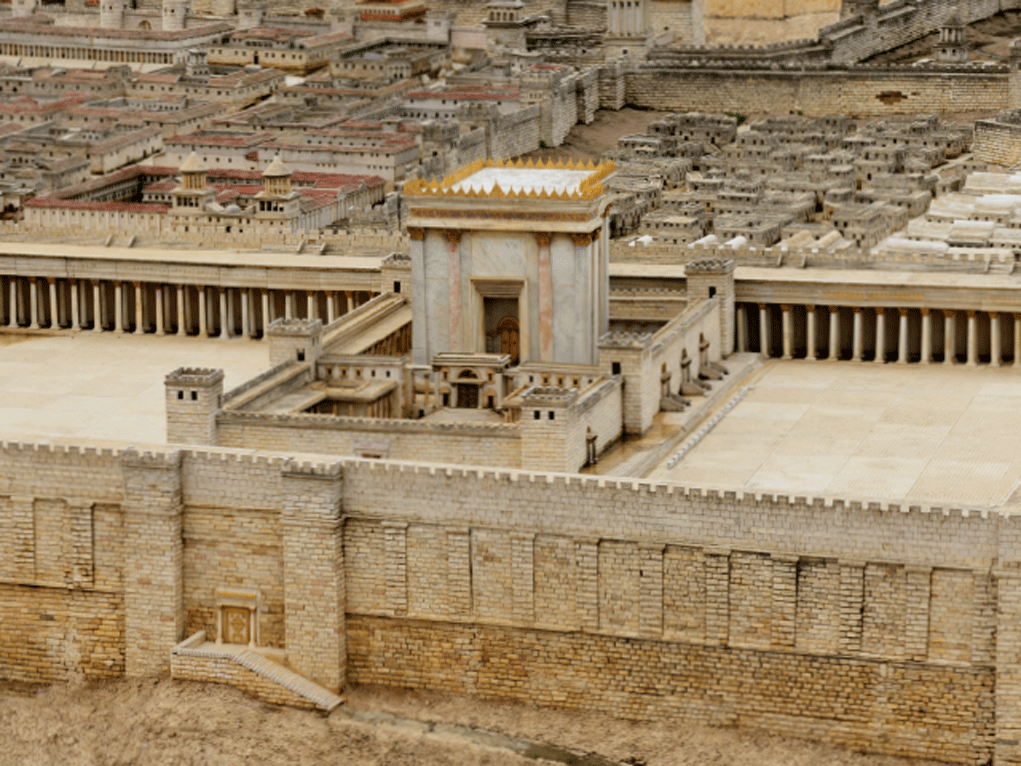 Yated Ne'eman22 days ago
The Chazon Ish’s Depth Behind the Lost Avodah of the Bechorim
Parshas Korach (Bamidbar 17:6) states: “Vayilonu kol Adas Bnei Yisroel mimochoras al Moshe ve’al Aharon leimor, ‘Atem hamisem es am Hashem.’”
The Ramban explains that after the death of Korach and his eidah, Klal Yisroel did not deny the Kehunah of Aharon. That had already been proven clearly, for a fire had gone forth from before Hashem and had accepted his korbanos. Their taanah was different. They wanted the bechorim to remain as the meshorsim of the Mishkon in place of the Levi’im. They did not accept the chalipin, the exchange, through which the Levi’im replaced the bechorim, because if the avodah remained with the bechorim, then every shevet would have a chelek in the avodas Bais Hashem. Therefore, they claimed, “atem hamisem osam,” you caused them to die, because you advised them to bring ketores like Kohanim, while in truth they were fit only for avodas Levi’im and not for the avodah of Kohanim.
The depth of the matter appears through the words of Rashi on the posuk, “Va’ani hinei lokachti es haLevi’im mitoch Bnei Yisroel tachas kol bechor.” Rashi writes that the avodah had originally belonged to the bechorim, and when they sinned with the eigel, they became disqualified, while the Levi’im, who did not serve avodah zarah, were chosen in their place.
The Mizrachi already asks that this seems difficult from the sugya in Zevachim 115b. There, the Tanna’im argue about when the bechorim stopped serving. According to Rebbi, they stopped already at Sinai. According to Rebbi Yehoshua ben Korcha, they continued until the Mishkon was established. But no one seems to say that they became disqualified at the time of the eigel. How then can Rashi say that when they sinned with the eigel, they were disqualified?
One could say that the cheit ha’eigel was the cause of their loss, but the actual loss took effect only later. Yet this is not enough, because if the eigel created a pesul in their avodah, why did the pesul not take effect immediately? Even before the Mishkon was established, they offered korbanos in the midbar. If they were already disqualified, how could they continue serving?
The yesod is found in the words of the Chazon Ish (Orach Chaim Seder Mattan Torah). He explains that the kedushas bechorim contained two separate dinim. One din was avodas hakorbanos, the avodah of Kehunah. The second din was avodas Levi’im, namely shirah, shemirah, and masa, the service of song, guarding, and carrying.
These two dinim are entirely different. The bechirah of the bechorim for avodas hakorbanos was never meant to last forever. From the beginning, it was only until the Mishkon would be established. That is the meaning of the Mishnah, “Ad shelo hukam haMishkon, ha’avodah ba’bechoros.” Before the Mishkon was set up, the avodah was performed by the bechorim. But once the Mishkon would be established, the avodas hakorbanos would belong to Aharon and his sons.
However, the bechirah of the bechorim for avodas haLevi’im was different. That was meant to remain for doros. Even after the Mishkon, the bechorim should have served with shirah, shemirah, and masa. From this second bechirah, they were removed through the cheit ha’eigel. Since they sinned with the eigel, they lost their right to serve in the place of Levi’im. The Levi’im, who did not sin, were chosen instead.
According to this, Rashi is clear. When Rashi says that the bechorim were disqualified through the eigel, he is not speaking about avodas hakorbanos. That avodah was temporary in any case, and it continued until the Mishkon. Rashi is speaking about the avodas Leviyah that should have remained theirs forever. From that, they were disqualified because of the cheit ha’eigel. It did not take practical effect until the Mishkon, because before the Mishkon, there was no complete avodas Levi’im, no shirah in the Mishkon, no guarding of the Mishkon, and no carrying of its keilim.
This also explains the machlokes in Zevachim. Rebbi, who says that the bechorim stopped the avodah at Sinai, is speaking about avodas hakorbanos. The sources that say that they lost the avodah through the eigel are speaking about avodas haLevi’im. There is no contradiction, because they are two separate parshiyos.
It follows that when the Mishkon was established, the bechorim lost two things. First, their temporary avodas Kehunah ended, because from then on, the korbanos belonged to Aharon and his sons. Second, their permanent right to avodas Leviyah was also removed, because that right had already been lost through the cheit ha’eigel and was then given to the Levi’im.
With this, the Ramban becomes luminous. Klal Yisroel accepted the Kehunah of Aharon. They did not claim that the bechorim should continue bringing korbanos. They understood that avodas hakorbanos had passed to Aharon. Their complaint was only about the second din. Why should the bechorim lose avodas Leviyah? Why should the Levi’im replace them entirely? If the bechorim would serve as Levi’im, then every shevet would still have a chelek in the avodah, because every shevet has bechorim.
That was the hidden taanah after Korach. They said to Moshe and Aharon, “Atem hamisem es am Hashem.” You caused them to die because you tested them with ketores. Ketores is avodas Kohenim. But according to their claim, Korach and his people were not fit to be Kohanim. Their only possible claim was to avodas Levi’im. They should have been tested in a matter of Leviyah, not in a matter of Kehunah. By telling them to offer ketores, you placed them into an avodah that was not theirs, and through that, they died.
This is why the answer came through the mateh of Aharon, and specifically as the mateh of Bais Levi. The fire had already proven that Aharon was the Kohen. But the people still questioned the bechirah of the Levi’im. Therefore, Hashem made the staff blossom, to show that not only Kehunas Aharon, but also the bechirah of Bais Levi, was min haShomayim.
The omek of the sugya is therefore that there were two losses of the bechorim. Their avodas hakorbanos ended because it was only meant to last until the Mishkon. Their avodas Leviyah was lost because of the cheit ha’eigel. Korach’s episode forced the distinction to become clear. The ketores proved that Kehunah belongs only to Aharon. The blossoming staff proved that Leviyah belongs only to Bais Levi. This is the depth behind the taanah of atem hamisem and the final birur of the lost avodah of the bechorim.
 Yated Ne'eman29 days ago
It isn’t every day that someone gives up a guaranteed profit of hundreds of thousands of shekels. But that’s just what Michael Strod did, wholeheartedly.
Michael Strod’s business involves identifying properties that have no known claimant or owner. Michael finds the legal heirs of these properties, often purchased many decades ago, notifies them of the existence of these assets, and helps get them transferred to their hands. In return, he receives a hefty commission.
“This is not a simple job,” Michael explains. “It requires a great investment in time, effort and resources – and of course, much Siyatta D’Shmaya. You can work on a case for a long time, advancing step by step, and then hit a brick wall. Sometimes you can’t prove the identity of the owner, and sometimes there are problems with the heirs. In such cases, all your hard work goes down the drain.”
But one recent case was straightforward. Michael had indisputable proof of ownership of the original purchaser, and had only to identify what he calls the inheritance chain. “I traced the inheritance chain and reached people in Europe who were heirs. I was making good progress in wrapping things up and was set to earn a commission of NIS 300,000.
“There weren’t a lot of heirs to deal with, and since the property had not been listed in the will, they needed me and my knowledge in order to move the process forward.”
But closing the deal proved to be anything but smooth. The first warning light began flashing at a relatively early stage. “I discovered early on that a missionary figure, who was not a relative of the deceased owner, had interfered with the initial bequest process. At first, I wanted to turn the case down for fear that the inheritance would end up in missionary hands. But then I thought that I should at least try to check out where the property would indeed end up.”
Meticulous detective work revealed that the heirs are all private individuals and that the original owner stipulated in his will that the land should go to Mr. D. In turn, Mr. D., in his will, left the land to Mr. S. “I obtained a copy of Mr. S.’s will and realized that all my dreams of earning a windfall would be unrealized. The final destination of most of the money was missionary cults engaged in persuading Jews to convert.”
According to Mr. S.’s will, symbolic amounts were to be distributed among friends, with the lion’s share going to organizations associated with Messianic sects – with the exception of a number of Jewish-Israeli nonprofits. In order to verify whether these groups were indeed engaged in persuading Jews to convert, Michael contacted Yad L’Achim, which has been leading the battle against missionaries for some 70 years.
Yad L’Achim quickly checked the names on the list Michael provided them and delivered a report that left no room for doubt. “It turned out that the situation was more dangerous than I suspected,” Michael recalls. “If I thought that one of the groups was engaged in helping people addicted to dangerous substances, Yad L’Achim clarified that the group used missionary preaching, combined with idolatry, as part of its method of detoxification.
“Also, an organization that claimed to offer assistance to the needy was found to be preaching their false faith and converting Jews to their religion.”
Another designated beneficiary was a social club of a certain nursing home. Yad L’Achim discovered that though the nursing home was intended for a non-Jewish population, its club attracts elderly Jews and exposes them to Christian symbols and active missionary preaching.
Yad L’Achim’s report left no room for doubt in Michael’s mind. “As far as I am concerned,” he said, “the case is closed. I am a member of the Jewish people and will not lend a hand to increasing the power of missionary sects that unfortunately still exist in the country.
“I likely have ancestors who sacrificed their comfort and perhaps even their lives on the altar of Jewish faith, and so this wasn’t a difficult decision for me.”
Yad L’Achim hailed Michael’s principled stand. “It is said of him and others like him that those who come to be purified are helped from Above. It is to his great merit that he did not assist organizations that threaten to destroy our people spiritually. The A-mighty will surely see to it that the commission he gave up will come back to him in blessed ways.”
For more information visit www.yadlachim.org or email [email protected]. Yad L’Achim: 4018 18th Ave, Brooklyn, NY 11218. Tel: 1-866-923-5224 (1-866-YAD-LACH).
 Yated Ne'eman29 days ago
This week, in Parshas Shelach, we learn about the saga of the meraglim, which is one of the most tragic episodes in the Torah. Standing at the border of Eretz Yisroel, the Jewish people, who had experienced Yetzias Mitzrayim, Krias Yam Suf, and the many nissim in the midbar, were poised to enter the land promised to their forefathers. The journey from Mitzrayim was nearly complete. Yet, instead of moving forward with confidence, the nation was overcome by fear, and an entire generation lost the opportunity to enter the Land.
They sent meraglim to scout out the land, and the meraglim returned with a frightening report. They reported facts as they saw them. Much of what they said was true. The cities were fortified. The inhabitants were powerful. The challenges were real. But their mission was a historic failure, for which we still pay the price until this very day. At the root of their failure was that they viewed everything during their mission through a lens of negativity.
Where they should have seen opportunity, they saw danger. Where they should have seen Hashem’s promise, they saw obstacles. Where they should have seen a land flowing with milk and honey, they saw imposing giants and fortified cities they believed they would not be able to capture.
Yehoshua and Koleiv saw the same landscape, the same cities, and the same giants as the other ten shluchim. Yet, they came to an entirely different conclusion. While the other meraglim focused on obstacles, Yehoshua and Koleiv focused on possibilities.
Where the meraglim saw reasons for despair, Yehoshua and Koleiv saw reasons for confidence. Most importantly, while the other meraglim measured the situation according to human limitations, Yehoshua and Koleiv viewed it through the prism of emunah, through the knowledge that Hashem had promised this land to them and told them that it was good. For centuries, the bnei Avrohom, Yitzchok and Yaakov had looked forward to meriting entry into the land.
The difference between them was not what they saw. The difference was how they saw it.
This lesson that we learn from this sorry experience extends far beyond the events of the desert. Life presents each of us with challenges, disappointments, and uncertainties. Every day, each of us is presented with a choice. We can choose to focus on what is wrong, on what we lack, and on the difficulties we face, or we can focus on what is right. We can look for the good, and recognize and appreciate blessings. We can see problems or we can see the opportunities that are hidden in every situation.
The negative approach is often easier. Complaints come naturally. Criticism requires little effort. Finding fault in people and circumstances can become a habit. But the Torah teaches us through the story of the meraglim that such a mindset can distort reality itself. When a person constantly searches for what is wrong, that is all he sees.
This applies not only to how we view events, but also to how we view other people. Every person has shortcomings. Every person makes mistakes. If we search for faults, we will certainly find them. And if we search for virtues, strengths, and the goodness that exists within every Jew, we will find that as well.
Everything that occurs is guided by Hashem. Even when we do not understand His plan, we know that He is directing the world with wisdom and kindness. The meraglim saw challenges and assumed disaster. Yehoshua and Koleiv saw those same challenges and trusted that Hashem’s purpose was ultimately for their benefit.
Positivity does not mean pretending that difficulties do not exist. The Torah does not ask us to ignore reality. Rather, positivity means refusing to allow difficulties to define reality. It means recognizing challenges while also recognizing Hashem’s ability to help us overcome them. It means viewing challenges as nisyonos, placed there to test us and provide impetus for self-improvement and aliyah.
A positive person lives a fundamentally different life than a negative one.
Negative people tend to become trapped by their circumstances. Every setback becomes a disaster. Every disappointment becomes a reason for discouragement. Every challenge appears larger than it really is. Their focus on problems drains their energy and clouds their judgment.
Positive people are not immune to difficulties, but they approach them differently. Because of their emunah and bitachon, they know that solutions are always possible and they search for them. Because they ask for and anticipate Hashem’s help, they maintain hope despite the situation. Their outlook gives them the strength to persevere where others give up.
This is true in our relationships as well.
When we focus on the faults of others, resentment grows. Every interaction becomes an opportunity for criticism. Small imperfections become magnified until they overshadow all the good that exists.
But when we make an effort to notice the strengths of others, our relationships flourish. A spouse feels appreciated. A child gains confidence. Friends feel valued. Communities become stronger. Looking for the good in people often brings out the good in them.
Many of the greatest leaders possessed this ability. They saw potential where others saw weakness. They recognized greatness hidden beneath flaws. They understood that encouragement accomplishes far more than constant criticism.
Positivity also transforms the way we experience life itself.
Every person receives countless gifts from Hashem each day—health, family, friendships, opportunities, and innumerable acts of Divine kindness. We can either focus on the good we have or on what is missing, what we would like to have but do not. By focusing on what is not good, we become downcast and sad, and we lose sight of the good that we have.
A positive perspective creates gratitude. Gratitude creates happiness. And happiness creates the emotional strength needed to navigate life’s inevitable challenges.
The Chovos Halevavos teaches that recognizing Hashem’s kindness is one of the foundations of avodas Hashem. A person who constantly notices blessings naturally develops a deeper appreciation for Hakadosh Boruch Hu, Who provides for them. Positivity is not merely a personality trait. It is a powerful form and indication of spiritual growth. The more Torah and mussar a person learns, the more spiritual he becomes, the closer he feels to Hashem, and the more he appreciates His goodness and kindness.
The consequences of the meraglim were so severe because their negativity did not remain confined to their own hearts. It spread throughout the camp. Fear became contagious. Discouragement became contagious. Despair became contagious. The people listened to them and became saddened, bemoaning their fate as they fretted about the future. Chazal (Taanis 29a) recount that Hashem chastened them for crying senseless tears and declared that He would give them something to cry about for generations to come. Indeed, we are still crying over the churban until this day. We are still suffering because of the sin of the meraglim.
My old friend, Rav Mordechai Simcha zt”l, was always a fountain of bright and witty comments. As a play on his name, he would often say, “Simcha is contagious.” Indeed, it is. Optimism is also contagious, as are confidence and bitachon. One person’s positive outlook can inspire an entire family, a community, or even a generation.
Take Reb Shalom Mordechai Rubashkin, for example. His faith inspired Klal Yisroel and still does. He had every reason to give up and accept his fate, and very few rational reasons to think that he would ever achieve vindication and freedom. Yet, because of his deep-seated emunah, he was able to view his situation differently. He viewed what he was going through as a nisayon, not as a fait accompli, and Hashem rewarded him. Klal Yisroel rejoiced with him when his faith was rewarded. His experience still serves as a chizuk to people experiencing periods of nisayon not to become traumatized and to maintain their faith that Hakadosh Boruch Hu is directing everything min haShomayim.
In every situation, we have a choice. We can be like the meraglim, searching for reasons why things cannot succeed. Or we can be like Yehoshua, Koleiv, and ehrliche Yidden throughout the ages, searching for reasons to trust, to hope, and to move forward.
The Torah’s message is not that life is easy. It is that life looks very different when viewed through the eyes of a maamin.
When we train ourselves to see the good in people, we become kinder. When we train ourselves to see the good in circumstances, we become stronger. When we train ourselves to see the good in our lives, we become happier. And when we train ourselves to see Hashem’s hand behind everything that happens, we discover a deeper sense of peace and purpose.
The meraglim saw giants and lost heart. Yehoshua and Koleiv saw Hashem and found courage.
Their lesson continues to guide us today: Look for the good. Focus on the blessings. Believe in the possibilities. Trust in Hashem. Very often, what we find depends on what we are looking for.
Gedolim often possessed an extraordinary ability to see the good in situations and in people where others saw only problems. Famous are the stories about Rav Levi Yitzchok of Berditchev. He was renowned for always finding merit in people.
Typical is the story told about the baal ha’agolah who was greasing the wheels of his wagon while wearing his tallis and tefillin. Most people would have been shocked by the apparent lack of respect. Rav Levi Yitzchok, however, looked heavenward and said, “Ribbono Shel Olam, see how precious Your children are. Even while occupied with their work, they refuse to separate themselves from mitzvos.”
Others saw a fault. He saw a virtue.
That was not naïveté. He was choosing to focus on what was admirable rather than what was lacking.
There are plenty of practical examples.
Two people lose a business opportunity. One spends months dwelling on what might have been. He becomes bitter and discouraged. The other is disappointed as well, but he believes that if Hashem closed one door, another will open. He moves forward and eventually discovers opportunities that he would never have found otherwise.
The external event is identical. The internal response changes everything.
The same is true in family life. A parent can focus on a child’s weaknesses and spend years being frustrated. Or he can focus on the child’s strengths and help the child blossom. Every experienced educator knows that children often become what others believe they can become. Positivity does not merely change how we see people. It changes how they see themselves.
We are currently in the season of Siddur and Chumash parties. I merited attending Chumash parties for two of my grandchildren recently, one last Sunday and one this Sunday. The pride the rabbeim took in their young charges was evident as they exuded positivity and joy, and the children, in turn, shone as they sang their songs, reviewed pesukim, and rose in their crowns to accept their Chumashim.
The confidence of the rebbi is reflected in the children, just as the light of the sun is reflected by the moon, brightening and casting light upon a dark night. Positivity and optimism are what enable us to succeed and thrive in a world that contains much darkness and sorrow.
Positivity is not simply about feeling happier. It is about seeing the world more accurately. The negative person sees only the obstacle and misses the opportunity. He sees the flaw and misses the virtue. He sees only today’s difficulty and misses tomorrow’s blessing. The positive person sees the challenge as well, but he also sees Hashem’s hand guiding events toward a purpose he may not yet understand.
We live in a time of hester, when Hashem is hidden, and we do not always see the brocha, but we must know that it is there and that we are not alone.
The meraglim were not ordinary people. Chazal teach that they were distinguished leaders, “roshei Bnei Yisroel.” Their failure reminds us that intelligence and greatness alone do not guarantee proper perspective. A person can be knowledgeable, accomplished, and sincere, yet still allow fear, bias, and negativity to distort his view of reality.
Yehoshua and Koleiv possessed something invaluable: the ability to see beyond the immediate nisayon and focus on the larger picture. They understood that the question was not whether there were giants in the land, but whether Hashem had promised them the land. With that attitude and perspective, everything else fell into place.
That remains one of the great challenges of life. We often become consumed by the “giants” in front of us—the problems, setbacks, worries, and uncertainties. We can spend so much time analyzing the obstacles that we lose sight of the blessings, opportunities, and Hashgocha Protis surrounding us.
A positive outlook rooted in emunah does not deny the existence of giants. It simply remembers that Hashem is bigger than the giants.
I have written previously about the time I was visiting my rebbi, Rav Avrohom Yehoshua Soloveitchik, and he inquired about the welfare of one of his talmidim. I told him, “Es geit em shver. He has it hard.” He quickly responded, “Bei di Ribono Shel Olam, iz gornit shver. Nothing is hard for Hashem.”
That has to be the way we view and deal with times of nisayon, when things are rough.
The meraglim foresaw tough battles ahead that could not be won. Thus, they saw a land that could not be conquered. Yehoshua and Koleiv did not let what they saw impress or frighten them, because they knew that bei di Ribono Shel Olam, iz gornit shver.
Yehoshua and Koleiv saw a future that could be achieved. Their vision built the future of Klal Yisroel. The people who leave the deepest impact on their families, communities, and friends are often those who have learned this lesson well. They are the ones who encourage rather than criticize, who look for strengths rather than weaknesses, who search for solutions rather than dwell on problems, and who remind others that no situation is beyond Hashem’s help.
In a world where negativity often comes easily, choosing to see the good may be one of the greatest forms of avodas Hashem. It allows us to appreciate Hashem’s blessings and face life’s challenges with confidence and serenity.
We do not merely live according to the world we see. To a large extent, we live according to the way we choose to see it. May we merit to view the world with the eyes of Yehoshua and Koleiv—eyes of faith, gratitude, optimism, and trust in Hashem.
Most of us are not going to be sent to scout a land before conquering it. But every day, we “spy out” the circumstances of our own lives. We look at our families, our communities, our finances, our health, our challenges, and our future. Then we decide what those facts mean.
The meraglim looked at facts and concluded, “We cannot do it.”
Yehoshua and Koleiv looked at the same facts and concluded, “With Hashem’s help, we can.”
That distinction exists in every generation.
The meraglim were not punished for seeing giants. There really were giants. They were punished for allowing the giants to become the whole story. They were punished for seeing themselves and their abilities as grasshoppers, “k’chagovim hoyinu b’eineihem.” They saw the obstacles and lost sight of Hashem. Yehoshua and Koleiv also saw the obstacles, but they saw them in the context of the larger reality of Hashem’s promise, Hashem’s protection, and Hashem’s plan.
Negativity often works the same way. It takes a difficulty and turns it into the entire picture. Positivity does not ignore the difficulty. It places it in its proper perspective.
Another angle is that negativity tends to be self-fulfilling. The generation that said, “We cannot enter the land,” ultimately did not enter the land. Yehoshua and Koleiv, who believed they could, did.
A person who constantly says, “I can’t,” “It won’t work,” or, “Nothing ever changes,” often stops trying. A person who says, “This is difficult, but with siyata diShmaya it can be done,” will persevere until he succeeds.
Positive people often feel better, accomplish more, build stronger relationships, inspire others, and navigate hardships more effectively because they are not paralyzed by pessimism. For someone who knows that Hashem runs the world, that He loves His children, and that everything He does has purpose, optimism is not wishful thinking. It is a natural consequence of faith.
The meraglim looked at Eretz Yisroel and asked, “How can we possibly succeed?”
Yehoshua and Koleiv looked at Eretz Yisroel and asked, “If Hashem wants us there, how can we not succeed?”
Those two questions continue to shape the way people approach life today.
The situation in Eretz Yisroel is not simple. There are many problems, both internal and external. The Torah community is being targeted as never before and finds itself in a matzav nora, a terribly serious situation.
Gedolei Yisroel traveled from there this week to inspire and appeal to us to join them in their battle for Torah, to believe, to contribute, and to have the positivity and fortitude of faith, of emunah and bitachon, to do what we can to overcome the darkness of golus, and know that if we withstand the nisayon, we will merit the geulah sheleimah bekarov.
 Yated Ne'eman29 days ago
Last week, in these pages, we discussed the very concerning proliferation of divorce in our community and, more generally, shalom bayis difficulties.
After all is said and done, it boils down to middos, basic middos, mentchlichkeit, transcending oneself and not thinking that the entire world is here to serve “me and my needs.”
The life of a single person, whether it is a bochur in a dormitory, a bochur in a dirah in Eretz Yisroel, or a girl who is busy with her own life, her own needs, and her own projects, is, in many ways, a very selfish life. Even the chesed one does is done when one chooses to do it and in the amount one chooses to do it.
Now, there are some maalos to being “selfish.” For example, when a bochur is young and decides that he wants to learn, really shteig, and become great in learning, there is selfishness in that too. “I want to become great. I want to know the entire Torah. I want to get the best Olam Haba possible. I want people to realize that I know Shas.”
Yes, the bochur might have come to the realization that Torah and ruchniyus are paramount, but only from the viewpoint that it is all about my Torah and my ruchniyus.
Stepping Out of the “Me” World
I once heard someone say that it is not possible to be an adolescent and not be selfish. What is adolescence? It is all about progressing from being a child to an adult. It is about forging your own identity. To do that, you must try to figure out who “I” am. Who is the “me” that I want to be? There is selfishness inherent in that journey.
And then comes a point where you have to go beyond the “me” that you are trying to become and think in broader terms. Those broader terms include thinking about what Hashem really wants from you—not just what you want from your avodas Hashem, but what Hashem wants from you…the entire you.
Often, during one’s teenage and young adulthood years, the real bein adam lachaveiro muscles, the real mentchlichkeit muscles, are not actually put to the test. They can get very flabby, very out of shape, without the person even realizing it.
After all, a bochur can think, “I am doing great. I learn during seder, and sometimes I even learn more than just the regular sedorim. I usually daven with a minyan. I try (most of the time) not to scream too loudly when my roommate is sleeping. I am doing okay.”
A girl may similarly pat herself on the back, thinking, “I am a good friend. I engage with friends all the time. I am gracious. I participate in chesed initiatives. I am pretty good.”
And, in truth, these thoughts are pretty good, but they are on your terms. They are the things you do when you are still baal habayis over your own time.
Marriage: A Middos Workshop
Marriage can be compared to a workshop on middos where you are not your own baal habayis for even a minute. Not only that, but you suddenly have to share your entire world—erev vavoker vetzohoroyim—with another person.
You might think that you are a good bochur or a good girl, but, in reality, you have never been tested. Not only that, but as accustomed as you are to being a good bochur or good girl, you do not really have much life experience in how to interact with a spouse. Yes, our spouses are different genders, are created differently, grew up in different homes, and speak a “different language.”
For example, it is not uncommon for one spouse to find something hilarious while the other does not find it even slightly amusing.
Recently, my friend’s daughter and son-in-law were discussing a story CD. My friend told me that his daughter remarked, “These recordings are not funny at all. They are really bochurishe humor.”
At the same time, her husband chimed in, “They are really funny!”
Everyone burst out laughing, but the point was made.
The Meraglim Were Great People, Right?
Now, before we return to the point, I would like to detour to this week’s parsha and the meraglim. There is a very important idea from the Chiddushei Harim regarding the meraglim. It is a vort about which a talmid of Rav Shlomo Wolbe quoted Rav Wolbe as saying that the way the Chiddushei Harim explained the sin of the meraglim is the way we are supposed to learn pshat in the sugya.
The Chiddushei Harim asked about the meraglim as follows: They were such great people, right? Rashi teaches us that the meraglim truly were great men. How, then, could they have fallen so precipitously?
The Chiddushei Harim answers his own question, saying that the meraglim were indeed great people who had very good intentions when they discouraged the Bnei Yisroel from entering Eretz Yisroel.
What were their good intentions? The meraglim saw how the Yidden in the midbar were living in an incomparable spiritual oasis. They were learning Torah from Moshe Rabbeinu. They were drinking water from the be’er of Miriam. They were eating monn, the most spiritual of foods, which not only did not bring them down as gashmiyus usually does, but actually elevated them to unprecedented heights. They had no worries, no tirdos of parnossah. In short, they were living the most idyllic, beautiful, spiritual life possible.
They were in the best yeshiva or kollel in the world. They had the best rebbi—Moshe Rabbeinu. The meraglim were worried. “What will happen when we go to Eretz Yisroel? We will have to engage in parnossah, the hard work of going out and making a living. We will be forced to eat regular, gashmiyusdige food. We will not have time to learn from Moshe Rabbeinu as we are doing now. Will Klal Yisroel really be able to have Hashem in mind while engaging in the mundane? Will they really be able to understand that, yes, even when someone is working, engaging in parnossah, and involved in the daily grind of working the fields, growing, harvesting, grinding, and interacting with vendors, middlemen, and customers, he can think about Hashem as well?”
The meraglim therefore put themselves in great danger, going so far as to risk losing their own Olam Haba and losing everything for what they thought was the benefit of Klal Yisroel.
Yes, they meant well, says the Chiddushei Harim, but they made one fundamental mistake. What was their mistake?
Our job, the Chiddushei Harim explained, is not to tell Hashem what is best for Him to do. Our job is to listen, whether we understand or not. Our job is not to give eitzos to Hashem. It is to listen and follow His instructions with temimus, even when it seems that we know better.
 Yated Ne'eman29 days ago
It isn’t every day that someone gives up a guaranteed profit of hundreds of thousands of shekels. But that’s just what Michael Strod did, wholeheartedly.
Michael Strod’s business involves identifying properties that have no known claimant or owner. Michael finds the legal heirs of these properties, often purchased many decades ago, notifies them of the existence of these assets, and helps get them transferred to their hands. In return, he receives a hefty commission.
“This is not a simple job,” Michael explains. “It requires a great investment in time, effort and resources – and of course, much Siyatta D’Shmaya. You can work on a case for a long time, advancing step by step, and then hit a brick wall. Sometimes you can’t prove the identity of the owner, and sometimes there are problems with the heirs. In such cases, all your hard work goes down the drain.”
But one recent case was straightforward. Michael had indisputable proof of ownership of the original purchaser, and had only to identify what he calls the inheritance chain. “I traced the inheritance chain and reached people in Europe who were heirs. I was making good progress in wrapping things up and was set to earn a commission of NIS 300,000.
“There weren’t a lot of heirs to deal with, and since the property had not been listed in the will, they needed me and my knowledge in order to move the process forward.”
But closing the deal proved to be anything but smooth. The first warning light began flashing at a relatively early stage. “I discovered early on that a missionary figure, who was not a relative of the deceased owner, had interfered with the initial bequest process. At first, I wanted to turn the case down for fear that the inheritance would end up in missionary hands. But then I thought that I should at least try to check out where the property would indeed end up.”
Meticulous detective work revealed that the heirs are all private individuals and that the original owner stipulated in his will that the land should go to Mr. D. In turn, Mr. D., in his will, left the land to Mr. S. “I obtained a copy of Mr. S.’s will and realized that all my dreams of earning a windfall would be unrealized. The final destination of most of the money was missionary cults engaged in persuading Jews to convert.”
According to Mr. S.’s will, symbolic amounts were to be distributed among friends, with the lion’s share going to organizations associated with Messianic sects – with the exception of a number of Jewish-Israeli nonprofits. In order to verify whether these groups were indeed engaged in persuading Jews to convert, Michael contacted Yad L’Achim, which has been leading the battle against missionaries for some 70 years.
Yad L’Achim quickly checked the names on the list Michael provided them and delivered a report that left no room for doubt. “It turned out that the situation was more dangerous than I suspected,” Michael recalls. “If I thought that one of the groups was engaged in helping people addicted to dangerous substances, Yad L’Achim clarified that the group used missionary preaching, combined with idolatry, as part of its method of detoxification.
“Also, an organization that claimed to offer assistance to the needy was found to be preaching their false faith and converting Jews to their religion.”
Another designated beneficiary was a social club of a certain nursing home. Yad L’Achim discovered that though the nursing home was intended for a non-Jewish population, its club attracts elderly Jews and exposes them to Christian symbols and active missionary preaching.
Yad L’Achim’s report left no room for doubt in Michael’s mind. “As far as I am concerned,” he said, “the case is closed. I am a member of the Jewish people and will not lend a hand to increasing the power of missionary sects that unfortunately still exist in the country.
“I likely have ancestors who sacrificed their comfort and perhaps even their lives on the altar of Jewish faith, and so this wasn’t a difficult decision for me.”
Yad L’Achim hailed Michael’s principled stand. “It is said of him and others like him that those who come to be purified are helped from Above. It is to his great merit that he did not assist organizations that threaten to destroy our people spiritually. The A-mighty will surely see to it that the commission he gave up will come back to him in blessed ways.”
Court order of Will Execution
For more information visit www.yadlachim.org or email [email protected]__. Yad L’Achim: 4018 18th Ave, Brooklyn, NY 11218. Tel: 1-866-923-5224 (1-866-YAD-LACH).
 Yated Ne'eman29 days ago
The school year is ending. The summer has finally arrived. For some, this means camp is looming ahead, for others the country and bungalow colonies. In any case, many have the magic word “vacation” on their lips. In my first ArtScroll sefer, Blueprints, I had the zechus to devote two chapters to Torah vacations and routines. However, since a few years have passed, Covid and some new realities about anti-Semitism and other things have changed the world, so perhaps this topic should be revisited with a new eye.
Although the present has changed drastically, the past remains the same. Our role models for how to vacation — Rav Chaim Ozer Grodzensky, Rav Shimon Shkop, Rav Boruch Ber Leibowitz and Rav Aharon Kotler — in the forest of Drozegnik for their dacha were deeply engrossed in learning, only surrounded this time by trees and in more comfortable chairs. As is well known, Rav Yisroel Neuman, one of the roshei yeshiva of Bais Medrash Govoah in Lakewood, simply takes his beloved shtender outside and continues his ceaseless hasmodah. My own rabbeim, Rav Yitzchok Hutner, Rav Aharon Schechter and Rav Yonasan David, continued to give shiurim and maamorim in Camp Morris, with occasional mention of the gadlus haBorei around them. But these days, there are other considerations that must come first.
Rav Aharon Teitelbaum of Satmar (quoted in Eizer Shmuel, page 294) felicitously expounds a Mishnah from this week’s Pirkei Avos (3:1) to guide his Chassidim in leisure planning. Akavia Ben Mahalalel said, “Consider three things and you will not come into the grip of sin. Know where you came from, where you are going, and before Whom you will give justification and reckoning.” The rebbe gave a vacation mussar shmuess, “Know where you came from,” meaning, “Think about your parents, grandparents, rabbeim and the yeshivos you attended before you make travel plans. What would they say?” Finally, would you be comfortable explaining and presenting this to our Creator and Father in Heaven? Great advice for us all.
The Vilna Gaon (Kol Eliyahu, Parshas Bereishis) quotes an amazing Medrash about one of the causes for Adam Harishon’s sin. The Medrash says something quite cryptic: “Why did Adam sin? Because he saw two but not three.” The first of the three of Akavia’s “considerations” was “where we came from,” meaning “a putrid drop.” Now, since Adam was created directly by Hashem, he couldn’t identify with this warning, causing him and all of mankind everything from death to destruction and all manner of tragic results. Now let us add the Vilna Gaon’s brilliant comment. We know that Adam was an unimaginably righteous person. Even after he sinned and was buried, his ankles, the lowest parts of his body, shone like two burning suns. Yet, the inability to look back upon humble beginnings caused him to be unable to imagine the abyss into which he was about to descend. We, therefore, must surely evaluate carefully if we are exposing ourselves and our families to mortal spiritual dangers when we travel.
During Covid, when travel was almost impossible, many people discovered the joys of taking a staycation. Those who were able to do so built pools or refurbished basements. Unfortunately, like other messages that Hashem kindly sent us, the lure of travel returned and suddenly we were on the road again. More recently, the spate of diseases and illnesses spread on expensive cruise ships may have been another divine reminder that physical ailments are often symptoms of spiritual maladies. This may be a good time to revisit Shlomo Hamelech’s exhortation, “If the anger of a ruler flares up against you, do not leave your place” (Koheles 10:4). Although this warning refers to many things, some meforshim identify the “ruler” as the yeitzer hora, which often rules over us and attempts to entice us to follow him into seductive places. Shlomo Hamelech, however, warns us that we are safest spiritually at home in our familiar surroundings.
One of the proofs offered that the moshel refers to our evil inclination is that the questions about where we have been and where we are going sound suspiciously like the questions Yaakov Avinu warned his servants that Eisav would ask: “When my brother Eisav meets you and asks you, saying, ‘Whose are you, where are you going…” (Bereishis 32:17). The Chiddushei Harim warns that our inner Eisav, i.e., the yeitzer hora, may ask these questions, seeking to frighten and depress us. We must be strong and resist his evil machinations. The Sefas Emes concludes that we must answer, as did Yaakov’s messengers, that “We belong to Yaakov Avinu.” This means that once we subjugate ourselves to Klal Yisroel, we have nothing to fear (see Sefas Emes, Parshas Vayishlach 5635). The Klausenburger Rebbe (Divrei Torah Shefa Chaim, Mikeitz 5723) quotes his father, the rebbe of Rodnik, with similar thoughts, only adding that these kinds of questions can come from the good source of the yeitzer tov or the evil source of the yeitzer hora and we must be careful to distinguish between the two (see also Sifsei Tzaddik, Vayishlach 25).
Rav Reuven Feinstein (Sefer Pirkei Shalom) teaches us another lesson related to this subject. In last week’s perek, Rebbi (Rabbeinu Hakadosh) presented us with three different things to consider: “What is above you — a watchful Eye, an attentive Ear, and all your deeds are recorded in a Book” (2:1). Is this a disagreement or do these warnings coalesce?
Rav Reuven suggests that Akavia Ben Mahalalel lived at the time when the Bais Hamikdosh stood proudly and Klal Yisroel was comfortable in their Land. The yeitzer hora at such a time often leads us into arrogance and complacency. The antidote is therefore to focus on sights and sounds that will lead us to modesty and humility. On the other hand, Rebbi lived after the churban under the Roman government, when there was a danger of depression and giving up our faith. Therefore, he reminded us that Hashem is watching us even in exile and in all conditions.
We should extrapolate from these teachings that it actually does not matter where we are, since Hashem is everywhere, watching over us. That attitude is a very wise one to take with us on our vacations, even when we don’t stay at home. Just knowing and truly believing that Hashem is with us can change the way we act and even think on vacation. This is certainly not a time to forget about Hashem, but to remember that He is always with us. Sometimes he saves us from depression, sometimes from arrogance, but he doesn’t just come “for the ride.” He is the Pilot, Driver and Ultimate Travel Agent. As Shlomo Hamelech continues (Koheles 3:14), Hashem is constantly doing things to cause us to fear Him and bring us to yiras Shomayim (see Droshas HaRamban to Koheles, Toras Chaim ed., page 13).
We will end with a story inside a story that we should take with us wherever we go. Rav Aryeh Levin, the great tzaddik of Yerushalayim and father-in-law of many gedolim, including Rav Yosef Shalom Elyashiv, was once visiting his rebbi, Rav Chaim Berlin, on an Erev Shabbos, when the latter was reciting Shir Hashirim. When Rav Chaim came to the posuk, “Behold you are beautiful, My beloved; behold you are beautiful, your eyes are doves” (1:15), he began to cry. Rav Aryeh asked his rebbi why he is crying, since this posuk is clearly describing the love between Hashem and Knesses Yisroel.
To respond, Rav Chaim, son of the Netziv, related the story inside this story.
“Once, when I was the rov of the city of Moscow, an important person asked to speak with me privately. He said that his wife had just given birth to a boy and he wanted me to circumcise him. I asked, ‘Why the need for such secrecy?’ and he answered that he occupied an important position in commerce and politically, but no one knew that he was Jewish. ‘I am asking the rov,’ he explained, ‘how to arrange for this procedure to be done secretly, because it could cost me my life.’ I told him to send away his household staff for the day and I will take care of it. The father served as sandek, there was no minyan, and I asked him to report to me on the baby’s recovery after the third day.
“When I visited the man’s home again after the third day, I asked him,
‘I see no signs of Yiddishkeit at all your home. You yourself have been hiding your Judaism, so why did you want so fiercely to make sure he has a bris milah?’ He answered, ‘I know that I have drifted far from my people, and I wonder if it will ever be possible for me to return. But for my son, there is hope. I want him to at least be a physical Jew so that someday he at least can reenter the fold.”
“When I get to that posuk in Shir Hashirim,’ Rav Chaim continued, ‘I think of that man and I understand why the words ‘my beloved is beautiful’ are repeated twice. This is, as Chazal teach, that the first is before the sin and the second is after. But why is he beautiful even after the sin? The answer is that Shlomo Hamelech is referencing the dove. Chazal teach that the dove never wanders so far from the nest that she will not be able to return. That is Klal Yisroel’s beauty as well—that even though we sometimes wander, we will always return. Rav Aryeh concluded that ‘perhaps this is the meaning of the question in the Mishnah, ‘From where have you come?’ Even if we only remember that we are a Yid, we can always return and build upon that.”
Let us build upon Rav Aryeh Levin, Rav Chaim Berlin, Akavia Ben Mahalalel and Rav Reuven Feinstein. If possible, let us not wander far at all. But if we must, like the dove, let’s not forget where our nest really is. Then we won’t get lost and we’ll be able to fly back into Hashem’s waiting arms.
Yated Ne'eman29 days agoA Week of Insanity
We have been through a week of madness here in Eretz Yisroel. On the front lines, the IDF suffered more fatalities, while the domestic battle between the Torah world and the government took another painful turn: Last week, a protest outside the home of Justice Noam Sohlberg turned violent and led to a massive wave of arrests. Of course, no one denies that violence is deplorable. For some reason, though, when leftists protested outside the homes of government ministers and burned garbage dumpsters outside the prime minister’s residence, no one seemed to have a problem with it, but the same type of behavior triggered sharp condemnations when it targeted a justice of the Supreme Court.
Meanwhile, the election for the next state comptroller generated its fair share of drama as well. In the first round of voting, retired Supreme Court justice Yosef Elron received 60 votes while attorney Michael Rabello received 57. Since Elron fell short of the threshold of 61 votes, it was necessary for another round of voting to take place. This time, Rabello won the election with 61 votes. This, of course, was a win for Netanyahu precisely at a time when his opponents are trying to depict him as a lame duck.
Shooting Spree Ends in Tragedy
No overview of this past week’s news would be complete without mentioning a couple of events at the beginning of the week. First, the terror attack on Sunday has shown us once again that our survival in Eretz Yisroel is predicated on miracles. Unfortunately, it is far too easy for bloodthirsty terrorists to murder a Jew in Eretz Yisroel. In this case, an Arab resident of Taibeh (i.e., an Israeli citizen) left his home in a car with a yellow license plate (again, marking him as an Israeli citizen) and headed to the gas station near the communities of Tzur Yigal and Kochav Yair, where he opened fire on innocent passersby, wounding two people. The terrorist moved on to the community of Tzur Natan and opened fire on civilians again. His next step was to fire on a car, killing the driver, which was followed by a gun battle at the entrance to the community of Salit. The murder victim was 55-year-old Chaim Kalomiti, a resident of Tzur Natan and an officer in the IDF. And this leads to a chilling thought: Who knows how many more murderers are living among the Arab citizens of Israel?
My second observation concerns the men who were arrested for participating in the violent riots at the home of Justice Noam Sohlberg; the court recently extended the detention of 52 of those suspects. Without commenting on the violence itself, let me say simply that the mass arrest was clearly collective punishment. Perhaps there were a few people among those 52 whom the police and the judge have the right to imprison, but why are so many men being kept behind bars? Is it simply that the police do not know exactly which of them are culpable?
Finally, there is another noteworthy development in the draft crisis: The Basic Law: Torah Study might be approved this week, in response to a demand from Aryeh Deri (who visited the bochurim being held in military prison on Sunday) and Degel HaTorah. This law might be the solution to the aggression of the Supreme Court; the judges have based their own decisions on the Basic Law: Equality, which they contend makes draft exemptions for lomdei Torah unconstitutional. Another Basic Law would carry the same legal weight, and the hope is that its stipulation about the importance of Torah study as a service to the nation will restore the legal validity of the draft exemptions. Bli neder, I will report to you on any further developments.
The Attorney General’s Obsession
The rest of the country has its attention focused on the borders and the White House, but Attorney General Gali Baharav-Miara has her own agenda. Her behavior, in my view, can no longer be classified as a function of legal concerns or even political maneuvering; instead, it demands full psychiatric assessment. Her obsession has exceeded all reasonable bounds and has crossed every red line. Let us put aside her habitual stance against the government (keeping in mind that she is supposed to be the legal advisor to the government, not against the government) and her passion to oppose everything done by the government and especially the prime minister, including the appointments of new officials. Instead, let us focus solely on her war against lomdei Torah, in which she has actually demonstrated originality and single-minded obsession that borders on madness. While it’s true that the judges are steering her in this direction, she is clearly taking the matter much further than they are. Last week, I mentioned that yeshiva bochurim have become afraid even to walk in the street. At this point, not only are the arrests continuing but the army is talking about actively broadening them.
The attorney general recently announced yet another economic blow to yeshivos and kollelim: As part of her legal battle to prevent funding from reaching lomdei Torah who are subject to the draft, she decided to cancel the Section 46 status of any institution attended by draft evaders. Section 46 is a clause in the tax ordinance that makes it possible to receive tax refunds in exchange for donations to approved institutions. To receive this status, an institution must file a request with the Finance Ministry, where the specifics of its operations are examined. If the institution meets all the legal criteria, the application is transferred to the Knesset Finance Committee for approval. The attorney general’s decision therefore means that donations to yeshivos will no longer be eligible for tax credits. Of course, she conveniently ignores the fact that the same yeshivos also serve students who are not classified as draft evaders. Why should the government prevent yeshivos from receiving donations when at least some of their talmidim are not required to enlist? This is a fundamental flaw in her decision, but the attorney general is blithely unconcerned about it. In any event, the majority of donations for yeshivos come from Jews in other countries, where the donors receive tax credits from their own governments instead, so the impact of this blow might not be as severe as she hoped.
The attorney general’s move came in response to an appeal to the court from the Reform movement, in which the petitioners argued, “Yeshivos that have become places of refuge for tens of thousands of draft dodgers, who have chosen at a time of crisis to ignore the nation’s needs and to refuse to participate in the defense of the state, should not be able to allow their donors to benefit from tax credits worth tens of millions of shekels.” Baharav-Miara made absolutely no effort to defend the government in her response to the court; instead, she sided with the petitioners and even published her decision on the subject before the judges could even debate it. As I said, she is even more extreme than the Supreme court.
But that wasn’t the end of the matter. The attorney general discovered that it would be very complicated to determine which institutions should be subject to her decree eliminating their Section 46 status on account of the draft. As a result, she decided that for the time being, until the matter is clarified, no organization or institution will receive Section 46 approval. She therefore ordered the Treasury to freeze the approval process for every institution and to refrain from sending the list of organizations to the Finance Committee. Of course, this evoked an uproar that extended beyond the chareidi community. This time, the attorney general had caused damage to secular organizations as well, and a torrent of outrage emerged from the secular community. At the same time, petitions were filed with the Supreme Court against the sweeping ban, and the Igud Bnei Yeshivos filed a petition on behalf of the yeshivos as well. I am not sure what argument they used to claim that the decision was illegal regarding Torah institutions; perhaps it was the fact, as I mentioned, that yeshivos also cater to students who are not subject to the draft.
Once again, the wave of fury against the attorney general was ferocious, but she seemed unfazed by it. She is simply obsessed with persecuting bnei Torah. Just as an angry person is incapable of listening to others who try to reason with him, the same is evidently true of a person who is blinded by hatred. The chairman of the Knesset Finance Committee, MK Chanoch Dov Milwidsky (Likud), minced no words when he announced, “The attorney general is preventing all nonprofit organizations in Israel from receiving Section 46 status because of her persecution and hatred for the chareidi community.”
Yungeleit Excluded from Subsidized Housing Lottery
While the judges on the Supreme Court push for increasing sanctions against bnei Torah and the attorney general continues issuing draconian decrees, some people seem to be observing these events with equanimity. The real-life impact of these decisions isn’t immediately evident to everyone, and for some people, the attorney general’s moves seem to be theoretical and removed from reality. But the problems and damage are very real. These decisions, when translated into action, have a tangible impact on every kollel yungerman and every yeshiva bochur. The most serious measure that has been taken, of course, is the attorney general’s decision to halt government funding for yeshivos and kollelim. This led directly to the establishment of the Keren HaTorah fund, an absolutely correct response to an unjust situation. Another major cause of harm is the decision to revoke government subsidies for children in day care whose fathers learn in kollel, especially the children of draft evaders. This has caused genuine financial damage to tens of thousands of yungeleit. The decision to revoke property tax discounts for draft evaders has likewise been deeply harmful; until that decision was made, the average kollel yungerman paid only 10 or 20 percent of the municipal property tax on his apartment, and yungeleit will now be hit with much higher bills.
But all this was apparently not satisfactory for the judges, as they also decided to cancel the public transportation discounts and other benefits previously received by bnei Torah. One of those benefits is the ability to participate in programs run by the Ministry of Housing to assist young couples purchasing their first homes. Two weeks ago, the Israel Lands Authority announced that it had approved a dramatic change in the lottery program for discounted housing in conjunction with Chaim Katz, who is filling in for Yitzchok Goldknopf as minister of housing in the wake of the latter’s resignation. According to the latest decision, 50 percent of the housing units offered at a discount in the upcoming lottery will be offered only to soldiers in the IDF reserves, with priority given to combat soldiers, and the remaining 50 percent of the apartments will be offered to the general public provided that they have regulated their draft status. “This is a very significant step that was taken in accordance with a directive of the attorney general,” the statement added, “according to which it is necessary to immediately implement an outline that will strengthen the preference for active reserve soldiers.”
The decision states that anyone subject to the draft who hasn’t regulated his status with the IDF will not be eligible to participate in discounted housing programs. In practice, this means that most chareidim will be filtered out of the process before they can even reach the point of signing up for a lottery. The revised program requires all applicants to sign affidavits confirming that they have settled their draft status. If a participant wins the lottery and then his affidavit is found to be false—which would be the case for any chareidi man who learns in kollel—he will lose his right to receive a discount. What will happen to the apartments in chareidi communities, where no secular Israelis will be interested in participating in the lotteries? The answer to this question is unclear, but the Israel Lands Authority has taken the unequivocal stance that chareidim are to be left out. And while this evoked widespread fury, there is very little that can be done about it.
Knesset to Discuss Discrimination Against Yungeleit
A few days after the Israel Lands Authority announced the new rules, the following notice was circulated: “Registration for the 11th lottery of the ‘Apartment at a Discount’ program of the Ministry of Housing and Construction and the Israel Lands Authority will open today [last Monday] and will include dozens of lotteries in 19 cities and settlements throughout the country for a total of 7,922 residential units. According to the new regulations, the members of the chareidi community, kollel students, and yeshiva graduates are not entitled to participate in the lottery. The settlements participating in the lottery include Rishon Letzion, Rechovot, Mazkeret Batya, Ashdod, Beit Dagan, Kfar Manda, Kfar Saba, Maale Adumim, and Nahariya, among others. Registration for the lottery will close on Monday, June 22, 2026. As in previous lotteries, all eligible participants may register in only three cities, for all the lotteries taking place in each. The exact date of registration during the registration period has no significance.”
The infuriating statement continues, “Following the Supreme Court ruling, eligibility to participate in the lottery is contingent on the fact that, according to IDF data, the individual or either spouse is not defined as someone subject to conscription who has not regulated his or her status. We will note that this eligibility will be determined after registration closes, by synchronizing the data transferred from the Ministry of Defense to the Ministry of Housing and Construction.”
In other words, to put it bluntly, chareidim should consider themselves out of the running, even in cities that are supposedly chareidi. Minister Chaim Katz declared with satisfaction, “The Apartment at a Discount lottery is getting underway, with thousands of apartments designated for the lottery and with preference given to reserve servicemen and combat soldiers. Those who left their homes, their families, and their jobs to serve the state will now get something back for their efforts. We will continue removing barriers and advancing real estate marketing and additional lotteries to increase the supply of housing and to make residential solutions accessible to the younger generation.”
There was nothing for the chareidim to do in response other than shout and protest. Many members of the Knesset objected vehemently to this malicious exclusion. Meir Porush filed a motion for the Knesset agenda pointing out that the measure was discriminatory, since kollel yungeleit were deemed ineligible for the program but draft evaders from other sectors weren’t excluded. Porush enlisted the support of six other members of the Knesset: Simcha Rothman (Religious Zionism), Tally Gottliv (Likud), Avi Maoz (Noam), Mishel Buskila (United Right), Moshe Abutbul (Shas), and Tzvika Fogel (Otzma Yehudit). The group wrote to the Knesset speaker, “An examination of the reality on the ground paints a serious picture of a double standard, which constitutes blatant, intentional discrimination against the chareidi community. While yungeleit who spend their days on Torah study are excluded from the plan and denied the basic right to a roof over their heads, other sectors of the Israeli populace who do not serve were not deprived of this eligibility, and they continue to enjoy full access to lotteries and the right to apartments at a discount. This policy creates an illegitimate distinction between citizens based on cultural and sectoral affiliations. The denial of housing solutions to the chareidi public, which is already facing a severe, unprecedented housing crisis, under the false pretext of rewarding those who serve—at a time when other sectors are excluded from these rules—is an intolerable social and economic injustice.”
The proposal was approved, and a discussion will be held in the Knesset. But will that solve the problem? Will a debate in the Knesset actually put an end to this? Allow me to speculate that it will not have such an effect. The outraged Knesset members will blow off steam and create headlines, but that is all. It is very difficult, if not impossible, to defeat the justices of the Supreme Court and the attorney general.
New Laws Keep Coming as Knesset’s Term Winds Down
The 25th Knesset is approaching the end of its days, yet the legislators continue piling new bills on the Knesset table with the energy of youth, as if we were at the beginning of a new term. Before Pesach, Meir Porush introduced a law calling for Israeli sovereignty to be extended over certain parts of Yehuda and Shomron; at the same time, the chareidim opposed a similar bill concerning Beitar Illit that was submitted by Yisroel Beiteinu. Porush’s bill calls for Israeli sovereignty to be applied to Ariel, Beitar Illit, Modiin Illit, and Maale Adumim. He does not mention that his bill was copied from a different MK; the bill bears his name alone. Porush is also the sole author of another newly submitted bill, which calls for inmates in prison to be provided with all their religious needs. The original version of this bill, which came from Degel HaTorah and relates to the religious needs of all prison inmates, was the initiative of then-MK Eliyohu Bruchi, who was outraged when the Shin Bet denied a chareidi detainee access to a Gemara. Meanwhile, MK Yitzchok Goldknopf submitted a bill calling for the Value Added Tax to be reduced to 17 percent, a proposal that received the signatures of 16 MKs from all parties except Shas. But none of these bills stands a chance of being passed into law.
I won’t bother with an exhaustive list of all the bills that were placed on the Knesset table, even though some of them are fairly interesting, but I must still mention a few. Tzvi Sukkot is interested in reducing the noise of the muezzin and has replicated a bill authored by Tzvika Fogel for that purpose. Ram Ben-Barak introduced a law regulating the training of dogs; it would be interesting to find out if this is somehow due to his prior experience as deputy director of the Mossad, which regularly uses canines in its work. Meir Cohen has proposed denying government benefits to anyone who hasn’t fulfilled the obligation to serve in the army, and Eli Dalal copied a law authored by Nachman Shai in the 19th Knesset, which calls for a non-Jewish soldier killed in the line of duty to be buried in the same cemetery as Jewish soldiers. This touches a raw nerve, and Dalal writes that about 20 percent of the soldiers in the IDF are estimated to have immigrated to Israel under the Law of Return—in other words, they are not Jewish. On that note, here is a telling anecdote: Many years ago, President Ezer Weizmann visited the immigrant family of a soldier in the IDF who was killed in action. He praised the parents for their Zionist ideals, and they replied, “What are you talking about? We came to Israel because we were starving in Ukraine.”
“But what about the dangers of serving in the army?” he asked.
They replied, “The probability of dying in Ukraine in a fight between drunken soldiers is much higher than the odds of dying in the Israeli army.”
Let’s round out this list of newly proposed laws with two original bills submitted by Moshe Abutbul. First, there is a proposal to require devices testing a person’s alcohol level to be installed in stores where liquor is sold, so that patrons can easily check to determine whether they are permitted to drive. This is an interesting idea, and it is Abutbul’s brainchild; he did not copy the law from anyone else. He also came up with another bill, which would require facilities where blood tests are performed to be equipped with devices to help the staff locate veins. “I have personally seen babies, and even adults, suffering when nurses cannot find veins to draw blood from them,” he explained.
With that, let us wish the members of the Knesset a pleasant vacation as the country’s legislature adjourns for the election campaign. We will surely be reunited with some of them in the 26th Knesset, but definitely not with all of them.
Judicial Ombudsman Slams Court’s Chillul Shabbos
After Pesach, I reported on an incident in which three members of the Supreme Court—Justices Amit, Yechiel Kasher, and Khaled Khabub, the Arab judge—held a hearing on Shabbos to discuss a petition against the Home Front Command’s restrictions on leftist protestors. Although the hearing was conducted by telephone rather than in person, many were outraged that the court met to conduct its business on Shabbos. The judges claimed that they were dealing with a situation of pikuach nefesh, since the protest was scheduled for motzoei Shabbos. Of course, the judges ruled in favor of the protestors and against the police and the state.
After a firestorm of outrage and condemnation erupted in the wake of that Shabbos, the judges realized that they were in trouble and blamed the Home Front Command and the police for “forcing” them to meet on Shabbos, claiming that their responses to the petition hadn’t been sent until after Shabbos began and they were left with no choice. That would have been a shaky excuse even if it were true, but the police quickly released their own statement disputing the judges’ version of events and asserting that their response had been delivered in advance of Shabbos.
This is an old story, but it is merely the background to the latest development. There is a government entity in Israel known as the Office of the Ombudsman of the Judiciary, which is headed by a retired judge named Asher Kula. This office, which provides oversight for the courts, received complaints about the judges’ decision to meet on Shabbos, and Kula released a decision this week condemning them for the violation of Shabbos. Under the circumstances, he wrote, there was no reason for intensive judicial activity to take place on Shabbos, including demands for material to be submitted to the court and the issuing of operative injunctions. Kula declared that the actions of the panel of justices harmed the judicial process and the public trust in the court system. Had the court refrained from meeting on Shabbos, the complainants emphasized, the result would have been simply the postponement of the protest at most; there was also a chance that it would have been held under more limited conditions. Contrary to the judges’ claims, they asserted, there would have been no immediate danger to human life. One of the complainants was MK Yinon Azulai, who argued that the judges had violated the Hours of Work and Rest Law and had betrayed the public’s trust.
The three judges, who were ordered to respond to Justice Kula about the complaints, tried to dismiss the matter outright, claiming that it was a matter of judicial discretion that wasn’t subject to the ombudsman’s oversight. They also responded to the substance of the complaints, arguing that there was an urgent need to give direction to the police, the protestors, and the organizers of the protests, since it was clear that the demonstrations were going to take place on motzoei Shabbos in any event. Given the threat of missile fire, the judges said, an immediate response was necessary.
Kula rejected the judges’ claims that he lacked the authority to discuss the complaints. In his decision, he wrote that the judges of the Supreme Court are expected “to cloak themselves both in their Jewish robes and in their democratic robes” and that Shabbos should be their “guiding light and the cornerstone of their conduct.” Kula also pointed out that the petition had been submitted with very little time remaining before the planned protest. “The submission of a petition immediately before the holiday of Pesach and the desire to hold a demonstration on the following motzoei Shabbos do not constitute sufficient grounds for the judicial system to violate Shabbos,” he asserted. Kula concluded that the complaints were justified and quoted the timeless words of Rav Avrohom Ibn Ezra, “When I observe Shabbos, Hashem will protect me.” Legal experts observed that Kula’s response was one of the most sharply worded decisions issued in recent years regarding the behavior of the Supreme Court justices.
On an unrelated note, let me add another comment about the Supreme Court: A report was published on the court system’s expenditures, and some people found its contents most amusing. On February 18, for instance, the Supreme Court signed a contract worth almost 40,000 shekels for a fitness coach for the judges of the court. The coffee industry also cashed in; on March 1, a contract for over 127,000 shekels was signed for the Supreme Court’s coffee station for the year 2026. In addition, the judges spent over 2,000 shekels on the purchase of coffee capsules for the office of the court’s director, and close to 2500 shekels on coffee, tea, and sugar for the court in general.
Violent Arabs to Pay Over a Million Dollars
The courts recently ordered Arab defendants accused of assaulting Jews in three separate instances to pay monetary damages to their victims. The Arabs appear to be less deterred by the threat of imprisonment and more pained at the thought of shelling out money. In all three cases, the Jewish victims had given up on receiving anything from the courts, where it seems that the wheels of justice do not turn at all, but the legal aid organization Chonenu insisted on continuing the judicial proceedings. In one case, a judge required an Arab who assaulted Jews in the Old City of Yerushalayim five years ago to pay 15,000 shekels in damages to the victims. This was a settlement agreement; the victims had originally sued for much larger sums. Advocate Bleicher, representing the plaintiffs, summed up the case as follows: “The plaintiffs were walking through the Old City toward the Kosel, when the defendant, who was coming from the opposite direction, spotted them and decided to attack them solely because they were Jewish. When the plaintiffs drew near the defendant, he veered toward them and deliberately collided forcefully with the shoulder of one of the plaintiffs. The victim asked, ‘What just happened?’ and in response, the defendant shoved him forcefully while shouting and displaying aggression. An altercation developed between them, and the defendant punched the victim with his fists and kicked him…. We consider it very important to exact a price from violent agitators who attempt to harm the Jewish presence in the heart of the capital city of Israel. Alongside the criminal proceedings, there is great importance to civil proceedings, in which we often manage to exact monetary penalties from the rioters and thus to increase deterrence and add to the security of the citizens of Israel.”
In the second case, the judge ruled that three rioters who had attacked a Jew in Yerushalayim were required to compensate him with the sum of 3,340,000 shekels—over a million dollars. (Incidentally, you are probably aware that the dollar has fallen to an extreme low. When you donate a dollar to Israel today, it yields less than three shekels!) The assault took place about ten years ago in the Old City of Yerushalayim, where Professor Avrohom Ehrlich was participating in a tour of the Old City in a course for tour guides arranged by the Ministry of Tourism and Haifa University. Ehrlich was riding an electric bicycle, and since the group was passing through areas with stairs, he separated from them and rode through the streets alone. At one point, Ehrlich arrived at a restaurant owned by Arabs and parked his bicycle outside the restaurant. The Arab employees of the restaurant arrived on the scene and began shoving him and ordering him to stop filming them; one of the assailants then seized his cell phone and broke the screen. Ehrlich managed to escape from his attackers but then returned to the area to retrieve his bicycle, and when he entered the restaurant, one of the assailants pounced on him again and began beating him with a stick, while other men joined them, some of them armed with baseball bats, and began striking his head and his entire body. The Arabs then dragged him into an alleyway while continuing to beat him. After a long time, Ehrlich finally managed to escape, but while he was rushing through the street and calling for help, other Arab passersby took the opportunity to attack him as well.
Ehrlich called the police, and the responding officers helped him collect his bicycle and identify the attackers. The incident left Ehrlich with injuries to his forehead, leg, and arm, and he suffered from severe post-trauma and was unable to return to work. The three assailants were convicted in a criminal trial, given suspended prison sentences, and ordered to pay damages to Ehrlich. Chaim Bleicher of Chonenu, who represented Ehrlich, welcomed the court’s decision. “In the past, there were those who believed that they could assault Jews with impunity. We want to completely eradicate those thoughts from our enemies’ minds. We will continue fighting with the weapons we possess to stamp out this violence and to ensure that anyone who commits an assault will pay the full price.”
Eighty Years Since the Passing of Rav Moshe Blau
We are currently marking the passage of 80 years since the passing of Rav Moshe Blau, who was the leader of the Eidah Chareidis in Yerushalayim and the head of Agudas Yisroel in Yerushalayim. Those two movements are separate today and do not always see eye to eye, but there was a time in the past when they were united. Rav Blau was a leader in the political and communal sense. He was also the brother of Rav Amram Blau, who later established Neturei Karta, which waged an ideological battle against Agudas Yisroel, especially with regard to the approach to Zionism. Rav Moshe Blau passed away in Sivan 5706/June 1946.
The spiritual leader of Agudas Yisroel was Rav Yosef Chaim Sonnenfeld, who passed away 14 years earlier, in Adar 5692/March 1932. Rav Yosef Chaim arrived in Eretz Yisroel in the year 5633/1873 and settled in the Old City of Yerushalayim. He never set foot outside the boundaries of Eretz Yisroel again, except on one occasion when he met with the king of Jordan. He, too, took a strong stance against Zionism and the concept of a Jewish state, but he was considered the leader of Agudas Yisroel in Yerushalayim. In 1919, Rav Kook was chosen to serve as the chief rabbi of Yerushalayim, but his appointment was not recognized by Rav Sonnenfeld or Rav Diskin, who waged a campaign against the Chief Rabbinate.
When Rav Sonnenfeld passed away, there was great fear in Yerushalayim that Rav Kook’s followers would seize control of the rabbinate of Yerushalayim and take over Rav Sonnenfeld’s position in the vacuum left by his passing. One of the community’s strongholds was the Diskin orphanage, and some of Rav Kook’s followers wrote to the institution’s supporters in America, suggesting that the time had come to appoint Rav Kook as the president of the institution. This was clearly part of a broader scheme to seize power, and this was when Rav Moshe Blau leapt into action. On behalf of the gedolei Yisroel, Rav Blau was asked to embark on a mission abroad to find a new rabbinic leader for Yerushalayim, someone in the mold of Rav Sonnenfeld, who would lead the chareidi community of Yerushalayim (as opposed to the religious Zionist community) without fear.
The newspaper Hamevaser, which was founded in January 2009 by Rabbi Menachem Porush, included a special supplement titled Manhig Labirah marking Rav Moshe Blau’s eightieth yahrtzeit and featuring a fascinating overview of his quest to find a new rov for Yerushalayim. We know that after several months of searching and meeting with various rabbonim, the position was filled by Rav Yosef Tzvi Dushinsky, a talmid of the Shevet Sofer of Pressburg. The community of zealots had debated between Rav Dushinsky and Rav Yoel of Satmar as possible candidates to replace Rav Sonnenfeld, while the Yerushalmi leadership had considered a number of distinguished rabbonim for the role. Hamevaser owes its wealth of historical information to the archives of Agudas Yisroel in Yerushalayim, which were established by Rabbi Menachem Porush, who was known for his penchant to hold on to every scrap of documentation that came his way.
Rav Moshe Blau’s quest for a rov for Yerushalayim took him to many cities in Europe, including Frankfurt, Riga, Dvinsk, Vilna, Warsaw, Gur, Pressburg, and Vienna. He left Eretz Yisroel with a list of rabbonim who seemed likely to meet the criteria for the position, and he planned to meet with all of them. At every step of his mission, he consulted with two of the generation’s leading gedolim: Rav Chaim Ozer Grodzensky in Vilna and the Imrei Emes in Warsaw. He shared his impressions of the rabbonim he had met with each of these gedolim. The supplement to Hamevaser contains fascinating excerpts from Rav Moshe Blau’s diary describing these encounters. You may be astonished to learn the identities of the rabbonim he considered approaching for the position, most of whom he met in person: Rav Elchonon Wasserman, the Rogatchover Gaon, Rav Isser Zalman Meltzer, Rav Meir Shapiro, Rav Menachem Ziemba, Rav Boruch Ber Leibowitz, Rav Moshe Mordechai Epstein, Rav Shimon Shkop, and Rav Pesach of Kobrin, among others. It is fascinating to read Rav Blau’s accounts of their reactions; every one of the rabbonim explained why he was not interested in the position or considered himself unsuited to it. Some of them said that they would accept a role as a rov but not as a president of institutions. One candidate told Rav Blau that he was not capable of paskening on dinei Torah. Rav Blau’s diary also describes Rav Chaim Ozer Grodzinsky’s opinion regarding each of the candidates. But as above, the position was ultimately given to Rav Dushinsky.
The Chazon Ish Turns Down the Post
There are many fascinating stories regarding Rav Moshe Blau’s quest that I would like to share with you, but let us settle for discussing his account of his meeting in Vilna with a humble man named Rav Avrohom Yeshayahu Karelitz, who would later become known as the Chazon Ish, the leader of chareidi Jewry in Eretz Yisroel. Rav Blau relates, “Rav Chaim Ozer instructed me to visit the gaon Rav Avrohom Yeshayahu Karelitz in Vilna, whom he described as ‘a genius and tzaddik who despises profit and shares the traits of our late rov.’ I recognized that he [Rav Chaim Ozer] felt that if [the Chazon Ish] was told that the position was offered to him as a last resort, there was a chance that he would accept the rabbonus in Yerushalayim. However, he merely hinted to this and didn’t say it outright.”
Rav Blau’s report continues, “This brilliant talmid chochom is the anonymous author of the sefer Chazon Ish. I did as I was asked and met with him, and he certainly made an exceptional impression. He resides in a dark, narrow room and lives in terrible poverty. His sole occupation is learning Torah; he toils over it without interruption and certainly creates an impression of being an alert and sagacious person with outstanding character traits. He, too, told me clearly that the rov of Riga would not come. He felt that I should not be looking for a famous authority, in the sense that ‘the get and the hand come together’ [a Talmudic principle indicating, in this case, that the rov’s prestige would come along with his appointment rather than preceding it]. I left his cramped room with the impression that even though we haven’t yet reached the ideal state in which a person who has had no involvement in worldly affairs can be appointed as a rov, nevertheless, in my opinion he would be an outstanding candidate for the position of head of the bais din, and he would be satisfied with very little in the way of material accommodations. The young people in Vilna speak about him with incredible admiration, referring to him as ‘the second Vilna Gaon.’ I told them to send one of the volumes of Chazon Ish to Yerushalayim; perhaps it has already been received. I would like to know what sort of impression it made on our lomdim.”
As Rav Chaim Ozer had anticipated, the Chazon Ish turned down the offer of a position in Yerushalayim. Rav Moshe Blau reports on the response and adds, “I spoke to him about it explicitly, and he rejected the offer. He also made a stipulation that he would never have to preside over a din Torah and would only broker compromises. His associates, however, told me that if we pressed him strongly, they believed he might eventually agree. I will reveal further that I wrote to Rav Grodzensky about him and asked him to speak with the rov and to let me know the outcome, and I also corresponded with one of Rav Karelitz’s close associates, but I received no response from either of them. I also asked Mr. Rosenheim to ask Rav Chaim Ozer to let him know if there was any chance that Rav Karelitz would accept the position of av bais din.”
Shortly thereafter, Rav Blau received a letter from Rav Yaakov Rosenheim, who wrote, “Yesterday, I received a letter from Rav Chaim Ozer dated on the 13th of Tammuz, in which he informed me that he had spoken with Rav Avrohom Karelitz, who vehemently refused to accept the position of av bais din of Yerushalayim, which he felt does not suit him.”
To Hear and to Learn
The State of Israel is waging a relentless war against those who learn Torah. The greatest problem facing the Torah community is that there is no one to talk to; there is no one to whom they can explain the importance and significance of the Torah. We have always been taught that Zevulun receives ample reward for supporting Yissochor as he learns Torah; if that is the case, then Yissochor himself must surely earn an even greater reward. The average man on the street, however, does not have the ability to comprehend the priceless value of Torah, and that leads to the endless, burning hatred that they feel for bnei Torah. As I’ve mentioned in the past, Rav Chaim Kanievsky points out that in the brocha of ahavah rabbah, we daven to “understand and to be wise” before we ask Hashem to let us “hear, learn, and teach.” How can we understand something before we have even learned it? Rav Chaim explained that the brocha is referring to a different type of understanding—the comprehension of the value of Torah.
Someone once asked Rav Elyashiv where to insert a tefillah in the Shemoneh Esrei asking Hashem to help him have the desire to learn Torah. “What do you think is the right place for it?” Rav Elyashiv asked.
“In the brocha of Hashiveinu, where we ask Hashem to bring us back to His Torah,” the questioner suggested.
“No,” Rav Elyashiv replied. “This request belongs in Atah Chonein, the brocha in which we ask Hashem for intelligence. Because if a person lacks a desire to learn Torah, it shows a basic lack of intelligence or discernment!”
I attended a wedding in Yerushalayim where the priorities of the Torah were clearly on display. Rav Avrohom Betzalel was marrying off his son, a talmid in Yeshivas Bais Mattisyohu. The roshei yeshiva and talmidim of Bais Mattisyohu and its associated yeshivos were present, as were roshei yeshiva and yungeleit of the Mir yeshiva world, to which the chosson’s father belongs. You see, Avraham Betzalel, who served until recently as a Shas Knesset member, left the Knesset and returned to the benches of Mir.
The speaker of the Knesset was not present at this simcha, but leaders of the generation and those who truly uphold the world were. Among the guests were many prominent marbitzei Torah, including two Rishonim Letzion, Rav Shlomo Amar and Rav Dovid Yosef. Also in attendance was Rav Binyomin Finkel (“Rav Binyomin Hatzaddik”), who receives much admiration. I watched him patiently bless dozens, perhaps hundreds, of people who approached him. I also saw him approach Mendy Weiss, who was singing at the wedding. Naturally, I asked Weiss what the distinguished rov had said to him.
Seeming flustered, Weiss replied, “He said to me, ‘You are fortunate that you bring joy to other Jews.’”
Lessons from a Fake Barrier
Let me conclude the column with an amusing anecdote. My son recently came to the Knesset building to borrow my car. (Do not envy me; it is a 15-year-old Toyota, and there isn’t much reason to be impressed by it.) Moments after he drove it out of my parking spot, he called me and exclaimed, “There’s a barrier ahead of me! How do I get out of the lot?” I explained that I had forgotten to tell him that the barrier rises automatically when a car that wishes to exit approaches it, and I added that the same was true of the barrier just before the right turn toward the adjacent cemetery. (That cemetery, incidentally, is the burial site of the Zhviller Rebbe; I often see many people visiting the kever, since there seems to be some sort of segulah to visit it on a Monday, Thursday, and Monday in succession.)
We agreed that there was a mussar haskel to be derived from the barrier: A person should never give up. Even if he seems to be heading toward an impassable obstacle, he should continue doing everything in his power to make progress, and he can be assured that the barriers will be removed from his path.
That night, my son remarked to me that he had come across a similar concept in the Michtov Me’Eliyohu: Rav Dessler explains that spiritual growth takes place in stages, and when a person climbs to the end of a level, he discovers the next one before him. In a similar vein, he added, Rav Boruch Weisbecker used to say that a person receives an infusion of strength for further spiritual accomplishments only when he reaches what appears to be his limit. For instance, if a person is capable of learning for one hour and works hard to spend that hour learning, he will find at the end that he has been infused with enough energy for another hour. And if a person marshals all of his strength in an effort to understand a sugya, he will receive the enlightenment he needs to develop a new understanding of the topic.
In short, a person should always invest the maximum possible effort in every spiritual endeavor; as long as he makes every effort available to him, he can rest assured that the path to further growth will open before him, just as the barriers in the parking lot move out of the way as soon as a car draws near.
 Yated Ne'eman29 days ago
Driving through traffic the other day, I noticed a bumper sticker on the car ahead of me. This is what it said:
It is what it is
UNLESS YOU DO SOMETHING ABOUT IT.
Plenty of food for thought right there.
“It is what it is” implies a certain resignation or fatalism. Indeed, there are some aspects of life that we cannot control or even alter in the slightest. But there are many other areas where we can and should step in and “do something about it.”
When Hashem created man, He gave him the ability to impact the world He created, in ways both large and small. Both public and private.
Imagine if Thomas Edison had never bothered to do the work necessary to uncover the physical properties of matter that led to the invention of electricity. If Alexander Graham Bell had not taken the trouble to invent the telephone, or Louis Pasteur to figure out a method for pasteurizing milk. If Jonas Salk hadn’t discovered the polio vaccine… You get my drift.
Being a partner in Creation, so to speak, comes with enormous responsibility. Hakadosh Boruch Hu incorporated many secrets into His world, and it’s up to us to hunt for the answers. Not to do so would be to turn our backs on humanity.
It’s not only the physical world that we’re tasked to build. Emotionally and spiritually, we have our work cut out for us as well. There are three relationships bred into the fabric of Creation, and we’re responsible to perfect all three. They are the relationship between man and Hashem, between man and his fellow men, and between man and himself.
Interestingly, these relationships are not monolithic. Rather, they are enmeshed and interdependent. Instead of picturing them as three pillars that stand on their own, imagine them woven together like strands of DNA in the classic double helix.
For example, how I learn to relate to others (specifically, my parents) when I’m young will later find reflection in how I relate to Hashem and to other people. And how I relate to myself mirrors and impacts my relationships with Hashem and my fellows. Let’s take a closer look and see how it works.
In this era of low self-esteem and hester ponim, suppose a parent is harsh and non-affectionate with his son. Would it be any wonder if the child of such a parent grew up fearing rather than loving his heavenly Father? Or even, Heaven forbid, wanting to run away from Him? Children who are raised with warmth and reliability are far more easily able to access their own love for, and trust in, their Creator. They’ll be more open to other people, too.
Similarly, a person who isn’t comfortable in her own skin won’t be comfortable with anyone else. Feeling angry at own deficiencies can lead to our lashing out in anger at others… after which we’re even more angry and disappointed with ourselves… which can lead to distancing ourselves from Hashem out of shame. In other words, every relationship is entangled with every other one. Everything impacts everything else.
It’s unrealistic to expect ourselves to be different with others than we are with ourselves, except in the short term if we’re very good actors. Who we are is who we are, whatever the context. It is our job to perfect ourselves and our relationships.
Who we are is who we are. It is what it is… unless we do something about it.
Giant Steps, Baby Steps
Every morning, in our davening, we refer to Hashem as matir assurim—the One who liberates those who are locked up. This can mean that He frees actual prisoners, as well as those whose limbs are locked up. But sometimes we’re locked up in a different way. We’re stuck in habits or patterns of behavior which aren’t good for us. Habits and patterns which hold us back from making the progress we need to make, to fulfill our mission of perfecting that tiny corner of the world that’s ours to perfect: ourselves.
The need to change negative patterns can be manifested in large things, such as marriage, parenthood or integrity in business. The big, important areas of life.
But big things are made up of many, many small things. Getting where we want to go calls for many, many baby steps. Each time we overcome a bad habit or stretch beyond our comfort zone, we take one such step. A small step can help us free ourselves from preconceived notions which may have been holding us back in larger ways as well. Let me give you a small example of what I mean. A trivial illustration that carries a big lesson.
Looking over my bank statement recently, I came across a payment I’d apparently made but had no idea what it was for. The statement’s reference regarding the purchase was cryptic. What was this all about? The sum involved, while not huge, was also not inconsiderable. It occurred to me that I could try to find out what I’d paid for.
Instantly, a reaction set in. First, I reminded myself that “I’m no good with money.” Financial matters had never been either a strong interest or a strong point with me. How in the world could I be expected to do a deep dive into my bank statement and emerge with a coherent answer? Impossible.
Apart from that, there was another longstanding message waiting for me to haul it out: “I’m no good with technology.” In this era of online banking, how was I supposed to untangle this digital enigma? Again, impossible.
And even if it wasn’t strictly impossible, I argued with myself, it also wasn’t all that necessary. After all, b”H we weren’t talking about a sum I couldn’t afford to lose. Anyway, even if I eventually managed to figure out who I’d paid that sum to, there was little likelihood that they’d give it back. No point wasting time and energy, right?
And even if I could successfully handle the problem, I was disinclined to put in the work. There were so many more interesting things to do than dig into some obscure item in my bank statement…
And so, the forces were marshalled against me. Preconceived notions (“I’m not good with money” “I’m not good with technology”), justifications for non-action (“It’s not such a big sum” “I’ll never get the money back anyway”), and sheer inertia, disinterest or plain old laziness all conspired to keep me stuck in my groove.
Somehow, I overcame all of these forces and bestirred myself to do a bit of detective work. When it came to technology, my husband always advised, “Just play around and you’ll figure it out.” I decided to play around on my computer and try to get to the bottom of that mysterious payment.
In the end, it was not so hard at all. With a quick google search and a dashed-off email, I not only tracked down the payee but even had the satisfaction of seeing them refund the payment. Success!
Not a very dramatic episode, I know. But every bit of self-improvement has its ramifications. I’d overcome my inner arguments, a faulty self-image, and my inertia to unlock and free myself from a non-useful pattern. I’d taken a baby step in my relationship with myself.
Who knew if, the next time I found myself stuck in my other relationships, with people and with Hashem, I might not bestir myself in such a way again? And with larger and much more significant results?
The same formula fits them all. From the smallest things to the biggest ones, it is the way it is. Unless you do something about it!
 Yated Ne'eman29 days ago
The 15-hour flare-up in tit-for-tat attacks between Israel and Iran was ended this past Monday thanks to President Donald Trump’s call to Israeli Prime Minister Binyomin Netanyahu, ordering him not to retaliate to Iran’s last salvo of missile strikes. As a result, Israel and its friends are more worried than ever, both about the terms of the deal Trump claims he is about to finalize with Iran to re-open the Strait of Hormuz and the negotiations that are supposed to finally put an end to Iran’s nuclear threat.
Iran started the latest round of reciprocal attacks by launching a missile barrage on northern Israel Sunday night, in response to Israel’s attack on the Beirut stronghold of Hezbollah, Iran’s Lebanese proxy. That, in turn, was Israel’s response to the resumption of Hezbollah’s missile attacks on the residents of northern Israel, who are tired of acting as defenseless targets for Hezbollah’s endless supply of lethal anti-tank rockets.
The outcome of the brief conflict, in which Israel was forced by Trump to back down twice, has further emboldened Iran’s hardline new leaders. They have been able to use Trump’s reluctance to allow Israel to attack Hezbollah strongholds in southern Beirut to drive a wedge between Trump and Netanyahu. By exploiting that division and using the issue of Hezbollah’s fate in Lebanon as a diversion, the Islamic regime appears to be emerging from the conflict with the U.S. and Israel weakened militarily and economically, but still in power and positioned to reconstitute its ballistic missile arsenal and rebuild its network of terrorist allies as it continues to drag out the nuclear negotiations with Trump.
Nevertheless, despite having been forced by Trump to scale back on their original Iran attack plans and ultimately stand down, permitting Iran’s final missile attack on Israel Monday to go unanswered, Prime Minister Netanyahu and his defense minister, Israel Katz, insist that the IDF’s expanded operations against Hezbollah in southern Lebanon are continuing. They also claim that Israel’s abbreviated air strike against Iran on Sunday has helped to re-establish Israel’s military deterrent against fresh attacks by its enemies.
Nevertheless, the new hardline leaders of Iran’s Islamic regime are still claiming the exclusive right to determine who may pass through the Strait of Hormuz. They are also claiming the right to dictate the extent of Israeli retaliation against its reinvigorated Hezbollah ally in Lebanon for the renewal of missile strikes on the civilian population of northern Israel, and the highly effective use of advanced drone technology to inflict casualties on the IDF forces in southern Lebanon.
Reigniting a Long-Simmering Conflict Inside Lebanon
In passing judgment on who was to blame for starting this latest flare-up in the long-simmering conflict, a Wall Street Journal editorial pointed to Hezbollah’s clear rejection of President Trump’s latest Lebanon ceasefire last week, in which he declared that Israel would refrain from attacking Hezbollah’s Beirut stronghold in exchange for Hezbollah’s agreement to stop firing missiles at towns in northern Israel.
Early on Sunday, Hezbollah launched another such barrage while Iran warned that it would also launch strikes at Israel if it tried to retaliate against Hezbollah in Beirut, which it clearly had a right to do under both the terms of Trump’s latest Lebanon ceasefire deal and Israel’s basic obligation to protect the safety of its citizens in their own homes. In that respect, Israel’s retaliatory single strike against Hezbollah Sunday night was both necessary and inevitable.
The editorial also criticized Trump for saying that Israel should not strike back because “The Iranian [missile] strikes didn’t hurt anybody,” effectively penalizing Israel for the success of Israeli air defenses.
Trump then said, “I am going to call Bibi [Netanyahu] right now and tell him not to retaliate [because] each of them had their fun. Israel had its strike, and Iran had its strike. We don’t need another one.”
The editorial then pointed out that Trump was ignoring the fact that Israel hadn’t attacked Iran at all. It was striking Hezbollah for attacking northern Israel. Furthermore, by insisting that Trump forbid the Israeli strike, Iran was effectively calling on him to deny Israel’s right to defend itself.
Trump Threatened to Abandon Israel to Its Enemies
In addition, the Wall Street Journal editorial noted that Trump reinforced the impression of a growing rift between him and Israel’s prime minister when he later told a reporter, “I said, ‘Bibi, you better be careful, or you will be on your own very soon.’”
The impression that Israel and the U.S. are no longer proceeding against Iran and its terrorist allies in lockstep with one another was further strengthened by Vice President JD Vance’s comments in an interview with Fox News in which he stated that the emerging peace deal between the U.S. and Iran would be a “home run for the American people,” whether Israel liked it or not.
Vance also said that while the U.S. and Israel “have a lot of shared interests, we also have some situations [such as the effort by Israel to neutralize the threat from Hezbollah in Lebanon] where our interests diverge.”
Vance then said explicitly that “I think where the president has been very clear here is that while Israel obviously has some [other] objectives [of its own], the United States’ main objective in Iran is to ensure that Iran does not have a nuclear weapon.” In other words, Vance was implying that anything that might interfere with reaching the objective of closing the deal with Iran, such as permitting Israel’s war against Hezbollah to continue in Beirut, must be put aside.
The vice president then added, “Over the last year and a half, we’ve created the space necessary where the president believes — and I think that he’s right — that we can get the long-term settlement to Iran’s nuclear deal.
Israel Will Be Stuck With Trump’s New Iran Deal, Like It or Not
“Now, Israel may like that, they may not like that. But fundamentally, we think this [emerging deal with Iran] is in the best interest of the United States of America.”
Vance also argued that Trump’s new deal with Iran was better than Obama’s deal with Iran in 2015, which Trump walked away from in 2018, because the earlier deal lacked a “proper inspections regime to ensure the Iranians could never build a nuclear weapon.
“That is one of the big differences between what happened then and what the president of the United States would get to, assuming we are ultimately able to make a deal,” Vance explained. “We’re going to take the attitude of: ‘Accomplish the president’s mission, but verify over the long term that the Iranians are keeping their end of the bargain,’” the vice president added. “It’s a tall order, but it’s one that the president has put us in a good position to achieve.”
Vance concluded by declaring, “We are, of course, going to verify it, but if we get this deal, it’s going to be a home run win for the American people.”
Meanwhile, in an interview with the BBC, Trump denied that Netanyahu had defied him by launching Israel’s initial retaliatory attack on Iran Sunday night. Trump said: “No, no. That’s not what happened.”
He claimed that Iran’s missiles “had already gone,” and Israeli forces “were already on their way,” by the time Trump spoke with Netanyahu first spoke late on Sunday.
Why Netanyahu’s Independence Is Being Questioned
Trump then added, “If I tell him [Netanyahu] to do something, he does it,” Trump said. He then added, “All I said [to Netanyahu] was we have to use common sense, we’re close to signing a very powerful deal, a very good deal.”
The problem with that statement by Trump was that it further reinforced the already widespread impression that Netanyahu was incapable of standing up to the American president. That just added to the political pressure on Netanyahu to push back at Trump’s bullying, to show both his political critics and his worried supporters that he could.
For Prime Minister Netanyahu, a resumption of fighting with Iran offered clear advantages — at least in the short term.
Publicly resisting Trump’s demands, or at least making a show of doing so, will help Netanyahu in what promises to be a difficult bid to win re-election as prime minister in the upcoming Knesset election in the fall.
Iran Has Emerged the Winner in the Latest Round of Fighting
Israeli voters will also judge Netanyahu based upon the outcome of last weekend’s 15-hour shooting war between Israel and Iran, which was the third conflict between the two over the past year.
The first war was last June. It ended in 12 days with a clear victory for the U.S. and Israel when key parts of Iran’s nuclear infrastructure were destroyed by massive 15-ton bunker buster bombs dropped by American stealth B-2 warplanes.
The second war was started by the airstrike that decapitated Iran’s government and military on February 28, and ended with a draw in April, when Trump announced the ceasefires in Lebanon and Iran, with both Hezbollah and Iran continuing to fight.
The third took place over this past weekend. It ended with Iran victorious when Trump told Israel that it could not retaliate against the latest Iranian missile attack against it, and that Israel could not attack Hezbollah again in Beirut without his permission and would risk severe consequences by doing so.
It erupted due to a challenge by Iran’s hardline rulers to the ground rules that have governed the strategic realities that have dominated the situation since Trump took office.
Iran’s Three Biggest Recent Accomplishments
Iran has made three major points clear since the second round of fighting started with the joint U.S.-Israeli attack at the end of February:
The Current Israeli-Iran Conflict Timeline
On February 28, Israel and the United States launched Operation Roaring Lion, whose goals included the destruction of Iran’s missile and nuclear programs, and also the fall of the regime. Iran, as expected, resumed missile fire toward Israel, though at a much lower level. Hezbollah, which had stayed out during Operation Rising Lion, intervened this time following the assassination of Supreme Leader Ali Khamenei, and the IDF entered Lebanon for the second time in a year and a half.
Iran and Hezbollah Are Weakened but Not Yet Defeated
There is no dispute over the Israeli and American military achievements. Iran’s defense industries were indeed dealt a severe blow. Missile launches were far fewer than during Operation Rising Lion, and Hezbollah is not the same terror army it was before October 7, 2023. Iran’s enriched uranium is buried underground, and reaching it would require complex engineering work while Tehran remains under constant Israeli and American monitoring.
But since Operation Roaring Lion started, 34 Israeli civilians and 30 IDF soldiers have been killed, and there has been an enormous Israeli economic dislocation, property damage, and school closures without the Israeli government being able to turn its military achievements into diplomatic ones.
Two months after the ceasefire that ended an operation in which Iran was militarily defeated, it continues to block the Strait of Hormuz and resists signing any peace agreement that meets Trump’s terms.
The most recent episode of attacks and counterattacks, which began over the weekend and spilled into Monday, marked the first time Iran and Israel have targeted each other since a ceasefire brokered by Trump went into force in early April. The weekend conflict was triggered by an Israeli air strike on Hezbollah targets in Beirut in retaliation for the resumption of Hezbollah missile and drone attacks on northern Israel.
It began a few days after Hezbollah rejected a new ceasefire agreement brokered by the U.S. during talks in Washington between Israeli and Lebanese government leaders designed to lead to a formal Israel-Lebanon peace treaty. That announcement of the new ceasefire in Lebanon followed a tough phone call in which Trump later admitted that he called Netanyahu “crazy,” among other things, for seeking to extend the IDF’s war against Hezbollah to Beirut, and which Iran has sought to use as an excuse to further delay signing off on the peace agreement that Trump wants so badly.
When Hezbollah fired off another volley of rockets at northern Israel on Sunday, Netanyahu did not hesitate to respond to the challenge by ordering an IDF air strike on the Dahiyeh, the Hezbollah stronghold on the southern outskirts of Beirut.
Later Sunday, Iran opened fire directly at Israel for the first time in two months in retaliation for Israel’s strike on Dahiyeh. But an Israeli security official admitted that he and his colleagues were caught by surprise by the swift Iranian reaction. Before they approved Netanyahu’s decision to strike Hezbollah targets in Dahiyeh, they did not see an Iranian missile strike at Israel as a likely retaliatory scenario. In fact, even after the Iranians threatened in the afternoon hours that they would respond with missile fire at Israel, some in Israel believed that Iran would not follow through on its threats because they had failed to fulfill similar threats in the past.
As a result, the Israeli public received notification of the Iranian missile attack threat very late, through an announcement by the IDF Spokesman’s office. Just a few minutes later, Iran launched 11 ballistic missiles at Israel. All were intercepted.
A Tense Night in U.S.-Israeli Relations
That was the beginning of a tense night in the relationship between Prime Minister Netanyahu and President Trump. Just before the first phone call between the two leaders, Trump said to American reporters, “I’ll tell Bibi: ‘Don’t attack.’”
During that call, which took place around 11 p.m. Sunday, Trump made it clear to Netanyahu that he did not support a strike because of its negative impact on his negotiations with Iran.
“We’re close to an agreement,” Trump said.
But when Netanyahu insisted that a military reaction to the Iranian attack was necessary to preserve deterrence, Trump replied, “You’re a sovereign country, but every decision has consequences.”
In the end, Israel did carry out that first attack. At 4:10 a.m. local time, Israeli warplanes unleashed air strikes against nine air defense systems in western and central Iran. But that was meant to be only the beginning. After Iran’s air defenses had been knocked out, the IDF had intended to hit several other types of strategic targets in Iran in order to exact a heavy price for breaking the ceasefire. But because of the strong U.S. objection to it, Netanyahu ordered the attack to be terminated early. The operation wound up being far more limited than originally planned, and primarily targeted Iran’s partially restored air defenses, which had been decimated in previous Israeli attacks on Iran over the past two years.
Why Israel Was Using an Unusual Standoff Weapon
Iran claimed that the initial Israeli air strike Sunday night was carried out by Israeli warplanes using air-launched ballistic missiles. Because they are typically launched up to 100 miles away from their targets, the air-launched missiles do not expose the plane and pilot carrying them to the risk of being shot down over enemy territory. Also, because they travel much faster than cruise missiles with similar range, air-launched ballistic missiles are much harder for air defense systems to shoot down.
Israeli defense industries manufacture three different versions of this type of weapon, which have been used by the IDF before. According to a report by the Wall Street Journal, the controversial and largely unsuccessful Israeli air strike on September 9, 2025, intended to kill a group of senior Hamas leaders meeting at a safe house in Doha, Qatar, was carried out by 12 Israeli Air Force warplanes using air-launched ballistic missiles, which they fired while still in Saudi Arabian airspace.
The initial stage of the Israeli attack late Sunday night also damaged a major Iranian petrochemical facility, the Karoun Petrochemical Co., which was under U.S. sanctions as a source of funds for the Islamic Revolutionary Guard Corps (IRGC).
In response, the IRGC issued a statement saying, “We warn you: Israel has opened a dangerous game by taking action against civilian targets and hitting oil industries. Its scope will include all energy targets in the region, and the consequences for the global economy are the responsibility of the United States.”
Other targets in the initial phase of the curtailed Israeli counterattack, according to Yechiel Leiter, Israel’s ambassador to the U.S., included Iranian missile-launch sites and non-energy infrastructure sites.
The Houthis Opened Fire at Israel Once Again
Shortly before 6 a.m., the Houthis in Yemen launched two ballistic missiles at Israel, one of which was intercepted, while the other failed to reach Israel. The Houthis also threatened to resume their previous attacks on Israeli and Israeli-affiliated ships transiting the Red Sea.
On Monday morning, the Iranians launched more than 10 missiles, which were intercepted by Israeli and U.S. air defense systems. Israel, for its part, also struck a petrochemical plant that produces materials for ballistic missiles.
While the Houthis had launched sporadic ballistic missile attacks on Israel in support of Hamas throughout the Gaza war, Monday morning was the first time they had launched such an attack since the Gaza ceasefire went into effect last year.
Meanwhile, reporting for Israel’s Channel 12 and the Axios news site, Israeli reporter Barak Ravid said that Trump had told him in a phone conversation that he had asked Netanyahu during their phone call Sunday night not to order the IDF to respond to Iran’s latest salvo of ballistic missile attacks on northern Israel.
The Trump-Netanyahu Dialogue
Trump also told Ravid that during their Sunday night conversation, he had told Netanyahu that he was risking U.S. support for Israel by proceeding against Trump’s wishes with regard to the planned attack on Hezbollah’s stronghold in Beirut.
Trump then told Netanyahu that if he were to be successful in reaching an agreement with Iran, further Israeli strikes would be unnecessary, but that if the talks on the proposed Memorandum of Understanding did fall apart, the U.S. itself would then lead a fresh attack on Iran, rendering the threat from Hezbollah in Lebanon secondary.
However, according to the Channel 12 report, Netanyahu rejected that argument by saying, “The Iranians violated our sovereignty. We have to draw a red line.” To that, Trump reportedly replied that while he was not giving Israel “a green light” to attack Iran, Netanyahu still had the right to make his “own calculations” about the wisdom of attacking Iran on its own.
While the conversation between Trump and Netanyahu then ended without a clear conclusion, some of Trump’s aides told Channel 12 they believed that Trump had bought at least a few more days to wrap up the deal with Iran on the Memorandum of Understanding before Israel would launch an attack on Iran on its own.
But they were wrong. Following that phone call with Trump, Netanyahu met with his security advisors and then ordered the retaliatory attack on Hezbollah targets in Beirut to begin, using ballistic missiles aimed at Iran’s air defenses and launched from Israeli warplanes flying at a safe distance from Iran’s borders.
Ynet reported that Netanyahu had originally wanted to strike Iran as early as last Thursday, but Trump had insisted that the plan be shelved at that time.
Secretary of State Rubio Received a Late Attack Notification
According to the Channel 12 report, it was not until those missiles had been launched at their targets that Netanyahu informed Secretary of State Marco Rubio that a retaliatory attack on Iran was in progress. In their earlier conversation, Trump had asked Netanyahu to stand down, but because at that point it was too late to stop the attack completely, Netanyahu was asked to cancel the rest of the planned Israeli air strike to limit the damage and to reduce the risk of escalation. The Israeli prime minister then reluctantly complied.
The next morning, Iran launched another wave of ballistic missiles at central and southern Israel. All except one of them were successfully intercepted. In addition, two more missiles were launched at Israel from Yemen by the Houthis, apparently at Iran’s request, one of which was intercepted, and the other fell short.
At this point, Trump was clearly running out of patience with both Israel and Iran. He posted an angry message on his social media account demanding that “Israel and Iran must immediately stop ‘shooting.’”
However, before Israel could retaliate with another attack against Iran, Netanyahu got a second phone call from Trump. The American president told the Israeli prime minister that he had received a message from Iran’s leaders saying that they would be willing to end their attacks and stand down if Trump could prevent Israel from striking back once again.
Trump told Ravid that he had also heard from five other countries involved in the negotiations with Iran, asking him to restrain Israel from launching any further air strikes so that the talks could move forward. At that point, to prevent the fighting from escalating further, and to prevent the peace talks from collapsing, Trump told Netanyahu, in no uncertain terms: “It [the war against Iran] is over. The story is finished.”
The Trump Demand That Netanyahu Couldn’t Refuse
It was a request that Netanyahu could not afford to turn down because Trump had previously warned him that if Israeli attacks continued, it might find itself fighting Iran alone. But Netanyahu also announced that Israel would go forward with attacks on Hezbollah targets in Beirut if the Hezbollah attacks on Israel’s northern communities resumed, even at the risk of triggering another round of missile attacks from Iran and angering Trump for ignoring his warning.
Before Netanyahu decided to heed Trump’s demand that Israel abandon its planned counterattacks against Iran’s missile launches, IDF officials told reporters Monday that the Israeli military had used the time after the ceasefire with Iran went into effect in April to prepare detailed plans for several days of renewed air strikes on targets deep inside Iran if and when the hostilities were to resume.
They also said that the close coordination between the IDF and the U.S. military’s Central Command before the April ceasefire had continued uninterrupted, including three conversations between IDF Chief of Staff General Eyal Zamir with the head of U.S. Central Command, Navy Admiral Brad Cooper.
Two Months Later, Trump Is Still Talking About a Quick Deal With Iran
In a later post on Monday, after the IDF attack was cancelled, Trump wrote that “both sides, Israel and Iran, want an immediate ceasefire. Final negotiations on ‘peace’ are proceeding, subject to ignorance or stupidity getting in its way. The blockade [on Iran] will remain in place, and in full force and effect, until a ‘Final Deal’ is reached. Things should move quickly.”
Meanwhile, although Iran announced that it was ending operations against Israel for the time being, it threatened to resume missile fire if Israel struck in Lebanon, including in southern Lebanon. In the hours since, reports emerged of strikes in southern Lebanon, and Hezbollah fired rockets toward IDF forces in Lebanon, triggering alerts in the Galilee Panhandle and western Galilee.
Warnings From Other Israeli Government Ministers
Israel’s Defense Minister, Israel Katz, warned Hezbollah and Iran Monday that “the fate of Dahiyeh in Beirut will be the same as the fate of Israel’s northern communities.”
“Any attack on northern communities will lead to a strike in Dahiyeh,” Katz said. “The IDF will continue to operate in Lebanon against Hezbollah.”
Katz then added, “We reject Iran’s threats outright. Any Iranian attempt to link Lebanon and Iran and attack Israel will be met with great force, as happened yesterday.”
Israel’s right-wing Finance Minister, Bezalel Smotrich, reportedly proposed to the Security Cabinet on Monday that Israel should, as a deterrent, attack 20-30 buildings in Beirut’s Dahiyeh for every Iranian missile launched towards Israel.
The question now is whether Israel will stand by its promise and strike again in Dahiyeh in response to any fire at northern communities, or whether, in light of the understanding that a strike in Dahiyeh could trigger a new round of fighting with Iran, and Trump’s disapproval, Israel will try to “absorb” the attacks on the north, and limit itself to strikes against Hezbollah in southern Lebanon only. The coming hours and days will tell.
Israeli Government Leaders in Denial
On one level, Israeli government leaders may deny that Iran won this round of the conflict because all of the ballistic missiles it launched at Israel were either shot down by Israeli interceptor missiles or fell short, except for one missile. It landed in the northern West Bank community of Itamar on Monday morning, and damaged four buildings, but fortunately without injuring anyone.
But Iran did look like the winner when Trump stopped the fighting because it was the party that began the attacks Sunday, and it was the one that ended them Monday. Iran also further humiliated Netanyahu by announcing that it had told Trump it would stop attacking after having taught Israel “a lesson” by punishing it for the Sunday attack on Dahiyeh.
Iran’s military also warned that, “should aggression and hostile actions continue — including in southern Lebanon — far more severe and forceful measures [against Israel] than before will follow.”
On the night between April 13 and 14, 2024, six months after the October 7 massacre, Iran dared for the first time to launch a broad attack on Israel, sending swarms of drones, cruise missiles, and ballistic missiles in retaliation for the Israeli bombing of the Iranian embassy in Damascus on 1 April, which killed two Iranian generals. On April 19, 2024, Israel responded to “True Promise 1” with a targeted strike on an air defense system, a move meant to signal its ability to hit Iran in painful places. Israel called the operation “Iron Shield.”
Previous Israeli-Iranian Clashes
On October 1, 2024, after the assassination of Hezbollah Secretary-General Hassan Nasrallah, Iran stated the strikes were retaliation for the killings of Hamas political leader Ismail Haniyeh in Tehran, Hezbollah leader Hassan Nasrallah in Beirut, and IRGC commander Abbas Nilforoushan. Iran launched its first retaliatory missile attack on Israel. In response, on October 26, 2024, Israel launched “Days of Repentance,” in which dozens of IDF fighter jets destroyed air defense systems in Iran and Syria. The Israeli warplanes also attacked and destroyed 12 planetary mixers used to produce solid fuel for Iran’s ballistic missile arsenal. The Iranian attacks, while more successful at saturating Israeli air defenses than the Iranian attack in April, did not appear to cause extensive damage. The area in and around the IDF’s Nevatim Airbase in the Negev was hit by 20 to 32 Iranian missiles, which damaged a hangar and taxiway. Several other missiles hit the Tel Nof Airbase.
About eight months later, with the permission and help from President Trump, Israel launched an attack called Operation Rising Lion on strategic targets and nuclear facilities across Iran. Tehran responded over the next 12 days by firing hundreds of ballistic missiles, cruise missiles, and drones at Israeli cities. Some hit and caused destruction in cities and IDF bases, killing 33 people and wounding thousands more.
On the other side, the IDF and Mossad managed to eliminate almost all of Iran’s senior security command, including Islamic Revolutionary Guard Corps (IRGC) Chief Hossein Salami — along with key nuclear scientists and weapons experts. The IDF pre-positioned drones in Iran to disable Iran’s anti-aircraft systems, and used over 200 Israeli fighter jets to carry out strikes on more than 100 targets 1,000 miles away from Israel in Tehran, Natanz, and Isfahan. Over 50% of Iran’s ballistic missile launchers and more than 30 sites critical to its missile and drone production programs were also reportedly destroyed.
Why Israeli Officials Have a Serious Credibility Problem
The Israeli government claims about the fighting over the weekend also followed a familiar pattern. When Israel launches a war, its leaders always rush to take credit and are quick to declare victory. But when Israel is surprised by an attack, or when it is forced to hold its fire while under attack, the Israeli public will hear about it first from an outside source.
On October 7, Hamas launched its murderous attack on southern Israel after dozens of earlier rounds of fighting in which it had been militarily defeated by the IDF, but never decisively beaten. The Israeli policy of always stopping before the final, ultimate victory over its enemies led to the bloody post-October 7 war in which more than 2,100 Israeli soldiers and civilians were killed, alongside tens of thousands of wounded.
Similarly, Israeli government officials are also claiming that Israel was not forced to back down in Lebanon because IDF military operations “are continuing in Lebanon at full force, according to the principle that if Hezbollah fires at communities in northern Israel, the IDF will strike back at them in Dahieh.
“The [harsh] conversation between Netanyahu and Trump was overall good,” these officials claim, because “the two countries still see eye to eye, even though twice over the weekend the Israeli government spoke to President Trump’s public position, both in the strike against Beirut and in the counterattack on Iran.”
These officials also contend that “Israel proved its ability to stand firm on its right to self-defense even against the [wishes of an American] president, but without tearing bonds between them and while preserving the strategic [U.S.-Israeli] partnership.”
Netanyahu Claims He Is Resisting Iran’s New Ground Rules
That credibility problem is most glaring in the prime minister’s denials in a recorded video message released early Monday evening that Iran and Hezbollah have emerged from the weekend encounters significantly strengthened.
Netanyahu said that the renewed Iranian and Hezbollah alliance was “unbearable, and unacceptable to me. . . Over the past 24 hours, Iran and Hezbollah have tried to impose on us that intolerable new reality. [But] I insist on Israel’s right to act against them as our enemies,” he said.
“Right now, the fighting is on hold because after we struck the terror regime in Tehran, it ceased attacking us. Should the terror regime in Iran make the mistake of attacking us again, we will respond with force. . .
“They thought they could launch attacks from Lebanon and Iran against Israel and that we would not act. That did not happen, and it will not happen. Not on my watch,” he said, even though Netanyahu was not permitted by Trump to fully carry out his military plans against Iran twice this weekend, and a week before, with regard to Hezbollah.
Defending Israel’s Right to Self-Defense
Netanyahu also claimed that Israel’s inherent right to act in self-defense in the face of attack remains intact. “Israel has a full right to self-defense, and we are exercising it whenever necessary —I say this with appreciation and respect in my good conversations with my friend President Trump,” the prime minister said,
“That is how we have acted now as well. After Hezbollah fired into Israeli territory, I ordered the IDF to strike terrorist targets in Beirut. After Iran attacked Israel, I directed the IDF to strike military and economic targets throughout Iran.” But Netanyahu did not talk about why he later agreed to curtail those plans at Trump’s insistence.
Netanyahu also recalled the IDF’s more successful past operations. He noted that “a year ago, we launched a historic preemptive strike against Iran’s intention to destroy us with atomic bombs. We thwarted that immediate threat, and we also eliminated the tyrant Khamenei.” He then reiterated his promise that “Iran will not have nuclear weapons.”
Then he referred to Hezbollah’s plan to invade the Galil while destroying Israeli cities with 150,000 missiles and rockets. “We thwarted that threat as well, and we eliminated Nasrallah,” the prime minister said, but again omitted the fact that the Galil invasion didn’t happen only because Hamas launched its October 7 attack first.
“Our fighters are dismantling Hezbollah,” Netanyahu said, returning to the current situation in south Lebanon. “They continue to destroy all of its terrorist infrastructure in the security zone, including massive underground facilities in the Beaufort Ridge, so large that I have never seen anything like them.”
“Iran and Hezbollah are weaker than ever, and we are stronger than ever,” Netanyahu repeated, and then added as an afterthought, “but our struggle against them is not yet over.”
“At present, the fire on this front [Iran] has been halted, because after the terrorist regime in Tehran was struck, it stopped attacking us,” Netanyahu said. He then warned that, “If that terrorist regime in Iran makes the mistake of attacking us again, we will respond with force.”
“With unity, determination, and wisdom, we will defend Israel, and with Hashem’s help, we will restore security to the north,” Netanyahu concluded Monday night.
According to a New York Times political analysis, Netanyahu’s decisions to attack Hezbollah in Beirut and to respond in kind to Iran’s missile attacks may have reassured his remaining supporters that he was still capable of standing up to President Trump’s criticism at least on some rare occasions. However, that was not enough to satisfy the most right-wing cabinet members.
During a meeting of Netanyahu’s security cabinet on Sunday, according to a reporter from Channel 14, a verbal confrontation broke out between Shas party chairman Aryeh Deri and ministers Finance Minister Bezalel Smotrich and National Security Minister Itamar Ben Gvir.
Deri sharply criticized the other two over their calls for further military escalation instead of respecting President Trump’s ceasefire calls.
“Enough with the ideas of attacking Iran and Beirut,” Deri reportedly said, because at this time “we also need to be realistic” by taking into account Israel’s military limitations instead of pursuing Israel’s strategic interests regardless of the costs.
At this point, Deri was saying, Israel and Netanyahu have no other choice but to see the military, strategic, and political alliance with Trump, which had been working so well until very recently, through to its finish.
Why Netanyahu’s Partnership With Trump Is a Mixed Blessing
Raz Zimmt, director of the Iran program at the Institute for National Security Studies in Tel Aviv, told the New York Times that until recently, the Trump-Netanyahu partnership, “Certainly, had a lot of advantages, because it enabled Israel to enjoy the military might of the United States. But the very, very significant disadvantage was that it was clear from the beginning that any decision on when and how to end this war rests with President Trump. And so as long as President Trump doesn’t want to resume hostilities with Iran, Israel can really do nothing.”
Zimmt also said that because Iran’s hardline government understands this as well, it has concluded that because “President Trump doesn’t want to go back to war, they can now take some risks to make sure this linkage of developments in Iran and Lebanon [can be] maintained [to their advantage].”
They have also learned another lesson from their current war against the U.S. and Israel: that forceful retaliation has allowed them to survive, and their tolerance for economic and military pain can give them leverage against their more powerful enemies.
This is in contrast to the approach of Iran’s previous supreme leader, Ayatollah Ali Khamenei, who had been careful to avoid situations in which Iran had to strike at Israel and the United States, and preferred to do so through Iran’s network of terrorist proxies. For example, in 2020, Iran pursued only limited retaliatory strikes against U.S. interests in the region after President Trump ordered the assassination of one of its most powerful military leaders, IRGC commander Qassem Soleimani.
Iran’s New Leaders Are Learning How to Manipulate Trump
As a result, when the new rulers of Iran took charge, they largely tolerated Israeli strikes on Hezbollah in south Lebanon in accordance with the ceasefire Hezbollah had agreed to in November, 2024. But as the new rulers became more confident in their ability to manipulate Trump through the negotiation process, they added the survival of Hezbollah as a viable military force in Lebanon to their list of negotiating demands, despite Trump’s resistance to that concept.
Iran’s new rulers believe their willingness to act more aggressively — from blockading the vital Strait of Hormuz to attacking its Gulf neighbors — has allowed them to not only survive Washington and Israel’s attacks, but to inflict economic pain and emerge with strategic leverage through control of the strait, a crucial global shipping route for oil and gas.
Iran’s new leaders have also learned that President Trump is more responsive to their demands when they adopt more aggressive tactics and strategies, and to convince him that it is easier to get Israel to pull back instead of them on such issues as attacks on Hezbollah in Beirut, and when to call an end to an exchange of fire between Iran and Israel.
Hezbollah understands that there is a gap between Israeli and U.S. objectives, especially with regard to Lebanon, and they want to put pressure on Trump to contain Israel.
They also understand that keeping Hezbollah strong creates a useful diversion, which it can create on demand by attacking northern Israel, forcing Israel to divide its military might when Iran attacks it directly again, which Iran’s new leaders are still determined to do.
Iran’s new leaders were also willing to risk retaliating directly against Israel after it attacked Hezbollah in Beirut because they know that Trump doesn’t want to go to war against them again as the midterm elections approach. Furthermore, even if that assumption proves to be wrong and Trump does decide to attack them again, Iran’s new hardline leaders are now confident that they could somehow survive in power despite another round of American-Israeli attacks, just like they did before the ceasefire in April.
At this point, it is clear that the Trump administration understands that the continued existence of Hezbollah as a rival to the authority of the legitimate Lebanese government is a formula for continued instability, border clashes with Israel, and Iranian mischief-making.
Fighting Hezbollah by Strengthening Lebanon’s Government
The only long-term solution is to recruit Israel’s help in strengthening the Lebanese government sufficiently to replace Hezbollah’s threatening military presence along the border with Israel and make the country of Lebanon viable economically and a regional financial center once again, as it was before the civil war started there more than 50 years ago.
That is why the United States convened the fourth high-level trilateral meeting between Israeli and Lebanese representatives last week. One of that meeting’s accomplishments was the issuance of a joint Israeli-Lebanese-American statement, which referred to a ceasefire agreement between Israel and Lebanon as a viable alternative to Iran’s demands for an immediate and total Israeli withdrawal from the parts of southern Lebanon now under its control.
The joint statement reads: “As a result of the U.S.-led negotiations, Israel and Lebanon agreed to the implementation of a ceasefire. The ceasefire is contingent on a complete cessation of Hezbollah fire and the evacuation of all Hezbollah operatives from the South Litani Sector.
“The two sides agreed with the guidance of the United States to swiftly advance the creation of pilot zones in which the Lebanese Armed Forces [the government’s army] will take exclusive control of the territory to the exclusion of all non-state actors [such as Hezbollah].
“These steps will enable progress towards a comprehensive peace and security agreement.”
The joint statement also included a declaration that the future of the relationship between Israel and Lebanon must be decided by the two sovereign governments alone, preventing both Iran and Hezbollah from holding Lebanon’s future hostage in their continuing efforts to attack and destroy Israel.
It also reaffirmed that “Israel and Lebanon have no hostile intent toward one another and [are] committed to continuing direct negotiations to build confidence, resolve all outstanding issues, and work toward a comprehensive agreement between the two countries. . . aimed at sustainably ensuring the sovereignty, security and territorial integrity of Lebanon and Israel. This includes the dismantlement of non-state armed groups and the prevention of their re-emergence.”
The joint statement also reiterated U.S. Secretary of State Marco Rubio’s June 2 declaration that Hezbollah is not just an enemy of Israel and an enemy of America, but also that it is an enemy of Lebanon.
Finally, in the statement, “Israel reaffirmed that its security and respect for its territorial integrity can only be achieved through the disarmament of Hezbollah and the dismantlement of its infrastructure throughout Lebanon.
 Yated Ne'eman1 month ago
Those at the Adirei HaTorah event on Sunday participated in something extraordinary.
They saw tens of thousands of bnei Torah gathered together. They saw roshei yeshiva, rabbonim, yungeleit, baalei batim, fathers and sons. They heard singing, felt excitement, and sensed that they were part of something historic.
But there are some people who would see much more than a gathering.
They would see a miracle.
Imagine a Holocaust survivor entering the stadium.
He looks across the sea of faces and struggles to comprehend what he is seeing. Everywhere he turns are young men devoted to Torah learning. Tens of thousands of people who have come together for no purpose of personal gain, entertainment, or recognition. They assembled for one reason, to honor the Torah and those who dedicate their lives to studying and living by it.
To many, it is inspiring.
To him, it is almost unimaginable.
He remembers a different world.
He remembers the great Torah centers of Europe. Warsaw, Vilna, Lublin, Pressburg, Slabodka, Mir, Kletzk, Telz, Ponovezh and hundreds of towns and villages whose very air seemed filled with Torah. He remembers botei medrash that hummed day and night, yeshivos overflowing with talmidim, and communities whose lives revolved around Torah.
Then came the destruction.
The Nazis did not merely seek to murder Jews. They sought to eradicate Judaism. They burned seforim, destroyed yeshivos, murdered rabbonim, roshei yeshiva and talmidim, and attempted to sever a chain stretching back to Har Sinai.
The survivor remembers standing amid the ruins and wondering whether that chain had been broken forever.
He remembers the ashes.
He remembers the silence.
He remembers a world in which entire communities vanished almost overnight.
Who could have imagined then what would come next?
Who could have imagined that less than a century later, there would be gatherings of tens of thousands of bnei Torah in America?
Who could have imagined stadiums filled not for sports, not for politics, not for entertainment, but solely for kavod haTorah?
A survivor would not simply see a crowd.
He would see the grandchildren of those who never had the opportunity to grow old.
He would see the dreams of murdered parents and grandparents walking among the living.
He would see proof that the Jewish people possess a resilience that defies every law of history.
Most nations celebrate military victories, economic achievements, or political triumphs.
The Jewish people fill stadiums to celebrate Torah.
A survivor would understand the significance of that better than anyone.
He witnessed what happens when Jews lose everything. Homes can be confiscated. Businesses can be destroyed. Entire communities can be wiped out.
Yet one thing endured.
The Torah.
The Nazis believed that they were burying the future of the Jewish people.
Instead, they planted seeds.
From the remnants emerged new yeshivos. From displaced persons camps emerged future roshei yeshiva, rabbonim, and teachers. Survivors crossed oceans carrying little more than faith, memories, and an unwavering commitment to rebuild.
Today, their descendants fill botei medrash across the globe.
Every young man learning a blatt Gemara is a declaration that the Jewish story continues.
Every yeshiva is a monument greater than any structure of stone.
Every child learning Alef-Bais is a victory over those who sought to extinguish us.
There is another person whose eyes would fill with tears upon entering the Adirei HaTorah event.
Not a survivor of Europe, but a Torah Jew who lived in America during the 1930s and 1940s.
He remembers a very different America.
Today we speak about the flourishing Torah world in the United States as though it were inevitable.
It was anything but.
In those years, many observers—within and outside the Orthodox community—were convinced that traditional Judaism had little future in America.
The challenges seemed overwhelming.
Shabbos observance often came at the cost of employment. Day schools were scarce. Yeshivos struggled to survive. Children of immigrants rapidly assimilated. The prevailing assumption was that America could provide economic opportunity, but never become a true home for Torah.
Europe was where Torah flourished.
America was where it would fade away.
Even many sincere Torah Jews feared that Orthodoxy might survive only as a small and shrinking remnant.
Had you told someone in those years that one day tens of thousands of bnei Torah would gather in a packed stadium to celebrate Torah learning, he would have thought that you were describing a fantasy.
A stadium?
Filled with lomdei Torah?
In America?
The very idea would have seemed impossible.
Imagine bringing such a Jew to Adirei HaTorah.
He would look around in astonishment.
Not because he had never seen a large crowd, but because he had spent a lifetime hearing that such a crowd could never exist.
Every face would refute the predictions.
Every yeshiva represented would disprove the experts.
Every voice joining in song would testify that Torah had not merely survived in America, but had flourished beyond anyone’s expectations.
The small yeshivos that struggled to keep their doors open became thriving institutions.
The handful became thousands.
The thousands became tens of thousands.
What many believed could never take root on American soil became one of the greatest centers of Torah learning in the world.
Standing at Adirei HaTorah, he would realize that he is witnessing one of the greatest surprises in modern Jewish history.
The dream became reality.
In truth, these two men, the survivor from Europe and the Torah Jew from early America, are seeing the same thing.
One sees the defeat of Hitler.
The other sees the defeat of assimilation.
One remembers a world where Torah was nearly destroyed.
The other remembers a world where Torah was expected to disappear.
Both arrive at the same conclusion.
The chain was not broken.
The Torah lives.
Yet, perhaps there is an even deeper perspective.
The survivor and the American Torah pioneer would not merely be looking at a crowd. They would be looking at the fulfillment of their hopes and prayers.
For the young men filling the stadium are not merely participants in an event. They are the answer to questions that previous generations carried in their hearts.
The survivor wondered whether there would be grandchildren learning Torah.
There are.
The immigrant who struggled to keep Shabbos wondered whether his descendants would remain faithful to Yiddishkeit.
They did.
The rosh yeshiva who opened a small classroom with a handful of students wondered whether Torah would ever flourish in America.
It has.
The parents who sacrificed comfort and convenience so their children could receive a Torah education wondered whether those sacrifices would bear fruit.
The fruit is before us.
What previous generations could only dream about, this generation experiences as reality.
And perhaps that is the greatest lesson of all.
When we look at a gathering such as Adirei HaTorah, we should not merely count how many people are present.
We should think about how many people stand behind them.
Behind every ben Torah are parents and grandparents who sacrificed. Behind every shteiging yungerman is a dedicated wife.
Behind every yeshiva are visionaries who built when there was little reason to believe they would succeed.
Behind every row of young men holding Gemaros are generations who carried the Torah through poverty, persecution, exile, and uncertainty.
In a sense, every seat in the stadium is occupied by more than one person.
The living fill the seats.
But surrounding them are the hopes, dreams, prayers, and sacrifices of generations past.
As the singing rises and the voices of thousands join together in honor of Torah, one can almost hear the verdict of history itself.
Those who sought to destroy us failed.
Those who predicted our decline were mistaken.
Against every calculation, every forecast, and every expectation, the Torah world has risen from the ashes, crossed oceans, taken root in new lands, and flourished beyond imagination.
The world may see a gathering.
They would see a resurrection.
The world may see a stadium.
They would see the rebuilding of a civilization.
The world may see an event.
They would see the fulfillment of a promise that has accompanied our people through every exile and every persecution: that the Torah entrusted to us at Har Sinai will never disappear from the Jewish people.
Standing amid the tens of thousands assembled for the honor of Torah, they would know that they are witnessing far more than a celebration.
They are witnessing eternity.
They tried to extinguish the flame.
Instead, it became a blazing fire.
And its light continues to illuminate the world.
Many articles about the growth of the Torah world focus on numbers — how many attendees, how many yeshivos, how many students, how many communities. Those numbers are certainly remarkable.
But what makes Adirei HaTorah so moving is that it is not really a story about quantity. It is a story about improbability.
If you had stood in Europe in 1945 amid the ruins of Jewish civilization, you would not have predicted this.
If you had stood in America in 1950, when many believed that Torah Judaism was destined to fade into history, you would not have predicted this.
If you had asked the survivors, the struggling roshei yeshiva, the rabbonim fighting off efforts to lower the mechitzah and open the parking lot, the immigrants fighting to keep Shabbos, or the parents sacrificing everything to send a child to yeshiva, they would have hoped for this, but many would have hardly dared imagine it.
That is why a gathering like Adirei HaTorah feels different. It is not merely large. It is unexpected. It represents the triumph of faith over statistics, conviction over prediction, and mesorah over the powerful currents that seemed destined to sweep it away.
Perhaps the most powerful image is not the stadium itself, but the thought of those earlier generations looking upon it.
A survivor searching the crowd for the grandchildren he feared would never exist.
A European rosh yeshiva seeing thousands of talmidim learning on a continent once thought inhospitable to Torah.
An immigrant laborer who lost job after job for Shabbos watching generations of descendants proudly living as Torah Jews.
A mother who scrimped and sacrificed to pay yeshiva tuition seeing a world where Torah education is cherished and sought after.
What would they say?
Perhaps nothing.
Perhaps they would simply stand silently and cry.
Not tears of sadness, but tears of gratitude.
Because before them would stand the answer to decades of prayers.
A living testimony that Torah is not merely preserved in books. It lives within people. It passes from parent to child, rebbi to talmid, generation to generation. And as long as that chain remains unbroken, the story of Klal Yisroel continues.
That is what makes Adirei HaTorah so powerful.
It is not only a celebration of those learning Torah today.
It is a tribute to those who made sure that there would still be Jews learning Torah today. And it is a declaration to future generations that the chain they preserved is now in our hands.
Yet, Adirei HaTorah is not merely a celebration of the past.
It is a celebration of the present.
To focus only on what was lost or what was rebuilt would be to miss the extraordinary reality standing before us.
The greatest achievement of Torah Jewry is not that Torah survived.
It is that Torah lives.
Across America and around the world, hundreds of thousands of Jews begin and end their days with Torah. Botei medrash hum from early morning until late at night. Young men devote years to serious Torah study. Baalei batim rise before dawn and remain after exhausting workdays to learn. Children fill classrooms learning Chumash, Mishnah, Gemara, and halacha. Families build homes centered around Shabbos, tefillah, chesed, and mitzvos.
This is not a museum preserving a glorious past.
It is a vibrant, living world.
The Torah celebrated at Adirei HaTorah is not merely the Torah learned by previous generations.
It is the Torah being learned today.
At this very moment, somewhere, a father is learning with his child. Somewhere, a rebbi is teaching a class. Somewhere, a chavrusa is struggling over a difficult Tosafos. Somewhere, a young boy is reciting Alef-Beis. Somewhere, a young girl is learning what it means to live a life of kedusha and emunah.
The chain continues to grow.
And perhaps that is what makes the gathering so remarkable.
The attendees are not gathering around a memory.
They are gathering around a reality.
The world often measures success through wealth, power, fame, or influence.
Adirei HaTorah celebrates something entirely different.
It celebrates people who dedicate themselves to understanding Hashem’s wisdom.
It celebrates lives shaped by Torah values.
It celebrates parents who sacrifice for Torah education, teachers who devote themselves to their students, communities built upon chesed, and individuals who strive each day to become better servants of Hashem.
In an age captivated by celebrities, athletes, entertainers, and influencers, tens of thousands gather to honor lomdei Torah.
What does that say about a people?
It says that despite all the changes in the world, despite the distractions and pressures of modern life, Torah remains at the center of Jewish existence.
The significance of Adirei HaTorah is not merely that tens of thousands attend.
It is what those tens of thousands represent.
They represent countless more learning in yeshivos and kollelim here and around the world.
They represent families striving to build Torah homes.
They represent communities where Torah guides daily life.
They represent a generation that appreciates that Torah is not an artifact of the past, but the foundation of the present and the future.
That is worthy of celebration.
Not only because previous generations dreamed it would happen.
But because it is happening.
Perhaps one of the most remarkable aspects of Adirei HaTorah is that many of those who attend do not fully appreciate how remarkable it is.
Not because they are ungrateful.
But because they are young.
They were born into a world where Torah flourishes.
For them, bustling botei medrash are normal. Thriving yeshivos are normal. Torah communities stretching across cities and continents are normal. Fathers learning with their children, kollelim filled with yungeleit, schools overflowing with students, and neighborhoods built around Torah life are simply the reality they have always known.
They never experienced the world that came before.
They never stood in the shadow of the destruction of Europe.
They never heard predictions that Orthodox Judaism could not survive in America.
They never saw yeshivos struggling to keep their doors open or families fighting to preserve Torah observance against overwhelming odds.
And that is precisely what makes the moment so extraordinary.
The greatest victories eventually become so complete that people forget there was ever a battle.
The young man sitting in a packed stadium surrounded by tens of thousands of fellow bnei Torah naturally assumes that this is how things are supposed to be.
But the generations before him know differently.
They know how improbable it all is.
They know how many obstacles stood in the way.
They know how many tears were shed, how many sacrifices were made, how many tefillos were offered, and how much faith was required to bring the Torah world to this point.
The young men filling the seats see themselves as ordinary participants in an extraordinary event.
But from the perspective of history, they are the event.
They are what previous generations dreamed about.
They are the answer to prayers offered in DP camps, in struggling yeshivos, in immigrant apartments, and in homes where parents wondered whether their children and grandchildren would remain faithful to Torah.
The greatest tribute to those earlier generations is not merely remembering their sacrifices.
It is recognizing what those sacrifices produced.
Look around the stadium.
Look at the thousands of young faces.
That is the achievement.
That is the victory.
That is the miracle.
Not simply that Torah survived.
But that an entire generation has grown up taking its flourishing for granted.
And perhaps that is the most profound sight of all.
The builders of the Torah world would look upon those young men and smile.
For they would know that what was once an impossible dream has become reality.
Rav Aharon Kotler, the Ponovezher Rov, the roshei yeshiva of Telz, and the many other builders of Torah who were mocked, criticized and perceived as irrational and impractical relics are today viewed as heroes blessed with incredible foresight and spiritual strength.
It’s a new day, a new era, with new vistas, old battles won and new battles to be fought. We look forward with faith and strength, saluting today’s heroes who make it possible, leading, supporting and implementing shelo yomush haTorah hazos mipinu umipi zareinu vezera zareinu ad olam ad bias Moshiach Tzidkeinu bekarov beyomeinu. Amein.
 Yated Ne'eman1 month ago
W_riter’s note: Dear reader, please forgive me for writing an article such as this just after the tremendous simcha, chizuk, and awe-inspiring manifestation of kavod haTorah and chizuk haTorah at the incredible Adirei HaTorah gathering this past Sunday. The truth is that these words were written well before the Adirei HaTorah gathering, after I had pondered this issue for a long time. Had I realized that it would be published the week of the Adirei HaTorah gathering, I probably would not have submitted it for this week._
That said, my second thought was: Aderaba, is there any greater kavod haTorah and chizuk haTorah than promoting the concept of emulating the Nosein HaTorah—mah Hu rachum af atah rachum? Is there any greater kavod haTorah and chizuk haTorah than strengthening the institution of a bayis shel Torah?
It is no secret that we have not only a divorce crisis on our hands, but also a shalom bayis crisis. Divorce rates, especially among young couples, are rising and rising. We all know it, we see it, and we are wringing our hands in despair. Aside from the divorce rate in our communities, which by all accounts has skyrocketed over the past number of years, we must understand that for every divorce, there are many couples who, boruch Hashem, do not get divorced but are nevertheless struggling and under tremendous stress.
Many of the heroic men and women in our community who help these couples highlight that there is a crisis at hand. A real crisis.
So, what do we do?
The Middos Deficiency
Before going further, I want to say something that, as much as I hate to say it, has to be said. After speaking with people involved in this field and people involved in the bais din system where gittin are being processed, it has become clear that the majority of the issues (certainly not all, but a majority) stem from middos deficiencies in young men. Yes, there is plenty of blame to go around, but too often it starts with the young men.
“They are simply not mechunach in middos, in basic mentchlichkeit,” was the way one person put it.
Why is this problem much more pronounced than it once was and why are things getting worse?
Certainly, there is no single answer, but without a doubt, a primary answer is that we live in a generation in which selfishness reigns supreme.
The world today is very megusham. We have everything. Our youth are accustomed to living with everything. The cleaning lady or their mother cleans up after them. They are given money to buy supper or lunch when they do not like what the yeshiva serves. There are numerous other examples of how we coddle our children, and they therefore have very little practice or experience in dealing with difficulty or adversity.
The G-dlessness and Selfishness of the Outer World Is Penetrating
These deficiencies that are evident in our frum world really come from the outside world. We live in a G-dless world. Just look at our politics. Totally selfish. Cutthroat. The way politicians savage each other in public is beyond disgusting.
In the old days, if a politician had done what today’s politicians on both sides of the aisle do, he would have been ostracized and considered a bad sport or “ungentlemanly.” Today, the meaner, angrier, more brazen, and more uncouth you are, the more popular you become.
Last week, I saw an old politician who lost an election being praised for giving a concession speech that, even ten years ago, would have been considered run-of-the-mill. Today, an honorable concession speech is a chiddush. Look at Thomas Massie, who recently lost his seat in the House of Representatives. He gave a concession speech by blaming the Jews and savaging the Jews.
Bottom line: The selfishness and G-dlessness that permeate the entire world have trickled down to us. We see it wherever we turn, but its results are particularly tragic and destructive when it comes to marriage.
It has come to a point where we can no longer assume that our children, our youth, our teens, and our young adults are going to learn good middos by osmosis. They will not.
The only thing they may learn by osmosis is selfishness, cruelty, and the importance of one thing alone: “Me.”
The Difference Between Manners and Middos
That being said, it is up to us to place an emphasis on being mechanech for middos in our homes, our yeshivos, and our schools.
When I say middos, I do not mean manners. The Germans also had wonderful manners. Manners alone are almost worthless. Saying please and thank you like a trained monkey is not worth much.
Middos means being mechanech in a way that is rooted in emulating Hashem. The posuk states, “Ubo sidbak.” We are commanded to cling to Hashem, to attach ourselves to Hashem. Just as Hashem is merciful, so should you be merciful. Just as Hashem is gomel chesed, so should you be gomel chesed.
We are not talking about deep ideas from the Ramchal or the Maharal. We are talking about basics.
“What you do not want someone to do to you, do not do to another.”
Being nosei b’ol and thinking about someone else’s needs. Transcending yourself, transcending your selfishness, and thinking about someone else, not because you can get something from that person if you are nice to him or her, but simply because you want to emulate Hashem by considering the needs of others and putting yourself in his or her place.
I do not know what is currently done in yeshivos, but I can tell you that when I went to yeshiva, our rabbeim really emphasized chinuch in areas of bein adam lachaveiro, basic things like trying to be considerate of a roommate when he is sleeping, filling up the washing cup after you for the next person, bringing a chair for someone else before bringing one for yourself—things that are very basic and teach you that you are not the only one in the world.
The truth is that even a yeshiva that has a structured Shabbos seudah demonstrates a form of chinuch. When there is a seder, when zemiros are sung, when a rebbi or a rosh yeshiva sits with the bochurim and says a devar Torah, when bochurim help serve, that is also part of being mechunach in middos.
When a bochur can come into the dining room on Shabbos, make Kiddush, wash, eat his seudah, and leave without singing a zemer or meaningfully participating in a seudah as part of a rabbim, that itself engenders the selfish nature of ani v’afsi. It becomes all about me and my needs. No one else really matters.
Are We Teaching Middos?
Are we teaching the basic middos of mentchlichkeit to our children and talmidim?
One distinguished rov who deals in shalom bayis told me that if it were up to him, he would establish a system in which it would be mandatory for every bochur who goes to learn at Bais Medrash Govoah to attend a weekly vaad focused on inculcating middos and mentchlichkeit.
The vaad would be given by a handpicked distinguished elder talmid, an alumnus of the yeshiva from which the bochur came. For example, a bochur who learned in Paterson would attend a vaad given by an older yungerman who was also a talmid of Paterson and had been appointed by the rosh yeshiva to deliver the vaad. The same would apply to Philadelphia, Keren HaTorah, Springfield, Long Beach, and so on.
We cannot simply let bochurim dive into marriage without chinuch in basic middos and mentchlichkeit. We cannot take anything for granted anymore, certainly not something this important. We do not have the luxury of assuming that they will somehow “figure it out” the way everyone in previous generations did.
“If It Would Have Been the Opposite…”
The Alter of Kelm writes (Ohr Rashaz, Parshas Bereishis, Maamar 39) about something that is a bit frightening. He writes about a time when terrible pogroms were taking place in Eastern Europe. When news of those pogroms and the cruel deaths and torture being suffered by Yidden in Eastern Europe reached Germany, Rav Shamshon Raphael Hirsch gathered his entire kehillah and delivered a drosha for more than three hours with great hisorerus. The entire community came to the shul and spent hours crying bitter tears and fasting because they were genuinely distraught over what was happening to Yidden—Yidden whom they did not even know— in another part of the world.
The Alter asked a powerful question: If, chas veshalom, it would have been the opposite—if something had happened to the Jews in a faraway country—would we here feel the same level of pain and distress?
Our times are not the same as the world of the Alter of Kelm. The world we live in is not the same. We do not even live in the world of Ronald Reagan, when, lehavdil, even in the non-Jewish world, there were certain basics that one could take for granted.
When Does a Child Become an Adult? “When They Stop Thinking Just of Themselves”
We must teach our children and our talmidim everything. We cannot assume that they know that a person must think—truly think—about how someone else feels.
In Abie Rotenberg’s fourth edition of the Amazing Marvelous Middos Machine, he sings about the difference between a child and an adult. He says:
“…I know the exact time and moment,When a kid turns into an adult.No, it’s not when a boy reaches 13,Or the day that a girl becomes 12.Kids are ready to do all the mitzvosWhen they stop thinking just of themselves…”
It is time to put a lot more effort into that. If we do not, I am afraid that the mesadrei gittin are going to be a lot busier, chalilah.
 Yated Ne'eman1 month ago
We have always been taught that everything that was created and even invented or discovered is for Klal Yisroel (see, for instance, Vayikra Rabbah, Bechukosai 36). However, when the Chofetz Chaim (see end of his Sefer Sheim Olam) was told that a machine had been invented that showed a video of our actions, he began to cry. His “benefactors” were aghast. “But rebbe,” they protested, “now what the Mishnah (this week’s perek, Avos 2:1) declared has been proven and can be imagined more clearly: ‘Know what is above you — a watchful Eye, an attentive Ear and all your deeds are recorded in a Book.’” The great tzaddik answered, “I am crying because I am an old man. I can remember when every Yid who learned this Mishnah believed these words with a full heart. Today, we require a human invention to prove it to us. Look how low we have fallen.”
Although the Chofetz Chaim’s words ring painfully true, we must also marvel at how Hashem sends us new technology when we need it. We know that “Hashem has made the one as well as the other” (Koheles 7:14). This means, amongst other things, that whatever Hashem makes or allows to be discovered is a two-edged sword. It all depends upon how we choose to use something. Nuclear energy can be a boon to mankind or can be used to annihilate all that exists. We can download wonderful Torah on the internet, but it can also destroy families in an instant and lead formerly decent people far from where they should be.
Looking more deeply, the words “Know what is above you” are a poignant reminder of the Chofetz Chaim’s teachings about how low we have fallen from our earlier greatness. The Hafla’ah (introduction, Pischa Ze’ira 7) explains this as referring to “the days when the prophets were able to see all. At Sinai, we all heard the incredible sounds, and even in the times of the Gemara, they still heard sounds from heaven (bas kol). After that, everything was written down, even what was once limited to the spoken word (baal peh).” The Maggid of Kozhnitz (Keser Yehudah, page 48) delineated this even more specifically by historical era: “The ‘eye that sees’ refers to the era of the first Bais Hamikdosh, when the Urim Vetumim showed the truth clearly and irrefutably. This defined the moment of Kabbolas HaTorah too, with the bas kol, but eventually all was simply written down and available for study.”
Speaking of the Chofetz Chaim, he used to tell businessmen in the name of Rav Itzele of Volozhin that “the answer to any question in commerce could be found in the Torah, if one only has the right eyes to see” (Rav Y.Y. Yasher, HaChofetz Chaim Upe’olov, page 310). Perhaps this was the source for the Chofetz Chaim’s tears when shown his first video. He understood very well that this was another sign of the downsizing of mankind and even Klal Yisroel. To the eminent Mishnah Berurah, “there is nothing that is not hidden in the Torah” (Taanis 9a) was a statement about the practical and accessible Torah as a tool in daily life.
The Chasam Sofer (Drashos for Sukkos, page 52) adds that Dovid Hamelech reveals in Tehillim (119:24) that “Your testimonies are my preoccupation, they are my counselors.” He explains this to mean that throughout the ages, our “counselors,” meaning the sages of Klal Yisroel, were able to look into the Torah for answers to any question. He shows from Chazal (Chulin 95b) that this is what the Gemara means when the Amora Shmuel deduced an answer from a Sefer Torah. Furthermore, when the Torah (Devorim 17:19) says that the king must “study the Sefer Torah all the days of his life,” it actually means that “in it and from it he can discern and understand whatever happens in his life.”
The Chasam Sofer (Drashos for Sukkos, page 52) takes all this an important step further. Dovid Hamelech uses the term shaashu’ai, which actually refers to one who is learning Torah in depth, with great pleasure and absorption. Even if he is not searching for any answers or solutions to problems, he will discover them through his learning anyway. Such is the profound fount of wisdom that is the Torah that it automatically grants its followers the wisdom and sagacity they require. The Bnei Yissoschor (month of Sivan 5:11) sees this concept in the Medrash on Mishlei which promises, “If you wish, you may find advice on any subject in the teachings of the Torah.” Thus, although the generations have descended steadily downward over the millennia, we can still access the ultimate eternal wisdom of the Torah through our devotion to its study.
In case all of this seems somewhat esoteric and far from our spiritual levels, there is tremendous good news in Chazal and the Rishonim. Tosafos (Brachos 6a) quotes the Mishnah above and adds that, of course, it is not only our sins and mistakes that are divinely recorded, but “the measure of goodness (middah tovah) is always greater than that of punishment,” and therefore, every good thing we do is immediately recorded. Indeed, there is a well-known Medrash (Rus Rabbah 5:6) that enhances this statement many times over: “If Reuven had known that Hashem was going to write up his rescue of Yosef from the hands of his brothers, he would have brought him back on his shoulders to his father. If Aharon had known that Hashem was going to write up that he was going to greet Moshe (Shemos 4:14), he would have gone with a band and musical instruments. If Boaz had known that Hashem was going to write in the Torah that ‘he handed her parched grain and she ate and was satisfied’ (Rus 2:14), he would have fed her fattened calves.” The Medrash concludes that several Tannaim said in the name of Rav Levi, “In times long gone, when a person did a mitzvah, the novi would write it down. But today, who is writing down when a person performs a mitzvah? The answer is that Eliyahu Hanovi writes it down and the Melech HaMoshiach and Hashem Himself sign the document.”
The Chiddushei Harim (quoted in Sefer Ezer Shmuel, page 161) says that it cannot be that such giants as Reuven, Aharon and Boaz would have acted differently and better if they had known that their actions would have been publicized and advertised. It means that had they been aware that the actions that they thought of as being intuitive and simple were actually worthy of becoming part of the Torah, they would have each prepared themselves more assiduously to perform them with even more holiness and purity.
Thus, we see that although some of the venue has changed, everything is recorded. If I may inject a personal note, I have now been to the sites of the concentration camps several times. It is always moving, since between my parents, they suffered through at least nine of these purgatories on earth. However, each time I learn something new. On our last trip, for the first time, I explored large posters and billboards bearing the names of millions, although not all, of the victims of Churban Europa, the Holocaust. I read the names of my parents, grandparents, uncles, aunts and other relatives. It was moving, shattering and strangely consoling. But it was suddenly clear to me that new abilities to travel, see and even touch my past had been miraculously made available to me. In fact, one of the Lelover Rebbes revealed that “just as the Torah records the travels of Klal Yisroel through the desert and beyond, so will be recorded all the travels and indeed travails of Klal Yisroel in her exiles, and this will become a sefer that will be studied in the World to Come” (Shmuos Yitzchok, Parshas Masei). Thank You, Hashem, for recording everything.
We now know that we are all authors. The book we are writing is our actions, for better or, G-d forbid, worse. When Rav Eliyahu Yehoshua Geldzahler told the Pnei Menachem that he was writing a sefer and was asking for a haskamah, the Gerrer Rebbe answered, “I, too, am writing a sefer. It is kol maasecha basefer nichtavim — the one mentioned in Pirkei Avos that we are all recording.”
I daresay that in an era when half of mankind seems to have a podcast or at least their fifteen minutes of fame, it has become all the more obvious that each member of Klal Yisroel has an opportunity and a mandate to write of great, wonderful and positive things in our lives. We don’t need a publisher. We have the best one of all. We don’t need an editor, for the Great Editor and Publisher sees all, hears everything and preserves every moment. Yes, it is frightening, but it is uplifting to know that we, too, can be in the company of Reuven, Aharon and Boaz, whose movements and actions were recorded for posterity.
May our personal videos be laden with mitzvos, good middos, sacrifice for others, and proudly shown for eternity on the most sublime screen of all.
 Yated Ne'eman1 month ago
Sunday. The sun was shining and the crowds began streaming in from all places across the metropolitan area. The electricity in the room was palpable.
Packed to capacity, there was not a seat to spare. For weeks beforehand, people had been talking about it. It was the buzz at Shabbos tables, and parents and even grandparents all waited in anticipation for the day to come. Something historic was about to unfold. The participants themselves, the stars of the event, had been coming home every night with a special glow, reminding their loved ones to mark the date. They were to be celebrated as the upholders of Torah, those lomdei Torah upon whom, the meforshim tell us, the very world stands.
I entered the large event hall, adorned with care: banners draped behind the mechubadim, a deliberate beauty that announced before a single word was spoken that this was no ordinary gathering.
When the program began, the room fell silent.
And then, one of the choshuve “honorees,” one of the participants who holds up the world with his Torah, began to speak.
“Vayikra, un er hut gerufin. El Moshe, tzu Moshe.”
No. This was not the Adirei HaTorah event. This was the seudas Chumash for Pre-1A at The Cheder in Brooklyn. And if, for the first few sentences, my dear readers were absolutely certain that I was describing that magnificent maamad in Philadelphia, then I have made my point before I’ve even made it. Because the only difference between those two events, the only one that actually matters, is that one of them had better parking.
Now, before anyone accuses me of minimizing what happened at the Xfinity Mobile Arena, let me say clearly: I am not. Adirei HaTorah was breathtaking. Twenty thousand Yidden in one arena, ten thousand in another. Yungeleit, baalei batim, fathers and sons gathered to declare, in an arena that has hosted rock concerts and hockey playoffs, that the yungerman sitting and learning is the most important person in the room. Any room. The mission of the evening, as the roshei yeshiva articulated with a clarity that cut right through the noise of modern life, was nothing less than restoring the glory of the lomeid Torah.
The roshei yeshiva spoke. Rav Yitzchok Soloveitchik spoke. And the massive audience spoke in ways louder than ever heard before on these shores. There is nothing comparable in the enormity of the event. But maybe, in some ways, in the Heavenly scales, there is a spiritual match.
Chazal teach us a deceptively simple observation: Im ein gedayim, ein teyashim — If there are no kids, there are no goats. If there are no kids, there will be no adults. Without that Chumash seudah, there is no Adirei HaTorah.
A generation of lomdei Torah does not materialize from thin air at a sports arena. It is assembled, one posuk at a time, in classrooms across the country. It may begin in Pre 1-A classrooms that smell like melted crayons, with a whiff of spilled grape juice, with pre-school rabbeim whose names will never appear in lights and will never enter rooms accompanied by musicians playing “Yomim,” but it is the patience and perseverance of those melamdei tinokos that quietly seed the fertile ground that grows the men who are one day celebrated in giant arenas.
Those twenty thousand men in Philadelphia were once five years old. Every single one of them had a moment, a first posuk, a first Rashi, a first Tosafos. Then a Maharsha and all the seforim, Rishonim and Acharonim that were so proudly articulated at Sunday night’s event.
The great celebration of thirty thousand is nothing less than the sum of thousands of tiny siyumim and haschalos of tens of thousands of kinderlach. A child finishing his first parsha. A boy chanting Bereishis bara Elokim with slightly more confidence because his rebbi infused in him the ahavas haTorah that will one day manifest itself in hours of yegiah on a bench in the Mir or Ponovezh, or a seat in BMG.
We know that the world stands on the Torah of tinokes shel bais rabbon. Maybe the Adirei HaTorah stand on them too.
I am reminded of something I heard in 1985 at a kollel dinner in Pittsburgh. If the source surprises you, it surprised me considerably more. The speaker was Dick Caliguiri, then the mayor of Pittsburgh, a man whose familiarity with Gemara was, shall we say, nonexistent, but whose instinct for truth was remarkably poignant. It was not long after Mikhail Gorbachev came to power and established perestroika, and Torah was slowly, cautiously, coming back to life in the Soviet Union. The mayor had recently visited the Soviet Union, and for reasons I never understood, he said that he had visited a kollel there. It quietly and courageously had taken root in the chaos of the times, behind what remained of the crumbling Iron Curtain. He told our entire audience in that Pittsburgh ballroom about those fewer than ten men, sitting in a cramped room, learning Talmud in a city that had spent decades trying to make the very thought of it illegal.
He looked out at us and said something I have never forgotten: “I know that the only reason there is a kollel in Moscow is because there is a kollel here in Pittsburgh.”
The man was an Italian-American mayor with no yichus to speak of and no knowledge of Torah other than two day schools and a kollel in his town. And yet he had articulated, without knowing it, something our greatest mussar giants have always taught us. Torah is never isolated or unconnected. Everything is linked. Every link holds the next one up. And chains are only as strong as their weakest or, in this case, smallest link, the five-year-old reciting Vayikra and Bereishis into a microphone that is slightly too tall for him.
That child in Brooklyn is not a warm-up act for Philadelphia. He is also Philadelphia. He is an Adir HaTorah, and if we train him right, he will grow to be celebrated, not in the basement of a cheder in Brooklyn, but in large stadiums that will host all of Klal Yisroel.
So I say: Bring on the rugelach and coffee. Bring on the folding chairs and the slightly off-key singing and the banner that says mazel tov in gold letters that have been quietly peeling off since the time they made the banner years ago. Bring on the small boys with their beautiful paper crowns, some that are sitting on the noses or held up by the ears of the boys with smaller heads. Then remember to applaud loud enough so that it will echo all the way to Philadelphia.
Adirei HaTorah happens once a year. A Siyum Hashas happens once in seven. They are glorious and they are necessary and they lift the entire klal in ways that are real and lasting.
But a child saying his first posuk of Chumash? That happens every single week even in front of a grandmother who is already crying before he opens his mouth. But that grandmother will be the mother of the daughter who is crying with pride at the accomplishments of her husband who said his first chaburah in BMG.
Those twenty thousand Adirei in Philadelphia are the teyashim or the tzon. Strong, proud, magnificent goats, each one a world. But the kids? The gedayim?
Without the seudas Chumash and the crooked yarmulka and the microphone that is slightly too tall, you have no event to plan, no arena to fill, no maamad to speak of.
Celebrate them. Cherish them. Nurture them. They are and will be the next generation of Adirei HaTorah.
Just Saying.
 Yated Ne'eman1 month ago
Forced Organ Harvesting, China’s Booming Industry
Congress held hearings earlier this month from eyewitnesses who testified about one of the most chilling human rights abuses of the modern era– forced organ-harvesting, the removal of internal organs from a living patient without his consent.
For years, Congressman Chris Smith, R-NJ, who chairs the Congressional-Executive Commission on China (CECC), has sought to shine a spotlight on China’s alleged forced organ harvesting industry.
Driven not only by demand within China but also by transplant seekers from dozens of countries—including the United States and Canada—the practice has grown into a flourishing international enterprise.
International investigators have documented China’s barbaric practice of surgically removing organs from prisoners and dissidents while victims are still alive.
According to human rights experts, thousands of innocent people have been killed through this process, with their organs immediately matched to recipients and sold for transplant. The practice has been described as matching “the cruelty and wickedness of medieval torturers and executioners.”
In the May 16 hearing, eyewitnesses who survived or escaped the Chinese gulag testified that the Chinese Communist Party has built this vast industry through the forced harvesting of organs from death row prisoners, as well as from millions of prisoners of conscience in Chinese prison camps.
They described evidence that imprisoned members of Falun Gong, the Uyghurs, and other persecuted ethnic and religious minorities have been targeted as organ sources, enabling China’s transplant system to perform large numbers of transplants with remarkably short waiting times.
The way this allegedly works is by Chinese authorities timing the executions of prisoners to correspond with the short window of time in which a donor’s organ retains enough freshness to be successfully transplanted.
Instances of a liver or heart being delivered to a patient on demand are unheard of in the rest of the world, where the process involves a referral to an organ-matching agency, blood and antigen tests, being matched with a voluntary organ donor, and eventually receiving the organ transplant. The process typically takes years.
China’s Camps of Terror
“This Commission has received rare and extraordinary eyewitness accounts from inside the Chinese gulag itself,” said Rep. Smith in his opening statement. “Ali Motevalian’s written testimony details his incarceration in a prison hospital near Shanghai, and Kalbinur Sidik’s testimony describes the detention camps of the Uyghur Region.
“Together, their accounts shatter Beijing’s fiction that its transplant system is voluntary and compliant with international standards. The Chinese Communist Party told the world it had ended the use of executed prisoners’ organs. These eyewitnesses say otherwise,” Smith said.
Inside the prison hospital system, in 2020 and 2021—years after Beijing told the world it had stopped taking organs from prisoners—Ali testified he saw “unconscious, shackled men brought by armed personnel directly into surgery rooms. They never returned. He saw bodies taken on carts toward the rear of a building where an incinerator operated.”
“A second eyewitness, Kalbinur Sidik, brings us inside another part of the Chinese gulag: the camps of the Uyghur Region,” Smith told the Commission. “Her account, which she will give herself before this panel, shows a system where human beings are reduced to commodities with their organs sold to the highest bidder. Police in these camps systematically perpetrate brutality and abuse on the imprisoned with impunity.”
The prison hospitals and modern-day gulags described in these testimonies are not places of medical care or rehabilitation, the New Jersey congressman said. “They are crime scenes—part of a system of coercion, medical abuse, and genocide.”
“Organ crimes are not just a China problem,” he emphasized. “It is a global one that flourishes wherever coercion, poverty, corruption, secrecy, and demand intersect. That is why Congress must act.”
Five U.S. states have passed laws prohibiting health insurance coverage for organ transplants linked to China. Critics applaud the move but contend it is only a meager first step against an abuse that demands a far more vigorous response.
Faith of Any Kind Must be Crushed
The Communist regime’s relentless campaign against religion stems from a simple fear: people of spiritual faith answer to a higher power than the Party and thus threaten totalitarianism.
The most widespread organ harvesting allegations in China centered first on people of the Falun Gong faith—peaceful men and women targeted by the Chinese Communist Party for eradication merely because of their religious beliefs.
Later came mounting evidence of organ harvesting from people of other faiths; from the Uyghurs, Tibetans, Christians, death row inmates, and others treated as property of the state.
Witnesses described the monstrous system whereby the Chinese Communist Party (CCP) profits from murdering healthy 28-year-old Uyghurs to sell their organs to the rich. In China, a wealthy CCP member can order a heart, kidney, liver, or other organs needed to survive. The organs come from young adults who are executed.
Ethan Gutmann, a China studies expert at the Victims of Communism Memorial Foundation, explained to the Commission that the target age is always 28 because that’s “when your organs have reached maturity and yet you haven’t started to deteriorate.”
Whether by gunshot or lethal injection preceding extraction, killing victims through organ harvesting ensures organ freshness and substantial profits for China’s transplant industry.
Consequently, patients from China and abroad — including North America, Europe, Japan, South Korea and the Gulf States — face minimal wait times. Premium payments can secure organs within two weeks; in urgent liver failure cases, waits have reportedly been as short as four hours.
“Let me be clear,” Rep. Smith told the Commission. “Ethical organ transplantation is one thing. It can be noble and life-saving. But what we are examining today is the opposite. Imprisoned and persecuted people are turned into mere factory inventory. Hearts. Livers. Kidneys. Lungs. Corneas. Taken from the living. Hidden behind hospital walls. Protected by secrecy, corruption, fear, and state power.”
Collaboration with American Institutions
The May congressional hearing also focused on the role of American institutions in allegedly bolstering China’s organ transplant industry.
Testimonies revealed that U.S. universities, medical schools, and research hospitals have trained Chinese transplant surgeons who later returned to China and became leaders of transplant programs linked to human rights scandals.
Another concern raised during the hearing was the transfer of transplant-related technology and knowledge through academic research collaborations. Witnesses argued that such partnerships have allowed Chinese transplant centers to benefit from American advances in transplant medicine, despite burning questions about the source of organs used in China.
Critics contend that such collaboration lends wrongful legitimacy to institutions accused of forced organ harvesting while enhancing their international prestige.
Smith said he chaired his first hearing on forced organ harvesting thirty years ago, on June 18, 1996. Since then, the evidence has become more detailed and horrific as organ harvesting mushroomed into ‘big business.’
“The House has twice passed my legislation with overwhelming bipartisan support,” the congressmen told a press conference. “The Stop Forced Organ Harvesting Act of 2025 passed the House 406 to 1. It would criminalize forced organ trafficking, impose serious sanctions, require reporting, deny visas, and create penalties of up to 20 years in prison. It would impose up to a $1 million fine for knowing complicity.”
“This bill blows the whistle on brokers, traffickers, corrupt officials, complicit doctors, hospitals, researchers, insurers, and middlemen,” Smith told the House panel. “If you profit from coerced transplants, you should be prepared to lose not only your money but your visa, your access to the United States, and your freedom.
The Senate has not acted on the bill; it has languished in the Foreign Relations Committee for almost a year.
“Every day without consequences is another day perpetrators operate in the shadows, witnesses are intimidated, evidence disappears, and families never learn what happened to their loved ones,” argued the New Jersey congressman.
***
America’s Organ Procurement Industry
While nothing approaches the moral depravity of China’s forced organ harvesting system, organ procurement and transplantation have become a multibillion-dollar enterprise in many countries, including the United States.
The New York Times ran a long feature last July about a federal inquiry into these programs, after complaints surfaced about doctors being pressured to do organ surgery on patients without their consent.
In numerous cases, the investigation said, patients thought to be in a vegetative state showed signs of pain or distress while being readied for the organ retrieval procedure.
Organs themselves cannot be legally bought or sold. But U.S. organ procurement organizations collectively receive billions of dollars a year in “for facilitating procurements”— a polite way of saying ‘organ snatching.’ Most of that revenue derives from state and federal grants and Medicare reimbursements.
Families Pressured to Authorize Organ Donation
The NY Times investigation criticized Kentucky Organ Donor Affiliates, which was coordinating donations in the state. It found that the organization’s employees repeatedly pressured families to authorize a donation, emphasizing its humanitarian value and how it would endow the patient’s life with “more meaning.”
In addition, they tried to push hospital staff to remove life support and allow for surgery even if there were indications of growing awareness in terminally ill, unconscious patients.
The federal investigation centered on an increasingly common practice called “donation after circulatory death.” Unlike most organ donors, who are brain-dead, patients in these cases have some brain function but are on life support and not expected to recover. Often, they are in a coma.
Once family members agree to donation, they, in effect, give the go-ahead to withdraw life support. The employees of an organ procurement organization begin testing the patient’s organs and lining up transplant surgeons and recipients. Every state has at least one procurement organization, the Times article said.
Typically, the patient is taken to an operating room where hospital workers withdraw life support and wait for death. The organs are considered viable for donation only if the patient dies within an hour or two. If that happens, the procurement team waits five more minutes and then begins removing organs. Strict rules are supposed to ensure that no retrieval begins before death or causes it.
The report described an incident in which a 50-year-old patient began stirring less than an hour after being taken off life support and started looking around. Shockingly, the organ retrieval procedure was not immediately ended, nor was the patient given any explanation for what was being done to him.
“The patient had no idea what was going on but was becoming more aware and agitated by the minute,” records noted.
After 40 more minutes — when the patient’s organs would no longer qualify for donation — the attempt was called off, and he was moved to an intensive care unit. He later sat up and spoke with his family, case notes report.
Most of the patients in the cases the investigators reviewed eventually died, hours or days after the aborted organ retrieval. But some recovered enough to leave the hospital, according to the Times’ report.
He Cried, Pulled His Legs to His Chest and Shook His Head
A congressional committee heard testimony about a Kentucky man, Anthony Hoover, who had an overdose in 2021. He was unresponsive for two days before his family agreed to donate his organs.
Over the next two days, the procurement organization moved toward surgery even as the patient’s neurological condition improved, the investigation found. During one exam, records show, he was “thrashing on the bed.”
Even though the man cried, pulled his legs to his chest and shook his head, officials still tried to move forward with the surgery, the NY Times reported.
The hospital staff “was extremely uncomfortable with the amount of reflexes patient is exhibiting,” case notes read. “Hospital staff kept stating that to go ahead with the organ retrieval would amount to euthanasia—mercy-killing,” which is essentially is no different, they insisted, from murder.
An organ procurement coordinator assured them it was not the same thing. Nevertheless, a hospital doctor flatly refused to withdraw life support. In a shocking turnaround, Mr. Hoover eventually recovered and left the hospital.
There is no record of hospital staff apologizing to the man they came so close to killing for his organs.
The federal investigation has since examined about 350 controversial cases in Kentucky over the past four years in which plans to remove organs were ultimately halted. In 73 of these cases, unconscious terminally ill patients began to stir and awaken, which would have made stripping them of their organs a clear act of murder.
***
Putin and XI Discuss Outwitting Death With Harvested Organs
Chinese President Xi Jinping and Russian President Vladimir Putin were recently caught on a hot mic discussing longevity and organ transplants during a military parade in Beijing. The conversation sparked intense controversy over China’s infamous forced organ harvesting practices.
According to the Washington Times, the conversation, broadcast by Chinese state media, featured Xi noting that living past 70 is now “commonplace,” with Putin responding that “biotechnology advances in organ transplantation” could help people “become younger and perhaps even achieve immortality.”
Xi then suggested humans “might live to 150 years old” during this century.
To many observers, the exchange captured the remarkable hubris of two 72-year old totalitarian leaders casually speculating about dramatically extending their own lifespans thanks to organ transplants.
The remarks quickly spread across Chinese social media, where they revived suspicions about China’s booming transplant industry depending on murder and organ snatching from helpless prisoners.
Critics note that China maintains hospitals and wings specifically for organ transplants for Chinese Communist Party leaders, with organs potentially sourced from persecuted groups. House Speaker Mike Johnson acknowledged hearing “horrific stories” about unwilling organ donors in China.
China officially ended the use of organs from executed prisoners in 2015, but recent reports indicate Beijing is building six new organ transplant facilities in Xinjiang, where an estimated 1 million Uyghurs are held in detention camps.
Evidence compiled by Dr. Jacob Lavee, director of heart transplantation at Sheba Medical Center in Israel indicates that Chinese transplant hospitals use a vast supply of organs sourced from living political and religious prisoners.
Chinese academic studies confirm that a number of these people, selected based on blood type, health, age and sometimes even dietary habits, are killed through the organ extraction process.
Dr. Enver Tohti, a Uyghur surgeon now residing in London, provided harrowing testimony quoted by the NY Post. In 1995, near Urumqi, Xinjiang, he was ordered to remove the liver and kidneys from a prisoner who had been shot but was still alive.
The prisoner physically resisted when the scalpel cut into him, and active bleeding indicated the heart was still pumping, leading Dr. Tohti to realize the man was still alive during the organ excision.
Dr. Tohti has stated under oath that the man died during the procedure. “That man had been shot but, technically, I killed him,” he confessed, “and that still haunts me to this day.”
Following this event, Dr. Tohti fled China and eventually sought asylum in London, where he continues to campaign globally against state-sanctioned organ harvesting.
Rep. Chris Smith, co-chair of the Congressional-Executive Commission on China, called the hot mic conversation between Putin and XI a “wake-up call” and urged Senate action on his legislation targeting forced organ harvesting.
“No dictator, no party boss, no wealthy patient, and no broker should be able to purchase longevity with the organs of the poor and persecuted,” Smith said. “That is all the more reason to pass the Stop Forced Organ Harvesting Act and make unmistakably clear that the United States will not stand by in the face of such cruelty.
“Not with our expertise. Not with our money. Not with a dollar of American complicity.”
Yated Ne'eman1 month agoYeshiva Bochurim Afraid to Return Home for Shabbos
As the old saying has it, the train has left the station. Or, in our case, the Knesset has disbanded. There was no great drama involved; the Knesset was supposed to disband soon in any event, in preparation for the upcoming election, which was originally scheduled for October, Cheshvan 5787. That means that even if the Knesset dissolves early, the election will be no more than a month earlier than originally planned. The opposition, of course, has been trying to frame this as a dramatic occurrence and a victory on their part. But the coalition’s bill to disband the Knesset is the one that has been approved, and all that the Knesset has left to do is to set a date for the election that will satisfy as many parties as possible.
If you are wondering exactly when the election will be held, I can tell you that it will definitely be a Tuesday (every election in Israel is held on a Tuesday, as required by law) and the only question is whether it will be held in late Elul, at the beginning of Tishrei, or in Cheshvan. At first, there was a rumor that Netanyahu didn’t want the election in the month of October since he didn’t want the 7th of October to be repeatedly invoked during the campaign. A subsequent rumor had it that Netanyahu took the opposite position and actually wanted the election in October, so that the country would see that the Knesset had completed its full term. For the chareidi parties, there are other important considerations. The beginning of the winter zman isn’t an ideal time for an election, whereas the period before Rosh Hashanah would ostensibly be a good time for the chareidi parties to drum up support, since it tends to be a time of spiritual inspiration for all Jews, even those who are not religious. Then again, thousands of chareidi voters will be out of the country at the time, visiting Uman. In any event, we will have to wait for the final decision to be made and then deal with the timing once it is determined.
On another note, this past Shabbos was a stressful time for much of the country. The Shabbos after Shavuos is typically a brief break for yeshiva bochurim, after over a month of intensive learning since the beginning of the zman. This week, the bochurim were warned to avoid the police, since any encounter with a police officer is liable to lead to an arrest. Most of the bochurim in Israel are currently classified as draft evaders, and the police have begun detaining every draft evader they encounter and transferring them to the custody of the military police. I watched yeshiva bochurim who were heading home with their suitcases fleeing in panic at the sight of a police car. It is a terrible situation and a disgrace to the State of Israel.
The fact that the civilian police have been arresting yeshiva bochurim on behalf of the military police was the subject of much controversy last week, when Police Commissioner Dani Levi caved to the demands of Attorney General Gali Baharav-Miara. Other high-ranking police officials, meanwhile, were furious with him for the move. In response, Moshe Gafni sent a notice to Degel HaTorah representatives in all local governments ordering them to cease all collaboration with the local police. Levi was apparently frightened by the harsh reactions against him and announced that he would reconsider the policy and perhaps order the police to release draft evaders immediately with a summons to appear at the draft office, rather than detaining them for arrest by the military police. At the same time, he instructed the chaplain of the police force to open a dialogue with leaders of the chareidi community, although it is very unclear what, exactly, they could possibly discuss. But let’s set this sad situation aside and move on to other subjects.
Passions Flare Over the Kosel Law
Even as the 25th Knesset disbands, there are still some members of the Knesset who are trying to squeeze some final accomplishments out of its waning days. For instance, a new law concerning subsidized day care passed its first reading on Wednesday, albeit only after the chareidim threatened to support the opposition’s bill calling for a state commission of inquiry into the events of October 7 if the coalition did not support the measure. The new bill, whose purpose is to override the sanctions on subsidized day care, stipulates that the subsidies are to be dependent only on the mother’s occupation and that a father’s legal status with regard to the draft will have no bearing on the family’s eligibility. The bill does not stand a chance of passing into law, but the chareidi representatives were visibly jubilant over its initial success.
I presume that you have heard of MK Avi Maoz. In fact, I have written about him in the past, including one particular article about his longstanding friendship with Prime Minister Netanyahu, which began when Netanyahu was the Israeli ambassador to the UN while Maoz was leading the campaign to free Natan Sharansky from Soviet prison. Netanyahu was the one who advised Maoz to ask President Reagan to include Sharansky’s release in the talks between Washington and Moscow. Maoz is an impressive person and a talmid of Rav Tzvi Tau; he succeeded in being elected to the Knesset by joining the list headed by Betzalel Smotrich and Itamar Ben-Gvir. The other two politicians believed that even if Maoz wasn’t worth a full mandate, he would certainly bring in enough votes to justify his inclusion on the list. After the election, Maoz became a one-man party of sorts, under the name Noam. I have been following his actions in the Knesset, and I can identify a distinct quality in the man: He always makes sure to daven with a minyan in the Knesset. You may take this for granted, but I can tell you that I do not see all the religious Knesset members at the minyanim, certainly not as consistently as Maoz.
In any event, Maoz speaks in the Knesset very often; he is entitled to speak in almost every debate, since he is considered a separate party, albeit with only one member. And his speeches are always on target, although I can’t say for sure whether he has managed to sway anyone, despite his cogent arguments. Maoz has also introduced some very important bills, which he has worked diligently and tenaciously to promote. He doesn’t usually succeed in passing new laws, but there are times when he manages to solicit the coalition’s support. (Maoz is technically a member of the coalition, although he resigned from his position as a deputy minister in the Prime Minister’s Office.) Maoz introduced the Kosel Law, which passed its preliminary reading in February 2026, and he managed to have the law discussed in the Knesset Interior Committee in advance of its first reading.
The Kosel Law is technically an amendment to the Law of Preservation of Holy Sites passed in 1967. Maoz’s bill states that the Chief Rabbinate has exclusive authority over the manner of worship at the Kosel. Of course, the Reform movement is opposed to this bill; they fear that the Chief Rabbinate will take away the Ezras Yisroel plaza on the side of the Kosel, which was already promised to them. They are not interested in the Ezras Yisroel plaza at all; they claim that it is an insult to them and insist on being allowed to hold their own services in the regular women’s section or the Kosel plaza. At the same time, they aren’t willing to give up the plaza that they have already received. Maoz’s law was previously reviewed by the Ministerial Committee for Legislation before its vote, and Netanyahu asked them not to discuss it. Nevertheless, Maoz was insistent and ultimately won.
The existing law already prohibits “desecrating” the Kosel and holding services that are not in accordance with the established practice at the site. Nevertheless, Maoz’s law adds a definition of desecration of the Kosel as “behavior that violates the instructions and rulings of the Chief Rabbinate.” Maoz explained to me, “As a result of various interpretations given by certain bodies, including the Supreme Court, over the years, I would like to clarify that the Chief Rabbinate has exclusive authority over the rules that apply at the Kosel.” The bill does not state explicitly that the mixed prayer groups of men and women in the Ezras Yisroel section should be abolished. However, it states very clearly that the Chief Rabbinate holds the exclusive authority to determine the rules of conduct at the Kosel (and not just to make recommendations). The law is very likely to overturn the Ezras Yisroel compromise, which is the reason for the Reform movement’s outrage. In addition, the law will make it possible to press criminal charges against the Women of the Wall, the group of provocateurs who have repeatedly smuggled sifrei Torah into the women’s section at the Kosel. It may even make it possible to forcibly prevent the group of women from continuing these stunts.
Blocking the Court’s Interference
This brings us to the debate in the Constitution Committee, which is headed by MK Simcha Rothman of the Religious Zionism party, who is more or less in favor of Maoz’s bill. Some representatives of Women of the Wall showed up for the committee session as well, and they were extremely vocal. MK Tally Gottliv, the Likud party’s fiercely outspoken Knesset member, clashed with one of those women, who made the appalling statement that Orthodoxy harms women. Gottliv shot back, “The Jewish religion from which I come exalts women and makes it possible for every woman to do what she believes is right. Unlike you, I do not dictate anyone else’s behavior. The Kosel Law wouldn’t have been necessary if not for your group’s deliberate provocations. And the Reform movement has adopted the Women of the Wall as their agents and provocateurs.”
Another speaker added, “The Reform movement is spearheading the liquidation sale of Judaism.”
The opposition accused Avi Maoz in particular, and the coalition in general, of trying to rush the law’s passage at the last moment before the election. That accusation, in turn, sparked an uproar. After all, why should that be considered improper? Why should an attempt to pass legislation before the Knesset dissolves be grounds for condemnation? Avichai Boaron of the Likud party joined the chorus of condemnation against the Reform movement. “We do not need to give up on values that are sacred to the majority of the Israeli public,” he said. “Not everything needs to be forced and used to poke a finger in the eye of the traditional and religious communities in Israel. It would have been better if we hadn’t needed the law at all, but since we need it, it is good that it is happening.”
Avi Maoz decried the coalition’s failure to properly strengthen the Jewish identity of the State of Israel, arguing that the government had failed to advance any significant measures in that area. “This coalition was elected by a public that wanted a Jewish state with a strong Jewish identity, but it failed to advance almost anything in that area in practice,” he said. Maoz also remarked, “One of the main reasons that this critical bill is in the headlines is the flagrant interference of the Supreme Court, which has the goal of changing the Jewish character of the Kosel. I will tell you clearly that the bill was designed to eliminate the ambiguity in the wording of the existing law, which has enabled the judges to twist the law and reinterpret it in accordance with their wishes and in violation of the clear intentions of the legislative body and the broader public. This bill clarifies the meaning of the term ‘desecration’ and will thus prevent any interpretation by anyone other than Israel’s Chief Rabbis.”
The Constitution Committee has not yet completed its deliberations. If Avi Maoz succeeds, the bill will proceed to the Knesset plenum for its first reading. That will make it possible for the bill to be brought to the next Knesset and passed into law—or, perhaps, for a miracle to happen and for the law to be passed in the current Knesset.
A Worm’s Eye View
Let’s return for a moment to the day care subsidy law, which was approved last Wednesday. A certain MK from the Likud party, an obscure politician named Dan Illouz, voted against the bill, and the entire Religious Zionism party did not enter the room for the vote. That should be an indication of which Knesset members can be expected to align themselves against the chareidim….
When Dan Illouz announced his vote (it was a roll call, with each member of the Knesset called by name) there was an explosion of outrage from the chareidi Knesset members. Illouz, who wears a yarmulke and received his seat in the Knesset under the Norwegian Law, recently penned an article titled, “Yes, Dismantle It.” He was referring to the Likud party’s political alliance with the chareidim, which he advised the party to terminate. “The alliance,” he wrote, “has become an existential threat to Israel.” I find it hard to believe that a sane person could write such words, but upon giving the matter some more thought, I understand him. Illouz sits on the rear benches of the Likud party; he has no real power, and as far as he is concerned, the Likud might as well be in the opposition. After all, it will make no difference to him; he will be just as powerless and inconsequential, regardless of who is prime minister. He will have the same lack of influence from the benches of the opposition as he does when the Likud is in the coalition.
Two weeks ago, we marked Rav Uri Zohar’s fourth yahrtzeit. Rav Uri often illustrated certain ideas with the analogy of a worm in an apple. The worm, he explained, is completely unaware of the world outside the apple; it knows nothing other than the interior of the fruit. Rav Uri had a different point to make with this analogy, but I would like to borrow it for my own purposes. Dan Illouz, a junior member of the Knesset, is akin to the worm in the apple. He has no idea that there is an entire world, a state, and a government outside his tiny bubble; he does not know that there are policies that must be advanced and issues that must be tackled. He knows nothing other than his own petty political maneuverings; nothing else matters to him.
The Persecution of Yonasan Urich
It is widely understood in Israel that Attorney General Gali Baharav-Miara is shamelessly exploiting her position as the head of the Israeli prosecution to do everything in her power to stymie the government in every way. She is the one who is behind all the sanctions and arrests of lomdei Torah, she is responsible for disqualifying every candidate nominated by Netanyahu to head the Mossad, and she is the one who has repeatedly notified the Supreme Court that she supports the petitions against the government. The Knesset is currently discussing a law that would split her position into two: a legal advisor to the government and the head of the prosecution system. The presumption is that the attorney general has too many spheres of authority, and this excess of power has given her the ability to topple the government.
At the beginning of this month, one of the attorney general’s most bizarre and politically charged legal machinations came to an end. She had advised the court that since a certain witness named Einhorn hadn’t come to Israel, the proceedings against two of the prime minister’s advisors, Ofer Golan and Yonasan Urich, should be terminated. The two had been indicted on charges of harassing a witness in Prime Minister Netanyahu’s trial— Shlomo Filber, former director-general of the Communications Ministry, who had agreed to turn state witness against Netanyahu but later backtracked, claiming that he was threatened and coerced into taking that step. Filber has since become an opponent of the state’s position in the cases against Netanyahu.
The allegation that two close associates of the prime minister had harassed Filber sounded implausible from the outset. But there turned out to be a more insidious reason for the accusations: The police took advantage of the investigation to gain access to the suspects’ cell phones, hoping to thereby amass more evidence against Netanyahu, since they had no access to the Prime Minister’s Office itself. Filber repeatedly insisted that he hadn’t been harassed and he did not feel threatened by the two suspects, but the attorney general stubbornly insisted on pursuing the case. Everyone understood that it was nothing but a politically charged campaign of harassment. Senior figures in the prosecution opposed the indictment, but the state prosecutor and the attorney general were obstinate. And the story has now ended in total defeat for the two. The official reason for the closure of the case is a technicality, but everyone understands the real reason the charges were dropped: They realized that they were going to suffer a defeat in court. Incidentally, Urich and Golan filed a request with the court three months ago to drop the case on the grounds that they would not receive a fair trial. This was most likely part of the reason that the attorney general hurried to close the case, fearing the backlash if their claims were accepted.
Attorneys Chadad and Milstein attacked the attorney general and the prosecution: “This case should never have begun, and once it was opened, it should have been closed years ago. In three different judicial forums, we demonstrated the serious flaws in the case and the criminal offenses committed within its framework against Ofer Golan and Yonasan Urich. These were allegations of harassment against a witness who declared that he was not harassed. The failures and misconduct in this case cry out to the heavens. No one can ever return to our client the seven years of legal torment and persecution that he suffered, but it is time for someone in the law enforcement system to be brought to justice for one of the most embarrassing, negligent, and improper cases conducted in Israel in recent years.”
Urich, who is fairly sharp-witted, wrote, “Almost eight years of legal torment and unbridled persecution ended this morning with a single phone call and a piece of paper sent to me digitally. No one can ever make amends to me and my family for what we have gone through. No one will be brought to justice, and no one will learn lessons from it. I want to thank Hashem; my wife, Talia, who has stood beside me through a world war; my family, who always embrace and support me; Prime Minister Netanyahu, whom I have the sacred privilege of assisting; my lawyers, Amit Chadad and Noa Milstein, who fought like lions in this case; and all of you, who gave me the sunlight of faith during the dark days, even at times when I had no faith.”
This case will now be closed, but Baharav-Miara has already announced her intention to prosecute Urich in the Bild case on the extremely serious charge of treason. Many people reacted by declaring that she is insane. And I tend to agree with them.
The Witch Hunt Continues
Now that you have observed the corruption, politicization, and outright bias infesting the Israeli prosecution, you will surely be able to put the following story in perspective: A year and a half after the scandal erupted, the state prosecution informed Tzachi Braverman, the former chief of staff of Prime Minister Netanyahu’s office who has been tapped to become Israel’s next ambassador to the United Kingdom, that he will be facing an indictment on charges of fraud, breach of trust, and obstruction of justice. Braverman will be summoned for a hearing, which is officially a process in which a person has the opportunity to convince the court of his innocence before he is formally indicted. However, no one in Israel truly believes in the integrity of this process.
In case you have forgotten about this story, let me refresh your memories: As part of the judicial witch hunt against Netanyahu, his spokesman and close associate, Eli Feldstein, was arrested and investigated. Feldstein became a central defendant in what was known as the Bild affair, based on the allegations that he had leaked a document to the German newspaper Bild that supported Netanyahu’s interpretation of the involvement of Qatar and Egypt in the issue of the hostages in Gaza. Urich was involved in that affair as well. One night during that time, Braverman asked Feldstein to meet with him in the parking lot outside the Prime Minister’s Office in Tel Aviv. It isn’t clear what they discussed there, but Feldstein claimed that Braverman revealed that he was under investigation and coached him on how to respond to the interrogators. That, of course, would be a violation of the law. Braverman, however, denied these claims and gave a completely different account of their conversation. Last week, in a statement to the public, the prosecution wrote, “It is suspected that due to his position, Braverman discovered in October 2024 that a covert investigation was taking place regarding the transfer of raw intelligence information, which was classified as top secret and was obtained through classified means, to the German newspaper Bild, where a significant portion of the information was published and partial quotations were released.”
The news of the charges alarmed many people, as it created the sense once again that the attorney general is waging a campaign of politically motivated harassment against anyone associated with Netanyahu. Braverman’s lawyers wrote, “This was a wrong decision that continues the terrible injustice that has already been done to Braverman. The written allegations make it clear that the basis of this decision was the testimony of Mr. Feldstein, a false witness driven by ulterior motives. It is very peculiar that the prosecution, which itself submitted an indictment against [Feldstein] while completely rejecting his various implausible versions of events and false claims, is basing its current decision on an unreliable witness who has given an assortment of false and contradictory versions of this story as well.”
Braverman has been barred from the Prime Minister’s Office since his arrest in January, and his departure for London has also been postponed indefinitely. In other words, the judicial system is destroying his life, just as it has destroyed the lives of many others in Netanyahu’s inner circle, such as Yonasan Urich. Urich was viciously slandered for months when he was accused of serving as a public relations agent for Qatar, to explain why he leaked the document casting Egypt in a negative light. He has been cast as a traitor and a spy, and Netanyahu was likewise excoriated for having people on his staff who allegedly worked for enemy states. However, the head of the Mossad recently claimed that the leaked document did not harm Israel’s national security in any way, and that Urich acted for the benefit of the country.
Falling Dollar Drags Down Donation Values
In case you are not aware of the dramatic fall in the value of the dollar vis-à-vis the Israeli shekel, it is important for me to bring it to your attention. In the past, if you donated a thousand dollars to tzedokah in Israel or sent a thousand dollars to help your children in Israel with living expenses, then you were effectively donating 3500 shekels to those causes. Today, however, the value of one thousand dollars is less than 3000 shekels. This is a crushing hardship for people who live in Israel and earn salaries in dollars, or for young couples who receive monthly aid from their parents—to say nothing of yeshivos, kollelim, and other organizations that are sustained by donations from America.
Last week, I met with a gabbai tzedokah who distributes vouchers for food to yungeleit before Pesach. Every year, he raises a total of about six million dollars from philanthropists in America to support this project; he receives the funds from wealthy financiers who contribute approximately the same sums to him every year. Tens of thousands of yungeleit benefit from this financial aid, which helps them manage the daunting expenses of the holiday. Now, try to calculate the difference in the shekel value of six million dollars since the exchange rate began its drastic fall. Unfortunately, this has a dramatic impact on the sums that can reach the yungeleit who rely on his project and others like it.
My acquaintance added ruefully that he is facing an even greater financial hardship than you might imagine. The problem, he explained, is that he received pledges from his usual donors in America during the months of Shevat and Adar, and he based his budget for the distribution of tzedokah funds on those pledges, using the exchange rate that existed at the time. Shortly before Pesach, he handed out the vouchers based on the sums he had calculated, but many of the pledges are being paid only now, and it turns out that he has given away much more than he received. The math is simple: If he integrated two million dollars in future pledges into his total budget, then that means that he distributed about seven million shekels, based on the assumption that one million dollars would be worth about 3.5 million shekels. At this point, however, the same two million dollars is worth far less than the sum he projected, and he is now struggling with a deficit of about a million shekels. These aren’t merely theoretical sums; this is essentially what happened to him. And this is just one illustration of the impact of the falling dollar in Israel.
Rav Yitzchok Edelstein, Rov of Ramat Hasharon
It is no secret that, from a chareidi perspective, Israel’s current government has not been especially successful. The government began its term with considerable momentum; the chareidim received extremely influential government posts and had many grand plans. Chareidi ministers led the Ministry of the Interior, which is responsible for establishing new cities; the Ministry of Housing, which is responsible for building apartments, and everything in between. There were chareidi ministers in the Ministry of Labor, which oversees the National Insurance Institute; the Prime Minister’s Office, where Uri Maklev racked up tremendous accomplishments, and the Ministry of Welfare as well. You are probably aware that I work in the Knesset, and you will not be surprised if I tell you that I receive many requests for help from average citizens (and from Americans as well). As long as the chareidim were in the government, it was always easy for me to help them. If I received a call from Americans in Israel who were unable to receive health insurance, I would simply contact senior officials in the National Insurance Institute, which was under the aegis of the ministry headed by Yoav Ben-Tzur. The chareidi parties also had influence over the health funds, thanks to the fact that Uriel Bosso, another chareidi politician, headed the Ministry of Health. And if an American tourist needed help with the Ministry of the Interior, I was always able to assist him in his dealings with the Population Authority. In July 2025, however, the chareidi ministers stepped down from their positions due to the government’s failure to pass the draft law. While the chareidim who held positions of ministry directors-general have retained those posts, and many of the ministers’ offices are still staffed by chareidim, their influence has waned considerably. At this point, I often have little recourse when I am asked to help struggling citizens.
It turns out, however, out that there was one ministry that never stopped working: the Ministry of Religious Affairs (or, as it is now known, the Ministry of Religious Services). The previous minister who headed this ministry, Michoel Malchieli of the Shas party, was extremely efficient and effective, and the director-general who remained after his departure, Yehuda Avidan, is hardworking and diligent. (Avidan’s family name was originally Bosso; he is a grandson of the Baba Chaki, the brother of the Baba Sali.) One of the projects on which he worked for a long time and that recently came to fruition was the appointment of new municipal chief rabbis. Dozens of cities had gone decades without appointing new chief rabbis, and Avidan worked hard to spearhead a new wave of appointments. The first appointment was in Tel Aviv; I have already told you about the election of Rav Zevadiah Cohen as the city’s chief rabbi, which the media described as another accomplishment for the Shas party. But that wasn’t the end. Several other chief rabbis were recently appointed, including Rav Menachem Mendel Nachshon, who was elected as the new chief rabbi of the city of Nof Hagalil (formerly Nazareth Illit) by a vote of 29 members of the electoral body. In Eilat, Rav Yair Hadaya was appointed to serve as the new Sephardic chief rabbi of the city. Rav Hadaya is the son of Rav Moshe Hadaya, who served as the Sephardic chief rabbi of Eilat for over 60 years. Out of the 36 members of the electoral body, 32 voted for the new chief rabbi.
The participants in the election for a chief rabbi, incidentally, are representatives of the municipality, the Ministry of Religious Affairs, and the shuls in the relevant city.
In Kiryat Ono (a relatively small city near Bnei Brak), Rav Yitzchok Vardi was elected as the new chief rabbi. In Charish, a city near Chadera that is supposed to be a chareidi city, Rav Asher Zigdon was installed in the position. Rav Zigdon serves as the rov of a community in the city known as L’Ovdecha B’Emes and is a former talmid of Yeshivas Ohr Hachaim in Yerushalayim, where he was a talmid of Rav Reuven Elbaz. He studied halacha and prepared for a future in the rabbinate in Kollel Torah Vachaim in Bnei Brak, under the aegis of Rav Shimon Baadani, who was a member of the Moetzes Chachmei HaTorah. All the chief rabbis are members of the chareidi community, and it is a great accomplishment that the community has managed to prevent the appointment of more progressive chief rabbis who would seek to lower their cities’ religious standards.
Finally, Ramat Hasharon has a new chief rabbi as well, after several years of unsuccessful attempts to fill the position. The new chief rabbi of Ramat Hasharon, who was appointed after the position was left vacant for nine years, is Rav Yitzchok Edelstein, the son of the city’s previous chief rabbi, the illustrious Rav Yaakov Edelstein. A native of Ramat HaSharon who has served as rov of the Golan Quarter community for more than twenty years, Rav Yitzchok has now stepped into the position held by his legendary father, Rav Yaakov Edelstein, for 66 years. Even though there were nine nominees for the position, Rav Yitzchok received 25 out of the 30 votes cast by the electoral body. He received the support of the Shas party in light of the fact that both his late father and his illustrious uncle, Rav Gershon, advocated with Aryeh Deri on his behalf years ago. At the very least, then, it can be said that the chareidi political leadership has made some significant accomplishments that will have a lasting impact for years to come.
Remembering Rebbetzin Mira Edelstein
Now that I have mentioned Rav Yaakov Edelstein, I should note that the Edelstein family is currently mourning the passing of Rebbetzin Mira (Meira), who was married to Rav Yaakov since the summer of 5772. One of the grandchildren said to me, “She was a great tzaddeikes; it would have been impossible for anyone to match her dedication to our grandfather.” Indeed, her devotion to her husband was outstanding.
Rebbetzin Mira passed away about a month ago and was buried on Har Hamenuchos. The Israeli Yated Neeman reported, “She was born in 1937 on Kibbutz Ganigar in the Yezreel Valley, far removed from the world of Torah and Judaism. As she matured, like many others, she sought fulfillment in the cultural world in which she lived. However, the teshuvah movement was beginning to develop at that time and was making waves in Eretz Yisroel, led by Rav Uri Zohar, and many followed him on his path of return. She, too, left behind the vanities of this world and chose the path of emunah, returning to her Jewish roots with all her strength.”
During the rebbetzin’s period of transformation, Rav Elazar Menachem Man Shach served as a veritable father figure to her. There is a well-known story about an incident in which Rav Shach spent half an hour with a baalas teshuvah, discussing the pros and cons of various sewing machines until they finally settled on one particular model for her to buy. That baalas teshuvah was the future Rebbetzin Edelstein.
At the levayah, everyone noticed the presence of Rebbetzin Elia Zohar and her son Rav Isamar. Their presence was meaningful, although it was also to be expected in this case. The usually reticent Rebbetzin Zohar said, “We have known each other for many years.” Indeed, they were probably acquainted for fifty years. If I understood correctly, the late Rebbetzin Edelstein’s journey toward faith began while she gazed at the Mediterranean Sea from her home in Tel Aviv; as she watched the waves, she came to the recognition that the world must have a purpose. She quickly became a bas bayis at the home of Rav Uri Zohar and his wife. She knew Rav Uri Zohar from his days as part of the world of secular culture, and it was almost a foregone conclusion that she would make her way to the Zohar home. Isamar remarked, “When we were children, she was like an aunt to us. She babysat for us and fed us.”
Rebbetzin Zohar commented to her family, “She was an incredible baalas teshuvah who achieved everything possible on the path of teshuvah.” The rebbetzin recalled that Meira had once come to her to be taught how to daven. “She was purposeful and determined,” she said.
 Yated Ne'eman1 month ago
We live in a meritocracy.
While name recognition certainly helps in politics, you don’t have to be a Bush or a Kennedy to win an election. In business, you can start out in a firm’s mail room and, through sheer effort and ability, rise to the top. Both science and the arts feature individuals who came up out of obscurity to shine. In virtually every field, what you can do trumps where you came from and which family you happened to be born into.
We hear a lot of praise for a person who pulls himself up “by his own bootstraps.” In other words, getting where you want to go through grit, determination and hard work, rather than having your career path smoothed out for you by some outside party or the help of money or connections.
Of course, pulling strings can be useful. In Israel, the concept of protektzia is built into the very fabric of society. Whatever your line of work or social standing, who you know can be an entrée into any circle you’d like to breach. At the very least, it can get you an interview somewhere.
By and large, however, we get by on our merits. Students are graded according to the amount of knowledge they’ve amassed in a subject and can spit back on a test. Workers are judged by their productivity. Athletes who win the most games get the most accolades. In a merit-based system, that’s just the way it is.
Our own system is largely merit-based, too. You don’t have to be the son of a rosh yeshiva to become a world class talmid chochom. A person from the lowliest background can work his way up to the highest echelons. If an ignorant shepherd can become a R’ Akiva, then there’s hope for all of us. When it comes to spiritual ambition, the sky’s the limit!
An ‘A’ for Effort
Still, there’s more to the picture than just merit. It’s all fine and good to assess people by their abilities, but there’s something else that also needs to be taken into account.
When my daughter was a senior in high school, she and a friend earned the two highest grade point averages in their graduating class and were therefore appointed, respectively, the Hebrew and English valedictorians at their graduation. My daughter, while cognizant of the honor, felt bad about other girls in her class who she felt had put in more effort than she had but, because their grades had not been as dazzling, were passed over for this sort of recognition.
Indeed, every parent who attends a parent-teacher conference wants to hear their child praised for the effort that he or she puts into their schoolwork, even if their grades don’t call for much celebration. A wise rebbi, teacher or parent will compliment a child’s efforts even if they are not yet mirrored by results. Because the first step in getting anywhere is a willingness to put in the work.
Hakadosh Boruch Hu, we are taught, takes intention and application into account even if the results are not stellar. For example, if we intend to do a certain mitzvah and are prevented, we still get the credit for it. In Torah study, we are adjured to pore over the Torah, day and night. We are not commanded to succeed at our learning, but only to put in the effort.
You can always tell what’s important to someone by where he puts his time and energy. Someone who sincerely toils in Torah even when he doesn’t see great success… or perhaps especially when he does not yet see great success… gets a definite ‘A’ for effort!
On the Shoulders of Giants
Hashem is also very kind to us when it comes to the merits of our ancestors. He might so easily let everyone sink or swim completely on their own. Instead, He instituted a system of zechus avos, whereby one generation can benefit from the levels attained by previous ones.
Thus, I can benefit years later from my grandmother’s tefillos. Or, going even further back, you may be enjoying advantages earned by some distant ancestor. Exactly how this works, we don’t know. We’re not privy to the inner workings of Hashem’s system. But we’re told that no tefillah goes to waste and no good deed goes unrewarded. Even if the person who did the davening or the good deed doesn’t personally feel the effects of his efforts, his descendants may, somewhere down the line. We mortals have severely limited vision, but Hashem’s view is long.
Similarly, when a loved one passes away, r”l, we express a hope that he or she will be a meilitz yosher for the family they left behind. This assumes that the departed soul can somehow have an influence on our success down below in this world, quite apart from whatever personal merits we bring to the table.
It seems, therefore, that Judaism is not a strict meritocracy after all. While our own efforts can certainly take us places, there are all sorts of unseen merits that can and do help us, too. Lest we become too puffed up in our own conceit, let’s remember that it’s not all about us. We’re all piggybacking on the spiritual achievements of those who came before us. We’re standing, so to speak, on the shoulders of giants.
Old merits never die. They just keep on giving…
Because Avrohom Avinu sought out Hashem and chose to be His faithful servant, Hashem chose him to be the start of a new, select lineage in the world.
Because Avrohom’s children and grandchildren chose to embrace Avrohom’s path and cling to the Divine covenant, Hashem eventually extended that covenant to the entire nation and named us His Chosen People.
Because our forefathers at Har Sinai accepted Hashem’s Law with love, we have the privilege of living with that Torah all these centuries later.
Because our ancestors all through history were moser nefesh for Torah, we are still around to be proud and G-d-fearing Jews today.
I suppose you can say that we’re a limited meritocracy. We have the certainty of knowing that every effort we make, every action we take, every thought we devote to the right things, will accrue to our credit. At the same time, we’re aware of the many invisible currents of merit that impact us in different ways.
Whether it’s the merit of an effort we made that didn’t bear the kind of fruit we hoped for, or the merit of a fervent prayer sent heavenward sometime in the near or distant past, or the merit of a departed loved one “pulling strings” for us in the next world, Hashem has left the door open for far more than we know. Maybe a better term than “limited meritocracy” would be a “complex meritocracy.” Because nothing, not even the system of merits and demerits that we all live by, is as simple as it seems.
And that should cheer us up to no end. We can work hard to pull ourselves up by our own bootstraps, and we’ll be rewarded accordingly. Yet even when our efforts fall short, there are untapped reservoirs of spiritual assistance waiting for us in vaults we may know nothing about.
But Hashem knows. And, in His love and compassion, He’s willing to pay out the fruits of those merits anytime we need it.
 Yated Ne'eman1 month ago
After a two-hour-long meeting in the White House Situation Room with top American foreign policy, military, and national security officials, last Friday, President Donald Trump rejected the latest Iranian proposal for a Memorandum of Understanding that would lead to 60 days of negotiations to end Iran’s current conflict with the U.S. and Israel and to address Trump’s demands that Iran end its nuclear weapons program.
According to officials from Persian Gulf states who were briefed by the White House on the current state of the negotiations, Trump sent that proposal back to Iran with no substantive new proposals, but it did have tough language demanding stronger assurances of the unrestricted re-opening of the Strait of Hormuz to all tanker traffic, more detailed upfront Iranian concessions on its nuclear weapons program, and a rejection of Iran’s demands for immediate sanctions relief, and the release of billions of dollars of Iranian funds that have been frozen in foreign banks due to U.S. Treasury-enforced financial sanctions on Iran.
That rejection was consistent with Trump’s previous public declarations ridiculing President Barack Obama’s practice of sending “pallets of cash” worth a total of $1.7 billion to Iran. Those were de facto ransom payments for the release of American citizens with dual nationalities whom Iran had arrested and convicted on bogus national security or espionage charges. These Americans were then held in prisons to enable Iran to practice what has become known as “hostage diplomacy” against the United States.
Trump also reiterated in a Truth Social post over the weekend his insistence that the U.S. will seize and destroy Iran’s entire stockpile of highly enriched uranium, despite Iran’s consistent refusal to discuss any detailed restrictions on its nuclear program until after the Memorandum of Understanding has been signed and the new 60-day cease-fire is in place.
Peace Talks With Iran Impacted by Increased Fighting in Lebanon
Earlier Monday, Trump told NBC News that he was not upset by reports from the state-controlled Tansim Iranian news agency that Iran had suspended its negotiations with the U.S. to protest the expanded scale of Israeli military attacks on Hezbollah in Lebanon, including the IDF’s capture of the ancient Beaufort Castle located on high ground overlooking most of northern Israel. The Tansim report also said that members of Iran’s “Axis of Evil,” presumably a reference to the Houthis in Yemen, were prepared to “activate other fronts” by imposing another blockade on all shipping traversing the international waters of the Bab el-Mandeb Strait, leading to the Red Sea and the Suez Canal.
Trump refuted the Tansim news report by declaring on his Truth Social account Monday that “[peace] talks are continuing, at a rapid pace, with the Islamic Republic of Iran.”
Trump has also reportedly grown frustrated by the length of time it takes for Iran’s new Supreme Leader, Mojtaba Khamenei, who has been living in hiding since the U.S.-Israeli war against Iran started on February 28, to respond to Trump’s proposals through the Pakistani mediators of the current round of indirect peace talks. However, the president has publicly insisted that he is in “no rush” to reach an agreement with Iran, and that he is willing to let the process take as long as necessary to make sure that the terms of the final deal are “right.”
In a weekend broadcast interview with his daughter-in-law turned news media personality, Lara Trump, the president confirmed his previous statements that the deal with Iran is “largely finalized,” and that he preferred to make peace with Iran rather than going to war once more against the Islamic regime because that would enable the opening of the Strait of Hormuz immediately, as long as Trump was satisfied that the deal will really end Iran’s nuclear weapons program.
Trump Promises to Make a Good Deal for the U.S. With Iran
Late Sunday night, Trump responded to the media reports about his demands that Iran provide firmer commitments in the Memorandum of Understanding by issuing a statement on his Truth Social account clarifying, in general terms, the current state and outlook for the negotiations with Iran. Trump noted, “Iran really wants to make a deal, and it will be a good one for the U.S.A. and those that are with us.”
However, Trump complained that when those “Dumcrats [a pun on Democrats]” and “unpatriotic Republicans,” whom he denigrated as “‘political hacks’. . . keep negatively ‘chirping’. . . over and over again, that I should move faster, or move slower, or go to war, or not go to war. . . [they make it] much tougher for me to properly do my job and negotiate.” Relying upon his confidence in his own negotiating skills, Trump ended his Truth Social post by urging those who are concerned about the outcome of the current U.S. talks with Iran to “Just sit back and relax, it will all work out well in the end. It always does!”
In response, Iranian Parliament Speaker Mohammad Bagher Ghalibaf said Sunday that no agreement will be approved with the United States until Tehran’s “rights” are secured. “The soldiers of the diplomatic battlefield have no trust in the words and promises of the enemy. What matters to us is tangible achievements that we must obtain, in exchange for which we will fulfil our commitments,” Ghalibaf said, according to Iran’s semi-official Tasnim news agency.
Conflict Spikes Across the Persian Gulf Region
There was also a significant spike in the level of conflict between U.S. and Iranian forces over the weekend, further reducing the effectiveness of the ceasefire that has been nominally in force between the U.S. and Iran since April 8. According to a statement issued by the U.S. military’s Central Command (CENTCOM) Sunday night, the exchange of attacks was initiated by “aggressive Iranian actions that included the shootdown of a U.S. MQ-1 drone that was operating over international waters.”
The CENTCOM statement added that, “U.S. fighter aircraft swiftly responded by eliminating Iranian air defenses, a ground control station, and two one-way attack drones that posed clear threats to ships transiting regional waters.” The Pentagon also described the attack on the Iranian targets as “purely defensive,” and therefore claimed that it did not violate the terms of the current U.S. ceasefire agreement with Iran.
Meanwhile, several Iranian state-run news outlets carried a claim by Iran’s Islamic Revolutionary Guard Corps (IRGC) that it struck the air base from which the U.S. launched an air strike on a telecommunications tower on Iran’s Sirik Island in the Persian Gulf. This was consistent with CENTCOM’s report about the attack by U.S. fighters on Iran’s air defenses.
A second Central Command report issued Monday morning said that its forces had “successfully intercepted two Iranian ballistic missiles targeting American forces stationed at the Ali Al Salem Air Base in Kuwait.
“These missiles were immediately defeated, and no American personnel were harmed,” the CENTCOM report added, although CNN reported that some of the Kuwaiti base’s personnel were injured by falling debris from the missile interceptions.
There was also an earlier Iranian ballistic missile attack on a Kuwaiti air base last week in which four American service members and three private contractors suffered minor injuries. Fortunately, according to a CBS News report, all seven of them were able to return to their normal duties within 24 hours.
CENTCOM also reported Saturday that its forces had opened fire upon and disabled the cargo vessel M/V Lian Star, which was flying the flag of Gambia as it attempted to run the American blockade of Iranian ports in the Persian Gulf and the Gulf of Oman. An American warplane fired a Hellfire air-to-ground missile, which destroyed the vessel’s engine room after it ignored more than 20 warnings to turn back. It was the fifth vessel to have been disabled by the U.S. military enforcing the blockade, in addition to 121 other vessels that have been peacefully “redirected” by the U.S. military since President Trump imposed the naval blockade on Iranian ports on April 13.
After the vessel was disabled, Secretary of War Pete Hegseth emphasized that the U.S. blockade on all shipping to or from Iran’s Persian Gulf ports will continue to be strictly enforced until a peace agreement with Iran is finalized.
Centcom Helped 70 Ships Run Iran’s Blockade
However, according to a CBS News report on Monday, for the past three weeks, CENTCOM has been quietly assisting 70 commercial ships to successfully run the Iranian blockade of the Strait of Hormuz, which is being enforced by small gunboats belonging to the IRGC, by showing them a channel through the Strait that is much further than usual from the coast of Iran.
On the other hand, the IRGC released a statement Monday saying that over the previous 24 hours, it had supervised the transit of 15 vessels, 4 of them oil tankers, through the Strait after charging them each a toll, despite the fact that the Strait has long been considered to be international waters which are open to free passage by vessels of all nations. The IRGC statement also included a warning that any vessels transiting the Strait in “cooperation with hostile extra-regional forces” [clearly meaning CENTCOM] will be seen as “an imminent security threat and will be dealt with accordingly.”
The IRGC threat to attack any ship trying to transit the Strait of Hormuz without paying a toll to Iran is not an idle bluff. According to the U.K. Maritime Trade Operations Center (UKMTO), run by the British Royal Navy, there have been 44 confirmed attacks on commercial ships operating in Middle East waters since the war with Iran began on February 28. The latest incident took place on Monday off the coast of Iraq, when the Panama-flagged containership, MSC Sariska V, reported a “large explosion following a hit from an unknown projectile on the starboard side,” which created a hole in the side of the vessel above the waterline.
Economic Impact of the War Over Middle East Oil
Meanwhile, the Pentagon estimated last month that the American blockade was costing Iran more than $400 million a day in lost oil export revenue, and that Iran’s oil storage tanks at its main export terminal on Kharg Island in the Persian Gulf were filled to capacity, forcing Iran to start shutting down production at its oil wells.
The imposition of the U.S. and Iranian blockades of the Persian Gulf caused prices for crude oil on global markets to spike by about 50% to more than $100 a barrel. That led in turn to an increase in the nationwide average cost of gas at the pump to more than $4.50 a gallon, causing financial hardship for tens of millions of American working-class and middle-income households. However, as prospects for a peace agreement between the U.S. and Iran seemed to improve over the past week, the benchmark price of West Texas Intermediate crude oil fell briefly below $90 a barrel while gas prices at the pump across America slowly dropped back down to $4.35 a gallon.
American Oil Is Replacing Blocked Persian Gulf Shipments
Trump’s former National Economic Council Director, Kevin Hassett, predicted in a Fox News interview Sunday that crude oil and gasoline prices will continue to fall in the coming days as more tanker ships, now carrying American-produced crude oil, begin reaching the oil refineries in East Asia, which were forced to shut down due to the cutoff in their usual oil shipments from the Persian Gulf. Once these refineries resume production, he said confidently, the current global shortages of gasoline and jet fuel that have been driving the sharp increase in energy costs and the price of gas at the pump will be quickly ended, and he predicted that fuel supplies and energy prices will then return to normal levels within two months.
In a separate interview with ABC News Sunday, Hassett also downplayed the concerns expressed last week by ExxonMobil Senior Vice President Neil Chapman that the continued drawdown of about 9 million barrels of oil per week will soon exhaust America’s Strategic Petroleum Reserve (SPR), potentially resulting in a further increase in the cost of crude oil to $160 a barrel. Hassett said in response to that dire prediction that both the federal government and private American companies are still holding billions of barrels of oil in reserve, which are available to be released to keep energy prices from increasing much further.
Hassett also responded to a recent Gallup poll that found that only 16% of Americans currently rate the Trump economy as excellent or good. He argued that those poll numbers do not reflect the fact that recent gains in real wages and the stock prices have more than offset the current temporary spike in the price of gas at the pump, and other examples of continued inflation.
“If [Americans] look at their wallets and look at how much money they have after the increase in prices, they’re going to find that they have a lot more money [to spend],” Hasset said.
Trump Under Pressure While Iran’s Leaders Are Emboldened
Nevertheless, President Trump remains under strong diplomatic pressure from America’s Persian Gulf allies to reopen the Strait to their energy exports as soon as possible. He is also under intense political pressure at home from Republican candidates running in the upcoming November midterm elections to bring prices at the pump back down to about $3.15 a gallon, where they were a year ago, before the U.S. and Israel jointly attacked Iran for the first time.
It appears that Iran’s new hardline leaders have been emboldened by their success, so far, in closing the Strait of Hormuz, and their ability to withstand President Trump’s efforts to further damage Iran’s economy by imposing a naval blockade on its oil exports.
Meanwhile, Israeli Prime Minister Netanyahu has admitted that he has little influence over President Trump’s decision on whether or not to agree to the Memo of Understanding, which would provide a financial lifeline for the current Islamic regime by loosening sanctions on its oil exports and unfreezing Iran’s funds sitting in foreign banks, in return for the immediate reopening of the Strait of Hormuz and negotiations over the restrictions that Trump is demanding on Iran’s nuclear program.
However, Netanyahu has not yet said or implied that Trump has given him any guarantee that the agreement the U.S. is now trying to negotiate with Iran will address Israel’s other top two security demands, which are the imposition of restrictions on the size and range of Iran’s ballistic missile arsenal, and the end to Iran’s practice of arming, directing, and supporting its terrorist proxies which have been attacking Israel, including, in particular, Hezbollah in Lebanon and the Houthis in Yemen.
Complicating Netanyahu’s Domestic Political Problems
This has become a major problem for Netanyahu’s bid for re-election as prime minister. As Israel prepares for the next Knesset election, which, by law, must be held no later than October 27, Netanyahu has come under withering attack by the leaders of Israel’s opposition parties. In addition to the lingering security concerns about Iran, as well as Netanyahu’s near-total subservience to President Trump. Israeli opposition leaders will also try to hold the prime minister and his government responsible for the grave intelligence failures that led to Hamas’ devastating October 7 attack, and the still unfinished war to eliminate Hamas control over Gaza, even though Trump’s ceasefire did eventually secure the return of all of the hostages, alive and dead, that Hamas captured and brought to Gaza that day.
The Wall Street Journal reported last week that the United Arab Emirates (UAE) carried out dozens of air strikes against Iran beginning in the early days of the war and continuing through the day after the April ceasefire was declared, suggesting a much deeper UAE involvement in the 40-day air campaign led by the U.S. and Israel than had previously been suspected.
How the UAE Separated Itself From Its Gulf Neighbors
The newly revealed extent of the strikes is further evidence of the UAE’s growing willingness to use force in retaliation for Iran’s numerous attacks on its strategic interests, including its oil and natural gas infrastructure, as well as high-profile luxury real estate and tourist attractions. That has set the UAE apart from some of its Gulf region neighbors, including Saudi Arabia, which has taken a far more cautious approach in response to the attack upon them by Iran.
The UAE’s counterattacks on Iran were conducted by its modern air force, equipped with 80 of the most advanced model of America’s F-16 versatile warplanes and an equal number of French Mirage jet fighters. The U.S. and Israel cooperated by providing the UAE with intelligence information on strategic targets in Iran, such as the islands of Qeshm and Abu Musa in the Strait of Hormuz; the naval port at Bandar Abbas; the oil refinery on Lavan island in the Persian Gulf; and the Asaluyeh petrochemical complex. The Asaluyeh air strike, which was carried out in cooperation with Israel, was so damaging that it prompted President Trump to request an end to further attacks on Iran’s energy facilities to avoid disturbing the current negotiations with Iran for a new ceasefire.
The Persian Gulf countries told President Trump before the war that they wouldn’t let their airspace or military bases be used for the planned joint U.S.-Israeli attacks on Iran, hoping that would enable them to stay clear of the fighting. However, Iran responded to the devastating initial round of U.S. and Israeli air strikes on February 28 by launching hundreds of missiles and drone attacks against the population centers, energy infrastructure, and airports in the Gulf states to raise the economic and political costs of the conflict to the rest of the region. At that time, some of the Gulf countries quietly reversed their policies and opened their airspace and bases to the U.S. warplanes attacking Iran.
Iran Launched More Attacks on the UAE Than Israel
The UAE suffered the brunt of Iran’s attacks with more than 2,800 missiles and drones, far more than Iran fired at any other country in the region, including Israel. However, while Saudi Arabia, which suffered far fewer and less damaging Iranian attacks from Iran, did publicly condemn the Tehran regime for attacking all of the other Gulf states, it took a much less confrontational approach to Iran than the UAE did.
Saudi Arabia’s Crown Prince, Mohammed bin Salman (widely known as MBS), also worked behind the scenes to try to resolve the conflict through diplomacy. He also deeply frustrated UAE President Sheikh Mohamed bin Zayed by refusing to participate in the UAE’s ambitious plans for coordinated multinational counterattacks against Iran.
However, the UAE did coordinate its ongoing counterattacks against Iran with Israel, which responded by loaning the UAE one of its renowned Iron Dome anti-missile batteries, complete with dozens of IDF personnel trained in its use. That battery then defended UAE targets from ongoing attacks by successfully intercepting dozens of Iran’s short-range missiles.
In addition, several top Israeli government officials, including Prime Minister Netanyahu, David Barnea, who was largely responsible for the remarkable recent accomplishments of Israel’s legendary Mossad spy agency, the head of the Shin Bet, and the IDF’s chief of staff, all secretly visited the UAE to coordinate with the war against Iran. That also vastly strengthened and added an element of military cooperation to the economic and diplomatic ties that have existed between the UAE and Israel since the 2020 signing of the Abraham Accords between them. Israeli officials have also been encouraged to hope that the current high level of military cooperation with the UAE against Iran will evolve into a long-term strategic partnership between the two countries.
That further exacerbated the pre-existing divisions between the Saudis and the UAE, which were already on opposite sides of ongoing civil wars in Sudan and Yemen. In early April, Saudi Arabia reportedly complained to the U.S. that the UAE’s counterattacks were raising the risk that all of the region’s energy facilities could be targeted by Iran, further rocking global energy markets. The Saudis were also said to have urged the U.S. to pressure the UAE’s leaders to stop their retaliatory attacks on Iran and join the diplomatic efforts to reach a negotiated end to the conflict.
UAE Leaders Abandon OPEC and Call for Closer Ties With Israel
The UAE responded to the Saudi complaint with an act of defiance by announcing in April that it was pulling out of the Saudi-led OPEC oil cartel. The UAE had initially denied Iran’s accusations that it had joined the U.S. and Israeli air strikes. But after the rift opened up with the Saudis, UAE leaders announced their intentions to strengthen their country’s growing security ties with both the U.S. and Israel.
The UAE also backed, with the support of its Persian Gulf neighbor, Bahrain, a draft United Nations Security Council resolution that authorized the use of military force, if necessary, to “repress, neutralize and deter attempts [by Iran] to close, obstruct or otherwise interfere” with free passage by all vessels through the Strait of Hormuz.
In addition to its military counterattacks, the UAE acted in other ways against Iran’s financial interests. It closed the Iranian-affiliated schools and clubs in Dubai, the UAE’s largest city. It denied applications for tourist visas and transit rights from Iranian citizens, and it no longer provided Iran with a lifeline to help it fight the crippling economic sanctions applied against it by Trump.
Iran Escalates Its Attacks on the UAE
The UAE’s aggressive military response to Iran’s attacks upon it led to an escalation by Iran in its selection of targets in the UAE. First on March 14, and then on May 4, three weeks after President Trump announced the blockade on all shipping going to or from Iran’s Persian Gulf ports, Iran staged major drone and missile attacks on the UAE’s oil port at Fujairah. That facility is particularly significant because it is located on the southern coast of the Gulf of Oman, at the end of an oil pipeline stretching across the UAE, which bypasses the Iranian blockade of the Strait of Hormuz. Also on May 4, the leaders of Iran’s hardline Islamic Revolutionary Guard Corps (IRGC) dared to publish maps extending the control of its navy, made up of small, fast gunboats, over the UAE’s Gulf of Oman coastline, including its crucial oil terminal at Fujairah.
On May 18, six drones were launched by one of the Iranian-supported Shiite militias in Iraq that have been firing drones and missiles at U.S. troops stationed at bases across the region, at the UAE’s nuclear power plant in Abu Dhabi. Two out of the three drones that eventually entered UAE airspace were shot down, while the third drone hit and damaged an electrical generator just outside the perimeter of the reactor complex.
Fortunately, the drone attack did not result in the release of radiation, but the leader of the U.N.’s nuclear monitor, the International Atomic Energy Agency (IAEA), expressed grave concern, condemning Iran’s attack targeting a civilian nuclear site, which could have had catastrophic results.
However, that attack and others on the UAE’s critical energy facilities apparently convinced the Emirati president to adopt a less aggressive posture by joining with other Gulf region leaders in a conference call to President Trump, urging him to seek once again a diplomatic solution to the conflict with Iran.
Gingrich Praises Trump’s Leadership
Meanwhile, former GOP House Speaker Newt Gingrich issued his own analysis of the current strategic position of the U.S. in its conflict with Iran, and stated that after spending a week reviewing the war, “I am now convinced President Trump is on the edge of an historic victory.”
Gingrich also said that the key to gaining a proper understanding of the situation requires review of “President Trump’s decisions and maneuvers not from the standpoint of American unilateralism but from the standpoint of the leader of a remarkable historic coalition, the largest coalition ever put together in the modern Middle East. . .
“A great deal of President Trump’s maneuvers against Iran make sense once he is seen as a coalition leader and not just as a unilateral American President.”
Gingrich then explains that while “everyone understands that Israel is an important ally, what is [too] little discussed is the depth of support from the United Arab Emirates, Qatar, Bahrain, Saudi Arabia, and other countries in the region.
Trump Is Building a Large Anti-Iran Coalition
He suggests that despite their initial opposition to Trump’s decision to attack Iran, “slowly, gradually, timidly, our European allies are lining up to help with the Persian Gulf and the Strait of Hormuz.”
Gingrich notes that, “It has to be sobering for the Iranian dictatorship to realize that it does not have a single ally willing to challenge the American naval blockade.”
Gingrich, a former college professor of American history, then compared the current military problem confronting Trump of winning the battle against Iran to clear the Strait of Hormuz to “the shocking and shattering level of force President Nixon and Secretary Kissinger used against Hanoi and Haiphong in [December] 1972 (which both leaders believed convinced the North Vietnamese to agree to a truce and the freeing of American POWs).”
However, Gingrich also observes that using that level of U.S. military force against Iran would “shatter the coalition because our Arab allies are convinced Iran could still do enormous damage to their oil fields and infrastructure.”
Gingrich Argues That Coalitions Are Slower but More Powerful
Gingrich then explains why Trump has adopted his current strategy: While “coalitions are inherently slower than unilateral [military] campaigns. . . coalitions ultimately bring vastly more power to the fight.”
While Gingrich admits that, “I am as frustrated as everyone else by the pace of talking with the [Iranian] dictatorship. But having reviewed the correlation of forces and the options available to the [U.S.] coalition on one side and the Iranian religiously motivated dictatorship on the other, I am prepared to assert that President Trump… is within reach of an enormous historic victory.
“And if the Iranian dictatorship ultimately proves it is hopelessly committed to a suicidal position, there will be plenty of time for a [military] campaign of enormous power and effectiveness.
“Either way,” Gingrich concludes optimistically, “we are on the edge of an astonishing victory for our values and for a safer Middle East.
Pros and Cons for a Quick Deal With Iran
On the other hand, Wall Street Journal columnist Walter Russel Mead has a much more pessimistic outlook on the prospects for both sides reaching a mutually acceptable negotiated solution to the conflict. Mead notes that the hardline new leaders of Iran and President Trump each have compelling domestic political reasons for wanting to end the conflict as soon as possible.
Obviously, Trump needs Iran’s closure of the Strait of Hormuz to end in time to provide substantial economic relief to the tens of millions of American car-owning households that can’t afford to continue paying $4.50 per gallon for gas at the pump, well before November’s midterm elections. Meanwhile, Iran’s new hardline leaders also need relief from Trump’s economic sanctions that have crippled Iran’s economy, before the suffering it is inflicting on Iran’s 90 million people finally leads to an explosion, overcoming their fear of the violent and brutal tactics the regime is using to repress any hint of opposition or challenge to their religious authority and governmental legitimacy.
Fresh Water May Be More Important to the Middle East Than Oil
Mead believes that the largest threat to the coalition that Gingrich is talking about between Trump and the leaders of Iran’s neighboring Persian Gulf states is not the vulnerability of their oil fields, pipelines, and refineries, but rather the danger that Iran will attack their desalination plants. For example, Mead writes that “Saudi Arabia’s cities rely heavily on massive desalination complexes. The capital, Riyadh, is particularly exposed, as most of its water comes through pipelines from large desalination plants on the Gulf. If those facilities were taken out of commission, much of Riyadh’s population would likely have to be evacuated within days.”
Furthermore, even though attacking the desalination plants providing drinking water to civilian populations is considered a war crime, the current hardline leaders of Iran did not hesitate to carry out attacks on desalination plants in Kuwait and Bahrain. As a result, Mead suggests that the “threat to Gulf desalination facilities. . . may loom larger. . . than Iran’s threats to shipping in the Strait of Hormuz.”
Mead therefore concludes that, “Unless the U.S. [can]. . . find an effective deterrent to Iranian attacks on vital infrastructure, the choice may come down to providing a credible nuclear shield [from Iran] for our Gulf allies or abandoning them to the tender mercies of the Islamic Republic.”
The Risks of Taking the Easy Way Out
New York Times commentator Bret Stephens explains that the near-term political and economic advantages from agreeing to a quick, but imperfect deal with Iran may seem preferable to the taking the political risks of dragging out the negotiations with Iran while Americans are still suffering from inflated energy prices, or the risk of leading the U.S. back into a war, and failing once again to force the Islamic regime’s stubbornly resilient leaders into submission to his demands. But Stephens also points out the three main risks to the United States of taking the easy way out by making an agreement with the utterly unscrupulous, dishonest, and ruthless Islamic regime.
First, Stephens cites the dangers of permitting the Iranian “regime to emerge from the war as the perceived victor.” America’s global competitors, such as China, and its allies, such as the Saudis, who have long relied upon the American nuclear umbrella for their protection, will take note of its failure to stand up to its enemies and stand by its friends. It will also further embolden the new leaders of the Iranian regime to believe that they can make any further demands they want from their Persian Gulf neighbors and the many countries around the world, dependent on a continuing flow of Persian Gulf oil for the energy needed to run their economies, simply by threatening to close the Strait of Hormuz again. Furthermore, Stephens notes, that any deal that the Islamic regime might make with Trump now “to end the current blockade [of the Persian Gulf] is merely an enticement for the next blockade and the one after that.”
Why Iran Has Never Won A War Or Lost A Negotiation
Second, Stephens warns that the familiar adage “that the Iranian regime has never won a war or lost a negotiation happens to be true. That’s not just because the regime has a genius for bargaining, though it does. It has an equal genius for bending and breaking rules and agreements whenever it suits its needs,” as it proved when it found ways around all of its legally binding obligations and the restrictions on its nuclear weapons program in President Obama’s 2015 nuclear deal with Iran.
Stephens also notes that the Iranian regime is expert at the diplomatic game of “play[ing] for time with a carefully balanced set of tantalizing promises and extraneous demands. . . they’ll insist upon in exchange for easily reversible concessions.”
Third and last, Stephens warns that “Trump will get no political relief in the midterms if his signature presidential act for 2026 is a failed war.”
Economic Pain in Pursuit of Strategic Futility Is a Political Blunder
However, the New York Times columnist also points out that while voters may complain bitterly about being forced to pay so much more for gas at the pump, “many are also willing to swallow the cost for a worthy objective — such as removing a potent and rising menace to America’s security and our vital interests. But economic pain in pursuit of strategic futility is an unforgivable political blunder.”
Stephens concludes that Trump is now facing a grim choice in dealing with Iran going forward. He writes, “Trump need not be defeated in this war, but he’s close. Should he lose it, what remains of his presidency will go down with it.”
Similarly, Dan Diker, president of the Jerusalem Center for Public Affairs, an Israeli think tank, warns that “any agreement [Trump agrees to] that leaves the [current] regime intact is likely to be treated by [Iran’s leaders] as a temporary tactical pause rather than a final settlement.”
Diker and many others, note that the Islamic regime has been successful in its diplomatic encounters with the West in the past because it “views negotiations not as a path to peace but as a continuation of conflict through [other] means.”
Diker’s description of Iran’s strategic mindset is a clever reversal of an insight into the nature of conflicts between nations made famous by Carl von Clausewitz, the 19th-century Prussian military strategist who defined war as “the continuation of politics by other means.”
The Islamic regime’s attitudes have been shaped by Shiite Islamic traditions, which celebrate the “concepts of endurance, sacrifice and martyrdom.” Also, the importance that Iran’s culture assigns to continued resistance and the ability to tolerate hardships for the sake of achieving its goals makes Iran’s leadership much more stubborn and less willing to admit defeat than that of any secular nation-state.
Iran Never Considers Any Agreement Final
As a result, Diker suggests that no Iranian agreement with an adversary is ever considered final. “Temporary truces are. . . used to buy time, regroup, and strengthen before resuming confrontation.”
Furthermore, the deliberately overlapping of institutional authority in Iran’s hybrid parliamentary/theocratic government makes it easier for its leaders to “obstruct or quietly reverse concessions [to their adversaries] even after agreements are signed.”
Diker refers to the observation by British Middle East analyst Andrew Fox that while the leaders of most Western nations use material metrics, such as territory won or lost, casualties, and the level of economic damage, to determine whether a war has been won or lost, Iran’s Islamic leaders are much more interested in attaining a spiritual victory over their enemies, which is enhanced rather diminished by any material losses that are suffered in the process.
Why Pressure Hardens Iran’s Resistance Rather Than Breaking It
As Diker observes, “This is why pressure so often hardens the regime rather than breaking it. . .
“Tehran does not define victory as Washington does. Its calculation is narrower and far more durable: Did the regime survive? Did resistance continue? If the answer is yes, the leadership can frame even catastrophic material losses… as a spiritual triumph.”
That is why President Trump may be technically correct when he claims that militarily, Iran has already been soundly defeated, and that the decapitation of Iran’s military and political leadership, combined with the assassination of its Supreme Leader on the first day of the war, means that the goal of regime change is already a reality. But because the Islamic regime has entirely different criteria for judging victory and defeat, the conflict is destined to go on, with no end yet in sight.
 Yated Ne'eman1 month ago
Iran hung over Israel, the United States, and much of the Arab world like an albatross for nearly half a century following the Islamic Revolution of 1979. During those decades, successive American presidents promised to contain the regime, restrain its ambitions, or reform its behavior. None succeeded.
Instead, the ayatollahs grew steadily bolder. They financed and armed terror proxies across the Middle East, spread terror and instability through Hamas, Hezbollah, and the Houthis, threatened shipping lanes and oil supplies, and relentlessly advanced toward nuclear capability. As time went on, Iran entrenched itself even further.
For years, Israeli Prime Minister Binyomin Netanyahu warned the world about Iran and the danger it represented. Most Western leaders treated his warnings with discomfort or irritation. Barack Obama openly despised him and viewed Netanyahu as an obstacle to diplomacy. Joe Biden was similarly distrustful of him and his confrontational approach.
The first American president willing to embrace Netanyahu’s view of Iran was Donald Trump. Together with Israel, the United States eventually crossed a line previous administrations feared to cross, striking Iranian nuclear facilities during last year’s 12-Day War. More recently, they undertook a joint operation to degrade Iran and permanently remove the threat it represented.
Iran suffered devastating blows. Military infrastructure was damaged. The Ayatollah Supreme Leader and senior commanders were eliminated. Yet, authoritarian regimes possess a grim advantage over democracies: They can absorb enormous suffering without changing course. Tyrannies do not answer to public exhaustion, economic pain, or mounting casualties in the same way elected governments do. So regardless of how hard they are hit and how much they suffer, they absorb the blows and continue forward.
The military success exposed an older and more difficult problem: It is relatively easy to begin a war. The hard part is ending it.
Democracies grow weary quickly. Citizens expect results, timelines, and exits. They measure wars in news cycles and election seasons. Dictatorships measure them in generations.
That is the dilemma now confronting Trump and Netanyahu. Bombing campaigns can weaken a regime, but unless the regime collapses or surrenders completely, the question becomes: What comes next?
Trump wants to be remembered not as a wartime president trapped in another endless Middle Eastern conflict, but as a dealmaker and peacemaker. Ceasefires are declared, promises are extracted, negotiations resume, and the cycle begins again.
Trump no longer allows Netanyahu to lead him. He wants a way out, and Netanyahu does not appear to have one. Trump declared a ceasefire many weeks ago. Iran promised to keep the Strait of Hormuz open and negotiate an end to its nuclear ambitions. Neither has happened, and now a new deal is being negotiated that allows the tyrants to remain in power while once again accepting their word regarding keeping the strait open and negotiating an end to their nuclear program.
And perhaps that is the larger lesson.
Human beings often rush into conflicts, relationships, policies, and wars driven by emotion, instinct, or necessity, without seriously considering how they will conclude if events do not unfold according to plan. Beginning something is easy. Ending it wisely is much harder.
Children grab for toys without thinking beyond the moment. They see a toy and want to play with it. If another child has it or wants it and resists, the struggle escalates instinctively. Neither child can yet speak, so they grab and fight.
Maturity means developing the ability to see beyond the immediate impulse, to anticipate consequences, to understand limits, and to recognize that force alone rarely resolves complex struggles.
Growing up means learning to live with insight instead of inclination.
Not every adult fully learns that lesson.
Some people move through life reacting emotionally to every frustration, temptation, and provocation. They begin conflicts without considering how difficult they may be to end. They make decisions based on momentary feelings instead of long-term consequences.
People often rush into things emotionally, impulsively, or reactively, without considering the consequences, the endings, the costs, or whether they even have a plan.
Nations are often not much different.
Military campaigns can begin with dramatic speeches and decisive action. But once events fail to unfold according to plan, leaders suddenly discover that there is no simple exit. Democracies grow impatient. New leaders replace old ones. Temporary victories create new complications; overwhelming power cannot always produce a clean or permanent solution.
And so the world finds itself trapped in cycles that nobody fully thought through from the beginning.
But this problem is not limited to governments and wars.
In truth, people do this every day in their private lives.
A person says something sharp in anger without thinking where the argument will lead. Someone makes a reckless purchase without considering the consequences.
Human beings are often captivated by the immediate moment. We want something, so we reach for it. We are hurt, so we strike back. We are angry, so we react.
But mature thinking involves the ability to pause and ask not only, “What do I want right now?” but also, “Where will this lead?”
Wisdom is not merely the ability to act. It is the ability to think ahead.
Before speaking, before fighting, before committing, before reacting, before investing time, money, or prestige into a project, a person must ask himself: What happens if this does not work out? Where will this step that I am taking lead me? And what will this decision demand of me tomorrow, next month, or years from now?
Anyone can start something. Intelligence and maturity mean understanding the cost of finishing it, and sometimes not getting involved in the first place.
The Brisker Rov would illustrate this idea with a moshol about a young baal agalah whose wagon veered off the road and became stuck in thick mud.
The driver strained with all his might to free the wagon. He whipped his poor horses repeatedly, pushed at the wheels, and tried every trick he knew, but the wagon only sank deeper. Exhausted and frustrated, he realized that he had no choice but to trudge into town to seek advice from the veteran wagon drivers gathered at the local inn.
Spotting one baal agalah who looked particularly seasoned and wise, the young man approached him and poured out his troubles.
“I’ve tried everything,” he said desperately. “Nothing works. Tell me, how do I get out of this mess?”
The older driver listened quietly and then replied: “My dear friend, you are right. Once a wagon sinks that deeply into the mud, it is impossible to get out. But an experienced baal agalah knows that the real wisdom is not in figuring out how to escape the mud afterward, it is knowing how not to get stuck in it.”
That lesson applies not only to wagon drivers, but to nations and individuals as well.
For decades, the world allowed Iran to become entrenched, believing that somehow the problem could always be managed later through diplomacy, sanctions, threats, or limited military action. Now leaders across the world are struggling to answer a question that should have been asked long ago: How do you get out of a situation that was permitted to grow unchecked for nearly half a century?
But the lesson is not only about Iran. It is about us.
In life, people often act first and think later. They speak in anger and only afterward wonder how to repair the damage. They enter conflicts, commitments, and situations without considering where they may lead. Emotion and impulse overpower judgment and foresight.
The wise person tries to think several steps ahead before acting.
Anyone can charge ahead impulsively. Wisdom lies in seeing the mud before the wagon sinks into it.
Chazal reinforce this lesson in this week’s parsha. Rashi (6:2), quoting the Gemara (Sotah 2a), asks why the parsha of nozir immediately follows the parsha of sotah. He explains, “Loma nismicha parshas nozir l’parshas sotah, lomar loch shekol haroeh sotah b’kilkulah yazir atzmo min hayayin — Whoever sees a sotah in her disgrace should forbid himself from drinking wine.”
At first glance, the lesson seems difficult to understand. The person we are referring to has just witnessed the terrible consequences of sin. He has seen humiliation, pain, and destruction. We would think that the experience would strengthen his resolve never to sin.
Yet, Chazal understood human nature differently.
Being exposed to sin, even while witnessing its consequences, can weaken a person’s natural revulsion toward aveirah. The very exposure creates familiarity. The boundaries become less absolute. What once seemed unthinkable slowly becomes imaginable.
Therefore, the Torah says that someone who witnessed the sotah in her disgrace must take protective action. He must reinforce himself before temptation arrives. He must become a nozir and distance himself from wine so that he will not be led to spiritual failure. Transgressing an aveirah begins with small compromises, lowered defenses, and the mistaken belief that “it could never happen to me.”
That is the deeper lesson the Torah is teaching.
A wise person does not merely react once he is trapped in the mud. He thinks ahead and protects himself before reaching dangerous ground.
And if this is true regarding a sotah, where the person who committed the aveirah is disgraced and suffering the consequences, how much more so must a person be careful when surrounded by sinners who appear successful, happy, and carefree. When an aveirah is packaged attractively, when wrongdoing appears glamorous or rewarding, the danger becomes far greater.
The Torah therefore teaches us that a person must always think several steps ahead. We must know where certain roads lead, even when the beginning appears harmless or pleasurable. We must understand that aveirah always leads to kilkul.
Similarly, Chazal teach us in Pirkei Avos, “Hevei mechasheiv hefsed mitzvah keneged sechorah, usechar aveirah keneged hefseidah.”
When it feels difficult or costly to do a mitzvah, Chazal recommend thinking about the eternal reward it brings and recognizing that the temporary sacrifice is insignificant compared to the everlasting gain. And when an aveirah appears profitable, enjoyable, or enticing, think ahead to the spiritual damage, the loss, and the consequences it will inevitably bring.
The Torah is teaching us to live not by impulse, but by thought.
Sinners and fools live only in the moment, swept along by temptation, emotion, and desire. Bnei Torah are meant to live differently. A ben Torah thinks before he acts. He looks beyond the excitement of the moment and considers where a path ultimately leads before taking the first step down the road.
And no person should imagine themself immune to influence.
People often assume that they can read whatever they wish, expose themselves to questionable ideas and lifestyles, and remain untouched by them. They convince themselves that seeing improper behavior, hearing distorted attitudes, or consuming foolishness — and worse — will not affect their thinking or weaken their values.
But the Torah teaches otherwise.
Chazal understood that exposure itself changes a person. What once shocked him slowly becomes normal. What was unacceptable gradually loses its ugliness. The yeitzer hora rarely succeeds through sudden collapse. It works slowly, eroding sensitivities little by little until a person no longer recognizes how far he has drifted.
When the Second World War ended, many of the refugees of the Mir Yeshiva who had survived the war years in Shanghai emigrated to the United States. Among them was the great mashgiach, Rav Yechezkel Levenstein. Yet, he found himself unable to remain here for long.
He explained that when he first arrived in America, the sight of public chillul Shabbos horrified him. Seeing cars driving on Shabbos caused him deep pain. But as time passed, he noticed that he was becoming accustomed to it. The shock was fading. That realization frightened him so deeply that he left America and moved to Eretz Yisroel.
Today, many of us are fortunate to live in neighborhoods where Shabbos is publicly honored and cherished. The streets are quiet, the stores are closed, and the atmosphere itself reflects kedushas Shabbos. But no person should believe that he is beyond influence. Even if our streets are sheltered, our minds and hearts are constantly exposed to a world filled with temptations, distractions, and values profoundly at odds with Torah.
The lesson of the nozir is as relevant today as ever. We must think ahead. We must protect ourselves before the struggle begins. We must recognize which influences strengthen us and which slowly weaken us, even when the damage is not immediately visible.
After having just experienced the beautiful Yom Tov of Shavuos, we should carry this message with us. “Loma nismicha chag Shavuos l’parshas nozir.” At Har Sinai, on Shavuos, we were given a way of life through the Torah that teaches us to live thoughtfully, carefully, and deliberately. We need to ask ourselves where what we are doing will lead, what type of person it will make us, and whether it will bring us closer to Hashem or further away.
The world often glorifies spontaneity and living for the moment. Torah teaches responsibility, foresight, and self-awareness. It teaches us to see the mud before the wagon sinks into it. It teaches us to be a mamleches kohanim v’goy kadosh.
May we all merit living lives of Torah and mitzvos and merit the coming of Moshiach very soon.
 Yated Ne'eman1 month ago
There are points during Shavuos when many of us feel on such a spiritual high that we wonder why, at other times during the year, we feel so low. For some of us, the high came during the singing at the ne’ilas hachag. For others, it was during the learning on Shavuos night. And for yet others, it was during davening. It does not matter when it happened. In general, Shavuos is a tremendously joyous Yom Tov, full of true chizuk in Torah. It is a Yom Tov when we are mekabel the Torah anew and when we really, truly want it to last.
Perhaps it is not a coincidence that Parshas Naso, which features the parsha of nozir, comes right after Shavuos.
Up, Down…and Up Again!
But first, by way of introduction, let me share a story that I happened to read on Erev Yom Tov.
Hillel*, an American bochur, learned in a prominent, non-chassidishe yeshiva in Yerushalayim in the early 1970s. During that period, he became very close to the Gerer Rebbe, the Bais Yisroel, and was deeply influenced by the elevated hanhogah taught and demanded by the Bais Yisroel.
Later, he returned to the United States, married, and, with time, had to enter the workforce to sustain his family.
Before long, Reb Hillel — the person who had learned so much from the Bais Yisroel and who always tried to rise above the pull of the yeitzer hora — found himself working in a large office. Working in that office may have been good for his financial bottom line, but it presented all kinds of spiritual hurdles that Reb Hillel was forced to overcome. It was not easy. He felt that his entire spiritual future was in danger, and he did not know what to do.
Hillel became tzubrochen. He was embarrassed…of himself. He was embarrassed at how exposed he had become to things to which he would not have wanted to be exposed. Even worse, he was so embarrassed that he did not have the courage to speak with a mentor about the nisyonos he was facing. This, in turn, made the situation even worse. It brought him to yiush, to despair.
Eventually, he took a short vacation from work and traveled to Eretz Yisroel.
He went to the Bais Yisroel, but was too embarrassed to tell the rebbe about his matzav. He did not even hint to the rebbe about the spiritual pitfalls he was facing and falling into.
On that Shabbos, the Shabbos of Parshas Acharei Mos, at the Gerer Bais Medrash, Reb Hillel was standing not far from the Bais Yisroel when the rebbe walked toward him and said the words from that week’s parsha, “Ushemartem es mishmarti v’lo sitamu bohem od — You will safeguard my charge and not be metamei yourselves through them…”
The way the rebbe focused his eyes on him and the specific posuk that he said sent an electric current through him. In his heart of hearts, he felt that the rebbe knew everything.
At that second, he felt that he had gotten past the nisayon of not being able to talk to the rebbe. His inhibition was gone. The next day, he went into the rebbe and opened his heart completely, relating everything. The rebbe was mechazeik him, elevating him tremendously. With just a few well-placed words, the rebbe enabled him to overcome all the chaos that had been muddling his brain. He walked out of the Bais Yisroel’s room like a different person.
What Is a Nozir?
This story got me thinking about the concept of nezirus.
There are many questions about nezirus, but first let us explore why a person would become a nozir.
One reason is to try to curb the power of the yeitzer hora. The Gemara (Nedorim 9) gives an example of a person who, after feeling that his yeitzer hora was overpowering him, undertook to become a nozir in order to elevate himself.
The Torah tells us that the root of the word nozir means separation. A nozir separates himself for thirty days from things that could lead to aveiros, such as wine. Also, the nozir does not cut his hair so as not to focus excessively on appearances, nor does the nozir come into contact with tumah.
After introducing the parsha of nozir, the Torah immediately tells us the halachos of what happens if a nozir mistakenly comes into contact with tumah during the thirty days of his nezirus. The Torah tells us how he must bring korbanos and then start over again.
Only then, after the Torah finishes telling us what one should do if he makes a mistake during his nezirus, does the Torah go on to tell us what one does if everything goes smoothly and which korbanos one brings at the conclusion of the thirty days of nezirus.
I once heard a basic question from one of the talmidim of the Bais Yisroel. He asked: Shouldn’t the Torah first tell us the halachos of nozir in a regular case, when a person properly completes his nezirus in accordance with halacha? Wouldn’t we expect that only then, after the Torah has explained all those halachos, the Torah would tell us what one should do in the unlikely event that he messes up his nezirus and is accidentally exposed to tumah? Why did the Torah tell us the halachos of what one should do if he messed up his nezirus before it actually finished telling us the halachos of a regular person who did not mess up his nezirus?
When We Try Hard…And Fall
He answered by explaining that there are times when we want to take our lives into our hands and stop being controlled by the yeitzer hora. We make a kabbolah to improve specific things that we feel need improvement. We really mean it. Our kabbolah is made with earnestness and great motivation, just like many of the kabbalos that many of us made on Shavuos or in advance of Shavuos.
If we are fortunate, the kabbolah does exactly what it is supposed to do, and we overcome the issue that has been weighing us down and vexing us. Everything is wonderful.
And then there are the times when it does not work the way we envisioned. There are times when, despite our best intentions and most heartfelt kabbalos, we are not successful, even on the very first try. There are times when the yeitzer hora places all kinds of stumbling blocks in our way, and instead of rising, we fall once again and feel even worse about it, because it happened despite our kabbolah and good intentions.
The Fall Is Part of Our Avodas Hashem
If this happens, the talmid of the Bais Yisroel explained, a person must strengthen himself and know that this is the seder ha’avodah. Kol haschalos kashos. All beginnings are difficult. In the end, however, a person can certainly rise above and merit to attain kedusha. Then, even that initial descent will result in ascent. Everything will be rectified. One should, therefore, never become totally broken as a result of a fall. The fall is itself part of our avodah. There are always ups and downs in our avodah.
That is why the Torah davka places the parsha of the nozir failing in his initial attempt first — to teach us that even if we fail initially in our quest for kedusha, or in any area of avodas Hashem, we should not become discouraged. Rather, we should get up, dust ourselves off, and try again.
This is the human condition in Olam Hazeh. There are ups and downs, and just as during the ups — such as on Shavuos — we were flying high, we must realize that, at times, there are also downs. Even more importantly, even during times of being down, we can always get up and start again.
Just like the nozir who messed up his nezirus, there is no room for despair, ever. Hashem is always there. He created us. He understands our nature. He just wants us to get up and not look back, but rather look forward and try again.
Try it!
 Yated Ne'eman1 month ago
My rebbi, Rav Yitzchok Hutner, was always exploring the follow-up to a Yom Tov. In his words, “Vos iz gebliben funn — What was left over from…Pesach, Sukkos, etc.?”
We find many seforim alluding to taking Sefer Tehillim with us after the Yom Tov of Shavuos. Of the many ways to divide Yidden into categories, one of them is “Tehillim zuggers,” those who are always reciting Tehillim and those who do so only upon special occasions. It becomes obvious when someone is called upon to say a rarely recited kappitel aloud. The teeth begin to break and it is obvious that this person may do fine with Ashrei but a good deal of Tehillim is somewhat foreign to him. For others, who complete Tehillim regularly — monthly, weekly or even daily — the pesukim flow like Shema and Ashrei itself. Sometimes, even otherwise scholarly talmidei chachomim find the words and pesukim challenging because of a lack of familiarity.
The week after Shavuos, the yahrtzeit of Dovid Hamelech, would seem to be a logical time to renew our connection with the wonderful gift of Sefer Tehillim. The Piltzer Rebbe, a grandson of the Chiddushei Horim, writes (Sifsei Tzaddik, Bamidbar, Shavuos, page 39) that “Dovid Hamelech bequeathed to us Sefer Tehillim, where we can each find whatever we need.” He quotes the well-known Chazal (Yalkut Shimoni, beginning of Tehillim) that whoever engages seriously in Sefer Tehillim is considered as if he studied deeply the difficult laws of Negaim and Ohalos.” In explaining this analogy, the rebbe suggests that Negaim and Ohalos both deal with situations that stem from pain, either illness or death. One who says and learns Sefer Tehillim can deal with, assuage and possibly even prevent such torment through the pesukim of one who suffered and overcame many challenges in his own life.
Rav Avrohom Sternbuch, rosh yeshiva of Yeshivas Bnei Tzion-Bobov in London, adds (Be’er Yitzchok, Shavuos, page 38) that “the first word of the Torah, Bereishis, includes the first word of Tehillim, Ashrei, to signify that Dovid granted us the gift of his Tehillim to supplant the need for the harsh conditions that lead to Negaim and Ohalos, pain and death. Just as the Torah itself is called a shirah – the essence of Sefer Tehillim and Torah is a cure for every ill, so does Tehillim soothe and provide a balm for the weary and dejected. Klal Yisroel has seen for centuries, indeed millennia, that whatever ails us can be remedied and cured by reciting Tehillim properly.
Rav Elazar Abuchatzeira (Pekudas Elazar, page 195) quotes his father as explaining why Dovid Hamelech wanted his sefer to be considered specifically like Negaim and Ohalos. If a talmid chochom analyzes a certain nega and decides that it is truly tzoraas, he must still ask a kohein to declare it to be so. Although the kohein may not be as knowledgeable as the talmid chochom, it is the kohein’s word that creates the reality of the halacha (see Rambam, Hilchos Tumas Tzoraas 9:2). Dovid Hamelech wanted his words to work similarly, even without one understanding the words and certainly their esoteric meaning. He definitely got his wish, because ever since, all of Klal Yisroel lovingly and readily recite his words, often attaining their goals miraculously, without knowing exactly what they are saying.
There is a tremendous chiddush in Rav Abuchatzeira’s words that must be explored. We know that there are several levels to davening with kavanah. We must know exactly which middah is represented by each of the names of Hashem that we utter (Shaarei Teshuvah 5:1). Furthermore, we must actually understand the meaning of each word in every brocha we say (ibid.). We are not even supposed to answer amein to a brocha when we are not aware which brocha was recited, even if the entire congregation is answering amein (Rama 124:8;11). This is because, as the poskim write sharply, we must not merely parrot words, but must have kavanah about each word. It is therefore all the more amazing and surprising that Dovid Hamelech would have wanted his words to resonate with us, even when they are incomprehensible. On the contrary, those Tehillim zuggers we spoke of are often the most dramatic proof of the fulfillment of Dovid’s wish.
But why, indeed, should this be? Why should the noble act of reciting Tehillim have been enacted as being almost emptied of intellectual and rational content? Perhaps the answer is somewhat embedded in the difference between those who learned all night and those who recited Tikkun Leil Shavuos. Now it is true that the Klausenberger Rebbe made a stark distinction between the recitation of Tehillim and the saying of Tikkun Leil Shavuos. He was of the opinion that the purpose of the Tikkun is to remind ourselves about how poor our knowledge is and how we must put our minds and time into learning more Torah. This, he said, is as opposed to the saying of Tehillim, which may be recited without any understanding at all (Divrei Torah 3:39:5). He does write elsewhere (B’chatzros Hachaim, Sivan, 5762, page 7) that the Tikkun accomplished what the Gemara (Brachos 6a) says that “if someone tried to perform a mitzvah and simply couldn’t, he is granted the reward for it anyway.” When we show Hashem that we have tried learning the entire Torah but we just couldn’t, we will be rewarded for the effort.
However, other gedolim make the equation between Tehillim and Tikkun Leil Shavuos. The Ben Ish Chai (Volume 2, Kallah 1) writes that by saying the Tikkun, we are thanking Hashem for His kindness in allowing us to learn at our own pace, often without sufficient depth. Rav Mordechai Eliyahu (Divrei Mordechai, Vayikra, Shavuos, pages 299-300) alludes to the idea that by reciting Tikkun Leil Shavuos, we are in effect replicating the statement of our ancestors when they proclaimed, “Naaseh venishma.” They accepted the entire Torah without knowing what was in it and we do the same when we say the Tikkun.
We can now understand why, as reported by Rav Chaim Kanievsky (B’sod Siach, Shavuos, pages 368-369), the Chazon Ish advised some people to learn all night and others to recite the Tikkun. If someone can accept the Torah by learning it directly, with or without understanding, that is the best. But if one cannot, he should recite the Tikkun, which approximates the famous naaseh venishma, since it is impossible to understand everything one is saying from the Tikkun. Nevertheless, the greatness is that we accept the words as true and from Hashem, just as we recite Tehillim without knowing the meaning of the words. This surely brings together the mitzvah of reciting Tehillim with Dovid Hamelech’s wish to be accepted like the halachos of Negaim and Ohalos.
With some trepidation, this may also be the appropriate moment to suggest an approach to a well-known Medrash (Yalkut Shimoni, Bereishis 41). Adam Harishon saw that Dovid Hamelech was only granted three hours to live, so he gave him the gift of seventy years of his own life. He was supposed to live for a thousand years, but instead he lived for 930. Of course, the meaning of this unique present is shrouded in mystery, but on just one level, it was Dovid Hamelech and his Tehillim that atoned for Adam’s sin. Adam second-guessed Hashem’s edict not to eat of the Eitz Hadaas and so changed the world drastically for the worse. Dovid Hamelech made sure to give back a gift to Klal Yisroel, his Tehillim, which we would recite and cherish even though we didn’t even pretend to understand its meaning. This is not only naaseh venishma, but the antithesis of the aveirah that ruined mankind.
Now that this year’s Mattan Torah has come and gone, let’s savor the unique avodah of davening from our favorite edition of Tehillim, even when we don’t know exactly what we are saying. We are implicitly declaring our trust in Hashem, our gratitude to Dovid Hamelech, and our emunas chachomim that whatever our tzaddikim have said and told us to say is kodesh kodoshim. May all of our tefillos be fulfilled.
 Yated Ne'eman1 month ago
I’ll take you back more than fifty years. When I was in high school, one of the first “Lakewood branches,” there was a certain rivalry we had with the younger branches. I won’t name the particular one, both out of discretion and respect, and mainly because we live in a different world today. But we were all out-of-town branches of the same Lakewood tree, established by talmidim of the rosh yeshiva zt”l (there was only one from 1960 to the early 1980s). Even though we held ourselves superior, there was a sense of competition, at least among the high-schoolers.
We felt we were the serious ones. They were not. So the favorite line about them went like this: The day after summer was over, the boys in that yeshiva began preparing for their Purim celebrations and shtick. And the morning after Shushan Purim, they were already preparing for camp.
Whether or not the line was true, many years later, more than I would like to admit in print, I thought a bit about it. In certain ways, the joke was not about them at all. The joke was about all of us. I’m not saying Purim and camp per se, but, in essence, we are all creatures of anticipation.
Look at the calendar. I don’t mean the one on the wall in which dates in June are circled for many weddings be’ezras Hashem. I mean the luach. Yomim Tovim, fast days and the like. That is an emotional calendar, and although it is only Kabbolas HaTorah that gets a countdown, almost like each day that is associated with it, does not live for its twenty-four hours, but rather is only a gateway to a greater goal. Indeed, there is and was nothing greater than Kabbolas HaTorah, and thus the forty-nine days that preceded it, in essence, lived for it.
Even months like Elul, as powerful as it is in its essence, encapsulated and epitomized by the acronym it bears, “Ani L’Dodi V’Dodi Li,” in essence do not exist for themselves. Elul is a runway for Tishrei. The tachlis of Elul is for Rosh Hashanah, and the tachlis of Rosh Hashanah is for the Aseres Yemei Teshuvah, all leading up to the Yom Hakadosh, Yom Hakippurim.
Of course, the Central Avenues (known as Madison Avenue in the secular marketing world) have mishloach manos displays and advertisements ready before the Chanukah candles have stopped burning.
And of course, months before Pesach, the ads are all themed with ideas about how to spend your Yom Tov exotically. That’s not the focus of this column, so I’ll leave it at that. Of course, while the proper anticipation of Shavuos through the forty-nine days of Sefirah is spiritual elevation, and the forty-nine days are, by design, a countdown to the pinnacle of spirituality, there is much angst, anxiety and anticipation, either fueled or calmed by the myriad cheesecake-themed advertisements that appear somewhere around Lag Ba’omer.
And then Shavuos comes. And it is wonderful. And — this is the part nobody warns you about — then it goes.
It is now, as I write this, the back half of Sivan. And I want to ask a quiet question that I do not think we ask often enough: Now what?
Because here is the strange and slightly uncomfortable truth. We are not, as a rule, living in eager anticipation of what comes next. What comes next is the Three Weeks. And whatever else can be said about the Three Weeks, nobody is counting down to them. There is no display in the seforim store. There are no themed advertisements. We may have said it in woe, but nobody has ever excitedly told a friend, “I can’t wait! Can you believe it’s almost Shivah Assar B’Tammuz?”
So, for a few weeks from after Shavuos until the Three Weeks begin, the next stop on the anticipation train is somehow not as exciting. Maybe even non-existent.
We are handed a stretch of ordinary time, with nothing to lean toward. (Of course, you have to get your kids off to camp and your family to the bungalow.) In the world of spiritual anticipation? That stretch is a void. A dead zone. The off-season.
But honestly, if you think any day is a dead zone, you’re dead wrong. There is no such thing.
In fact, it may be the opposite.
Of course, there is enormous beauty in anticipation. Waiting for a day greater than today. Anticipation is one of the great engines of Yiddishkeit. It is how we stay awake. A Yom Tov you saw coming for forty-nine days lands very differently than one that ambushes you. Like Elul before the Yomim Noraim, like Sefirah before Shavuos, even like the Three Weeks before Tisha B’Av, a countdown is a chesed. It works. No one likes to get ambushed by Yom Tov. But anticipation has a quiet cost, and the cost is this: A person who is always getting ready for the next thing is, by definition, never fully in the thing he is in. We become so practiced at leaning forward that we forget the chair has a seat. We anticipate so beautifully that we never quite arrive.
And the back half of Sivan, precisely because it sells nothing and advertises nothing and asks us to count down to nothing, turns out to be the one season the calendar hands us for just living in the day.
These are the weeks for the avodah that has no marketing department. Being present at your own supper table. Actually hearing the answer when you ask a child how his day was. Noticing the people you usually speed past on the way to the next preparation. The plain, un-themed, deeply unglamorous work of being a mentch in ordinary time — the work that no shiur reminds you to do because there is no Yom Tov attached to it.
And here is the thought I cannot let go of.
The Three Weeks mourn a Bais Hamikdosh that was lost, the meforshim tell us, over exactly this — over sinas chinom, over people who looked past one another. Over a nation that, you might say, was very good at the vertical, looking heavenward, but was unfortunately too careless looking horizontally.
So imagine. Imagine a community that took these unmarketed weeks of late Sivan and actually used them. That treated ordinary time as the avodah it is. That time is now.
Maybe it’s not about looking toward loftiness, but rather earthliness. Maybe just being a little kinder to the person in front of you for no reason printed on any calendar. And even in the loftiness area, we can live for the moment. We can live for Tosafos’ kasha, and take it more seriously without the anticipation of the massive celebrations that will soon ensue.
Who knows? Maybe if we truly lived these next weeks for the very moments that they give us, we wouldn’t have the Three Weeks to mourn. And the only thing left on the entire calendar to anticipate, the only countdown left to run, would be the actual rebuilding of the Bais Hamikdosh itself.
That, it turns out, is the one anticipation that was always worth the wait.
Because there is no pre-season and there is really no off-season. There is only the moment we are in. And we better be in it.
Just Saying.
 Yated Ne'eman1 month ago
Lab-Leak Evidence Allegedly Scrubbed from CIA Reports
A Senate Homeland Security Committee last week heard explosive allegations from a CIA whistleblower that former NIAID director Dr. Anthony Fauci orchestrated a wide-ranging cover-up of Covid-19 origins, in collaboration with various federal intelligence agencies.
CIA Officer James Erdman said Fauci improperly “influenced” a probe into the origins of the Covid-19 pandemic — inserting himself into high-level scientific debate to downplay findings that the pandemic most likely resulted from a laboratory accident in China.
Erdman came forward “at great personal risk” because “the truth was being buried,” Sen. Rand Paul, R-Ky., said last Wednesday, describing the whistleblower as “an officer with decades of intelligence and national security experience.”
Erdman and an elite team from the Department of National Intelligence spent a year tracing how the intelligence community (IC) had arrived at their conclusions of “a natural cause” –the belief that the virus evolved by itself. These findings, Erdman told the Senate panel, ran counter to the actual conclusions reached by objective experts.
“According to Officer Erdman’s testimony, CIA analysts concluded multiple times between 2021 and 2023 that a lab leak was the most likely origin of Covid-19,” Sen. Paul said in his opening statement. “Yet those conclusions never shaped the official narrative; they never made it into the intelligence report. Congress was never told.”
“It was not until after the 2024 election that the outgoing Biden administration produced an assessment on the origins of the pandemic. Not because of new intelligence, but so officials could walk out the door claiming there was nothing left to find,” the senator said.
For this assessment, “the CIA released a skimpy 9-page, partially redacted summary of already released intelligence,” Erdman told the Senate Homeland Security Committee.
“That is not analysis. That is a cleanup operation,” said Sen. Paul in his statement.
The Secret Teleconference
Erdman testified that Fauci seized two critical moments– once on Feb. 3, 2020, and again on June 4, 2021—to promote the natural origins theory about the pandemic’s outbreak.
“Dr. Fauci’s role in the cover-up was intentional,” Erdman testified, saying the then-director of NIAID meddled in Covid-origins analyses by providing a list of “approved experts and scientists” to the U.S. Intelligence Community (IC). Not surprisingly, that list included several scientists who had joined a secret February 2020 teleconference with Fauci that ultimately produced an authoritative scientific paper, Proximal Origins of SAR COV-2.
This document, which carried enormous weight in the scientific community, promoted the view that the virus evolved naturally, while discrediting the notion that it had been created in a lab. It was treated by the establishment and the media as an undisputed article of faith not to be questioned.
A host of FOIA-released emails documenting conversations between Fauci and others, however, told a different story.
The emails recorded the prior concerns of some of the scientists on the teleconference that the virus showed signs of having been manipulated by human hands. These concerns had apparently been suppressed as they were at odds with the views later expressed in Proximal Origins of SAR COV-2.
A June 2021 Yated article, Fauci Emails Boost Suspicions of Wuhan Lab Leak, detailed the bizarre sequence in which prominent scientists initially wrote emails suggesting the pandemic likely stemmed from a lab accident involving a manipulated virus, only to reverse themselves days later and publicly embrace the claim that the virus originated in nature.
“From the declassified emails, it appears this switch was spearheaded by Fauci himself but also involved his boss, former NIH Director Dr. Francis Collins, as well as Jeremy Farrar, the head of the British Wellcome Trust,” the article said.
In addition, the article noted that at least three of the experts on the teleconference subsequently received generous NIAID research grants awarded by Director Fauci.
“Some of the scientists were part of the Biological Sciences Experts Group (BSEG), an advisory body whose members often receive considerable funding from NIAID and public health agencies,” Erdman confirmed last week.
With the media protecting the Biden administration elites, the story of subterfuge and cover-up had no traction back in 2021. Today, five years later, these revelations, coming at the same time as major shakeups at NIH, are dominating headlines. [See Sidebar]
Fauci’s Cronies Helped Him Redefine Gain-of-Function
Strikingly, several scientist allies allegedly helped Fauci rewrite the definition of gain-of-function in 2015, in an effort to lift a funding pause on dangerous experiments, Erdman told the Senate panel.
Gain-of-function is an innocent-sounding laboratory process that genetically manipulates a virus, and can increase its transmissibility and toxicity. The professed aim of such dangerous work is to develop vaccines to combat these viruses should they ever spontaneously “appear” and threaten humanity.
The key flaw in this argument, critics say, is obvious: creating pathogens that don’t exist in nature risks unleashing them and causing a pandemic. In addition, decades of virus-manipulation have been fruitless, as no human vaccine has ever been developed in advance of a human epidemic.
The technique is risky because it can be used to alter a virus into a bioweapon. It is also illegal in this country.
The Fauci-revised definition said gain-of-function applied to scientific experimentation that the scientist knew with reasonable certainty, in advance, would produce a more infectious and harmful mutation.
According to this tortured logic, even when viruses in fact become more dangerous after the experiment succeeds, as long as the outcome was not fully predicted, the process can’t be defined as gain-of-function.
This ludicrous re-definition enabled Fauci to insist with a straight face, under Congressional questioning, that he had never funded gain-of-function research. After all, he couldn’t possibly know in advance—with absolute certainty—what the experiments would produce, could he?
As reported in a July 2022 Yated article, Fauci responded with outrage when accused of lying to Congress about his role in the forbidden research.
Sen. Paul: Dr. Fauci, knowing that it is a crime to lie to Congress, do you wish to retract your statement of May 11, where you claimed that the NIH never funded gain-of-function research in Wuhan?
Dr. Fauci: Senator Paul, I have never lied before Congress and I do not retract that statement! The paper that you were referring to was judged by qualified staff up and down the chain as not being gain-of-function.
Sen. Paul: You take an animal virus and you increase its transmissibility to humans. You’re saying that’s not gain-of-function?
Dr. Fauci: Yeah, that is correct and Senator Paul, you do not know what you are talking about!
Pressure from critics and activists in the Obama administration brought about a temporary pause on funding gain-of-function research, especially when it involved potential pathogens of a deadly nature.
“But five months before the moratorium was announced, EcoHealth, under Fauci chum Peter Daszak, secured a NIAID grant of roughly $3.7 million under the wire,” according to a Nov 2024 Yated article headlined, “Revelations From the Great Covid Cover-up.”
Daszak, with Fauci’s approval, allocated the money to various labs engaged in collecting bat samples and performing gain-of-function experiments, including China’s Wuhan Institute of Virology.
Exposed As a Fraud
Fauci’s testimony denying his role in funding gain-of-function subsequently collapsed under the weight of government documents, congressional testimony, and eventual admissions from NIH leadership itself.
Eventually, it was confirmed that U.S. taxpayer dollars flowed through EcoHealth Alliance into Wuhan, where coronavirus gain-of-function experiments took place. With few exceptions, these shocking revelations were ignored or downplayed by the media, keeping Americans in the dark about the life and death gambles playing out under the rubric of science.
Back in October 2021, Yated reported that government documents implicating the NIH in the funding of “gain-of-function” experiments at Wuhan had surfaced, forcing NIH director Francis Collins to abruptly announce his resignation.
“Records obtained by a FOIA request from the group DRASTIC, a team of scientists investigating the origins of Covid-19, exposed both Collins’ and Fauci’s pronouncements as false,” the article said.
“Among the documents are records of NIH grants for gain-of-function research in Wuhan, as well as progress reports that outlined the exact experiments carried out with the help of the grants,” the article noted.
Echoes of the Deep State
In his testimony to the Senate Committee, Erdman accused the Intelligence Community (CIA) of withholding as many as 2,000 pages of classified material on Covid origins — in violation of a 2023 law signed by former President Biden ordering disclosures to the American public.
When asked whether intelligence officials were deliberately trying to protect China, Erdman testified that motivations were difficult to determine. But he described a culture inside parts of the intelligence community that was deeply resistant to favoring a laboratory origin. [See Sidebar]
“Nobody wanted the lab leak conclusion,” Erdman said, speculating that this attitude was apparently driven by the fear of gain-of-function research being linked to the pandemic.
In 2022 and 2023, the CIA conducted a Covid revisit, and “retaliated against analysts supporting the lab-leak hypothesis,” Erdman says. They allegedly took action particularly against those who refused to agree with “management’s middle-of-the-night anonymous rewrite of the analysis.
The revised version “changed the assessment that had pointed to a lab accident to a conclusion of ‘we can’t be sure,’” Erdman testified.
He went on to catalogue other instances in which the CIA sabotaged orders from Congress, covertly following its own agenda in line with the nature of a “deep state.”
“In 2023, Congress unanimously passed legislation requiring the Office of National Intelligence to release the intelligence community’s findings on the origins of Covid. In response to that law, the Biden administration released a pathetic 9-page summary of already known intelligence,” Erdman told the Senate Homeland Security Committee.
“The deep state still resists the congressional mandate” to release documents on Covid’s origins, said Sen. Rand Paul at last week’s hearing.
Erdman said in his testimony that under its new director, National Intelligence is in the process of declassifying some 2,000 documents related to Covid’s origins. That work has been slowed, he said, by the CIA and State Department refusing to turn over requested documents.
Running Down the Clock on Accountability
Following Erdman’s testimony, several GOP lawmakers called for Fauci to face criminal prosecution for allegedly seeking to suppress the origins of Covid-19.
“We just heard testimony that Fauci intervened behind the scenes to try and get our own intelligence agencies–CIA, FBI—to change their assessment of the lab leak,” Sen. Josh Hawley, R-Mo., told Fox News. “Why? Because he helped fund the Wuhan lab. He supported and funded gain-of-function research, and then he tried to cover it up, and then he worked to cover it up from the American people.”
“I hope he’s indicted,” Hawley added.
The hearing last Wednesday came after a statute of limitations deadline for Fauci to face criminal charges regarding false testimony passed earlier this week. In addition, the former NIAID director was given a presidential pre-emptive pardon by former President Biden in his final hours in office.
President Trump has said the ‘autopen’ pardons issued by the Biden administration are not legally binding but has so far not challenged them in court.
“Whether the DOJ decides to charge Fauci or not, I’m not letting up,” Sen. Paul wrote on social media Monday.
“Never has one arrogant bureaucrat destroyed more people’s lives,” Sen. Ted Cruz of Texas posted online.
“Never in the history of the public-health profession has anyone been so richly rewarded for doing so much harm to the public’s health,” a NY Post editorial asserted. “In addition to funding dangerous research in the Chinese lab that may have created the coronavirus — he promoted a series of harmful policies in America and throughout the world, including suppression of early treatment and the catastrophe of universal vaccine mandates, that did even more damage than the virus.
***
A Reckoning (of Sorts)
A moment of reckoning quietly appeared last week in Nature— the prestigious British science journal (that spent four years insisting the lab leak theory was a dangerous conspiracy). “NIH Ousts Infectious-disease Leaders as Covid Scientists face U.S. charges,” the headline read.
In what appears to be a top-to-bottom removal of key individuals who ran NIAID, three more senior officials at the department were fired last week, including acting director Jeffrey Taubenberger.
This brings to eight the number of top officials fired or pressured to resign from the federal agency once led by Anthony Fauci during his nearly five-decade tenure.
Fauci is long gone. Now, most of his allies who carried out his agenda are on their way out. According to the Nature article, some of these individuals, besides losing their jobs, are facing criminal prosecutions as well.
Fauci might have gotten an Autopen pardon. But his cronies and underlings did not.
Already in April, the DOJ criminally indicted David Morens, a ‘senior adviser’ to Fauci from 2006 through 2022. He was charged with conspiracy against the United States, destruction and falsification of federal records— all connected to a scheme which he boasted to his colleagues would block his email communications about Wuhan research grants from FOIA requests.
In a striking admission that constitutes the indictment’s “Exhibit A,” Morens said he had learned the tactic of how to fool the government from the in-house FOIA officer.
“I learned from our FOIA lady here how to make emails disappear after I am FOIA’d but before the search starts, so I think we are all safe,” he wrote.
In another incriminating email, after EcoHealth won a new $7.5 million grant from NIAID, Morens who worked for NIAID director Fauci and apparently thought he deserved a cut, wrote to EcoHealth CEO Peter Daszak: “Ahem…. So much money!! Do I get a kickback????”
In yet another damning email cited in the indictment, Morens wrote, “We all agree that we want to keep off any fingerprints including from North Carolina Scientist 1. I need to keep all this off of gov’t email and gov’t phone text.”
Can it possibly get any more ironic? Morens, a top NIH scientist, sent this incriminating reminder to his colleagues about not leaving signs of culpability on government email or government phone texts—in a government email, from his government phone.
The culture at NIH was apparently so corrupt that a senior federal official was brazen enough to write emails soliciting a kickback, reminding his colleagues to hide their actions from government eyes, and confirming the agency’s FOIA official had taught the scientists how to destroy government records.
Informed sources say the Morens emails will inevitably drag other Fauci cronies down with him; it is just a matter of time.
***
Scandal’s Trail Leads Back to 2002
“Fauci’s involvement in gain-of-function goes way back to 2002 when coronaviruses were originally not transmissible to human beings,” investigative reporter Laura Logan elaborated in a Fox News appearance. “Americans need to understand Dr. Fauci was funding gain-of-function long before he farmed it out to China. It was being carried out at the University of North Carolina’s Chapel Hill. But it was deemed too dangerous so Congress banned it and Fauci pushed it abroad to China.”
Support for Logan’s perspective comes from a Vanity Fair investigation based on “interviews with more than 40 people, and a review of hundreds of pages of U.S. government documents,” the magazine said.
It found that “conflicts of interest, stemming in part from large government grants supporting controversial virology research, hampered the U.S. investigation into Covid-19’s origin at every step.”
In one State Department meeting, the magazine editors said, officials seeking to demand transparency from the Chinese government say they were explicitly told by colleagues not to explore the Wuhan Institute of Virology’s gain-of-function research, because it would bring unwelcome attention to U.S. government funding of it.
In an internal memo obtained by Vanity Fair, Thomas DiNanno, former acting assistant secretary of the State Department’s Bureau of Arms Control, Verification, and Compliance, wrote that staff from two bureaus, his own and the Bureau of International Security and Nonproliferation, “warned” leaders within his bureau “not to pursue an investigation into the origin of Covid-19.”
Why not? Because, he was told, it would “open a can of worms if it continued.”
Those comments about avoiding any real investigation into China’s role—for fear of exposing U.S.-funded gain-of-function research—suggest that even now, with all the revelations that have surfaced, the public has seen only a fraction of the full story.
What has emerged so far appears to be merely the tip of a far larger and darker iceberg.
Yated Ne'eman1 month agoOne Hundred Thousand Jews Visit the Kosel
This past weekend was a time of great emotion here in Israel. In America, you are accustomed to celebrating a Yom Tov for two days, but in Eretz Yisroel it is a fairly uncommon phenomenon. This past Thursday was erev Yom Tov; on Friday, we celebrated the Yom Tov of Mattan Torah, and then we went directly into Shabbos, which was delightful. I can personally attest to the experience in my neighborhood of Givat Shaul: All the shuls that I saw were packed with men and boys learning Torah until sunrise, as were the yeshivos in the neighborhood—and there are quite a few yeshivos in Givat Shaul. Of course, one of the most major focal points in Yerushalayim was the Kosel Hamaaravi. I did not personally walk to the Kosel, but the local residents who did make the trek were deeply moved when they returned. Tens of thousands of people made their way to the Kosel on Shavuos. Many of them walked from more distant areas of the city, while others managed to spend the Yom Tov in apartments in the Old City or in nearby hotels, including thousands of American visitors. Various tents were set up for the benefit of visitors to the Kosel, some state-sponsored (there were four tents in different neighborhoods sponsored by the Ministry of Yerushalayim Affairs) and others organized by chessed organizations and private individuals.
I asked the people at the Western Wall Heritage Foundation for some statistics concerning this Yom Tov at the Kosel. To their credit, this organization likewise arranges for visitors to the Kosel to be able to make Kiddush after davening and have something to eat (for Kiddush b’makom seudah). They shared the following information: Over 100,000 people visited the Kosel over Yom Tov and the Shabbos that followed it. The number of visitors peaked on the morning of Yom Tov, when a crowd of over 20,000 people gathered for vosikin, filling the plaza. After davening, a major Kiddush was held, with tens of thousands of individual Kiddush kits distributed to the mispallelim. Throughout the night of Yom Tov, thousands of people flocked to the Kosel plaza and the adjacent shuls to learn Torah and recite the Tikkun Leil Shavuos and Tehillim. The flow of mispallelim continued throughout Shabbos, with tens of thousands of people present for the tefillos of Friday night and Shabbos morning and for the Kiddush held after davening.
To this overview of the Yom Tov, I would like to add that many yeshivos traditionally visit the Kosel on the night after Shavuos together with their roshei yeshiva, and many chassidish communities visit the Kosel along with their rebbes. The annual visits were held on motzoei Shabbos and included thousands of participants.
A Lesson from the Chazon Ish
Before we move on to more mundane matters, I must quote a comment of Rav Gershon Edelstein, whose yahrtzeit falls this week. Anyone who reads Rav Gershon’s shmuessen and drashos will note that he often quotes the Mishnah in Pirkei Avos (6:4), “This is the path of Torah: Eat bread with salt, drink water in small measure, sleep on the ground, and lead a life of hardship while you toil over the Torah. If you do that, you will be happy and it will be good for you: You will be happy in this world, and it will be good for you in the World to Come.” Rav Gershon often pointed out that while it may be understandable to expect pleasure in the World to Come as a result of such a lifestyle, it seems highly incongruous for the Mishnah to suggest that such a person will be happy in this world as well. How can a person be happy while experiencing such privation? But Rav Gershon always responded to his own question, “Yet that is indeed the case. A person who learns Torah in poverty is the happiest person in this world.”
I was often puzzled by Rav Gershon’s statement, which seemed to imply that it is preferable to learn Torah in poverty. However, the Bartenura states in his commentary on the Mishnah, “This doesn’t mean that a wealthy person should lead a life of suffering to learn Torah. Rather, it means that even if a person has nothing but bread with salt to eat … and he has no pillows or mattresses and can sleep only on the ground, he should not refrain from learning Torah.”
One year, in a shmuess in advance of Shavuos, Rav Gershon discussed Chazal’s statement, “Anyone who engages in learning Torah lishmah will merit many things. Not only that, but the entire world was worth being created for him.” Rav Gershon first discussed the concept of lishmah, quoting a Gemara in Nedarim to elucidate the meaning of the term. Next, he questioned whether the Mishnah’s statement that such a person “will merit many things” refers to the long list of qualities that follows it or it should be read as a separate statement, implying that a person is rewarded with “many things” for learning Torah lishmah, in addition to the many qualities the Mishnah goes on to list: “He is called a friend and beloved, he loves Hashem, he loves people….” Regarding this statement, Rav Gershon said, “The Chazon Ish once told me that Hashem loves those who learn Torah in poverty. If a person learns Torah in poverty, he is beloved to Hashem. When young kollel yungeleit with families learn Torah, how much material wealth do they have? They learn Torah amid privation, which is a tremendous source of merit.”
The Ohr Hachaim echoes this idea in his commentary on Parshas Naso, explaining that the name of Nesanel ben Tzuar alludes to the fact that the Torah is acquired through suffering. (The name “Tzuar” is derived from the same root as the word tzaar, the term for distress or suffering.)
One of the qualities that the Mishnah attributes to a person who learns Torah lishmah is the tendency to forgive those who insult him. Rav Gershon’s son-in-law, Rav Avrohom Yeshayahu Adler, once related on that note, “I don’t know if this was a sign of forgiveness or if my father-in-law, with his good heart, did not even feel insulted at all, but there is a famous story about a particular bochur who caused him great distress and later became engaged to a girl from a family whose members were not aware of that detail of his past. When the kallah’s father discovered that his future son-in-law had antagonized Rav Gershon Edelstein, he asked Rav Nissim Karelitz if he should proceed with the shidduch or call it off. Rav Nissim replied that he was not able to answer that question and that it should be posed to the rosh yeshiva himself. When they approached the rosh yeshiva, he replied immediately, ‘It was nothing; it was merely the act of a child, and there is no need to take it into account.’ In fact, he even personally attended the engagement celebration to make it clear that there were no hard feelings on his part.”
Now that we have covered some spiritually uplifting topics, it is time to move on to more mundane matters. As usual, I have many things to report to you. The Hezbollah drones are continuing to cause fatalities among IDF soldiers in the north, and the dollar is continuing its precipitous decline in relation to the shekel. Above all, we are all waiting for the next development in the conflict with Iran as we tensely monitor every word, every move, and even every sneeze from President Trump. The big question now is whether we are about to begin another period of running to bomb shelters (at least, for those who have shelters in which to take refuge) or we are about to witness the signing of an agreement with Iran—and whether that agreement will be good or bad for the Jews. But as always, I will have to forgo some of the items that I would like to include in this column for the sake of staying within my allotted space.
Knesset Approves Bill to Dissolve Coalition
It might seem as if I am repeating myself, but that is not the case. Last Wednesday, the Knesset put aside almost all of its business for the day—and the original agenda contained over 50 bills for discussion—leaving only four or five urgent matters and the 11 bills to dissolve the Knesset. Every party or even half a party introduced its respective bill in turn. What, you may ask, was the point of submitting 11 different bills for the same purpose? The answer is that the various parties were vying for bragging rights; every party wanted to claim that it was the one responsible for bringing down the Knesset. What actually happened is that only the coalition’s proposal was approved, by a huge majority of 110 votes, and the remaining bills were removed from the agenda by a majority vote of the coalition. The bill sponsored by the leaders of all the coalition parties, from the Likud and Religious Zionism through UTJ and Shas, has now been transferred to a committee for further discussion, and the coalition will be able to control the timing of its progress.
Ofir Katz, the coalition whip, delivered the address explaining the bill and ridiculed the opposition in the process. He pointed out that the Knesset isn’t actually dissolving far ahead of schedule. Even without the law being passed, the 25th Knesset was always scheduled to end its term at the beginning of the month of Cheshvan. And even if the law is passed, there is a minimum ninety-day waiting period before the next election, which means that the election cannot be held before Elul. Therefore, dissolving the Knesset now will mean only that the election will be moved up by about a month. In effect, that means that the 25th Knesset has survived its term, and there can be no greater shame to the opposition—or to any opposition, for that matter. Hence, Ofir Katz mocked Lapid and his colleagues.
“This morning, I saw that the opposition was planning major events and press conferences to celebrate the law to dissolve the Knesset, organized by Yair Golan and with Gadi Eizenkot and the entire opposition promising to attend,” Katz said sharply. “They are holding a press conference over a law dissolving the Knesset, when we are discussing a difference of only a month or so. They make it sound as if they achieved some great accomplishment by triggering the Knesset’s dissolution. But I really haven’t managed to understand why they are celebrating. I think that no one has notified the opposition that this coalition lived out its days. Someone ought to tell them that we aren’t just at the end of the first year of the term; we have been in the Knesset for a full term. They make it sound as if they have some connection to dissolving the Knesset. The chairman of the opposition has been releasing notices and posting that they prevented things, they blocked things, and they managed to avoid certain laws. Yair Lapid either lives in a parallel universe or has been creating his own imagined reality. Otherwise, it is impossible to understand the gap between what he has written and the reality on the ground, in which there is actually no connection between the opposition and what is happening today. Yair Lapid should be reminded that they are the only opposition in history that caused the coalition to expand from 64 seats to 68 members. No other opposition ever accomplished that. We passed nine budgets and 520 laws in this term. If there are laws that we did not pass, it was on account of differences of opinion within the coalition. We did it smoothly, without any interference from you. And the truth is that for the past four years, we have faced no real hurdles at all. It was like kicking a ball into an unmanned goal.”
The events of the rest of that day demonstrated that he was absolutely correct. The opposition’s motions to dissolve the Knesset were removed from the agenda, each by a margin of ten votes or more. The coalition certainly proved its supremacy in the Knesset.
Chareidim to Netanyahu: “We Are Not Interested in the Draft Law”
What actually prompted the dissolution of the Knesset was the issue of the draft law. The chareidi parties informed the government and the coalition that it is impossible to continue in the present fashion, and if the government falls, it will not be their problem. Rav Dov Landau declared unequivocally that the chareidim no longer have faith in the current bloc. And while it’s possible that the same bloc will return to power after the election, the current situation, in which yeshiva bochurim are consistently being arrested and persecuted, is no longer tolerable.
As a result, the coalition decided to dissolve the Knesset while maintaining control over the timetable and the election date. Meanwhile, the prime minister is still attempting to pass the draft law. This, of course, leads us to the question of whether this is a political move: Does Netanyahu consider it politically unwise to attempt to run for reelection after passing a law exempting chareidim for army service? Would the move work against him when the country goes to the polls? And is he therefore dragging his feet on passing the law? Many believe that this is precisely the calculation he has been making, and that he would prefer to delay the draft law until after the election. Personally, however, I disagree with this hypothesis. On the contrary, I believe that Netanyahu would prefer showing up at the election with the draft law behind him. Of course, some elements in the country will be irked by the law, but once it is passed, it won’t be the main issue of the election. On the other hand, if the law hasn’t passed yet, then all the anti-religious elements will frame the election as a battle over the draft law, and Netanyahu could easily lose much more as a result. Some voters might cross the lines and vote for the opposition to prevent the draft law from passing after the election, and their votes might alter the balance of power between the blocs. Therefore, in my opinion, Netanyahu should be interested in passing the law now, before the country goes to the polls. In addition, he will appear more trustworthy if he has the law passed now; since he made a promise to pass it, he must show the country that he is keeping his promise as well. For now, the chairman of the Foreign Affairs and Defense Committee, Boaz Bismut, is working hard to advance the bill as quickly as possible.
I mentioned that Netanyahu should be concerned about the balance of power between the blocs; I should note that that is exactly the issue on which this election hinges. There is the right-wing bloc and the bloc of change, which consists of Netanyahu’s opponents. The battle for power in the Knesset will be fought between these two camps. Most of the polls indicate that the election will end in an impasse, but most experts claim that the polls are bogus (similar to what America experienced when Trump ran for the presidency against Harris) since Israel has a distinct right-wing majority. Any stalemate between the right and the left will never accurately represent the ideological divisions in the country, since the left can rival the right’s power only when it is propped up by the Arab parties. And the Arabs have never been a factor in any calculations of what is good for the country. Therefore, the polls are doing a disservice to Israeli society by framing the election as a close competition. Furthermore, the imbalance between the right and the left becomes even wider when we take into account that both Bennett and Lieberman, who have aligned themselves with the anti-Netanyahu camp, consider themselves right-wing. Lieberman, in fact, has always been on the extreme right. Therefore, everyone would agree that there is a strong right-wing majority in Israel today, and if the right does not control the government, then the will of the people has truly been distorted.
In any event, as in previous weeks, we are once again discussing the election on the horizon and the draft law that still seems to be on the table. As soon as the draft law passes, everything will change: The lost government funding will be restored, the detained bochurim will be released, and the country’s yungeleit and yeshiva bochurim will be freed from the stranglehold that is currently constricting them. The passage of a law could easily give us breathing space for a year or more, since no one will expect the Knesset to change the law during an election period, and then it will take time for a new government to be formed. Perhaps, in the event that the draft law is passed during this Knesset, there will even be a miracle, and the Supreme Court will not strike it down. These might be good reasons to push the law through the Knesset at this time; however, the chareidim notified Netanyahu this week that they have no interest in his draft law, and the election is therefore being moved up from Cheshvan to Tishrei.
Arrests of _B_nei Torah Can Have Life–Threatening Consequences
The attorney general, as you are likely aware, has constantly been calling for an increase in arrests of yeshiva bochurim, acting on the orders of the justices of the Supreme Court. At first, yeshiva students who did not report for the draft faced arrest only at the airport, but the attorney general demanded arrests in their homes as well. And while the arrests were concentrated at first on the periphery of the country, Baharav-Miara insisted that the phenomenon must expand to include chareidi population centers in Bnei Brak and Yerushalayim as well. She even called for arrests to be carried out in yeshivos, which has indeed begun happening in recent times. In addition, she has demanded that the civilian police collaborate with the military police; however, she wasn’t especially successful in achieving that. For a while, the police claimed that they lack the manpower to take part in arrests of draft evaders and that it isn’t within the realm of their responsibility. They also argued that they have their hands full simply dealing with massive protests on the streets (both the Kaplan protests and chareidi demonstrations).
Last week, however, Police Commissioner Dani Levi announced at a meeting of the senior police command staff that he was issuing new instructions for the police to comply with the attorney general’s demands. “When a police officer happens to encounter a draft dodger,” he said, “the officer must detain him, report to the military police, and wait with the detainee until their representative arrives. A representative of the military police is required to report to the scene within half an hour of receiving the call. If the representative does not show up within this time, the detainee will be released and will be given a summons to the military police.” This marked a dramatic about-face: Until last week, the police commissioner took the position that chareidi draft dodgers who happened to be apprehended for other reasons were to be released immediately. The police would simply give a chareidi youth a summons to appear at the military police headquarters, and he would be free to go on his way.
Now, there is no question that the police commissioner was under pressure from the attorney general, but that didn’t prevent the chareidi parties from being outraged over his decision. The chareidim accused the police of channeling their resources in the wrong direction: “At a time when crime and violence are on the rise and murderers are roaming the streets freely, the police, instead of dealing with the country’s security, have decided to divert resources to persecute our precious bnei Torah as if they were the lowliest criminals.” The Shas party issued a statement addressed directly to the commissioner: “It is a shame and a disgrace that this is happening in the state of the Jews. Mr. Commissioner, do not fall into the political trap being laid by the attorney general and her team, whose entire goal is to bring down the government. Do not raise your hand against the bnei yeshivos and Torah learners!” MK Moshe Gafni added, “The attorney general has brought Israeli society to the deepest abyss, and the police commissioner will now be compelled to fight against lomdei Torah. This will not be a source of honor for him.”
Let me add two more points. First, on Shavuos and the accompanying Shabbos, ten bnei Torah were languishing in military prison. Our society will never grow inured to such a painful phenomenon. Second, this situation has the potential to lead to life-threatening danger. A chareidi man who is involved in a traffic incident or who is harmed or assaulted by a criminal will be afraid to call the police, since he might find himself facing arrest for draft evasion instead of being aided by law enforcement. The situation is both maddening and absurd.
Is the Election for State Comptroller a Political Maneuver?
This Tuesday, an election will be held for the position of state comptroller. The comptroller, who regularly releases reports criticizing various bodies, has a position whose importance must not be overplayed but should not be understated either. The state comptroller has a certain degree of influence and can certainly become a nuisance to any government. In extreme situations, the comptroller even has the authority to relay his findings to the police and to call for a criminal investigation. One thing is clear: Whenever a state comptroller is chosen, it is a serious test of the power of the government and coalition. This time, it is also a personal test for Prime Minister Netanyahu, who picked the coalition’s candidate on his own. The election is held in secrecy, similar to a presidential election, which means that there can always be surprises; there is nothing to prevent the participants from lying about their choices and defecting to the opposite side of the aisle.
The deadline to submit candidacies was last Wednesday, and there are two candidates in this election. One is retired Supreme Court justice Yosef Elron, and the other is Michael Rabello, a personal attorney of Prime Minister Netanyahu who represented him on several occasions, including quite recently, in the Supreme Court case against the appointment of David Zini as head of the Shin Bet. Rabello also represented Netanyahu in the debate over establishing a state commission of inquiry into the events of October 7. A nominee for the position of comptroller must receive the signatures of ten members of the Knesset in order to participate in the election; both Elron and Rabello were easily able to collect those signatures. Elron had his position on the court and the support of the opposition to back up his candidacy, while Rabello was supported by the members of the Likud and the chareidi members of the Knesset. He wears a yarmulke and is a highly desirable candidate from a chareidi standpoint. Benny Gantz immediately announced his support for Elron, calling on all the members of the Knesset to vote for Elron, whom he hailed as “the most fitting candidate and the one accepted by all parts of this institution.” Judge Elron, Gantz added, has all the talents and abilities necessary for a state comptroller; his legal, professional, and personal backgrounds create a “strong foundation that will enable him to perform the job with dedication, integrity, and autonomy.”
Parenthetically, there was a third individual who was planning to vie for the position: Professor Daniel Herskowitz, who serves as Israel’s civil services commissioner today and likewise wears a yarmulke. Herskowitz began collecting signatures and recruited two or three supporters within the chareidi parties, but when he failed to reach the threshold of ten signatures, he dropped out of the race.
At this point, the election for state comptroller has become a battle between the coalition and opposition and a personal matter for Prime Minister Netanyahu. But if you ask me, I wouldn’t be surprised if this situation was another of Netanyahu’s clever ploys. The coalition originally supported Elron, who was considered a highly conservative judge (Elron dared to run for the position of chief justice of the Supreme Court against Yitzchok Amit, who was considered entitled to the appointment due to his seniority on the court) and was therefore embraced by the right. However, Netanyahu may have feared that Elron would lose to a candidate favored by the opposition, and therefore decided to nominate Rabello as well. As soon as Netanyahu backed Rabello as his candidate of choice, the result was as predictable as it had been unthinkable before the nomination: The opposition in its entirety rallied around Elron. At this point, the Israeli left has become passionate about supporting the onetime conservative, pro-right Supreme Court justice. If a few coalition members secretly cast their ballots for Elron as well, he will win the election in a landslide.
If I am right, this maneuver would be very typical of our prime minister.
Herzog Cancels a Trip to New York
President Yitzchok Herzog was scheduled to visit New York this week as a guest of the Conservative movement, which invited him to a ceremony marking the ordination of Conservative clergymen. However, Herzog decided to cancel his trip. These are the facts, which leave us with the simple question of why he decided to change his plans. I would not be surprised if Herzog decided that it was improper for him to show support for the Conservative movement, which, like the Reform movement, has had a destructive impact on American Jewry. Some claim, however, that Herzog was also concerned about encountering some sort of trouble with American immigration officials upon entering the country. Everyone knows that a traveler arriving in the United States might be surprised by a confrontation with the immigration police, who are known to be extremely rigid. This would be a deeply embarrassing situation for Herzog, even if it entailed nothing more than a delay of an hour or two.
Now, why would Israel’s president be concerned about that scenario? Well, he knows very well that President Trump is not pleased with his reluctance to pardon Netanyahu. And Trump has the capacity to do the most unexpected things. Someone in Trump’s inner circle indirectly conveyed the message that anyone who creates political hurdles in Israel should expect to encounter bureaucratic hurdles upon arriving in America. I am sure that you, too, would not be eager to travel to the United States after receiving a veiled threat of that nature.
The official explanation from President Herzog’s office, however, was that his trip to New York was scrapped because of his overly intense travel schedule—the president has recently visited countries including Kazakhstan, Panama, and Costa Rica—and because of tensions in the Middle East. At the same time, one Israeli newspaper reported, “An official involved in planning the trip to New York believes that the cancelation was due to the president’s concern over Trump’s reaction. According to that source, officials in President Herzog’s circles were concerned about the possibility that the American president might order him to be arrested or detained, or that he would be summoned to a meeting at which he would come under heavy pressure to pardon Netanyahu. The source pointed out that Herzog’s trip to the event in New York was scheduled a year ago, and that officials in the president’s office waited for Trump’s possible visit to Israel in honor of the Yom Haatzmaut festivities in the hope that they would be able to smooth out the differences between them. According to an official involved in the particulars, it was believed in the president’s office that if Trump’s visit to Israel in honor of Yom Haatzmaut went smoothly, Herzog would be able to travel to New York. However, Trump ultimately canceled his visit to Israel, and this left the president’s office in a quandary over the scheduled trip to New York. An official involved in the planning claimed that there was a genuine concern that if Herzog traveled to the United States at this time, it would result in great embarrassment.”
An official statement from the president’s office claimed that the newspaper’s interpretation of this incident was incorrect: “This is fake news. It never happened. Anyone who publishes this theory is lying and taking the risk of facing a libel suit. When the invitation was publicized several weeks ago, it was clarified that the trip would not take place. This distorted article completely ignores the fact that the president is scheduled to visit communities in the United States in the coming months. It was simply decided that he would forgo this trip in light of his busy schedule and the tense situation in the region.”
I leave it up to you to decide whom to believe.
The Gabbai’s Solution
On Shavuos, I discovered that the gabbai of our shul, Rav Chaim Yehuda Lieder, is actually a Yaakovson. When two sifrei Torah were brought out during the minyan, I noticed that one of the seforim had been gifted by the mispalleim of the Toldos Shmuel (Tausig) shul and the Lieder family in memory of their parents, Rav Yitzchok Eizik Lieder and Rebbetzin Yocheved, the daughter of Rav Chaim Yehuda Yaakovson. (Rav Chaim Yehuda was a well-known melamed and author.) The couple lived in the Sorotzkin neighborhood of Yerushalayim and enjoyed a distinguished pedigree; the Lieders are descendants of Rav Moshe Leib Sassover, and the Yaakovsons trace their lineage back to the Vilna Gaon. Both parents passed away on the same day—the 20th of Kislev 5770—just a few hours apart. Their son, Rav Chaim Yehuda, often remarks, “Amazingly, our parents also got married on the same day.”
Our gabbai is not only witty but extremely dedicated to his job. Every day, around the clock, he makes sure that everything in the shul is properly arranged and cared for. He knows the names of the mispallelim and their parents by heart, he has committed every yahrtzeit in the shul to memory, and he functions as a leader of a kehillah in every sense. And his chessed extends not only to the living but to the deceased as well, as he is a member of the Prushim chevra kaddisha. Anyone who has attended a burial on Har Hamenuchos has seen him involved in his holy work, jumping into the open grave to help bury the deceased. He has occasionally been seen by thousands of people at funerals that were broadcast live. He was the one who took responsibility for the burial of Rav Shmuel Auerbach, as well as for the young boy Yosef Eisenthal. In short, he is a righteous and affable man, beloved to his fellow men and to Hashem. On Shabbos of erev Rosh Chodesh Sivan, he remembered to call me up for Maftir. I was supposed to lead Mussaf as well, but I motioned to him that my voice was failing and that I would forgo the privilege. He looked at me kindly and said, “Don’t make me crazy; just daven at the amud.” With the confidence that he infused in me, I decided to comply.
But my main point is about Shavuos. On Yom Tov, a debate erupted in the shul regarding whether the mispallelim should stand during the reading of the Aseres Hadibros. The shul was packed with people from numerous communities and places of origin, and the dispute rocked the entire room. Someone quoted Rav Elyashiv, who held not to stand for the Aseres Hadibros (or for the reading of Az Yoshir, for that matter), and that a person should either sit or stand throughout the leining but should not rise specifically for the Aseres Hadibros. “The ayin in the phrase achos Timna is just as holy as the aleph of anochi,” Rav Elyashiv reportedly said. To resolve the issue, Lieder suggested that anyone who wished to stand for the Aseres Hadibros should remain standing throughout Krias HaTorah, and that anyone who wished to sit for it should be seated throughout the process. However, one man decided to make a show of announcing that he planned to stand throughout the leining and then to sit for the Aseres Hadibros, simply to drive home his position. One can always find someone in any minyan who is determined to prove a point. However, in this case, he was outsmarted by the unflappable gabbai. When the time came for the fourth aliyah, the gabbai called up that particular congregant, thus forcing him to stand for the Aseres Hadibros as well.
 Yated Ne'eman1 month ago
If you take a close look at any group of people, you’re likely to find different approaches to the universal task of tackling life. Each person has a specific modus operandi or mode of operation. And each of these modes, in turn, is based on a specific motivation.
Let’s take a look at three of them.
I’d like to start by introducing Mr. Principled. Now, we all like to think of ourselves as principled people. We take pride in possessing a solid set of values by which we do our best to conduct our lives. But Mr. Principled goes far beyond that.
What I’m talking about is not only someone whose life is guided by the Torah or, l’havdil, by the rules and regulations of secular law. Beyond the rules that guide society, Mr. Principled has a very decided set of personal guidelines that govern every aspect of his life and relationships. And he’s not afraid to make the tough decisions that are sometimes needed to implement them.
If Mr. Principled is a father, his child-rearing technique will adhere firmly to his chosen set of values. He’s the kind of parent who, after warning his mischievous son that the next infraction will mean losing that night’s Chanukah gifts… will actually go ahead and carry out the threat. Finding his warning ignored and the misbehavior repeated, he will stand by his word and withhold the gifts he so lovingly chose for his child.
Though the decision may cause him even more pain than it causes his son, he believes in Sticking to his Guns. In Seeing Things Through. In doing what’s best for his child in the long run, even if it makes him unpopular in the short term. And, difficult as it may be at times, that’s what he does.
Miss Principled is the kind of teacher whom students know not to cross. However charming and interesting she may be in the classroom, her rules are not made for bending. Any pupil who tests this truth will soon learn her lesson, the hard way.
What motivates Principled People is a clear sense of right and wrong, and a driving desire to impose that clarity on their world.
Next, let’s move on to a different sort of person. His strength lies in his ability to troubleshoot. To solve problems. To achieve his aims in the most efficient possible way. In short, to make things happen.
Mr. Practical, as we’ll call him, has the ability to think out of the box. While he may be as principled as the next guy, it’s not right and wrong per se that fuels many of his day-to-day decisions and actions, but the simple goal of getting the job done. To that end, he’s prepared to be innovative and even daring.
He’s the kind of person who’ll casually stroll into the office of some prestigious hospital doctor without an appointment or a by-your-leave, to discuss his relative’s case. Before the doctor can do more than blink in surprise, Mr. Practical is asking questions and batting around possibilities. His motto might be, “Act first and apologize later.” A certain amount of chutzpah is one of the tools in his toolbox, and he has no hesitation in using it when necessary.
Mr. Practical’s world view may be as firmly grounded in principles as Mr. Principled’s. What distinguishes one from the other is Mr. Practical’s down-to-earth readiness to solve a problem or get the job done. While Mr. Principled pauses to assess the rights and wrongs of a troublesome issue, Mr. Practical is already forging ahead to find a solution.
A whole different kettle of fish than either of these two is Mrs. People Pleaser. I’ve deliberately made her persona a feminine one, since it’s known that women, by nature, are generally more eager to please than their male counterparts. Which is not to say that men don’t fall into this category as well. Both of them have an earnest desire to win other people’s approval and, by extension, their love.
Everyone wants to be liked, but Mrs. People Pleaser goes the extra mile. That’s why it can be so hard for her to be decisive. In contrast to the Principled, who are fearless in implementing what they believe to be right, and to the Practical, whose forte is efficient troubleshooting, People Pleasers find it hard to settle on a course of action unless they’re sure it won’t offend others or rob them of respect for her.
To use our example with the mischievous child whose naughty behavior lost him his Chanukah presents, Mr. Practical, while perhaps not inclined to go as far as his more principled counterpart, might applaud Mr. Principled’s action as being likely to make a lasting and hopefully beneficial impression on the misbehaving child: a practical outcome. Mrs. People Pleaser, however, would likely be horrified at the possibility of losing her child’s love through such drastic measures.
In general, choosing one thing over another is hard for her unless she has the full-hearted support of those whom she admires and respects. Her eagerness to win their approval can often be strong enough to override her own feelings. If asked to state her own opinion or preference on a subject, she may quote others’ views instead of expressing her own. She’ll go along with what others want rather than run the risk of alienating them by stating her own wishes. She wants to be absolutely sure to get it right, in order to obtain the love and acceptance she longs for.
Mrs. People Pleaser can be kind to others, but her kindness is often tinged with neediness. She craves recognition and acceptance. Unlike Mr. Principled, who acts as he sees fit regardless of others’ opinions, or Mr. Practical, who’s mostly interested in solving the problem and moving on to the next thing, Mrs. People Pleaser measures her actions by the reactions of others.
Weighing the Modes
If we weigh each of these three modes of operation, we find that all of them have their points of genuine strength and their areas of real weakness. Mr. Principled may be so blinded by the perceived correctness of his path that he fails to take into account people’s sensitivities. Others’ feelings tend to take a back seat to his own convictions. This does not always play out well on the stage of human relationships where flexibility, and not rigidity, is needed to oil the wheels.
Mr. Practical can be so focused on mustering the necessary resources to do the job at hand that he ends up viewing the people around him as just another resource. This utilitarian approach can lead him to be short-sighted about how others feel and think. The job, and not its attendant emotions, is what’s paramount for him. This can be a real detriment when it comes to really seeing people and relating to them outside the scope of their practical usefulness.
People Pleasers can be delightful to have around, since their main aim in life is to please! However, their underlying neediness can lead to hurt feelings and resentments. We all want to be loved, but that need should not be a bottomless pit.
When one’s paramount goal is to please others with the goal of winning acceptance and love, there’s little room in the picture for either principles or practicality. Decisiveness flies out the window. Also, a certain degree of sincerity is sacrificed on the altar of gaining others’ approval. You’re never really yourself if your whole focus is to be what others want you to be.
Of these three approaches to life, which mode of operation resonates most closely with you?
 Yated Ne'eman1 month ago
Two weeks ago, the resumption of joint American-Israeli air strikes against Iran appeared to be imminent until Trump stated on Monday, May 18, that the leaders of the Gulf states had asked him to postpone the attack on Iran that Trump said he had ordered for the next day. Trump said the Gulf state leaders had told him that those now running Iran, facing the threat of another devastating American-Israeli attack, had become “more reasonable” and appeared to be more willing to agree to America’s demands concerning the reopening of the Strait of Hormuz and the elimination of Iran’s nuclear threat.
Since then, various rumors have been flying about what concessions each side has already agreed to, and which issues remain to be resolved by negotiations during a new 60-day ceasefire that is supposed to follow the signing of a Memorandum of Understanding between the U.S. and Iran, which will outline the issues to be resolved by negotiation.
So far, Iranian leaders have said that they will only begin discussions with the U.S. over the fate of its nuclear weapons program after the Memorandum of Understanding has been signed by both sides, and a new 60-day ceasefire has begun.
Meanwhile, the Strait of Hormuz blockades by both sides will end, permitting a resumption of the normal shipments of 20 percent of the world’s oil supply to end the current price spikes. At that time, Iran expects to be permitted to begin selling its oil again to its foreign customers without having to fear running afoul of U.S. economic sanctions.
Trump Repeats His Nuclear Demands From Iran
However, on Monday, in a pair of announcements, President Trump once again spelled out his core demand for Iran’s nuclear weapons capabilities to be permanently dismantled.
In a speech at the Memorial Day service at the Arlington National Cemetery, Trump promised once again that the U.S. will “never [permit Iran to] have a nuclear weapon.” He also paid tribute to the memory of the 13 American servicemen who lost their lives due to Iranian drone and missile strikes on military bases in Kuwait and Saudi Arabia, and the accidental crash of an American tanker refueling plane in Iraq, during the 40-day U.S. air war on Iran called Operation Epic Fury. Trump said, “These incredible men and women gave their lives to ensure that the world’s number one state sponsor of terror will never have a nuclear weapon.”
Later that same day, Trump posted a demand on Truth Social that all of Iran’s enriched uranium stockpile must be either turned over to the United States or destroyed under the supervision of the nuclear weapons monitors of the U.N.’s International Atomic Energy Commission (IAEA).
Reportedly, the points of agreement reached so far between Trump’s negotiators and Iran have not yet been approved (at press time) by Iran’s new Supreme Leader, Mojtaba Khamenei. Getting messages to or from Khamenei is said to be very difficult because he is in hiding at an unknown location with limited access to the outside world. Communication with him reportedly takes place only through a network of couriers. The purpose of such precautions is to make it more difficult for Israel to find him and launch another decapitation attack, like the one on February 28, which wounded Mojtaba and killed his father, who had served for the previous 37 years as Iran’s Islamic Supreme Leader, as well as several other members of the Khamenei family.
Because Iranian officials authorized to work with the Trump administration are reportedly struggling to communicate with Khamenei, any agreement on the Memorandum of Understanding reached with those Iranian officials is likely to face lengthy delays before being finalized. Then again, Iran is known to drag out negotiations and has pulled this stunt previously, even when communication with its leaders wasn’t a problem.
Trump has also said that he is not in any “rush” to sign an agreement with Iran and wants both sides “to take their time and get it right.”
Israel Is Shut Out of Trump’s Current Talks With Iran
Meanwhile, Israeli Prime Minister Binyomin Netanyahu admits that he has had very little influence on Trump regarding the U.S. demands in the Pakistani-mediated negotiations with Iran that resumed after the Gulf states convinced Trump to put off the attack he had approved two weeks ago. As a result, Israel’s friends and senior officials fear that the emerging “Memorandum of Understanding,” calling for a 60-day ceasefire between the United States, Israel, and Iran, will be “a bad agreement for Israel.”
Israeli officials are especially worried that Iran could emerge from the agreement as a “nuclear threshold state,” with the knowledge, infrastructure, and more than enough near weapons-grade enriched uranium to “break out” and complete a nuclear weapon in a very short period of time, while still under the protection of a ceasefire agreement with President Trump.
That concern is due to reports that, while Iran has agreed in principle to the removal of the 970 pounds of 60% highly enriched uranium and shutting down the enrichment of uranium and other aspects of its nuclear program, the details of those arrangements won’t be negotiated until after a new 60-day ceasefire is in place. That raises the danger that Iran will return to its familiar stalling tactics, designed to keep its nuclear threat intact.
Officially announcing the end of the conflict between the U.S. and Iran without an agreement in hand to fully dismantle Iran’s enrichment facilities and remove the enriched uranium from Iranian territory could actually allow Iran to covertly restore its nuclear capabilities without fear of an attack, because Iran will then be protected from Israel by an American diplomatic umbrella.
Israeli officials are also concerned that the initial “understanding” won’t prevent Iran from using the ceasefire to rapidly rebuild its ballistic missile and drone arsenals with which it will continue to threaten Israel and the rest of the region.
Israel Worried That Iran Will Emerge Strengthened
“Iran must not emerge strengthened,” a senior IDF official said. “They must not be allowed to come out stronger.”
Iran will also undoubtedly use some of the renewed income from the lifting of sanctions to rebuild its international terror network. Israel is particularly concerned by the renewed threat from Hezbollah, which has not been disarmed and is still actively attacking IDF soldiers operating in southern Lebanon and Israeli communities along the northern border, despite the ceasefire that Trump has proclaimed in Lebanon.
That ceasefire, which Trump recently extended by 45 days, originally limited the IDF’s permission to continue attacking Hezbollah aggressively to the narrow security zone that the IDF is still trying to clear inside Lebanon’s southern border. Otherwise, Trump asked Netanyahu to limit any further IDF attacks on Hezbollah in the rest of Lebanon, especially in Beirut, to “defensive” actions only.
As a result, Hezbollah has restarted its missile and drone attacks on Israeli communities along the northern border, which had forced the residents of those communities to abandon their homes during the post-October 7 Gaza war. That is why, “the agreement [Trump is now negotiating with Iran] must not include Lebanon,” a senior Israeli official said. Otherwise, he fears that the emerging deal with Iran could amount to “buying temporary quiet at the price of a long-term threat” to Israel’s security and the stability of the region.
In response to the latest Hezbollah spurt of drone attacks on northern Israeli communities, IDF Chief of Staff General Eyal Zamir urgently requested the government’s permission over the weekend to launch air strikes on Hezbollah buildings in Beirut, and an end to the restrictions that Trump had placed on IDF operations in the rest of northern Lebanon.
The latest Hezbollah attacks also prompted two elected Israeli officials to demand that any ceasefire restrictions on the IDF’s response to those attacks be lifted immediately.
Minister Bezalel Smotrich said that “for every explosive drone [Hezbollah launches against Israeli troops], ten buildings in Beirut should be brought down.” He also announced a new 2-billion-shekel Israeli government investment in the development of new, advanced anti-drone technologies.
Netanyahu nemesis Avigdor Liberman, chairman of the Yisroel Beitenu opposition party, said that it may only be a matter of time before Hezbollah’s explosive drones reach Tel Aviv and Yerushalayim. He also urged Israel to take more decisive measures to immediately defeat and disarm Hezbollah once and for all.
Trump Has Unleashed the IDF in Lebanon
It now appears that all three of these urgent requests for an end to the IDF’s mostly passive responses to Hezbollah’s attacks were promptly fulfilled with the adoption of a much more aggressive policy towards Hezbollah that Netanyahu announced to the Israeli people in a video released Monday. In that video, the prime minister said that “in recent weeks alone, our heroic fighters have eliminated over 600 [Hezbollah] terrorists,” and has now launched a major new operation against Hezbollah, with Trump’s permission. Netanyahu added that “we are not letting up. I said to [the commanders of the IDF] press the pedal [and hit them] even harder. . .
“What this demands from us now,” Netanyahu added, “is to intensify the strikes, to intensify the force [in our attack on Hezbollah]. We will hit them with everything we have.”
In the same video, Netanyahu said, “I want to commend the residents of the north. . . for showing resilience [in the face of the renewed Hezbollah attacks]. . . a resilience that inspires all of us.”
IDF Chief of Staff General Zamir wasted no time after getting the green light from Netanyahu to start attacking Hezbollah more vigorously. He went up to the headquarters of the IDF Northern Command on Sunday to approve plans for new military operations against Hezbollah deep inside Lebanon.
Zamir then declared in public remarks that, “The IDF continues to monitor regional developments, and is prepared to immediately return to high-intensity fighting to further weaken Iran’s terrorist regime and its capabilities. We will maintain our military readiness and operational flexibility for as long as required.”
Concerning IDF operations in Lebanon, Zamir said, “We are determined to deepen the damage to Hezbollah across all of its systems. The damage we are inflicting on the terrorist organization is systematic and consistent, and we will not let up.”
Zamir’s message was echoed Monday by General Rafi Milo, the chief of the IDF’s Northern Command, who said at a military ceremony in the Golan Heights city of Katzrin that, “On the Lebanese front, the Northern Command is at war [because] harm directed at [Israeli] civilians. . . is not a reality we can accept or treat as routine. . . [and that Israel] will not tolerate [attacks] on the home front.”
A senior U.S. official told The Times of Israel on Monday that, after Hezbollah refused to respect the ceasefire in Lebanon by ending its attacks on northern Israel, Trump permited the IDF to “respond accordingly.”
The American official noted that, over the previous eight days, Hezbollah had fired over a thousand drones and over 700 rockets at Israel, in an apparent bid to derail the current series of talks in Washington between Israeli and Lebanese government officials aimed at ending the current technical state of war and negotiating a permanent peace treaty between them.
He also said that Hezbollah sees those negotiations as “an existential threat [because] a successful ceasefire led by the government of Lebanon would strip Hezbollah of their power and their narrative. . .
“Hezbollah has ignored repeated requests to stop firing at Israel, including a recent ultimatum, [and that] Israel will never be expected [by the United States] to passively absorb attacks on its forces and civilians.”
Trump Official Reminds Hezbollah That Biden Is No Longer in Charge
The senior U.S. official concluded that Hezbollah was to blame for the violence in Lebanon today, because it “broke the ceasefire on March 2 and is now intent on denying the Lebanese people a path to peace and reconstruction.”
To emphasize President Trump’s recognition of the importance of Israel’s security needs, the U.S. official also reminded Hezbollah’s Iranian-controlled leadership that it is no longer dealing with “the Biden administration.”
Over a period of 48 hours beginning Sunday, Hezbollah launched a massive series of drone attacks on civilian areas in the north, harassing Metula, Hanita, and Shomera, and IDF soldiers in the south of Lebanon. According to an interview with the Kan public radio channel on Monday, a resident of Shomera said, “The moshav is in chaos. Children are locked in the kindergarten, drones are in the air, and live fire [can be heard].” But fortunately, no Israeli military or civilian casualties were reported due to the latest salvos of attacking Hezbollah drones.
A report by Israel’s I24News channel on Monday said that the IDF was going to take action to “change the [current situation] unequivocally,” by launching a major offensive against Hezbollah across Lebanon that it is calling Operation Arrows of Fire. To prepare Israeli civilians for the expected Hezbollah response, and following a recommendation by Israel’s Home Front Command, the mayors and regional council heads in communities along the northern border with Lebanon ordered the closure of all schools in northern Israel on Tuesday and until further notice, and instructed students to start attending their daily school lessons remotely.
The Israeli Home Command also publicly recommended Monday the evacuation of residents from Beirut, which had been spared attacks by the IDF since the day after the ceasefire that Trump announced for Lebanon in April went into full effect. The French AFP news service reported that, in response to the announcement by the Home Command, civilians living in the Hezbollah stronghold in the southern suburbs of Beirut began evacuating their homes Monday night in the expectation that their neighborhood would soon be attacked by Israeli warplanes.
The Al Jazeera news service reported Monday night that Iran had warned the U.S. that any Israeli strike on Hezbollah targets in Beirut would threaten Iran’s continued participation in the Pakistani-sponsored talks to reach an agreement on the Memorandum of Understanding.
The IDF also announced late Monday that over the previous 24 hours, it had launched Operation Arrows of Fire by staging attacks on over 70 Hezbollah targets across Lebanon, including 10 strikes on Hezbollah command centers and weapons depots on the ancient coastal city of Tyre, about 50 miles south of Beirut. The IDF said that the other strikes had hit Hezbollah targets in Lebanon’s Beqaa Valley region, as well as armed Hezbollah terrorists riding motorcycles in the areas of southern Lebanon where IDF troops were operating.
U.S. Forces Have Attacked Iranian Threats in the Strait of Hormuz
In addition, on Monday, the U.S. military’s Central Command announced that its forces had carried out what it called “defensive strikes” against small Iranian boats laying mines in the Strait of Hormuz and against Iranian missile launch sites and forces it said were threatening U.S. troops. The Central Command statement added that the U.S. forces were “using restraint during the ongoing ceasefire [with Lebanon].”
Iran’s state-controlled news agencies also published unexplained reports of explosions heard during the day in the coastal city of Bandar Abbas and two other Iranian cities near the Strait of Hormuz, but the reports also said that the explosions were no cause for public alarm.
Meanwhile, President Trump has pushed back strongly at public complaints by prominent members of his Republican party, including Senators Ted Cruz of Texas and Lindsay Graham of South Carolina, due to the concessions that Trump reportedly made to Iran in an effort to close a deal that would rapidly reopen the Strait of Hormuz.
Trump’s strongest political motivation for reaching such an agreement is his desire to bring down the elevated cost of crude oil due to Iran’s closure of the Strait of Hormuz as quickly as possible. The closure has resulted in a jump in the price of gas by more than 50% and threatens to reignite inflation. It has also undermined much of Trump’s support and popularity with the American people. Trump’s average job approval rating in national polls has fallen below 40% for the first time since he took office last year.
Senator Graham warned in a post on X that “If a deal is struck to end the Iranian conflict because it is believed that the Strait of Hormuz cannot be protected from Iranian terrorism and Iran still possesses the capability to destroy major Gulf oil infrastructure, then Iran will be perceived as [a dominant] force requiring a diplomatic solution. . .
“[That would amount to] a major shift of the balance of power in the region, and over time will be a nightmare for Israel. Also, it makes one wonder why the war [was] started to begin with.”
Senator Cruz stated that he is “deeply concerned about what we are hearing about an Iran ‘deal,’ being pushed by some voices in the administration.”
“President Trump’s decision to strike Iran was the most consequential decision of his second term. He was right to do so, and we achieved extraordinary military results — including destroying all of their missiles and drones and sinking their entire navy,” Cruz continued.
“If the result of all that is to be an Iranian regime, still run by Islamists who chant ‘death to America,’ now receiving billions of dollars, being able to enrich uranium and develop nuclear weapons, and having effective control over the Strait of Hormuz, then that outcome would be a disastrous mistake.
“[However], the details are still coming out, and I pray the early reports are wrong,” Cruz concluded.
Cruz’s concerns about “voices in the administration” pushing for a deal with Iran was an apparent reference to reports that Israeli officials believe that Trump’s chief negotiating envoys, Steve Witkoff and Jared Kushner were the driving force behind the scenes urging Trump to close a deal with Iran that would bring about a rapid regional stabilization, even though it would be at the cost of Israel’s long-term security.
Trump Pushes Back at the GOP Critics of His Decision to Resume Negotiations
Trump pushed back at the critics of his decision to push for a Memo of Understanding with Iran and the fears that it will leave Iran stronger than it was before the war began because of its ability to close the Straits of Hormuz again, and Israel militarily handicapped, unable to strike back effectively at Hezbollah or at Iran for fear of incurring Trump’s wrath for violating the ceasefires that he has imposed.
Trump wrote on Sunday, “If I make a deal with Iran, it will be a good and proper one, not like the one made by Obama, which gave Iran massive amounts of cash, and a clear and open path to a nuclear weapon. Our deal is the exact opposite, but nobody has seen it or knows what it is. It isn’t even fully negotiated yet. So don’t listen to the losers, who are critical about something they know nothing about. Unlike those before me who should have solved this problem many years ago, I don’t make bad deals!”
Trump explained in a separate Truth Social post why, in 2018, he renounced the 2015 nuclear deal that Obama signed with Iran, and how the deal that Trump is trying to make with Iran now will be better.
“One of the worst deals ever made by our country was the Iran nuclear deal, put forth and signed into existence by Barack Hussein Obama and the rank amateurs of the Obama administration. It provided] a direct path to Iran developing a nuclear weapon. Not so with the [enriched uranium] transaction currently being negotiated with Iran by the Trump Administration — the exact opposite, in fact!
“The negotiations are proceeding in an orderly and constructive manner, and I have informed my representatives not to rush into a deal, [as] time is on our side.”
In an effort to reassure Israel and its supporters, Trump then declared that, “The [existing U.S. naval] blockade will remain in full force and effect until an agreement is reached, certified, and signed.
“Both sides must take their time and get it right. There can be no mistakes! Our relationship with Iran is becoming a much more professional and productive one. They must understand, however, that they cannot develop or procure a nuclear weapon or bomb.”
Trump Pushes the Muslim States Asking for His Help With Iran to Join the Abraham Accords
“I would like to thank, thus far, all of the countries of the Middle East for their support and cooperation, which will be further enhanced and strengthened by their joining the nations of the historic Abraham Accords, and, who knows, perhaps the Islamic Republic of Iran would like to join, as well!
Trump’s decision to hold off on another attack last week, and launch instead another effort to reach an agreement with Iran, was also defended by his Secretary of State, Marco Rubio, who said that if Iran hoped to avoid renewed attacks by the U.S. and Israel designed finish off the destruction of both its military and its domestic economy, it would need to accept U.S. terms and comply with them.
“The idea that somehow this president, given everything he’s already proven he’s willing to do, is going to somehow agree to a deal that ultimately winds up putting Iran in a stronger position when it comes to nuclear ambitions is absurd,” Rubio suggested.
Trump posted his Sunday shortly after an unnamed “senior Trump administration official” told reporters that so far, the U.S. and Iran have agreed, in principle, that Iran will fully reopen the Strait of Hormuz in exchange for the U.S. ending its blockade on Iranian shipping. All further details of the agreement, including whether Iran would agree to permanently dismantle its nuclear program and give up its enriched uranium stockpile, remain unresolved, to be settled in further negotiations during the new ceasefire.
The unnamed U.S. official also conceded that the proposed Memorandum of Understanding could still founder if Iran goes back on its part of the agreement, which it has often done before. For example, it could refuse to turn over its uranium, or make unreasonable demands for economic benefits, such as the lifting of sanctions, before fulfilling its own commitments under the Memorandum of Understanding.
The U.S. official said that the agreement would provide the U.S. and global economy with some needed “breathing room.”
He also insisted that there have been no specific commitments yet, from the American side, on releasing Iran’s frozen assets in foreign banks, or on any initial lifting of American economic sanctions, despite Iran’s demands for upfront economic relief.
Key Details Missing From the Unfinished “Understanding”
The official also claimed that Iran has accepted, in principle, to give up all of its uranium, but how and when that happens remains subject to future negotiations.
He said the U.S. would provide Iran with sanctions relief only in response to and proportional to the steps Iran takes in restricting its nuclear program according to the terms of the final agreement.
In addition, the U.S. and Iran have not yet agreed on the time frame during which Iran would suspend its nuclear work. Trump has said he wants Iran to suspend its uranium enrichment activities for 20 years, while Iranian negotiators have said that they would only discuss a shorter suspension, and that instead of giving up its stockpiles of highly enriched uranium, as Trump has demanded, Iran now wants to keep at least part of its stockpile after it has been diluted under regional supervision.
But for Israel, that is also unacceptable, because any agreement that leaves enriched uranium in Iran’s hands, even temporarily, would be seen as preserving Iran’s ability to stage a quick nuclear weapons breakout. From Israel’s perspective, even the continuation of low-level uranium enrichment on Iranian soil would still be problematic, because the same infrastructure and expertise needed for that process could be used to create the raw materials for making crude nuclear weapons as well.
The U.S. official also said that the number of years Iran is blocked from enriching uranium is less important than the enforcement mechanism that will prevent Iran from cheating on whatever agreement is finally reached.
The Missing Items in the Deal That Israel Is Most Worried About
However, the U.S. official said nothing about including any restrictions on Iran’s ballistic missile threat or ending Iran’s support for Hezbollah as part of the negotiations for the Memorandum of Understanding. This is a serious problem from the Israeli military’s point of view, which considers Iran’s nuclear weapon development, its ballistic missile arsenal, its drone capabilities, and its network of proxy terrorists as integral parts of Iran’s larger strategic threat to Israel’s existence, on multiple fronts. That is why Israeli leaders worry that any deal with Trump that only addresses the nuclear issue, while putting off the others, risks leaving Israel to face a renewed threat from a rebuilt and rearmed Iran within just a few years.
The current mediation effort has been led by Pakistan’s army chief, Field Marshal Asim Munir, who has gone to Tehran to meet with Iranian officials, including Foreign Minister Abbas Araghchi, President Masoud Pezeshkian, and parliament speaker Mohammad Bagher Ghalibaf.
Israeli skeptics warn that these Iranian officials are not the final decision-makers in the Islamic regime. The real power in Iran is thought to lie in the hands of hardline senior officers in the Islamic Revolutionary Guard Corps (IRGC), such as its commander in chief, General Ahmad Vahidi. He, apparently, controls Iran’s new Supreme Leader, Mojtaba Khamenei, who, at least theoretically, has the final word on all security and strategic issues in Iran today.
Iran’s Controlling IRGC Hardliners Staying in the Background
The consensus assessment in Israel is that Iran is putting forth more moderate diplomatic figures to manage the public and international negotiations with U.S. negotiators, while the hard-liners who hold the real power to make the final decisions remain behind the scenes. That allows Iran to appear more pragmatic and reasonable, while avoiding the need to make any final concessions on the issues that matter most to them, until after the ceasefire they seek from Trump is in place.
The hardliners welcome the delay because they believe that time is on their side. The longer the conflict lasts, the greater will be the domestic pressure on the Trump administration from its political enemies to give in to Iran’s demands, rather than running the risk of going to war against Iran again.
Meanwhile, Iran’s semi-official Tasnim news agency reported Sunday that Tehran is demanding sanctions relief and the unfreezing of its foreign assets early in the negotiation process, and would be willing to walk away, leaving the Memorandum of Understanding unsigned, if Trump doesn’t agree to these concessions.
The Influence of the Gulf States on Trump
The Gulf Arab states that intervened last week with Trump and pleaded for him to postpone his planned attack on Iran, are eager to avoid further Iranian attacks on their energy facilities and to see the reopening of the Strait of Hormuz, enabling them to resume their oil exports.
But the Gulf states are reportedly uncomfortable with the prospect that any deal with Iran would leave it in effective control of the strait. Iran may also be emboldened to use military threats once again to intimidate its neighboring Persian Gulf states, after the U.S. naval and air armadas, which Trump has deployed in the region to support another attack on Iran, move on.
Even the global oil markets, which are eager to see a quick end to the U.S. and Iranian blockades halting tanker traffic from the Persian Gulf, are hungry for more details about how quickly the flow of crude oil can be resumed, and whether Iran will be left in a position to block the strategic waterway again in the future, leading to more disruptions of the global energy market.
Iran Is Strengthened By Its Proven Ability To Shut Down The Persian Gulf
H.A. Hellyer, a senior fellow at the Royal United Services Institute, a London-based military think tank, told the Wall Street Journal that no matter how the current negotiations turn out, “Iran enters the postwar period with leverage it didn’t have before, because Hormuz is now an established [Iranian] bargaining chip. The major risk for Gulf Arab states is that this leaves [the regime in] Tehran feeling emboldened and thus interested in making itself more, not less, of a nuisance to [the] regional order.”
Israeli Prime Minister Binyomin Netanyahu is now also under increased political pressure at home, due to Trump’s apparent willingness to cut a deal that fails to prevent Iran from re-establishing its long-range ballistic missile threat.
That threat has become much more immediate due to a report by Channel 12 news, based upon an updated American intelligence assessment, which claims that Iran has already restarted its mass production of long-range drones, ballistic missiles, and their launchers, using improvised underground factories, and assistance from Russia and China.
Iran Has Rebuilt Its Ballistic Missile Threat Much Faster Than Israel Expected
Based upon that assessment, Israeli defense officials are now said to believe that Iran could rebuild its previous drone manufacturing capabilities within a few months and significantly ramp up its ballistic missile production rate within about a year, or possibly sooner.
Netanyahu was also being criticized for agreeing to Trump’s initial ceasefire restrictions on IDF attempts to stop Hezbollah’s missile and drone attacks on Israeli troops inside Lebanon, and Israeli civilians living along the northern border. Trump lifted those restrictions over the weekend, at Israel’s request, and gave Netanyahu a green light to order a new, all-out IDF assault on Hezbollah.
Netanyahu is currently facing a tough fight to win another term as prime minister in the next Knesset election, which will take place no later than this October. His position was further compromised by Trump’s statement to reporters last week following a telephone conversation with the Israeli prime minister that Netanyahu is “a very good man. He’ll do whatever I want him to do.”
Netanyahu’s Tied to Trump’s Decisions
Because Netanyahu has tied himself so closely to Trump and has taken the political credit for staging joint attacks with the U.S. against Iran during the two wars over the past year, he is now being blamed for enabling Trump to negotiate a deal with Iran at the expense of Israel’s security.
His critics blame Netanyahu for allowing Trump to bully him into agreeing to a ceasefire in Gaza seven months ago before the IDF’s destruction of Hamas’ military capabilities in Gaza was completed. They also fault Netanyahu for accepting a Trump-ordered ceasefire in Lebanon.
To defend himself against those accusations, Netanyahu told the Israeli people Sunday, “I spoke last night with President Trump about the Memorandum of Understanding to reopen the Straits of Hormuz and the upcoming negotiations toward a final agreement on Iran’s nuclear program.
“I expressed my deep appreciation to President Trump for his unwavering commitment to Israel’s security, including during Operation Roaring Lion and Epic Fury [the war that was started by the joint February 28 air strikes], when American and Israeli forces fought shoulder to shoulder against the Iranian threat.
Netanyahu then declared that, “President Trump and I agreed that any final agreement with Iran must eliminate the nuclear danger. That means dismantling Iran’s nuclear enrichment sites and removing its enriched nuclear material from its territory.”
In addition, Netanyahu said that “President Trump also reaffirmed Israel’s right to defend itself against threats on every front, including Lebanon,” even though Iran has been pushing to extend the ceasefire agreement in the Memorandum of Understanding to end the war the IDF has been fighting against Hezbollah.
Netanyahu insisted that “The partnership between us and our two countries has been proven on the battlefield and has never been stronger.
“My policy, like President Trump’s, remains unchanged: Iran will not have nuclear weapons.”
However, Netanyahu was unable to say that he got a commitment from Trump to prevent Iran from re-establishing its ballistic missile threat. Nor did he get a promise from Trump to maintain the sanctions that have crippled Iran’s economy, and whose loosening would strengthen the new hardline leadership of the Islamic regime, which is still dedicated to Israel’s destruction.
Netanyahu Admits His Influence On Trump’s Policies Has Diminished
Several media reports say that Netanyahu has admitted privately to his advisors that he has had little ability to influence President Trump’s decisions in his current negotiations with Iran, even though they have had at least three phone conversations over the past week. One of his advisors reportedly said that Netanyahu has told him he “has no maneuver to influence the [American] president right now.”
A Reuters report confirmed that the negotiations are focusing on an agreement in principle on the re-opening of the Strait of Hormuz first, followed by negotiations on the fate of Iran’s nuclear program, including its uranium enrichment efforts and its stockpile of uranium. Much of that material is believed to be buried under the rubble of the underground nuclear site at Isfahan, which was attacked and believed largely destroyed last June by 15-ton bunker-busting bombs dropped by American B-2 stealth bombers.
The report also said that even though Trump and Netanyahu agreed on the need to start the war against Iran by launching a joint air attack on February 28 that killed its Supreme Leader and many other senior Islamic regime leaders, “Israeli and U.S. war objectives have diverged since then, with the U.S. focused on reopening the Strait of Hormuz.”
In an interview on CBS TV in early May, Netanyahu stressed that “there’s [more] work to be done,” to ensure the removal of enriched uranium from Iran, an end to its support for terrorist proxies like Hezbollah, and stopping its mass production of long-range ballistic missiles capable of reaching Israel and other targets more than 1,200 miles away.
Nevertheless, in a post on Monday, Trump reported that, “Negotiations with the Islamic Republic of Iran are proceeding nicely! It will only be a great deal for all or no deal at all — back to the battlefront and shooting, but bigger and stronger than ever before — and nobody wants that!”
Trump’s Call to Muslim States to Join the Abraham Accords
Trump added, in an apparent effort to ease the political pressure on Netanyahu, that, “During my discussions on Saturday with President Mohammed bin Salman Al Saud, of Saudi Arabia; Mohammed bin Zayed Al Nahyan, of The United Arab Emirates; Emir Tamim bin Hamad bin Khalifa Al Thani, Prime Minister Mohammed bin Abdulrahman bin Jassim bin Jaber Al Thani, and Minister Ali al-Thawadi, of Qatar; Field Marshal Syed Asim Munir Ahmed Shah, of Pakistan; President Recep Tayyip Erdoğan, of Turkey; President Abdel Fattah El-Sisi, of Egypt; King Abdullah II, of Jordan, and King Hamad bin Isa Al Khalifa, of Bahrain, I stated that, after all the work done by the United States to try and pull this very complex puzzle together, it should be mandatory that all of these countries, at a minimum, simultaneously, sign onto the Abraham Accords. Those countries discussed are Saudi Arabia, the United Arab Emirates (already a member!), Qatar, Pakistan, Turkey, Egypt, Jordan, and Bahrain (already a member!).”
Trump conceded that, “It may be possible that one or two have a reason for not doing so, and that will be accepted, but most should be ready, willing, and able to make this settlement with Iran a far more historic event than it would otherwise be.”
He stated that the Abraham Accords, which were negotiated by his representatives and signed during his first term as president, “have proven to be, for the countries involved (the United Arab Emirates, Bahrain, Morocco, Sudan, and Kazakhstan), a financial, economic, and social boom, even during this time of conflict and war, with the current Members never even suggesting leaving, or taking so much as even a pause. The reason for this is that the Abraham Accords have been great for them and will be even better for everybody, and bring true power, strength, and peace to the Middle East for the first time in 5,000 years. It will be a document respected like no other that has ever been signed, anywhere in the world. Its level of importance and prestige will be unparalleled!”
Trump added that he expected the process to start “with the immediate signing [of the Abraham Accords] by Saudi Arabia and Qatar, and everybody else should follow suit. If they don’t, they should not be part of this deal [with Iran] because it shows bad intentions.”
Trump’s Most Unrealistic Peace Proposal Yet
Trump suggested an extremely unrealistic possibility, that Iran’s current Islamic regime would also agree to sign the Abraham Accords with Israel.
“In speaking to numerous of the great leaders mentioned above,” Trump said, “they would be honored, as soon as our document is signed, to have the Islamic Republic of Iran as part of the Abraham Accords. Wow, now that would be something special!
“This will be the most important deal that any of these great, but always in conflict, countries will ever sign. Nothing in the past, or in the future, will surpass it. Therefore, I am mandatorily requesting that all countries immediately sign the Abraham Accords, and that, if Iran signs its agreement with me, as President of the United States of America, it would be an honor to have them also be part of this unparalleled world coalition. The Middle East would be united, powerful, and economically strong, like perhaps no other area, anywhere in the world!
“By copy of this truth,” Trump said, in closing his Truth Social post, “I am asking my representatives to begin, and successfully complete, the process of signing these countries into the already historic Abraham Accords.”
Nevertheless, American officials are still being cautious about reaching an agreement on a Memorandum of Understanding, given the current distance between the American and Iranian positions on a range of issues, as well as lingering doubts about the authority of Iran’s negotiators to make any binding commitments that require significant concessions without the new Supreme Leader’s express approval.
The Saudis and Pakistan Reject Trump’s Call to Sign the Abraham Accord
Saudi Arabia was quick to reject Trump’s call for them to join the Abraham Accords immediately by issuing a statement declaring that it will only agree to normalize relations with Israel after an “irreversible pathway” to Palestinian statehood has been established.
Pakistan’s Defense Minister, Khawaja Asif, also rejected President Trump’s call for the Arab and Muslim states seeking to avoid another U.S. war against Iran to join as signatories to the Abraham Accords, revealing his country’s deep, ideologically based hatred of Israel, which should have disqualified it from serving as the ostensibly neutral mediator of the current negotiations.
“Personally, I don’t think we should join any such accord that clashes with our fundamental ideologies,” Asif said.
“How will you sit down with those people [Israeli leaders] whose word cannot be trusted even for a single day?”
“We have a very clear stance that this is not acceptable to us,” the Pakistani defense minister added, “and secondly, we are the only country whose passports don’t [ever] include Israel’s name.”
If the current Pakistani-moderated negotiations do break down, Trump has said that a detailed American attack plan is already in place and ready to be implemented. It will attack Iran’s remaining military capabilities, as well as the missiles and missile launchers that Iran has recovered from the sites that were attacked during the nearly six weeks of air strikes that followed the initial February 28 attack.
What The Next U.S.-Israeli Attack On Iran Might Look Like
According to a Ynet analysis by Ron Ben-Yishai, a new U.S. air campaign is also expected to focus on Iran’s economic and infrastructure targets that had previously been spared. These include Iran’s energy infrastructure, including oil and gas production, transportation, refining and processing facilities, as well as electricity generation, which will impact Iran’s civilian population.
The same Ynet analysis predicts that the next round of Israeli air strikes will continue to concentrate on strategic and military targets, including Iran’s remaining ballistic missile facilities, drone production sites, as well as the steel plants and petrochemical industries that are also vital to Iran’s continued weapons production capabilities.
Israeli military planners are also reportedly making a key distinction between Iran’s large remaining arsenal of short-range missiles, which primarily threaten the nearby Gulf states and the American military bases located in them, and Iran’s longer-range missile arsenal, a significant portion of which was either destroyed during the recent six-week air war or is still trapped in the rubble of collapsed underground launch sites.
Iran No Longer Has Enough Missiles For A Saturation Attack On Israel
Many of Iran’s surviving missile production sites, launch infrastructure, and command networks have been damaged, and many of the trained personnel who know how to operate them have been killed. That means that although Iran’s remaining long-range missiles can still reach Israel, there are not enough of them left for Iran to launch saturation attacks, using dozens of rockets simultaneously launched at the same target, necessary to overwhelm Israel’s highly effective missile defenses.
But even if the new Israeli attack plan does eliminate most of what remains of Iranian long-range missile capability, Iran would still be able to retaliate indirectly by using its short-range weapons to resume the destruction of the energy production facilities of its Persian Gulf neighbors, including Saudi Arabia. The leaders of those states would then try to pressure President Trump to intervene once again, like they did last week. They would ask Trump to demand that Netanyahu order the IDF to stop its attacks on Iran, a demand that the Israeli prime minister could not afford to refuse.
For that reason, the preferred outcome for Israel at this point is not a decision by Trump to resume the joint U.S.-Israeli air strikes against Iran, which still might not succeed in forcing Iran’s new leaders to give in to U.S. and Israeli demands, or to agree to the proposed Memorandum of Understanding, which would re-open the Strait of Hormuz, but likely leave too many of the key issues with Iran still unresolved.
Israel Might Prefer Trump To Continue The Current Status Quo
Instead, it would be more desirable for Israel if Trump were to continue his campaign of maximum economic, military, and diplomatic pressure on Iran until its new hardline leaders are more willing to accept a much more comprehensive peace agreement that meets all of American and Israeli security demands. That includes Iran giving up its entire stockpile of enriched uranium and ending its enrichment of uranium permanently. It also requires placing definite range and numerical limits on Iran’s arsenal of ballistic missiles and drones and cutting off Iran’s support for its regional terrorist proxies, beginning with Hezbollah and Hamas.
Meanwhile, according to an eye-opening Jerusalem Post opinion piece, written by Washington-based counterterrorism expert Erfan Fard, “sources close to the White House say Trump has grown increasingly frustrated with the stalled [negotiations over the Memorandum of Understanding with Iran]. . . “and is now [once again] weighing the option of a ‘decisive final military operation’ as a way to end the crisis.”
According to Fard, part of the problem with the current negotiations is that “The United States [is] still [talking with] the Islamic Republic’s ‘diplomatic façade,’ while real authority [in Iran today] remains concentrated within the ideological-security structure of the IRGC.” In addition, the appointment of Mojtaba Khamenei to replace his late father as Iran’s new Supreme Leader, was arranged by the leadership of the IRGC, because it controls him.
How The IRGC Gained Control Over Iran
During the former Supreme Leader’s 37-year rule, he permitted the leadership of the IRGC to gather political power and control over Iran’s key economic and military institutions. Eventually, the IRGC reduced Iran’s elected government officials to powerless puppet leaders, while using the religious authority and prestige of Iran’s Islamic Supreme Leader to legitimize their de facto rule over the country.
Fard says that, “The IRGC did not merely manufacture [Mojtaba Khamenei as Iran’s] symbolic leader. It reconstructed command centers, intelligence networks, financial structures, and security command systems while simultaneously shaping the broader architecture of Iran’s future order.”
Fard writes that, “The IRGC is no longer merely a military force. It has evolved into an ideological army, an economic empire, a vast network of intelligence organizations, an internal security apparatus, and the Mafia-like engine driving regional terrorism.”
Only now has it become apparent that Iran is being ruled by an IRGC military junta, which has long hidden behind a Shiite Islamic theocracy, along with a sham elected parliament and president.
Has Trump Been Wasting Time by Negotiating With the Wrong Iranians?
Fard accuses the Trump administration of wasting its time by negotiating with Iranian government officials who are powerless political puppets and are not authorized to make any concessions on behalf of Iran’s true rulers.
He argues that the crucial point the Trump administration should keep in mind is that “The IRGC no longer protects [Iran’s governing] system. It has become the system.”
In addition, Fard warns that IRGC’s leaders, who are actually ruling Iran from behind the scenes with an iron hand, are dedicated, first and foremost, to remaining in power, and they really don’t care how much that may ultimately cost their country.
 Yated Ne'eman1 month ago
Mountains are central to our history. The first mountain we encounter is Har Hamoriah, where Avrohom Avinu approached to bring his son Yitzchok as a korban.
On that mountain, malochim appeared to Avrohom and Yitzchok. On that mountain, Yaakov Avinu experienced kedusha and received tremendous brachos. On that mountain, the Bais Hamikdosh was built.
The mountain that hosted so much holiness also experienced great tragedy. Though it witnessed immense kedusha, during the time of the churban its holiness was defiled and tumah found a resting place there. We anxiously await the day when the Shechinah will once again return there together with the Bais Hamikdosh Hashlishi.
The Torah also speaks about Har Gerizim and Har Eivol, the mountains near Shechem. Upon one, eternal brachos were proclaimed. Upon the other, eternal curses were declared for those who do not follow the Torah. The mountain of blessings was lush and green, while the other remained barren and desolate. They remain that way until today.
In Nach, we read about the mountain upon which Eliyohu Hanovi confronted the false prophets of the avodah zorah known as Baal.
But of all the mountains, the one most central to who we are is Har Sinai. Though physically small, it towers over the entire landscape of Jewish history. On Shavuos, we picture millions of Yidden encamped around it, overwhelmed with tangible awe. They had traveled for forty-five days, following Moshe Rabbeinu through a hot and dusty desert in order to reach it.
Their journey had truly begun at brias ha’olam, when the world itself was created. The nation was moving toward its ultimate destiny. Bereishis, Chazal teach us, bishvil haTorah shenikreis reishis – the world was created so that the Torah could eventually be given to the Jewish people.
There was thunder and lightning. The sound of the shofar echoed powerfully, growing louder and louder. Smoke rose from the mountain, which stood beneath a thick cloud. The Divine Voice reverberated throughout creation, shaking the foundations of the earth. The Bnei Yisroel trembled with fear as they watched their leader ascend the mountain and disappear into the arofel, the thick fog.
On Shavuos, as we revisit the story of Moshe Rabbeinu ascending Har Sinai, we are reminded that the road to the highest levels of kedusha is rarely smooth or clear. More often, it passes through fog, smoke, and uncertainty. The Torah tells us, “Vayavo Moshe besoch he’anan,” and later, “Moshe nigash el ha’arofel asher shom ha’Elokim.” Moshe entered the cloud and approached the dense darkness where Hashem’s Presence rested. Moshe Rabbeinu did not receive the Torah beneath calm and peaceful skies. It came amid thunder, lightning, smoke, and heavy fog.
Perhaps that itself was part of the lesson.
A person may think that drawing closer to Hashem always comes with clarity, serenity, and immediate inspiration. But the Torah teaches otherwise. Very often, before reaching greater light, a person must first pass through confusion. Before attaining deeper holiness, he encounters resistance, distraction, and what Chazal call tishtush hamochin, a fogging of the mind and spirit.
Wherever there is kedusha, there is tumah attempting to oppose it. The greater the potential for holiness, the stronger the forces that seek to obstruct and contaminate it. To demonstrate this, at the very moment the world was about to become forever elevated through Kabbolas HaTorah, Har Sinai was surrounded by arofel, darkness, and smoke.
That pattern has repeated itself throughout history.
Whenever Yidden sought to build Torah, strengthen themselves spiritually, or establish places of purity and growth, opposition inevitably arose. Sometimes the resistance came from external persecution and hardship. At other times, it emerged internally, through confusion, cynicism, temptation, or spiritual exhaustion. The greater and stronger the structure of kedusha becomes, the more aggressively tumah attempts to seep through the cracks and poison it.
Yet, those who seek taharah do not become lost in the fog or frightened by it. They understand that it is part of the process. Moshe Rabbeinu moved forward into the arofel because he knew that beyond it rested the Shechinah itself.
The challenge facing those who strive for greatness in Torah and avodas Hashem is to continue advancing even when clarity fades. To keep learning, davening, building, and striving despite the noise, confusion, and distractions swirling around them. The yeitzer hora tries to convince a person that if he feels uninspired, overwhelmed, or spiritually blocked, he should retreat. But the lesson of Har Sinai teaches the exact opposite. Sometimes, the greatest growth occurs precisely when one pushes through the fog rather than surrendering to it.
This is the foundation of the nisyonos involving emunah and bitachon. It is easy to believe when everything is clear. But we must also recognize the Hand of Hashem when it is hidden, when life becomes difficult and events do not unfold the way we hoped.
Throughout the generations, our forefathers understood this truth. They knew that there are periods of darkness and hester, and that the path to kedusha, survival, and a blessed Yiddishe life is not by avoiding struggle, but by refusing to allow struggle to define or stop us.
That message is especially relevant in our generation, when distractions are endless and confusion is everywhere, when moral boundaries become blurred and spiritual fog surrounds us. We live in an age of superficiality, shortened attention spans, and short memories. It is easy to lose clarity regarding who we are and what we are meant to strive for. This is the modern form of arofel.
We must continue pushing our way through the fog, recognizing that if we persevere – if we maintain our sense of kedusha and Torah values – we can continue climbing until we reach the place we seek, “asher shom ha’Elokim,” the place beyond the darkness where Hashem resides.
The Brisker Rov was the mesader kiddushin at a wedding. Standing under the chupah, it came time for the chosson to place the ring on the kallah’s finger and declare her his wife. As the young man attempted to put the ring on her finger, he became so nervous that he began shaking and dropped the ring.
His father bent down, picked up the ring from the floor, and handed it back to the chosson. Once again, the chosson’s hand trembled, and as he tried to place the ring on his kallah’s finger, it slipped and fell to the ground. His father picked it up and returned it to him.
The nervous chosson made a third attempt to place the ring on the girl’s finger. Once again, the seemingly simple task escaped him and the ring dropped to the floor. This time, people began murmuring. Someone turned to the rov and remarked, “This seems like a sign that they should not be getting married. Perhaps their match is simply not bashert.”
The rov shook his head. “No, no,” he replied. “This is a sign that the couple was meant to marry now and not three minutes earlier.”
Upon hearing those words, the young man relaxed. His father handed him the ring once more, he placed it on the kallah’s finger, and declared, “Harei at mekudeshes li… kedas Moshe v’Yisroel.”
The study of Torah is difficult, and many times, while learning, we feel as though we are trapped in arofel, lost in a fog of confusion. We cannot follow the back-and-forth of the Gemara or understand the kushya or teretz of Tosafos. We convince ourselves that the sugya is beyond our ability to comprehend. We feel tempted to close the Gemara and find something easier to occupy ourselves with.
But we must remember that this is the way of the Torah. It does not come easily. Nevertheless, we immerse ourselves in it, and after much toil, we slowly begin to understand and appreciate its beauty and brilliance.
Rav Shmuel Auerbach related a story that he heard from a direct witness, ish mipi ish. One of the holy tzaddikim of Yerushalayim possessed a kemei’a that he would lend to people in need of a yeshuah. The Kabbalistic parchment had been written by the Taz, author of the Turei Zohov on Shulchan Aruch. The kemei’a was known to be exceptionally powerful, and many who used it saw their problems resolved.
The owner of the kemei’a was extremely curious about what was written on the concealed parchment that possessed such extraordinary power. Although opening an amulet generally causes it to lose its effectiveness, he reasoned that perhaps he could copy the secret names of Hashem and the malochim written on it onto a new parchment and preserve its power to help those in desperate need.
When he carefully opened the ancient sacred document, he was astonished to discover that it did not contain holy names or the names of ministering angels. Instead, in the handwriting of the Taz, there was only a single sentence: “Dear Creator of the world, in the merit of my deep toil to understand the words of Tosafos in Chullin on daf 96, please bring salvation and blessings to the person wearing this amulet.”
That is the power of Torah. This is the reward for laboring to understand the words of a Tosafos.
The Torah grants life to those who struggle through the arofel in order to understand and absorb its holy words and messages. The strength it gives its faithful adherents is eternal. But to attain a true understanding of Torah, we must possess patience, discipline, and wisdom. We must never give up or surrender.
The first Jews who received the Torah had their own arofel: the slavery of Mitzrayim and the descent into the deepest levels of tumah. Their faith sustained them as they followed Moshe Rabbeinu out of the country and through the Yam Suf. Within forty-nine days, they prepared themselves to receive the Torah at Har Sinai. They fought their way through the fog of Mitzrayim’s tumah and elevated themselves to the highest levels attainable by man.
On Shavuos, we read Megillas Rus, the story of Na’ami and her daughter-in-law, Rus. Two courageous women survived tremendous tragedy and rose above their personal arofel to become the ancestors of Dovid Hamelech and ultimately Moshiach. Rus HaMoaviah rose above the depravity of her homeland and became a devoted giyores. Nothing deterred her from remaining loyal to Torah and the Jewish people. She endured poverty and loneliness while pursuing the path she had chosen. In return, she merited royal descendants and eternal blessings. We continue to await the arrival of her descendant, the ultimate redeemer.
Rus had every reason to return to Moav and to the wealth she had left behind when she married into the family of Elimelech, yet she so eloquently bound her destiny to the Jewish people. Her story inspires us to persevere during difficult times. It is yet another reminder that those who follow the path of Hashem and cling to Torah and mitzvos with determination will ultimately flourish and succeed.
Rather than retreating, she moved forward. Instead of surrendering to what appeared to be overwhelming obstacles, she demonstrated that commitment to Torah is always preferable to any alternative. We, too, must never give up, no matter what difficulties we encounter in the observance or study of Torah.
When Hashem appeared to the Bnei Yisroel and offered them the Torah, they responded in unison, “Na’aseh venishma – We will do and we will hear whatever You tell us.” Their response was so praiseworthy that the Gemara in Maseches Shabbos (88a) relates that afterward, malochim placed two crowns upon the head of every Jew, one for na’aseh and one for nishma. A bas kol rang out proclaiming, “Who taught My children this secret?”
Many ask what was so extraordinary about na’aseh venishma that it elicited such a dramatic response. Perhaps we can explain that by responding in this manner, they were declaring: “Na’aseh – we will live according to the dictates of the Torah and follow its commandments. Venishma – and we will accomplish this through dedicating ourselves to the study of Torah. No difficulty will stop us from working as hard as we can to understand the words of the Torah. We will not become lost or deterred in the arofel.”
Na’aseh venishma. We have been repeating that pledge for thousands of years. Wherever we are, whatever language we speak, regardless of our geographical distance from major Jewish centers, despite the ravages of exile, golus, churban, and pogroms, we continue proclaiming together, “Na’aseh venishma.”
Those words are what distinguish us and what have sustained us throughout the ages. We have been protected by the Torah and by our loyalty to it and to what it demands of us. The other nations that once filled the world have disappeared throughout history. We remain because of those two words that guide and define us.
On the Yom Tov of Kabbolas HaTorah, we once again stand at Har Sinai and proclaim, “Na’aseh venishma.” We receive the Torah anew and are reminded of our mission and purpose. Shavuos is not merely a commemoration of what our ancestors accepted long ago, but a renewal of our own commitment to live as people shaped and elevated by Torah, today and every day.
My uncle, Rav Avrohom Chaim Levin, rosh yeshiva of Yeshivas Telz, once recalled a difficult period in the yeshiva when an incident had deeply shaken the rosh yeshiva, Rav Elya Meir Bloch. The atmosphere in the bais medrash was tense as the talmidim gathered to hear the rosh yeshiva speak. They expected a fiery rebuke, a painful description of how low a person can fall. As they entered and took their seats for the shmuess, they feared what he would say.
But Rav Elya Meir spoke about something entirely different.
“We already know how low a person can sink,” he said. “Now let us speak about how high a person can rise.”
And with the classic mussar emphasis on gadlus ha’adam, he delivered a shmuess about possibility, about the greatness contained within every Jew, and the heights each person can attain.
The great mashgiach, Rav Yechezkel Levenstein, would say that while it is a serious failing for a person not to recognize his deficiencies, it is an even greater failing not to recognize his strengths and qualities. A person who ignores his weaknesses cannot improve himself, but a person who ignores his greatness cannot even begin the journey upward.
Perhaps this is one of the central messages of Shavuos as well.
The Torah was not given to malochim. It was given to human beings who struggle, fail, become discouraged, and sometimes lose clarity. Yet, Hashem looked at those very human beings and entrusted them with His Torah because of what they are capable of becoming.
The yeitzer hora wants a person to focus obsessively on his weaknesses and failures, convincing him that holiness and greatness belong only to others. But the yeitzer tov reminds us that the opposite is true.
The fire of Har Sinai burns within the heart of every Jew.
The fire of Torah possesses the power to illuminate the neshomah and burn away the tumah that seeks to envelop it. Even during periods of arofel and choshech, confusion and spiritual exhaustion, every Yid possesses the strength to continue moving forward, to walk through darkness with purpose, and to strive upward as a kadosh reaching toward Heaven.
So often in life, there is a temptation to surrender, to convince ourselves that the burdens are too heavy, the distractions are too powerful, and the challenges are too overwhelming. A person may feel that he has stumbled too many times to ever rise again.
But the nation that declared “Na’aseh venishma” is not a nation that gives up.
The very essence of those words was the willingness to continue forward despite uncertainty, despite difficulty, despite not fully understanding what lay ahead. At Har Sinai, Klal Yisroel demonstrated that it understood that greatness is achieved by accepting the challenge of growth.
Every Shavuos, as we once again accept the Torah, we are reminded not only of our obligations, but also of our greatness. We remember that we were created for more than mediocrity and distraction. We were created to rise, to horeveh in Torah, to grow, and to become a great nation of great people.
For those who carry the words “Na’aseh venishma” within their souls, no challenge is insurmountable and no height is beyond reach.
We speak about greatness, holiness, and climbing toward Heaven. We speak about the crowns that were placed upon our heads at Har Sinai, about walking through the arofel, about becoming anshei kodesh while living in a difficult physical world filled with challenges. But all of this can sound lofty and distant, as though true greatness belongs only to malochim and not to ordinary people like us.
The Torah teaches otherwise.
There was once a great commotion in the town of Sadigura. Rav Yisroel of Ruzhin had come to visit, and crowds gathered to catch a glimpse of the great tzaddik and perhaps receive a brocha. A young child heard the excitement and asked what it was about.
“A rebbe as holy as a malach has come to town,” they told him. “The heilige Ruzhiner is here.”
Curious and sincere, the child pushed his way through the crowd until he stood before the rebbe. He carefully walked around him, studying him from every angle.
The rebbe noticed and asked the boy what he was looking for. “I was told that the rebbe is a malach, and my cheder rebbi taught us that in Akdamus it says that malochim have six wings. I am looking for your wings.”
The rebbe looked down at the cherubic young boy and smiled. Pointing to the six sons accompanying him, he said, “These are my six wings.”
The Torah does not ask us to escape our humanity and become malochim. It asks us to elevate our humanity. True greatness is not found in withdrawing from life, but in sanctifying it. The wings that lift a Jew Heavenward are not hidden somewhere beyond this world. They are built here – through raising children, building families, learning Torah, refining our character, helping others, persevering through struggle, and remaining loyal to Hashem and His Torah.
Moshe Rabbeinu entered the arofel not to stop being human, but to demonstrate that a human being can ascend far beyond what he imagined possible. Klal Yisroel stood at Har Sinai and affirmed that ordinary people of flesh and blood could live lives infused with kedusha and eternal meaning.
And every year on Shavuos, we stand there once again, hearing the call to greatness and reminding ourselves that despite the darkness of the times, despite the distractions of life, our weaknesses, and our struggles, we are the people to whom Hashem spoke at Har Sinai, and we are the people to whom He gave the Torah. That upward path still exists.
We are not malochim. But we possess the wings that can carry us as high as we wish to go.
Let’s go.
Ashreichem Yisroel.
Gut Yom Tov.
 Yated Ne'eman1 month ago
A Shavuos Chinuch Message
S_havuos_ is an intense time of year. We are accustomed to hearing from our rabbeim that just as Rosh Hashanah is a Yom Hadin regarding what will transpire in the coming year — who will live and who will die — Shavuos is also a Yom Hadin regarding Torah and ruchniyus. On Shavuos, it is paskened how much ruchniyus we will have and how much of a connection to Torah we will attain. Our rabbeim said this in the name of the Shelah Hakadosh and others.
I remember as a bochur, as we approached the Shloshes Yemei Hagbolah, and especially during the long seder that most yeshivos have right before Yom Tov, that there was an intensity in the air, a feeling of, “I had better learn, because my whole year of Torah is dependent on this.”
We felt a strong pressure. For many bochurim, it was a good thing. It was a motivator. It got us into it. However, for others, it was too much. There were those who felt, “I am not really into it. I don’t feel the mesikus haTorah.” They were constantly gauging themselves: “Am I really learning well? Do I really love Torah? Did I say Ahavah Rabbah with enough kavanah? After all, this Ahavah Rabbah is certainly the most important Ahavah Rabbah of the year…” And if they weren’t sure that they were doing it right, they didn’t feel good. They didn’t respond well to the pressure, and some therefore thought, “I sort of want this pressure to be over. Pass the cheesecake…”
Pressured Parents = Pressured Parenting
This feeling of pressure is not limited to yeshiva bochurim. In some ways, parents feel an even greater sense of pressure than their children. If our child comes home from school with a less-than-perfect mark, or if we see that the child does not have such a cheishek for learning, we feel a certain innate pressure building up.
Some parents especially feel that pressure around Shavuos time. It starts with the tens of emails and reminders hanging in shuls not to forget to say the Tefillas HaShelah on Erev Rosh Chodesh Sivan. The Tefillas HaShelah is a wonderful tefillah. It is full of feeling and contains what are probably the most important bakashos any parent can have. It should be said with seriousness, and even with tears if they come naturally. Yet, at the same time, there is this feeling of pressure for parents as we approach Shavuos. We look at our children and wonder: Do they really have a kesher with Torah? How many times will they get up for a coffee and a shmooze during Shavuos night? Is he really learning? Is she really ehrlich? What does she have on her SD card that I don’t know about?
Being a parent and hoping that your children are going down the right path is something that is fraught with anxiety today, and for good reason. Nevertheless, we must understand that if we are anxious, our children sense our anxiety. Then they become anxious and begin to associate ruchniyus, Torah, and Yiddishkeit with a sense of pressure and anxiety.
Home Should Be a Cocoon of Love
The great mashgiach of Lakewood, Rav Matisyohu Salomon, would often speak about the fact that the tremendous love and closeness that a father feels for his child could sometimes work against him and at times create pressure and friction. He therefore advised many parents to hire someone else to learn with their children, as he himself did for his own children.
Similarly, Rav Matisyohu did not feel that the Shabbos table is the time to “interrogate” a child to see whether he knows the parshas hashovua. The Shabbos table, the mashgiach felt, should be a calm, happy, low-pressure, relaxed family time. The pressure of having to know the answers to the questions contradicts the very purpose of what the Shabbos seudah — and indeed the Yiddishe home — is meant to be.
A child who comes home from school should feel like he is coming home to a place where he is loved and accepted unconditionally, regardless of his conduct in school. The home is not a continuation of school. It is the natural place where a child should feel comfortable and free of pressure. When one asks questions on the child’s parsha sheets, the child may feel, “If I know the answers, I am accepted and loved, and if I don’t…”
Not Even a Tiny Bit of Anxiety
I have the zechus of being in the middle of writing a book about the Zidichover Rebbe of Chicago, Rav Yehoshua Heschel Eichenstein, whose second yahrtzeit will be marked later this month. A cousin of his once asked him why he rarely learned with his children, and the rebbe replied, “I will tell you the truth. When I was growing up, if a father was learning with a child and the child didn’t know the Gemara or Chumash, he got a frask. Thus, for many kids (and their parents), learning with a parent became a source of anxiety. Even if I wouldn’t hit my children for lack of knowledge, I don’t want to even have a tiny bit of anxiety as a result of learning with them, and I don’t want them to detect even a smidgen of anxiety or disappointment on my part.”
He strengthened his point when his son, as an adult, asked him why he had not demanded more of them as children.
“I always wanted my children to feel comfortable,” he told his son warmly. “I wanted them to feel like their home was a safe haven, not a place where a taskmaster was driving them.”
The Two Parts of Shavuos
Shavuos is a time of great ruchniyus opportunity. It is a time when we bond with Hashem, a time when we should exude tremendous simcha that we have the great matanah of the Torah and that we were chosen by Hashem to be the nation that received His Torah. Indeed, it is such a time of simcha that it is the only Yom Tov regarding which the Gemara teaches us that we must display our simcha by also indulging in “chatzi lochem.”
The Gemara teaches that there is a machlokes regarding the other Yomim Tovim as to whether one is obligated to indulge in gashmiyus, in seudos and delicious foods in honor of Yom Tov. However, the Gemara continues, that machlokes applies only to the other Yomim Tovim. When it comes to Shavuos, everyone agrees that a person must also have lochem, at least half for oneself (referring to the gashmiyus), and half for Hashem (referring to the ruchniyus). Yes, everyone agrees that on Shavuos, one must also have the lochem — the gashmiyus — such as delicious seudos and the like.
How Chatzi Lochem Can Lead to Increased Chatzi LaHashem
To truly be dovuk in Hashem, a Yid must not feel constant pressure and anxiety, because that can often boomerang and produce the opposite effect. Sometimes, the very fact that there are beautiful seudos and an atmosphere of simcha can help a person imbibe the ruchniyus of the Yom Tov in a healthy way, without undue anxiety and pressure, and without constantly gauging whether he is really “dovuk in Torah” or whether one’s child is “really going on the proper path.”
Attaining ruchniyus for oneself can be tricky and counterintuitive. Sometimes, too much can lead to too little. In that way, the yeitzer hora is a really sly fox.
When it comes to trying to ensure that the ruchniyus of one’s children is progressing properly, it is perhaps even more complicated. What seems right can sometimes be wrong — and often the opposite. Each child is a world unto himself. His needs are unique, and just because his brother or sister needs something, or because a certain type of chinuch worked for one’s siblings, does not mean that it will work for him.
Children Are Too Important and Too Individual for a Set Brocha
The aforementioned Zidichover Rebbe of Chicago would often illustrate the importance of individuality in chinuch with the following thought. In Shemoneh Esrei, we don’t find any brocha where one should daven for his children. Why? After all, aren’t children the most important gift in a person’s life? We find that people can have everything — wealth, honor, a good marriage — but if they don’t have children, they feel that they have nothing. If children are so important, why didn’t the Anshei Knesses Hagedolah create a separate tefillah or brocha in Shemoneh Esrei on their behalf?
The rebbe strengthened his question further by asking: Isn’t the whole idea of tefillah learned from Chana, when she davened for a child, for Shmuel Hanovi?
The rebbe answered that the reason the Anshei Knesses Hagedolah instituted a set text for Shemoneh Esrei was because they understood that there would come a time when people would not be able to daven with proper kavanah. They therefore wanted to institute a uniform nusach that would “work” even when people could not properly focus.
Children, however, are so important that every person will daven and find the right words even without a set brocha.
Not only that, the rebbe continued, but it is not possible to create one uniform nusach wherein one davens for one’s children, because each child needs something different. What is good for one child may be harmful for another. Each child is an individual, and therefore each parent must daven for each child on an individual basis, with tefillos begging Hashem to provide that child’s individual needs and strengths.
A gutten, freilichen Shavuos, full of chatzi laHashem and also chatzi lochem!
 Yated Ne'eman1 month ago
I hope my readers will forgive me. On Lag Ba’omer, I boruch Hashem participated in four weddings, then two more before Shabbos. No complaints, chas veshalom. Simchos are great. But I am a bit obsessed with chasunos right now, so let’s explore the famous Shavuos–chasunah analogy.
The Gemara (Eruvin 54a) famously states that “this world that we must someday leave is like a wedding. Grab and eat, grab and drink.” As we all know, Chazal meant that this world passes quickly and we must seize every possible mitzvah and moment of learning.
The Chofetz Chaim elaborated: “This world is like a chasunah hall. Every day there is a different wedding. One day this group is dancing, the next day another. The dancers from the night before are gone. Others have taken their place. While you are there, snatch what you can.”
The Chofetz Chaim doesn’t need my emendations. However, after last week, I would humbly add as follows. Sometimes we see some of the same people. They may have danced more energetically at the last wedding; they may have spent longer in the middle circle. Perhaps here they were closer relatives or friends; perhaps at the other they were just peripheral. For myself, once I was from the chosson’s side, once from the kallah. We must know our place and recognize our role wherever we go. The common denominator is that we should try to bring joy wherever we go and contribute to the event.
The Steipler Gaon added an important factor to the metaphor. He noted that at the table, there is no need to struggle for food. The waiters attend to the guests, making sure that they receive their desired portion. But at one end of the hall, there is a bar. Leaving aside all other considerations, here it is self-service (at least some places). If you don’t take something for yourself, you end up thirsty and unhappy. This world, too, he concluded, is self-service. We must get up and take what we require. Chatof ve’echol, chatof ve’ishti.
We can now add that when we were young, our parents fed us and made sure we absorbed what we needed. Later, to change metaphors, our teachers fill us with knowledge, wisdom and good thoughts. Later, when we reach maturity, we are expected to forage for ourselves. While we may watch many people at these wonderful affairs, when we get home, we must attend to ourselves. Often, after a vacation or Pesach in a hotel, the children look around on the first morning home, asking, “Where’s the waiter? Isn’t there a tea room?” The answer is, “No. Go get it yourself.” That is the message of the Gemara and the reminder of Shavuos. We must chap every opportunity to learn Torah and do mitzvos, for the clock is ticking loudly and rapidly.
Rav Reuven Karelenstein adds a pithy point to the wedding scenario. The wedding preparations take months. There are many things to accomplish. A date must be set, housing obtained, a menu formulated, the band, flowers and music must be chosen, photographers must be hired, kibbudim shared and decided upon. But on the great day, if there is no ring, there is no marriage. Even if the chosson carefully said, “Harei at mekudeshes,” but forgot the crucial “li,” they are not married. It was all for naught. That is the moshol, but the nimshol is poignant and distressing. If we come into the world and forget our purpose; if we strive, spend, run, jump and avoid why we were placed here, it was a tragic waste of energy, potential and incredible resources lost forever.
The Medrash (Tanchuma, beginning of Chukas) tells the story of someone who was traveling from Eretz Yisrael to Bavel. He witnessed the strange sight of two birds fighting with each other, to the point that one actually killed the other. However, the winner quickly flew and returned with a certain herb. He placed it upon the dead bird, bringing it back to life. Our traveler thereupon seized the magic blade of grass and began bringing the dead back to life. He spotted a dead lion, used his new device and brought it back with a roar. Unfortunately, the lion promptly ate him. The Medrash concludes that the man was a fool. If you are given the power to resurrect the dead, don’t use it to commit suicide yourself.
Chazal (Tomid 32a) ask, “What should a person do to live? He should kill himself.” Of course, this doesn’t mean literally. It does mean that we should use all our energies, resources, wherewithal, talents and gifts to serve Hashem and accept the Torah unconditionally. One of the reasons Hashem picked up the mountain, holding it above us, was to instill yiras Shomayim in us. In fact, meforshim (see Oheiv Yisroel, Parshas Shekalim) teach that fear of Hashem is only completely instilled in a person when he is moser nefesh for Torah or a mitzvah. Rav Elimelech Biderman (Be’er Hachaim, Shavuos, page 442) cites stories and peirushim proving that this includes a small act or even thought of yiras Shomayim.
One example is from the Sheim M’Shmuel (Naso 5674). He states that if someone undertakes to become a nozir, he is immediately forbidden to become tomei, even for the seven closest relatives to whom a Kohein may and indeed must make himself tomei. This shows us that even the tiny moment when a person makes a vow or other commitment, he is filled with a higher kedusha even than a Kohein. This shows us that if we accomplish something difficult, even for a moment, we have justified our stay here on earth.
Rav Meilech goes on to demonstrate that being moser nefesh for Hashem’s Torah and mitzvos brings one the miracles he may need. The Mishnah (Avos 5:5) relates that one of the miracles in the Bais Hamikdosh was that the Bais Hamikdosh was totally full and cramped with people who had come to fulfill the mitzvah of visiting there on Yom Tov. The neis was that although they could barely fit when they were standing near each other, when they prostrated themselves, there was still room for all. Rav Meilech explains that the neis only happened because people were willing to stand in cramped quarters, being moser nefesh for the mitzvah.
It is well known that Rav Elazar Menachem Man Shach was of the opinion that Shavuos is the Yom Hadin for Torah. He derived this from his uncle Rav Isser Zalman Meltzer’s reading of a Ran, but he treated the statement literally. To the rosh yeshiva, on Shavuos it is decided if we would succeed in our Torah studies that year and to what extent. It is interesting to recall that Rabbi Shlomo Lorencz, longtime member of the Knesset and confident of many gedolei Yisroel, floated an idea to the Chazon Ish about the yeshiva world. He wanted to differentiate between two types of yeshivos. One would be for the brightest, most excellent of students and the other for those with limited capabilities. He felt that this would allow for the future leaders of Torah to grow in an atmosphere conducive to their talents and the others, too, would gain without facing challenges too difficult for them.
The Chazon Ish was adamantly opposed to such an arrangement. He explained that we never know who will emerge as those future leaders. It could be that through mesirus nefesh and diligence, an apparently limited talmid would rapidly grow into the gadol we would later revere and seek for guidance. As we now know, the Netziv of Volozhin was one such initially weak talmid, as was Rav Pesach Pruskin, the rebbi of none other than the posek hador, Rav Moshe Feinstein. Not only do we never know, but Mattan Torah was for everyone, because we are all invited to the wedding. Yes, sometimes we have to get up and feed ourselves — Torah and middos — but if we make the effort, we will own the Kabbolas HaTorah and can grow beyond what anyone, including ourselves, thought was possible. May we all have a successful and productive Shavuos, growing by leaps and bounds at the most beautiful wedding of all.
 Yated Ne'eman1 month ago
Last Shabbos, the Shabbos before Shavuos, is always Parshas Bamidbar. It is known by some as Shabbos Derech Eretz. The Mishnah in Avos teaches us that derech eretz kodmah laTorah, that proper conduct precedes Torah, and so before we can receive the Torah on Shavuos, we pause for a Shabbos of mentchlichkeit, of refinement, of derech eretz.
But for many Americans, it had a different name. President Trump named it Shabbos 250 in honor of the United States semiquincentennial. I guess that our president, who has no qualms about vilifying his opponents and is not known for his genteel civility, chose another name for the Shabbos. But that is fine.
After all, as part of his Jewish American Heritage Month proclamation, he designated this past Shabbos a “National Sabbath” as part of his vision to “Rededicate 250” in honor of the 250th anniversary of American Independence.
And honestly? Credit where credit is due. This is a president who, whatever else one wants to say about him, has shown a genuine warmth toward the Jewish people, one that we have not always enjoyed from the Oval Office. He moved the embassy to Yerushalayim when every predecessor balked. He pardoned Sholom Mordechai Rubashkin. And has surrounded himself with Jewish advisors who keep Shabbos, daven three times a day, and don’t think twice about leaving the West Wing early on a Friday afternoon. So when the man asks his Jewish citizens to honor the Shabbos, the appropriate first response is not cynicism.
I am not exactly sure what Shabbos has to do with the 250th anniversary of American independence. The president advocating for shemiras Shabbos is quite a curious notion, but, in fact, many Yidden were kvelling. After all, no sitting president ever asked Jews to keep Shabbos. George Washington wrote a nice haskamah letter to the Touro Synagogue. President Reagan gave a drosha at Temple Hillel, where former Ambassador David Friedman’s father served as the rabbi. But “Yidden, heet Shabbos!” — words immortalized by the Munkatcher Rebbe — were not expected to be echoed by Donald Trump.
Like all things Jewish, and all things Trump, the reaction was mixed. Some were excited, others suspicious.
Truth be told, he is not the first political figure to make the pitch. Connecticut Senator Joe Lieberman, who was shomer Shabbos his entire career in Washington, wrote a book in 2011 called The Gift of Rest, an open exposition on Shabbos addressed to both Jewish and non-Jewish audiences, with across-the-board endorsements from leaders of the Mormons, the Southern Baptists, and of course prominent Jews. Even Charlie Kirk, the conservative activist killed last year, left behind a posthumous bestseller called Stop, in the Name of G-d, about the value of keeping a Shabbos. Shabbos has somehow become a crossover product. The world, it seems, has discovered or are at least becoming curious about what we have been doing in our homes and shuls since Har Sinai.
But as much as the world dabbles in this “day of rest” idea, we can’t forget that Shabbos is exclusively our and belongs to no one else. It is that special sign, the ois between the Ribono Shel Olam and Klal Yisroel alone. Not for the world. Not even for the world to experiment with. Akum sheshovas chayov misah. A nochri who keeps Shabbos in the way that we do crosses a line. It is our sign, our signature, our weekly testimony that Hashem made the world in six days and rested on the seventh, and that we, His chosen, were the ones who said na’aseh venishma when everyone else refused even to read. Even for a nishma first.
Which is exactly why, charming as the president’s gesture was, we cannot afford to outsource our Shabbos to the goodwill of the goyim. We are the guardians. The umos ha’olam may admire the institution from a respectful distance, and that is sweet, but the responsibility for protecting Shabbos belongs to us alone, and history has more than once required us to prove it.
Think of the Shabbos marches in pre-war Europe, when frum Yidden in Lithuania, even in Germany, paraded through the streets to protest the Sabbath desecration that was creeping into Jewish life. Think of the great Shabbos rallies in New York and Chicago in the early twentieth century, when our great-grandparents who had crossed an ocean and lost jobs every Monday morning for keeping the seventh day took to the streets to demand that Shabbos be honored in the home, the shul, and the workplace. Rav Yaakov Yosef Herman, of All for the Boss fame, lost positions, lost income, and lost respectability in the eyes of his neighbors all because Shabbos was non-negotiable. They didn’t have presidential proclamations. They had mesirus nefesh.
It did not come with slogans, or pomp and internet sign-ups, or half-baked commitments to make a president proud. It came with mesirus nefesh for the entire Shabbos to make the Ribono Shel Olam proud. And as gracious as the president is, let’s not forget our job.
A talmid of Rav Shlomo Freifeld once told me how he was the driver for my zaide, Rav Yaakov Kamenetzky, together with Rav Yitzchok Hutner. The driver got lost in an area of Brooklyn not friendly to bearded rabbis. As he meandered through the mean streets, Rav Hutner became nervous. “Freg a politzmahn,” he implored. “Ask a policeman.” My zaide, well versed in the streets of Neherda’ah, said, “Don’t worry. Go two blocks. Make a left. After the first light, another left. Then an immediate right, and there’s the entrance to the highway.” Rav Hutner was insistent. “Please. Ask a policeman.” So the bochur found a police car and asked. The officer took one look at the two sages in the back seat, understood the gravity of the situation, and began: “Turn around, go four blocks, and make a left. After the first light, another left. Then an immediate right and you’ll see the entrance to the Brooklyn-Queens Expressway.”
My zaide turned to his dear friend with a smile. “Nu, Reb Yitzchok. Az d’goy zugt, dos iz es besser? When the gentile tells you, are you happier?”
It is a fair question to carry into Shavuos. Yes, we were flattered by the Presidential Proclamation. Yes, we appreciate the president’s recognition. But our Shabbos was beautiful before it was a “National Sabbath,” and it will be beautiful long after the bunting from the 250th comes down, even if it is only a comparable handful of Yidden keeping Shabbos kehilchasa.
This week, as we did 3,338 years ago, we stand at Har Sinai again and once again answer na’aseh venishma before we’ve even heard the question. The other nations were offered the Torah and passed on it. We said yes before we read the fine print. The Ohr Hameir, a talmid of Rav Zev Wolf of Zhitomir, who was a talmid of the Maggid of Mezritch, explains that shemiras Shabbos is a weekly embodiment of that very na’aseh venishma. We stop creating, we surrender control, and we enter Hashem’s world before we fully understand it. Every Shabbos, we relive the moment our nation chose emunah before everything.
That may not be what the president had in mind, but it is certainly what we must have in mind.
So thank you, Mr. President. The recognition is appreciated, the warmth is felt, and the gesture is historic.
But the gift of Shabbos was never in question for the people who already knew it. We were guarding it in Hungary. We were guarding it on the Lower East Side. We were guarding it in Kelm and Slabodka and Telshe. We are guarding it now. We will not have to wait another 250 years for another National Shabbos.
For Trump, it may be Shabbos 250.
For us, it’s Shabbos 3,338.
Just Saying.
Yated Ne'eman1 month agoRav Dov Landau’s Statement Sends the Country into a Tizzy
The Israeli political world is in an uproar. While we projected last week that the next election will take place in half a year, on Tuesday, 16 Cheshvan 5787/October 27, 2026, the events of the end of the week changed everything. It all began with a statement issued by Rav Dov Landau, especially the instructions in his own handwriting that accompanied it. This reshuffled the deck and may have set the stage for sweeping change.
The biggest question at this moment is what the chareidi parties will do: Will they spearhead an initiative to move up the election, or will they leave the date of the election in place but act as if the current government does not exist? Then there is another question, although it concerns a scenario that doesn’t seem very realistic right now: What will happen if Netanyahu manages to have the draft law quickly passed at the beginning of the week? Will the chareidim return to business as usual? Will they even return to the government? (Remember, the chareidi ministers resigned from their positions in protest over the failure to pass a draft law.) The reason this seems unrealistic is that even Netanyahu might have no real interest in passing the law at this time. He might prefer to enter an election without having passed the draft law, which is bound to be one of the hot topics of the election campaign. On the other hand, he does have a good reason to pass the law immediately—so that the chareidi parties do not look for different partners after the election. Moreover, if he wants to pass the law in the coming days, he may encounter less resistance within the ranks of his own party. The Likud members are beginning to understand that their opposition to the draft law might lead to the fall of the right-wing government in the next election.
What grabbed the country’s attention in particular was Rav Landau’s declaration that the chareidim will no longer maintain their allegiance to the right-wing bloc. In the past, the chareidi parties worked with all their might to ensure that the political right would remain in power; that will no longer be true. Everyone began talking about the prospect of an early election as if it was sensational news, but let’s put things in perspective. For one thing, the opposition has no real reason to celebrate, since they aren’t really in the picture. If the government falls, it will have nothing to do with their efforts, and if the election is moved up, they will not be able to claim credit for it. They have no impact on these events. Another point, no less important, is that even if the election takes place earlier, it will be moved up only by a month or two; the difference isn’t all that dramatic.
This week, coalition members Ofir Katz (the coalition whip and a member of the Likud party), Uri Maklev, Yinon Azulai, Tzvika Fogel (of Ben-Gvir’s party), and Ohad Tal (also of Ben-Gvir’s party) submitted a bill to dissolve the Knesset. Let me repeat that: This bill came from members of the coalition. If an early election is inevitable, the coalition prefers to have it result from a bill they submit rather than one that comes from the opposition. This is a political move rather than a matter of public image; the coalition prefers to remain in control of every political measure.
An Election in Elul May Benefit the Religious Parties
As soon as the Knesset approves a bill for its own dissolution, the law determines the sequence of events that ensues. The bill may even pass this Wednesday, before Shavuos, given that the opposition has promised to introduce their own bills to dissolve the Knesset then, in the hope that they will receive the support of at least some of the chareidi representatives. Personally, however, I beg to differ with the confidence expressed by Lapid and company. I don’t think that any chareidi member of the Knesset will support the bill, at least to avoid supporting sinners. At the same time, the Likud might decide to bring its own bill to the Knesset for a vote, which would receive the support of the coalition. And if that happens, the government will enter a transitional period before the election. But while it is possible that this will occur on Wednesday, I would wager that it won’t happen all that fast. After all, there is no real rush. According to the timetable set forth in the law, the election will not be held before the end of Elul in any event. Therefore, the most we can expect is for the election to be advanced by about a month and a half.
For the chareidi parties, however, this difference in timing may make a very big difference. If the election is moved up to Tuesday, September 15, for instance, it will take place on the fourth of Tishrei, or the day after Tzom Gedaliah, in the middle of the Aseres Yemei Teshuvah. This would be an excellent development for the chareidi parties, especially the Shas party. It is a time when tens of thousands of Jews who are tempted to vote for all sorts of other parties come to the Kosel every night to recite Selichos, and it is certainly an excellent time for the chareidim to attract voters. Even if the election is moved up to September 1 or September 8, a week or two prior to the Aseres Yemei Teshuvah, it will still be taking place toward the end of Elul and just before Rosh Hashanah¸ when the Jewish spark and commitment to tradition within every Jew can more easily be rekindled. For the Shas party in particular, with its vast Sephardic voter base, this is an especially conducive time to attract undecided voters. The Likud party, meanwhile, has no objection to the chareidim receiving more votes on account of the election’s timing, but only on the condition that the right-wing bloc remains intact.
Meanwhile, there are others in the government, such as Prime Minister Netanyahu and Justice Minister Yariv Levin, who are not interested in having the election moved up even by a single day. They would prefer to use all the time remaining to them to pass new laws that will help them remain in power or at least will restrict the power of the Supreme Court. Finance Minister Smotrich is likewise uninterested in an early election, since he is in the middle of creating a budgetary revolution for the settlements in Yehuda and Shomron. He would prefer to have the election held later, after he has finished allocating funds for those communities; he believes that he will fare better at that time, whereas the current polls are showing his party floundering around the threshold.
In short, we have an interesting week ahead of us, and possibly an interesting month. Of course, that is nothing new; we are often living in interesting times here in Israel.
The Right–Wing Bloc May Retain Its Strength
Everyone has known all along that there would be an election within the next few months, but now that there is a possibility that it will be held earlier, all the political parties have been thrown into turmoil—the Likud party above all. Everyone in the Likud was preparing for primaries, but the dozens of candidates—those who are in the Knesset and hope to be reelected, and those who are not yet in the Knesset but hope to join its ranks—will have to move up their own preparations now as well. And there is another important point to keep in mind: According to the party constitution, a new party member must complete a 16-month qualifying period in order to be eligible to participate in the Likud primaries for the Knesset list. This means that anyone who joined the party in recent months will be able to vote in the primaries only if the general election and the primaries are held on their original dates. But if the Knesset dissolves earlier and the election is moved up, the Likud primaries will be held earlier as well. In that case, according to estimates within the party, between 10,000 and 20,000 new party members will not have completed their qualifying periods and will not be able to participate in the vote.
Now, why should this interest us? I will tell you a secret: There are thousands of chareidim who registered in the Likud as new members. This doesn’t mean that they would vote for the Likud in the general election, but they will certainly vote in the primaries. And their votes can make a very big difference.
But let’s take a look at the other side of the political map as well. As you know, there has already been one merger in the anti-Netanyahu camp: Naftoli Bennett and Yair Lapid have joined forces. It was very unclear if this alliance would bear fruit, and for the time being, the polls show that it hasn’t made much of a difference. Lately, there has been talk of another merger, this time between Gadi Eizenkot and Yvette Lieberman. Each of them heads a party that is worth between seven and ten mandates in the Knesset, and they hope that a union between the two parties will create a whole that is greater than the sum of its parts, leading them to rake in at least twenty mandates. The final goal is ostensibly for all four parties to unite, in the hope that they will be able to cross the threshold of 61 mandates as a bloc. That hope, however, is the stuff of fantasy. The opposition can never win 61 mandates on their own; they actually hope to cross that threshold with the Arabs’ support and to establish a coalition along with them. The opposition might not admit to this, but it is truly the only option for them, and it would be a very bad scenario for the chareidim. For now, however, the right-wing bloc has been maintaining its strength, and all the polls show the Likud party emerging as the largest party in the next election as well.
What about the chareidi parties? Rumor has it that Shas is planning to replace some of its representatives in the Knesset; however, I am not sure if that is true. The Shas party members in the Knesset have all been highly successful. Within United Torah Judaism, which includes both Degel HaTorah and Agudas Yisroel, there will probably be the usual arguments over the rotation agreement and which faction will lead the slate, and each faction will threaten to run separately, but there will be a shared list in the end as always. Will any of the representatives be replaced? Degel HaTorah has no reason to replace anyone, and within Agudas Yisroel, of course, it depends on what the rebbes decide. At this point, the Agudah is represented by Yitzchok Goldknopf of Ger, Yisroel Eichler of Belz, Yaakov Tessler of Vizhnitz, and Moishe Roth of Sanz. I would project that none of them will leave.
Free Speech Meets Double Standards
Naftoli Bennett recently filed a libel suit against Minister Idit Silman, a former member of his party who was actually responsible for bringing down the infamous Lapid-Bennett government. Silman claimed that Bennett took psychiatric medication, in a bid to demonstrate that he is psychologically fragile and not suited to lead the country, and Bennett decided to take her to court for it. It is unclear why this would be considered a libelous statement, given that we live in a generation when no one is ashamed—or, at least, no one is supposed to be ashamed—of suffering from emotional disorders. It is said that half the country has been categorized as suffering from anxiety, while the other half lives on antidepressants. In any event, keeping in mind that Bennett decided to sue Silman, one must wonder why he felt justified commenting, “Because of the chareidim, our soldiers are being killed.” What could possibly justify voicing that thought, which is surely more slanderous than any comment about someone’s mental state? Bennett has apparently failed to hold himself to the same standards that he imposes on his critics.
Are you wondering, perhaps, if this was a single slip that does not represent Bennett’s true mindset? Unfortunately, that is not the case. This week, after the chief of staff of the IDF addressed the Foreign Affairs and Defense Committee, Bennett repeated his claim: “The ongoing draft evasion is costing the lives of our soldiers.” This clearly wasn’t a fluke; on the contrary, it is part of an organized campaign. And accusing others of causing the deaths of soldiers is far worse than claiming that a politician takes medication for anxiety.
Yair Lapid, Bennett’s close ally, is guilty of the same incitement and slander. Yesh Atid regularly sends text messages to anyone whose phone number is recorded in their database of supporters. About a month ago, Lapid wrote to his voters, “Pay attention: The government stole millions of shekels of your money in the middle of the night and passed it on to Deri and chareidi activists. You fight in the army, you run to bomb shelters, and they steal. Now is the time to lift up your heads; Yesh Atid will put an end to this thievery and return the money to the public. You can count on us.” Again, why is this appalling rhetoric permitted at all?
This, at least, can help us understand the common ground between Bennett 2026 and Yesh Atid. These two political parties are toxic, their rhetoric dripping with venom. But our question stands: Why are they permitted to speak in ways that are prohibited to others such as Idit Silman? In fact, the left seems to have given itself the right to make any statement of any kind, no matter how vicious or slanderous it is. And that is aside from the fact that they have launched a massive campaign of delegitimization against the current government and the chareidi public, branding them as enemies of the state and parasites.
Drone Crosses Border, Injuring Three
Last week, I wrote about the problem of the Hezbollah drones. These primitive, simple devices have proven themselves quite dangerous. The highly advanced Israeli army does not know how to contend with a weapon that is so old and unsophisticated. The drones have already killed several IDF soldiers in Lebanon, and over the past two weeks, 17 victims were evacuated to Rambam Hospital in Haifa suffering from various degrees of injuries inflicted by the explosive drones. A soldier who visited a wounded friend related, “Almost every day, helicopters have been landing here carrying soldiers wounded by the drones. The Israeli forces in Lebanon are completely exposed, and no one knows when a drone is about to strike, since there are no warning systems. The drone simply appears and explodes. It is insane that the army still hasn’t come up with a development to prevent these drone strikes, which are the greatest threat facing our troops in Lebanon now.”
Another soldier serving in Lebanon added, “Our troops have not received any instructions for dealing with this threat. The only means of protection we have is the fishing nets placed on military vehicles. The drones with fiber optic cables arrive quietly, taking our soldiers by surprise. The forces are constantly worried about the threat, since they don’t know when or where the drones will catch them. There is no way to intercept these drones, which have become the greatest nightmare of our forces in Lebanon.”
A doctor reported that the soldiers wounded by the drones suffered injuries primarily on their faces, necks, arms, and legs, areas of the body that have less protection. A helmet and sturdy vest can prevent more serious injuries.
The defense establishment is working around the clock to find a solution that will reduce the drone threat level within a period of days to weeks. Over 100 proposals have already been examined, and some of those ideas will indeed be implemented for soldiers in the field. This week, it was reported that combat teams in southern Lebanon are expected to receive drone-detection kits. Defense officials admit that the equipment isn’t 100 percent effective, but it is a system that might give the soldiers the priceless seconds they need to take cover when an incoming drone is detected. Meanwhile, as you probably understood, the IDF has been protecting its vehicles, and sometimes its soldiers, with a type of netting that is supposed to catch a drone several meters before impact.
Last weekend, a drone crossed the border and injured three Israeli civilians, one of whom was critically wounded. The victims were struck in the parking lot of the grotto site at Rosh HaNikra, near the Lebanese border. The victims, residents of Metulla, are workers at the tourist site, which is currently closed to visitors. The IDF condemned the drone strike as a “blatant violation of the understandings of the ceasefire on the part of the terror organization Hezbollah.” Residents of the north, meanwhile, accused the government of abandoning them and called for the fighting in Lebanon to increase and for Hezbollah to be completely eliminated. The prime minister has already talked about eradicating both Hezbollah and Hamas, but it seems that the IDF hasn’t yet fully accomplished that goal.
Moshiach Patch Infuriates Chief of Staff
A major uproar erupted last week over an incident in the IDF. One might say that this incident illustrates the army’s lack of tolerance and accommodation for chareidim; however, it is possible that the chief of staff was correct and that the issue was one of discipline rather than religion.
Here is what happened: Chief of Staff Lieutenant General Eyal Zamir paid a visit to soldiers from the Nachal Brigade serving in the Shomron. Many of the soldiers in the brigade are religious, and Zamir encountered a soldier wearing a patch with the word “Moshiach” on his uniform. These patches have become somewhat fashionable in the army in recent times, perhaps as part of the general atmosphere of greater spiritual awareness in the country as a whole since October 7. However, the chief of staff complained to the soldier’s commander about the patch and ordered him to be disciplined, and the soldier was sentenced to 30 days in military prison.
When the story became public, it triggered a firestorm of outrage. The backlash against the chief of staff and the commander was ferocious. Parents of soldiers wrote bitterly, “The facts cry out to the heavens. This is a soldier who just completed two rounds of fighting in Lebanon. He doesn’t wear a yarmulke at all, but he chose to wear a patch expressing a common sentiment of hope and faith among Am Yisroel and its soldiers. This soldier was in the middle of a shift on guard duty when the chief of staff noticed him, and instead of being appreciated for his service, he found himself placed behind bars for a full month and removed from the battlefield. This is not the way to treat a hero. Belief in the coming of Moshiach has been a cornerstone of Jewish history and culture,” the parents continued. “It has accompanied us throughout the exile, amid pogroms and revivals. When the chief of staff of the Israel Defense Force chooses to send a soldier to jail for expressing basic Jewish faith, he is spitting in the faces of thousands of fighters, religious and secular alike, who draw their courage from tradition and faith. The army of the Jews cannot and does not need to fight against its faith.”
The parents demanded the soldier’s immediate release, and his mother wrote an emotional letter as well.
The army tried to minimize the damage by defending its actions. The commander of the brigade wrote to the soldiers, “It is important for you to know that the full responsibility rests on me. I acted as I did because discipline is a basic value that begins with us, the commanders, and encompasses all our soldiers. Unfortunately, the lack of discipline both in operational events and on routine duty is a threat to human life. The patch isn’t the real story here; the story is the values that we teach. The Nachal Brigade must serve as an example and a model in this area as well; that is our duty. Anything is preferable to a soldier being killed because of a lack of discipline. I believe in this path, and the background noise around it is part of it. Please ignore it.” In other words, he insisted that the soldier wearing the patch was punished to preserve discipline, not for ideological reasons.
What is the truth here? Is the army fighting against any display of Jewish faith, or is it merely part of an effort to enforce military discipline, including the rule against wearing anything that is not part of a military uniform? I imagine that the truth lies somewhere in the middle.
Netanyahu’s Secret Trip to Abu Dhabi
This wasn’t the only news story that caused an uproar in Israel this week. Last Wednesday, the Prime Minister’s Office released an official statement consisting of a couple of lines: “In the middle of Operation Roaring Lion, Prime Minister Binyomin Netanyahu secretly visited the United Arab Emirates and met with the president of the UAE, Sheikh Mohammed bin Zayed. This visit led to a historic breakthrough in relations between Israel and the United Arab Emirates.”
This led to a veritable explosion among the public. Why was it necessary to publicize the matter, especially at this time? What did Netanyahu hope to gain? For now, it is impossible to determine the answers to these questions. It might have been an effort to drum up further public approval in advance of the election, or perhaps to distract the public from the furor over the draft law. Alternatively, it is possible that the story had already been leaked and Netanyahu preferred to announce it publicly before anyone else would report it. In any event, it certainly caught the country’s attention.
Perhaps I should elaborate a bit on this story. The secret visit took place during the war, on March 26, and was several hours long. Netanyahu visited the city of Al Ain, which is on the border between the UAE and Oman and is about 250 kilometers from the coast of Iran. Interestingly, on the very same day, the commander of the Iranian Revolutionary Guards’ navy was eliminated.
The response from the Foreign Ministry of the United Arab Emirates was surprisingly furious: “The United Arab Emirates denies the reports being spread regarding the visit of Israeli Prime Minister Netanyahu to this country or a reception for any Israeli military delegation on its territory. The UAE emphasizes that its relations with Israel are open relations established within the framework of the Abraham Accords and are not based on secrecy or confidential arrangements. Any claim of visits or arrangements that were not announced to the public has no basis in fact, unless it was publicized by officially authorized bodies in the United Arab Emirates.”
This begs the question: If the public announcement of Netanyahu’s visit angered them so greatly, why did Israel reveal it?
In light of the denial, Netanyahu’s former chief of staff, Ziv Agmon—who was dismissed after he was recorded mocking Knesset members from the Likud party—published his version of the story: “Having accompanied the prime minister on this historic trip, which was top secret until today, I can attest that the prime minister received a royal reception in Abu Dhabi. The sheikh honored the prime minister greatly and personally transported him in his private vehicle from the plane to his palace. The things that the prime minister accomplished during this visit will be spoken about for generations.”
Without getting into all the details or understanding all the motivations, I can say one thing with certainty: Leaving Israel for another country, especially an Arab country, in the middle of a war and spending at least a day and a half there without anyone’s knowledge is an incredible accomplishment on its own. In the modern era, when everything is exposed to the public and it is almost impossible to keep a secret, it is amazing that Netanyahu was able to leave Israel for two days and meet with the head of an Arab state without anyone being aware of it.
Despite Global Turmoil, the Judges Continue Attacking Bnei Torah
The world is in a state of upheaval, whether it is in Ukraine, in China, or in the Straits of Hormuz. Israel is at war and the residents of the north are trembling with fear … yet the Supreme Court is going about its business as always. And that business, unfortunately, is the business of persecuting the chareidi public. Anti-religious organizations and other entities are still filing petitions against anything and everything connected to chareidim, and the judges continue listening to their petitions and issuing verdicts intended to restrict and suffocate the chareidim even more. No one can deny that they are driven by powerful hatred for the Torah and those who study it, along with the single-minded goal of toppling the Netanyahu government. The leftists are doing everything in their power to frustrate the chareidim, hoping that their frustration will spill over to Netanyahu and break the alliance between them. Among the latest petitions, one was filed by a Reform organization known as Chiddush, while another came from a member of the Knesset who belongs to the Labor party (which has since renamed itself the Democrats party). The petitioners’ identities are all we need to know in order to divine their motives.
The Knesset Finance Committee previously approved a transfer of 1.1 billion shekels for chareidi schools. These funds, as usual, had mostly been transferred to the schools already during the academic year of 5786 and were approved retroactively by the committee (although the Finance Ministry approved the actual transfers before they took place). The petitioners immediately complained to the Supreme Court that the retroactive approvals were illegal, and the judges accepted their arguments and demanded explanations. The government explained that this is a standard procedure and that the judges themselves receive salaries that are approved only retroactively, after they have been paid for the year. This didn’t exactly convince the judges, but after it became clear that most of the money had already been transferred in practice, the judges decided that it was a fait accompli and there was no reason for them to issue a ruling. During that hearing, Treasury representatives argued that it has been the standard practice for years for the government to approve expenditures at the end of the year even after they were already carried out.
However, the petitions quickly expanded to encompass the legitimacy of the funding itself, and the petitioners argued that the funding is illegal because chareidi schools do not actually teach the core curriculum. That is, even though the schools declare that they do teach the core subjects (in the case of girls’ schools or the lower classes in the chareidi school networks), the petitioners claimed that it is untrue. The judges discussed this issue last weekend and ordered the state to explain how it verifies that schools receiving government funding are indeed teaching the core curriculum of secular subjects. The judges decided that the government must answer their question within two weeks and that the Supreme Court would issue an amended interim order permitting the transfer of funds only to such schools.
In other words, the chareidi school system is about to absorb another economic blow.
It should also be clear that this isn’t the end of the story. The judge asked the government representatives, “How can you trust schools that claim to teach the core curriculum when they admit that they do not have teachers who are trained to teach those subjects?” One can already guess that the judges will rule that the government is not permitted to fund such schools even if they claim to be teaching the core curriculum, unless they can prove that they actually do so and can identify teachers on their faculties who are qualified in those fields.
 Yated Ne'eman1 month ago
Another stunning turnaround.
Another dissident once denounced as a dangerous conspiracy theorist now sitting at the peak of power — armed with the authority to act.
Four years ago, Tulsi Gabbard was just a private citizen, a former Hawaiian congresswoman who went public with her concerns about a sprawling network of U.S.-funded biological laboratories operating overseas.
Back in March 2022, Gabbard publicly accused the Biden administration of concealing the existence of biolabs in Ukraine and other foreign countries, and researching dangerous pathogens.
Her warning came days after senior Biden official Victoria Nuland acknowledged during congressional testimony that Ukraine possessed “biological research facilities” — a statement that contradicted wholesale denials circulating from government officials and major media outlets.
As reported by Yated at the time, Nuland was responding to questions from then Senator Marco Rubio of Florida (now Secretary of State), during her testimony at a March 2022 hearing of the Senate Foreign Relations Committee:
Sen. Marco Rubio: Does Ukraine have chemical or biological weapons?
Victoria Nuland: Ukraine has biological research facilities, which in fact, we are now quite concerned Russian forces may be seeking to gain control of. So, we are working with the Ukrainians on how they can prevent any of those research materials from falling into the hands of Russian forces should they approach.”
Nuland’s testimony was seen by many as confirmation that the United States was in fact funding bioweapons facilities in Ukraine.
Sounding the Alarm
“There are 25 plus U.S.-funded biolabs in Ukraine, which, if breached, would release and spread deadly pathogens to the United States and the world, causing untold suffering and death,” Gabbard said in a podcast. She called for the labs to be secured and the pathogens destroyed, emphasizing the biosecurity risks, and warning of possible outbreaks.
“Instead of covering this up,” she urged, “the Biden-Harris administration needs to work with Russia, Ukraine, the EU, the UN, NATO and all relevant parties to immediately implement a cease-fire in the vicinity of these labs until they’re secured and all these pathogens destroyed.”
Gabbard noted that in addition to the biolabs in Ukraine, “the United States funds over 100 such facilities around the world that are engaging in dangerous research, including gain of function similar to the lab in Wuhan.”
“After realizing how dangerous and vulnerable these labs are, they should have all been shut down two years ago,” Gabbard insisted. “But they have not been.”
“Why is this research something that is so critical, not being done in secure labs within the United States?” Gabbard asked on a Fox News show in 2023. “Why is this research being outsourced? And if they have nothing to hide, why are they trying so hard to hide it?”
Another witness at the Senate Foreign Relations Committee hearing that heard the shocking testimony from Victoria Nuland was Dr. Steven Quay, chief executive officer at Atossa Therapeutics Inc. He co-wrote a Wall Street Journal column citing four studies that provide strong evidence for the lab-leak theory.
One study, published by Nature Medicine, concluded the original Covid-19 pathogen was 99.5% optimized for human infection, which is strong confirmation of the lab-leak hypothesis.
Quay was asked at the Senate hearing by Sen. Josh Hawley, R-Mo., if he was concerned about the expansion of Chinese GOF research. In response, Quay pointed out that in December 2019, Chinese researchers were “doing synthetic biology on a cloning vector of the Nipah virus, which is 60% lethal.”
“We just experienced a 1% lethal virus,” Quay said, referring to Covid-19. Noting the Black Plague “was a 20% lethal event that set the world back 250 years, a pandemic of the Nipah virus (associated with encephalitis, a severe swelling of the brain), would set us back a millennium.”
‘Conspiracy Queen’
As a May 2025 Yated article reported, Gabbard made allegations about the Biden administration covering up its funding of overseas biolabs when the federal and media censorship machine was running at full speed.
Not surprisingly, she was immediately mocked as the queen of conspiracy theories and trashed by Democrats in Congress and their media allies.
“Tulsi Gabbard is parroting false Russian propaganda. Her treasonous lies may well cost lives,” Senator Mitt Romney spewed out.
USA Today raced to “fact check,” slamming Gabbard’s allegations as “Russian disinformation.”
“Russia Teams Up with China to Amplify False Claim of U.S. labs in Ukraine,” the paper’s headlines warned darkly.
Forbes, Newsweek, the New York Times and many other mainstream outlets joined in the attack.
By 2024, Homeland Security had branded Tulsi Gabbard a security threat and placed her on the Secondary Security Screening Selection (“SSSS”) travel restriction list for ‘enhanced’ searches at airports. (DHS later claimed it was a ‘mistake.’)
It’s worth recalling the false messaging that came from the highest levels of the federal government at this time. In a March 9, 2022, statement, the Biden administration denied the existence of “US-owned or US-operated chemical or biological laboratories in Ukraine,” dismissing the claims as Chinese and Russian propaganda.
“The Russian accusations are absurd. They’re laughable. There is nothing to it,” White House Press Secretary John Kirby told a news conference. “It’s classic Russian propaganda. If I were you, I wouldn’t give it a drop of ink worth paying attention to.”
Stunning Reversal
Today, Tulsi Gabbard holds the post of Director of the Office of National Intelligence, one of the most powerful intelligence agencies in the world.
According to an “exclusive report” in the NY Post last week, Gabbard has opened an investigation into those same foreign biolabs she warned about in 2022— transforming a subject once spurned as malign “misinformation” and conspiracy theory into a vital national security concern.
The DNI announced her office’s investigation of more than 120 biological laboratories abroad that the U.S. government had allegedly funded for decades. The Biden administration’s denials and dishonest messaging about the biolabs are now the subject of intense scrutiny.
The Post quoted the Director of National Intelligence saying her team is going “to identify where these labs are, what pathogens they contain and what ‘research’ is being conducted.”
The goal is “to end dangerous gain-of-function research—risky experiments aimed at making viruses more deadly—that threatens the health and well-being of the American people and the world,” Gabbard said.
“The COVID-19 pandemic revealed the catastrophic global impact research on dangerous pathogens in biolabs can have,” Gabbard told the NY Post. “Yet despite the known, obvious dangers, politicians, so-called health professionals, like Dr. Fauci, and many within the Biden administration’s national security team, lied to the American people about the existence of these US-funded and supported biolabs.”
‘Worse, they threatened those who attempted to expose the truth.”
Trump Bars All Funding for Gain-of-Function Research
In May of last year, President Trump signed an Executive Order immediately halting all U.S. government funding for gain-of-function research “in China, Iran and other foreign countries.”
“Dangerous gain-of-function research on biological agents and pathogens has the potential to significantly endanger the lives of American citizens,” the order reads. “If left unrestricted, its effects can include widespread mortality, an impaired public health system, disrupted American livelihoods, and diminished economic and national security.
“The Biden Administration allowed dangerous gain-of-function research within the United States with insufficient levels of oversight,” the Order noted.
In a statement to the press, Trump reasoned that Covid-19 had proved that dangerous pathogens “can leak out innocently, stupidly and incompetently, and half destroy the world.”
According to the U.S. Department of Defense, from 2014 to 2023, the United States funded overseas pathogen research with $1.4 billion. However, during the same period, the Department of Defense Office of Inspector General could not even identify how many studies on potential pandemic pathogens (PPP) were conducted with this money.
The explosive clause in Trump’s order detailing U.S. government funding for gain-of-function research “in China, Iran and other foreign countries” should have dominated headlines. Instead, the media largely ignored it — as though the prospect of deadly pathogens falling into the hands of hostile regimes was not worth mentioning. [See Sidebar]
Under new guidance from Gabbard, the U.S. Intelligence Community will review research at all US-funded biolabs, particularly at facilities where gain-of-function experiments could increase the transmissibility and lethality of viruses.
National Intelligence officials noted that the foreign labs extend into more than 30 countries, and date all the way back to a Department of Defense program that sought to dispose of weapons of mass destruction (WMD) after the end of the Cold War.
More than 40 of the biolabs under review are located in Ukraine — and could “be at risk of compromise” due to Russia’s war, National Intelligence officials noted.
Subterfuge Kept the Grant Money Flowing
In 2014, the Obama administration paused funding for gain-of-function experiments in 22 fields, including those involving SARS, influenza and MERS, because of the increased risk such experimentation carries of causing a pandemic.
Yet EcoHealth Alliance director Peter Daszak, reportedly in collusion with Fauci, diverted $600,000 in grants from the NIH to the Wuhan Institute of Virology to a lab known to have engaged in GOF experimentation.
Gabbard’s office, working alongside NIH leadership and the Department of Health and Human Services (HHS), has set out to trace the paper trail of NIH grants linked to the Wuhan Institute of Virology, targeting gain-of-function research and its potential role in causing the pandemic through a lab-leak.
Her office has launched a comprehensive probe into more than 120 overseas biolabs that have received U.S. tax dollars, aiming to catalog the pathogens and research being conducted.
The administration has published details about the financial links between U.S. agencies and the Wuhan lab, actively focusing on former NIH director Dr. Anthony Fauci’s role in the funding.
During a recent television appearance, Tulsi Gabbard went further than any senior U.S. official in publicly addressing Fauci’s alleged role in pathogenenic research. She said that preliminary findings “make it clear that Anthony Fauci helped fund the research” that in all likelihood “caused the pandemic.”
“We are working on being able to share that specific link very soon,” Gabbard said, hinting that Fauci may be at the top of those soon to be subpoenaed. “During a Senate hearing on May 11, 2021, Fauci said under oath that the NIH never carried out gain-of-function research in Wuhan. He denied the allegations over and over to Senator Rand Paul. But the facts say otherwise. Is it any wonder that he sought a preemptive pardon from President Biden?”
“And the reason why this is so important is not just what happened in the past,” the National Intelligence director continued. “It’s because this gain-of-function research is happening in biolabs around the world. Who knows what kinds of pathogens are in these labs that could create another Covid-like pandemic?”
Secretary of War Pete Hegseth said the Trump administration is righting the wrongs of the Biden administration.
“The prior administration bankrolled dangerous gain-of-function research and foreign biolabs with American tax dollars, then deliberately hid it from the American people,” Hegseth said in a statement.
“The declassification of this discovery shows how little oversight this work had. Under President Trump’s leadership, DNI Tulsi Gabbard and the entire Cabinet are righting these historic wrongs and delivering justice for those on the front lines and the ones they protect. The era of lies and betrayal is over.”
***
A Time Bomb Built Over Decades
In May 2025, standing at President Trump’s side in the Oval Office as the president signed the newest executive order, HHS Secretary Robert Kennedy detailed the little-known history of how gain-of-function and bioweapons research in this country accelerated so drastically over the past seven decades.
“GOF research began in 1947. By 1969,” Kennedy said, “the CIA said it had reached nuclear-level equivalency [as a potential bioweapon,] that it could kill the entire U.S. population for $0.29 per person.”
The HHS director recapped how GOF research was recognized early on as a dangerous, fruitless avenue. Leaders who sought to shut it down, however, were outmaneuvered by individuals who championed the experimentation.
“By 1969, President Nixon went to Fort Deitrich and announced a unilateral end to gain-of-function research, which was called ‘dual use’ research, meaning it was intended for both vaccination development and military purposes,” Kennedy said.
“Nixon then persuaded 180 countries to sign the bioweapons charter of 1973 that ended gain-of-function research around the globe.”
A fateful twist came with the passage of the Patriot Act in 2002 following the September 11 attacks on the Twin Towers, the HHS chief recounted. “The Patriot Act had a little-known provision in it that said that although the Bioweapons Charter and the Geneva Charter are still in effect, US officials who violated it cannot be prosecuted.”
“That relaunched the bioweapons arms race, and that was driven by gain-of-function research,” he said.
***
Lab Accident Caused Ebola Outbreak
Experts say that in 2014, several pathogens escaped from U.S. labs in Africa, causing the deadly Ebola virus outbreak in West Africa. President Obama declared a moratorium on future use of bioweapons research and instead, much of that research was moved offshore to the Wuhan lab and other sites.
“GOF research and bioweapons have become a global preoccupation,” Kennedy said at the signing of the May 25 Executive Order. “Russia is deeply engaged in this research, as is Iran and other countries.”
“In the entire history of gain-of-function research, we can’t find a single good thing that has come out of it,” he declared.
NIH director Jay Battacharya who was also present at the signing ceremony noted that the fallacy of GOF research is “believing that it can protect us, either against pandemics or against bioterror attacks from other nations. That belief is an illusion,” he said.
“Any nation that engages in this research endangers their own population and that of the world.”
The president signed the order last Monday “to improve the safety and security of biological research in the U.S. and around the world.” But experts say it’s not at all certain that the gain-of-function genie can be put back in the bottle.
Battacharya has observed that countries around the world are doing this research, which he says has become cheap, easy, and convenient. Any mad scientist determined enough to create his own bioweapon can order equipment from Amazon for next-day delivery and quickly start creating Ebola viruses from scratch.
 Yated Ne'eman1 month ago
Picture this scenario. You wake up in the morning, feel unrested and grumpy. As you stare into the mirror at your droopy eyes and the bags under them, your mind starts filling with messages to yourself.
“I’m sooo tired!”
“How can I function on so little sleep?”
“I’ll never be able to make it through the day!”
If the reason for your interrupted sleep happens to be a family member, at this point you may start harboring resentful thoughts about them as well. You add some visuals about all the disasters that will likely accrue to your fatigue in the coming hours, along with the probable headache you’ll get and the difficulty you’ll have trying to behave, on so little sleep, like a pleasant and rational human being to those around you.
You fill your head with so many negative observations that there’s no room for a single ray of optimism to intrude. And all that negativity feels perfectly natural. As if you’re confiding your woes to a good friend. Your self-pity feels like a cushion to lay your weary head on. You may not have had enough sleep, but kvetching to yourself about it feels like some sort of minor compensation or consolation prize.
It’s not. What all those gloomy messages actually do is weaken whatever life force you possess this morning. They make it much more likely that your dire predictions for the day will come true. As comforting as they may feel, they’re no friend of yours.
Suppose, instead, you try to tell yourself one positive thing as you slump tiredly in front of the mirror. Just one. It can be a simple message, such as: It’s all good.
Your immediate reaction may be to recoil from such a thought. Incredulously, you ask yourself how being utterly exhausted before the day even begins could possibly be a good thing? Maybe Pollyanna was able to thrive on such a sugary diet, but you’re more realistic than that!
But suppose… just suppose… you have the self-discipline to take the thought one step further. To try to figure out how there might possibly be some good amid the awfulness. It may not be easy. After all, you can’t erase the fact that you didn’t get enough sleep. You can’t change your fatigue into a barrelful of energy, right?
That’s correct. But it’s a law of nature that two things cannot fill the same space at the same time. While you can’t turn the clock back and produce a restful sleep, what you can do is displace those negative reflections and gloomy predictions with some positive thoughts. Such as: “I work from home, so I can catch a nap later if I need one.” Or, “I’ll try for an early night tonight.” Or “I’ll really appreciate a good night’s sleep the next time it happens!”
Or even the last-ditch fallback: “It could be worse…” Because it can always be worse.
I’m not saying that any of these thoughts have the power to fill you with pep. What it does have the power to do is diminish your grumpiness and fill you with a better attitude. Maybe even something approximating good cheer. Or at least, better cheer.
And that’s worth a lot.
A Harsh Landscape
There’s a mitzvah in the Torah to refrain from hating another Jew in one’s heart. This might run counter to some modern-day psychological thinking. Isn’t it better to harbor feelings of hatred inside one’s heart, some might ask, than speaking that emotion out loud? If you’re feeling outraged, outmaneuvered or misunderstood, why not clench your mental fists and think, “I hate you, I hate you!” to ease some of your frustration? A person’s private thoughts can’t do any damage, right?
Wrong. As we’ve started to explore above, thoughts can do plenty of damage. Starting with turning you into a hate-filled person.
The Torah demands that we expunge hateful feelings toward our brothers and sisters by whatever means are necessary. Ideally, we can try to be melamed zechus on the perpetrator of our pain. That means seeking out their good traits, or remembering past kindnesses, which may help to overcome our anger and diminish the hatred in our hearts.
Alternatively, you can find the courage to speak up. To courteously air your grievance and give the other person a chance to explain himself. A great deal of fury and dislike are the result of either miscommunication or lack of communication. Talking it out, honestly and respectfully, is a route that can take a person from hating his fellow man… to actually loving him!
Pirkei Avos teaches that jealousy, lust, and a desire for honor are things that remove a person from the world. How does this work? Simple. When a person fills his head with such thoughts, he creates a private little bubble in which nothing exists but himself and his desires.
When we allow our thoughts to focus on “I don’t have” and “I want” to the exclusion of all else, we are basically stepping out of the world of goodness and gratitude, into a bleak, harsh place that can never make us happy.
That’s why our Torah urges us not to go there. When it comes to unwholesome desires… don’t even think about it!
A Sacred Place
The mind is not meant to be a garbage dump of negative thoughts and emotions. It should be a sacred place, a light-filled place of positivity and goodness. Trying to live up to that ideal is not being unrealistic or Pollyanna-ish. On the contrary: it’s facing reality and deciding how we choose to relate to it. It’s opting for happiness over perpetual disgruntlement. It’s being our own best friend.
There’s nothing wrong with acknowledging grumpiness when it comes up, or even with kvetching a little to elicit the sympathy and support of someone close to us. But overall, let’s try to keep our thoughts buoyant. Let’s move away from the myth that what we keep inside our heads has no effect on anything. Because, in fact, the opposite is true.
Every great thing in this world begins with a thought. So does every horror. If we focus on cultivating the beautiful and exalted, even inside the privacy of our own minds, it follows that the world will be a less horrible place. More: it will become more beautiful and exalted place. It’s up to us.
So, the next time you wake up grumpy and unrested, or come away from a conversation angry and dissatisfied, and feel the inclination to fill your mind with thoughts of gloom, doom and self-pity… Stop right there. Don’t even think about it!
 Yated Ne'eman1 month ago
Ko Somar L’Bais Yaakov V’Sageid Livnei Yisroel
The Yeshiva as the House of Life
There is a great difference between one who learns Torah and one who lives Torah within a yeshiva. Torah can indeed be learned in many places; in one’s home, in shul, or while traveling. Yet Chazal reveal that the yeshiva is not merely the top setting for learning. It is a “bais chayeihem,” a house of life, without which Torah itself is lacking the dimension essential to its full vitality. The supremacy of the yeshiva is not only where Torah is learned; it is where Torah becomes life.
The Gemara in Bava Kamma (99b) and Bava Metzia (30b) expounds the posuk, “V’hodata lahem es haderech — and you shall inform them.” Rav Yosef interprets this as “Zeh bais chayeihem,” the house of their lives. Rashi explains that “the house of their lives” means talmud Torah. The Maharsha, in Bava Metzia, asks a penetrating question: the beginning of the posuk already speaks of limud Torah, “V’hizhartah es hachukim v’es hatoros.” Why then is talmud Torah repeated in the phrase “V’Hodata lahem”?
He explains that it’s not a repetition but an addition: Torah is not merely to be learned, but must be learned in a specific makom. “Bais chayeihem,” implies that they must establish “botei midrashos” for limud haTorah. Torah must be learned and lived in a yeshiva.
This is a profound point. A man who learns alone may know halachos and sugyos. He may even be deeply involved. But if he is detached from the bais midrash, he lacks the full “chiyus” of Torah. Limud haTorah demands a specific home, and that home is the yeshiva.
This is echoed in the Rambam in Hilchos Talmud Torah 3:12. After quoting Chazal, “Ein haTorah miskayemes ela b’mi shememis atzmo aleha — Torah is preserved only in one who kills himself over it,” the Rambam adds on the words “be’ohalei chachomim” in the tents of the chachomim, referring to botei medrashos. Torah is sustained not just through ameilus, but needs its immersion in a specific makom, an environment where Torah is the air one breathes with pilpul chaveirim, in a yeshiva.
The Maharsha himself testifies to this reality. In his Chiddushei Maharsha on Shabbos (75) and on Sanhedrin (42), he notes that he refrained from recording certain chiddushim because he had not learned them at the time in the yeshiva.
One who carefully examines the language of the Maharsha will see that the reason he refrained from writing was not that he lacked what to say, but rather that his words were not worthy in his eyes to be recorded in his Chiddushei Halachos. This is because they had not yet been clarified and refined within the koslei hayeshiva.
This teaches a standard. A chiddush is not evaluated only by its content. It must emerge from yeshiva learning. The yeshiva is where ideas are tested, refined, sharpened, and measured by rebbeim and talmidim alike. Without that, even knowledge and brilliance are incomplete.
The Irreplaceable Supremacy of Learning in a Yeshiva
In Gur Aryeh on Parshas Toldos (25-20), the Maharal deepens the matter further. The Maharal asks why the Torah emphasizes Yitzchok’s age, that he was forty years old, when he married Rivka. The Maharal explains that the Torah is clarifying why Yitzchok seemingly delayed his marriage for so long. Yitzchok waited until he was forty, only because Rivka, his destined zivug, was born when he was thirty-seven. He was required to wait three years for her to reach the age of maturity before he could take her as a wife.
The Maharal then asks: if so, why did Yaakov wait until the age of eighty-four to marry?
His answer is foundational. Yaakov was “ish tam yoshev ohalim,” a dweller of tents, meaning, he was a yeshivaman, immersed in Torah in the Yeshiva of Shem v’Eiver. And regarding such a person, Chazal say, “Yasok b’Torah v’achar kach yisa eisha — let him study Torah and afterwards marry,” unlike Yitzchok, whose fundamental learning was in the house of Avrohom Aveinu. The Maharal thereby makes an extraordinary distinction. Delaying marriage to learn Torah is not a blanket rule for every learner. It applies specifically to those who are rooted in yeshiva. Yaakov lived in the tents of Torah. That altered the whole calculus of his life. Yitzchok, on the other hand, primarily learned in the house of Avrohom Avinu, in a domestic setting. For someone learning at home, the obligation to marry at age eighteen without any mitigating factors remains firm.
This reveals the incomparable elevation of yeshiva learning. The yeshiva is so powerful that it shapes the rhythm of life itself. The standing of one who learns within the framework of a yeshiva is fundamentally different from that of one who learns at home.
The Chasam Sofer, in his Teshuvos on Choshen Mishpat (9), takes this distinction a step further. Addressing the sugya that limud Torah is greater than honoring one’s parents, he explains that there was never even a hava amina that Yaakov should be punished for the fourteen years he spent in the Yeshiva of Shem and Eiver, like he was punished for the years he spent with Lavan. His explanation is incisive. Some obligations can be fulfilled at home, but the distinct limud haTorah in a yeshiva cannot. “Learning in the bais medrash of Shem and Eiver,” he explains, “is impossible to fulfill in one’s home.”
That is the key. The yeshiva is not merely better in degree. It is different in kind. There is a form of Torah learning that cannot be replicated, even in the home of a father like Yitzchok Avinu or a father who is himself a great talmid chochom.
To illustrate the profound nature of this distinction, the Chasam Sofer discusses a wealthy man who earmarked a portion of his estate to support an impoverished, brilliant bochur in a yeshiva, to develop him into a moreh horaah. When that yeshiva unexpectedly closed, a complex halachic question emerged: Could the allocation instead be redirected to fund private learning with the av bais din of Amsterdam? This preeminent gaon had offered to personally teach the young man alongside his own son, guaranteeing to mold them both into morei horaah. On the surface, the alternative was incredibly attractive; it offered direct access to a towering rabbinic authority and an arguably superior path to success. Yet, the Chasam Sofer firmly ruled against diverting the funds, maintaining that the bochur must be sent to an actual yeshiva.
The implication is unmistakable: Even the undivided attention of a singular gaon, in a setting tailored for maximum growth, cannot substitute for a yeshiva. The yeshiva framework is not interchangeable with one-on-one teaching, no matter how extraordinary the rebbi. Ultimately, a bais midrash fosters something far greater than the sum of its parts.
This conceptual difference illuminates the precise phrasing of Rabbi Nehorai in Avos (4:14). He does not say, “Galeh l’makom lilmod Torah — Exile yourself to a place to study Torah.” Rather, he instructs, “Hevei goleh l’makom Torah — Exile yourself to a place of Torah.” This nuance carries immense weight. Torah learning can occur anywhere, but a “place of Torah” possesses its own independent reality and spiritual atmosphere. One must physically and mentally relocate there because Torah is not merely a body of knowledge to be acquired; it is the vital environment in which a person is fundamentally formed.
The Father’s Role
Teaching, Directing, Guiding
Within this framework, the precise role of the father becomes clear.
A father is commanded to teach Torah to his son: “v’shinantem l’vanecha.” He is the first rebbi, the one who introduces the child to the words of Torah, builds his yesodos, and points him toward a life of learning.
But crucially, the father does not replace the yeshiva. He prepares him for it. The father himself either teaches or facilitates an appointee, the rebbi. The father is the gavra, but the makom is a yeshiva.
The ultimate formation of a ben Torah occurs outside the home, inside the demanding, life-giving ecosystem of the yeshiva. A father’s greatness is found not in holding his son within his own domestic orbit, but in sending him outward to the place where Torah becomes identity.
This illuminates the deeper meaning behind Chazal’s timeless directive: “Hevei goleh l’makom Torah.” True growth requires displacement. It demands entry into an ecosystem where Torah is not merely studied, but defines the very air one breathes.
This is precisely the sentiment expressed by the Chazon Ish in one of his letters regarding the nature of yeshivos. He wrote that for centuries, the yeshivos of Bovel “have been wandering and moving,” yet “nis’chalfu shemosam v’lo nis’chalfa nafshom — their names may have changed, but their soul has not.” This is a breathtaking formulation. A yeshiva is not a mere structure of stone; it is a living nefesh. Its physical building may alter, its city may shift, and its name may change, but the inner soul of the yeshiva endures. It functions as a collective Torah organism, a continuous chain of life binding generations together.
The mashgiach, Rav Yeruchom Levovitz, consistently insisted that a yeshiva must remain completely true to its traditional archetype. Hashem is eternal, the Torah is eternal, and just as change is impossible within the Torah itself, it is equally impossible within the essence of the yeshiva. The Torah and the yeshiva do not represent distinct ideals; they are fundamentally intertwined.
Consequently, a single truth becomes evident: the tzuras hayeshiva, preserved in its authentic form, is not simply one option among many. It represents the Torah world in its most vital, generative state.
One can certainly learn at home, learn while traveling, or advance significantly under isolated conditions. But to claim that such learning is equivalent to yeshiva learning is to misunderstand the profound architecture of Torah as delineated by Chazal and the gedolei Yisroel. A yeshiva k’tzurasa is not a subjective choice; it is the definitive bais chayeihem of the Torah.
A Home That Teaches
The Inner Architecture of Bais Yaakov and the Nature of Girls’ Chinuch
When describing a young woman who has fallen into immorality, the Torah uses an unusual expression: liznos bais aviha, she has acted immorally in her father’s house (Devarim 22:21). The consequence of her actions is equally localized: ve’hotzi’u es hana’ara el pesach bais aviha, they shall bring the young woman out to the entrance of her father’s house. Regarding a bas kohen, the Torah goes so far as to state, “Es aviha hi mechellas — she desecrates her father.”
We find no such language regarding a son. Even the ben sorer u’moreh, the wayward and rebellious son, is judged at the shaar mekomo, the public gate of his city, rather than at the threshold of his parental home. This distinction demands analysis: why is a daughter’s failure defined in such strict relation to her father’s house? This is especially perplexing because, according to many Rishonim, there is no formal chiyuv chinuch for a father to educate his daughter. The halachic obligation of education is mandated exclusively from father to son. One might logically assume that the son, being the primary recipient of instruction, would be the one to desecrate his father’s house through failure, yet the Torah indicates the opposite.
In general, why is there no obligation to mechanech one’s daughter? She also must be prepared for mitzvos.
The Son_
Formation Through Instruction and Friction_
The Gemara establishes the concept of chiyuv chinuch as a formal and legal obligation upon a father to actively train his son in the performance of mitzvos. This obligation is deliberate and structured because the growth of a boy is characterized by outward movement. He leaves the narrow confines of the home and encounters competing external influences. He is by nature outward-moving. He is formed through engagement, intellectual challenge, and the friction of ideas beyond himself.
Regarding girls, the posuk says, “Kol kevudah bas melech p’nimah — The entire dignity of the king’s daughter is inward” (Tehillim 45:14). This is not merely a directive regarding modesty; it is a definition of environment. A daughter’s makom**,** her primary ecosystem, is within the home. She is rooted in the presence of her parents and woven into the ongoing rhythm of family life. She does not primarily grow through exposure to the outside world but through continuous immersion in the inner life of the home.
Therefore, the formal and active obligation of chinuch was stated specifically regarding sons, not daughters. While a daughter is equally obligated in practical mitzvos, her path of development follows a different model entirely.
The Daughter
Formation Through Atmosphere and Inwardness
From this divergence emerge two distinct systems of growth:
The Son**:** He is shaped through instruction, exposure, and deliberate teaching. The Father and the yeshiva build the mind of Torah, training him through limud haTorah and asiyas hamitzvos.
The Daughter**:** She is shaped through environment, observation, and atmosphere. The home builds the heart of Torah life, training her to live through consistency and quiet formation.
That is why the daughter’s failure is defined in strict relation to her father’s house. Precisely because her entire spiritual formation was meant to take place within those walls. Her values, her sensitivities, and her worldview were absorbed there. If she strays, the Torah does not view it as an isolated breakdown of personal choice; it is seen as a reflection of the environment that raised her. The judgment at the doorway stands as a piercing declaration to the parents: “Re’u gedolim sh’gidaltem — see the results of what you have raised.” If she was constantly present, constantly observing, and yet emerged with distorted values, it reveals that something vital within the home’s atmosphere was lacking.
The Echo of the Home
Shusa de’Yanuka
This principle of environmental reflection is reinforced by the Gemara in Sukkah (56b) in the tragic account of Miriam bas Bilgah, a Kohen’s daughter who publicly disgraced the mizbei’ach. The Sages penalized not only Miriam but her father and his entire priestly watch. To justify extending the consequences to her family, our Sages cite the folk wisdom: “Shuta de’yanuka be’shuka, o de’avuha o de’imeha — What a child says in the marketplace comes from either the father or the mother.” As Rashi clarifies, she must have heard that tone of disrespect at home. A child whose world is centered in the home does not invent values independently; she echoes what she has absorbed.
This divergence leads to a critical distinction: Boys must be taught; girls absorb_._ The very metzius of a woman is to build a bayis, but this capacity cannot be taught abstractly. It is absorbed, often imperceptibly, from the climate in which she is raised.
The education of boys can be transferred into formal structures. But the education of girls is not primarily informational; it is atmospheric.
Less About In-Formation
More About Formation
For his daughter, however, the father’s responsibility shifts from direct instruction to authentic modeling. He must live consistently, embody Torah values transparently, and maintain an environment of absolute truth. The distinction is absolute: the son listens to what the father says, while the daughter becomes what the father is.
The Genesis of Bais Yaakov as a Surrogate Home
In previous generations, the education of a Jewish girl occurred organically through immersion, rendering a formal and institutionalized system unnecessary. This absence did not suggest that her role was secondary. On the contrary, it proved that the home was functioning at its highest potential. This natural system depended entirely upon the presence of an authentic and insulated Torah home. In such an environment, a daughter absorbed the essence of her heritage simply by existing within its walls.
The Erosion of
Natural Transmission
When the kedusha of the home began to weaken under the pressure of external influences, and the allure of the street became more compelling than the home, the natural transmission of our mesorah faltered. Eventually, the home alone could no longer guarantee the proper formation of a bas Yisroel. While this system had functioned naturally for centuries, the shifting cultural climate demanded a new approach.
Bais Yaakov
A Revolutionary Surrogate
The establishment of Bais Yaakov emerged as a revolutionary development in Jewish history. This movement must be understood with absolute precision. Bais Yaakov was not designed to imitate the architecture of the yeshiva. It was built to recreate the atmosphere of the home. Its purpose is to function as a culture and a lived experience of Torah. It steps into the breach to provide the warmth and spiritual climate that the contemporary street attempts to erode.
From Intuitive Absorption to Formal Instruction
Concepts that a daughter once absorbed through natural osmosis must now be conveyed through formal study. Halacha, emunah, hashkofah, mussar, and the timeless narratives of Tanach now require structured lessons and textual analysis. The profound appreciation for Torah and talmidei chachomim, which was once an intuitive part of her identity, must now be explicitly taught. Even the foundational understanding of her purpose in this world is now a matter of instruction.
The Gemara asks through what merit women earn their share in Torah. They conclude that it is earned by sending their children to learn, encouraging their husbands to learn, and waiting for their return. In a fragmented world, this noble identity is no longer simply felt; it must be learned.
Conclusion
Returning to the Ideal
The ultimate aspiration of the Torah world is not for Bais Yaakov to permanently replace the home. Instead, its mission is to inspire a generation of daughters who will build homes so authentic and vibrant that institutional intervention becomes unnecessary once more. Bais Yaakov exists to safeguard a timeless ideal in a world that has lost its form. Its success is measured by its ability to restore the crown of “kevudah bas melech p’nimah,” bringing the Jewish home to its original glory.
A yeshiva k’tzurasa for a boy, and an authentic bayis or its Bais Yaakov surrogate for a girl, are not matters of mere educational preference or sociological tradition. They are the authentic bais chayeihem, as they constitute the true center of existence and stand as the indispensable sources of life for the entire Torah world. Only by preserving the unique, intentional nature of both these spheres can the mission of chinuch fulfill its ultimate purpose.
 Yated Ne'eman1 month ago
“Uveyom habikkurim behakrivchem mincha chadoshoh laHashem… Vehikravtem olah lerei’ach nichoach laHashem porim bnei vokor shnayim ayil echad shivah kevosim bnei shanah.
The Baal HaTurim notes that by all the olos written regarding the moados, the word olas is written choseir, whereas by Atzeres it is written molei. This is a remez that on the sixth of Sivan the Torah was given.
The matter requires biur. Why was this remez placed specifically in the olah of Atzeres and specifically in the korbanos of Parshas Pinchos? In Parshas Emor, the olah of Shavuos was already stated earlier, and such a remez should have seemingly appeared there.
It appears as follows.
In Parshas Pinchos, by the mussafim of all moados, it says, “Use’ir izim echad lechatos.” Yet, by Yom Habikkurim it says, “Se’ir izim echad lechaper aleichem,” and does not state “lechatos.”
The Daas Zekeinim and Chizkuni bring from the Yerushalmi: “By all korbanos, the word cheit is written, but by Atzeres it is not written. Hashem said to them, ‘Since you accepted upon yourselves ohl Torah, I consider it upon you as though you never sinned in your .’”
Likewise, the Pesikta says that Hashem said to Yisroel, “My children, read this parsha every year and I shall consider it upon you as though you are standing before Har Sinai and receiving the Torah, as it says, ‘Bayom hazeh ba’u Midbar Sinai.’”
Thus, the reading itself renews a certain maamad of Kabbolas HaTorah, and through that, it is ke’ilu lo chataseim miyemeichem.
However, this seems difficult, for in Parshas Emor the Torah says explicitly, “Va’asisem se’ir izim echad lechatos,” regarding the korbanos of Chag Habikkurim. If Atzeres is the day on which cheit is erased through kabbolas ohl Torah, why does the Torah there write lechatos openly?
The answer depends on a sharp chiluk.
The Daas Zekeinim asks why, in the Tefillas Mussaf of Shavuos, we do not mention two se’irim, since, in truth, there are two se’irei Atzeres, one in Emor and one in Pinchos.
He answers that the tefillah of Mussaf corresponds to the korban mussaf, and one of the se’irim was not a korban mussaf but was brought in the morning because of the shtei halechem.
Rashi also explains, “Eilu le’atzman ve’eilu le’atzman” — those of Emor come because of the lechem and those of Pinchos are the mussafim.
Hence, the se’ir of Pinchos is a din in chovas hayom, while the se’ir of Emor is bound to the korbanos haba’in al halechem.
The Gemara in Rosh Hashanah 6b teaches: “Atzeres is sometimes on the fifth, sometimes on the sixth, and sometimes on the seventh of Sivan.” If both Nissan and Iyar are molei, it is the fifth; if both are choseir, it is the seventh; and if one is molei and one is choseir, it is the sixth.
It follows that, essentially, the Yom Tov of Yom HaBbkkurim is not inherently fixed to the sixth of Sivan, but to the fiftieth day of the Omer. Only when one month is molei and one is choseir does it coincide with the sixth of Sivan.
This creates a fundamental distinction between the time of Kiddush Hachodesh al pi re’iyah and al pi cheshbon.
When they sanctified months by testimony, Shavuos could fall on the fifth, sixth, or seventh. But according to the fixed calculation, it always falls on the sixth, since the arrangement is always one molei and one choseir.
Thus, the inherent kedushas hayom of Yom Habikkurim is not necessarily Zeman Matan Toraseinu. Rather, under the cheshbon, they meet in one place.
The shittah of Rabbeinu Chananel and the Gaonim is that in the midbar, the months were not fixed by re’iyah, but by cheshbon.
Rabbeinu Bachya, in Parshas Bo (12:2), explains that the Ananei Hakavod covered them by day, and the amud ha’eish by night, so they never saw the sun or the moon. Therefore, the months in the midbar were set by calculation.
And in Menachos 45b, it is explicit that all korbanos written in Chumash Hapekudim, meaning Parshas Pinchos, were offered in the midbar. But the korbanos written in Toras Kohanim, meaning Parshas Emor, including the korbanos connected with the shtei halechem, were not offered in the midbar, since the Omer and shtei halechem come only from Eretz Yisroel.
Accordingly, the matter is illuminated.
The korbanos of Pinchos were already brought in the midbar. At that time, the months were fixed by cheshbon, and therefore Shavuos always fell on the sixth of Sivan, the very day of Matan Torah.
Hence, regarding those korbanos, the Torah can write “lechaper aleichem” and omit “lechatos,” because the korban is bound to the day of Kabbolas HaTorah, and once Klal Yisroel accepts ohl Torah, it is ke’ilu lo chataseim miyemeichem.
But the korbanos of Emor were not brought in the midbar. Their actual chiyuv began only after entering Eretz Yisroel, when the Ananei Hakavod had departed and Kiddush Hachodesh returned to re’iyah. Then Atzeres could be on the fifth, sixth, or seventh of Sivan.
Since that korban is not necessarily tied to the sixth of Sivan, it cannot be defined as the korban of the day on which Kabbolas HaTorah removes cheit. Therefore, the Torah there writes explicitly “se’ir izim echad lechatos.”
This also explains the Baal Haturim with great precision.
The remez that the Torah was given on the sixth of Sivan is placed specifically by “vehikravtem olah” in Parshas Pinchos, because those korbanos were offered in the midbar, when Shavuos always coincided with the sixth of Sivan. But by the olah of Parshas Emor, which was not brought in the midbar and belongs to the era of kiddush al pi re’iyah, there is no necessary identity between Chag Habikkurim and the sixth of Sivan. Therefore, the remez of “beshisha beSivan nitnah Torah” belongs only there, in the olas Atzeres of Parshas Pinchos.
 Yated Ne'eman1 month ago
This week’s parsha of Bamidbar opens a new sefer in the Torah and introduces the counting of the Bnei Yisroel and the precise arrangement of their encampments as they journeyed toward the Promised Land. Chazal instituted that Parshas Bamidbar is always lained on the Shabbos preceding Shavuos, and that connection is deeply significant. As we stand at the culmination of the days of Sefirah, during which we prepared ourselves for Kabbolas HaTorah, the lessons embedded in this parsha become especially relevant.
Rashi, on the opening posuk, explains that Hakadosh Boruch Hu counts the Jewish people because of His love for them. A person repeatedly counts and checks his treasured possessions not because he has forgotten them, but precisely because they are precious to him. What we value, we do not lose sight of.
The Gemara in Bava Metzia teaches that when a person loses money, we assume that he has already realized the loss and despaired of recovering it, because people instinctively and constantly check their pockets to make sure that their valuables are still there. Rarely does someone lose a wallet or checkbook without immediately noticing the loss. We carefully monitor what matters deeply to us.
That is the message of the census in Bamidbar. Every Jew counts because every Jew matters. Though we are many millions strong, no individual is expendable, interchangeable, or insignificant. No Jew should ever feel like a faceless statistic swallowed by the masses. No person should ever be made to feel that the world would manage fine without him.
The Torah’s insistence on counting every individual teaches that human worth is not measured by prominence, accomplishment, wealth, or influence. Every person is precious because every person bears the tzelem Elokim. Every neshomah is counted because every neshomah matters.
This lesson is particularly timely during the days of Sefirah. Chazal teach that the talmidim of Rabi Akiva perished because they failed to accord one another proper respect. It is difficult to understand how the disciples of the great Rabi Akiva – the very Tanna who proclaimed “Ve’ahavta lerei’acha kamocha zeh klal gadol baTorah” – could have stumbled in this area. Perhaps the sheer size of their numbers contributed to the failing. When there are 24,000 students, it becomes easier for an individual to feel less indispensable. The uniqueness of each talmid becomes blurred within the vastness of the crowd. Familiarity and scale can dull sensitivity.
But the Torah demands the opposite perspective. The greater the crowd, the greater the responsibility to ensure that no individual disappears within it.
The iconic Mirrer mashgiach, Rav Yeruchom Levovitz, whose 90th yahrtzeit falls this Sivan, was once asked how he could possibly guide and influence the hundreds of bochurim in the Mirrer Yeshiva. How could one person serve as mashgiach to three hundred talmidim, each with different struggles, personalities, strengths, and aspirations?
Reb Yeruchom answered with a perspective that revealed the essence of Torah leadership and chinuch. He said, “I am not one mashgiach over three hundred bochurim. There are three hundred bochurim, and each one has one mashgiach.”
In those few words, he defined what it means to care for people.
Most people who viewed the Mir bais medrash saw a large yeshiva filled with hundreds of students. But Rav Yeruchom did not see a crowd. He saw individuals. He did not relate to his talmidim as part of a mass, nor did he speak to them as interchangeable members of a group. Every bochur was an olam malei, a complete world unto himself, with unique strengths to cultivate, weaknesses to address, and greatness waiting to be uncovered.
That was the secret of his influence. People flourish when they know that they are seen and when they are addressed as individuals, not merely as another member of the group.
Rav Yeruchom understood that chinuch and leadership cannot be built on generalities alone. A successful mashgiach, rebbi, rov, or parent is not someone who merely delivers shmuessen to a room full of listeners. A good mechanech listens, notices, understands, and connects. He recognizes when someone is discouraged, when someone else is struggling, when one person needs guidance, and when another simply needs encouragement and belief.
Rav Yeruchom did not ask, “How do I manage three hundred students?” He looked at each one and asked, “What does this bochur need from me?”
That perspective reflects the Torah’s view of Klal Yisroel. When Hashem commands Moshe to count the Jewish people in Parshas Bamidbar, the counting was not about statistics. It was about affirming the value of every individual. Each Jew was counted because each Jew mattered.
The greatness of a leader, a teacher, or anyone else lies in the ability to look beyond the crowd and see the individual standing before him.
There are people who speak to you without making eye contact. They may technically be talking to you, but they are not really looking at you. And when they do not look at you, you sense that they do not truly care about you. Their eyes drift beyond you or past you, because their minds are occupied elsewhere – with themselves or with something else entirely. People like that cannot genuinely connect.
And when someone does not truly look at you, you instinctively feel that he does not truly care about you.
Real connection demands presence. It requires more than speaking. It requires listening. More than hearing words, it requires recognizing the person saying them. The people who influence us most are not always the most brilliant or eloquent. They are the people who make us feel seen, understood, and valued.
My rebbi, Rav Elya Svei, was one of the leading roshei yeshiva of his generation and was sought out by people across the world for guidance and counsel. Yet, when I, or any other young bochur, stood before him in the bais medrash, speaking with him in learning or discussing personal matters with him in his office, there was no one else in the room.
He looked at you. He focused on you and your issue. At that moment, there was nobody else and nothing else more important. And because of that, the talmid felt that he mattered.
One time, when I was sitting with Rav Elozor Menachem Man Shach, the conversation continued for quite some time while people waited impatiently outside the room for their turn to speak with him. There was noise and commotion beyond the door, but Rav Shach did not hear any of it. He heard me. He looked at me. He focused on me, despite the fact that I was an American yungerman in my twenties.
One of the attendants entered the room and informed him that a certain dignitary was waiting outside, hinting that the gadol hador should quickly finish up with his anonymous American guest. Rav Shach looked at him quizzically and said, “But I’m speaking now to Lipschutz.”
The other person would have to wait.
To Rav Shach, to a gadol b’Yisroel, every Jew was choshuv. Every Yid deserved simas lev, to be focused on and treated with respect.
And that is part of what the Torah is teaching through the counting in Parshas Bamidbar. Hashem does not look at Klal Yisroel as an anonymous mass. He counts each Jew individually because He sees each Jew individually. Every person carries a unique mission, a unique struggle, and a unique worth.
This is one of the great lessons the Torah seeks to teach us before Kabbolas HaTorah. The talmidim of Rabi Akiva failed because they did not sufficiently honor one another as unique and irreplaceable individuals. They saw each other as part of a group instead of appreciating the value of each individual comprising the group.
In a large yeshiva, in a thriving community, or even within a family, it is easy for people to become numbers, faces in the crowd, individuals whose struggles and strengths go unnoticed. Parshas Bamidbar reminds us that this is not the Torah’s view of a Jew. Hashem counts us because Hashem treasures us. And those who seek to walk in His ways must learn to view others the same way.
People are often quick to criticize, quick to dismiss, and quick to condemn without fully understanding another person’s struggles, circumstances, or intentions. One of the central avodos of Sefirah is learning to restore dignity to other people – to see them, value them, and treat them with the respect due to someone created b’tzelem Elokim. The counting of the Bnei Yisroel was a public declaration of love, importance, and worth.
This message carries enormous relevance in our generation. Not many decades ago, the Jewish people stood on the brink of destruction. Every surviving Jew was cherished and appreciated. During those terrible years, Jews instinctively understood that every person mattered. Yet, prosperity and growth can sometimes weaken that sensitivity. When communities flourish and botei medrash and schools overflow, there is a danger of unconsciously taking individuals for granted.
There was a time when yeshivos struggled desperately to find students. Today, many institutions are bursting at the seams with talmidim and talmidos. But abundance must never diminish appreciation. A great yeshiva, even when crowded, never makes a single bochur feel invisible. A good school, even when it has more students than it ever dreamed possible, never makes a student feel superfluous. No child is extra. No student lacks needs, emotions, and feelings that must be attended to. There is room and a place for everyone. A thriving community must never allow any individual to feel forgotten.
The parsha continues by describing the arrangement of the encampments: “Ish al machaneihu v’ish al diglo.” Every shevet had its designated place. Every individual camped where he belonged.
The Torah here teaches another fundamental principle: Greatness comes not only from recognizing your value, but also from recognizing your place.
Every shevet has a mission. Every person has a role. The harmony of Klal Yisroel depended upon each individual understanding where he belonged. One of life’s great temptations is the assumption that we could do better if only we occupied someone else’s position. We imagine that if we stood where others stand, if we had their platform, influence, authority, or responsibilities, we would accomplish more than they do and fix what they are doing wrong. And so, people abandon their own mission while attempting to live someone else’s.
The Torah’s carefully ordered encampment teaches that greatness is not achieved by invading another person’s territory. It is achieved by maximizing the potential of the position Hashem assigned to us.
Since the country is focused on war, perhaps we can illustrate this with a moshol about a group of friends who were drafted into the army. One was assigned to the infantry, another to the air force, and another to the navy. Each was jealous, convinced that the other had been given a better, easier, or more prestigious role.
Eventually, they approached their commanders and requested transfers to different units. But the commanders explained that each was performing a vital role. An army cannot function with only infantry, only pilots, or only sailors. Every division is essential, and every role is indispensable to the success of the whole.
What creates the strongest and most effective fighting force is not uniformity, but rather when every soldier in every branch rises to his fullest potential and fulfills his mission with excellence. Only then can the army achieve victory.
So too with Klal Yisroel. Each person has a unique role and shlichus in this world. Instead of looking at others and wishing to be in their place, we are meant to focus on fulfilling our own mission with dedication and integrity. That is what builds the strength of the klal and brings each of us to our personal and collective purpose.
Sefirah is meant to restore order to our inner world. Just as the encampments in the desert were arranged with precision and purpose, these weeks are meant to help us organize ourselves spiritually and emotionally in preparation for Matan Torah. Much as the month of Elul prepares us for Rosh Hashanah, Sefirah prepares us for Shavuos.
Ever since the second day of Pesach, we have counted upward, day by day, from Yetzias Mitzrayim toward Kabbolas HaTorah.
And so, as Shavuos approaches, we must ask ourselves some questions. Have we grown during these weeks? Have we refined our middos? Have we become more patient, more humble, more respectful, more disciplined? Have we become more worthy of receiving the Torah anew?
Forty-nine days separate Pesach from Shavuos because transformation takes time. Forty-nine shaarei kedusha must be approached. Forty-nine steps must be climbed. Each day is another opportunity to rise beyond the distractions, superficiality, and moral confusion that dominate the world around us.
As the Am Hanivchar, we are called upon to live differently. Before we can stand at Har Sinai and realize our destiny, we must elevate ourselves and become better than we are – more refined, more compassionate, more elevated, more selfless.
Let us seek to excel in our roles, in our learning, and in our understanding of Torah.
Let us show, through the way we speak to one another and care for one another, that we have learned the tragic lesson of Rabi Akiva’s talmidim. Let us demonstrate through our actions that we are worthy of receiving the Torah.
May we all be zoche to growth in Torah and mitzvos and merit the coming of Moshiach Tzidkeinu bekarov.
 Yated Ne'eman1 month ago
Sometimes, a small, innocent anecdote can paint the picture of an entire society — or a mentality that permeates an entire society — and it is scary. Very scary.
The following true story is one such example.
Reb Yitzchok*, a mesivta rebbi in an out-of-town mesivta, was walking together with a bochur in his shiur, shmoozing about Torah. Reb Yitzchok related a thought from the Chofetz Chaim, who asks rhetorically, “What is the ultimate goal that we are supposed to attain in yeshiva? What should we leave with when it is time for us to leave yeshiva?”
Reb Yitzchok then answered that a person should be overflowing with Torah and yiras Shomayim, but before he could finish explaining, the bochur interjected, “Why? For what?”
Then, without even waiting for an answer, the bochur, apparently thinking that he understood the answer on his own, answered his own question.
My dear readers, listen to the answer, for it contains an entire worldview.
He said, “Oh! So that he can be chal.”
Sometimes, the most powerful words are those spoken innocently, without even a trace of malice. The bochur gave a simple answer and was completely satisfied with the answer he gave. Why? Because that is the world in which he lives.
The Definition of “Chal” and What It Means to Us
Now, for those who are not so proficient in today’s yeshivishe shprach, let me explain what it means “to be chal.” In halachic terms, being chal or a chalos means that there is a practical halachic change or outcome that takes place.
For example, when a man gives a ring to a woman and says, “Harei at mekudeshes…,” in front of kosher witnesses, and she accepts it, the kiddushin is chal. The woman has now attained the status of a married woman.
In the colloquial sense, being “chal” means being relevant. You are somebody. You matter. You have status. And if you are “not chal,” then you are not worthy of being a somebody. You do not matter and you have no status.
What that bochur was saying — so innocently that he himself did not realize that an entire worldview was emerging from his mouth — was that the reason it is important to be overflowing with Torah and yiras Shomayim during one’s yeshiva years is because otherwise you are not relevant. You are not an item. You have no status and no societal worth.
He did not say, “Because that is the purpose of man.” He also did not say, “Because there is no greater way to bring nachas ruach to Hashem.” He did not even say, “So that I will become a talmid chochom who knows Hashem’s Torah and is able to properly fulfill the commandments of the Torah and Hashem, the Nosein HaTorah, Who gave us those laws.”
Nothing Worse Than “Not Being Chal”
He said, “Because otherwise you are not chal. You have no value. You didn’t ‘make it.’”
The implication is that the entire purpose of everything a person does — even the Torah one learns — is to “be chal,” to make it.
Society is sending us a message. It is everywhere. You have to be a somebody. You have to be noticed. You have to make a splash. You have to “be chal,” because, chas veshalom, there is nothing worse than “not being chal.”
Some Painful Questions
In light of this, let us ask some pointed, painful questions:
Why am I wearing a specific type of pants? Because they are comfortable? Because they are nice? Or because if I wear this type of pants, I show that I am the type of person who is “chal”?
Do I really like this kind of outfit, shaitel, or shoes, or am I simply trying to be “chal”?
Why am I driving this car? Because it drives smoothly, suits my needs, is the right price, and I like the way it looks? Or because it is the type of car that makes me “chal”?
Why am I holding my guests hostage? They have taken the time and effort to attend my child’s wedding, and I am making a chupah that lasts nearly an hour, complete with musical interludes and accompaniment. My guests were not looking to attend a concert in the middle of a wedding. They have things to do.
It costs me tens of thousands of extra — sometimes borrowed — dollars that could be better spent elsewhere, but I am doing it anyway. Why? Is it because I want them to be beautifully serenaded, or is it because by making such a chupah, I am “chal”?
Why am I insisting that my son or daughter attend this yeshiva, school, or seminary, even though it really is not a good fit for him or her? Is it because if I do not send them there, I am not “chal”?
Am I really sacrificing my children, whom I love more than anything else, on the molech of being chal? Really?!
The Difference Between Self-Worth, Self-Esteem, and Being “Chal”
The bottom line is that we, as a society, project certain messages to ourselves and our children. One very damaging, false, and untrue message is that there is some kind of intrinsic value in “being chal.”
Yes, having a feeling of self-worth and self-esteem is critical. A human being needs to know and feel that he has intrinsic value, that he has a mission, that Hashem has entrusted him with a shlichus in this world. But being “chal” is the diametric opposite of that concept.
“Being chal” really means that the only value I have is if society thinks I am a “somebody” and if I “made it.”
If there is no picture of me in the paper putting up a mezuzah at the latest business opening or in a new bais medrash, then I am not chal.
I am not even going to go down the path of social media and how being “chal” is the entire tachlis of social media, podcasting, and the like. I hope most readers are not there yet, but make no mistake about it — this culture is permeating our world, our yeshivos, and even the most hallowed places in our lives.
A Tragedy of All Tragedies
For example, as a writer for the Yated, there are people who think that I have some kind of control over what goes into the paper aside from the columns that I write. I have had people call me asking if I could place pictures of them putting up a mezuzah or reciting a brocha under a chupah in the paper.
Of course, I direct them elsewhere and explain that I have no control over such content, but when I hang up, I always shake my head, wondering, “Wasn’t he embarrassed to ask that outright?”
That is my instinctive reaction, followed by the realization that he has no choice.
Yes, it may be embarrassing for him in front of one person — me — but what is the alternative? That he might, chas veshalom, not be chal?
That is the tragedy of all tragedies.
What is a little embarrassment in front of one person if, as a result, he can become “chal” in front of tens of thousands of readers? Is it even a question?
My dear readers, please forgive me if these words sound somewhat cynical. There are writers, like my dear friend and colleague Rabbi Yossi Rosenberg, who know how to communicate these kinds of sensitive points with humor. I was not blessed with that talent, so I simply have to write things in the jarring way in which I see them.
But rabbosai, we have a problem — a real problem.
Understanding the Problem
Are our youth receiving the message that the overarching goal in life is to be chal?
Are they not getting the message that the most important thing in life is to serve Hashem, to help others, or lehachayos ruach shefolim ulehachayos lev nidkaim? Are they not getting the message that the most important tafkid in life is to become the best bochur, husband, wife, father, or mother that I can be?
If the message they are receiving is that the overarching goal in life is to be chal, to be the best in the eyes of others, then we are in trouble. Deep trouble.
If your goals in life are not to bring nachas ruach to Hashem, to serve Him in whatever situation we find ourselves, inside the bais medrash or outside the bais medrash, but rather to “make it,” to attain a certain status, “to be chal,” then we are truly on a terribly wrong and twisted path.
Now, I have no idea how to “reset” this program. The first step is recognizing the magnitude of the problem.
And it is big.
It is chal…
 Yated Ne'eman1 month ago
Since we are now in the period just before Mattan Torah, it is a good idea to listen to Hashem’s instructions about how to prepare for this annual event. The posuk (Shemos 19:1) tells us that as soon as we reached Midbar Sinai, Hashem told Moshe Rabbeinu to tells us, “You shall be to me a kingdom of kohanim and a holy nation. These are the words that you shall speak to the Bnei Yisroel.” Rashi adds a cryptic phrase: “no less and no more.” Rav Yitzchok Zilberstein (Borchi Nafshi, Vayikra, page 450) recalls that when he was learning in Yeshivas Slabodka, his rosh yeshiva, Rav Eizik Sher, explained the profound lesson Rashi is teaching with these four magic words.
“It would seem odd,” the rosh yeshiva began, “that Hashem would wish to withhold Moshe from supplementing His words. After all, Moshe would surely be able to inspire us about our great fortune in becoming Hashem’s holy nation and having the privilege of serving Him.”
The famed baal mussar answered that as opposed to the excessive amount of propaganda and publicity to which we are all subjected on a daily basis, Hashem has no need or desire to persuade us of anything. He simply presents us with the facts. We are about to receive the Torah. If we prepare ourselves properly, we will be showered with tremendous blessings. We will be the most fortunate people in the world. That is all Hashem needs to say. Anything more would not only be superfluous, it would be counterproductive and unseemly for the Creator of the universe.
Rav Zilberstein adds a contemporary corollary that is even truer than when he wrote it about twenty years ago. “The plague of advertisements and commercialization is worse than ever before. We are inundated with misinformation and disinformation from every side, all of which is almost unavoidable.”
To digress for a moment, my rebbi, Rav Yitzchok Hutner, also wrote about this subject soon after he arrived in the United States. His first publication after arriving on these shores was about the dangers of the false press and deceptive media (see Rebbetzin Bruriah David’s Sefer Hazikaron Pachad Yitzchok). Imagine what Rav Huner would have had to say about the internet and AI.
Rav Zilberstein goes on to castigate what seems relatively innocent compared to the horrific lures of today’s media. He criticizes those who sell and advertise drinks with names such as “taam hachaim – the taste of life.”
“This is the taste of life?” he says. “It is only Torah and mitzvos that are the true taste of life.”
Ironically and very sadly, we almost laugh at this worry when compared with the true evils and spurious lies we face constantly. I don’t know if this one has come to Rav Zilberstein yet, but my rebbi would surely have directed the full force of one of his maamorim at this phenomenon. A so-called influencer on the Democratic side of the political spectrum has actually been advocating for shoplifting and other forms of robbery as legitimate ways of political expression. Others have rushed to the side of a recent murderer who killed someone in cold blood because he disagreed with his politics.
While the antidote to all of this is surely a proper kabbolas haTorah, as Rav Zilberstein says, we must first shield our children and ourselves from these baleful influences. One way of doing this, as Hashem told Moshe Rabbeinu even before Mattan Torah, is to remember who we are and how must think and act. My rebbi was careful to announce in every volume of his Pachad Yitzchok that we will be learning Hilchos Deios and Chovos Halevavos — the laws of how to think and the obligations of our hearts. These expressions are a stark reminder that before we act, we must cleanse our thoughts and attitudes from the pollution around us. Becoming a goy kadosh and a mamleches kohanim is part of the antidote to the depravities that now fill the world.
Rav Chaim Friedlander (Sifsei Chaim, Shemos, page 302) offers us an incredible metaphor for understanding the task given to us at Har Sinai. He notes that somehow or other, human beings are involved in everything that happens on earth. Whether good or evil, it is man who does things, sometimes for better, sometimes for words. He explains that the reason for this is, as the Ramchal (Daas Tevunos 124) teaches, that since the world was created for mankind, every one of our actions affect the world at large. We may add from the often-quoted line of Rav Shamshon Raphael Hirsch that it is our task to be an ohr lagoyim, a light unto the nations. When we are worthy, we influence them to the best that a human being can be. When we don’t, anti-Semitism sets in to remind us that the world does indeed revolve around us. Rav Yaakov Kamenetzky explained this to mean that we want nothing for ourselves, only to elevate the world to the levels that it can attain when Am Yisroel keeps the Torah.
Rav Shimshon Pincus (Sichos, page 220), too, points out that Hashem’s message even before Matan Torah was that He had created us to be a unique entity in the world. As the Kuzari (1:26) famously taught, there were once four levels of creation: the inanimate, agricultural, animal and man. But then Hashem made a new species in the universe, Am Yisroel. This was even before we had heard a word from Hashem or performed a single mitzvah.
The Baal Shem Tov and Chassidus in general always taught that a Yid is different just because of his holy neshomah. That is what we learned from Rav Zilberstein and Rav Scher.
During the Shloshes Yemei Hagbolah, when we prepare to receive the Torah once again, we must recognize the sublime nature of being a Yid. Everyone knows that we are different. For the enlightened ones, this is a compliment. For our enemies, this is a source of jealousy and enmity. But the fact of mamleches kohanim and goy kadosh is indisputable.
In truth, this process began on Pesach, when we began counting Sefirah. Every day brought us one step closer to being the nation Hashem wants us to be. He created us with that holiness and purity. It is our task not to ruin or diminish it.
The Sheim M’Shmuel (Shemos, page 246) goes even further. The promise of being the mamleches kohanim and goy kadosh ensures our eternality. He quotes from Chazal (Sanhedrin 92a) that being a member of the goy kadosh is defined by living by the rules of eternity. This may be a reference to the teachings of both the Ramchal and Chassidus that it is our ultimate task to restore the glory of Adam Harishon before he sinned, before the edict of death had changed everything. When we think in the glorious terms of malchus, kedusha and service of Hashem (kohanim), we are transported from limited creatures to the infinite neshamos that are a part of Hashem Himself
If we try our best to absorb these ideals now, before Shavuos, we can hopefully ascend to the heights of our potential as man and Am Yisroel to be mekadesh Sheim Shomayim and bring the geulah sheleimah bemeheirah beyomeinu. Amein.
 Yated Ne'eman1 month ago
From what I understand, the tickets sold out in four hours. Every available seat for the fifth Maamad Adirei HaTorah were gone within four hours of going on sale. The event is scheduled for May 31st at the Xfinity Mobile Arena in Philadelphia, but I heard that the demand was so overwhelming that organizers weighed a move to a venue that holds many more.
I’m not sure if that is true, but they don’t say that stuff about me and you.
But maybe they do. At least in a way. I find myself reflecting on a Gemara that we all know, yet is so cryptic in so many ways. Every year, in the weeks between Pesach and Shavuos, we review it, and now, on the cusp of one of the largest gatherings celebrating limud with rabbeim, chavrusos and yeshiva, I find it more pertinent than ever.
Yevamos 62b. Twenty-four thousand talmidim of Rabi Akiva. Ascara. The worst. Why? The Gemara tells us, with unsettling brevity, that they died because lo nohagu kavod zeh bozeh — translated in the American vernacular, they did not treat one another with proper respect. What I cannot stop wondering, despite the countless conjectures through all of my rabbeim’s shmuessen and postulations, is: What, precisely, did they do or fail to do?
Indeed, throughout my schooling, every one of my rabbeim and teachers seized the opportunity for lessons in betterment of bein adam lachaveiro. The twenty-four thousand have served as the cautionary tale of choice for every conceivable interpersonal failing. In kindergarten, they apparently did not share their snacks. In yeshiva, they allegedly held less than charitable opinions of certain chavrusos. In bais medrash, maybe they were mevatel the chaburos that their friends gave. It seems that the nebulous vacuum invited every “baal mussar” to fill it with whatever we happen to be guilty of in any given season.
But there is a source in Koheles Rabbah (perek yud alef) that seems to cut through the ambiguity with remarkable clarity. Rabi Akiva himself, in an almost autobiographical soliloquy, relates how he had 12,000 talmidim (the Medrash does not say pairs) who were niftar between Pesach and Atzeres. In his opening statement, he offers no reason. Only when he goes on to describe how he then taught seven (not five) new talmidim does he give us a window into what the aveirah may have been. Addressing his surviving talmidim in the aftermath of the catastrophe, he tells them directly: “Harishonim lo meisu ela mipnei shehoysah eineihem tzarah baTorah zeh lazeh. Atem lo tihiyu kein. The earlier ones died only because their eyes were tzarah toward one another in Torah. You should not be this way.”
The Medrash goes on to tell us how those seven talmidim, among them Rabi Shimon bar Yochai, reacted: “Miyad amdu umilu kol Eretz Yisroel Torah. Immediately they stood up and filled all of Eretz Yisroel with Torah.”
Just seven talmidim. Not twelve thousand. Sheva yechidim who heard the mussar, internalized it, and miyad, without delay, without a vaad, without a five-year plan, went out and filled an entire land with Torah.
Not in sharing snacks. Not even in accepting someone as a chavrusa or smiling at a shtickel Torah, but something totally different. It was not a lack of kavod in the usual social sense. Somehow it seems that there was a tzimtzum in their harbotzas Torah.
I thought about this while thinking about the Adirei HaTorah and the unimaginable amount of harbotzas and hafotzas Torah that has emanated from the bais medrash of Rav Aharon Kotler since the founding of Bais Medrash Govoah in America.
But even added to the actual proliferation of Torah itself, Rabi Akiva, who once boasted as a shepherd of his animosity toward talmidei chachomim, became the symbol of “V’ahavta lereiacha kamocha.” And where does it manifest most? Zeh klal gadol baTorah! The love. The sharing. The proliferation must be in Torah.
An event that fills an arena with tens of thousands declaring their love for Torah and those who learn it is indeed extraordinary. The chashivus haTorah on display is real, and it matters.
And it transcends more than just the internal pilpul in the halls of the yeshiva. “Miyad amdu umilu kol Eretz Yisroel Torah. Immediately they stood up and filled all of Eretz Yisroel with Torah.”
Fill the land with Torah. Establish kollelim. Build yeshivos. Grow talmidim. That is the celebration.
I was reminded of this a while back when I was at a Shabbaton in Kisvarda, Hungary, where I watched Rav Dovid Cohen, the Chevroner rosh yeshiva, interact with a group of Hungarian baalei teshuvah. Over the Shabbos, perhaps six or seven young men, newcomers to learning, offered divrei Torah — brief, tentative, the kind a seasoned talmid chochom might receive with patient tolerance and move on.
That is not what happened. Every time one of these young men finished speaking, Rav Cohen rose from his seat, walked over, took the fellow’s hand in both of his, and told him — warmly and specifically — why what he had said was beautiful.
The opposite of tzoras ayin. In the hands of a gadol, it looked effortless. It was not.
A while back, a former talmid met me and shared a story from his sophomore year in high school. He had been given hagbah based entirely on the assumption that a young man of his size must know what he is doing. He did not. The Torah began to wobble. The boys began to shout. He got it back to the shulchan, but the experience was, in his words, mortifying.
What he remembered, twenty-five years later, was that a relatively small rebbi walked over quietly afterward and taught him exactly how to do it. How to lift the Torah. He demonstrated. That Shabbos in shul, the boy did it perfectly. He told me that he has performed hagbah many dozens of times since.
I have an extremely vague memory of this. At the time, it did not occur to me to think of it as anything. But teaching someone how to show the Torah to the world may indeed be the greatest achievement in one’s life. Indeed, it is the voice from Sinai that penetrates an entire world.
As tens of thousands prepare to gather on May 31st to fill an arena with Torah, Torah, Torah, let us carry one additional kinyan into the room.
Eineihem tzarah b’Torah zeh l’zeh. Rabi Akiva told his surviving students: You should not be this way.
That many people in an arena is a maamad. Thousands of men who will then go home and fill the world with Torah is only paving a pathway to geulah.
Just saying.
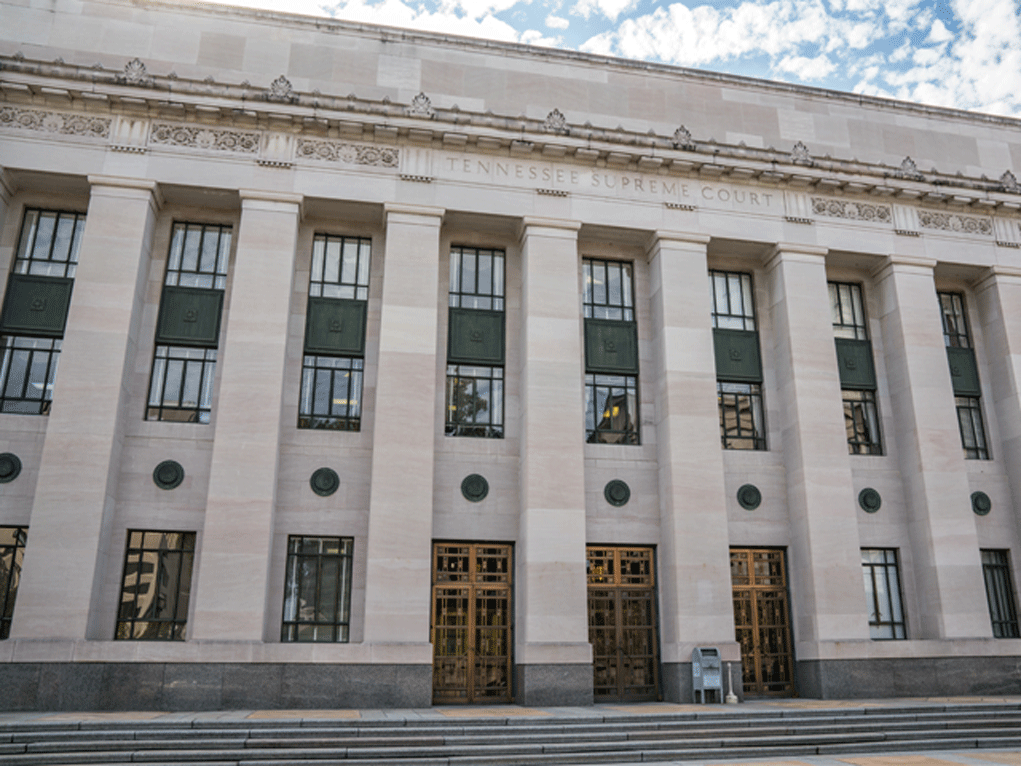 Yated Ne'eman1 month ago
Republicans Poised to Flip up to 14 US House Seats
“Republicans just won the redistricting war — and boosted their slim hopes for holding the House in November,” an explosive article in the left-wing Politico proclaimed.
The article went on to explain that, against all expectations, a liberal Virginia Supreme Court struck down a congressional map that would have potentially netted Democrats as many as four seats in the 2026 midterm elections.
Only 3 extra seats are needed to flip the U.S. House of Representatives to a Democratic majority.
“Shell-shocked Democrats are scrambling to pick up the pieces after the Virginia Court quashed a new map designed to help them seize control of the House in November’s midterms,” The Hill wrote, echoing the media’s doomsday tone over the Democratic defeat.
The ruling constitutes a significant setback to the party’s efforts to counteract the Republicans’ redistricting push in red states around the country, political analysts say.
“House Democrats fell into a state of anguish after the ruling came out,” reported Axios. “Depression dominated Democrats’ public statements and private text threads as the party absorbed its third redistricting loss in 12 days.”
With mid-term elections around the corner, fierce battles between the major political parties over congressional redistricting have erupted across America, as Democrats and Republicans seek to secure a majority in the House of Representatives in November.
The race to redistrict to gain an electoral advantage received a major boost after last week’s bombshell Supreme Court decision that ruled that “gerrymandering” by race (manipulating voting districts based purely on race) was unconstitutional.
On the heels of that landmark decision, new court rulings in Virginia and Tennessee striking down Democrats’ race-based districts have all but locked in Republican gains through “redistricting,” giving them as much as a 10-seat boost,” Politico reported.
Virginia Victory
Virginia’s legal battle unfolded after voters approved the Democrat-backed referendum in an April special election by a narrow margin.
Republicans quickly challenged the process in court, arguing that Democrats rushed the amendment through the Legislature to bypass constitutional safeguards and secure an unfair advantage.
Democrats lost at the trial court; the case went all the way to the Supreme Court of Virginia, which tossed it out.
The referendum was so flawed, experts say, that not even Virginia’s liberal Supreme Court could rescue it. The justices struck down the entire plan, ruling that all votes for or against the proposed redistricting amendment were unconstitutional.
Virginia Circuit Court Justice Jack Hurley said the Democratic-led legislature had violated procedural requirements by placing a referendum on the ballot that missed the deadline for such an initiative, because early voting for the 2025 election had already started.
“This violation irreparably undermines the integrity of the referendum vote and renders it null and void,” the majority wrote.
Using even stronger language later in the opinion, Hurley underscored that the legislature’s failure to follow the rules “incurably taints the resulting referendum vote and nullifies its legal efficacy.” The state’s Supreme Court said Virginia will therefore need to use its congressional map from 2021 instead.
Immediately following the stinging defeat, Virginia’s Democrats launched an overnight petition asking the U.S. Supreme Court to intervene. Legal experts say the petition stands little chance of succeeding, with even a NY Times article predicting it would be rejected.
“Some legal experts believe the petition will fail,” the paper admitted, “because the case is not about federal law or the U.S. Constitution but rather a challenge to a state law which is outside federal jurisdiction.”
After investing eight months and nearly $70 million to pass the referendum,” the Times wrote, “the ruling was a huge blow to Democrats.” This was $70 million of donor money that can no longer be spent on the midterm races.
Virginia Senate Minority Leader Ryan McDougle, the main plaintiff in the case, told Fox News that the entire state of Virginia should be applauding the state supreme court.
The Supreme Court ruling today affirms what we all know: you cannot violate the Constitution to change the Constitution,” McDougle said. “The Justices of the Supreme Court of Virginia affirmed that even the General Assembly must follow the law. This ruling is not a partisan one — it is a constitutional one.”
“The rule of law is the foundation of our Commonwealth,” the Virginia Senate Minority Leader added, “and today it has been upheld.”
Furious Pushback
Furious Democratic leaders have vowed to fight the verdict. House Minority Leader Hakeem Jeffries, D-NY, accused Virginia’s high court of “defying the will of the voters,” saying he was exploring “how to unravel this decision.”
He pledged to “employ maximum warfare, everywhere, all the time,” a fitting priority for the aspiring Jeffries, who stands first in line to become the House Speaker should Democrats reclaim the House in November.
Democrats had hoped the Virginia changes—later invalidated by the Supreme Court—would help offset Republican gains elsewhere, particularly after GOP-led states such as Texas redrew congressional boundaries favorable to Republicans.
Democrats had been aiming to implement maps that would turn their party’s current 6-5 edge in the U.S. House into a 10-1 advantage, but those hopes are fading.
“The recent court ruling gives Republicans a decisive edge in the redistricting war,” Politico said.
Chaos at Tennessee Capitol
The court rulings outlawing the use of race in districting have thrown the Democratic Party into a state of frustration and frenzy, media outlets report.
“Fury and Desperation Grip Dems After Friday’s Ruling,” the NY Times declared after the Virginia Supreme Court handed down its opinion.
“Democrats in Panic Mode after GOP Set to Gain 10 Seats_,” Sky News_ reported. “Chaos erupts at Tennessee Capitol as Redistricting Maps Move Forward,” a local Tennessee paper cautioned.
The paper quoted the shocking observations of an eyewitness to the proceedings at the Tennessee Capitol as Democrats and protesters resorted to throwing fits inside the Capitol building.
“The final vote in the Tennessee State House sounded less like a legislative proceeding and more like a group meltdown in a psychiatric ward,” the eyewitness wrote. Demonstrators howled, Democrats pounded their desks, flailed their arms and stomped out, and state troopers removed raucous gallery members.
“One Democrat Senator leaped onto on a table waving a banner, and refused to come down.
“Despite the cacophony, the Republicans calmly approved the map, presumably using sign language to communicate their “yea” votes through the racket.”
After the Capitol cleared out, Lt. Gov. Randy McNally called out Rep. Charlane Oliver for her crude and raucous protest from the top of her desk, as a vote was taken on a new congressional map.
“Senator Oliver’s outrageous and unprecedented display on the Senate floor today was disgraceful. She disrespected her colleagues, her constituents and this state,” McNally said. “There is simply no excuse for what she did.”
“The Senate floor is for deliberative debate, not calculated performative disruption,” McNally said. “It was conduct unbecoming of a senator — pure and simple.”
Despite the orchestrated uproar, Tennessee Republicans got the vote done. Governor Bill Lee has already signed the redistricting bill designed to give Republicans one more seat in Congress and protect President Trump’s control over the House.
Tennessee currently has eight Republicans and one Democrat — Rep. Steve Cohen, whose district is centered in the city of Memphis — in its House delegation. Under the new map, Republicans would be favored to sweep all nine seats, while Tennessee’s only Democratic representative may lose his seat.
Under the old map, Cohen’s “majority-minority” district seat was created under the Voting Rights Act, whereby voting districts are designed so that one racial minority group forms the majority.
But last week, the Supreme Court overturned that regulation, and effectively ruled that courts must first determine that there’s a provable case of racial discrimination before ordering race-based redistricting.
A mismatch between the size of a minority population and its share of congressional representation, on its own, is no longer treated as sufficient evidence of unlawful discrimination.
Mayhem in Alabama
Alabama is one of several states attempting to install new congressional district boundaries ahead of the November midterm elections. Its capital, Montgomery, was the scene of mayhem last month, similar to the raucous uproar in Memphis, as Republican lawmakers completed the redistricting vote during a thunderstorm evacuation.
Observers described Democrat officials screaming incoherently, gibberish, refusing to leave the lectern, and pulling fire alarms that blared incessantly throughout the proceedings.
As the thunderstorm escalated, evacuation notices lit up everyone’s phones, water began floating lawmakers’ cars away, and floodwaters seeped into the state house’s ground floor, puddling in the hallways.
Ironically, the violent storm ended a Democratic filibuster, which allowed Republicans to call the vote. The lawmakers cast their votes even as they were evacuating the chamber amid blaring fire alarms, with State Senator Greg Albritton standing guard at the chamber doors, making sure each member voted before they left.
The video scenes from the two legislatures “were so troubling and bizarre they almost defy description,” a journalist wrote. “Terrible optics for Democrats. Where one might expect dignity and professionalism, there was only mob mania; petulant, adolescent acting out. It smacked of desperation.”
Alabama Gets Green Light to Redraw Map
In yet another win for the GOP in the “gerrymandering wars,” Alabama received the green light from the U.S. Supreme Court on Monday to enact the redistricting effort the state had voted for in late April—one that could boost Republicans in two Democrat-controlled voting districts.
In a 6-3 ruling, the justices cited their blockbuster ruling in the Louisiana case last week that outlawed racial districting. A lower court had ordered Alabama’s congressional map to include two majority-black voting districts. The Supreme Court ruling this week vacated that order.
Republican Gov. Kay Ivey signaled last week that Alabama was “ready to quickly act” should the courts issue favorable rulings related to redistricting.
Trump and GOP allies argue the recent court ruling restores fairness after years of aggressive Democrat gerrymandering efforts in blue states nationwide.
Republicans currently hold a slim majority of just 3 seats in the House of Representatives, with 218 seats for GOP members to 215 for Democrats. (As of April 23, 2026, there is one vacant seat due to the death of Rep. Doug LaMalfa, R-Ca. A special election to fill that seat will be held on Aug. 4, 2026.)
With Louisiana, Florida, Tennessee, Mississippi, Alabama and South Carolina poised to redistrict ahead of November elections, Republicans are potentially positioned to flip between 10-14 US House seats in their favor.
Just one year ago, it was unthinkable that 10 House districts would be redrawn mid-decade to favor Republicans. Less than a month ago, the media was running a stream of articles hailing the Democrats’ push to win back a House majority, citing pundits who predicted that Democrats would sail to victory in November.
Rarely has a political situation changed so sharply in so short a time.
In the end, it was the courts — not fellow Republicans — that ultimately handed the biggest redistricting wins to Trump. Many GOP lawmakers across the country were not willing to heed calls to redraw their states’ maps.
“We expected corporate media’s gaslighting that Trump’s redistricting battle plan would backfire. But too many Republicans who should have known better also boarded the doom bus,” wrote Florida attorney and political commentator Jeff Childers.
“For example, Rep. Jay Obernolte, R-CA, said, “It was a mistake to go down this road.” Rep. Brian Fitzpatrick, R-PA, called GOP gerrymandering “bad for our country” and said, “nobody should ever go down this route.”
***
Democrats’ Desperate Measures
The judicial defeat in Virginia has so rattled Democrats, some panicked voices have advocated doing something so radical, it sounds like something only a hardened demagogue would dream up.
A NY Times article reported the apparently leaked details of an “angry private call” between House Minority Leader Hakeem Jeffries and top Virginia Democrats aimed at restoring a congressional (gerrymandered) map voided by the court.
“The conversation reflected the desperation and fury that have gripped the party after the state Supreme Court struck down the map,” the paper said. The individuals on the call floated a bizarre scheme: why not just fire all the Virginia judges who ruled against them and start over with new ones that would toe the line?
Calling the plan “audacious and possibly far-fetched,” the Times article explained that since Democrats control the legislature, they could rapidly pass a new law to lower the retirement age to 54.
Why 54? Does a human brain suddenly lose its ability to grasp judicial law at age 54? No scientific evidence was cited in the call. The number 54 was presumably chosen because that is the age of the youngest justice currently sitting on the Virginia Supreme Court. (The oldest is 73.)
The apparent plan is for Virginia Democrats to legally declare that every justice on the state’s highest court is too old and senile to do their jobs and force them all into immediate retirement.
Virginia judges are appointed by the General Assembly, where Democrats hold majorities in both chambers and can presumably pull off this outrageous move if all party members cooperate.
Virginia Democrats “could then fill vacancies on the court with sympathetic Democratic judges,” the Times article said. Party leaders advocated this sweeping scheme even though the vote was 4-3, with three judges voting in favor of approving Virginia Democrats’ racially based districting referendum.
No matter. For the sake of “protecting democracy” –getting rid of undesirable judges who don’t rule in the Party’s favor —all must be thrown under the bus.
“To Lefties driving today’s Democratic Party,” wrote a NY Post editorial, “it’s not “democracy” unless it’s hard-wired to let Democrats run roughshod — and when their power-grab schemes run afoul of the rule of law, their only answer is to devise a fresh scheme.”
Not all Democrats applauded the plan. Former U.S. Representative James Moran, D-Va., expressed reservations to Fox News Digital, saying such a move “could backfire” on his party. “We do have to keep our credibility,” he said. “We have to do things that pass the legitimacy test.”
***
Protests Inside State Capitols Likely to Intensify
Political analysts say the extremist confrontations now erupting across the country may be a preview of the coming midterm elections, with chaotic protests inside state capitols likely to intensify in the months ahead.
Some predict the Democratic Party will rally and overcome GOP gains in the frenzied run-up to the November elections. Others say the country may be witnessing the slow unraveling of a major political party.
Campaign strategists in both parties have sounded a note of caution, pointing out that if the political environment turns sharply against Trump and Republicans — perhaps fueled by rising gas prices and lowered approval ratings — Democrats may still succeed in unseating a couple of Republican seats in November.
With the Virginia map tossed, Republicans could wind up netting a dozen House seats in the redistricting wars, but that might not save the GOP majority, writes the NY Post, noting that the president’s job approval rating is currently mired in the low forties.
“The ‘old’ map still gives Dems an excellent chance to pick up two or three seats in Virginia,” the article said. “And even the Texas gerrymander that started the whole thing could blow up in Republicans’ faces if Hispanics in that state revert to their pre-2024 voting patterns.”
In counterpoint to this possible scenario, acting U.S. Attorney General Todd Blanche cast the Supreme Court’s rejection of Virginia’s gerrymandered map as part of a far broader political realignment.
Responding to the ruling, he issued a blunt warning about what he sees as the emerging landscape for Democrats:
“Combine these court wins with nationwide photo ID,” he said, “with the end of mass mail-in ballots, and with falling oil prices once the Iranian situation is resolved, and all of a sudden the Dems are staring down the barrel of a 2026 midterm bloodbath.”
 Yated Ne'eman1 month ago
Knesset Summer Session Opens with Draft Law on Center Stage
The Knesset began its summer session this week, and the secular media used the occasion to continue railing against the draft law (or “draft evasion law,” as they put it). They feared that Netanyahu would somehow manage to pass the law this summer. In fact, the national-religious right was opposed to the law, and there were a number of members of the Likud party who vowed to vote against it as well, even if it meant that they would be disciplined by Netanyahu. However, something has changed. As the anti-Netanyahu bloc drew closer to 60 mandates in the polls, the Likud and Religious Zionism began to fear a new threat—that the chareidim would join forces with Bennett, Eizenkot, and Lieberman to form a centrist-chareidi government. (Personally, I don’t believe there is the slightest chance that the left-wing bloc will manage to accumulate 60 mandates, since there is a definite right-wing majority in the country, but that is a story for a different time.) After all, the chareidi parties would certainly get everything they want in such a government—not only government funding but a new draft law as well, and one that satisfies every one of their demands. Despite their repeated insistence that the draft exemption for yeshiva students must not be allowed to stand, Netanyahu’s political rivals are likely to give up anything in exchange for power, even if it means giving in to the chareidim. Remember, the Bennett-Lapid-Lieberman government was willing to fork over billions of shekels to the Arabs and to refrain from attacking Gaza in order to receive and retain the Arabs’ support in the government. Surely, then, some funding for chareidim and a new draft law would not even make them blink. Perhaps they will even grant lomdei Torah a full exemption from the draft.
But what about the judges, you ask? Won’t they strike down a law that exempts yeshiva students from military service, as they have always done? In the scenario we are discussing, there is no cause for concern. As soon as there is a government that suits the judges—i.e., a government that will cancel the judicial reform and leave them comfortably in power—they will play along. After all, they are the ultimate politicians.
This is the reason that the right-wing politicians have begun to reconsider their stances on the draft law, wondering if perhaps it would be best for them to have the law passed before the next election. Which would mean that it must be passed during the Knesset’s summer session.
However, after writing these words there was a dramatic change. Following an announcement by Netanyahu that there is no majority for the draft law and another request to delay its implementation until after the elections, Rav Dov Landau called for new elections and told Degel HaTorah lawmakers to withdraw support from the coalition.
“We no longer have trust in Netanyahu,” Rav Landau said. “From here on, we will do only what is good for chareidim and the yeshiva world. We must act to dissolve the Knesset as soon as possible. The concept of a ‘bloc’ no longer exists as far as we are concerned.”
Opposition parties Yesh Atid and The Democrats moved quickly to introduce a bill dissolving the Knesset.
In March, chareidi parties backed the budget on the understanding that the draft law would return to the agenda two weeks after Pesach.
Does Netanyahu Have a Chance of Passing the Law?
This past Shabbos, 17 yeshiva and kollel students were being held in military prison. All of them were arrested over the past two months and sentenced to time behind bars. There were also attempts made last week to arrest three more yeshiva bochurim, but those attempts failed. And as if that wasn’t enough to make the atmosphere tense and foreboding, yeshiva bochurim all around the country feel threatened. There is also the economic stranglehold tightening around the chareidi community. All of that can change in an instant if a draft law is passed: No one will be classified as a draft evader anymore, and government funding will return. There will certainly be petitions and court sessions that are likely to continue for an entire year, but even one year of quiet can be beneficial. However, if the legal advisors of the Knesset are opposed to the law, then the Supreme Court will strike it down in an instant. That is the problem.
Within the coalition, some believe that even if Netanyahu would want to pass the draft law, he would not be successful. Boaz Bismut, the chairman of the Foreign Affairs and Defense Committee who has been overseeing the discussions, says that his committee has no problem with approving any bill that receives the chareidim’s approval, with or without the legal advisors’ support. And when the law is brought to a vote in the Knesset, many are confident that if Netanyahu wants to pass it, it will pass. However, Netanyahu will face a challenge in dealing with the members of the Knesset on the back benches, who know that they will no longer be present in the Knesset’s next term since they will likely not make the cut in the Likud primaries. Ostensibly, these politicians will have no problem flexing their muscles and bucking the prime minister’s orders—although, on the other hand, this would be the death knell for their political careers. As far as the chareidim are concerned, though, this isn’t their problem. Mustering a majority in the Knesset will be Netanyahu’s headache.
And now, someone else spoke about against the draft law—Ophir Sofer, a member of Smotrich’s party who serves as minister of immigration and absorption. Sofer announced that he would vote against the bill if it is brought to the Knesset, provoking an angry reaction from Moshe Gafni. “He has no concept of the importance of learning Torah,” Gafni fumed. “It would be better for him to focus on his job as minister of immigrant absorption rather than meddling in the affairs of the yeshiva world.” Gafni went on to attack the members of the religious Zionist camp who have been opposing the Torah world, while Smotrich hurried to defend Sofer.
Aryeh Deri has announced several times, including this past week, that his Shas party will accept any decision made by the gedolim of Degel HaTorah.
We have to daven to Hashem to have mercy on us.
A Debate in the Knesset Will Not End Youth Violence
The chareidi press tends to avoid reporting on crime. Therefore, I assume that you are unaware of the maelstrom of outrage and controversy surrounding the subject of the mounting violence among youths in Israel. One recent egregious incident took place in Petach Tikvah, leaving residents of the city shaken. To make a long story short, a group of youths attacked another boy when he left the pizzeria where he worked as a waiter. The other boys were angered by the fact that the victim had asked them not to make a mess in the store, which led to a fierce quarrel that ultimately turned deadly. The young pizzeria employee was murdered for no reason other than that he had tried to quiet a group of rowdy youths. A similar incident took place in Beer Sheva as well. The secular media has been rehashing these stories for the past two weeks, bemoaning the depths to which Israeli society has sunk. And then, to make matters even worse, there is a group of youths, children of Eritrean infiltrators, who have been roaming the streets of Tel Aviv and beating other children, leaving much of the country wondering how the scourge of violence can be eliminated.
When the Knesset opened its summer session this week, several urgent motions for the agenda were filed on the subject of violence among young people. The minister of education will respond to the motions and committees will meet to discuss it … but then what? The leaders of Petach Tikvah, as well as Tel Aviv and Beer Sheva, need to understand that the solution to the problem lies in education; until they realize that, nothing will change. Even stiff penalties will not serve as deterrence.
In defense of Mayor Rami Greenberg of Petach Tikvah, whom I have never met, it must be noted that after the terrible murder outside the pizzeria, he decided to focus on outreach among the youths of his city. Prior to Lag Ba’omer, Greenberg announced that he would attend the bonfire held by Mishnas Shimshon for hundreds of students from their midrashot, with the goal of bolstering their activities. Mishnas Shimshon is a network of organizations that includes the Ohel Yiskah kollel in the neighborhood of Amishav, the Nefesh Shimshon kiruv project, and Lev L’Gibborei Yisroel, whose participants visit wounded soldiers undergoing rehabilitation in Tel Hashomer Hospital. The organization was founded by Rav Moshe Pincus in memory of his illustrious grandfather, Rav Shimshon Dovid Pincus. The yungeleit in the kollel spend time learning with the soldiers as well as with other irreligious residents, adults and youths. Rav Pincus has enjoyed incredible siyata d’shmaya, and his programs have attracted hundreds of youths from the city. Mayor Greenberg deserves to be applauded for promoting the work of these institutions.
Herzog Recommends a Plea Bargain
Do you still remember Netanyahu’s request for a pardon and President Trump’s involvement in the matter? Well, after weeks without a development, something has finally happened. Netanyahu hasn’t received the pardon he requested, but the president’s office has begun putting pressure on both sides in the case (Netanyahu’s defense team and the prosecution) to reach some sort of agreement that will terminate the trial. President Herzog did not accept Netanyahu’s request for a pardon, nor did he reject it; he simply made an effort to promote dialogue between the two sides, with the goal of fostering an agreement. A letter from Michal Tzuk, the legal advisor to the president, invited the attorney general, the state prosecutor, and Netanyahu’s attorneys to meet in the president’s residence to discuss the possibility of arriving at some sort of mutual understanding. The president’s staff explained that this is a preliminary stage before Hertzog begins his deliberations over the request for a pardon. The president would prefer to see the two sides reach an agreement that will put an end to the trial, and will consider a pardon only if that option fails. The letter stresses that accepting the presidents’ invitation should not be construed as an agreement with the other side or a withdrawal of their claims in court.
Attorney General Gali Baharav-Miara and State Prosecutor Amit Aisman accepted the president’s invitation, which means only that they are ready to talk; this doesn’t necessarily signal their willingness to accept a deal. They also made two significant qualifications: There are to be no preconditions to the discussions, and the talks must not interfere with the progress of the trial. They refused to answer whether the talks will be held in the president’s residence. The prime minister, for his part, hasn’t yet given an official answer to Herzog’s request. It is not a simple matter for him; if he agrees to the talks, it might signal that he is open to the possibility of a plea bargain, which would lead to the question of whether he is prepared to admit to having committed a crime, to accept responsibility, to step down from his position, or to agree to moral turpitude. A refusal, on the other hand, might also tarnish his public image, indicating that he is unwilling to try to end his criminal trial even when the president gives him an opportunity to do so.
Herzog explained that he chose what he believes to be the best path forward. Netanyahu’s trial, he asserted, is one of the most divisive and polarizing topics in Israeli society, and he felt that it would be best to try to reach an agreement to end the trial without having to deal with the dramatic question of whether a sitting prime minister should be given a pardon even without having been convicted of a crime. In other words, Herzog is trying to find a middle ground, neither accepting nor rejecting the notion of pardoning the prime minister. The main question is whether he is calling for an actual plea bargain, which generally requires the defendant to admit at least to part of the allegations against him and to accept a penalty of some kind, or for criminal arbitration, which does not require anything of the defendant.
Musings in the Wake of Lag Ba’omer
The smoke of the Lag Ba’omer bonfires dissipated days ago, but I still find myself preoccupied by the events that led up to this year’s hillula. I read stories about the people who longed to visit Meron on Lag Ba’omer and managed to get there in spite of the many obstacles and the authorities’ opposition, and I couldn’t help but wonder if they were truly correct in their actions. Did they have the gift of nevuah to inform them that no missiles would fall while they were there, and that the police would show restraint and would refrain from beating them or causing harm? Then again, masses of people visited the mountain on the day after Lag Ba’omer, all with official permission, and this, in my mind, gave rise to the opposite question: What made the Home Front Command so certain that there would be no missiles on the 34th day of the Omer? Were they blessed with prophecy of some kind? What made it safer to be in Meron on that day than on the day before?
I found myself confused, left with the distinctly unpleasant feeling that the decisions had nothing to do with the actual degree of danger and instead were based on the type of people who were affected. Was it really too risky to open Meron to the public on Lag Ba’omer, or was it contempt for the religious populace that drove that decision? Yes, we must give thanks to Hashem for the fact that there was no tragedy; at the same time, there is no avoiding the suspicion that the decision makers were not free of bias or personal agendas. That would also explain why there was a sweeping ban on visiting the Kosel, which the secular government considers nothing more than a tourist site, during the war with Iran. Perhaps they view Meron as a place of recreation, rather than holiness, as well.
As it turns out, this isn’t without precedent. The Israeli newspaper Hamevasser dedicated its weekly supplement to Meron last week and featured copious information about the history of Lag Ba’omer in Meron. One of the articles reported on the events of Lag Ba’omer in the year 5716, when severe restrictions were placed on the hillula out of concern for public safety. There was a fierce debate in the media at the time as to whether the Ministry of Religious Affairs had agreed to the restrictions or possibly even participated in imposing them, or the ministry worked behind the scenes to limit the damage and at least to make it possible for the regular participants in the hillula to receive permits to attend. The ministry claimed that the decision had come from the police, and the police did not respond. According to a report in the newspaper Shearim, dated on the 29th of Iyar 5716, “The public wants to know and must receive an explanation as to whether the restrictions imposed by the police on the traditional pilgrimage to Meron were necessary, and if it was possible to make any corrections or repairs in advance to avoid an affront to the sensitivities of tens of thousands of celebrants who gather in Meron every year on Lag Ba’omer.”
The same question could easily be asked about the hillula that was restricted this year, many decades after that incident: Were the limitations imposed by the police and the Home Front Command truly necessary?
In any event, this Lag Ba’omer also taught us that Rabi Shimon is not limited by geography, and every Jew can connect to Rabi Shimon bar Yochai anywhere, not only in Meron—whether it is in Beit Shemesh, at Rav Shefa in Yerushalayim, in Givat Shaul, or in Yeshivas Ateres Shlomo, where the festivities were arranged by the bochurim while the neighborhood rabbonim closed their eyes. Shloimy Breuer, an extremely serious yeshiva bochur, managed to organize and produce a remarkable event, recruiting the musical services of Yehuda Appel on the keyboard, Yaakov Raphael with a guitar, and Mottele Rokach as a singer. Together, the group swept hundreds of bochurim to the heights of inspiration—of course, only after the conclusion of the night seder. The enthusiasm and passion that typify Meron on Lag Ba’omer echoed through the streets of Rishon Letzion, sweeping even the non-chareidi residents along with them.
Terror in Israel and Deaths in Lebanon
I haven’t written much about security-related matters, but the country is still suffering from the schemes of bloodthirsty terrorists. Last weekend, Border Guard officers arrested three terrorists who were planning to carry out attacks, including a Palestinian Authority policeman and an ISIS activist from Yehuda and Shomron. In the villages of Dura and Deir al-Asad, security forces arrested two terrorists who were planning to carry out attacks “in the immediate future.” In another operation in Shechem, another terrorist was arrested for past involvement in terror. And on a somewhat unrelated note, an Israeli soldier was taken into custody this week on suspicion of having stolen weapons, while another soldier was arrested on suspicion of spying for Iran. And I haven’t even mentioned what is happening within Iran, which has led to nail-biting tension in Israel. No one here has the slightest interest in spending more time running to bomb shelters or panicking at the sound of an air raid siren; on the other hand, we all agree that the Iranian nuclear threat must be completely eliminated.
As I mentioned last week, Israel is also facing the threat of drones operated by Hezbollah in Lebanon. This new variety of drones has proven difficult for the IDF to evade, and the weapons are continuing to cause Israeli injuries and fatalities. The army is currently working on ways to defeat the primitive drones, and IDF soldiers have been armed with weapons that might be able to overcome them. Meanwhile, we are still burying fallen soldiers; may Hashem protect us.
Ruminations of the Bereaved
This week, I received a copy of Otzma, the magazine published by an organization dedicated to assisting widows and orphans of IDF soldiers and security personnel. Leafing through this periodical gave me a small sense of the pain and grief experienced by tens of thousands of widows and orphans. The stories, many of which took place over the past couple of years, since Simchas Torah of 2023, are deeply saddening. For instance, there is the story of Motti Wieder: For many years, Motti habitually traveled to Har Hazeisim on Yom Hazikaron to visit the kever of his father, Chaim Tzvi Wieder, who was killed in the Yom Kippur War. Fifty-one years after the loss of his father, he received a visit from IDF officials, this time to inform him that his son Elyashiv Eitan, a combat soldier in the Golani brigade, had been killed in Lebanon. This left him with a terrible decision to make every year: Should he visit his father’s kever on Har Hazeisim or his son’s resting place on Mount Herzl? Elyashiv was born during the Aseres Yemei Teshuvah, and his bris was held on erev Sukkos when the family returned from the kever on Har Hazeisim.
This issue of Otzma contained a supplement titled Gaaguim (“Yearnings”), which consisted of poems written by bereaved parents, widows, and orphans. Sadly, I felt that there was a vital element that had been left out of the publication: the concept of emunah. The true source of consolation for these bereaved families should be the fact that their loved ones died al kiddush Hashem and thus attained some of the loftiest levels of holiness. With all due respect to the activities arranged by the organization—hikes at sunrise, surfing lessons, and a trip to the Secret Forest in Cyprus—I wonder why there is no mention of special tefillos, trips to holy sites, or other Jewish-oriented initiatives to benefit the souls of the deceased.
The opening pages of Gaaguim contain letters from President Herzog, Prime Minister Netanyahu, Chief of Staff Eyal Zamir, and Police Commissioner Levi. The chief of staff quoted Yossi Gamzu, Netanyahu quoted a poet, and Herzog quoted himself. No one bothered to cite a single posuk about the soul or the Jewish spirit. However, the opening letter in Otzma written by the chairwoman of the organization, Zahava Gross-Meidan, stirred my emotions. As a widow whose husband was killed in IDF service, she knows how to express the pain and grief that haunt bereaved families. “Over the past two years,” she wrote, “too many names have been added to the weight we carry on our hearts…. On this day, along with remembering the deceased, we choose life once again and pray for the strength to accompany us forward. Those who pin their hopes on Hashem will have renewed strength…. Even when it seems as if the world has stopped and our hearts are completely broken, we still have a force within us that renews itself every day—the power of faith, community, and choosing life.”
It’s a pity that the politicians didn’t take a page out of her book and include some mention of Hashem and Jewish faith in their own letters as well.
The Day of Liberation and Salvation
While Netanyahu’s letter in the magazine may not have had much in the way of Jewish content, he sometimes knows how to write like a Jew. This week, there will be a fascinating event that I find more meaningful with every passing year: the celebration of the defeat of Nazi Germany. The rest of the world commemorates the event on May 9, but I am referring to its Hebrew anniversary, the 26th of Iyar. In Moscow and in many other capital cities in Europe, this historic event is commemorated on its Hebrew anniversary and with Jewish rituals such as Kaddish, Kel Malei Rachamim, and other tefillos. The idea to mark the date specifically according to the Hebrew calendar originated with a man named Gavriel (German) Zakharyaev, whom I have mentioned in numerous articles in the past. Thanks to his advocacy, a law was passed in Israel calling for the occasion to be marked on its Hebrew date, and the annual event at the Kosel organized by Zakharyaev has therefore become an official occasion. The event is attended by a large crowd of cheder children from Yerushalayim representing the hundreds of boys who learned six million mishnayos in memory of the Jews murdered in the Holocaust.
I met Gavriel Zakharyaev several years ago, when his assistant, Dovid Mordechaiev, asked for permission to organize a hachnossas sefer Torah in the Knesset. The idea sounded bizarre and unrealistic at first, but it ultimately came to fruition. On the same day, Zakharyaev donated three sifrei Torah to three different places: One small sefer was delivered to the home of Rav Chaim Kanievsky, a second was placed at the Kosel, and the third was gifted to the Knesset. A few months later, the Knesset administration asked for the sefer Torah to be transferred to a different shul, since the Knesset is prohibited by law from accepting gifts. But I digress.
The annual event at the Kosel will be held this Wednesday. The guest of honor at the event is usually either Rav Yisroel Meir Lau or his son, Rav Moshe Chaim Lau, and the minister of religious affairs (a post held by Michoel Malchieli in recent years) is typically in attendance as well. At the same time, Mr. Zakharyaev appears as the guest of honor at a parallel event in Moscow, while concurrent events are held in capital cities all around Europe and attended by the rabbonim of various countries, including Tunisia.
But let me return to my main point: In honor of the upcoming events, Prime Minister Netanyahu wrote a letter in which he mentioned the tribulations that the Jewish people have endured in recent years. “Let us remember,” Netanyahu wrote, “that our duty to subdue evil regimes isn’t a one-time task…. Just look at the historic revolution we have created in this War of Revival. The small country of Israel and its great friend, the United States, are carrying the entirety of Western civilization on their backs. Our soldiers, filled with a sense of mission, are standing strong on all fronts to guarantee the eternity of Israel, with Hashem’s help, and we all stand with them.” Netanyahu went on to acknowledge the IDF veterans and to thank the organizers of the events being held in Yerushalayim, Moscow, and other cities, and concluded, “I must give my warmest thanks to German Zakharyaev, one of the leaders of the Russian-Jewish Congress, who was the driving force behind commemorating this important date on the Hebrew calendar.”
In the House of Hashem
Last weekend, I attended an American wedding. No, I wasn’t in Boro Park or Lakewood; I was in Yerushalayim, but it was an American wedding nonetheless. The father of the chosson was Rav Yitzchok Meir Green of Boro Park; I can still remember attending his engagement celebration many years ago. His father-in-law was the late Rav Avrohom Noach Klein, a prodigious baal tzedokah in Boro Park. To this day, the family still manages the tzedokah fund that he established, distributing funds to various institutions and needy individuals to honor his memory. On that note, I remember that Rav Chaim Kanievsky came to visit us during the shiva for my father; it was quite unusual for him to make the trip from Bnei Brak to Beer Yaakov, but he arrived and said to us, “Every act of tzedokah, every Kaddish, every mishnah, and every mitzvah that you perform in his memory will benefit your father in the World of Truth. Just imagine that he has no pillow, and then you perform an act that provides him with a pillow.” To borrow Rav Chaim’s analogy, I tend to believe that Rav Avrohom Noach has plenty of “pillows” in Shomayim thanks to his family’s ongoing good deeds.
The kallah’s father was Rav Naftoli Etzioni (Holtz), who is a descendant of the Chiddushei HoRim and the Tiferes Shlomo. The kallah’s grandmother, Rebbetzin Chaya Pietrkowski, lives in Lakewood. In short, it was an American simcha despite being held at the Nof simcha hall in Yerushalayim.
At the wedding, I met many members of the family of Rav Yisroel Green of Boro Park. Many years ago, when I learned in America as a yeshiva bochur, first in Lakewood and then in South Fallsburg, Rav Yisroel Green and his rebbetzin opened their home to me. The Midrash states that when Hashem instructed Moshe to travel to Mitzrayim to demand the release of Bnei Yisroel, Moshe said, “Master of the Universe, I cannot do it, for Yisro received me and opened his home to me, and I am like a son to him, and when someone opens his door to his friend, he owes his life to him.” That line neatly encapsulates the depth of my own feelings of gratitude to the Green family. And I was the second generation to benefit from their largesse; their home and Reb Yisroel’s office in Manhattan (where he later worked together with his partner, the illustrious baal tzedokah Reb Yossel Neuman) were open to my father during his time in America as well. In addition, Rav Moshe Shmuel Shapiro was hosted in their home when he visited America. I could easily write an entire article about Rav Yisroel Green; however, he would not want me to do that.
Rav Yitzchok Meir, the father of the chosson, is an outstanding talmid chochom. During the wedding, he shared an incredible vort with us on the statement of Chazal, “Rabi Shimon says: All of Yisroel are royalty.” This statement is quoted with regard to the halachic issues of going outdoors on Shabbos while wearing jewelry or using rose oil for medical purposes on Shabbos. Rabbi Green proposed an outstanding chiddush, which I will not quote here. However, I will quote the following thought, which he shared with my table: “On Shabbos Shuvah in the year 5755, I joined you for the morning seudah. You may not remember it, but I remember that I told you a vort that I had heard from the Pnei Menachem at a tish on the previous Shabbos. He quoted the posuk, ‘I ask for one thing from Hashem, which I shall request—that I dwell in the house of Hashem all the days of my life.’ The Pnei Menachem asked: How is it possible for a person to be in the ‘house of Hashem’ at all times? After all, a person must eat, sleep, and perhaps engage in business as well. The Pnei Menachem answered his question with a roar: ‘When a person thinks about Hashem in everything he does, then he is in Hashem’s House even when he is involved in gashmiyus!’”
 Yated Ne'eman1 month ago
Suppose you’re in the market for a house. You have a mental picture of the kind of place you want, along with a list of preferred features. Day after day, you trudge around behind a Realtor, checking out the options.
There are so many different parts to a house. So much that can be right… and so much that can be just plain wrong. How do you weigh one against the other? Suppose you find a house that’s mostly what you want, but is lacking in some ways. How do you judge whether or not it’s a good buy?
To help you figure it out, you bring an inspector on board. The inspector’s job is to check the place out from top to bottom, with the aim of ascertaining its overall “health.” He doesn’t concern himself with things that can easily be remedied, such as torn window screens or an aging boiler. His job is to discover, and to share with you, the potential buyer, the pluses and minuses of the house’s condition where it counts.
It would be the height of folly to reject an otherwise fine prospect because you don’t like the color of the living room walls. Obviously, that’s something you can change without too much trouble. However, if the inspector tells you that the place needs a new roof, requires an overhaul of its entire HVAC system, and has a problem with termites in the basement, that’s definitely food for thought. These are serious problems which call for serious repairs and a serious outlay of money.
If, however, the inspector declares the house fundamentally sound, you’ve got something to work with. All the smaller details which aren’t precisely to your liking can be either dealt with or put up with. If the basic picture is healthy, you’re good to go.
A person’s physical health follows a similar rule. He may be plagued by such trivial annoyances as dandruff, ingrown toenails and a tendency toward acne. She may deplore her frizzy hair or suffer from occasional heartburn. But if the doctor pronounces their vital organs to be in good shape, they can, with good justification, call themselves healthy.
To follow the analogy: When engaged in the search for a life partner, it’s useful to set ourselves up as house inspectors rather than buyers. Doctors rather than patients.
A buyer can be fickle, and a patient can be irritated by trivial complaints. But the question we should ask ourselves is whether or not a particular candidate for marriage is fundamentally
sound. Our focus ought to be on the condition at the basic level, rather than the fixable or can-be-lived-with details on the perimeter.
I’ll never forget a girl I knew long ago, who declared that she would never marry a boy who wore brown suits. Sometime later, a mutual friend informed me that she’d just run into that girl, now happily engaged and walking with her chosson who was wearing… a brown suit! That long-ago kallah was smart enough to separate the vital from the trivial. She chose a husband who had the important qualities that she was looking for, and she was willing to either put up with, or work on changing, the kind of clothes he chose to wear.
On the Same Team
They say you should never marry someone in the hope that they’ll change. That doesn’t mean that they’ll never change. It does mean that you can’t depend on it happening.
Many years ago, I knew someone who was not enjoying her marriage to a difficult man. She went to speak to a rov, who told her flatly that she couldn’t expect her husband to change. The choice lay before her: either to divorce him, or to undertake to change herself. By finding new inner strengths and different ways of coping with the things that bothered her about his personality, she could recreate their relationship to make it both more functional and more satisfying.
She decided to stay in the marriage and do the necessary personal work to help smooth away the rough edges. And she’s still there all these years later, with a healthier if not perfect marriage, enjoying plenty of nachas from their children and grandchildren.
It’s not always easy for an outsider to take a couple’s “temperature” to see if the marriage is healthy. That’s because what you see is not the whole picture. You sometimes run into couples who enjoy mock bickering in public as a way of being entertaining. Regardless of whether you approve of this mode of social behavior, what matters much more is how they treat each other when they’re out of the public eye. How they behave in private is the true barometer of the relationship.
The reverse is true, too. A couple who acts friendly and even affectionate in front of others but rips off the mask to treat each other nastily in private, is a couple that’s in trouble. It’s not the outer charade that defines the health of the relationship, but the inner reality. And only the two of them are privy to that knowledge.
Over the course of their years together, it’s only natural for the first, dazzling impression to fray around the edges. Where you once believed your partner to be a pattern of perfection, you gradually become aware of the human imperfections which he, like everyone else, contends with. Over time, he also discovers the areas where you’re lacking. These discoveries can be disillusioning, but they don’t have to be devastating. What’s called for when that happens is to separate the basics from the trivial.
If the middos are there, and the goodwill is there, you’ve got something to work with. Minor faults can be overlooked or smoothed away. Major ones require more effort. But as long as the foundations of the building are solid, your home will endure.
Someone wise once told me that a critical ingredient in a good marriage is for husband and wife to be “for” each other. They need to both be playing on the same team. They have to have each other’s backs. Then, when a disagreement crops up or a major argument erupts, on a basic level they’re still for each other.
There’s no worse feeling than approaching your own front door knowing that you’re about to enter enemy territory. Unfortunately, in marriages where the foundational level is flawed and left to flounder, this can happen. Let enough negative water flow under the bridge of the relationship, and it will start to crumble.
Your spouse, for all his shortcomings, must be on your side, and vice versa. That’s basic. So is principle that both of your middos must be kept in good shape. Like a house or car, maintenance is crucial. Even good middos can deteriorate if allowed to slide through lethargy or lack of focus. And problematic middos must certainly be noticed and weeded out.
Nobody is perfect down to every last detail. You’ll each have things to work on and areas that can stand some improvement. But at bottom, a marriage thrives when both parties, like a good house, are fundamentally sound. Then, even if there are things to be worked on (and there always are), there’s a solid basis for success.
 Yated Ne'eman1 month ago
As President Donald Trump prepared to leave for his delayed visit with China’s leader, Xi Jinping, in Beijing, he warned that the future of the shaky ceasefire with Iran is comparable to that of a gravely ill patient on “life support” with no more than a 1% chance of recovery. Trump issued that dire prognosis to White House reporters after flatly rejecting as “unbelievably weak” the latest response to his demands that Iran’s leaders give up their nuclear weapons program, re-open the international waters of the Strait of Hormuz, halt its production of ballistic missiles, and end support for its terrorist proxies, including Hezbollah, Hamas, and the Houthis.
After reading the latest Iranian proposal, Trump responded in a written message on his Truth Social account, declaring, “I have just read the response from Iran’s so-called ‘representatives.’ I don’t like it — TOTALLY UNACCEPTABLE.”
In an earlier Truth Social post, Trump wrote that, “Iran has been playing games with the United States, and the rest of the World, for 47 years, [but] they will be laughing no longer!” signaling his dissatisfaction with Iran’s latest response to his demands, which Trump had been led to believe he would receive on Friday, May 8, but which was not delivered by Pakistani mediators to U.S. negotiators until Sunday, May 10.
Trump told White House reporters Monday that among several non-starters in Iran’s response was a demand that the U.S. recognize Iran’s sovereign right to dictate which ships will be permitted to pass through the Strait of Hormuz. The strait has long been considered to be international waters, and therefore open to free passage by ships flying the flags of all nations. The Iranian response also demanded the withdrawal of all U.S. military forces from the region, and billions of dollars in cash reparations from the United States for the damage Iran suffered during the 40-day campaign of joint U.S.-Israeli air strikes.
Iran’s Latest Offer to Trump Was “A Waste of Time”
Trump said that he considered their latest response to be so unacceptable that he did not “waste his time” by reading it to the end. In its response, Iran refuses to even begin discussions on the fate of its nuclear weapon program until 30 days after the U.S. had agreed to Iran’s initial demands for a permanent ceasefire and the reopening of the Strait of Hormuz under full Iranian control, including the right to charge tolls for any ship passing through. The main problem with that proposal is that the most crucial issue from the American point of view, the fate of Iran’s nuclear program, would be left completely unresolved until a later stage in the negotiations, while Trump has demanded that the first requirement of any deal would be for Iran to make an immediate and binding commitment to end its uranium enrichment for as long as 20 years, turn over all of its highly enriched uranium and pledge never to seek to develop a nuclear weapon capability again.
According to a report from Iran’s semi-official Tasnim news agency, last week’s Iranian response also demanded the immediate end of the American naval blockade of Iran’s ports in the Persian Gulf, a guarantee of no further attacks, an end to all Israeli attacks on Hezbollah in Lebanon, the release of all of Iran’s financial assets that are frozen in foreign banks and the lifting of all U.S. sanctions on Iran’s economy, including the ban on Iranian oil exports.
Iran Keeps Going Back on Its Concessions
Trump told White House reporters that the latest written Iranian peace proposal, which was presented to the U.S. through Pakistani mediators last week, also omitted several key concessions to which Iran’s leaders had verbally agreed. One of them was the surrender of Iran’s 972-pound (440 kilograms) stockpile of 60% highly enriched uranium, which American weapons experts believe is enough for Iran to quickly build 11 nuclear weapons with a minimal amount of further enrichment to 90% purity. According to Rafael Mariano Grossi, the director-general of the U.N.’s nuclear monitor, the International Atomic Energy Agency (IAEA), about 440 pounds from that stockpile was buried by the 15-ton bunker buster bombs that American B-2 warplanes dropped last June, destroying the tunnels of the underground Iranian nuclear facility at Isfahan.
Trump also said reporters that in a discussion of the current disposition of Iran’s enriched uranium stockpile two days earlier, Iran’s negotiators had told their American counterparts, “You’re going to have to [go into the bombed sites] to take it.” That was because what Trump had referred to as the dangerous “nuclear dust” of highly enriched uranium is now buried so deep under the rubble of the bombed nuclear sites that only the U.S. and China have the sophisticated excavation tools necessary to retrieve it. But, Trump said, that key concession was also entirely missing from the written response that Iran presented last week.
According to a Wall Street Journal report, the Iranians had proposed diluting some of its 60% highly enriched uranium so that it would no longer be suitable for making a nuclear weapon, and transferring the remainder to a third country, such as Russia, for safekeeping.
Trump Says Iran Is Defeated, but the War Is Not Yet Over
Meanwhile, in an interview with independent television journalist Sharyl Attkisson, Trump emphasized that the Iranian site that contained the highly enriched uranium was being “very well surveilled” by the U.S. Space Force, and warned that “if anybody got near the place, we will know about it, and we’ll blow them up.” He also said that the enriched uranium could be easily removed by U.S. forces “whenever we want.”
Trump also made it clear that when he says that Iran has been defeated, he was not saying that all U.S. combat operations against Iran are now finished. “No, I didn’t say that,” he said, and then explained that while Iran is “defeated, that doesn’t mean they are done [fighting].”
Trump also said that if he decided to resume the air strikes on Iran, the U.S. military could “go in for two more weeks and do every single target. We have certain targets that we wanted, and we’ve done probably 70 percent of them, but we have other targets that we could conceivably hit… that would just be final touches” of the plan for Iran’s complete destruction.
Last week, the White House also sought to portray “Operation Epic Fury,” the original military campaign against Iran, which began on February 28 with the joint U.S.-Israeli decapitation raid on Tehran, as having, in fact, ended with Trump’s ceasefire announcement on April 7, long before the operation had reached the 60-day limit for congressional authorization under the 1973 War Powers Act.
On the other side, in an interview with Iranian state media, General Akrami Nia, a spokesman for the Iranian military, said that its forces were at “full readiness” to protect the sites where the enriched uranium is stored, against the possibility that American or Israeli forces might try “to steal it through infiltration or helicopter-borne operations.”
Trump said that Iranian negotiators had also verbally “guaranteed that Iran wouldn’t obtain nuclear weapons for a very long period of time,” but that promise, too, had been omitted from the official written proposal that Iran presented through the Pakistanis.
Iran’s Leadership Is Divided Between Pragmatists and “Lunatics”
Nevertheless, when White House reporters asked Trump whether he thought that a peace deal was still possible with the current leaders of Iran’s Islamic regime, he responded that it was.
Trump said that one of the reasons that a deal has remained elusive is the fact that the United States and Israel had wiped out the top ranks of its leadership on the first day of the war, and that more than two months later, those dead Iranian leaders have not yet been fully replaced.
The president then added that breaking the current diplomatic deadlock depends upon the outcome of the increasingly bitter dispute between the more pragmatic Iranian government officials who desperately want to reach an agreement to end the conflict with the United States, against the hardline “lunatics” of the powerful Islamic Revolutionary Guard Corps (IRGC) who want to keep fighting the U.S. to the bitter end, regardless of the suffering it will cause for the Iranian people. Trump also said these “lunatics” believe that their stubborn resistance will eventually force him to give in to their demands. But they are wrong.
Trump also offered a response to his critics who complain that he has no clear plan for dealing with Iran’s obstinate leaders. “I do have a plan,” Trump insisted. “The plan is that Iran cannot have a nuclear weapon.”
Trump indicated that another fundamental problem with trying to negotiate any deal with Iran’s current leaders is the lack of certainty. For example, he said that when Iran’s negotiators had agreed to his demand that it abandon its nuclear ambitions, “it [didn’t] mean much because the next day they forgot.” Trump also added a warning that if Iran did not agree to the latest deal that he has offered them, it was “going to [suffer] a lot of pain.”
Last week, while Iran was reviewing President Trump’s latest offer, he revealed some of its specifics. “It’s an offer that basically said they will not have nuclear weapons. They’re going to hand us the nuclear dust and many other things that we want,” Trump explained.
Over the weekend, as the White House was waiting for the latest Iranian proposal to arrive, Secretary of State Marco Rubio and White House Middle East envoy Steve Witkoff met in Miami with the Qatari Premier Mohammed bin Abdulrahman Al Thani, who has been serving as one of the key intermediaries in the negotiations between the U.S. and Iran.
Trump Planning His Next Move Against Iran
On the day before Trump left Washington for his trip to China, he held a high-level meeting in the White House Situation Room to discuss America’s next step in the ongoing conflict with Iran. The other participants included Vice President JD Vance, Secretary of State Marco Rubio, Defense Secretary Pete Hegseth, CIA Director John Ratcliffe, Chairman of the Joint Chiefs of Staff General Dan Caine, and Trump’s special negotiating envoy Steve Witkoff.
They discussed America’s various diplomatic and military options now that the extended ceasefire has transformed the conflict from a war of missile and drone attacks by Iran on Israel and U.S. allies, in response to the intensive campaign of air strikes by the U.S. and Israel on Iran, into a war of slow economic attrition for both sides due to the extended closure of the Strait of Hormuz to virtually all maritime traffic.
Many believe that Trump decided to wait until after his trip before making his next move against Iran in the hope that he could persuade China’s leader that it is very much in his own country’s best interests to persuade Iran to give up its nuclear program and to permit the resumption of free passage for all shipping through the Strait of Hormuz.
One of Trump’s current options is to restart Project Freedom, a military initiative under which American guided missile destroyers and up to 100 American warplanes to escort commercial maritime traffic to assure their safe passage through a new passage in the Strait of Hormuz along its southern coastline that is within the territorial waters of Oman, and as far away from the Iranian coastline on the other side of the strait as possible.
Iran’s Leaders Are Betting That Trump Will Give In to Their Demands
Meanwhile, the continued American naval blockade of Iran’s Persian Gulf ports means a loss to Iran’s economy of more than $440 million a day, most of that from lost oil export income.
Nevertheless, Iran’s ability to maintain its closure of the Strait of Hormuz in the face of the massive American military buildup has apparently encouraged its current hardline leaders to believe that they can dictate terms to President Trump. They are betting that Trump will be forced to accept their demands to get them to reopen the strait to all maritime traffic, because if the spike in the price of gas at the pump for American consumers due to the global oil shortage continues for much longer, it will threaten Trump’s hopes for maintaining Republican control over the House and Senate in the upcoming November midterm election.
As a result, according to Raz Zimmt, the director of the Iran research program at Israel’s Institute for National Security Studies, “Iran is not prepared to return to the prewar status quo and is demanding long-term economic and security guarantees that the war will not resume and that it will be able to derive economic benefit from the situation.”
The growing confidence of Iran’s regime that it will not only survive the current conflict but actually emerge triumphant was reflected in a recent post on X by Iran’s President Masoud Pezeshkian in which he declared: “We will never bow down to the enemy, and if there is talk of dialogue or negotiation, it does not mean surrender or retreat.”
Iran Claims Its New Supreme Leader Is Recovering From His Injuries
Iran’s new Supreme Leader, Mojtaba Khamenei, according to Iranian reports, has recovered from the serious injuries he received from an Israeli bombing on February 28, the first day of the war. Iran’s military chief, Ali Abdollahi, has told Iranian state television that during a recent meeting with him, he received “new directives and guidance for the continuation of operations to confront the enemy.”
In a previous Iranian state media press release, Khamenei was reported to have issued a written statement on April 30 declaring that Iran will never give up its nuclear weapons program. “We and our neighbors across the waters of the Persian Gulf and the [Gulf] of Oman share a common destiny,” the statement said. “Foreigners who come from thousands of kilometers away to act with greed and malice have no place in it — except at the bottom of its waters.”
In addition, the Wall Street Journal reports that for the first time since he was injured, an Iranian official, Mazaher Hosseini, has issued a report confirming the nature of those injuries to Khamenei’s back and kneecap. Hosseini also reported that since his back problem has been resolved, and his injury appears to be healing, Khamenei is expected to resume a normal schedule of public appearances soon.
As Iran Keeps Attacking Its Neighbors, the UAE Quietly Strikes Back
Meanwhile, Iran has continued to attack its Persian Gulf oil-producing neighbors. The United Arab Emirates (UAE), Kuwait, and Qatar have all reported that they had come under attack again, likely by Iranian drones, on Sunday.
The Defense Ministry of the UAE said that Iran launched two attack drones at it on Sunday, both of which the UAE claimed were “successfully engaged.” While Iran denied having launched those drones at the UAE, it also warned the UAE that it risked a “crushing response” if it were to take any retaliatory actions against Iran in response.
That warning was particularly interesting because of a report by the Wall Street Journal that back in April, shortly after Trump announced the ceasefire, the UAE secretly launched its own retaliatory strike against Iran’s oil refinery on Lavan Island in the Persian Gulf, independent of the ongoing U.S. and Israeli air strikes. Iran did report at that time that the refinery had been attacked, igniting a large fire which would disable its operations for a few months. Even though Iran did not make any specific accusation as to who was responsible for that attack, it did launch retaliatory attacks against both the UAE and Kuwait at that time.
According to the Wall Street Journal, the Trump administration was aware that the UAE had carried out the attack. However, instead of being upset about the violation of the newly announced ceasefire, the Trump administration, according to the report, “welcomed the participation of the UAE, and any other Gulf states that want[ed] to join in the fight” against Iran.
While the UAE’s foreign ministry declined to confirm or deny on the Wall Street Journal report, it did point to its previous statements, issued immediately after some of the 2,800 times during the 40 days of war following February 28 that Iran attacked the UAE with ballistic missiles and drones, in which the UAE reserved the right to retaliate military at whoever was responsible for targeted it with a hostile act.
Shortly before the first air strike of the war by the U.S. and Israel, all of the Gulf countries agreed not to participate, nor permit their airspace or air bases to be used for attacks on Iran.
Nevertheless, once the war started, Iran decided to launch numerous missile and drone attacks against all of the Gulf’s population centers, energy infrastructure, and airports. This was an apparent effort to generate more diplomatic pressure on the United States from the Gulf states it had targeted to halt its air strikes on Iran.
The retaliatory attack by the UAE on Iran was also significant because it represented a break with the unanimous practice by all of the other neighboring Persian Gulf states, which chose not to respond in kind when they were attacked by Iran many times during the 40-day war, even though many of those Iranian attacks did significant physical damage and caused several casualties.
Iran Has Damaged Its Image Among Its Friends
However, because Iran’s attacks on the UAE were far more numerous than against any other target, they did significantly more economic damage by forcing the UAE to close its airports, hurting its tourism business. It also damaged the UAE’s luxurious hotels and many other buildings, hurting the country’s real estate market and triggering a wave of worker furloughs and layoffs. According to the Wall Street Journal report, the repeated Iranian attacks generated a “fundamental shift in the [UAE’s] strategic outlook. . . that now sees Iran as a rogue actor bent on undermining the country’s economic and social model based on expatriate talent and a reputation for safety and stability.”
The report that the UAE did join at least once in attacking Iran did not come as a complete surprise because of the publication in mid-March of news photos taken of a jet fighter in one incident, and a drone in a second incident, flying over Iran, which did not appear to belong to Iran, Israel, or the U.S. The jet fighter in the first picture was later identified as a French Mirage, and the drone in the second photo was identified as a Chinese-made Wing Loong drone, both of which are known to be in regular use by the military of the UAE.
It was also no surprise that the UAE decided to retaliate against Iran with an air strike because, according to former U.S. Air Force General Dave Deptula, the UAE’s air force is widely known in the region to be well-trained and well-equipped with a variety of modern warplanes and surveillance drones. As a result, General Deptula asked, rhetorically, “If you have that capable of an air force, why would you sit back and absorb attacks from Iran without responding?”
According to the Wall Street Journal report, the UAE also retaliated against Iran using non-military means. For example, it backed a draft resolution at the United Nations that authorized the use of force if necessary to in order to break Iran’s closure of the Strait of Hormuz to all maritime traffic. It also reportedly closed several schools and social clubs in the city of Dubai that have known ties to Iran, and began denying applications submitted by Iranian citizens for tourist visas and transit rights through its territory.
Iran responded to that move by publicly accusing the UAE of joining with the U.S. and Israel in their attacks on Iran.
In addition, the UAE has broken with its oil-exporting Persian Gulf neighbors by recently announcing its resignation from OPEC, thereby declaring its independence from the global oil-producing cartel. The UAE was also the only state in the region that received Israeli assistance in defending itself against Iranian attacks in the form of an operational Iron Dome missile defense battery, complete with a small contingent of Israeli troops trained in its use.
Other reports of suspected Iranian attacks on its neighbors include a statement on X Sunday from the general staff of the Kuwait army, which said that, “At dawn today, the armed forces detected several hostile drones in Kuwaiti airspace, which were dealt with in accordance with established procedures.”
That was in addition to reports in April by the Kuwaiti army of two separate drone attacks on its northern border posts, as well as an undefined infrastructure target causing significant damage.
Also on Sunday, Qatar’s Defense Ministry reported that a commercial cargo vessel coming from Abu Dhabi was attacked by a drone in Qatari territorial waters, causing a small fire that was contained before doing extensive damage. However, in that case, Iran’s Fars news agency reported that “the bulk carrier that was struck near the coast of Qatar was sailing under a U.S. flag and belonged to the United States.”
The Shaky Ceasefire Is Hanging by a Thread
All of these attacks took place despite the ceasefire with Iran that President Trump announced on April 7. That truce is supposedly still in place, but “hanging by a thread,” because Trump is rapidly running out of patience while waiting for a more acceptable response from Iran’s new hardline leaders. Each new Iranian attack on its neighbors, or American interdiction of a ship traveling to or from an Iranian Persian Gulf port, is making the continuation of the currently shaky ceasefire increasingly unlikely.
The IRGC’s navy on Sunday also issued a warning in response to an incident the previous Friday in which U.S. warplanes opened fire and disabled two old Iranian oil tankers, which had been retired from regular service. They were apparently being moved to Iran’s Kharg Island oil terminal in the Persian Gulf to serve as makeshift floating storage tanks for oil being pumped by Iranian wells that can no longer be shipped because of the American naval blockade of Iran’s Persian Gulf ports.
Iran is trying to store as much of that excess oil as possible to avoid the necessity of shutting down its oil wells, which might cause lasting damage, reducing their total oil production capacity.
The IRGC Navy warned that any attack on Iranian oil tankers or commercial vessels would be met with a “heavy assault” against one of the many U.S. military bases in the region or one of its “enemy” ships.
Netanyahu’s Revealing “60 Minutes” Interview
Meanwhile, in a lengthy interview with CBS News “60 Minutes” reporter Major Garrett, Prime Minister Binyomin Netanyahu said that the war against Iran would not be finished, from the Israeli point of view, until all of the large stockpile of 60% enriched uranium was “taken out of Iran.”
In addition, Netanyahu explained. “There are still enrichment sites [in Iran] which have to be dismantled. There are still proxies that Iran supports. There are ballistic missiles they want to produce. Now we’ve degraded a lot of it, but all of that is still there, and there is work to be done.”
When he was then asked how Iran’s enriched uranium could be removed from the country, Netanyahu replied simply that “You go in, and you take it out.”
“If you have an agreement, you go in, and you take it out. Why not? That’s the best way,” he said, but he also made it clear that if there was no agreement, the U.S. and Israel would eventually have to go into Iran to remove it by force.
Netanyahu also said that Iran is not really interested in a permanent ceasefire in Lebanon, because it wants Hezbollah fighters to remain in their military positions in South Lebanon, threatening Israel’s border permanently in order to “hold its people [living in northern Israel] hostage.”
The prime minister also suggested that “If this [Iranian] regime is indeed weakened or possibly toppled, I think it’s the end of Hezbollah. It’s [also] the end of Hamas, [and] it’s probably the end of the Houthis, because the whole scaffolding of the terrorist proxy network that Iran built collapses if the regime in Iran collapses.”
However, Netanyahu then clarified that even though the toppling of the Islamic regime would be the ideal outcome, it was possible, but not guaranteed.
Netanyahu Ready to Start Reducing Israel’s Dependence on the U.S.
Netanyahu also stated that he intends to start immediately the process of weaning Israel off the current level of military support it receives from the U.S., which is $3.8 billion each year. He wants to bring that number down to “zero over the next decade,” because that is the only way, he believes, to establish Israel’s status as a truly independent military power.
He also said that when he told that to President Trump, and to his own people in Israel, “their jaws dropped,” in amazement and disbelief.
“I don’t want to wait for the next Congress” to start that process, Netanyahu insisted, “I want to start now.”
At the end of the interview, Netanyahu revealed how he was changed by the impact of Hamas’ heinous attack on Israel on October 7, 2023. “Before October 7, I was considered perhaps the most restrained prime minister in Israel’s history,” Bibi said, with regard to his reluctance to engage Israel in military battles. “Obviously, it changed on October 7, because they [Hamas] were going to annihilate us.
Netanyahu also said that when it first took place, “I didn’t think it was just an attack by Hamas. I saw it as it was an attack by the [entire] Iranian axis to try to annihilate us. . .
Israel Is Now in the Ultimate Battle Between Good and Evil
“And I said on the second day of the war, ‘We’re going to change the Middle East. We’re going to change this condition where they’re ganging up on us, thinking they’re going to wipe out the one and only Jewish state, wipe out 3,500 years of Jewish history. It’s not going to happen, not on my watch. And I said to Israel’s citizens, ‘Not on your watch’ either.”
It is clear that Netanyahu sees the battle against Hamas in Gaza, the battle against Hezbollah in Lebanon, and the remaining threat from Iran’s reduced but still dangerous nuclear and ballistic missile threat, and Iran’s continuing support for its network of Islamic terrorism, as a parts of a historic, global war between the forces of good and the forces of evil, with Israel and the Jewish people once again on the front line.
 Yated Ne'eman2 months ago
As we learn the parsha each week and study the words of different meforshim, there are, invariably, ideas in the Torah that feel less like commentary and more like a quiet unveiling of history itself. The Meshech Chochmah in Parshas Bechukosai offers one of those. In a few penetrating lines, he not only explains the Tochacha, but maps the spiritual psychology of golus and the conditions that make the geulah possible.
The Tochacha is like a cascade of consequences: If Klal Yisroel follows the mitzvos, there will be brocha and hatzlocha. If not, chalilah, there are curses of increasing severity. In the posuk that discusses our period of golus (26:44), “V’af gam zos behiyosam b’eretz oyveihem lo me’astim velo ge’altim lechalosam lehofer brisi itom,” Hakadosh Boruch Hu promises that even when we are dispossessed and forced to live in foreign lands, He will not forsake us or allow us to be obliterated, nor will He annul the bris that He has with us.
The Meshech Chochmah explains that golus is not simply random suffering. It follows a tragic but recognizable progression. The way the Hashgocha works is that after being settled in a country for a few hundred years, a storm erupts and we are blown out of that place where we have grown comfortable. We move to a new exile. There is pain, instability, and dislocation. We feel like strangers. And then we come together, strengthen ourselves, and build up our Torah institutions. The foreign land becomes familiar. Livelihoods stabilize. Houses are built. Children who have never seen anything else are raised there. And then something subtle but seismic occurs: The Jew begins to feel at home.
The feeling of comfort in golus is the turning point.
Because once Jews feel comfortable in a foreign country, golus stops feeling like golus. The longing to return home, the yearning for the Bais Hamikdosh, begins to fade. The tension between what is and what should be disappears. And at that moment, history begins to move again, not gently, but forcefully.
And then, sometimes painfully, the illusion breaks. The Jewish people once again begin hearing those hate-filled voices that shout at them to leave and go somewhere else.
So has it been throughout the ages.
In recent days, Jews in England, particularly in London, have been reminded of this pattern in a most jarring way. A stabbing attack in Golders Green left two Jewish people who were walking on a street wounded. It was declared a terrorist incident.
Leading up to it, there were arson attacks targeting Jewish individuals, shuls, and even Hatzolah ambulances.
Authorities have raised the national threat level to “severe,” meaning further attacks are considered highly likely.
This is not fringe discomfort. It is a shift in atmosphere. Reports indicate thousands of antisemitic incidents a year, with many Jews expressing fear about openly living as Jews. And not only in England, but throughout Europe, Jews do not feel safe.
In this country, as well, there has been a marked increase in antisemitic incidents. Not too long ago, it was political suicide to speak against Jews and Israel, but today, there are Democrats who do so without jeopardizing their standing in the party.
What is perhaps most haunting is not only the violence, but the sense that something once assumed to be stable no longer feels so.
And here, the Meshech Chochmah’s words echo with unsettling clarity. Golus contains within it a built-in instability. When Jews begin to feel fully at home, Hakadosh Boruch Hu has a way of reminding them that they are not.
There is no justification for hatred or violence. Those who commit such acts are responsible, morally and humanly, for what they do. But we must know that it is not random. There is a pattern, a rhythm, and it is meant to keep us connected to where we belong, to remind us who we are, to keep alive the bris, the connection, with Hashem.
Golus begins with distance, moves toward comfort, and then, when that comfort becomes too complete, it is disrupted, because golus, by its very nature, cannot become permanent.
And so, what we are witnessing, painful as it is, carries a message that Jews have heard before across centuries and continents. We are not home. These reminders come to spark us to work toward geulah, to do what we must to bring about the redemption. Recognizing that golus is inherently incomplete is the first step in preparing to leave it.
In earlier generations, when the Jewish people were blessed with leaders who could discern and convey the Yad Hashem in all that transpired, people were not as confounded by events at home and abroad. In the times of the nevi’im, people were often forewarned before a calamity would strike, so that they could accept teshuvah upon themselves and prevent the tragedy. And even when they did not, afterward they were taught that it was the Yad Hashem that had struck, and they would engage in whatever was necessary to correct their ways.
Even after our people lost nevuah and Hashem began conducting the world through hester, people still had enough faith to recognize that nothing happens on its own and that everything takes place through Hashem.
As time went on and people became increasingly less learned, they lost the ability to see Hashem’s Hand in the various manifestations of His din. They began attributing events to natural causes, without recognizing that what they were witnessing were Divine messages directed at them.
We read the news and wonder what we can do to affect the situation. What can we do to temper the hatred for Jews? What can we do to bring about peace in Eretz Yisroel and peace in the world? What can we do about the internal war on the chareidi community in Israel? What can we do to bring stability and prosperity to our suffering brethren?
We won’t get the answers to these questions by following statuses, scrolling through pundits, or reading popular columns of analysis, interpretation, and speculation.
The answers are found in this week’s parsha, Bechukosai.
The posuk states quite simply, “Im bechukosai teileichu v’es mitzvosai tishmeru va’asisem osam.” If you will follow the chukim and mitzvos of the Torah, you will be blessed.
The Torah promises that if you follow the chukim and mitzvos, “vishavtem lovetach b’artzechem…venosati shalom ba’aretz ushechavtem v’ein macharid…v’cherev lo saavor b’artzechem, you will live safely in your land, there will be peace in the land, and you will sleep with no fear.”
Everything that is happening today is clearly prescribed in this week’s parsha. The history of the Jewish people is all in Parshas Bechukosai. When we were good, life was good. And when the people sinned and strayed, then what the pesukim say will happen (26:14–44) happens.
The posuk states, “Im bechukosai teileichu v’es mitzvosai tishmeru va’asisem osam.” The Toras Kohanim expounds on the words “Im bechukosai teileichu” that “Melameid sheHakadosh Boruch Hu misaveh sheyihiyu Yisroel ameilim baTorah…” From here we see that Hashem desires that the Jewish people be ameil in Torah.
Chazal teach us that “Im bechukosai teileichu” is not only a promise of brocha for those who observe the chukim, but the words contain a deeper charge, namely, “shetihiyu ameilim baTorah,” that we must toil in Torah. The brachos are a reward for observing the mitzvos, but they also flow from immersing in Torah, from laboring over it and living with it.
When we study the Torah, we are connecting with Hashem in the most direct way possible. We are engaging with His word, and it shapes us, our neshamos, our thinking, and the way we live. Through Torah, we become refined, purposeful, and more aligned with what we are meant to be.
“Shetihiyu ameilim baTorah” is the heartbeat of yeshivos and kollelim, those unique places where Torah is not just studied, but lived with intensity and dedication. It is there that ordinary people rise beyond themselves, where human beings, through effort and persistence, elevate themselves and become connected to something far greater. It is through that striving that we merit the brachos of Heaven.
That connection to the Torah strengthens us in the face of a world filled with distractions and pressures. Ameilus gives a person clarity and resilience, enabling us to withstand the constant pull of a society that often leads in the opposite direction.
This avodah is especially relevant during these days of Sefirah. As we count toward Shavuos, we are preparing ourselves to receive the Torah anew. Each day of the count presents an opportunity for growth, for refining our middos, for becoming more fitting recipients of the Torah.
We, maaminim bnei maaminim, are meant to see the Yad Hashem in everything that unfolds around us—in every bomb, in every missile, in every mission, in every antisemitic act, and in everything we have been blessed with.
But that vision does not come automatically. It is sharpened and deepened through Torah. The more a person is immersed in Torah, the more clearly he perceives Hashem’s presence, in moments of challenge and in moments of brocha.
What we must do is clear. We need to increase our Torah learning, approaching it with greater focus and depth. We need to strengthen our observance of mitzvos, performing them with more care and awareness. We need to daven with more kavonah, paying attention to the words and thinking about what we are saying. We need to be more mindful of what we allow into our lives, what we read, what we watch, what we bring into our homes, where we go, and what we put into our mouths.
We take pride in our mesorah, in the harchakos and takanos that preserve our distinctiveness and elevate us. We do not seek to mirror the world around us or mimic it. We are striving toward a different goal, aware that we are away and remaining focused on getting home.
Foreigners who cannot find meaningful employment in their home country travel to countries such as ours, working hard and sending money back to their families and saving for the day they can return home. The same way, through Torah, mitzvos, and teshuvah and correcting the failings that caused us to be sent into golus in the first place, such as lashon hora and sinas chinom, we get closer to the day we can return. Each word of Torah, each mitzvah, brings us nearer to the geulah.
As we are maavir sedrah this week and study the combined parshiyos, we should take the time to work on understanding the pesukim and their eternal messages about us, about the world, and about life.
Because the message of Parshas Bechukosai is not only a warning, it is a direction. Golus is meant to be transient. The instability, the discomfort, and the reminders that are repeated throughout our history are not there to confuse us, but to awaken us. They push us to ask not only what is happening, but what is being asked of us.
The answer is as clear today as it was when it was first given: “Im bechukosai teileichu.” To live with the Torah. To toil in it. To allow it to shape us, elevate us, and reconnect us to where we truly belong.
If golus begins when we forget who we are, then geulah begins when we remember.
The parsha of the tochacha also contains nechomah, for just as we are told that if we sin we will be struck down by our enemies and chased out of Eretz Yisroel, we are promised that Hashem’s bris with the avos will not be forgotten and we will be brought back home.
May it happen speedily in our day.
 Yated Ne'eman2 months ago
I remember it like yesterday. It was a levayah held on Chol Hamoed. The nifteres was someone I knew, a fine, distinguished matriarch of a large family who had led a wonderful life.
I knew that the levayah would not be long because it was Chol Hamoed, and the Shulchan Aruch unequivocally does not permit hespeidim in such an instance. I figured that there would be some Tehillim and that’s it. Well, I guess I was naïve.
I remember a son getting up and saying, “It is Chol Hamoed and we are not allowed to be maspid… Nevertheless, for our choshuve mother, I will just say a few words of divrei preidah.” He then proceeded to deliver a full-blown hesped. By relabeling it “divrei preidah — words of goodbye,” he must have assumed, wrongly, that it was halachically permitted.
I know that perhaps there are bigger aveiros that a person can do than say a hesped on one’s mother on Chol Hamoed, but that incident got me thinking about what can happen when the Shulchan Aruch is not a “brick wall” that cannot be penetrated, but becomes like silly putty, molded by using different language to justify conduct that is not permitted.
When you decide that you are the arbiter of morality and simply change language to justify what you want to do, that is when things go off the rails.
When Reality Turns to Fantasy
I thought about this long-forgotten story last week after the assassination attempt on President Trump by a man named Cole Allen. I have always been fascinated by manifestos that people leave behind to justify murder. I remember trying to wrap my mind around the logic of the “Unabomber” when reading parts of his long manifesto and realizing how, at some point, his logic shifted from reality to fantasy.
Thus, last week, when I read the manifesto that Cole Allen had written as he fully anticipated being killed in his attempt to kill Trump, I was struck by how “normal” he sounded. He sounded like almost any commentator on left-wing media outlets and like many sitting members of Congress.
The only difference was his ultimate maskanah, his conclusion. If Trump was such an evil person, then he had to be removed. Murdering Trump, according to Cole Allen, was not a criminal act, but rather a heroic one that would save America and the world.
He then went into detail explaining the hierarchy of his moral code. Murdering Trump and members of his cabinet was, to him, the greatest mitzvah. But what about collateral damage? The Secret Service was also fair game, but he said that he would try not to kill hotel employees, and he would use the type of bullets that do not penetrate walls so that he would not inadvertently kill more people than necessary.
Let’s think for a moment about what was going on in the warped mind of Cole Allen, because it is a siman of what is going on in the warped minds of so many Americans on the left and even on the right.
They simply create their own moral code. There is no fixed definition of morality. I define morality by what I believe is moral. It is moral to kill the president. It is moral to kill members of the cabinet. It is even somewhat moral to kill journalists, because they are perceived as complicit. It is less morally justified to kill bystanders or minority hotel employees. You see what happens when there is no Shulchan Aruch, no fixed standard?
How Murder and Similar Crimes Can Become “Permissible”
Now let’s turn to a widely discussed podcast recently produced by the New York Times, because if you want to understand where Cole Allen got his “heter” to murder so many people in cold blood, all you need to do is listen to that podcast.
On the program, New York Times writer Nadja Spiegelman was joined by two far-left commentators, and they discussed topics such as stealing and murder, concepts that appear in the Ten Commandments and have been part of the moral code even for the umos ha’olam for centuries.
They began by discussing theft. All agreed that it is permissible to steal from wealthy individuals such as Amazon founder Jeff Bezos, because he is excessively rich and it is unfair that he earns so much at the expense of others. They described how they had stolen from Whole Foods, an upscale chain store in Manhattan and Los Angeles, and even coined a term to justify it: “microlooting.” Ms. Spiegelman admitted that she and her friend “microloot” — what in plain English is called shoplifting — because it is a political act, a form of retribution against large corporations.
Another guest on that program was Hasan Piker, an extreme left-wing commentator whose rhetoric has stirred significant controversy. Despite expressing admiration for figures like Hitler, he remains embraced in certain circles.
Recall Brian Thompson, the healthcare executive who was shot and killed in Manhattan by Luigi Mangione, another individual who operated under his own moral framework. Listen to how Piker justified the killing on that same New York Times podcast:
“Brian Thompson, as the UnitedHealthcare CEO, was engaging in a tremendous amount of social murder. The systematized forms of violence, the structural violence of poverty, the for-profit, paywalled system of healthcare in this country, and the consequences of that are tremendous amounts of pain, tremendous amounts of violence, tremendous amounts of deaths. And that was a fascinating story for me, because Americans are very draconian about crime and punishment. They’re very black and white on this issue. And yet, because of the pervasive pain that the private healthcare system had created for the average American, I saw so many people immediately understand why this death had taken place.”
So there you have it. When there is no clear, unchanging moral code, human beings can justify almost anything when their own seichel becomes krum.
This is what Yitzchok Avinu meant when he told Avimelech, “Rak ein yiras Elokim b’makom hazeh.” When there is no fear of G-d, when there is no clear, indisputable moral code of right and wrong, the distorted thinking of human beings can justify anything.
Because the Torah Said!
There is a beautiful story about the Gerer Rebbe, the Imrei Emes, that illustrates this idea. Not long after assuming leadership, the Imrei Emes declared that davening would begin at 7:30 a.m. every day, including Shabbos. Gerer chassidim throughout Poland adjusted their schedules and began to daven at that time.
The elder chassidim, however, found this difficult. They were accustomed to davening later, after hours of preparation, and felt that without that preparation, their davening was like a guf without a neshomah. But the Imrei Emes remained firm.
A chossid once told the rebbe that without the lengthy preparation, he could not feel sweetness in his tefillah. The rebbe responded by quoting the words recited in korbanos: “Tanya bar Kappara also said, ‘If they would add a small measure of honey into the ketores [it would smell so good that] no one would be able to resist the smell.’ Why, then, did they not mix honey into it? Because the Torah said that any leaven or honey are not to burn from them, it is a fire offering to Hashem.”
The message was unmistakable. Even if something would be sweeter and more appealing, if the Torah says no, that overrides everything. Zeman tefillah is a halacha, a din in Shulchan Aruch. No other calculations can override it. The Torah said. That is final.
Now, it is easy to take comfort in the fact that we do have a moral code, and that we would never justify murder or theft as acts of righteousness, as Cole Allen or Hasan Piker have done.
When Justifications Turn the Forbidden into Permissible
Nevertheless, even within our own world, we see people offering justifications for behavior that the Torah clearly forbids. We hear statements such as, “Our dor is a shvache dor. We cannot expect people to fully comply with the Shulchan Aruch.”
We hear arguments that girls must support a husband and therefore studying kefirah in college becomes acceptable. The Shulchan Aruch lays out standards of kedusha—what one may look at and what one may not — but, people say, this is 2026 and we cannot really demand that today.
There are countless other examples of this mindset and the reader can fill in the rest.
We must remember that in a world that has become so morally distorted — where murder, theft, and all forms of toeivah are justified — we must be especially vigilant not to adopt that same mentality, even on a smaller scale. The words “shehaTorah omrah” and “ein yiras Elokim b’makom hazeh” must always remain on our lips.
Whatever happens in the broader world inevitably influences the frum world, even the most insulated communities.
Beware.
 Yated Ne'eman2 months ago
If someone were to ask you, “What’s the worst possible curse?” what would you answer?
Of course, none of us want to hear that question or worry about an answer. But one of this week’s sedros, Bechukosai, gives us an answer, and it is something we can and should live by.
The first of the punishments — i.e., curses — in the Tochacha is: “I will assign upon you panic.” Rav Yaakov Meir Schechter, a tzaddik who has lived through many personal tragedies, writes (Venichtav Basefer) that behalah (panic or fright) is the first of the curses because it is the worst.
Our gedolim have told us that we are in the middle of the period known as ikvesa d’Meshicha, the frightening period just before the arrival of Moshiach (see Rav Elchonon Wasserman’s classic by that name). The rebbe of Grodzisc, who was murdered al kiddush Hashem by the Nazis ym”sh, was one of those who gave everyone around him chizuk at the last moments of their lives. He quoted the great Amora Ulah in the Gemara (Sanhedrin 98b) as saying, “Yesei velo achminei. I want Moshiach to come, but I don’t want to be there.” However, he taught his fellow kedoshim that “now that it is here, let us die al kiddush Hashem properly prepared.”
Rav Elchonon, too, was as good as his word. Just before he was murdered by the Nazis at the Ninth Fort, he calmly, as if giving a shiur on Bava Kamma, reviewed with his family, talmidim and other Yidden going to their death the halachos of perishing al kiddush Hashem. I had the zechus of repeating these last words of the rosh yeshiva of Baranovitch at that spot and I tried to force myself to speak with the same menuchas hanefesh as did Rav Elchonon. I failed miserably. How do we do better?
One of the most important lessons of Sefiras Ha’omer is preparation. Slowly, but surely, day after day, we prepare for Mattan Torah. Instead of worrying or even panicking if we would be able to live up to the new reality, we looked forward and counted up to the great moment. This was not only our finest hour. It was perhaps our best 49 days. We patiently extracted ourselves from the 49 levels of tumah and worked our way up to the 49th level of kedusha so that we would be worthy of the Torah. Of course, looking forward to a moment such as Maamad Har Sinai is not the same as worrying about death and suffering. However, human nature is such that any change in what we think should be happening can be devastating and traumatic.
That is exactly what happened after Mattan Torah. The Soton and other evil forces, from within and without, in the form of behalah, duped us into thinking that Moshe Rabbeinu had died. We panicked and “lost it,” causing us to lose almost everything. We would never be the same again until the final redemption (Sanhedrin 102a). How do we counteract this terrifying process?
The answer is to avoid the often self-imposed curse of behalah. When Rav Chaim Kanievsky had some kind of brain-related event — perhaps a stroke — he didn’t lose his equanimity at all. Realizing that something was occurring that could disturb his ability to learn, he quickly completed his daily chovos (learning obligations) and allowed his son to take charge of the medical situation.
Although I wasn’t there, I have heard from reliable people that my rebbi, Rav Yitzchok Hutner, was on his deathbed in Yerushalayim when a kindly nurse asked him, “Ha’im noach l’harav? Is the rav comfortable?” With one of his last breaths, he commented with a smile, “She’s asking me about Noach, but I’m holding by Lech Lecha.” It was certainly not a jest, perhaps a typical line of his to bring a smile to nervous faces, but even in death, he never panicked.
Rav Yisroel Salanter, too, was in his last moments on earth, attended to by a young bochur who had never been in the presence of death. The great founder of the Mussar Movement soothed the young man’s worries and calmed his nerves. As the Alter of Kelm, one of Rav Yisroel’s prime talmidim later commented, “Rav Yisroel was what he taught to the very end.” Undoubtedly, he would have preferred spiritually to prepare properly — viduy, teshuvah — at such a time. But there was a chesed to be performed, for there was an agitated young bochur who needed consolation and not to panic.
It has been pointed out that throughout history, if panic had been avoided, the world would be a much better place. The Arizal taught that had Adam Harishon waited another two hours, he would have been allowed to eat from the Eitz Hadaas without consequences. He “jumped the gun” and the rest is tragic history: ten curses for him, ten for Chava, ten for the primordial serpent, parnossah will never again come easily, death for all living things, difficulty in childbearing—all because of precipitous haste.
To return to Mattan Torah and the Eigel for a moment, had Klal Yisroel just waited a bit, just a drop of patience, Moshe Rabbeinu would have returned and all would have been perfect.
The Arizal added that even Korach, had he not rushed into rebellion, would have been named “Levi Gadol” and would have happily fulfilled what could have been a glorious destiny. Instead, he is forever associated with discontent, hubris and overextension.
Even Dovid Hamelech, who lived such a glorious life, sinned because he couldn’t seem to wait for the right time. The Gemara (Sanhedrin 107a) reveals that Bas Sheva was actually destined to marry Dovid properly, for Uriah would have died on his own, freeing Bas Sheva for Dovid. Instead, he had to fight thirteen wars, live through numerous revolts and insurrections, in addition to the agonizing decree that he could not be the one to actually complete his beloved plan to build the Bais Hamikdosh.
Rav Aharon Leib Shteinman (Ayeles Hashachar, Bechukosai) notes that Rashi comments about the curse of behalah, “Vetzivisi—I will command upon you.” He asks: Why does this klalah need a special command?” Since he doesn’t offer an answer, perhaps we can suggest that, as Rav Yaakov Meir Schechter pointed out, this is the worst of the curses because it has such far-reaching ramifications for Klal Yisroel and individuals. It may be that it therefore required its own commandment.
One of the major sources for achieving such levelheadedness is the Chovos Halevavos’ introduction to Shaar Habitachon. This section has become a bulwark for many people to make sure that they don’t lose their composure and sanity because of adversity in their lives.
Rabbeinu Bachya quotes there from “one of the chassidim” the prayer, “May Hashem save us from pizur hanefesh, having a fragmented soul.” He explains that “this is a seemingly minor matter but actually everything in our lives depends upon doing this right ” Rav Asher Zev Weiss, Belzer rosh yeshiva in Ashdod (Otzar Hamaamarim, page 315), adds that without yishuv hadaas — a settled, calm mind — a person cannot even be called a human being. He makes the amazing statement that one who has no yishuv hadaas is no better than a plant. The vicissitudes of life are always difficult to navigate, but if someone is thrown by every obstacle or adversity, he is no better than an animal, which simply reacts to stimuli such as danger by rote or instinct at best. A human being must learn to think, consider and make decisions based upon his intellect. For a Yid, as he points out, we also have a holy mesorah to look to for guidance and precedent in reacting to any situation.
We will conclude by returning to an amazing ruling from Rav Yisroel Salanter. One of his major talmidim was the Alter of Kelm. The Alter was known to be a profound thinker, who carefully considered every word and action in his life. However, this itself put him in great medical danger and he was often thrown into a true sakanah. The doctors tried to convince him to think less about everything, but he refused. Finally, the exasperated family turned to the Alter’s rebbi, Rav Yisroel, to help. He listened with a surprised look on his face. “You want me to help save his life by stopping him from thinking? Don’t you understand that the definition of a human being is that he uses his brain? If you deny him the ability to consider, think and make decisions, he will be in more danger than he is from thinking.” Chazal (Nedorim 41a) say that if a person has daas, he has everything. If he doesn’t, he has nothing. Let him be” (Otzar Hamaamarim, page 317).
Rav Yisroel was teaching us that thought is never bad. It is when panic results that there is true danger. The lessons about behalah almost seem contradictory until we realize that they must be taken together. Thus, as is often the case, there is a tightrope for all of us. To act thoughtlessly is not to be human. If we panic, the consequences and ramifications can be long-lasting and even eternal. We must think carefully and have emunah and bitachon that we are not just in good hands, but in the best of Hands, when we rely upon Hashem. We should ask daas Torah, try to understand what is wanted of us, and then relax and trust in Hashem.
It is well known that the Alter of Novardok taught his talmidim by example to act but never to worry. He would wait for a train even though he didn’t have a ticket. He would go shopping with no money in his pocket. This may not be for everyone, but we must learn from both Alters. The Alter of Kelm taught us to think deeply before we jump and the Alter of Novardok taught us to rely totally upon Hashem. These two imperatives are not all contradictory. The common denominator is: Never panic.
 Yated Ne'eman2 months ago
In a historic and revolutionary decision, the Supreme Court has quietly dismantled the racially-based Voting Rights Act (VRA)—a federal law designed to prohibit racial discrimination in voting.
The VRA has for decades governed the process of drawing up voting districts throughout the country, often carving out boundaries in odd ways to ensure that certain candidates in these districts win office.
The case, Louisiana v. Callais, was brought by Louisiana citizens challenging a revised congressional map that created two black-majority districts, on the presumption that the state’s black population was entitled to greater representation in Congress.
The Court’s 6-3 ruling, written by Justice Alito, disagreed, siding with the plaintiffs and knocking out the lynchpin of an entire political structure.
Alito significantly narrowed a key provision of the 1965 VRA law, ruling that to prove a map unfairly discriminates against minority voters, there must be evidence of discriminatory intent in the drawing of voting districts.
In a bombshell opinion, the Court said that the Voting Rights Act provides “no right to have members of a protected class elected in numbers equal to their proportion in the population.”
Yet the drive to equalize the numbers has fueled Democratic lawsuits against Republican districting for more than 40 years!
The manipulation of district boundaries to give one political party an unfair advantage—referred to as ‘gerrymandering”—had evolved into creating voting districts based purely on race, which is illegal, the Court underscored.
This practice has become the norm not only in Louisiana but in dozens of states, ever since the VRA, with its often-cited Section 2, became law in 1965. Section 2 bars racial discrimination and is often used to justify redistricting.
The ruling handed a win to conservatives who have argued that lower court judges were prompting states to unconstitutionally prioritize race in forcing more “minority-majority” districts (voting districts designed so that one racial minority group forms the majority).
“This is one of the most politically explosive Supreme Court decisions ever issued,” wrote Florida attorney and political commentator Jeff Childers. “What the Court did in Louisiana v. Callais was not just about one badly drawn Louisiana map, or even about potential GOP seat pickups in the 2026 midterms. This story is so much bigger than that.”
“SCOTUS quietly unwound four decades of racist politics that corrupted our body politic top-to-bottom,” he stressed.
“To hear the critics tell it, the Supreme Court on Wednesday gutted the 1965 Voting Rights Act and made it harder for racial minorities to vote. It did no such thing,” the Wall Street Journal editorial board stated in its response to the decision. Conservatives view the decision as restoring the Voting Rights Act to its proper form, the paper argued.
Supporters saw in the Court’s ruling an affirmation of a principle that liberals consider almost blasphemous: minority groups don’t have rights. In the American system, individual citizens —not groups— hold the rights. The “rights of minority groups” is a notion coined by liberals with no Constitutional foundation, supporters of the ruling say.
Ruling Torpedoes Myth of ‘Systemic Racism’
The ruling’s fallout is already being felt far beyond Louisiana. Across Congress, state legislatures, councils and courts, a new political chessboard is emerging, as GOP-led states move to redraw maps and dismantle Democratic gerrymandering ahead of the midterms.
NBC reported on these aftershocks with the headline, “US Supreme Court Ruling Shakes up Battle for Congress.” The story quoted two prominent political analysts, Amy Walter and Matthew Klein, who admitted the consequences of Louisiana vs. Callais are so “potentially vast” that it is difficult to imagine all the implications. “We are swimming in uncharted waters,” they wrote.
Republicans and conservatives are celebrating the landmark ruling, saying it demolishes a core tenet of leftist dogma—that “systemic racism” in American institutions warrants government-endorsed policies of “reverse” racism.
“Hail to the Supreme Court for slapping down the obsessive use of race in drawing electoral lines — recognizing that it has nothing to do with boosting equality,” wrote the NY Post editorial board.
“The Court’s common-sense 6-3 ruling struck down a Louisiana districting scheme that added a second majority-black district in the name of complying with the 1965 Voting Rights Act,” the article said. Justice Alito’s majority opinion explained that the VRA has been grossly misinterpreted.
“The Voting Rights Act,” the Court’s opinion clarified, “did not require Louisiana to create an additional majority-minority district” since there was “no compelling interest” to justify such “use of race.” Indeed, that voting map “is an unconstitutional gerrymander, and its use would violate the constitutional rights of [Louisiana’s citizens],” the Court said.
A Changed Country Since the VRA Became Law
Alito also took direct aim at the “woke” claim that racism is so deeply embedded in American life that it justifies sweeping government intervention. He said today’s framework needs to reflect the reality of the past 40 years of American life, including vast social change in the South, once a hotbed of discrimination and persecution of black people.
Justice Alito acknowledged that the VRA was a response to “nearly a century of entrenched racial discrimination in voting, a pervasive evil which had been perpetuated in certain parts of our country in defiance of the Constitution.”
As a result of the Voting Rights Act, he wrote, black Americans, once barred from the polls, now vote at similar rates as the rest of the electorate.
The NY Times, in its response to the ruling, acknowledged this fact by quoting Justice John Roberts in a similar 2013 case. ‘Our country has changed,” the chief justice wrote. The Voting Rights Act was ‘strong medicine,’ he said, but it was the right response at the time to ‘entrenched racial discrimination.’
When it was first enacted, Justice Roberts noted, the voter registration rate of black people stood at 6.4 percent in Mississippi. The gap between black and white registration rates was more than 60 percentage points.
Forty years later, Chief Justice Roberts wrote, the black registration rate in Mississippi was 76 percent, almost four percentage points higher than the rate of registration for white people.
“Sixty years ago, Congress imposed intrusive racial laws in districting as a remedy to once-systemic discrimination [against] black citizens, the NY Post editorial pointed out. “But the civil-rights laws, and America’s social progress, have produced a very different country today, even in the deepest South,” where these racial remedies are no longer needed.”
Supreme Ct: To Redraw Voting Districts, Must Prove ‘Intent’ to Discriminate
“The high court didn’t completely strike down the Voting Rights Act,” the NY Post editors noted. “It only limited obsessive government use of race when no one can point to any actual wrong to be righted.”
Before this landmark ruling, challengers could justify redrawing a voting map by showing that it failed to produce equal representation for minority groups. Now, under the Court’s decision in the Louisiana case, plaintiffs must demonstrate intentional discrimination—a far more demanding standard.
While no one is asserting that racism has been completely vanquished, a mismatch between the size of a minority population and its share of congressional representation, on its own, is no longer treated as sufficient evidence of unlawful discrimination.
The Court’s ruling, with its direct negation of woke dogma, triggered an outpouring of hand-wringing from Democrats and liberal groups. Some high-profile black activists castigated the conservative Court for the majority opinion.
“Not since Jim Crow have we seen this level of systematic disenfranchisement of black voters,” lamented Congressional Black Caucus Chairwoman Yvette Clark. “With the stroke of a pen, this rogue Court has effectively signed the death certificate of the Voting Rights Act, undoing decades of black progress.”
Raphael Warnock, D-Ga., one of a handful of black U.S. senators, warned that the Supreme Court’s decision to trim back the Voting Rights Act will have “a devastating impact on democracy.”
“What happened this week is nothing less than a devastating blow — not only to our democracy, but particularly to people of color in the South,” Warnock said during an appearance on CBS’ Face the Nation. “This question about intent is misleading, and it ignores our history.”
“The Court has acted egregiously,” fumed the Brennan Center for Justice. “The decision is a devastating setback in the long fight for equality for all Americans. It has dismantled the ability of voters of color to have a fair chance for representation in government.”
“The reality is this is much deeper and much further than Louisiana,” Democratic Rep. Troy Carter told CBS News. “This can impact up to 19 or 20 seats in the congressional Black Caucus. It can impact school boards. It can impact city councils and legislative seats. This is, in fact, an explosive move to turn the clock back all the way to pre-1965,” he added.
Do Minorities Need Special Districts Carved Out Just For Them?
In an ironic twist, the NY Times quoted some Republican state officials who took a very different view, applauding last Wednesday’s decision.
“The court rightly acknowledged that the South has made extraordinary progress, and that laws designed for a different era do not reflect the present reality,” the paper quoted Steve Marshall, Alabama’s attorney general.
“We will act as quickly as possible to apply this ruling to Alabama’s redistricting efforts and ensure that our congressional maps reflect the will of the people, not a racial quota system the Constitution forbids,” Marshall said.
Josh Williams, a Republican state representative of a majority-white district in Ohio, also expressed his support for the landmark ruling. “The idea that Black Americans need special districts carved out just for them is complete nonsense,” Williams posted on social media this week.
“It’s a violation of the law and blatantly unconstitutional.”
Last week’s ruling aligns closely with the Supreme Court’s broader shift toward what some call a “colorblind Constitution.” In line with that ideology, the Court ended affirmative action in college admissions, with Chief Justice John G. Roberts Jr. writing that “eliminating racial discrimination means eliminating all of it.”
Other supporters of the Louisiana ruling praised its courage in elevating “content over skin color.”
“The high court’s decision moves the country forward, closer to the day when politics is driven by the content and quality of candidates’ programs, and not by the color of anyone’s skin,” the NY Post editors concluded.
Ruling Expected to Trigger Strong GOP Majority in House
“The Supreme Court ruling is a game changer,” Brad Parscale, Trump’s former campaign manager, observed in an appearance on CBS News.
“Right now, the court’s ruling only applies to Louisiana, but states can challenge their congressional maps based on this ruling, obtain the right to redraw them, and pick up Republican seats. If states are aggressive, we could see a healthy majority in the House for the foreseeable future.”
The ruling blocks states from drawing “majority-minority” districts that favor black voters, giving Republicans a chance to rewrite the congressional maps, particularly in Southern states.
As a result, Republican-led states can now move to eliminate black and Latino electoral districts that were drawn purely to ensure black and Latino candidates would win office.
As the ruling’s fallout filters down to the states, it could enable one to nine more GOP-friendly districts for the 2026 midterms, a CBS News analysis stated. (The current margin is only a GOP lead of three seats.)
Other outlets predicted a much greater lost for Democrats. NPR estimated that “about 15 House districts at risk of being eliminated. And Axios reported the ruling “might enhance the Republican majority in the House by an estimated +19 seats compared to the electoral maps for 2024.”
Some political analysts went even further, estimating that the Court’s ruling would cost Democrats as many as 40 seats in the House.
Rep. Cleo Fields, D-La., whose Louisiana black-majority district was invalidated by the court’s ruling, urged the state to redo its map quickly (or else the court might do so). “It is what it is,” he said. “The final court has spoken. Louisiana now must now redraw lines.”
A proposed map from Republican Gov. Ron DeSantis has already passed the state Legislature and is waiting for his signature. Having anticipated the U.S. Supreme Court’s ruling, Florida expects to add four more Republican-leaning seats by eliminating or shrinking Democratic-leaning districts in Tampa, Orlando and parts of the state’s southeast coast.
Many eyes are on Alabama, whose primaries are scheduled for May 19. The state now has two House seats with predominantly black constituencies, both of which are held by Democrats; Reps. Sanford Bishop in Georgia and Shomari Figures.
Previously, the state had just one Democratic House member which changed after the voting map was redrawn. In light of the Supreme Court’s ruling, Bishop and Figures are likely future targets for having their districts redrawn, predicted the NY Post.
The article said that Alabama Attorney General Steve Marshall has asked the Supreme Court to expedite its review of the two black constituencies this week. Marshall noted the state “will act as quickly as possible” to apply the Louisiana ruling to Alabama’s redistricting efforts, to “ensure that our congressional maps reflect the will of the people, not a racial quota system the Constitution forbids.”
***
Effects of Bombshell Ruling in Blue States
The NY Times predicted the court’s ruling would have far-reaching ramifications. “Some fear,” the paper said in a clear understatement, “that the court’s decision will reverberate beyond the halls of Congress.
The Supreme Court’s rollback of the Voting Rights Act has already had striking effects in blue states. In Illinois, for example, lawmakers were on the verge of approving a constitutional amendment to enable a more favorable Democratic gerrymander, but the Court’s ruling halted the effort just before ratification.
Just the News reported another aftershock: “The Justice Department says it will enforce SCOTUS ruling in every state with racially gerrymandered districts.” The report began with a letter from Senator Eric Schmitt, R-Mo., to the DOJ, reminding that it has federal authority to enforce new rules in all fifty states.
Assistant Attorney General Harmeet Dhillon promptly replied, “We are ON IT!”
Experts say the DOJ can, and likely will, systematically review existing maps across blue states to identify districts where race was an explicit or overriding factor in district drawing. In some cases, a mere look at the map makes it obvious that the Voting Rights Act framework was used as an excuse to draw weirdly shaped “majority‑minority” districts. (Illinois’s 4th Congressional District, for instance, looks like two pretzel-shaped neighborhoods connected by a highway.)
Race Against Time
While many legal scholars expected the Supreme Court ruling to arrive at the end of the term in June—leaving too little time to redraw maps before the midterms—the decision instead came late last week. It set off a scramble among GOP-majority states with districts drawn based on race to revise these legislative boundaries before looming deadlines.
Federal courts cannot change voting or election rules too close to an election. The issue of time thus remains a major factor that could potentially block large-scale redistricting before the 2026 midterm elections.
In many states, primary elections are fast approaching, or candidate filing deadlines have already passed—making large-scale redistricting before 2026 implausible without immediate aggressive action.
Florida, for example, is in the process of redrawing its congressional map. And, in Tennessee, Republican Senator Marsha Blackburn, who is running for governor, called on the state legislature to reconvene and redraw the state’s districts: “I urge our state legislature to reconvene to redistrict another Republican seat in Memphis,” Blackburn said.
Georgia’s primary is set for next month; it would be hard for the state to redraw that map, given that the ballots have already been set. South Carolina is a likely candidate to redraw its map under the Supreme Court’s ruling, but with filing deadlines passed and primaries set, changes this year are highly unlikely.
Mississippi is also considered a strong candidate for a new map, but it has already held its primaries for this election cycle, the article noted.
Press Robinson, a Black activist from Louisiana who was involved with Louisiana v. Callais litigation, predicted the case is “going to affect elections at every single level of the political process.”
“Congressmen, judges, school board members, councilmen. Doesn’t matter. It will affect them all,” Robinson said.
Yated Ne'eman2 months agoIsrael Searches for Solution to Drone Threat
Everyone in the country has been talking about two topics: Meron and the draft law. As I reported in a separate article this week, we are waiting for gedolei Yisroel to render their decision on the law taking shape; any rumors that the gedolim have already made a decision are unfounded. The country is waiting for their decision with no small measure of tension. And the fate of the hillula in Meron was a topic of discussion as well.
Nevertheless, the topic that is holding the public’s attention more than anything else, even more than the political arena heating up, is the issue of enemy drones. Apparently, Hezbollah possesses drones that the IDF does not know how to contend with. The drones have injured many Israeli soldiers and even caused a few fatalities. This is a serious problem, since large numbers of Israeli soldiers have been deployed in Lebanon in the hope of wiping out all of Hezbollah’s terror nests, and the drones are turning the area into a death trap. Anyone who has been following the war between Russia and Ukraine is aware that the dangers posed by these drones have been revealed there as well.
The new explosive drones are controlled remotely by a technology known as First Person View (FPV), which aids their precision and makes it easier to train their operators. The drones are civilian products that came to the front lines from the world of drone competitions. They are astonishingly fast weapons, with a capacity to fly at speeds of over 200 kilometers per hour, and are incredibly cheap, with a price tag of only about 1200 dollars apiece. Their explosive payloads are smaller than the load carried by the average suicide drone or rocket, but they can still be deadly. Thanks to a program that corrects flight errors, the drones can be incredibly precise. Videos from Ukraine show the drones attacking all sorts of moving targets, pursuing soldiers and following them into tunnels, and entering bunkers through their ventilation shafts or military outposts through their windows. But all these features existed in FPV drones even a year or two ago; the latest development is the drones’ mode of operation. The newest drones rely on fiber optic cables, which isn’t really a new development; it is based on an American study in 1978 that set out to identify the next generation of smart missiles. Each drone is equipped with a tiny camera and linked to a fiber optic cable that carries images back to the operator and relays course corrections to the drone. Explosive drones reached Lebanon long before anyone in Ukraine had thought of the idea. In fact, Hezbollah was one of the first terror groups in the world to use drones, mainly because of their availability.
The IDF has encountered enemy drones on many occasions; the weapons appeared in the early days of the war in 2023. Hezbollah videos have shown explosive drones damaging Israeli antennas and equipment, and the IDF has used sophisticated jamming technology and smart weapons to thwart these devices. However, the Israeli countermeasures sometimes fail, and the results can be tragic. A drone can attack its target at high speed or approach and attack a weak point such as the hatch on top of a tank, the window of a command center, or the door of a bunker. Videos of drone attacks in Ukraine illustrate the lethal nature of these devices; the statistics are painful to behold. If we are to believe President Zelensky, the drones killed 35,000 of Putin’s soldiers in December 2025 alone.
The IDF admits that it is still having difficulty finding a solution for the threat posed by the drones, although there are technological measures in existence that make it possible to neutralize a drone regardless of its communication system. Hezbollah has already understood the advantage that a drone can provide, and it is clear in Israel that there is a need to prepare for a situation in which terrorists are able to use drones with fiber optic cables that are 30 or even 60 kilometers long. With an arsenal of such drones, the terrorists can threaten Israeli communities in the north even without amassing tens of thousands of rockets and hiding them in bunkers that cost billions of dollars to construct. Israel understands that it will need to develop new detection systems and deploy appropriate weapons to take down the drones before they can cause damage. At the beginning of the week, Prime Minister Netanyahu published a video in which he announced, “Several weeks ago, I ordered the establishment of a special project to combat the threat posed by drones. Today, I will receive a progress report. It will take time, but we are working on it.”
Israeli Navy Repels Flotilla
Israel recently dealt with another form of terror as well: a flotilla headed toward Gaza. This isn’t the first time that anti-Israel elements have organized such a flotilla with the goal of turning public sentiment against Israel throughout the world, framing the Israeli government as a cruel regime committing war crimes against the “innocent” population of Gaza. Last week the IDF intercepted another flotilla heading toward Gaza in the vicinity of Crete, surprising the “peace” activists, who thought they wouldn’t encounter the Israeli navy until they arrived in the vicinity of Gaza this week. They were surprised by the early Israeli attack and claimed that their ships were attacked by armed Israeli soldiers. The IDF seized more than 20 vessels in the flotilla, which were carrying a total of about 175 activists. The flotilla consisted of dozens of other ships as well, most of which reversed course in response to the Israeli demands. If any ships continue sailing toward Gaza, the IDF plans to take control of them as well. An Israeli source explained that the decision to intercept the flotilla in international waters at such a great distance from Israel was due to its size; the flotilla consisted of over 100 ships and 1000 activists.
Videos uploaded by participants in the flotilla show the initial encounter with the Israeli navy. A voice can be heard announcing, “This is the Israeli navy. Any attempts to breach the maritime security closure on the Gaza Strip constitute a violation of international law. If you want to send humanitarian aid to Gaza, you can do so through established and recognized channels. Please change your course and return to your port of origin. If you are carrying humanitarian aid, you are welcome to proceed to the Ashdod port, where the aid will undergo a security inspection and will then be transferred to the Gaza Strip. You are required to change your course. Any additional attempt to sail toward Gaza will endanger your security and will leave the IDF no choice but to use all necessary means at its disposal to enforce the legal maritime blockade. It is dangerous to remain on your current course. If you continue your attempts to breach the blockade, we will stop your ship and work to have it confiscated through judicial proceedings in court. You bear full responsibility for your actions.” The Israeli takeover of the offending ships evoked widespread condemnation, amid claims that the Israeli navy had aimed weapons at the flotilla and taken over its ships “in an illegal fashion in international waters.”
The flotilla’s organizers released a statement claiming that it was part of a “broad global movement at sea and on land, which is working to dismantle systems that enable apartheid, occupation, ethnic cleansing, and genocide.”
The Israeli Foreign Ministry responded, “The driving force between the flotilla’s provocation is Hamas, which works together with professional provocateurs with the goal of preventing President Trump’s peace plan from progressing to its second stage, and diverting attention from Hamas’s refusal to disarm.”
The Lag Ba’omer Festivities: What the Decision Makers Cannot Understand
The country has been through an incredible number of upheavals regarding the hillula of Lag Ba’omer in Meron. The issue was the subject of a meeting with Netanyahu, a cabinet session, and then warnings from the Home Front Command. It is frightening to consider the fact that matters of life and death are decided by people who are far removed from understanding halachic considerations. After all, we are no longer in the days when the religious community remained mute after receiving orders from Shin Bet or the Mossad, and certainly from the Home Front Command. The behavior of the security services in recent years should be enough for all of us to realize that one cannot rely on their meaningless efforts and empty proclamations. In the case of the hillula in Meron, there is also a saddening aspect to the situation, since no decision should have been made without first taking all the relevant considerations into account—and none of the government officials deciding on the issue have the slightest understanding of the religious significance of Meron. None of them is personally acquainted with even one of the tens of thousands of people for whom Meron is in their lifeblood and Rabi Shimon bar Yochai is their guiding light.
Of course, we all take danger seriously; religious Jews have deep respect for the need to avoid physical peril. But that does not excuse the decision makers for their behavior and double standards. No one has prevented soccer games attended by thousands of fans from taking place in the north, and no one even considered banning mass gatherings for the Druse on their recent holidays. For that reason, I tend to suspect that the decision makers are simply too quick to pull the trigger when it comes to Jewish religious practices. The same double standard was in evidence when the authorities banned davening at the Kosel during the war with Iran, while there was no such ban on the demonstrations on Rechov Kaplan. We simply cannot trust the Home Front Command; they do not understand the meaning of Lag Ba’omer or Rabi Shimon, nor do they understand the significance of davening at the Kosel, which they view as a mere tourist attraction.
Rav Dovid Chefetz told a story about his father, Rav Noach Chefetz, who was a brilliant master of Kabbalah: “My father once wanted to travel to Rabi Shimon bar Yochai’s kever on Lag Ba’omer, at a time in his life when it was difficult for him to walk. We contacted Ezer Mizion, and they sent an ambulance from Tzefas. They instructed us not to enter the tziun, perhaps because of the coronavirus. We spent the entire trip asking my father to daven for us; his prayers had extraordinary power. Finally, we were standing beside the wall closest to the tziyun. At that point, we were sure that he would begin davening tearfully for healing for himself and for all of Klal Yisroel’s needs. But that is not what he did. He did not have the strength to stand, so he supported himself on the wall and began to daven quietly, ‘Rabi Shimon, when will I achieve the virtue of humility? When will my soul be like dust before everyone?’ That was the purpose for which he made the trip to Meron in an ambulance!” Rav Dovid concluded.
This is just one illustration of the meaning of Meron and the festivities of Lag Ba’omer to the righteous. And here is another example: I once met with Rav Menachem Kirschenbaum (who passed away in Teves 5786). Rav Kirschenbaum was a descendant of the Tzemach Tzedek, and while he lived in Yerushalayim, Meron was a central focus of his life. For many years, since he was young and until the end of his life, he traveled to Meron and danced with incredible passion on every Lag Ba’omer. When I visited him at home, he showed me a vast archive of pictures and videos that he had captured over the course of decades, some of them both rare and historic. When he spoke about Meron, his eyes sparkled with delight. For decades, he was the one who began the dancing in the Rashbi’s courtyard immediately after Maariv on Lag Ba’omer. And I can’t help but muse that if Rav Menachem had been present at the cabinet meetings, the government officials might at least have begun to appreciate the cost of their decisions.
Sadly, since the year 5780, there has been only one year when a relatively normal hillula was held in Meron on Lag Ba’omer. First there was the Covid pandemic in 5780, followed by the terrible tragedy of 5781. In the year 5782, severe restrictions were imposed on the event, leading to an absolute collapse. In 5783, it was placed under chareidi control and there were fewer police officers present, which made it possible for a reasonable hillula to be held. Since that time, sadly, the Lag Ba’omer festivities have repeatedly been plagued by war, missile attacks, and the closure of the mountain.
A New Perspective on the Oppression of Torah Learners
A certain talmid chochom recently met with one of the gedolei hador (whose identity I have not been given permission to divulge), and they discussed the legal system’s ongoing efforts to harm lomdei Torah. I have already reported on this subject several times; one of the latest initiatives is a bid to revoke the tax-deductible status of charitable donations made to yeshivos. The talmid chochom quoted the Yalkut Shimoni’s comment that the enslavement of the Jewish people in Mitzrayim is a sign of their stature; had it been a different nation, the Midrash attests, Pharaoh would not have oppressed them. He added a quote from the commentary Zayis Raanan: “Bnei Yisroel did not assimilate among them, and instead observed Hashem’s mitzvos; that is why he despised them.” The talmid chochom went on to expound at length on the merits and importance of remaining separate from the nations of the world, a practice that sustains us as a nation. He therefore concluded that we must give thanks to Hashem when we are despised by the nations.
This idea is supported by a comment of the Shem MiShmuel on the Haggadah of Pesach, which suggests that the words “_v’hi she’amdah laavoseinu v’lonu—_this is what has stood for our forefathers and us” refer to the Haggadah’s description of Bnei Yisroel’s enslavement, as the Zohar states, “What was the reason for the golus and for Mitzrayim? … It was orchestrated by Hashem so they would not have a connection with [the Mitzrim] … and this helped them avoid assimilating.” Similarly, the Shem MiShmuel states, the constant enmity and attacks on Klal Yisroel from the nations of the world has preserved us during this long exile as well. As the nations attempt to destroy us in every generation, that itself has kept the Jewish people separate from the nations and enabled them to avoid assimilation.
The gadol listened to the talmid chochom’s discourse and nodded, and then the talmid chochom continued, “Perhaps that also explains the hatred of amei haaretz for talmidei chochomim in our generation and the persecution of lomdei Torah. Perhaps it was decreed on us to prevent us from mingling with them and connecting with them, and we should give thanks for this as well.”
“I hear,” the gadol replied. In other words, he did not share his own opinion, but he also did not negate the possibility. That should give us some food for thought.
The Supreme Court’s Audacity
I have written about the Supreme Court many times, but that is because the court keeps generating more news stories. The judges’ audacity simply knows no bounds. They are aware that most of the public is outraged by their behavior, that bereaved families view them as enemies, and that the entire political system is furious over their conduct, yet nothing seems to stop them. Last week, the court heard petitions calling for the minister of justice to convene the Judicial Selection Committee. Justice Minister Levin has refused to convene the committee, which operates under his aegis, until he receives consent to appoint judges from both sides of the political map. The judges of the Supreme Court had no qualms about discussing the petitions despite the fact that they are themselves part of the dispute, which is essentially a power struggle between Levin and the court. Despite the ultimate conflict of interest, they consider themselves fit to render an official ruling on this issue. Yet they seem to wonder why people view them as shallow politicians!
Justice Yitzchok Zamir, who served as attorney general during the time of the Bus 300 affair and later became a justice on the Supreme Court, was recently interviewed on the radio and decried the threat supposedly posed by politicians to the judges. “Professor Zamir is with us today, breaking a 30-year silence,” the interviewer intoned as she introduced him, implying that this was a sign of a dangerous situation. The truth, however, is that Zamir had a very different reason for his decision to speak out: He wanted to promote a book that he is releasing about the Bus 300 affair. What seemed to be a noble effort to promote societal values was actually a cheap public relations ploy. Moreover, Zamir wasn’t breaking his silence at all, for the simple reason that he has never been silent. He has appeared before the Constitution Committee multiple times in recent years, and he has also been interviewed at least once a year, including one particular interview that ran for two hours and ten minutes. He even once spent 13 minutes talking about the judicial reform, which he decried as a major threat. I was outraged when the interviewer remarked that he had chosen the path of silence for many years, and Zamir did not bother to contradict her. Such is the “integrity” of the justices of the Supreme Court.
And I am not done yet. During his interview, Zamir said, “We are already in a regime ruled by one individual. The prime minister controls the government and the government controls the Knesset, and there is no separation of powers, which is vital in any democracy.” If those words sound familiar, it is because they were heard once before—from the autocratic judge Aharon Barak, in his “We Are Subjects” speech in Haifa. Is it possible that the judges copy from each other? Or at least that they mimic their secular admor, with his credo that everything is subject to judicial review?
As for the substance of Zamir’s comments, both the original statement and his imitation are pure nonsense. Every prime minister controls the government, and the government always controls the Knesset. The coalition under Ben-Gurion, for instance, was far more draconian and dictatorial than today’s government, and the same was true of Ariel Sharon’s administration. But this does not contradict the fact that there is complete separation of power between the executive and judicial branches of the government.
Someone once quipped that one doesn’t have to be a thief in order to be a politician, but it can certainly help. In a similar vein, one does not have to be a superficial plagiarist to be a justice on the Supreme Court, but those traits are certainly helpful for that purpose.
The Cost of a Presidential Visit
This is somewhat amusing, but President Trump never seems to fade out of the headlines in Israel. It is completely understandable that he is constantly subject to media attention in America, but the same phenomenon occurs here in Israel as well, and that isn’t only because he seems to be the one who dictates whether there will be a ceasefire or a resumption of warfare with Iran. Even his visit to the Knesset on Hoshanah Rabbah is still occupying the media’s attention, generating constant reports and investigations of how much it cost the Israeli taxpayer.
This week, the media reported that Trump’s visit to Yerushalayim on October 13, 2025, a six-hour visit after the last twenty hostages were released from Hamas captivity, came with a price tag of 900,000 shekels for the Knesset alone (i.e., not including the costs of various security arrangements and escorts). It was a historic visit that took place with very little advance warning and came on the eve of the holiday of Simchas Torah, and there is no question that the tight schedule had an impact on the cost of his visit. The Knesset was decorated with floral arrangements and special screens for the occasion, and the Knesset even produced caps bearing the words “Trump—President of Peace.”
Here is a breakdown of some of the expenses: The caps produced in honor of Trump’s visit came with a price tag of 17,000 shekels, and gardening in honor of his visit cost 315,000 shekels. The floral arrangements were purchased for a total cost of 50,000 shekels, equipment for simultaneous translation was rented for about 100,000 shekels, the satellite transmission to the United States of Trump’s speech cost 40,000 shekels, and an expansion of wireless reception in the Knesset resulted in a cost of 21,000 shekels. Additional expenses included lighting and other logistical arrangements, as well as payments to various vendors in case of cancelation.
Trump’s entourage, including diplomats, official photographers, foreign media personnel, and security guards, was estimated to consist of about 250 people. There were 600 people present for the event in the Knesset. The Knesset speaker was criticized for inviting close associates and members of the Likud: “Among the guests who do not hold official positions were, among others, vote contractors for the Likud and party branch heads, American businesspeople, the Falik family, who are close to Prime Minister Netanyahu; Gabe Grossman, who hosts a conservative podcast; and Ben Shapiro, and this is only a partial list.”
The Knesset was not fazed by the criticism. The Knesset public relations office responded, “The Knesset is proud to be hosting a historic visit from President Donald Trump, and preparations were made for the visit as for any other occasion of supreme political significance…. The results of the visit and President Trump’s speech in the Knesset reverberated on a global level and were a source of national pride to the State of Israel, establishing the Knesset’s position as a parliament of central importance in the world and an institution that represents Israeli democracy.”
A Master of Kiruv
At the annual Lev L’Achim convention at Binyonei Ha’Umah, the International Convention Center in Yerushalayim, Rav Dov Landau had the following to say: “The people of this country are thirsting for the Word of Hashem. The people of Israel, even those who are far removed from religion, appreciate and value the Torah and those who learn it…. We must certainly appreciate and honor the precious yungaleit who dedicate their time to volunteering for Lev L’Achim, sometimes amid various difficulties, to learn Torah with other Jews with great pleasantness, without argument or debate, so that the light of the Torah and those who study it guides them back to the proper path. This leads to a proliferation of bnei Torah, yirei Shomayim, and Jews who observe mitzvos and an increase in kavod Shomayim, creating pleasure for our Father in Heaven, Who yearns for His children to return to him.”
Givat Shaul—and the religious community of Yerushalayim as a whole—recently bade farewell to Rav Moshe Chalkowski, the longtime director of the Neve Yerushalayim seminary. (Rav Moshe’s wife, Rebbetzin Rochel, otherwise known as “Bambi,” is a legendary midwife in Shaare Zedek and the founder of a chessed organization dedicated to assisting women and families in distress.) For decades, Rav Moshe taught Torah and assisted his wife in her chessed activities, but his crowning achievement was his work in kiruv. In his seminary, he taught thousands of girls who went on to build homes steeped in Torah. When I visited the family during the shiva, I came across a volume containing handwritten recollections shared by the visitors. One of those anecdotes, told by a woman named Zissy (apparently a sister-in-law of Rebbetzin Chalkowski), read as follows: “A baalas teshuvah once came to Uncle Moshe, and he asked her if she observed Shabbos. ‘I do whatever I know,’ she said. ‘As do I,’ he replied. That brief exchange was enough to win her over.”
Models for Our Children
Last week, I attended a deeply moving event—the bris of a child born to his parents after eight years of waiting. The sandak was Rav Shlomo Breuer, mashgiach of Yeshivas Bais Mattisyohu, Yeshivas Bnei Reem, and other yeshivos as well. The honor of amidah labrachos was given to Rav Moshe Wolpin, a renowned rosh yeshiva and rosh kollel in Yerushalayim who is considered a spiritual heir and successor of Rav Abba Berman. The child’s maternal grandfather is Rav Yaakov Romm, who heads Kollel Halacha L’Moshe in Mattersdorf, Yerushalayim, along with his brother, Rav Aharon Romm, whose name you may recognize from his visits to America on behalf of Keren Olam HaTorah. Halacha L’Moshe is one of the most prominent and longstanding kollelim in Yerushalayim, which was founded by Rav Yaakov’s father, Rav Moshe Dovid Romm, who happens to be the baby’s namesake as well.
Rav Moshe Dovid Romm (who passed away at the beginning of Adar Rishon 5774/February 2014) deserves to be the subject of an article in his own right. He was a master of kiruv who influenced thousands of people to become bnei Torah and who traveled far and wide to teach and disseminate Torah. In his later years, he founded the kollel that bears his name today. Rav Moshe Dovid was an outstanding personality in the Torah world with many close connections to gedolei Yisroel of the previous generation. One of the great men who shared a bond of friendship with him that nearly qualified as brotherhood was Rav Aharon Leib Shteinman, who remembered him being one of his earliest talmidim. After his petirah, his sons compiled his chiddushei Torah into two volumes under the title Moshe Yedabeir. Rav Yaakov Romm, his son, spoke at the bris, and I will quote a portion of his comments.
“This baby has been named for my father, and I will therefore share a vort of his,” Rav Yaakov said. “Every day, in the birchos haTorah, we recite the prayer, ‘Please make the words of Your Torah pleasant in our mouths.’ Then we go on to say, ‘May we and our offspring all know Your Name and study Your Torah.’ Why don’t we extend the first request in the brocha to our children as well? Why don’t we beseech Hashem to make the Torah pleasant for them, too? My father explained that the sense of pleasantness and sweetness of learning Torah is passed down from father to son. When a child sees his father learning Torah with passion and eagerness, he will desire to have the same experience. Therefore, there is no need for us to ask for it. Learning Torah lishmah, on the other hand, is not passed down automatically from generation to generation; therefore, we must daven for our children as well.
“My father used to illustrate this point as follows,” he continued. “He would say, ‘There were times when I heard Uri Zohar on the radio when he was still a prominent entertainment figure and I felt compelled to turn it off. I simply couldn’t tolerate listening to his conceit. But then he made a radical transformation and moved into our neighborhood on Rechov Sorotzkin, and I became acquainted with him. He spent his days and nights poring over the Torah, never stepping away from his shtender, and he became a talmid chochom. This was how I witnessed how the Torah can elevate a person to an extraordinary level of nobility and pleasantness.’ My father used to say this in Yiddish, and he was amazed at how a person could become so deeply refined and elevated that everyone was always eager to be in his presence.”
 Yated Ne'eman2 months ago
Are you a fretter or a figurer?
Let me explain what I mean.
On the journey through life, we encounter obstacles on a regular basis. We step into situations, or situations smack into us. Our way forward is often barred by brick walls, or at least walls that resemble bricks. Even when we can’t yet see them, we can imagine the road ahead littered with minefields.
Apart from obstacles to surmount, there are also projects to launch and complete. A lavish yom tov or a simcha to prepare. A new masechta to conquer. Tests to take and interviews to ace. There’s an ongoing need to prove something to ourselves or to others. How do we cope with these challenges?
If you’re a fretter, you’ll start by freezing in fear at the enormity of what confronts you. Like the student paralyzed by the amount of material she’s called upon to study. The housewife who finds herself swimming around and around the pond of worry in her head at the thought of what she must accomplish in the days or weeks or months ahead. Or the insecure yeshiva bochur who feels like giving up before he even begins.
Fear of failure roots us to the spot. It does its best to prevent us from putting our best foot forward, or even any foot forward. The student imagines herself staring at a test paper and not knowing a single answer. The balebusta feels exhausted at the mere thought of her future exhaustion. The yeshiva bochur wants to run away, lest he betray how unfit he feels to keep up with his companions in the bais medrash.
When an obstacle seems too great or a project too immense, the fretter flounders in fear. The dimensions of the challenge may be actual, or they may be blown up to gargantuan proportions by the fretter’s worry. At the extreme edge of the spectrum, a person can fret herself into a frenzy that leads to a state of near emotional paralysis.
In the grip of such a state, the student’s mind isn’t clear enough to even think about studying. Ditto for our poor bochur in the bais medrash. As for the fretful housewife, she spends virtually all of her energy running the treadmill of her anxiety, unable to divert it to productive use.
Cool Under Fire
At the other end of the spectrum is the figurer. This hardy soul spends little or no energy on
doomful imaginings or on questioning his own competence. The specter of fatigue or failure leaves him unmoved. Instead of wallowing in worry, he sits down and figures out what needs to be done. He draws up a plan and musters his resources. And then he simply rolls up his sleeves and tackles the job until it’s finished.
Fretters often marvel at figurers. The latter’s coolness under fire leaves them breathless with awe. Figurers, for their part, may observe a fretter’s frenzy with a certain amount of disdain. Either because they lack imagination or because they’re programmed to do more than to feel, they are constitutionally incapable of entering into the fretter’s world of worry.
Figurers are planners and doers. At their best, they’re able to channel their energies productively because they don’t let unproductive emotion get in the way. At their worst, they can turn themselves into calculating “doing” machines which neither see nor care for other people’s frailties. They may appear rather inhuman in their intolerance for those weaker than they.
Fretters, on the other hand, are often extremely empathetic to those who, like them, worry about surmounting the obstacles and successfully completing the big projects in their lives. Being on such intimate terms with fear of failure, they can recognize and sympathize with others who demonstrate the same dismaying symptoms.
Being a fretter isn’t easy. But it does come with a wonderful bonus: humbled by their fears, fretters find it natural to turn to Hashem for the strength and success they need. This is in contrast to figurers, who court the danger of relying too much on their own considerable abilities without reference to their Source.
In Good Measure
A middah, as we know, means a measured amount. As with any other character trait, a propensity to either fret or figure should optimally avoid the outer edges of the spectrum.
Extreme fretters run the risk of failing through the very fear of failure that ties their hands. Extreme figurers need to be wary of turning into robot-like accomplishers without a heart. Obviously, neither extreme is healthy. The first mode sacrifices functionality, while the second sacrifices empathy and simple human kindness.
What fretters need to remember is that a person’s worth is not measured by her G-d-given talents but by the character she’s worked to develop and build. She needs to remember not to compare herself to others, especially not the cool-headed planners and doers who are lucky enough not to get all tangled up emotionally when confronting the hurdles that life continually throws at us.
She needs to remember that it’s okay to ask for help, okay to keep things simple, and okay not to be strong as a rock twenty-four hours a day. That it’s okay to be herself, with all her limitations. Accepting that premise can help clear her mind and prime her engines for getting the job done.
What figurers need to remember is that not everyone is as cool under fire as they are. That what looks to them like just a job can manifest to someone else as an unclimbable mountain.
When making their calculations, devising their plans and tallying their achievements, they can feel inordinately proud of themselves. It’s useful for them to bear in mind the feelings of those who don’t find such tasks as easy as they do. This won’t make them any less efficient but will certainly make them more sympathetic, and perhaps also a tad less prone to conceit over their own amazing efficiency. A conceit which can leave Hashem out of the equation by focusing too much on “see what I can do!”
We all have a bit of both in us. When faced with a huge job such as making Pesach or a wedding, we can be forgiven for indulging in a few moments of fretful imagination. Most of the time, we move past that stage and into the figuring and doing stages without too much difficulty. One thing that helps when battling insomnia because we’re worrying about the millions of things that need doing, is to sit down and make a list. This clarifies our thinking and provides a tangible focus for our otherwise diffuse anxiety. Knocking off the items on the list, one by one, provides a sense of empowerment and satisfaction which, in turn, energizes us to do more.
Under pressure, we rarely stand still. All through the process, we move from fretting to figuring and back again. Throw in some heartfelt tefillah for siyata d’Shmaya, and we can generally move on to a successful conclusion… until the next time that we’re called upon to face a big hurdle or launch a mammoth project.
Then we’ll have to do the balancing act all over again: fretting and figuring in the right measures, to achieve the perfect middah for handling what life throws at us.
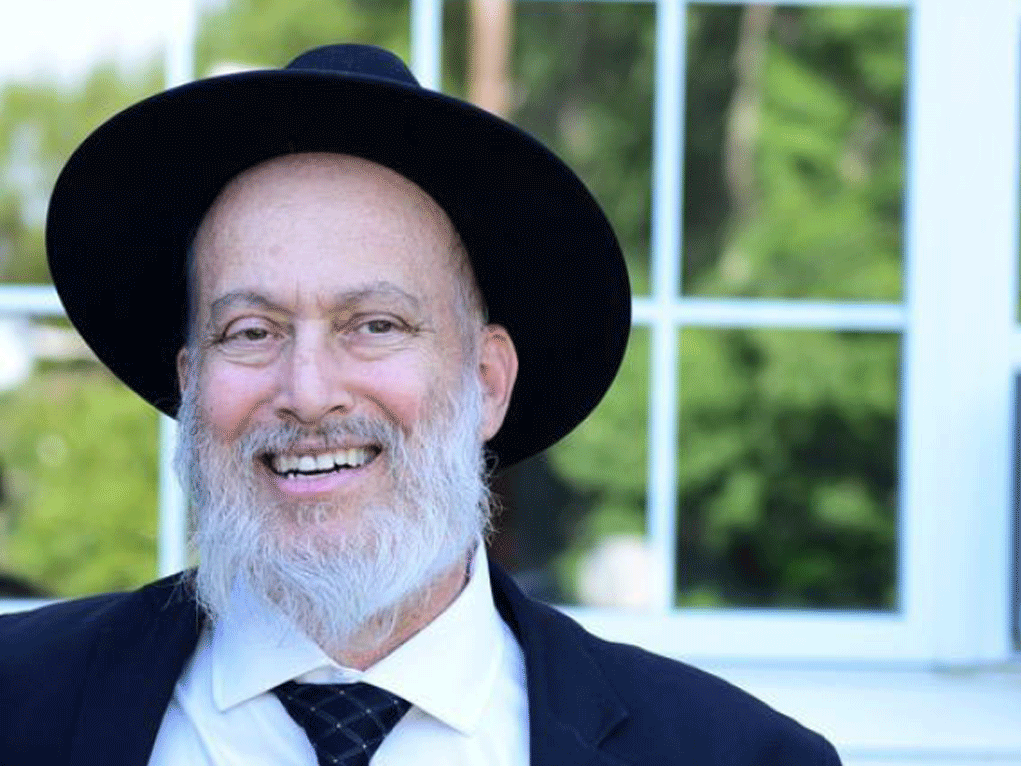 Yated Ne'eman2 months ago
There are levayos that mark the end of a life. And then there are levayos at which the tzibbur stands in stunned silence, beginning to grasp — only now, only too late — the magnitude of the greatness that walked among them. The levayah of Rabbi Chaim Yisroel Abadi zt”l, niftar this past Shabbos, Parshas Emor, at the age of 66 after a long machlah, was the second kind.
He was, in the simplest and truest sense, an oheiv Yisroel, a man whose ahavas Yisroel was not a middah he worked on, but the very air he breathed. He loved Yidden the way a father loves his children, without conditions, without calculations, and without giving up. Especially without giving up.
A Son of Lakewood, A Father to Lakewood’s Lost Children
Rav Chaim was a son of Rav Yitzchok Abadi, the noted posek who, at the age of 19, was sent by the Chazon Ish to learn under Rav Aharon Kotler, and who was later appointed posek of Bais Medrash Govoah and the Lakewood kehillah while still in his 20s. Rav Abadi was niftar only five months ago, on the second day of Chanukah. Now, within a single calendar year, Lakewood has lost both the father who shaped its halachic landscape and the son who refused to let its struggling children fall through the cracks of it.
Rav Chaim’s avodah took a strikingly different path than his father’s. Rav Yitzchok carried the Torah of psak. Rav Chaim carried the Torah of pikuach nefesh, quite literally saving neshamos that the mainstream system had, in too many cases, given up on. He loved his father deeply, was mechabed him endlessly, and was sho’el eitzah from him constantly, but the path he walked was his own.
To understand what Rav Chaim built, one must remember what Lakewood looked like in the late 1990s. The Torah metropolis it is today was already taking shape, but beneath the surface, a crisis was unfolding. Hundreds of teenagers were finding themselves alienated from the system in which they had been raised. Some were technically still frum but spiritually adrift. Almost all of them had stopped davening, because there was simply nowhere they felt welcome to walk in.
Today, we take it for granted that there are tracks and options, programs and people, ways to help boys and girls who don’t fit the mainstream mold. We take it for granted that such teens are not to be marginalized, that there is hope for them, that they have a place. Today, if you don’t believe that, most people would think there is something wrong with you.
It is so taken as a given that we may forget who started it all. Rabbi Chaim Abadi was the one who brought this concept into existence. There were others who played a significant role too, Rav Dovid Trenk and Rav Shlomo Gissinger most prominently among them. But while they often worked quietly on individual cases, Rabbi Abadi revolutionized the idea of giving these boys and girls a chance on a wholesale level.
The amount of fighting and resistance and naysaying that he endured to get to the point where Lakewood is today regarding at-risk youth is staggering. He sat through countless meetings and phone calls where people didn’t simply discourage him from his efforts, but literally yelled and screamed at him over his work to save neshamos. And somehow, Rabbi Abadi was completely unfazed. He marched forward as if nobody had said anything at all.
He led a revolution. And he did it better than anyone else.
The Birth of “The Minyan”
Minyan Shelanu began, as so many great things in Klal Yisroel begin, around a small group of friends.
A handful of bochurim who were not enrolled in yeshiva used to gather at Rav Shlomo Gissinger’s shul after the regular minyan had dispersed. They would daven, eat breakfast, smoke a cigarette, and head to work. Rav Chaim, who had semicha but worked as a successful real estate developer, gave several of them jobs at his own company. For some, it was the first stable framework they had known in years.
Out of that informal gathering was born Minyan Shelanu — “Our Minyan.” It quickly became something far larger than its founders had even imagined: a bais medrash, a social center, a refuge, a surrogate home, and the only place in Lakewood where a kid who didn’t fit in could feel that he wasn’t a broken outcast.
Rav Chaim was emphatic on one point: The Minyan was not a kiruv operation. The teenagers walking through his doors were not strangers to Yiddishkeit. They were sons of bnei Torah. What they were missing was not Yiddishkeit itself, but simply a feeling of belonging.
The method to reel in these youngsters was deceptively simple: unconditional acceptance, an insistence on telling a boy or girl the truth, and a staunch loyalty to each and every person who came into Rabbi Abadi’s orbit.
Under Rabbi Abadi’s leadership, The Minyan grew into an entire ecosystem. A daytime kollel and night seder opened under the direction of Reb Yaakov Bess, a yeshiva placement program under Reb Shneur Olshin, a Thursday night cholent and speech, with addresses delivered over the years by leading roshei yeshiva. Then came the game room, an annual Shabbaton, and a road trip at the end of the year that, during one famous summer, took the boys through 13 states from the Smoky Mountains down to Florida. And, when needed — and it was often needed — full payment for drug rehabilitation, therapy, and yeshiva tuition for those whose families could not, or would not, help.
Years later, he opened The Chill, a parallel division for girls kept entirely separate from the boys’ program, which served as its own haven for young women in similar straits. When a fire ripped through The Chill’s Jackson headquarters early one morning, destroying everything in its path, the girls who had called it home spoke of it the same way the boys spoke of The Minyan: as the place where, when every other door in their lives was locked, this one was always open.
The Father Who Never Gave Up
To outsiders, Rav Chaim might have seemed like a man who simply provided love — hugging and laughing and giving exciting speeches. That is not who he was at all.
Instead, he gave every kid who needed it the feeling that he was their father, that he was in their corner, and that nothing would ever change that. He created a framework in which every teen who came under his influence understood that they would be loved endlessly and would never be given up on, but at the same time, there were rules for everybody, including themselves.
Rabbi Abadi didn’t give fake compliments. He didn’t tell every kid how amazing they were. He gave them the unvarnished truth, but the truth was always wrapped in a love so genuine that the boys and girls trusted him like a father, and often more than a father.
It was a special, unique balance that nobody else had ever managed to pull off.
In one instance, there was a boy he had to essentially throw out of Lakewood because he was causing tremendous harm to his peers. Several years later, at The Minyan’s annual Lag Ba’omer celebration, Rav Chaim approached a local baal achrayus, deeply agitated. He had just learned that this boy was holed up with a family in Brooklyn, and the family dynamic was not good. He needed to find an alternative family for this boy to stay with — right now. This was a kid he had to expel. And it didn’t matter. He couldn’t set the boy up for failure. He had to give him the best opportunity to succeed.
Giving up on someone simply did not exist in his worldview.
Facing Adversity with Resolve
Rabbi Moshe Rotberg, rov of Khal Zichron Yechezkel in Toms River, recounts a story that illustrates the steely, unbending resolve that Rabbi Abadi was legendary for.
As Rabbi Rotberg was leaving first seder one morning, he got a call from Rav Chaim. “Come on over. I need to show you something.”
When he arrived, Rav Chaim pulled out his phone and showed him a text message he had just received. It was, Rabbi Rotberg says, “filled with the most vile, hateful, despicable words I have ever seen sent to anyone.” He immediately tried to console Rav Chaim, but was brushed off.
“No, I don’t need that. I just want you to come with me.”
“Come with you where?”
“To meet this guy.”
“To meet him? Why would you want to meet him?”
“What do you mean?” Rav Chaim said. “He sent me a message, so clearly he needs me to talk to him.”
“What’s his story?”
“Eh, what’s the difference?”
Hesitantly, Rabbi Rotberg went with him. They knocked on the door. The door opened. “Hi, Rabbi So-and-so,” Rav Chaim said warmly. “I got your message. I see there’s a lot to discuss. So let’s sit down and talk.”
The man, stunned and bewildered, invited them in. For the next hour, Rav Chaim sat and spoke with the man who had just cursed him out in the most vile terms imaginable. At the end of the meeting, the man apologized.
That episode is a window into who Rav Chaim was. Vicious words could not cow him. He was made of steel. But beneath the steel — and the reason for it — was an unshakable belief that every Yid, even one who had just sent him hateful messages, was someone worth showing up for, worth talking to, worth hearing out.
The Chesed Nobody Knew About
Rabbi Abadi’s son-in-law, Rabbi Avi Bensoussan, who now leads The Minyan, spoke at the levayah about how much of Rav Chaim’s avodah was hidden even from his own mishpacha.
“None of us can comprehend what he did. He kept everything so quiet. Even his own family didn’t know,” he said through tears. “A year ago, when he got sick with his final machlah, I took his phone to help out as best I can. I had no idea — 24/7 the phone didn’t stop. Texts and calls from around the world. People calling about everything! I had no idea. I am his family, and his own family had no idea how much he was doing. We had no idea that we were sitting with a gadol, with a gaon. He didn’t stop!”
Rav Chaim ran from kavod with the same intensity that he ran toward struggling Yidden.
Rabbi Bensoussan related that someone once called him about a shidduch, not knowing his relationship to Rav Chaim. The caller said that he was inclined to say no, because he had looked into the “rabbi” the boy named on his resumé, and he was disappointed to learn that it was “some contractor named Chaim Abadi.”
The man had no idea. Rav Chaim had kept his profile so low that an outsider would mistake him for a simple tradesman. He was a gadol. But nobody knew.
There were calls he would take from absolute strangers. He would listen to their problems, give a solution or pull a lever to help, and hang up without ever learning their names. On numerous occasions, when someone asked him afterward who had just called, he answered, “I have no idea.”
“You don’t know who you were talking to?”
“No. Why does it matter?”
It made no difference to him who you were. If you needed help, he was there.
“Who Are We Going to Ask Now?”
Rabbi Bensoussan quoted a Medrash at the levayah that captured the moment perfectly.
The Medrash in Vezos Habrocha asks: When Moshe Rabbeinu was niftar, shomayim v’aretz cried, the Borei Olam cried, Klal Yisroel cried, and Yehoshua Bin Nun cried. The obvious question is: Was Yehoshua Bin Nun not part of Klal Yisroel? Why is his crying mentioned separately?
The answer is that Yehoshua, of course, cried with Klal Yisroel. But then he had a shailah that he needed to ask. And when he went looking for his rebbi and the realization dawned that his rebbi was gone — that there was no one to turn to — he cried again, a different kind of cry.
“That’s the question I keep hearing,” Rabbi Bensoussan said. “Who are we going to ask now? With Rabbi Abadi gone, who will guide us?”
It is a question being asked everywhere. The original Minyan guys are grandparents today. Rav Chaim was with them through their teenage years, through their yeshiva years, through their shidduchim, through building their families — up until his very last day. There is nothing to replace him, because what he built was not a movement, a philosophy, or a shitah that can be replicated. It was the whole package of him as a person. And there was nothing like him.
The Final Months
In recent months, as his physical condition deteriorated, Rav Chaim refused to stop. The phone never stopped ringing, and he never stopped answering.
In one instance, there was an event taking place somewhere near Lakewood that would be harmful to teens in attendance. Rav Chaim — already so weak he could barely breathe — made a call, insisting that this event had to be shut down. He called and texted, again and again, until he received confirmation that the event had been cancelled.
That was who he was: a man whose body was failing, whose breath was short, refusing to let go of even one teenager whose neshomah might be at risk.
“I Am Alive Because of Him”
Moshe Heinemann, a former Minyan member and close talmid, spoke at the levayah as a representative of The Minyan boys.
“One thing that stood out to me about this levayah is that everyone here can speak about him for an hour,” he said. “To so many of us, he was something more than we can possibly define. Some called him Chaim, others called him ‘Rabbi.’ But one thing is certain: He was an Abba to everyone — someone you could go to with anything, who made you feel you weren’t alone, someone who was non-judgmental no matter what, someone you could ask any shailah to.
“The list of hats he wore is endless. But at the same time, he was also someone we would just call to hang out with, to go eat out with, to take a ride in his pickup truck. Minyan Shelanu was his heart. It was a place of acceptance, where everyone belonged.”
There are countless alumni today who say it plainly: “I am alive because of him. It is that simple.”
What He Leaves Behind
There are those whose lives are measured in the Torah, seforim, or gemillus chassodim they leave behind. Rav Chaim’s life is measured in the neshamos he refused to abandon. And the void he leaves cannot be measured at all.
He is survived by his devoted wife, Mrs. Fraidy (Wanouno) Abadi, his beloved children and grandchildren, and by countless talmidim, admirers, and families who exist today because he refused to let them go.
At Rav Shlomo Gissinger’s levayah in 2019, Rabbi Abadi rose to be maspid. His voice broke as he spoke directly to the niftar: “When you go up to Shomayim, I want you to ask the Ribono Shel Olam: What’s the plan? Who is going to take care of the kids in Lakewood? What’s the plan?”
Today, countless Yidden are begging Rav Chaim to do the same.
Yehi zichro boruch.
***
Rabbi Abadi’s Legacy
By Rabbi Yitzchok Hisiger
Rabbi Chaim Abadi zt”l had a way of seeing people that most of us don’t.
He didn’t just notice who was sitting in front of him. He noticed who was slipping away. He saw the boy whose eyes had already wandered far beyond the walls of the bais medrash, the one who still showed up but no longer felt like he belonged.
I once watched him pause in the middle of a crowded room, his attention pulled not to the speaker or the center of the action, but to a quiet boy lingering near the doorway, half in, half out. While others continued talking, he walked over, placed a hand gently on the boy’s shoulder, and began a conversation that lasted long after the room had emptied. There was nothing dramatic about it. No audience. No recognition. Just one person refusing to let another disappear unnoticed.
He saw the girl who carried within her a quiet distance that no one else seemed to pick up on.
And once he saw them, he didn’t look away.
He chose the ones who didn’t fit. The ones who sat in the room but were never quite part of it. The ones who asked questions that sounded like chutzpah but were really cries for clarity. The ones whose struggles were too complicated, too messy, too exhausting for a system that prefers things to be neat and predictable.
He did not write them off. He did not label them. And perhaps most importantly, he did not stand at a distance and talk about them.
He went to them.
And he brought them to him.
He understood something that most of us only understand in theory but rarely live in practice: Before you can guide a young person, you have to first see them. Not the version of them you wish they were, not the version that fits comfortably into your expectations, but the person they actually are, with all the confusion and contradiction that comes with it.
Instead of reacting with frustration or disappointment, Reb Chaim approached them with patience and understanding, recognizing that what looked like resistance was often pain, and what looked like indifference was often confusion.
And if we are being honest, most of us have seen that same resistance and chosen the easier path: to dismiss it, to label it, or simply to move on.
He did not try to force them back into a mold that had already rejected them. He tried to understand where they were, how they were thinking, what they were feeling, and only then did he begin to guide them, slowly, carefully, with a sensitivity that cannot be taught in a training manual.
That is why he succeeded.
Not because he had better techniques, but because he cared enough to see each neshomah as an olam malei, not as a problem to be solved.
And now he is gone.
It is tempting, in moments like this, to speak about how rare he was, how unique, how irreplaceable. All of that may be true, but it also allows us to distance ourselves from what he represented. If he was one of a kind, then we are not expected to follow in his path. If his work required something extraordinary, then the responsibility does not rest on ordinary people.
But that is not the truth.
The boys he worked with are still here.
The girls he understood are still here.
The same confusion, the same quiet drifting, the same sense of being unseen has not disappeared with him. If anything, it has grown.
We have all seen them, and far too often, we have convinced ourselves that someone else will take care of it.
And the question that remains is a simple one, though it is not an easy one: What are we going to do about it?
Are we going to continue speaking about “kids at risk” as if they are a category that exists somewhere else, affecting someone else’s children? Are we going to keep telling ourselves that this is the responsibility of professionals, of organizations, of people who have the time and the training to deal with it?
Or are we going to recognize that this is happening all around us and that ignoring it does not make it go away?
Reb Chaim did not wait for someone else to take responsibility. He did not say, “This is not my problem.” He did not say, “I’m already carrying too much.” He saw a need and he stepped into it, again and again, even when it was difficult, even when it was draining, even when there were no guarantees of success, and even when people criticized him for what he did or how he did it.
If we truly want to honor him, then it cannot end with words.
It has to begin with a shift in how we look at the children around us. It has to mean that when we see someone struggling, we do not immediately define them by that struggle. It has to mean that we are willing to listen a little longer, to judge a little less, to stay present even when it is uncomfortable.
It has to mean that the next time we notice someone quietly drifting, we do not look away, even when getting involved feels inconvenient, uncomfortable, or beyond what we think is our responsibility.
It has to mean that we refuse to accept a reality in which children quietly slip away while we continue on as if nothing is happening.
Because that is the reality Reb Chaim refused to accept.
He believed that every neshomah was worth fighting for, even when the fight was slow, even when it was complicated, even when it did not look like success to the outside world.
That belief defined him.
And now, in his absence, it is the only thing that can truly carry his legacy forward.
Not admiration. Not praise. Not even memory.
But action.
If we can learn to see as he saw, to care as he cared, and to take responsibility as he did, then his life’s work does not end with him. It continues in every child who is given another chance, in every young person who is seen before it is too late.
That is how Rabbi Chaim Abadi should be remembered.
Not only for the lives he touched, but for the lives we will choose to touch because of him.
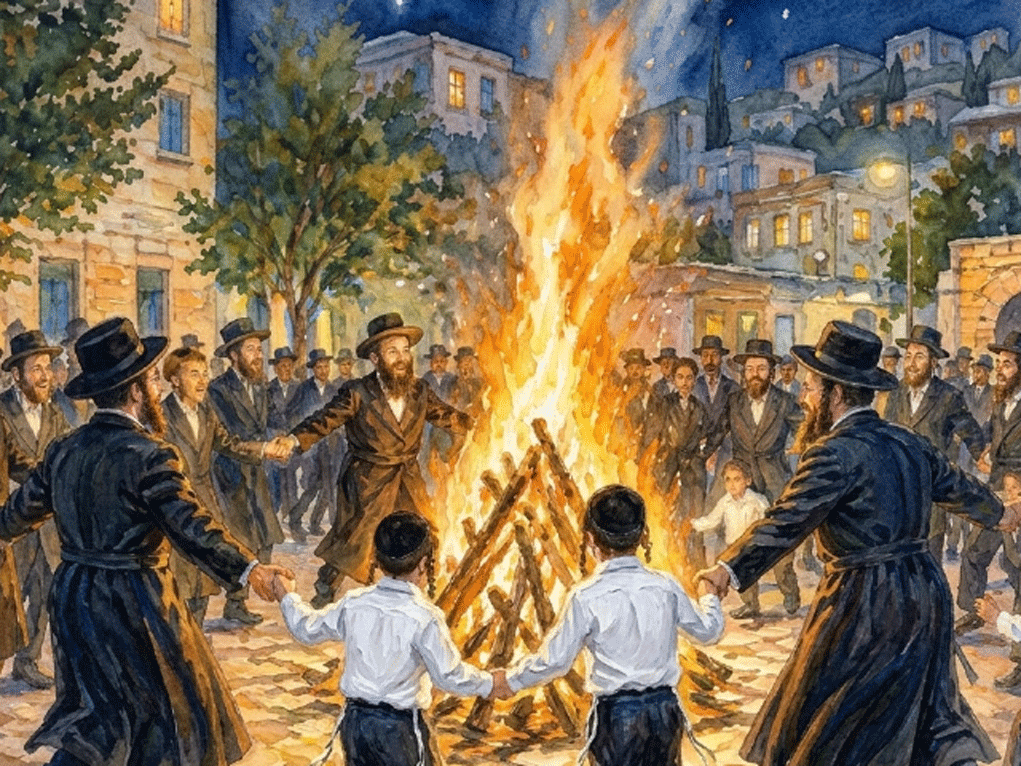 Yated Ne'eman2 months ago
This week again, the news can lead a person to feel uneasy. Talks to end the war with Iran and curb their nuclear ambitions failed to materialize. The Israeli ceasefire with Lebanon was extended, but Hezbollah continued its attacks on Israel. The Israeli Supreme Court ramped up its war against lomdei Torah. The Washington shooting was a chilling reminder of the general sense of instability and the fragility of the world order.
And yet, as the world continues spiraling in an unsettling way, we continue counting the Omer, moving steadily from Pesach to Shavuos, as we approach the uplifting day of Lag Ba’omer.
The mitzvah of counting the Omer is found in this week’s parsha of Emor (Vayikra 23:15). This counting is not merely a tally of days, but a journey that leads us toward Kabbolas HaTorah.
The mourning aspects of the Sefirah period have so taken over the seven weeks between Pesach and Shavuos that we can sometimes forget that there is more to Sefirah than refraining from cutting hair, celebrations, and music. Sefirah is a time of preparation, a gradual ascent, when we strive to make ourselves worthy of receiving the Torah anew.
In fact, the Maharal teaches that the period of Sefirah is blessed with an awesome light that is not present the rest of the year (Nesiv HaTorah 12). This ohr increases daily along with the levels of Torah, until it reaches a climax on Shavuos, when the Torah was given. He writes that as we count Sefirah, we say “Hayom,” because yom, day, is an expression of light, and we make the brocha and thank Hashem for granting us the light of this specific day of the Omer, as every day more light is revealed as we proceed along the path to Torah (Derech Mitzvosecha). Each day offers a new opportunity, a fresh measure of clarity and growth, as we move closer, step by step, to Torah.
This progression is reflected as well in the korbanos we bring. The Korban Omer, which is brought on Pesach, is comprised of se’orim, animal fodder. The shtei halechem of Shavuos is brought from wheat, which is much more refined. The message is clear: We are meant to elevate ourselves, to rise from more instinctive, physical levels to a more refined and spiritual existence.
We are all familiar with the Chazal (Yoma 9b) that the second Bais Hamikdosh was destroyed because of sinas chinom.
At the time the talmidim of Rabi Akiva perished, the churban was still fresh in the minds of the Jewish people, and the Romans who had destroyed the Bais Hamikdosh still ruled over them. No doubt they worked to repent over the sins that had caused the churban so that they would merit redemption and geulah. However, the plague that struck down the holy talmidim because “lo nohagu kavod zeh lozeh — they were lacking in respect for one another” indicated to them that the issues of sinas chinom still needed to be corrected in order to merit the geulah.
The people of that time realized that there was much more that remained to be done in order to end their golus under the Romans. The fact that the mageifah took place during the days of Sefirah, when there is increased ohr and daily introspection, perfection, and growth toward obtaining Torah, indicated that not only were the people not worthy of the Bais Hamikdosh, but they were also unworthy of Torah.
The same qualities that are necessary for Kabbolas HaTorah are necessary for geulah, so this special period of Sefirah was chosen as a time to improve ourselves and prepare not only for Torah, but also for geulah. By mourning the loss of the talmidim, we are reminded that to merit Torah, we must refine our character—how we treat each other, how we speak, and how we live together. We see what happens when there is sinas chinom and a lack of respect for each other.
During the Sefirah period, we work each day to perfect another of the 48 kinyanim of Torah and engage in raising ourselves from the nefesh habehami levels of se’orim, animal food, to the nefesh haruchni at the 49th level of kedusha. These attributes prepare us for Kabbolas HaTorah, when we stood united, k’ish echod beleiv echod, at Har Sinai. They also prepare us for the unity that geulah necessitates, when Hashem Echod Ushemo Echod will be recognized across the world.
At the time of the destruction of the Bais Hamikdosh, the Jewish people excelled in the study and observance of Torah, mitzvos, and chesed (see Yoma, ibid.). The only area in which they were lacking was ahavas Yisroel. That alone was enough to cause the destruction of the Bais Hamikdosh and bring on golus and all that it entails.
Much the same, it seems that the talmidim of Rabi Akiva excelled in all areas of Torah, except in the realm of bein adam lachaveiro.
In our day, we note the explosion of Torah and frum communities. There is so much that we can point to with great pride. Yeshivos and Bais Yaakovs are more plentiful and larger than ever. We have every conceivable type of chesed organization. There is unprecedented dikduk b’mitzvos. Yet, the fact that we remain in golus indicates that we are lacking in ahavas Yisroel and achdus. If sinas chinom were not prevalent among us, if there were no machlokes and division, golus would have ended.
During these days of Sefirah, we must work to end the hatred and dislike of others, including people who look different or see things differently than us. We need to take to heart the message of Sefirah and the passing of Rabi Akiva’s talmidim so that we can return again to where and what we were, and what we are meant to be.
The number of days in the Sefirah period is cited as connected to the 48 methods necessary to acquire Torah. The Mishnah in Pirkei Avos teaches that to properly acquire Torah, we must excel in the 48 devorim through which Torah is acquired. Most of them involve matters that relate to the way we deal and interact with one another. Someone who has not perfected himself ethically and morally cannot properly excel in Torah. A person who is deficient in the way he deals with other people will also be lacking in Torah.
The Ramchal in Maamar Hachochmah discusses the idea that the Bnei Yisroel in Mitzrayim sank to the 49th level of depravity. After redeeming them from servitude, Hakadosh Boruch Hu provided for them the 49-day period between Pesach and Shavuos so that the freed slaves could raise themselves from the abyss of decadence and alter their behavior in a steady progression until they would be worthy of receiving the Torah on Shavuos.
This ability is evident every year during this time period, the Ramchal says. The Ohr Hachaim adds to this concept and writes (Vayikra 23:15) that the counting of the days of the Omer is akin to the count that an impure person performs to calculate the time remaining until he regains his purity. During this period, we must engage in introspection just as the unclean person would do during their period of counting.
These days involve more than a ritual counting and mourning. They demand a spiritual ascendancy to cleanse ourselves from the moral and spiritual imperfections that afflict all of us. During this period, we are to study and apply the 48 kinyanim of Torah in order to be worthy of accepting the Torah on Shavuos.
The mourning we engage in is directly tied to the introspection that this period obligates.
We mourn the loss of Rabi Akiva’s 24,000 talmidim, we emulate their accomplishments, and we seek to fill the void created by their absence. Rav Elchonon Wasserman taught (Kovetz Maamarim V’igros) that a person who is pretentious and egotistical cannot be successful in a leadership position. An effective leader can communicate with people because he relates to them, feels their pain, and does not consider himself to be on a higher level than the people he serves.
In order to reach people, you have to truly care about them and want to influence them. You have to address them with respect. Nobody likes being talked down to. Most people respond to positive reinforcement and tune out negativity.
If you rid your soul of sinas chinom, then you will behave with mentchlichkeit and treat people properly. If you live with ahavas Yisroel, people will respect you and listen to you. You will be able to help them improve their shemiras hamitzvos, Torah learning, understanding of life, and acceptance of what Hashem gives them.
The greatest teacher is not the one who knows the most, and the greatest leader is not necessarily the one who does the greatest things. He is the one who motivates people to accomplish the greatest things. The greatest teacher is the one who understands his students and is able to reach them. The greatest teacher is the one who loves his students.
A good teacher gives a child the feeling that he has confidence in him and recognizes his potential for achieving greatness. The quality rebbi or morah lets the students know that they share their dreams, hopes, and goals for the future, and will do everything they can to help the children attain them.
There are two ways you can seek to motivate people: either by appealing to their hopes or by playing to their fears. The one who excels makes sure to speak to people’s confidence and not to their doubts. People respond far better when they are treated as if growth is possible for them. When a person feels believed in, he begins to act in a way that justifies that belief.
For leaders and teachers, as well as parents and friends, communication is more than words. What matters is not only what we say, but how we say it. We can inspire and motivate when we communicate with love and care. By living the commandment of “ve’ohavta lerei’acha kamocha,” we show our children, students, friends, and acquaintances that they are valued, believed in, and loved.
Every person has the ability to impact the world. If we maximize the abilities Hashem has given us by immersing ourselves in limud haTorah, using our strength to build rather than destroy, and channeling our blessings toward helping others, we can make a difference. We can change the world.
Sefirah is a time to focus on this growth—to refine not only how we learn, lilmod, but how we teach and uplift others, lelameid. It is a time to develop the sensitivity, awareness, and optimism that allow us to bring out the best in ourselves and in those around us.
On Lag Ba’omer, with achdus, brotherhood, and love, people gather, light bonfires, sing songs, and dance. They show that they have taken to heart the obligations of Sefirah and aveilus, and are preparing themselves for Torah and geulah, k’ish echod b’lev echod. They stand together, firing up their neshamos as they reach for light and holiness.
Lag Ba’omer brings a welcome interruption to the Sefirah mourning. We take haircuts, shave, trim our beards, and allow music to once again lift our spirits. The customs of aveilus, observed in memory of the passing of the talmidim of Rabi Akiva, are set aside, and a measure of simcha returns.
Rabi Akiva was the greatest of his generation. He was the shoresh of Torah Shebaal Peh. The line of transmission of the Torah from Har Sinai to future generations ran through him and his talmidim. When those students perished, the loss was staggering. A grieving nation, already battered by Roman persecution, was left to wonder how the mesorah would endure. Who would carry the Torah forward and who would teach the next generation? They wondered if they could ever be consoled for the loss of so many great men, crucial to the spiritual survival of the nation.
But Rabi Akiva did not yield to despair. He recharged the people and helped them recover from the devastating loss. He gathered a new group of talmidim and began again, ensuring that the chain of Torah would remain unbroken.
On this day, which marked a cessation of the deaths of Rabi Akiva’s talmidim, we commemorate the renewal. We celebrate the resilience, as we foresee a future bright with hopefulness and optimism. On this day, Rabi Akiva’s talmid, Rabi Shimon Bar Yochai, revealed the secrets of Toras Hasod, which infused all future generations with added dimensions of kedusha, depth, and understanding.
Through the centuries, as the Romans of every era sought to weaken and destroy us, we look to Rabi Akiva and Rabi Shimon Bar Yochai for inspiration. We note how they faced down the enemy and persevered, ensuring that our nation and Torah are alive and flourishing to this day. In the wake of a tragedy that would have felled lesser people, they strengthened themselves and set about ensuring that the chain would remain unbroken.
Lag Ba’omer rejects despair. It declares that the Jewish people do not give up or allow the chain of mesorah and greatness to break. The fires of Lag Ba’omer burn vibrantly, proclaiming that the Torah endures, the future is bright, the mesorah will continue, and our people will continue to rise.
The longer our exile is prolonged, the more we turn to days like Lag Ba’omer for inspiration and encouragement, and the more popular their observance becomes.
But it is not enough to just light a fire. It is not enough to sing and dance. We must live the message of Lag Ba’omer, the lessons of Rabi Akiva and Rabi Shimon Bar Yochai. We have to perfect our middos and achieve the 48 devorim that Torah acquisition requires. To merit Torah, we must truly care for one another, treat each other with dignity, and uproot any trace of sinas chinom from within us.
In a world that often feels fractured and uncertain, Sefirah and Lag Ba’omer remind us where our focus must be. By refining ourselves, by strengthening our commitment to Torah and deepening our connection to one another, we prepare for Kabbolas HaTorah and for geulah.
Each of us has the ability to bring light to the world through Torah, through maasim tovim, and through the way we live our Torah lives.
Let us daven that the fires of Lag Ba’omer ignite within us a lasting flame comprised of a commitment to kedusha and growth, and a dedication to proper middos, the eternal mesorah and Torah, so that we may bring about the geulah sheleimah bekarov.
 Yated Ne'eman2 months ago
I know. The answer to all deep philosophical questions is, “Everyone does it,” but just last week, I happened to hear two separate but similar stories that got me thinking and wondering why “Everyone does it” is an acceptable answer.
The first story is a very common occurrence. Mrs. Steinberg*, a veteran teacher of ten-year-old girls, had to take a three-month leave of absence, so a substitute was hired. Mrs. Werner* may have been inexperienced, but she came very prepared with fascinating, colorful lessons, incentives, and a determination and desire to succeed. Alas, she wasn’t the most charismatic person, and even worse, she had a bit of an accent.
Well, those two wonderful “maalos” were not looked upon kindly by the lively class of ten-year-olds. What began with excited preparation and eagerness to capture the ear of her students slowly turned into a torture chamber. Every day was pure gehennom for Mrs. Werner. Not only had the girls clearly decided that they had license to talk non-stop and disregard the fact that there was a woman standing in front of them who had painstakingly prepared lessons, but it was even worse. Many of the girls went a step further by asking questions to her face while mimicking her accent. That, of course, sent the other, less bold girls, into peals of laughter.
Sounds like a normal substitute scene, no? Kids do that. Some of us adults might even remember doing the same thing in our younger years, right?
Now for the second story, which in a way is even worse. Rav Cohen*, a fantastic rebbi and a real serious talmid chochom, began to teach an upper elementary school class in a prominent mosad in an out-of-town community. Rav Cohen’s lessons are extremely well planned. Any student who actually pays attention in class will come out with a clear understanding of the Gemara and a mehalech in learning, empowering him to eventually be able to enter a mesivta with an excellent foundation in learning.
The problem arose as his first year of teaching progressed. Rav Cohen was very successful in creating amazing lessons, but not as successful at managing the class. Sooner or later, the tougher boys who like to test rabbeim began to test him, but he couldn’t assert his authority in the way he wanted to. This is a challenge that many first-year rabbeim face, but in his case, it deeply affected him, and the pain he experienced was acute.
Yes, this is also a very standard story with no chiddushim, right? An idealistic rebbi giving his all and being met not just with indifference, but with cruelty from students who insist on making his every moment in the classroom miserable…
Whose Achrayus is it Anyway?
Now, when many people hear stories like these, they respond by saying, “You know, boys will be boys and girls will be girls, and this is just the way it is.”
Personally, I think that is a cop-out. It is a cop-out for us as parents, and it is also a cop-out for those in upper management of a mosad, such as menahelim and menahelos.
Let’s first talk about the achrayus, the responsibility, that Hashem places on each parent to guide his or her child. If a parent knows that their child is abusing (and yes, the word abusing is appropriate and not extreme) a rebbi or a morah, the first thing they must do is talk to their child about middos.
The same girl who, at the drop of a hat, would agree to do chesed and go on a hospital visit to a sick child, help a mother who just had a baby, or go sing in a nursing home because she recognizes the importance of chesed, compassion and rachmanus will at the same time be so cruel to her teacher. Why? Have we never instilled in them the basic ideals that a Yid must be a rachaman, having compassion on another Yid and not hurting him or her? Is a rebbi or morah not bichlal amisecha, not considered a legitimate Yid, just because they stand in front of a classroom?
Furthermore, in addition to basic compassion, mentchlichkeit and rachmanus, what about the fact that there is a lav, a lo saasei, of “lo sonu ish es amiso—each of you shall not aggrieve his fellow”? Yes, there is a lo saasei not to cause pain to another Yid. Believe it or not, this lo saasei is no less of a lo saasei than the lo saasei not to eat chazir. Would any child, even a ten-year-old girl or a twelve/thirteen-year-old boy, knowingly ingest pig meat?
So why do they treat the lo saasei of lo sonu with any less stringency?
The Importance of Instilling Mentchlichkeit Into Our Children
When speaking about the upper management of chadorim and schools, there is no doubt that the menahelim, menahelos and principals are wonderful people who do so much to ensure that the schools are running well and that the talmidim and talmidos are emerging with an excellent education. Nevertheless, if there does exist such a classroom in your school, it is your job to give the moros and rabbeim the support and guidance that they need to be able to overcome these very normal hurdles.
Children know that there are cameras in the room. They know that the principals see what is going on in their classrooms. If a menahel or menaheles doesn’t respond forcefully to such behavior, what kind of message does that send to the children?
Still, why are we not teaching our kids basic mentchlichkeit? It shouldn’t be that difficult to convey the lesson of “be a mentch,” “be a respectful human being,” and “don’t hurt another person” to our children and talmidim/talmidos. As far as I know, the Torah does not make an exemption for the mitzvah of being a mentch or the aveirah of lo sonu for rabbeim and teachers.
We teach and model so much good behavior for our students. Why isn’t this lesson going through? Is it perhaps because they don’t see that we really mean it?
Remember: Don’t transgress the aveirah of eating chazir, and just as importantly, don’t transgress the aveirah of lo sonu.
Above all, just be a mentch. It isn’t that hard.
 Yated Ne'eman2 months ago
It is well known that the incredible saga of Rav Shimon Bar Yochai and his son, Rav Eliezer, writing the holy Zohar in the cave may be found in Maseches Shabbos 33b. The Aruch Hashulchan (Orach Chaim 493:7) noted that Rav Shimon and his son left the cave on the 33rd day of the Omer and that Rav Shimon also passed away on this day in later years. Indeed, the significance of the number continues with the revelation that the narrative of the cave is the 33rd mention of Rav Shimon in Shas (Rav Shalom of Kaminka, talmid muvhak of the Sar Sholom of Belz). Over the centuries, many esoteric aspects of this sojourn of the father and son have emerged. Some are beyond this writer and this article. However, some of these revelations and explications offer us practical suggestions for improving our own avodas Hashem and various aspects of our spiritual lives. In honor of the upcoming kedusha of this special day, let’s explore some of these to the extent that we are capable and permitted to do so.
That Gemara in Shabbos tells us that Rav Shimon and Rav Eliezer only put on their clothing during their entire occupation of the cave for twelve full years in order to daven. The rest of the time, they “sat covered in sand up to their necks.” The question is why they did such a strange thing. The Shelah Hakadosh teaches that they were in effect burying themselves. Again, to what end? One answer is actually almost obvious. The Gemara (Brachos 63b) asks: “How do we know that the Torah is not sustained in a person unless he kills himself over it? [It may be derived] from the posuk, ‘This is the Torah [of] a person who dies in a tent.’” The Maharal (Netzach Yisroel, Chapter 7) explains that the corporeality of the body and the spirituality of the soul are two opposites. He therefore raises the major issue: “How, then, can the Torah, which is pure intellect, reside in the body, which is totally materialistic?” Therefore, a person must (figuratively, not literally) eliminate his physical self so that the Torah within him can survive.”
Of course, we must be extremely careful here. Not only does the Torah forbid suicide, but one of the main mandates of the Torah (last week’s parsha, Acharei Mos) is “You shall live by them” (Vayikra 18:5), to which Chazal (Yoma 85b) add, “But not die by them.” The Gemara elsewhere (Tamid 32a) records that one of the questions Alexander the Great put to the Elders of the South was: “What should a person do in order to live?” Their cryptic answer was: “He should kill himself.” What can all this possibly mean coming from our life-affirming Torah?
The Imrei Emes of Gur (Likkutim, Maseches Tamid, page 90) explained that the term yamus es atzmo, which is mistranslated literally as “should kill himself,” actually means “should kill his ‘self,’” meaning his ego and self-centeredness. The Shelah also references the verse in Koheles (7:29), which states that “Hashem originally made man perfectly straight.” In other words, we are inherently perfect but tend to ruin the perfection that the Creator granted us. Thus, when Rav Shimon and Rav Eliezer buried themselves inside the cave, they were actually renouncing any shred of self that they still possessed. Slowly and painfully, as the Gemara there describes, they had eliminated any personal needs, wants or desires, and lived perfectly in a state of wanting solely to do the will of Hashem.
Let us stop here for a moment and attempt to extrapolate something for ourselves. That may seem both ironic and somewhat sacrilegious, but plumbs to the heart of Lag Ba’omer.
On this day, as we commune and draw as close as we can to Rav Shimon, we are granted an annual possibility of negating any trivial or even necessary physical inclinations so that we can enhance our precious neshomah and make it the dominant force in our lives. Of course, for Rav Shimon and Rav Eliezer, that meant an actual burial, the removal of any physical desires whatsoever and being fed by foods as close to monn as humanly possible. For us, this can mean something as simple as giving up anything that we desire but is not good for us. It can mean drawing a drop closer to the ideal of prioritizing the soul over the body. It can even mean learning something in which we are not particularly interested or attracted just to fulfill the wish of the Al-mighty.
Rav Yehoshua of Kutna (end of Sefer Yeshuos Malko) cites the ancient custom of burning expensive clothing at the grave of Rav Shimon in Meron. Rav Yosef Shaul Nathanson (Shoel Umeishiv 5:39) is extremely critical of this minhag. He concludes, “Trust me, if those people had just taken the funds that these articles of clothing cost and given them to the impoverished, both Rav Shimon and the poor would have been very happy.” However, Rav Kutna defends the custom by explaining that Rav Shimon and his son had returned to the status of Adam Harishon before he sinned. At that point, he had no need for clothing and neither did Rav Shimon and Rav Eliezer.
Based upon these powerful words, several gedolim have understood another description in the Gemara about the cave. When the Tannaim left their cave, Rav Pinchos ben Yair, Rav Shimon’s son-in-law, brought him to a bathhouse for a long-delayed bath. When Rav Pinchos attempted to smooth the cut and cracked skin of his father-in-law, he cried over the state of his pain-wracked body. He cried tears, but they only caused more pain when they entered the cracks in his body. “Woe is to me that I should see you so,” lamented Rav Pinchos. But Rav Shimon responded, “You should be happy to see me like this because this has improved me tremendously.”
Many of our meforshim (see Sefer Kedai Hu Rebbi Shimon, page 93) apply the lesson to us all. When the body is reduced by pain and suffering, the soul gains the ascendency. When the body is pampered, the soul loses out, although the body is temporarily satisfied. The posuk (Koheles 2:9) tells us that Shlomo Hamelech retained his Torah knowledge even when he engaged in some of the (permissible) comforts of this world. However, Chazal (Medrash, Koheles Rabbah) interpret the posuk to mean that “the chochmah I learned in difficult circumstances stayed with me more than anything I learned when things were easy.” The Brisker Rov used to say that the Torah he learned and taught under extremes of anti-Semitism and danger, such as under the Nazis and, later, the bombing in Yerushalayim, was absorbed on a much higher level. Rav Shach, too, testified that when he was a young orphan, he learned alone in an empty shul in the winter cold with very little food. He later reflected that those harsh conditions resulted in the highest levels of Torah that he had ever experienced. The prototype of this attitude toward Torah learning is Rav Shimon and his son in the cave.
We are now in a position to at least partially understand the relationship between Lag Ba’omer and the death of Rabi Akiva’s 24,000 talmidim. The Maggid of Kozhnitz (Avodas Yisroel, Parshas Behar, page 169) teaches that after the tragedy of all these deaths during the Omer, the five new talmidim of Rabi Akiva who restored Torah to Klal Yisroel were also mesakein — rectified — the souls of those who passed away. In truth, these were very lofty neshamos who should have lived longer and accomplished much. However, as we know, their sin in not giving each other sufficient honor caused their deaths. But since they were inherently keilim — vessels — who could have enhanced Klal Yisroel, the rule about earthenware vessels is that “sheviroson zu taharoson — their becoming broken is their purification” (Maseches Keilim 2:1). The new five elevated the souls of the 24,000 to the point that their souls received the kapparah that they required.
These holy words of the Maggid answer an ancient question. The Tur and other Rishonim write that the joy of Lag Ba’omer flows from the fact that the talmidim of Rabi Akiva ceased dying. Yet, as the Pri Chodosh asks, what was the joy in the cessation of their deaths when there was no one left to die? Clearly, if Rabi Akiva had to start fresh, not one was left alive. However, according to the Maggid, we celebrate today that whereas, for whatever reason, the original talmidim of Rabi Akiva failed in their bein adam lachaveiro, the new five talmidim were moser nefesh to elevate the souls of their predecessors. This noble act is the source of our joy on this day. Here, too, we can emulate Rabi Shimon and his colleagues. If we daven for our ancestors, even and perhaps especially for those who require a kapparah, our ahavas Yisroel and caring bring about new love for us from Hashem.
All in all, if we try to put ourselves back in the cave with Rav Shimon and to elevate the souls of those who came before us, we can gain much from the holy day of Lag Ba’omer that we are fortunate enough to have coming our way.
 Yated Ne'eman2 months ago
Many years ago, I sat in my zaide’s sukkah and he was visibly disturbed. A talmid chochom, a brilliant orator and scholar, had cast aspersions on the sanctity of Hoshanah Rabbah, postulating that he had a problem with the fact that it was considered to be a Yom Hadin. He had posed what seemed, on the surface, to be a perfectly reasonable question: If Hoshanah Rabbah is such a profound Yom Hadin, a day whose sanctity arguably transcends even Chol Hamoed, why is there virtually no mention of it in the Shulchan Aruch?
My zaide was not merely troubled by the question itself. He was troubled by who had heard it. Young men had been listening. Impressionable young men. And he feared, perhaps rightly so, that a question posed cleverly enough, without a satisfying answer, can lodge itself in the heart and quietly erode what generations of Yidden had accepted as sacred. He devoted enormous energy to formulating a response, ultimately offering what I can only describe as a masterful explanation for why the depth and power of Hoshanah Rabbah had been preserved in the writings of Chazal in the Mishnah, the Gemara, and the Medrash rather than codified openly in the later halachic literature. The details of his answer are not for this column and are found in his sefer, Emes L’Yaakov. But the lesson of his consternation with the supposition most certainly is.
That memory came rushing back to me when I recalled my only trip to Meron on Lag Ba’omer some fifty years ago. Before boarding that bus out of Ponovezh — sneaking out, really, probably along with scores of other bochurim who quietly ignored the protestations of the roshei yeshiva — (half) Litvak that I am, I had searched, at least half searched, for a source for this great pilgrimage.
A Mishnah. A Gemara. A Gaon. A Rishon. Even a line in the Shulchan Aruch or the Rama that would explain why hundreds of thousands of Yidden make a pilgrimage to the kever of Rabi Shimon Bar Yochai on this day. The only reference I could find in the Shulchan Aruch was an offhand mention that “they say,” omrim, that the talmidim of Rabi Akiva stopped dying on Lag Ba’omer, and that we therefore increase “ketzas simcha,” a bit of joy, on that day.
Ketzas simcha. A bit of joy. That’s all.
And yet.
My chavrusa, who had Chassidishe leanings and was practically levitating with anticipation, and I found ourselves on a school bus with neither air conditioning nor functioning shock absorbers, bouncing over unpaved roads in the dark. (Remember, 50 years ago, coach buses were not the standard fare, and the roads to Meron were hardly paved.) I felt, at certain points, like someone being escorted by Meron prison authority to a holding facility somewhere in northern Israel. By the time we arrived — more than four hours later, thoroughly battered — hundreds, perhaps thousands, had already come before us, many with animals in tow and musical instruments of every variety, tents already pitched, bonfires already blazing. (I do not think that it was the tens of thousands who would ultimately fill the landscape decades later, but even in 1976, the numbers were staggering.)
The culture shock was real. This was not Bnei Brak. It certainly was not Long Island. This was not anything I had grown up with in America. And yet, I will never forget it.
When I made it to the top of that mountain, I saw tzaddikim huddled near the tziyun, reciting Tehillim, immersed in the sacred words of the Zohar. And below were children with angelic faces about to receive their first haircuts from men with long white beards and equally angelic countenances. Whatever confusion I felt about the halachic underpinnings of the event dissolved in that glow. There are moments that speak to something deeper than clear written sources. This was one of them.
I have not returned to Meron on Lag Ba’omer since. But I know that whatever I witnessed then has grown geometrically in the decades since in holiness, in numbers, in the sheer spiritual weight of so many Yidden gathering in one place.
And then came the tragedy.
On Lag Ba’omer of 5781, forty-five Yidden, precious neshamos, fathers and sons, bochurim and young men, were killed in a crush on that very mountain. The world was stunned. Klal Yisroel was devastated. How does one process such a thing? How does one reconcile the sacred with the shattering?
I do not pretend to have the answers. I do not know why the Ribbono Shel Olam allowed such a thing to happen on such a day at such a place. But I will say this: The tragedy did not diminish the holiness. It deepened the weight of our obligation to approach it with the gravity it deserves.
And now, this year, we face yet another dimension of pain. The celebration at Meron has been significantly curtailed, not because of bureaucratic indifference, and not because of any diminished reverence for Rabi Shimon, but because of missiles. Because enemies of the Jewish people are once again threatening our lives, and gathering hundreds of thousands on a mountaintop in the north of Eretz Yisroel presents a genuine danger that cannot be dismissed. For those who have made this pilgrimage every year, for whom Lag Ba’omer at Meron is a spiritual lifeline, this restriction is painful in ways that are genuinely hard to articulate.
I understand that pain. I share it. Maybe the greater the holiness, the more attempts there are to impede, even diminish it.
Indeed, there are those who pondered, like I once did: Where is the source? Where is it in the Shulchan Aruch? If it isn’t cited clearly, can it truly be sacred — assuming that what cannot be footnoted cannot be holy?
My zaide taught me otherwise. Klal Yisroel does not fabricate kedusha. When millions of Yidden across centuries converge on a single place with tears and fire and song and tefillah, something real is happening. Just as there is no rational explanation for the survival of the Jewish people — a tiny nation that has outlasted every empire that sought to destroy it — there is no rational explanation for how Rabi Shimon Bar Yochai and his son, hiding for years in a cave, emerged not broken but luminous, pouring forth the sacred secrets of creation that sustain us to this day.
Rational explanations are not always the currency of eternity.
The period of Sefiras Ha’omer carries within it a particular grief that has echoed across our history. The deaths of twenty-four thousand talmidim of Rabi Akiva. The Crusades. The pogroms. The Inquisition. The Holocaust. This period has been drenched in Jewish blood and Jewish sorrow for two thousand years. Lag Ba’omer is the moment within that darkness when the dying stopped, when five remaining talmidim went on to transmit the Torah that sustains us. It is not a footnote in history. It was the footsteps of our future. It is a lifeline.
Perhaps that is precisely why Klal Yisroel, across centuries and continents and cultures, has clung to it. Not because of a clear articulation in Torah Shebiksav. Not even in Torah Shebaal Peh. Without an open Gemara or a Shulchan Aruch, they come. And if they can’t come, they yearn. Even cry. Because the Jewish soul recognizes something that the Jewish mind cannot always articulate.
This year, the bonfire at Meron will burn smaller. The crowds will be thinner. The music will be quieter. And somewhere in the distance, there may be the sound of sirens.
But Rabi Shimon Bar Yochai is still there. And Klal Yisroel, in whatever way it can, will find a way to connect. I may not be able to explain it. But I most certainly revere it. And I cherish all those who long for it.
Just saying.
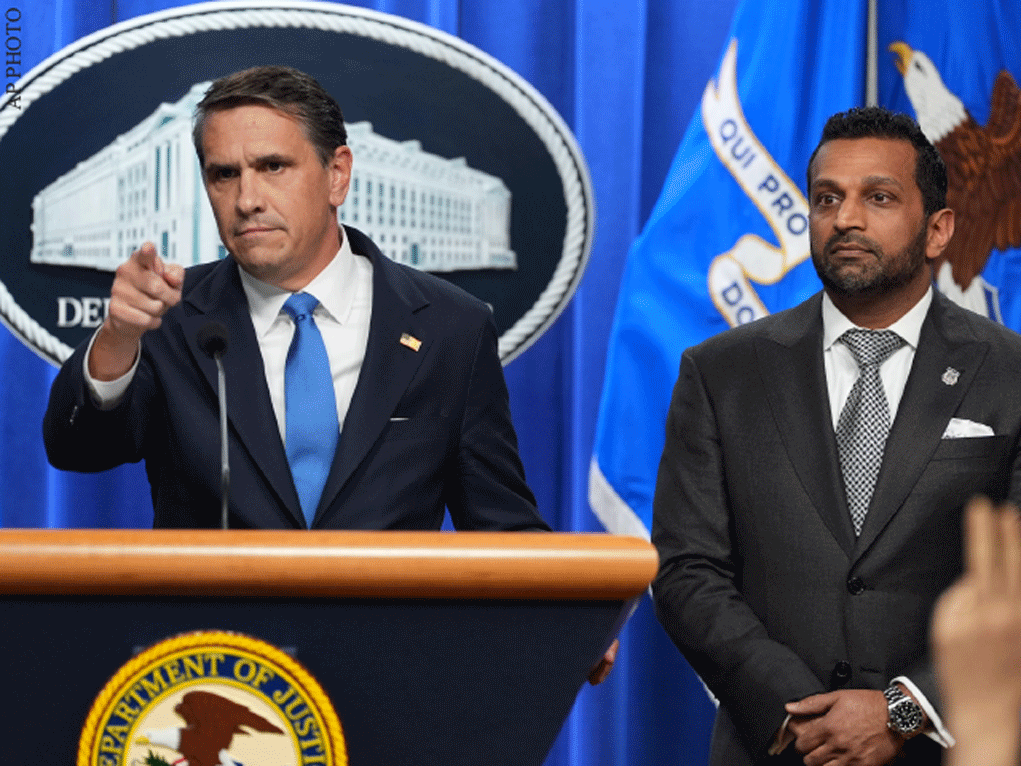 Yated Ne'eman2 months ago
Like a wolf in sheep’s clothing, the Alabama-based Southern Poverty Law Center (SPLC), once esteemed as a leading civil rights and legal aid organization, now stands exposed.
Its carefully cultivated image as a champion of justice has been shattered by a shocking federal indictment that alleges years of fraud and sowing hatred and divisiveness across American society.
For decades, the Southern Poverty Law Center, founded in the 1970s, basked in its reputation as a humanitarian force—advocating for the poor and taking on violent hate groups such as the Ku Klux Klan who terrorized black people and Jews.
That vaunted legacy is collapsing in the wake of bombshell allegations from the DOJ that the group has been engaged for years in bank and wire fraud, and a total perversion of its mission.
The indictment alleges that the Southern Poverty Law Center improperly raised millions of dollars to pay informants to infiltrate the Ku Klux Klan and other racist groups—and to incite these groups to acts of violence—while creating fake companies and bank accounts to hide the money trail.
This alleged stealthy activity ensured a steady flow of donations to an organization that professed to be combating racism but was keeping itself in business by fomenting it.
“The SPLC is manufacturing racism to justify its existence,” said Attorney General Todd Blanche in a news conference. The group “defrauded donors by secretly using their money to fund the very extremism it claimed to be fighting.”
“To covertly pay its field sources, the SPLC opened bank accounts connected to a series of fictitious entities,” the 11-page indictment alleges. None of these businesses ever existed. No customers. No vendors. No products or services.
Then, to convince the banks to open accounts for their invisible businesses, the SPLC allegedly lied on the account applications.
The scheme ran smoothly until 2021, when one of the banks investigated SPLC’s accounts, discovered they were fictitious, and shut them down. The management compelled the SPLC to sign a letter confirming that they were all fake and actually owned by the SPLC.
In what might be the prosecution’s lynchpin, the DOJ claims to have this explosive letter.
The indictment seeks criminal forfeiture of the SPLC’S assets, which the document has assessed as close to $800 million.
AG Blanche said early this week that the investigation has “been going on for a long time,” adding that it was “shut down” during the Biden administration before being revived during President Trump’s second term.
SPLC made a profitable business out of casting America as overrun with hate groups, explained FBI Director Kash Patel. The group campaigned successfully on a slogan of “Stop the hate!”
“They lied to their donors, vowing to dismantle violent extremist groups, and actually turned around and paid the leaders of these very groups, in many cases facilitating the commission of state and federal crimes,” Patel said.
Payments of at least $3 million were disbursed to people affiliated with the Ku Klux Klan, the United Klans of America, the National Socialist Party of America, and other extremist groups, according to prosecutors.
Smear Tactics
From being a staunch advocate for the poor, SPLC has allegedly morphed since the 1990s into an embodiment of left-wing woke ideology. It has used its considerable clout to malign conservative and religious groups as “haters” and “domestic terrorists.”
This week’s indictment was not the first time the SPLC has been embroiled in scandal. House Republicans hosted a hearing centered on the SPLC in December, saying it coordinated efforts with Biden’s Democratic administration “to target Christian and conservative Americans and deprive them of their constitutional rights to free speech and free association.”
The SPLC became a useful tool for those on the Left to demonize conservatives, particularly during the Biden administration. Former President Biden met personally with SPLC staff six times, and the SPLC was invited to the White House numerous times to meet with Administration officials, according to DOJ documents.
At these meetings, the SPLC shared research and gave input on parents they were monitoring, whose only offense was challenging their school board over curriculum materials that taught children as young as kindergarteners about deviant lifestyles.
The Biden administration worked with the National School Board Association to draft a letter comparing these parents to “domestic terrorists” and encouraging the government to use the Patriot Act to hold them accountable.
Bryan Fair, interim chief executive of the SPLC, said in a statement that the organization is still reviewing the charges, but that after witnessing the Justice Department’s news conference, they are “outraged by the false allegations.”
Fair said the organization “will vigorously defend ourselves, our staff, and our work.”
Federal Indictment:
SPLC Aided Neo-Nazis in Charlottesville Riot
One of the most serious claims in the indictment involves the infamous Aug. 11, 2017 “Unite the Right” rally in Charlottesville, Virginia—when a mob of white nationalists, including neo-Nazis and KKK members, marched across a college campus and clashed with counter-protestors.
The indictment specifies that the SPLC paid $270,000 to a notorious racist who helped plan and organize the infamous rally, including the acquisition of racist posters, and helped to coordinate transportation for other participants to pump up attendance.
That night, neo-Nazis, Ku Klux Klansmen and other white supremacists marched through the University of Virginia campus bearing torches and terrorizing students with white supremacist and anti-Semitic slogans and chants, the indictment says.
The protest turned deadly when a car driven by a self-proclaimed neo-Nazi plowed through a crowd, killing a 32 year-old woman and injuring dozens.
Democrats and their media propaganda arms used the tragic incident to concoct a complete fiction to malign President Trump during his first term. They seized on his comment that “there are fine people on both sides” (among the protestors and counter-protesters) to portray him as lavishing praise on right-wing bigots.
They would fundraise on that lie for years, deliberately omitting the rest of Trump’s comment: “I’m not talking about the neo-Nazis and the white nationalists because they should be condemned totally.”
The Left’s spin on the incident turned into a huge propaganda coup for Democrats. Joe Biden has claimed it was the inspiration for his 2020 presidential bid, while faulting Donald Trump for emboldening the neo-Nazis, white supremacists, and even the Ku Klux Klan. [See Sidebar]
The ‘Hate Map’
Critics say the SPLC’S incitement has contributed to a political landscape in America today that justifies violence when those acts are aimed at “stopping racism” or “combatting fascism.”
Central to the group’s tactics is a widely cited “Hate Map,” which is used to malign mainstream conservative organizations. The map has expanded to include groups such as Moms for Liberty—parents who oppose woke indoctrination in their children’s school curriculum—as well as Turning Point USA, the largest conservative grassroots youth movement in the country.
By redefining “hate” to include conservative opposition to progressive or “woke” ideology, SPLC has fostered a political climate in which violence and even murder are acceptable forms of protest.
This climate intensified during the administration of Joe Biden, as federal authorities sought out the SPLC for inside information regarding parents opposed to teaching kids critical race theory (CRT) and other woke priorities, because they were supposedly “domestic terrorists.”
“Some conservatives mock the SPLC for ridiculous examples like this, but the ‘hate’ accusations are deadly serious,” writes investigative journalist Tyler O’neil in his book, Making Hate Pay: The Corruption of the Southern Poverty Law Center.
He offers two concrete examples of radicalized or psychotic people using the ‘hate map’ as their justification in carrying out murderous attacks on ideological opponents.
In 2012, a terrorist brought the SPLC “hate map” to the attack he carried out on the Family Research Council in Washington, D.C., “aiming to kill everyone in the building,” the book details. “A brave building manager foiled his attack, but was wounded in the process. The shooter is presently serving a 25-year prison sentence after pleading guilty to three felonies.”
And earlier this year, the SPLC added the aforementioned Turning Point USA to the “hate map.” The group was founded and led by activist Charlie Kirk who vigorously backed President Trump and was an outspoken supporter of Israel.
A few months after being added to SPLC’S “hate map,” Kirk was assassinated. The man charged with his murder had reportedly texted his roommate about Kirk, “I had enough of his hatred. Some hate can’t be negotiated out.”
Despite a perfunctory condemnation of the violence and killing, the SPLC has failed to remove Turning Point USA and Family Research Council from the “hate map.”
“This organization is a left-wing smear factory,” O’neil said in a 2024 interview for the Heritage Foundation. “One of its major goals is to go after and silence its political opponents. Many of those opponents are really good people who are just trying to stand up for their rights in a politically-charged environment.”
“I think it’s incumbent upon us to recognize, when the nation’s highest elected official is using a group like this to silence the American people,” O’neill added, “that is a huge red flag, and we should be paying attention.”
A Scheme That Does More than Pay the Bills
While the “hate map” has inspired violence, it also likely helps pay the bills, writes Daily Signal author O’neill. The author noted that SPLC’S most recent Form 990 listed $786.7 million in net assets as of Oct. 2024. In addition, the group also has millions in offshore accounts.
Before the 2026 indictment, FBI Director Patel had already taken steps to sever the FBI’s relationship with the SPLC in October 2025. After assuming directorship of the FBI under the Trump administration last year, Patel explained the reason for the relationship’s termination, saying the center had been turned into a “partisan smear machine.”
He accused it of defaming “mainstream Americans” with its notorious “hate map” that re-cast benign dissent as anti-government activity.
“Their so-called ‘hate map’ has been used to defame mainstream Americans and even inspired violence. That disgraceful record makes them unfit for any FBI partnership,” the FBI director said. He said his decision was in line with the bureau’s new goals to not rely on “agenda-driven intelligence from outside groups.
“Under this FBI,” he announced, “all ties with the SPLC have officially been terminated.”
 Yated Ne'eman2 months ago
The Toras Cohanim Parshas Emor [12-6] states, “Miyom haviachem tisporu. Yachol yiktzor v’yovi v’yispor eimasai sheyirtzeh. Talmud lomar, mehochel chermesh bakomah tochel lispor. I meheichel chermesh, yachol yiktzor v’yispor veyovi eimasai sheyirtzeh. Talmud lomar, miyom haviachem tisperu.” At first glance, it would seem that the mitzvah of sefirah is not inherently connected to the actual bringing of omer hatenufah, and that the posuk merely teaches the beginning time of the sefirah, namely, after the bringing of omer hatenufah.
However, from the fact that the Rambam placed the halachos of Sefiras Ha’omer in Hilchos Temidin U’mosafin, after the dinim of minchas ha’omer, and not in Hilchos Chometz U’matzah, as the Rif placed them at the end of Perek Arvei Pesochim, it is evident that the Rambam held that sefirah is essentially shayach to the bringing of omer hatenufah. The ikar mitzvah is to count from the time of the bringing of ha’omer, and therefore these two inyonim are mishach shaychi ahadadi.
Rav Yeruchom Fishel Perla, in the introduction to his pirush on Sefer Hamitzvos, discusses the machlokes harishonim regarding Sefiras Ha’omer nowadays, when there is no omer. Is the mitzvah min haTorah, or only mid’Rabbonon? He explains that this depends on the above chakirah. If the etzem mitzvah of sefirah is from the bringing of ha’omer, then today, when there is no bringing of ha’omer, the mitzvah should only be mid’Rabbonon. But the Rambam rules in Hilchos Temidin U’mosafin that Sefiras Ha’omer is min haTorah even today. It would seem, then, that the Rambam holds that the bringing of ha’omer is not essentially shayach to sefirah, and that “miyom haviachem es omer hatenufah” is only a limud for the starting time. If so, why did the Rambam place Hilchos Sefiras Ha’omer in Hilchos Temidin U’mosafin and not in Sefer Zemanim, in Hilchos Chametz U’matzah?
It would appear that the matter can be explained through the nusach said after Sefiras Ha’omer, “Harochaman hu yachazir lonu avodas Bais Hamikdosh limkomah bimheirah veyomeinu.” The lashon “limkomah” requires biur. Is it not pashut that the avodah of the Bais Hamikdosh can be performed only in its place? Moreover, at the end of Shemoneh Esrei, where Chazal were mesaken a bakosha for the return of the avodah, the nusach is “veshom naavodcha b’yirah,” and it does not say “limkomah.”
The Rambam rules in Hilchos Temidin U’mosafin [7-24], that Sefiras Ha’omer today is min haTorah. This is difficult from the sugya in Menachos 66a, “Amar Abaye, mitzvah lemimnei yomi umitzvah lemimnei shavuei. Rabbonon devei Rav Ashi monu yomi umonu shavuei. Ameimar moni yomi velo moni shavuei, amar zecher l’Mikdosh hu.” Rashi explains, “Hai minyona dehashta lav chovah hu, deha leika omer, ela zecher leMikdosh be’alma hu, hilkach beyomi sagi.”
In the simple reading, even Abaye and Rabbonon devei Rav Ashi agree that the sefirah nowadays is only zecher l’Mikdosh. Their machlokes with Ameimar is only whether this zecher requires counting both days and weeks, or days alone. This is difficult according to the Rambam, who rules that the mitzvah nowadays is min haTorah.
Rav Chaim Brisker explained the Rambam as follows. When Rashi writes, “Hai minyona dehashta lav chovah hu, deha leika omer,” his intent cannot be that whenever the omer is not actually brought, there is no chiyuv to count, for even in the time of the Bais Hamikdosh, the sefirah was at night, before the omer was actually brought. Rather, Rashi means that since nowadays there is no din hakrovas ha’omer at all, because the Mikdosh is destroyed, the mitzvah of sefirah is botel. Thus, Rav Chaim explained that the sugya in Menachos follows the view that kedusha rishonah kidsha leshaatah velo kidsha le’asid lavo. According to that view, once the Mikdosh was destroyed, the din of hakrovas ha’omer ceased, and therefore the mitzvah of sefirah ceased. But the Rambam rules in Hilchos Bais Habechirah that kedusha rishonah kidsha leshaatah vekidsha le’asid lavo. Therefore, the din of bringing ha’omer remains, and the mitzvah of sefirah remains min haTorah.
However, this explanation requires iyun, for according to it, the whole sugya in Menachos is not aliba dehilchesa, but follows the man de’amar that lo kidsha le’asid lavo, and this is dochak.
It therefore appears to say differently. The Rambam writes in Hilchos Bais Habechirah [6,14-15] that Shlomo was mekadesh the azorah and Yerushalayim leshaatan vele’asid lavo, and therefore “makrivin kol hakorbanos kulan af al pi she’ein shom bayis bonui.” Thus, korbanos may, in principle, be brought even when the Bais Hamikdosh is not built.
Yet in Zevochim 59a the Gemara says, “Amar Rav Gidal amar Rav, mizbei’ach sheneekar maktirin ketores bimkomo, umodeh Rav bedomim.” Meaning, ketores may be offered on the place of the mizbei’ach, but zerikas hadom requires an actual mizbei’ach, because the posuk says, “vezovachta olov.”
Tosafos in Zevochim 59b ask why, according to Rabbi Yochonon, one who is maaleh bachutz nowadays is chayav for shechutei chutz. Since there is no standing mizbei’ach, it should be eino rauy lepesach Ohel Moed. Tosafos answer that Rabi Yochonon may be speaking of haalaas ketores, since “mizbei’ach sheneekar maktirin ketores bimkomo.” Alternatively, he may be speaking of haalaas mincha whose kemitzah was done in a kli shareis inside, for “makrivin af al pi she’ein bayis,” and only regarding zevochim do we require a mizbei’ach, as it says “vezovachta olov.” It is clear from Tosafos that there is room to be mesupak whether the din of “maktirin ketores bimkomo” applies only to ketores, or also to other haktaros, such as haktoras mincha.
According to this, we may say that the sugya in Menachos also holds aliba dehilchesa that “kidsha le’asid lavo.” Nevertheless, it holds like the first tzad in Tosafos, that maktirin bimkomo applies only to ketores, but not to other haktaros. If so, nowadays it is impossible to be maktir the Minchas ha’omer. Although the kedushas hamikdosh remains, since there is no actual cheftza of a mizbei’ach, the mincha cannot be brought. Therefore, Ameimar and the other Amora’im held that since the din hakrovas ha’omer is botel, the mitzvah of sefirah is also botel min haTorah, and the chiyuv is only mid’Rabbonon as a zecher l’Mikdosh. Their machlokes is whether this zecher requires days alone, or also weeks.
The Rambam, however, holds that maktirin bimkomo applies to all haktaros, not only to ketores. Therefore, the din hakrovas ha’omer was not botel, and consequently Sefiras Ha’omer remains min haTorah even nowadays.
According to this, the nusach is exact, “Harachaman hu yachazir lonu avodas Bais Hamikdosh limkomah.” In truth, even nowadays, there is room for hakrovas hakorbanos, since kedusha rishonah kidsha le’asid lavo. The lack is that certain avodos require the actual cheftza of the mizbei’ach, and not merely the place of the mizbei’ach. Thus, we ask that the avodah return “limkomah,” meaning to the mizbei’ach itself. Then the avodas ha’omer will return in its complete form, and the mitzvah of sefirah will stand again in its full Torah form.
This also explains why in Shemoneh Esrei the nusach is only “veshom naavodcha beyirah,” and not “limkomah.” In the general tefillah for the restoration of avodah, there is no specific nafka minah in the nusach whether the hakrovah is upon the actual mizbei’ach or in the place of the mizbei’ach. But by Sefiras Ha’omer, whose yesod is taluy in the din of hakrovas ha’omer, there is a special bakosha that the avodah return specifically limkomah.
Accordingly, it is well understood why the Rambam brought the dinim of Sefiras Ha’omer in Hilchos Temidin U’mosafin and not in Hilchos Pesach. Even though the Rambam holds that the mitzvah nowadays is min haTorah, nevertheless, the mitzvah of Sefiras Ha’omer is essentially connected to “yom haviachem es omer hatenufah.” And although the omer is not actually brought nowadays, since the Rambam rules that kedusha rishonah kidsha le’asid lavo, the din of hakrovas ha’omer still has a kiyum in halacha, and therefore the chiyuv of Sefiras Ha’omer remains min haTorah.
Yated Ne'eman2 months agoGirl Dies of Wounds Sustained in Missile Attack
I will begin this week’s column with the news of another tragedy that has left Eretz Yisroel reeling: On erev Pesach, the Gush Dan region was hit with one of the heaviest missile barrages of the war, and a cluster missile fired into the center of the country resulted in 15 different impact sites. One of those sites was on Rechov Rimon in Bnei Brak, where 14 people were injured, including an 11-year-old girl who was left in critical condition after she was struck by shrapnel. The girl’s father was moderately wounded, and her two brothers were lightly wounded as well. The girl was hospitalized in Tel Hashomer for almost a month, hovering somewhere between life and death, while tens of thousands of people undertook kabbolos on her behalf and the public was asked to daven for her recovery. Sadly, she passed away last Friday. After her death, her name was finally reported in the media: Nesia Karadi. She was listed as the 28th fatality of the Iranian missile barrages. Nesia’s levayah was held on motozei Shabbos in Bnei Brak and attended by a large crowd, including rabbonim and public figures. Speeches were delivered by Rav Michoel Lassry, who is an uncle of the family, and Rav Yigal Cohen.
Nesia’s father, Rav Elazar Elchonon Karadi, delivered a chilling hesped in a voice choked with tears. He thanked the many people who had accompanied the family through their battle for Nesia’s life with tefillos and religious undertakings, and he also expressed gratitude to the hundreds of people who had donated blood. “Your blood will save lives,” he announced. “Nesia was very fortunate. She was the only person in the world who could wake up the Jewish people to do teshuvah.”
Rav Karadi appealed to the public to turn the tragedy into a catalyst for spiritual growth and national strength, and begged the attendees at the levayah to take on kabbolos, even small ones, in memory of his daughter. “I ask our precious nation to continue being strong, saying Tehillim, and learning mishnayos in her memory,” he said. “Make even the tiniest resolution l’ilui nishmas Nesia bas Hila.” Turning to the mitah where his daughter’s body rested, he appealed to her to advocate for Klal Yisroel before the Kisei Hakavod. The family also begged the forgiveness of the nifteres for their failure to save her life. “Ima, your siblings, and I ask for your forgiveness,” Rav Karadi said. “We have done everything in our power for you, but Hashem had different plans…. We are certain that you will watch over our family and help them from Above.”
Supreme Court Orders Sanctions on Bnei Torah
The issue of the plight of Torah learners in Eretz Yisroel, and the government’s relentless persecution of the country’s lomdei Torah, has been occupying our attention for a long time. It is the justices of the Supreme Court who have been largely spearheading those efforts. They were the ones who struck down the previous draft law on the grounds that it was unequal, and they went on to demand that the government arrest “draft evaders.” The judges also insisted that the police must cooperate with the IDF to carry out arrests and that the government is obligated to impose sanctions on bnei yeshivos—and not just any sanctions, but heavy, painful ones. As you probably recall, Attorney General Gali Baharav-Miara decided to push for draconian measures and hasn’t stopped inventing more and more punishments for people who learn Torah.
At the same time, the court received petitions accusing the government of failing to abide by its ruling that required sanctions on lomdei Torah. The petitioners claimed that this was considered contempt of court. The government, mainly through the cabinet secretary, tried to defend itself, explaining the constraints that prevented the Supreme Court order from being carried out, the intensive efforts that are underway to pass a new draft law to avoid the necessity of sanctions altogether, and the fact that some of the sanctions are ostensibly illegal. However, the attorney general opposed the government’s stance in her response to the Supreme Court. This week, at the cabinet session on Sunday, the government was forced to begin discussing additional sanctions (although no decision was reached), but the judges convened at the same time and announced a series of sanctions that they considered appropriate, which they ordered carried out immediately. These sanctions included revoking benefits on housing purchases, canceling subsidized day care and afternoon programs for school-aged children, and suspending discounts on property taxes and public transportation. The judges’ ruling was based on a seldom-used clause that states, “The court will judge matters that it considers necessary for the sake of justice.” Some have claimed that Justice Sohlberg (who wears a yarmulke) showed mercy by refraining from deciding that the government had actually breached the court’s previous ruling; for the chareidi community, however, this is not much consolation at all.
The Vaad HaYeshivos in Eretz Yisroel, in an unusual step, released a statement in response to the court ruling: “Since the days of our forefathers and throughout our years in exile, the Jewish people have always studied in yeshivos. It is inconceivable that specifically here in Eretz Yisroel, about which the posuk states that ‘the Torah will come forth from Tzion,’ there should be unbearable sanctions imposed on bochurim and yungeleit who toil over the Torah, those who carry on the legacy of our forefathers, with the sole intent of cutting them off from the source of their vitality and of life for Am Yisroel throughout the generations. No such sanctions have ever been imposed on anyone, even those convicted of the most heinous crimes. The students of Torah who rid themselves of the many affairs that human beings pursue, and who kill themselves in the tent of Torah, will continue pursuing their Torah learning with all their might, despite those who seek to interfere with them. The Vaad HaYeshivos will work under the guidance of the gedolei Yisroel in every way to stand at the side of the rabbonim and their talmidim as much as possible. We have always been promised that no weapon brandished against us will succeed, and any tongue that rises against us for judgment will be condemned.”
The statement was sharply worded but has no practical significance. The Vaad HaYeshivos has no power; in fact, no one can overrule the judges. The only solution is to pass a draft law, which is currently under discussion. Will Netanyahu manage to pass a new law when the Knesset returns to work in a couple of weeks? And will the rabbonim accept the law in progress? Only time will tell.
Harsh Reactions and the Need for a Draft Law
The outrage in the chareidi world is evidenced by many of the responses to the judges’ ruling. Aryeh Deri, chairman of the Shas party, wrote, “The Supreme Court’s ruling is an extremely serious assault on the foundations of the existence of Am Yisroel in Eretz Yisroel. This ruling not only harms the Torah world but is a direct attack on the security of the state and the economic resilience of Israel, since our entire existence in our land is based on the spiritual infrastructure of Torah learning and the zechus of lomdei Torah. Without Torah learners, the State of Israel has no future and no right to exist. The Torah has sustained the Jewish people throughout the generations and is the spiritual armor and source of merit that preserves us to this day, due to the merit of those who spend their days immersed in Torah learning. The attempt to place economic sanctions and decrees on lomdei Torah is an unforgivable sin, and any monetary or legal harm to Torah students is essentially a severe blow to the security of the people and to Eretz Yisroel as a whole.”
Yitzchok Goldknopf, chairman of United Torah Judaism, likewise attacked the Supreme Court: “The decision to impose heavy, discriminatory sanctions on lomdei Torah is a ruling with a black flag waving over it. It is the crossing of a major red line, and it is a direct assault on the heart of the Jewish identity of the State of Israel. I call on the prime minister and the party leaders who signed the coalition agreement, in which they pledged to formalize the status of Torah learners, to show leadership and responsibility and to live up to their commitments. It is unthinkable for the government to participate in harming Torah learners on your watch; you must regulate their status immediately.”
Moshe Gafni, chairman of Degel HaTorah, issued a response along similar lines: “The State of Israel is steadily losing its identity as a Jewish and democratic state. From one ruling to the next, from one court session to the next, and from one verdict to the next, the Supreme Court has been working consistently and systematically to harm Torah learners and to limit their place in the state. We will not lend our hand to this. Lomdei Torah are the foundation of our existence as a people, and we will continue learning Torah and bearing the burden of Am Yisroel’s spiritual defense on our shoulders, in any situation and under any conditions.”
Deputy Minister Yisroel Eichler launched an offensive of his own as well: “The dictatorial judges of the Supreme Court have declared war against Jewish children and their parents who live below the poverty line. They have done this by revoking the most basic human rights from them, such as housing, welfare, transportation, and tax discounts. They are attacking the Torah world wildly and with dangerous cruelty. The chareidi minority is helpless against these wicked people, who have the brazen audacity to assume authorities for themselves that they were never granted. The citizens of this state did not choose them and their heresy, and never gave them a license for this.”
Other public figures released statements as well. Minister Orit Struck of the Religious Zionism party (headed by Betzalel Smotrich) attacked the Supreme Court as well, although she also decried the chareidi worldview. Former chief of staff Gadi Eizenkot, on the other hand, proclaimed that the Supreme Court’s ruling does not represent an attack on the Torah world.
As I noted, it seems that the only way to remove the threat looming over the country’s bnei Torah is for a new proper draft law to be passed.
Political Earthquake: Bennett and Lapid Unite
There is so much to write about that I do not know where to begin or how to continue. But if you are interested in the Israeli political map, then the hottest story is undoubtedly the recent announcement by Naftoli Bennett and Yair Lapid that they plan to run jointly in the next election. Some may try to frame this as a mortal blow to the current coalition, on the grounds that the election has already been won by their alliance, but the opposite is true: Bennett and Lapid have joined forces because both are in bad positions. Far from being a harbinger of change, their merger is a sign of desperation and failure.
Naftoli Bennett, at first, seemed like the best hope for everyone who is desperate to unseat Netanyahu. The left and center have no candidates who can rake in 30 or even 20 mandates, while the Likud and Netanyahu are consistently receiving around 25 to 30 mandates in the polls. Together with the chareidim, who have approximately 20 mandates, and the political right, which seems to be worth about 12 to 14 seats in the Knesset, the prime minister would ostensibly have a majority of 61 mandates or more.
Netanyahu has several opponents in the election. There is Yair Lapid with his party, Yesh Atid, which is steadily sinking in the polls and was hovering around the electoral threshold. Benny Gantz’s party, Blue and White, has dropped below the threshold. The leftist party formed by Labor and Meretz, which is headed by Yair Golan, seems likely to receive somewhere between ten and twelve mandates. Yisroel Beiteinu, headed by Avigdor Lieberman, is another opposing party, although there is a strong possibility that he might surprise the electorate and ally with Netanyahu after all. As long as these were the only opponents facing him, Netanyahu was calm. But then Naftoli Bennett returned to the scene, introducing his new party, Bennett 2026, and began to rise in the polls until his party was worth nearly the same number of mandates as the Likud. Another recent development came when Gadi Eizenkot—a former chief of staff of the IDF and former ally of Benny Gantz in Blue and White, who cut his ties with Gantz and dropped out of the Knesset—decided to join the race, and his Yashar party steadily rose, first from six to eight mandates and then further. He has even begun to threaten Bennett’s role as head of the party with the second largest number of seats, after the Likud. Bennett knows how to read the polls and understands that he is in a bad position. This weekend, for instance, Matan Kahana, who was a minister in the Lapid-Bennett government, announced that he plans to join Eizenkot’s Yashar party rather than Bennett’s.
To make a long story short, Bennett understands politics and realizes that his party was heading downhill, and Lapid understands politics as well and sees that his own popularity is waning. The two men therefore decided to join forces in the hope that it would add an injection of momentum that would elevate both parties. Then they invited Eizenkot and Lieberman to join them as well, hoping that the alliance of all four would succeed in outperforming the Likud. Is that a realistic possibility? My answer to that question would be: Maybe, but more likely not. Moreover, I would say that Lapid and Bennett announced their union too early, and they will probably lose even more of their standing before the election. Most political commentators believe that their alliance mainly benefits Gadi Eizenkot, which isn’t bad for Netanyahu, since Eizenkot hasn’t yet said a word about whether he would join a Netanyahu-led government after the election. Moreover, some commentators believe that Bennett lost several mandates after he announced the union, since many right-wing voters who might have supported his party, perhaps before they are tired of Netanyahu, are bound to change their minds after his alliance with Lapid.
Zero Plus Zero Equals Zero
It is also important to note that there has already been a government headed by Bennett and Lapid. That government’s power rested on the support of an Arab party (headed by Mansour Abbas), a state of affairs that was utterly unprecedented in Israeli history. Bennett had declared time and again during the election campaign that he was aligned with the right and that he would never appoint Lapid prime minister; he even publicly signed a document making a binding commitment to that effect. And not only did he violate his promise by entering into a rotation agreement that allowed Lapid to take the office of prime minister, but he also was the first prime minister in history to bring an Arab party into the coalition, not to mention caving to their demands for huge sums of government funding. The Bennett-Lapid government is known as one of the worst governments in Israeli history. With Lapid heading the Ministry of Finance and Matan Kahana controlling the Ministry of Religious Affairs, the government did everything in its power to harm chareidim and Yiddishkeit.
This week, announcing the merger of the two parties, Bennett wrote, “Former Prime Minister Naftoli Bennett and former Prime Minister Yair Lapid announce the first step in the process of reforming the State of Israel: the merger of the Yesh Atid party and the Bennett 2026 party into a unified party headed by former Prime Minister Naftoli Bennett. This process will bring about the unification of the reformation bloc, putting an end to internal battles and making it possible for all efforts to be invested in a decisive victory in the upcoming elections and leading Israel to the necessary reforms.”
Their tactics are completely clear: Their goal is to broaden the camp of Netanyahu’s opponents on the right and left alike, introducing new groups and new alliances into the camp and thus leading to a political revolution. Lapid believes that the key to succeeding in the upcoming election is for the political center to rally around Bennett, a liberal member of the right. They understand that it is necessary to put an end to the internal squabbling in the anti-Netanyahu camp, to work together, and to focus on the single goal of unseating Netanyahu. It is also quite easy to understand why Lapid agreed to hand the party’s reins to Bennett. First, as I mentioned, it is a matter of momentum; Lapid hopes that merging with Bennett’s party will put an end to the trend of voters defecting from Yesh Atid to Eizenkot’s party. As for Bennett’s motivation, he understands that as an existing party with 24 seats in the current Knesset, Yesh Atid has access to significant government funding for its campaign, along with tens of thousands of party activists, a highly developed infrastructure, and active party offices.
Thus, the merger between the two parties is the hot topic in political news this week, but as I mentioned, there is no reason for handwringing over it. This merger is a union between a party that is plummeting toward the electoral threshold of four mandates (Yesh Atid) and a new party (Bennett 2026) that has been losing mandates in the polls every week and has already shrunk from 22 seats in the Knesset to ten.
Or, as someone once put it, zero plus zero equals zero.
Shocking Revelation: Netanyahu Secretly Received Medical Treatment
Last Friday, the citizens of Israel discovered that Prime Minister Netanyahu had undergone an operation and radiation treatment for a small cancerous growth. The prime minister publicized this information along with his annual medical report, which is published by the Prime Minister’s Office. According to the information provided by his office, Netanyahu first received treatment for a growth in 2024 and underwent regular imaging since that time. Several months ago, new tests showed a small growth, which was surgically removed, and the prime minister then began receiving radiation treatments. This information came from Professor Aharon Popovtzer, the director of the Sharrett Institute of Oncology in Hadassah Medical Center.
This type of story could never have occurred in America, where nothing is ever kept secret. The doctor who treated Netanyahu added that the condition appears to have resolved. When he was asked about the fact that it had been covered up for so long, he explained that Netanyahu’s medical report had been delayed for two months at the prime minister’s request, to prevent it from being publicized during the war and serving as fodder for further Iranian propaganda. Netanyahu framed it as a small medical problem that has been completely resolved. He added, “A year and a half ago, I underwent a successful surgery, and I have been routinely monitored ever since. At my last checkup, the doctors discovered a tiny growth of less than a centimeter, and I underwent a focused treatment that removed the problem. Boruch Hashem, I have overcome this as well.”
Netanyahu’s initial operation, a year and a half ago, has now been revealed to have been dealing with a cancerous growth. The prime minister was treated with radiation for cancer, and no one was aware of it. Netanyahu himself likewise did not report it. On December 29, 2024, the surgeon who treated Netanyahu emerged from the operating room and announced to the cameras, “There is no concern of malignancy or cancer.” But we now know that Netanyahu had cancer even at that time. Did Netanyahu, his office, his doctor, and his hospital all mislead the public? The media has reminded us that this wasn’t the first such incident: Three years ago, when Netanyahu was rushed to Tel Hashomer Hospital in the middle of the night, the doctors reported that he was suffering from dehydration and his heart was completely healthy. But we later learned that Netanyahu received a pacemaker during that hospitalization. (Nevertheless, he hasn’t actually had to use it; it was simply implanted in case the need arises.) Netanyahu has been criticized for failing to follow the standard protocol in Israel; ever since the tenure of Ariel Sharon, it has been accepted that the prime minister will report to the public on his health once a year and will be transparent about his ability to continue holding his position. When Ehud Olmert was prime minister, he received the same diagnosis and reported it to the public immediately.
Herzog in Kazakhstan
President Yitzchok Herzog is in the headlines, and it is all because of a story that appeared in the New York Times this week claiming that he had decided against granting a pardon to Netanyahu. Instead of a pardon, the article claimed, Herzog plans to promote a plea agreement. Interestingly, the president’s office confirmed the report (and perhaps they were the ones who leaked it in the first place).
But if we are speaking about Herzog, perhaps we should add something on a positive note: Yitzchok Herzog left Israel this week for a two-day trip to Kazakhstan. I received a copy of his itinerary, which left me with a couple of impressions. First of all, I could see that the president was working hard; it was clearly a business trip and not merely a thinly disguised vacation. To be fair, Herzog is very skilled at public relations and is spearheading the effort to maintain Israel’s public image in the international sphere at a time when the country isn’t exactly very popular, to put it mildly. Second, I must applaud the person who prepared the itinerary for Herzog’s tour, who did an excellent job. Israeli officials often seem to ignore the local Jewish communities when they travel abroad, which naturally tends to be detrimental to those communities’ standing in their respective countries. Herzog’s trip was a welcome exception.
Here is an overview of the presidential trip: The president and his entourage took off on Monday night at 3:00 (which means that they had a sleepless night). They stayed in the Ritz-Carlton Hotel in Estonia, which I imagine must be a fairly decent hotel, arriving at 2:00 in the afternoon and setting out an hour later for a reception at the presidential palace. The group returned to the hotel at 6:00 and then made sure to arrive at the Sheraton Hotel at 7:00 for an event celebrating the 78th anniversary of Israel’s independence, which was held with the president of Kazakhstan, the chairman of its parliament, and the Israeli ambassador to Kazakhstan, Yoav Bistritzky. Herzog’s media entourage included a religious photojournalist named Yishai Yerushalmi, who has been responsible for many photographs from important events in Eretz Yisroel that were published in this newspaper.
On Tuesday, the delegation got up early in the morning to daven Shacharis at the Ohel Rachel shul. They were asked to bring their luggage with them and to check out from the hotel at that time. At the shul, they met with a large group of local Jewish leaders: the chief rabbi of Kazakhstan, Rav Shaya Cohen, and the chief rabbi of Estonia, Rav Shmuel Kot, both of whom I have known since they were Chabad shlichim, as well as Rav Assaf Feinstein, Rav Asher Tomarkin, Rav Menachem Mendel Zelmanov, Rav Mordechai Marzov, and Rav Aryeh Reichman. The meeting also included the two leaders of the Jewish community, Albert Shimoni and Alexander Baron. This was followed by speeches and tefillos in the shul. The delegation’s next stop was the National Museum of Kazakhstan, followed by the International Center for Artificial Intelligence. The official visit ended with a round table discussion on the subject of “innovation and collaboration.” The group left the country on their return flight to Israel at 2:00 in the afternoon. As you can see, it was an exhausting visit with barely a minute to rest, and much of it involved the local shul and rabbonim. For that, Yitzchok Herzog certainly deserves to be applauded.
A New Chief Rabbi of Tel Aviv
After the position of chief rabbi of the city of Tel Aviv was left vacant for eight years, Rav Zevadiah Cohen, who served as the head of the botei din in Tel Aviv and a rov in the city, was appointed last Sunday to fill that position. Rav Cohen, the brother of Rav Zamir Cohen of Hidabroot, is a well-known and highly regarded dayan. It was clear in advance that he was bound to receive the position, especially since both the previous chief rabbi, Rav Yisroel Meir Lau, and Mayor Ron Chuldai voiced their support for him in recent years. (Rav Lau was forced to retire from the position eight years ago on account of his age; Chuldai’s support can probably be attributed to a request from Aryeh Deri and the Shas party.) The election was repeatedly postponed in response to petitions to the Supreme Court from various other candidates who hoped to gain from the delay. The leftists in Tel Aviv had other preferred candidates, whom they consider “Zionists” or who have served in the army, including some who spoke out in favor of women. I won’t bother listing the names of the candidates supported by liberal and anti-religious elements.
The position of chief rabbi of Tel Aviv is important in its own right, but there is another dimension of significance to it, as many rabbonim who held the position in Tel Aviv went on to become chief rabbis of Israel, including Rav Ovadiah Yosef and Rav Shlomo Amar. The election in Tel Aviv was held under the supervision of a committee headed by Rav Yaakov Zamir, a former dayan on the Bais Din Hagadol. The 61-member electoral body consisted of representatives of the city council, public officials, and representatives of the Minister of Religious Affairs.
Rav Zevadiah Cohen, a talmid of Yeshivas Porat Yosef, was favored by Rav Ovadiah Yosef and recently received the approbation of the gedolei Yisroel for his new position. He received 37 votes in the election, while his main opponent, who was presumably the favored candidate of the left, received 21 votes. There were other candidates as well, but it was clear that none of them stood a chance of receiving the position. Twelve of those candidates didn’t receive a single vote, and one of them, Rav Aryeh Levin, a rov in Tel Aviv and grandson of the famed tzaddik of Yerushalayim, received three votes. The chareidi community was thrilled with the news of Rav Zevadiah’s election; the unmistakable lesson was that candidates who try to ingratiate themselves with the left and the chilonim are bound to suffer a downfall.
How Can Jews Spy for Iran?
I have written in several previous columns about the phenomenon of Israelis spying for Iran. In most cases, these were youths who fell for the temptation to earn a few pennies, making the mistake of thinking that they could outsmart the anonymous malefactors who contacted them by phone. But there were also some adults, mostly immigrants, who agreed to undertake dangerous tasks rather than merely taking pictures of houses or streets. This week, however, brought a more dramatic development: The military prosecution filed an indictment against two soldiers serving as technicians in the air force for carrying out severe security offenses on behalf of Iranian intelligence forces. According to the indictment, the two soldiers were in contact with their Iranian handlers for several months and carried out an assortment of tasks under the direction of Iranian intelligence in exchange for monetary compensation. The two suspects were arrested in March in a joint operation of the Shin Bet, the Israel Police, the miliary police, and the IDF’s information security network. The severity of their actions was evident in the information they relayed to Iran: One of the suspects transferred classified materials from his military training, which were directly connected to Israel’s fighter jet fleet, to an Iranian agent. He also transferred documentation of facilities and area within the military base where he served. The military prosecution has accused the two soldiers of severe security offenses. One of them is facing charges of aiding an enemy during wartime, transferring information to an enemy, and facilitating contact with a foreign agent. The second soldier is accused of maintaining contact with a foreign agent and transferring information to an enemy. The two soldiers tried to defend themselves by claiming that they lost contact with their handlers after refusing to carry out tasks that involved using weapons. At the same time, security officials revealed that even after the Iranian operative broke contact with them, the soldiers did not halt their efforts to renew contact with him, with the goal of trying to continue profiting from their activities.
In the wake of this scandal, Israeli security services warned the public again about Iran’s efforts to make contact with Israeli citizens on social media and through other means, vowing to continue working with resolve to locate and thwart any attempts at terror or espionage in the State of Israel and to bring to justice anyone who chooses to harm the security of the state.
Did the Minister of Defense Lie to the Knesset About a Chareidi Prisoner?
We all remember Shabbos Zachor this year as the day when the war with Iran began. We also remember it as the day when a chareidi detainee in Prison 10 was denied the opportunity to hear the leining of Parshas Zachor by prison staff. Yoav Ben-Tzur loudly decried the incident on the Knesset floor, and he received the following response from Minister May Golan on behalf of Defense Minister Yisroel Katz: “The IDF’s detention system provides accommodations and respect to all populations, including the chareidi population. The separate wing of the military prison holds individuals who are under observation due to dangerous behavior. For reasons of safety and security, it is impossible to permit minyanim for prayer in this wing; however, individual tefillah is permitted. For that purpose, Chumashim are provided upon request to inmates in the wing.”
I found this response fairly bewildering. If these is no minyan, then the prisoner cannot hear Parshas Zachor. It makes no difference if “individual prayer” is permitted or if Chumashim are available. But it gets worse. The minister continued, “For the sake of privacy, I cannot divulge the circumstances of the imprisonment of the inmate to whom MK Ben-Tzur referred. At the same time, I must emphasize two facts. First, an examination of the facts indicates that the prisoner never requested to hear Parshas Zachor. Had he done so, the rov of the prison would have provided a halachic solution. Second, in ordinary prison facilities, there is a large, well-appointed shul with a range of sifrei Torah and religious books. Prisoners who are placed in the wing for constant supervision and to prevent unusual behavior would endanger the other occupants of the prison and the command staff.”
Again, this sounds like doubletalk. Was there a minyan? If not, what could the prison chaplain have done? And if there was a solution, why wasn’t it implemented? In my mind, it seems that someone was trying to cover up a mistake. Someone manufactured this nonsensical response and passed it up through the hierarchy until it reached the minister’s office and was presented in the Knesset, with the hope that it would put an end to the story. But that hope will be dashed. The Shas party will continue investigating and pursuing the matter until the guilty parties are punished.
 Yated Ne'eman2 months ago
I’ve always been in awe of people who can make matches. This is especially true since I lack the vision to view two individuals as a couple until they actually are one. Shadchanim have a unique and very useful insight into what might work. They look at two separate people and see a potential dynamic where none yet exists. To my way of thinking, that’s almost magical!
Some of the more interesting matches are the kind that put together a pair of apparent opposites. I once met a couple, for example, where the wife was vibrant, outgoing and talkative, while her husband tended overwhelmingly toward the quieter end of the spectrum. In social situations, she shone. Her husband looked as though he’d rather be elsewhere.
But it went deeper than that. The husband was a serious, deep kind of person while his wife, though no less intelligent, preferred to flit lightly on the surface of things. On the outside, they presented very differently. Even contradictorily. And yet, their marriage worked.
Maybe it worked because they were opposites. She helped ease him into the social world, while he served a role in grounding her. He admired her vivacity while she respected his wise and serious take on life. In a spirit of mutual appreciation, their relationship thrived.
When two opposites marry, it’s usually because each see something in the other that they lack. The high-strung young woman, for instance, craves a partner with a chilled and upbeat personality who’ll be able to calm her fears and soothe her ruffled feathers. The young man who lives with his head in the clouds can benefit from a practical wife who’ll see to all the pragmatic details of their shared life. A timid girl feels safe with a husband who takes on the world with confidence. Problem meets solution. Heavy balances light. Opposites complement and complete one another.
I once knew an ambitious, hard-driving fellow who became engaged to a girl whom everyone knew as something of a cheerful airhead. When his friends indicated their surprise, he told them, “When I come home at the end of a long day, she’s just the type of person I want waiting for me at home!”
He didn’t feel the need for a wife as serious or even as bright as he was. He was not looking for a reflection of himself. What he was seeking was a partner who’d lighten up his life. And he found it.
Status Quo
As you may have noticed, life does not embrace the status quo. As time marches on, changes creep in. Nothing we go through in life, including the ordinary interactions of marriage and family life, leaves us untouched. In ways large and small, each new experience adds to the ballast of what we carry inside. Eventually, and inevitably, the accumulated experiences have their effect.
This effect can be positive, such as increasing our emunah and bitachon, sensitizing us to others, and generally refining our middos. If we’re not careful, however, the negative can creep in as well. When the going gets rough, instead of increasing our trust in Hashem we run the risk of sinking into a state of chronic discouragement or even cynicism. And even discounting the tough times, the tedium of the mundane can sour a person if she’s not careful. Disappointment can leave its mark as surely as disaster.
The point is that people change. And that means that relationships change. Nothing is more susceptible to being impacted by personal change than marriage. If one half of the equation shifts, it causes some sort of shift in the other half. Where opposites once attracted, they can start to repel.
The high-strung woman who once giggled at her new husband’s humor can begin reacting with annoyance at what she perceives as a lack of seriousness or sensitivity toward the weighty issues facing them. Where she once appreciated the role of humor in keeping her in a relaxed frame of mind, now she snipes at him whenever he cracks a joke. His otherness no longer comforts her. It grates.
The pragmatic woman can start to harbor resentment toward her head-in-the-clouds husband. Whereas she once cheerfully undertook the role of steering the family’s domestic course with plenty of hands-on hard work, now she wishes that her spouse was a little more capable so he could take some of the burden off her shoulders. Instead of admiring his ability to think deeply about abstractions, as she once did, she finds herself feeling annoyed about it. She wishes that her husband’s feet were planted more firmly on the ground.
The shy, timid wife grows up and develops her own self-confidence. She formulates her own opinions which, sooner or later, clash with those of her husband. Where once she was happy to let him interact with the outside world for both of them, now she has definite ideas which don’t always accord with his own. The result? Arguments and disharmony as they each struggle to have things their own way.
What went wrong with these once smoothly functioning couples? Nothing but life. People grow and, hopefully, improve. Gradual shifts in perspective, as well as conscious goals and practice, can change us in ways which bring two opposite personalities more in sync. The one who was timid grows self-assured like her husband. The nervous one learns to self-soothe. The one who was impractical develops new skills in the home and out of it.
All of which is why the most important gift we can give ourselves and our spouses is flexibility. Over the course of our shared life, we will inevitably change. The more we can each bend to meet the changes in our partner, the happier and more harmonious our marriages will be.
But flexibility, on its own, is not enough. The “opposites” need to hold onto the mutual respect and appreciation that once characterized their relationship. They need to remember why they married each other and recognize that, although the old give-and-take may not apply as much anymore, there’s a new dynamic in which they can still give to each other… although what they give may look different than before.
As life goes about its business of introducing change, in ways large and small we change along with it. The changes may come for each of us at different times and at different paces. If each spouse is willing to rise to the challenge of recreating him or herself in response to the other’s growth, it can only do the marriage good.
Such respectful flexibility serves as a token of the trust and goodwill that lies at the heart of all good marriages. Even one that started out as a marriage of complete opposites!
 Yated Ne'eman2 months ago
Following the news these days can leave a person feeling whipsawed.
One day, the United States and Israel are striking Iran, determined to dismantle its nuclear ambitions. The next day, talk of a ceasefire emerges, and Iran signals a willingness, at least outwardly, to step back. One day, Israel is engaged in a full-scale confrontation with Hezbollah, declaring that this time it will not rest until the threat to its northern residents is eliminated. The next day, a ceasefire is imposed.
One day, President Trump announces that a sweeping peace agreement with Iran is within reach. The next day, Iran declares that it will not even attend the talks.
The same events are described in completely different terms depending on who is speaking. Some portray a necessary and even heroic campaign against a dangerous regime that threatens not only Israel, but the stability of the Western world. Others condemn the very same actions as reckless and unjustified, accusing leaders of overreach and irresponsibility.
It is not only the events themselves that are dizzying. It is also the constant shift in how they are understood.
The world feels unsteady, lurching from one crisis to the next. Wars, threats, disasters, rising hatred, senseless violence—each day seems to bring a new upheaval. It can feel as though no one is truly in control, as if there is no steady hand guiding events, no clear path toward stability.
But we know that beneath the surface turbulence, beyond what appears to be happening, nothing is haphazard. Rather, everything is being carefully guided by the Ribbono Shel Olam. There is a plan, even when we cannot see it. There is order, even when everything appears chaotic.
A person who doesn’t appreciate that cannot remove the feeling of instability. Those who live without Torah and are tethered to their phones can feel as if life pulls them in different directions, emotionally and mentally. The constant barrage of information, the shifting realities, and the conflicting voices can leave a person unanchored.
But we live differently. We exist for a higher purpose.
As Hakadosh Boruch Hu prepared to give us the Torah at Har Sinai, He defined who we are meant to be. He told Moshe Rabbeinu to convey to us our mission: “V’atem tihiyu li mamleches kohanim v’goy kadosh, You shall be to Me a kingdom of kohanim and a holy nation” (Shemos 19:6).
What sets us apart, what defines us, is not only what we do, but who we are meant to become—namely, a goy kadosh, a nation of holiness. Kedusha is not an added dimension of Yiddishkeit. It is its very core. Every one of us, no matter who we are and what we do, is charged to live a life of kedusha. That obligation is not just for the few, for the best, for the roshei yeshiva, rebbes, kollel yungeleit, rabbonim, and others who dedicate their lives to Torah study. It is the mandate of us all.
This week’s parsha of Kedoshim opens with that same all-encompassing charge: “Kedoshim tihiyu—You shall be holy.” Moshe Rabbeinu gathered together kol adas Bnei Yisroel, the entire nation, and delivered this message to everyone equally—not only to a spiritual elite, not only to those removed from the mundane world, but also to ordinary people living ordinary lives.
Because for us, holiness is not the domain of the exceptional. It is the responsibility of every Jew.
We are not meant merely to get by, performing mitzvos, learning Torah, and checking the boxes of observance. That is not the entirety of who we are. We are meant to be kedoshim, living differently, thinking differently, and being driven by a higher standard that shapes how we act, how we speak, and how we live.
But what does it mean to be holy?
It means to always be aware that Hashem created the world and created us for a purpose. When we know that He controls the world and everything in it, we live differently and conduct ourselves accordingly.
Many imagine holiness as something distant, reserved for those who withdraw completely from the material world, detaching themselves from its distractions and temptations. Yet, the Torah immediately dismantles that notion. The same parsha that commands kedusha goes on to speak about honesty in business, proper weights and measures, respect for parents, care for the poor, sensitivity in speech, and fairness in judgment.
These are not side topics. They are the definition of kedusha.
The Torah’s vision of holiness is not an escape from life, but an elevation of it.
Rashi famously explains “kedoshim tihiyu” as a call for perishus, restraint. Not merely abstaining from what is forbidden, but exercising discipline within what is permitted. A person can live entirely within the framework of halacha and still be driven by indulgence and a lack of refinement. Kedusha begins where mere permissibility ends. It is the awareness that just because “I can” does not always mean “I should.”
The Ramban sharpens this idea with his powerful description of the “novol birshus haTorah,” a person who follows the mitzvos, yet whose life lacks dignity and inner boundaries. The Torah’s command of holiness comes to close that gap. It calls upon a person to cultivate an inner nobility and live with restraint, proportion, and purpose.
As we count down toward Shavuos and Kabbolas HaTorah, we also have to take stock of our lives as Jews. We are all, no doubt, proud bnei Avrohom, Yitzchok, v’Yaakov, but sometimes we forget what it is all about.
We live in a world of plenty, where so much is available, and much of it has a hechsher or other indications that it is kosher. It becomes difficult to draw the line of where to stop and where to go; what is appropriate for us to bring into our homes and what is not. We forget to think about what will affect us in a good way and what will affect us in a negative way.
When we go shopping in the large, beautiful, fully stocked supermarkets that we are now blessed with, as we try to decide whether to purchase an item, we check the label and examine its ingredients and caloric content. How much sugar does it have? How much sodium? What about trans fats and other elements that can affect our physical health?
Being a member of the am kadosh means that we should also consider how any product we buy will affect our spiritual health. Will the product help us become better Yidden? Will it help us learn Torah? Will it give us an added geshmak in performing mitzvos? Or will it turn us off and cause us to become cynical of people who strive for holiness? Just because something has a glitzy cover and appears appealing does not mean that we should buy it.
I had a dear relative who was not privileged to grow up in a religious home. She lived out of town and did her best to keep kosher. One of the ways she determined whether food was kosher was by looking for Hebrew letters on the packaging. She assumed that any product with Hebrew letters on it was kosher, and where she lived, that assumption usually worked.
I met her shortly after she returned from her first visit to Israel and asked her how the trip had gone. She could not stop speaking about how wonderful it was to be surrounded by Jews wherever she went and how different it felt from her small hometown. Decades later, I distinctly remember one of her comments. She said, “And one of the best parts of being there was that it was so easy to find kosher products, because everything had Hebrew letters on it!”
We can laugh at her naivete, or we can feel compassion for this sincere and well-meaning woman. But in truth, we often do something quite similar. We assume that because something has a Hebrew name, it is proper and kosher enough for us.
Our world has become dumbed down and we often act without giving things sufficient thought. We form opinions based on snippets of information we have picked up, or more often merely skimmed, from dubious people driven by agendas or irresponsibility. In doing so, we lose sight of the truth and of our obligation to be better and holier than those around us.
We become involved in pursuits that take over our lives and fail to remain dedicated to Torah study and behavior.
So many of the mitzvos in Parshas Kedoshim relate to how we treat others, because without them, we can become overly focused on ourselves, our families, and our immediate circles, and grow indifferent to the needs and feelings of others.
There is much more to being a Yid, but being thoughtful, caring, and treating others the way we ourselves would like to be treated is where it begins, and it should become second nature to us.
The Alter of Kelm would say that included in this week’s mitzvah of ve’ohavta lerei’acha kamocha is that we care about another person not merely because we are commanded to do so, but because we genuinely love him. He explained that the mitzvah is to love another as you love yourself, and just as you love yourself naturally—not because anyone instructed you to—we are meant to love others as part of our very nature.
And just as there is no limit to how much people love themselves, it is not as if a person loves himself to a certain degree and then fulfills his obligation, so too, when it comes to loving others, there is no limit. We must be proactive in anticipating the needs of others, caring about them, rejoicing with them, grieving with them, assisting them, and helping them achieve a sense of satisfaction and happiness.
It is something we are all capable of doing or it would not be a mitzvah in the Torah. No one should say, “This is not for me. I am not that type of person. I do not have patience. I am too busy. I cannot be bothered attending other people’s simchos or, lo aleinu, shivahs. I cannot be kind to everyone.”
This is who we are meant to be and what our essence is meant to reflect.
We are all familiar with the story of the prospective ger who asked Hillel to summarize the entire Torah in one sentence. Hillel responded, “Mah de’aloch sonei lechavroch lo sa’avid—What you do not want done to you, do not do to your fellow.”
Apparently, Hillel was explaining the words ve’ohavta lerei’acha kamocha, teaching that this mitzvah is the very foundation of the Torah. Treating others the way we wish to be treated is not just a nice idea. It is not just another one of the 613 mitzvos.
This week, we will be learning the third perek in Pirkei Avos, where the Mishnah (3:17) states, “Im ein derech eretz, ein Torah” – without proper conduct, there can be no Torah. Someone who cannot conduct himself properly cannot properly learn Torah.
Chazal further teach in the third perek of Pirkei Avos that one who finds favor in the eyes of people finds favor in the eyes of Hashem. As members of an am kadosh, what we say and do in our interactions with others must always be aligned with the principles of derech eretz and middos tovos.
The Meshech Chochmah asks a striking question at the end of Parshas Yisro: What did Moshe Rabbeinu personally gain from Kabbolas HaTorah? Moshe had already reached the highest possible levels of spirituality. He was able to ascend to Shomayim even before the Torah was given, which is a clear indication that he had already achieved perfection. So what changed at Mattan Torah?
The Meshech Chochmah’s answer is profound and deeply relevant to us. Until Mattan Torah, he explains, even Moshe Rabbeinu’s avodah, and more broadly man’s avodah, was primarily in the realm of ruchniyus. Holiness was expressed through detachment from the physical, through elevating oneself beyond the material world.
At Mattan Torah, something fundamental changed. From that point on, gashmiyus became a vehicle for kedusha. The physical world was no longer something to escape from, but something to elevate.
In this light, the Meshech Chochmah explains the meaning of Hashem’s words to Moshe at the burning bush: “Shal ne’alecha mei’al raglecha—Remove your shoes from your feet.” On a simple level, Moshe was being told to remove the physical coverings that connected him to the earth. Symbolically, he was being told: “Set aside your physicality as you stand before Me.” At that moment in history, before the Torah was given, holiness meant stepping away from the material and entering a space of pure spirituality, like a malach.
But after Mattan Torah, everything shifted. The “shoes” are no longer removed. They are part of the avodah. The physical life of a Jew is not something to be discarded in order to serve Hashem. It is something to be refined and elevated in the process of serving Him.
Thus, after Mattan Torah, Hashem told Klal Yisroel, “Ve’anshei kodesh tihiyun li—You shall be holy people unto Me” (Shemos 22:30).
Holiness is not achieved by escaping life, but by elevating life as it is lived, and doing so with kedusha.
We are not meant to become malochim. We are meant to remain human beings who bring kedusha into human life.
We do not need to withdraw from the world to be good. We do not need to retreat into isolation to become kedoshim. The Torah wants us to live among people, amidst the complexity of daily life, and to make that life holy.
In a turbulent world, where up can feel like down and down like up, where truth becomes blurred and depth is too often replaced with emptiness, being anchored to Torah gives us stability. It allows us to find clarity and purpose amid the confusion, and to build lives of kedusha through Torah, mitzvos, and avodas Hashem.
May we all merit to fulfill our missions in this world, to live full and meaningful lives, and to bring the world ever closer to the coming of Moshiach, bemeheirah beyomeinu.
 Yated Ne'eman2 months ago
Over bein hazemanim, my son and his family took a ferry across the Hudson River, planning to spend the day in Manhattan for a family outing.
As occurs so often near the city with one of the largest Jewish populations, while on the ferry that shuttles back and forth from New Jersey to Manhattan, he and his wife noticed a man who seemed completely secular. He looked Middle-Eastern, with clearly nothing outwardly hinting at a shemetz of Yiddishkeit. There was one detail that they spotted that gave a pretty big hint. Around his neck was a Magen Dovid.
In today’s climate, with the uncomfortable tension and rising antisemitism that so often fills the air of the city, it felt refreshing. Here was a man, not visibly religious, yet unafraid to display, in his own way, a quiet connection to his heritage.
Like most of us, when seeing a proud co-religionist — even a secular one — in a hostile environment, my son felt a certain warmth, a silent kinship.
The man made brief eye contact with my son’s family. It lasted only a second, but suddenly something shifted. The man quickly looked away. Within moments, almost as if on instinct, he tucked the necklace out of sight.
Why? There were no protests, no hostilities, and he was not on a college campus. What made him hide his Magen Dovid?
It was them. What caused this man to hide his Magen Dovid was not the presence of those who might hate him, but rather the presence of those who might understand him. A simple chareidi family.
And that can be even more unsettling than outright hostility.
Not fear of harm, but fear of connection. Not fear of confrontation, but fear of conversation.
Perhaps, just perhaps, he was afraid that a simple “hello” might lead somewhere deeper. Maybe he would have to explain where he came from. Maybe he once had more of a connection. Maybe he grew up with a certain image of chareidim or even a disdain. And what happens when that image begins to crack?
There is something telling in that instinct. The Magen Dovid, for many Jews who are not observant, functions as a symbol of ethnic belonging — a badge of solidarity worn especially in difficult times. Antisemitism surges, and suddenly, the Star of David reappears on necklaces and lapels across the city. It is a statement of defiance: I am not ashamed to be a Jew.
And yet, in the presence of real, practicing Jews, the necklace disappears.
That tension reveals something important. It is one thing to identify as a Jew in contrast to the outside world. It is another thing entirely to confront what that identity actually means from within. The former requires only pride. The latter requires something far more demanding: honesty.
I recently heard about a young man, Zevi Samet. Zevi grew up in heimishe circles, a product of the familiar warmth and structure of our world, yet life led him down an unexpected path. He became a star player on YU’s basketball team, a place where he quickly realized that he stood apart. Not only was he the only frum player on the team, but he was considered by his peers as “chareidi.”
Many in that situation might quietly blend in, tone things down, and keep their religiosity private. Zevi chose otherwise.
With quiet confidence and genuine warmth, he brought his Yiddishkeit with him and projected, not as merely a statement, but as a presence. On the court, off the court, in the locker room, in conversations, in the small interactions that build bridges without announcements. His three-pointers and blocked shots may have impressed his teammates, but it was his authenticity that left the lasting impact. And through his sincerity, barriers softened.
Teammates who had grown up secular, some even with a strong negative perception of chareidim, began to see something different. Not stereotypes, not headlines, not assumptions, but a person. A real person. One who listened, who respected, who lived with purpose. He pushed hard on and off the court. He arranged minyanim, where teammates who never stepped inside a shul began to daven before playing ball.
Eventually, the team decided to spend a few Shabbosos together, one in Lakewood and one in Inwood, among others. What began as curiosity turned into something much deeper. These Shabbosos were not just successful. They were transformative. The players did not want to leave.
Some of them later reflected, almost wistfully, that had they known earlier what chareidim were really like, their entire perspective and approach to them while growing up might have been different.
There is a beautiful Medrash Tanchuma that tells us that when Moshe turned aside to approach the burning bush, the Ribbono Shel Olam declared: “You troubled yourself to look. You are worthy to redeem Klal Yisroel.”
At first glance, it seems strange. But it is not. Moshe understood that once he turned toward that remarkable sight, he would be drawn into a new and demanding level of responsibility. Most people would have looked away. They would have tucked in their Magen Dovid. He approached. And he was chosen.
But sometimes, people choose not to know. And perhaps that is what my son witnessed on the streets of Manhattan. Not rejection, not hostility, but hesitation. A quiet fear that if one gets too close, if one allows himself to see clearly, it may require a reevaluation. And reevaluation is uncomfortable.
Which brings me to a remarkable observation I heard in the name of Rav Elya Brudny. He noted that up until recent composers, Vehi She’amdah was always sung to an upbeat, triumphant niggun. He posed the obvious question: Shouldn’t it be sung like a dirge? After all, the paragraph speaks of the nations rising in every generation to destroy us. It is a sobering, even frightening reality. Shouldn’t the melody reflect that weight?
His answer is profound. We sing it with joy not despite its content, but because of it. Yes, the nations have always sought to destroy us. But why? Because we have something. Something they sense, even if they cannot name it. A light. A covenant. A purpose that has never expired. The persecution itself is not evidence of our failure. It is, paradoxically, testimony to our significance. We are hated because we matter. And so we do not sing Vehi She’amdah as victims. We sing it as a people who know what they carry. That is not a song of sadness. It is one of triumph.
And perhaps that is precisely what the secular man on the streets of Manhattan was running from. Not the hostility of the world, but the quiet, undeniable pull of that very same light. You can tuck away a necklace. You cannot so easily tuck away what it represents.
The man with the Magen Dovid may not have been afraid of others finding him. He may have been afraid of finding himself.
And that, more than anything, was his loss.
Just saying.
 Yated Ne'eman2 months ago
This year, I had the great zechus of publishing my sefer, Days of Redemption, Days of Revelation, with ArtScroll. In it (pages 204-213), one of the things I discussed is the lesson of Pesach Sheini. The Ohr Hachaim Hakadosh, amongst others, asks why those who were defiled by dead bodies felt that they had the right to ask — even demand — “Why should we be diminished?” After all, they themselves had admitted that they were tamei meis.
One of the most prevalent answers is that since they were carrying either the bodies of Yosef Hatzasdik or Nodov and Avihu, they felt that they had been engaged in a mitzvah and so should not be penalized. The meforshim add that the lesson to us all is that it is not sufficient to be potur — exempt — from a mitzvah. It is even worse to feel relieved. Even if it is impossible for us to do a particular mitzvah, we should be saddened, even mortified, that we have not been granted that immense privilege.
I would like to take this opportunity to add a new level to this thought and teaching, which is not in the sefer. Rav Yechezkel Levenstein (Maamar “Vechayei Olam,” 5720) relates a story told by the students of the Vilna Gaon when he was about to pass away. He began to cry, whereupon his talmidim attempted to console him by recounting his great accomplishments. This was not helpful. He thanked them but also explained that in this world, one can spend a relatively small amount of money and gain the eternal value, for instance, of the mitzvah of tzitzis. He lamented that he was about to lose this immense gift. Rav Chatzkel noted that there is no more powerful exemption from mitzvos than death, yet the Gaon was distressed that he would no longer be able to do mitzvos. Those who were in effect the chevra kadisha for such holy souls were indeed excused from a mitzvah and would never be punished for its absence on their heavenly ledger, but they hadn’t accomplished it either. The lesson of Pesach Sheini is never to be complacent about release or immunity. It is true that Rachmana patrei, the Torah releases us from an obligation when it is impossible (Bava Kamma 28b), but the mitzvah has still not been replaced.
Pesach Sheini and the preparation we should make for the opportunities it brings us should inspire us to yearn and deeply wish for every chance to do a mitzvah. When I speak to young people who boruch Hashem still have parents, I remind them of their great fortune. If your parent asks you to help with something, don’t just yes. Jump at the privilege. Unfortunately, as we all know, this, too, often passes when we suddenly mourn not just for them but for the lost opportunity. A well-known story tells of the man who asked Rav Chaim Soloveitchik if he must visit his father who requested the long-sought time to be together. The son was a bit of a scholar and noted that the halacha is that a son need not spend money on this mitzvah, but his father hadn’t offered to sponsor the trip. Rav Chaim’s terse response was, “Go by foot.” Being acquitted isn’t the same as innocence.
Indeed, the Maharal (Gur Aryeh, Bamidbar 9:1) concludes even more sharply that “Exemption only means that there is no punishment, but neither has the mitzvah been done.”
The tzaddikim who asked for the opportunity to bring a Korban Pesach, although they were fully exempt and were in fact performing a great mitzvah, were correct in being concerned that at that point they did not have the mitzvah of Korban Pesach on their merit list at all. Thus, Klal Yisroel had a new mitzvah for eternity and could point with genuine pride that they had accomplished both.
The Rambam (Peirush HaMishnayos, Avos 4:2) points to the Gemara (Makkos 10a) that Moshe Rabbeinu ran to do a mitzvah that he could have avoided and it might have prolonged his life and postponed his death. Yet, a mitzvah that can be performed must be done, sometimes despite the direst consequences.
We quoted Rav Gedaliah Schorr (Ohr Gedalyohu, Moadim, page 75) that this concept explains a seemingly odd phrase at the end of Megillas Esther. After all the triumphs of Mordechai and Esther, the Megillah alludes to the fact that Mordechai was no longer universally respected. Rashi (10:3), quoting the Gemara (Megillah 16b), explains that some members of the Sanhedrin felt that since Mordechai was no longer exclusively preoccupied with Torah — he had become the new viceroy to the king — he was no longer on the lofty pinnacle he was at before. Now, it is clear that Mordechai had to do what he was doing for Klal Yisroel, but the fact that he was in this position also said something negative about him. The implication seemed to be that, for some of his colleagues, had he been on a higher spiritual level, he wouldn’t have had to engage in bittul Torah.
Some of the new sources for this discussion are as follows: Rav Dovid Cohen (Birkas Yaavetz 2:294; Maaseh Avos Siman Labonim 4:158) takes the position that Mordechai’s colleagues in the Anshei Knesses Hagedolah held that for someone on Mordechai’s level, he should have followed the path that Rav Shimon Bar Yochai took later. The great Tanna held that the leaders of the generation are forbidden from becoming involved in any matters except for Torah, regardless of consequences. Of course, we understand that Mordechai was not of that opinion, but this teaches us the profound lesson that anything that takes us away from Torah or mitzvos must be evaluated with the utmost discretion before agreeing to “leave the Gemara.”
This is even more amazing in light of the Medrash (Lekach Tov on this posuk) that Mordechai didn’t take a penny from the house of Haman, which he had acquired. He donated it all to Klal Yisroel as a whole (see also Targum Sheini), yet this was not sufficient for some of Mordechai’s friends.
Interestingly, a number of meforshim (e.g. Ibn Ezra; Rav Chaim Kanievsky in Taama Dikra) defend Mordechai by the statement that people who serve the public can never please everyone. Even more, Rav Yechezkel, the rebbe of Kuzmir (Maamar Yechezkel, Noach, page 6) and Rav Tzadok Hakohein of Lublin (Machsheves Tzaddik, page 140) explain that the fact that Mordechai had some detractors is the greatest proof that he was a tzaddik, since he didn’t seek popularity at all. On the other hand, Rav Asher Weiss (Minchas Asher, Parshas Ki Seitzei, page 376) holds that the complaint of some members of the Sanhedrin was that in the battle with Amaleik, it is totally counterproductive to engage in any bittul Torah at all, although in other wars we would be allowed to decrease learning to save lives.
Rav Shlomo Brevda (Sefer Kimu Vekiblu, page 148) is at first surprised that the Megillah would end on the apparently negative note of Mordechai’s lack of total popularity. However, he concludes that this, too, is an important lesson. Klal Yisroel follows the majority, and therefore, even if a minority of the Sanhedrin was not completely satisfied with Mordechai, it is just fine in Jewish thought and history (see, also, Chasam Sofer, Drasha for the 7th of Adar). Rav Dovid Goldberg, rosh yeshiva of Telz Cleveland (Shiras Dovid, Megillas Esther, page 145), explains that Mordechai’s lack of full popularity is in direct opposition to Achashveirosh, who tried to act as a deity who is acceptable to all. Mordechai knew that this level of acclaim is only possible with Hashem Himself and he therefore would never seek universal acceptance.
With all this said, we can only imagine how serious it could be if we have the ability to do a mitzvah or a favor for someone, or make a kiddush Hashem, but we avoid doing so because of the trouble, money or time spent. Pesach Sheini ultimately teaches us that while we should never, ever, seek universal acclaim for anything we do, we should always try to do the right thing. In the case of those carrying the aron of various tzaddikim, they made the right call of seizing the moment to perform a mitzvah. The proof is that not only did Hashem endorse their complaint, but He made it into an eternal halacha and mitzvah.
Yes, Pesach Sheini is symbolic of the tightrope we often walk when making important decisions. But if we keep in mind the rule of making Hashem happy with us and hoping for most of Klal Yisroel as well, we will not go wrong and we will be well rewarded for our emunah, bitachon and mesirus nefesh.
 Yated Ne'eman2 months ago
A good friend of mine recently suffered the loss of his father, a distinguished Yid of much accomplishment.
At the levayah, my friend, who is a ben yochid, an only son, delivered a very emotional hesped. Before concluding, he said something that made a profound impression on me. What was his eye-opening comment? He told me, “People have been asking, ‘What can I do for your father? Can I give tzedakah in his memory to a mosad that he liked? Perhaps I should learn Mishnayos l’illui nishmaso.’”
With great passion, my friend continued, “This is only my own opinion, but if you really want to do something for my father’s neshomah, you should redd shidduchim. Boruch Hashem, my father had many grandchildren. He saw what they and their parents were going through during the parsha of shidduchim and it pained him greatly. So, if you really want to do something for my father, get out there, brainstorm, and redd shidduchim! Think about all the families that are suffering and try to alleviate that suffering by redding shidduchim. The very fact that someone is thinking of them, even if it doesn’t result in a shidduch, is a chizuk for them.”
For the last while since that levayah, I have been thinking about my friend’s hesped.
We Need Action
Everyone knows what the matzav is out there on the playing field. Whether we call it a crisis or not and whether we can or cannot pinpoint the exact demographic reason for the difficulties is just semantics, taking the focus away from the point. Instead of spurring people to action, it causes them to get caught up in debate.
Lemaaseh, we need action!
Especially now, during the yemei haSefirah. We all know that Rabi Akiva’s talmidim died during this period because they did not give each other the requisite honor. Now, no one should think for even a second that the heilige talmidim of Rabi Akiva called each other names or dealt with one another in a coarse manner. Not at all. The baalei mussar teach us that their deficiency was in a “dakus”—in their minds, they did not have the proper feelings of honor for one another.
From here we see that even if someone acts nicely toward another person, and even if someone cares, it is possible that he still does not have the proper feeling for another’s situation, and in Shomayim, that is not acceptable.
Shidduchim Are Not for the Faint of Heart
I hope readers will not take me to task for being a bit blunt, but if I may say so, many of us really do feel bad about the situation. We see an older single and we genuinely feel bad. We cluck our tongues and say, “Oy! She is such a good girl. She really needs a shidduch. I wish I had someone for her…” But then we move on with life.
Life is busy. One might think, “But I am not a shadchan.”
That is not enough. We are not yotzei by clucking our tongues, by feeling bad for a moment until the next call, text, or email comes in, and by saying, “Oy! She needs a shidduch.”
My aforementioned friend had only recently finished marrying off all his children after having been in the parsha of shidduchim for some twenty years and the trauma was still written all over him. His health had suffered terribly, his nerves were shot, and he is not the only one.
On a personal level, I have been involved in the parsha of marrying off my children for over a decade, and I still have a long way to go, and let me tell you, it is not for the faint of heart!
It isn’t only the difficulty of the actual nuts and bolts of shidduchim—of calling shadchanim, putting out feelers, then waiting and waiting and waiting for a shidduch to be redd.
Then, when a shidduch is finally redd, trying to get reliable information, sifting out the lies and half-truths that so many tell you (lesheim Shomayim, of course), being faced with rejection on most of the ideas before they even get underway…
Then, once they finally meet, the difficulties, the misunderstandings, the rejection for often illegitimate reasons…
But it is much deeper than that.
It is the anxiety. Think of a father and mother—or a girl—who hasn’t been redd a shidduch in a year or met with a boy in two years. (It is not uncommon.) The parents sit up at night and wonder: Is she ever going to get married? Will she be one of those wonderful forty-year-old accomplished women walking around unmarried?
The parents can’t help but think this way, and the girls themselves also can’t help but think this way. After all, it is not a dovor shelo ba l’olam. We see it happening in front of our eyes…
Feeling Others’ Pain…
It is not enough to know this cerebrally. You have to feel it—really feel the pain, the anxiety, the nightmare, and the heartache that they are going through. Really. Think about it. Really!
That being said, I truly know and understand that until a person feels the same pain, they are not really capable of feeling another’s pain. Even the greatest tzaddikim had difficulty with this, as illustrated by the following story about Rav Shayele of Kerestir. His son was gravely ill, and Rav Shayele was sitting in his room crying heavily.
The normal assumption would be that he was crying for his very sick son. But no. Rav Shayele dispelled that notion.
“The reason I am crying,” Rav Shayele explained to those around him, “is not because my son is unwell. Rather, it is because I always thought that I genuinely felt the pain of the Yidden who unburden their hearts to me, telling me their tzaros. I thought that I felt their pain as if it was my own pain, but now I see that my own tzarah bothers me a bit more. That is why I am crying!”
…Or At Least Taking a Moment to Think About Them
So yes, it is extremely difficult to truly feel another’s pain. That being said—and I speak for myself as well—every single one of us can take a few minutes to think about what thousands of parents and girls (and some boys) are going through as they wait and wait, trying to carry on with a productive life. Think about how difficult it is for them to get up every day, get dressed, put on their best face, and then face the world with all its expectations and judgment.
Rabbosai, my dear readers, male and female, it is not enough to just cluck your tongue and feel bad. Feeling bad is only a first step—and a very small first step. We must translate those feelings into action. Get out there, network, and redd shidduchim. Don’t be bashful! Don’t say, “I am not a shadchan,” and don’t feel bad if you get brushed off the first, second, and third time. That is all part of the process.
Call to Action
Im ein ani li mi li. B’makom she’ein ish. These are not just nice sayings or phrases. They are meant to be used in situations such as this, when there are thousands of singles among us, wonderful people waiting for someone to think about them and redd them a shidduch. It is a chovas tzibbur. Nothing less.
My friend was right. Yes, giving tzedakah l’illui nishmas and all of the other things people do are amazing, but if you really want to help Hashem’s children, if you really want to partner with Hashem and do a chesed with the chaim and the meisim, take a moment to think about all of the thousands upon thousands of wonderful families in our midst and what they are going through and do something about it. They are our relatives, our friends, our neighbors—all of the above.
This issue is close to home for virtually everyone.
Think about the pain, the suffering, the uncertainty, and the anxiety. Think deeply about the worst-case scenario that so many are dreading and worrying about with trepidation and do something.
I want every reader who is reading this article to stop. Please don’t turn the page yet. I want you to think about what is written here and internalize it. Try to put yourself in the place of a girl, a boy, and their parents, and picture what they are going through. Use your imagination.
Redd a shidduch today! Network! Get busy. No excuses.
 Yated Ne'eman2 months ago
In Separate Deals, US Consolidates Influence Over Three Global Straits
In moments of crisis, relationships reveal their true character. People or nations that once stood shoulder to shoulder either reaffirm their commitments or expose their underlying hollowness and fragility.
NATO’s refusal to support the United States in the war with Iran has revealed for many Americans the imbalance in the relationship and the organization’s lack of loyalty.
At almost the same moment last week that Trump was announcing the terms of a deal reached with Iranian negotiators, British Prime Minister Starmer and French President Macron were touting the results of a NATO-led summit concerning the Strait of Hormuz.
The announcement from these two NATO leaders could not have been more ironic at that moment: “A multinational force,” they declared, would “open the Strait of Hormuz.”
This was after the strait was already open and the fighting, for the moment at least, had ceased.
To dispel any notion that NATO countries would join the U.S. blockade of Iranian ports aimed at securing the Strait, Starmer made it clear there would be no such military action. This was not Europe’s war, he said, and NATO would not be dragged into it.
The new multinational mission would be activated, Starmer said, “as soon as conditions allowed” –meaning, only after active fighting and bombardment had ceased.
A senior European official told Fox News Digital that the proposed force would be “strictly defensive” – involving “no blockade, no toll, nothing that blocks the fluidity of what is going through the Strait of Hormuz.”
Critics mocked the announcement, noting it highlighted NATO’S lack of military muscle.
Military analyst Barak Seener, speaking on Fox News, minced no words. “Britain and France are playing at being relevant in international affairs,” he said. “It’s laughable that a European coalition that is only willing to act once hostilities have ended can even speak of protecting its shipping lanes.”
“Saying ‘we’re not getting dragged into the war’ disguises the embarrassing fact that the Royal Navy has been so hollowed out and diminished, a British initiative can only be ‘defensive’,” the military analyst commented. “France’s navy is also facing structural and budgetary pressures that strain its ability to conduct high-tempo operations.”
A European proposal regarding the Strait that is not backed by American military power is essentially worthless, he said.
Iranian Ship Seized by U.S. Forces
The vital role of American military power was laid bare early this week, when a massive Iranian cargo ship attempted to breach the U.S. blockade. During a six-hour standoff, the vessel ignored repeated warnings and pressed forward—until a U.S. warship disabled it with a precise strike on its engine room.
“Once the 900-ft cargo ship, Touska, was disabled and drifting in the ocean, U.S. Marines boarded it and took it into custody,” U.S. Central Command announced.
According to the Financial Express, the Touska is operated by the Islamic Republic of Iran Shipping Lines, an IRGC-owned company. Far from being a benign commercial company, Western intelligence reports claim the ship is the primary means of transport for the IRGC’s ballistic missile and nuclear programs.
The Touska is believed to have previously smuggled into Iran explosive materials like sodium perchlorate, a key propellant for the production of ballistic missile fuel, coming from ports in China. For years, the Iranian ship managed to evade international sanctions and blacklists. Under Trump’s Middle East foreign policy, that era of laxity has come to an end.
On the heels of the Touska seizure, Iran initially refused to attend a second round of U.S.-brokered talks in Pakistan this week, the NY Post reported. But according to Pakistani sources, Iran’s show of defiance was “empty bluster; mere posturing for the best deal possible,” the paper said.
As of this writing, the verdict is still out on whether the talks will actually take place and how they will play out.
Coming just days after the announcement from Starmer and Macron about a “multinational force that would open the Strait,” the Touska incident underscored a blunt reality that no one could miss: control of the Strait of Hormuz ultimately hinges on American power.
It exposed the limits of any NATO initiative in the region that lacks U.S. backing—demonstrating that without U.S. military muscle, such efforts are largely doomed.
Man Without a Plan?
Democrats and their media allies have relentlessly slammed Trump’s “war without a plan.” But that narrative is beginning to unravel as results from the U.S. blockade of Iran’s ports come into focus, and as observers begin to connect the dots in the broader strategic picture.
Even the most left-wing, Trump-hating outlets such as the New York Times are grudgingly conceding that the U.S. blockade is having an impact. “Some analysts said that whatever the risk of more disruptions to the world’s energy supplies, Mr. Trump was right to try to turn the tables on Iran,” the NY Times wrote last week.
The Times quoted energy expert Clayton Seigle, who has long urged negotiating an end to the crisis from a position of strength. In a March 25 op-ed titled “This Should Be Trump’s Next Move With Iran,” he called for a naval blockade of Iranian oil shipments—precisely the course President Trump adopted less than three weeks later.
“The Trump administration should flip the script on Iran, depriving it of revenue unless the regime restores security in the Gulf,” Siegle urged. “The best approach to curbing Iran’s oil exports is to impose a naval blockade of tankers carrying Iranian oil.”
“A similar operation helped Washington easily take control of Venezuela’s oil exports last December with no reported U.S. losses. The cordon could be established in the Arabian Sea, beyond the range of most Iranian weapons systems, with minimal risk to U.S. personnel,” the energy expert wrote.
Another expert on Iran, Miad Maleki, was quoted in the paper saying, “I can’t think of a better option to increase pressure on the Iranian regime.”
The NY Times seems to be betting that readers won’t notice the glaring contradiction between its clashing perspectives. On the one hand, the Times’s routine castigation of Trump’s policies as “reckless” and “unhinged,” on the other, the citing of experts who applaud the very same Gulf strategy the paper has debunked.
Critics agree the current U.S. blockade is sharply constricting Iran’s oil lifeline and straining its financial system to the brink. Under mounting pressure, Iran is being forced back to the negotiating table—despite the belligerence and posturing of IRGC hardliners who insist the regime will never yield to U.S. demands.
The pressure on the regime from being blocked in its oil exports—its lifeline to continued power—is likely to become unbearable, Siegle told the NY Times. “And it could impose economic hardship for Iran for years. You can’t put the toothpaste back in the tube.” Meaning, oil clients will have likely turned elsewhere.
Even more threatening to the regime, Iran’s storage facilities are quickly filling up and could reach capacity within as few as two weeks as a result of the U.S. blockade. If the extraction equipment were shut down as a result, the damage could be irreparable, severely impairing Iran’s oil production for years to come, experts say.
Flipping Around Iran’s Playbook
Fox News host Jesse Waters broke down the dynamics of Trump’s game plan. First, in six weeks of military fighting, the United States and Israel crushed Iran’s grip on the Strait. Tehran has been threatening to shut the Strait every few years since the 1980s, brandishing the same “nuclear option” whenever tensions flare.
Trump flipped that strategy around, turning Iran’s own chokepoint into a noose around its economy_._ After achieving operational control of the Strait, he opened it to all traffic except Iranian traffic.
U.S. warships can anchor, safely out of Iran’s reach, on the far side of the Strait and stop ships headed to or from Kharg Island, where 90% of Iranian oil exports originate—which is what has been happening over the past week.
The blockade has a disastrous effect on the oil wells themselves. “When oil wells are not continuously pumped, they start deteriorating, the Fox News host explained, quoting Iran International, an opposition political party based in London.
“Forced shutdowns could permanently eliminate 300,000 to 500,000 barrels per day of production capacity – equivalent to $9–15 billion in annual revenue lost forever,” Iran International said. “An extended blockade would effectively zero out Iran’s export revenues within days and trigger cascading effects across its financial system.”
What the Critics Missed—Trump’s Long Game Revealed
Consider one more piece of the puzzle—one that suggests the blockade is not an isolated move but part of a broader strategic plan on Trump’s part. It concerns a major defense cooperation agreement with Indonesia, reported in Al Jazeera but somehow overlooked by major news outlets.
“Indonesia, U.S. Sign Major Defense Cooperation Agreement,” the Al Jazeera headline read. Indonesia adjoins another of the world’s most critical oil arteries, the Strait of Malacca—a passage vital to China’s energy and industry lifeline.
Officials have long highlighted the Strait of Malacca as a critical vulnerability for China. They have even coined the label “China’s Malacca Dilemma” to refer to China’s heavy reliance on the narrow Strait of Malacca for energy imports and trade.
The Malacca Dilemma also refers to Beijing’s fear that rivals could blockade this chokepoint, choking off 80% of its oil imports and crippling its economy.
Experts regard the Strait of Malacca, controlled by Indonesia, as one of the world’s most vital maritime passages—even more consequential than the Strait of Hormuz. The Strait of Malacca carries roughly 25-30% of global traded goods—including oil (20 million barrels daily), manufactured products, and coffee. It serves as the shortest route linking Asia’s manufacturing hubs (China, Japan, South Korea and Taiwan) to the Middle East and Europe.
With Hormuz under blockade, the United States now appears to be tightening its grip on a second critical artery, the Strait of Malacca. One would expect such a high-stakes move to command far more media attention, yet it barely registered.
Revealing Timeline
Equally overlooked is the unusual sequence of recent moves, all within a 30-day window, that have steadily deepened ties between the United States and Indonesia.
On March 18th, twenty days after the Iran war began, AP reported on a new US trade deal with Indonesia. “A new trade pact between Indonesia and the United States has recast their economic ties,” the article said, “binding Jakarta’s resource wealth and energy future more closely to Washington’s strategic needs.”
Next, on March 26th, a month into the war, Indonesia joined President Trump’s Board of Peace.
Finally, on April 13th, Indonesia signed the aforementioned major military agreement with the United States.
What can explain Indonesia’s sudden eagerness for closer ties with the United States? A headline from an April 1 article in Jakarta Post suggests the answer: “Indonesia Rations Fuel as Prices Soar Over Mideast War.”
The article reveals that Indonesia, with its massive population, must import a significant amount of its oil. Their current energy crisis is so severe that at the end of March, the government announced public fuel rationing and ordered all non-essential government employees to work from home.
The U.S. has stepped forward to help, coordinating trade deals in February and March that lowered Indonesia’s tariff rate to 19%, and to zero on its key exports of palm oil, coffee, cocoa, spices and rubber.
Indonesia, in turn, agreed to buy American planes and invest $10 billion in the United States, AP reported. The U.S. also agreed to sell Indonesia oil and natural gas, help the country build modular nuclear reactors, and buy its rare minerals, which reduces the U.S.’s reliance on China.
U.S. Extends Influence Over a Third Global Artery
Consider a third Trump deal made within days of announcing a new economic and military accord with Indonesia: this one with Morocco, a country that shares a coastline with another critical waterway, the Strait of Gibraltar.
The partnership was cemented during high-level meetings in Washington, D.C., from April 14–16, bringing together U.S. Defense Secretary Pete Hegseth and a senior Morocco delegation, according to a government website.
“Morocco, U.S. Strengthen Military Ties with Decade-Long Defense Partnership,” a headline in Hespress, Morocco’s leading news outlet announced.
Why would the United States be seeking closer ties with Morocco? Morocco’s coastline runs the entire length of the Strait of Gibraltar— a tiny channel that controls all access to the Mediterranean Sea, with its northern border bounded by Spain, a NATO member.
The expansion of U.S. military ties with Morocco perhaps signals a broader message to NATO—particularly to Spain, whose government has denounced the United States over its war with Iran, and has acted with virulent hostility toward Israel. The message? The United States does not need you.
The Trump Administration thus appears to be positioning itself around not one but three of the world’s most important energy chokepoints; the straits of Hormuz, Malacca, and now Gibraltar. All these moves took place in the same 30-day period.
A coincidence? Not likely, say experts.
If Trump controls Hormuz and has leverage over Malacca as well as the Strait of Gibraltar, China’s entire energy supply might end up depending on American goodwill, experts point out. That’s much more than a trade war. That’s an existential chokehold.
***
Europe’s Lack of Backbone Erodes Western Strength
“NATO proudly defines itself as a defensive organization. Fine. But let’s be clear about what ‘defense’ actually means in 2026,” wrote former U.S. Ambassador to the EU Gordon Sondland in a Fox News op-ed.
“It does not mean waiting politely until the next missile hits or the next proxy attack kills Americans or Israelis,” Sondland argued. “Defense, in the real world, includes deterrence, disruption and, when necessary, decisive action against actors who have spent decades making their intentions clear.”
The article went on to describe Iran’s 47-year war against America which took the form of dead American soldiers, attacks on shipping, “and a relentless campaign against Israel, one of the West’s most important allies.”
“This isn’t theoretical. It’s not episodic. It’s sustained hostility,” the author wrote.
“So when the United States moves to degrade that threat, even in a limited and targeted way, the expectation from Washington — particularly from Trump — isn’t that NATO jumps into the fight.”
“It’s far simpler than that,” the former ambassador to the EU reasoned. “Let us use bases. Give us airspace. Provide political cover. Stand with us publicly.”
“And yet, time and again, the response from parts of Europe is waffling, hesitation, legal hand-wringing and carefully calibrated distance.”
“NATO blinked on Iran,” the author emphasized, “And Trump has every right to be furious.”
***
Trump Threatens to Pull Out of ‘Piper Tiger’ NATO
President Donald Trump has said he is strongly considering pulling the United States out of NATO after allied nations rejected his request to assist the United States in the Iran war.
“I was never swayed by NATO,” Trump said when asked if he would reconsider the U.S.’ membership after the conflict. “I always knew they were a paper tiger, and Putin knows that too, by the way.”
In mid-March, Trump warned NATO allies of negative consequences should they refuse to help secure the Strait of Hormuz—crucial for Europe’s energy lifelines. But European countries either refused outright to send warships to the vital strait, or let silence and inaction convey their answer.
Trump criticized the nations for not stepping up, insisting his call for action had been a “test.”
“We’ve been there automatically for them, including Ukraine. Ukraine wasn’t our problem. We were there for them, but they were not there for us,” he told the Telegraph, a British newspaper.
Secretary of State Marco Rubio, in an interview with Fox News, echoed the president’s sentiments, saying the United States may need to “re-examine” its relationship with NATO once the war ends.
“We are going to have to re-examine alliance,” he said. Has it become a one-way street where America is simply in a position to defend Europe, but when we need the help of our allies, they’re going to deny us the right to use their bases, and they’re even going to deny us overflight (the right to fly warplanes over their airspace)?
Though Rubio did not name specific countries, Trump has repeatedly singled out Britain for its initial refusal to allow U.S. forces to use British bases for strikes on Feb. 28. Spain has also denied the United States permission to use jointly-operated bases to attack Iran, and earlier this month closed its airspace to U.S. planes involved in the war.
Defense Secretary Pete Hegseth also addressed the Trump Administration’s frustrations with NATO.
“A lot has been laid bare, a lot has been shown to the world, about what our allies would be willing or not willing to do for the United States,” he told reporters Tuesday. “When we ask for additional assistance… we get questions, or roadblocks, or hesitations.”
“You don’t have much of an alliance if you have countries who are not willing to stand with you when you need them,” he added.
Yated Ne'eman2 months agoThe Ceasefire with Iran Does Not Please Everyone
I have much more to write about. For instance, the dollar has dropped to a level that hasn’t been seen in thirty years, and is now trading at less than three shekels. For Torah institutions and chessed organizations that receive donations in dollars from abroad, this has caused tremendous financial damage. In other news, the municipality in Bnei Brak decided to declare war on the vending machines where food and drink can be purchased at all hours; these machines have turned street corners into noisy hangouts, drawing complaints from residents. Another significant story is the visit from the president of Argentina, who came to Israel to light a torch on Yom Haatzmaut and made the Kosel Hamaaravi his first stop and visited Yeshivas Chevron. President Milei is an interesting person; you may recall that I once interviewed his good friend, Rav Shimon Wahnish, who is the Argentinean ambassador to Israel today. And in another noteworthy story, the hillula of Rabi Meir Baal Haness at the end of this week is expected to draw a crowd of a hundred thousand people.
I am sure that you are aware of the ceasefire with Iran. It was the front-page story in Israel’s Yated Neeman last week, and for good reason. An entire country breathed a huge sigh of relief when the truce was declared; no one can deny that we had all grown weary of constantly running to our bomb shelters and safe rooms. When the exact details are released about the number of fatalities during the Iranian missile and drone strikes, you may be surprised to learn that there were far too many tragic deaths. True, we experienced incredible miracles; if Hashem hadn’t protected us and had allowed events to run their natural course, there would surely have been hundreds, or possibly even thousands, of deaths, which is precisely what the defense establishment projected. But while we were spared from such a horrific calamity, every death is deeply painful to all of us, and even a few lives lost is far too many.
As for the damage to property, when the statistics are released, you will discover that thousands of homes were destroyed, as well as hundreds of cars. Thanks to Hashem’s great kindness, the bulk of the damage affected property rather than people. But even that was difficult to endure, and there were many other trying aspects of the situation, such as the prolonged closure of schools, which led parents to the brink of insanity as their children suffered from the long days at home, the collapsing economy, and the constant need for millions of people to run for shelter upon hearing air raid sirens.
I will admit that there was another reason that we all felt relief—the imminent arrival of Lag Ba’omer, when tens of thousands of people hope to visit Rabi Shimon bar Yochai’s tziyun and attend the various bonfires on Mount Meron. Moreover, as soon as the ceasefire was announced and the Home Front Command opened the Kosel to visitors, thousands of people flocked to the site to daven there as well. And a similar phenomenon took place this week in Kerestir. Thousands of Israelis who had planned to travel to Kerestir for the yahrtzeit of Rav Yeshaya ben Rav Moshe were pained by the closure of the airport. As soon as the ceasefire was announced and the airport resumed its operations, thousands of travelers rushed to sign up for flights to Hungary.
To make a long story short, there were many reasons that all of us here in Israel were waiting eagerly for this ceasefire. But now we are hearing that the truce is fragile, and there is no guarantee that the usual Lag Ba’omer festivities will be permitted to take place this year. Let us daven that Lag Ba’omer will be a joyous time as usual.
Furthermore, not everyone is pleased with the ceasefire. For one thing, President Trump forced Israel to extend the truce to Lebanon as well, which means that the Israeli plan to completely eliminate Hezbollah is now on hold, to the great displeasure of the residents of the north. The residents of communities in northern Israel are tired of the vicious cycle of ceasefires that allow Hezbollah to rearm and then launch fresh rounds of missile attacks, targeting the cities of Kiryat Shemonah, Metula, and Nahariya. When the government announced a return to routine this Sunday, Mayor Avichai Stern of Kiryat Shemonah pushed back, announcing that even though the Home Front Command was permitting schools to reopen, the municipality would not comply with the decision. In fact, not only were schools shuttered in the city as a protest against the ceasefire, but the municipality sent the residents to Yerushalayim to demonstrate against it. “We strongly protest the dangerous ceasefire and the abandonment being arranged over our heads,” the mayor wrote. “For over two years, our children have been suffering from instability, frequent evacuations, and extensive time spent in bomb shelters, with no sign of security on the horizon. The agreement that is taking shape, led by the Americans and on an Iranian initiative, serves as a political ploy to benefit the Lebanese government in advance of its elections in May, but we are no one’s game pieces. We will not be the victims of illusory quiet…. Our demands are unequivocal: dismantling Hezbollah as a military and civilian organization, ensuring effective defensive lines and defense systems on the northern border, and full protection for every resident and public institution, with an emphasis on educational institutions.”
There are two sides to every coin, and there are two sides to every ceasefire as well.
The Welcome Sight of Bochurim Returning to Yeshiva
This time of year always brings us the beautiful images of the country’s yeshiva bochurim returning to their botei medrash. Thousands of bochurim crowded bus stops around the country, waiting for buses to take them back to their yeshivos for the new zman. Is there any more stirring sight than the image of yeshiva bochurim standing with their suitcases and their hat boxes as they wait for buses, with Gemaras tucked beneath their arms? Rosh Chodesh Iyar ushers in a new zman and the return to the benches and shtenders of the bais medrash. Here in Israel, the religious newspapers typically print notices expressing their best wishes and appreciation for the talmidim returning to their yeshivos.
Bein hazemanim, as we know, is a difficult period of time. Whenever the country’s Torah learners go on vacation, we all feel apprehensive. The Torah protects us from our enemies, and it is somewhat unsettling when that protection is absent. Rav Gershon Edelstein always decried the natural decrease in Torah learning during bein hazemanim, which he pinpointed as the reason for the proliferation of tragedies during such times. He once wrote, “During bein hazemanim, having a fixed commitment to learning Torah is akin to a life raft for someone who strives to be a ben Torah.” Rav Meir Greineman related, “During wartime, the Chazon Ish increased his exertion over Torah learning even beyond his natural abilities. I witnessed this, and it is relevant to our difficult times as well.”
Last week, I wrote about the brothers Yissochor Dov and Avrohom Yeshayahu Spiegel, who drowned at the beach in Netanya. Yissochor Dov, who was pulled out of the water in critical condition, has since passed away from his injuries. The funeral was heartrending, and when Rav Dov Landau visited the family during the shiva, he expressed the sentiments that we all share: There are simply no words with which we can comfort the bereaved parents. Only Hashem can give them comfort. At the levayah, Rav Shlomo Spiegel, the bereaved father, begged Hashem for his other son, who had been missing since the last day of Chol Hamoed Pesach, to be found. His listeners joined him in begging Hashem for mercy. “The fire that is most destructive during sefiras ha’omer is the fire of bein adam l’chaveiro,” he declared in a message to the public. Begging for mechilah, he called on everyone to resolve during this time to be especially cautious not to offend or harm others. He hoped that his plea would benefit his sons.
A Holocaust Survivor Shares His Memories
The past two weeks have been emotionally draining here in Israel. Last week, the country marked Yom Hashoah, the Israeli government’s official day of commemoration for the Holocaust, and the media was filled with stories about the Holocaust and interviews with survivors. Once again, we read about the horrors inflicted on our people by the previous generation’s incarnation of Amalek. Every year on Yom Hashoah, the March of the Living takes place in Auschwitz, attended by participants from all over the world, including Israel. This year, about 60 Holocaust survivors who are still capable of traveling were slated to participate in the event, but their plans were canceled on account of the war. When the ceasefire was declared at the last minute, the flights of eleven of the survivors were reinstated. The media reported on the personal stories of both groups—the survivors who participated in the march and those who remained in Israel—and it was chilling to read about their experiences.
One of the eleven people whose stories were published last week was a man named Avrohom Blau from Bnei Brak, who was born in Budapest during the war and is shown in a photograph in the newspaper sitting beside a Gemara. He related, “I was born on April 17, 1941, into a religious family. When I was a child, Hungarian ruffians used to torment me. During the fighting, we ran away several times from the ghetto in Budapest and wandered from one abandoned home to another, with danger constantly looming over us. In March 1944, the Nazis invaded and began their vicious persecution of the Jews. Thousands of Jews were slaughtered by the soldiers of the Arrow Cross, the local fascist regime, and many were shot on the banks of the Danube. They were ordered to stand on the docks, facing the water, and were shot in the back. The bodies fell into the water and were swept away by the current instead of being buried with respect. The murderers later decided to save ammunition by tying the Jews to each other, adding stones and weights, and then shooting only some of them, causing all of the people to fall into the water and drown. In 2005, the Shoes on the Danube memorial was erected in memory of these victims.
“During the siege, the situation in the ghetto steadily worsened,” Rav Blau recalled. “There was barely any food to eat, and we had no way to warm ourselves in the frigid cold. Dead bodies were strewn in the street; the Arrow Cross continued murdering Jews until the last minute. There were two months when a fierce battle raged over Budapest; it was one of the most destructive battles in eastern Europe during the Second World War. Toward the end of the war, my sister died of starvation beside me, and I, at the age of three, was on the brink of death as well, as I was later told. When the battles came to an end, there were about 70,000 Jews still alive in the ghetto, while thousands of others were being housed in the homes of foreign diplomats. Many of them were severely weakened and ill. We lost more than 60 percent of our family members during that time. In February 1945, the Red Army liberated Budapest and the city was flooded with red flags. I remember waving a red flag with all my might at the young age of four. I didn’t exactly understand its meaning, but one thing was certain: I realized that something terrible had finally come to an end, and we were waving the flags to mark its conclusion. In the eyes of a four-year-old, that seemed like a good thing.”
Rav Blau hoped to participate in the March of the Living, but he was unable to renew his travel plans after the disruption caused by the war. “I was very exited to join the delegation of Holocaust survivors from Israel,” he said. “I was hoping to recite Kaddish there, on the accursed soil of Auschwitz, in memory of my grandfather and his many family members who perished there…. But the war with Iran caused the delegation to be canceled, and the city of Bnei Brak, where I live, suffered numerous shrapnel strikes and damage to many buildings before the ceasefire. Nevertheless, we must also loudly proclaim that every day brings its own miracles. There could have been a great tragedy here, and we clearly have Someone Who is protecting us.”
Preparations for Lag Ba’omer Underway in Meron
By the time you read these lines, we will be counting the 22nd day of the Omer. A simple mathematical calculation tells us that Lag Ba’omer will therefore be only 11 days away. The official preparations in Meron for Lag Ba’omer and the hillula of Rabi Shimon bar Yochai actually began long ago, before the ceasefire with Lebanon and amid continued, unending rocket fire from Hezbollah. Despite the situation, the preparations needed to begin, in case a ceasefire was declared—which, after all, is exactly what happened. Had there been no ceasefire, however, all of that work and investment would have gone to waste. Nevertheless, the minister responsible for the festivities in Meron decided to take the risk and act as if a ceasefire was certain.
Once the ceasefire was declared, Shlomo Karchi wrote jubilantly, “As the minister responsible for the hillula of Rabi Shimon bar Yochai, I am obligated to continue advancing the preparations in Meron, out of a sense of responsibility, faith, and hope that by the time Lag Ba’omer arrives, our soldiers will return, with Hashem’s help, crowned with victory and salvation, and we will restore quiet and security to Israel. Yesterday, we conducted a professional tour of the area of the hillula together with MK Tzvika Fogel, chairman of the National Security Committee, and with all the professional authorities from the Ministry of Yerushalayim Affairs and Israeli Heritage, the director-general of the ministry, and representatives of the Israel Police, the firefighting service, Magen Dovid Adom, the production company, the Merom HaGalil Regional Council, and others. Thank G-d, the preparations are proceeding very well from a safety standpoint, in terms of infrastructure, and with regard to the general organization. Subject to the instructions of security personnel, this should ensure a hillula that is joyous, safe, and respectable on Lag Ba’omer.”
Though Meir Porush is no longer the minister in charge of the preparations in Meron, his staff is still in the picture, including Yossi Deitsch, the project manager and Porush’s close associate who previously served as deputy mayor of Yerushalayim. The ministry that Porush used to head (the Ministry of Yerushalayim Affairs and Israeli Heritage Heritage) is likewise still responsible for the hillula, and the ministry’s director-general, Shimmy Elbaum, is another of Porush’s men. However, I am certain that Meir Porush feels a pang of sadness upon seeing himself excluded from the preparations. Although Shlomo Karchi, who was appointed by the government to be responsible for the hillula, tries to involve Porush in every decision, it is clearly not the same.
As in previous years, work began on Area 89 at the bottom of the mountain, which has served the participants in the hillula since the Meron tragedy several years ago. In recent days, the ground was prepared and tents were erected for the large crowds that are expected to visit the mountain, subject to Home Front Command approval. The next step is the wave of competition for the coveted entry permits that enable a person to pass through all the police checkpoints. This week, Shlomo Karchi published the criteria: “Permits will be issued to rabbonim and public figures with a long history of participating in the hillula, and whose presence at the hillula is important to the public or for the success of the event, as well as to official guests of the State of Israel from abroad and to diplomats. Requests for permits according to these criteria will be discussed by a public committee appointed by the relevant minister and will be submitted in accordance with the attached procedure no later than the 3rd of Iyar 5786…. The list of recipients of the permits will be released on the ministry’s web site after they are issued, at a reasonable amount of time before the hillula.”
I can predict with complete confidence that the uproar surrounding the permits that we see every year will be repeated this year as well.
A Reckoning for Israel’s Independence Day
This week, on Tuesday, Israel marked Yom Hazikaron—the official day of remembrance for fallen IDF soldiers and the victims of terror. The next day, Wednesday, was Yom Haatzmaut, when the country celebrates its independence.
As usual, some painful statistics were published in advance of this week’s events. The number of fatalities in Israel’s battles from the year 1860 until the present day stands at 25,644. To date, 5,313 citizens have been murdered in terror attacks, including 1,017 who have been killed since the calamity of October 7. Since the previous Yom Hazikaron, another 170 fatalities have been added to the list of terror victims, and another 54 individuals who were disabled as a result of hostile actions passed away due to their disabilities and were recognized as victims of Israel’s battles. Today, there are 59,583 people in the State of Israel who are considered members of bereaved families, including 8,420 bereaved parents, 4,872 widows, and 14,430 orphaned children. Since 1851, when the Jewish yishuv was established in Eretz Yisroel, the number of civilian fatalities has reached 5,313 (620 before the War of Independence, 931 over the course of the war, and 3,762 since it ended). Since the establishment of the state (on the 5th of Iyar 5708/1948) until today, 4,587 civilians have been murdered, including 810 children under the age of 18. Over the past year, since last year’s Yom Hazikaron, 79 civilians have been murdered in terrorist attacks, including 35 who were killed during Operation Rising Lion (the campaign against Iran in June 2026) and 27 in the course of Operation Roaring Lion in March 2026.
Yom Haatzmaut should be an occasion for a cheshbon hanefesh for those who celebrate this country’s existence. The protocols of the Knesset, the parliament of the Jewish state, are filled with heretical comments, insults directed against Torah learners, and expressions of contempt for things that should be our most precious values. And the appalling words are complemented by horrific actions as well. Over the past two years, yeshiva bochurim and kollel yungeleit have been subjected to an endless campaign of persecution, as senior officials in government ministries, not to mention leading figures in the state prosecution and attorney general’s office, are working hard to stamp out every allocation of government funding that could possibly benefit the country’s bnei Torah.
In these trying times, we can draw encouragement and strength from the knowledge that the world is under the absolute control of its Creator. Sometimes, we can observe that Hashem has turned the plans of the wicked against them, causing their schemes to yield results that are precisely the opposite of what they intended. Yom Haatzmaut itself is a striking illustration of this idea. It was instituted as a day of recreation and idleness, a time for hot dogs and barbecues with little connection to ruchniyus. But Hashem had other plans, and for thousands of religious Israelis, it has become a day of vacation from their regular jobs when they can dedicate their time to Torah learning. I believe that this practice was introduced by the Kaliver Rebbe, but it has since become almost ubiquitous. Tens of thousands of Jews throughout Israel, who are off from work, spend their time learning Torah at a series of shiurim from morning until night.
“One Plus One Is Much More than Two”
Alas, several days after Yissochor Dov Spiegel’s levayah, Hashem answered the bereaved father’s prayers, and the body of the deceased boy’s 18-year-old brother, Avrohom Yeshayahu, was found. The second levayah was held on Sunday night, mere hours after the body was located at the seashore in Tel Aviv. Like his brother, Avrohom Yeshayahu was a talmid at Yeshivas Tushiya in Tifrach, and the rosh yeshiva, Rav Aviezer Piltz, delivered a tearful hesped at his funeral. “The Voice of Hashem breaks the cedars,” Rav Piltz began, quoting a posuk, “Hashem is speaking to us in a very loud voice, as He has broken two powerful cedars. The two Spiegel brothers were known in the yeshiva as outstanding bnei aliyah.”
A hesped was also delivered by Rav Binyomin Finkel, who is personally acquainted with the boys’ father, who heads a chaburah in the Mir yeshiva. Another hesped was delivered by Rav Yisroel Gans, one of the roshei yeshiva of Yeshivas Kol Torah and a rov in the area of Rechov Ponim Meiros, where he lives near Yeshivas Imrei Moshe, the yeshiva attended by Avrohom Yeshayahu Spiegel last summer before he transferred to Tifrach. Rav Gans davens in the yeshiva, and Avrohom Yeshayahu forged a bond with him and even learned with him b’chavrusa. Rav Yehoshua Mishkovsky, the rosh yeshiva of Yeshivas Imrei Moshe, delivered a hesped as well.
Once again, Rav Spiegel delivered a heartrending hesped as he prepared to bury another son. “We davened and cried out so much to see you brought back for your final rest. We have suffered a double blow…. One plus one is much more than two,” he added. Indeed, the tragic deaths of two outstanding young bnei Torah should leave all of us deeply shaken.
Permit me to add a comment on a personal note. I was well-acquainted with the boys’ grandfather, Rav Yisroel Spiegel, who was one of the leaders of Tzeirei Agudas Yisroel in Eretz Yisroel and an editor at Hamodia. He was responsible for introducing me to the world of writing. After my marriage, I was his neighbor; I rented an apartment that belonged to the father-in-law of Avrohom Ravitz in a building occupied by several distinguished individuals: Rav Leib Heiman, the mora d’asra, as well as Rav Yisroel Spiegel, Rav Avrohom Ravitz and Rav Aryeh Goloventzitz. During that time, I developed close friendships with all my neighbors, chief among them Rav Spiegel.
And that isn’t my only personal connection to the tragedy. I have a grandson who just completed his third year in Yeshivas Imrei Moshe and has now enrolled in Yeshivas Bais Mattisyohu. As it turns out, Avrohom Yeshayahu Spiegel was his chavrusa and close friend in the yeshiva for three years. My grandson, along with the rest of his circle of friends, is in complete shock due to the tragedy. This week, he said to me, “Do you remember that when I used to visit you on Shabbos, I was accompanied by a bochur whom you found very impressive? That bochur was Avrohom Yeshayahu Spiegel.”
Indeed, I remembered that he visited my house on several occasions and was always equipped with an outstanding vort. He was highly knowledgeable about every subject he studied in yeshiva, and he enjoyed hearing my stories about my grandfather. His death is a profound tragedy.
A Look at the Global Jewish Population
Here are some more statistics that were published this week: On the 78th anniversary of Israel’s founding, the country has a population of 10,244,000. This includes a large group of people who are officially recognized as non-Jews, but it also includes many people who are registered as Jews but are not halachically Jewish. Some estimates put the number of such people—the non-Jewish immigrants who are officially classified as Jews—at about two million. And there are also slightly more than two million Arab citizens of Israel. In addition, 296,000 people, or about 2.9 percent of the country’s population, are foreign workers. When the State of Israel was founded, in contrast, its population stood at only 806,000 citizens. Since Yom Haatzmaut last year, the population of Israel has grown by about 146,000, or about 1.4 percent. The Israeli population has increased by 110,000 (or 1.1 percent), while the population of foreigners has increased by about 36,000. During this period, about 177,000 babies were born to Israelis, about 21,000 immigrants arrived in the country, approximately 48,000 people passed away, and the net balance of Israelis living abroad was negative, at about 45,000, while approximately 5,000 people entered the country through family reunification programs. Since the establishment of the state, Israel has absorbed over 3.5 million immigrants, of which about 1.68 million (or 47.8 percent) arrived since the year 1990. The Central Bureau of Statistics also reported that there are 15.8 million Jews in the world, and over seven million Jews, or about 45 percent of the global Jewish population, live in Israel. Of course, this does not answer the question of how many of them actually lead Jewish lives and how many have assimilated.
By the end of 2024, about 45 percent of the world’s Jewish population resided in Israel. About 81 percent of Jews in Israel are “sabras,” or native-born Israelis. Surveys have also found that 91 percent of Israelis are either satisfied or very satisfied with life. Israel is ranked among the top ten countries in the world in the United Nations World Happiness Report. (As of 2026, it ranked eighth in the world.) About 66 percent of Israelis are satisfied or very satisfied with their economic situation, 83 percent of Israelis consider their health situation good or very good, and 96 percent are satisfied or very satisfied with their relationships with their families.
Antisemitism Remains a Troubling Trend
The Ministry of Diaspora Affairs and Combating Antisemitism released some statistics that show a sharp spike in antisemitic incidents around the world. This includes incidents of harassment of Jews, vandalism of Jewish-owned property, arson attacks on community buildings, physical assaults, and murderous attacks on individuals and Jewish institutions, which took the lives of 19 Jews around the world. During the period covered by the report (April 2025 through April 2026), 958 incidents of antisemitism were reported in 72 states, making an average of over 74 incidents every month. In April of last year alone, 118 antisemitic incidents were reported. Over 70 percent of those incidents took place in Western countries that are home to the world’s largest Jewish communities. The United States leads the list, with over 300 incidents (one third of the total), followed by Britain with over 130 incidents and then France, where 58 incidents took place against the backdrop of hatred of Jews. There were also dozens of incidents in Italy, Spain, Germany, and Canada. A detailed analysis of the events points to an uptick in violence and hatred over the past twelve months. There have been hundreds of incidents of vandalism, including attacks on shuls, communal institutions, and Jewish property, over 130 physical attacks on Jews, dozens of antisemitic demonstrations with messages of incitement, and dozens of economic boycotts and other forms of delegitimization.
The statistics show a monthly average of 11.5 incidents of physical violence, with the peak in August 2025. After a decrease in violent incidents at the end of 2025, a gradual upward trend began at the beginning of the current year. Almost 40 percent of the incidents included destruction or damage to property, with visibly Jewish sites such as shuls, cemeteries, and businesses being consistently targeted. One of the most worrisome statistics shows that 27.2 percent of the total number of incidents included physical assaults. Even though these incidents were less frequent than the episodes of vandalism, it is certainly a more severe type of offense, in a category that includes mass casualty incidents and targeted killings. The report’s findings indicate stable, ongoing high levels of antisemitic incidents and phenomena in areas primarily inhabited by Muslim and Palestinian populations, especially in countries where such activities are permitted to occur on the pretext of “freedom of expression.” Those countries include Britain, Australia, France, Canada, Germany, and certain states in the United States.
One Must Talk to the Judges in Their Own Language
Last week, I wrote about the recent machinations of the Supreme Court. The justices of the Supreme Court have managed to infuriate the entire population of Israel—sometimes the political right, sometimes the chareidim, and sometimes the national religious sector. They simply have no red lines. As I reported here, the judges convened on Shabbos to hear a petition filed by left-wing protestors in Tel Aviv against the police, evoking widespread outrage with their decision to meet on Shabbos and with their ruling. Since that incident, there have been two noteworthy developments. First, some of the other judges on the court voiced their objections to Chief Justice Amit at their weekly meeting about the desecration of the Shabbos. In addition, official complaints were filed with the Ombudsman of the Judiciary about this utterly foolish move on the court’s part.
Last week, the court also held a publicly televised hearing over the petitions demanding the dismissal of Minister Ben-Gvir. I could easily write an entire article about this subject alone. There was one particular lawyer, David Peter, who represented Ben-Gvir and the government and managed to teach the judges a lesson or two. It was fascinating to listen to him; Peter managed to make the judges look as small as possible. Among other things, he said to them, “Not only do you not have the authority to discuss dismissing a minister, which is under the jurisdiction of the prime minister, but you also do not have the authority to decide that you do have the authority.” He responded sharply to every comment from the judges; nevertheless, they were not intimidated. In the meantime, the judges offered a compromise: Ben-Gvir will not be dismissed, but his authority will be reduced, mainly with regard to appointing officials and giving orders to the police.
On that note, I recently heard a recording of Avrohom (Avi) Mimran, the founder of Mesugalim. Since the coronavirus pandemic, and throughout the recent war, Mimran has been advising and assisting families with children with special needs, who must contend with exceptional hardships at times of crisis. These children are affected to an extreme by experiences such as quarantine during a pandemic or taking shelter in a cramped safe room while a terrifying air raid siren blares overhead. Mimran’s explanations shed light on the closed, frightening world of a child with special needs or a person on the autistic spectrum. As he pointed out, an adult might think that he is communicating with such a child, as the child nods his head and appears to understand him, but the reality is that the child is somewhere far away. “You are speaking Hebrew to him, but he hears Chinese,” Mimran said to a group of struggling parents. “You need to learn his language.”
Upon hearing that, I suddenly had a flash of insight. People are often perplexed by the fact that the judges of the Supreme Court have the audacity to repeatedly chip away at any remaining public trust in their institution. First, they convened on Shabbos. Then they offered the absurd explanation that the case demanded chillul Shabbos because it is a matter of pikuach nefesh to permit demonstrations in Tel Aviv. They went on to insist that they were completely justified in applying a different standard to this case than to permitting tefillah at the Kosel Hamaaravi, and that there was no need for them to issue a similar ruling to permit the Kosel to reopen to mispallelim. This left many people scratching their heads. Do these judges live in a bubble of complete detachment? Are they unaware of the fact that the public sees them as an enemy? Even an animal would change direction to avoid falling into an open pit; how could the judges of the Supreme Court stubbornly refuse to bend? For a while, I considered this a mystery that was impossible to solve, until I realized that we are simply speaking different languages. Until we figure out how to communicate with the Supreme Court justices in their own language, we will all be talking to a wall, and they will continue issuing the same type of rulings, which are out of touch with reality.
Meanwhile, a chareidi organization recently filed a petition with the Supreme Court against Attorney General Gali Baharav-Miara, claiming that her constant demands for more sanctions against lomdei Torah are absurd and excessive. There is some logic in appealing to the court; Baharav-Miara has based her demands on the Supreme Court’s rulings, which means that if the judges rule against her, she will have no basis for continuing her campaign of oppression. It will be interesting to see how the court responds to this petition.
 Yated Ne'eman2 months ago
I have a confession to make. Many years ago, certain circumstances led me to develop a grudge against someone.
I had nothing against the person herself. In fact, I admired her. But something she did led me to believe that I’d been wronged. Suffering under a sense of great disappointment, I felt as though something precious had been taken from me. I needed someone to pin my pain on, and she was elected.
Having been appointed the villain of the piece, she continued to hold that position in my mind for a long time. It wasn’t until recently that I became privy to additional facts of the case which helped me understand that my disappointment, while real, had not been of her making. It had come about through a combination of perhaps unrealistic expectations, possibly misplaced compassion, and a lack of clear communication.
In short, I’d created a narrative in my head based more on feeling than on fact and then allowed that narrative to take its place in the archives of my memory. Filed neatly away under the heading of “Old Grudges.”
From time to time, when the topic came up, I’d pull the story out for review. I’d re-air my grievance and wallow briefly again in that long-ago sense of victimhood. The whole tale was suffused with the disappointment I’d felt back then. An emotion that colored everything about the episode.
When, as I said, I recently discovered that my grudge had far less of an actual basis than I’d believed, I naturally felt ashamed. I wished that I’d been able, at the time and afterward, to overcome my disappointment long enough to judge that designated villain favorably. Maybe then she would not have earned the role of villain in my mind at all.
Maybe I would have been able to accept the fact that she was not the instrument of my pain through any bad behavior on her part. Rather, she’d acted to the best of her own knowledge. If I ended up being hurt by what she did, she’d obviously been selected by Hashem to facilitate that hurt. Such a realization would have allowed me to withhold a negative judgement and rise above my bruised feelings.
The discovery also made me wonder, uneasily, how many other times I may have misidentified something based on how it made me feel at the time. My only consolation is that I’m not alone in this weakness. Many of us routinely follow the lead of our emotions without bothering to ascertain the cold, hard facts first. Sad, but true.
According to the police, witnesses to a crime or an accident are notoriously inaccurate in their descriptions. You’d think that being on the spot and seeing something with one’s own eyes would make a person the perfect narrator of said event. But the contrary is true. Interview five witnesses, and you’ll likely get five different descriptions. That’s because people are not recording machines. They’re human, which means that they’re subjective. And being subjective means not only seeing things but also interpreting them.
Our interpretation of events should be based on the cold, hard facts we mentioned before. Instead, we often interpret them in the light of our individual personalities, histories and proclivities. That’s why the same person that you might describe one way may wear a very different set of adjectives in my scenario. Perhaps he reminds us of someone we knew in the past. Maybe his appearance aroused our pity or our fear, which in turn obscured the reality of what our eyes saw.
For example, if I come across two kids roughhousing, I might indulgently think, “Boys will be boys…” Or I might condemn the larger of the two as bullying the other. It all depends on where I’m coming from.
It’s all a matter of perspective. And perspective is subjective.
Bribery Blinds
There’s a reason why the Torah exhorts a judge not to accept a bribe from a party to a legal squabble. Bribery, we are taught, blinds the eyes of the wise. Even the wisest and most honest of men is not a robot. Receiving a gift from someone will inevitably dispose the recipient of that gift to incline in the giver’s direction. That’s human nature.
The Torah recognizes that even the greatest judge is not an angel, but a mortal being of flesh and blood and emotion. Emotions which can be ignited and twisted.
Not surprisingly, the same principle holds true in all areas of life. Flattery and compliments are music to our ears and sugar to our egos. They can blind us to the flatterer’s true nature and more unsavory aspects. Hearing the music that we love to hear, and tasting the sweetness we crave, renders us far less than objective and our judgements far less than accurate.
When our Sages urge us to judge others favorably, they’re not just offering a good idea. They’re acknowledging one of the fundamentals of life: the fact that people are not machines. We have feelings, and those feelings can, and unfortunately often do, overshadow the facts. Until we can be certain that we have all the available facts and, equally importantly, that we’ve interpreted them correctly, we can’t trust our judgements. Far better to err on the side of judging favorably than to fall into a pit of misguided grudges and grievances.
We walk into every encounter burdened with our assumptions, our sensitivities, and our sense of entitlement… all of which have their legs stretched out, ever ready to trip us. That’s why it’s so vital that we hold onto the words of wisdom that can guide us through every shoal: hevei dan es kol ho’odom l’kaf zechus. Don’t jump to conclusion based on an assumption or a lack of information. Take the trouble to dig up the facts. And certainly, we should never conclude anything on the basis of our hurt feelings.
Our starting point should be a favorable judgement. After that, we can try to seek clarity. More often than not, that clarity will show us a prettier picture than we might have expected. Because people are fundamentally decent, and their intentions are usually good.
I hope that my own error, and the uncomfortable reflections it’s aroused, will prompt me to do better in the future. As the police commonly request of a loquacious eyewitness, “Just the facts, ma’am.” Anything else is open to subjective interpretation. And from there, it’s just a hop, skip and a jump to tumbling into a hole that it can be hard to extricate ourselves from.
Let’s avoid the embarrassment, or worse, of jumping to the wrong conclusions about our fellow men or women. Judging them with a friendly eye in the first place is preferable to scrambling for damage control afterward.
We can do that by allowing the facts, and not our triggered emotions or preconceived notions, to dictate the narrative.
 Yated Ne'eman2 months ago
To say that we are living in historic times would be an understatement. The United States and Israel undertook a major effort to strip Iran of its ability to threaten the world with nuclear weapons. Over the course of more than a month, thousands of sorties were flown over Iranian territory with minimal interference, and over 30,000 bombs were dropped on a wide range of strategic targets. Much of Iran’s military infrastructure was significantly damaged, including key elements of its missile production capability.
However, despite these blows, Iran retains significant residual capacity. It continues to possess enriched uranium necessary for nuclear weapons development, maintains the ability to launch attacks against Israel and several Arab Gulf states, and still holds leverage over global energy markets through its control of the Strait of Hormuz, through which roughly 20% of the world’s oil supply passes.
President Trump and Prime Minister Netanyahu agreed to a two-week ceasefire, which remains in effect as of this writing. However, negotiations stalled over Iran’s refusal to meet key demands, including a full halt to uranium enrichment, the dismantling of its nuclear infrastructure, an end to supporting terrorist proxies, the opening of the Strait of Hormuz, and a broader commitment to regional peace. At this point, it remains unclear whether, or when, the United States and Israel will resume military operations against Iran.
Yet, beyond the strategic developments and geopolitical calculations, as Torah Jews, we know that history is never only shaped on the battlefield. Events of this magnitude tend to sharpen our awareness that beneath the headlines and beyond the arena of nations, there are deeper forces at work. Chazal state (Avodah Zora 2b) that Hakadosh Boruch Hu says, “Milchamos Ani osisi, shene’emar Hashem ish milchomah—Hashem is the one who fights the wars,” though we can affect their outcomes through our actions. Many gedolim have spoken of the correlation between Israel being under attack and the country’s ongoing court-imposed battles against yeshivos.
Shuvu, the network of kiruv schools in Eretz Yisroel, is facing a serious financial emergency, prompting three Gedolim to travel to the New York area this week on its behalf. Rav Moshe Hillel Hirsch, Rav Shimon Galei, and Rav Yehuda Silman addressed gatherings, underscoring the critical importance of sustaining an organization that brings children and their families closer to Torah. Support for Torah causes is always essential, but especially in times of danger, when Klal Yisroel needs added zechuyos. Helping bring children tachas kanfei haShechinah is a unique and powerful source of merit, clearly significant enough for these leaders to undertake the journey to strengthen Shuvu’s vital work.
The war brought to mind the statement of the Pesikta Rabbosi (37:2) which I paraphrase here: Rabi Yitzchok stated that the year in which the Melech HaMoshiach will reveal himself, the leaders of the world will be fighting with each other. The leader of Poras (Iran) will be fighting with the leader of Arabia, and the leader of Arabia will go to Edom for advice and help, and the leader of Poras will seek to destroy the world; the nations of the world will become fearful and fall on their faces as they are overcome with pangs similar to birth pangs.
As we entered Nissan, the month of geulah, we were reminded of this Medrash, and as we celebrated Pesach, which is the Yom Tov of geulah, and the fighting continued and then abated, we were hopeful that the war, its bombardments, and Iran’s refusal to accede to America’s demands—which would be expected of any defeated nation in Iran’s situation—are indications that this conflagration can lead to the arrival of Moshiach, which we all long for.
But we have to prove ourselves worthy. Many times during our history, the time was ripe for Moshiach, but the people weren’t, so the opportunity was lost. The period of Sefirah is a most opportune time for us to rectify the sinas chinom that led to the destruction of the Bais Hamikdosh and our dispersal into the golus which continues to this day.
On Pesach, we celebrated the birth of our nation, the defining moments when we stood together and became Hashem’s beloved people. The Maharal writes that since the world was created for Torah and for Am Yisroel, with the forming of our people at Yetzias Mitzrayim and Krias Yam Suf, creation was complete.
This historic transformation is reinvigorated each year on Pesach, as we each view ourselves as freshly redeemed from Mitzrayim and welcomed into Hashem’s embrace.
During the uplifting days of Yom Tov and Chol Hamoed, we stepped out of the cumulative noise of everyday life and into a world of clarity and connection. Through the Sedorim, the festive meals, the spirited tefillos, and the gift of being unburdened by routine pressures, we were able to breathe again, spiritually and emotionally. We recharged our neshamos and reconnected with what defines us and with who we are.
Pesach reminds us that we are more than individuals navigating our private struggles. We are part of something larger, something eternal. It calls upon us to remember who we are and why we are here, not just in the abstract, but in our purpose in life itself: in the way we live, the way we treat each other, and the way we carry ourselves in the world.
In a displaced persons camp after the war, a group of survivors gathered to conduct a Pesach Seder. They had all lost their families, homes, and everything familiar. The table before them was bare, aside from some matzah and wine, but they were determined to relive the story of Yetzias Mitzrayim, Klal Yisroel’s and their own individual deliverances from death.
The air was charged with emotion, and when they reached Avodim Hoyinu, one of the men rose to speak.
“We say that we were slaves,” he began, his voice unsteady. “But we have just come from a place worse than slavery. We saw what man is capable of doing. And yet, we are still here. We are still together. We are still Hashem’s people. They tried to break us, to separate us, to erase us, but they failed. We are here. We have persevered, as have our forefathers throughout the ages.”
Shebechol dor vador omdim aleinu lechaloseinu. In every generation, people have risen up to destroy us, to wipe us off the face of this earth. Just as each era has its modes of war, of expression, and of speech, so does each generation experience differing methods of hate and means to kill Jews.
Over the past month, and during Pesach, our brethren in Eretz Yisroel retreated to shelters and safe rooms as they sought protection from an array of missiles and drones sent by enemies bent on their destruction. Tragically several people lost their lives. Despite the loss of property across the country, quite miraculously relatively few were harmed, and a ceasefire of sorts settled in, granting at least a temporary reprieve.
And now, as Yom Tov fades and we gently return to our responsibilities, the challenge begins. It is easy to feel elevated within the embrace of the chag, with its special mitzvos, minhagim, celebrations, and kedusha. Our task now is to carry that elevation forward and allow the clarity, joy, and fulfillment of Pesach to charge our daily lives and keep us on the higher levels we attained, so that we can continue our march toward Kabbolas HaTorah and merit geulah as well.
Pesach leads us into the Sefirah period, with its focus on tikkun hamiddos. The parshiyos of Tazria and Metzora, which we lain this week, form a bridge between Pesach and Shavuos. These parshiyos discuss the affliction of tzora’as and the necessity of removing the afflicted person from among the community and placing him in isolation for weekly periods.
The Medrash (Vayikra Rabbah 16:1) teaches that tzora’as is brought on by engagement in any one of seven corrosive traits: haughty eyes, a deceitful tongue, hands stained with innocent blood, a heart that schemes evil, feet that rush toward wrongdoing, false testimony—and, most grievous of all, the sowing of discord between people. This final sin is often carried out through slander and lies—motzi sheim ra and lashon hora. Thus, the Torah refers to the person with tzora’as as a metzora, for the word is formulated from the words motzi sheim ra. Someone who speaks lashon hora is punished with tzora’as.
In this world, there are four elementary forms, each one on a higher level than the one below it: domeim, tzomei’ach, chai, and medaber—the inert, such as stone and dirt; that which grows, such as grass and trees; that which is alive, such as animals; and, above them all, man, who is granted the gift of speech.
The ability to speak allows us to effectively communicate with each other. With speech, we can learn, grow, develop, study Torah, engage in mitzvos, and be part of a cohesive social fabric. Thus, Targum Onkelos famously says that the words in Bereishis that state that man was alive, “Vayehi Ha’adam lenefesh chaya,” indicate that “vehavas b’adam ruach memalela,” man was given the power of speech. The ability to speak gave man his spirit and life.
Life is that ability to connect with other people—the experience of joining with others, interacting with them, and using words to convey emotion. The breath invested into each word is the very essence of life itself.
Humans were given the gift of speech to enable us to live an exalted life, connected with Hashem and Klal Yisroel. Someone who misuses that gift to cause dissension and separate people from each other is therefore isolated from everyone else and set apart.
Bodod. Alone. Because he rejected the gift of life and used his words to create division and hate, he is forced to withdraw from society, deprived of the essential joy of life and social interaction.
We received the Torah when we were united, k’ish echod beleiv echod, and all of Klal Yisroel became areivim zeh bozeh, interconnected. Yisroel v’Oraisa v’Kudsha Brich Hu chad hu. We are connected to each other, to the Torah, and to Hashem as one.
Hatred causes dissension, disconnects people from each other and from Hashem, and prevents Him from returning His Shechinah to us in the Bais Hamikdosh.
Those who recognize that all of Klal Yisroel is one body that is meant to be united are not encumbered by pettiness or jealousy. They understand that our neshamos emanate from the same place beneath the Kisei Hakavod. When they see another Jew, they feel that connection, unfettered by the externals that often distract people from one another.
Man is composed of two parts, chomer and tzurah. Chomer refers to the physical side of a person: the body, material concerns, and the day-to-day demands of life. Tzurah, on the other hand, is the inner essence of a person, the spiritual core: his character, values, and soul.
While both are part of who we are, the true self is the tzurah. That is the deeper identity of a person, the part that gives meaning and direction to everything else. The chomer is only the outer layer, like a garment that covers what is inside. When a person becomes overly focused on his chomer, he becomes absorbed in the external and superficial, losing sight of what life is truly about.
A person who lives only in the world of chomer naturally becomes self-centered. Without a strong inner tzurah, he lacks the depth to properly appreciate others. He may become consumed with comparison, jealousy, and resentment. Other people’s success threatens him rather than inspiring him. Instead of feeling connected to others, he views himself as being in competition with them. This makes genuine unity impossible for him, and he ends up isolated, not only socially, but emotionally and spiritually as well.
That can lead to lashon hora and negativity. When a person is focused only on appearances and externals, he is more likely to judge, criticize, and tear others down, because he sees life through the lens of ego and insecurity rather than truth and connection.
In this sense, tzora’as is not just a physical affliction, but a wake-up call. It forces a person who has become overly focused on external appearances to confront something deeper—namely, his vulnerability and imperfection. Through that experience, he is meant to pause and reflect, to step back from the surface of life and ask what truly defines him.
It is an invitation to rediscover the tzurah within, the inner self that connects rather than divides, that builds unity rather than isolation, and that gives a person meaning beyond the physical world.
The posuk in Bereishis (2:18) states, “Lo tov heyos ha’adam levado—It is not good for a person to be alone.” As Hashem was creating the world, He declared that loneliness is unhealthy for a person, and He therefore fashioned a partner for him. Man is not meant to exist in isolation. He is meant to live in relationship, connection, and community.
This idea is not only spiritual, but also reflects what we see in human experience. Modern research and medical studies have shown that people who maintain friendships and meaningful social bonds tend to live healthier lives. Isolation, by contrast, is damaging to body and soul.
This goes even deeper on a spiritual level. A person who is consumed with lashon hara, hotza’as sheim ra and rechilus ultimately becomes a divider of people. Instead of building connections, he creates distance. Instead of strengthening relationships, he weakens them. And in doing so, he brings about his own punishment, because the world he creates is one of suspicion, mistrust, and loneliness, where people pull away from him in return.
He is, in effect, left alone in the very world he helped shape.
In contrast, a person of tzurah, rooted in arvus and animated by a ruach memalela, is sensitive to the neshomah of another person. He does not merely see people as bodies or external figures, but as inner worlds. He feels connection rather than competition, unity rather than division.
Great people, in this sense, experience genuine joy in being with others. They value being part of something larger than themselves. They look for ways to uplift, to support, and to contribute. They seek out people not to use them, but to help them, because they understand that we are all fundamentally one.
Everyone can use encouragement and some chizuk. Let people know you care. Even a small expression of interest, a sincere question, or a moment of attention can mean a lot to anyone.
A person who speaks lashon hara is not simply speaking negatively about others. He is trying to diminish them, to strip them of their kavod, their self-worth and the respect others have for them. When a person loses the respect of those around him, he often begins to lose respect for himself as well. In that sense, lashon hara can not only damage a reputation, but it can also erode a person’s spirit and cause him to withdraw from others.
This is reflected in the punishment of “vehisgiro shivas yomim,” where the person with tzora’as is confined and isolated, given space away from others until he learns once again how to value them.
With the gift of speech, ruach memalela, we have the ability to build people, restore dignity, and breathe life into someone who is struggling.
During Sefirah, we recall and mourn the talmidim of Rabi Akiva who passed away because “lo nahagu kavod zeh bazeh,” they did not treat one another with proper respect. Kavod—respect, validation and acknowledgment—is not an extra layer of refinement. It is life itself. A person needs kavod, self-worth, and the respect of others in order to function and live.
Just as the destruction of the Bais Hamikdosh was caused by sinas chinom, it will be rebuilt through love and respect for others, through hearts and neshamos that are open to one another.
We can prepare for the coming of Moshiach with every word we speak and every interaction we have. Each moment of restraint from negativity, each effort to uplift rather than diminish, and each act of restoring another person’s kavod is another step toward the coming of Moshiach.
May we merit to internalize the lessons of Tazria and Metzora—the power of speech, the sanctity of connection, and the value of every Yid. And through that, may we strengthen unity among Klal Yisroel and hasten the arrival of the day when sinas chinom will be erased. Let us return to where we were at the time we became a nation, with complete unity, k’ish echod beleiv echod, so that we may merit the arrival of Moshiach very soon.
 Yated Ne'eman2 months ago
It is not pleasant to admit one’s own faults in public, especially in a forum such as a newspaper, which is read by many thousands. Still, leto’eles, I think it is worthwhile.
I happen to daven in a shul that has a very strict “no-talking in shul” policy. The olam largely complies, and if, on a rare occasion, someone forgets, there are good neshamos who will not hesitate to shush them without mercy…
I recently had occasion to daven in a different shul than my usual one. It so happens that I have an old, dear friend who davens in that shul, and whenever I go there, we always get into some sort of discussion. This friend, who is a real tzaddik and who will go out of his way to help others, often with great mesirus nefesh, is a gregarious fellow and always has a comment or a well-placed joke (at my expense) on the tip of his tongue. That is the way he masks his good deeds.
There is one problem that arises every time I walk into that shul. For some reason, I seem to just forget about the important mandate of not talking in shul. Somehow, my friend, with his easy quip or comment, elicits a counter-comment from me, and although I try to whisper and be discreet, I know it is wrong. Just being in that sevivah with him is, for some reason, enough to take away the inhibition of not talking.
For whatever reason, this nisayon is one that I have not yet been able to overcome in that shul, until my most recent visit there. Believe it or not, that very friend (who knows I am writing these words and agrees to them) was the source for the turnaround.
As he was shmoozing with me at the beginning of Kabbolas Shabbos, he pointed to a Yid who was sitting at one of the tables. “You see that guy over there? He had cancer and, boruch Hashem, he is well now. As a result of his ordeal, he made a kabbolah not to talk in shul, and it bothers him when others talk.”
My friend continued: “I talk anyway. I can’t control myself, but I thought you should know…”
His words hit me like a slap in the face. Of course, I should learn to control myself. The last thing I wanted to do was to cause pain to a cancer survivor. As I made a hachlatah not to fall again and shmooze in shul, even with this friend, I felt a bit hypocritical. Why was hurting that cancer survivor so much more of a potent deterrent than hurting Hashem? What is with me?
The Power of Peer Pressure
Either way, there is another lesson that I learned from that encounter that I would like to focus on. That lesson is the power of peer pressure and the power that one’s sevivah, the surrounding environment, has on a person.
For whatever reason, meeting with this person, whom I consider a good friend, set me off. My usual inhibition, both spiritual and practical, just falls away when I am near him.
In this week’s parsha, there is a profound lesson regarding the power that sevivah has on a person.
In this week’s parsha, we learn an interesting halacha about a kli cheres, a vessel made out of earthenware. The Torah tells us that something tamei does not have to touch a kli cheres to make the vessel tamei. Even if one would put something tamei in the airspace of a kli cheres, the vessel would become tamei.
For example, if I would take a sheretz, a dead insect, which is tamei, and hold it inside an earthenware cup in a way that it is not touching the walls of the cup at all, the cup still becomes tamei.
The Gerer Rebbe, the Pnei Menachem, says that from here we see the power of the hashpa’ah of one’s surroundings. If a person is surrounded by negative hashpa’os, negative people, or people who don’t conduct themselves completely in accordance with the standards of the Torah, or even in accordance with the standards of “kadeish atzmecha b’muttar loch,” he will be negatively impacted by them, even if he doesn’t touch them or have anything to do with them.
Just like the sheretz that doesn’t even touch the earthenware vessel makes the vessel tamei, so too, the seviva, the atmosphere—any atmosphere—has an impact on those surrounded by it, even if there is no interaction. This is true when it comes to an atmosphere of tumah or negativity, and certainly in an atmosphere of kedusha, simcha, or positivity. The sevivah has a very strong impact on a person, even if he has no direct interaction or contact with it.
The Effects of Leitzonus…Even Years Later
The Pnei Menachem explained this with a well-known idea based on a Mishnah in Pirkei Avos. The Mishnah says, “If two people sit together and there is no divrei Torah discussed between them, it is considered a moshav leitzim, a place of scoffers.” The question is: Why is it called a moshav leitzim if, let’s say, they did not speak at all? Why is that so bad?
The answer, the Pnei Menachem says, is that the very fact that they are not saying divrei Torah to each other is itself proof that the place where they are sitting was once a moshav leitzim. It was once a place where people were speaking leitzonus, and the impact of that leitzonus on the atmosphere is so severe that now, even years later, it somehow prevents these two Yidden from sharing divrei Torah. That is the power of hashpa’ah that inappropriate behavior has on a place.
He concludes, “How much more so does a heilige place that is full of kedusha have a hashpa’ah of kedusha forever after!”
“I Wasn’t Able to Learn Many Bletter Gemara…”
The Rachmastrivka Rebbe of Boro Park, who passed away more than a year ago, once related a story about his father-in-law, the previous Skverer Rebbe, that resonated with me.
Before the war, when his shver lived in Yas, a modern town, he was very scared about the kind of hashpa’ah that the surrounding culture would have on his daughters (who would later be the Vizhnitzer Rebbetzin of Monsey and his wife, the Rachmastrivka Rebbetzin).
He did not allow his daughters to attend school, because he was afraid of the influences there. However, he had a problem. How would he entertain young girls and teens if they had no school and no friends?
He once told his son-in-law, the Rachmastrivka Rebbe, “During that time, I was not able to learn many bletter Gemara because of my daughters [i.e., because he had to keep his daughters occupied], but I have no regrets and I don’t feel bad at all.”
What did he do? He would find interesting stories in the Gemara. He would then teach his daughters from these aggadetas and tell them stories from tzaddikim so that they would not feel lonely, bored, or deprived. He spent hours each day translating stories from Gemara and Chazal into Yiddish, so they would be stimulated. In this way, he tried to make sure that they would not feel the need to go out of the house.
That is the power of sevivah. Because he was so careful about the sevivah they were in, his daughters merited to remain deeply pious women who served as rebbetzins and had a profound positive hashpa’ah on so many others.
Will I or Won’t I? Time Will Tell!
Getting back to talking in shul…
Now, I cannot definitively tell you what will happen the next time I visit that shul and meet my good friend. Will I slip into old habits and begin shmoozing again or will I remember the lessons I have just shared?
Certainly, I hope the result will be different. Armed with the above lessons about the power of sevivah, and due to the very fact that so many will read these words and then be able to laugh me out of town for my hypocrisy, I hope that my good friend will understand that he will have to wait until after davening for me to give him back what he dishes out to me….
 Yated Ne'eman2 months ago
There’s a great old Israeli political joke. After Binyomin Netanyahu beat Shimon Peres for prime minister of Israel, his secretary starts getting the same phone call every single day. Ring! Ring! The secretary picks up the phone. “Hello, is Mr. Peres there?”
“I’m sorry, he’s no longer prime minister.” Click.
Next day, same thing. Ring. Ring. “Is Mr. Peres there?” Click.
This goes on for weeks.
Finally, the secretary can’t take it anymore. “Why do you keep calling?! How many times do I have to tell you?! Peres is out! Netanyahu is the prime minister! Stop already!”
The fellow on the other end says very calmly, “I know. I know. I just love hearing it over and over again.”
The Seder night is the full story. Every detail, every nuance, every prat uprat. But Chazal didn’t want us to hear it once a year and move on. After the great detailed relaying of the story on Pesach night, it’s not over. It’s never over.
Every single day. Every single night. We pick up the phone and dial Egypt. “Hello, are the Jews still there?”
“No. They left. They’ve been gone over three thousand years already.”
“Wonderful. Thank you.” Click.
Next morning. Same call. “Are the Jews in Egypt?”
“No! They left millennia ago!”
“Boruch Hashem.” Click.
You think that sounds repetitive? That’s exactly what we do every night of the year. We have to keep banging this message home, day after day, night after night. Not only because we are reliving the joy and gratitude of the fifteenth of Nissan, but because we are reiterating our personal reiteration of the freedom that we discussed on the Seder night. Slave mentality, in both a physical and spiritual sense, doesn’t pack up and leave just because the chains come off. Unless we act free and remind ourselves constantly that Hashem gave us the greatest gift of freedom, the mindset of avdus can seep right back in. If you don’t actively push back against it every single day, it starts running your life again without you even noticing.
On Pesach night, we go all in. The whole story with every detail. From Metchilah or Avodim Hayinu until the last prat uprat of the story. Up to Chad Gadya in the wee hours of the morning. The Seder is the annual deep dive of emunah and acknowledgment. It’s a self-realization of not only our physical bondage, but of our peduyas nafsheinu. The other three hundred and sixty-four days of the year, we make the phone call. Shema in the morning, Shema at night. Zeicher l’Yetzias Mitzrayim woven into Kiddush, into davening, into the fabric of the whole Jewish day. Because Hashem knows us. He knows how easy it is to drift. He built in the reminder.
You are not slaves. Get rid of that slave mentality that America and golus want you to have!
And what does slave mentality even look like today? Do we have something to relate to? Nobody’s picking cotton. Nobody has a whip. So what are we talking about?
Look at what happened after the Civil War in America. Lincoln’s government promised the freed slaves forty acres and a mule. Land, a future, a fresh start. He would make the African-American a “free distinguished man” in a matter of weeks. Then years. Then centuries. The promise was broken almost before it was made. Reconstruction came and went. A hundred years of civil rights battles followed — laws, courts, marches, legislation. And still, generations later, the damage didn’t just evaporate. Because you can pass all the laws you want. You cannot legislate a mentality out of a people. Freedom is not a legal status. It’s something you have to feel in your gut. In your bones. And getting it there takes real, daily, intentional work.
The slavery exists in so many ways in our society today. Slaves to our culture, our gadgets, our lifestyles, and every meshugeneh who starts a trend that is imitated by thousands, if not millions, of likers and followers whose minds are in chains. They are incarcerated by the relentless pull of the American mindset that tells us what to want, what to wear, and what to chase.
The Abarbanel sees our miraculous and immediate, eternal transformation hidden inside the Mah Nishtanah. He says that the child isn’t just rattling off four cute questions about vegetables. The kid is genuinely confused about something deeper. Tonight we eat matzah or the bread of affliction, as it’s called in the Maxwell House Haggadah. Tonight we eat maror, the taste of bitterness. But tonight we also recline like kings, dip like aristocrats, and carry ourselves like free people. So which is it? Are we slaves or are we free? Because the Seder seems to be pointing in two directions at the same time, and that’s not a small contradiction.
The Abarbanel’s answer is stunning. He says that tension is the whole message. Avodim hayinu, vayotzi’einu Hashem. We were slaves, and Hashem took us out. Not gradually. Not the way it normally works in history, where it takes generations for the psychology to catch up with the reality. At Yetzias Mitzrayim, in a single moment, Hashem didn’t just change our address. He changed our identity. We went from avodim to bnei chorin—from slaves to free people to the Am Hanivchar—overnight. No transition period. One night we’re mixing mortar, and the next morning we are eating the Korban Pesach like kings and princes.
That is why the Seder holds both symbols at once — the matzah of affliction and the reclining of royalty. We’re reenacting that extraordinary moment when Hashem redefined who we are from the inside out. The slavery and the freedom existed in the same breath, and we relive it every year so we never forget what we actually are.
We are not former slaves who got lucky. We are bnei chorin — free people — by divine definition and by His guidance. Hashem’s directive is not a historical footnote. It is our identity.
So what does the slave mentality look like today? It looks like spending your life worried about what everyone else thinks. Being afraid to stand up and say, “This is who I am and what I believe.” Being enslaved to your phone, your inbox, the endless noise of a world that wants your attention every waking second. That quiet nagging feeling that you’re not quite good enough. Not quite worthy. Not really free to be who you’re supposed to be.
That’s Mitzrayim. The word itself, meitzarim, means the narrow, constricted places. And Hashem has been telling us for three thousand years: You are out of there. You left. Stop acting like you didn’t.
Pesach is over. Indeed. The Haggados are back on the shelf. The leftover matzah is sitting in a box in the corner, getting pulled out piece by piece maybe as a replacement for the shalosh seudos emergency bulke you could not locate. But the job isn’t over. We are just in a different mode.
Now comes Sefirah. Forty-nine days of counting, of building, of climbing from Pesach to Shavuos. From the freedom of the body to the freedom of the soul, because you cannot truly have one without the other. The deepest freedom is Torah. Ein ben chorin ela mi she’oseik b’talmud Torah. It is not freedom from responsibility. It is freedom from every false master that tries to own you. Cheirus iz charut — it is etched into our essence. But we have to keep etching deeper and deeper.
That’s what the phone call is really about.
Every morning. Every night. We pick up and we dial. Ring! Ring! “Hello. Are the Jews still in Egypt?”
“No. They left. They have the Torah. They are bnei chorin.”
“Good. Just wanted to hear it again.” Click.
I’ll call back tomorrow.
Let freedom ring. Lehovi l’yemos haMoshiach.
Just saying.
 Yated Ne'eman2 months ago
We know what each of the Yomim Tovim are all about and we have generally heard about it since our childhood. But what is the purpose of Sefiras Ha’omer? We are aware, of course, that it is the countdown to Shavuos and Mattan Torah. But when we hear from Rav Shalom Sharabi, the Rashash (quoted in the Tzvi Latzaddik), that the success of our entire year depends upon it, we begin to wonder if there is more to it than just a daily count. In fact, the Sefer Hachinuch (Mitzvah 306) tells us that these days are meant to “instill in our souls the incredible event that looms before us, the moment we will once again receive the Torah.” It is true that we became a free people on Pesach, but the true freedom was established at Mattan Torah, since “no one is considered free unless he labors in Torah” (Maseches Kallah, Chapter 8).
I had an experience this Pesach that was similar to one recounted by Rav Yaakov Yisroel Beifus, author of the Lekach Tov series. He was on line in a Chicago office with several Israelis who were waiting for some bureaucratic red tape to clear. A gentile man from Mexico asked what language they were speaking and was told that it was Hebrew. To Rav Beifus’ surprise, the man became extremely emotional. “I love the Bible,” he exclaimed, “and I have read that the Jewish people are the children of G-d. This is the first time I have actually had the privilege of meeting one of G-d’s children.” Over Yom Tov, I sat next to and got to listen to the extraordinary life story of Nissim Black, a ger tzedek who is raising a wonderful Torah family. One of the anecdotes he relates is the first time he met a Jewish person and how he felt that he was in the “presence of Hashem.”
Since I was the next speaker and it was at seudah shlishis just after Pesach, I related the feelings of my rebbi, Rav Yitzchok Hutner, that “just to sit together with Yidden, no words need to be uttered. Just sitting together is one of the most sublime pleasures of all” (Maamorei Pachad Yitzchok, Pesach, Maamar 113). The Sefirah period is devoted to honing and deepening this feeling and spiritual pleasure. We, who have received and follow the Torah, must bask in each other’s presence and look forward together to reenacting Kabbolas HaTorah, which gave us our identity and purpose in life. To return to Rav Beifus’ Mexican friend, the gentile who liked to study the Bible had a request. “Can I ask you a question? When you, a son of G-d, walk in the street, what do you think about? It can’t be that that you are like me, thinking silly inane thoughts. You are above that. So could you please share some of those thoughts with me?”
Now, on the one hand, surrounded as we are with so much hatred and anti-Semitism, isn’t that refreshing? But on the other hand, isn’t that something of an indictment and implicit criticism of us all?
In fact, Rav Chizkiyohu Mishkovsky quotes Rav Shlomo Wolbe in a similar vein. The great mashgiach noted that “he would sometimes notice talmidei chachomim of some stature walking through the street who were apparently not thinking exclusively about Torah.” They would pass by a store window and do some “window shopping” like everyone else. Of course, there was nothing particularly forbidden in the window, but neither was it what is expected of a ben Torah. He offered the moshol of a billionaire who passes by a kiosk. He won’t be fascinated by its trivial offerings, because he is above requiring any of its wares. “We, too,” he concluded, “should be far above the inanities of this world and its seeming delights.”
The answer to our question about the purpose of the Omer period is that it is to elevate us to a different dimension. These days are meant to remind us that we are about to experience our annual encounter with the Ribono Shel Olam. Even more importantly, He will be giving us his greatest treasure once again. It is not a time to be attracted to baubles and superficial attractions. To borrow Rav Eliyohu Eliezer Dessler’s famous metaphor, to one who has the real thing, there is no reason to enhance the object with expensive advertising and commercials. You have the genuine and authentic item. Don’t waste your time and money.
But how do we do all this? The answer is through preparation. Nothing good comes without preparation. Thus, when the Ohr Hachaim Hakadosh was planning his first trip to Meron, he crawled on his hands and feet for a great distance to prepare himself for the moment when he would come close to Rav Shimon Bar Yochai. When we recited Dayeinu in the Haggadah, we offered special gratitude for approaching Har Sinai even if we hadn’t received the Torah. Many commentaries ask: What was the good of going to Har Sinai if not for receiving the Torah? One answer is that even the preparations were worthwhile. It might be the unity we achieved. It might be the 48 middos we absorbed. But in any case, preparing for Mattan Torah is an avodah that takes 49 days and is worthwhile in and of itself.
One source that also combines Pesach and Shavuos relates to what Moshe Rabbeinu was doing at the moment we left Mitzrayim. Klal Yisroel went around “borrowing gold, silver and clothing from their neighbors so that Avrohom Avinu would not complain that Hashem had fulfilled the bondage but not the promise of great wealth upon the exodus” (Brachos 9b). Yet, when Moshe Rabbeinu went to retrieve the coffin of Yosef Hatzaddik, the Gemara (Sotah 13a) credits him with fulfilling the edict that “a wise man seeks mitzvos” (Mishlei 10:8). The question is asked: Weren’t the other Jews also fulfilling Hashem’s words? The answer is that to most of Klal Yisroel, the words rechush gadol — great wealth — meant literally money, but to Moshe Rabbeinu, that meant the eternal wealth of acquiring another mitzvah. It is a subtle distinction, but that is why Moshe Rabbeinu was our rebbi and the one who remembered even as he left Mitzrayim that the purpose of this entire journey was to do another mitzvah, when possible.
Another explanation of the purpose of the weeks and days of the Omer is offered by Rav Chaim Shmulevitz (Sichos Mussar). He cites the miraculous story of the wife of Ovadya the novi. She was destitute and had no oil at all in the house. Elisha asked her what she does have in the house. She answered that she has empty vessels and utensils. Elisha told her to borrow more pitchers, which she proceeded to fill miraculously. When they were filled, the neis was over. The question is raised: Why didn’t Hashem make a miracle creating more vessels? Rav Chaim answers that even with a miracle, we must first make preparations. When we provide the vessels, Hashem fills them. In the words of Yechezkel (36:26), Hashem will give us a new heart, but we must first prepare our bodies and souls to receive the transplant.
We learned this method from shevet Binyomin as well on Shevi’i Shel Pesach. Chazal (Sotah 36b) record that all the shevotim were vying for the mitzvah of jumping into the churning sea first. Binyomin did jump in first (Tehillim 68:28), but they were pelted with stones by the leaders of shevet Yehudah. Later, Binyomin merited housing the Holy of Holies in his territory (Devorim 33:12 and Targum to Bereishis 49:27). However, the Gemara (Yoma 12a) states that a string of land went from the territory of Yehudah into that of Binyomin. The entire tribe cried bitter tears until the place of the Kodesh Hakodoshim was restored to them. The Alter of Slabodka asked: Which was it? In Sotah, the Gemara says that the Kodesh Hakodoshim was in the land of Binyomin, but in the Gemara in Yoma, Rashi states that the Aron was in its land. He answers that, in truth, because of Binyomin’s mesirus nefesh at the sea, the place of the Kodesh Hakodoshim was granted to him. However, it was a very large area. The reason that Binyomin won was that he yearned for the Torah to be in his domain. He prepared for this with his tears and so it was granted to him.
Hashem wants us all to receive the Torah once again. But He also gives us time to prepare ourselves, our souls and our yearning for that holy moment. What we will receive and the extent to which we will understand it depends upon us. How many keilim—vessels—will we bring? How clean and pristine will they be?
Let use our Sefirah time wisely, not missing a day or even a moment. Then our Kabbolas HaTorah will be truly something magnificent to see and hear, making it the unforgettable event it should and can be.
 Yated Ne'eman2 months ago
By Rav Michoel Sorotzkin
There are lives that impress, lives that inspire, and lives that quietly but indelibly redefine what a ben Torah can be. And then there are the rare lives that seem to belong less to the ordinary rhythms of this world than to a higher orbit altogether, lives of such constancy in Torah, such refinement in middos, such fidelity to truth, that when they are taken from us, we feel not merely the absence of a man, but the sudden dimming of a luminous world. With the petirah of Rav Chanoch Aryeh Friedman, the olam haTorah has suffered precisely such a loss. “Vayishalech Chanoch es haElokim ve’eineno ki lokach oso Elokim.” The posuk seems to have been written for such a moment, for such a person, for such a man. He lived a life of Elokus, of palpable dveikus, of relentless avodah and unembellished greatness, and then, in a manner as painful as it was awe-inspiring, he was taken from us.
His final days themselves seemed to reflect the pattern of his entire life. He had come to America not for rest, but in order to strengthen and sustain the great Torah citadel he had built, Kollel Bais Yechiel in Har Nof. Even in weakness and suffering, his concern was for Torah, for talmidim, for the continuation of a makom that had become synonymous with hasmodoh, halachic clarity, and the quiet transmission of greatness. There is something almost unbearably moving in that image: a man already refined by decades of avodah, then further “nizdacheich b’yissurim,” while still engaged in the sacred burden of carrying Torah on his shoulders.
Rav Chanoch was not the product of the familiar old-world mold. He grew up in Chicago in a family whose environment was more in the baalei batishe world, respectable, and deeply committed, but not the natural habitat from which one would predict the emergence of a gadol b’Torah. Yet perhaps it was precisely there that one first sees the remarkable foundations that would define him. His father, Mr. Yosef Friedman, an attorney by profession, was known as an osek b’tzorchei tzibbur b’emunah, a man of uncommon integrity, nikayon kappayim, and profound kavod haTorah. He possessed the wisdom to recognize what his son was destined for, and the courage to allow it. When the young Chanoch, already renowned as an iluy with phenomenal hasmodah and a prodigious memory, was sent as a teenager to the Skokie Yeshiva, it could have been assumed that this was the natural path. Yet his father agreed to let his sixteen-year-old son leave that environment and go into golus l’makom Torah, to bask beneath the waning but still fiery sun of Rav Aharon Kotler in Lakewood.
That decision altered not only one life, but the lives of generations. In Bais Medrash Govoah, he became the youngest talmid in the yeshiva, learning b’chavrusa with Rav Moshe Hillel Hirsch, and absorbing from Rav Aharon not only Torah content but the very grammar of utter seriousness in avodas Hashem. From there, he journeyed to Yerushalayim, to the Mir, where he became one of the outstanding talmidim of Rav Nochum Partzovitz and a frequenter of the home and orbit of Rav Chaim Shmulevitz. These are biographical details, yes, but more importantly, they help explain the unmistakable texture of the man he became: the breadth of the American beginning, the fire of Lakewood, the lomdus and depth of Mir, and over all of it an inner discipline that made everything cohere into one seamless avodah.
He was a marbitz Torah in the deepest sense of the phrase. As rosh kollel and av beis din of Bais Yechiel, he shaped bnei Torah not merely through shiurim and psak, though in both he was exceptional, but through the force of his very being. His halachic rulings were marked by fairness, precision, and sensitivity. His shiurim were deep and analytic, yet never merely clever. He was one of those rare roshei kollel whose iyun sharpened the mind while simultaneously ennobling the soul. Those who came to him for din Torah or for horaah encountered not only a powerful intellect, but a conscience governed entirely by Torah truth.
Yet perhaps the most astonishing feature of Rav Chanoch was the scale and consistency of his personal avodah. He completed Shas every single year, marking the siyum during hakafos shniyos in his bais medrash in Har Nof. This emerged from a private regimen of almost unimaginable discipline. Bavli, Yerushalmi, Shisha Sidrei Mishnah, daily learning in Shulchan Aruch, the morning iyun seder with the yungeleit, a longstanding chavrusa of decades, public leadership, private counsel, communal responsibility, and yet the wheel never stopped turning. This was not the feverish energy of a man chasing accomplishments. It was the settled rhythm of someone for whom Torah had become the very atmosphere of life.
And in that lies one of the deepest lessons of his life. At his siyumim, he would tell people with disarming simplicity, “Gam atem yecholim.” Not everyone could be Rav Chanoch Friedman, but he genuinely believed that people vastly underestimate the kochos hanefesh and the siyatta diShmaya that emerge when one accepts a real kabbolah. He would cite the Chofetz Chaim that when a person resolves with authenticity to fulfill a commitment regardless of difficulty, Heaven assists him. And he testified that he had seen it in his own life, that at moments when nature dictated he could not possibly keep pace with his learning obligations, he began, and from Shomayim he was carried further. That statement, in his mouth, was not rhetoric. It was the distilled theology of a lifetime.
It is especially fitting that he became the publisher of the writings of the Chofetz Chaim on the Torah. This was not simply a literary or scholarly undertaking. The Chofetz Chaim was his model in the architecture of the soul. One sensed in Rav Chanoch the same reverence for every word of Torah, the same vigilance in bein adam lachaveiro, the same refusal to allow brilliance to outpace purity. He did not merely learn the Chofetz Chaim’s Torah; he labored to inhabit his world. There are talmidei chachomim who quote seforim, and there are talmidei chachomim who are quietly shaped by them until the sefer becomes a living presence in their character. Rav Chanoch belonged to the latter category.
He himself taught that when Chazal say “Ein lo l’HaKadosh Boruch Hu b’olomo ela daled amos shel halacha,” one who emerges as a true moreh horaah is precious beyond measure, because so few traverse the long road from possibility to actual psak. He spoke of the innocent image of the child, “pnei keruvim k’pnei tinok,” as a model for the one who would grow in Torah with both unquenchable hunger and purity of mind. He described talmidei chachomim as “eish,” because unlike water, wind, or earth, fire transforms whatever touches it into fire. So did he live. Those who encountered him were warmed, illuminated, and in some measure ignited.
On a personal note, I cannot think of the Friedman family without recalling a memory from my youth. After my own father’s petirah, when I arrived in America as a fresh yasom, Mr. Yosef Friedman and his wife, Mrs. Zlata Golda, invited me to their home in Chicago for Yom Tov Sukkos, as my sister just married Reb Chanoch’s younger brother, a great talmid chochom in his own right, Rav Avrohom Friedman, who later became the rosh yeshiva of Skokie Yeshiva in Chicago. They enveloped me with extraordinary warmth. I remember vividly that as soon as I entered, Mr. Friedman told me that I had the zechus to sleep in a bed on which three gedolei Yisroel had slept: the Ponovezher Rov, Rav Aharon Kotler, and “my son Chanoch,” then a young yungerman of already legendary promise, about whom Rav Aharon himself had spoken in glowing terms. The next morning, he asked me with a smile, “How was it to sleep in the bed of gedolei Yisroel?” It was a charming remark, but it was also more than that. It revealed a home in which kavod haTorah was not decorative, but breathable. In retrospect, one understands that the father who cherished Torah so instinctively was privileged to raise a son who would become one of its finest embodiments.
In an age hungry for noise, Rav Chanoch represented the majesty of the unadvertised gadol. His anovah was as striking as his scholarship. His dignity was matched by warmth. His greatness did not need staging, because it issued from decades of hidden labor before Hashem. Such men do not leave replacements. They leave obligations. They leave the haunting summons of “Gam atem yecholim.” And above all, they leave behind the echo of a life that walked with Hashem. “Vayishalech Chanoch es haElokim ve’eineno ki lokach oso Elokim.”
***
By Yosef Goldstein
Rav Chanoch Friedman passed away on Motzoei Pesach. He was the rosh kollel of Kollel Beis Yechiel in Yerushalayim and av bais din of Beis Din Choshen Mishpot of Har Nof. Rav Chanoch grew up in Chicago during the 1960s. At that time, the norm was for boys to learn a profession to support themselves; Torah learning was not seen as essential. Most of his relatives were not observant, and he was brought up in a traditional environment. Nevertheless, he became one of the world’s greatest talmidei chachomim, completing Shas Bavli, Yerushalmi, and Mishnayos every year; he mastered and memorized them to the extent that he could quote any passage word for word. He was a tremendous masmid mastering the entire Ketzos Hachoshen, Avnei Miluim, all the seforim of the Chofetz Chaim, and many other seforim as well.
Rav Chanoch was blessed with extraordinary intellectual abilities. Rav Aharon Kotler described him as a true iluy. As a young boy, he was influenced by Rav Peretz, a talmid of the Slabodka Yeshiva, who instilled in him a deep love for learning. At age twelve, he was even happy to contract pneumonia so he could stay home from school and complete a masechta in time for his bar mitzvah.
At fourteen, recognizing his passion for Torah, his father sent him to the Skokie Yeshiva beis medrash, skipping high school entirely — an almost unheard-of decision at the time.
His dedication only intensified. While there, he organized a nightly chaburah at midnight. The rosh yeshiva, Rav Rogoff, would regularly test him. When asked what material he wished to be examined on, Rav Chanoch would simply respond, “Anything you choose.”
At sixteen, Rav Mendel Kaplan sent him to Lakewood to learn under Rav Aharon Kotler. During his entrance examination, he recited sections of Minchas Chinuch by heart. Rav Aharon accepted him, making him the youngest student in the yeshiva.
His hasmodah was exceptional. Each Simchas Torah, he would purchase Atah Horeisa for one thousand blatt Gemara, and he would personally complete any portion others could not finish. When the yeshiva began learning Bava Basra, he approached Rav Aharon and requested permission to learn a different masechta since he had already mastered it. After testing him, Rav Aharon agreed and remarked that Rav Chanoch was the greatest talmid chochom among the bochurim he knew.
He later continued his learning in the Mir Yeshiva in Eretz Yisroel, where he was again recognized as an iluy and extraordinary masmid. Rav Chaim Shmulevitz chose to learn with him as a chavrusa. It is related that he once alternated reciting entire blatt Gemara by heart, both Bavli and Yerushalmi, with another prodigious scholar. Rav Chanoch considered himself a close disciple of Rav Nochum Partzovitz, authoring seforim discussing Rav Nochum’s teachings.
Beyond his diligence, he devoted himself to refining his middos. He mastered the writings of the Chofetz Chaim and compiled them into organized works, including Likutei Chofetz Chaim al HaTorah. Notably, he published these anonymously, describing himself only as “an avreich who wishes to benefit the public.” He also authored an index to Ketzos HaChoshen long before digital tools existed. Rav Nochum attributed Rav Chanoch’s vast Torah knowledge to his efforts in spreading the teachings of the Chofetz Chaim.
His scholarship spanned all areas of Torah. In addition to completing Shas annually, he learned in depth with his kollel and issued halachic rulings in Choshen Mishpot. He authored dozens of seforim across a wide range of topics, including a work with 21 essays on Rav Chaim Soloveitchik’s teachings on Ohalos.
He traveled twice a year internationally to raise funds for his kollel yet never compromised his rigorous schedule. He would not begin fundraising until he had completed his daily learning quota. He also maintained long-distance chavrusos, learning by phone for sessions lasting up to six hours.
He was never seen without a Gemara. At every event, even family celebrations, he remained immersed in learning. At his granddaughter’s wedding, he sat at the head table absorbed in a sefer, and visitors had to wait until he realized that they were there.
Despite this, he maintained a deep emotional connection with his family. He refused to travel for Shabbos or Yom Tov to avoid disrupting his learning, but his family would visit briefly during Chol Hamoed, experiencing genuine warmth and affection in those moments. He even called his sister daily to check on her.
He davened vasikin every day. On Shabbos mornings in Chicago, he would return from vasikin, eat briefly, and learn continuously until Mincha, asking if there was still fleishig food for seuda shlishis. This routine was consistent, even in the long summer afternoons. People would regularly find him learning late into Friday night before making Kiddush.
This past Tzom Gedaliah, he was found in shul long after the fast had ended, still learning. When food was brought to him, he insisted on finishing his learning first.
He had no interest in material comforts. After his wife passed away, he asked only for simple food — plain boiled chicken and potatoes, without seasoning.
Even in illness, his commitment remained absolute. While hospitalized, after drinking water, he insisted on walking four amos in accordance with halacha, despite great difficulty.
Though he could barely speak toward the end of his life, when he heard his daughter counting Sefirah, he whispered along. Visitors would come for brachos, and although it was difficult for him to respond, requests related to Torah would visibly energize him.
Near the end, on Motzoei Pesach, his longtime chavrusa, Rav Moshe Hillel Hirsch, urged doctors to do what they can to extend his life, saying his very existence was a merit for the world. Shortly afterward, Rav Chanoch passed away, but his legacy endures.
