

From 7,000 miles away, it turned out, Venezuela has been oiling the springs of Iran’s terrorism tentacles, both in the Western Hemisphere and across the Middle East. The full import of President Donald Trump’s plucking Nicolas Maduro from his bed and transporting him to a Brooklyn jail will take a while to be felt, but it certainly is giving the jitters to Iran’s regime.
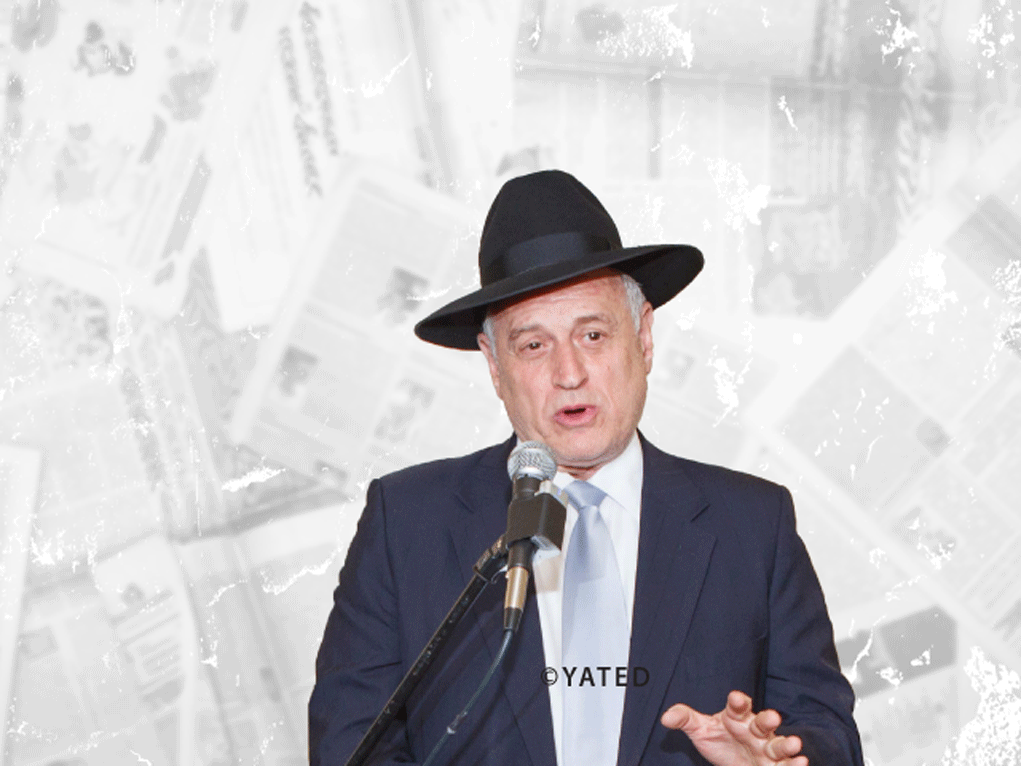
This is the gist of Malcolm Hoenlein’s viewpoint, he told the Yated in an interview. He has been closely following events for many decades and is one of the most knowledgeable people on the subject. A Flatbush resident, he is the vice chairman emeritus of the Conference of Presidents of Major American Jewish Organizations.
Hoenlein also discussed Zohran Mamdani’s first week as mayor of New York City and the strategies for battling antisemitism, which have recently become popular among some in the mainstream right.
I want to start with Iran, but I have a feeling that Venezuela is a big part of what’s going on there. Do you agree?
It’s absolutely related and could be part of a bigger strategy that the United States did not instigate, but that the United States could take advantage of. For instance, the energy that China gets from Iran and Venezuela constitutes a very significant chunk of its oil imports. If you can deny them access to that, that would strategically be a very valuable move.
Venezuela was the hub for a massive amount of the activity that Iran was involved in in South America. As I’ve told you and everybody else for years, the Hezbollah network had planes going from Iran to Damascus to Caracas, there were secret flights every week bringing gold for fuel. Venezuela was a very critical ally for Iran in South America.
Now that some of the other countries are sort of walking away from Iran or have reformed, Venezuela will be the big prize. It could change strategically in terms of the security threats from Iran to the United States, namely being able to operate from a southern coast rather than 7,000 miles away, let alone being a base to operate in connection to Mexico and other places even closer to the U.S.
So I think there is a larger picture here to be looked at. Each one stands on its own. The unrest in Venezuela has been growing because the economic conditions there are terrible. The same is going on in Iran. Independent of anything else, the regime caused the demonstrations and the revolt because the currency is now worth a million and a half to the dollar, there is a water shortage, a food shortage, and electricity is cut off for a good part of the day. You have all the conditions for unrest and for people to engage in anti-government activity.
And notice that once the bazaar owners got involved, it escalated very quickly because they are usually reluctant to do this. But their stores are empty, and there’s no way to restock. They are usually close to the government, and they were usually interested in stability, and the fact that they got publicly involved has escalated this greatly.
You also have to look at the fact that this has been escalating for some time. People are very angry over the money that was sent to Hezbollah and Hamas. That’s why you hear the chant in the streets, “We will not die for Gaza, we will not die for Lebanon, we will die for Iran.” They’re saying, “We don’t want the money going over to these causes; we want to have it invested at home to improve our circumstances.”
Iran is also having a huge brain drain. Tens of thousands of Iran’s best and brightest are leaving. Many of their campuses are half empty. You have the young people rebelling and throwing off the burkas. Authorities are again starting to clamp down on some of these things, and we saw religious police again in evidence, arresting a lot of people, and executing a lot of people. At the end of December, they were executing one person every two and a half hours. That’s ten a day. And we know that the official number of those who were executed last year was over 2,000. Those are the ones acknowledged, in addition to many arrests.
It’s a very unsettled situation, especially when you don’t have water in Tehran, and they talk of evacuating Tehran because they can’t resurrect the reservoirs.
Much of the water system feeding Tehran was built by Israelis, I’m told, when they were there in the late 1970s, under the Shah.
Weren’t the reservoirs replenished over the last couple of weeks? There was a lot of rain in the Middle East.
There was a lot of rain, but when the reservoir beds are dry, they don’t necessarily hold the water. And it wasn’t enough to make up. They’re so low that even with the heavy rains of the last couple of weeks, it doesn’t compensate.
What type of character is the average Iranian? How much could you push him or her to the wall, and they’ll just accept it? For example, Arabs are known to be willing to tolerate a lot before they rebel. What about the Iranians?
The Iranians are more sophisticated. They’re smart, many of them are educated. They’ve proven that they can tolerate a great deal because the currency has been in a steady decline for a long time. I think it was in 2015 or 2018 when it was 100,000 rials to the dollar. Now, it’s a million and a quarter to the dollar. They lop off four zeros from the currency, which means that somebody who had $50,000 now has five dollars.
And yet the people are restrained. I don’t understand their resilience and their ability to cope with seeing their savings wiped out, their holdings wiped out. To be able to buy a cellphone, you need a wheelbarrow to carry the money.
That reminds me of Germany under the Weimar Republic.
That’s why you look at historical precedents, and you see that people, educated people, are willing to accept all this. But there’s a limit to what they will put up with, and when they see that the corruption and the crackdowns and that the government has done little to alleviate their circumstances — so, yes, you get the reaction that we’re seeing.
I’ve seen people trying to compare it to the Green Revolution of 2009. On one hand, Iran was in a much better circumstance then. They were seen as stronger militarily; they had Hamas and Hezbollah as allies. They had Russia and China on their side. They had a President Obama in the United States who didn’t want to take sides, and we found out later was even sending letters to the ayatollah at the time.
Now, you don’t have all of that. They’re seen as a minor power in the Middle East. No Hamas, no Hezbollah. A president of the United States coming out against them, Russia and China are both busy with other things.
On the other hand, from what I remember then, the protests were much more widespread. It spread to hundreds of towns and villages across the countryside. Now, you just hear about protests in Iran’s main cities; you don’t hear about them in the countryside. What’s your take on this?
Are you saying that these demonstrations are not spreading to the countryside?
At least I don’t see it, unless it’s because the internet was shut down, so we don’t know.
It wasn’t in the beginning, but it is today. It’s in every one of the 31 provinces, and it is spreading to the countryside. We’re seeing demonstrations in small towns and outlying areas. Initially, it was more in the big cities, but one of the things that people are looking for is whether it spreads. The other sign you look for is defections by the Revolutionary Guards and the Basij. And so far, that has not happened.
Basij is the religious police, right?
Right.
We know that many in the leadership have visas to leave — many to Argentina. I don’t know how that’s going to work out now with a pro-U.S. president in power there. I know over a thousand of them have kids studying in the United States and have tried to arrange visas to be able to come here if they need it. Hopefully that won’t happen.
So on the first point, no, it has spread. I think by now it could already be the size of the Green Revolution. If you remember, the United States said then we don’t get involved in internal affairs. Both Hillary Clinton and Colin Powell said that when the demonstrations took place during their respective tenures as Secretary of State. This was a blow to them. That’s why the people kept saying, “We want to hear from Trump,” and they did. And it meant a lot to them that the United States even just gave them verbal support.
They’re also looking for support with communications, with Starlink. They’ve been working on trying to get them in. It’s not easy, but they have gotten in tens of thousands of units.
Part of the problem is that there is a leadership vacuum among the protesters. You don’t have a figure that commands broad enough support. Reza Pahlavi, the former crown prince, is trying to position himself, but he’s not the guy who will be the prime minister; he’s a figurehead. The fact that protesters are calling for the Shah is an interesting development.
The crown prince has been more public, but the question is whether he can unify the opposition. You have to remember that Iran is not a unitary country. In a country of over 90 million people: there are 30 million Azeris, 12 million Baluchis, millions of Arabs, and millions of other ethnic people in the country.
How large is the constituency of the ayatollahs — in other words, Shiite Muslims who are Persian people?
Fifty percent are Muslim. Now, whether they are supporters of his, we see more and more young people and others who are not, and who reject the dress codes. The clergy still have power. They have the power to arrest, and they have the power to execute. That’s a big deal. We have to wait until we start seeing the collapse of the Basij and the other instruments of the regime.
The overwhelming majority of the people want the government out. The majority even want relations with Israel, and if you noticed, they were also calling on Bibi to issue a statement. And we saw at the demonstration on Shabbos for the first time that I know where Israeli flags were waved — not many and not broadly, but the fact is it’s the first time since this started that I saw this.
This is unlike what we saw in Syria and elsewhere, where they waved many Israeli flags.
I think the biggest elephant in this whole story here is the fact that there’s no central leadership. For example, in Syria, I doubt that the whole revolution could have succeeded if there had not been a central person to rally around, Jolani.
Yeah, but he was not a leader before. He was a leader in Idlib. He was associated with ISIS. He was a wanted terrorist. And we’re still not sure who he is. If you look at the areas where he ruled in Idlib, it was very Islamist. And suddenly, when he came to Damascus, he traded in his terror uniform for a suit.
Right, but at the right time, he came, he put himself forth as a leader, and people were able to rally around him, and that’s what forced Assad out. I don’t see that in Iran.
I’m contesting whether the people rallied around him or whether he was imposed or that he imposed himself on them, and they resisted. If you remember, they had a massacre of Alawites, they had a massacre of Druze.
So you’re saying that it’s irrelevant if there’s a leader. In other words, first overthrow the regime, and then they can decide.
No. A leader is very critical.
If you have to bet on somebody right now, do you notice anyone who can fit the bill?
It will be collective leadership, I think.
You think there’ll be, I don’t know, a representative democracy, but it would be a representative government?
A representative group that would have to be interim and that would pave the way toward elections. The election will hopefully be of people who will really recreate democracy there. Representatives of the various factions would have to be part of that, including Reza Pahlavi and his followers. Could he maybe emerge out of this as an interim leader? Maybe that could happen.
But as a democratic leader, not as a Shah, right?
Right. He has said he doesn’t want to be the leader.
Since I see this coming to a head very quickly, I want to ask you — what lessons do you think the United States learned from Afghanistan and Iraq in how to help Iran govern itself if the regime is overthrown? What do you expect to happen here that would be different from there?
Well, the circumstances are very different here, and Iran is a much more sophisticated and developed country. Many of them are educated, and I think they will welcome the chance for freedom. The question is whether they can keep Iran together. Does it become a confederation of all its elements?
In Syria, people thought that would happen, but it didn’t. But Syria is also a coalition of many different groups. That’s why you still see the Kurds fighting for their rights, and the Druze and other Alawites all trying to ensure their own security. We’ve seen some actions even recently where the Kurds were fighting troops outside of Aleppo. So, you don’t see stability emerging out of it. They blame Jolani for having been connected to ISIS. The circumstances of each country are unique.
Afghanistan was a particular set of circumstances which we botched — I don’t think we’ll see a repetition of that. I hope in Iran, if the opportunity presents itself, or if they help make it present itself, that we’ll work to ensure that a new regime comes into play that will get rid of the outside influences, such as Russia, China, and Turkey, to cite a few.
If Syria can become a contributing country and if Iran becomes a positive contributing country, the whole region will change.
If Iran is removed as a threat to Israel and the United States, how will that affect Israel’s relations with the Gulf countries? Take Saudi Arabia — the joint threat from Iran was the main factor that led them to ally with Israel. If Iran is removed as a threat, will they go back to the old days of being regional enemies?
They’ve been doing that now already. You hear talk of Saudi Arabia, Turkey, and Pakistan having a defense pact. You see the conflict between Saudi Arabia and the United Arab Emirates in Yemen. You see how they distance themselves from the Abraham Accords. I don’t know if this is tactical and temporary or if it’s a longer-haul thing. I still hope and believe that Saudi Arabia will join the Accords.
Iran’s removal from the scene frees up, obviously, all these countries from a great threat to them, both internally and externally. It certainly would be a blow to China and Russia, which have invested so much in their relationship with Iran. It will diminish the threats against the Gulf states because of Hezbollah, Hamas, and the Houthis, and all the others — certainly in Iraq, where Iran is backing militias — all of that is removed by Iran’s government collapsing. That will change the whole region, especially for Israel.
So Israel could loom even more important as an ally to rebuild and to start new commerce, etc. You’re right, there could be less of an impetus if they don’t feel they need protection, but I think they all know that there’s no guarantees for the future and that they’ve come to discover how much they have in common.
I, for instance, see the move in Somaliland as very important, with Israel establishing relations with it. It means that Israel could be planning to defend against a Houthi resurgence — Somaliland is right across the Bab el-Mandeb, and this gives them a very important position. Other countries didn’t respond to Somaliland, yet they’re critical of Israel for doing it.
Turkey wants to build a base there on the Red Sea. Others are going to, and they don’t want to see Israel there. So strategically, it could be very important for Israel.
Going back to Iran, how will this affect Hamas? They’ve been getting money from Qatar, but they have been mainly supported by Iran for the past few decades. How will the removal of Iran as a bad actor from the scene affect them?
Oh, greatly. First of all, a lot of the weapons for Hezbollah and Hamas were coming from there. They are a strategic ally that Iran thought it could count on if it came under attack. They still are being told that Iran is rebuilding their capacity so that they could fire missiles at Israel.
You eliminate that, you’ve pulled the rug out from under them. A lot of their financing and a lot of their operational capacity is determined by having access to Iran.
Realistically speaking, do you see President Trump’s plan for Gaza as anything more than just comic relief?
No. I think he has a vision for rebuilding Gaza, and we know from his past that when he has a vision, they tend to happen if it’s possible.
First, though, we’ve got to get the ceasefire in place, the disarmament of Hamas, and the return of the last hostage, before we can look at the next phase. I think the president is looking at the next phase and seriously looking at what could be done. They’re talking about huge numbers of housing units to be constructed in Gaza, starting near Rafah.
But a central part of all this is getting countries that are not seen as aligned with Israel to police Gaza, and so far, no country has committed to that. How does this get off the ground without that? Hamas is not going to disarm. I saw that Israel is starting to prepare plans for a reoccupation of Gaza rather than pulling out.
Israel has to be prepared for every option, and if they see that Hamas or Hezbollah are rearming, they have to be prepared. They have plans to reoccupy Lebanon, too, if they need to.
In other words, it will be Israel disarming Hamas and not Indonesia or some other friendly Arab nation?
That’s one scenario, yes.
Doesn’t that undermine President Trump’s whole plan?
First of all, President Trump’s plan can’t be implemented if we don’t have disarmament and the return of the last body. It takes a long time to plan and clear the area, but in the meantime, Israel needs to be assured that the security requirements are going to be met. That is not the case now.
Moving across the Atlantic to right here in New York, what are Jewish groups talking about over Mayor Mamdani’s first week in office?
The first thing they are talking about is the cancellation of the executive orders that dealt with IHRA, the definition of antisemitism, and their disappointment that he took those first measures. They were talking about the appointments he made, which are very mixed at best. They are happy with the election of the new city council speaker, who is the first Jewish speaker.
They were talking about Mamdani’s reaction to the demonstrations over the Nefesh B’Nefesh event this week. He condemned the protesters for expressing support for Hamas and said it has no place here. He also said that he disagrees with the sale of properties in the West Bank because he says it’s a violation of international law — which it is not. I guess he feels he can’t do one without the other.
Jewish groups are looking at ways to bypass Mamdani on the antisemitism orders through the governor. They’re coming up with their own legislative packages to make sure that security grants are sustained. That’s a state issue, but the city also has a lot to do with it.
Your tone sounds like, we’re concerned, but we’re taking a wait-and-see attitude.
Yes. We judge everybody on an individual basis.
On a national level, the counter-antisemitism group in Washington was just set in place. Yehuda Kaploun was just confirmed at the State Department as the ambassador against antisemitism, and the new board at the Holocaust Museum just got seated. How do you expect this to change things?
I hope the Holocaust Museum board will play an important role, and I think the final confirmation of Rabbi Kaploun after a long wait — he’s very energized and will bring a lot to the job. He wants to do a lot. He has the ear of the president. He will work together with a very sympathetic Department of Justice and others in different positions in government.
One thing that came out of left field, which I did not see coming, was the sudden about-face from pro-Israel to anti-Israel on the right. You have some pretty significant voices, to such a degree that Vice President J.D. Vance hesitates to criticize them. What does it say about the future of America under the Republican Party?
We have problems with the extremes on both the left and the right. I’m not sure that we have decided on the best strategy for dealing with them. There are many who argue that the best thing is to ignore Candace Owens and Nick Fuentes, that we are building them up, that we are giving them notoriety, and that we’d be much better off if we were to focus on the positive guys.
Even with Mamdani, it was pointed out to me that he would say something anti-Israel, and everybody would jump all over it and focus on it. In the meantime, he would talk about affordability, so he got everybody distracted while he took advantage of his notoriety to get attention to talk about what people were concerned about, which was not being able to afford their rent.
We have to be sophisticated in our approach and decide: should we build up Carlson by attacking him, or should we ignore him? Does he not feed off the attention he gets from us? And would it not make a bigger difference, not to ignore but about how we go about doing things?
How did we counter Father Coughlin in the 1930s?
Actually, I don’t know that we did. I think that we turned to Christians and the government to do it. But he was listened to in every house in America during the war period. Charles Lindbergh, the first person to cross the Atlantic, also became an antisemite. I mean, he, too, was a really bad person, and he was the most popular person in America.
Were you surprised at all these voices turning on Israel? When Tucker Carlson was at Fox, he was extremely pro-Israel.
Maybe when it served their purposes. Candace Owens was also pro-Israel. We don’t know who their supporters are, what money they’re getting. Tucker is building a house in Qatar, and we believe that they paid him for a lot of his activities. I think they paid for his podcast for the Heritage Foundation. They chase the money and the notoriety, and you don’t build up your numbers when you’re pro-Israel. You build it up when you are controversial and negative, when you espouse conspiracies. They’re crazy. I mean, it’s just insanity. He sort of plays the innocent or the ignorant; certainly, the ignorant would be true.
But you raised an important point that we should go back and look at how historically antisemites were countered. Roosevelt and Coughlin had a falling out; Coughlin supported him in his first election, and then he snubbed him and began attacking Roosevelt’s Jewish Treasury secretary, Morgenthau. Obviously, the president then split with him.
But Coughlin was the first to harness the power of radio broadcasts. Franklin D. Roosevelt later used the same thing with his fireside chats.
What gives you optimism during these times?
An optimist says that this is the best of all possible worlds, and a pessimist agrees. It’s a very thin line between optimism and pessimism. We have plenty of reason to be optimistic when we look at the world, and you see that in the seven-front war that Israel faced, which many people did not think they could overcome, let alone against Iran — it did. The president has a sustained pro-Israel policy, and Israel’s economy continues to grow remarkably, even in this period.
I think Somaliland is a positive development. I think the conflict between the UAE and Saudi Arabia in Yemen is a negative development. The Saudis moving to closer cooperation with Pakistan and Turkey is not healthy.
The diminution of Iran and its ability to strike and to support the network of enemies of Israel is really important. Maybe the change in Syria, the fact that you have a joint working group — I have some reservations about it, but I think that it’s a positive sign. The Lebanese army is moving to confiscate weapons from Hezbollah; it’s not nearly what they’re obligated to do, but it is happening to some degree.
I think that the president’s plans for Gaza, some of which could be implemented, could stabilize the region a little bit.
I think when you look overall at the different circumstances in the Middle East, the relationship between the United States and Israel, the Greece-Israel-Cyprus relationship is certainly growing, and I think that could be the fulcrum of a bigger Mediterranean initiative. If you look in Southeast Asia, Kazakhstan and Azerbaijan want closer relations with Israel. Turkey is facing severe financial and other challenges.
So there is a lot of potential, and already, real things are happening that are good for Israel’s future. At the same time, each one has a flip side that you could argue poses potential dangers as well.
In other words, we’re in the hands of the Eibershter.
We are, but He’s looking for us to do our part, and right now our part is in, as Bibi calls it, the eighth front of this war, which is winning the hearts and minds of the American people, winning the political battles here and in Europe and elsewhere. People have to be much more assertive; we have to be more clever and more effective because the stakes are higher.