

As the United States deploys warships and aircraft to the Middle East, experts warn that the Trump administration is actively preparing for military action against Iran, after appearing to have abruptly switched gears last week.
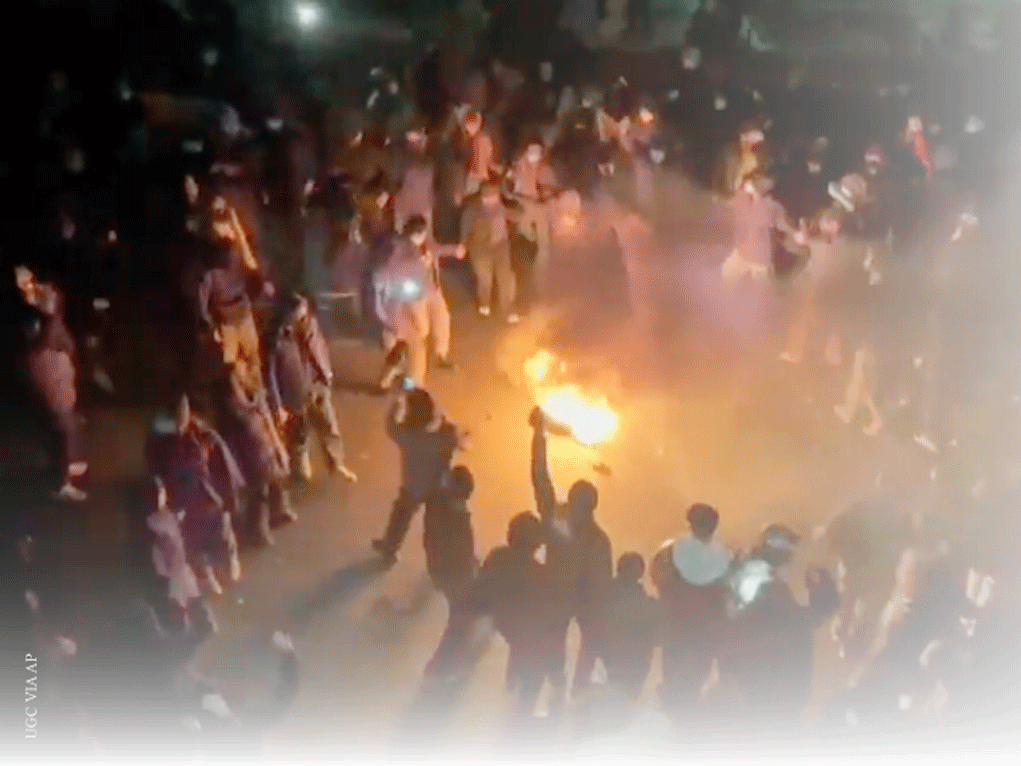
With Iran’s rulers carrying out the bloodiest crackdown in the nation’s modern history—the death toll has soared to 16,500 according to the newest estimates—President Trump urged demonstrators last week to continue protesting and to “save the names” of their tormentors.
“Help is on the way!” he posted online, vowing that those responsible for the mass murder of unarmed civilians would not escape justice.
According to reports in the Washington Post, President Trump had zeroed in on a strike plan on Jan. 13, that called for attacks to be launched that day from U.S. naval vessels and submarines in the Middle East.
He stopped short, however, of issuing his final approval.
With senior military advisors citing the risks to 30,000 U.S. servicemen stationed on military bases in the region, as well as other strategic concerns, questions arose about whether the timing was right for the planned strike.
After late-hour phone conferences with Middle East leaders, including Israeli Prime Minister Binyamin Netanyahu and other regional allies, Trump decided to call off the imminent attack.
The president concluded that the strikes might indeed decapitate Iran’s ruling clique, destabilize the regime and disrupt military infrastructure, but they would likely not lead to regime change—the administration’s core objective.
In addition, according to the Washington Post, Netanyahu told President Trump that Israel was not equipped to defend itself against an Iranian missile retaliation following a U.S. attack.
Netanyahu supported the assessment of Trump’s national security team that, in light of the need for a broader campaign to topple the regime, and given the limited U.S. military presence in the Middle East, the American attack plan might well fall short of its mission.
The U.S. is now moving assets into the Gulf region to alter that calculus, strategic analyst and retired Gen. Jack Keane explained in an appearance on Fox News.
With the transfer of two giant aircraft carriers—the USS Abraham Lincoln and the USS Gerald Ford—to the Persian Gulf, coupled with the reinforcing of allied air defense systems, Washington appears to be building up its regional forces in advance of a military strike, Keane said last week.
Bloodbath Continues
The military expert said President Trump “has been clear about his intent to see Teheran’s regime collapse” and nothing has changed except the timetable.
As reports stream in about the soaring death toll, it’s clear “the bloodbath in Iran is far from over,” Gen. Keane said. “Claims from Iranian officials that ‘the killing has stopped’—belong in the trash can because all the evidence disputes that,” he stated.
“The slaughter appears to have halted only because the Basij religious police and the Revolutionary Guard Corps are patrolling the streets with loudspeakers and machine guns. They’re forcing Iranians in cities and provinces across the country to stay inside their homes or be shot on sight.”
In addition to Teheran’s own massive security forces, Ayatollah Khamenei has brought in militias from other countries such as Iraq, Pakistan and Afghanistan, to bolster the regime’s deadly crackdown, the military analyst said. “These people treat anyone they find in the streets as a terrorist and gun them down.”
In response to claims from Iranian officials that the rioting has subsided, the killing has stopped and “the streets are quiet,” Keane called that silence the “calm of death.”
If anyone wants to know the truth behind the sham of “the killing has stopped,” they only need to recall that “after the 12-day June war with Israel, Iran’s rulers arrested 22,000 people, claiming they were all Mossad agents. They killed 1500-2000 of them. How do we know that? Because they hung them in public, using a crane. Meaning they didn’t die of a broken neck as happens with the gallows, they died by strangulation.”
“These are brutal, barbaric people,” the general said. “They will certainly do the same to the 20,000 or more people they’ve arrested since the protests began—in addition to the thousands they’ve already killed—because that is who they are.”
Along with the street killings, state executions have surged dramatically, according to Ali Safavi, a senior official with the National Council of Resistance of Iran (NCRI). Safavi told Fox News that 2,000 people were executed in 2025, while 153 have already been hanged in the first 18 days of January 2026, averaging more than eight executions per day.
Mass Executions Reportedly Continuing
“Ali Khamenei is continuing mass executions in parallel with the killing of young protesters,” Safavi said. “Three executions in the form of hanging are now happening every hour, according to our data.”
Trump has not yet taken action, Keane said, because the U.S. is still positioning military assets in advance of possible Iran retaliation against U.S. military bases in the region and against Israel.
“What this means, is we’ve expanded our targets to include Iran’s ballistic missiles, in addition to their leadership command, and in addition to the commanders of forces killing people in the street. It’s got to be done right. We need to ensure that we have all the necessary assets in the region to [take out those missiles].
Experts agree that any attack option would have to be very different from a sensational “one and done” strike of the kind Trump has favored in past military interventions, such as the recent capture and arrest of Venezuela’s Nicolas Maduro, and the Jan. 2020 missile strike that killed wanted arch-terrorist Qasem Soleimani as he was driving in his car.
A U.S strike against the Iranian regime would have to be a broad and prolonged one, experts say. It would have to target all pillars and symbols of the regime, from Khamenei’s residence to parliament and the command and control centers staffed by senior IRGC personnel.
Shocking Reports Coming Through Starlink
The British Sunday Times has obtained a shocking new report combing testimony from doctors in eight major eye hospitals and 16 emergency departments across Iran, which says at least 16,500 protesters have died and 330,000 have been injured.
Most of the killing was carried out in two days of slaughter after the country was plunged into internet darkness on January 8, the doctors’ report says.
The doctors spoke using Starlink — satellite technology that enables people to access the internet via terminals, bypassing traditional internet infrastructure. Their report described the violence as an “utter slaughter,” with most of the victims believed to be under the age of 30.
Eyewitnesses who fled Iran also described snipers targeting protesters’ heads, mass shootings and systematic blinding using pellet guns. One former Iranian resident said in the report that doctors reported more than 800 eye removals in a single night in the capital alone, with possibly more than 8,000 people blinded nationwide.
The Sunday Times was also able to reach a number of people who had fled Iran. One person, from Mashhad, said, “Tell the whole world that on Friday they sprayed everyone with gunfire. The IRGC forces were calmly trying to aim for people’s heads.”
Another from the province of Karam said: “Snipers on rooftops were shooting people in the back of the head. We were walking when suddenly several people next to us would collapse to the ground, covered in blood. When we tried to go toward them to carry the bodies away, they opened fire on us.”
The accounts reflect the scenes in disturbing videos that have emerged from Iran in recent days, as well descriptions by some witnesses crossing the border into Turkey. They tell of IRGC forces and its Basij militia on motorbikes using live ammunition from Kalashnikovs and even machineguns mounted on pick-up trucks, to mow people down. There were reports, too, of Iraqi militias being bussed in, taking attack positions at street corners.
Even the ayatollahs admit thousands of people have been killed, in spite of attempts earlier in the week to downplay the carnage. Iranian Foreign Minister Abbas Araghchi tried to prop up the regime’s propaganda, telling Fox News that the number of people killed was actually in the hundreds, and that suggestions otherwise were part of a “misinformation campaign.”
President Trump sharply condemned Khamenei over the weekend, calling him a “sick man” and urging new leadership in Iran. In an interview with Politico, Trump accused Khamenei of overseeing “the complete destruction of the country” and using “violence at levels never seen before.”
180 Attacks Against Americans in Just One Year
There is broad consensus across the political spectrum that the collapse of the Iranian regime would serve U.S. national security interests. A November 24 report from the Foundation for Defense of Democracies strongly reinforced this position, detailing how Iran and its proxies have conducted more than 180 attacks against U.S. forces in the Middle East just between October 2023, and November 2024.
These attacks resulted in three deaths of U.S. servicemen and more than 180 wounded.
The murderous hand of the regime has reached into this country as well, with the U.S. Department of Justice announcing charges against an Iranian national and two American accomplices in November 2024 for plotting to assassinate President Trump.
Teheran has issued crude threats against the president, such as displaying on Iranian TV the iconic picture of then-Presidential candidate Trump in Butler, Pennsylvania with his fist raised, after an assassin’s bullet in 2024 nearly took his life.
The Iranian regime posted in Farsi beneath the picture: Next time the bullet won’t miss.
In a similar display of twisted hate, a senior hard-line cleric called or the death penalty for arrested demonstrators and directly threatened President Donald Trump, saying his hand “should be cut off.”
While making direct threats on the life of an U.S. president has taken the regime’s venomous hostility to a new level, its hatred and contempt for America is nothing new. From the earliest days of the Islamic Republic, Iran considered the United States and Israel its sworn enemies, and set out to destroy the Jewish State. Under the ayatollahs, the regime swiftly became a warmonger, feared by its neighbors as the bully of the region.
Over the past 47 years, Teheran funneled billions of dollars into organizing terrorist militias, including Hezbollah, Hamas, Islamic Jihad, Shiite militias in Iraq, and the Assad regime in Syria, to carry out its murderous agenda while keeping itself in the shadows.
With Hamas, Islamic Jihad, and Hezbollah severely weakened; the Assad regime consigned to history; Iran itself reeling from humiliating military defeats last June; and a nationwide uprising pressing for the regime’s downfall, the Islamist tyrants running the country have been backed into a corner.
Many feel this moment in history might be the most opportune of all to unseat the corrupt clerics oppressing and killing their own people. But without factoring in the IRGC with their vast command of military force, intelligence and commercial holdings, the picture is dangerously incomplete. [See Sidebar]
***
Terror State Within a State
Is Iran’s Supreme Leader, Ayatollah Ali Khamenei, truly the all-powerful dictator the world believes him to be?
According to Iranian journalist and dissident Mohsen Sazegara, quoted in the Sunday Times UK, it was the Islamic Revolutionary Guard Corps—not Khamenei himself—that ordered the nationwide internet shutdown, a move that plunged Iran into digital darkness and enabled the regime’s largely hidden slaughter of the protesters.
This move by the IRGC underscored where real power lies when the regime feels threatened, the article said.
The IRGC is believed to have more than 180,000 active personnel, comprising a navy, air force, and ground forces. Combined with the Basij Police Force, which it controls, it is thought to number almost a million people.
According to Sazegara, the IRGC holds a vast amount of power. “One of the heads of this monster is involved in drug dealing — they bring opium from Afghanistan, run gambling houses, arrest and torture people. They’re like the mafia.”
Some believe the Revolutionary Guards are a state within a state, the Sunday Times of London observed. Over decades, the IRGC has built a sprawling parallel empire beyond Iran’s borders, commanding a network of military force, intelligence reach and commercial power that now rivals states, and is a major player in the Middle East.
Besides commanding elite armed units, the IRGC controls vast sections of the economy, winning contracts to build airports, dams and railways, the article asserts. Through front organizations and smuggling networks, it has circumvented international sanctions, selling Iranian oil to China and drones to Russia for use in the war in Ukraine.
“A lot of Revolutionary Guard commanders have become billionaire generals, more businessmen than military leaders,” said Shahin Gobadi, spokesman for an exiled opposition group. “They and their children are living in luxury.
He claimed that those involved in suppressing protests were paid a daily bonus of $70. “That’s a lot in a country where a laborer earns only $40 a month.”
While protests appear to have abated under the ferocious crackdown, experts say the crisis is far from over. “The regime has butchered so many people in such a savage way, rather than suppress the protests they have simply fueled the next round,” Ali Ansari, director of the Institute for Iranian Studies, told the Sunday Times. “The level of shock in Iranian society will rebound on them.”
Ansari believes that cracks and divisions are emerging in the IRGC leadership. “Some people in the Revolutionary Guard Corps think that spending billions of dollars to wipe Israel from the map is a useless project, that the nuclear program is a waste of money that has resulted only in sanctions,” he said. “Right now, some powerful factions inside the regime are pushing for a change in these policies.”
Many analysts believe the only way the regime will fall is if the IRGC and Basij fighters refuse to fire on protesters — or take matters into their own hands.
Whatever happens, the article said, “The IRGC hasn’t consolidated so much power and money over decades just to sit it out as passive observers of what comes next. They have a very good chance of becoming kingmakers when the moment comes.”
***
The Most Dangerous Kind of Dictatorship
An insightful op-ed by Dr. Sarit Zahavi of Alma Research Center, notes a collective understanding across Israel and many countries in the Gulf region that the collapse of the Ayatollahs and their Islamic Republic “is the only path to sanity in the Middle East.”
If the regime falls, the writer notes, the oxygen pipeline of weapons, money, and training that fuels the region’s fires will finally run dry. This applies to Hezbollah in Lebanon, the Shiite militias in Iraq, and the Houthis in Yemen, who continue to threaten global shipping with ballistic missiles provided by Tehran.
She goes on to sound a warning regarding a proposed ‘compromise’ some diplomats have suggested, in which the Iranian President Ayatollah Khamenei, might be removed from power to appease the protesters.
“Let me be clear: Khamenei leaving the scene is not the same as the regime falling,” Zahavi states. “Iran is not a dictatorship of one man; it is a dictatorship of an ideology. Replacing the man at the top while leaving the institutions of oppression intact—meaning the IRGC, the religious councils, and the revolutionary courts—is the worst-case scenario, because it creates a dangerous illusion of change.”
Carried away by such an illusion, the West might be tempted to embrace this ‘new’ leadership, lift sanctions, and release frozen funds, the writer argues. “That money will not go to the Iranian people; it will be used to crush them with greater ferocity and to reinvigorate the terror proxies abroad.”
“Even now, despite mass protests and a collapsing economy, the Iranian regime has not paused its export of terror for a second. Just this week, the Iranian Foreign Minister landed in Beirut with a single goal: to ensure Hezbollah does not disarm,” the author notes.
“President Trump has promised to deal with the Iranian threat and the murderous repression of the Iranian people. Accepting a cosmetic change in Tehran would undermine his credibility and his achievements in the region, the article contends.”
“We cannot settle for a change of faces. The goal must be the fall of the ideology. Unless a true democracy replaces the regime of the Ayatollahs, the threat to the region – and the world – will remain.”