
 Yated Ne'eman
Return of the Last Hostage Closes One Chapter and Opens Another
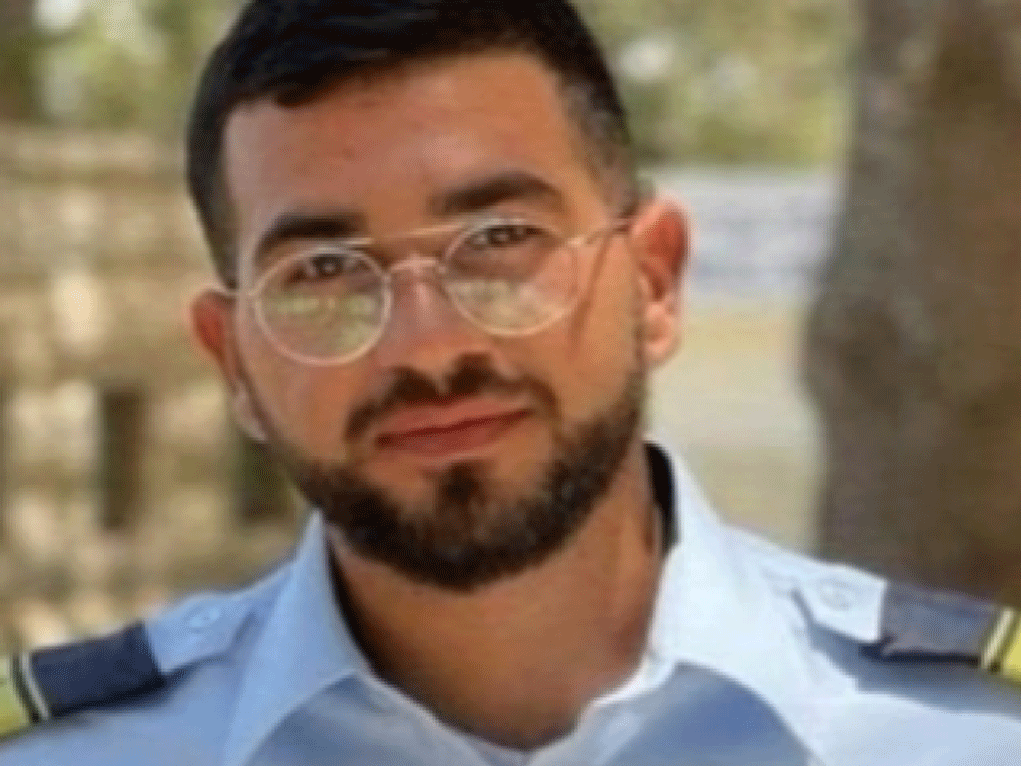
In a moment that Jews around the world have longed for ever since the heinous Hamas attack on October 7, 2023, the body of Israeli policeman, Sergeant Ran Gvili Hy”d, the 251st and final hostage kidnapped by Hamas and held in Gaza for the next 843 days, has finally been returned to the Jewish people for a proper burial. The discovery of his body by the IDF in a mass grave with 250 other bodies in the al-Bateh Muslim graveyard in Gaza City Monday provides closure for Gvili’s long-suffering parents Talik and Itzik Gvili, his brother Omri, and his sister Shira, and fulfills the conditions for the start of the second phase of President Donald Trump’s 20-point Gaza peace plan adopted last October.
The return of Gvili’s body to Israel for burial with full military honors this week put an end to the most excruciating chapter in the history of the Jewish people since the end of World War II.
Ran Gvili, age 24, was a member of an elite counterterrorism unit of the Negev Border Police. Although he had suffered a broken shoulder due to a motorcycle accident just 10 days before October 7, and was scheduled to undergo surgery for its repair, Gvili did not hesitate. Upon learning of the attack that morning, he put on his uniform and set out for the Be’er Sheva police station in order to join the fight against the invading Hamas terrorists.
In an interview with Yisroel Hayom last month, Ran’s father said his son told him before leaving their home that, “he would not let his friends fight alone, and that even with the fracture, he could still hold a handgun. I will never forget the look in his eyes. It was as if he was saying, ‘This is what I have waited for my entire life.’”
Ran Gvili’s Gallant Last Moments
According to a Times of Israel report, Ran Gvili then joined with others dispatched from the Be’er Sheva police station to fight a group of terrorists that was threatening the religious Kibbutz Alumim, near the Gaza border. Ran was credited with having helped to rescue about 100 people who had just fled from the site of the Nova music festival when it came under attack, and killed 14 of the Hamas terrorists.
He was shot in the arm and leg during the fighting, but he held his position instead of evacuating to seek medical aid, in order to radio information about the attacking enemy forces to his commanders and keep fighting. Eventually, when he ran out of ammunition, Ran was fatally wounded. After he died from his wounds, his body was seized and brought to Gaza by the terrorists.
When Trump’s ceasefire plan went into effect this past October 10, Gvili was one of 28 dead hostages whose bodies were still being held captive in Gaza along with 20 still living hostages, all of whom Hamas had promised to return to Israel within 72 hours.
The twenty living hostages in Gaza were returned almost immediately in exchange for nearly 2,000 Palestinian prisoners and detainees, including 250 serving life sentences for killing Israelis.
But the return of the bodies of the dead hostages became a long and drawn-out procedure.
Hamas claimed that it needed more time and heavy equipment to locate and retrieve the bodies of the hostages, which had been buried under the accumulated rubble from two years of combat and bombardment. The bodies were discovered and returned by Hamas, usually one at a time. For each hostage that was returned, Israel released the bodies of 15 dead Palestinians it was holding for this purpose to Hamas.
The Motives Behind Hamas’ Delaying Tactics
But for more than 50 days after the bodies of the rest of the 27 dead hostages held by Hamas had been returned, Gvili’s body remained lost, somewhere in Gaza. Hamas insisted that it had made a thorough search but was unable to locate his remains, and that its search efforts had also been hindered by bad winter weather. But Israel suspected that Hamas was deliberately slow walking the return to give it more time re-establish its control over western Gaza, and to delay indefinitely Hamas’ disarmament under the terms of the second phase of Trump’s peace plan.
On December 7, Hamas leader Khaled Mashaal publicly rejected the demand in Trump’s 20-point peace plan that Hamas disarm, and declared that “protecting the resistance project [Hamas] and its weapons is the right of our [Palestinian] people to defend themselves.”
Speaking to an anti-Israel summit hosted by the Turkish government in Istanbul, Mashaal said, “The [Hamas] resistance and its weapons are the ummah’s [Islamic nation’s] honor and pride.” He also declared that, “A thousand statements are not worth a single projectile [weapon] of iron.”
Meanwhile, as the delays mounted, Gvili’s family began to fear that Ran’s body might never be returned. To give them more hope and reassurance that their cause had not been abandoned, Prime Minister Netanyahu brought Gvili’s family with him during his late December visit to meet with President Trump and senior administration officials at Trump’s Mar-a-Lago home in South Florida.
After the meeting, Gvili’s family said that both Trump and Netanyahu had shown “genuine commitment” to securing the return of Ran’s body and a willingness to put further pressure on Hamas to locate his remains, and not permit the ceasefire to move ahead without it.
Nevertheless, Ran Gvili’s mother said, “Time doesn’t heal my broken heart — it only reduces the chance of bringing Ran home.”
How the IDF Identified Four Possible Locations for Gvili’s Body
About a month ago, Shin Bet interrogators extracted specific information from a captured Palestinian Islamic Jihad (PIJ) terrorist who had, with other PIJ terrorists, admitted to having moved Gvili’s dead body several times. The IDF then identified several areas in Gaza where Gvili’s body might be found. One of them was in one of the Hamas tunnels in central Gaza City, another was under the al-Shifa Hospital, and two other possible sites were in different Muslim cemeteries in Gaza City.
Initially, Israeli combat engineers dug into the suspected tunnel and thoroughly scanned it, but found no human remains. Because one of the cemeteries and the al-Shifa hospital were in the half of Gaza currently under Hamas control, Israel was unable to conduct searches there. But the other al-Bateh Muslim cemetery in the Shejaiay Darah-Tuffah portion of Gaza City was on the Israeli side of the yellow line, which divided Gaza in half following the implementation of the ceasefire agreement.
When the IDF recently received additional information from Hamas through the Qatari ceasefire mediators suggesting that Ran Gvili’s body was likely to be found in the al-Bateh cemetery, the IDF decided to launch Operation Brave Heart, in which the bodies in that cemetery were systematically exhumed and scientifically examined to see if one of them could be identified as belonging to Ran Gvili through dental records, matching fingerprints or DNA testing.
When the IDF exhumed and checked the 250 bodies in the mass grave over the weekend, one of the dentists working on Operation Brave Heart found one that matched Ran Gvili’s X-rays, after which an examination of the body’s fingerprints and other tests at Israel’s Abu Kabir Forensic Institute confirmed the identification.
Netanyahu Insisting on Hamas Disarmament Before Reconstruction
Prime Minister Netanyahu hailed the return of Gvili’s body as “a great achievement.”
In an address to a special session of the Knesset in honor of visiting Albanian Prime Minister Edi Rama, Netanyahu declared, “There are no more hostages in Gaza. We have an interest in bringing forward the next stage of the ceasefire, which is not the reconstruction of Gaza, but rather the demilitarization of the Gaza Strip and the disarmament of Hamas.”
Netanyahu also said that it is in Israel’s best interest “to advance this phase, and not to delay it.”
He also repeated that Hamas’ disarmament “will happen the easy way, or the hard way, but it will happen.”
Tributes to a Fallen Hero
After his body was identified, a statement issued by the Hostages’ and Missing Families Forum hailed Ran Gvili for having “fought with courage and self-sacrifice at the front line. . . earning the nickname ‘Ran the Defender of Alumim’ from the kibbutz community. . .
“Only after his ammunition ran out, Ran fell in battle and was kidnapped to Gaza. Ran, with his big smile and broad shoulders, had a huge heart. A true friend, beloved by all, he loved life, was a young man of values, always spoke simply yet with powerful calm presence.”
The Jerusalem Post cited IDF sources, which suggested that Palestinian Islamic Jihad (PIJ) might have buried Gvili in the Muslim cemetery, thinking incorrectly that he was one of their own fighters.
The same report also said that after the identity of the other Palestinian bodies in the mass grave was checked, the IDF endeavored to return them in as dignified a manner as possible and clean up the cemetery in which they were found out of respect for the dead. Tributes to the courage and sacrifice of Ran Gvili were then issued by several other Israeli political leaders. Finance Minister Bezalel Smotrich said of Ran Gvili, “He who goes out first is last to return. And the sons have returned to their borders. My heart is with the noble Gvili family, who demonstrated extraordinary courage and strength. We are committed to completing the mission and bringing victory.”
Opposition Leader Yair Lapid said, “I embrace [Raan’s] family [and] know how hard you fought for his return, and … did everything to bring him home.”
Chairman of Yesh Atid Gadi Eizenkot added: “Shehecheyanu v’kiyimanu v’higiyanu lazeman hazeh! My heart broke and healed at the same time with the news of Ran Gvili’s body being returned for burial in Israel. This operation is the essence of the story of the People of Israel — a people who do not forget, do not relent, and do not give up on anyone, even in the toughest times and across the passage of years.”
Ran’s mother, Talik Gvili, responded to news of the IDF’s discovery of her son’s body by thanking its chief of staff, General Eyal Zamir, saying that Ran, “would be proud of you. You are the best.”
General Zamir responded that the army was only carrying out its sworn duty to its soldiers. “We kept our promise that no one is left behind [on the battlefield].” He also added that “IDF soldiers, the fighters at the front and the entire nation are deeply moved by Ran’s return for a Jewish burial.”
“After two and a half years, it is a real relief,” Talik Gvili replied. “Please tell all the [IDF] teams [involved in the search for her son’s body] that they are the best.”
The timing of the discovery of Ran Gvili’s body was also fortuitous, because President Trump had long since grown impatient for the start of phase two of his Gaza ceasefire plan, for which the return to Israel of all 251 Hamas hostages, alive and dead, was a prerequisite.
Enabling the Reopening of the Rafah Border Crossing
Last week, when Trump launched the newly formed Board of Peace, the reopening of the Rafah border crossing was being treated as a fait accompli. Israel Hayom also reported that American officials had already approved the Israeli remote monitoring and tracking security measures for everyone who would pass through the Rafah crossing between Gaza and Egypt once it goes into operation.
The crossing had been closed since it was seized by the IDF on May 7, 2024, except for the 42-day Gaza ceasefire, which started on January 19, 2025, and ended that March. But from the start of the war on October 7 until Israel took control of the Rafah crossing the following May, tens of thousands of Gaza residents were able to use it to flee the fighting and enter Egypt.
With the reopening of the Rafah crossing, seriously ill Gaza residents will once again be able to use it to gain access to advanced medical treatments not currently available to them in Gaza. In addition, those who were able to flee the fighting in Gaza while the crossing was open will be able to return to whatever is now left of their former homes.
One of those Gaza refugees now living in Egypt is Kamel Ayyad, age 53, an official for the Greek Orthodox Church in Gaza who fled two months after the war started with his wife and three daughters. In an interview published by the New York Times last week, Ayyad said that while he hoped to return to his home in Gaza, his friends are telling him that the ceasefire there is still unstable, and that bringing his family back to their former home, if it is still there, would be too risky.
However, Ayyad fears that even though “No one wants to gamble with the lives of their family,” he might not have a choice, because the Egyptian government is anxious to get rid of its Gaza refugees, and no other country in the region is willing to take them in.
However, as long as Ran Gvili’s body had not yet been returned by Hamas, Prime Minister Netanyahu refused to permit the reopening of the Rafah border crossing that Israel still controls because it was the last of Israel’s unfilled obligations under phase one of Trump’s ceasefire plan.
Despite the Ceasefire the War in Gaza May Not Yet Be Over
But even though the ceasefire in Gaza is moving into phase two, the potential for the conflict to resume is still very real. Hamas fighters have re-emerged to seize the eastern half of Gaza from which the IDF has withdrawn, and Hamas leaders have publicly repudiated their previous agreement to the demand in Trump’s peace plan that its fighters be disarmed and Gaza demilitarized.
Meanwhile, Gaza’s civilian population of roughly two million Palestinians is still living in overcrowded tent camps or the rubble of up to 90% of Gaza’s housing units that were destroyed or badly damaged during more than two years of warfare between the IDF and Hamas fighters.
In addition, as long as Ran Gvili’s body remained missing, the Hostages and Missing Families Forum continued to sponsor large weekly demonstrations. In conjunction with Netanyahu’s political opponents, the public protests maintained the pressure on the Israeli government to keep working “until the last hostage” had been found, which would fulfill its solemn commitment to the Israeli people to “bring them home.”
But with the last obstacle to the start of phase two of the ceasefire finally removed, the Israeli government formally announced its willingness to reopen the Rafah border crossing, while insisting that the passage through it of every individual would be subject to Israeli approval.
Meanwhile, a spokesman for Hamas claimed that the discovery of the body of the last hostage by the IDF somehow meant that Hamas had fulfilled its obligations during the first phase of Trump’s Gaza ceasefire plan and called on the United States to stop Israeli troops from violating the ceasefire by attacking Hamas fighters who threaten them.
Trump Credits Hamas for Cooperating on the Return of Hostages
On Monday, President Trump also said that Hamas had helped Israel to find Ran Gvili’s body. “They worked very hard to get the body back,” Trump said of Hamas in an interview with Axios. “They were working with Israel on it. Now we have to disarm Hamas like they promised” when they accepted the ceasefire on October 10, Trump added.
Trump’s son-in-law and peace negotiator Jared Kushner also praised the cooperation between the U.S., Israel, Egypt, Turkey, Qatar and “many individual Gazans” who helped to locate and return the bodies of all the deceased hostages from Gaza, and made sure that none of the October 7 captives were left behind, which was not at all certain when the effort began.
An unnamed U.S. official then told the Times of Israel that the next stage of the ceasefire agreement, calling for the disarmament of Hamas, “comes along with some sort of amnesty, and candidly, we think we have a very good program to disarm. We’re in contact, or people representing us, are in contact with [Hamas], and we expect it to happen,” even though Hamas officials are now publicly rejecting the parts of Trump’s original 20-point peace plan that call for Hamas to be disarmed.
The official insisted that Hamas had signed the agreement with the disarmament clause, and warned that, “if they decide to play games, then obviously President Trump will take other actions” to enforce the deal.
Laying the Foundations for Gaza’s Future
The U.S. official also declared that, “President Trump is fully aligned with Prime Minister Netanyahu with [the] statement that the rebuilding will not occur until there’s a demilitarization and a disarmament of Hamas. . .
“Israel is looking to give space and to try and help support the people of Gaza who want to see it rebuilt. . .
“The ball is in the court of Hamas… They’re the ones standing in the way of Gaza being rebuilt and the people of Gaza living a better life,” the U.S. official concluded.
The U.S. official also said in a briefing for reporters that efforts are now going forward to build a local Palestinian police force so that the residents of Gaza can start policing themselves. “Ultimately, it’s going to be up to the government of Gaza and the people of Gaza to make sure that Gaza is secure. The more that they can show that it’s secure and not going to pose a threat to its neighbors, the more that they can help themselves by having a lot of these [construction] materials come in.”
The official also confirmed that the Palestinian Authority now has “observer status” with the new interim Palestinian government, known as the National Committee for the Administration of Gaza (NCAG). The official also said that the PA has been supportive of the efforts of the NCAG to gain civilian control over Gaza, and seems to have accepted its very limited role in that process until it has been thoroughly reformed, as called for under Trump’s peace plan.
The U.S. Military Buildup for Another Attack on Iran
Meanwhile, the arrival on Sunday of the U.S. Navy’s aircraft carrier, the Abraham Lincoln, accompanied by three Tomahawk cruise missile-launching destroyers in the waters of the Indian Ocean, as well as additional U.S. Air Force fighter jets and air defense systems arriving at U.S. bases across the Middle East. As a result, President Trump now has enough military forces in place to carry out his promise earlier this month to the embattled protesters against Iran’s radical Islamic regime that “help is on the way.” The civilians participating in the street protests, which broke out on December 28 across Iran, were subjected to a violent crackdown by forces controlled by the elite Iranian Revolutionary Guard Corps (IRGC).
According to a disturbing report published last week by Time Magazine, the scale of that IRGC crackdown was an order of magnitude larger than had previously been reported. Instead of the original death toll of 3,117 protesters that was publicly reported by the Iranian government, the Time report cited an internal figure provided by two senior officials of Iran’s Ministry of Health, which said that as many as 30,000 people who participated in 4,000 separate street protests across Iran were killed during just two days, January 8 and 9. During that time, the Iranian government had cut off all international telephone and internet connections in the country to cut off the protesters from all contact with the outside world.
The Mass Slaughter of Civilians in the Streets of Iran
According to eyewitness reports, supported by cellphone video clips, millions of Iranians were participating in the street protests when Iranian security forces stopped using mostly non-lethal force during the first week of the grassroots uprising, and began to use rooftop snipers and truck-mounted machine guns to open fire upon the defenseless civilians.
The Time Magazine report also said that so many Iranians were killed during those two days that the nationwide supply of body bags was exhausted, and the ambulances that were supposed to haul away the dead bodies lying in the streets had to be replaced by eighteen-wheel semi-tractor-trailers.
The Time story also said that the 30,000 figure for casualties in Iran over those two days from the health ministry officials was independently confirmed by a nearly identical death toll of 30,304 recorded last Friday at Iran’s hospitals, as reported by Dr. Amir Parasta, a German-Iranian eye surgeon. Dr. Parasta also told the Time magazine reporter that the figure he cited “does not reflect protest-related deaths of people registered at military hospitals, whose bodies were taken directly to morgues.” As a result, Dr. Parasta told the Time reporter, “I guess the real [death] figures are still way higher” than the original figure he reported.
On the second day of the mass shootings, Friday, January 9, an IRGC official went on to Iranian state television to warn anyone venturing into the streets of Iran, for any reason: “If … a bullet hits you, don’t complain.”
The slaughter of the protesters in the streets and the blunt warning on state television had an immediate effect. The streets across Iran had suddenly fallen silent once again, but the underlying problems of the struggling Iranian economy and the deterioration of the quality of life for ordinary Iranian citizens, which had triggered the protests, remain in place. Furthermore, because Iran is still being treated as a pariah state by most of the international community, the current Iranian regime is powerless to address those problems.
According to the Time Magazine article, the slaughter in Iran on that scale over two days is unprecedented in the post-World War II era. The last comparable documented event was the genocidal slaughter carried out by Nazi death squads, which shot and killed 33,000 Ukrainian Jews on September 29 and 30, 1941, in a ravine outside of Kyiv known as Babi Yar.
After the arrival over the weekend of the additional U.S. military forces in the Middle East, President Trump boasted in an interview with Axios that, “We [now] have a big armada near Iran, bigger than [the one we had near] Venezuela.” Trump was referring to the U.S. military forces in the Caribbean, which launched the operation that seized Venezuelan leader Nicolas Maduro and his wife on January 3 and brought them to the United States for criminal trial on drug trafficking charges in a New York federal court.
Trump Offers Iran a Choice Between Diplomacy and War
However, Trump also insists that he would much prefer to engage diplomatically with the Iranian regime on behalf of the protesters rather than resorting to military force, as he did in June when he sent American B-2 bombers to destroy Iran’s hidden nuclear weapon production facilities with huge bunker-busting bombs.
Several Iranian officials responded to the Trump threat of another American attack with a promise that Iran would strike back hard at Israel as well as American military targets across the region. That prompted a warning from Prime Minister Netanyahu in return that the Israeli military is prepared to respond to an Iranian attack with a devastating retaliation. “[The IDF] continues to stand guard against any threat from Iran. Any attempt by Iran to harm us will be met with a decisive response. It would be a very big mistake, one mistake too many,” Netanyahu said.
Even the threat along Israel’s northern border with Lebanon from Hezbollah, which had been decapitated and thoroughly defeated by Israel with the creative use of exploding pagers and walkie-talkies, is now being revived with help from Iran. Last week, Hezbollah’s new leader, Naim Qassem, who replaced its longtime head, Sheik Hassan Nasrallah, who was assassinated by Israel on September 27, 2024, threatened to mount new attacks on Israel if Trump carries out his threats to attack Iran again, or its supreme Islamic leader, Ayatollah Ali Khamenei, who is reportedly now hiding out in an underground bunker.
Last week, Qassem issued a blunt warning to President Trump that if he dares to threaten the ayatollah, Hezbollah will retaliate. “This time,” unlike what happened when Iran was attacked by Israel and the United States last June, “a war on Iran could ignite the entire region.”
Israel Was Fortunate in Avoiding a Hezbollah Attack
From a pair of illuminating articles by Yair Kraus published by Ynet over the past two weeks, we learned why the threat from Hezbollah to attack Israel must be taken very seriously. They revealed that on October 7, 2023, Hezbollah was fully prepared to launch a devastating assault from Southern Lebanon that would have quickly overwhelmed the IDF’s defenses in the Galil and led to the immediate capture of the northern Israeli towns of Metula, Shtula and Nahariya, Meanwhile, during the first two days of the attack, a continuous barrage of 16,000 Hezbollah rockets would quickly overwhelm Israel’s missile defenses and render Haifa and other northern Israeli towns uninhabitable.
According to the Hezbollah attack plan, the main assault would be led by up to 5,000 members of its Radwan Force commando units, some of whom were veterans of the Syrian Civil War, in which Iran and Hezbollah were fighting in support of Bashar Assad. When Iran signaled to Hezbollah to attack, those well-trained fighters, who had entered roughly 30 southern Lebanon villages dressed as civilians, would emerge from tunnels ending just outside the Israeli border fence fully armed. They would then detonate the mines that had been planted under the Israeli security fence at the border. Northern Israel would then be left exposed and defenseless as the heavily armed commandos would swarm across the border, overwhelming the undermanned IDF border posts on the other side.
Simultaneously, the attack plan called for 150 Hezbollah naval commandos to come ashore from the Mediterranean on the beach at Nahariya, and two other battalions of Hezbollah fighters would cut the main Acco-Tzfat highway and seize the high ground to prevent its use as a fire base for long-range Israeli artillery.
Meanwhile, the Israeli military units that had been assigned to defend the north would be ineffective because most of their training was based on the assumption that they would be fighting in Southern Lebanon, rather than trying to avoid inflicting casualties on Israeli civilians while trying to attack and expel the Hezbollah fighters from captured Israeli towns throughout the Galil.
Israel’s Military Negligence on Its Northern Border
According to the Ynet story, before October 7, the leaders of the IDF were well aware of Hezbollah’s mass attack plan for northern Israel, which had been developed under Iranian guidance, portions of which had been published by a Lebanese newspaper called Al-Joumhouria in early 2011. In early 2023, a retired Lebanese general also described publicly and in detail exactly how Hezbollah would launch its ground attack on northern Israel, and how Hezbollah fighters planned to neutralize Israel’s superior air power and tanks by embedding themselves among the civilians living in northern Israel and using them as human shields.
Yet Israel’s military leaders decided not make any adjustments to northern Israel’s defense plan because they were confident that they would receive enough warning of the Hezbollah attack from Israeli intelligence to activate reserve IDF units in time to reinforce the most vulnerable areas along the northern border.
In other words, the IDF leaders on October 7 were making the same mistake that an earlier generation of overconfident Israeli military leaders made during the days leading up to the surprise attacks by Egypt and Syria that caught the IDF unprepared at the start of the 1973 Yom Kippur War.
IDF leaders also believed that, for domestic political reasons, Hezbollah did not want to initiate another war with Israel because that would alienate too many Lebanese citizens and undermine Hezbollah’s growing influence inside Lebanon’s government.
The October 7 Attack Order That Never Came in the North
The only thing that saved northern Israel from being quickly overrun was the fact that Hezbollah’s leader at that time, Sheik Nasrallah, had been given no advance warning by Hamas leader Yahya Sinwar about the October 7 attack he was planning. Nasrallah, therefore, had not positioned his forces to be ready to launch his own attack plan in immediate support of the Hamas assault.
Another factor was that Iran’s leaders were caught as much by surprise by the timing of Hamas’ attack in October as Nasrallah was. According to Shimon Shapira, a former member of Israel’s Military Intelligence Directorate, at the time, Iran’s leaders were trying to open a diplomatic channel with the Biden administration, and therefore decided not to give Nasrallah the order to launch Hezbollah’s own attack plan at that time.
As a result, Nasrallah’s initial response to the Hamas attack was limited to harassing missile fire at a handful of targets in northern Israel rather than a full-scale attack. However, because Israel’s military leaders knew just how vulnerable their defenses in the North were at that time, they responded by immediately ordering a major military buildup there. That prevented Nasrallah from changing his mind and belatedly launching his own attack plan, because its success was heavily dependent upon the element of surprise.
The net result was that for most of the first year of the war, the focus of the fighting remained in Gaza. Hezbollah and Israel’s military forces in the North appeared to be content to trade sporadic missile and artillery fire, with neither side willing to escalate the low level of the fighting.
The Israeli military finally decided that the stalemate in the North, which had forced more than 60,000 residents in the area to flee their homes, had become untenable. The fighting then became much more serious, beginning with the surprise detonation by the Mossad of Hezbollah’s booby-trapped pagers and walkie-talkies, and continuing with the assassination of most of Hezbollah’s top military leaders.
But the real surprise for Israeli military leaders came when the IDF launched an invasion of Southern Lebanon, and discovered the huge scale of Hezbollah’s military preparations in that area, where Israeli soldiers seized more than 85,000 weapons and intelligence items, including thousands of rocket launchers, explosives, anti-aircraft missiles, and vehicles. Israeli military officials also stressed that this huge number of weapons captured represented only a fraction of Hezbollah’s total arsenal.
Before October 7, Northern Israel Was Militarily Defenseless
By contrast, Israel’s military defenses in the North at the time were totally inadequate. While on paper the IDF had 3,500 to 4,000 troops deployed in the region, in fact, many of those troops were home on leave on October 7, which meant that Israel’s long northern border was largely undefended. In addition, the civilian self-defense and emergency forces in the northern Israeli communities, which were intended to hold the line in case of a serious attack until regular IDF reinforcements arrived, were also largely unprepared at the time.
Some of those squads had no weapons at all, due to concerns about theft. In the event of an attack, the members of those units were told to drive to the IDF military base, sign them out, and then return to their community to defend their homes, which, obviously, was completely absurd. That was why some Israeli military leaders who were aware of this situation called it a “miracle” that Hezbollah did not launch a full-scale attack on the North on October 7, because if they had done so, it would have resulted in an even greater military disaster than from Hamas’ attack on the South.
According to the Ynet reports, the only good news that came out of this potentially tragic military situation is that the roughly 40 internal investigations that the IDF conducted in the wake of the October 7 attack recognized these severe military readiness shortcomings in the North, and have led to major improvements, including a doubling of the number of troops deployed, the forward positioning of some of those troops at IDF positions inside the Lebanese border, as well as a major expansion and rearming of the civilian defense squads across the region.
But the fact that such drastic remedial measures in the North were necessary is itself troubling, as is the fact that Israel’s military leaders ignored the situation for so long.
How the October 7 Attack Wounded Israel’s Soul
Throughout the 844 days between the Hamas October 7 attack and the discovery and return of Ran Gvili’s body, a Jerusalem Post editorial said, “the hostage crisis hung over Israel like a dark cloud. The pain of the hostages’ families, as well as the uncertainty surrounding their fate, served as an open wound for Israeli society, constantly reopened by Hamas propaganda videos, failed negotiations, and internal divisions. . .
“Israel found itself trapped between wars on multiple fronts and fragile ceasefires, unable to fulfill the most fundamental obligation to its citizens: Bringing them all home.”
Upon the return of Gvili’s body, Israel’s president, Yitzchok Herzog, issued a statement declaring that, “The entire people of Israel are moved to tears. After many difficult years, for the first time since 2014, there are no Israeli citizens held hostage in Gaza. An entire nation prayed and waited for this moment. May Ran’s memory be a blessing.”
For Gvili’s family, the long-awaited news of the discovery and return of Ran’s body was something of a mixed blessing. Ran’s mother, Talik Gvili, who had spoken out and advocated tirelessly on behalf of her captive son and never really gave up the last glimmer of hope for him, said the return of his body brought “a relief, after these two and a half years, even though we hoped for a different ending.” On her Facebook, she wrote proudly about her son that he was “the first to go out, the last to come back. Our hero.”
Ran Gvili’s levayah, where his heroism and courage were honored by the Israeli people, was held this week in his hometown of Meitar, not far from Be’er Sheva.
But as the Jerusalem Post editorial notes, while the return of Ran Gvili’s body “has elicited a quiet, heavy sigh of relief and a somber ending to a period that shook Israeli society to its core. . . [it] does not absolve Israel’s leadership of responsibility for how long it took, or how high the price became.”
Despite Trump’s Ceasefire in Gaza, October 7 Is Not Yet Over
The editorial points out that skeptics will also argue that even with the completion of phase one of Trump’s ceasefire agreement, “nothing meaningful has changed. Gaza’s future governance is still unresolved. Hamas has not been disarmed and is growing emboldened every day. . .
“[Israel’s internal] divisions, many of which predated October 7, will not disappear.
“The story of October 7 has not yet ended. . . Gaza border towns will still take years to rebuild, and [the Israeli public’s] trust in leadership, security, and institutions will take even longer to restore.”