

In a last ditch diplomatic effort to head off another armed confrontation between the United States and Iran, just eight months after the U.S. and Israel staged an unprecedented 12-day air war which wiped out much of Iran’s nuclear program, stripped Iran of its air defenses, and crippled its long-range ballistic missile program White House special envoy Steve Witkoff and Iranian Foreign Minister Abbas Araghchi were to meet Friday in Istanbul to see if there is enough common ground to head off another series of attacks on Iran which could lead this time to a broader regionwide war.
The meeting in Istanbul was set up through intensive diplomatic efforts last week by Turkey, Qatar, Egypt, the United Arab Emirates (UAE), and other Middle East countries. The goal of the meeting in Istanbul was to head off another war between the U.S. and its regional allies, including Israel, and Iran and its proxy forces in the region, including Hezbollah and the Houthis, by restarting the indirect negotiations between both sides that ended last June when Israel and the U.S. launched a devastating 12-day air war against Iran’s nuclear and ballistic missile facilities.
Turkey and its president, Recep Tayyip Erdogan, played a leading role in this latest effort to calm tensions by agreeing to host the Friday meeting in Istanbul and by urging Iran’s leaders to show enough willingness to meet President Trump’s demands to break the growing momentum towards another armed conflict that could expand to engulf the entire region.
The Turkish, Qatari, and Egyptian foreign ministers, as well as diplomats from Saudi Arabia, Oman, and Pakistan, were also expected to attend the meeting in Istanbul. President Donald Trump’s son-in-law, Jared Kushner, who has been working closely with Witkoff in the Trump-sponsored negotiations to end the wars in Ukraine and Gaza, will also be participating in the meeting in Istanbul, which may be the last chance to head off another U.S. attack on Iran.
Iranian state media also confirmed that Iranian President Masoud Pezeshkian ordered the restart of nuclear talks with the U.S. in Istanbul. With more U.S. military forces moving into place, other countries in the region have launched a flurry of diplomatic efforts, including an unannounced visit to Tehran by Qatari Prime Minister Mohammed bin Abdulrahman Al Thani over the weekend.
Egyptian President Abdel Fattah Al Sisi also spoke with Iranian President Masoud Pezeshkian to discuss a broad proposal drafted by Oman and Qatar that combines steps to deal with Iran’s uranium enrichment efforts with economic incentives and security commitments designed to encourage Iran to accept President Trump’s demands for restrictions on its missile program and an end to its support for terrorist organizations. During his conversation with the Egyptian leaders, Iranian President Pezeshkian reportedly said he wanted guarantees from the U.S. that Iran wouldn’t be attacked during the new round of negotiations.
Trump Mediator Steve Witkoff’s Busy Week
Trump’s chief negotiator, Witkoff, was already scheduled to be in the region this week for meetings in Israel with Prime Minister Binyomin Netanyahu, presumably to finalize the joint American-Israel approach to Iran. Witkoff was also to participate in another round of Russian-Iranian peace talks in Abu Dhabi before he continued to the meeting with Iran’s Foreign Minister Araghchi in Istanbul.
In an interview Sunday with CNN, Araghchi said that “I see the possibility of another talk if the U.S. negotiation team follows what President Trump said, to come to a fair and equitable deal to ensure there is no nuclear weapons. … This is what he said in one of his latest posts. So if that is the case,” Araghchi said, “I’m confident that we can achieve a deal.”
However, Araghchi’s stated willingness to negotiate is limited to Iran’s nuclear program, which was largely destroyed by the devastating U.S. and Israeli air strikes last June. It was still not clear whether Iran would now be willing to halt its uranium enrichment operations and give up its large stockpile of highly enriched uranium, which it refused to do before the negotiations ended last June with the coordinated attack by Israel and the United States.
Agachi was ignoring completely Trump’s demands that Iran halt its ballistic missile program, cut off its support for terrorist groups such as Hezbollah in Lebanon, the Houthis in Yemen, and the Islamic militias in Iraq, and put an end to the Islamic regime’s reign of terror which reportedly killed tens thousands of Iranian last month and arrested thousands more who took to the streets to protest against the government of the ayatollahs.
Iran Trying to Limit New Talks to Its Nuclear Program Only
Iran has also informed the regional mediators, including Turkey, Qatar, and Egypt, that it will only discuss putting limits on its already-crippled nuclear program, while rejecting Trump’s additional demands for curbs on its missile program and an end to its financial and military support for its terrorist allies and proxy militias across the Middle East.
Despite the wide gap between the U.S. and Iranian positions going into the Friday meeting in Istanbul, a U.S. official told reporters that because President Trump has called on Iran “to make a deal, the meeting [in Istanbul] is intended to hear what they have to say.”
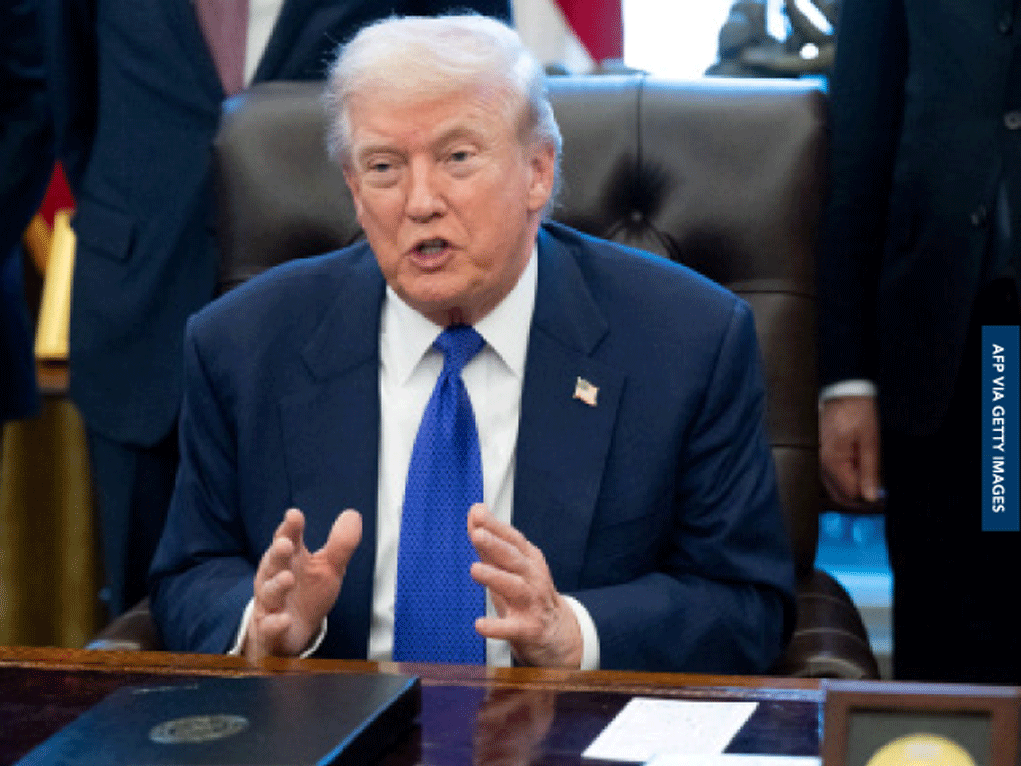
Meanwhile, President Trump told reporters in the Oval Office on Monday that greatly reinforced U.S. military forces in the Middle East are now prepared to go into action against Iran once again should the talks in Istanbul fail to make enough progress. “We have ships heading to Iran right now, big ones — the biggest and the best — and we have talks going on with Iran, and we’ll see how it all works out,” Trump said, implying that the U.S. military would be fully in position to launch another powerful strike on Iran within another few days.
“I’d like to see a deal negotiated,” Trump reiterated. “I don’t know that that’s going to happen … right now we’re talking to them. We’re talking to Iran. And if we could work something out, that’d be great. And if we can’t … probably bad things would happen.”
Trump also said in an interview with Fox News, “The plan is that [Iran is] talking to us, and we’ll see if we can do something. Otherwise, we’ll see what happens … We have a big fleet heading out there. They are negotiating, so we’ll see what happens.”
Trump repeated that Iran should negotiate a “satisfactory” deal that would prevent it from getting any nuclear weapons, and then said, “I don’t know that they will. But they are talking to us. Seriously talking to us.”
Trump Is Pressing Iran on Three Sets of Demands
Reuters reported last week that Trump had demanded three conditions for resumption of talks: zero enrichment of uranium in Iran, limits on Tehran’s ballistic missile program, and ending its support for regional proxies. Iran has long rejected all three demands as infringements on its sovereignty, but the greatest obstacle in the current talks is likely to be the restrictions Trump wants on Iran’s ballistic missile program, which it has been rapidly rebuilding, rather than its uranium enrichment efforts, which are still largely out of commission due to last June’s air strikes.
Iran’s leaders remain largely defiant in the face of Trump’s demands. They have said that they will not negotiate with the U.S. while under threat, while warning that Iran will launch a harsh response to any American attack. Iran also insists that any negotiations must begin with the lifting of all sanctions on its economy imposed by the U.S., its Western allies, and the United Nations.
Iran is also demanding the end of restrictions on its oil and gas exports, renewed access to its frozen assets in foreign countries, and an end to the international arms embargo against it, as well as guarantees that any agreement it signs with the United States will not later be abandoned, as President Trump did in 2018 when he walked away from the 2015 nuclear deal with Iran that the Obama administration had signed.
In return, Iran has offered only a return to a slightly modified version of the deeply flawed 2015 nuclear agreement negotiated with the Obama administration, which focused narrowly on limiting Iran’s uranium enrichment efforts. Trump withdrew from that agreement because he argued that it was ineffective at halting Iran’s nuclear program and ignored the threats from its large ballistic missile arsenal and its terrorist regional proxies.
Trump Has Renewed His “Maximum Pressure” Campaign Against Iran
Trump is once again applying “maximum pressure” in an effort to extract concessions from Iran using military, economic, and psychological pressure, and by issuing an ultimatum publicly warning Iran that time is running out for it to head off another attack. He hasn’t announced a hard deadline this time.
Before launching last June’s 12-day war against Iran in conjunction with Israel, Trump gave Iran’s Supreme Leader, Ayatollah Ali Khamenei, two months to dismantle his nuclear program. When the Ayatollah refused, President Trump and Prime Minister Netanyahu did it for him, by carrying out their threats to wipe out Iran’s nuclear infrastructure, including those portions that were buried deep underground, and they did it just as soon as the two-month deadline Trump announced expired.
This time, Trump has also raised the possibility of regime change in Iran, and has repeatedly said that time was running out for negotiating a deal that would make another American attack on Iran unnecessary. Trump has also threatened that the next American strike on Iran would be far more destructive than the one last, which was narrowly focused on Iran’s underground nuclear facilities.
Based upon the attack that Trump ordered on Iran last June, it can be safely assumed that even though Trump has not yet carried out his latest threats to attack Iran, this time in the defense of the brave Iranian demonstrators who have risked their lives to protest against the widely hated Islamic regime, he is not bluffing. The threatened attack has been delayed only so that the necessary military preparations for its success can be completed before it is launched.
Nevertheless, Ayatollah Khamenei has remained defiant in the face of increasing U.S. military pressure. “The Americans should know if they start a war, this time it will be a regional war,” the Supreme Leader said Sunday.
Iranian Leaders Are Now Seriously Worried About Regime Change
But despite this defiant rhetoric, Reuters reports that Iran’s leadership is increasingly worried that another effective U.S.-Israeli series of air strikes could break its grip on power by encouraging the members of Iran’s already enraged public back onto the streets.
Based upon statements from four unnamed current Iranian government officials, Reuters has reported that high-level Iranian government officials have told Supreme Leader Ayatollah Ali Khamenei that the level of public anger generated by last month’s crackdown has reached a point where the fear of being killed is no longer a sufficient deterrent to keep the protesters from confronting the regime’s security forces again on the streets of Iran.
Khamenei was reportedly warned that any more damage to the credibility of his regime, such as another successful series of U.S. and Israeli air strikes, could “inflict irreparable damage to [Iran’s current] political establishment.”
One of the officials told Reuters that, “an attack combined with demonstrations by angry people could lead to a collapse [of the ruling system]. That is the main concern among the top officials, and that is what our enemies want,” said the official
“People are extremely angry,” another former senior Iranian official told Reuters, adding that “the wall of fear” that the Islamic regime hoped to create with last month’s crackdown “has collapsed. There is no fear left.”
According to a Washington Post report, citing a European official in contact with Iranian officials, the growing fear within the ranks of the Islamic regime’s leadership has silenced the internal objections that were voiced over the level of deadly force the government used against the protesters last month. In the face of the current threat of another devastating U.S. attack, those disagreements are now being set aside.
“The regime has completely closed ranks” to create a united front against Trump’s threats, the European official said. “All the messages from my [Iranian regime] contacts now [say], ‘We are ready for total war.’”
Why Trump Is Allowing Diplomatic Efforts to Run Their Course
As the massive U.S. military buildup in the Middle East continues, Trump is allowing the diplomatic effort to head off another war against Iran to run its course. However, it still appears highly unlikely that the threat of an even more devastating U.S. attack on Iran will force the Islamic regime to give up its aggressive efforts to dominate the region, its support for terrorism, and its attempts to destroy Israel.
Meanwhile, a Wall Street Journal editorial approved of Trump’s demands for Iranian concessions on its missile program and support for terrorism, in addition to more limitations on its nuclear program as “fine ideas.” However, it questions the message that would be sent to the Iranian people, who have risked their lives to protest against their government, if Trump backs off his threats without taking military action, even if he does win the concessions from Iran’s leaders that he has been demanding.
The editorial also notes that even if Trump and his negotiators do succeed in getting such concessions, “they would amount to paper promises that the ayatollah would be unlikely to honor.”
Meanwhile, some Arab mediators have said that Iran’s leaders worry the U.S. could be pursuing diplomacy as a way to buy more time for a strike. They recall that U.S. and Iranian officials were scheduled for talks last June when Israel launched a surprise attack just days before the meeting was supposed to take place.
As the editorial points out, everything that has happened since the U.S.-Israeli attack on Iran last June makes the current effort to reach a successful diplomatic agreement to resolve these issues with Iran a highly “dubious quest.
“First, in June, Iran’s nuclear program and top military echelon were devastated by Israeli and then U.S. strikes, which exposed Iran’s weakness, penetration by Israeli intelligence, and vulnerability by air. Second, in December and January, the Iranian people rose up to demand an end to their regime’s failed rule. Third, the regime subsequently massacred its own people by the thousands despite Mr. Trump’s repeated demands not to do so.”
Trump’s Promise to the Victims of Iran’s Vicious Crackdown
When the leaders of Iran ignored Trump’s warning and ordered their armed thugs kill tens of thousands of defenseless demonstrators, President Trump was moved to assure the protesters, “help is on its way.”
Because the Iranian regime cut off internet access inside Iran and international phone connections, the full extent of its crackdown on protesters, including mass shootings, took a long time to become apparent. However, Time Magazine, citing anonymous sources inside the Iranian regime, reported that at least 30,000 civilian protesters were killed in just two days, January 8 and 9. The public protests in towns and cities across Iran then promptly ceased because the government issued a warning to any civilians found loitering in the streets of Iran that they were subject to being shot without warning. During subsequent weeks, the Iranian regime staged a massive roundup of untold thousands of Iranian citizens with any record of protest activities against the ayatollahs in the past, in an effort to suppress any further protests.
Trump Hesitated Because Time Was Needed for a U.S. Military Buildup
Trump did not act on his threat to deliver “help” to the Iranian protesters immediately because his advisors told him that the U.S. military resources necessary to assure the success of another attack on Iran, and the ability to defend against the likely Iranian counterattacks, were not yet in place.
The delay has given the Navy enough time to move the Abraham Lincoln aircraft carrier armed with F/A-18 attack planes and stealthy F-35 fighter jets, which was stationed in the Pacific, to the Arabian Sea, well within striking distance of Iranian targets, as well as the aircraft carrier’s escort vessels, including three cruise missile-firing destroyers.
In addition, the Pentagon has also sent a dozen additional F-15E attack planes to the region and put its strategic bombing force on high alert, including the B-2 bombers, which dropped the bunker-busting bombs that destroyed Iranian underground nuclear sites last June.
As the Wall Street Journal editorial explains, “It took time, but an American armada has arrived in the region. Also moving into place are THAAD and Patriot air defenses to protect U.S. bases and allies in Israel and the Gulf from any Iranian retaliation.”
What Is Left to Talk About?
Now that the stage has been set for another successful U.S. attack on Iran using overwhelming U.S. military power, Steve Witkoff is heading back to the Middle East this week to give Iran’s leaders one more chance to head off another national disaster. Trump still insists that he would prefer to resolve the situation by making a deal with Iran instead of attacking it, but the Wall Street Journal editorial asks “the crucial question… what is left to talk about?”
While Foreign Minister Araghchi has insisted that the only concessions that Iran is willing to discuss at this point are new limitations on its nuclear program, that is no longer seen as the chief threat to the region at this point due to the extensive damage done to its nuclear infrastructure last June by the Israeli air attacks and the bunker buster bombs that the American B-2 bombers dropped on its underground facilities.
The only near-term potential nuclear threat that Iran retains at this point is from its 960-pound stockpile of 60% enriched, near-bomb-grade uranium that the inspectors from the U.N.’s International Atomic Energy Agency confirmed that Iran had amassed before last June’s attacks.
It is quite possible that much of that highly enriched uranium stockpile is still buried with the debris from the underground nuclear facilities that the U.S. bunker-busting bombs destroyed, and is currently inaccessible to the Iranians as well. It is also not clear whether, in the wake of last June’s attacks on its major nuclear facilities, the Iranians still have the other components necessary to turn that highly enriched uranium into a usable nuclear weapon.
As the U.S. military buildup in the region continues, increasing the likelihood that the eventual U.S. attack on Iran will be successful, Trump has nothing to lose by waiting another week to see whether the meeting in Istanbul can lead to practical, detailed peace talks in which Iran is willing to make a good faith negotiating effort, despite how unlikely such an outcome appears to be.
Critics of Trump’s Agreement to One More Peacemaking Effort
Meanwhile, Trump has come under criticism from some Republicans, including his former Secretary of State, Mike Pompeo, his former U.S. ambassador to the U.N., Nikki Haley, and South Carolina Senator Lindsay Graham, for being willing to send Witkoff to Istanbul to explore the remote possibility that Iran is ready to make the necessary conditions.
Haley wrote on her social media account, “You can’t make a deal with a regime that lies about its nuclear production, oppresses its people, and spreads terror around the world. Iran can’t be trusted.”
Former Secretary of State Pompeo was even more emphatic in declaring that any attempt to engage in serious diplomatic talks with Iran was pointless. He said that Iran has broken every deal that they have ever signed up for, including the “stupid deal” President Obama signed in 2015, which they violated the very day it was signed.”
Pompeo did express some hope that the need for another U.S. attack on Iran, risking the lives of American soldiers, could be avoided if some Iranian general or IRGC official decides that the current Iranian against Iranian bloodshed cannot be allowed to continue and leads a popular uprising by the Iranian people that overthrows the current regime. But Pompeo concluded that, “We all want peace, but we also know that you can’t have peace in this region so long as the ayatollah is in charge.”
In an interview with Fox News, Senator Graham argued that Trump should take advantage of the current opportunity to remove the threat from Iran to the rest of the region. “The biggest thing you could possibly do for the Middle East,” Graham declared, “is take this regime down, [now that] they’re as weak as they’ve ever been since 1979.” Graham concluded the interview by directly urging Trump to order the attack by saying, “Mr. President, you can do it, I hope you will do it.”
Even if Haley, Pompeo and Graham are right in declaring that any diplomatic effort to make peace with Iran is doomed to fail, as long as the U.S. military buildup is not yet complete, it does make sense for Trump to make the effort, so that he can then reassure U.S. allies in the region who fear that Iran will attack them in retaliation for an American attack that he did everything he possibly could to avoid that outcome.
Trump Weighing His Attack Options
Assuming that the diplomatic effort does fail, Trump is expected to go forward with a plan of attack on Iran, most likely with at least some Israeli participation, that is designed to last from as little as just a few days to as long as several weeks.
The objective of a shorter military operation would likely be to force Iran’s Islamic regime to capitulate to the terms dictated by President Trump. That was how the short war against Iran last June was ended after just 12 days of Israeli and U.S. bombardment. But unfortunately, Trump did not force Iran’s leaders at that time to take the measures he is now demanding to shut down their ballistic missile program and end their support for terrorist organizations in the region.
Any short, highly precise air attack on Iran, no matter how intense, would likely not be decisive enough to topple the regime. Following any such limited strike, Iran would still retain the ability to inflict casualties and severe economic damage on the adversaries it chooses to target. These targets include U.S. assets and bases across the Middle East, U.S. naval vessels operating in nearby waters, the oil fields and refineries of America’s Gulf state allies, or Israel’s population centers.
Regime Change Likely to Require a More Extensive Attack Plan
A significantly longer and more comprehensive U.S. and Israeli plan of attack on Iran would be required if the goal is to create a widespread popular revolt within Iran that would lead to the total collapse of the current Islamic regime. Furthermore, a lengthier military campaign against Iran would be more likely to prompt Iran’s allies in the region, including Hezbollah, the Houthis, and the Iranian-backed Iraqi militias, to launch at least token attacks on Israeli and American targets in the region. The need to defend those targets is why the Pentagon is still rushing to bring more naval and air forces into the region, and build up the available reserves of anti-aircraft and missile interceptors to defend those targets from attack by Iran’s remaining stockpiles of short and longer-range ballistic missiles and drones.
The additional defensive assets that are required include mine-clearing vessels to prevent Iran from potentially blocking the Strait of Hormuz, or efforts by the Houthis in Yemen to disrupt marine traffic in the Bab el-Mandeb Strait.
U.S. and Israel Both Facing Missile Interceptor Shortages
In addition, the IDF has launched a crash program to build more interceptor missiles for its Arrow, David’s Sling, and Iron Dome missile defense systems because it almost exhausted its available supply of interceptors in defending against the large salvos of incoming Iranian ballistic missiles during the 12-day war against Israel last June.
The U.S. Patriot and THAAD missile defense systems that were also active during the June war suffered from the same problem in trying to respond to the salvos of Iranian missiles. In fact, it has been reported that just during those 12 days of combat, U.S. forces used up 25% of the total number of THAAD interceptors that have ever been built.
Since then, the Iranian regime has also launched a crash effort to build more long-range ballistic missiles in the hope of being able to overwhelm the capacity of Israeli missile defense systems to shoot them all down at the same time.
Why Trump Needs to Make Sure His Attack Succeeds
Another important political consideration is that Trump cannot afford to launch any military operation against Iran or its allies in the region in which an American aircraft is likely to get shot down, a U.S. naval vessel is seriously damaged, or American personnel are captured by hostile forces. Any such scenario would represent a major psychological victory for the Iranian regime, weaken the internal Iranian protest movement, and deal a blow to the image of U.S. military invincibility that the Trump administration has been seeking to project.
When Witkoff arrived in Israel on Tuesday, he met with both Prime Minister Netanyahu and IDF Chief of Staff General Eyal Zamir in order to consult with them on the positions he will take during the negotiations with Iran in Istanbul. Netanyahu and Zamir urged Witkoff to stand firm on Trump’s demand that any new deal with Iran include enforceable limits on Iran’s long range ballistic missile program, which is increasingly viewed in Israel as an existential threat, and an end for Iran’s support for its terrorist proxies, and encouraged the American negotiator to reject Iran’s efforts to limit the scope of the new deal to Iran’s already crippled nuclear program.
Some Israelis Are Worried About Witkoff’s Attitude
According to a Ynet report, Israeli officials believe that Witkoff is opposed to another U.S. military strike on Iran, and fear that Witkoff could fall into the same “trap” which ensnared President Obama’s Secretary of State, John Kerry in 2015, when he was gradually persuaded by the Iranian negotiator to abandon most of Obama’s original demands restricting Iran’s nuclear program.
Israeli leaders are hoping that Trump is still determined to go all the way in pressing his demands for Iranian concessions on ballistic missiles and its support for international terrorism, and that Trump’s agreement to these last-minute negotiations with Iran in Istanbul is an effort to create more justification for another attack on Iran.
Meanwhile, Prime Minister Netanyahu held a meeting to update the Knesset opposition leader, Yair Lapid, on Israel’s position regarding Witkoff’s meeting with the Iranian foreign minister in Istanbul and the IDF’s preparations for another attack on Iran and its defensive measures against the likely Iranian ballistic missile and drone counterattack. After that meeting, Lapid said, “Israel is united in the face of Iran. There are no disputes between us about the importance of confronting this threat. It is important that Tehran knows that Israel stands united against the Iranian regime’s terror.”
However, as the Wall Street Journal editorial points out, and as tens of thousands of Iranian protesters have learned the hard way, the leadership of Iran’s Islamic regime is not easily intimidated. The Islamic regime’s 46-year history proves that it is “willing to impoverish and endanger its own country to pursue a ‘death to America’ and ‘death to Israel’ foreign policy. It is a regime bent on spreading revolution, not on living peacefully with its neighbors.”
The Case for Attacking Iran Now
“Any sanctions relief now would break faith with the protesters, who relied on Mr. Trump’s promises, and extend the [Islamic] regime a lifeline while it totters on the brink of becoming a failed state. . .
“There is a better way for President Trump: Help the protesters topple the ayatollah and his enforcers. Don’t crush the Iranian people’s hopes; give them the confidence to keep pushing against a regime that has no answer but bullets to any of their problems. If Iran’s revolutionary regime falls, the whole region gets better, and China and Russia lose the third spoke in their axis of U.S. adversaries.”