
 Yated Ne'eman
China’s Alignment with Iran and Its Theft of America’s Military Secrets
U.S. Allies Reopening Ties with Beijing
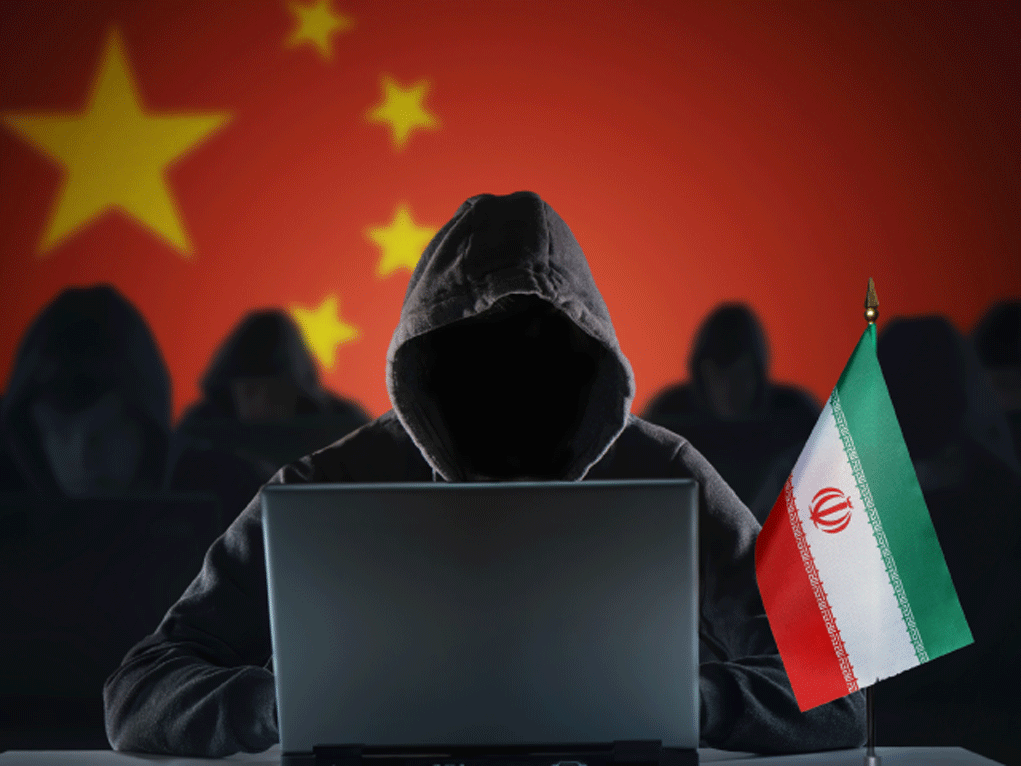
Iran’s recent declaration that it intends to expand its ballistic missile arsenal has triggered renewed scrutiny of China’s role in advancing Tehran’s ambitions and in flouting international sanctions, as Beijing funnels billions of dollars to Iran each month for oil.
China has been caught covertly supplying Tehran with ammonium perchlorate, a key ingredient needed for missile production, which the regime has said will target Israel. Some of Iran’s newest missiles are reportedly capable of reaching all American military bases in the Middle East and beyond.
Both Iran and China seek to counter American influence in the Middle East and have long cooperated to further that shared goal. Both countries regularly team up with Russia to conduct joint naval exercises in a display of military coordination and to boost Beijing’s maritime profile in the region.
Their collaboration goes back decades. It was cemented in 2021 with a 25-year cooperation agreement, expanding energy and trade ties and reinforcing joint opposition to Western initiatives.
At least one of the missile systems Tehran used to target U.S. forces in Iraq in 2020 included technology from this long-term partnership with China, according to the Foundation for Defense of Democracies (FDD).
In the spring of 2023, Iranian officials negotiated in Beijing and Moscow to replenish Tehran’s stores of ammonium perchlorate, a precursor for ballistic missile solid propellant. Not long after these negotiations, U.S. intelligence reported that two Iranian cargo vessels sailed from China in January 2025, carrying more than 1,000 tons of perchlorate. They were followed in early June by additional shipments carrying ballistic missile propellant ingredients from China to Iran, the Wall Street Journal reported.
The Treasury Department has sanctioned businesses in China and Iran that are known to have a role in the procurement of ammonium perchlorate, as well as in the acquisition of components needed to produce unmanned drones. The sanctions, however, have reportedly had little impact on production.
Facial and Emotional Detection Technology
Beijing also provides components for Iran’s missile propulsion and guidance systems, along with technology, drone components, air defense systems, and military hardware.
In addition, Chinese companies, such as Tiandy and Hikvision, have provided the technology needed for widespread surveillance in Iranian cities, including facial and emotion detection technology that the mullahs have employed in their current brutal crackdown on Iranian protesters.
Using Chinese-made technology, military police and IRGC thugs have been rounding up thousands of protesters and hunting down suspects in hospitals and in their homes.
Beijing has also assisted in developing Iran’s benign-sounding “National Information Network,” a tool that helps a regime control, throttle, or shut down the internet to stifle protest coordination and to thwart all connectivity with the rest of the world.
“The future is uncertain, but as the protests slow under the weight of brutal repression, it seems questionable that the Islamic Republic will fall in the short term,” writes The Diplomat. “If the regime does survive, it will be in no small part due to the surveillance technology and tools of oppression shared between the Chinese and Iranian governments.”
“From this perspective,” the writer argues, “China is by no means a bit player in the current crisis, but rather a major one whose influence is felt behind the scenes.”
Systematic Stealing of Western Technology
China has perfected its systematic theft of Western technology, especially concerning weapons and military secrets, along with aggressive economic policies aimed at securing global dominance for Beijing.
One strategy is through computer hacking, where hackers break into systems at defense companies, government offices, universities, and tech businesses to steal plans, computer codes, and information about weapons.
Another way is by coercing people on the inside—such as Chinese workers or researchers—to disclose classified knowledge they are not supposed to share.
Key methods used by China to obtain restricted or classified information include having officials pose as recruiters or headhunters on professional networking sites (e.g., LinkedIn) to identify and target U.S. service members and individuals with security clearances. The “headhunters” offer generous “consulting” fees for providing, sensitive information.
Another approach involves talent plans and scholarships, whereby Chinese intelligence agencies recruit individuals from U.S. universities, labs, and businesses to transfer technology, particularly in fields like artificial intelligence, quantum computing, and biotechnology.
Chinese citizens in the U.S. may be coerced into cooperating with intelligence agencies under threat of punishment for themselves or their family members remaining in China.
China also uses business and legal pressure to get technology without openly stealing it. For example, companies may be forced to share their technology in order to do business, or Chinese companies may buy parts of foreign businesses to gain access to important ideas and tools.
In some countries, the rules for protecting technology are weaker, which makes it easier for sensitive U.S. technology to pass through partnerships or shared projects. Together, these methods enable Beijing to accelerate its military modernization while eroding America’s technological and strategic advantage.
US Allies Kowtowing to China
Europe is desperately looking to China to achieve elusive goals of trade and security, a Fox News op-ed by Chinese expert Gordon Chang argued. With a mindset geared toward appeasement, “European leaders are determined to placate the Chinese, no matter what Beijing does to impoverish Europeans and endanger their homelands.”
Despite the danger of enabling Beijing to gain a major foothold in global industries and cutting-edge military technology, several U.S. allies, notably Canada, France, Britain and Germany, have been reopening ties with China.
Leaders of these countries are choosing the economic benefit of expanded trade over the ominous long-term danger of these moves.
The recent steps toward recalibration follows years of estrangement from Beijing, largely due to its abysmal human rights record, and to the fear of its predatory policies toward competitors.
Canada was the first to seek a rapprochement, drawing a sharp rebuke from President Trump, who threatened to impose “100 percent tariffs” on Canadian goods if Prime Minister Mark Carney “makes a deal” with China, Fox News reported.
In the same vein, Trump called British Prime Minister Starmer’s meeting last week with Chinese President Xi Jinping, in which trade agreements were signed, a “dangerous move.” He alluded to grave security concerns and the fact that China historically breaks agreements when expedient.
Starmer’s attempt at warming relations with China also drew fire from some British officials who said they “took no comfort” from watching the prime minister “bow” to Xi, warning that the UK was trading away its national security and human rights values for economic gain.
“US allies are drawing closer to China, but on Beijing’s terms,” wrote the New York Times. The article notes that among the trade agreements signed with China is Britain’s decision to allow a major Chinese automobile company to establish a European headquarters in Liverpool, and a toy company to open seven stores in the UK.
The visit with Xi, with its lackluster results for Britain, “highlights the severe limits of any pivot to China,” observed France-based economist Alicia Garcia-Herrero, quoted by Reuters. “The trade deals with Beijing expose timid Western leaders chasing scraps, while China’s export flood overwhelms their industries.”
“Like other needy Western leaders seeking rapprochement with Iran,” wrote the Guardian, Britain’s prime minister did not dwell on awkward subjects such as human rights abuses, Chinese spying and Taiwan. But in talks with President Xi Jinping, one vital issue was avoided altogether—and should not have been: China’s dangerous, unexplained, secretive and rapid buildup of nuclear weapons.”
Critics note that the shift toward China comes with other real dangers. China is not just another place for Europe to sell its products; it is a powerful competitor that can swiftly outstrip Europe’s factories and technological industries, fueling Beijing’s quest for world dominance.
In addition, closer ties with China have enabled the stealing of American technology, inventions, and important military secrets, which jeopardize U.S. security. Chinese firms have a well-documented practice of using joint enterprises to demand technology transfers from systems, some of which originated in the United States.
What Washington sees as a long-term, high-impact threat, some allies instead cast as life-or-death economic necessity, choosing short-term relief over an even more dangerous future.
***
How Beijing Stalks Chinese Dissidents in the U.S.
Beijing is not content to employ repressive policies across its own territory, but actually maintains a sophisticated, multi-pronged strategy of “trans-border repression,” aimed at stalking, harassing, and intimidating Chinese dissidents residing in the United States.
One prong of this operation involves Chinese agents tracking critics and dissidents, using GPS devices, taking photos, and monitoring their homes and workplaces. These operations seek to silence dissent and force the return of individuals deemed threats to the Chinese Communist Party (CCP), where they can be prosecuted.
Another branch of the stalking operation consists of illegal, unofficial “police service stations” in American cities to monitor, harass, and pressure Chinese nationals to return home.
A primary tactic involves threatening, detaining, or harassing dissidents’ family members still living in China, to force the U.S.-based family member to halt their criticism of the regime and pro-democracy activism or return to China for prosecution.
In addition, Chinese regime agents use a wide range of computer malware and spyware attacks to compromise the devices of activists, particularly targeting Uyghurs, Tibetans, and Hong Kong pro-democracy activists.
Lastly, thousands of fake accounts are used to troll, harass, and intimidate dissidents, often spreading disinformation to damage their reputation.
In response, the U.S. Department of Justice (DOJ) has charged numerous Chinese agents caught harassing Chinese individuals residing in the United States with acting as illegal agents of the Chinese government, and engaging in interstate harassment, a federal crime.
Holding Family Members Hostage
In 2015, the Obama administration discovered that Chinese agents, as part of “Operation Fox Hunt,” were tracking down Chinese dissidents in the United States to pressure them to return to China to stand trial, according to a report in the Guardian. Obama protested to Beijing, demanding that the Chinese agents be withdrawn from the country, or face arrest.
In October 2020, former FBI Director Christopher Wray told lawmakers that “when the regime couldn’t locate a Fox Hunt person in the United States, the Chinese government sent an emissary to visit the victim’s family here. And the message they said to pass on? The person in question had two options: Return to China promptly or commit suicide.”
And what happens when Fox Hunt “targets,” knowing the fate in store for them, refuse to return to China? Their family members, both here in the United States and in China, are subjected to intimidation. Those back in China are often arrested as a pressure tactic to coerce the person being stalked to return to China, said Wray.
In July 2021, ProPublica reported that Operation Fox Hunt, purportedly focused on economic crimes, was actually targeting Beijing’s critics: “Tibetans, Hong Kongers, followers of the Falun Gong religious movement and, perhaps most visibly, the Uyghurs.”
ProPublica reported that a team of Chinese Communist Party (CCP) operatives and police based in Wuhan had been roaming the United States pressuring Chinese immigrant communities, with the spies stalking their victims in plain sight.
Professional Stalking Agents
A few court-documented examples, based on FBI documents, turn the spotlight on the methods used by professional CCP stalking agents against Chinese citizens living in the United States, who offended the Chinese regime in some way.
In one case heard by a New Jersey judge, a former Chinese official living in the United States was sued by the China-based Xinba Construction Group. The individual was harassed outside of court and received notes threatening his family. Later, he received a video from his family in China, presumably coerced by the Chinese regime, imploring him to return.
In another case, CCP security officials entered the United States in 2017 posing as cultural officials. During the visit, the officials made an attempt to persuade Chinese dissident Guo Wengui to return to China in order to face charges for prosecution. Guo Wengui attended the meeting with the “diplomats,” but recorded the conversations and alerted the FBI.
The Chinese officials were subsequently confronted by FBI agents in Pennsylvania Station, where the imposters initially insisted they were “cultural affairs diplomats” but ultimately admitted to being security officials. They were given a warning for their activities in New York and ordered to return to China.
Two days later, the officials again visited the apartment of Guo Wengui prior to leaving the country. Afterward, Wengui walked them out of the building, again declining their offer of clemency in exchange for not disclosing to anyone the officials’ brazen charade as “diplomats.”
The FBI was aware of the second visit, and agents were prepared to arrest the Chinese security officials at JFK Airport prior to their Air China flight, on charges of visa fraud and extortion.
Following pressure from the State Department to avoid a diplomatic crisis, however, the FBI did not make arrests. Agents merely confiscated the Chinese officials’ phones before the plane took off.
***
Stop China from Stealing Our Military Secrets
“The American people have paid too little attention to how easily the Chinese Communist Party can access sensitive information here, often because we fail to enforce our own rules governing electronic devices inside secure facilities,” former Chief of Staff to the Trump National Security Council Fred Fleitz writes in a Fox News op-ed.
The article underscores how, in just a few decades, China has built the second-largest economy in the world, and is using that economic power to fund a military buildup that is more sophisticated than anything the world has seen before.
“China’s rise has not come from innovation alone,” the author maintains. “Both economically and militarily, it has been built on the systematic theft of U.S. commercial and defense secrets.”
The article goes on to detail how much easier it is for a country to bypass the complex, expensive and time-consuming process of building technology and production systems from scratch, and instead, just “borrow” the intellectual property already designed by others.
“That is what China has done for decades, and its ability to do so has only increased over the last ten years with digital technology, especially cell phones,” the article explains.
Espionage once centered on stealing documents. Today it involves the theft of massive files, complete weapons manuals, and thousands of photographs of U.S. military equipment in use on American bases and ships. Instead of starting from square one, China, with stolen designs and technology, can jump directly to production.
“In 2025 alone, there were at least ten public cases of individuals charged or convicted of spying for China using their cell phones,” the writer attests. “Those cases are only the tip of the iceberg. Many more are resolved quietly when classified material is involved, to avoid exposing sensitive information in open court.”
According to retired CIA executive Rodney Alto, the majority of national intelligence facilities that prohibit electronic devices lack any mechanism to detect them. This helps explain how China has been able to catch up so quickly to America’s military superiority. As the US military develops new weapons and defense systems, China learns from stolen copies of this country’s work and races to even the gap.
“This must be corrected — and now,” the writer argues, going on to explain that the United States is preparing the largest buildup of military intellectual property in history, including hypersonic weapons, revolutionary new submarines, and other programs “that rely on technologies that do not yet exist.”
“That gives us a rare opportunity to protect these secrets before they are created, and before they can be stolen,” the article underscores. “We know extraordinary technologies are coming. Now is the time to enforce a government-wide ban on unauthorized electronic devices in sensitive facilities, backed by mandatory detection systems, real penalties for violations, and sustained oversight by Congress.”
“It’s the only way to make sure we don’t continue to build China’s blueprints for them.”