
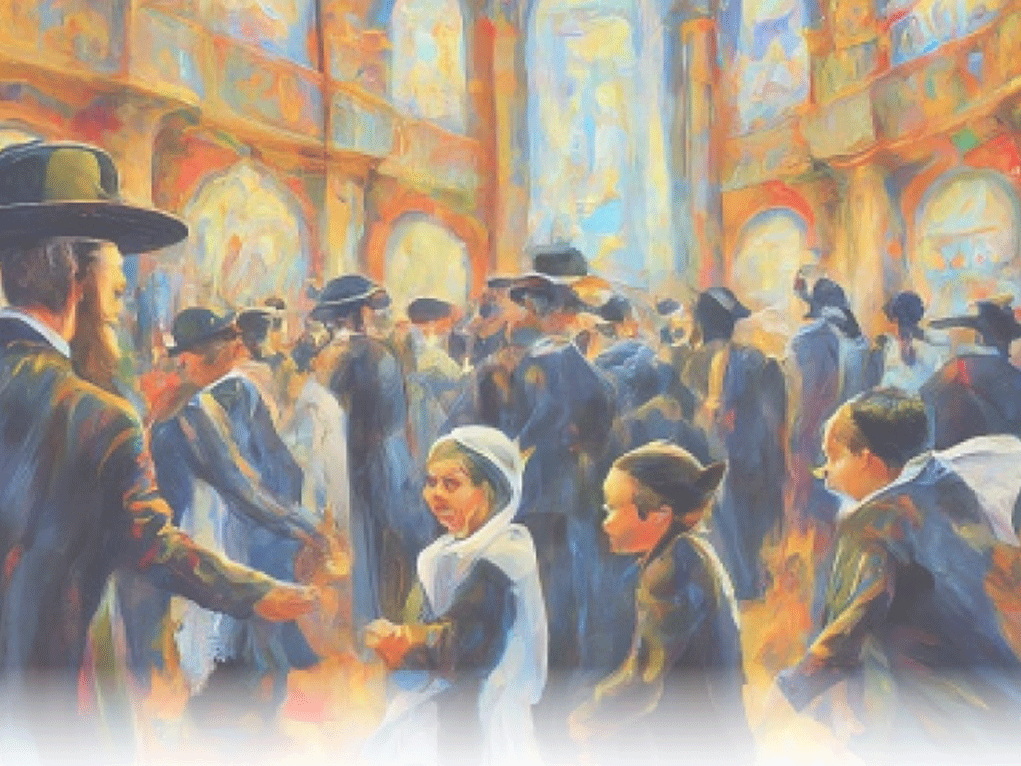

There is a conversation taking place in the frum world that is not quite a machlokes, but it is also nottotally insignificant. I’m not sure what to call it. I’m not sure if you can call it a conversation. It’s more like an animation. And I am not sure if the argument is being debated in botei medrash with mareh mekomos. I doubt it highly. Instead, the quite fascinating divergent views in hashkafah are being played out in a different medium, and through a different medium.
The machlokes seems to be manifesting in song versus song, video versus video. Text vs. text. Instead of the fiery shmuessen we baby boomers were used to and the kol korehs plastered on pashkevilin throughout the streets, this argument seems to be played out with animated mentchees flying on carpets and eating bilkilach.
I really don’t want to get into the argument or voice an opinion on it. I don’t have the weight, even with this column in the Yated, to have an impact, and I don’t really feel comfortable entering the fray (if you can call it that).
I remember being in my grandfather’s home when someone came to visit him in need of advice. He discussed an inyan regarding which he wanted to make a statement that would eventually go public. My zaide advised him, “You may be right, but this is not the type of thing that is worth having your windows broken for it.”
We live in a generation in which we are seeing tremendous strife, especially in Eretz Yisroel. Although not from a clear source, the words “Worth giving your life over it” have been either stated by reliable sources or bandied about by misquoters.
I don’t think that the mentchees on the two sides of the aforementioned argument are up to the “yeihareig v’al yaavor” stage of declarations or of fighting, because so far, they have relegated their battle to cartoon characters.
But it does not mean that the philosophical disagreements are necessarily kinderish. In today’s day and age, people are using the medium that talks to a generation that absconded the 1,000-page novel to comic book sketches and the stick line charts to explain complicated cases in Yevamos to animated chosson and kallahs, brothers and sisters jumping off a screen and dancing at weddings. And I’m not knocking it. As someone involved in elementary school education, I see that you have to talk the language of the generation. Otherwise, your point may not be understood.
In the past, Yiddishkeit never needed slogans, but there were always catchphrases and aphorisms that embodied the “klal gadol baTorah.”
I think that both sides are sincere and are talking to the crowds with whom they are familiar.
There is a classic vort said in the name of almost every rebbe and rosh yeshiva who have delved into machsheves Yisroel. I have heard it in the name of Rav Yitzchok Hutner, the Sefas Emes, and the Belzer Rebbe, among others. It illuminates the stark difference between the unity of the Egyptians chasing the Yidden into the Yam Suf and that of the Yidden standing at Har Sinai.
When Klal Yisroel lifted their eyes and saw the Egyptians racing after them, the posuk says, “Vehinei Mitzrayim nosei’a achareihem.” Rashi famously notes that nosei’a is singular. Not nosim. The Egyptians were advancing as one.
And Rashi explains: They were united b’lev echad k’ish echad — with one heart, like one person.
Later, in Parshas Yisro, when Klal Yisroel arrives at Har Sinai, the Torah again uses the singular: “Vayichan shom Yisroel neged hahar.” And again Rashi comments: k’ish echad b’lev echad — like one person, with one heart.
The phrases sound nearly identical. But all the aforementioned baalei machshavah famously point out that the stark difference lies in the order of the words.
Regarding the Egyptians, the lev echad comes first. The shared emotion to attack. The common cause of hatred, revenge, momentum and reclaiming lost slaves united them. That lev echad produces a temporary ish echad. Take away the mission and the unity evaporates.
Regarding Klal Yisroel, the order is reversed. We are k’ish echad first. One organism. One body. Only afterward comes b’lev echad, shared direction, shared focus, shared language.
That distinction could not be more relevant.
Because when unity depends solely on a shared emotional portfolio or shared vocabulary of slogans and mantras and chanting in the streets, it is counterfeit. When the cause shifts, the unity cracks. The commitment dissipates and the unified Egyptian forces split into individual horses and riders catapulted into the raging waters of the Yam Suf.
Klal Yisroel is not built that way. We are inherently one nation. We may have our divides, but we are in essence a single unit. Raging battles of a few hundred years ago, fights we thought would never end, have dissipated into a dance of unity.
I don’t have to explain when we see with our own eyes how what once was thought of as eternal divergence has come together in an amazing harmony. Are there differences? Of course, but the briach hatichon of Toras Hashem and the search for connection to the Borei Olam are inherently there forever.
The Yid who serves Hashem quietly, without slogans, without public articulation, without emotional display, without a bumper sticker declaring his allegiance to either the Daf or his unending love and gratitude of Hashem, is not missing a component of Yiddishkeit.
A Yid who embellishes his service to Hashem with song, gratitude, and verbal expression that borders on public displays is not trying to import something foreign. He has different ways to express himself. And although I was raised and nurtured in the world of the supremacy of limud haTorah as the ultimate method of avodas Hashem and the way to become close to Him, I most certainly cannot get into the mindset and motivation and ultimate value proposition of those whose rabbeim have guided them on a different path.
And the little mentchees who may fight it out on the animated playground of artificial intelligence remain as an artificial battle.
Because, in essence, we are one.
A body does not require uniform sensation to remain whole. The heart pounds during exertion. It slows during rest. The hands work. The eyes observe. The spine holds everything upright. None of them accuses the other of being insufficiently alive.
The Torah did not require Klal Yisroel to feel the same way at Sinai. Each shevet encamped separately. Each neshomah stood where it stood. What was required was presence — belonging, k’ish echad.
And that is the point that gets lost in our current conversation.
The moment one style becomes the benchmark, we invert the order. We turn b’lev echad into the prerequisite for k’ish echad. And that is not Jewish unity. That is Egyptian unity.
Har Sinai did not demand a shared tone. It demanded a unified standing.
Perhaps that is the reminder we need now. Not to resolve the conversation, not to pick a winner, not to canonize one derech and retire another. Just to restore the order.
We are one people first. The slogans need not synchronize.
And if we remember that, the conversation can remain what it should be: a conversation among parts of the same body, not rival camps arguing over who owns the pulse.
The rest is just artificial — without much intelligence.
Just saying.