
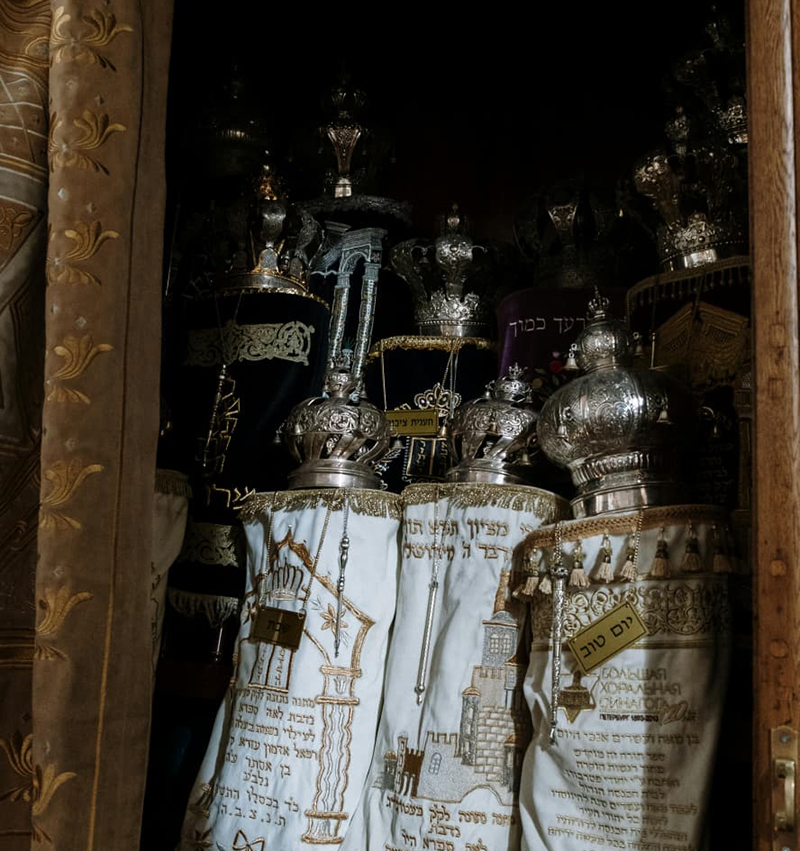

In this week’s Olam Hahalachah, Rabbi Mendel Prescott, Rosh Yeshiva of Machon Smicha and Rov of the Colony Community, examines Why We Take Out Two Sifrei Torah for Parshas Shekalim and Whether We Must.
Question: When the aron kodesh was opened for Krias HaTorah this past Shabbos, we realized that the Shekalim Sefer Torah had not been rolled; it was still at the Rosh Chodesh kriah in parshas Pinchos. What was the correct thing to do — to use the second Sefer Torah, or rather to roll the Parshas HaShavua one, currently at the end of Mishpatim?
Answer: The reason why a separate Sefer Torah is used for Shekalim is based on a Mishnah[1] that discusses the Krias HaTorah ceremony that took place in the Beis HaMikdash on Yom Kippur morning. The Kohen Gadol read Parshas Acharei Mos — just as we do — and then the Yom Kippur section in Parshas Emor. Afterwards, the Sefer Torah was rolled and wrapped. The Yom Kippur section from Parshas Pinchas (which we read as Maftir) was recited by heart.
The Gemara[2] explains that rolling the first Sefer Torah is not an option because “ein golelín Sefer Torah b’tzibur mipnei kevod hatzibur” — a Sefer Torah is not to be rolled in the presence of a tzibur out of respect for them, a rule better known as tircha d’tzibburah.
Why was there no issue for the Kohen Gadol to skip from Acharei Mos to Emor? In those days, a turgeman (translator) stood at the bimah, translating each passuk — which took several seconds. Since the rolling is only a few amudim, it could be completed while the turgeman is still speaking.[3]
For this reason, two Sifrei Torah are taken out whenever there is a special Maftir — to avoid having the tzibur wait while the Sefer Torah is rolled.
While this hold true in most cases, Parshas Shekalim, as we’ll see, may be treated differently for a practical reason: Parshas Shekalim always falls out within three parshiyos of its reading in Ki Sisa, requiring minimal rolling. (It can fall on either Mishpatim, Terumah, Vayakhel, or Pekudei – depending on the calendar).
In the late 1700’s, HaRav Nosson Adler in Frankfurt, Germany, had the practice in his Beis Midrash of taking out only one Sefer Torah for Parshas Shekalim for this reason.[4] In Yerushalayim in the 1800’s, HaRav Shmuel Salant is said to have done the same. Only when Rosh Chodesh fell on Shabbos — requiring a third kriah for Rosh Chodesh — did he instruct that three Sifrei Torah be used, since the Rosh Chodesh kriah is very far and would require significant rolling.
This idea is already mentioned by the Rishonim, such as Rabbeinu Yonasan,[5] who discusses the case of Shekalim falling on Parshas Tetzaveh (which cannot occur according to the current calendar but did occur in the times of the Gemara). He writes that one Sefer Torah suffices since no rolling is necessary.
However, that’s not a perfect comparison, because there is no rolling at all in that case, whereas from Mishpatim or even Terumah, there is still some minimal rolling. Moreover, the Gemara indicates that even minimal rolling should be avoided, as Acharei Mos to Emor (two parshiyos worth) would not be allowed if not for the turgeman’s delay.
As for Rav Nosson Adler’s practice, some argue it was not due to the minimal rolling but for another reason.[6] Rav Nosson Adler received two aliyos every Shabbos morning: as a Kohen he took the first Aliyah, and he was also consistently called up for Maftir. Getting two Aliyos is normally not an issue, if both krios come from the same Sefer Torah. But if Maftir is read form another Sefer Torah there is an issue of pegamo shel rishon – making appear as if the first Sefer Torah was invalid.[7] That is why Rav Nosson Adler used only one Sefer Torah.
Most of the Rishonim who discuss Krias Shekalim mention in passing that two Sifrei Torah are taken out for it.[8] Though, in the Tur or Mechaber we don’t find clear codification for that, as their only mention of multiple Sifrei Torah is in the context of when Shekalim coincides with Rosh Chodesh.[9] As for a regular year, they don’t address the number of Sifrei Torah at all, leaving no explicit ruling either way.
The matter seems to have remained debatable. The Orchos Rabbeinu[10] reports that at the Chazon Ish’s minyan, one Shabbos Shekalim that fell on Parshas Vayakhel, Rav Chaim Yosef Dinkels called out passionately that one Sefer Torah was sufficient. The Chazon Ish acquiesced — not to contradict Rav Dinkels publicly — though his personal opinion was always to take out two Sifrei Torah.
The question, however, remains: Why is there an issue of tircha d’tzibburah with such minimal rolling? Moreover, somewhat ironically, the time gained by avoiding the rolling — which amounts to about fifteen seconds — is offset by the hagbah–gelilah process required for the second Sefer Torah.
The Ri’tz Gei’es[11] seems to address this question and provides a rationale. He quotes a phrase from the Gemara, brought in various contexts: dilma asi l’misrach — “they may come to continue…” In other words, although there may be justification in this particular case to simply roll the Sefer Torah, if the practice of taking out two Sifrei Torah is not set as a fixed rule, people might extend that practice to other cases where rolling would indeed cause tircha d’tzibburah.
Back to your question: since the main reason for using a second Sefer Torah is to avoid extra rolling, it would be counterintuitive to take out the second Sefer Torah and spend time rolling it b’tzibur. It therefore seems more reasonable to use one Sefer and spend the fifteen seconds rolling it before Maftir—especially since it can be rolled during a mi shebeirach, causing no delay at all.
Read the answer and download the full Olam Hahalachah publication.
Sign up to receive the Olam Hahalachah each week straight to your inbox by clicking here.
[1] מסכת יומא (פרק ז משנה א)
[2] מסכת יומא (ע, א)
[3] מסכת יומא (סט, ב)
[4] ספר נחל אשכול (חלק ב עמוד סו, אות יא)
[5] הובא בנימוקי יוסף מגילה (כט, ב)
[6] ראה בספר מנהגים והליכות של רבינו נת’קע אדלער ז”ל (עמוד נו בהערות)
[7] מסכת יומא (ע, א)
[8] כגון, האבודרהם (ארבע פרשיות), מנהגי מהרי”ל (סדר ארבע פרשיות), וכל בו (סימן כ).
[9] או”ח סימן תרפה (סעיף א)
[10] חלק ג (עמוד לב, אות א)
[11] הלכות מגילה, בסופו
