
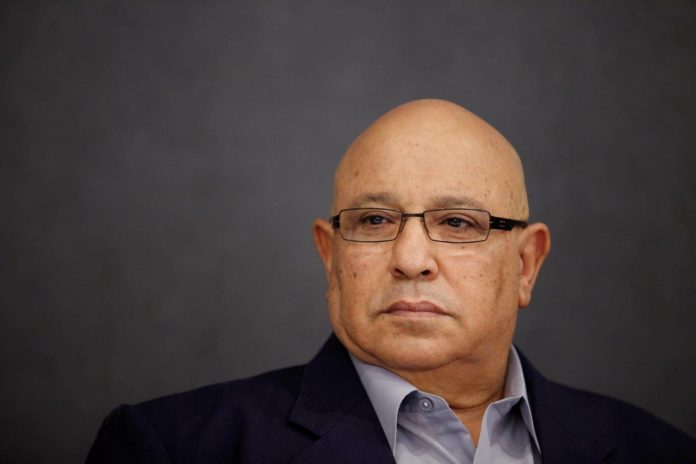

Meir Dagan, who led the Mossad from 2002 to 2011, remains one of Israel’s most influential and often controversial intelligence chiefs. Known for his audacious operations, incisive strategic thinking and unwavering commitment to Israel’s security, he shaped some of the country’s most consequential covert campaigns, from countering Hezbollah to slowing Iran’s nuclear ambitions. His tenure was marked not only by bold successes but also high-stakes gambles and occasional miscalculations.
Born in 1945 in Kherson, then part of the Soviet Union (now Ukraine), Dagan spent his early childhood in Romania before immigrating to Israel as a teenager. His family history was indelibly marked by the Holocaust; many of his relatives were murdered, including his maternal grandfather, Ber Erlich Sloshny, who was publicly executed by the Nazis in the town of Łuków. A photograph capturing his final moments hung on the wall of Dagan’s office throughout his career, serving as both a personal moral compass and a stark reminder of the dangers of anti-Semitism, a symbol of his lifelong vow that “there will be no second Holocaust.”
After surviving the war, Dagan and his parents arrived in Israel in 1950, first settling in a transit camp near Lod and later in Bat Yam, where his parents operated a small laundry. These formative experiences fostered the resilience and fearlessness that would later define his leadership.
Following his retirement—some have said dismissal—from the agency, Dagan broke with the Mossad’s tradition of silence by publicly opposing a preemptive Israeli strike on Iran’s nuclear facilities. He cautioned that such an operation could spark a disastrous regional war and strain Israel’s vital alliance with the United States. His outspoken stance drew criticism from those who accused him of breaching norms of secrecy. But Dagan consistently argued for patience and measured decision making over impulsive military action.
In 2012, at the age of 67, Dagan was diagnosed with a life-threatening liver disease requiring a transplant. Because of age restrictions, the procedure could not be performed in Israel, prompting him to undergo surgery in Minsk, Belarus. During this difficult period he formed a close relationship with Rabbi Meilech Firer, whose guidance and support proved invaluable. After his recovery, Dagan expressed deep gratitude to Rabbi Firer and later assisted him in fundraising for a new rehabilitation center.
Despite his health challenges, Dagan remained an active and influential voice in public debates on Israel’s national security. In the following interview, Samuel Katz—author of The Architect of Espionage: The Man Who Built Israel’s Mossad into the World’s Boldest Intelligence Force—discusses Dagan’s worldview, his operational record and how history may judge him, especially in light of the October 7 massacre and Israel’s subsequent operations against Iran’s nuclear program.
I find it interesting that anyone can still regard Meir Dagan as an important intelligence figure after Israel’s attack on Iran. He was so adamant in his opposition to such action, predicting all kinds of terrible outcomes that didn’t come to pass. In that sense, history has proven him wrong. Has your understanding of Dagan changed in light of that?
No, not at all. I think it’s impossible to compare Meir Dagan’s warning about attacking Iran in 2009 to the facts on the ground in 2025. For Israel, it was a completely different universe not only with regard to capabilities but in terms of having a friend in the White House. President Obama was not a friend of Israel or Netanyahu, and Israel didn’t possess the necessary military might or intelligence—both in the view of the IDF assessment and in the eyes of Meir Dagan—to ensure that the attack would be successful. Back in 2009, Israel didn’t possess the F-35 fighter bomber, the air refueling capabilities or the remote tactics, and it had yet to build a vast network of intelligence assets to bring it the level that existed in 2025.
If my recollection is correct, most of his caution wasn’t based on doubts about Israel’s capabilities but on concerns about the potential repercussions of a counterattack from Iran. He was predicting worst-case scenarios. Fortunately, doomsday didn’t occur.
I don’t think he was worried about doomsday; I think he was worried about entering a war in which Israel wouldn’t have the strategic backing of the United States. One of the things Meir Dagan understood better than most was that Israel’s greatest strategic asset is its military and technological alliance with America. In 2009 and 2010, that was being severely tested.
We must also give credit where credit is due, namely his devotion to combating the Iranian threat.
Undoubtedly. When he was in command of the South Lebanon area, he led the first skirmishes of what would become the much wider war with Iran via Hezbollah. Later, as head of the Mossad, he was pitted against them and greatly enhanced Israel’s covert efforts. Intelligence gathering, the establishment of networks and assets in a country with allies from various ethnic groups isn’t something you can do overnight. In many cases it takes a long time. But I also think that the efforts of both Israel’s Military Intelligence and the Mossad that were invested in Iran and Hezbollah were so profound that in some cases the concern over threats nearer to home weren’t given the attention they warranted.
It’s interesting that he viewed Iran as a rational enemy. Do you think he truly understood the Iranian regime?
I think you’re focusing on words rather than actions, which is a mistake. The leadership in Iran may preach the end of the world, but the people in the Islamic Revolutionary Guard Corps and the elements that keep the powers that be in power don’t want to relinquish their hold, nor do they want to give up the wealth they have amassed. In that sense they are rational, but they haven’t been successful in the way they exercise the power of their proxies.
Why do you consider Dagan such an important figure? Is it for his ability to gather intelligence or for the way he executed operations based on it?
I’ll tell you why. He was born from the ashes of the Holocaust; his parents had survived the Nazi invasion of Poland and most of his family was murdered. One of the things that drew me to him was the fact that they built an adopted family of other people who had also been subjected to the horrors of Europe. He was shaped by these things as a child.
He had also seen the victory of the Six-Day War and experienced the shock and surprise of the Yom Kippur War. As he once said in an interview, his entire generation of soldiers was betrayed by the decision makers. In that latter war, some 2,500 Israeli soldiers were killed over the course of 18 days. It’s also important to mention that when he was an armored brigade commander moving on Beirut in 1982, the horror of losing so many of his junior officers had a profound impact on him. He developed a unique talent for using capable individuals with very specific skillsets that could save lives in selective operations and prevent massive casualties. That’s why his approach was to avoid being foolhardy. If something was going to be done, there had to be a guarantee of success.
We need to assess Dagan in light of the October 7 massacre, as it changed Israel’s perspective on how to engage its enemies.
October 7 wasn’t a “massacre.” It has been incorrectly described on social media and in political discourse as an attack. But it wasn’t an attack; it was a full-fledged conventional invasion in which 22 communities and locations were captured. It was meant to hold territory, it was meant to start a larger Middle East war, and it was meant to redefine the Middle East with Israel desperate at the beginning of the American presidential cycle.
One of Meir Dagan’s special projects was the financial warfare intelligence unit that in Hebrew was known as Tziltzal and in English as Harpoon. He understood all along that money is the oxygen that drives terror. When the Israelis made the decision to allow Qatari and other money to go into Gaza so Hamas would want a better future for its people instead of warfare, it was a very Western approach. Only Westerners think that the most important driving force is to live the American dream. But Dagan understood that for all its Western European lifestyle, Israel is located in the Middle East, and you can’t apply Western standards to people who have made it very clear that they want to eliminate you. The Tziltzal unit was disbanded in 2017, after Dagan passed away. I think that many of the things that happened between his death and October 7 would have horrified him.
Please define those things that would have been reprehensible to him.
One of his most important contributions was that the Israelis traditionally firewalled all their information and handed it out very carefully. The intelligence world is a partnership of allies and sometimes adversaries. The Israeli intelligence services talk to nations and services with whom they don’t maintain diplomatic relations. Intelligence chiefs and officers are emissaries. One of the things Dagan believed was that intelligence that wasn’t being used was a waste of resources and of the effort to obtain it. It was wasted if it was sitting somewhere in a computer or file cabinet. He shared intelligence that could be actionable with his partners in the friendly world—the US and the West—and he also shared information with other partners who could help bring about greater security for Israel.
To read more, subscribe to Ami

