
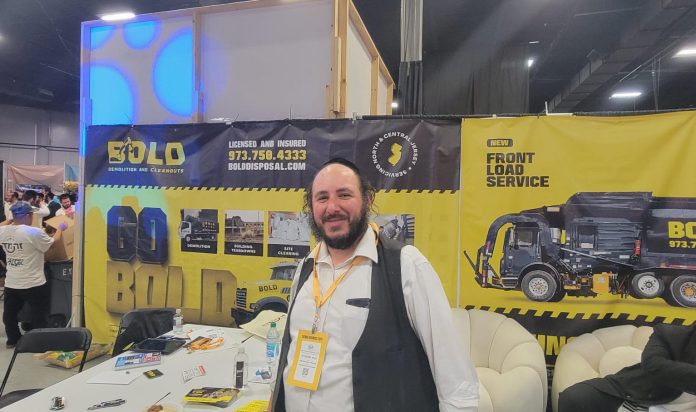

At last year’s Orthodox Jewish Builders Association Expo, run by Meilech Webber, I conducted mini Lunchbreak interviews with several of the entrepreneurs who exhibited at the show. Those short chats were fun but left me wanting to hear more. One exhibitor I was happy to reconnect with was Isac (Beri) Wollner, founder of Bold Disposal and Demolition.
What impressed me most in our first quick talk was Beri’s happy demeanor and stress-free attitude, even in difficult situations. Beri had grown a company from scratch and was doing very well, until the market changed drastically. Forced to let all his employees go, Beri was left with just a single dump truck and a mountain of debt. Yet, with determination and creativity, not only was Beri able to recover but he established something even more successful.
Today, Bold Disposal and Demolition services the entire tristate area, focused on the real estate, warehousing and manufacturing market for cleanouts, gut jobs, demolitions, dumpster rentals and innovative construction or renovation solutions.
Beri talked about getting through tough times, developing his current business and what he learned along the way.
Enjoy!
—Nesanel
I grew up in Williamsburg, the second of eight children. We were comfortable but not wealthy. My father started out working for S&W, the clothing store in Manhattan. Then, with a few partners, he bought out a chain of gas stations and ran that for a few years. After that, he bought Sharmash Bus Company—with routes between Brooklyn, Kiryas Yoel and the Catskills—from his uncle. Ten years later he sold it to the Monroe Bus Company, which also doesn’t exist anymore, and started a new company called Vamoose, whose buses run from Manhattan to the Washington, DC, area. It’s still going, after 20 years.
“Vamoose started out as a cheap service, with its customers mostly from New York City. But after five years, my father realized that the cheap model wasn’t sustainable long term, so he redesigned it as a high-end service. In addition to regular coach buses, he also offers premium, business class coaches that seat only 34 passengers in a space built for 56. It has its own bus stop on Seventh Avenue and 31st Street in Manhattan. He has contracts with the Pentagon and the White House for their employees to travel back and forth to New York. During Hillary Clinton’s presidential campaign, her team contracted with Vamoose.
“I went to Satmar throughout my entire childhood. As a bachur, I was often involved in organizing and overseeing different initiatives. When the yeshivah had an event, I was the one coordinating it. I headed fundraisers for friends who didn’t have the means. I learned that from my parents, who are natural askanim. When a cousin from Eretz Yisrael reached out because his wife was sick, our family became very involved in helping them.
“After yeshivah, I joined my father at Vamoose and became his partner in growing the company. They were only running between New York and the DC area, and I wanted to expand to Boston as well. We applied for the operating licenses and thought that everything had been processed and approved. Evidently, there was some misunderstanding. On the first day of the new route, we got a call from the Boston Globe saying, ‘We hear you’re running a company in Boston without a license.’ That was a surprise, because I had the license in my hand! I have no idea how the paper found out about it or why they felt it was of interest to readers, but there was a large writeup about it the next day.
“Whatever their intention was, the article was tremendously beneficial to us—it was essentially very effective free advertising! We received hundreds of reservations. No one cared whether we had a license; they just cared that there was a bus going where they needed to go. Vamoose nearly doubled in size the week the article came out. But the venture didn’t have a happy ending. We had received permission from the local municipality and the city, but we hadn’t realized a state-level license was also required. They agreed to let us continue operating for a few weeks on the condition that we stop taking new reservations during that time and reapply for the remaining license.”
“The yad Hashem in the process was evident, though. In order to get a state license, you had to own a bus, but my father leased all his buses. We signed a contract with the owner of the leasing company, a Russian Jew who spoke a good Yiddish, stating that he would be our sole provider for the buses and the license would be granted under his name.
“It took us over a year to finally get the license. At our first meeting with our new partner, he said, ‘The license is in my name. I’ll give you 10% of the profits.’ The contract clearly stated that we would share the income, but he stood by his paltry offer.
“My father decided to just walk away from the whole thing. On our way out, my father said, ‘Hatzlachah rabbah.’ Our now ex-partner replied, ‘You don’t really wish me luck, you wish that my bus would overturn on the highway.’
“Sadly, two weeks later, on a Motzaei Shabbos, that’s exactly what happened. One of our ex-partner’s buses had taken a different route on I-95 and overturned. Fifteen people were killed. If the company had been in our name, we would have been blamed for the accident. The whole business was shut down by the federal Department of Transportation.
“Eventually I went out on my own. From 2009 until 2015, I managed a school in Boro Park. The foreclosure industry was becoming very popular at that time. The banks were getting a lot of houses that had gone into foreclosure, and they needed people to maintain them until they were sold. They would often want some small renovations to be done as well. I started a company to do these maintenance and repair jobs—things like changing the locks, cleaning the properties and fixing the plumbing.
To read more, subscribe to Ami

