
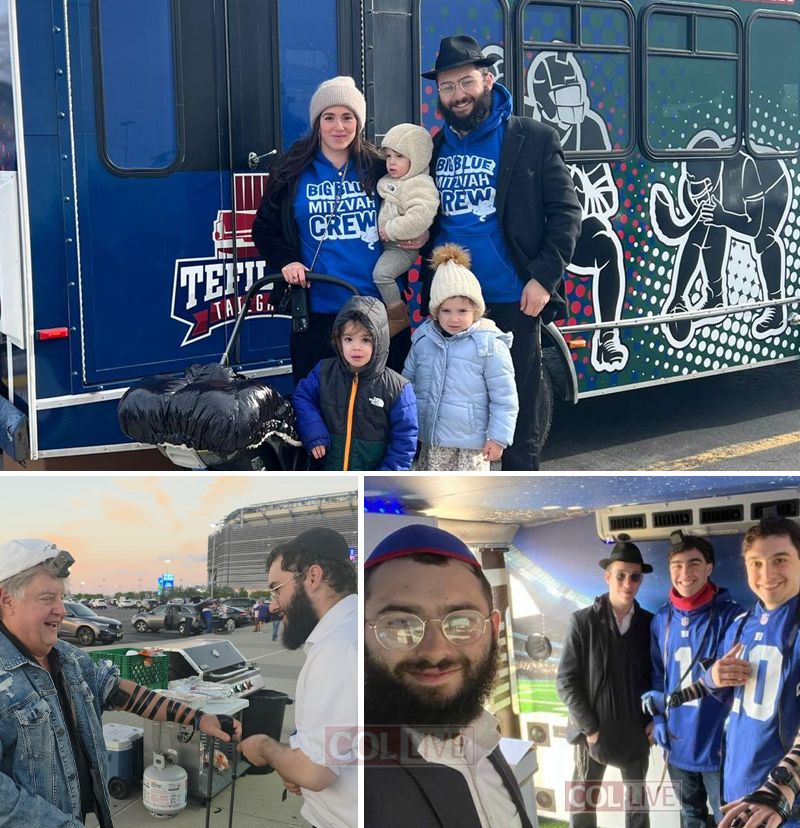

Rabbi Ephraim and Shprintza Balter, Chabad of the Meadowlands, NJ
While the weekly tailgate parties at MetLife Stadium consume much of our focus during the football season, we’re busy year-round with various other projects as well.
At the southern edge of the Meadowlands is one of New Jersey’s remaining county jails, which houses both local and federal inmates, as they make their way though the justice systems and corrections process. I visit at least once a week to meet with and assist the Jewish inmates.
Pinny* had been jailed for a few months already, awaiting his trial and sentencing. He came from a Torah-observant home, but the jail was only able to accommodate his religious needs to a certain extent. He relied on me for tefillin, books, and, of course, words of chizuk.
It was a long summer Wednesday, my usual jail visit day, but a few other pressing matters came up, and I missed my chance. By the time I returned home, it was dinner and bedtime for my children. When they’d all been successfully put to bed, I realized the long summer day made it possible for Pinny to put on tefillin that day!
I quickly drove to the jail and practically ran to Pinny, beating shkiyah by a small margin. As Pinny wrapped the black straps around his arms and said Shema, I noticed another inmate watching us. I recognized him due to his intimidating and imposing stature. He’d been in the same tier as Pinny for some months, but had never paid me any mind during my visits. But today, his continued stares made me apprehensive.
Finally, he ambled over. “It’s a bit late for that, no?” he asked. “Isn’t that supposed to be done before sundown?”
While my mind tried computing how he would possibly know such a niche halachah, I answered his question, explaining that sundown was still a few minutes away.
“What was that all about?” I asked Pinny, quietly, as he removed the tefillin with a reverent kiss.
“I think his grandmother was Jewish,” Pinny replied. “I’m not exactly sure what his story is.”
That was enough to intrigue me. I searched out Ernesto* and asked him about himself.
“My Grandma was Israeli,” he told me. “She was real upset when my mother joined up with my father – a non-Jewish Puerto Rican man. She kicked my mother out, but eventually, she let us back in to live with her. We weren’t religious or anything, but my grandma lived near a bunch of Jews, so I kinda got some of the rules and lingo down.”
Ernesto favored his father, and while the jail administrators would defer to me in allowing him religious privileges, I knew I had to do my due diligence in verifying his story. Unfortunately, honesty isn’t considered a high virtue in these institutions, and inmates are known to make up all kinds of “Bubbe Maises.” I found his maternal grandmother’s gravestone, right in the heart of a Jewish cemetery. His story checked out.
“If your maternal grandmother is Jewish, so are you!” I told Ernesto on my next visit.
His face lit up. “I’d love to learn more about what that means,” he said. A shadow crossed over his face. “I’ll have plenty of time to do nothing but. I just took a plea-deal for at least a 10-year sentence.”
I connected Ernesto with organizations and resources that could help. He began learning to read Hebrew, and devoured online articles about everything Jewish. He keeps a picture of the Rebbe in his cell, and hopes his newfound faith will help him through the tough times ahead.
——————-
Tailgating is an unusual – but incredibly important – way of doing shlichus. I take my inspiration from the Rebbe, who introduced the concept of “Mitzvah Tanks,” mobile centers that met Jews where they were and brought Yiddishkeit to them on the streets, rather than waiting for them to visit a synagogue. For many, our tailgate party is the only interaction with Yiddishkeit they have all year.
We started off slowly at first, but one year, we decided to host a tailgate party at every single game. But one Sunday, I was debating whether or not to set up my usual party. It was a night game, so the action wouldn’t start until 8:00 PM. On those cold winter days, shkiyah came at 4:30. Fans wouldn’t arrive before 3:00 at the earliest, so there wouldn’t be much time to do mivtzoyim before shkiyah. But I knew they were expecting me, so I packed everything up, rounded up some bochurim, and made the drive from Brooklyn to New Jersey.
It was a race against time, as the bochurim and I wrapped as many tefillins as we could before the sun set. Once it grew dark, the frenzy stopped. We sat around the campfire, warming our frozen hands against the flames. The game wouldn’t start for hours, so we had plenty of time to sit, eat, and chat. There were a bunch of football fans who joined us on those folding chairs, and it soon turned into a bonafide farbrengen.
Jason* told us he’d decided to never again step foot in a synagogue after having some bad experiences.
“This is the only ‘synagogue’ where I feel welcome and comfortable,” he told us.
We continued farbrenging about Yiddishkeit and its pertinence to and meaning in our lives. I could see how thoughtful Jason was, and how deeply the farbrengen affected him.
Jason may have decided he’d never go to shul again, but, baruch Hashem, we were able to bring the shul to him! It proved just how impactful our presence was. Although many of our interactions lasted only moments, this gave us the opportunity for a greater, deeper connection.
—————–
Boruch* was a young man who’d grown up in a traditional Chassidish home. He never fit into the typical mold, and had rambunctious energy that made his teachers and parents throw up their hands in despair.
Boruch belonged to a texting chain called “Daily Tefillin Selfies.” Every member of the group committed to putting on tefillin every day, and encouraged each other by posting their daily selfie with the black boxes and leather straps.
One day, Boruch was with a group of friends, exploring American Dream Mall, when he realized he hadn’t put on tefillin that morning.
Boruch turned to the internet, tagging Chabad in his post, asking Are there any tefillin in American Dream?
That inspired a sponsor to donate two pairs of tefillin for the mall. Within 24 hours, tefillin were available in two stores in high-traffic areas, so anyone who needs a pair can easily access one.
While we’re working to create something with more reach, the tefillin stands have proved invaluable. I often get calls from mall goers looking for tefillin or a minyan. Baruch Hashem, we’ve been able to help many Jews.
—————–
I met Dmitri* in the jail, lost, hurt, and confused. A business matter had become rather thorny, and he was to serve as a warning for the masses. While the lawyers pounded out the issues in court, Dmitri remained in jail for over a year. During that year, I visited him regularly, and we formed a close friendship.
Dmitri was born in the Soviet Union, under Communist rule. His parents were loyal Stalinists, and upheld the “motherland” over all else. Brought up on a diet of Communist ideals, it was incredible that Dmitri had any leanings towards anything Jewish, but, inexplicably, he did.
At 18, he made the ultimate rebellion against his parents – he underwent a bris, firmly declaring his allegiance to his faith, rather than the political ideology of his youth. He kept it a secret from his parents, although his recovery was slow and difficult.
Eventually, he emigrated with his wife and children. Although one of his sons grew up to embrace a Torah-true life, Dmitri himself remained largely ignorant of Torah and mitzvos. He struggled to read Hebrew, but over time, became more connected with his roots. He began davening and wearing tefillin every day, and valued his relationship with Hashem.
When he moved to the US, he opened a business and looked forward to a peaceful interlude. Unfortunately, his legal troubles landed him in jail instead. I was able to bring him books, give him tefillin, and, most importantly, talk with him and offer him chizuk and comfort.
Baruch Hashem, Dmitri is now free and ready to take full advantage of his new lease on life.
——————-
My mother-in-law, Mrs. Yadida Flint, is a known figure in Crown Heights, particularly in 770, which she visits daily. She’s renowned for her energy, passion, sincerity, and friendliness. Since we’ve moved to the Meadowlands, she is extremely proud to have children on shlichus.
One day in 770, just a few months after we’d moved, she saw a woman who needed a ride back home. My mother-in-law got on the case immediately, asking all the women around if any of them had a car and could do this chessed. Unsurprisingly for such a transit-reliant city, no one did. My mother-in-law then spied a young woman who’d just come in, who was looking around curiously, and seemed at a loss of what to do.
My mother-in-law greeted her and asked, as she had everyone else, if she had a car. She was almost shocked to hear a “Yes…?” My mother-in-law asked her a few friendly questions and found out that her brother, who was on a journey discovering his Yiddishkeit, had convinced the girl, Diana*, to visit 770.
“Where do you live?” my mother-in-law asked.
“New Jersey,” Diana replied.
“Oh! My daughter and son-in-law just moved there on shlichus!” my mother-in-law gushed. “I must put you in touch with them! Where do you live?”
Although New Jersey is a big state, and the Meadowlands isn’t known as a particularly Jewish area, Diana lived just around the corner from us!
Since then, Diana has been a frequent visitor, and has become a great family friend. She learns regularly with my wife, and has become more interested in discovering her heritage.
*Names changed to protect privacy
