
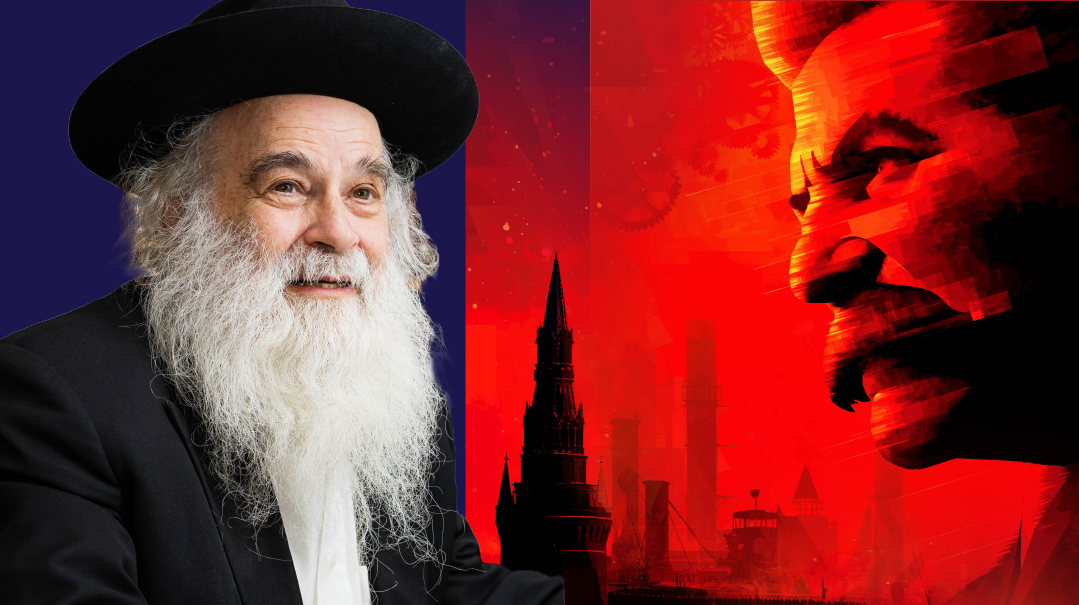

Rav Benzion Zilber still celebrates one of history’s great forgotten miracles
Photos: Elchanan Kotler
Raised in a home that defied Soviet oppression to transmit the truth, Rav Benzion Zilber is living proof of his parents’ supreme dedication to Torah — and of a forgotten miracle that saved millions of Jews
ATfirst glance, there’s not a lot to distinguish the third-floor apartment at 113 Sanhedria Murchevet from the surrounding ones. Located in a cluster of buildings that are home to a number of renowned talmidei chachamim, the apartment’s old-world Yerushalmi simplicity and walls lined with seforim and pictures of gedolim are what you might expect.
But come Shushan Purim, the entirely unexpected takes place here.
While the neighbors recall the Jewish people’s salvation in ancient Persia, the apartment’s owner adds something from another time and place entirely.
He takes out a shot glass and raises an unexpected toast — in Russian.
“L’chayim,” he says. “To the death of Stalin!”
For Rav Benzion Zilber — a man who was raised in Joseph Stalin’s long shadow — the annual custom is not simply a private commemoration. He wants the Jewish world to remember a miracle that is one of the great forgotten moments of Jewish history.
“The sudden death of Stalin when he was in the middle of bringing about the Final Solution for millions of Soviet Jews is miraculous,” he says. “It’s something that should be widely celebrated. Yet because Soviet Jewry was so oppressed, it was never able to tell its own story.”
I’ve wanted to meet Rav Benzion for a while — two and a half years, to be precise.
In summer 2023, I turned a long-standing interest in the dramatic last weeks of Stalin’s life into an article for Pendulum, this magazine’s history supplement.
The feature focused on the so-called “Doctors’ Plot” — Stalin’s plan to destroy Soviet Jewry.
On January 13, 1953, Pravda publicly announced that a group of Kremlin doctors — most of them Jewish — had conspired to poison Soviet leaders. Overnight, the campaign against so-called “rootless cosmopolitans,” the regime’s thinly veiled term for Jews, escalated dramatically.
As part of my research, I spoke to Rav Benzion, whose saintly father Rav Yitzchak Zilber was already in Siberia when the Doctors’ Plot broke out. Exiled for teaching Torah, Rav Yitzchak rallied fellow prisoners by sustaining Jewish life in the labor camp.
Over the course of my research for the article, I held lengthy phone calls with Rav Benzion, but never actually met him.
One fragment of conversation that lodged in my mind finally brought me to his door.
“Every Purim, I do as my father did: I make a l’chayim to celebrate Stalin’s miraculous death,” Rav Benzion had said.
Then, in a wry, Russian-inflected aside, he added: “It’s true that Stalin collapsed on the 14th of Adar, and I keep Shushan Purim — but why should Stalin get to dictate when I make a l’chayim?”