
Premier Orthodox Jewish magazine covering news, lifestyle, and culture for the observant community.
Premier Orthodox Jewish magazine covering news, lifestyle, and culture for the observant community.
 Mishpacha
Welcome to WordPress. This is your first post. Edit or delete it, then start writing!
 Mishpacha
I
t’s the middle of the night and there’s a siren.
Then it’s quiet.
And you lie there, waiting for another one, your whole body listening. You think the kids are still asleep. If they’re up, really up, you gotta hold that little someone in the dark and say, “It’s okay, it’s okay” with a calm you’re borrowing from some place you can’t name.
You’ve been borrowing from that place for a long time now.
All day, no matter what you’re doing, you’re also listening out for a siren. Talking and listening. Cooking and listening. Playing and listening. Singing and listening. Listening and listening.
The days are long in a way that’s hard to explain.
 Mishpacha
Dear Older Single,
I’d like to thank you for your exquisite letter describing the pain of being in your situation. Thank you for having the courage to put your pain into words and to give us readers some insight into your life. There is nothing to say in response, no way to fix it, no soothing words, and so I’m not trying. I’d just like to say that you’re seen and heard, and even admired for the pain that you must carry through every second of every day. (In addition, and as an aside, you’re a fantastically evocative writer, but I don’ t even want this comment to detract from the point that you were trying to make.)
I hope that all of us reading this heard you and saw you. And I hope that we can just sit together in the uncomfortable silence of this vivid window that you’ve given us into your life.
M.L.
Lakewood
Reading this discussion about divorcées feeling their pain isn’t validated by society made me think about something important. Pain isn’t a competition. A widow, a divorcée, and a single person can all experience deep pain, and each situation deserves compassion.
At the same time, I think it can be unhealthy if we wait for validation from others and feel victimized when it doesn’t come. Support from people is wonderful when we receive it, but if we don’t, we still have the ability to process our pain and move forward.
For me, the question becomes: What does Hashem want from me now? Instead of waiting for others to do good for us, we can ask how we can bring good to others and build a meaningful life despite our challenges.
As a divorced woman, I try to focus on the values I want to live by. One goal I set for myself is never to bad-mouth my ex to my children. Even though many of my children were taken by my ex, I try to focus on helping other children, neighbors or disadvantaged children, whenever I can. In a sense I say to Hashem, “I will try to be a partner and help with Your children.”
Instead of comparing suffering, perhaps we can focus on how to create rich and meaningful lives and support each other along the way.
Name Withheld
I’ m responding to the articles pushing for parents to step back from overprotecting their children. I agreed wholeheartedly with it. A child learns not without struggle, bumps, or setbacks, but within an environment that is fundamentally safe. Of course, a child must be protected from dangers that could cause real harm. But protection doesn’t mean removing every obstacle.
When we teach a child to ride a bike, we choose a safe place, the sidewalk. It isn’t perfectly smooth. There are cracks, uneven blocks, bumps, and maybe a bit of mud. But we know the child is safe from the greater danger of moving cars. The ground is just as hard on the street as it is on the sidewalk, but a bloody and scraped knee is a risk we accept because it is part of how a child learns. To ride. To grow. To succeed.
One day that child will ride on the road, and eventually drive there in a far larger and more dangerous vehicle than a bicycle. Learning doesn’t happen in an environment free of difficulty or pressure. It happens in a place where mistakes are possible, where hurt can occur, but where the consequences aren’t catastrophic.
The goal is not to repave the road or remove all the cars so the child can practice there. The goal is to prepare the child for the road ahead. Because that road will always have larger potholes than the cracks in the sidewalk where they first learned. To ride. To grow. To succeed.
Name Withheld
The article about fathers working far from home, while insightful and well written, had one major omission.
Whatever one’s hashkafic leanings, an entire article without mention of the strikingly similar current reality for thousands of our people due to husbands and fathers in the army reserves is, perhaps a little… tone-deaf? I’m sure no harm was meant but with that being the reality for so many of our brothers and sisters for over two years now, it bears mention.
Miriam Pearl
The amazing work Chana Malka Klein does vis-à-vis medical shidduchim astounded me. Kol hakavod! The follow-up letter decrying that we need such a service also resonated with me. May I humbly suggest a simple solution that I feel may help matters in a gigantic way?
First, I needed a statistic regarding how many families in the US have a child dealing with a medical condition. So I turned to Google (although I’ m not sure it’ s perfectly reliable). It surely doesn’t take into account our frum families with many children. Google states: Approximately 20% of children in the US (about 14.5 million) have special health care needs, which include chronic physical, developmental, behavioral, or emotional conditions. When including broader, acute, or minor chronic illnesses, estimates suggest that up to 40-50% of US children are affected.
Here’ s my suggestion: If every family who has a child with a medical condition who maintains that their child can lead a perfectly normal life and therefore want a spouse who isn’ t medically challenged in any way would be open to have their other children marry someone with a medical condition, oh what a wonderful shidduchim world this would be. (I understand that people wouldn’t want a match from a family dealing with the same condition as their child’s.) This would open countless shidduch suggestions for those affected.
I know families who didn’ t want to divulge (until a later date) that their child had Crohns or diabetes; another family that their son had cancer as a child, and so on. I know families who do share the info, but will only consider matches with people who don’ t have any medical issue. That’ s their prerogative. But I don’ t see that they “practice what they preach” when their other children are in the parshah. Why aren’t they open to someone with a condition who can lead a normal life? Isn’t it only right to do for others what you want done for you?
Name Withheld
(Originally featured in Family First, Issue 986)
 Mishpacha
Rebbetzin Chaya Gitta Miller sits in her tasteful and cozy living room, the walls of which are lined with seforim and dotted with pictures, during our interview. It’s in this small Northern British town of Gateshead, within terraced houses lining a narrow street, that her husband, Rabbi Mordechai Miller ztz”l, helped found and fashion an institution — Gateshead Seminary — which would produce thousands upon thousands of talmidos who absorbed his message that nothing can compare to the wisdom, depth, and beauty of Torah.
There’s a lot of laughter in Rebbetzin Miller’s home. There always was. Rabbi Mordechai Miller was known for his dry wit alongside his insightful shiurim. Even now, 25 years after his passing, the laughter in the Miller household hasn’t been silenced. Gateshead ladies love to stop by for a good game of Scrabble with this vibrant nonagenarian Rebbetzin.
Two of her daughters are also here, and gales of laughter often intersperse their vivid reminiscing. Their lives have a laser-clear Torah focus, but there’s a lighter side and an overt happiness in the package, too. As Rabbi Dr. Akiva Tatz, a disciple, wrote in his obituary of Rabbi Mordechai Miller, he was “a serious oveid with a light touch and sense of humor… intensity cloaked in sparkling good nature.”
The concepts he taught were the depths of Torah hashkafah and machshavah, but, Rabbi Tatz says, “His unique talent for clarity and simplicity made him a master teacher.” Rabbi Miller could take deep concepts from the Maharal and use the clearest language and the most apt parables to make them accessible to his young students. Some girls may have found the highbrow lessons too difficult to understand, but Rabbi Miller maintained his approach. “I’m not teaching them things they know already,” he’d say. And if they couldn’t understand, that was fine, too. “They don’t have to be able to grasp Torah. Even better, let them feel that Torah is so deep and so vast that they can’t always understand it.”
Rabbi Miller was a master of hashkafah. Among the streams of young people who passed through Gateshead, there were those who harbored questions about their Yiddishkeit, and dozens of both bochurim and sem girls had their doubts assuaged by him. He gave highly popular shiurim for SEED, and once traveled to South Africa as a keynote speaker at a kiruv seminar. In fact, the story goes that his shiurim even changed the life of a technician who was fixing someone’s tape recorder. He put in a tape of Rabbi Miller’s shiur to test whether the machine was fixed — and found himself transfixed and wanting more.
The five printed volumes of Rabbi Mordechai Miller’s Shabbos Shiurim are mainstays for anyone who wants to plumb the depths of mussar, hashkafah, and halachah in the weekly parshah, but they are only a fraction of the richness that exists in the notebooks of thousands upon thousands of Gateshead sem girls. If the girls who absorbed his shiurim carry its truths to their own homes and imbue them in children and students, the credit goes to their master teacher, and to his wife, who Rav Eliyahu Dessler ztz”l handpicked to stand at his side.
 Mishpacha
O
ver Pesach generally, and at the Seder more specifically, we will likely encounter a variety of family members and guests who do not share our Torah perspectives, halachic opinions, and outlook on life. There are parents who will have a child returning home for Yom Tov who is not engaged in a Torah way of life. There are baalei teshuvah who will be hosting their nonobservant parents for the Sedorim. There are those who will have relatives at the table who are blatantly anti-religious. There are individuals who will have unaffiliated Jews at their Seder who will ask tough questions. And the most common situations are the good old-fashioned hashkafic and ideological quarrels that are bound to arise.
While many try to avoid these situations because it’s painful to communicate with those who are different or disagree with us, these circumstances are actually golden opportunities for personal growth and connecting with others. A thoughtful response to a comment has the potential to adjust the spiritual trajectory of someone’s life, while a derogatory remark carries with it the potential for a family member to never return home. I know of countless stories in both directions. Some of these stories are the most inspiring, while others are the most devastating. Forward-thinking and mindful execution can yield enormous dividends that can be life-altering. However, a lack of preparedness and ill-considered remarks can be life-shattering. Instead of running away from the elephant in the room, let us prepare for the inevitable. How should we handle these encounters?
In honor of the Yom Tov of Pesach when the number four reigns, please consider the following four approaches, case dependent, if you are serious about wanting to deal effectively with those who are different from you.
You may encounter an individual who expresses damaging, negative, and at times toxic commentary about the Torah, halachah, the mesorah, or other areas of Judaism. This can be the most challenging and complex confrontation one may face. Rav Chaim of Volozhin learns from the Pesach story itself how to handle such characters.
Rashi explains that originally, only one frog was prepared to plague the Egyptians, but because the Mitzrim hit this one frog incessantly, more frogs emerged, triggering the onslaught of the plague of frogs. Rav Chaim wonders what would have happened if the they had not hit that frog? The answer is obvious; there would have been only one frog. Indeed, it was the Mitzrim themselves who were the catalyst of the plague of frogs, because they continuously hit that one frog.
Rav Chaim explains that we learn from here how to deal with those who are anti-Torah; don’t fight back. Fighting back will only strengthen the other side; it will “cause more frogs.” Instead, the greatest weapon to suppress the situation is to ignore the situation. (Peh Kadosh on Shemos 8:2) I see this all the time: When one attempts to convince, argue, and debate the antagonist, it adds fuel to the fire and strengthens the opposing side. Instead, try changing the topic, conversing with others, or ignoring the comment completely. The power of silence in the heat of a tense moment is indescribable.
This is exactly how Rav Chaim’s rebbi, the Vilna Gaon, explains a peculiarity in the response the Torah gives to the rasha, the wicked son. As opposed to the other three sons, to whom the Torah articulates a direct response, regarding the wicked son the Torah’s response is in the third person, “v’amartem,” and you shall tell them (Shemos 12:27). Why does the Torah not articulate a direct response to the wicked son?
The Gra explains that the Torah is teaching us that we don’t respond to the wicked child; instead, we respond to everyone else. We respond with interest to the wise son, the simple son, and the son who doesn’t know how to ask, each according to their ability. However, we do not respond directly to the son who is completely uninterested in hearing our response. To a question there is an answer, but to a declaration there can be no response (Haggadah Shel Pesach – HaGra). Indeed, Rabbi Samson Raphael Hirsch explains these verses similarly and implemented this very technique when he dialogued with such people. Not responding is the greatest and most powerful tactic when being verbally attacked. (Collected Writings 1:61-64 and Rabbi Samson Raphael Hirsch by Rabbi Eliyahu Meir Klugman pages 186-189)
Many of our brethren were not given a Torah education, as we were blessed to receive. There is nothing more powerful than sharing the Torah with those who were never introduced to it. Chazal teach us that it’s specifically through Torah that we will be most successful in penetrating the heart and soul of the Jew. We must educate and inspire, teach and model to those who are different from us. We must not be afraid to share our heritage and holiness with our brothers and sisters whose ancestors also stood at Har Sinai. Invite them into our orbit and allow them to taste the beauty of a Torah life.
Gedolei Yisrael over the ages have encouraged each of us to be teachers. Rav Shimon Sofer dedicates the introduction to his father’s Teshuvas Chasam Sofer, Pisuchei Chosam, to articulate this point. The Chofetz Chaim penned an entire sefer, Chomas Daas, to highlight this responsibility. Rav Moshe Feinstein writes in Darash Moshe (parshas Bo) that we must believe and know that we have the tools in our Torah arsenal to impact every single Jew, even the most sinful and most distant.
I have been privileged to see this firsthand from two of the greatest mekarvim of our generations. I saw the five-finger clarity and aish haTorah that Rav Noach Weinberg had when interacting with the most uninterested, unaffiliated, argumentative, pretentious, or too-cool-to-be-Jewish Jew. I continue to be privileged to witness how Rav Chaim Mintz doesn’t stop reaching out, interacting, teaching, connecting, and inspiring those who are most different from him. I know of countless families who dedicate their Shabbos and Yom Tov tables to those who are unlike them. I am aware of dozens of individuals who take time to learn with those who are much less learned than themselves. When done right, these interactions are transformative for both parties. Torah has the power to create the most meaningful and substantive relationship; including for those who are most different from one another. With wisdom, sensitivity, and tact, we, too, can connect with those who are very different from us.
The days of Pesach are a treasured opportunity to proactively discuss and teach the story of our exodus, the birth of our nation, belief in Hashem, Hashem’s providence, Jewish history, the purpose of creation, redemption, the role of the Jew in this world, and more. We have it within us to educate those who are distant and different. We must believe and know that it can be done, has been done, and is being done.
An underutilized tool to successfully interact with those who are different is by sincerely connecting with them. No tricks, no tactics; just be a friend and relative, and express authentic interest in the person. Let’s explain.
Shlomo Hamelech teaches us, “As water reflects a face back to a face, so one’s heart is reflected back to him by another” (Mishlei 27:19). This means that another person knows how you feel about them based upon the way they feel. A person will know if you care about them if they feel cared about. A person will know if you love them if they feel loved. A person will feel if they are unimportant in your eyes because they can sense that. A person will experience if you are genuine and sincere. You can’t fake that. If you want to connect with those who are different, it’s up to you.
One of the greatest teachers of this was Rabbi Shlomo Hoffman, who passed away in 2013. Rabbi Hoffman, who was an outstanding talmid of the Chevron Yeshivah and its roshei yeshivah, needed to leave full-time kollel to support his young family. With no education or experience, he began working as a parole officer in the newly formed Israeli prison system to help rehabilitate criminals. Rabbi Hoffman, who was an erudite talmid chacham and ben Torah par excellence, saw remarkable success working with people who were 180 degrees different from him: secular teens, hardened criminals.
One of his early successes came working with a teen named Uzi who committed senseless acts of vandalism and theft. Psychiatrists and psychologists who worked with Uzi said that he could not be rehabilitated and there was no way for him to improve. Enter Rabbi Hoffman, who spent two years working with Uzi until remarkably, he began to pull his life together. At a symposium held with a group of psychologists, psychiatrists, and social workers, Rabbi Hoffman, who became an acclaimed leader in the field of criminal rehabilitation in Israel, explained how he succeeded with Uzi when nobody else did. Rabbi Hoffman said that he carefully executed what his rebbi, Rav Isaac Sher, had shown him and what Chazal teach. He showed positive feelings toward Uzi, which nobody else did. Uzi returned those feelings in kind. Rabbi Hoffman said, “From the moment I met him I felt connected to him. I felt that I could help him. I showed him that I believed in him, and it reflected back.”
Rabbi Hoffman developed this theory and practicum and showed how it was sourced in the words of the great Rabbinic thinkers. (Rabbi Hoffman, Vaadim on Kamayim by Rav Meir Simcha Stein)
“As water reflects a face back to a face, so one’s heart is reflected back to him by another,” the pasuk says. If we want to connect and relate with family members and others who are different from us, we must show a sincere interest in and concern for the other person; it will be sensed and will be reflected back, and a beautiful relationship can emerge.
The Gemara recounts the following story. There were troublemakers in Rabi Meir’s neighborhood who caused him a great deal of anguish. Rabi Meir davened to Hashem that they should die. Rabi Meir’s wife, Bruriah, challenged her husband and instead suggested that Rabi Meir pray for an end to their transgressions, and not for the demise of the transgressors. Rabi Meir saw that Bruriah was correct, and he prayed for Hashem to have mercy on them, and they repented. (Brachos 10a)
What allowed for this complete metamorphosis? A complete change of heart? How did the sinners do it and how did Rabi Meir do it? Bruriah and Rabi Meir teach us to never give up on anyone and to never, ever, cancel anyone. Yes, there are those who are not like us. However, our job is not to make others think and act like us, but to instead daven that others understand themselves and have the clarity to make good decisions. Believe in those who are different. Believe in Hashem. Believe in the power of prayer. We must do our best and let Hashem do the rest.
Please consider these four approaches as you prepare for Pesach. I am certain that if one or some are considered and implemented, it will be transformative for you and those around you. It can be done. Hatzlachah rabbah! Wishing you and your family a chag kosher v’samei’ach!
Rabbi Moshe Walter is the rav of Woodside Synagogue Ahavas Torah in Silver Spring, Maryland, the executive director of the Vaad HaRabanim of Greater Washington, a popular speaker, and the author of the Making of Halachah, Minhag, Mentsch, and Siddur series published by Feldheim.
(Originally featured in Mishpacha, Issue 1104)
 Mishpacha
N
othing so buoys those of us working in the vineyard of ideas, such as your humble scribe, as seeing before us instances in which intellectual work made a dramatic difference in the ways in which we live our lives. One can point to many such cases in recent years.
Perhaps the most dramatic was the 2024 publication of Jonathan Haidt’s The Anxious Generation, which documented the mental health consequences for children and teenagers worldwide from iPhones and social media. In the two years since publication, state after state, from red to blue, has banned phones in public schools. Pennsylvania is now poised to become the 32nd such state. And phone-free legislation is in the pipeline in eight more states.
Internationally, Brazil has banned all phones in schools nationwide, and Australia enacted another plank in Haidt’s four rules for restoring childhood when it banned all those under 16 from entering into contracts with tech platforms. In a recent appearance at the Jewish Parents Forum, organized by Caroline Bryk of the Tikvah Fund, Haidt said 15 more countries are now contemplating such legislation and that he expects it to be adopted by the entire EU within a year.
In another remarkable reversal, two major American medical associations, which had long maintained that so-called “gender-affirming care” is solidly based scientifically, admitted on successive days at the beginning of February that it is nothing of the kind. And the New York Times, no less, published an editorial last week by Jesse Singal laying out the story of how those leading medical associations allowed themselves to be hijacked by activists in their midst to claim scientific justification for treatments that are in many cases irreversible, and for which no minor could possibly give informed consent.
The American Society of Plastic Surgeons issued new guidelines on February 3 against surgical interventions to those under 19. And the next day, the American Medical Association followed suit, and announced that in the absence of clear evidence of the efficacy of such interventions, they should generally be deferred until adulthood.
Both statements were flat-out reversals of the previous position of both groups, which had lobbied against legislation in multiple states restricting various aspects of “gender-affirming care.” What is most remarkable is that the earlier positions had all claimed to express a scientific consensus.
It never did. The British government’s Cass Review, the largest study yet of youth gender medicine, found “remarkably weak” evidentiary support for the care. The Cass team harshly graded a study by the American Academy of Pediatrics that supported such care: 12 out of a possible 100 in “rigor of development” and 6 out of 100 in “applicability.” Similar reviews by the national health authorities in Finland and Sweden reached the same conclusions.
A THIRD AREA where there has been a remarkable shift in policy is in support for the school choice movement. A quarter century ago, it was generally accepted in legal circles that no school voucher system that benefitted parents of children in parochial schools would pass constitutional muster. Then in Zelman vs. Simmons-Harris (2002), the Supreme Court ruled in a narrow 5-4 decision that vouchers offered to parents who had the choice to use them on either public or private schools, either parochial or not, did not violate the Establishment Clause.
Today, as a result of that decision and several that followed, and the dedicated efforts of the school choice movement, tuition relief in the form of vouchers, education scholarship tax credits, and education savings accounts is available to Jewish parents in over half the states, and a federal education scholarship tax credit is now available to states that opt in. While religious Jewish organizations, led by Agudath Israel of America, have always been strong supporters of school choice, the Jewish Federations of North America is now lobbying Democratic governors to opt in to the federal tax credit, over the objection of teachers unions.
DESPITE THESE EXAMPLES of rapid and high-impact changes in opinion, in part fostered by thinkers and writers, ideas rarely capture widespread support in a vacuum; nor is their impact always salutary. In the latter category, one must acknowledge that Tucker Carlson and Candace Owens have made it socially acceptable, particularly among young Americans, to say pretty much whatever one wants about Jews and their nefarious control of American foreign policy.
Jonathan Haidt’s The Anxious Generation provides the clearest example of a book triggering a social movement overnight. But even in his case, he is the first to admit that he drew heavily upon the work of others, notably Jean Twenge’s iGen on the congruity of exploding mental health issues among young girls with the appearance of the iPhone; and Lenore Skenazy on the baleful effects of parental safetyism and desire to protect their children from all forms of failure, discomfort, or danger.
Moreover, the power of ideas cannot be disconnected from their social context. Had so many parents and educators not already noticed the addictive effect of technology on their children and on their ability to connect socially to family and friends or to otherwise live life, rather than just scroll about it, Haidt’s book would not have had the impact it did. In many cases, parents and educators were looking for cover to reassert some control over their children’s unhealthy behaviors. At his most recent appearance at the Jewish Parents Forum, Haidt attributed to the group his awareness of the strength of the parental impulse to protect their children.
The sudden about-face of the leading medical associations on gender-affirming care doubtless owes more to a recent $2 million judgment against a surgeon for the mutilation of a 16-year-old girl than to the reexamination of the evidence for such surgeries, especially as they had never investigated that evidence in the first place. That judgment will likely scare insurance companies away from covering such surgeries or from providing coverage at anything approaching affordable rates.
The successes of the school choice movement are in part an outgrowth of the widespread perception that public education in large swaths of America is a disaster. School closures and remote classes during Covid also played a role, particularly as parents became aware of the degree of ideological indoctrination to which their children were being subjected. And those successes depend on the breadth of the alliance and the contributions of many players, including most notably the Institute for Justice in the legal sphere, and the lobbying efforts of a broad alliance of the groups under the banner of EdChoice and the American Federation of Children nationally.
FINALLY, FEW BATTLES are won once and for all. At the Jewish Parents Forum, Caroline Bryk likened Haidt’s book to the fall of the Berlin Wall. While an accurate metaphor in some respects, Haidt himself was the first to declare that the battle for childhood against technology is hardly over and will require much more than a book. AI, opined Haidt, is an even greater threat — one to our very humanity, and it will take much more than phone bans and age limits to control, as it is embedded, or soon will be, everywhere.
To gear up for that fight, he has set out to create a movement from his perch at New York University Stern School of Business. He has added a team to drive policy, culture, and behavioral change across the globe. The team recently published a book for eight- to 13-year-olds, The Amazing Generation, designed to help young people reimagine a life lived in reality, as opposed to one lived on line.
Haidt has created a Tech and Society Lab focusing on how digital technologies have reshaped childhood and adolescence. His website, After Babel, regularly publishes well-researched and thoroughly documented articles on related topics, including online gambling, video games, and AI chatbots — 67 in the past year, with 66 distinct authors. A recent article by the chief economist at Gallup linked the trend toward permissive parenting to out-of-control technology use, and argued for a parental model that is at once demanding and responsive and loving toward children.
Yes, ideas make a difference, often a large difference. But ultimately, they have to be connected with social and political movements, which involve an entirely new type of organization. And Haidt is an example of someone doing both.
(Originally featured in Mishpacha, Issue 1104. Yonoson Rosenblum may be contacted directly at [email protected])
 Mishpacha
T
his is the time of year when I brush off the dust from my magnum opus and proceed to add the current year’s chapter. I’ve been working on this manuscript for over 20 years, and some years I have more to add than others.
There was the chapter on the year that I suffered from a slipped disc in my back and spent Shabbos Hagadol in the hospital ER. Then there was the time I was in a rush and forced a pressure cooker open before it was ready. I spent Pesach that year with second-degree burns on my hand.
There was the year when my deep freezer didn’t go back on after being cleaned, but we didn’t realize until the next day and had to throw out half the meat and chicken inside.
Then of course are the “normal” years that also include washing machines that go on strike the week of Pesach, and fridges that rebel against being cleaned and throw all the electricity in the house for hours afterward. There’s the wild and the wacky and the plain old frustrating. Each event is recorded in the manuscript and while it’s growing, I’m still grappling with a working title.
Each year, when I finally sit down at Leil HaSeder, I look around at the shining silver, the snowy white tablecloth, and the glinting glassware, and I know that no matter what happened this year, we once again experienced the miracle of making a kosher Pesach. And hey, that’s my title: Don’t Passover the Miracles.
(Originally featured in Family First, Issue 986)
 Mishpacha
Photos: Israeli military air force, IDF spokesman, U.S. Air Force courtesy
The situation room was spartan except for the glow of digital maps. Screens flickered along the wall, their grids casting a cold light across the room. Across them ran thin flight lines, stretching eastward from Israel across the Middle East.
They pointed toward a destination that until last year belonged more to the realm of training scenarios than operational schedules: Iran.
In that room at Hatzerim Air Base, near Be’er Sheva — far from the cameras and official statements — sat Lieutenant T., 23, a combat navigator in the Israeli Air Force’s 107th Squadron, known as the “Knights of the Orange Tail.”
For long hours he helped plot what would become the opening blow of the largest strike formation in the history of the IAF. The work stretched over weeks of preparation.
“For quite a long period I planned Phase One, the Bereishit strike,” he says. “From there I rolled it out to the ground crews, to all the teams, and immediately afterward I went up to fly myself — literally the very next day.”
In unemotional military-speak, that sentence captures the reality of Israel’s new war with Iran which is largely an air war: plan, brief, launch, fly. One day, Lt. T. was tracing routes and calculating the choreography of a mass attack. The next, he was strapped into the rear seat of a two-man F-16I Sufa, heading east with the very formation he had helped build.
On the Tuesday before the operation began, IDF Chief of Staff Lt. Gen. Eyal Zamir arrived at Hatzerim to address the crews. He moved between briefing rooms and planning centers, meeting commanders and aircrews preparing for a mission months in the making.
“When you are ordered to act and the command is given,” he told them, “I have faith in you that these aircraft will take to the skies, strike their targets, and carry out their missions with distinction.”
A few days later, on Shabbos Parshas Tetzaveh, the order would come — nearly 200 fighter aircraft would take off.
Lt. T. had completed the pilot course only a little over a year earlier, in the middle of a war. Did he ever imagine he would find himself taking part in a mission of this scale?
“Honestly, no,” he says. “I didn’t think I would have the privilege to do something this significant.”
 Mishpacha
P
inny Brecher of Monsey was driving his family back home from a wedding in Lakewood when their Suburban hydroplaned and skidded off the Garden State Parkway, careening through the guardrails and flipping over at least once. When the car finally shuddered to a halt, it was lying on its side. Pinny tried to open the door, but it wouldn’t budge. Suddenly, he noticed a chassidish young man standing outside the car, looking in through the window. He too could not pry the door open.
“Suddenly, my son turned to me,” says Pinny. “He said ‘Abba, here!’ ”
Tzvi Meir was holding a window punch, a small device that breaks vehicle glass for escape or rescue.
“About two years ago, a Chaveirim member gave me one, for no particular reason,” Pinny shares. “He had bought a few and decided to hand them out. I kept it in my car all this time, never really paying attention to it.”
But in those terrifying moments, Pinny knew exactly why he was one of the chosen recipients.
“Given my position, I couldn’t effectively strike the window,” Pinny says.
But miraculously, the impact of the crash had dislodged the door enough to create a gap between the door and its frame.
“I reached out through the gap and handed the punch to the chassidishe man. He then struck the window, which shattered immediately.”
From there, the Brechers were able to exit the vehicle, and their siblings and parents dropped everything to offer whatever support they might need.
Later, Pinny came to learn the identity of his savior — it was Shmaya Fischer, a popular wedding singer. Pinny made sure to pay a visit to the Fisher home to express his hakaras hatov.
Yeshiva Bais Moshe of Scranton, Pennsylvania, founded in 1965 by Rav Yaakov Schnaidman and Rav Chaim Bressler, both talmidim of Rav Aharon Kotler, has rightfully earned its place as one of America’s premier legacy yeshivos. The founding roshei yeshivah, together with Rav Chaim Schnaidman and Rav Nachman Pritzker, who have since joined the hanhalah, were mechanech legions of talmidim. Yet since the yeshivah’s 1976 acquisition of the historic Mercy Heights Hospital property (the hospital where the 46th president of the United States was born), the facilities have barely undergone renovations.
In a major milestone event last week, alumni, current talmidim, and gedolei Torah converged in Scranton to join the hanhalah in celebrating the chanukas habayis of a new 50,000-square-foot state of the art facility, marking a major milestone for the yeshivah.
Several hundred alumni returned for a memorable Shabbos to celebrate the occasion. For many talmidim, a highlight came on Shabbos morning, when longtime supporter and alumnus Mr. Shimon Lefkowitz announced that the balabatim would be joining together to purchase the third aliyah for the founding co-rosh yeshivah, Rav Chaim Bressler, with a goal of raising $61,000 in honor of the yeshivah’s 61st year. The response exceeded expectations, bringing in an impressive $80,000 on the spot.
Later, for the sixth aliyah, alumnus Mr. Ari Dobkin made a generous bid on condition that the bochurim commit to learning additional dapim of Gemara in the zechus refuah sheleimah for the other founding rosh yeshivah, Rav Yaakov Schnaidman, who was unable to attend due to health concerns. On the spot, over 60 bochurim pledged over 13,700 dapim to be learned over the coming year in the zechus of Rav Yaakov ben Chana, may he merit a refuah sheleimah b’karov.
—Gavriel Horan contributed to this report
(Originally featured in Mishpacha, Issue 1104)
 Mishpacha
If you’ve scorched a pot, try simmering water with some baking soda in the pot and it’ll be much easier to clean.
Are your wood floors dull and not getting shiny? There’s residue buildup. Clean once with diluted vinegar, then switch to barely damp mopping.
My cleaner uses the blow dryer to blow dust out of hard-to-reach areas, like behind furniture or in ceiling corners.
Shaving cream can work as a defogger on your mirrors — any cheap kind will do. Spread it over the area you want defogged, let it sit for 15 minutes or so, then wipe or squeegee it off. It’s like magic! The mirrors stay fog-free for weeks.
If you have a smelly drain, try pouring down boiling water, then dish soap, then boiling water again. It breaks grease without using harsh chemicals that ruin pipes.
Put dish soap straight on the fabric before adding water.
Try baking soda and hydrogen peroxide paste and hang in direct sunlight if possible.
That’s detergent buildup — wash once with vinegar, no soap.
Heat melts the stain — scrape while warm, then wipe with rubbing alcohol.
When cleaning granite countertops, bend down so you’re eye level with your countertop to see every last crumb.
If you have pink slime in your shower, it’s not mold. It’s bacteria, and dish soap is the best way to remove it.
If your tile floors are sticky after mopping, it means you’ve used too much cleaner. Mop once with plain water to reset.
For minor scratches and scuffs on a wood or interior door, use the inside of a fresh banana peel and rub it back and forth.
(Originally featured in Family First, Issue 986)
 Mishpacha
The missile siren is not an alarm but a wail
rising and falling, rising and falling again and again,
insistent, pleading, beseeching.
The missile siren is not an alarm but a wail,
an infant crying for its mother,
I am alone, stay by my side,
come close, hold my hand, stroke my cheek,
grant me your love,
hide not from me nor abandon me,
stay with me always.
The missile siren is not an alarm but a wail,
a cry from Am Yisrael
to the One Above,
come close, hold my hand, stroke my cheek,
grant me Your love,
hide not from me nor abandon me,
stay with me always.
The missile siren is not an alarm but a wail,
the wail of the shofar,
the yelalah of shevarim-teruah, shevarim-teruah
over and over, again and again,
the weeping of Rochel Imeinu
crying for her children again and again
and refusing to be comforted
The missile siren is not an alarm but a wail,
the wail of the Shechinah on high
abandoned by Her children,
calling them to return.
The missile siren is not an alarm
that sends us fleeing to a shelter,
but the lament of the sacred soul
that sought to flee from Him,
and yearns now to return
to Him Who is our shelter.
The missile siren swiftly, in our day,
will turn from wail to song
and lift us from the huddling shelter,
onto hills of celebration
where sobs become a melody,
and weeping becomes laughter
and sadness becomes dancing
and tears, tears of joy
and eyes and ears are opened
and finally perceive
(Originally featured in Mishpacha, Issue 1104)
MishpachaWhat does it really mean to inspire a child? Not just to guide them — but to help them truly want the life you’re teaching?
Rachelli Fried together with educator and chinuch teacher, Rebbetzin Dershowitz, explore Eishes Chayil’s profound insight about warmth, modeling, and the subtle difference between discipline and true chinuch — and how a mother’s passion for Yiddishkeit quietly shapes the hearts of her children.
 Mishpacha
_
llustrated by Esti Saposh_
The next two weeks flew by in a flurry of packing, cleaning, playing with the Gershonowitz kids downstairs so Reb Elimelech and his rebbetzin could clean, and recleaning our apartment after Yehuda Gershonowitz ran through it eating a potato boureka.
The letter had instructed us to arrive at the hotel on Tuesday morning, March 31st, Erev Bedikas Chometz, so after davening neitz, we headed for the Tachanah Merkazit with our suitcases and caught a train from the Yitzhak Navon station. We had only just settled into our seats on the train when I noticed, out of the corner of my eye, Nachum removing a quill, ink, and a roll of parchment from his backpack.
“This is a moving train,” I reminded him, eyeing the ink.
“It better be,” he replied, setting the bottle down on his tray table and nonchalantly dipping his quill inside it, “or I want a refund on our tickets.”
“Right, but how do you expect to do whatever you expect to do with all that—”
“Write Shir Hashirim on a klaf in time for Shabbos Chol Hamoed,” he interjected.
“—while the train moves?” I finished.
“Hopefully, I’ll be helped along,” he said, his hand already moving swiftly across the parchment, leaving behind glistening black letters, “by your enriching commentary about such novelties as the fact that this train is in motion.”
“Are you saying you want quiet?” I asked, making a mental note that “conveying preferences without being offensive” should be our next social skills target.
MishpachaM
ore than 40 years ago there lived a little girl who was a perfectionist. In first grade, while learning how to write, she’d get frustrated at her messy penmanship and destroy the papers, wishing for perfect script like her teacher’s.
In fifth grade, the little girl learned how to sew. While she enjoyed planning the colors and designs of each outfit, by the time the project was completed, she’d push it to the back of the closet because it didn’t come out professional enough.
In high school, this preference for perfection followed her year by year. It was a millstone around her neck, passing judgment on all her accomplishments and rendering them wanting.
As a young mother, she was determined to work so her husband could learn, take care of her kids with complete devotion, and also keep a sparkling clean house. Anything less than was simply unacceptable.
But time moves on. And with it, hopefully, comes maturity that takes our ingrown traits and tempers them with wisdom and experience.
This middle-aged woman learned that perfectionism did not work to her benefit, and in fact detracted from her real progress. She learned that the dishes could wait in place of taking her kids to the park, and the laundry could be folded without the use of a ruler. (For illustrative purposes only; she never actually used a ruler.)
Bit by bit she grappled with her inner demands, and bit by bit she was able to temper them with patience and priorities.
Not The End
A while back, my husband and I bought burial plots. I hope this doesn’t creep you out as it did me, but apparently, it’s a segulah for long life. But it lent itself to a discussion with my kids about matzeivos and levayos… don’t ask. It was one of those conversations that you’re not sure how you got into and you wish you could get out of.
Somehow, though, in the course of the conversation, something came up that brought home to me that I had made progress over the years.
“I don’t want long megillos on my matzeivah,” I said to my older children very seriously. “Remember when the time comes, I want only two words on my matzeivah: I tried.”
(Originally featured in Family First, Issue 985)
Mishpacha**
IT was early morning when Dovid Greenstein informed me that his 91-year-old mother, Chaya, had passed away. (All names have been changed.) He asked if I was available to deliver a hesped at the levayah. I agreed and instructed my secretary to cancel my appointments for the day.
As I had never met Dovid’s mother, I asked him for some details of her life. Dovid replied that his mother had been in the nursing home section of her assisted living facility for the last 19 years.
When I asked about her special qualities, Dovid said, “She was very attached to the other residents of the facility, and she went to shul there every Shabbos. But I doubt there will be many people at the levayah. After all, my mother was a resident of the facility for almost twenty years. I can’t imagine there being more than a handful of people at the funeral.”
I nodded, and both Dovid and I agreed that the levayah would be short.
At 11:55, I arrived and was shocked to see almost 50 people, mostly older women, filling every seat in the small chapel.
I asked Dovid, “Who are all these women?”
Dovid shrugged.
At this point, a director from the facility told us that some of the women residents insisted that arrangements be made to transport them to the funeral. I noticed that most of the women in the chapel had walkers, and more than a few were in wheelchairs.
I recited two perakim of Tehillim and spoke about Chaya Greenstein. As I concluded my brief words, I heard a woman’s voice calling out to me as she slowly pushed her walker to the front of the room.
“Rabbi, my name is Sylvia Cohen, and I would like to speak for a few minutes. I must explain why all of us girls insisted on being here today.”
Sylvia made her way to the podium, pulled out a paper, and began to read.
“We are here to say goodbye to our dear friend Chaya. What was special about Chaya? I can sum it up in three words: the written word. All of us here know what I am referring to.
“Chaya performed one mitzvah that impacted all of us. Every time one of us had a grandchild or a great-grandchild and it was announced in shul, the very next morning, we would find a handwritten personal note wishing us a heartfelt mazel tov.
“Every Motzaei Shabbos, when all of us were playing Mah-Jong, Chaya would go to her room, take out her pen, and begin to write mazel tov letters. Those were letters of love for both writer and receiver.
“Chaya did for us what few others did. It’s very lonely living in a nursing home. And even when people come to visit, we often get the feeling that as soon as they arrive, they’re already counting the minutes until they can leave. Too often, we feel that we don’t really matter.
“However, Chaya was different. Chaya made us feel special, that we mattered, that we’re people too, and that we are also children of Hashem.
“Everyone needs to feel that they matter. And Chaya was the one who made us feel that way. And that is the reason all of us insisted that we be brought here today. We insisted on being here to say goodbye and thank you to our beloved Chaya.”
At this point, Sylvia refolded her paper and slowly pushed her walker back down the aisle.
(Originally featured in Mishpacha, Issue 1103)
 Mishpacha
Photos: AP Images
F
or a brief moment last week, the Kurds found themselves in a uniquely Washingtonian position, as they were simultaneously invited into a war and politely asked to stay home. According to reports circulating through diplomatic and security circles, President Trump held a call last week with leaders of several Iraqi and Iranian Kurdish groups, including groups that have spent decades fighting the Iranian regime from bases tucked into the mountains of Iraqi Kurdistan.
The White House confirmed the call, albeit in characteristically careful language.
“The president has held many calls with partners, allies, and leaders in the region, in the Middle East,” Press Secretary Karoline Leavitt told reporters on Wednesday, admitting nothing more than that POTUS spoke “to Kurdish leaders with respect to our base that we have in northern Iraq.”
By Thursday, Trump sounded enthusiastic about the idea of Kurdish forces joining the fight.
“I think it’s wonderful that the Kurds want to do that,” the president said in an interview with Reuters. “I’d be all for it.”
Forty-eight hours later, however, the Kurds had been firmly benched.
“We’re not looking to the Kurds going in,” Trump said in a gaggle with the White House Press Corps over the weekend. “We’re very friendly with the Kurds, as you know, but we don’t want to make the war any more complex than it is. I’ve told them I don’t want them going in.”
Which leaves the Kurds occupying a strange geopolitical limbo. Encouraged on Thursday. Ruled out by the weekend. Somewhere in between lies what might best be described as Schrödinger’s Kurds, simultaneously entering the war and not entering it until the policy is fully observed.
Of course, there may be a method to the apparent contradiction. Trump has long practiced what might be called live beta-testing foreign policy. He starts by floating an idea, and then watches the reaction ripple through allies, adversaries, and cable-news panels. Then, he recalibrates as needed.
First, the call with Kurdish leaders sends the message to Tehran that the United States has options for turning Iran’s own internal fault lines into pressure points, and Thursday’s public encouragement reinforces that possibility. The more recent reversal in which POTUS dismissed the Kurds sends an entirely different message to regional players who would prefer that the Kurdish question remain unopened for now. In diplomatic terms, the maneuver translates roughly as: We could do this, we’re just choosing not to. For the moment.
Pentagon officials have also tried to tamp down speculation that Washington is preparing to arm Kurdish groups inside Iran.
“None of our objectives are premised on the support or the arming of any particular force,” Secretary of War Pete Hegseth said this week. “So what other entities may be doing, we’re aware of, but our objectives aren’t centered on that.”
Which, translated loosely from Pentagon dialect, appears to mean: Someone is arming somebody, and while we may know about it — or may even have something to do with it — we prefer to leave the matter comfortably suspended between pause-able ambiguity and plausible deniability.
Naturally, this has done little to slow down the churn of the rumor mills. Over the past two weeks, stories have ricocheted across the region claiming that Iranian Kurdish factions are quietly receiving weapons. From whom? Perhaps Washington, or from American allies, or from mysterious sources that appear to operate suspiciously close to American allies. But in the Middle East, whispers about covert arms shipments tend to travel faster than the trucks that supposedly carry them.
When I reached out to the spokesman for one of the major Kurdish political parties to ask whether the United States is secretly providing weapons, he refused to answer so emphatically that it left me with the distinct impression that something is happening behind the scenes. Precisely what remains a mystery.
Speaking to me from Erbil, Kurdish journalist Mohammed H., who has been traveling along the border separating Iraqi and Iranian Kurdistan monitoring the situation along the frontier, dismissed reports that Iranian Kurdish forces are already mobilizing or receiving weapons.
“Nothing of this front yet, nothing,” he said flatly. “It’s fake news.”
According to Mohammed, Kurdish fighters from several Iranian Kurdish factions remain exactly where they have been for years: in the mountains just across the border, watching events unfold.
“They are ready,” Mohammed insisted. “But they need help. They need support. Not just someone saying ‘good job.’ They need weapons. They need rockets, Javelins.”
The terrain, he explained, favors precisely that kind of warfare. Iranian Kurdish parties, he noted, have been fighting the regime for decades and maintain experienced fighters who know the terrain intimately.
“They have more than thirty or forty years in those mountains. They have tunnels. They’ve had clashes. They know the land.”
And they are not a small force. Kurdish populations inside Iran number roughly ten million people, with several organized political and military groups operating from bases across the Iraqi border.
While the Kurds wait for Washington to decide whether they are invited into the war or politely excluded from it, Tehran appears to be acting as though the decision has already been made.
Even Kurdish leaders themselves appear to be lowering the temperature. Bafel Talabani, the head of the Patriotic Union of Kurdistan, was one of the leaders who received a phone call with President Trump. Over the weekend he appeared on Fox News, where he seemed eager to tamp down speculation that Washington is currently arming Kurdish fighters to march into Iran, stressing that relying on the Kurds as “the tip of the spear” might not be he way to go.
That hasn’t stopped the tension from escalating on the ground. Kurdish journalist Mohammed H. recently filmed a suicide drone striking near a hotel housing offices tied to the US and Turkish consulates. Mohammed believes the drone’s real target was Talabani’s headquarters just 200 yards away; he suspects it was directly correlated to his appearance on Fox News.
“After those comments,” Mohammed said, “Iran sent them a message: Be careful.”
In Erbil, meanwhile, US air defenses reportedly intercepted two Iranian drones earlier the same morning.
Saman P., an Iraqi Kurd who works as a fixer in Sulaymaniyah, about 90 minutes from the Iranian border, told me a suicide drone struck just two minutes from where he had been driving. “The kids are terrified,” he said quietly. “The airspace is closed, and we can’t get out of the country.”
For now, the Kurdish fighters remain in their mountain tunnels, watching the same contradictory signals coming out of Washington that everyone else is trying to decode.
Which means that, at least for the moment, the Kurds remain suspended in a familiar state of quantum geopolitics. Until then, the Kurds remain in the mountains where Mohammed left them, subjects within a Schrödinger-esque thought experiment: ready for a war they haven’t been invited to fight, uncertain whether they’re meant to stay out of it, waiting on weapons not yet promised, navigating signals Trump himself may not have yet finalized.
(Originally featured in Mishpacha, Issue 1103)
 Mishpacha
ON
a recent winter evening in the House of Lords, close to ten o’clock at night, peers were still debating the government’s Children’s Wellbeing and Schools Bill when an unexpected voice rose to defend Britain’s yeshivos.
The speaker was not a rabbi or a Jewish communal leader, but the Anglican Bishop of Manchester.
In Britain’s constitutional system, senior bishops of the Church of England sit as members of the House of Lords, and their voices often carry particular weight when questions of religion and public policy arise.
Addressing peers during the debate, the Bishop warned that a proposed legal definition of “full-time education” risked misclassifying institutions devoted solely to religious instruction. In doing so, he suggested that Parliament might unintentionally force a centuries-old form of Torah education into a regulatory framework designed for conventional schools.
For Britain’s chareidi community, the moment was striking. After years of disputes surrounding chinuch, a new front had opened — this time over the future status of certain yeshivos ketanos.
For those familiar with long-running debates over the place of Torah education within Britain’s regulatory system, the government’s introduction of its Children’s Wellbeing and Schools Bill appeared to reopen questions many had hoped were already settled.
The controversy did not arise in a vacuum. In recent years, advocacy groups like Nahamu (not too dissimilar from groups in the US like Yaffed) have campaigned for greater regulatory oversight of certain yeshivos. These activists argue that stronger supervision is necessary to ensure educational standards. They helped bring the question of under-16 yeshivah education into the national debate and increased pressure on government to clarify how such institutions should be treated.
Against this backdrop, concerns began to grow within the chareidi community about the implications of the new legislation.
In March 2025, as the bill progressed through Parliament, a briefing prepared by the Yeshivah Liaison Committee began circulating among policymakers and religious leaders. Shortly afterwards, the Bishop of Manchester, Dr. David Walker, raised the issue during debate in the House of Lords on his own initiative, framing it as a matter of religious liberty.
At that stage, however, the chareidi community was still struggling to secure direct engagement with government. We could not get a meeting with the education minister responsible for the legislation.
Around the same time, I had begun working with well-known askan Shimon Cohen on the issue. Through my involvement with the Coalition for Jewish Values, on whose rabbinic board I serve as international liaison, I had recently begun participating in the All-Party Parliamentary Group on Freedom of Religion or Belief. I brought the question of yeshivah education to their attention as a matter of religious liberty, and a number of exploratory meetings were subsequently hosted in Parliament under the auspices of the APPG to examine our concerns.
In that context, Shimon Cohen contacted me with a practical question: Did I happen to know the Bishop of Manchester?
For many years, I’ve participated in the Greater Manchester Faith and Communities Leaders Forum, meeting regularly at the Bishop’s residence with senior representatives of the region’s faith communities to discuss issues of public concern. Through that forum I had come to know the Bishop.
A meeting arranged last May among the Bishop, Shimon Cohen, and representatives of the Stamford Hill yeshivah community proved to be a turning point. During the meeting, the Bishop asked simply how he could help. Shimon Cohen replied that the community had been unable to meet with the education minister.
“I will arrange the meeting,” the Bishop responded immediately.
For a community navigating the issue on its own, the Bishop’s willingness to intervene proved to be decisive.
The debate centers on Clause 37 of the Children’s Wellbeing and Schools Bill. At first glance it appears to be a technical provision defining “full-time education.” In practice, however, that definition could have significant implications for parts of the yeshivah system serving boys under the age of 16.
The Torah community’s concern extended beyond regulation into the realm of classification. If a yeshivah is legally treated as a school, it becomes subject to an entire regulatory framework for institutions whose purpose is academic instruction. Yet the purpose of a yeshivah is to promote immersive religious learning, operating alongside the parental responsibility for education that British law has long recognized.
Here a brief transatlantic clarification is needed. In the United States, the term yeshivah usually refers to a full-day Jewish school combining Torah learning with secular studies. In the United Kingdom, however, the term typically refers to institutions devoted exclusively to Torah study. They are not structured as general schools and do not present themselves as such.
Within parts of the chareidi community, boys devote most weekday hours to intensive Torah study within a yeshivah framework.
At the same time, British law places responsibility for a child’s education primarily upon parents rather than on institutions. Elective home education is therefore lawful and widespread. The law does not prescribe a national curriculum for home-educated children, requiring instead that parents ensure their children receive a “suitable education,” leaving considerable flexibility in the form that education takes.
This reflects a longstanding principle of British education law: The state may set minimum expectations, but the primary responsibility for a child’s education rests with parents. Within the chareidi community, this legal framework has allowed parents to retain responsibility for their sons’ broader education while yeshivos provide intensive Torah learning.
While public discussion has often focused on the large chassidic communities of North London, where boys enter yeshivah ketanah immediately after bar mitzvah and devote themselves fully to Torah study from the age of 13, the picture across Britain’s Torah world is more complex. In many litvishe communities, boys typically remain in school until around age 15, often completing several GCSE examinations before entering yeshivah ketanah for full-time learning between the ages of 15 and 18.
Because of this difference, some litvishe yeshivos hoped the legislation might not affect them. However, the legal requirement that young people remain in full-time education until the age of 16 could still have implications for those yeshivos serving boys under 16.
As awareness of the legislation grew, discussions began to take place in Gateshead, Manchester, and Golders Green, bringing together roshei yeshivah, rabbanim, and askanim to hear detailed briefings from Shimon Cohen and to consider how the legislation might affect their institutions.
The question of “safeguarding” has also played a role in the debate. In recent years, some yeshivos in Stamford Hill have been reluctant to adopt “safeguarding” frameworks linked to the Ofsted inspection regime. Those frameworks are ostensibly designed to ensure children’s safety and well-being in mainstream schools; but they are often tied to expectations surrounding Britain’s “protected characteristics” legislation. For institutions devoted exclusively to Torah education, those requirements raised serious religious concerns.
Community representatives have consistently emphasized that safeguarding itself — i.e., keeping children safe — is essential and nonnegotiable. The challenge has been to develop frameworks that protect children while respecting the integrity of Torah education.
The potential consequences of the legislation were not merely theoretical. Under the Bill’s unamended provisions, those responsible for running a full-time educational institution for children under 16 that was not registered as a school could face criminal liability, including the possibility of a criminal record.
One conversation last December with a senior official in the British Jewish community showed me how stark the expectations had become.
“The government will pass the legislation,” he said matter-of-factly. “There will be arrests. And a few days later the community will come to the table.”
That illustrated the misunderstanding that had developed between policymakers and the chareidi community. For many in government, the issue appeared to be one of regulatory compliance. For the communities affected, however, it touched on fundamental questions about the preservation of the Torah way of life.
The conversations that followed gradually helped narrow the gap. The quiet intervention of a bishop in defense of Torah education carries a similar resonance — when a voice from outside the Jewish community recognizes that protecting Jewish learning is part of protecting the moral fabric of society itself.
The coming months will determine how Britain balances safeguarding, educational expectations, and religious freedom. Yet the dialogue that has begun suggests that a more constructive understanding may now be taking shape.
For the chareidi community, the objective remains clear: to preserve the integrity of Torah education while continuing to live responsibly within the framework of British law and the society of which we are a part.
Rabbi Jonathan Guttentag is the founder and principal of the Whitefield Community Kollel in Manchester. He serves as international liaison on the rabbinic board of the Coalition for Jewish Values and has been involved in parliamentary engagement on issues affecting Torah education in the UK.
(Originally featured in Mishpacha, Issue 1103)
 Mishpacha
Measuring success in the US-Israel military campaign against Iran is challenging when an average of 1,626 Red Alert sirens sound daily in the first ten days of fighting.
The initial exhilaration of the dramatic opening strike that took out Ayatollah Khamenei and his top aides faded quickly as Israelis repeatedly sought shelter, sometimes in pajamas and a bathrobe in the middle of the night, or interrupting the Megillah reading, Shema, or Shemoneh Esreh, to take cover.
Ultimately, only the outcome — not the initial blow — will determine victory. If the war concludes with Iran and its proxies unable to pose a serious threat to Israel again, and Israelis can once more sleep peacefully and carry on their routines without sky scanning, most will see the price as worth paying.
However, after ten days, it’s clear there is no single knockout punch that will send Iran reeling to the canvas. Instead, it has become a test of endurance, shaped by military limitations and political will on all sides.
Unanswered questions include whether the US and Israel can eliminate Iran’s remaining ballistic missile capabilities without depleting their interceptors; whether President Trump can maintain the backing of Congressional Republicans and voters worried that victory will prove elusive while spiking gas prices are a reality; and whether Iran has any last-minute surprises up its sleeve that could extend the war by causing chaos for US troops and Israel’s homefront.
The combined US-Israel military strength creates an overwhelming mismatch against Iran. Since the fighting began against the modern-day Haman on Shabbos Zachor, the IDF and forces under US Central Command (CENTCOM) have destroyed at least 70% of Iran’s ballistic missile capability and air defenses. This includes missiles intercepted in flight, buried in underground “missile cities” in Iran, and launchers Iran has positioned on its territory.
Israeli attacks on these missile cities are perhaps the biggest achievement so far, considering they’re built to be “indestructible.” Interesting Engineering (IE), an online publisher headquartered in New York and Istanbul, described these missile cities as built hundreds of meters deep inside rocky mountains, featuring multiple hardened tunnels, interconnected storage halls, and separate zones for warheads, fuel, and guidance systems.
“The tunnel design often includes blast-trap dead-end shafts aligned with the entrance axis,” writes IE’s Atharva Gosavi. “When a strike hits, the shockwave is channeled into these stub tunnels rather than penetrating the main complex. The overall setup allows the system to survive even when some entrances are hit or compromised.”
However, they have their weak spots. The Wall Street Journal reported that although these missile facilities are deep underground, both the Pentagon and Israel have used satellite photos to identify their above-ground buildings, roads, and entrances. The WSJ reports US and Israeli airstrikes have “entombed” Iranian missiles underground in some locations. India’s NDTV network reported that Iran may have moved some of its truck launchers and missiles out of the bunkers before the war started, hoping to protect them from strikes by dispersing them.
Which brings us to the next challenge, one that still causes fear among Israelis and other Arab nations, including the UAE, Qatar, Kuwait, Bahrain, Jordan, and Saudi Arabia: mobile launchers, also known as Transporter Erector Launchers or TELs, and the ongoing battle between missiles and interceptors.
Modern missile defense strategy has shifted from purely reactive interception to a proactive effort to destroy launch platforms before they can be used. For Israel and the US, this involves identifying and striking Iran’s TELs and their storage facilities before defensive interceptor supplies are depleted.
The logic is simple. Each launcher destroyed not only means one less missile fired — it can also save dozens, possibly hundreds, of interceptors. However, implementing this strategy is challenging. Mobile launchers can be hidden, moved quickly after firing, or concealed in a variety of hardened or underground facilities, even if most of the missile cities described above are put out of commission.
This results in a high-stakes race between Iranian launch crews and American-Israeli strike capabilities.
When the war began, Israel estimated Iran had an inventory of some 2,000 to 2,500 ballistic missiles, according to the Institute for National Security Studies (INSS) at Tel Aviv University. This figure may exceed the combined interceptor inventories of Israel and the US.
Defensive doctrine typically requires firing at least two interceptors against each incoming ballistic missile to ensure a high probability of success. The INSS estimates Iran fired more than 600 of its ballistic missiles in the first days of war. In practice, this means that even a modest missile barrage can rapidly drain defensive stocks, as advanced interceptors are expensive, complex, and slow to manufacture, compared to ballistic missiles.
Ultimately, success will depend on whether Israel and the US can outpace Iran’s missile launches and maintain enough interceptors before their defenses become overwhelmed. The outcome of this relentless struggle will probably shape the next phase of the war.
So far, the war has been fought on conventional terms, but perhaps not for long. The New York Times reported that after last June’s 12-day conflict, when the US and Israel attacked and severely damaged Iran’s nuclear facilities, Iran’s government devised “Operation Madman.”
Anticipating a future conflict, the late Ayatollah Khamenei ordered that in the event of his death, his successor should ignite the entire region to make the costs of war too high for Israel, the US, and its Arab allies.
So far, Iran has used missiles and drones against the UAE to target Dubai’s airport, coastal hotels, and Amazon data centers. Iran also attacked a desalination plant in Bahrain, Oman’s largest port, the US embassy in Kuwait, and an oil refinery in Saudi Arabia. It forced Qatar to shut down a refinery that supplies about 20% of the world’s liquefied natural gas (LNG) exports.
The war has disrupted oil tanker traffic through the Strait of Hormuz, south of Iran, along the Persian Gulf and Gulf of Oman, which handles some 80% of the world’s oil and LNG supplies, mainly the parts headed to Japan, India, China, and South Korea, which together account for more than 26% of the world’s economy. It’s no wonder that crude oil prices spiked by 45% in the last month as tensions built and war raged.
Perhaps the bigger threat from Operation Madman is if a desperate Iran launches hypersonic missiles, which fly at speeds up to 4,000 miles per hour and are much harder to intercept.
Last week, the Israeli open-source intelligence site Netziv.net posted a conversation with Vladimir Popov, a retired major-general in the Russian army. China has helped rebuild Iran’s defenses and offenses since the June 2025 war, and Popov alleges that Chinese military personnel are currently on the ground in Iran testing what they’ve provided under real combat conditions, much as Israel serves as a lab for American weapons systems.
Popov contends that the Iranians are saving their most lethal weapons, including hypersonic missiles, for the event that their situation becomes truly catastrophic, with China cheering them on.
Such claims cannot be verified independently and should be treated with caution.
We do know that Iran’s Fattah-1 missile, which they reportedly fired at Tel Aviv in June, has many of the characteristics of a hypersonic missile. Iran has nicknamed this its “Israel striker,” and it takes just seven minutes to reach Tel Aviv.
That said, many defense experts say the Fattah-1 is not exactly as advertised. The Nordic Defense Review says Fattah-1 does not behave like true hypersonic glide vehicles deployed by the United States or China. Its design matches that of a MaRV (maneuverable reentry vehicle) rather than a hypersonic glide vehicle (HGV). That distinction matters. True hypersonic glide vehicles fly at lower altitudes and maneuver extensively, exploiting gaps between traditional ballistic missile defenses and lower altitude air defense systems. The Fattah-1, by contrast, follows a more traditional ballistic trajectory, with limited course corrections during descent, which means it’s less evasive.
We can only pray that China and Iran never have the chance to use such weapons, but if they do, Israel’s military industry has a response. Defense contractor Rafael has developed Sky Sonic, which, according to its prospectus, can match the speed of an incoming hypersonic missile, accurately predict its trajectory, and respond instantly to mid-course alterations.
President Trump and relevant military and intelligence officials are definitely monitoring China. China has supported Iran in recent years by ignoring international sanctions and making its own deals, including buying up to 80% of Iran’s oil exports at deep discounts below market price. Cheaper oil has given China a competitive edge in manufacturing over countries that must pay the full market price.
Many analysts suggest that one reason Trump decided to strike Iran, knowing it would disrupt global energy markets, was to weaken China, and ultimately gain control over Iranian oil after defeating them, similar to his approach with Venezuela.
This is a topic of debate. The Atlantic, a publication ranked as politically “left” by AllSides, notes that in the first week of the Iran conflict, Trump did not mention seizing Iran’s oil, as he did with Venezuela. However, that might be because Trump does not want to upset other energy-producing Arab allies in the Middle East, at least for now.
Other analysts argue that Iran’s and China’s loss will be Russia’s gain. As oil prices rise, the US has just lifted sanctions on Russian oil already aboard ships, allowing it to be sold to India. Secretary of the Treasury Scott Bessent said that the US is considering lifting more sanctions on Russian oil due to its ongoing war with Ukraine. Increasing oil supplies would ease pressure on gas prices. According to AAA, the price of unleaded regular gas rose to a national average of $3.45 a gallon last week, up from $2.98 the week before — a 16% increase.
Trump has taken pride in the lower gas prices that have prevailed since the start of his second term. If turmoil continues and prices continue to rise, Trump will face political pressure to de-escalate the war with Iran.
Pundits continue to suggest that the war is unpopular with Americans, who don’t feel that Trump has clearly articulated his goals or what he sees as the endgame.
The poll numbers are not actually that dire for Trump.
The Real Clear Politics average poll shows just a 6-percentage-point gap (49% to 43%) between Americans who disapprove of the war and those who approve. A Fox News poll shows a 50-50 split, that 84% of Republicans favor Trump’s actions against Iran, and that 61% of all Americans consider Iran a “real national security threat” to the US. Just 40% of Independents support the war, with Democratic support at a paltry 20%.
America’s left may be anti-war, or perhaps just anti-Trump, but even Israeli Arabs support the war in higher percentages than US Democrats. An Israel Democracy Institute poll last week showed 26% of Israeli Arabs in favor, alongside 76% of Israel’s Jewish political left and 97% of the political right in favor.
Michael Singh, managing director of the Hudson Institute, suggests that the Trump administration could shore up support by increasing the pace and transparency of briefings by policy professionals that describe US progress against key goals and provide as clear a sense as possible of its theory of victory.
What could that victory look like?
Francis P. Sempa, an adjunct professor of political science at Wilkes University, wrote a piece for Real Clear Defense, quoting the book, War: Ends and Means, in which authors Angelo Codevilla and Paul Seabury note that “history’s clearest teaching about war is its utter unpredictability,” and that war’s winners are those “who combine flexible minds with inflexible will and who have luck on their side.”
Substitute G-d for the word luck, and you have the perfect quote and the best ending.
Shabbos Zachor, February 28**
In shul, we are about to read the Torah’s admonition to remember Amalek, the embodiment of evil, when suddenly a missile alarm sounds. How appropriate. The macabre parallels are obvious to us as we file out grimly to the underground shelter. Amalek strikes again. We all sit quietly, stoically, with no signs of nervousness or fear — at least not visibly.
As we wait and hope for the all-clear signal, a classic question flits through my head: The Torah states that we must remember the evil Amalek, and concludes the commandment by adding what seems to be a superfluous phrase: “Lo tishkach — Do not forget”(Devarim 25:19). But how can we be ordered not to forget, when forgetting is an integral component of being human?
There is still no all-clear signal; we pray silently that the missiles and rockets will fall harmlessly. My Amalek musings continue: In truth, it is hardly possible for Jews to forget Amalek, because Amalek’s hatred of G-dliness and Jews has never stopped. So perhaps the words Lo tishkach might be translated a bit differently: not as a commandment, “Do not forget” — but as a Divine statement of fact, “You will not forget.” Amalek will never cease his hatred for Jews, and thus you will never be able to forget him and his evil.
From across the shelter, I hear someone reciting Tehillim, the familiar Psalm 91. Verse 5 assures us that “you will not fear the nightly dread, nor the arrow that flies by day [mei’cheitz ya’uf yomam].” The words stun me. The word cheitz, normally rendered “arrow,” refers to a destructive implement that flies thru the air — like a missile. The Psalm assures us that we will have no reason to fear the missile that flies through the air.
The all-clear sounds. No more musings. Back in our places, the Torahs are removed from the ark, and we are ready to hear confirmation about the evil that we have just experienced.
The missile alert just sounded again, and I enter our Jerusalem building’s large below-ground bomb shelter, crowded with huddled residents. I notice two women sitting by themselves in a far corner of the room, wearing full head-scarves and long, flowing robes. From across the room they look like chareidi women, but as I pass them, it is clear that they are Muslim women who evidently ran into our shelter when they heard the missile alert, and who, together with the rest of us, are waiting and hoping for the all-clear signal.
Just to be human, I nod politely to them. Mistake. They do not react, and as I glance at their eyes, I see cold hostility. I am not surprised, but the anomaly strikes me: Muslim women huddling in a Jewish shelter that protects them from missiles being fired by a Muslim country. I speculate about what they might be thinking. Were they praying for a missile to strike the shelter, killing everyone but themselves — or perhaps including themselves and turning them into heroic suicide martyrs? Such wild (maybe not so wild) fantasies fly through one’s mind when missiles are falling not far away.
The mind does not stop there. I am transported back a full 60 years, to the 1967 Six Day War, when my wife and I and our four little children also sat in a shelter — in Bnei Brak. There were no Muslim women with us, of course, but there were striking similarities between that shelter experience and the one we find ourselves in now: similar rumors about the progress of the war, similar recitation of Tehillim, similar singing of zemiros to lift our spirits, similar attempts at good cheer, similar stoic silence and worries alternating with optimism and bravado. Human nature does not change.
There are some dissimilarities as well. Then, we apprehensively huddled by the transistor radio, hungry for the news, which dribbled in only occasionally. Then, we feared mere bombs (mere?), not today’s overwhelmingly deadly missiles. Then, we felt more isolated, with no contact with the world outside: Then, unlike today, America was not wholeheartedly supporting us, which was a cause for worry.
The shelters are similar, but much else has changed. And as I dash to our shelter because of yet another siren, I realize more clearly than ever that one fact has nevertheless remained the same: Amalek still lives, and — despite Camp David and the Abraham Accords and other tasty and welcome goodies — his eyes are still cold and hostile.
I must stop here. The siren is saying that the cheitz ya’uf yomam, that arrow/missile of Psalm 91, might be on its way. But I am perfectly calm, because that same verse promises lo sira, “you will not be afraid.”
(Originally featured in Mishpacha, Issue 1103)
 Mishpacha
S
he boarded with a diaper bag, a stroller, and a baby balanced against her hip. She was 28 — the age where you still look like a girl until exhaustion quietly redraws your face into something older.
From the back door, another woman climbed on. Sixty-five, maybe older. Her sheitel was set neatly; outfit and shoes coordinated with careful dignity. Her hands were worn — hands shaped by decades of kneading and being needed, folding laundry, stirring soup. Hands that carried groceries before there were delivery apps and “self-care Sundays.” She moved like someone who has learned that balance is no longer a given.
There was one seat left. They saw it at the same time. And then they saw each other.
The young mother adjusted the baby on her hip. The older woman tightened her grip on the pole. And in that suspended second, a quiet war broke out.
 Mishpacha
Prepared for print by Faigy Peritzman
Becher — Clean and kasher through hagalah.
Betty Crocker — Clean from visible chometz and put away with chometz dishes.
Books / Seforim — If during the year they were used while eating chometz and you’re planning to use them during Pesach, they need to be cleaned and inspected (at bedikas chometz). If you’re not planning to use them during Pesach, cleaning and inspection isn’t required.
Car — Requires a thorough cleaning (of all accessible areas) and inspection. If car will not be used on Pesach, the car may be sold through mechiras chometz.
Cookbooks — Put away with chometz dishes.
Countertops — Stone, marble, butcher block, and quartz counters (without cracks where food can be trapped) may be kashered by cleaning and scrubbing well with water and soap (making sure to scrub every seam or crevice) and then pouring boiling water from a kli rishon over the entire area. If done correctly, covering the counters is not required, but still preferable. Ceramic, glass, Formica, and other plastic materials shouldn’t be kashered for Pesach and covering them with water-resistant covering is required.
Dish towels (aprons, mitts) — Machine wash (hot setting) with detergent. You’re not required to have special ones for Pesach.
Dishwasher — Remove visible chometz and close up. Don’t use on Pesach.
Food processor / mixer — Remove visible chometz and put away with chometz dishes.
Glassware (decorative) — Put away with chometz dishes.
Havdalah paraphernalia — Clean well and use on Pesach.
Hot water urn — If you’re aware that during the year it came in direct contact with chometz or chometz dishes, kashering not recommended. Otherwise_, kasher_ by filling it with water and bringing it to boil, and then opening the tap and letting the boiling water flow out.
Microwave oven — Remove visible chometz and put it away. Kashering not recommended.
Oven (self-clean) — Remove all visible food. Run full self-clean cycle with racks in place. No need for thorough cleaning or waiting 24 hours from last usage. After kashering, cover inside door with foil.
Oven (non-self-cleaning/steam-clean/convection) — Clean all surfaces (walls, floor, doors, and racks) thoroughly with a caustic cleanser. Pay special attention to the thermostat, oven window, and edges of the oven chamber. Black discoloration that is flush with the metal need not be removed. Oven shouldn’t be used for 24 hours before kashering. Place racks in the oven and turn on the oven to broil (highest heat) for 90 minutes. After kashering, cover racks and inside door with foil.
Pantry shelves — Clean thoroughly. Lining not required.
Portable grill — Kashering not recommended. Remove visible chometz, tape it shut, and put it away with chometz dishes.
Refrigerator shelves / bins — Clean thoroughly with soap and water, paying special attention to the edges where crumbs may get trapped. Lining not required.
Stovetop (gas) — Clean entire area well, then kasher by turning on fire to the maximum temperature for 20 minutes. After kashering, cover knobs, control panel and area between the grates with foil.
Stovetop (electric) — Clean the stovetop surface. Turn on the burners until they glow red. After kashering, cover knobs, control panel, and area between burners with foil.
Stovetop (glass) — Can’t be kashered properly. Instead, clean stovetop surface thoroughly and turn on burners till they glow red. After waiting 24 hours, cook for Pesach by placing all pots on metal disks (rivets), or use a specially made glass stovetop cover (available at Walmart), thereby avoiding any direct hot contact with the glass surface.
Stovetop hood — Clean well. If possible, cover with silver foil.
Toys — If used during the year while eating chometz and you’re planning to use them on Pesach, then wash well and inspect. If not planning to use on Pesach, remove any visible chometz (washing and scrubbing not required) and put them away.
Tablecloths — Machine wash (hot setting) with detergent. You’re not required to have special Pesach tablecloths. If hot setting will damage tablecloths, wash with warm setting and use on Pesach with a double cover.
Warming Drawers — Clean from visible chometz and tape up. Don’t use on Pesach.
Washing cups — Clean well and use.
(Originally featured in Family First, Issue 985)
 Mishpacha
AS
a naturally curious person, learning has always appealed to me. One of the factors that went into my decision to convert to Judaism was its depth: I’d never reach the end of learning. What I didn’t take into account was how insecure I’d feel about all the things I didn’t know.
When my oldest daughter was in second or third grade, I realized with dismay that I couldn’t help her with her limudei kodesh homework. All those _mi amar el mi_s and _al mi ne’emar_s? I didn’t stand a chance.
“I graduated from college with honors, but I can’t help my eight-year-old with her homework,” I confided to an FFB friend over steaming cups of coffee.
“I can’t help my daughter with her homework either,” she responded candidly. “I hated school, plus I was eight the last time I learned this. It’s not exactly fresh in my mind.”
It helped to know I wasn’t entirely alone, but the distance between the mind and the heart is, as they say, vast. I could know that the gaps in my knowledge weren’t a personal failing, but I still felt, at times, deeply deficient.
 Mishpacha
Buy the kids’ clothing for Yom Tov and try on the clothing I want to hand down from kid to kid. The Jewish seamstresses in my area stop working early to make Yom Tov, and the last place open for alterations is crazy expensive. And don’t remind me of the year that we forgot to pick up our alterations and cleaner’s bag on Erev Bedikas Chometz. True story! We had to call the (Jewish) owner at home and beg him to open the store on Erev Pesach. So, clothing first. Cleaning can wait.
R.H.
Order anything I want to get from China so that it arrives in time! Like cloth napkins for the Seder, nice napkin rings, hair accessories, and kids’ Shabbos shoes. (My little secret — apparently, everyone else buys them in the local stores for $80 a pair.)
C.H.
First, I take stock of my chometz, like macaroni, cereal, and croutons, and I stop restocking it so I won’t be stuck when nobody wants leftovers anymore. Does that count?
H.J.
The first actual cleaning job I do is clean the places out of the babies’ reach. The rest has to wait till close to Yom Tov.
R.V.
My aunt taught me that Pesach cleaning starts on a snow day. When that snow day comes, go through your closets and get organized.
Leah L.
By request, our local butcher will make chicken and meat kosher l’Pesach months in advance. I freeze breaded raw cutlets and burgers, since those go very quickly.
M.K.
The first thing that I do for Pesach is make my fruit compote — in August, because plums are cheaper and readily available, and at their most delicious and juiciest!
Z.P.
Better to take two or three cleaning ladies who each give you some hours than to rely on one. That way, if some other desperate Jewish woman poaches your cleaner, or she gets fed up with hard work and calls in sick close to Yom Tov, you still have someone coming and aren’t completely on your own.
P.T.
Where I live, there are Pesach camps for little kids after schools close. I pay the price and send them; I can’t clean with little kids underfoot.
H.H.
If the man of the house gets tense or anxious before Pesach, there’s no need to update him on every detail of the cleaning. It will just lead to more stress.
P.W.
Give the kids snacks made from kitniyos in the run-up to Pesach. That way you’re completely calm and don’t break the bank with kosher l’Pesach stuff. And go for picnic suppers to spare yourself a mess at home.
Y.K.
Every year, I buy fewer of the expensive kosher l’Pesach products. How much do we actually need to eat over one week? I make delicious basics and buy big quantities of high-quality fruit and vegetables. There is plenty of kugel, Pesach brownies, nuts, cubed fruits. No one goes hungry.
S.M.
One thing I do is clean my fridge early and slip different sized garbage bags over the shelves before I put them back in the fridge. This way, they stay clean until I’m ready to turn over. Then I remove the bags and touch up the fridge. Gets a big job done early.
Before I had a Pesach kitchen, I used to set up shelving for Pesach stuff instead of emptying out kitchen cabinets. I find that the hardest part of Pesach is turning back to chometz when Pesach is over. Minimizing how much chometz stuff was moved before Pesach made switching back much easier.
All the Purim nosh gets saved. When the kids do a Pesach job, they get to have something. When we’ve cleaned all the bedrooms and the playroom, we go to the ice cream store. The kids are excited to clean and look forward every year.
S.W.
When I moved, I realized how much junk I’d accumulated and gave away a dozen boxes of houseware! Moral of the story and best Pesach hack: Stop buying every cute mug and gadget you see in Amazing Savings, and keep your kitchen down to basics.
Barbara B.
Don’t compare others’ cleaning schedules and don’t stress about everyone else’s ideas (in articles like this one!). Comparison creates competition, and Yom Tov isn’t a contest. Go with your own strengths and get to Pesach however it works for you.
N.S.
(Originally featured in Family First, Issue 985)
 Mishpacha
Illustrated by Esti Saposh
**“SO,**Nachum said, “another date, another Dexamol?” My roommate’s voice was only coming from the living room, but the pounding in my head made it sound miles away.
“What’d you say?” I muttered, standing in our dirah kitchen over an open box of painkillers and looking down at the little yellow pill in my hand.
“I’m merely noting a pattern,” Nachum’s voice continued from that same faraway place, “January 29th; February 7th, 15th, 18th, 23rd, and 28th”—he sounded like he was reading off of a list—“March 5th, 8th, and today. You know what those days have in common, don’t you?”
Though my headache was making halos form around our kitchen light, I could still discern the outline of Nachum’s blond head through the doorway; it was bent over a microscope on the cluttered desk in our living room.
“No, Sparks, I don’t. But I’m sure you’ll tell me.”
Nachum didn’t skip a beat: “Those are all days you went on a date, Rosen. They’re also all days you had a headache and had to take Dexamol.”
“So?” The throbbing in my head was so intense now, I felt as though the Pessins’ pre-Pesach shiputznik wasn’t drilling into the walls on the floor above me but directly into my ears.
I dry-swallowed the pill.
“So, is it correlation or causation, Rosen? That’s what I’m still trying to work out. Either way, doesn’t it seem a little disconcerti— I mean, I don’t profess to be a dating expert but—”
We both spoke at the same time:
“That won’t stop you from giving your unsolicited advice anyway,” I said.
“I think you need to talk to someone, Rosen,” said Nachum. “Maybe the rosh yeshivah?”
“Yeah, maybe.” I tried relieving some of the pressure in my head by massaging my temples.
 Mishpacha
Photos: Elchanan Kotler, Machon Or Chadash/Pinchas Borenstein, Yitzchak Rosenthal, Meir Yechezkel Kempinski
Walk up the hill from Jerusalem’s Geula neighborhood toward the Machaneh Yehudah shuk, and on a narrow road just off Rechov Yaffo, under Yeshivah Sfas Emes, there is a red brick structure. Even though the color and design of the exterior wall is a throwback to the beis medrash in Gora Kalwaria of old, it doesn’t stand out unless you’re looking for it, and some passersby miss it entirely.
This is the ohel eventually built over the kever of the Imrei Emes, Rav Avraham Mordechai Alter of Gur, one of the great rebbes of the last century. The Rebbe had purchased a burial plot on Har Hazeisim, but he was niftar on Shavuos of 1948, during the War of Independence, when the Jordanian Legion surrounded Jerusalem and cut off access to the Old City and the surrounding hills. With no way of reaching Har Hazeisim, the family decided to bury the Rebbe in the courtyard of the Gerrer yeshivah.
Just a decade earlier, the Imrei Emes of Gur had been a leader of tens of thousands of chassidim in Poland and now, he was laid to rest in a hastily arranged post-midnight levayah attended by a few hundred chassidim on Motzaei Yom Tov.
And on a rainy late winter morning in 1996, the day after Purim in Jerusalem — 30 years ago this week — the yeshivah courtyard became the resting place of the Imrei Emes’s ben zekunim as well, Rav Pinchas Menachem Alter, known as the Pnei Menachem.
It’s not your typical rebbishe gravesite — it’s not on the outskirts of a Polish hamlet, on a hill overgrown with tall grass where headstones lean at angles, nor is it located in a grand mausoleum at the peak of one the mountains surrounding the Holy City. It’s right here, smack in middle of town, where the rumble of the light rail and exhaust of buses mingles with the lively shouts of watermelon vendors eager to make a sale.
It is here — tucked into the walls of a yeshivah that the Imrei Emes founded a century ago while still in Poland, a yeshivah that would serve as a refuge for the fragments of a decimated chassidus and world, a yeshivah in which the rebirth would begin.
The two men who lie side by side, father and son, led in similar ways, both of them seeing limud haTorah as the singular source of energy and light, a means of offering illumination and hope. It was within the walls of the beis medrash that they lived, and it is here that they rest.
MishpachaIn episode 10 of The Learning Curve, Rabbi Garfield and Rabbi Schonfeld discuss kids stealing; what age is normal, and when should you seek outside help? How can you help a child who refuses to accept accountability? And the big question: Should a "new age" teacher keep some old world decorum in her classroom?
Season sponsored by Israel Bookshop Publications
Shop now at https://israelbookshoppublications.com
 Mishpacha
Yonoson Rosenblum’s outstanding column, “The Art of Listening,” should be made mandatory reading at any graduate clinical training program in marital therapy.
In my half-century-plus working with couples, I have found nothing more successful in helping couples improve their marriages than teaching them to communicate more effectively by showing them how to really listen to each other.
Meir Wikler, D.S.W.
Brooklyn, NY
I am writing to clarify the blurb titled “A Sign of the Times” accompanying a photo of Rav Simcha Cook and me in a recent edition of Mishpacha. I am the unnamed talmid in the orange jacket. I appreciate greatly the delicate expression in which you were dan l’chaf zechus, that the sign in the photo “was removed” from the yeshivah dining room and that “perhaps” I intended to return it. Es chata’ai ani mazkir hayom.
I was a senior in the Ner Yisroel mechinah in 1987. The Sindler Dining Hall, where we took our meals (and where floor hockey was played surreptitiously on late Thursday nights), was scheduled for expansion the following summer. The fire marshal’s sign was a fixture, and I expected that someone from the yeshivah would save it as a memento. But the wall on which the sign hung was scheduled for demolition a day or two after the last of our final exams, and the evening after our last exam, the sign was still there. It would surely be buried in the rubble and lost forever. So I climbed on a chair and removed it.
To clear the air, I never forgot about it. It hung in my apartment in New York when I was in law school, then in my apartment in D.C. when I was first starting my career, and for the past 20 years in my basement in Silver Spring, MD, opposite my diplomas and bar admission certificates. At some point in the past quarter century, I offered the sign to an administrator in the Ner Yisroel system. He smiled, and in the kind manner we compliment a child on his collection of bottle caps and soda can tabs, said, “That’s okay, you can keep it.” And so I did.
But when I heard that my favorite high school rebbi, now the menahel of the mechinah, was celebrating a special birthday, I could think of no better way to send that sign home. And then that photo appeared in the magazine. My family saw it, my shul rav saw it, my mechinah classmates saw it. You managed to bring back a lot of good memories and laughter.
Josh Seidemann
Silver Spring, MD
When my daughter started arranging shiurim for her high school grade a few months after she got back from seminary, I looked at her strangely. She has many incredible maalos, but I never knew her as the arranger type. When I brought it up, she said it’s a strong lesson she acquired in seminary: achrayus, taking responsibility and doing what needs to be done.
Naysayers want to know what can a seminary year add? I say I’m eternally grateful that my daughter was able to tap into this piece of herself and learn how powerful and impactful she can be.
Name Witheld
In the article about the upcoming Democratic primary in the 9th Congressional District of Chicago, Rabbi Shlomo Soroka from Agudath Israel of Illinois points out that the frum community can play a real role in deciding the election. That is all good and well. The Agudah has always been guided by gedolei Yisrael, who strongly encourage frum Yidden to vote.
But — and admittedly, perhaps I am a being too sensitive here — the closing line gave me pause: “This race could say a lot about the makeup of the next Congress, and we could actually shape this election — as opposed to it shaping us.” This line conveys a feeling of “the outcome is in our hands, and if we don’t act, we’re at the mercy of whichever radical progressive emerges.” Yes, hishtadlus is necessary. But outcomes are fully in Hashem’s Hands. So let’s all vote! But let’s do it because our gedolim tell us to, not to flex our political muscles. And more importantly, let’s all work on bitachon, tefillah, and commitment to Torah and mitzvos.
Yissachar Dov
Chicago, IL
The Double Take and Kichels about crowdfunding really resonated with me. Just like so many other areas of society, fundraising has turned into social pressure and competition.
I want to be able to give tzedakah to the organizations I choose based on my values, my hakaras hatov, and the halachos of tzedakah, not based on guilt or fear of offending someone. Crowdfunding has created unreasonable pressure on relationships that is so unnecessary.
Fundraisers, do your job. There’s a reason that it’s your job and not anyone else’s. Don’t delegate it to your parent body and turn it into a competition. As the Double Take pointed out, giving is no longer about the mitzvah of tzedakah or what you can afford. Today, it’s about avoiding fights and hurt feelings.
How is this fair?
The campaigns never stop. It’s simply not feasible to give to all of them. And yet, how many people feel offended when someone doesn’t contribute? The joy and satisfaction of giving tzedakah is being taken away. Instead of giving b’lev shalem, we give begrudgingly, just to keep the peace.
S.Y.
The articles about the recently departed rosh yeshivah and gadol b’Yisrael, Rav Elyakim Schlesinger ztz”l, were informative, enlightening, and inspirational.
Personally, I had never had the opportunity to either meet him or hear anything from him, and I very much appreciated the Mishpacha piece that allowed us to learn about him and provided readers with a deeper perspective of the very trying times of Eretz Yisrael in its infancy.
However, there was one small part of the article that gave me pause, leaving me wondering why it was included. The writer included an interview with the Rosh Yeshivah in which he related many stories about his deep connection with the Chazon Ish. One of those anecdotes centered around the Chazon Ish’s position on voting for the frum parties involved in the formation of the state. The Rosh Yeshivah recalled how when he showed the Chazon Ish a copy of a kol korei with his name encouraging people to vote, the Chazon Ish said his name had been used for a position he did not maintain.
I was not troubled by the story itself. As this was the Rosh Yeshivah’s personal recollection, there is no doubt it is totally accurate.
However, decades upon decades of the gedolei hador who instructed every chareidi to vote for the chareidi parties did so by quoting that this was the position of the Chazon Ish. Rav Shach proclaimed this numerous times. The legendary Rav Shlomo Lorencz wrote an entire sefer documenting the personal instructions and guidance he heard from the Chazon Ish vis-à-vis his participation in the government as a representative of the chareidi parties.
In the hundreds of conversations that I was zocheh to have with Rav Chaim Kanievsky over 50 years, I never dared to bring up anything to do with politics. However, I once asked him if his father, the Steipler Gaon, ever publicly said anything his brother-in-law, the Chazon Ish, did not agree with. Rav Chaim asked me, “Like what?”
I answered that the Steipler wrote many times about the obligation to vote in the elections, and Rav Chaim responded, “He did everything like the Chazon Ish.”
Again, I am not disputing what the Rosh Yeshivah heard from the Chazon Ish. However, as this is clearly the opinion of a yachid, while the overwhelming opinion of the rabim is that the Chazon Ish maintained the opposite position, I can’t understand why this story was included in the article. What was the purpose? To create more confusion? To question the credibility of our gedolim of past generations who were maybe mistaken in their understanding of the Chazon Ish’s opinion? How did this story add to our required reverence of gedolim and their daas Torah?
I think that Rav Yisroel Salanter’s oft-quoted quip, that not everything thought should be said, and not everything said should be repeated, and not everything repeated should be printed, is very much in order here.
That being said, we are all grateful to Mishpacha and its talented writers for having shared with us the story of this great gadol, which has so much for us all to learn from.
Rabbi Chaim Aryeh Zev Ginzberg
Cedarhurst, NY
There have been a lot of letters about the Double Take in which one student could not participate in the trip to the water park, but I haven’t seen my solution.
I don’t see why the school couldn’t offer a choice of two trips. Not all girls can swim, so surely it would benefit other girls as well. When I was in high school, the school took us roller skating, but as many girls weren’t allowed to skate, they offered a second trip doing apple picking as an alternative. No one felt excluded, and we all had a great time. I think this should be standard practice for schools with dilemmas such as these.
Mrs. Y. E. Baron
Manchester, UK
I’ve been following and reading Dov Haller for many years now. I’m amazed how I get immersed into his story each week. For the few years that he was on vacation, he was dearly missed.
As a simple Yid from Kensington, I never would have thought I’d be able to relate to the Capler family in any way. Now, after reading about them for a few months, I can almost picture myself being wealthy. Going out to eat is not a thing in my circles, but I feel like I’m missing out by not dining out at Shmelka’s place. Haller has a keen understanding of both our culture and the various personalities that comprise it, that allows him to use his pen to bring any story to life.
I think Haller would be a wonderful content editor for your magazine. He’d do a great job knowing what the average reader can relate to and would enjoy reading.
N.K.
(Originally featured in Mishpacha, Issue 1102)
 Mishpacha
There’s nothing like running outdoors, says Rivky Horowitz, and she’d know. She’s an avid runner who’s participated in half marathons and triathlons. I’d always been a treadmill runner, but gave the outdoors a try, and liked it instantly. But that was before the winter. Cold weather running seems like it needs something extra, and I turned to Rivky for advice.
Does Rivky run outside when it’s cold?
She does, she told me. She couldn’t remember precisely how many runs she’d already clocked that week, telling me without telling me that outdoor runs in the cold are pretty much the norm for her.
“Always check the temperature,” she said. “But you have to also look at the wind factor and the real feel, because that’s really what you’re up against.”
If you’re going to run outdoors in the cold, the general rule is to dress for weather about ten to 15 degrees warmer than the actual temperature. You’ll also need to consider the wind chill, which plays a strong part in determining how cold you’ll feel. The day I spoke to Rivky, she’d already been out at the bus stop. Although she’d run outdoors the day before, she was nixing it for that day.
“I was at the bus stop for three minutes,” she said. “My ears were numb. The wind is crazy today — about twenty-two miles per hour. The real feel is more than ten degrees colder than the actual temperature. A day where the temperatures are in the low forties with no winds makes for a fabulous run. A day in the thirties with a real feel the twenties — that’s a whole different story. A really windy day is tricky, because the wind cuts through.”
If you want to run when the temperatures are low, you’ll need to dress in layers.
Base Layer
This first layer keeps you warm when you start out. Choose a thermal T-shirt or a basic running shirt. A moisture wicking sports fabric is an excellent option because it keeps the sweat away from your skin, helping you stay warm.
32 Degrees Women’s Lightweight Baselayer Crew Top | Long Sleeve | Form Fitting | 4-Way Stretch | Thermal Amazon, $18.25
MathCat Seamless Workout Shirts for Women Long Sleeve Yoga Tops Sports Running Shirt Breathable Athletic Top Slim Fit Amazon, $26.88
Mid Layer
Some online runners’ forums suggest a sleeveless running vest as the mid layer, but the runners I spoke to prefer a zip up in technical fabric. These are available in various weights. A heavier option is better for colder days, while a lighter option can work as an extra layer when it’s chilly but not super cold. Rivky Horowitz likes this layer to have sleeves with thumbholes that are long enough to pull over her hands like a pseudo mitten.
Consider Athleta’s Summit Half Zip Hoodie. It’s comfortable to run in, but is a lighter weight. Athleta’s Intervals Jacket is heavier, making it a great option for a run when it’s in the forties, but it doesn’t come cheap. Athleta often has sales, but sports tops of this kind are available at Marshall’s, Target, and Amazon, which has fleece-lined options.
Rivky tells me one of her favorite tops is from Marshall’s.
“It has all the same features,” she said. “It just doesn’t say Lulu on it.”
When you shop for this layer, choose something fitted that doesn’t let the cold air in, helping you maintain your body’s heat.
Outer Layer
Opinions diverge here, too. Some runners prefer a jacket, like the previously mentioned Intervals Jacket. But if you’re going to put two layers under a jacket, you need to find a roomier jacket, or size up.
Rivky rarely uses a third layer, but she owns a high-necked, fleece lined, hooded sweatshirt that can work as a third layer or can be worn as a very warm second layer. The hood has drawstrings that allow her to cover her mouth. “When I start my run, all you see is the top of my nose and my eyes,” she says. “As I start to warm up, the hood comes off.”
Look at Athleta’s Unstoppable Fleece Lined Half Zip Sweatshirt, $34.99 for a similar option.
Chaia Frischman, another avid runner who’s participated in multiple races, recommended fleece lined leggings, and layering tights under them for when it gets very cold. Her favorite ones are from Fabletics. Check out Cold Weather High-Waisted Pocket Legging, $21.98
Head
Rivky loves a hood, which allows her the freedom to put it on and take it off at will. You can take your hat off, but where do you put it? she asks. “No one wants to run holding a hat.”
Ear warmers also work well. Amazon Joeyoung $7.99
If you’re going to run in the cold, you’ll need to take extra measures to protect yourself from injury. The cold weather causes your blood vessels to contract as your body redirects blood to your core. Overall, this protects you from the cold, but can make you more prone to injury. Layering up is one protective measure, as is a dynamic warm-up — best done indoors. When you begin your run outdoors, start slowly, giving your body a chance to allow for more blood flow to your arms and legs before you pick up speed. Hydration is also important. In the cold, people get less thirsty, but a run will still make you sweat. You need to protect against dehydration, even in the winter.
When you’re properly prepared and protected, cold weather running is a special kind of pleasure.
Rivky says, “You look at people running in the cold, and you wonder what’s wrong with them. But it’s absolutely liberating. It just feels fabulous.”
(Originally featured in Family First, Issue 984)
 Mishpacha
The only problem with goat’s milk is that you can still taste the goat. But the benefits are more than worth the price. And if I get the strawberry yogurt, it’s not so bad.
“Moooommmmmmy! Why is there no toothpaste in this house?” Rina, my oldest, whines as she pads into the kitchen in her uniform, slippers slapping the tiles.
We happen to have at least four tubes of open toothpaste — one in each bathroom and at least two in the kids’ bathroom (regular and tutti-frutti for the younger kids) — but Rina wouldn’t dream of sharing a tube of toothpaste with her flesh and blood family. We must’ve run out of spares in the bathroom cabinet.
I debate responding and decide against it. Rina is not a morning person — and especially not a Monday morning person.
She pads over to the fridge. “Why is there nothing normal to eat? Only go—”
She stops mid-word and takes the goat yogurt. She wouldn’t dream of complaining about the goat products in our fridge. My size is too important to her.
A few years ago, a new company offered a month’s worth of goat-milk products as a prize in a Chinese auction. No, I didn’t put a ticket into that, but I won the jackpot, and wouldn’t you know it, the only thing I won the entire night — despite having used most of my maaser to put tickets in for the sheitel and the European vacation — was that farshtunkaner supply of goat products. Well, I wasn’t going to let them go to waste. So for a month I substituted goat’s milk products for all my usual dairy.
By the end of that month, my clothing was falling off of me. My doctor thinks my body may have reacted with the growth hormones in cow’s milk. Obviously, I continued with goat products. It took about three years, but I never need a cane anymore. Never get dirty looks when I can’t manage to fit on only one chair and I’m shopping in the regular stores. I’m not a size four or anything, not even an eight, but finally in the realm of average. People probably think I’m on shots. Let them. I’ve lost weight and avoided the health risks.
I’d been to doctors, tried every diet. Nothing was ever like this — painless (well, except for the taste… but you get used to it), easy, and lasting. Rina’s still young, but I know she’d been embarrassed by me. Now she can finally admit she has a mother. I’ve been welcomed into the human race.
 Mishpacha
When we remove every obstacle, will our children be able to handle the climb ahead?
MYson, Moishy, turned nine, which meant that he was officially on sweeping duty on Friday afternoon. I spend the morning cooking, then washing dishes, and while I’m busy at the sink, the designated child sweeps the floor.
Moishy began with gusto, enthusiastic about his new job. But when he put the broom away with a self-satisfied “Huh!” I saw that he’d missed half the carrot peels and anything that was too close to a corner.
I expected that, honestly. Moishy is not my oldest.
“Good.” I instructed him. “You just need one more round. Make sure to get under the counters.”
Another attempt, this one with less gusto.
“Great. Did you get under the table?”
No, he did not. And he had missed the area by the fridge, too, and had accidentally emptied half the dustpan onto the floor next to the garbage.
“Sweeping is hard work, isn’t it?” I commented lightly. “Maybe start from the corners next time.”
But Moishy had reached his limit and was gearing up for a full-on tantrum. “I don’t want to do this next time!” There was screaming. There was stomping. There was the isn’t it enough that I do anything? and the none of my friends have to sweep!
And in the midst of the crying and shouting, I was struck with the thought that it would be so, so much easier and faster and better if I just did it myself.
But over the years, I’ve learned that it’s not that simple.
 Mishpacha
Following a coordinated military operation by Israel and the United States to eliminate Iran’s “Supreme Leader” Ali Khamenei and his ruling circle and obliterate Iran’s nuclear and ballistic missile programs once and for all, two critical questions loom.
Will Iran undergo a regime change, and if so, what form might it take?
Will Israel’s remaining adversaries learn a lesson from Iran’s experience and recalibrate in response to the overwhelming display of US-Israeli military dominance?
Let’s start with regime change, which is quite common. Two academic studies have identified at least 260 regime changes in well over half of the world’s countries since World War II. Martin Paldam, a professor of economics at Denmark’s Aarhus University, produced one of these studies, noting that a “triggering event” is a prerequisite for regime change.
Israel and the US pulled that trigger.
However, we must clearly distinguish between a “leadership change,” which occurs when the leader is removed while the governing system remains intact, and a “regime change,” in which the entire political order collapses or undergoes fundamental restructuring.
A collaborative study led by political scientists Barbara Geddes (UCLA), Joseph Wright (Penn State), and Emily Frantz (Bridgewater State College) identify three possible outcomes when an autocratic leader (as Khamenei was) falls. Either a member of the incumbent leadership group replaces him, and the regime persists; or democratically elected leaders replace the incumbent leadership group, or the incumbent leadership group loses control to another group, which replaces it with a new autocracy.
Option number two, a democratic Iran, is the most palatable but least plausible for two reasons.
Historically, more than half of all regime changes since World War II have simply replaced one autocracy with another, and fewer than 25% have resulted in democratic governments. In the Middle East and North Africa (MENA), the numbers are even worse. Since the 2011 Arab Spring, regime changes have occurred in seven nations, most recently in Syria, but only Tunisia has experienced a brief period of democracy.
Over Iran’s last 100 years, two consecutive autocracies — the Pahlavi Shahs (1925-1979) and the current Islamic Republic — have ruled the nation, with no democratic interludes.
In addition to Iran’s lack of experience with democracy, it’s crucial to note that 85% to 90% of Iranians share the same religion as the ayatollahs who have governed Iran for the last 47 years. While the younger generation may not be as strict as the mullahs, their faith remains their primary guiding principle.
President Trump and Prime Minister Netanyahu have both stated that regime change is the overriding goal of the current military campaign. History and the odds are stacked against them, and the campaign must be approached with realistic expectations. Eliminating Iran’s military capabilities — and not leaving them to fight another day under a similar regime — is a more important and more achievable goal.
Prime Minister Netanyahu has made Iran a legacy issue for himself. The coordinated US-Israeli attack has vindicated his approach, but Israel still faces a long list of adversaries that will complicate Trump and Bibi’s efforts to craft a new, more peaceful Middle East.
President Erdogan’s long-term strategy has been to position Turkey as a more acceptable strategic ally to the US than Israel, which remains a pariah in much of the Muslim Middle East. Turkish power would support US interests, allowing the US to extricate itself from regional involvements.
With the US now more likely to remain a strong force in the Middle East, and with Israel proving to the US that it remains its most reliable ally, does Erdogan pivot? Or does he double down, believing that a weak Iran gives Turkey more clout to pursue its objectives of restoring the Ottoman Empire to its former glory?
One reason for the Saudis’ initial interest in the Abraham Accords was that it shared Israel’s fear of a nuclear Iran. If Iran no longer poses a nuclear threat, does that further reduce its incentive to normalize relations with Israel? Or is there a chance Crown Prince Mohammed bin Salman (MBS) will warm to Israel again after Indian prime minister Narendra Modi’s recent visit to Israel, with talk of constructing a high-speed rail line to move goods from India to Europe? That would serve MBS’s goal of diversifying Saudi Arabia’s economy away from oil. The tracks would pass through both Saudi Arabia and Israel, necessitating at least tacit Saudi normalization with Israel.
A couple of months ago, reports indicated that the Trump administration would pressure Israel in March to reach an agreement with Syria’s Ahmed al-Sharaa and begin the process of an IDF withdrawal from outposts it seized when the previous Assad regime fell. Israel maintained it needed those outposts to ensure that its fighter jets could reach Iran, on a shorter route, over Syrian airspace.
If Iran is degraded as a threat, does that make it more likely that Trump will push Israel on that front? Or will Trump sour on al-Sharaa, as just another autocratic leader of an unstable nation?
The Houthis will be weaker without funding and logistical support from Iran, but they are armed and trained well enough to be a nuisance that can close shipping lanes in key international waterways. Their missiles have reached Ben-Gurion Airport and Eilat, forcing Israel to temporarily close the Port of Eilat. Hamas and Hezbollah still represent unrepentant border threats to Israel. Israel has more freedom of action to use military force against Hezbollah in Lebanon, but its hands are tied in Gaza by Trump’s 20-point peace plan, which could blow up in everyone’s faces without a real plan to disarm Hamas.
Egypt violates the Camp David Treaty by building troop strength and positions in the Sinai that exceed what’s allowed. It’s also aiding and abetting weapons smuggling to Negev Bedouin who could turn them against Israel. Egypt is blocking Gazans who want to exit the war-torn strip for greener pastures. The Trump administration and Congress have taken a hands-off approach with Egypt, and Israel hasn’t exerted sufficient pressure to force an Egyptian retreat. That only emboldens Egypt, which has recently mended fences with Turkey to form a stronger anti-Israel alliance. It’s a clear and present danger that needs close scrutiny.
(Originally featured in Mishpacha, Issue 1102)
 Mishpacha
Just as shuls were reading Parshas Zachor, the commandment to wipe out Amalek, Israel Air Force bombers set out to pound the Iranian enemy in its largest sortie in history, which included approximately 200 aircraft that struck more than 500 targets in one first wave, while four B-2 stealth bombers from the United States took out military targets in the eastern part of the country. While last summer’s 12-Day War focused on neutralizing Iran’s nuclear and sophisticated missile capabilities, the current campaign hit the heart of the rule of the ayatollahs and the Revolutionary Guard.
As expected, though, the Iranian counterresponse was fast and furious, and from Shabbos morning, Israelis were paying the price, as hundreds of ballistic missiles and swarms of suicide UAVs showered over the country in precision strikes from over a thousand miles away.
The first penetration that succeeded in breaching Israel’s aerial defenses and caused casualties was in Tel Aviv, a direct hit on an old residential building and lots of collateral damage, in an area with public shelters in the absence of the more modern apartment safe rooms. But the fiercest reprisal came the following day, when a heavy barrage of launches from Iran sent millions into shelters. And in the greatest tragedy of the war so far, a ballistic missile with an enormous warhead made a direct hit on a shul and shelter on Yehuda HaMaccabi Street in the old part of Beit Shemesh, leaving at least nine dead, dozens injured, and an entire town reeling.
The Tiferet Yisrael shul and the public shelter underneath were completely obliterated; hundreds of scorched seforim were scattered in all directions, dozens of surrounding houses were destroyed or severely damaged, and victims were trapped under the rubble of several collapsed structures.
As of press time, there were nine known fatalities: Ronit Elimelech,45, and her mother, Sara; Oren Katz, a father and husband; Gavriel Baruch Ravach, 16; Bruria Cohen and her adult son, Yosef; and three siblings from the Biton family — Yaakov, 16, Avigail, 15, and Sara, 13.
“We live over a mile away,” one Beit Shemesh resident said, “And when we emerged from our safe room after hearing a blast that literally shook the foundations, we saw that all the windows had either blown out or shattered. And we weren’t even nearby.”
I was there 20 minutes later — there are no words to describe the devastation. Firefighters were still busy extinguishing the fires that raged through the destroyed homes, as personal belongings, furniture, entire lives of people, were scattered in horrifying chaos across the road that until a few moments before was a quiet street.
Home Front Command teams had already begun to deploy, but time was playing against them. Drones scanned the upper rooms, dogs sniffed in the courtyards, while rescue workers called into the cavities of the destroyed homes, desperately searching for trapped victims who were still alive. Due to the complexity of access to the impacted area, a forward triage point was set up from which evacuations were carried out. Some survivors, dazed and injured, refused to be evacuated before knowing what happened to family members, some of whom were no longer alive.
“I can’t find my family!” cried one of the local residents in hysteria, while Home Front Command personnel tried to persuade her to urgently go to the hospital. But she refused to leave. “My son has a heart condition, and I’m not leaving without him!”
Even when it wasn’t a question of life or death, everyone in Israel had their Purim plans upended, with children spending days in shelters instead of at costume parties in their schools, which have been closed since the beginning of the week.
Yossi Moskowitz, who lives in Givat Shmuel outside Bnei Brak, isn’t alone when he says that despite the upended plans, the constant air-raid sirens and the impending danger, there is a feeling of gratitude when looking at the greater scheme of things — the collapse of the evil Iranian regime, whose death-to-Israel threats and frenzied race for nuclear capabilities have been haunting the Jewish state for the last 47 years.
“We’ve been spending almost the entire day in the shelter, and now we’re deliberating what to do regarding reading the Megillah,” he told me on Taanis Esther, a few hours before Purim. “Our shul doesn’t have a protected space, and with sirens going nonstop today, no one wants to be running through the streets in the middle of the Megillah looking for a shelter. But you know, when we saw what happened in Beit Shemesh, we understand that we’re getting off easy. Of course, everything is in the Hands of Hashem and the shelter is only our human effort, our hishtadlus, but it’s the effort we need to make.”
Yossi’s parents and in-laws live in Bnei Brak, and have neither a safe room in their apartment nor a miklat in the building.
“My parents live on the fourth floor, and when the siren goes off, they go out to the stairwell, which is the minimum they can do,” he says. “They can’t go down four floors and then run to a public shelter, it’s too dangerous for people their age. They make their effort within what there is.”
Despite all the discomfort and inconvenience, Yossi radiates optimism. “Because,” he says, “in the end, what is happening in Iran is an open miracle. I’m 47 years old, and since I can remember, the Iranian threat has been shadowing us. Suddenly, to see how HaKadosh Baruch Hu dismantles this monster is simply amazing. Sinwar had his plan of destruction on Simchas Torah, and in the end it led to a chain of events in which Khamenei is eliminated and Iran collapses. These are certainly special times.”
Sara Nachshoni, who lives in Petach Tikvah, which suffered a direct hit both this week and last summer, says the war has forced the public to distill the inner essence of the holiday, while giving up the external and often elaborate and unnecessary wrapping. Still, she says, she feels a lot of confusion.
“Purim is a holiday of connection to innerness and breaking boundaries, but it’s very difficult to feel free when you need to be constantly calculating where the nearest protected space is. The war has also created a heavy emotional burden on the children, and this of course affects the parents, who need to contain their disappointment while at the same time feeling anxiety themselves.”
For years, Sara and her husband have gone to hospitals on Purim to read the Megillah and bring good cheer to patients, but this year she doesn’t know if that will happen. And regarding the large family seudah she traditionally holds, with relatives coming from all over the country, that, too, is not happening. But we’re trying to find our joy from the inside these days, and remember and connect to the great miracle Hashem is doing for us.”
(Originally featured in Mishpacha, Issue 1102)
 Mishpacha
T he Yom Tov season is upon us. Adar, the month of simchah, flows into Nissan, the month of geulah. These are days meant to be filled with anticipation and song: children returning home, tables beautifully set, kitchens alive with preparation, hearts widening in joy.
And yet the backdrop feels different this year. War in Eretz Yisrael. Daily alerts and global tremors. Headlines that weigh heavily on the soul, with consequences that seem to stretch far beyond the battlefield.
How are we meant to react? How do we celebrate Purim, move through Adar, and prepare for Pesach while missiles fall and pain fills the air? How can simchah coexist with such an intense eis tzarah?
I would like to share Rav Shimon Schwab’s powerful approach to navigating this profound dichotomy with clarity and balance.
A well-known Gemara (Megillah 10b) describes the scene in Heaven as Klal Yisrael crossed the Yam Suf, marking the culmination of Yetzias Mitzrayim. The angels wished to sing their own shirah to Hashem in celebration of the Jewish People’s miraculous salvation.
But Hashem stopped them: “My handiwork, the Egyptians, are drowning in the sea, and you are singing?”
And so the angels remained silent.
Yet Klal Yisrael sang. Our shirah was accepted, precious, divinely inspired, and eternal — so much so that we recite it in full every single day and frame our daily tefillah with its central pesukim.
Why the difference? Why were human beings permitted to sing when the angels were not?
Rav Shimon Schwab offered a profound explanation. This was a moment of extraordinary complexity, a moment of both salvation and tragedy. It required the ability to hold celebration and grief together.
Klal Yisrael could sing because we are capable of emotional depth and nuance. We could rejoice in our redemption while simultaneously remaining aware of the loss of life on the other side. We could give thanks without becoming callous, sing with gratitude while still recognizing that Hashem’s creations were perishing.
Angels, however, are not built for such complexity. Chazal (Bereishis Rabbah 50:2) teach that each angel has a single, exclusive mission. An angel is one-dimensional, unable to emotionally multitask. He cannot sing and cry simultaneously; if tragedy defines the moment, that is all he can express.
But human beings were created with the capacity to live in tension — to feel conflicting emotions honestly and simultaneously. That ability is not a flaw; it is one of our greatest spiritual strengths.
And that is our avodah now.
We feel the pain of our brothers and sisters in tzarah. We worry for them. We daven with a renewed passion that HaKadosh Baruch Hu save Klal Yisrael from our enemies.
Yet at the very same time, we experience the exquisite simchah of Purim, the expanding joy of Adar, and the hope of Nissan — the season of geulah.
How do we achieve a state in which we can control our feelings? How do we gain the capacity to simultaneously carry deep pain for Klal Yisrael in one chamber of the heart while experiencing full and unrestrained joy in another? To answer that, we need to understand something about human nature.
Humans operate with two distinct forces: the koach halev and the koach hamoach — the heart and the mind. The heart feels deeply and reacts quickly. It aches and trembles, and can become overwhelmed in times of crisis. When the lev encounters unanswerable questions — “Ribbono shel Olam, how can this be?” — it becomes unsettled, seeking resolution. Without resolution, it grows heavy, even paralyzed.
The moach functions differently. The mind can live with unanswered questions, as anyone who learns Gemara knows. One can work through a sugya and still be left with a kashe. The Gemara itself sometimes concludes: “Kushya — it is indeed difficult.” Yet the learning stands; the question does not break you. Sometimes, it even deepens you, because a serious mind understands that not every question requires an immediate solution, and that realization does not produce despair, but rather steadiness.
That distinction becomes critical in times of war and chaos. A striking Midrash in the introduction to Mishlei records a debate between Dovid Hamelech and Shlomo Hamelech: Which is greater, the moach or the lev?
Dovid argues that the moach is greater, while Shlomo champions the lev.
At first glance, this seems backward. Dovid, whose Tehillim give voice to the deepest emotions of Klal Yisrael, champions the intellect. Shlomo, the wisest of all men, elevates the heart.
The answer lies in their respective realities.
Shlomo reigned in an era of peace and prosperity. In tranquil times, the heart can and should take the lead, allowing joy to expand and emotion to flourish. A vibrant lev helps a nation thrive.
Dovid lived a life of war, leading Klal Yisrael through constant battle. He teaches that in times of crisis, the moach must lead. When there is chaos, clarity must prevail, and when there is fear, discipline must anchor us.
Today, we are living in Dovid’s reality. The soldiers on the front lines of the current war certainly feel, but they do not act from raw emotion. They act with training, focus, strategy, mission, and seichel. If they are fighting on the physical front lines, we are fighting on the spiritual ones, and we too must act with focus, strategy, mission, and seichel.
In times of war, the heart may feel too heavy to daven well, too burdened to learn with clarity, and too overwhelmed to perform mitzvos with enthusiasm. But the moach must take over, declaring: “This is my avodah now. This is my mission.” With that resolve, we respond not with emotional paralysis but with concrete, disciplined action. Our seichel must govern our response.
A more focused Shemoneh Esreh. A kapitel Tehillim said slowly and deliberately. A small but consistent kabbalah in shemiras halashon. An added measure of patience at home. A few extra minutes of Torah learned with intensity. Not reactive emotion, but directed avodah. Seichel.
And when our moach leads the way and dictates how our lev should feel, we can successfully navigate the dichotomy of the Yom Tov season in a time of war. We do not deny the pain, but we allow the moach to guide the lev in simultaneously experiencing pain and joy.
When we learn to master the uniquely human art of balance, allowing our seichel to guide us, we transform turmoil into growth. We respond not with despair but with purposeful avodah.
In doing so, we can utilize this eis tzarah to rise, to refine ourselves, and to draw closer to Hashem. Through that elevation, may we merit to enter this zeman of geulah by earning the ultimate Geulah—bimheirah b’yameinu, Amen.
Rabbi Aryeh Kerzner is the rav of Agudas Yisrael of Montreal and a noted posek and popular speaker. Many of his shiurim and speeches are available online. He is the author of the sefer Halachah at Home, published by ArtScroll/Mesorah.
(Originally featured in Mishpacha, Issue 1102)
 Mishpacha
Photos: AP Images
The senior Iranian leadership who gathered at 8 a.m. on Shabbos morning likely thought that they’d lived to fight another day. Despite the vast aerial and naval armada assembled on their doorstep, another tense night had ended with only breakfast on the horizon.
First, Thursday night had passed without an Israeli strike of the kind that it had unleashed in last June’s 12-Day War. Then Friday night had passed without American stealth bombers unleashing their deadly payloads over the vast country.
So, as the sun lit up the skies of Tehran on Saturday — the first day of the Iranian workweek — Ayatollah Khamenei and his senior security officials knew that they were safe, at least until nightfall. The Americans and Israelis, they knew, never struck in daylight.
Or so they thought — because one six-decade-old historical lesson had escaped them. On June 5, 1967, at 7:45 a.m., as Egyptian pilots concluded their dawn patrols and headed for breakfast, the Israeli Air Force struck in an opening blow that changed history.
One and a half thousand miles further east, most Israelis missed the outgoing planes. The sirens that rang out startled many people, but shocked very few. Just days before Purim, the proximity of old Persia and modern salvation was on all lips.
The war that has broken out is a tale of Netanyahu and Trump — two leaders who find themselves on the same page for different reasons.
The view from Israel is simple. The new war is just the latest stage in an existential clash with Iran and its proxies, underway now for more than two years and decades in the making.
Israel can no more live with Iran’s destructive and rapidly growing ballistic missile arsenal than it could with its nuclear program, which was allegedly destroyed last June.
But over in Washington is a different story. If regime change was his goal all along — and the negotiations were to build a case for war among his skeptical base — this strike is the biggest gamble of Trump’s career.
All now depends on whether the regime in fact falls. If it does, Trump will have pulled off a foreign policy coup for the ages. Iran’s potential return to the Western fold would reset global politics.
And it would draw a dramatic line under a 47-year-long confrontation between America and Israel on the one side, and a messianic, fundamentalist regime on the other.
The nearly five decades of shadow war with the Iranian ayatollahs contain many subplots. The West has lurched between hubris and fear. Israel has alternately supped with the devil and traded blows with it. The story of the rescue and rebirth of Iranian Jews as the Shah fell has sat alongside fears for the dwindling community still in Iran.
And as Israel absorbs the tragedy of war, over it all hovers the thought: Is this the endgame? Will the Purim war spell the downfall of a regime that has held grim sway for so long?
 Mishpacha
The past few weeks have been a waiting game, our fingers on the pulse of the news, every sound an imagined alert, and every possible outcome considered. Will Iran attack is the loudest question in the park circle, today or tomorrow is the analyst’s biggest debate, and the what ifs are blaring through all our minds.
Every ambulance that drives past my apartment makes me jump, every noise is questioned as a siren, and every buzz of a text message sends panic through my body. Is that an alert from the Homefront Command? A friend told me that she wished Iran would just attack already, so we could at least know what will be. Long-term planning has been put on hold: I can’t book a trip for a week’s time because who knows what will be then. We might be under lockdown. It might all be over. Even shopping is different.
This mindset of waiting was filling me with anxiety; my thoughts ran wild, imagining all the worst possible scenarios. As I began to reprimand myself and remind myself to tap into the reservoirs of emunah and bitachon I hold inside, I stopped myself.
I need this all-consuming mindset. But instead of an unnerving anticipation of an Iranian war, I should be consumed with thoughts of Mashiach’s arrival. Instead of anxiety, I should be filled with anticipation.
How I wish that every siren and buzz would make me jump, hoping it’s the sound of the Shofar. If only I couldn’t make plans for the future because I was so sure Mashiach will be here. I have never had a friend casually mention, If only Mashiach would come already, with such desperation and longing. It’s something we only hear in shiurim, something we whisper in specific tefillos. Mashiach isn’t a discussion for the park bench. But now, I understand what it means for the wait to be real, what it means to genuinely live each day, going through mundane tasks, wondering, “When is Mashiach coming?” What it means to really want and believe he will be here each day.
Trump’s ultimatum and the hum of fighter jets linger in my head as I try to make supper. But anticipation has taken on new meaning. I know he’s coming. My only question is when.
Adina Lover
I had the same feeling of dread in the pit in my stomach.
But this time, it’s a different kid I’m worried about.
At home, there is that here we go again feeling, and I’m not too worried. The kids are used to it; even though I feel them shaking when I wrap my arms around them, I know it’s the adrenaline a siren brings; they’re old enough to understand they’re safe. And sirens are almost the only time I see the neighbors when we meet in the building miklat. I enjoy the camaraderie of shared kvetching over what we’ve left unfinished in our apartments above.
But while I do a mental headcount of my family in the bomb shelter to ascertain they’ve all made it down, I also know I have one child in the yellow zone in Gaza. I know he has no shelter to go to. I worry whether an attack on Iran will chas v’shalom inspire Hamas. I ask Hashem to keep an eye on Yehoshua.
When I have a child on active duty, there’s always a tightness somewhere in the back of my mind, a slight holding of my breath. But when there’s a ceasefire in effect, I’m calmer.
Shlomo drafted just before Simchas Torah. I spent over two years with that pit in my stomach whenever there were sirens and I didn’t know where he was (or when I did know where he was, and it wasn’t somewhere reassuring.) Now Shlomo’s finished his service — but Shua has started.
When I hear that siren — same pit. Different Kid.
Hashem, protect us all.
Penina Steinbruch, Bayit Vegan, Jerusalem
I wasn’t surprised. We’d been hearing about the upcoming attack for so long that some internally clenched muscle almost unwound when the siren finally sounded. It’s like waiting for a contraction during labor — you know it will come, you know it will hurt, you know it will take away your breath and whatever fragile sense of control you thought you had — and still, you’re waiting for it to start because then you can finally wait for it to end.
But I hope that when this round ends, that it will be the real end, the final end. Because if we are learning anything from the rounds of missiles we’re living through, it’s that there are no mortal solutions to our problems.
As I look at my children, I hope they’re feeling gratitude for these outright nissim they are living through. It’s become so normal to watch murderous missiles intercepted right over our heads that we don’t always remember to feel gratitude for this lifesaving technology that Hashem has granted us. I hope they feel His love and embrace during these very fraught moments as we literally see Him diverting and dissolving the missiles, protecting us from harm.
Shana Friedman
Home. We were on our way home from Shabbos in Maaleh Adumim when the sirens went off. We raced toward the nearest tunnel and joined car after car that had pulled into the shelter bays carved into the concrete walls. We stayed inside, engines off, windows closed. I sang “Shir Hamaalos,” my go-to Tehillim in times of stress.
Home. Just days earlier, I had moved up my flight from New York, where I was visiting for a wedding. A blizzard was forecast, and I was afraid I wouldn’t make it back in time. Back to my home — to this. To sirens. To tunnels. To Israel at war. I knew there is no place I would rather be than in a shelter bay with my people, singing to Hashem, listening for the all-clear, knowing that whatever comes, we would face it together as a People. At Home.
Emmy Leah Zitter, Beit Shemesh
I looked around angrily to see who was daring to wake up my baby. Yes, I knew it was an air-raid siren, but the level of annoyance didn’t change. I used to be afraid. I used to wonder how I was going to be able to protect the innocent children I’d brought into this world. But now our family’s Rebbe said those in Yerushalayim don’t need to go to the miklat. Just avoid windows, and go indoors if you’re outside when a siren wails. And just like that, the fear melted away.
Sirens to us now mean saying a perek of Tehillim for Am Yisrael and then continuing whatever it is we’re doing. It’s like existing in a bubble. I hear the doors slamming, the racing footsteps of my neighbors as they hurry to the shelter, but I don’t join them — not because I’m separating myself from the tzibbur, but because I’m connected to one.
B. Frank, Jerusalem
AT this point, my childrens’ sentiments are all focused on their Purim plans, and disappointment at the school Purim parties being canceled. One of my sons who follows Trump news avidly (as do many Israeli bochurim) went into Shabbos saying, “Trump’s annoying me now, why does he have to mess with my Purim?”
When we were sitting in our mamad at eight this morning, my half-asleep high school girl was mumbling, “No! This can’t be! We have production in ten days! You think this can be over by then?” (She has a leading part.)
Only half of our Purim stuff came from the US; the other half was supposed to come tomorrow. Obviously it won’t now. We’re working out Plan B for the one child whose costume didn’t arrive, and also getting used to the idea of braving the stores.
As all of these major world events swirl around us, as we watch nissim giluyim unfold, I hope my children absorb the message: Rabbos machashavos b’lev ish, va’atzas Hashem hi sakum.Hashem’s plan is always the best possible scenario for everyone. But beyond that, I hope we can convey that in the “small, everyday details” we can adjust to plan B — we can, embrace it, do it with enthusiasm, and make everything as Purim’dik and exciting as could be under the circumstances. And when this is all behind us, hopefully with only good news for the Jews, they can continue to use these tools for the rest of their lives.
Naomi Schwartz
The lion roars, and our hearts quake.
That would sound so nice and poetic if it were true.
What’s actually happening is lots of things are broken.
The beds, for one. I let the kids jump high and scream “machoh timcheh es zecher Amalek” as loud as they can. The five-year-old is devastated to miss shul with two sifrei Torah open and everyone stamping on the floor. So we stamp here instead. It’s good to get angry at something.
Hearts, for another. My ten-year-old is beside herself — her costume sitting so carefully folded next to her bed for days now, waiting to wow her classmates. The costume she wanted — one that no one has ever seen, one that maybe no one will see.
Promises, lots of them.
This year Mashiach for sure has to come, I’ve told the kids so many times. Last summer, as we sat for 12 days as the lioness rose. And the year before. And after the darkest Simchah Torah of all time, and after a world ground to a stop due to a pandemic.
I’m scared to make another promise — that this time it’s Adar and our Haman was just killed in Persia. That we’re ready for a Purim miracle and a Geulah in Nissan.
Hashem, will You make that promise for us?
Rachel Newton
(Originally featured in Family First, Issue 984)
 Mishpacha
All you wanted was some predictability and order in your life. Nothing too extreme or regimented: Morning would come, the kids would wake up (or be woken — at first gently, then with exaggerated chirpiness, then with improvised songs featuring crude rhymes such as “get out of bed / like your mother said”) and they’d get dressed, get ready, and go off to school. Because school would be open, the buses would be running on schedule, and all healthy children would spend their day with teachers and friends. Obviously.
Was that really too much to ask?
All you wanted was to be able to make plans in a clearheaded and organized way. For all that you admire flexibility and spontaneity, you’re really not so great with last-minute changes. You prefer to make your plans in advance. Plans for the summer, for example. Or plans for a quick trip abroad to join a family simchah. It’s such a reasonable, normal thing to do: look at a calendar, circle a date, and then book airline tickets or pencil in three days of bein hazmanim for a big family outing.
Is that really too much to ask?
All you wanted were some headlines discussing a different conflict in a different country. Honestly, there are so many countries in the world, and so many nations that don’t get along. Couldn’t those commentators and analysts and politicians find some other state to dissect? Couldn’t the perpetual naysayers find some other government to criticize, some other nation to demonize? You wish that for one entire week your little country, a country that tries so hard to be ethical and moral while not being suicidal — an increasingly dizzying balancing act — would merit, if not some grace and understanding, then at least some ignoring.
That really isn’t too much to ask, is it?
All you wanted was a peaceful Shabbos, the type of Shabbos where no one anxiously scans the sky for trails of smoke before washing for challah. Where squadrons of fighter jets don’t emit a strange buzzing harmony to the zemiros. Where the davening proceeds calmly, without the baal tefillah having to compete with a siren, where v’yasem lecha shalom evokes poetic images of Jews with different types of yarmulkes dancing in a circle, not pleas for murderous mullahs to be thwarted before they can slaughter more innocent Jews.
Is that really too much to ask?
All you wanted was to schmooze with your family back in America about the weather and the kids and the Shabbos meals and the Purim menu without having to screen every sentence, every comment, through the various “will this make them too worried/will I sound too nervous/will they ever relate” filters. You don’t want to feel an invisible wall between you. Because really, you come from the same place, you grew up experiencing the same things, you know each other in a way no one else can. Even after yet another round of another couple hundred missiles, family should still be family.
That really isn’t such a big ask.
All you wanted was to sleep a whole night without your phone squawking urgently about an upcoming attack. An entire night without that keening siren rudely extracting you from the sweet depths of slumber. And really, a night of blissfully unbroken sleep is definitely a minor thing to ask. Right?
All you wanted was the reassurance that you weren’t doing anything foolhardy by raising your children in the place your ancestors had yearned to visit, the destination your great-great-great-grandmother had trekked to as she neared the end of her life, just to be buried in its soil. Those ancestors hadn’t dare dream of actually living in the promised land: disease and drought, poverty and persecution, antagonistic sovereigns with rigid quotas, had forced them to reserve the yearning for their siddurim. But you live in a different reality, a reality where the country of boundless spiritual potential is no longer girded by the material barriers of the past. Or so you thought… until the barrage of raised eyebrows and the comments and the questions: are you sure it’s safe, are you sure your kids will be okay, are you sure this is a stable place to bring up a family. It’s come to the point that you’ve begun asking yourself those questions, too, wondering if this makes sense. You want to tell yourself, with full confidence, that you’re giving your children something they can’t get anywhere else. You want them to feel with certainty — a certainty that stems from your own conviction — that they might be more vulnerable here in some ways, but they also have more protection.
Is that really too much to ask?
You want predictability. But maybe all those layers of routine have swathed the daily miracles with such opaque mundanity that you scarcely see them anymore.
You want to make plans, to control your calendar and your lists and your schedule. But maybe you need a reminder that we’re not in control, we never were — there’s a Scriptwriter positioning us in preordained roles at preordained times, moving figures across a cosmic stage according to His own plans and pace, to reach His desired finale.
You want the headlines to focus on some other conflict in some other country. But maybe you don’t want to face the truth: that the land you live in will always garner more scrutiny and demand more sacrifice than any other. That the nation you belong to will always be held to a different standard, fated to stand alone and apart.
You want a quiet, peaceful Shabbos without rumbling jets or plumes of smoke. But maybe you forgot that Shabbos — if you really tap into it — can provide its own bubble wrap, an impermeable layer encasing you against the tension and trauma of everything happening outside.
You want to connect to your family without those barriers blocking the phone lines. You want to just talk, just share, without filtering every sentence. But maybe it’s your own sense of otherness that you’re projecting into every conversation. Because they have their dilemmas you can’t fathom just as you have these missiles they can’t imagine — until real sharing and real listening break through the barriers.
You want an unbroken night of sleep. Don’t we all. But just as you’ve rubbed the slumber from your eyes when your newborns called for you, maybe your Father Up There is waiting for your calls, too.
You want to know that you aren’t being irresponsible by raising your children in a war zone. That even if they face more threats in this very contested, troubled land, they also merit a protection more direct, more overt, than they’d experience anywhere else. And that’s a hard one, a very hard one — especially when the windows rattle and the impact of an intercepted missile just yards away literally shakes your bones and widens your children’s eyes in shock. Because children are very perceptive; they read their mothers more avidly than they read those piles of books on the couch. It’s only natural that your children sense your doubts and insecurities long before you articulate them. But how can you radiate stability when everything — even the windowpane — is shaking?
You think through the past few cycles of missiles, of muddled plans and unplanned moments and mandatory lessons you never signed up to learn. And you start to realize that despite all those things you want, He wants something else.
So you do your best to let go of that desire for routine, for stability, for normalcy, and instead to master your unfamiliar lines in the script that’s unfolding. You try to focus on the miracles He keeps enacting, to lean into the embrace He’s extending. Hopefully, if you can lean into that embrace, your children will sense it, too. They’ll feel the security of His protection and direction.
Because really, that’s what you aspire to these days. That’s what you ask for, during the rare quiet moments in this no-school-no-schedule-no-plans-random-siren-at-any-moment existence.
And because you’re asking Him, it’s not too much to ask.
(Originally featured in Mishpacha, Issue 1102)
 Mishpacha
Much of life is so serious, so full of intensity. Sometimes you just have to let go, take the load off your back and let the Eibishter hold it, while you lighten up. Because really, you’re not in control of anything. I have a very light-hearted personality — in class I was always the silly guy. On the other hand, I’m always searching for deeper meanings and growth. Even my lighter songs have serious meanings and messages and it’s actually an easier way to get the messages across into people’s hearts.
Yidden have historically turned to humor as a way to cope with the ever-present dangers and pressures of surviving and succeeding in often hostile environments. Growing up in America in the 1960s, ’70s, and ’80s offered a measure of post-Holocaust respite, but it also came with its own challenges. There was intense pressure to make a living and build a successful business while raising a Torah-oriented family.
Sensing a need in our tight-knit — sometimes uptight — community for some much-needed humor to lift our spirits, I began writing funny parodies of current popular hit songs. I rewrote the lyrics to reflect our traditional lifestyle and values, always with a smile, a wink, and a Yiddishe knaitch.
It’s true that a song doesn’t change the world, but it can make the journey through life a little lighter.
If these silly songs managed to lift spirits and lighten burdens, then I consider it a privilege to have shared in the simchah of Am Yisrael.
I don’t know if I’d call our songs “funny,” but we definitely like to explore the lighter side sometimes. It’s a way to open up the heart and the mind. It’s also about trying to say it in a way that hasn’t been explored before. So it’s fun, or maybe a bit whimsical, but also very thought-provoking and exciting.
For us, there’s always a message that goes beyond the music. The holy tzaddikim taught that Yiddishkeit should be experienced with joy and vibrancy, constantly deepening our connection to Hashem and to other Yidden. Our goal is to spread Torah in a joyful way and we hope that comes through in what we do.
Joy is not just an addition to avodas Hashem, it’s a prerequisite. Doing a mitzvah with joy elevates the mitzvah infinitely. So it’s not about putting out funny music — it’s about putting out music that inspires growth and closeness with Hashem and with other Yidden.
In this generation, whatever kids want to listen to ends up on their parents’ playlists, in carpool, at home, and eventually at simchahs and bigger stages. Very sophisticated songs often don’t resonate with kids today. Instead, it’s about giving over deep messages using a medium that people want to listen to. And funny songs are one of those methods.
People have told me they really appreciate the lines from the song “To be a Yid”: “You don’t have to be Breslov to be b'simchah, but you have to be b'simchah to be a Yid / You don’t have to be a Litvak to learn Torah, but you have to learn Torah to be a Yid / You don’t have to be a Tzioni to love Eretz Yisrael, but you gotta love Eretz Yisrael to be a Yid…”
Years ago, when I taught in Rabbi Groner’s yeshivah, I was sitting schmoozing with the boys at a kiddush on Shabbos morning, when one kid said, “You’ve got to be Breslov to be b'simchah.”
I said, “No, you don’t.” And right there, I started singing “You don’t have to be Breslov to be b'simchah…” Instead of looking down at other people, let’s appreciate them and take whatever we can from their strong points.
When I perform this song, I often ad-lib for the crowd. I might sing, “You don’t have to live in Lakewood to be yeshivish… You don’t have to live in Passaic to be a baal teshuvah…” People find this entertaining, but is it deep? Of course, it’s very deep.
Obviously, there are too many to list, but one standout is Moishe Shmeel. He told his rebbi he was absent because his goldfish passed away. His rebbi then called him “a shtick fleish mit tzvei fees” — a two-legged chunk of meat! He also hid the baby at his brother’s bris. Inspired by… me, in sixth grade.
Probably “Chi Chi Wawa.” That was really the first funny song we did, and it introduced something unexpected. The inspiration came from a shiur we heard from Rabbi Yussi Zakutinsky, rav of K’hal Mevakshei Hashem in Lawrence and TYH mentor, about different approaches to dealing with the yetzer hara. One approach is to see the yetzer hara as a big, scary opponent, in which case you run away and avoid situations where you will have to confront it, which is a very high level.
But there is an even deeper approach, associated with the teachings of the Baal Shem Tov: Instead of seeing the yetzer hara as a big scary dog, you look at it as a small chihuahua gnawing at your pant leg that barks but doesn’t really bite. Instead of being stuck in fear, you double down on your avodah. When faced with temptation, you open a Gemara, do a mitzvah, perform chesed, daven harder. The focus is not on obsessing over the yetzer hara, but on being obsessed with opportunities for mitzvos. That mashal is what inspired the song.
Hard to say. We get a lot of feedback on our lyrics. The “Milton Kishenor” line in “Money Room” gets a lot of buzz. Personally, I think the “You’re blocking my driveway“ line in the song “Manhattan,” inspired by all the visits we made to Bubby, Zeidy, and the extended family in Brooklyn when growing up, is pretty funny.
Maybe our funniest and yet most meaningful lyric is “KuKaRecoo.” It sounds silly and children giggle when they hear it, but it’s based on one of the most beautiful stories of the Baal Shem Tov. A farmer boy who had no religious upbringing was inspired to cry out to Hashem on Yom Kippur, but he didn’t have the language of tefillah — and so he started making farm animal noises. When people in the shul tried to stop him, the Baal Shem Tov explained to them the boy had just opened the gates of Heaven and brought down tremendous blessings for everyone.
Maybe “Der krach fun der pickle?’’ Like many meshugassen, the original trigger has long been forgotten. A meme was going around of a chassid happily crunching a pickle, and then he says “Der krach fun der pickle… yoish.” People loved it and reposted it, but my message was that when you thank Hashem, you should go right down to the smallest detail, thanking Him for the crunch of the pickle and the taste of the apple. Hashem could have just created a mushy pickle, or a tasteless apple, but He gave it those extra little details as a kiss.
Oh, that’s an easy one. “Fishy swishy yum yum.” Admittedly, at the time, there was no super deep meaning behind it. In retrospect, if we were doing it again, we might try to inject more explicit meaning. The song “Yum Yum” was originally created as a parody by a well-known comedian, Rabbi Greenspan, poking fun at our music. When it came out, we received many messages about it. We thought it was funny, we appreciated it, and we had a good laugh at our own expense.
We chose to take it with humility and turn it into something joyful and positive by actually producing the song with a very entertaining music video.
Many people don’t know this, but the same applies to “Happy Clappy.” The term came from people cynically describing shuls that have long, musical, dancing Kabbalas Shabbos davening. Instead of rejecting the label, we embraced it. We see a great value in giving over the message that any way you serve Hashem, within the parameters of halachah, is something extremely precious and a cause for celebration.
Probably the “one-eyed, one-horned, Flying Lukshin Kugel Eater” — which actually contains many layers of profound, esoteric, kabbalistic secrets, ineffable incantations, and mystical allusions far too powerful to elucidate at this time.
Hey, lighten up! But really, we’ve created many very serious songs over the years — “Tik Tok,” “Sholom Ber,” “The Wedding’s Over,” and the nightmare-inducing “These I Remember — Eileh Ezkerah,” among others. I call these my mussar songs. So many people have gone to the Next World in my songs that some listeners have labeled me a serial killer. But when the serious messages are surrounded with silly and funny ones, hopefully, the messages get through.
Well, Jewish music is a very serious avodah. If all Jewish music was becoming silly, I’d hear that complaint. But it’s not. True, there’s a little bit of lighter stuff coming out on the side, but that’s nothing new. Country Yossi was bringing simchah to Yidden with his parodies years ago, and even Suki and Ding put out some really funny spoofs — who can forget “Just One Sheitel”?
Life today has gotten very complicated, and people are going through all types of challenges. Wherever I go, people tell me, “Keep making Yidden besimchah.” So I try to do that. No one ever told me, “Keep spreading seriousness.”
Maybe the people who complain need to smile the most?
You are also right. Being serious is essential, but being joyous is just as important.
We absolutely love slow and serious music too. There is nothing more powerful than a song that pulls at your neshamah and gets your serious emotions going. We’ve put out many serious songs, such as “Yidden,” “Rebbe I Wanna Learn,” and “Mi Sheomar,” which was composed after a terrible tragedy in our community. “Never Alone” brings home a strong message of emunah, and “Mamleches Kohanim” has so much heart, reminding us that Hashem desires greatness for each and every one of us — and the list goes on.
We produce music as a vehicle to spread a message, and when you look at what people are listening to the most, it is often the lighter songs. So we lean into the best way possible while providing context, using descriptions, videos, and additional Torah content so the message gets through.
We’d keep it going! It would be great to get his feedback!
We would never put out a song unless we believed the tzaddikim who inspire us would be proud of it. That said, every song has its time and place. There are moments where a song like “Yum Yum” would not be appropriate. But the tzaddikim also teach about the value of mili dishtusa, doing silly things, that can inspire growth and open the heart.
My rosh yeshivah was Rav Shlomo Freifeld ztz”l, of Shor Yoshuv. He loved my songs and would often ask me to sing them on Purim. Of course, I was very selective in my choice of material.
So there’s camp, and then there’s life outside camp. Outside camp, when the Rosh Yeshivah or any rebbe walks in, it’s a given that around a hundred guys come running over to be the one to tell the band that the Rosh Yeshivah’s here, and we quickly switch to “Yamim al Yemei Melech” or “Tzaddik Katamar Yifrach.” If my own rebbe, Reb Itche Meir Morgenstern, walked in and I was playing something silly, of course I would change up the vibe to something serious. There’s a pachad of tzaddikim.
Camp, though, is a different environment. I’ve had roshei yeshivah and major talmidei chachamim sitting through an entire concert and even enjoying it and hearing the serious messages behind the fun songs.
There is one song I wrote, “Shakshuka in Morocco for breakfast every day.” Don’t look for any deep meanings here. We were riding camels in Morocco, one of my favorite places, and I got into a silly mood and started singing about shakshuka for breakfast. We incorporated it into a medley with meaningful songs about Shabbos in Marrakesh and the tzaddik Rav Amram ben Diwan, but between you and me, that song happens to be complete silliness.
I would say that all our music is fun. Because fun that also has meaning to it brings to a place of true simchah. So even singing a slow, emotional, serious song, where you’re expressing your neshamah in a real way, brings you to a level of true simchah even though you’re not laughing or being silly. Tamid besimchah means always feeling confident and assured in your connection to Hashem, not second guessing or feeling down, chas veshalom. I would hope that all our music is fun in that way.
TYH has a very diverse audience. Our listeners range from people within the chassidishe communities all the way to unaffiliated Jews on college campuses. Different songs speak to different audiences. We know that not every song is for every person. In Bnei Brak, we would play something very different than what we would play in a high school in the middle of America.
Today, I don’t think I would write songs like “A Boy Named Zlateh,” “Then He Potched Me,” or “The Cholent Song.” Times have changed.
When I’m alone, I’m usually listening to Carlebach or to chassidish music. The heavy electronic DJ vibe and meaningless songs that some people are busy with are not for me. But I don’t go around trying to be mechanech the generation.
I would get rid of the line telling Tuki that kissing his bubby was nice, but not a mitzvah like kissing his mezuzah. I got a lot of flak about that one, especially from irate grandmothers. Even Rabbi Eli Stefansky took me to task during his Daf Yomi shiur.
In the song “I Wanna Be Like Zusha,” the TYH Boys are imagining themselves as popular singers, a dream that might be in the head of any kid, but then they realize that in order to be great, you just have to be yourself. Although the “Zusha” is referring to the chassidic folk band, we also wanted to connect it to the famous story about Reb Zusha, who said that in Shamayim he would not be asked why he was not Moshe Rabbeinu, but why he was not Zusha. But based on feedback, we realized the link to Reb Zusha didn’t land clearly enough for everyone. If we were doing it again, we would add a bridge that explicitly ties the song back to the story. We don’t want confusion. We want our message to be clear.
When I once met Sholom Mordechai Rubashkin at an event and introduced myself, he looked at me, smiled, and said, “You helped lighten my load.”
I once walked into a camp, and the bochurim told me they’d just had an entire shiur on one of my songs. I asked the rebbi what he’d said, and he told me he based his shiur on the line “You don’t have to be Breslov to be besimchah.” That was wild.
When “Every Yid’s a Big Tzaddik” came out, there was discussion and debate about its meaning. But by now, many shiurim have been given on that topic! And one particularly meaningful insight was that maybe the song is not about viewing yourself as the biggest tzaddik, but about how you look at others. Every Yid you encounter should be seen as a big tzaddik. We love to be a part of spreading a message that unites Yidden and brings us closer to Mashiach.
(Originally featured in Mishpacha, Issue 1101)
MishpachaWhat does it really mean to give? Not just to help — but to help in a way the other person can actually receive?
Rachelli Fried together with educator and therapist, Mrs. Gabi Horovitz, explore Eishes Chayil's powerfully profound lesson about human connection, sensitivity, and the art of attuned giving.
MishpachaITwas around Succos when the mother of Sorah and Larry passed away.
The responsibility to clear out her apartment was theirs.
While doing so, they found many volumes of family photo albums, Sorah’s and Larry’s
old report cards, and various family mementos.
However, what brought Sorah and her brother Larry to my office was a large journal whose pages had yellowed and frayed, a relic of more than 50 years ago.
It was the diary which their father, Bernard, had kept decades ago. It was an impressive volume. On the inside cover was written: “Private Diary of Bernard J. Blusting, not to be read by my family.”
Both Larry and Sorah knew that their father — who had passed away twenty years earlier — had a kept a diary during the early years of his married life. Their mother would often remind them, “Now, don’t forget, once I leave this world, you must read your father’s diary. He never let me read it, but I’m sure your father wrote important lessons in that diary!”
Now, however, Larry and his sister Sorah were at an impasse. Sorah felt strongly that their deceased mother had given them explicit instructions to read the diary. Yet Larry was reluctant. So on this frigid February morning, they presented their dispute to me, seeking a Solomonic solution.
“I know Mom told us to read Dad’s diary after they were both gone,” said Larry. “But if our father never wanted anyone to read it, including our mother, I think it’s better we leave it as a closed book.”
My ripping the diary in two and giving them each half was certainly not going to fly, so instead I offered them the option of having me read it first. As I told Sorah and Larry, even if their father restricted access to the diary, that only seemed to apply to his family. They both agreed and gave me the diary.
As I began to read, I was surprised, but not shocked. Bernard J. Blusting wrote openly and candidly about the struggles and challenges the newly married couple had faced. He related in painful detail their trials and tribulations, and how numerous times he had contemplated ending the marriage.
It now became crystal clear to me why Sorah and Larry’s father did not want anyone in his family, including his own wife, to know of his inner pain. He wanted to spare them the hurt. His pain was real, yet so were his persistence and commitment to making the marriage work, in spite of the challenges.
Why Bernard never discarded the diary is anyone’s guess. Perhaps he wanted an outsider to know how he struggled yet persevered?
When Larry and Sorah returned to me after I had read the diary and asked if they should read it, my thinking was: If their father never wanted these struggles to be known, I’m certainly not going to reveal them.
I looked up at them and said with confidence and honesty, “I read your father’s diary. Your mother was right. He left you a legacy of proper behavior which you should incorporate into your own lives.”
“So, Rabbi, I assume you feel we must read the diary?” asked Sorah with anticipation.
“Actually, no,” I responded.
“But what about the important lessons you said we could learn from it?” she pressed.
“The most important lesson you should learn from your father is that not everything one records needs to be publicized. Your mother was right, your father left you with a great and important lesson. Namely, certain things are better off never revealed and rather should remain hidden in the inner recesses of our hearts.”
(Originally featured in Mishpacha, Issue 1101)
 Mishpacha
Photos: Elchanan Kotler
ATfirst glance, there’s not a lot to distinguish the third-floor apartment at 113 Sanhedria Murchevet from the surrounding ones. Located in a cluster of buildings that are home to a number of renowned talmidei chachamim, the apartment’s old-world Yerushalmi simplicity and walls lined with seforim and pictures of gedolim are what you might expect.
But come Shushan Purim, the entirely unexpected takes place here.
While the neighbors recall the Jewish people’s salvation in ancient Persia, the apartment’s owner adds something from another time and place entirely.
He takes out a shot glass and raises an unexpected toast — in Russian.
“L’chayim,” he says. “To the death of Stalin!”
For Rav Benzion Zilber — a man who was raised in Joseph Stalin’s long shadow — the annual custom is not simply a private commemoration. He wants the Jewish world to remember a miracle that is one of the great forgotten moments of Jewish history.
“The sudden death of Stalin when he was in the middle of bringing about the Final Solution for millions of Soviet Jews is miraculous,” he says. “It’s something that should be widely celebrated. Yet because Soviet Jewry was so oppressed, it was never able to tell its own story.”
I’ve wanted to meet Rav Benzion for a while — two and a half years, to be precise.
In summer 2023, I turned a long-standing interest in the dramatic last weeks of Stalin’s life into an article for Pendulum, this magazine’s history supplement.
The feature focused on the so-called “Doctors’ Plot” — Stalin’s plan to destroy Soviet Jewry.
On January 13, 1953, Pravda publicly announced that a group of Kremlin doctors — most of them Jewish — had conspired to poison Soviet leaders. Overnight, the campaign against so-called “rootless cosmopolitans,” the regime’s thinly veiled term for Jews, escalated dramatically.
As part of my research, I spoke to Rav Benzion, whose saintly father Rav Yitzchak Zilber was already in Siberia when the Doctors’ Plot broke out. Exiled for teaching Torah, Rav Yitzchak rallied fellow prisoners by sustaining Jewish life in the labor camp.
Over the course of my research for the article, I held lengthy phone calls with Rav Benzion, but never actually met him.
One fragment of conversation that lodged in my mind finally brought me to his door.
“Every Purim, I do as my father did: I make a l’chayim to celebrate Stalin’s miraculous death,” Rav Benzion had said.
Then, in a wry, Russian-inflected aside, he added: “It’s true that Stalin collapsed on the 14th of Adar, and I keep Shushan Purim — but why should Stalin get to dictate when I make a l’chayim?”
 Mishpacha
**
GEDALIA GUTTENTAG as YISROEL BESSER
YITZCHOK LANDA as JAKE TURX
SHMUEL BOTNICK as GEDALIA GUTTENTAG**
W
eeks dominated by dire predictions of war have, in retrospect, carried little more than piecrust promises — easily made, easily broken. Twain would likely define the saga as cataclysmic war largely exaggerated, and one must speculate as to the raison d’être of a massive display of unused force.
Pundits see this as Trumpian consueto modo, an Art of the Deal scare tactic to prevail at the negotiating table by coercion rather than persuasion. Equally likely, however, is the ever-present prolepsis of an impending midterm election. Republicans, and even more so, Trump’s stronghold of far-right-leaning adherents, suffer from an acute case of paradoxe intérieur — with an insatiable desire to display American dominance in constant friction with a concomitant insistence to avoid war at all costs, both in the name of isolationism as well as restrained fiscal policy. Trump has thus identified the perfect solution: Display force but avoid war. The wisdom and efficacy of this strategy will be discovered at the ballot box come November.
But in what seems like classic Trump modus operandi, this approach works for him, and for him only. The great sufferer is, of course, Israel. For the Jewish state, political expediency is far down on the list of priorities when weighing the pros and cons of war with its greatest geopolitical nemesis. In all likelihood, this reality promulgated Netanyahu’s impromptu visit to the White House earlier in the month. The substance of the discussion between him and his American counterpart remains, for now, under wraps, though a measure of imagination may prove instructive.
Knowing that an explosive indictment of Iran’s leadership would be a gift too pleasing to offer, Trump likely demurred from making any such suggestion. Flexing both literal and figurative girth, his response to Netanyahu’s plea for a US onslaught may have been the same that earned him the status of Manhattan’s greatest real estate mogul; as the Americans might say, “My way or the highway.” The ensuing three hours shrouded by the Oval Office’s oak doors featured a desperate Netanyahu exercising decades’ worth of political finesse in an attempt to convince Trump that it is, in fact, in his best interest to pursue war. The success of these arguments appear limited as the imposing warships lining the Persian Gulf have yet to fire their first shot.
 Mishpacha
Illustrations by Esti Saposh
Are you the kind of person who uses the shorthand “u”? I always wonder how much time you think you’re saving by spelling one of the most commonly used words in the English language “u” instead of “you.”
I’m sorry, that’s a big, red no for me. Talk with derech eretz! Type like you would talk to a teacher or parent or grandparent! It’s not that hard!
No “u,” no “ur.” And while we’re at it, don’t start a sentence with “u,” either. No “u going to the hishenbrunners vort??” Instead, try “Are you going to the Hishenbrunners’ vort?” It sounds so much better!
Oh, wait. Possibly more important: Don’t ever, ever, ever add more than one question mark to the end of a sentence. Please! Spare me the agmas nefesh!! (My two exclamation points here are absolutely called for and necessary.)
MishpachaBeware of smoke. It stains. Trust me, I know. Every Chanukah we run into the same problem. All my boys light their own menorahs and they get very competitive about whose menorah is going to stay lit the longest. Hence the wicks get longer every year, the cups of oil get wider, and the smoke emitting from these menorahs lined up inside next to the patio door rises higher and stains my dining room ceiling black.
I’ve begged my boys. Made impassioned pleas. They all agree to tone it down every year. But somehow the wicks are still long, the oil still hot, and I still get black circles on my dining room ceiling.
I don’t know how most people would handle black circles on their dining room ceiling, but this poor housekeeper can’t stand them. It makes the room look aged and unkept. I tried to overcome my initial dislike and make peace with it. I told myself that it’s beautiful because it was smoke from a mitzvah permanently etched on my ceiling, but no matter what pep talk I gave myself, I wound up repainting the dining room ceiling every year after Chanukah. Beware of smoke; it’s expensive to repaint the ceiling once a year.
Finally, about two years ago, Binyamin and Yitzi built a whole contraption right outside the patio door to house the many menorahs. Hubby was happy because it was actually more mehudar than inside the house. Boys were happy because there was plenty of room to house even bigger cups of oil and longer wicks than before. And me, I was happy because I could keep my ceiling white and clean.
I feel awkward ending this tale like this. Ultimately, I wasn’t able to work on myself enough to overcome my natural aversion to smoke stains and accept them as the evidence of a mitzvah. Beware of smoke: It confuses me. I wonder what other people feel about this. Maybe I can open a support group. Contact me @dirtyceilingsamitzvah.com.
(Originally featured in Family First, Issue 983)
 Mishpacha
As told to Shoshana Gross
F
illing up a car with diesel is never a good move… especially when your car runs on regular gas. But there I was, standing at the pump somewhere between the Midwest and New York, my hand shaking as I squeezed the handle of the nozzle.
All I could think about were the jeans. My daughter. In the passenger seat. Wearing jeans.
It wasn’t the first time, but those stiff, ripped blue pants still felt like a heart attack waiting to happen. I was driving her to a special school in New York, a school for girls who had gone off the derech, girls who needed “a different kind of environment” (I knew all the euphemisms). Girls like my daughter.
I glanced stealthily to my left, and my stomach dropped. A chassidish family was filling up their van at the next pump. The mother in her tichel, the father with his long peyos flapping in the wind, a gaggle of children streaming out in their pressed, proper, tzniyus clothing. That was what a frum family should be. What I used to believe my family would be.
And there I was: a divorced mother of four, with my troubled, jean-clad daughter, driving to a school for kids who didn’t fit the mold I wished she would.
I could feel eyes boring into my back, and the flood of crimson crawling up my neck. I wanted to disappear. Or shout across the pump, “She’s a good girl, really!”
Instead, I just stood there, fumbling with the diesel nozzle, until an attendant bellowed, “Lady! Whaddaya doin’? Why’ya puttin’ diesel inna your car?”
My new car. Diesel.
I definitely had everyone’s attention now.
What am I doing wrong? Hashem, why are You punishing me? Why can’t I fix her?
 Mishpacha
This question has as much to do with Purim as it does with shalom bayis. Children live in the space between their parents’ values, and when that space becomes fractured, they feel it immediately. In marriage and parenting, clarity and alignment matter.
How is a parent supposed to transmit values when the other parent is not on the same page?
There is no simple formula here. When the two adults are modeling different standards, the child will inevitably absorb both messages. And if the father is not buying into your concerns, and especially if his behavior is consistent with what the broader culture normalizes, it becomes extremely difficult, if not impossible, to shield your child from that influence.
Sometimes, in our effort to protect a child from a specific behavior like vaping, we risk creating a larger wound by highlighting or deepening a rift between parents. A child who senses tension, criticism, or disrespect between his mother and father may internalize something far more destabilizing than exposure to a bad habit. Shalom bayis is not a side issue; it is the emotional ecosystem in which a child grows.
That does not mean surrendering your values. It means the first avodah is not only with the child, it is with your husband. Some parents may understand vaping to be so dangerous that it warrants zero tolerance. I am not a medical professional, and I would encourage each person to do his or her own research using responsible sources. But even if you conclude that it is highly dangerous, your ability to influence what happens in the home will remain limited, as long as maintaining a committed and loving marriage is also one of your core values.
The first step is a private, calm, and respectful conversation, not in the heat of frustration, not in front of the child, and not framed as “you’re wrong.” Rather: “I’m worried about our son. Can we think this through together?” The goal is not to win. The goal is to find alignment or at least a workable middle ground.
In a marriage of two healthy people who have their children’s best interests at heart, you should be able to find a solution you can both live with. If this is not the case, you should seek guidance from someone who understands the nuances of your situation to get hadrachah that takes all the details into account.
If you can approach it as a shared challenge rather than as a personal critique, you have a far greater chance of building consensus. Sometimes involving a rav, a trusted mentor, or an outside voice can be helpful, not to arbitrate who is right, but to facilitate a conversation that may otherwise feel charged.
Ultimately, children are shaped not only by the specific behaviors they see, but by the unity, or disunity, of the home. The long-term strength of your message will depend far more on whether it is delivered in partnership than on how forcefully it is delivered alone.
This is delicate terrain. Protect your values, but protect your marriage too.
Rabbi Yerachmiel Garfield is the Head of School at Yeshiva Toras Emes of Houston, and the director of the Yeshiva Leadership Group.
Being a menahel and trying to help parents and talmidim navigate the world around them is a challenging enough job. Being a shalom bayis mediator and therapist is not something I have any interest in pursuing. I say that at the onset to be clear that I will not even attempt to address how your husband’s habits may be affecting your shalom bayis. How do you as a spouse deal with his unwillingness to change the parts of his lifestyle that in your view are damaging to those around him? These are difficult scenarios that require proper guidance.
Now back to my lane. (My wife does complain that I sometimes do not pay attention to the road and that I unwittingly veer into the other lane. Hey, at least I’m trying.) We all want our children to thrive and excel. Most healthy parents want their children to be better at everything in life than they are. We hope that they avoid some of the mistakes we’ve made and improve to become way above what we are. So the mere notion of trying to have our children not struggle with the same things that we do is a noble idea and worth pursuing.
With that in mind, here is the tricky part. Being vulnerable and sharing with our children some of our challenges and weaknesses as a way of inspiring them is brave and can be very productive.
Some examples: “I refused to get help in Gemara as a kid and still struggle today as a result. I want more for you!”
“You’re right, Mimi. Balancing the kids and davening is hard for me and I don’t always make it to shul for Rosh Chodesh bentshing. But I watch you daven and I envy your connection to tefillah. Please daven for both of us.”
“Yes, I am a Mets fan. But it’s not my fault. I was forced into it by my older brother. Please, for the sake of your wellbeing, root for the Yankees.” ( Who says self-therapy can’t be included in a TLC column?)
But it’s easier said than done. Too often we don’t share enough of our own challenges with our children and instead just demand a certain behavior from them even though we fail to meet those standards. Preaching to our children to do one thing while we do just the opposite is not only hypocritical, it’s counterproductive.
It becomes even more challenging when there may be a disagreement between the parents on a specific issue.
So, here is my advice. Whether your husband changes his lifestyle or not, the two of you have to figure out a way to give the message to your children that is not hypocritical. If your husband understands that this is a struggle for him, even if he’s not actively working on it right now, then I do believe there is a pathway to inspire your children to live a different lifestyle. However, if he thinks that his constant vaping and drinking are totally acceptable and has no issues with his kids following suit, then I have no advice to offer without leaving my lane.
Bait not taken. (I hope my wife is proud.)
Rabbi Ari Schonfeld is the menahel of Yeshiva Ketana of Manhattan and Rosh Mosad of Bais Tzipra of Manhattan, and director of Camp Aish.
(Originally featured in Mishpacha, Issue 1101)
 Mishpacha
Although you suspect that your Purim difficulty may stem from not experiencing this holiday in childhood, you’re correct in suggesting that there are other possible explanations, too — such as your natural disposition. In fact, disposition (talents, interests, etc.) also affect frum-from-birth people, causing many to have mixed feelings about the holiday. Being born into a large frum household doesn’t guarantee that one will have an interest in and competence in creative packaging, cooking, tablescapes, costume design, and so on. Of course, people who have the right skill set and mindset for the celebrations of the day truly do enjoy it to the point where, because it showcases their talents, they might look forward to it all year!
The question is what can you do about your distaste for the holiday? When it comes to feelings, the first thing is to acknowledge and accept them. Feelings are very resistant to being dismissed, criticized, or rejected. Suggesting to ourselves that we “shouldn’t” feel something that we feel often has the effect of strengthening the undesirable feeling AND adding a new feeling — guilt — to the mix.
On the other hand, if we can just accept our feelings, they’re more likely to shift, move, and release. Perhaps you aren’t aware of this, but it’s okay not to feel enthralled about doing things you’re not that good at or not particularly interested in. Once released of the obligation to love meal planning, table designing and costume creation, you may find it easier to fulfill the tasks without having to hate them. “I don’t enjoy this, but I can do it.” I can do it for Hashem because I want to fulfill the mitzvos I’ve learned about. I can do it for my kids because I want to teach them how to observe Yiddishkeit and because I want them to love Purim all of their lives. I can do it for my husband because I want to fulfill my part of the team we are building and living.
In other words, there are certain things I DO want to do, even if cooking, hosting, packaging and so on aren’t on the list.
Indeed, having mixed emotions is the norm of human experience. “I like this part of the activity, but don’t enjoy this other part.” I like cooking, but don’t like cleaning up afterward. I like playing with my kids, but don’t enjoy disciplining them. I like running my own business, but I detest the marketing and bookkeeping tasks that are required. And so on.
In the same way, you don’t need to like all the domestic activities of the holiday. There’s no obligation to like anything. Rather, there is an obligation to show up and do everything that is required.
These activities, by the way, have the potential to stimulate feelings of joy while we perform them (which is part of their purpose). You might be pleasantly surprised that on Purim itself you find yourself feeling happier than you do right now in anticipation of the day. But even if you don’t, you might like the feeling you get from doing something that is difficult but meaningful. And of course, if you’re looking for what there is to like in the celebration of Purim, you’re sure to find something, even many things. Turn your attention away from what you know you don’t like to make space for these discoveries.
(Originally featured in Family First, Issue 983)
 Mishpacha
GEDALIA GUTTENTAG as YISROEL BESSER
YITZCHOK LANDA as JAKE TURX
SHMUEL BOTNICK as GEDALIA GUTTENTAG**
P
ulitzer Prize nominee Arthur Schopenhauer once wrote, “If President Trump wants a Nobel Peace Prize, he need only begin a number of conflicts large enough to capture the attention of the Nobel Committee, and then end them immediately. History suggests that those who create crises are often best positioned to be celebrated for resolving them.”
That observation came back to me recently while listening to the Mark Levin Show, when he shared an anecdote about learning Daf Yomi with his six-year-old grandson, during an Avos U’banim program, while on a packed D train. He described how a father seated nearby glanced up from his phone and remarked, to no one in particular, how frustrating it was that yet another Shabbos had passed without President Trump attacking Iran.
“Does he want this Nobel Peace Prize or not?” the man sitting next to Levin fumed.
When the train arrived at the Coney Island Zoo, the father noted on his own podcast, how struck Mark Levin was to encounter Rav Moshe Shapira, in the aviary overlooking the reptile house, while preparing a shiur on the Maharal, on the dynamics of the great cosmic battle between Yaakov and Eisav. It was there that Rav Shapira shared something with Mark that he, the father telling over the story, would never forget.
“Do you know,” Rav Moshe Shapira said quietly, “why certain events have not yet occurred? People assume these matters are decided in the halls of governments. But Chazal teach that the tefillos of Klal Yisrael shape history far more than we realize.”
 Mishpacha
Photos: AbstractZen
F
ixing eiruvin can be complicated business, but there are some factors that really smooth the way. Having excellent assistants is one crucial element. In some cases, I’ve had assistants who are handy and capable, and in others, it’s been a bit more interesting.
“Rabbi, I’m going to need someone to help me tomorrow. Can you find me an assistant?” I asked Rabbi Silverstein after Shacharis. “I’ll be working on Main Street and I’ll need someone to do traffic control.”
I really hoped Rabbi Silverstein was listening. Main Street was a busy thoroughfare with three lanes of traffic in each direction. I would be stringing a wire across all six lanes of traffic, and I needed an assistant who could ably keep an eye on the whizzing vehicles and halt the traffic flow as needed. But Rabbi Silverstein’s mind was elsewhere, his eyes on his phone and his fingers tapping urgently.
Rabbi Silverstein was the rav of a large kehillah in the Midwest, and he regularly had weddings, funerals and a slew of important meetings on his agenda. Eiruv assistants were only one of a myriad of items to be checked off his to-do list.
Yet, he had also been the one to insist on upgrading his community’s failing eiruv and had committed to doing whatever it took to get the job done. Now what I needed was help sourcing a local volunteer to assist me.
 Mishpacha
Imagine a four-minute scene built around a man trying to open a jar of pickles. He wedges it against a curtain and the curtain collapses. He slams it against a cabinet and the cabinet falls apart. He bangs it into a wall and a chunk of sheetrock explodes outward. The tension keeps building as the audience leans forward, waiting for resolution. Eventually, another character enters the wrecked room, notices the jar of pickles, twists the lid once, and opens the jar effortlessly. That’s the joke. But the real punchline is that Ari Abramowitz can hold an entire audience in suspense over something as trivial as an unopened jar of pickles, and make it feel like high drama.
Part performer, part director, part storyteller, and part professional chaos organizer, Ari Abramowitz has spent years building theatrical experiences, each on a level bigger than the one that preceded it. He produces live storytelling programs with slides, sound effects, and dramatic staging for shuls, camps, and family events, while also creating filmed and recorded content for kids through projects like Ari and Friends on Mostly Music, Ropogos on Toveedo, and the English-language camp film Echoes of Faith. His newest venture, Kling, is a subscription phone line delivering stories and entertainment to children (currently in Yiddish, with plans for English).
What makes Ari unusual isn’t just that he creates content. It’s that he treats imagination like a communal activity, something meant to be shared, built together and experienced live. Give Ari a few props, a handful of volunteers and minimal adult supervision, and he’ll build you a universe.
One thing you learn quickly talking to Ari Abramowitz is that he takes jokes very seriously. And his approach to writing comedy is straightforward: Just start writing. He doesn’t begin by deciding where to begin, he begins by beginning.
“My thing is always — just start writing,” he says. “I don’t care if the first half is going to be completely scratched. I just start writing… and as I start writing, I get into it.”
Start writing. Start building. Start preparing. Don’t wait for the mood. Don’t wait for inspiration. Don’t trust your own greatness. Put your head fully into it, and the engine turns over.
Part of why Ari can do both comedy and drama, and can switch between them without needing to be rebooted, is that he doesn’t just observe a world, he enters it.
He illustrates this point by sharing how, when he was 17 and working in a kids’ shoe store, he decided that he was going to become an expert on shoes.
“Whatever I’m busy with, my head is 100 percent there,” he says. “Not only is my head there, I become that situation.”
It’s a revealing insight, and it helps explain why his comedy isn’t just “jokes.” It’s scenes; it’s worlds. He doesn’t skim the surface of an idea. He moves in, unpacks, hangs up a coat, and starts rearranging the furniture.
I ask how he’d approach a sketch about the invention of gefilte fish, and within seconds he’s narrating the story of a desperate fish seller staring at a pile of bones and thinking, I can sell this. So he grinds it all together, adds flour, invents a name on the spot, and now he has to convince customers this is intentional. Once that universe exists, the jokes start showing up on their own, pulled from mental storage like their props in a messy closet. He’ll sometimes anchor the whole sketch with an ending first. Maybe a carrot accidentally falls onto the dish, a customer buys it that way, and suddenly everybody wants what he’s eating. “I write the end at the bottom,” he says. “Then I work my way down to it.”
 Mishpacha
Tiramisu with a coffee-chocolate ganache filling? I’m so in!
Serves 8
Place chocolate in a medium-sized bowl.
Pour 1/4 cup whipping cream and ¼ cup coffee liqueur into a small saucepan over medium heat. Bring mixture to a simmer, taking care not to boil. Pour cream mixture over chopped chocolate and allow to stand for 5 minutes. Whisk until smooth and set aside.
In the bowl of an electric mixer fitted with the whisk attachment, beat the pareve cream cheese until smooth. Add confectioners’ sugar, 1–2 Tbsp coffee liqueur, vanilla, and salt. Scrape down the sides as you mix. Slowly add the remaining whipping cream and beat until you achieve stiff peaks.
Scoop or pipe 1/4 cup tiramisu into the bottom of eight dessert cups. Pour 1 Tbsp chocolate-coffee ganache over it. Top with 1/4 cup tiramisu. Dust with cocoa powder and garnish with a ladyfinger.
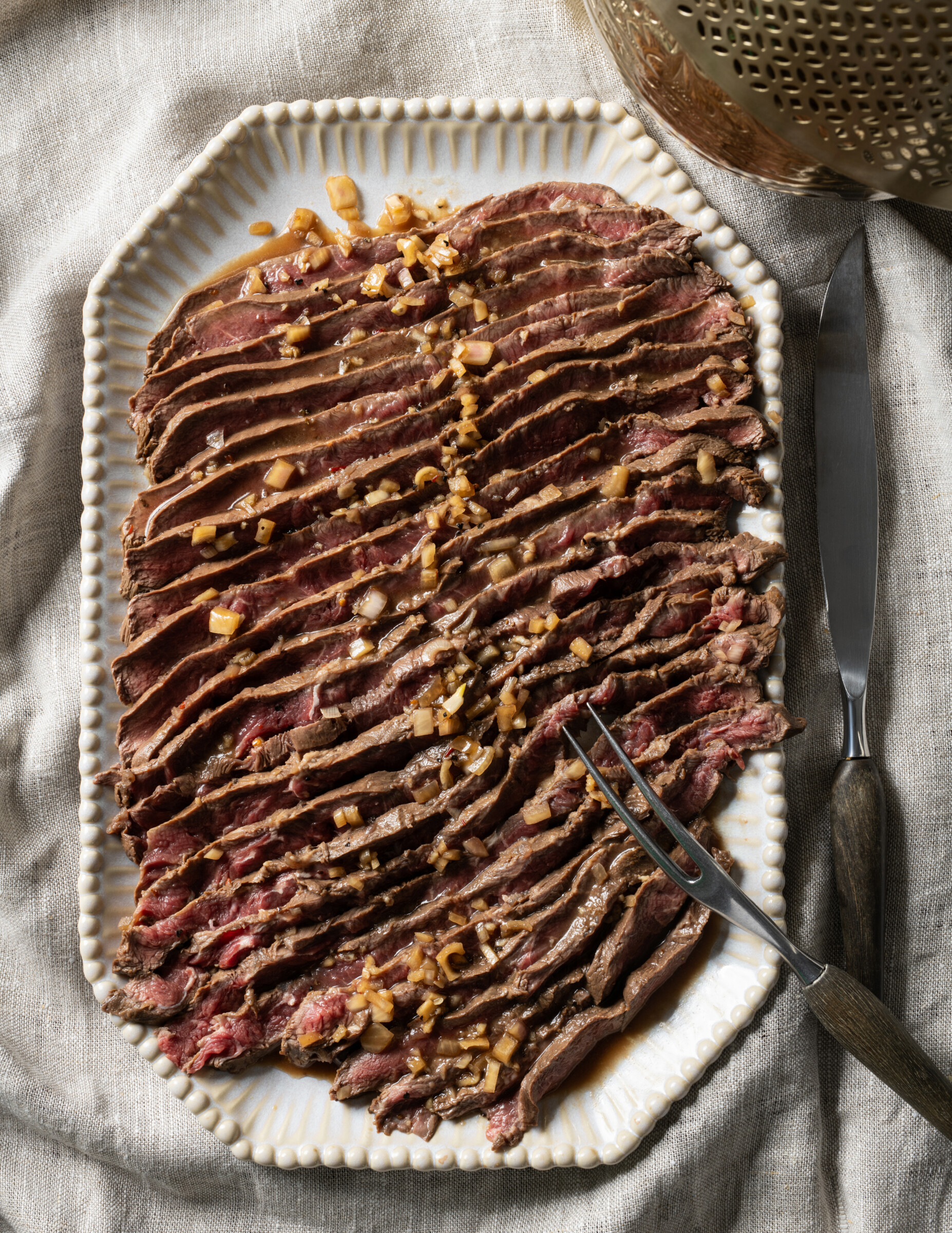 Mishpacha
A perfect meat will take center stage at any meal.
Serves 6
Preheat oven to high broil.
Combine all marinade ingredients in a large ziplock bag. Shake well.
Pat the meat dry and add it to the resealable bag. Turn to coat evenly. Allow meat to marinate for 10 minutes.
Transfer the meat and marinade to a 9x13-inch (23x33-cm) baking pan. Broil for 2–3 minutes. Turn meat over and broil for an additional 2–3 minutes, until internal temperature reads 125–130°F (52–54°C) for medium rare.
Serve warm or at room temperature.
Tip: This recipe works on any medium-rare meat, such as London broil or French roast. Adjust cooking time accordingly.
 Mishpacha
These delicious chicken balls can be used either as an appetizer or as an entrée.
Yields 30 chicken balls
To prepare lemon-basil dipping sauce, combine all ingredients in a small bowl. Whisk until completely smooth. Set aside.
Combine all chicken ball ingredients in a bowl and mix well. (Do not overmix, as that will toughen the meat and yield dense balls.) Using a 1-Tbsp cookie scoop, form the mixture into balls.
To prepare the coating, place crushed crackers in a small bowl.
Whisk the egg, water, and chili-lime seasoning in another small bowl.
Dip each ball into the egg mixture, allowing the excess to drip off. Next, evenly coat each ball with the crushed crackers.
Heat a thin layer of avocado oil in a large skillet over medium heat. Add chicken balls in batches to avoid overcrowding. Brown the chicken balls on all sides for 6–8 minutes, until cooked through.
Transfer to a plate with a slotted spoon. Serve with lemon-basil dipping sauce or store-bought sweet chili sauce.
 Mishpacha
Some of the best recipes are a result of playing with food. I’m so happy I played here. The results are nothing short of fabulous.
Serves 6
Bring beef broth and tomato paste to a boil in a 2-quart saucepan. Add quinoa. Reduce heat, cover pot, and simmer for 18–22 minutes, until liquid is absorbed. Remove from heat; fluff with a fork.
Heat a large skillet over medium heat. Add oil. Add onion and sauté for 5 minutes. Add garlic and stir for 30 seconds, until fragrant.
Stir in spinach, pecans, and sun-dried tomatoes. Sauté for 2 minutes. Add vinegar, lemon juice, salt, and pepper and cook for another 1–2 minutes. Remove skillet from heat and stir in quinoa.
Serve at room temperature.
MishpachaIn episode nine of The Learning Curve, Rabbi Schonfeld and Rabbi Garfield discuss if you should bribe kids not watch the superbowl, how a parent should approach poor Purim behavior, and welcome Rabbi Yoel Kramer, a chinuch legend, to the podcast to explain what makes a great Rebbi. Season sponsored by Israel Bookshop Publications
Shop now at https://israelbookshoppublications.com
 Mishpacha
Facilitated by Faigy Peritzman
T
he first thing you need to understand is that davening is mostly about building a relationship with Hashem. In any relationship, there needs to be two-way communication. I speak to you; you speak to me.
Okay, so what does that look like in a relationship with Hashem?
We talk to Hashem through davening. Hashem talks to us through Torah, through nature, and through messages from other people.
But davening isn’t just about the siddur. Davening has two parts: scripted communication and unscripted communication. Just like in a relationship with a human being, there are certain things we say because those are the prescriptive expected phrases and they have the power to create a real feeling appropriate for specific occasions. Thank you for coming. Happy anniversary! These scripted phrases grease the wheels of social human interactions.
But if the whole relationship is about scripted communication, where it’s difficult to attach real meaning, then it’s neither organic or genuine. What Hashem really loves to hear is our unscripted communication. This is the impulsive “Thank You, Hashem!” when you find a parking spot or “Please, please, Hashem” when you’re waiting for test results from the doctor.
Hashem craves, so to speak, our unscripted communication because that’s the true glue of our emotional and spiritual connective relationship with Hashem as our Heavenly Father. Meaning, how you talk to someone impulsively and spontaneously says more about your relationship than what you read from a script — even an extremely holy and powerful script.
So, as a woman, you actually have the luxury of keeping the scripted communication, which is still extremely valuable and holy, but which you find hard to relate to, to a minimum, and your unscripted communication with Hashem, which hopefully feels more natural and “real” to you, to a maximum. In this way, you’re fulfilling the true purpose of prayer: building a real and connective relationship with Hashem.
Ruchi Koval is a parent coach, author, kiruv rebbetzin, and public speaker who helps parents struggling with their teens and adult children.
Y
ou want to speak to Hashem in your own words, and sometimes the siddur feels in the way. Chazal gave us a fixed text to support — not replace — our relationship with Hashem.
Many share your frustration: It’s hard to fit the specifics of your life into words that seem so general. If we are all saying the same thing, where is my connection? How can these shared lines carry my private heart?
A mashal helped me: My grandmother a”h sent a birthday card every year. I wasn’t the only one; all the grandchildren received cards. Yes — thousands of the same Hallmark cards existed. But she underlined the phrase in the card that showed why she chose that particular one — the line that conveyed, “This is you.” Those underlines turned a mass-printed message into a personal conversation. I still felt seen.
The siddur works the same way. The words are the card; your kavanah is the underline. When you pick a greeting card, you read to discover which printed message reflects your feelings. Do the same with tefillah. Before you begin, pause and ask: “What part of this tefillah speaks to my life today?” In Shemoneh Esreh, linger on “Hashem, sefasai tiftach” when you need help to daven, “chonein hadaas” for clarity, or “shema koleinu” when your heart is full. Underline with attention — slow down, stress a word, add a whisper in your own language before or after the printed line about what the words mean to you. Let the fixed text become a foothold for a personal conversation.
Small steps are holy steps. Chazal teach that it is better to say less with kavanah — thought and reflection — than more without that personal inflection. Read slowly. Ask, “What am I actually saying?” Bring one concrete detail of your day to that line.
Don’t wait to feel to speak; often speaking grows the feeling. The goal isn’t fireworks; it’s honesty. “Hashem desires the heart — Rachmana liba ba’ei.” Even an underline, quietly, can be precious in Shamayim.
Elisheva Kaminetsky is a wife, parent, grandparent, principal, adult educator, consultant, and kallah teacher.
M
any women quietly share this ache; I show up, I say the words, and yet I feel disconnected and frustrated with myself for feeling that way. It can be painful to pick up a siddur or Tehillim and wonder why the words don’t seem to lift us the way we believe they should.
Part of the struggle is that we live in an olam ha’asiyah, a world of doing. We’re conditioned for productivity, efficiency, and quantifiable outcomes. Tefillah, however, asks something very different of us. At its core, tefillah is less about doing and more about being in a spiritual and emotional state of connection with our Source. That can feel unfamiliar, even uncomfortable, in a world that doesn’t appreciate the stillness of introspection. We so value accomplishing, that simply being present, with our thoughts, longings, confusion, or pain, can feel elusive and even pointless.
Chazal understood this tension. The words of tefillah give us structure, but they aren’t meant to replace the inner world of a person. They’re meant to contain and articulate it.
This is why the quiet plea at the end of Shemoneh Esreh is so powerful: “Yehiyu l’ratzon imrei fi v’hegyon libi lefanecha.” We often translate this as asking Hashem to accept the words of our mouths, but it explicitly includes the meditation of my heart. Hashem receives not only what we manage to articulate, but also what remains unsaid and even unformed.
This means that frustration itself can become part of tefillah. The disconnect you feel isn’t proof of failure, rather it’s information about where your heart actually is. When you stand before Hashem and think, I wish this felt different, that thought itself is already an expression of relationship. Tefillah doesn’t demand spiritual perfection. It invites emotional and spiritual honesty.
For many women, connection comes from allowing small moments of truth. One line that resonates. One pause to acknowledge: This is hard for me today. One quiet recognition that Hashem is with you even when the feelings are muted.
In a world obsessed with doing, tefillah gently insists on being. Being tired. Being hopeful. Being disappointed. Being real. And in that space, sometimes slowly and unexpectedly, connection can begin to take root.
Shevi Samet is a wife and mother, educator, kallah teacher, and Core MMC.
(Originally featured in Family First, Issue 982)
 Mishpacha
Photo: Flash90
WE
know President Trump always prioritizes economic benefits when weighing decisions. Whatever option he ultimately chooses regarding Iran — be it military action, regime change, negotiation, or some combination of the above —he must consider both the financial burden Iran’s current government imposes and the potential economic gains if a new regime replaces the current one.
To appreciate the scale of these economic considerations, it is important to examine the costs associated with military engagement.
According to the Costs of War project at Brown University, the United States has spent nearly $34 billion since October 7, 2023, on conflicts involving Iran’s so-called “3-H proxies” — Hamas, Hezbollah, and the Houthis. The US has allocated $22 billion to support Israel and directed an additional $12 billion to other allies and to its own military actions. Notably, this total is almost six times the typical annual US spending on military aid to Middle Eastern allies.
America’s current military deployment against Iran is costing it approximately $30 million per day, based on comparable estimates from the US military campaign against Venezuela.
These expenses underscore the urgency for the US to pursue alternatives that could deliver economic benefits, but only if a gentler, kinder government replaces Iran’s current regime.
In 2016, shortly after President Obama endorsed the Iran nuclear deal, McKinsey released a study estimating Iran’s economy could expand by $1 trillion over the next two decades. This projection was largely optimistic, assuming Iran would comply with the agreement and beat its centrifuges into plowshares, but that potential remains.
A more recent analysis by the Quincy Institution for Responsible Statecraft (June 2025) suggests that the US could export $25 billion annually to Iran, mainly in sectors such as aviation, agriculture, and automotive manufacturing. These exports could create 200,000 jobs for aerospace workers in Washington state, grain farmers in the Midwest, and auto parts manufacturers in the Rust Belt.
Despite potential incentives and economic benefits, Iranian leaders continue to rattle their sabers. The Islamic Revolutionary government won’t change, even at the risk of self-destruction.
Yet for the US to achieve meaningful change in Iran, it must clearly define its objectives and demonstrate resolve. The Trump administration claims it is acting wisely, pursuing negotiations and preparing for war. It’s a time-honored tactic that includes the art of deception, but Middle Eastern nations can easily misinterpret it as a show of weakness and a lack of resolve.
On the one hand, it’s hard to believe the administration would suddenly do an about-face and withdraw all of the military assets it dispatched to the region at great expense, including an aircraft carrier group and another on the way, advanced fighter jets, and anti-missile systems, without achieving any tangible results.
However, the time is approaching when the administration risks undermining itself by pursuing mutually exclusive agendas and contradicting its own positions.
President Trump said last Friday regime change is “the best thing that could happen” in Iran. But Vice President J.D. Vance told a Forbes reporter last week that “if the Iranian people want to overthrow the regime, that’s up to the Iranian people.”
Regime change will not occur spontaneously. We already saw the consequences when the Iranian people took to the streets, and the regime’s forces mowed down tens of thousands with automatic weapons. They continue to repress dissent with violence.
Vance added that America’s overriding concern is ensuring Iran doesn’t obtain nuclear weapons. That’s not going to reassure Israel, which is equally concerned about Iran’s ballistic missile threat, the money Iran continues to pump into its proxies, and the upgraded weapons systems China and Russia are pouring into Iran, according to open-source intelligence.
Trump’s own D-Day — the day of decision — is nearing. Maybe he’ll elect to wait out the month of Ramadan to avoid inflaming the Arab street, but the choice is stark. Either go to war, in which case you can never know all the consequences in advance; or make a deal you can be certain the other party won’t honor.
Israel is standing by, along with many other parts of the world that would like to see Iran’s 47-year reign of international terror come to an end, one way or another.
Canada abolished its Office of the Special Representative on Combating Islamophobia following widespread concerns, according to the Middle East Forum, that the office “blurred the lines between anti-Muslim bigotry and legitimate concerns expressed by secular Muslims and security agencies about the influence of Islamist actors within Canada’s Muslim leadership.”
By sending Foreign Affairs Minister Gideon Saar to this week’s meeting of President Trump’s Board of Peace for Gaza, Prime Minister Netanyahu is delivering a subtle signal that he lacks confidence in the process.
Bibi claims he can’t return to Washington a second time, after just getting back from last week’s meeting with Trump, even if that also means skipping his personal appearance at AIPAC.
He doesn’t need a pretext. Judging by the latest spike in Hamas ceasefire violations, Hamas is bored with peace and in no hurry to demilitarize.
Netanyahu’s stance is a further indication that he accepted Trump’s 20-point Gaza plan to achieve his goal of returning all Israeli hostages from Gaza, assuming the next stages of the plan would fail and he would instruct the IDF to finish the job it started.
Critics argue that even if Israel eliminates Hamas as a military and political power, it still lacks a plan for the “day after.”
The solution lies in the approach: If the IDF is the only force that can eliminate Hamas, it’s the only force to control it the day after. Once it’s clear the IDF is there to stay, the Board of Peace can redirect its focus to Trump’s original idea of relocating Gaza’s residents to greener pastures.
A new Congressional Budget Office estimate predicts that the US government will pay $1 trillion in 2026 just to cover interest on the nation’s $38 trillion debt. The total federal budget, across all categories, never exceeded $1 trillion until 1986 — 40 years ago — and now that sum will cover only interest payments.
(Originally featured in Mishpacha, Issue 1100)
 Mishpacha
As told to Rabbi Moshe Dov Heber by Shneur Steinberg
I run a hospice in Michigan, and over the years, I’ve seen many moments of pain and many moments of quiet courage. But one recent experience will stay with me forever.
A few months ago, I received a phone call from the sister of one of our patients, Jeremy Hoffman, who was living in a nursing facility but receiving hospice services from us. The woman’s voice trembled as she spoke. She explained that she couldn’t travel to be with her brother, and he had no other family. She’d had no choice but to ask the court to appoint a state guardian for him. From that point on, every decision about his care was out of her hands.
Not long ago, she told me, she’d sent a friend to visit him. The friend’s report was painful. “Jeremy doesn’t look well,” she said. “He hasn’t had a haircut in a long time, and his clothes aren’t clean.”
His sister was crushed. She felt helpless knowing her brother was alone in a nursing facility and she couldn’t be there for him. Now she was turning to me. “Now that he’s in hospice, is there anything you can do to help?”
I called the nursing facility immediately, but they said there was no way for Jeremy to get a haircut. Undeterred, I made several calls and finally found a barber willing to come to the facility. I would need to drive him, wait for him, and drive him home once he was done. I agreed; it didn’t feel like a big thing, just what had to be done.
After the haircut, I texted Jeremy’s sister a picture of him. She was so grateful. We spoke on the phone again, and I asked her for her name. “Helen Adler,” she said.
“That sounds Jewish,” I told her. “I’m Jewish, too.”
She paused and then said, “Yes, I’m Jewish, and so is my brother.”
 Mishpacha
**Zara Lace Trim Knit Cardigan
This Zara lace trim cardigan is one of those rare pieces that works equally well as a top or a layer. The mink color hue feels fresh yet classic for winter and pairs with everything from a denim skirt to a dressy, statement-patterned skirt. It adds texture, warmth, and just the right touch of femininity.
**By Téss Avery Maxi Dress
By Téss continues to be one of my go-to tzniyus brands for elevated basics that truly multitask. This stretchy maxi dress is flattering, thanks to its adjustable ruching. Add a jacket, belt, and accessories for nighttime, or style it with a cozy cardigan for daytime — plus, it comes in black and brown.
**Yakira Bella Mina Zip-Up Jacket and Skirt
This is the ultimate throw-on-and-go set that instantly makes a comfortable outfit feel polished and intentional. A true closet staple, it works just as well after a workout, carpool run, or errands. Layer it with booties and a blazer for an easy look that transitions seamlessly into the rest of your day.
**By Téss Black Slip Skirt with Lace Trim
This By Téss slip skirt — with its delicate lace hem — adds a refined twist to a classic. You’ll be pleasantly surprised by how often you reach for it: Oversized sweaters, blazers, turtlenecks, tees, even hoodies all look more put together thanks to the subtle detail.
**Commense Black-and-White Rib-knit Skirt and Cardigan
This black-and-white ribbed knit skirt set defines effortless — it looks pulled together with no effort at all. Dress it down with sneakers and a beanie or elevate it with heels and statement earrings.
**Commense Pleated Cinched-Waist Metal Button Blouse
A crisp, structured white button-down is the kind of wardrobe workhorse you’ll wonder how you ever lived without. Wear it with a simple slip skirt for an everyday chic look, or pair it with a dressier skirt and statement necklace for a simchah-ready ensemble. Clean, modern, and endlessly versatile.
**Sam Edelman Liona Loafer in French Merlot
A great loafer is an easy way to elevate an outfit, and this vintage-inspired Sam Edelman pair in a rich French Merlot shade does exactly that. It adds instant polish to even the simplest looks, from workout wear to Friday night. For a trend-forward touch, try styling it with a lace or textured crew sock.
Amazon Women’s Sweater Dress Trendy Color Block Fall Winter Long Sleeve Dresses with Silky Smooth Hem
The subtle color-block detail of this knit and silk sweater dress gives it a fresh, modern feel. Switch it up — it’s perfect for a cozy Friday night, styled with boots and a jacket for dinner, or pair it with sneakers or loafers for a polished daytime look. The price point makes it even more appealing, especially for a piece that feels this well made.
**Cider Collar Solid Belted Metal Detail Long Sleeve Blazer
I’m always drawn to a blazer that can double as a dressy top and instantly add edge to any outfit. The gold detailing on this one makes it feel especially intentional, while the belt adds shape and a layer of interest that elevates the entire look.
(Originally featured in Family First, Issue 982)
 Mishpacha
M
odern mothers are all too aware of their human limitations. They tend to blame themselves for their children’s problems. Perhaps they didn’t listen well enough, say “I love you” often enough, give enough or take away enough. Perhaps they were too distracted, too busy, or too bossy. They know that they must have failed in a million ways because they know they’re imperfect. What they erroneously think, however, is that this imperfection has ruined or will ruin their children.
I recently read a disturbing book that documents the experiences of a family with 12 children, six of whom suffered from schizophrenia. The story was disturbing for many reasons, but what stood out most strongly was how much blame those in the story placed on the mother for her children’s condition.
What’s interesting, though, is that the mother wasn’t having any of that. She didn’t see it as her fault. There’s a lot we modern mothers can learn from her confidence.
The protagonist, Mimi, was a woman who did her best to raise ten sons and two daughters while her husband was mostly absent (first due to work and then due to illness). Six of her sons were extremely ill. Their story involves violence, murder, suicide, and abuse — the extreme consequences of extreme mental illness. Mimi ran her own “hospital ward” in her home, looking after these dangerous young men until her own death in 2017.
The boys were studied by the National Institute of Mental Health as part of ongoing research hoping to discover the cause and appropriate treatment of schizophrenia. However, the first explanation given to the parents was the one that was in vogue in the mental health profession in the years spanning 1940 to 1970: It was all Mimi’s fault_._ Mimi was declared to be a “schizophrenogenic mother” — the cause of her boys’ severe illness.
A schizophrenogenic mother was described as a parent who was simultaneously overprotective and rejecting, both cold and too involved or controlling. I believe that this description can apply to any mother at different times of any parenting day! According to the professionals, the competing traits were thought to create a “double-bind” that produced confusion so intense as to cause psychosis in young people.
Fortunately, both Mimi (and her husband) rejected the explanation and went on to search for medical treatment for their sons.
It took 30 years for the mental health profession to discard its “bad-mothering” theory of schizophrenia in favor of a biological model. Schizophrenia is currently viewed as a neurodevelopmental disorder rooted in a complex interaction between genetic material, brain structure, and environmental stressors including substance abuse. But during those years when the cause was attributed to confused parenting, innumerable parents, already suffering from the excruciating mental health conditions of their children, suffered even more anguish because of the blame heaped upon them by the mental health professionals they turned to for help.
Mimi knew how much love she gave and how hard she worked to take good care of her sons but one of her daughters, Lindsay, found fault with her. She thought that Mimi was too focused on the boys and didn’t pay enough attention to the two girls or the four other healthy siblings. All the attention, it seems, went to the sick brothers.
My thought about this was — “No kidding!” There were 12 children, one ill father, and one mother. Of the 12 children, six were very unwell. Should Mom have paid more attention to young Lindsay and the others? Of course! But realistically speaking — could she have done so? I don’t think so.
Mothers are limited human beings with limited energy and resources. But if Hashem had wanted one mother to be able to perfectly meet the needs and fulfill the wishes of each of her children, He would have made her without human limitations. If her perfection was the requirement for the production of a healthy child, then her perfection would have been part of creation.
It wasn’t.
From this, we can see that the natural imperfection and lacking that a mother necessarily brings to the task of raising children is actually good for her children (why else would Hashem create it?). Not getting what they want when and how they want it doesn’t make children ill or dysfunctional. If they become that way, it’s for many complex reasons. The mother who does what she can humanly do is doing enough. Mimi knew this and we should know it, too.
(Originally featured in Family First, Issue 982)
 Mishpacha
“IF you never had a refrigerator on your toe,” my sister wrote in her eighth-grade yearbook, “you cannot understand my happiness at having it removed.”
A couple of weeks ago, my big pareve pot encountered fleishigs. Or did it? In hindsight, it’s hard to know, because I did what every Jewish woman does when she sees her pareve utensils where they aren’t meant to be: Scream. And wash it quickly in cold water.
What’s relevant here is that my husband couldn’t be sure of the pot’s status. He suggested we reenact the crime in order to render a verdict — place the pot on the burner on top of the oven vent, to see if the steam that reaches from the oven broiler is yad soledes bo. My daughter, who’d wandered in after her father (what teenager doesn’t want to be privy to every mundane conversation her parents have in hopes they unthinkingly spill a state secret?) made her pronouncement: The pot was fine.
When I checked, I thought it was fine. But I have Mommy hands. When my husband put his hand over the burner, he jumped back. Under the circumstances, he thought it best to consider the pot fleishig.
I went through my own five stages of grief. Denial: It’s very hard to treif up a kitchen. This can’t be! Anger: Who was silly enough to put the pot somewhere it could be contaminated by meat?! (Me.) Bargaining: Okay, not so much. Would I really never yell at my kids for cutting half an onion with a milchig knife just because I had my pot drying on the vent-burner while meat was broiling underneath it? Of course not. Depression: This is a good pot! Almost 20 years old, purchased on a huge sale, and you know they don’t make things like they used to. It’ll probably cost $100 to replace this pot with something equivalent, and we’re not made of money. Acceptance: What’s $100 when it comes to a mitzvah? Take it! Take all my money. And break my oven — and my washing machine — at the same time! (True story.)
It was a process. I trudged through the next two weeks unmoored, doing things I never do. I made onion soup with butter and mushroom-barley soup with meat. On Friday, I went way out of my comfort zone and made popcorn in my is-this-fleishig pot, because, as my husband pointed out, we weren’t eating it with milk anyway. I washed the pot in the fleishig sink and threw the once-pareve-now-who-knows-what scrubber in the garbage.
Finally, I called the beis hora’ah. Turns out the rav on call knew exactly what was going on, had tried similar halachic experiments of his own, and gave me an eitzah for kashering.
It was like a weight lifted. I was giddy at the thought of resuming my life without worrying about researching recs and looking for bargains. Which is pathetic. All this to-do about a pot! Do you know that there are people out there with real problems?
It’s a pot. If it came to it, which it didn’t, thankfully, replacing it would have been $100. That’s money, don’t get me wrong, but it’s not a vast sum. It’s not an emergency. And yet I can’t shake the feeling of having escaped. I wasn’t ready to part with my pot, which I’d bought as a bright-eyed kallah. It had been $20, on sale at Macy’s.
I can make soup again! I can put the leftovers in the freezer to take them out at will. I can nosh on lokshen kugel and drink my coffee at the same time. I can sauté onions and leave them unlabeled in the fridge.
It’s okay, I don’t expect you to understand. After all, you never had the refrigerator on your toe.
(Originally featured in Family First, Issue 982)
 Mishpacha
One of the most common types of advice and guidance I am asked for is how to handle it when someone wrongs you. I can probably fill my word count for this column with stories galore, but I will suffice with the following brief examples.
The person who wasn’t invited to a friend’s simchah. Someone who had never been invited to a particular person’s home for a Shabbos meal. Someone who was on the receiving end of a nasty comment at a kiddush. An employee who was publicly called out by his employer at an important work meeting. Someone who was left out of a critical family decision. A talmid who suddenly stopped speaking to his rebbi. A mechutan who made a choice regarding the wedding without seeking input from the other side. And on and on.
Before I accepted my position as a rav, a prominent askan gave me a very important piece of advice: “You need to have thick skin and learn to allow people’s comments and opinions to roll off your back. If you take the comments too seriously, you won’t make it.”
He was absolutely correct. In close to two decades as a rav, I’ve heard countless times, “Rabbi, I just have some constructive criticism to share with you.” I can now claim a fair share of experience in handling personal affronts. I would like to share three important perspectives on this topic that I have found to be effective in dealing with offensive actions and words.
The first approach is to consider the alternative and be prepared to look at a painful situation differently, even when it seems so patently clear that the other party is wrong.
Let’s consider the following scenario. Someone makes a demeaning remark that causes you pain. One way to respond is to lash back. A second response is to dismiss the person. However, did you ever try the following?
Look at the situation from another angle. Consider whether the person who made the disparaging remark was ever given the proper tools to handle his rage. Maybe the person was never trained properly by his parents or family in how to react when things didn’t go their way? Additionally, maybe this person has had such a hard life, and from adolescence through adulthood, nothing has gone his way. If so, there is no reason to respond strongly, as the circumstances of this individual’s life do not allow him to react appropriately. Instead, try to see the situation in a different light and judge the person favorably.
This was exactly the scenario that was recently brought to my attention. Someone came to talk to me about a very inappropriate and nasty insult that he received. He shared with me the name of the offender, and I wasn’t surprised in the least. I explained to the person how sad it is that the perpetrator doesn’t know any other mode of communication. Try to consider the challenges this person has, recognize that, and allow that to chart your path forward. It doesn’t mean that you need to be his friend, but at least appreciate the challenges he has and do your best to consider this factor now and in potential future interactions.
I then shared the following story with the person. A sefer was written by an individual that contained chapter after chapter of refutations to various responsa of Rav Moshe Feinstein in his Teshuvos Igros Moshe. The author compounded this by loading his work with scornful and derogatory statements against Rav Moshe. This author then brought his manuscript to the very same typesetter and printer who published Rav Moshe’s seforim.
Seeing the contents of the work, the printer immediately contacted Reb Moshe and explained the situation to him and asked Reb Moshe what he should do.
Rav Moshe replied, “One who writes a sefer quite often needs it to supplement his income and achieve renown. One is obligated to do another Jew a favor. You depend on printing to earn your livelihood. Go ahead with the sefer’s publication.” (Recounted in Reb Moshe, ArtScroll expanded edition, page 449.)
While Reb Moshe’s pious ability to consider the alternative is difficult to imitate, it obligates us to think twice when we are wronged. Rav Moshe understood that just as effort must be made to unravel and decipher the depth and meaning of a challenging gemara, a difficult Rambam, or a problematic psak, so must effort be made in every challenging situation and with every difficult person.
With his sensitivity, wisdom, and judiciousness, Rav Moshe recognized that there is an entirely different way to learn this difficult sugya, and he emerged with an alternative conclusion. Be open to another possibility and challenge yourself to look at things differently.
The second approach is to shake off, let go, and wave away the offense and the offender.
The Torah explicitly commands us not to seek retribution from an egregious offender, as the pasuk states, “Do not reject an Egyptian, because you lived as a stranger in his land” (Devarim 23:7).
This is remarkable. The Jewish nation had been brutally enslaved by the Egyptians for hundreds of years and would be completely entitled to feel a lingering resentment. Yet Hashem commands us not to bear the Egyptians any ill will. How is that possible?
Hashem is teaching us that at some point we must move on and let go. The only way to transition from being a slave nation to a redeemed nation is by letting go of the sorrow and misery that we experienced at the hands of the Egyptians. If we hadn’t let go, we would have remained emotionally and cognitively in Egypt forever. By letting go, we became a free nation and the chosen nation.
Chazal stress this very point on an individual level as well. The Gemara states, “Our sages have taught that about those who are insulted but do not insult others, who bear their shame but do not respond, who act out of love and are joyful in their suffering, the verse states: ‘And they that love Him are as the sun going forth in its might’ ” (Maseches Gittin 36b).
Chazal are teaching us that the wisest and best approach for dealing with those who wrong us is by simply letting go. The Sefer Hachinuch explains that this technique, while not easy, is the way that great people live (Mitzvah 338). Holding on to the injustice will hold a person hostage, emotionally and cognitively, to the situation. Relinquishing one’s claim allows for detachment from the entanglement and thus complete freedom.
While contemporary psychological studies and research prove that letting go is the healthiest way to move on after being mistreated, I personally witnessed this at work. My grandparents, all Holocaust survivors whose entire families were murdered at the hands of the Nazis, never looked back, never blamed, and never articulated negativity.
Instead, they let go of the golden life they had, let go of the torment they experienced, and let go of the agony they endured. They moved forward, built beautiful families, successful careers, and defeated Hitler by letting go. Indeed, tens of thousands of such individuals rebuilt their lives and our nation. With incredible fortitude, they let go and rebuilt a broken nation to a glorious nation.
Of course, we can never judge the feelings of anyone who endured the Holocaust. But we can learn from our ancestors how to “forgive and forget,” “let bygones be bygones,” and to “bury the hatchet,” on a personal and national level.
The third approach is found in the writing of the Rishonim. We must understand that everything that happens to us comes from Hashem. For some this may be the hardest approach, and for others the easiest.
The Sefer Hachinuch (Mitzvah 241) begs us to take his words to heart and know “that everything that happens to man, be it good or bad, is an orchestrated event brought about from Hashem, and that no matter occurs without the will of Hashem. So when another person causes him pain or suffering, he should realize that his own sins were the cause, and that Hashem decreed this injury or suffering upon him.
“Therefore, he should not focus his thoughts on taking revenge on the one who has harmed him, since that person is not the cause of his distress. Rather his own sin is the true cause. As King David said when Shimi ben Gera heaped curses upon him, ‘Leave him be and let him curse, for Hashem has told him to do this.’ That is, that King David blamed the matter on his own sin, rather than on his antagonist, Shimi ben Gera.”
The Sefer Hachinuch, following the approach of the Chovos Halevavos, understands that “no person or other creation can harm another without Hashem’s permission” (Shaar Habitachon 3). With this attitude, we can walk through life with a protective shield against anyone who wrongs us. Everything that occurs is from Hashem, including the affronts that come our way. This approach requires study, work, thought, wisdom, and perseverance.
Rare is it that one goes through life without any unpleasant altercations. Each of us suffers insults, wounds, slights, offenses, or affronts on some level. When this happens to you, consider these three approaches to ensure a proper response cognitively, emotionally, spiritually, and verbally. This will calm you, internally and externally, and give you the greatest reward in this world and the next.
Rabbi Moshe Walter is the rav of Woodside Synagogue Ahavas Torah in Silver Spring, Maryland; the executive director of the Vaad Harabbanim of Greater Washington; a popular speaker; and the author of the Making of Halachah, Minhag, Mentsch, and Siddur series published by Feldheim.
(Originally featured in Mishpacha, Issue 1100)
 Mishpacha
W
hen I was a kid, my parents owned an exercise bike. It sat in our basement — black and chrome and perfectly serviceable. I tried it a few times, pedaling frantically to nowhere.
It was boring work.
When I started exercising regularly, I didn’t consider adding indoor cycling to my routine, even though we owned an exercise bike. It belonged to my husband. I rarely thought about that exercise bike in my parents’ basement, but it must’ve made an impression on me. When I looked at his bike, I felt the same thing all over again — boredom. If there’s one thing that can squelch the inclination to exercise, it’s boredom, so I kept my distance. A while later, he got rid of the bike because he disliked it. I felt smug validation.
He told me it was the bike itself he disliked, not the activity. Being completely impartial because I had no plans to ever use it, I helped him choose a new one, never considering my preferences because it was irrelevant.
Then the bike came, and it actually looked inviting. It was sleek and easily adjustable. The design made me want to get on and take a ride. I felt a pull. Maybe it was time to reassess that automatic aversion I felt toward exercise bikes, I thought. I ordered a pair of cycling shoes. Then I tried a few cycling classes using a fitness app. To my surprise, I found I really enjoyed it.
I think timing had something to do with it. The bike came at a time when my fitness routine was starting to feel a bit too set, too regular. It needed a shake-up. Experts have long advised varying your fitness routine to avoid fitness plateaus. When you keep doing the same exercise all the time, your body becomes accustomed to it, so you can lose strength and endurance. One way to avoid this is to ramp up the challenge within the activity you’re already doing. But another way is to add something new.
Cycling is doing just that for me.
It’s a couple of weeks now and I’ve added a cycling class to my weekly routine. It meant cutting another cardio workout, but the variety makes it worth it.
Biking is gentle on the joints. It’s great for beginners or those who need a break from high-intensity workouts. The low impact protects joints and strengthens the muscles that protect the hips, knees, and ankles.
While biking can’t take the place of regular strength workouts, it still builds muscular endurance. When you intensify the resistance, it builds leg strength. You use your arms and core for stability and posture.
An intense biking session can get your heart pumping and your blood flowing. This also improves lung capacity, and overall is an excellent aerobic workout. Consistency will improve your stamina allowing you to ride harder and faster.
Post-ride endorphin and serotonin release makes you feel happier and less stressed. It’s also good for a mental reset. You can either focus on your workout or let your mind wander, which gives it a break from daily busyness.
If you have a regular fitness schedule, incorporating an activity you don’t normally do allows your muscles to rest between more intense workouts. This prevents injuries and boosts performance. It’s a good break for runners, walkers, and HIIT athletes.
“If you enjoy the outdoors and you enjoy beautiful scenery, and that’s part of the reason why you enjoy biking, you’ll find a cycling class very different,” says Bluma, an avid cyclist who’s done charity bike-a-thons and has biked as much as 60 miles.
The input is different when you cycle outside, she says. “An hour cycling class is the equivalent of biking two hours outdoors,” she says. “When you’re on an exercise bike, you’re pedaling the entire time. When you’re biking outside, you’re going uphill, downhill, sometimes you’re coasting. You’re not working the entire time.”
Some cycling classes try to ramp up the intensity by working additional muscle groups.
“Sometimes in a cycling class, they’ll also have you do different exercises, such as bending forward, standing up, or using weights,” she says.
Indoor biking can also be a safer choice. You don’t have to worry about weather conditions, traffic hazards, or nighttime biking. If someone has balance issues, a stationary bike can give the same benefits as outdoor biking without the worry of falling.
Cycling didn’t just change my workout. It reminded me that we need to check in with ourselves to see if our fitness routines are working for us. When they aren’t, and we need to add something new, sometime it’s worth looking at something we once dismissed.
(Originally featured in Family First, Issue 982)
 Mishpacha
IT
makes no sense, when Miriam thinks about it, that children are only children for a decade or two. That those pivotal years, the ones that will define them, are so brief, just a flicker of time in their lives before adulthood. She still likes to think of Devorah as that freckle-faced five-year-old, her little fingers clutched around Miriam’s pinky as they first walked into her kindergarten class.
That image is all tangled up with Devorah as a teenager, rolling her eyes at homework and on the phone until after midnight. With Devorah as a beautiful kallah, standing beside a grinning Elchonon, her face glowing. With Devorah as a mother herself, lounging beside Miriam at the park near Miriam’s house, watching her five children shrieking with joy on the swings.
But Devorah will always be that freckle-faced five-year-old to Miriam, even if that comment makes her sigh long-sufferingly over the phone. “I didn’t even have freckles, Ma. You’re remembering it wrong. Shani was the one with freckles.”
No, Devorah had kept those freckles until adolescence, strong in the summer and barely there in the winter, until they disappeared in her teenage years. Miriam remembers it perfectly.
But with age comes wisdom, and the understanding that her conversations with Devorah are too precious to be wasted on disagreements. Shani and Rina call constantly, but Devorah has always been a little less willing to schmooze. Now that she lives across the country, the Friday calls are just about all Miriam gets of her.
“Maybe she was,” Miriam says easily. “Nu, tell me, what’s going on with the kids? How are the boys?”
“Running wild, as they always do,” Devorah says, laughing. “I see them when they come in for bedtime. Sarala has stopped playing with the boys on the block, though. She says they’re too crazy.”
“She’s really growing up into a little lady.” Sarala is five and freckled (just like her mother, mind you), on the verge of figuring out who she is outside of her older brothers. “And the babies?” Miriam can hear one of them kvetching in the background. The little ones are needy, always lingering close to Devorah, and Miriam remembers how her own daughters had been clingy at that age, too. “Send more pictures, will you?” Devorah comes every Succos and Pesach, her family spreading across her childhood house like a welcome tornado, and Miriam is only too happy to play the doting grandmother, but she misses the kids fiercely in the months in between.
She tries to imagine the children scattering across their own house, which she’s only visited once, when Devorah first moved in. Devorah’s Brooklyn house is small, and she prefers to fly to California instead of hosting.
Miriam doesn’t mind. Elchonon’s job is taxing, and Devorah works so hard. She can use the break. “Elchonon still working long hours?”
“Always. He tries to get home in time to do homework with the boys, but it doesn’t always happen.” One of the kvetching babies lets out a strident shriek, and Devorah sighs. “I’ve got to go. Talk to you.”
The phone clicks off, and Miriam holds on to it for another moment, thinking wistfully of that little girl who had once clung to her with absolute dependence.
 Mishpacha
IT’S
seminary acceptance season. Twelfth-grade girls are navigating the process, with many bound for Eretz Yisrael. Simultaneously, their parents experience both eagerness for an idyllic experience and dread at the price tag. At many a Shabbos table, the debate about seminary in Eretz Yisrael centers on whether this post–high school year constitutes an essential spiritual investment or an excessive and unnecessary financial expense that has somehow become nonnegotiable.
The unique kedushah of Eretz Yisrael is central to the Jewish experience, and Yerushalayim in particular stands alone. The Vilna Gaon, who longed for Eretz Yisrael, teaches that the miracle of Purim was greater than the miracle of Chanukah. Why? Because the miracle of Chanukah occurred in Eretz Yisrael, and therefore “eino chiddush kol kach”; it was not such a great novelty. Where Heaven touches earth, miracles are almost mundane.
This is the environment we send our daughters to. At its core, the seminary experience should therefore be rooting our young women to Toras Eretz Yisrael in all its dimensions, not as a ger (stranger) but as a toshav (resident).
Consider what it means for our young adults, during this formative stage for their identities, to spend ten months living in Yerushalayim shel Maalah’s manifestation on earth. Foremost, it is connecting to and learning from the panorama of Torah personalities and communities that have transformed our ancestral homeland into the nexus of Jewish living today. It is learning Navi where the Neviim prophesied, studying Jewish history where it has unfolded and where it continues to unfold.
Imagine learning Sefer Shmuel and then hiking in Ein Gedi where Dovid Hamelech actually hid from Shaul Hamelech. When I was learning in Mercaz HaTorah in Yerushalayim, the yeshivah spent a Shabbos in Tzfas, where we learned sugyas related to semichah, then heard lectures about the Mahari Beirav’s attempt to reinstate classical semichah, centered in that very city. Such pedagogical possibilities are prolific.
(One criticism I have heard from several female family members: Their seminary experience was “13th Grade” — i.e., just another year of high school. An innovative curriculum that weaves text and terrain is vital in maximizing seminary’s value.)
And it is also found in what anywhere else would be mundane. It is riding her buses and shopping in her stores, not as bucket list destinations, but within the rhythm of daily life. Davening at the Kosel every other Tuesday. Buying groceries in Geula or Machaneh Yehudah, depending on the seminary.
If that sounds like lofty rhetoric, look at the results. The “flipping out” phenomenon that some fear is well documented. And even for those seminary graduates who don’t radically change, many, if not most, return with a deepened commitment to Yiddishkeit and higher levels of conscientious observance. That is compelling evidence that there is a significant ruchniyus value in inhabiting Torah life in its natural habitat.
Yes, the intensity will likely mellow over time. But a wise educator once shared with me an observation both humorous and profound: In high school, kids are less frum than their parents. In Eretz Yisrael, they become frummer than their parents. Then, ten years later, they become their parents. The seminary year doesn’t just create a temporary spike, it establishes a foundation that shapes who these young women become.
There are several quiet ironies worth noting. My better half, an alumna of a well-regarded Bais Yaakov–style seminary and native of Flatbush, is less convinced than I am of the value of seminary. Perhaps that is because our shidduch resulted from her own experience. A chance seat on the seminary flight beside my cousin from Passaic turned into a friendship that lasted throughout their year together and beyond, and ultimately produced our family.
Our story is not unique, and it showcases another major benefit to seminary; It is a cosmopolitan experience. Young women hailing from London and Los Angeles, Toronto and Toms River, meet and form friendships, gaining a broader and more nuanced understanding into the collective Jewish experience.
Most of us are not about to move to Ramat Beit Shemesh. Our lives are based in the diaspora. But if we cannot live in Eretz Yisrael permanently, can we give our daughters ten months? Ten months to learn Torah in air that makes one wiser. Without the formative years of seminary in Eretz Yisrael, the chances of building a life there as a young kollel couple or permanently drop dramatically.
Seminary does more than teach, it connects. Without those early roots, even sincere desire will likely not materialize into one day living al admas hakodesh.
Yet this formative year comes at a steep price. At roughly $35,000 per seminarian, the cost for sizable families can be crushing. If paying for seminary would burden you with crippling debt, don’t. If you’re 48 years old with next to nothing saved for retirement, your IRA takes precedence. And if your daughter simply doesn’t want to go, or would flourish better elsewhere, that’s legitimate too.
As with all significant outlays, planning well in advance, and saving small amounts in tax-advantaged accounts like 529s, adds up. Additionally, shorter six-month programs like Lahav Bais Yaakov should be promoted.
But consider the calculus carefully. The standard alternative is a local seminary, averaging $18,000, usually coupled with two weeks in Eretz Yisrael for another $3,500. Crucially, whether it be Sara Schenirer, Touro, or Stern College, most seminaries offer programs akin to a “freshman year abroad,” where students earn valuable credits toward post-secondary education that they otherwise would not earn. No doubt the net cost differential remains, but it’s a fraction of the $35,000 sticker-shock-inducing figure.
Perhaps I was raised a little differently than my contemporaries. My father a”h, a child Holocaust survivor, raised me on an old song of longing, “Me’al Pisgat Har Hatzofim, Shalom Lach Yerushalayim.” In 1946, only my grandfather’s sickness prevented my paternal family’s planned move to Eretz Yisrael with the Brichah.
I was raised with the assumption that all we have built here, while beautiful, is temporary. So while our Devorah is only four, and no doubt I will wince when the bill comes, I am saving a small amount for seminary now, and looking forward to her building her own connection to the Land. A Land that the first Rashi in Chumash teaches has been calling our people from the very beginning.
Shmuel Winiarz is a real estate attorney and amateur Jewish historian. He lives in Passaic, New Jersey, with his family.
(Originally featured in Mishpacha, Issue 1100)
MishpachaIN
the course of my eiruv travels, I try to be conscious of opportunities to make a kiddush Hashem. Truthfully, the goal of my work, to increase people’s adherence to halachah, is in itself a kiddush Hashem. Still, I’m often on the lookout for ways to showcase the chesed and integrity that is intrinsic to frum Jews. Sometimes the opportunities come about in unexpected ways.
I was kneeling down to angle my drill into the bottom of a utility pole in Cleveland, Ohio, when I heard a deeply Russian and very disgruntled, “Chey! Vat you’re doing to my property?!” (It wasn’t private property). I looked up into the aggressive eyes of a babushka lady standing over me.
I jumped up, straightening my reflective vest. “Oh, I’m a third-party contractor, just doing some work on the utility poles, ma’am,” I replied airily, trying to gloss over inconvenient explanations. “No vay,” she growled suspiciously, “you chave Illinois license plates. Zere is no vay you are chired by Cleveland Public Power. You are trespassing, zat is vat you are doing!”
As I was debating exactly what to say next, she continued, “And zat is vy I chave concealed carry, you know. In case of trespassers!”
 Mishpacha
That entry for 2026 might be an exaggeration, but as we will see below, not by much. Certainly, we are today blessed with an abundance of authentic rabbinic leadership that is learned, inspiring, and wise. But there is another side to this coin, shown by a recent survey of newly minted (non-Orthodox) rabbis. In a word, there are rabbis and there are rabbis.
Not long ago, the raging debate was on the subject of “Who is a Jew?” Today we have progressed, and now the question is, “Who is a rabbi?” And well might we ask….
What does “rabbi” mean? It once meant that one is a teacher, is knowledgeable of Torah and halachah, inspires and elevates his flock, is immersed in Torah study and spiritual growth, answers religious and halachic questions.
Although we are still blessed with such leadership today, in certain circles it is none of the above. Some view it as a profession among professions. Once it was a calling, a mission and a G-d-directed life. Today, one can be a lawyer or accountant without any religious obligations — or a rabbi without any religious obligations. In fact, he doesn’t even have to be halachically Jewish, as we will see below.
Worse: Anyone who so desires can call himself rabbi. There is no central licensing authority that permits the use of this title. There are a number of private rabbinic ordination assembly lines where, upon payment of fees, one receives an impressive diploma, and lo and behold, he — or she — is a rabbi. To add to the confusion, the secular media refer to anyone with a beard, peyos, black hat, and the ability to read elementary Hebrew, as “rabbi.”
Can one be a physician without having studied Gray’s Anatomy or Harrison’s Principles of Internal Medicine? Or an attorney without having studied Hart’s The Concept of Law? Or an accountant without the ability to add or subtract? Of course not. Can one be a rabbi without being able to read rabbinic Hebrew, and without the knowledge to make it through a Ramban or simple Rashi in the original? Definitely yes. I have known so-called rabbis who could not translate a Rashi on Chumash, much less a section of Mishnah or Gemara. But they delivered fine sermons about what they called “Judaism.” In a community where no one knows an alef, he who knows both an alef and a beis is a brilliant scholar, a thinker, and a teacher of Torah. It is instructive that, as a reaction to the degrading of the title, the Orthodox Rabbinical Council of America stopped referring to its members as “rabbi,” and instead now refers to them as “Ha-Rav.”
If the leadership of non-Orthodox Judaism is in such parlous state, one can only imagine the condition of the followers.
But there is more. In our day, not only are many self-styled rabbis ignorant of Torah and halachah, and not only do they not observe mitzvos or practice Judaism. Today, many of them were either not raised as Jews or are products of highly questionable quickie conversion procedures.
Some of today’s modern rabbis, in their pell-mell rush to identify with the spirit of the times in which all is permitted and nothing is forbidden, are not even deterred by what the Torah calls to’eivah, a highly pejorative term reserved for assaults on G-d’s natural order of the universe and for distortions of His blueprint for mankind. That to’eivah violations are an encroachment on the sacred premises of the Creator does not concern them. They are certain that the Torah’s “thou shalt not”s were never intended to be permanent prohibitions, and when times and circumstances change, these strictures — such as those dealing with Shabbat labor or food restrictions or the meaning of adultery and idolatry — become antiquated and can be ignored. Especially, they add, prohibitions that cause discomfort are by definition not binding, because the Creator loves us, and does not want us to be unhappy or uncomfortable. And thus, almost every Torah restriction is diluted into meaninglessness.
The key, as always in the modern world, is not what G-d wants and desires, but what I want and desire. With this philosophy, the ruler of the world is not the “I” of the first commandment, “Anochi Hashem Elokecha, I am the L-rd your G-d.” Instead, there is a new anochi: not G-d but I myself, and whatever pleases this new anochi is good, and nothing is out of bounds. Because the Torah’s laws are malleable, elastic, and its words mean whatever I want them to mean.
Thus it comes as no surprise that such elasticity should result in the recent ATRA Study of non-Orthodox rabbis in the USA, in which over 50 percent of those about to be ordained as rabbis have no clear gender identity. Not to mention that over 20 percent of newly minted rabbis were not even raised Jewish, and over 58 percent are women (Rosov Consulting Firm, 2025).(Question: When the rabbi is a woman, is her husband the rebbetzin?)
We have come a long way. What began as a slight watering down of Jewish law has today reached tsunami levels. Once we start tinkering with Judaism’s borderline guardrails, soon enough pillars like Shabbos and adultery and the other mitzvos begin to totter, and ultimately all the walls — including who is qualified to be a spiritual leader — come crashing down.
Welcome to 2026. Perhaps, with much prayer and heavenly intercession, the title “rabbi” will speedily be restored to its pristine glory, and we will once again point proudly to many more of our rabbis as old-fashioned, antiquated men of ruchniyus who are talmidei chachamim, models of piety, and halachic authorities, just as they once were. With His help, “once upon a time” might be reincarnated in our own day.
(Originally featured in Mishpacha, Issue 1100)
 Mishpacha
Warning: This bark has attitude — it’s sweet, zesty, and totally irresistible. A big shout-out to Rachel, whose inspiration and creativity brought this recipe to life!
Yields 30–35 pieces
Preheat oven to 350°F (175°C). Line a baking sheet with parchment paper.
Toast the pistachios for 10 minutes, or until fragrant. Let cool, then chop roughly.
Melt the white chocolate in the microwave in 20–30-second intervals, stirring between each round, until smooth.
Break half of the freeze-dried strawberries into pieces and set aside.
Once the chocolate is fully melted, stir in ½ tsp sour salt, lemon zest, 1/3 cup toasted, chopped pistachios, and the broken freeze-dried strawberries. Taste and add up to an additional 1/4 tsp sour salt for a brighter tang, if desired.
Spread the mixture evenly on the prepared baking sheet. Immediately sprinkle the remaining pistachios and the whole freeze-dried strawberries on top, along with a little lemon zest and a light sprinkle of sour salt, and press it all down gently.
Refrigerate for 15–20 minutes, or until firm. Lift the parchment paper from the baking sheet and break the bark into pieces.
 Mishpacha
Celebrate Purim with extra sparkle and a whole lot of fluff! These cocktail-inspired marshmallows are playful and utterly irresistible, perfect for adults wanting a sweet treat with a twist. With a flavor for every festive mood, each bite is a little party in your mouth. Big thanks to Rivky, whose creative genius and enthusiastic testing brought these spirited marshmallows to life. You can taste the magic in every bite!
Yields 24 marshmallows
Pour 1/2 cup + 2 Tbsp water into the bowl of an electric mixer. Sprinkle the gelatin and jello, if using, evenly over the water and let it bloom.
In a medium-size saucepan, combine sugar, corn syrup, and remaining water. Stir once before turning on the heat. Bring to a boil over medium-high heat and cook for 7 minutes, until clear and bubbling, without stirring.
Lightly grease a 9x13-inch (23x33-cm) pan with cooking spray. Combine confectioners’ sugar and cornstarch and lightly dust the pan with a small amount of the mixture.
With the mixer running on low speed, slowly pour the hot syrup into the bloomed gelatin. Increase the speed to high and beat for 8 minutes, until very thick, white, and fluffy. Add flavorings according to variation and beat for 1–2 minutes, just until incorporated.
Working quickly, pour the mixture into the prepared pan. Generously coat the top with the remaining sugar-cornstarch mixture to keep it from drying out. Let sit, uncovered, for 6–12 hours, until fully set.
Turn the marshmallow slab onto parchment paper. Using a bench scraper or sharp knife, cut it into 24 marshmallows. Use excess sugar-cornstarch mixture to coat the sides as needed.
Note: For non-alcoholic marshmallows, omit the alcohol and replace it with an equal amount of water or juice. The marshmallows will set perfectly and retain all the bright cocktail-inspired flavors.
 Mishpacha
These are the perfect easy mishloach manos treat — rich, chewy, crunchy, and completely irresistible. These bites come together in minutes and slice beautifully for gifting. Cut them in a rustic or candy style for a festive, stress-free Purim win.
Yields 16–24 pieces
Line a 5x10-inch (13x26-cm) loaf pan with parchment paper. Sprinkle the bottom lightly with milk powder.
In a bowl, combine the mixed nuts, cookies, and white chocolate.
Melt coconut oil over low heat. Add marshmallows and melt until mostly melted. Add milk powder and stir until smooth. Pour the marshmallow mixture over the add-ins and mix well.
Press the mixture firmly into the prepared pan, wearing oil-sprayed gloves.
Sprinkle the top lightly with milk powder. Allow to cool completely.
Once cooled, remove from pan and cut with a sharp knife or bench scraper into 1 1/2-inch (4-cm) logs, biscotti-style. Cut each log in half and wrap candy-style in cellophane. Alternatively, cut the logs into bite-size thirds and package in a jar or box.
These stay fresh for one week, wrapped or in a closed container in a cool, dry place
 Mishpacha
These whimsical, customizable treats are perfect for any theme or color scheme. Soft coconut cookies form the base, topped with a mini cookie inside a clear dome. Sprinkle a little sparkle, add decorations, and create a magical edible display.
Yields 8–12 cookies
Mix margarine, sugar, and egg yolk until light and fluffy. Add vanilla and coconut extracts. Add egg white, flour, shredded coconut, and baking powder, and mix until a soft dough forms.
To shape the cookies, roll the dough to 1/4-inch (1/2-cm) thick on a floured surface and cut 2 1/2-inch (6-cm) circles with cookie cutters. With the remaining dough, cut some mini cookies for inside the snow globes.
Preheat oven to 375°F (190°C).
Bake cookies for 8–10 minutes, until lightly golden. Remove from oven and allow to cool completely.
Frost the cookies generously and dip into shredded coconut. Place mini cookies or decorations on top. Spritz lightly with sparkle powder, if desired.
Cover the decorated cookies with dome-shaped plastic covers to create a snow globe effect.
Cookies can be baked in advance and frozen; decorate and assemble fresh.
 Mishpacha
These soft, bakery-style muffins are inspired by classic strawberry shortcake. Made with strawberry yogurt and filled and topped with a light strawberry-vanilla cream, this is a true muffin with a special twist.
Yields 12 muffins
Preheat oven to 375°F (190°C) and line a muffin pan.
Mix eggs, sugar, oil, vanilla, and yogurt until combined.
Sift together the flour, baking powder, and baking soda; add to wet ingredients and mix just until combined. Fold in the dried strawberries. Divide the batter among the muffin cups.
Bake for 18–22 minutes, until lightly golden. Allow to cool completely.
To prepare the cream, beat the whipping cream until stiff peaks form. Add remaining ingredients and mix until smooth.
Fill a piping bag fitted with a metal tip with cream. Insert the tip into the center of each muffin and squeeze some cream inside. Add a small dollop of cream on top to cover the filling point.
Dust with confectioners’ sugar and garnish with sliced strawberries.
These muffins can be made in advance and frozen, but the cream must be made fresh.
 Mishpacha
A treat board is a fun and creative way to pack Mishloach Manos. By adding personalized graphics, these boards can be tailored to any theme or aesthetic—from fun and whimsical to clean and modern.
What makes this packaging especially appealing is how simple it is. There’s no wrapping, no cellophane, and no ribbons to fuss with — and honestly, that’s a big part of the charm. We know so many of our readers love the satisfaction of a DIY, but still want to keep things clean, streamlined, and easy. This is one of those projects that feels creative and hands-on, but requires minimal effort to pull off.
Everything comes together neatly and quickly, making assembly stress-free and mess-free. The finished boards are sturdy, polished, and easy to transport.
If you’re into this style of simple-but-elevated mishloach manos, be sure to check out our other Minimalist Mishloach Manos.
 Mishpacha
If you love a fun party food bar , you will love this interactive, adorable, and totally unexpected fill-your-own dessert experience—where guests become the pastry chefs— a chic and playful way to serve something sweet.
It’s hands-on, creative, and honestly… smiles are guaranteed.
Designed to be both interactive and fun, this fill-and-enjoy sweet bar invites guests to customize their own treats with ease and creativity.
Cannolis and cupcakes are displayed ready to be filled with luscious creams and finished with an assortment of toppings. Hanging pastry bags add a playful touch while tying beautifully into the Purim theme. We love this idea for Purim or any day!
Adult supervision is suggested, but the fun is 100% worth it.
MishpachaWhat if the goal isn’t changing your responsibilities but changing the way you experience them?
Rachelli Fried and Adela Buchsbam explore the mindset shift that reshapes everyday life.
MishpachaBaron Wilhelm (Shimon Wolf) von Rothschild: a Rothschild who chose an Orthodox life, backed yeshivas, advised emperors—and met a tragic end. Rabbi Efraim Zalman Galinsky and Gedalia Guttentag uncover his remarkable story.
The post Eps 9. The Holiest Rothschild first appeared on Mishpacha Magazine.
 Mishpacha
Last week, Rabbi Michoel Ber Weissmandl, who leads Kollel Heichal HaTorah in Manchester, England, shared with his kehillah a personal story that highlights the lasting impact even a relatively small gesture can have. The Rav related that his daughter had spent several weeks in a local hospital due to medical complications. During that time, his rebbetzin would often purchase several bars of chocolate before heading to the hospital, and distributed them among the staff and patients in her daughter’s ward, spreading sweets and smiles.
On one such visit, an elderly patient graciously accepted the treat and then turned to Rebbetzin Weissmandl with a wide grin. “You’re Jewish!” she exclaimed. Then she added, “I have an amazing closeness to the Jewish people, and whenever there is bad press about them, I always say, ‘You don’t know these people!’ ”
Intrigued, the Rebbetzin asked her why. The elderly woman explained that her positive feelings stemmed from a single episode that had occurred some seven decades earlier in that very medical establishment, where she gave birth to her son. The joyous occasion, however, was marred by difficult hospital conditions. There was a shortage of available rooms, and as a non-insured patient, she was at the bottom of the priority list. Compounding the difficulty was the way things worked back then in the 1960s, when mothers and babies were often subject to extended hospital stays, designed to ensure both were fully healthy before returning home. The prospect of a long, uncomfortable stay in a makeshift room wasn’t especially appealing to the new mom.
Hospitalized at the same time was a Jewish woman who had paid for a private room. She somehow learned of this woman’s predicament and invited the roomless patient to share her private room for the duration of her stay, gratis.
“We became friends,” the grateful patient recalled to the Rebbetzin. “Once, she received jelly for dessert, and I asked the staff for the same. They told me that she was a private patient, and that was why she received jelly. When the Jewish woman heard that, she turned to me and said, ‘I really don’t need or like this jelly, and I would be so happy if you would have it.’ ”
The two new mothers eventually left the hospital and never saw one another again. Yet that simple kindness inspired a lifelong affinity for the Jewish People that was still going strong nearly seven decades later.
This past Thursday, the second annual TorahLinks J3 Conference was held at Bell Works, NJ. The J3 Conference brings together hundreds of students and young professionals from the Olami network, many of whom are in the process of finding their way toward a more observant Jewish life, alongside a similar number of Orthodox business leaders, for an evening of networking. The event represents a natural outgrowth of TorahLinks’s years-long partnership with the Lakewood Torah-centric business community.
At one dinner table, the conversation turned to everyone’s occupations, and a group of students learned that one of the Lakewood business executives also serves as a dayan on a local beis din and spends his mornings in the yeshivah in Lakewood. The students were duly impressed and requested to join a study session the next morning instead of their planned tour of Lakewood.
The conference buzzed with the energy of nearly 600 Jews gathered together, and included fireside chats with leaders at the top of their industries. Yet for this group, the highlight of the weekend didn’t take place in the grand setting of Bell Works, but in the far humbler setting of a chaburah room in Beis Yitzchak, sitting around a table, learning Torah.
Two years after the passing of Lakewood mashgiach ruchani Rav Mattisyahu Salomon ztz”l, the yeshivah held a formal maamad hachtarah to install Rav Reuven Hechster as the new mashgiach. The monumental event took place Sunday evening, drawing thousands of talmidim who sang Rav Hechster from his office to the yeshivah’s cavernous dining room, where he gave his inaugural address.
Rav Hechster was born and raised in Eretz Yisrael before going to learn in Beth Medrash Govoha, where he became a talmid muvhak of Rav Nosson Meir Wachtfogel ztz”l, the legendary Lakewood mashgiach who served until his passing in 1998. Rav Hechster penned a series of seforim called Leket Reshimos containing the teachings of his great rebbi on a host of topics.
In 1999, Rav Hechster returned to Eretz Yisrael and was tapped by Rav Nosson Tzvi Finkel ztz”l to serve as mashgiach in Mir-Brachfeld alongside Rav Aryeh Finkel ztz”l. For a quarter of a century, Rav Hechster held the position with distinction, developing into one of the central figures of the Israeli yeshivah community.
This past Sunday, Rav Hechster expanded that role to include the American Torah community as well with his appointment as Lakewood mashgiach. In his opening address, Rav Hechster made clear that he saw himself as perpetuating the derech he was first exposed to in Lakewood.
Rav Malkiel Kotler described the job of a mashgiach as instilling in the tzibbur the sense that they are a mamleches Kohanim v’goy kadosh, and that it was Rav Nosson who helped the talmidim of the yeshivah connect to Rav Aharon’s derech.
Rav Hechster opened his address by quoting his great rebbi. He quoted the Gemara (Berachos 6b) that states, “Kol adam she’yesh bo yiras Shamayim, devarav nishma’in — Any person who has the fear of Heaven, his words are heeded.” Rav Nosson added two words: “sof sof devarav nishma’in — eventually, his words will be heeded.”
Almost three decades after Rav Nosson’s passing, his talmid muvhak stood in front of a crowd that had, bli ayin hara, swelled well past its humble beginnings as living proof of his rebbi’s prescient words.
(Originally featured in Mishpacha, Issue 1099)
The post The Moment: Issue 1099 first appeared on Mishpacha Magazine.
 Mishpacha
**
The next personality that the Midrash explores is the mother of Shimshon, whom Chazal refer to as Tz’lelponis (Bava Basra 91a_)_. She’s called this because “tzel — shadow” captures her pivotal spiritual experience: She saw the “shadow of Hashem” through the malach who appeared to her twice, informing her that she'll have a child and that she must raise him as a nazir. How does this verse in Eishes Chayil relate to the extraordinary woman, Tz’lelponis, and what can we learn from her?
As noted by Rav Binyamin Eisenberger in Mesilos B’nevi’im, both of Shimshon’s parents were known to be righteous people, so it's curious that the malach appeared to the woman and not to her husband, Mano’ach. Chazal indicate that they disagreed about the source of their childlessness; each of them believed that the flaw lay in the other. The malach comes to tell Tz’lelponis that it is she who is barren and that they would merit to receive significant blessing only when peace would reign between them.
This dynamic is captured in the second half of the pasuk. We can interpret the word “vachagor” as “she strengthened herself,” “la’kena’ani,” related to the word “hachna’ah,” to defer to her husband. She understood the lesson of the malach and internalizes the message — blame is destructive; it's only with humility and unity that one engenders an atmosphere of shalom in a home and becomes a conduit for much blessing and goodness.
Rav Gamliel Rabinowitz in Tiv Haftaros emphasizes that parents’ behavior has a profound effect on their children. It's for this reason that the malach commands Tz’lelponis to adhere to the laws of nazir. Carrying her child in these circumstances created the spiritual energy necessary to infuse her son, Shimshon, with the level of kedushah that he needed.
Someone once approached the Chazon Ish and asked when the age of chinuch for a child begins. He responded, “Ten years before one gets married!” The implication is that each person must work on his personal development and middos, since it will deeply impact their child in subtle and not so subtle ways.
Indeed, Rav Aharon Soloveitchik ztz”l points out that this is one way to understand the midrash that links this pasuk to Shimshon’s mother — because Tz’lelponis was comfortable selling what she produced to traveling peddlers, Shimshon also developed the skill of interacting with other populaces and was able to integrate seamlessly among the Pelishtim and cause chaos and havoc from within, thereby saving Klal Yisrael.
Tz’lelponis typifies one who focuses on creating her home with mutual respect and serenity. She is also the Eishes Chayil, one who understands that her physical and spiritual character directly influences her future generations, not only in words but more importantly, in deed.
Rebbetzin Shira Smiles is a lecturer in the Yerushalayim area, and a mechaneches in Darchei Binah Seminary. She is the author of Torah Tapestries_, which includes extensive essays on each parshah, and_ Arise and Aspire_, on birchos hashachar._
Many people today have a fascination with whatever royalty remains in the world, much of which is ceremonial. While it’s interesting to see what Princess Kate wears, and the regal way she carries herself is instructive, her popularity far exceeds her level of influence in the world. The Jewish woman, on the other hand, is capable of being a true source of influence. How does that work?
In our pasuk, the Malbim sees the cloth or tunic the Eishes Chayil makes and sells as the knowledge she has acquired and then passes on to others. The belt she weaves and then gives to the kena’ani, translated here as the peddler, is compared to the binah, the understanding, that she extrapolates from the knowledge she attains.
Knowledge can be bought or sold. We pay for schooling, or for the expertise of someone knowledgeable in their area, and it can be given over in a straightforward way, if there is a willing teacher and a capable student. Binah, understanding, isn’t sold. It has to be offered differently and is acquired in a more nuanced way. The inner binah that is hers, when integrated into her life and expressed through the way that she lives (da’as), can overflow onto others who come in contact with her. Her understanding is her shefa (bounty) that flows from within her, and the Eishes Chayil is the mashpiah, the ultimate influencer.
As Jewish women, we carry within ourselves the deep wisdom and understanding of how to keep the Jewish people going until Mashiach arrives. Though many women enjoy learning and sharing words of Torah, as I do, the real hashpa’ah — influence — comes from how we carry ourselves in the world and how we hold the wisdom of the ages that is our spiritual DNA. When it’s congruent with the dignity with which we present ourselves, it overflows on all those we come in contact with and makes a mark.
The work of the modern Eishes Chayil is to make sure she continues to fill her inner well with Torah-true knowledge, from which she can draw deeper understanding. When she absorbs this into her life, she ensures that she is a ma’ayan novea, an overflowing spring of influence in the world.
Rebbetzin Debbie Greenblatt is a senior lecturer for the Gateways organization and a teacher of both the observant and the not-yet-observant. She is also director of education at Core.
When is enough, enough? The Eishes Chayil has linens and regal clothes, her children have clothes of shani, and her husband is prominent. What should she do now?
The pasuk tells us that the Eishes Chayil doesn’t stop. She continues to make sadin, linen fabrics, but instead of replacing her last season’s clothes — va’timkor, she sells them. She also makes belts that she distributes to other merchants to sell.
Although the Eishes Chayil has enough, it would be a waste of her potential and time to stop creating (Nishmas Chayim). Rather than indulging in another outfit, or retiring and going on endless coffee dates, she uses her time and talents to invest in her future by selling her handiwork. She exchanges the pleasure of wearing something new to earn money that she can invest in her future, either to buy things needed by her family for the long term (Meiri) or to give tzedakah (Malbim).
Rav Chaim Kanievsky, in Taama D’kra, adds an additional dimension. According to halachah, the sadin requires tzitzis and can’t be given to a non-Jew to sell, while other articles like belts don’t require tzitzis and can be given to non-Jews to sell. The Eishes Chayil knows this halachah and makes strategic decisions so that her work is always governed by halachah.
The Eishes Chayil has achieved a balance that is a model for all of us. She takes care of herself, but doesn’t spoil herself. She prompts us to stop and think before we buy yet another outfit or extra bag, and ask ourselves whether we should rather save so we can invest in something that will last into the future — whether this is for our family or for tzedakah.
She also reminds us that the professional world isn’t neutral territory. We need to continue to stay educated and aware of halachah so that we do things according to it. She also reminds us that we should continue to develop our potential and use our time wisely to build a better world, both in This World and the Next.
Question: How can I use my talents and material wealth with a focus on the future both in This World and the World to Come?
Mrs. Shira Hochheimer is the author of Eishes Chayil: Ancient Wisdom for Women of Today_, a presenter for Torat Imecha Nach Yomi, and an administrator for WITS in Baltimore, MD._
(Originally featured in Family First, Issue 981)
The post The Shadow of Hashem first appeared on Mishpacha Magazine.
 Mishpacha
(Originally featured in Family First, Issue 981)
The post Expect to Spend: It’s a Girl! first appeared on Mishpacha Magazine.
MishpachaAs always, Yonoson Rosenblum hit the nail right on the head with his excellent article “No Right of Return.” I’d like to add a small (or maybe not that small) detail that lends context.
The Palestine Liberation Organization (the so-called “good Palestinians” of the Palestinian Authority) adopted the Palestinian National Charter in July 1968. Article 6 reads as follows: “The Jews who had normally resided in Palestine until the beginning of the Zionist invasion will be considered Palestinians.”
It is questionable whether the “beginning of the Zionist invasion” refers to 1917, the year the Balfour Declaration was declared, or to the 1880s, the years of the First and Second Aliyahs. In any event, the vast majority of Israel’s eight million Jews are considered foreign usurpers and fall under Article 20 which states: “Judaism, being a religion, is not an independent nationality. Nor do Jews constitute a single nation with an identity of its own; they are citizens of the states to which they belong.”
When President Clinton visited Gaza in 1996, he brought the matter up with Yasser Arafat, who convened the Palestinian Parliament and asked for a show of hands to vote on repealing the objectionable clauses. This meaningless gesture satisfied the naive US president.
I guess countless nations all over the globe had significant increases in their Jewish population.
Yosef Eisen
Reading your feature about the Ohel Sarala chizuk trip to kivrei tzaddikim in Europe led by Rav Chaim Aryeh Zev Ginsberg and Rabbi Shlomo Bochner left me very moved. That being said, as a boy in shidduchim, I was kind of jealous.
While yes, I am thankful to be in “the driver’s seat” and that my mother gets so many suggestions, I also need chizuk, like everybody else who has been in shidduchim for a while. I feel this is a very overlooked point in our shidduch system. People think that since boys are in yeshivah, “they are fine.” Well, that is not true... boys struggle, too! I wish there was more support and chizuk for boys. We do not receive that in yeshivah. How nice would it be to feel part of something, too.
I also wanted to address the article featuring some new initiatives intended to help with shidduchim. While all that is great, I feel the most important issue was left out, and that is the high expectations of both boys and girls. I’ve seen many times in my own shidduchim how people are simply not looking for what is important. Middos such as being thoughtful, conscientious, kind, and caring are put to the side. Instead the focus is on things that have little bearing in a marriage, such as the boy’s level of learning or what yeshivah he attended or the kind of phone he uses. I believe that if this issue were addressed, many more shidduchim would materialize.
Another issue the article neglected to mention is the lack of hadrachah for girls. Personally, I’ve built close relationships with several rebbeim and they are able to guide me during this challenging stage. But I’ve also how some girls don’t have this support and how it negatively affects their shidduchim. Ending something without giving it a chance does no one a favor.
I really would sign my name (I don’t believe in anonymous letters), but I’m still in shidduchim….
A bochur dating for three years
I very much enjoyed Yitzchok Schwarz’s recent article highlighting new initiatives aimed at addressing the challenges of shidduchim. The more we are willing to try new approaches, the greater our chances of making a real dent in this complex and painful area of communal life.
As someone actively involved in shidduchim, as both a dating coach and shadchan, I’ve become involved in several newer initiatives that focus on empowering and supporting young married couples to step into the role of shadchan. These couples are encouraged to think intentionally about their friends, neighbors, classmates, shiur-mates, and former neighborhood peers, and to actively suggest and redt shidduchim.
The idea is a simple but powerful one: Young peers often know today’s daters best. They understand how they think, what they value, and what might truly be a good fit. Just as importantly, singles often feel far more comfortable speaking openly with people their own age. To support this, there are WhatsApp groups, dinners and gatherings, collaboration and networking efforts, and even shared databases being developed by and for these young couples and daters.
In addition, I’m also part of an initiative focused on spreading education about shidduch dating to the broader community. Through vaadim, Zoom classes, and concise, jam-packed video content, we aim to raise awareness about some of the key challenges that exist in the shidduch world and to provide healthier frameworks and practical tools for parents, daters, and community members alike.
I would like to encourage everyone to remember that anyone and everyone can be a shadchan. Sometimes it simply requires looking to our right and to our left, noticing the singles around us, and being willing to help in whatever way we can. When more of us take responsibility, the burden becomes lighter and the possibilities grow. Sometimes the greatest shadchan isn’t a professional at all, but someone who simply cares enough to notice.
Jordan Ginsberg
The Gift of Compassion
The scenario presented in last week’s Double Take was very true to life, but I was disturbed to see the closing argument presented by the principal. She was quoted as such: “If I could tell Tova one thing it would be: Trying to reshape an entire school program around your daughter’s trigger is impossible — and risks teaching her helplessness, not healing.”
I disagree. That’s not how traumas work. This kind of thinking harms those who are working so hard to get through difficult life experiences, and the only lesson that the student will learn from such a scenario is that her needs don’t matter. Reshaping the program would not teach her helplessness; it would teach her about the gift of compassion.
Realistically though, I understand it was hardly likely that the program could be changed after it was announced. I think a more appropriate message from the principal could have been, “If I could tell Tova one thing, it would be: Trying to reshape an entire school program around your daughter’s trigger is impossible — but we will offer her compassion and a substitute prize to recognize her hard work.”
Vichna Belsky, BS
Certified Life Coach
Thank you so much for your insightful articles that offer lessons we can all gain from. A few weeks ago, Rav Chaim Aryeh Zev Ginzberg wrote an article about Rav Yaakov Kamenetsky, describing his steadfast adherence to speaking only the truth. I’d like to add another anecdote.
Toward the end of his life, Reb Yaakov suffered a stroke and struggled to speak. Ideas did not come out as he conceived them. This was obvious at the Agudah Convention, and one could see how much it bothered him. Subsequently the word went out that he was not able to speak anymore.
Three weeks before Reb Yaakov was niftar, I was at the Diskind home in Baltimore where he was staying. We had a minyan there for him and I clearly heard him saying Shema word for word. Following davening, Rav Diskind ztz”l (Rav Yaakov’ son-in-law), asked me if I could come over after the Seudas Leil Shabbos to speak with Reb Yaakov for 15 minutes, since I spoke Yiddish well and Reb Yaakov knew me. That conversation ended up lasting 45 minutes and it may have been his last.
Reb Yaakov only responded to questions with “yes,” “no,” or “maybe,” but his wisdom was distinctly perceptible. Finally, he took my hand and gave me a full brachah. Obviously, he was indeed able to speak but chose not to, in order to stay true to “Titain emes l’(Rav) Yaakov.”
Rabbi Dovid Yankelewitz
Yeshiva Darchei Torah
Far Rockaway, NY
Thank you for highlighting the issue of the nurses strike currently taking place in NYC. It put an important spotlight on how it is affecting patients and families in many ways. As a nurse for 18+ years at New York-Presbyterian Children’s Hospital, I want to clarify some points.
The last nurses strike in NY Presbyterian Hospital was in 1996, 30 years ago, and lasted just one day. Contracts are negotiated and renewed every three years — and often down to the last hour. This time around, negotiations at NY Presbyterian Hospital began in August to prepare for a renewed contract that expired on December 31.
From August onward, hospital administration did not bargain in good faith, ran around in circles with the same terrible offers, and often did not show up at all to bargain. Even when a (legal) ten-day strike notice was given on January 2, the administration still did not seriously participate in negotiations. On January 11 (the evening before the strike was to begin), they arrived over six hours late to negotiations, stayed for 20 minutes, and walked out laughing at the nurses.
Instead, they chose to spend millions of dollars and utilize their strike insurance coverage to bring in temporary nurses to work on site. They paid 8–12k per week, per replacement nurse, to come and work while they locked the rest of us nurses outside without pay, without health insurance, without parking access, and without email or scheduling access. We were out in the cold in the dead of winter — and the hospital refused to come and negotiate further. The strike insurance covered their costs, and the hospitals didn’t feel the hurt.
The hospital was backed by Governor Hochul’s emergency order to allow nurses unlicensed in NY to come and work. They also chose to close down many units and transfer out 50 percent of their patients to affiliated hospitals to maintain a low patient census. They hired a high number of temporary strike nurses and forced all the doctors, fellows, and residents to be on the units. They collaborated with Montefiore and Mt. Sinai all along the way, with the hospitals acting in unison for months.
No, the nurses did not suddenly disappear on the morning of January 12.
No, the hospital was not caught off guard.
No, the nurses did not want to walk away from their patients. From their jobs. From the work they love to do.
Nurses are the backbone of healthcare and have made my hospital what it is today. If you need surgery, have a high-risk pregnancy, or need chemotherapy or other procedures, the doctor and surgeon may be who you decide to come for. However it is the nurses, their work around the clock, lab draws, medication administration, wound care, catheter and ventilator management, IV fluids, etc. that dictate outcomes of your care. Recent Mishpacha articles discussed a baby born with a cleft lip, a woman enduring a miscarriage, and a woman with severe fragrance allergies. Nurses are needed for all of this, but also need to be taken care of so that they can continue to care for others.
Two of the biggest issues of this current strike are safe staffing ratios and healthcare coverage. The hospitals threatened to cut back our health coverage or make us start paying more for it, when they themselves control the rates of insurance increases!
Safe staffing ratios would ensure a proper number of nurses to care for the patients. When my 58-bed NICU has a patient census up to 78, where do those extra nurses come from? Literature has proven that insufficient nurse staffing leads to poor patient outcomes.
So yes, we are standing outside in the freezing cold winter, without income, fighting for you, our patients, and for your health outcomes. And we should be supported for doing so.
Shevi Rosner, RN
Clifton, NJ
I’ve noticed that in the conversation about spending and peer pressure, one major expense hasn’t been mentioned: seminary. As I see it, seminary is a wonderful thing but a major expense, something I think most parents really can’t afford but do anyway because of the peer pressure. From ninth grade, it’s drilled into the girls that the only way to marry a ben Torah is if they go to seminary. Pity the parents who dare to buck the trend and say no to this meshigas.
Name Withheld
I’d like to weigh in on the issue of overspending, especially when a child wants a very specific item that “everyone” is buying. If my child wanted something that I thought wasn’t necessary I used to ask if they wanted to split the cost. If they said no, I knew that it wasn’t as important as they presented it to be.
Aside from clarifying this for me, it taught my children the lesson of earning money. I know children who never babysit or take on a summer job or any other position that teaches the discipline of earning a dollar. When I was in Bais Yaakov, there was a girl who gave haircuts during lunch and recess. My husband told me there was a bochur who did the same thing in his yeshivah. You can get a job in an overnight summer camp instead of paying for camp. I did canteen work for three years and learned a lot about sales. At the same time, I had a ball.
Going to Israel for a year or longer to learn is an incredible experience. The parents can commit to help paying the tuition but let your child know in ninth or tenth grade that you will pay a portion of the tuition and possibly even the airfare, but they will need to earn all the pocket money.
These simple but maturing ideas help to get young people out of the race for “more” early in life.
Anna Maryles
Chicago, Illinois
(Originally featured in Mishpacha, Issue 1099)
The post Inbox: Issue 1099 first appeared on Mishpacha Magazine.
 Mishpacha
Living in historic times means that we’re blessed with an abundance of Mashiach predictions. Random quotes from medieval Kabbalah seforim are passed around with urgency, undeniable evidence that a rise in oil prices or a heavy snowstorm was foretold as the indicator. Sometimes, these messages are accompanied by imaginative gematrias and dazzling remazim that leave no room for doubt.
They are beautiful, of course, fragile constructs that don’t tell much about when Mashiach will arrive, but say so much about how badly he is wanted.
You don’t have to forward these messages to ten people. I promise that when he does come, Mashiach won’t penalize you for not heeding the prophets of WhatsApp.
Chazal, however, did give us indicators, training us to read the pattern of history.
Quoting the pasuk in Yeshayahu (59:15), “Vatehi ha’emes ne’ederes — And the truth is lacking,” Chazal (Sanhedrin 97a) tell us that in the Ikvesa D’Meshicha, the period before Mashiach’s arrival, truth will be formed into adarim, flocks, and go away. (The words for absent and for a flock share the same root of eder.)
A flock doesn’t vanish in a flash; one sheep drifts away, then another, followed by a third, and suddenly, the field feels empty. The truth is gone, off to the side grazing quietly, as life in the field goes on.
But some mefarshim understand this gemara differently. Like flocks of sheep walking in different directions, there will be many claimants to the title of truth, each one claiming that they are the essential truth.
Emes will not retreat — it will fragment, partial truths mistaking themselves for the whole. So instead of a shared field, we get rival pastures, all of them holding on to half-truths. When each flock feels that it alone carries the truth, then there is no truth, and this is the tragedy.
But it’s also a signpost, marking the generation of destiny, and thankfully, that is us.
In America, a civil war has erupted, masked ICE agents waving guns facing off against equally zealous protestors brandishing megaphones; each side is convinced the other is ruining the country.
We don’t do civil war, baruch Hashem. We are a people raised on color war, so our battles play out on 24/6, theme songs proclaiming our vision and values.
The thing is, like in color war, the themes are not competing truths, but parallel loyalties that were never meant to cancel each other out.
There are certain realities that are built into the fabric of creation.
Shulchan Aruch, and its every word, is absolute. Learning Torah, horev’ing in learning, is the purpose of the universe, and the oxygen that sustains it.
Simchah shel mitzvah is a prerequisite for hashra’as Shechinah, the source of all blessing.
Both are true, and can easily be proven.
Now, bear with me for a moment.
Last week, my children had midwinter break, which is what it’s called here in Montreal, rather than “yeshivah week.” (Even though I know what a yeshivah is and I also know what a week is, I don’t get the shidduch that led to this very mudneh term.)
I was happy for my kids to have an opportunity to relax during what has been a particularly brutal winter, and we spent Shabbos in Orlando under the “Parents know what’s best for their children and don’t judge the decisions they make, even if you think they’re wasting money or spoiling their children” act.
It was beautiful.
Children (and parents) who, for the past three months, have walked with hunched shoulders under heavy coats, suddenly felt not the slap of frigid air, but the steady warmth of sunshine on the back of their necks.
And then it stopped being beautiful. It got a bit cold, then even colder. In case we didn’t realize that it was freezing, funny friends back home, having access to up-to-date information about Florida weather thanks to frum websites with a mission of Schadenfreude keeping us hashkafically informed, sent us all sorts of jokes.
Along with this, those of us visiting Orlando from Montreal had to keep our faces in a permanent smile to accommodate the hilarity of the “You brought the weather with you from Canada?” brigade, farginning them their laughs as well.
Standing on the Orlando sidewalk after Shacharis on Sunday morning, I heard an interesting exchange.
Most of the parents gathered chose to be positive, focusing on the fact that there was no snow, it was still warmer than back home… that sort of stuff.
“Thank You, Hashem!” one man exclaimed emphatically as the wind lifted his yarmulke off his head.
Someone else turned to him and said, “Oh, you’re Thank You, Hashem?” asking the question as one might ask, “You’re Israeli?” or, “You’re Vizhnitz?”
It was odd, because l’maiseh, we’re all Thank You, Hashem — every single Yid (as hinted by that very word, a derivative of Yehudi, a name we carry because we live with gratitude) ascribing to the basic ideal of a movement that encourages us to be conscious of His steady kindness and love.
One story.
Another story from Orlando. (Once you’re going, you might as well get your money’s worth, right?)
On Sunday morning, one of my children ended up in a minyan that was a bit more new-age, lots of singing, clapping, dancing, a flow of aggressive warmth in protest against “cold” shuls. It was all very nice; they davened, and leined, and then, it came time for Tachanun. It was no special occasion, and there was no chassan in attendance. Yet the baal tefillah beamed at the crowd and waved his hand: “No Tachanun on vacation, obviously,” he said, and quickly moved on. No one protested.
That’s frightening.
A person who, under the banner of “shul has to be a happy place” and “Yidden have suffered enough, it’s time to laugh,” breezily waves away a tefillah, is not choosing Yiddishkeit, but something else.
The good Yidden who launched and carry the Thank You, Hashem movement, and certainly the talmid chacham of extraordinary depth, breadth, and humility to whom they have bound themselves, would no doubt get nauseated from that sort of thing; as soon as you start editing Shulchan Aruch to fit your mood, you’re in crisis.
If you’re getting that message from someone, then they are impostors; they aren’t Thank You, Hashem, but a different group called We Are Grateful, Hashem, but Please Don’t Micromanage Us.
As soon as mood, uplift, and vibe become the goal of a religious endeavor, there is a risk that some sense of obligation will be forfeited.
“Zeman Krias Shema is just too early! Aren’t you supposed to enjoy davening?”
Just like the right color and decor can only beautify a home built on a firm, well-structured foundation, emotional vitality and joy can only enhance and elevate an experience based on halachah.
Boredom is to say “be happy when things are good and sad when things are bad and holy when you’re feeling it.” The opposite of boredom is to find one of the tools Hashem gave you — a blatt Gemara, doing a favor for another Yid, immersing yourself in a mitzvah, or even enjoying a beautiful sunset or piece of music — whatever it is, and to discover joy. That takes strength.
There are four words that epitomize this balance: Mishenichnas Adar, marbin b’simchah (Taanis 29a, Magen Avraham 686:3).
“How can the dry, precise calendar tell me what to feel? Emotions don’t come with a switch you can flip off or on!”
The answer is that the Torah is teaching you that you can control your inner life; you don’t need the right music, weather, or ambience, because it’s already there, if you’re ready to work.
That’s why halachah, black-and-white letters with no animations, graphics, jingles, or catchy beat, can instruct us: Be happy!
It’s what the Torah says, to each and every one of us. That’s the most important thing, and it’s the only thing.
(Originally featured in Mishpacha, Issue 1099)
The post Be Happy! first appeared on Mishpacha Magazine.
 Mishpacha
IT’Snot every day that a former White House press secretary finds himself demoted, voluntarily, to the peanut gallery, elbowing for airtime with the rest of us. But last Thursday delivered precisely that plot twist.
There he was: Sean Spicer, Trump’s first press secretary. The man who took a briefing room that once doubled as a federally sanctioned nap pod and turned it into appointment television. Before Spicer, briefings were something a few thousand people snoozed through. With Spicer, they were something millions watched, often with popcorn.
And now? He was one of us.
Sean Spicer, podcast host, author, civilian. Just another credentialed colleague, another raised hand, another hopeful squint toward the lectern.
He took a standing position at the front of the right-hand aisle, and we chatted while waiting for the briefing to begin. He’s just wrapped a book, Trump 2.0, out next month. His thesis was simple: Absence sharpened the blade.
“Had Trump gone back-to-back,” he told me, “the second term wouldn’t have been nearly as consequential. Time out of office lets you think. Analyze. Decide who you want around you, and what you actually want to get done.”
He mentioned a recent visit to Mar-a-Lago, but Trump wasn’t there. They did speak on the phone, though. When I asked for details, he smiled and gave me the most Washington answer imaginable: “We were just catching up.”
We then discussed a moment back in 2020, when Spicer was hosting a show on Newsmax and showed up for a Trump briefing, instantly making history as the first former press secretary to be called on for a question by his old boss.
“Yeah, please, in the back,” the president said, gesturing toward his former spokesman.
It didn’t go unnoticed that POTUS never actually said his name. Still, he got the question.
We took a selfie and I drifted back to my own spot on the other side of the room. Just before the briefing kicked off, Spicer made a move; crossed the room, switched aisles, repositioned himself on the left-hand side directly in front of me. In his hand was a single sheet of notepad paper upon which a handwritten question was scrawled.
Press Secretary Karoline Leavitt took the podium and delivered her opening remarks. Then she scanned the room and called on reporters for a total of 38 minutes. She did not call on her predecessor, who was standing maybe 12 feet away, close enough to read the seal on the lectern. In the end, Spicer didn’t get a question.
As the room cleared, I overheard him quietly auditing his own decision-making to another reporter.
“I shouldn’t have moved spots,” he said. “If I’d stayed on the other side, she would’ve seen me.”
Once upon a time, the room revolved around Sean Spicer. On Thursday, it spun right past him.
The price tags on lifesaving medications have become something between a national frustration and a chronic illness of their own. Everyone is sick of being sick and tired of being billed, no one expects much to change and nothing ever does.
Enter TrumpRx.gov. Unveiled this past week by President Donald J. Trump, the new platform offers a direct path for American patients to purchase some of the most expensive, high-demand prescription medications at the same price paid in other developed countries, often at a fraction of current US rates.
Behind its sleek federal interface lies a sweeping policy experiment rooted in a concept known as Most-Favored-Nation (MFN) pricing, which means that if Pfizer sells a drug to Denmark for $250, that becomes the baseline price for America. For decades, this notion was considered a policy fantasy. It was too legally fraught, too diplomatically messy, too ambitious to operationalize. And the Trump administration has pulled it off.
At its core, TrumpRx.gov is not a new entitlement; it’s neither insurance plan nor social program. It’s not an overhaul of the pharmaceutical industry either. Patients with valid prescriptions simply log on, find their medications from a growing list of 43 (and counting), download a manufacturer-backed coupon, and redeem it at the pharmacy.
Some of the cuts are so dramatic they read like a mistake featured on Dan’s Deals. Ozempic and Wegovy, once priced over $1,000 per month, now range between $149 and $350. Fertility medications that used to cost hundreds per dose are being offered for under $30. Medications are typically available at discounts as high as 80% to 90%.
How did this all come to pass? Rewind to May 2025, when Trump signed an executive order mandating MFN pricing for American patients. In July, the White House mailed what can only be described as “compliance encouragement letters” to pharma CEOs. By September, 16 major manufacturers had signed on to the pricing framework. And then came the kicker: In December, the administration inked a trade deal with the United Kingdom to raise their drug prices by 25%, forcing foreign nations to start picking up their fair share of global R&D costs.
The plan forces American prices down and foreign prices up until equilibrium is achieved. It’s a novel blend of health care policy and trade enforcement, and one that may only have been possible under an administration willing to treat pharmaceutical pricing like a geopolitical negotiation rather than a technocratic reform.
Legal challenges may emerge. There are open questions about how these discounts will interact with insurance plans, and whether the temporary cooperation of drug manufacturers will hold over time. The administration, for its part, is pressing Congress to codify the model through a legislative proposal called the Great Health Care Plan, something that would cement MFN pricing, increase insurance transparency, and potentially reshape private market incentives.
But regardless of the next legislative steps, TrumpRx.gov is live and is already slashing prices on some of the most in-demand drugs in the country. It’s one of the rare moments in American politics when a sitting president promised to lower your out-of-pocket costs and actually launched something that’s tangible, navigable, and unironically helpful.
Arash Aalaei, a congressional reporter for Iran International, showed me something interesting. He was scrolling through live conversations with contacts inside Iran — messages that were getting out despite the regime’s latest Internet blackout. I asked the obvious question: How?
According to Arash, the regime has flooded major cities with vehicles equipped with mobile jamming devices, rolling blackouts on wheels designed to smother any signal trying to escape. So Iranians adapted, as they always do.
People have begun embedding Starlink routers directly into the ceilings of their cars. When they need to communicate with the outside world, they go for a drive. Far beyond the city limits, beyond the reach of the roaming jammers, they pull over, power up, and send their messages to the free world.
In today’s Iran, the road itself has become the Internet.
(Originally featured in Mishpacha, Issue 1099)
The post Spinning Past Sean Spicer first appeared on Mishpacha Magazine.
 Mishpacha
One of my close friends likes penguins. So when I saw an ad for a diamond-art penguin, I ordered it — in a moment of possible insanity. After many, many hours of dropping tiny black and white “diamonds” into minuscule openings_,_ I presented her with a sparkly, smiling penguin to adorn her desk.
I’m always on the lookout for things to gift. Of course, birthdays deserve a present, and I wouldn’t miss the chance to bring back a “souvenir” from an Israel trip. Sometimes, a visit to the local dollar store will inspire me to pick up some craft or squishy toy for a grandchild.
Is there a downside to my willingness to give out gifts? Is it spoiling children, making a relationship about what they expect to be given? Well, I’m going to have to disagree on this one. Spoiling’s in my contract! I base my actions on what I always fantasized having a grandmother would be like. But there is more to it.
The post The Gifts That Keep on Giving first appeared on Mishpacha Magazine.
MishpachaThe eight-year-old boy sat confidently in his seat. He knew he would win the most coveted prize: a pair of Radio Shack walkie-talkies.
His camp rebbi, Rav Moshe Chaim, had made memorizing yedios klalios the focus of the summer’s learning program. The boys were encouraged to learn by heart the names of all 24 seforim of Tanach, as well as the names of Shishah Sidrei Mishnah. Our young friend had not only mastered all of that, but he had even memorized the names of all 63 masechtos of Mishnayos!
Therefore, our child prodigy sat assuredly as the names of the various awards were called.
Rav Moshe Chaim took the microphone and added a cursory caveat: The grand prize would be awarded not just for excellence in yedios klalios, but also for exemplary middos tovos.
Our protagonist never digested these words as thoughts of Radio Shack walkie-talkies danced in his mind.
“The winner is….”
Our boy-wonder was beginning to stand when, as if in a trance, he heard another name being called, and he saw another boy walk to the stage and take hold of his walkie-talkies.
He sank back in his seat, hands hiding his tear-filled eyes as he reeled in utter disbelief at this horrific miscarriage of justice.
Suddenly, he realized he was not alone. Someone had sat next to him and placed his arm around our disappointed friend’s shoulder.
With much love, Rav Moshe Chaim said, “I know you’re disappointed. But you could have done even better in middos and overall behavior. It would not have been fair to award you the prize. One day, you’ll appreciate that you have potential for greatness, and maybe you’ll even thank me for this.”
At that moment, though, our friend could only see someone else walking off with his walkie-talkies.
Fast-forward 20 years. Many years of learning Torah have almost erased the memory of the walkie-talkies from the mind of our now-married kollel fellow. He is spending Shabbos 3,000 miles away from home, a guest in a shul he has never been to.
His ears perk up when he hears, “Ya’amod Moshe Chaim ben Avraham.”
In an instant, our protagonist is transported back two decades, and he is reliving the camp banquet. The walkie-talkies are front and center in his mind, and there is his former nemesis standing just a few feet away, walking toward the bimah to receive his aliyah.
When Moshe Chaim heads back to his seat afterward, he suddenly turns and makes a beeline for our hero and places his arm around his shoulder. Before anything is said, tears begin to flow as our friend recalls the same embrace over twenty years earlier.
He looks at Rav Moshe Chaim and says, “I was planning on telling you I’m mochel you. But now I realize I must thank you. You may have deprived me of the walkie-talkies, but you gave me something much more precious. You showed me that you cared about me and believed in me.”
Twenty-five years later, our story continues.
The camp is running a reunion, and our friend is asked to share one memory; he chooses the story of the walkie-talkies. The clip is forwarded around, and eventually Moshe Chaim sees it as well.
A day later, our friend notices a package on his porch. The attached note reads: “You are truly deserving of these now.”
If you ever happen to be in Far Rockaway, stop by the White Shul and say hello to Rabbi Eytan Feiner.
And don’t forget to notice the brand-new walkie-talkies, proudly displayed on his bookshelf.
(Originally featured in Mishpacha, Issue 1099)
The post The Walkie-Talkies first appeared on Mishpacha Magazine.
 Mishpacha
Open your fist. You can’t take it with you. Let go and let go and let go.
Whatever you think you own, you don’t. Possession is an illusion, truth is transcendent. The more you want, the less you have. It takes so much faith to just let go.
The sun rises on a day that belongs to you. Your hands stretch out and grab fistfuls of air. But the sun sets, and the day is gone, never to be seen again. What have you gained with all of your reaching?
Let go.
You hoard your anxieties. Relentlessly rushing. The endless piles of stuff. The terrible weight of your beautiful expectations. Counting, recounting. So much need. So much greed. But truly nothing is yours except what you give away. You must release to acquire.
Let go and let go and let go.
The post Open Your Fist first appeared on Mishpacha Magazine.
 Mishpacha
INgeneral, if one of my chassidic patients brings me to meet his rebbe, the rebbe will want to ask me about the case and to hear my diagnosis and treatment plan before making his own assessment. If there is more time, I’m sometimes asked to list my ruchniyus resume in addition to my medical credentials: Where do I daven? What seforim am I learning? Did I know the Bostoner Rebbe ztz”l during my time at Harvard Medical School?
But at my first meeting with Rebbe Yissachar Dov of Lelov-Piotrkov years back, the Rebbe immediately smiled at me as I entered his private room and asked me if I’d like to learn with him. He flipped through the pages of Rebbe Aharon of Karlin’s Beis Aharon, which happened to be on his shtender and which opened my mind to a world of chassidus that until then I had only visited but had never really been zocheh to live.
Ninety minutes later, after we’d delved into the most central chassidic topics of hiskashrus and dveikus, the Rebbe closed his sefer and told me to return and learn with him whenever I was in the area of his beis medrash on Rechov Bar Ilan in Jerusalem.
“And what about the patient?” I asked, my mind still floating in a bewildered haze, having seemingly traveled back in time to a generation where a rebbe still had time to teach strangers one-on-one about the fundamentals of avodas Hashem.
“He will be fine, b’ezras Hashem. Come back to learn. And bring your friends. A gutte nacht.”
After that encounter, I wasn’t even surprised when the patient who initially asked me to speak with the Rebbe made an immediate change towards a healthy life — a turnaround that would have been highly unlikely based on prior behaviors and statistics. Nor was I surprised that all the various people I brought to the Rebbe over the years felt as though he had given them a spiritual gift that they would have for the rest of their lives.
This list didn’t only include my cousin who was floundering at a yeshivah for at-risk kids and is now shteiging in the Mir, or an old friend who couldn’t commit to a healthy lifestyle and is now on the right track having avoided a heart attack, or a rosh yeshivah who finally found his personal gadol. The Lelov-Piotrkov Rebbe, who passed away last week, was an admor for every Jew.
But somehow for me, it felt even more personal. The Rebbe always seemed to find time for me in his days that were already packed with avodas Hashem, intensive learning, and helping his fellow Yidden. And it consistently happened at the times when I could use it the most after a long day in the clinic and in need of his varmkeit and Torah pearls. How many times did the Rebbe instruct his gabbai to call me just as I was driving past his beis medrash and ask me to come in?
We studied Noam Elimelech, Yismach Yisrael, and Beis Aharon, but we mostly learned what the Rebbe referred to as “Maseches Dovid Lelover,” stories and lessons of the otherworldly chesed and ahavas Yisrael that the Rebbe’s holy ancestor Rav Dovid of Lelov was famous for — and which he bequeathed to his progeny through the next generations.
Rav Yissachar Dov Biderman is the seventh generation after Rebbe Dovid Lelover, who was a close talmid of the Chozeh of Lublin. It’s a bit confusing how today there are dozens of Lelover Rebbes, and that’s because in addition to the seven generations of rebbes from Rebbe Dovid to Rebbe Yissachar Dov’s father, Rebbe Moshe Mordechai of Lelov, there were branches created by sons and sons-in-law over the 200 years since Rebbe Dovid’s passing, as well as the fact that all seven of Rebbe Moshe Mordechai’s sons (Rebbe Yissachar Dov and his brothers) became either rebbes or heads of batei medrash.
There are many famous stories told about Rebbe Dovid, like how, as a six-year-old, he gave his own fur coat to a poor child in cheder during an especially harsh winter because he couldn’t bear to see another Yid in pain, even if it meant he’d suffer in their place.
The Rebbe would repeat these stories to me, and before Succos one year, he told me an especially moving one: Rebbe Dovid Lelover had painstakingly saved money all year in order to buy an esrog. On his way to the market, he saw another Yid standing on the side of the road next to a dead horse. As the Yid told him about how his parnassah as a woodcutter was dependent on the horse and how he’d be unable to feed his family without a means of transportation, the two of them cried together. And then Rebbe Dovid put his hand in his pocket and gave the Yid all the money he’d saved during the year, telling him, “Everyone will be blessing their esrogim and I’ll be blessing your horse.”
Reb Yissachar Dov was so moved by this story that he began to cry. He took his tears and wiped them on his forehead, teaching me that this was a very powerful means of washing away one’s aveiros. He then took his finger to dry his eyes once more before reaching across the shtender and wiping his tears upon my own forehead.
“This will help you to be a good chassid, an even better chassid, a great professor, and a great Yid,” he said. I can’t describe those moments in words, but I definitely felt the holiness doing its work.
(I once began to tear up when discussing a patient of mine who had suffered tremendously in his life. The Rebbe took his finger, wiped away an escaping tear, and put it on my forehead, telling me, “This will help.”)
Rebbe Yissachar Dov loved to teach me specifically about Dr. Chaim David Bernhard, the most famous talmid of Rebbe Dovid Lelover, who was the personal doctor of the Polish king. Dr. Bernhard’s father was a chassid of Rebbe Elimech of Lizhensk, who blessed him that his son would light up the world. But Chaim David himself had other plans. As a young man, he left the traditions of his fathers and was pulled into the glitter of secular high society and nobility, eventually serving as the chief physician of Polish counts and even the king.
But then, through several Providential events, he had an encounter with Rebbe Dovid Lelover, and by the time it was over, he was recommitted to Yiddishkeit, slowly relearning the ways he’s set aside long ago. Eventually “Rabbi Dr.” Bernhard became a mashpia and rebbe in his own right.
“Rebbe Dovid Lelover came back to the world just to bring Dr. Bernhard back to Yiddishkeit and chassidus,” the Rebbe told me one evening as he closed his sefer. “So perhaps I’m only here in this world to teach you a bissel chassidus.”
He repeated the story as he graciously put up a mezuzah on the door of my new clinic in Jerusalem. “You shouldn’t need to be a doctor. You should just teach chassidus like Dr. Bernhard.” he said. “But if you need to be a doctor, then you should be as good a doctor as Dr. Bernhard!”
And I felt it, the unique attention that he gave me, which made me feel as though I was the only person on the entire earth when we spoke. It wasn’t only the hours he gave me or even the tish beketshe that he took off of his own body and handed to me in order to uplift my own Shabbos. It was the look in his eyes that told me very clearly that I was his favorite chassid.
But the amazing thing was that every single person he had contact with felt the exact same way. I remember watching dozens of times over the years as the same elderly neighbor came to the door to schnor a cigarette and how the Rebbe jumped to his feet and ran to give him one in spite of his own physical pain due to multiple medical conditions. This neighbor also felt as though he was the Rebbe’s favorite chassid, in the same way that we all did.
And this love wasn’t limited to frum Yidden. I remember the day after Simchas Torah, October 8, 2023, when the Rebbe called me from his personal cell phone (I didn’t know he even had one, and didn’t recognize the number) no less than 20 times before I finally picked up.
“Come immediately,” he told me. “I have a mitzvah for you to do.”
When I arrived, the Rebbe handed me a wad of bills and told me, “Go as fast as you can and buy a huge quantity of almonds, nuts, and garinim, and run to give them to Jewish soldiers. Tell them that I love them, and that they should be strong and not lose faith when they do their mitzvah of protecting their fellow Yidden. Tell them that if I had the koach that I would hug and kiss each young soldier and tell them how much I love them.”
(The Rebbe really didn’t have koach. He suffered from a severe chronic lung disease, and at one point when I looked at his CT scans, I was shocked. Based on his scans, his lungs had essentially stopped functioning four years prior. He was one of those tzaddikim that was able to stretch time and bend physics.)
Following the Rebbe’s instructions, I spent thousands of shekels on all sorts of pitzuchim for soldiers over the next few days and told them that it was from the Rebbe. Many young men cried and told me that indeed, at this point in their precarious mission, they felt a deep connection with every Jew. I’m sure this was Rebbe Yissachar Dov’s intention. Every Yid was his favorite chassid.
One Friday afternoon, I was leaving a levayah for a soldier who was the son of a neighbor. Although it was Erev Shabbos in the winter and the clock was ticking, the Rebbe called as he always did just as I was driving past his home, to see if I would come to learn a bit of Torah with him before Shabbos. I told him that I had a car full of people, and he said, “Good, then bring them, too. We can all give each other chizuk.” To the soldiers who were with us, the Rebbe said, “You should know that you are on a big shlichus to protect your fellow Yid, and when you wear tzitzis it will protect you, so make sure to have your friends wear them, too.”
Like his heilige ancestor Rebbe Dovid, giving chizuk to his fellow Yid was the Rebbe’s greatest concern. He went through many personal challenges in his own life, including losing his first wife in a deadly fire, but would see those tragedies as blessings as well, saying that his pain made him able to feel the pain of others, the pain of Klal Yisrael. During one of the many Covid lockdowns here in Israel, I remember the Rebbe’s gabbai calling me to ask for my gardener’s phone number. The Rebbe wanted to know if he could pay him to plant a single lemon tree in his courtyard, “because he probably doesn’t have so much parnassah right now and it will give him chizuk.”
The gardener — a man whose Persian roots and status as a former IDF commando made him an unlikely chassid — was excited to find some extra work during a time where luxuries, like his services, were hardly being utilized. While the physical work took only an hour, the Rebbe spent twice as long discussing the halachos of orlah and shemittah with his new chassid. Less than a month later, the Rebbe took a minyan of chassidim out to visit the gardener on a hilltop not far from the Psagot Winery where they discussed the brachos inherent in Eretz Yisrael and davened as they watched the skyline view of Jerusalem.
The Rebbe’s learning and his davening were mesmerizing to watch, but his avodas Hashem in everyday activities was something I imagined to see in a different time, perhaps the era of the Baal Shem Tov’s talmidim. I remember watching the Rebbe wash his hands before taking terumah and maaser on grapes that he had asked me to bring him. Time froze as he prepared for the mitzvah.
He once told me, “There is a special ‘L’sheim Yichud’ tefillah you say for every action in the world, whether it’s for separating terumah, for eating, or even for being a psychiatrist! You have to connect the gashmiyus with the ruchniyus. So you daven and ask Hashem to help you to do right. I remember as a child that when I washed before eating, I used to always say, ‘Hashem, I’m only eating so that You will give me strength to do more mitzvos.’ I still try to do that today.”
Yet as lofty as his avodah was, the Rebbe never considered it an interruption to help another Yid. In fact, for the Rebbe, that was the ultimate tachlis.
“My zeides always had a sefer open,” he told me. “Either they were learning from it or running to help another Yid and didn’t have time to close it.”
The Rebbe grew up with a personal role model for avodas Hashem and ahavas Yisrael. His father, Rav Moshe Mordechai Lelover, who moved his beis medrash to Tel Aviv in the early 1940s, was known as true gadol and tzaddik both inside and outside the frum world.
“My father was the rebbe of Menachem Begin,” he told me. “He introduced Begin to his friend the Baba Sali, but Begin relied on my father and always asked him everything. In 1981, he came to get a brachah before he gave the order to bomb the Iraqi nuclear reactor. My father gave him a big brachah that this should be a great help for Am Yisrael, and at the exact moment the bomb fell, my father had a stroke and never spoke again. It was like his last sacrifice for Am Yisrael.” Rebbe Moshe Mordechai passed away six years later.
IFyou want to know who Rebbe Yissachar Dov of Lelov-Piotrkov was with one quick vort, maybe this is it: “If you see a Yid who’s doing something that doesn’t seem so good,” he once told me, “you should know that either it’s not really the way it looks, or that it’s not really him doing it at all. This is the teaching of my holy ancestor Rebbe Dovid Lelover — that a Yid never does something intentionally that’s not good. It must be the yetzer hara, because how could the essential neshamah do something not good? Perhaps he didn’t say the brachah shelo asani goy with enough kavanah that morning, but it wasn’t really him.
My rebbe passed away at age 84 on Erev Tu B’Shevat while in the mikveh, something he had always said would happen, to ensure that he left this world as pure as he came. Heartbroken, I pulled my car off to the side of the road and tore kri’ah. After a few moments, though, I thought of those words the Rebbe said so often: Even this couldn’t be bad because Hashem only creates good. I took the tears that were running down my face and wiped them across my forehead — and thought about how I could help my fellow Yidden in his merit.
Yehi zichro baruch.
Dr. Yaakov Freedman is a psychiatrist and a business consultant practicing in Jerusalem. His newest book, Stories and Halachah from The Psychiatrist’s Couch_, is available from Adir Press._
(Originally featured in Mishpacha, Issue 1099)
The post My Personal Rebbe, My Personal Tzaddik first appeared on Mishpacha Magazine.
 Mishpacha
Click here for the links to the items used in the article!
https://www.amazon.com/hz/wishlist/ls/3OS9BSX1MRJZ8?ref_=wl_share
The post Costume Links first appeared on Mishpacha Magazine.
Mishpacha<span data-mce-type="bookmark" style="display: inline-block; width: 0px; overflow: hidden; line-height: 0;" class="mce\_SELRES\_start"></span>
In episode 8 of Season 3, Rabbi Garfiel and Rabbi Schonfeld answer reader emails and voicemails, including how rebbeim can assur texting for bachurim when they have texting themselves, whose responsibility is it decide if a child should be medicated for ADHD, and how should someone know if he should go into chinuch?
Season sponsored by Israel Bookshop Publications! Shop now at https://israelbookshoppublications.com/collections/sale
The post Eps 8. Let’s Talk Mailbag first appeared on Mishpacha Magazine.
 Mishpacha
This Mishloach Manos is all about clean lines and confident simplicity. A simple black box, sealed with a black ribbon and finished with an embossed label, creates a look that’s sharp, minimal, and striking without trying too hard.
The post Black and Bold Mishloach Manos first appeared on Mishpacha Magazine.
 Mishpacha
When it comes to Mishloach Manos, we love ideas that feel fresh, creative, inexpensive, and just a little unexpected. This year, we came up with a really cool out-of-the-glass idea—literally.
The post Stemware Jars first appeared on Mishpacha Magazine.
 Mishpacha
When putting together a Mishloach Manos, we’re always drawn to ideas that feel simple, practical, and nicely presented. This covered tray is an easy option that looks put together without feeling overdone.
You can find the printable labels here: For Canva Files_02
The post Cheesecake Mishloach Manos first appeared on Mishpacha Magazine.
 Mishpacha
Sometimes all you need is a pretty box and a few beautiful food choices. We love this floral box paired with simple, elegant treats—it’s an easy combination that feels thoughtful and put together.
The post Floral Gift Box first appeared on Mishpacha Magazine.
 Mishpacha
We love a good baking hack, and this one is definitely a keeper. We recently developed this idea and can’t believe how simple they are to make. It’s one of those shortcuts that feels just as satisfying as baking from scratch.
The post Lotus Pecan Cookies first appeared on Mishpacha Magazine.
 Mishpacha
Macaroon boxes are a great packaging option for all kinds of baked goods, not just macaroons. Their clean shape and clear presentation make them perfect for cookies, brownies, bars, or any favorite treat you want to showcase.
The post Macaroon Box Mishloach Manos first appeared on Mishpacha Magazine.
 Mishpacha
If you’re looking for a creative and cost-effective way to elevate your packaging, a personalized embosser is such a smart investment. It’s a great alternative to custom-made stickers and adds a timeless, professional touch without the need to reorder supplies every year.
The post Embosser first appeared on Mishpacha Magazine.
 Mishpacha
We were super excited to discover these drawer boxes on Amazon—they’re incredibly versatile and work beautifully for Mishloach Manos. With their clean lines and compact design, they instantly feel special while still being practical.
These boxes come in many different colors, which makes them easy to adapt to your style. Go neutral for a more classic, elegant look, or choose brighter colors for something playful and festive. They can fit right into almost any theme.
One of the best parts of these boxes is their flexibility. You can use as many drawers as you’d like, depending on how much you want to include. Whether you’re keeping things simple or adding a few extra treats, the design works either way.
You can find the printable labels here: For Canva Files_01
The post Treat Drawer Boxes first appeared on Mishpacha Magazine.
 Mishpacha
A nut tray is always a great choice for Mishloach Manos. It’s timeless, practical, and universally appreciated—especially when it’s done with creativity and elevated details.
For Purim, we wanted to take this classic idea and make it feel fresh and special, without overcomplicating it.
You can find the printable labels here: For Canva Files_05
The post The Rustic Nut Tray first appeared on Mishpacha Magazine.
 Mishpacha
Customizing canvas bags is an easy and creative way to make a personalized Mishloach Manos that really stands out. With iron-on transfers, you can turn any size canvas bag into something special in just minutes. Simply choose your bag, place the design, and iron it on—no complicated steps required.
The post Custom Canvas Bags with Transfers first appeared on Mishpacha Magazine.
 Mishpacha
With just a drop of creativity, you can turn a simple paper bag into a special and eye-catching packaging idea. It’s proof that you don’t need complicated materials or elaborate designs to create something that feels thoughtful and intentional, just like our Kraft Box Packaging.
The post Paper Bag Packaging first appeared on Mishpacha Magazine.
 Mishpacha
Granola is a wonderful idea for Mishloach Manos—it can be prepared in advance, packages beautifully, and is always appreciated. It’s practical, delicious, and feels thoughtful without being overly complicated.
You can find the printable labels here: Granola
The post Granola Tower first appeared on Mishpacha Magazine.
 Mishpacha
Chocolate and cold brew are both classic Mishloach Manos items—and they pair beautifully together. It’s a combination that feels familiar, well loved, and always appreciated.
This setup keeps things neat and understated for a polished look. Simple packaging lets the items shine while still feeling intentional and gift-ready. It’s an easy way to create something that looks put together without extra fuss.
You can fill the pouches with homemade cold brew or use a store-bought option, depending on what works best for you. Either way, the end result feels thoughtful and practical
You can find the printable labels here:For Canva Files_12
The post Coffee Break Mishloach Manos first appeared on Mishpacha Magazine.
 Mishpacha
It’s a simple concept that makes a strong visual statement.
Go tall and dramatic for a statement piece
Either way, the stacked design stays polished and cohesive.
We filled ours with jerky, but the options are endless. This packaging works beautifully with:
any flavor Jerky
nuts
candy
chocolate
or any favorite treat
Mix and match fillings to suit your theme or taste.
This stacked container idea is creative without being complicated. It’s easy to assemble, easy to customize, and works for a wide range of Mishloach Manos treats—making it a practical and stylish option for Purim gifting.
You can find the printable labels here: For Canva Files_07 For Canva Files_08
The post Beef Jerky Tower first appeared on Mishpacha Magazine.
