
 Vos Iz Neias
India’s Modi Addresses Israel’s Parliament as Netanyahu Touts Mutual Alliance
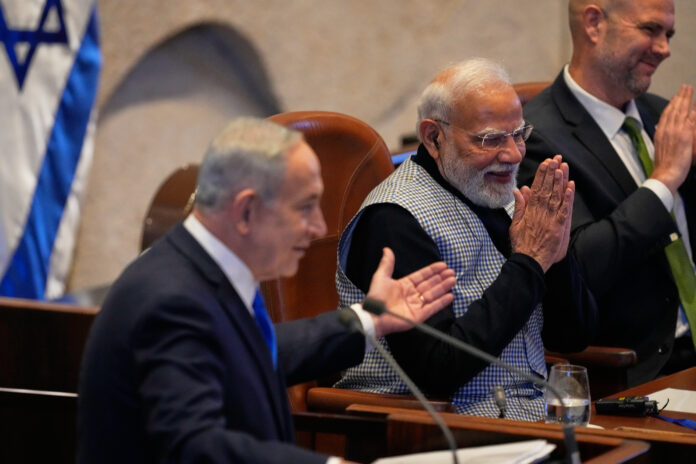
JERUSALEM (AP) — Indian Prime Minister Narendra Modi received a rousing welcome from Israeli lawmakers on Wednesday at the start of a two-day visit as he promised “friendship, respect and partnership” with Israel at a time when its world standing has suffered because of the war in Gaza.
“Let us ensure that the friendship between India and Israel remains a source of strength in an uncertain world,” Modi said in an address to the Knesset, Israel’s Parliament, where he received a standing ovation from lawmakers after a 30-minute speech.
We feel your pain.
We share your grief. pic.twitter.com/mmYDPjwwP3
— Narendra Modi (@narendramodi) February 25, 2026
The enthusiastic greeting underscored how much closer Israel-India relations have grown under Modi, whose embrace of Israel has marked a shift in the foreign policy of India which has historically supported the Palestinians.
India did not establish full diplomatic ties with Israel until 1992 and Modi’s visit aims to strengthen security, economic and technological cooperation between the two countries.
The Indian leader was greeted at the airport with a hug from Israeli Prime Minister Benjamin Netanyahu, who later introduced Modi to the Knesset as “Narendra, my dear friend.”
“I’ve never been more moved than by your visit here with us,” said Netanyahu, calling Modi “a great friend of Israel, a great champion of the Israel-India alliance and a great leader on the world stage.”
The visit is likely to give Israel a boost of international support after seeing relations with many of its allies deteriorate since the war in Gaza began in October 2023.
The Knesset building in Jerusalem had been illuminated in the colors of India’s flag on the eve of Modi’s arrival. Following his speech to lawmakers, Modi was awarded a medal by Speaker Amir Ohana, who said it recognized Modi’s leadership in strengthening relations between India and Israel.
Opposition party lawmakers walked out of the Knesset chamber during speeches by Netanyahu and Ohana, to protest the exclusion from the event of Yitzhak Amit, the chief justice of Israel’s Supreme Court.
Netanyahu, who is on trial for corruption charges, has sought to overhaul the country’s justice system, and his allies refuse to work with the Supreme Court chief.
The opposition returned for Modi’s address and the opposition leader, Yair Lapid, assured the Indian leader that the walkout had “nothing to do with you.”
On Thursday, Modi will meet with Israeli President Isaac Herzog and visit the Yad Vashem Holocaust memorial center. Netanyahu’s office said that the two leaders would sign myriad economic, security and political cooperation agreements.
Modi said India is “committed to further consolidating” its relationship with Israel “across many sectors,” including security and the sharing of advances in artificial intelligence and quantum technology.
“We’re committed to expanding trade, strengthening investment flows and promoting joint infrastructure development,” Modi said.
In addition to being a powerful ally, India is also Israel’s second largest trading partner in Asia. Total trade between India and Israel was valued at $3.6 billion in the 2025 fiscal year, according to India’s Ministry of Commerce and Industry.
Modi became the first Indian prime minister to travel to Israel in 2017, and Netanyahu reciprocated with a trip to India the following year.
A staunch Hindu nationalist, Modi was one of the first global leaders to swiftly express solidarity with Israel following the Oct. 7, 2023, attack by the Palestinian militant Hamas group that triggered the war in Gaza.
Speaking at the Knesset before Modi took the podium, Netanyahu thanked the Indian leader for that support.
“You didn’t flinch. You didn’t waver. You didn’t give excuses,” Netanyahu said. “You stood next to Israel. You stood by Israel.”
In turn, Modi affirmed India’s “strong support” for the U.S. ceasefire plan for Gaza that was endorsed by the U.N. Security Council last year. It lays out plans for ending Hamas’ rule, disarming the militant group, rebuilding the territory and withdrawing Israeli troops with only a vague commitment to possible Palestinian statehood.
“We believe that it holds the promise of a just and durable peace for all the people of the region, including the Palestine issue,” Modi said.
Modi made no mention of Israel’s newly approved measures to deepen its control over the occupied West Bank. India was among more than 100 countries earlier this month to condemn those measures, which weaken the already limited powers of the Palestinian Authority.