
 Vos Iz Neias
Israel’s Parliament Moves Toward Ban on Mixed-Gender Prayer at Jerusalem’s Western Wall
JERUSALEM (AP) — Israel’s parliament has given preliminary approval to a bill that would put the country’s Orthodox chief rabbinate in charge of the entire Western Wall in Jerusalem, raising fears among liberal Jews that mixed-gender prayer at the site will soon be outlawed.
The bill, if approved, threatens to further strain relations between Israel and the Reform movement, the largest stream of Judaism in the United States.
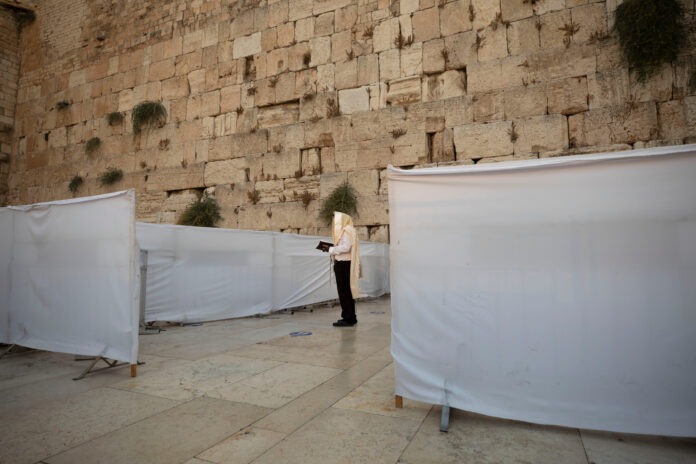
The Western Wall is the holiest site in the world where Jews can pray. While its gleaming main plaza is under the supervision of the rabbinate and prayer there is segregated, the site also has an egalitarian section, far off to the side, where men and women can pray together.
Under the bill, any prayer at the wall that runs contrary to the chief rabbinate’s specifications would be deemed “desecration,” punishable by up to seven years in prison. That could mean spell the end of the wall’s egalitarian section.
“It’s criminalizing the way the vast majority of Jews pray in the heart of the holiest site of the capital of the Jewish state,” said Orly Erez-Likhovski, executive director of the Israel Religious Action Center, the social justice arm of Israel’s Reform movement.
The section itself is largely out of view and accessible only through a small doorway.
Once inside, visitors are blocked from touching the ancient stones by a warren of grates left there after 2018, when a massive stone dislodged from the wall and toppled onto the prayer platform, prompting its immediate closure.
It is a stark contrast to the wall’s iconic esplanade, replete with plaques from generous donors, where buzzing devotees segregate to pray by the Wall’s ancient stones.
The bill, sponsored by far-right lawmaker Avi Maoz, was passed in a preliminary reading late Wednesday 56-47.
It was brought to the preliminary vote Wednesday to mitigate a Feb. 19 ruling by Israel’s Supreme Court to begin repairing the egalitarian section of the wall, according to the Israel Democracy Institute, a Jerusalem think tank.
Prime Minister Benjamin Netanyahu’s government agreed to undertake the repairs a decade ago as part of a compromise to promote pluralism.
It is not known when the bill will be presented for a final vote of approval.