

After speaking with Moshe Grunfeld for over three hours, it was abundantly clear that his parnasah—simchah photography—suits him perfectly.
Moshe possesses a calm and happy nature, which is invaluable when it comes to dealing with the pressures of a tight, often frenetic wedding schedule. Unfazed in almost any situation, he projects a tranquil energy that his clients instinctively mirror.
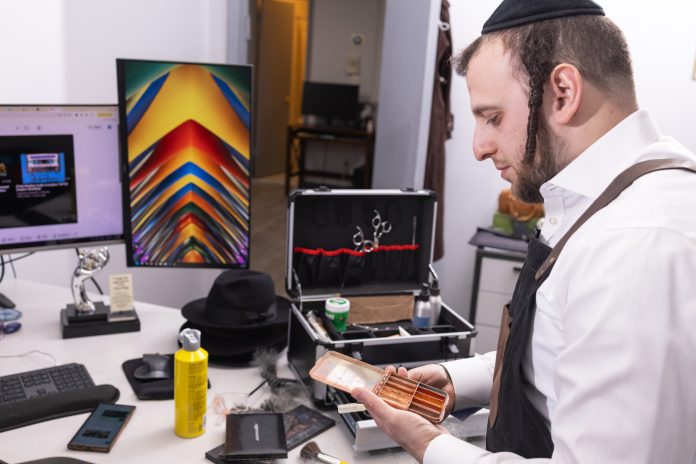
Moshe’s professional reach also extends into the thriving field of frum feature films and live theatrical productions. What began as a chance experience with makeup during a camp play developed into a remarkable expertise. Founder of the theatrical makeup company Punim Chadushes (New Faces), Moshe has mastered the art of transforming actors into characters, using cosmetics, hair, prosthetics and various tools of the trade to render cast members unrecognizable even to their closest family and friends.
Whether he is capturing a face from behind the lens or creating one behind the scenes, Moshe is a master of the visual frame. Before Purim, when we all adopt costumes of some kind, how appropriate to speak to the king of disguises himself.
L’chaim! Enjoy!
—Nesanel
I was a preemie, so I like to say I got a head start on life and just kept moving forward. The youngest of eight, I was born in Albany but grew up in Boro Park. My father, who grew up in Williamsburg, was in the catering business. He initially operated Cotillion Terrace but eventually opened his own kitchen and built the business from the ground up. My mother passed away on March 21, 2020, right before her 70th birthday. I was very close with her, and her absence still weighs heavily on my heart.
“I attended a local cheder and then went on to learn in Munkatch, and I developed a close relationship with the Munkatcher Rav.
“In the Munkatcher yeshivah there was an emphasis on harnessing one’s strengths, which had a profound impact on me. I approached the hanhalah with a request to learn how to bind sefarim. They not only approved but even gave me an office and the necessary tools to pursue my interest. It was a serious learning environment but not a pressured one, which suited me well.
“As a kid, I always loved building things and creating fun activities. I ran carnivals on our block, and the whole neighborhood looked forward to them. For a few years, the money we raised went to Hatzalah, and I even received plaques for my work. I also helped other kids organize their own carnivals, recommending things that had worked well and working to improve things that hadn’t.
“After my bar mitzvah, I got involved in a struggling Chevras Tehillim near my house. It was a great learning experience, and I was able to help a number of branches of the organization. Even then, I didn’t just participate, I improved.
“I studied what kids actually wanted. I brought in famous storytellers, I bought nosh wholesale instead of retail, I ordered ice cream by the truck from Klein’s, and I tracked which prizes were taken first and which sat untouched. Within a few months, attendance grew from about 30 boys to over 500.
“I’ve always tried to give more value for the money. I focused on branding before I knew what that was. My signs had curtains, and every Chevras Tehillim I helped used the same imagery, so people knew it was under one management.
“Chevras Tehillim took up a lot of my time, but I also volunteered for Chai Lifeline. As a bachur, I went to hospitals very often. I thank Hashem that my parnasah today is earned by being mesamei’ach Yidden in other ways.
“When I was 18, the Munkatcher yeshivah closed down. With the brachah of the Munkatcher Rav, I started looking for a job. I had some very good offers, but since I was so young, the Munkatcher Rav recommended that I stay in a Torah environment. Because he was like a father to me and always supportive, I wanted to follow his advice.
“Soon afterward, I bumped into my seventh-grade teacher, Reb Leibish Hammer, who was teaching in Yeshiva Darchei Torah of Far Rockaway. He mentioned that Siach Yitzchok, also in Far Rockaway, was looking for someone to oversee the preschool’s arts and crafts department. They had two kindergartens and the rebbeim needed another hand to prepare these creative projects.
“It was essentially arts and crafts therapy. My job was to keep track of the children’s progress by monitoring their ability to follow instructions, replicate patterns, including lines, colors and sequence, as well as other key skills. While these tasks may seem simple, they were important for the children’s development. If a child couldn’t keep up or follow directions properly, it was a possible indicator of delay.
“I felt suited to that job right away because I always liked drawing. I have an older brother, Hershy, who is very artistic and taught me how to draw and how to use colors. It’s good to be the youngest. You benefit from all your older siblings’ talents; everybody teaches you. Many volunteers are the youngest in the family. Rebbe Nachman of Breslov says that everybody has a desire to be mashpia, to influence others. So older siblings are mashpia on the younger ones, and then the youngest ones seek out places where they can give and be of service.
“It was a part-time job, only a few hours a day, but it paid well. I was at Siach Yitzchok for over three years until I decided to return to learning full time. I joined a kollel in Williamsburg, where I merited a wonderful chavrusa from a rebbishe family. My time in kollel was gevaldig. I got married in 2011.
“Wherever I was, whatever the situation, I always tried to make it better. If I felt something wasn’t going well, I would try to think how I might improve it.
“I first started doing makeup when I was a counselor in Munkatcher camp. They were having a play and the makeup artist they had booked couldn’t make it at the last minute. There was makeup in the costume room, and I started experimenting, even though I knew nothing. I saw makeup, I saw faces, and I saw a need, so I stepped in.
“It wasn’t such a big deal for me to figure out: it’s art, just instead of coloring on paper, you’re coloring in 3D. I did a good enough job that Shloime Steinmetz at the Klausenberger camp asked me to do the makeup for their performance. Then Spinka camp called me.
“In 2009 or 2010, I worked for Hershy Rosner, a makeup artist and photographer, helping him with the makeup for a play called ‘Interen Kenigreich.’ That was the first time I was exposed to a real backstage environment. Later, after I got engaged, he hired me as a production assistant. I helped with editing, video work, script writing and things like that. I have tremendous hakaras hatov to him, because he guided me and taught me so much.
“After working for Hershy Rosner, I joined On Time Studios for a few months, where I was surrounded by talented creative people like Mendy Leonorowitz, a gifted filmmaker and director, and Ari Abramowitz, a strong writer. They relied on me to set up the scenes so they looked realistic and professional. I still do this today as the art director for Boruch Perlowitz productions.
“I have four brothers in construction and many friends who are contractors, so when the opportunity came up to take over a flooring company, I felt I could do it. With their backing and guidance, I stepped in. Baruch Hashem, it took off quickly. Within weeks, I was signing proposals for major buildings, six and ten floors of hardwood flooring, large-scale projects. But I was newly married, had just had a baby and everything in my life was shifting. I felt overwhelmed and disconnected. I needed to figure out who I was beyond the environment I was in.
“We moved to Airmont, New York, for a year, but that wasn’t enough. I wanted a full reset. So I unplugged completely and moved to Scranton, Pennsylvania, where we lived for four years. It was far removed from the noise. I didn’t know many people there, but it is a very strong, established community with genuinely warm people, where I was truly able to grow.
To read more, subscribe to Ami

