
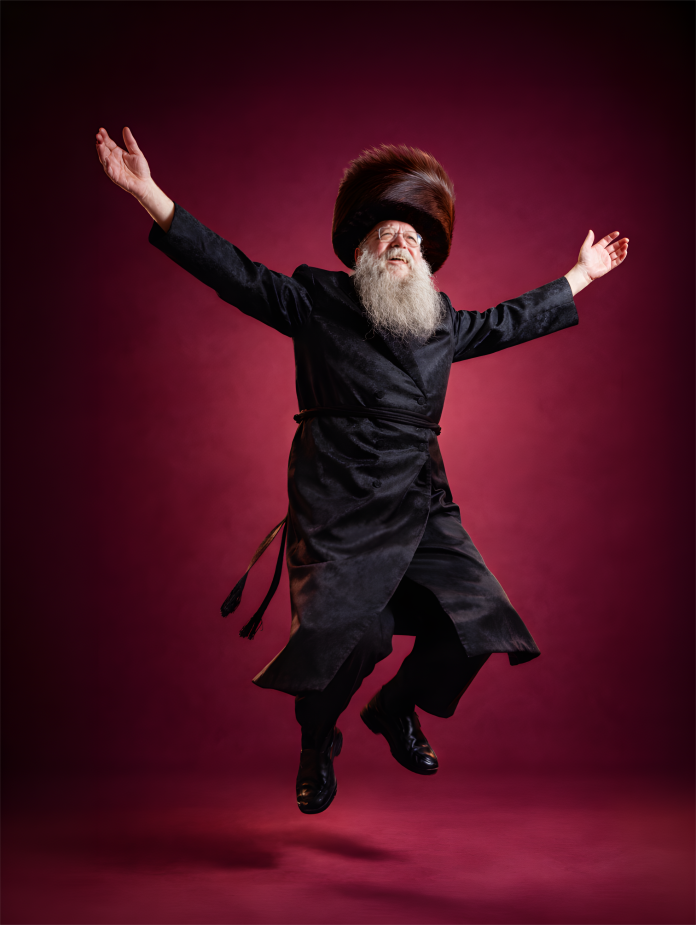

You flew in today from London to be the badchan at the Rachmastrivka chasunah in Boro Park, and you came to visit me between the kabbalas panim and mitzvah tantz. You’re very busy, to put it mildly.
Baruch Hashem. Yesterday I was in Manchester because Satmar made a big chanukas habayis for their Heichal HaTorah. The Rebbe, Rav Aharon, was there. It was a major event.
You performed as a badchan?
No. I gave a drashah. I can’t do everything, but bisyata dishmaya I wear many hats. One of them is badchanus, but there are also chairmanships [serving as an emcee], maggidus and drashos. They’re all almost the same thing, but each one requires a different mehalech. I also have a weekly column in Moment magazine. Additionally, I’m the yosheiv rosh of Belz in London and a gabbai in one of the shtieblach. So as you said, I’m busy.
I know there are a number of Sterns in Vizhnitz, but I understand that you have no connection to them.
Correct. I was once at a large dinner for Vizhnitz in Ramat Gan. The Vizhnitzer Rebbe, Rav Yisrael, may he have a refuah shleimah, had recently become rebbe. I said, “I’m not a Vizhnitzer chasid, but I’m a chasid of the Vizhnitzer Rebbe, and I don’t think there’s anyone in klal Yisrael who isn’t.” I was very close with his father the Yeshuos Moshe, zt”l. He once said to me, “You’re a true Belzer chasid, but you’re also a true good friend of Vizhnitz.”
I assume that other rebbes would be able to say the same thing.
Yes, but Vizhnitz possibly more than most, and especially Vizhnitz London, with whom I’ve been very close for many years.
You don’t discriminate, and you badchan everywhere. And you don’t only do it for rebbes; you also do it for balebatim.
Yes. From the very rich to the poor. But as they say in English, it’s a completely different kettle of fish.
Explain the difference.
Doing this for balebatim is much easier because I’m in control. I can say whatever I want and make a joke whenever I want. By rebbes, I have to be far more cautious. Although the Vizhnitzer Rebbe of Monsey, Rav Mottele, once told me before a dinner, “I know Vizhnitzer Torahs better than you do, and I don’t need to hear Vizhnitzer things from you. On the contrary, I want you to talk about what comes naturally to you. You don’t have to force anything.” There are rebbishe chasunahs where I do have to put things in from their chasidus, but there are also others who say they want to hear something different.
On the other hand, when you go to a balebatishe chasunah, the mechutan has to tell you all of his maalos. But when you go to a rebbishe chasunah, the gabba’im take care of that.
By a rebbe there are no praises; there’s nothing personal about the rebbe himself. I’ll talk about his ancestors and his father, but not about the rebbe.
I’ll give you an example from what I just said tonight before the chuppah. The chasan is a Belzer einikel and so is the kallah. They descend from Belz in various ways. So this was an opportunity to incorporate a few things about their ancestors.
I told a story that Rav Shmuel Engel writes in his sefer Shu”t Maharash, volume 7. He was at Rav Shayale Tchechoiver’s chasunah in Belz—Rav Shayale became the son-in-law of one of the Mitteler Belzer Rav’s sons-in-law. Rav Shayale was a yasom by then—his father, the Divrei Chaim, had already passed away—and the Mitteler Rav told him, “Your father promised me that he would come for the chasunah, but the Eibershter had other plans. Do your utmost with all of your kochos so you can have a connection with your father.” And the sefer says that everyone started to cry. That was a good story to tell because it was about an ancestor of both sides.
Belz is your home, but how did you become a Belzer chasid? I understand that your family weren’t chasidim.
Not at all. We were always Ashkeneizim. My father didn’t wear a gartel, and he wore a short jacket. My mother’s father was Rav Shloma Baumgarten, son of Rav Yosef Baumgarten, who was the rav of the Schiffschul in Vienna. My father’s father was the rosh hakahal of the Schiffschul and an askan for Agudas Yisrael. He spoke at every Knessiah Gedolah, from the first to the last.
What did he do for a living?
He had a butcher shop in London. He passed away at an old age. His father was also an askan. They were all Oberlandishe Ashkeneizishe Yidden. So how did I get to Belz? It’s a very good question, and there are two parts to the answer.
My zeide, Rav Shloma Baumgarten, had a sister who got married after the war to a Belzer chasid named Reb Nachman Dachs, who was the rosh hashochtim in London. He had been a shochet in Germany before the war. He was a very passionate chasid and had even merited to see the Mitteler Belzer Rav. He paid my expenses to join him on a trip to Switzerland for a Shabbos when the Belzer Rav was there. It really pulled me very strongly. But my father wasn’t so excited, so he decided to ask Rav Yankele (of Pshevorsk), with whom he was very close. This was obviously many years ago. Rav Yankele told my father, “He’s a young rebbe and he brings out the talents of the bachurim. It’s very good. Let your son go to him.”
I went to Eretz Yisrael to learn in Tchebin, but I would also go to the Rav. The first time I went for a tish was on 21 Av, the yahrtzeit of the frierdiker Belzer Rebbe, which was right before the new zman began. After the tish, all of the out-of-town guests would pass by the Rav to take their leave, and I also went. He asked me who I was, and I told him. “Did you enjoy it?” he wanted to know. I answered that I did. “Come again on Shabbos,” he said. When I went back on Shabbos, a bachur came over to me and said, “The Rav said that we should be mekarev you.” I was all of 17 years old at the time. The rest, as they say, is history. “Heviani hamelech chadarav—the king brought me into his chamber.” Then I was invited for private Shabbosim in Givat Hamivtar almost every other week.
Were you wearing chasidishe levush?
No. I was wearing a short jacket and a shtafene hat. I have no explanation for the way he was mekarev me.
It was v’nafsho keshurah b’nafsho.
Precisely. Totally a connection with my nefesh. Although I stayed in Tchebin, I was going to Belz every week, and then I started going there every night for Maariv. On Friday and Motzaei Shabbos, I would learn with a Lelover yungerman in the Lelover beis midrash. The Lelover Rebbe, Rav Moshe Mordechai, saw me a few times and nodded to me. Then one day he asked me who I was. When I told him, he wanted to know where I spent my time. “In Belz,” I replied. “Belz!” he said. “Do you know what Belz is? Belz is a pipeline for kedushah and ahavah for klal Yisrael. The world doesn’t know who the Belzer Rav is!” That was really mechazek me.
To read more, subscribe to Ami

