

By Rabbi Yair Hoffman
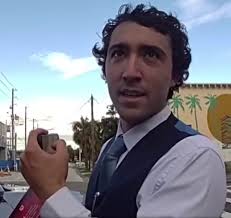
Tyler Oliveira strikes again.
He built his YouTube channel on a simple formula: find a community that looks different, show up with a camera, and let the algorithm do the rest.
He filmed addicts overdosing in Vancouver without consent. He amplified the debunked pet-eating hoax about Haitian immigrants in Springfield, splicing in unrelated arrest footage to manufacture fear. The subjects change. The method never does.
Then Tyler came for the Jews.
In January 2026, he drove to Kiryas Joel, a Satmar Hasidic village of 44,000 in Orange County, and produced a forty-minute video titled “Inside the New York Town Invaded by Welfare-Addicted Jews.”
He bypassed the village’s offices and businesses—where he could have met professionals and business owners—and focused on encounters that critics described as staged to create confrontation. Nearly five million views. The top comment: “The Great Noticing continues”—a coded antisemitic term whose usage increased by more than 2,000 percent in a single year.
Then he drove to Lakewood. His video, “I Exposed New Jersey’s Jewish Invasion,” opened with the claim that Orthodox Jews had sparked “fear” among non-Jewish residents. He cited fraud charges against a rabbi—charges that were later dismissed. He highlighted large family sizes as though fertility were an accusation. When one resident warned him, “This is going to jump a lot of hatred towards a community that’s seeing a rise in antisemitism that hasn’t been seen in years—every single day, our lives are at risk,” Oliveira responded: “You say antisemitism, I say anti-Goyism.”
Richard Roberts, a prominent Lakewood philanthropist, invited Oliveira into his home for a three-hour interview, hoping to show him the truth. Oliveira listened politely. Then he chopped the interview to fit his predetermined narrative and gave extended airtime to local activists critical of the community.
Roberts, who had hired his own videographer to record the full conversation, called the final product a “hit piece” that was “feeding an antisemitic crowd.”
The pattern was clear. Tyler Oliveira had found his niche: filming Orthodox Jews and asking questions that weren’t really questions.
Now pretty much everyone in both Lakewood and Kiryas Yoel is familiar with the F. family. How would Tyler Oliveira present them?
“Okay guys, so I’ve been looking into this family,” he’d say into his camera, sitting in his car in that way he does—the same way he sat outside kosher supermarkets in Lakewood, narrating his suspicions. “The father—Yoshiyahu—is a manufacturer. That’s his business. And this man has seventeen children.
Seventeen.
Seven with his first wife, Chana, and then she dies and he marries a woman named Avigayil and has ten more. I mean—how?
How does a small manufacturer afford seventeen kids? What is going on here? Who’s funding this?”
He’d pause for effect, the way he always does.
“And look at this—two of the kids are both named Yosef. Both of them died in infancy. I’m not making light of that, obviously, but—seventeen kids and you’re running out of names?
This is what happens when a community just has kids without any plan.”
Then he’d get to Binyamin, the youngest son, and really hit his stride.
“This kid gets pulled out of school at ten. Ten years old. No more formal education. His father puts him to work in the candle shop. Then at twelve he gets apprenticed to his half-brother Ya’akov, who runs a printing press. Twelve years old, working in a print shop. No diploma. No degree. And somehow—somehow—this kid ends up owning his own press, starting a newspaper, publishing something, and getting himself into politics. How does that happen? How does a kid with no education end up running everything? I’m just asking questions, guys.”
He’d shake his head slowly.
“Large family. Small manufacturing business. No secular education. Kids apprenticed to relatives. And then suddenly they’re in media, in government, in civic life. It’s the same pattern, guys. The same thing I showed you in Kiryas Joel. The same thing I showed you in Lakewood. The same thing I showed you in Monsey. I’m not saying anything. I’m just showing you what I see.”
He’d upload it. He’d add the ominous music. He’d splice in some unrelated footage of crowded streets. The comments section would do the rest. “The Great Noticing continues.”
There’s just one thing Tyler didn’t bother to find out.
The F family’s real name is Franklin.
Yoshiyahu is Josiah Franklin. Chana is Anne Child. Avigayil is Abigail Folger. Ya’akov is James Franklin.
And Binyamin—the uneducated kid from the shop who somehow ended up in media and politics?
That’s Benjamin Franklin.
Founding Father. Inventor. Diplomat. Architect of American democracy. The man who helped draft the Declaration of Independence and the United States Constitution. The face on the hundred-dollar bill.
Everything Tyler Oliveira films in Orthodox communities and presents as evidence of dysfunction—the large families, the trades, the apprenticeships, the lack of conventional diplomas, the tight-knit networks, the kids who start working young and end up building something extraordinary—America celebrates as its greatest origin story when the family name is Franklin.
But when the family name is Teitelbaum or Friedman? When the father wears a black hat instead of a tricorn? When the business is on Route 9 instead of Milk Street in Boston? Then it’s a “Jewish invasion.” Then it’s “welfare-addicted.” Then it’s five million views and a comments section full of people “just noticing.”
The only difference is the yarmulke.
The author can be reached at [email protected]