
 Vos Iz Neias
“You Will Regret This”: Iran’s New Strongman Threatens America and Israel— But Should His Insurance Underwriters Be Updating His File?
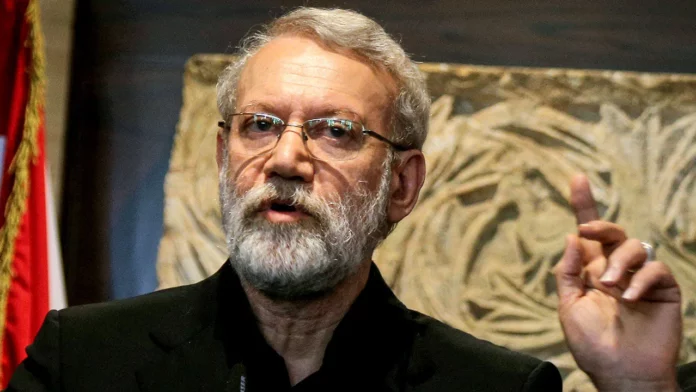
NEW YORK (VINnews/Shira Miller) – Somewhere in Tehran—assuming Tehran’s government district is still standing—an insurance underwriter at Bimeh Iran or Asia Insurance Company may want to pull up a certain policy file. The policyholder: Ali Ardashir Larijani, age 67, secretary of Iran’s Supreme National Security Council. The risk profile: catastrophic.
On Saturday, February 28, 2026, as American and Israeli bombs rained down on Iranian military installations and government buildings, Larijani took to X (formerly Twitter) to announce that Israel and America would “regret their actions.”
His full statement was vintage mullah bluster: “We will make the Zionist criminals and shameless Americans regret their actions. The brave soldiers and the great nation of Iran will deliver an unforgettable lesson to these hellish international oppressors.”
That Larijani felt the need to publicly confirm he was alive tells you everything. Now that the supreme leader is gone, Larijani is the man holding the steering wheel of the Islamic Republic—and he just painted the biggest target imaginable on his own back.
From an underwriting standpoint, the question is straightforward: How do you assess the life expectancy of a man who has just declared himself the operational leader of a country under sustained bombardment by the two most capable militaries on earth?
The Man in the Crosshairs
For those unfamiliar with Larijani, a brief dossier. Born in 1958 in Najaf, Iraq, into one of Iran’s most powerful clerical dynasties. His father was a grand ayatollah. His brother Sadeq ran the entire Iranian judiciary. He married into the family of Ayatollah Morteza Motahhari, a founding ideologue of the Islamic Republic. He holds a PhD in Western philosophy from the University of Tehran and a computer science degree from what is now Sharif University. He is a former IRGC commander, former head of state television, former speaker of parliament for twelve years, a former chief nuclear negotiator, and the man who helped shepherd the disastrous 2015 JCPOA through the Iranian legislature.
In other words, Larijani has had his fingerprints on virtually every major policy disaster of the Islamic Republic for four decades. He is the consummate regime insider—a man who has served every faction, survived every purge, and always landed on his feet. Until now.
Why He Probably Won’t Last a Week
Consider the facts on the ground. The United States has initiated what President Trump called “major combat operations in Iran.” Israel’s defense minister confirmed Israeli strikes. The campaign is reportedly designed to last at least five days. Targets include missile installations, air defense systems, nuclear facilities, and—critically—government command structures.
Larijani has just told the world exactly who he is: the man running the show. In modern warfare, that is not a boast—it is a beacon. American and Israeli intelligence, which successfully tracked and eliminated Qasem Soleimani, Hamas’s Ismail Haniyeh, and Hezbollah’s Hassan Nasrallah, do not leave declared enemy commanders off their target lists.
Then there is the internal threat. If Khamenei is indeed dead, Iran faces a succession crisis of historic proportions. The Islamic Republic’s entire constitutional structure revolves around the supreme leader. Without one, every power center—the IRGC, the Guardian Council, the Assembly of Experts, the judiciary—will be jockeying for control. Larijani has enemies in all of these institutions. He was disqualified from running for president not once but three times by the Guardian Council. The hard-line factions view him as dangerously moderate. The IRGC rank-and-file never fully respected him as one of their own. In a power vacuum, such men do not tend to survive long.
And then there is the street. Just weeks ago, in January 2026, Larijani was the architect of a brutal crackdown on Iranian protesters—ordinary citizens demanding basic freedoms. He leveraged IRGC commanders and intelligence services to crush the demonstrations. The Iranian people know who gave those orders. In a moment of regime instability, that kind of record does not buy loyalty. It buys rage.
The Underwriting Problem
Iran’s life insurance market is small and heavily regulated by the Central Insurance of Iran. Life insurance accounts for a tiny fraction of the country’s overall insurance premiums—roughly 5%, compared to a global average near 58%. The market is dominated by the state-owned Bimeh Iran, followed by Asia Insurance, Alborz Insurance, and Dana Insurance. Products are nominally structured to comply with Islamic principles, avoiding riba (interest) and gharar (excessive uncertainty), often through cooperative Takaful models where participants share risk collectively.
But here is the practical reality: no actuarial table accounts for a 67-year-old man who has just declared himself the wartime leader of a nation being bombed by the United States and Israel simultaneously. Standard risk models evaluate age, health, smoking status, occupation, and lifestyle. They do not have a checkbox for “currently running a country under aerial bombardment while issuing threats to the world’s two most powerful military forces.”
If Larijani holds a life insurance policy with any Iranian carrier—and given his elite status, he almost certainly does—his underwriters face a question that no amount of Kant’s Critique of Pure Reason can resolve: Do you continue to insure a man whose occupation has just become “de facto head of state of a country at war with America and Israel”?
The Bottom Line
Ali Larijani is a survivor. He has navigated four decades of Iranian factional politics, outlasted presidents and rivals, and clawed his way back to the apex of power after being cast aside. He is intelligent, connected, and ruthless.
But intelligence and connections did not save Soleimani. They did not save Haniyeh. They did not save Nasrallah. And they may not save Khamenei, whose fate remains uncertain as of this writing.
Larijani’s defiant declaration on Saturday was designed to project strength. Instead, it may have signed his death warrant. When you publicly announce to the combined military and intelligence apparatus of the United States and Israel that you are the man in charge and that you intend to make them “regret” their actions, you have made yourself Target Number One.
His underwriters should update their files. The rest of us should be watching closely. The Islamic Republic’s days of threatening the civilized world may finally be numbered—and so, quite possibly, are Larijani’s.