
 Yeshiva World News
IRAN TARGETS SAUDI OIL: Drone Hits Aramco, Shutting Kingdom’s Largest Oil Facility
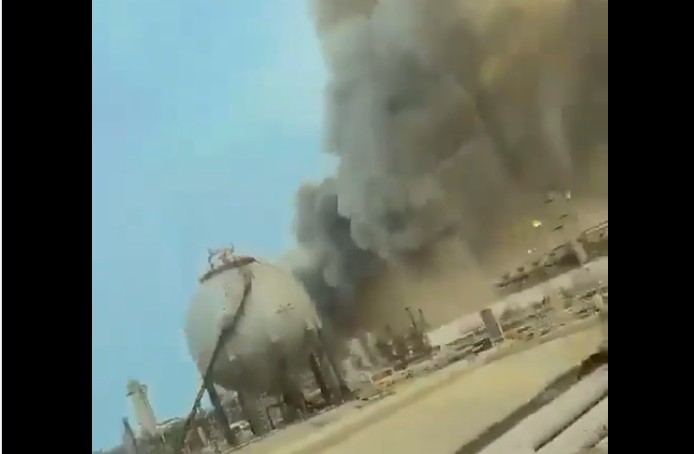
Saudi Arabia shuts its Aramco oil refinery in Ras Tanura after it was struck by Iranian drones.
Two drones were intercepted at the facility, and shrapnel caused a fire to break out at the site.
State oil giant Aramco in Ras Tanura, near Dammam, has a capacity of over half a million barrels of crude oil a day. It is part of an energy complex on the Saudi coast, which also serves as a key export terminal for crude oil.
Its closure comes after the precautionary suspension of most oil production in Iraqi Kurdistan and at several large Israeli gas fields, including Chevron’s Leviathan gas field.
The move also follows the near-halt of shipping via the Strait of Hormuz, the narrow mouth of the Persian Gulf through which a fifth of global oil trade passes, after Iran attacked several ships.
“The attack on Saudi Arabia’s Ras Tanura refinery marks a significant escalation, with Gulf energy infrastructure now squarely in Iran’s sights,” said Torbjorn Soltvedt, an analyst at the risk intelligence company Verisk Maplecroft.
“The attack is also likely to move Saudi Arabia and neighbouring Gulf states closer to joining U.S. and Israeli military operations against Iran.”
“An extended period of uncertainty lies ahead as Iran seeks to impose a heavy economic cost by putting tankers, regional energy infrastructure, trade routes, and U.S. security partners in the crosshairs,” he said.
Saudi state television reported that the decision to close the facility was precautionary and that there were no casualties from the fire.
On Sunday, Saudi Arabia shot down Iranian missiles aimed at Riyadh’s international airport and the Prince Sultan Airbase, which hosts US forces.
The latest drone strike is part of a wider barrage across the Gulf, including hits on Abu Dhabi, Dubai, Doha, Manama, and the Omani port of Duqm, which has choked key shipping hubs in the UAE and Oman and pushed benchmark Brent crude futures up by about 10 percent on Monday.
Traders are now wagering that oil flows from Iran and other Middle Eastern producers will slow or even stall, as repeated strikes—including on two tankers transiting the Strait of Hormuz—limit exporters’ ability to move crude to global buyers, a scenario energy analysts say would drive oil and gasoline prices higher if it drags on.
West Texas Intermediate, the main US crude benchmark, was trading near 72 dollars a barrel early Monday—about 7.3 percent above Friday’s roughly 67‑dollar close—while Brent, the global benchmark, changed hands around 78.55 dollars after jumping 7.8 percent from 72.87 dollars on Friday, itself then a seven‑month high.
Roughly 15 million barrels of crude a day—around one‑fifth of global supply—pass through the Strait of Hormuz, the world’s most critical oil chokepoint, as tankers carry oil and gas from Saudi Arabia, Kuwait, Iraq, Qatar, Bahrain, the UAE and Iran through waters bordered to the north by Iran.
Iran temporarily closed parts of the strait in mid‑February for naval drills, a move that sent oil prices about 6 percent higher in the following days.
Saudi Arabia’s oil infrastructure has come under serious fire before, most notably in September 2019 when a combined drone‑and‑missile assault on the Abqaiq and Khurais facilities briefly knocked out more than half of Saudi crude output and shook global energy markets; Yemen’s Iran‑backed Houthi rebels claimed the attack, but Washington said Iran itself was responsible.
(YWN Israel Desk—Jerusalem)