
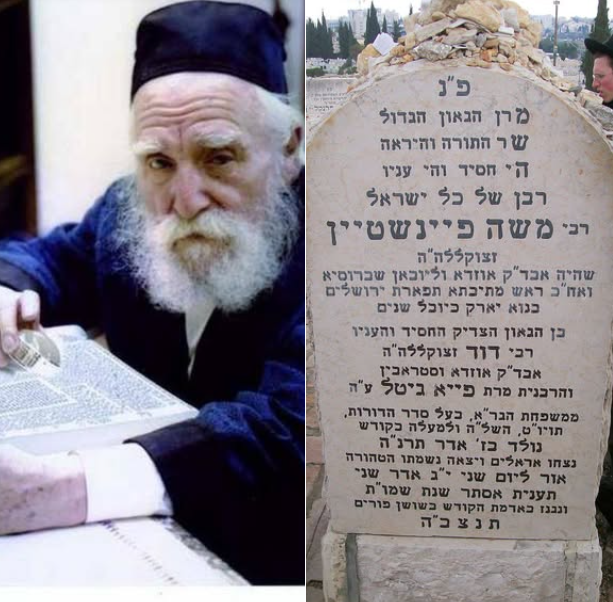

NEW YORK (VINnews/Rabbi Yair Hoffman) – Today is the 13th of Adar, the Yartzeit of the Posaik Hador, Rav Moshe Feinstein zt”l, who was niftar 40 years ago in 1986. Who was he exactly and how did he have such a remarkable impact on the United States?
Let us first go back, not to the beginning but to his entry here, in the United States.
On a frigid Thursday, January 14th 1937, in the afternoon, the RMS Aquitania glided into New York Harbor, carrying among its third-class passengers a penniless refugee rabbi, his wife, and three young children. The man who disembarked that day brought with him no material wealth—only the clothes on his back, a few possessions, and the accumulated Torah wisdom of Lithuanian scholarship stretching back through generations to the Vilna Gaon himself.
He had survived a pogrom where his house was blown apart by artillery, endured Communist persecution that stripped him of home and livelihood, and escaped Soviet Russia with only days to spare before his passport expired.
He would tell relatives who criticized his decision to come to America: “I came to be a street cleaner. I am prepared to clean the streets, to be a shammes, as long as my children and I will be free to learn Torah.”
That refugee would become Rav Moshe Feinstein, the posek hador—the foremost halachic authority of his generation—whose responsa would guide millions of Jews navigating the unprecedented challenges of modern life. His integrity would become legendary. And his very name would become synonymous with Torah leadership in twentieth-century America.
The world he left behind in Luban was destroyed utterly. The calendar he lovingly prepared for eighteen years of Jewish observance was never used—the community was murdered in the Holocaust before even five years had passed. But the Torah he brought with him to America, the methodology he taught, the responsa he wrote, and the example he set continue to illuminate the path for Jews facing challenges he never imagined.
This is his story.
On the seventh day of Adar in the year 5655, corresponding to March 3, 1895, a child was born in the town of Uzda who would become the preeminent halachic authority of his generation. The town of Uzda lay in the Minsk Governorate of White Russia, in what is today Belarus. This region, part of the Pale of Settlement where Jews were permitted to reside under Tsarist rule, was home to numerous vibrant Jewish communities despite the oppressive restrictions placed upon them.
The child’s father, Rav David Feinstein, and his mother, Faya Gittel, named their son Moshe.
Rav Moshe’s father, Rav David, was a direct descendant of Rav Avraham, the brother of the Vilna Gaon. The Vilna Gaon, Rav Eliyahu ben Shlomo Zalman, who lived from 1720 to 1797, was perhaps the greatest Torah scholar of the modern era, a man whose genius encompassed not only all areas of Torah but mathematics, astronomy, and geography as well. His brother, Rav Avraham, was himself a tremendous scholar and the author of Maalos HaTorah, a profound work of Torah scholarship. Both the Vilna Gaon and his brother Rav Avraham were in turn direct descendants of the author of Be’er HaGolah, the commentary that appears on every page of the Shulchan Aruch and provides source references essential for all who study Jewish law.
The Vilna Gaon’s influence extended beyond his immediate family. Rav Avraham Tzvi Kamai, who founded the Mirrer Yeshiva, was the grandson of Rav Avraham, the Gaon’s brother, making him a relative of Rav David. Rav Kamai’s son-in-law, Rav Finkel, later became Rosh Yeshiva of the Mir, one of the greatest yeshivos in Lithuania. Thus the Feinstein family was connected by blood and tradition to the most illustrious institutions and personalities of the Lithuanian yeshiva world.
At some point in the family’s history, Koidenover Chasidus entered the Feinstein lineage, though the exact date of this development remains uncertain. Rav Moshe’s great-grandfather, also named Rav David, was a Koidenover Chasid, as was Rav David, Rav Moshe’s father, in his youth. The Koidenover movement represented one strand of the Hasidic revolution that had swept through Eastern European Jewry in the eighteenth and nineteenth centuries, emphasizing devotional prayer and the service of Hashem through joy and emotional connection to the Divine.
Rav Yitzchok Yechiel, Rav Moshe’s maternal grandfather, had four sons-in-law, each of whom was a significant Torah scholar and leader. The first was Rav Eliyahu Pruzhaner, whose devotion to his family and selfless character we have already described. Rav Eliyahu was the father of Peshe, who married Rav Moshe Soloveitchik and became the mother of Rav Yosef Dov Soloveitchik. Rav Yosef Dov, known in America as “the Rav,” would become the leading Torah authority of Modern Orthodoxy and the Rosh Yeshiva of Yeshiva University’s Rabbi Isaac Elchanan Theological Seminary.
The second son-in-law was Rav Yaacov Kanterovitz, whom Rav Moshe refers to in his responsa, published as Iggeros Moshe, as “my uncle the great Gaon.” The use of the term “Gaon” in this context indicated extraordinary scholarship, comparable to the great sages of the Talmudic academies. The third son-in-law was Rav David Feinstein, Rav Moshe’s father. The fourth was Rav Moshe, the father of Berl Katzenelson. Berl Katzenelson would become a mentor to David Ben-Gurion, who would later become the first Prime Minister of Israel.
The town of Uzda, where young Moshe Feinstein spent his earliest years, was typical of the Jewish settlements that dotted the Pale of Settlement in the late nineteenth century. The Pale, that vast region of the Russian Empire where Jews were compelled to live, stretched from the Baltic Sea in the north to the Black Sea in the south, encompassing parts of modern-day Lithuania, Belarus, Ukraine, Moldova, and Poland. Within these boundaries lived the largest concentration of Jews in the world, perhaps five million souls, creating a civilization that would produce an extraordinary flowering of Torah scholarship even as it endured poverty, persecution, and periodic violence.
There, under his father’s tutelage, young Moshe studied three sedarim of Shas, three of the six orders of the Talmud. The methodology they employed was that of Volozhin, the approach that Rav David had absorbed during his own years in that great yeshiva. Rav David had meticulously recorded all the shiurim, the lectures, that he had heard in Volozhin, and now he transmitted this material to his son.
Yet Rav David understood that his son’s education required more than study with him alone.
When Moshe was in his late teens, Rav David sent him for one year to the nearby town of Slutzk, where he would study with one of the greatest Torah scholars of the generation, Rav Isser Zalman Meltzer. Slutzk lay northeast of Uzda, in the same region of White Russia.
However, during Moshe’s time in Slutzk, a dispute arose between Rav Isser Zalman and his mashgiach, Rav Pesach Pruskin.
Unable to resolve their differences, Rav Isser Zalman and Rav Pesach decided to take their dispute to a din Torah, a judgment before a rabbinical court. They agreed that Rav David Feinstein, Moshe’s father, would serve as the dayyan, the judge.
The choice of Rav David for this delicate task reveals the respect in which he was held throughout the region. Both Rav Isser Zalman and Rav Pesach were older than Rav David and were established figures in the yeshiva world. Yet they trusted his judgment.
Rav David heard the arguments of both sides and issued his ruling. He determined that Rav Pesach Pruskin could take ten talmidim, ten students, and establish a new yeshiva.
Young Moshe was chosen to be one of the ten students who would leave Slutzk with Rav Pesach to study in the new yeshiva.
Rav Moshe left Rav Isser Zalman’s yeshiva and studied with Rav Pesach Pruskin for three years. These were formative years in his development as a Torah scholar. During this entire period, he lived in Rav Pesach’s house,
Rav Moshe became extremely close to Rav Pesach Pruskin during these years. For the rest of his life, he would consider Rav Pesach as his primary rebbe, the teacher who most influenced his development. When asked about his approach to learning, about his methodology in analyzing a sugya or arriving at a halachic conclusion, Rav Moshe would credit Rav Pesach with forming his derech halimud, his way of learning. When Rav Prusskin’s granddaughter got married in the 1960’s, Rav Moshe gave them a check for %200, on his meager salary. That was how much hakaras hatov he had to him!
During his time with Rav Pesach, Moshe led a chaburah in Ketzos HaChoshen.
Years later, Rav Gustman, himself one of the great Torah scholars of the twentieth century, would testify to the remarkable intellectual powers and exemplary character that young Moshe displayed during these formative years. Rav Gustman had studied in the yeshiva world of Lithuania and later served as the youngest member of the Beis Din of Rav Chaim Ozer Grodzinski in Vilna. His testimony about Rav Moshe carries special weight precisely because Rav Gustman himself was recognized as a gaon, a genius, and because he had known the greatest Torah scholars of the pre-war generation and could make comparisons based on personal knowledge.
Rav Gustman related to Rav Moshe’s family many stories about Rav Moshe’s intellectual powers and exemplary character during his youth. Rav Moshe himself would never have told these stories, for to do so would have violated his profound sense of humility. But he confirmed them after Rav Gustman told them, and they therefore became part of the historical record, providing insights into the development of one of the great Torah leaders of the twentieth century.
Rav Pesach used to say that it was a special zechus, a privilege and merit, to have had a talmid like Rav Moshe, who surpassed him many, many fold. This statement reveals the greatness of both men.
As mentioned earlier, despite their dispute and the din Torah that had divided them, when Rav Pesach Pruskin arranged the chanukas habayis, the dedication ceremony, for his new yeshiva, the guest speaker was none other than Rav Isser Zalman Meltzer, the very person with whom he had disagreed.
At this chanukas habayis, young Rav Moshe was honored with delivering a public shiur, a lecture on a Talmudic topic before the assembled community
Rav Moshe’s shiur was a triumph. The lecture he delivered that day was later published without modification in his work Dibros Moshe on Bava Kamma. The fact that it required no revision, that what he presented orally in his youth could be published decades later as a mature work of scholarship, testifies to the extraordinary level he had already achieved.
In 1920, at the age of twenty-five, he married Shima Kustanovich. The marriage took place on a Friday afternoon, with Moshe’s father, Rav David, serving as the mesader kiddushin, the one who officiated at the ceremony. In a detail that reveals the modesty and unpretentiousness that characterized the family, Rav David performed the ceremony not only for his son but for several other couples as well on that same afternoon. There was no elaborate wedding celebration, no week of sheva brachos with feasts and festivities. The sole sheva brachos took place on Shabbos, and then the young couple began their life together.
This simplicity was not due to poverty or lack of means. Rather, it reflected a value system that emphasized substance over show, that viewed the marriage itself as the important thing rather than the celebration surrounding it. In later generations, elaborate weddings with multiple days of celebration and hundreds of guests would become the norm in Orthodox communities. But in the world of Lithuanian Jewry in the early twentieth century, simplicity and focus on the essential remained prized values.
Rebbetzin Shima Feinstein would prove to be a true eishes chayil, a woman of valor, throughout their sixty-six years of marriage. Her support for her husband’s Torah work was unstinting. She managed the household with limited resources, raising their children in an environment of Torah and middos tovos even during times of terrible poverty and danger. She endured the hardships of life under Communist persecution with courage and fortitude. And when they finally reached America, she helped her husband adjust to a new country and culture while maintaining the values and standards they had brought from Europe.
Shortly after his marriage, Rav Moshe assumed his first rabbinical position. He became the Rav of Uzda, the town where he had been born and where his father had served.
Rav Moshe eventually decided to leave the position in Uzda. With his brother, Rav Mordechai, who was also a tremendous talmid chacham, he went to the nearby town of Izdarobin. There they established their own yeshiva, creating an institution where they could teach and study without the ceremonial trappings of a formal rabbanus. Izdarobin, whose name means “old rabbi,” had a reputation for employing the most prestigious rabbanim in Russia, and the community welcomed these two brilliant young scholars.
The yeshiva that Rav Moshe and Rav Mordechai established attracted serious students from throughout the region.
The yeshiva in Izdarobin operated during a particularly dangerous period. The Russian Revolution had erupted in 1917, plunging the country into civil war. The Bolsheviks, who seized power in November of that year, were committed to destroying all religious institutions as part of their program of creating a purely materialistic society. While they could not immediately suppress all religious practice, they made it clear that religion had no place in their vision of the future.
For Jewish communities, the chaos of the revolution and civil war brought new dangers. Armies of various factions swept back and forth across the land, each bringing violence and destruction. The White armies, fighting to restore the old Tsarist order, were often virulently antisemitic and carried out pogroms against Jewish communities. But the Red Army was hardly better. While the Bolsheviks officially opposed antisemitism as a form of bourgeois prejudice, individual commanders and soldiers often participated in violence against Jews.
When antisemitism in Russia became unbearable, Rav Moshe and Rav Mordechai made a crucial decision. They sent six of their best talmidim to Eretz Yisroel.
After leaving Izdarobin, Rav Moshe Feinstein assumed the position that would define his career in Russia. He became the Rav of Luban, a town that lay northeast of Minsk in the Minsk Governorate. Luban, like other towns in the region, had a substantial Jewish population that maintained traditional observance despite the challenges posed by government persecution. The position of Rav in Luban was prestigious, and the community’s allegiance to their young rav would prove absolute.
Rav Moshe served as Rav of Luban for sixteen years, from approximately 1920 until his departure for America in 1937. These were the years in which he developed his reputation as one of the premier poskim in Russia.
Rav Gustman, who was the youngest member of Rav Chaim Ozer’s Beis Din in Vilna, later reported what happened when two responsa from Rav Moshe and a Posaik who disagreed with one of his rulings arrived. Rav Chaim Ozer studied both carefully, analyzing the arguments and the sources cited by each side. Then he delivered his verdict. He ruled that Rav Moshe was correct. But Rav Chaim Ozer went further. He said, “I too had written a responsum permitting it, but Rav Moshe’s teshuvah was several levels more brilliant than mine.”
This statement from Rav Chaim Ozer was extraordinary. Here was the gadol hador, a man in his sixties with decades of experience as a posek, saying that a young rabbi in his twenties or early thirties had written a more brilliant analysis than his own.
But Rav Chaim Ozer went even further. He added, “There are two brothers in Russia, much greater than I, who study Torah with the tradition that goes back to Ezra the Scribe: Rav Moshe in Luban and Rav Mordechai in Shklov.”
The years in Luban were marked not only by Rav Moshe’s growing reputation as a posek but also by the development of his family. He and Rebbetzin Shima had four children during their time in Europe: Pesach Chaim, Fay Gittel, Shifra, and David. Tragically, Pesach Chaim died while still in Europe.
Rav Moshe’s father-in-law, Rav Yaakov Kustanovich, was a great tzaddik renowned for his hospitality. He served as the shochet of Luban, and Rav Moshe himself had received kabbala for shechita, authorization to perform ritual slaughter.
The respect and affection that the Luban community felt for their young rav was absolute. They recognized his greatness in Torah, but they also appreciated his personal qualities: his gentleness, his genuine concern for each individual, his willingness to help anyone who needed assistance, and his complete integrity in all his dealings. This mutual devotion between rav and community would be tested severely in the years to come, as Communist persecution intensified and both Rav Moshe and his community faced choices that would determine whether Judaism could survive in Soviet Russia.
The Jewish community of Luban, like Jewish communities throughout Russia, lived under a constant threat of violence. The pogroms that had swept through the Pale of Settlement in the late nineteenth and early twentieth centuries had left deep scars on the collective Jewish psyche. Every Jew knew stories of towns destroyed, of families murdered, of Torah scrolls desecrated and synagogues burned. The knowledge that such violence could erupt at any moment, that one’s gentile neighbors could turn into a murderous mob with little provocation, created an atmosphere of perpetual anxiety.
This anxiety proved justified during Rav Moshe’s time in Luban. On Lag B’Omer, the thirty-third day of the counting of the Omer, during the Russian civil war that followed the Bolshevik Revolution, Luban was subjected to a terrible pogrom. The civil war, which raged from 1918 to 1921, pitted the Bolshevik Red Army against various White armies that sought to restore the old order. Both sides committed atrocities against civilians, and Jews were particularly vulnerable.
The Jews of Luban had been warned that marauding hoards of drunken peasants, led by their priests, were looting, raping, and killing throughout the region. These pogroms often involved the use of mortars or light artillery provided by local army commanders. The participation of Orthodox Christian priests in organizing and leading anti-Jewish violence was a particularly bitter reality. The religion that preached love and forgiveness transformed into an instrument of murder, as clergy incited their parishioners to destroy the “Christ-killers” and blessed those who participated in the violence.
At the time of the pogrom, Rav Moshe was still unmarried, probably in his early twenties. He had a premonition that the gentiles were about to attack. This intuitive sense of danger, this ability to perceive threats before they materialized, was a quality that Rav Moshe possessed throughout his life.
Acting on this premonition, Rav Moshe decided to leave his house. He had already prepared for the possibility of flight by putting his kesavim, his Torah writings, in a case so that he could flee without leaving them behind. These writings represented years of work, his chiddushei Torah, original insights and analyses that he had developed through his studies. To a Torah scholar, such writings are precious beyond measure, representing not merely intellectual achievement but spiritual avodah, service to Hashem through the study and elucidation of His Torah.
Minutes after Rav Moshe left his house, it was hit by a shell and blown up. The attackers had specifically targeted the rabbi’s house, seeking to destroy the spiritual leader of the Jewish community. The blast would have killed anyone inside instantly.
With people shooting at him, Rav Moshe ran through the streets of Luban. Bullets cracked past his head. Shells exploded around him. The screams of the wounded and dying filled the air. Smoke rose from burning buildings. Yet somehow, clutching his satchel of writings, he managed to escape the town.
Realizing that the satchel of writings made him too visible and too encumbered to run further if necessary, Rav Moshe made a difficult decision. He left the satchel behind the stone wall and continued his flight. The writings that he had so carefully preserved, that represented years of Torah study and original thought, had to be abandoned if he was to save his life. The choice must have been agonizing, but Rav Moshe understood that pikuach nefesh, saving a life, takes precedence over all other considerations.
For days, Rav Moshe remained in hiding. He found refuge in the woods near a town twenty-five kilometers from Luban. He spent several nights sleeping in fields, exposed to the elements, without food or adequate shelter. Eventually, a Jewish family took an enormous risk by sheltering him in their home. They knew that if they were discovered hiding a fugitive, they would be killed along with him. Yet they could not turn away a fellow Jew in desperate need. This act of mesiras nefesh, of self-sacrifice, exemplified the mutual responsibility and solidarity that bound Jewish communities together in times of persecution.
Rav Moshe remained with this family until he recovered from his ordeal and could safely return to Luban.
Meanwhile, back in Luban, two days after the pogrom, the surviving townspeople began the grim task of burying their dead and assessing the damage. In the field where Rav Moshe had hidden, they found the satchel containing his kesavim. Recognizing the writings immediately, they brought them to Rav Isser Zalman Meltzer in Slutzk, who was by this time one of the most respected Torah leaders in the region.
Rav Isser Zalman immediately sent the writings to Rav David in Uzda, Rav Moshe’s father. When Rav David saw his son’s writings but not his son, he naturally assumed the worst. He asked Rav Isser Zalman whether finding the writings was sufficient proof of his son’s death and therefore necessitated that he begin the mourning period. This question itself reveals the terrible uncertainty that characterized life during the civil war. Families often did not know whether their loved ones were alive or dead, as communication was disrupted and bodies were not always recovered.
Rav Isser Zalman responded with both wisdom and faith. “No,” he said, “I am sure he is alive.” We do not know what basis Rav Isser Zalman had for this certainty. Perhaps it was simply hope, a refusal to believe that such a brilliant young scholar had been taken from the Jewish people. Perhaps it was intuition or even ruach hakodesh, Divine inspiration. Whatever the source, his conviction proved correct.
Several weeks later, Rav Moshe reappeared in Luban, having recovered from his ordeal. His return must have been a moment of tremendous joy for the community, who had feared their young rav was lost. But Rav Moshe himself was profoundly affected by the experience. He had seen firsthand the hatred that gentiles could harbor toward Jews. He had experienced the terror of being hunted, of fleeing for his life while his neighbors were murdered around him. He had lost his home and nearly lost his life.
In response to this tragedy, Rav Moshe adopted a permanent change in his religious observance. For the rest of his life, it was his custom to observe the modified mourning rules for all of Sefirah, the period between Pesach and Shavuos, without breaking for Lag B’Omer as is customary. Most Jews observe mourning practices during part of the Sefirah period in memory of the students of Rabbi Akiva who died during this time, but they suspend these practices on Lag B’Omer, which is celebrated as a minor holiday. Rav Moshe, however, continued the mourning practices straight through Lag B’Omer because of the tragedy that had befallen his town on that day.
One remarkable incident from Rav Moshe’s time in Luban reveals his profound spiritual sensitivity and the reality of the spiritual world. On the first Shabbos Vayera that Rav Moshe spent in his son-in-law’s home in Monsey many years later, he related a story from his first year as Rav in Luban that had clearly made a deep impression on him.
A townsman fell seriously ill. Rav Moshe, fulfilling the mitzvah of visiting the sick, went to see him. The patient was a very beloved member of the community, and many people had gathered at his bedside, concerned for his welfare and hoping to provide comfort. The man could barely speak. His tongue was swollen and seemed to fill his mouth, making communication nearly impossible.
When Rav Moshe arrived, the patient made an unusual request. He asked all the other visitors to leave. He wanted to be alone with the Rav of Luban. This request itself was significant. A person on what might be his deathbed, surrounded by family and friends, asks to be alone with his rabbi. Clearly, he had something of great importance to confess or to discuss, something too sensitive to share in front of others.
Once they were alone, the patient began to speak, struggling to form words with his swollen tongue. He told Rav Moshe, “I know why I am ill and why I will die.” Several weeks earlier, on Parshas Vayera, he had commented to several people that he was astounded that Hashem would have David HaMelech, King David, come from women who had committed incest with their father. He was referring to Lot’s daughters, who after the destruction of Sodom had gotten their father drunk and had relations with him, believing that they were the last humans alive and needed to repopulate the world. From these unions came Moav and Amon, and eventually, through the line of Ruth the Moabite, came David HaMelech.
The patient continued his confession. That night, after making these comments, he had a dream. In the dream, two old women dressed in black appeared to him. They complained bitterly: “Why did you debase and insult us? We could have claimed that we became pregnant by an angel of Hashem, and then we would have been honored throughout the generations. Instead, we told the truth and named our children Moab, meaning ‘from father,’ and Benei Amon, ‘a son from my own people,’ so that no one would ever be able to claim that they had been conceived by means of immaculate conception. Had we not done so, there would have been veracity to such claims. By telling the truth and accepting shame rather than claiming divine intervention, we performed a great service. Yet you spoke of us with contempt.”
The patient concluded his confession by telling Rav Moshe, “I know how terribly I sinned, and Hashem insists that I must pay with my life.” The following morning, he died.
Rav Moshe’s absolute commitment to serving as the official Rav of Luban, even when doing so brought tremendous hardship, stemmed from his understanding of what was at stake. He often said that he was the last official Rav in Russia. After the Revolution, the Communists could not openly prohibit the rabbinate because religious freedom was supposedly guaranteed by the Soviet Constitution. But they found other ways to suppress religious leadership.
They imposed a heavy “parasite tax” or “bourgeoisie tax” on rabbanim, making it financially impossible for most to continue in their positions. The term “parasite” was particularly insulting, implying that rabbis contributed nothing to society and merely lived off the labor of others. This was part of the Marxist worldview that saw religion as the “opiate of the masses” and religious functionaries as obstacles to the creation of a perfect socialist society.
In order to avoid the tax, many rabbanim resigned from their official positions. They would remain in town and continue to serve the needs of the people unofficially, but they would no longer hold the formal title of rav. From a practical perspective, this seemed like a reasonable compromise. They could continue their religious work while avoiding the crushing financial burden of the tax.
But Rav Moshe held that this was forbidden under the injunction of יהרג ואל יעבור, which sometimes demands that one forfeit one’s life rather than transgress. This principle, derived from the Talmud, establishes that for certain fundamental matters, a Jew must accept martyrdom rather than violate the law. These include the three cardinal sins of idolatry, murder, and forbidden sexual relations, as well as any transgression performed publicly when the purpose is to force Jews to abandon their religion.
Rav Moshe reasoned that resigning from the rabbanus under Communist pressure constituted a form of kfira, denial of faith in Hashem and His Torah. Whenever a rabbi resigned from the rabbanus, the Communist newspapers would carry a gloating report that another rabbi had given up his “decadent religion.” These propaganda victories were important to the regime, demonstrating that even religious leaders recognized the superiority of scientific socialism and were abandoning their primitive superstitions.
By refusing to resign, Rav Moshe was making a public stand for Torah and Judaism. He was declaring that no pressure, no hardship, no persecution would cause him to abandon his role as a Torah leader. This was not merely stubbornness or a concern for personal honor. It was a profound theological statement about the eternal validity of Torah and the obligation to maintain Jewish religious leadership regardless of external circumstances.
The cost of this decision was enormous. All of Rav Moshe’s salary went to pay the parasite tax, leaving him literally penniless. The family had no income whatsoever. They survived only through the charity of community members who, despite their own poverty, made sure their rav and his family had food to eat.
When Rav Moshe still refused to resign despite this financial devastation, the Communists mounted an even more aggressive campaign against him. They confiscated his shul building, taking away the place where the community gathered for prayer and study. They took away his home, leaving the family without shelter. They took away his food rations, the government-issued coupons that were necessary to purchase even basic necessities in the Soviet command economy.
The fast day of Asarah B’Teves, the tenth of Teves, had special significance for Rav Moshe for the rest of his life. This fast day, which commemorates the beginning of the siege of Jerusalem that led to the destruction of the First Temple, is considered particularly stringent in Jewish law. Even in later years, when Rav Moshe’s physical health no longer permitted him to fast on Shiva Asar B’Tammuz or Tzom Gedaliah, the other minor fast days, he always fasted on Asarah B’Teves. It was a day of personal tragedy for him, for on this day the authorities took away his shul.
On that same day, a briefcase containing many of his chiddushei Torah was stolen. Rav Moshe always kept his writings in a leather case, and he happened to take it along on a train journey. A fellow passenger stole the case, probably having no idea what it contained and hoping only to find something of monetary value. With the case disappeared years of Torah writings, original insights and analyses that represented countless hours of study and thought. This loss was devastating. A Torah scholar’s chiddushim are his legacy, his contribution to the eternal chain of Torah study and interpretation. To lose such material was to lose a part of oneself.
The reason Rav Moshe had taken the kesavim with him on this train trip was that he had learned, through bitter experience during the Lag B’Omer pogrom, never to leave them behind. During that pogrom in the 1920s, when he had fled for his life, he had managed to hold onto his writings even while being shot at. After that experience, he put his kesavim in a case and took them wherever he went, ensuring that they would not be left behind if he had to flee suddenly.
When the authorities confiscated Rav Moshe’s home, he and his wife and three surviving children had no place to live. The situation seemed impossible. They were penniless, homeless, and without food rations. Yet the community did not abandon them. Rav Moshe moved in with the local shoemaker, Asher der Shuster, who lived in one room with his own family.
This shoemaker was himself a remarkable individual. Despite working long hours at his trade, despite having little formal education, Asher der Shuster knew all of Shas by heart. He had memorized the entire Talmud through constant repetition and review, demonstrating the Jewish people’s profound connection to Torah study regardless of social class or economic circumstances. He regarded Rav Moshe as his great Rebbe and considered it the highest privilege to help him in his time of need.
Asher divided his one-room dwelling in half with a curtain, giving Rav Moshe’s family one side while his own family occupied the other. He shared his food rations with them, even though this meant less food for his own children. This act of mesiras nefesh, of self-sacrifice for Torah and for a Torah scholar, exemplified the best qualities of Eastern European Jewish life. Despite poverty and persecution, despite the hardships imposed by a hostile regime, the bonds of mutual responsibility and devotion to Torah remained strong.
Living in such cramped conditions, with multiple families sharing a single room, must have been extraordinarily difficult. There was no privacy, no space for quiet study, no comfort. Yet Rav Moshe continued his work. He continued to answer halachic questions from the community.
It is hard to know for certain what finally made Rav Moshe decide to emigrate to America. For some time, relatives in the United States had been urging him to leave Russia because of the growing antisemitism and the threat of war. The Soviet Union under Stalin was becoming increasingly totalitarian and paranoid. The Great Purge of 1936-1938 saw millions arrested, imprisoned in the Gulag labor camps, or executed. While the purges primarily targeted Communist Party members suspected of disloyalty, no one was truly safe. Jewish religious leaders were particularly vulnerable, viewed as obstacles to the creation of the new Soviet society.
But Rav Moshe refused to abandon his people. He understood that if he left, the community would be without religious leadership. Who would answer their halachic questions? Who would perform marriages and supervise divorces? Who would maintain Torah standards in a society that was systematically trying to destroy every vestige of religious life? As long as there was a community that needed him, he felt obligated to remain, regardless of personal cost or danger.
The final insult, the event that finally convinced Rav Moshe that he could no longer remain in Russia, occurred on Pesach in 1935. The local Communist officials issued a ruling prohibiting children from attending the Seder, the traditional Passover meal that is central to Jewish observance of the holiday. The alleged rationale for this prohibition was that the ritual theft of the afikoman, a piece of matzah that is hidden during the Seder and then “ransomed” back by the children, actually taught youngsters to be thieves.
This cynical, sarcastic interpretation of a beloved tradition was characteristic of Communist propaganda. Officials who had themselves often been yeshiva students in their youth, who understood perfectly well that the afikoman custom was a way of keeping children engaged in the Seder and teaching them about the Exodus from Egypt, deliberately perverted its meaning for propaganda purposes. They visited homes to make sure that children were not participating in the Seder, treating this religious observance as if it were a crime.
Then the officials added a new cruelty. They convened a special school assembly on the Seder night and sent truant officers to collect the Jewish children from their homes. It was nighttime, when children would normally be with their families, but attendance at this assembly was mandatory. The truant officers went from house to house, forcibly removing children from their families and escorting them to the school building.
The entire purpose of the school assembly was to issue each and every Jewish student a piece of black bread and force them to eat it. The officials knew full well the anguish this would cause youngsters from Torah-observant homes. On Pesach, eating chametz, leavened bread, is one of the most serious prohibitions in Judaism. To force children to violate this prohibition publicly was an act of spiritual cruelty designed to break their connection to their heritage and to humiliate their parents.
After this incident, Rav Moshe decided that he could no longer remain. The persecution had crossed a line. When the authorities were deliberately forcing Jewish children to transgress Torah law, when family life itself was being attacked, when children were being torn from their parents on the holiest nights of the year, there was no longer any possibility of maintaining a Torah community. He would have to find a way to leave, to bring his family to safety, and to continue his Torah work in a place where Jews could practice their religion freely.
The decision to leave must have been agonizing. Rav Moshe was abandoning a community that loved him and depended on him. He was leaving behind his parents, his extended family, his students, everything familiar. He was embarking on a journey to an unknown land, with no position waiting for him and no certainty about how he would support his family. The America of 1936 was in the midst of the Great Depression, with massive unemployment and economic hardship. Moreover, America had a reputation as a spiritually dangerous place, where Torah observance was difficult and where many immigrants abandoned their traditions.
But the alternative was to remain in Soviet Russia, where the future for Jews and for Torah was clearly hopeless. The persecution would only intensify. War was coming; anyone who followed European politics could see that another devastating conflict was inevitable. If his children were to have any chance of growing up as Torah-observant Jews, if his family was to survive, he had to leave.
Having made the decision to emigrate, Rav Moshe faced the daunting challenge of actually obtaining permission to leave. The Soviet authorities did not readily grant passports to their citizens, especially to religious leaders whose departure might be seen as a propaganda defeat. The process of obtaining a passport and the subsequent journey to America would prove to be complicated, dangerous, and ultimately miraculous, involving intervention from unexpected sources and demonstrating once again the hand of Hashgacha Pratis, Divine Providence, in Rav Moshe’s life.
Rav Moshe decided that it would not be wise to apply at the local office in Luban. The local officials knew him, knew that he was the rabbi who had refused to resign, and would almost certainly deny his application. Instead, in 1936, he went to Moscow and applied for a passport there, hoping that in the capital city, where thousands of applications were processed, his might escape special scrutiny.
Moscow, the capital of the Soviet Union, was a city of contrasts in the 1930s. The Kremlin, the ancient fortress that served as the center of government, dominated the city with its red brick walls and golden-domed churches that had been converted to museums and offices. Broad new avenues had been constructed to create the grand vistas that Stalin favored, but these modern thoroughfares contrasted with narrow medieval streets where wooden houses still stood. The city was crowded, with hundreds of thousands of peasants having migrated there hoping to find work in the new factories that were being built as part of Stalin’s industrialization drive.
To establish himself as a resident of Moscow and thus eligible to apply for a passport there, Rav Moshe rented a room sixty kilometers from the city. This was far enough from the center to be affordable but close enough to allow regular travel for the application process. He dressed like a worker, in simple clothing that would not mark him as different or draw attention. He lived with a family in this rented room, maintaining a low profile and avoiding anything that might identify him as a rabbi.
The address where he stayed was not chosen randomly. As Rav Moshe would later learn from Rav Yosef Zalman Nechemya Goldberg zt”l, the son-in-law of Rav Shlomo Zalman Auerbach, the apartment belonged to Rav Goldberg’s father. This apartment served as a “legitimizing” address not only for Rav Moshe but for a number of other rabbanim who had come to Moscow to apply for passports. There was apparently a network of mutual assistance among rabbis trying to escape, with certain addresses known as safe places where one could establish nominal residence without too many questions being asked.
While living near Moscow, Rav Moshe went to the local shul incognito, never identifying himself as a rabbi or scholar. He wanted to avoid drawing attention, to be just another Jew attending services. But people noticed that he was studying Mishnayos with great concentration and evident understanding. The community, desperate for Torah instruction, asked him if he could teach them Mishnayos, explaining that they had no rav.
Rav Moshe’s response revealed both his love of teaching and his inability to turn away from Jews who needed Torah instruction. Despite the danger, despite knowing that he should maintain his anonymity, he agreed to give a Mishnayos shiur in the afternoons. Over the next few months, this shiur became a major event for the entire area. Several hundred people came to hear this unknown Jew display his extraordinary mastery of Torah. Word spread throughout the Jewish community of Moscow that someone of remarkable learning was teaching Mishnayos, and people came from considerable distances to attend the shiur.
This should have been a moment of triumph, an opportunity to spread Torah knowledge to Jews who had been deprived of serious instruction for years. But it was also a serious tactical error. The Soviet Union was a police state where informers were everywhere. The NKVD, the secret police, maintained extensive networks of spies and encouraged citizens to report on their neighbors. A gathering of hundreds of Jews for religious instruction could not possibly escape official notice.
The government, through its many informers, must have learned of his activities and identified him as a religious leader. This would have been sufficient reason to deny his passport application. Religious functionaries were not permitted to leave the country where they might spread anti-Soviet propaganda or reveal the truth about religious persecution to the outside world.
The situation seemed hopeless. Rav Moshe had risked everything by coming to Moscow and applying for a passport. He had established residence, paid bribes to officials, waited for months. And now his application was denied. He could not safely return to Luban, where the situation was deteriorating. But he had no permission to leave the country. He was trapped, and the danger was increasing daily. The Great Purge was beginning, and anyone who had drawn official attention by being denied a passport was at risk of arrest.
Salvation came from an unexpected source: his brother-in-law, Rav Nechemiah Katz. Rav Nechemiah had married the daughter of the Rav of Toledo, Ohio, and had himself become the rabbi of that city. Toledo was a significant Jewish community in the American Midwest, and its rabbi had connections that extended to the highest levels of American government.
The story of how Rav Nechemiah came to be in America and in a position to help was itself remarkable and demonstrated the workings of Hashgacha Pratis. Years earlier, when Rav Moshe had married Rebbetzin Shima, his wedding had been modest. There was no lavish celebration, no week of elaborate feasts. The couple began their life together with limited resources. What money they did have, including Rav Moshe’s wedding gifts and the dowry that Rebbetzin Shima brought to the marriage, represented their total financial security.
Rav Nechemiah, who was family and whom Rav Moshe trusted completely, came to them with a business proposition. He had identified what he claimed was a sure-fire investment opportunity, a deal that would profit them enough to buy a complete Shas. This was no small matter. A complete set of the Talmud was expensive, and the town of Luban did not have one. They had extremely dilapidated single volumes, worn from years of use and falling apart, but not a complete set in good condition. The ability to acquire a complete Shas would be a tremendous boon to the community and would facilitate Torah study for generations.
Rav Moshe, trusting his brother-in-law’s judgment and motivated by the worthy goal, gave Rav Nechemiah all the wedding money and dowry to invest. The investment failed. Rav Nechemiah lost everything. This was a devastating blow to the young couple, who now began their married life with literally nothing. For Rav Nechemiah himself, the failure was psychologically crushing. He had taken his brother-in-law’s money, money that represented the couple’s entire financial security, and lost it all.
Depressed by this failure and perhaps feeling that he could not face the family he had disappointed, Rav Nechemiah decided to leave Russia and try to build a new life in America. This decision, born of failure and shame, would prove to be the instrument of salvation for Rav Moshe and his family years later. Had the investment succeeded, Rav Nechemiah might have remained in Russia. He would not have been in America with connections to Senator Robert A. Taft Sr., one of the most influential politicians in the United States. He would not have been in a position to intervene when Rav Moshe desperately needed help obtaining a visa.
Senator Taft, son of President William Howard Taft, was a powerful figure in American politics. He would later serve as Senate Majority Leader and be known as “Mr. Republican” for his influence within the party. In 1936, he was already a respected attorney and political leader in Ohio, with connections to the State Department and influence over immigration matters. When Rav Nechemiah explained the situation to him, describing how a renowned Torah scholar and his family were trapped in the Soviet Union and needed help obtaining the necessary documents to emigrate, Senator Taft agreed to intervene.
The intervention of an American senator carried weight even with the Soviet bureaucracy. The Soviets were concerned about their international reputation and particularly about their relationship with the United States, which they hoped might become a trading partner and ally. A direct inquiry from a prominent American politician about a visa case would not be ignored. Moreover, by 1936, the Soviet regime was beginning to allow some emigration, particularly of people they regarded as undesirable or troublesome. A rabbi who had refused to resign his position and who had drawn attention by teaching Torah publicly might actually be someone the authorities would be happy to see leave.
Through Senator Taft’s efforts and whatever strings Rav Nechemiah was able to pull through other channels, a passport was finally issued in November 1936. The document was mailed to the legal address sixty kilometers from Moscow where Rav Moshe had established residence. But by this time, Rav Moshe had moved to a rented room within Moscow itself, closer to where he needed to be to complete the emigration process. He learned that the passport had arrived only eight days before its expiration date.
Eight days. If he had learned of the passport’s arrival one day later, or if there had been any delay in the notification, the document would have expired before he could use it, and the entire process would have to begin again with no guarantee of success. The narrow window demonstrated how precarious the entire situation was and how easily the opportunity could have been lost.
Despite the urgency, despite the need to move quickly before the passport expired or before the authorities changed their minds, Rav Moshe took the time to prepare one final gift for his community. He created a calendar for the people of Luban showing all the dates for Rosh Chodesh, the new moon, and the Yomim Tovim, the Jewish holidays, for the next eighteen years. This calendar would enable the community to maintain proper Jewish observance even without a rabbi to guide them.
With the passport finally in hand and the calendar completed, Rav Moshe and his family prepared to leave. The journey from Luban to the West was complex and dangerous. They had to travel by train from Luban through Soviet territory to Riga, the capital of Latvia. Latvia, though it would later be absorbed into the Soviet Union, was still independent in 1936 and served as a transit point for those leaving Soviet Russia. From Riga, they would make their way across Europe to the French port of Cherbourg.
On the train from Luban to Riga, Rav Moshe woke up with a pasuk from Tehillim, Psalms, running through his mind. The verse was from Psalm 141:6 – ושמעו אמרי כי נעמו, “they will hear My words because they are pleasant.” Rav Moshe interpreted this as a message from Hashem that all would be well, that their journey would be successful, and that they would reach safety.The family made their way from Riga westward through Europe to Cherbourg, a port city in Normandy on the northern coast of France. Cherbourg had long served as a point of departure for transatlantic voyages, its deep-water harbor and rail connections to Paris making it one of Europe’s premier embarkation points for those traveling to America. The city, with its maritime tradition stretching back centuries, had seen countless emigrants pass through its gates, each carrying dreams and fears about the new world they were about to enter.
On Sunday, January 10, 1937, Rav Moshe and his family boarded the RMS Aquitania, one of the most famous ocean liners of the era. The Aquitania was a vessel of legendary reputation, known throughout the maritime world as the “Ship Beautiful” for her elegant lines and luxurious appointments. Built by John Brown & Company of Clydebank, Scotland, and launched in 1913 for the Cunard Line, she was one of the last great four-funneled liners, a majestic ship that embodied the golden age of ocean travel.
The Aquitania called briefly at Southampton, England, taking on additional passengers and mail before heading out into the open Atlantic. Southampton, like Cherbourg, was a major port for transatlantic travel, and the brief stop there was the last sight of Europe that passengers would see before the long ocean crossing. From Southampton, the great ship steamed westward, her four funnels belching smoke as her turbines drove her through the winter seas at speeds approaching twenty-three knots.
The voyage took approximately five days from Cherbourg to New York, depending on weather conditions. The Aquitania’s third-class passengers were a diverse group: emigrants from various parts of Europe seeking new opportunities in America, some fleeing persecution, others simply hoping for economic betterment. There would have been other Jews aboard, perhaps other religious families making the same journey from Eastern Europe to America. The shared experience of the voyage, the common hopes and fears, created temporary bonds among people who would likely never see each other again once they reached New York.
As the ship approached American waters, the weather typically improved. The final day of the voyage brought anticipation and anxiety in equal measure. Passengers crowded the railings, hoping for their first glimpse of land. The Aquitania would have been met by a pilot boat off Sandy Hook, New Jersey, a pilot coming aboard to guide the great ship through the approaches to New York Harbor. Then came the dramatic moment when the Statue of Liberty came into view, standing in the harbor with her torch raised high, symbol of freedom and opportunity to millions of immigrants.
The Aquitania proceeded up the Hudson River, her great bulk dwarfing the smaller vessels in the harbor, and made her way to Pier 54, one of the Cunard Line’s docks on the west side of Manhattan. The pier, a massive structure extending out into the river at the foot of West 14th Street, was designed to handle the largest ocean liners, with customs and immigration facilities built into the terminal building.
On Thursday, January 14, 1937, the Feinstein family disembarked from the Aquitania onto American soil. The immigration process was lengthy and sometimes humiliating, with officials checking documents, asking questions, conducting medical inspections. The experience of passing through immigration at New York in this era has been described by countless immigrants: the anxiety about whether all papers were in order, the fear of being turned away after having come so far, the incomprehension when officials barked questions in English that the immigrant could not understand.
Rav Moshe’s arrival was different from that of most immigrants in what awaited him beyond the customs barrier. Standing there to greet him was Rav Moshe Soloveitchik, the Rosh Yeshiva of the Rabbi Isaac Elchanan Theological Seminary, along with a large contingent of rabbanim. That these distinguished Torah leaders had taken the time to come to the dock to greet an arriving refugee rabbi demonstrated the respect in which Rav Moshe was already held, even before he had set foot in America.
Initially, Rav Moshe and his family took residence in the Lower East Side of Manhattan. But soon his relatives in the Feinstein family were instrumental in giving Rav Moshe an opportunity to establish himself. They arranged for him to start a yeshiva in Cleveland with the father-in-law of Rav Ruderman. Rav Yaakov Yitzchok Ruderman, who had founded Yeshivas Ner Yisroel in Baltimore, was one of the rising stars of American Torah leadership, and his family connections extended to Cleveland, an important Jewish community in Ohio.
Cleveland had a substantial Orthodox population and several established congregations. The opportunity to found a yeshiva there seemed promising. A yeshiva would allow Rav Moshe to do what he did best: teach Torah, train students, and build an institution devoted to serious learning. Cleveland was less intimidating than New York, a smaller city where it might be easier to establish oneself and where the cost of living was lower.
Rav Moshe left his family in New York and went to Cleveland to evaluate what could be done. He spent seven months there, studying the community, meeting with potential supporters, assessing whether he could successfully establish and maintain a yeshiva. Rebbetzin Shima managed the household and cared for three children alone during this time.
After seven months, Rav Moshe returned to New York, convinced that he did not have the ability to succeed in Cleveland. This conclusion may seem surprising. Rav Moshe was a brilliant scholar, an experienced educator, and a proven communal leader. Why would he doubt his ability to establish a yeshiva in Cleveland? Cleveland’s Orthodox community, while substantial, was not as large or as committed to intensive Torah study as the communities in New York. Building a serious yeshiva from scratch in such an environment would be extraordinarily challenging. Years later, Rav Moshe would say that he had regretted this decision and did not understand his own motivation at that time. In new York, he as yet did not have a position. From the perspective of Jewish history, his return to New York and eventual position at Mesivta Tifereth Jerusalem proved providential.
The solution to Rav Moshe’s employment situation came through family connections. His wife, Rebbetzin Shima Feinstein, had a first cousin, Rav Yosef Adler, who was the Rosh Yeshiva of Mesivta Tifereth Jerusalem on the Lower East Side of New York. Mesivta Tifereth Jerusalem, commonly known as MTJ, was one of the established yeshivas in New York, founded in 1907 and occupying a building on East Broadway. The yeshiva served both high school age students and a higher-level beis medrash program.
Rav Adler invited Rav Moshe to start a Beis Medrash and Semichah program at MTJ. This was a perfect fit for Rav Moshe’s abilities and experience. A Beis Medrash program would focus on advanced Torah study for post-high school students, and a Semichah program would train rabbis, teaching them not only Talmudic sources but also the practical halachah necessary for serving as communal rabbis. This was exactly the type of teaching Rav Moshe had done in Luban and was precisely suited to his knowledge and skills.
Rav Moshe accepted the position and began teaching at MTJ. The work was deeply satisfying. He was back in the world he knew best, the world of the Beis Medrash where Torah study was the central activity and highest value.
The position at MTJ provided not only professional satisfaction but also the beginning of financial stability. Rav Moshe now had a salary, modest though it was, and the family could begin to establish a more permanent life in America. They were no longer dependent on the charity of relatives or the temporary arrangements that had characterized their first months in the country.
Two years after Rav Moshe began teaching at MTJ, tragedy struck. In the summer of 1939, Rav Yosef Adler drowned while swimming off the beach in Far Rockaway. Far Rockaway, located on the Rockaway Peninsula in Queens, was a popular beach destination for New York Jews during the hot summer months. Many families would spend the summer there, escaping the oppressive heat of Manhattan tenements. But the Atlantic Ocean could be dangerous, with rip tides – strong currents and undertows that could overwhelm even strong swimmers.
Rav Adler’s sudden death at a relatively young age was a tremendous loss for MTJ and for the broader Jewish community. He had been a respected Torah scholar and educational leader, and his death left the yeshiva without a Rosh Yeshiva. The board of the yeshiva faced a crucial decision: whom should they appoint to lead the institution?
The choice fell naturally on Rav Moshe Feinstein. He had been teaching successfully at the yeshiva for two years. The students respected him. His knowledge and abilities were evident to anyone who attended his shiurim. Moreover, he had the experience of having served as the rav of Luban for sixteen years, so he was not new to positions of leadership. The board offered him the position of Rosh Yeshiva, and Rav Moshe accepted.
II. PART II
During his early years at Mesivta Tifereth Jerusalem, Rav Moshe’s salary was thirty-five dollars a week. To understand how little this was, consider that the average annual income in America in the early 1940s was around fifteen hundred dollars, or roughly thirty dollars per week. Rav Moshe was earning slightly above the average, but he had to support a wife and three children on this amount in New York City, where the cost of living was higher than the national average. Thirty-five dollars a week had to cover rent, food, clothing, and all other expenses. There was nothing left over for luxuries or savings.
Moreover, the family initially lived in East New York, Brooklyn, near Rav Reuven Levovitz, who was married to Rebbetzin Feinstein’s sister, Zlota. East New York was a working-class neighborhood with a significant Jewish population, but it was far from the Lower East Side where MTJ was located. The commute from East New York to the yeshiva on East Broadway required taking the subway, and even this small expense—five cents per ride at that time—was a consideration when money was so tight.
In fact, Rav Moshe could not afford the carfare home to East New York. Rather than spend ten cents per day on subway fare, he slept on a bench in the Beis Medrash all week, returning home only for Shabbos. This arrangement meant he was separated from his family for most of the week, sleeping in the study hall on a hard wooden bench, without proper facilities for bathing or maintaining personal comfort. It was a level of sacrifice and self-denial that few could sustain, but Rav Moshe did so without complaint because it allowed him to fulfill his responsibility to teach Torah while minimizing expenses.
Eventually, the situation improved slightly when the family was able to find an apartment on the Lower East Side, closer to the yeshiva. This move eliminated the impossible commute and allowed Rav Moshe to live with his family. But the financial pressures remained intense. The Lower East Side was crowded and often uncomfortable, with tenement apartments that were small, dark, and lacking in amenities. The family’s apartment would have been modest at best, with limited space for a growing family.
Yet Rav Moshe and Rebbetzin Shima maintained their home with dignity and warmth despite the material limitations. The apartment was clean, the meals were nourishing if simple, and the atmosphere was one of Torah and middos tovos. Rebbetzin Shima was a remarkable woman who managed to stretch their meager resources to feed the family and provide for guests, who were frequent. In the tradition of Jewish hospitality, their home was open to students who needed a meal, to visitors from out of town who needed a place to stay, to anyone who required help. The Rebbetzin’s ability to maintain a welcoming home while managing on such limited resources demonstrated her own strength of character and her commitment to her husband’s work.
During these early years in America, an incident occurred that would prove decisive in establishing Rav Moshe’s reputation as a posek who could not be influenced by considerations of politics or power. He was asked to adjudicate a major dispute between some of the most powerful rabbanim in the United States and some shochtim, ritual slaughterers, in the slaughterhouses that these rabbanim supervised.
The details of the dispute involved complex questions of Jewish labor law, contracts, and the authority of rabbinic supervisors over the workers they oversaw. The rabbanim, who were well-established figures with strong political connections in the Orthodox community, presumably felt they had good grounds for their position. The shochtim, workers who depended on their jobs for their livelihoods, had their own arguments about their rights and the fairness of the rabbanim’s demands.
Rav Moshe studied the case carefully, analyzing the relevant halachic sources and considering the arguments of both sides. His conclusion was that the shochtim were correct and the rabbanim were wrong. This ruling could not have been easy to make. Rav Moshe was still establishing himself in America, still relatively new to the country, still building his reputation. To rule against powerful rabbanim who could potentially harm his career required courage and absolute commitment to halachic truth regardless of consequences.
The rabbanim whose position Rav Moshe rejected were not pleased. They had expected, perhaps, that a relatively new arrival to America would be reluctant to contradict established figures, that considerations of deference or self-interest would lead him to support their position. Instead, Rav Moshe had ruled based solely on his understanding of the halachah, without regard for who might be offended or what repercussions might follow.
The rabbanim’s response was direct and threatening. As Rav Moshe would later recount with a mixture of amusement and satisfaction, they said to him, “We tried to help you and you turned against us. You’re finished in America.”
This threat was not empty rhetoric. These were powerful men with influence over major institutions, control of fundraising networks, and the ability to help or harm rabbinic careers. If they chose to campaign against Rav Moshe, to speak negatively about him to donors and community leaders, to prevent him from receiving honors or positions, they could make his life very difficult. For someone in Rav Moshe’s precarious financial situation, dependent on his modest salary from MTJ and with a family to support, such a threat represented real danger.
Rav Moshe’s response to this threat demonstrated his character and his priorities with perfect clarity. He said, “My role was not to help you or myself, but to state the halachah without prejudice, which I did.”
This statement was more than a defense of his ruling. It was a declaration of principle that would guide Rav Moshe’s entire career as a posek. His obligation was to Torah truth, not to individuals or factions. His responsibility was to analyze sources objectively and reach conclusions based on that analysis, not to consider who would be pleased or displeased by his rulings. His loyalty was to halachah itself, not to personal relationships or political considerations.
The din Torah, being a very public one with many people involved on both sides, was soon known throughout the Jewish world. News traveled quickly through the tight-knit Orthodox community. A new posek had emerged in America, one who could not be intimidated, who ruled based solely on his understanding of halachah, who was willing to contradict even powerful figures when he believed they were wrong. This was precisely the quality that people wanted in a posek—absolute integrity, freedom from political influence, commitment to truth above all else.
The long-term consequences of this incident were exactly the opposite of what the angry rabbanim had threatened. Rather than being “finished in America,” Rav Moshe’s reputation was made. Thereafter, every difficult din Torah in America was referred to Rav Moshe. People who feared the political power of the “establishment,” who worried that established rabbinical courts might be influenced by considerations beyond pure halachah, who needed a posek they could trust to be completely objective, turned to Rav Moshe Feinstein.
Over the ensuing decades, he presided at hundreds of dinei Torah, adjudicating disputes involving millions of dollars, complex business relationships, contested divorces, and every variety of disagreement that arises in human affairs. His reputation for absolute integrity and brilliant analysis made him the address for the most difficult cases.
In February 1943, a joyous occasion brought light into what had been difficult years. Rav Moshe’s oldest daughter, Fay Gittel, married Rav Eliyahu Moshe Shisgal. The wedding took place on Sunday, February 7, 1943, and the mesader kiddushin, the one who officiated at the ceremony, was Rabbi Yaakov Kanterovitz from Trenton, New Jersey. The choice of Rav Kanterovitz for this honor was significant. He was Rav Moshe’s uncle, the great gaon whom Rav Moshe had mentioned in his responsa with such respect, calling him “my uncle the great Gaon.”
Also present at the wedding were some of the leading Torah scholars in America: Rav Aharon Kotler, founder and Rosh Yeshiva of Beth Medrash Govoha in Lakewood, New Jersey; Rav Elazar Silver, one of the great rabbinic leaders and activists who worked tirelessly to rescue Jews during and after the Holocaust; and Rav Yitzchok haLevi Rosenberg. The presence of these gedolim at the wedding demonstrated the respect that Rav Moshe had earned within the Torah community and the recognition that despite his relatively recent arrival in America, he was regarded as one of the important Torah leaders.
The chasan, Rav Eliyahu Moshe Shisgal, was himself a remarkable person and would become one of the great Torah scholars raised in America. He had been born in Slutzk in 1921, the same town where Rav Moshe had studied with Rav Isser Zalman Meltzer. In fact, Rav Isser Zalman had served as the sandek at Rav Shisgal’s bris, holding the infant during the circumcision ceremony. This connection between the families dated back to Europe, to the world of Lithuanian Torah scholarship that both men’s families had inhabited before the upheavals of revolution and persecution.
Rav Shisgal’s father, Rav Avrohom Yitzchok Shisgal, had brought his entire family to the United States in 1925, when Eliyahu Moshe was only four years old. They settled at 138 Henry Street in Manhattan, in the heart of the Lower East Side, and became part of the growing Orthodox community there. Young Eliyahu Moshe received his education at Yeshiva Torah Vodaas, one of the premier yeshivas in America, where he learned under two of the great Torah scholars of the generation: Rav Shlomo Heiman and Rav Reuven Grozovsky.
Rav Shlomo Heiman, who served as Rosh Yeshiva at Torah Vodaas from 1935 until his death in 1945, was renowned for his brilliance and his ability to train students in profound Talmudic analysis. His shiurim were legendary, drawing students who would later become leading rabbis and scholars throughout America. Rav Reuven Grozovsky, who would succeed Rav Heiman as Rosh Yeshiva, was similarly renowned for his analytical depth and his ability to develop students’ learning abilities.
Under these great teachers, Rav Shisgal flourished. His brilliance became evident at a remarkably young age. In May 1939, when he was only eighteen years old, Rav Shisgal published a learned article in the Torah journal HaMesilah about doubts in shechita. This lomdisha piece, dealing with complex questions in the laws of ritual slaughter, was so brilliant that it reflected his gadlus baTorah, his greatness in Torah scholarship, even as a teenager.
Rav Shisgal had become a maggid shiur, a teacher of advanced Talmud, at Torah Vodaas at the remarkably young age of twenty-two, while still single. This appointment testified to both his knowledge and his teaching abilities. He taught the older bochurim, young men close to his own age, and would continue teaching at Torah Vodaas for twenty years at the instigation of his rebbe, Rav Shlomo Heiman.
When Rav Aharon Kotler arrived in America in 1941 and began saying a shiur in Seder Zeraim, the order of the Talmud dealing with agricultural laws, in Manhattan, Rav Shisgal attended regularly. The connection between these two Torah giants would deepen when Rav Aharon established his yeshiva in Lakewood in 1943. Reb Shraga Feivel Mendelovitz, the legendary founder and principal of Torah Vodaas, sent his top bochurim to learn in Lakewood and to help establish the new yeshiva. Rav Shisgal was among them, and he became very attached to Rav Aharon, developing a relationship that would last until Rav Aharon’s death.
The marriage between Fay Gittel Feinstein and Eliyahu Moshe Shisgal thus united two families of Torah scholarship. For Rav Moshe, having a son-in-law of such caliber was a source of tremendous joy and satisfaction. Rav Moshe would later write that he merited to have Rav Shisgal as his very first son-in-law, and that he derived great pleasure from him in Torah, wisdom, and fear of Heaven.
The relationship between Rav Moshe and his son-in-law was extraordinarily close. It was not merely the formal relationship of mechutan, in-law, but a genuine bond of mutual respect and affection. In a responsum dated July 29, 1957, published in Iggeros Moshe, Rav Moshe addressed a question to Rav Shisgal regarding a complex halachic matter involving the principle of kanayim pogin bo. The way Rav Moshe addressed him in the responsum was revealing: “my son-in-law who is like a son.” This was not mere formality but reflected the genuine closeness between them.
The family lived together on Grand Street in Manhattan, with Rav Shisgal and Fay Gittel maintaining their own household while remaining closely connected to Rav Moshe and Rebbetzin Shima. Rav Shisgal continued his teaching at Torah Vodaas and became deeply involved in communal leadership as well. In 1951, he became the Rav of a local shul, Congregation Beth HaKnesses, an unpaid position he served in for eighteen years.
The congregation had a special significance for the Shisgal family. It had been established in 1893, and Rav Shisgal’s father, Rav Avrohom Yitzchok, had been the previous rav. For Rav Eliyahu Moshe to assume his father’s position was itself an honor and a continuation of family tradition. That he served completely unsalaried demonstrated that this was not a means of earning a living but rather a commitment to communal service.
Congregation Beth HaKnesses faced many struggles during Rav Shisgal’s tenure. The Lower East Side was changing as younger families moved to other neighborhoods and older members passed away or relocated. More troubling were incidents of blatant antisemitism that plagued the congregation. In 1953, the city acquired the shul building at 290 Madison Street through eminent domain, condemning the property and planning to build a seventeen-million-dollar housing project there called the LaGuardia Houses, which would provide apartments for close to eleven hundred families.
The loss of their building was devastating for the congregation. Eventually, after protracted negotiations, the city gave the shul an opportunity to buy back the building for one hundred twenty-four thousand dollars in 1956. This was an enormous sum for a small congregation to raise, but they managed through tremendous sacrifice and fundraising efforts. In 1971, the shul finally paid off its mortgage, a moment of triumph after years of struggle. Rav Moshe Feinstein and, lehavdil, Mayor John Lindsay were both present at a ceremony celebrating this occasion.
But the troubles were not over. On March 20-21, 1971, the shul was vandalized and set on fire. The damage was extensive, some fifty thousand dollars worth, a catastrophic loss for a small congregation. Two days later, the vandals returned to abuse other religious articles that had escaped the fire. Then, a few weeks later, anti-Semitic slogans were scrawled in black ink on the synagogue’s floors. In the final week of August, most of the remaining siddurim, prayer books, were stolen. The congregation had only about sixty regular mispallelim, worshipers, and these repeated attacks on their holy place was deeply demoralizing.
Through all these challenges, Rav Shisgal provided leadership and chizuk, strength and encouragement, to his small but devoted congregation. His commitment to them, his willingness to serve without salary, his steadiness in the face of antisemitic attacks, all demonstrated the same kind of mesiras nefesh, self-sacrifice, that characterized his father-in-law’s service in Luban.
As a teacher, Rav Shisgal was remarkable. Rav Moshe described his relationship with his students as that of a friend, an approach that was somewhat unusual for that era when rebbes typically maintained more formal distance from their talmidim. Rav Moshe described Rav Shisgal’s method of learning as first studying and understanding each matter in great depth. His students picked up this method and became great Torah scholars themselves. The combination of profound knowledge, rigorous methodology, and genuine personal warmth made Rav Shisgal an exceptional educator.
Torah never stopped from his mouth. Rav Moshe said of his son-in-law that what he learned and knew in his short time of fifty-two years, other talmidim could not know in one hundred years. This was an extraordinary assessment from someone as sparing with praise as Rav Moshe. It testified to Rav Shisgal’s phenomenal breadth and depth of knowledge, his tireless dedication to study, and his ability to absorb and retain vast amounts of material.
Rav Shisgal was very attached to his rebbe, Rav Shlomo Heiman. When Rav Heiman passed away in 1945, Rav Shisgal was devastated. At the funeral, he saw that one of the talmidim was not crying. He approached the student and said, “The rebbe is not here—why can’t you cry?” This response revealed Rav Shisgal’s emotional connection to his teacher, his belief that the proper response to the loss of such a gadol was genuine grief, and his inability to comprehend how any student could remain unmoved.
Beyond Rav Heiman, Rav Shisgal maintained close relationships with other gedolim of the generation. He was close to Rav Yaakov Kamenetsky, to Rav Yosef Eliyahu Henkin, to Rav Aharon Kotler, and of course to his father-in-law, Rav Moshe Feinstein. On the occasion of one of his daughters’ weddings, Rav Shisgal personally delivered an invitation to Rav Henkin. Rav Henkin demurred, saying that he knew there would be many great rabbis present and he did not wish to receive any blessings or honors. Rav Shisgal consulted with his father-in-law about this response, and when Rav Henkin arrived at the wedding, they gave him the first two blessings under the chuppah anyway, honoring him despite his protestations.
In the early 1960s, Rav Shisgal was appointed as the Rosh Yeshiva of Yeshiva Be’er Shmuel for two years. Earlier, in 1954, he had begun teaching at Tiferes Yerushalayim, Rav Moshe’s yeshiva, at the Staten Island campus. He continued this position for eight years. All told, he taught Torah for thirty years, dividing his time between Torah Vodaas, Tiferes Yerushalayim, and Be’er Shmuel, while also serving as the unpaid rav of his father’s congregation.
Tragically, Rav Eliyahu Moshe Shisgal passed away in 1973 at the young age of fifty-two. His death was a devastating blow to his family, to his students, to his congregation, and to the broader Torah community. At the shloshim, the memorial service thirty days after his passing, Rav Moshe Feinstein cried as he read the posuk from the parsha of the week in Ki Savo. The verse declares, “I have done all that You have commanded me.”
Rav Moshe burst into tears and said, “Velcher mentche—who in this world can say, ‘I have done all that You have commanded me’?” Then, speaking through his tears about his beloved son-in-law, Rav Moshe said, “HaRav Shisgal could say, ‘I have done all that You have commanded me.'”
This assessment, coming from Rav Moshe at such an emotional moment, revealed the profound respect and love he had for Rav Shisgal. For Rav Moshe to say that someone had fulfilled all of Hashem’s commandments was praise of the highest order, a recognition of complete dedication and righteousness that few could claim.
After Rav Shisgal’s passing, Rav Yaakov Kamenetsky offered his own assessment: “No one truly knew him. His place was among those of a much earlier generation.” This cryptic statement suggested that Rav Shisgal’s greatness was not fully appreciated even by those who knew him well, that he belonged spiritually and intellectually to the era of the great European scholars rather than to twentieth-century America, and that his loss represented something even more profound than was immediately apparent.
For Rav Moshe, losing his first son-in-law, the brilliant scholar who had been like a son to him, who had shared his love of Torah and his commitment to teaching, was a personal tragedy that would affect him for the rest of his life. The family would preserve Rav Shisgal’s chiddushim, his original Torah thoughts, and work to publish them so that his Torah would continue to illuminate future generations. But the personal loss, the absence of this remarkable individual from family gatherings and from the world of Torah scholarship, could never be fully assuaged.
The marriage of Fay Gittel and Rav Shisgal in 1943 and the relationship that developed over the thirty years until Rav Shisgal’s death in 1973 represented one strand in the complex tapestry of Rav Moshe’s life in America. While his daughter’s marriage had brought joy and a son-in-law who brought him great nachas, satisfaction, the broader story of Rav Moshe’s development as the posek hador was continuing through these years, with his reputation spreading and the questions coming to him becoming increasingly complex and consequential.
In 1959, a milestone was reached in Rav Moshe’s career as a posek: the publication of the first volume of Igros Moshe, “Epistles of Moshe,” his collected responsa. The title was simple and unpretentious, yet this volume would establish Rav Moshe as the preeminent halachic authority not only in America but throughout the Jewish world. The responsa in this first volume, which dealt with questions in Orach Chaim, the section of Jewish law governing daily life, blessings, prayer, and holidays, demonstrated the range and depth of Rav Moshe’s knowledge and his ability to address contemporary questions that earlier authorities had never encountered.
The publication of Igros Moshe made Rav Moshe’s responsa accessible to rabbis and scholars everywhere. Previously, his rulings had circulated mainly through personal correspondence or through word of mouth. Now they were available in printed form, carefully organized by topic, with comprehensive indices that allowed readers to find relevant material easily. Rabbis dealing with difficult sheilos could consult Igros Moshe to see how Rav Moshe had addressed similar cases. Students could study the responsa to learn his methodology and approach to psak.
The impact was immediate and profound. As subsequent volumes of Igros Moshe appeared—eventually totaling seven volumes published during his lifetime, with additional volumes published posthumously—Rav Moshe’s rulings became the primary reference point for difficult questions in contemporary Jewish law. When a complex situation arose, the first question rabbis would ask was: “What does Rav Moshe say?” His responsa were widely referenced, quoted, and used as precedents for deciding new cases.
The range of topics addressed in Igros Moshe was extraordinary. Rav Moshe ruled on questions involving modern technology: could one use electricity on Shabbos and under what circumstances? How should halachah address innovations like microphones, telephones, and eventually computers? He addressed medical ethics: when was a person considered dead according to Jewish law, a question that became urgent with the development of organ transplantation? Under what circumstances could one violate Shabbos for medical emergencies? Could experimental treatments be used?
He ruled on questions of family law and personal status: how should Jewish law address the rising rates of divorce in modern society? What status did children from problematic marriages have? How should gittin be written and delivered in the contemporary world? He addressed kashrut questions raised by modern food production methods, contemporary business practices, and the structure of modern communities.
Some of his rulings became famous and controversial. His responsum on donor insemination addressed a question that earlier generations had never faced: what was the halachic status of a child conceived through artificial insemination? His ruling that such a child was not considered a mamzer, a child from a forbidden relationship, was compassionate and practical, but it drew fierce criticism from some segments of the Orthodox community, particularly from Satmar Chasidim.
Another controversial ruling concerned the height and nature of the mechitzah, the partition separating men and women in Orthodox synagogues. Rav Moshe ruled on the minimum requirements for such a partition, seeking to balance the halachic requirements with practical considerations in contemporary American synagogues. Again, some felt his ruling was too lenient, while others appreciated his practical approach.
The Satmar community, in particular, maintained sustained opposition to Rav Moshe on these and other issues. The Satmar Rebbe sent a committee consisting of their three greatest talmidei chachamim to meet with Rav Moshe and ask him to retract his teshuvah on artificial procreation. The Rebbe had instructed them, however, not to get into a discussion of halachic sources with Rav Moshe, presumably recognizing that in a direct confrontation over Talmudic sources, his emissaries would be overmatched.
The emissaries did not heed their Rebbe’s warning. They began discussing the topic from Talmudic sources, attempting to show that Rav Moshe’s conclusions were not supported by the texts. Rav Moshe, in the recollection of those who heard about the meeting, devastated them intellectually. He pointed out that they had never even mastered the simple understanding of the Talmudic texts they were citing, that their arguments rested on misunderstanding of basic sources. When they responded, “Well, the Rebbe warned us not to talk to you about learning,” Rav Moshe replied, “Your Rebbe is wiser than you.”
This exchange, while apparently good-natured on Rav Moshe’s part, demonstrated the enormous gap in learning between him and even the most respected scholars of the Satmar community. It also revealed Rav Moshe’s confidence in his mastery of sources and his willingness to defend his positions vigorously when challenged.
There was one incident in which Rav Moshe zatzal found amusing as well. Both Rav Moshe and the Satmare Rebbe were present at a shiva in front of an avel, a mourner. The Satmar Rebbe was speaking in learning with someone else entirely, and Rav Moshe was a bit shocked. The Satmar Rav was in very close earshot of the mourner, and there was no doubt that he would hear him. The halacha is clear that an avel should not learn Torah!
Rav Moshe pointed it out to the Satmar Rebbe. The Rebbe then pointed to one of the empty aveilim chairs that was less than 3 tefachim above the ground and remarked, “Iz do a mechitzah, iz do a Mechitzah!” He was, of course, referencing Rav Moshe’s more lenient position on Mechitzos in shul than those of others. Rav Moshe zatzal smiled as if to say, “you got me..” This was Rav Moshe’s personality – never taking an insult.
One particularly egregious case involved a certain rav who had quite viciously attacked Rav Moshe, crudely denigrating him in his writings. Subsequently, this individual became involved in a criminal matter. Knowing the great respect that judges and others in the legal system had for Rav Moshe, he had the chutzpah to ask Rav Moshe for a recommendation that might ameliorate any punishment imposed on him. Rav Moshe went to great lengths to help.
The Rebbetzin expressed her dismay at this man’s chutzpah. How could he possibly face Rav Moshe after what he had written about him? Rav Moshe’s response perfectly captured his character and his priorities. “What has one to do with the other?” he asked. “He came to me for help. Did you expect me not to help him?”
This incident illustrated a fundamental aspect of Rav Moshe’s personality. He did not conflate different areas of life. Someone’s intellectual or ideological disagreement with him had no bearing on whether that person deserved help when in need. Someone’s personal attacks on him did not affect Rav Moshe’s obligation to perform chesed when the opportunity arose. He kept these matters separate, responding to each situation based on its own requirements rather than allowing personal feelings to influence his behavior.
As Rav Moshe’s reputation grew, so did his responsibilities. He was not merely a Rosh Yeshiva teaching at MTJ and answering written sheilos. He became involved in communal affairs, taking positions on important issues facing American Orthodoxy. He served on various batei din, rabbinical courts, adjudicating disputes. He participated in rabbinic conferences addressing contemporary challenges to Orthodox Jewish life.
In later years, Rav Moshe took an active leadership role in Chinuch Atzmai, the independent Orthodox school system in Israel. Despite never having lived in Israel for any extended period, he understood the crucial importance of Torah education for Israeli children and devoted significant time and energy to supporting this cause. His involvement demonstrated his concern for the entire Jewish people, not merely the American community where he lived and worked.
Through all these activities and responsibilities, Rav Moshe maintained his primary commitment to learning and teaching. He continued delivering his regular shiurim at MTJ, continued his daily study schedule, continued writing responsa that addressed the full range of questions that came to him. His days were long and demanding. He would wake early for davening, spend the morning teaching or studying, devote the afternoon to answering correspondence and meeting with people who came for guidance, and spend the evening again in study or attending to communal responsibilities.
His personal life remained simple and unpretentious despite his growing fame. He lived in a modest apartment on the Lower East Side. He walked to yeshiva rather than using a car. In the evening, he would often go for a walk with the Rebbetzin, stopping at the local candy store to buy a glass of soda, a small treat that they both enjoyed.
The trait of emes, of absolute integrity, permeated all his responsa, all his behavior, his very personality. This integrity manifested itself in ways both large and small. The story of how he handled Social Security payments provides a perfect illustration. As mentioned earlier, Rav Moshe had escaped the military draft in Russia by obtaining a birth certificate that made him five years older than his actual age. This false birthdate was subsequently recorded on his passport and on all official documents when he arrived in the United States.
When Rav Moshe became eligible for Social Security based on the birthdate listed on his official documents, the checks began arriving. For the first five years after he became eligible according to his official birthdate, Rav Moshe regularly returned his monthly Social Security checks. He offered no explanation to the government, simply saying, “Thank you, I do not need it. When I need it, I will let you know.”
He did not want to tell the government that the birthdate on his passport was false, as this might have legal complications and might reflect negatively on how he had obtained the passport in the first place. But he also would not take money to which he was not actually entitled. For five years, therefore, he returned every check, waiting until he reached the age when he would have been genuinely eligible based on his actual birthdate. When those five years passed, he began cashing the Social Security checks, knowing that he was now entitled to them according to both his official and his actual age.
This scrupulous honesty extended to every area of his life. Rav Moshe gave a disproportionate percentage of his income to charity. He kept meticulous records of every penny he gave for tzedakah, never returning an envelope he received in the mail from a charitable organization without putting in at least a few dollars. His charitable giving was so extensive relative to his modest salary that it triggered IRS audits on five separate occasions.
The audits themselves became testimonies to Rav Moshe’s integrity. His salary from MTJ was seven thousand dollars a year, yet he claimed charitable deductions far exceeding what one would normally expect from such an income. The IRS computers flagged his returns as anomalies, and agents were dispatched to investigate whether he was fraudulently inflating his charitable deductions.
Each time, the investigating agent would arrive prepared to find fraud. Instead, they encountered Rav Moshe, who would patiently produce receipts for every single dollar claimed as a charitable deduction. His record-keeping was perfect. Every donation was documented. There was never a discrepancy between what he claimed and what he could prove. The agents were invariably so impressed by his integrity, honesty, and meticulous care in handling charity funds that each one sent him a gracious, courteous letter of apology for troubling him.
Unfortunately, these letters of apology did not prevent his return from being flagged again the next year. The sheer magnitude of his charitable giving relative to his income meant that his returns continued to trigger the IRS’s warning systems. But each investigation reached the same conclusion: Rav Moshe’s deductions were completely legitimate, supported by documentation, and reflected genuine charitable giving rather than any attempt at fraud.
Beyond his integrity in financial matters, Rav Moshe demonstrated absolute honesty in his halachic rulings. He never shaded a psak to please a powerful person or important institution. He never ruled based on what would be popular or politically advantageous. When asked for his opinion, he gave it based solely on his analysis of the sources, regardless of consequences. This unwavering commitment to halachic truth, combined with his comprehensive knowledge and brilliant analytical abilities, was what made him the posek hador.
As the years passed and Rav Moshe’s reputation continued to grow, more and more people came to recognize him as the leading halachic authority of the generation. Difficult sheilos from around the world arrived at his modest apartment on the Lower East Side. Rabbis facing unprecedented situations sought his guidance. Individuals caught in seemingly impossible halachic dilemmas turned to him for solutions. And Rav Moshe responded to each question with the same thoroughness, the same intellectual rigor, the same commitment to finding the correct answer according to Torah law.
The scope of questions that came to Rav Moshe was truly remarkable, reflecting the full spectrum of challenges that modern Jewish life presented to traditional halachah. Some questions were purely theoretical, abstract problems in Talmudic reasoning that had no immediate practical application but that required resolution for the sake of intellectual completeness. Others were urgently practical, involving real people facing real dilemmas that required immediate answers.
Rav Moshe’s schedule was exhausting as well. Hewould wake early, typically before sunrise, and begin his day with davening at the yeshiva. After prayers and breakfast, he would teach his morning shiur to the advanced students in the beis medrash program at MTJ. These shiurim continued the traditional Lithuanian approach to Talmud study that he had learned from his father and from Rav Pesach Pruskin: systematic, comprehensive, analytically rigorous, demanding the highest level of preparation from students.
The students who learned under Rav Moshe developed reputations as serious talmidei chachamim. Many went on to positions of Torah leadership themselves. Among his prominent students were Rav Nisson Alpert, who became rabbi of Agudath Israel of Long Island; Rav Elimelech Bluth, who served as rabbi of Ahavas Achim of Kensington and as a posek for various organizations; Rav Shimon Eider, who became known as a posek and author of practical halachic guides; and many others who took positions as rabbis, educators, and dayanim throughout America and beyond. His son-in-law Rabbi Dr. Moshe Dov Tendler took a position in Yeshiva University and helped Rav Moshe understand many of the complexities in medical science. His grandson, R’ Mordechai, served as his shammesh for twenty years and is now publishing several volumes of Mesoras Moshe.
Rav Moshe’s sons also studied under him and became distinguished Torah scholars in their own right. His son Rav Dovid Feinstein assumed leadership of the Manhattan branch of Mesivta Tifereth Jerusalem and became a respected posek whose opinion was sought on difficult questions. His other son, Rav Reuven Feinstein, became the rosh yeshiva of Yeshiva of Staten Island, which had begun as a branch of MTJ that Rav Moshe had established. Both sons absorbed their father’s methodology and approach to Torah study, ensuring that his derech would continue into the next generation.
Rav Moshe supervised countless gittin over his decades in America, training numerous rabbis in the proper procedures and serving as the final authority when questions arose about proper procedure. His student Rav Shmuel Fuerst became a dayan in Chicago, serving on the Chicago Rabbinical Council’s beis din and handling gittin for the Midwest region. Another student, Rav Nota Greenblatt, became Av Beis Din, chief judge of the Vaad Hakehilos of Memphis, Tennessee, similarly handling complex gittin and other matters of personal status. The training these students received from Rav Moshe ensured that high standards were maintained throughout America.
Rav Moshe’s approach to other contemporary issues also reflected his careful balancing of tradition with practical wisdom. When asked by a bachur whether he could attend college, Rav Moshe first asked how the young man’s parents felt about it. When the bachur explained that his parents wanted him to attend, Rav Moshe responded that he should listen to his parents. Rav Felder, who was present, questioned this guidance, and Rav Moshe explained his reasoning: first, the bachur had not expressed that he himself did not want to go to college, suggesting that he was amenable to the idea; second, and more importantly, “es iz shver tzu zogen gain galten elter”—it is difficult to tell someone to go against his parents’ wishes.
This response illustrated several aspects of Rav Moshe’s approach to practical guidance. He recognized that not every issue had a single correct answer that applied in all circumstances. The question of college attendance was not purely halachic but involved educational philosophy, family dynamics, and practical considerations. A bachur whose parents wanted him to attend college, and who did not himself strongly object, was in a different situation than one who desperately wanted to remain in yeshiva full-time while his parents pressured him to get secular education. Rav Moshe tailored his advice to the specific circumstances, understanding that the obligation to honor parents carried significant weight and that counseling a young man to defy his parents created its own serious problems.
On other practical matters, Rav Moshe’s rulings sometimes surprised even those who knew him well. Rabbi Felder once brought up the difficult issue of the blessing recited on chocolate. Why, he asked, is the blessing “shehakol” and not “Borei Pri Ha’Adama,” given that cocoa beans are grown specifically to be eaten and their flavor is certainly detected in chocolate? This was not merely a theoretical question; the proper blessing on chocolate was a matter of practical importance for observant Jews.
Rav Moshe’s response was characteristic: “It has already been the custom for many years for Klal Yisroel to recite the shehakol. Now, what is left for us to do is to find the rationale for the custom of the world, as it is impossible to say that all of Klal Yisroel is doing it improperly.” This response demonstrated Rav Moshe’s respect for established minhag, custom, and his recognition that when the entire Jewish people had adopted a particular practice, there must be valid reasoning supporting it, even if that reasoning was not immediately apparent. The role of a posek was not to overturn longstanding customs based on theoretical arguments but rather to find the halachic justification for practices that had become universal.
Not all of Rav Moshe’s guidance involved leniencies or accommodations. When a religious Jew entered the Beis Medrash to speak with Rav Moshe about his son who was sitting in jail for dealing drugs, and requested that Rav Moshe write a letter to the judge asking for mercy, Rav Moshe’s response was harsh and uncompromising. “Your son makes people ill and damages them,” he said. “Let him sit in jail.” Even when the father pleaded and persisted, Rav Moshe refused to budge. He added that the son’s actions were against the laws of the state and that one cannot simply do whatever one wants without regard to civil law.
This incident revealed Rav Moshe’s strong sense of civic responsibility and his recognition that Torah law requires respect for legitimate civil authority. A drug dealer who ruins lives through distributing narcotics is not someone deserving of mercy or special intervention, regardless of family connections or religious affiliation. Rav Moshe understood that writing letters of support for those who committed serious crimes would compromise his own integrity and would send a message that religious Jews could evade consequences for criminal behavior. He therefore refused, despite the personal discomfort of turning away a father pleading for help for his son.
In another case that demonstrated Rav Moshe’s priorities, the descendants of the Chofetz Chaim approached him with a difficult question. The saintly Chofetz Chaim, Rav Yisroel Meir HaKohain Kagan, one of the greatest Torah scholars and tzaddikim of the late nineteenth and early twentieth centuries, was buried in Radin, Poland. Some members of the gentile population in that area were vandalizing the Jewish cemetery, desecrating the graves including that of the Chofetz Chaim. The descendants asked Rav Moshe whether they were permitted to re-inter the Chofetz Chaim, to move his remains to Eretz Yisroel where they would be safe from such desecration.
Rav Moshe responded that while technically they would be permitted to re-inter the Chofetz Chaim in Israel based on the principle of kavod hameis, respect for the deceased, he would not advise it. His reasoning was striking and revealed his spiritual sensibility. “All of Polish Jewry that had passed away in Poland and are buried there as well are carefully anticipating the opportunity to greet Mashiach along with the Chofetz Chaim at their side. If you take him to Eretz Yisroel, who knows what can happen if those souls would be against it!”
This response demonstrated Rav Moshe’s profound belief in the reality of the spiritual world and in the continuing connection between the living and the dead. The souls of the deceased Polish Jews, he believed, found comfort in having the Chofetz Chaim among them, and they anticipated that when Mashiach comes and the dead are resurrected, they would have the merit of greeting the Redeemer alongside this great tzaddik. To remove the Chofetz Chaim from Radin would deprive them of this merit and might even cause spiritual harm through their opposition to the move.
Whether one accepts this reasoning or not, it provides insight into Rav Moshe’s worldview. For him, the spiritual realm was as real as the physical. The concerns of deceased souls were as legitimate as the concerns of the living. Decisions about such matters needed to take into account not merely physical desecration but spiritual consequences that might not be immediately visible.
As Rav Moshe moved into his later years, his position as the preeminent halachic authority in America and indeed throughout much of the Jewish world was firmly established. When difficult questions arose, “What does Rav Moshe say?” became the standard starting point for analysis. His responsa were cited constantly in Torah literature, his rulings became precedents for subsequent decisions, and his methodology influenced how a generation of poskim approached contemporary questions.
SOME RULINGS
On a significant question regarding mixtures of forbidden and permitted foods, Rav Moshe ruled that there is no bitul beshishim, nullification in sixty times the volume, regarding something forbidden because of danger rather than ritual prohibition, such as a mixture of fish and meat. This ruling followed the stringent position of the Taz against the more lenient view of the Shach, though most later poskim had adopted the Shach’s leniency.
If someone had adopted a stringency because he believed it was the opinion of his rabbi, and subsequently learned that this was not actually his rabbi’s opinion, Rav Moshe ruled that there is no need for hataras nedarim, the formal annulment of vows. The stringency had been adopted based on a mistake rather than as a genuine vow, so the normal procedures for releasing oneself from vows were unnecessary.
In a related ruling that revealed his understanding of commitments, Rav Moshe explained that a handshake can be like a neder, creating a binding obligation. This emphasized the seriousness with which one should treat even informal agreements and commitments.
On matters of family relationships and responsibilities, Rav Moshe ruled that a person should never take his father or mother to a din Torah, to a rabbinical court. The obligation to honor parents means that one should not subject them to the formal judicial process even if they have wronged one financially. This ruling followed a position found in Sefer Chasidim and reflected Rav Moshe’s understanding that some obligations transcend normal legal processes.
In the commercial realm, Rav Moshe ruled that it is forbidden to buy and sell non-kosher commodities. Thus trading in pork bellies or other non-kosher products is prohibited, even though the trader never personally handles or consumes the forbidden items.
If someone wishes to study in Israel at a time of perceived danger, Rav Moshe ruled that he must ask his parents’ permission. This obligation extended even to someone learning in kollel, who must also ask his in-laws, because even though there is no complete obligation to accord them the same honor as parents, it is forbidden to cause them anguish by exposing oneself to danger without their approval.
On the question of hachnasas Sefer Torah ceremonies, where wealthy donors think they are completing the final letters of a Torah scroll when in fact the sofer has already finished the Torah, Rav Moshe ruled that there is no deception involved. The money donated is considered full tzedakah, and the symbolic completion of the letters is understood by all involved to be ceremonial rather than technically accurate.
Regarding insurance, Rav Moshe ruled that money received from insurance for a destroyed Sefer Torah does not have kedusha and may be used for other purposes. The insurance payment is compensation for financial loss rather than a direct replacement for the holy object.
He ruled that it is denigrating to a Sefer Torah to photograph it unless there is good reason for doing so. This reflected his general principle that one should treat holy objects with maximum respect and avoid any use that might diminish their dignity.
On questions of Even HaEzer, dealing with marriage and family law, Rav Moshe addressed various practical issues. In a Kesuvah, the marriage document, if the word “v’kaninah” (and acquired) was left out entirely, one may write it in, but the witnesses must sign the Kesuvah again. However, if only the line of the letter kuf was left out, it may be filled in without requiring the witnesses to sign again. This distinction reflected the difference between an entirely missing word and an incomplete letter.
He ruled that there is no need to separately rent the yichud room, the private room where bride and groom spend time alone immediately after the ceremony, because this is already included in the hall rental. The requirement that the husband take his wife into his own residence is fulfilled through the rental.
On the difficult question of arranging a get, a Jewish divorce, when the parties are separated by distance, Rav Moshe ruled that when there is great need, it is permissible to arrange a get by means of video, which is preferable to telephone. This applies only when they are completely certain that it is indeed the husband on the video. This remarkable ruling, addressing technology that barely existed during most of Rav Moshe’s life, demonstrated his willingness to apply halachic principles to new situations when necessary to solve practical problems.
Even more remarkably, Rav Moshe ruled that when there is great need, one may give a get up until fifty minutes after shkiya, sunset, with the date listed as the previous day. This ruling appears to extend the halachic day considerably beyond what most authorities would permit and represents one of the more controversial positions recorded in Rav Felder’s work.
On questions of Choshen Mishpat, dealing with civil and monetary law, Rav Moshe addressed various modern situations. If someone printed a book without the permission of the copyright owners, he ruled that it is permitted to purchase it from the publisher as long as an injunction has not been issued, because there is an assumption that the owner is not adamant about enforcing his rights. This ruling reflected Rav Moshe’s understanding of property rights and the practical realities of copyright enforcement.
If a car was sold with specific mileage stated, and the odometer had been tampered with, Rav Moshe ruled that even if the seller was unaware of the tampering, the sale is invalid if there is a significant discrepancy. However, if the seller made no mention of mileage and was unaware of the tampering, the sale remains valid. The distinction reflected principles of mistake in sales and the extent to which sellers are responsible for unknown defects.
When a charitable institution conducts a raffle and forgets to place one person’s ticket in the drawing, Rav Moshe ruled that they are not obligated to refund the money since his main intent was charitable giving rather than gambling. This ruling balanced the technical requirement of fairness in raffles against the reality that most people who buy raffle tickets for charity are primarily motivated by desire to support the cause rather than by expectation of winning.
On the question of parental gifts, Rav Moshe ruled that when parents purchase a car for their child, they retain the right to place restrictions and conditions on its use even after giving it to him. The gift is not considered a complete transfer of ownership that eliminates all parental control.
Regarding sales of real estate, Rav Moshe ruled that if someone sold a house with a faulty boiler and the purchaser was unaware of it, the sale is still valid because there is no onaah, overcharging, regarding land. However, it is forbidden to knowingly mislead a buyer about such defects.
On the sensitive question of reporting Jewish criminals to police, Rav Moshe ruled clearly that it is permitted to call the police on a Jewish thief, and there is no halachic issue of mesirah, the prohibition against informing on Jews to gentile authorities. His reasoning was that it is impossible to allow the state to become completely lawless. The prohibition of mesirah applies when gentile authorities act unjustly or when the punishment is disproportionate to the crime, but not when legitimate law enforcement is necessary to maintain social order.
These rulings, spanning all four sections of the Shulchan Aruch, demonstrate the breadth of Rav Moshe’s expertise and his practical approach to applying Torah law to contemporary situations. Each ruling reflected careful analysis of sources, consideration of practical consequences, and commitment to finding solutions that honored both the letter and spirit of Torah law.
RELATIONSHIPS WITH OTHER GEDOLIM
His relationships with other gedolim of his generation were characterized by mutual respect even when they disagreed on specific rulings. Rav Moshe maintained close connections with Rav Yaakov Kamenetsky, who served as Rosh Yeshiva of Torah Vodaas and later of Yeshiva of Spring Valley. The two great scholars consulted regularly on difficult questions, though each made his own independent determinations.
Rav Moshe was also close to Rav Yosef Eliyahu Henkin, one of the leading poskim in America before Rav Moshe’s rise to prominence. Rav Henkin, born in White Russia in 1881 and arriving in America in 1923, had addressed many of the early questions about adapting Torah life to American conditions. He had enormous respect for Rav Moshe’s abilities and would defer to his analysis on complex questions. The incident at Rav Shisgal’s daughter’s wedding, where Rav Henkin demurred from receiving honors but Rav Moshe and Rav Shisgal gave them to him anyway, illustrated the mutual respect and affection between these great scholars.
Rav Aharon Kotler, founder of Beth Medrash Govoha in Lakewood, New Jersey, represented a somewhat different approach to Torah life than Rav Moshe. Rav Aharon championed full-time Torah study and was skeptical of accommodations to American culture that he felt might compromise Torah standards. Yet he had tremendous respect for Rav Moshe’s Torah knowledge and his integrity. When Rav Aharon needed a halachic question addressed with absolute objectivity, he would turn to Rav Moshe. When Rav Aharon passed away in 1962, Rav Moshe felt the loss keenly, recognizing that a giant of Torah had been taken from the Jewish people.
Rav Moshe’s relationship with the Lubavitcher Rebbe, Rabbi Menachem Mendel Schneerson, was cordial and respectful despite significant differences in approach and philosophy. The Lubavitcher Rebbe led a Hasidic movement with its own distinctive practices and beliefs, emphasizing outreach to non-observant Jews and belief in the imminent arrival of Mashiach. Rav Moshe’s Lithuanian background and approach were quite different. Yet both recognized in the other genuine dedication to Torah and to the Jewish people. They consulted on matters of mutual concern and maintained communication despite leading very different segments of Orthodox Jewry.
As Rav Moshe aged through the 1970s and into the 1980s, physical challenges increasingly constrained his activities. He had sight in only one eye; the other eye had been what is now called a “lazy eye” but, having gone untreated in his youth, had never developed proper function. This monocular vision had never prevented him from learning or writing, but it did require that he hold texts very close to his face and bend over his work at an angle that put strain on his spine.
On the thirteenth of Adar II, 5746, corresponding to March 23, 1986, Rav Moshe Feinstein’s neshamah returned to its Creator. The man who had survived a pogrom, who had endured Communist persecution, who had fled across Europe to reach freedom, who had built Torah institutions and guided generations of Jews, who had issued thousands of responsa that shaped contemporary Jewish life—this man’s time on earth had ended.
The news spread rapidly through the Orthodox community. Within hours, Jews throughout New York and beyond knew that the posek hador had passed away. The loss was staggering. For decades, Rav Moshe had been the address for the most difficult questions, the final authority when disputes needed resolution, the voice of Torah wisdom guiding the community through unprecedented challenges. Now that voice was silenced.
Preparations for the funeral began immediately. According to Jewish tradition, burial should take place as quickly as possible, ideally within twenty-four hours of death. But for someone of Rav Moshe’s stature, there were practical considerations that required slight delay. The funeral would need to accommodate tens of thousands of mourners. It would need to include proper eulogies from Torah leaders who could adequately express what the Jewish world had lost. And it would need to coordinate with the plan to bury Rav Moshe in Eretz Yisroel, which would require transporting the body by air to Israel.
The funeral in New York took place near Mesivta Tifereth Jerusalem on the Lower East Side, in the neighborhood where Rav Moshe had lived and taught for nearly fifty years. Over twenty thousand people gathered, filling the streets, crowding onto rooftops and fire escapes, straining to hear the eulogies that were delivered through loudspeakers. The crowd included Torah scholars and simple Jews, rabbis and laypeople, students who had learned directly from Rav Moshe and others who knew him only through his responsa.
The eulogies delivered at the New York funeral attempted the impossible task of capturing what Rav Moshe had meant to the Jewish people. Speakers spoke of his comprehensive mastery of Torah, his brilliant analytical abilities, his absolute integrity, his gentle character. They spoke of his accessibility despite his greatness, his willingness to help anyone who needed assistance, his devotion to the Jewish people. They spoke of the thousands of responsa that would continue to guide future generations, the students who would carry forward his approach to learning, the example he had set of what it means to be a true talmid chacham.
But words, however eloquent, could not adequately express the magnitude of the loss. Language fails when trying to describe the departure of a gadol of this caliber. The tears that flowed, the grief that was palpable in the massive crowd, the sense that something irreplaceable had been taken from the Jewish world—these spoke more powerfully than any eulogy.
After the funeral in New York, the plan was to immediately transport Rav Moshe’s body to Eretz Yisrael for burial. But this plan encountered an unexpected obstacle. The plane carrying the aron, the coffin, experienced mechanical problems and had to return to New York. The delay meant that the funeral in Israel, originally planned for the day after the New York funeral, had to be postponed by an additional day.
This delay, while frustrating for the family and for those waiting in Israel, allowed even more people to learn of Rav Moshe’s passing and to arrange to attend the funeral. When the plane finally arrived in Israel and the funeral took place, the turnout was staggering. Estimates ranged from two hundred thousand to two hundred fifty thousand people, one of the largest funerals ever held in Israel.
The enormous crowd in Israel testified to Rav Moshe’s status not merely as an American posek but as a figure of international significance. While he had never lived in Israel except for brief visits, while his career had been based entirely in New York, his responsa and his reputation had spread throughout the Jewish world. Israeli rabbanim consulted his rulings. Israeli yeshivos studied his Talmudic commentaries. Families in Israel dealing with difficult halachic questions would write to Rav Moshe in New York seeking his guidance. His influence transcended geographic boundaries.
The funeral procession in Israel made its way through Jerusalem toward Har HaMenuchos, the cemetery where Rav Moshe would be buried. The crowds lining the streets, the eulogies delivered at various points along the route, the sense of collective mourning—all reflected the recognition that a giant had fallen, that the Jewish people had lost one of their greatest leaders.
The Matzeiva over Rav Moshe’s grave recorded that he had been Rav of Uzda. This inscription fulfilled Rav Moshe’s wish to honor the town that had given him the rabbanus that made his draft exemption possible, the community that had saved his life in the most literal sense. Though his tenure as Rav of Uzda had been brief, though he had left because he could not bear the ceremonial honors that came with the position, he never forgot his debt to that community. The inscription on his gravestone ensured that future generations would know of this connection.
In 1982, I asked a shailah to Rav Moshe zatzal about the halachic status of neo-Nazis. Rav Moshe responded to me with a fascinating three-point answer. I was zocheh to have visited him in teh early eighties. Once, years after he was niftar, I author was visiting Rav Moshe’s Matzeiva, but there was another Matzeivah next to his where a yahrtzeit commemoration was being held. Rav Moshe zatzal’s was knocked down, r”l. I called Rav Dovid immediately, and the matter was taken care of soon. I was happy that I had the zchus to assist. I was also zocheh to teach many, many of his descendants.
Yehei zichro boruch.
The author can be reached at [email protected]