

by Rabbi Yair Hoffman
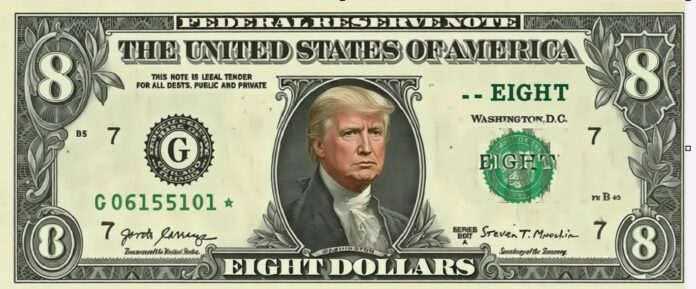
Yes, the fictional picture above, is an eight dollar bill. You will see why, as you read further down.
Of all the mitzvos of Purim, one stands out for its extraordinary power to transform lives. The Mishnah Berurah (694:3) tells us that we should spend more on matanos l’evyonim than on mishloach manos. That is a remarkable statement. It tells us that the heart of Purim lies not in the festive packages we exchange with friends, but in the gifts we press into the hands of those who have the least.
The mitzvah is discussed in the Gemara at the bottom of Megillah 7a. The requirement: give at least one gift to each of two different poor people on the day of Purim. The plural form of the word “l’evyonim” in the pasuk teaches us that the minimum is two recipients.
A related Gemara in Bava Metziah 78b discusses the charity plate of Purim. The Rishonim debate whether this Gemara addresses the mitzvah of matanos l’evyonim itself, or whether it deals with a separate obligation to provide for the Purim needs of the poor.
What Kind of Mitzvah Is This?
There is a fascinating debate among the Rishonim that goes to the very essence of this obligation. Is matanos l’evyonim fundamentally a mitzvah of tzedakah—charity in its classic sense—or is it something altogether different: a special Purim mitzvah whose purpose is to create simcha, joy and happiness?
This question is far from academic. Depending on how we answer it, several practical halachos change dramatically:
Ma’aser funds. If matanos l’evyonim is tzedakah, then one may use ma’aser money to fulfill it. If it is a simcha obligation, then ma’aser funds may not be used.
Obligation of the poor. If it is tzedakah, a poor person is generally exempt—his obligation to give tzedakah is only once a year. But if the mitzvah is rooted in simcha, then even a poor person must give matanos l’evyonim. Indeed, even someone who has reached the point of needing to ask others for charity must still give.
Rav Alexander Ziskind of Grodno was one of only two individuals who ever received a haskamah on a sefer from the Vilna Gaon himself. In his classic work, Yesod V’Shoresh HaAvodah (12:6), he recommends reciting a specific preamble before fulfilling this mitzvah. From the text, it is clear that Rav Ziskind understood matanos l’evyonim as an act of tzedakah.
The Ramban (Bava Metziah 78b), on the other hand, explains that the primary purpose of this mitzvah is to spread simcha—joy and delight—among those who need it most. If anyone did not give yet, this author has slightly less than two dozen real bone fide evyonim coming between 10:00 AM and 5:00 PM today, Just zelle to [email protected]
How the Mitzvah May Be Fulfilled
This obligation may be fulfilled through any type of gift—money, food, drink, or clothing. One should, however, try to give a substantial monetary gift. Ideally, the amount should be enough to buy bread weighing at least three eggs’ volume—roughly five slices. At the bare minimum, one must give a perutah (1/1,244th of an ounce of silver) or its equivalent value to each of two poor people. If silver was $93.77 an ounce – that would come to about 8 cents.
Many poskim, however, are concerned that giving such a minimal amount no longer generates any real feeling of simcha for the recipient. When these minimum amounts were originally calculated, the value of silver was significantly higher.
Rav Shmuel Kamenetsky, shlita, rules that the minimum should be $1. The Shaarei Teshuvah holds that it should equal the cost of a meal for a poor person—in modern times, approximately five dollars (according to Rav Shmuel Fuerst). In the post-COVID era, where all prices have sky-rocketed, it seems that the amount should be closer to eight dollars. hence the picture above.
Spend More on Matanos L’Evyonim
The gedolei haposkim (see Mishnah Berurah 694:3) tell us that it is preferable to spend more on matanos l’evyonim than on mishloach manos. Consider: the calculation for mishloach manos includes not just the food items, but the packaging, the time, and the effort invested in preparing them. For many families, all of this adds up to several hundred dollars. We should be giving at least that much—and ideally more—for matanos l’evyonim.
When to Give
These gifts should be given during the daytime, after the Megillah reading. Matanos l’evyonim should be above and beyond ma’aser; therefore, ma’aser money should not be used, although it may be added to supplement one’s gifts.
Some poskim hold that, technically, matanos l’evyonim may be given before Purim. However, because of the concern that recipients may spend the money earlier, it is preferable to give on Purim itself. Others write that when an intermediary is used, the funds should be held as a package for the poor person—not received on the poor person’s behalf beforehand.
If one intended to give to a specific poor person but was unable to do so, one may redirect the gift to someone else—as long as one did not verbalize the original intention. If one did verbalize it, one should follow up and fulfill that commitment (BaLeilah Hahu p. 16).
The Money Itself
Money set aside for matanos l’evyonim should not be redirected to another tzedakah without consulting a posek. This is based on the Gemara in Bava Metziah (78b), according to those Rishonim who understand that passage as dealing with matanos l’evyonim. Other Rishonim learn that the Gemara is not discussing matanos l’evyonim at all, which gives a posek room for leniency.
A guiding principle: On Purim, we are not overly strict in determining whether someone is truly poor. Whoever puts out his hand—we give to him. Leading poskim note, however, that this leniency does not extend to organizations. The reason may be that the simcha of Purim is generated by making actual poor people happy—not organizations.
Women and Children
Women are fully obligated to give matanos l’evyonim. A married woman may fulfill the mitzvah through her husband, though ideally the husband should inform his wife that he has given on her behalf as well.
Children who are dependent on their parents should still give matanos l’evyonim on their own (Aruch HaShulchan 694:2). Even if they may be technically exempt from tzedakah, the dimension of simcha still applies.
To Whom Does One Give?
Originally, the mitzvah was to give to a true evyon—someone who did not have enough money for a Purim meal. Nowadays, such extreme poverty is thankfully rare. The poskim have ruled that the gift may be given to any poor person eligible to receive ma’aser funds. The Chazon Ish (Terumos U’Ma’asros, cited in Ba’Leilah Hahu p. 12) writes that it may be given to anyone who is not “mesudar b’parnasaso”—settled in his livelihood—to the extent that he can sustain himself and his family.
One may fulfill the mitzvah by giving even to a young child who qualifies as poor.
Matanos l’evyonim may—and ideally should—be given anonymously. This is, in fact, the highest form of fulfilling the mitzvah.
Giving by Check
Rav Moshe Feinstein, zt”l, ruled that one may fulfill matanos l’evyonim with a check—even a post-dated one. Rav Shlomo Zalman Auerbach, zt”l (Halichos Shlomo 19:23), and Rav Elyashiv, zt”l (Yismach Moshe p. 140), concur.
Rav Nissim Karelitz, shlita, however, holds that the check must be negotiable on Purim itself. This can present a difficulty when Purim falls on a Sunday. In areas where check-cashing facilities are open on Sundays, it would not be a problem.
Some have questioned whether these rulings from Israel apply in America, where “stop payment” orders are readily available. In truth, stop-payment capability exists in Israel and England as well, so this distinction does not hold.
Mourners
Although one generally does not give gifts to a mourner, matanos l’evyonim is an exception—because it is considered tzedakah.
A mourner within the twelve months of bereavement is obligated to give matanos l’evyonim. This applies even during the seven days of shivah.
An onein—someone who has lost a close relative whose burial has not yet taken place—may give matanos l’evyonim in the merit of the neshamah of the deceased, according to Rav Shlomo Zalman Auerbach, zt”l.
A Little to Many, or Much to Few?
Should one spread matanos l’evyonim among as many poor people as possible, giving each the minimum? Or is it better to concentrate one’s giving on fewer people with more substantial gifts?
The Bach (Siman 695) writes that it is preferable to give more people the lesser amount. Rav Elyashiv, zt”l (Shvus Yitzchak 8:2, as cited in Kovetz Halachos p. 92), holds that it is preferable to give fewer people a more significant sum. Rav Elyashiv appears to be emphasizing the simcha dimension of the mitzvah—a small token does not generate real joy.
Since either approach fulfills the mitzvah, one should perform it in whichever manner inspires the greatest sense of dveikus b’Hashem—closeness to the Al-Mighty.
So What is the Preamble?
L’shaim ichud kudsha brich hu, hareini muchan l’kayem mitzvas assei shekasuv besorasainu hakedosha shetzivani yotzri ubori “Nason titian” u “pasoach tiftach” vegam mitzvas assei shel kaballah “umatanos l’evyonim.”
The author can be reached at [email protected]