

It was a Shabbos that we will never forget — the sirens that accompanied the reading of Parshas Zachor, the loud booms that gave no indication of whether we were hearing interceptions or actual missile strikes, the airplanes that flew over Yerushalayim throughout the day, the deserted streets and shuls, and the reports from foreign workers that a war had begun. We were all overjoyed when we learned that the tyrannical mass murderer Khomenei had been killed, but we shed tears when a woman was killed in Tel Aviv on Shabbos, and we were grief-stricken the next day after the deadly missile strike on the bomb shelter of the Tiferes Yisroel shul in Beit Shemesh. My own family was gripped by fear as the sirens repeatedly wailed, since our apartment has no safe room or protected area. And the questions and uncertainties hover in the air: What will happen on Purim? How long will this go on? How many missiles will Iran continue launching in desperation?
On Shabbos morning, I had a strange sense that something was amiss. The streets were relatively empty, and I was one of the first to arrive at davening — and I do not daven at neitz. I soon discovered that an air raid siren had been heard in Yerushalayim an hour before I arrived at shul, which is how everyone else knew that the war had begun. I, on the other hand, did not hear the siren, perhaps because I was sleeping too soundly, but more likely because I am hard of hearing due to a combination of my age and hereditary factors. Nevertheless, I didn’t need the siren to inform me that something was happening; the clues in my surroundings tipped me off. Rechov Givat Shaul, the main street in my neighborhood, is usually filled with people on Shabbos, whether they are hurrying to shul, returning from davening, or, in some cases, running through the streets with towels draped on their shoulders (after all, our neighborhood has an eiruv) either to or from the mikveh. But this time the street was empty. What made this even more striking was the fact that it was the week of Parshas Zachor, when women go to shul as well. The local tzedokah committee had gone to great efforts to compile lists of the times when Parshas Zachor would be read in every shul in the neighborhood and in every nusach, and to post those notices in every building. They even specified which women’s readings were attended by a minyan of men. It is a wonderful neighborhood and community; there is no question about that. In any event, this time, the empty streets made it abundantly clear that this wasn’t a Shabbos like any other.
I generally daven on Shabbos morning in a shul known as Tausig. I am very fond of the gabbai, Rav Chaim Lieder (who is in charge of taharos and burials for the chevra kaddisha of Yerushalayim during the week), as well as the other mispallelim and the baal korei. Above all, I am fond of the time when davening begins, which is approximately 9:15 a.m. (Yes, we make it in time for zman tefillah; do not worry.) On a typical Shabbos, anyone who arrives after Shochen Ad will have a hard time finding an empty seat, but this time, most of the benches were unoccupied. Upon entering the shul, I made a quizzical gesture to one of the regular mispallelim, and he motioned back that there was a war. At first, I wasn’t sure how to interpret his gesture; there isn’t an easy way to signal without actually speaking that a war has begun. But I didn’t have to wait long to clarify his intent; one minute later, the shrill sound of an air raid siren pierced the air. That was frightening enough, and then someone else motioned to me that it was the third siren of the morning. At that point, I began to feel deeply unsettled.
So the other shoe had finally dropped, and we were at war. This was not a joke. Just before we read the words “remember what Amalek did to you,” a loud boom echoed in the distance with incredible synchronicity. It was impossible to know what the explosive sound signified: Did it mean that a missile had been intercepted and neutralized, or did it mean that Israel’s defenses had failed to intercept it and the missile had landed somewhere? If it was the latter, then it had surely struck nearby; the explosion had been very loud. Meanwhile, planes were buzzing and circling in the air constantly. I gathered that Trump had decided to make good on his threats and had begun crushing the “axis of evil.” He had declared that he would not allow Iran to become a nuclear power, and it seemed that he was determined to keep his word.
Air Raid Sirens Sow Terror
Everyone feels fear at some point in his life. Some people are naturally anxious and tend to fear things that do not frighten others. But even the most unflappable person surely feels fear sometimes. I believe that in most cases, when a person experiences fear, there is a way to escape from the danger. An air raid siren, on the other hand, induces mortal terror, and there is no apparent way to avoid the peril. If you haven’t experienced this, then it is likely that you have never felt fear of that nature.
When an air raid siren sounds people head for the closest bomb shelter, which is located in the basement of a building, or to a safe room, which is reinforced.
On the other hand, recent missile strikes have indeed caused damage to buildings in Tel Aviv, in Be’er Sheva, and even in Bnei Brak.
While hishtadlus is an obligation for anyone who has the opportunity, we know that only Hashem determines our fate. When the Iron Dome successfully shoots down incoming missiles, we know to attribute it to His protection. Iron Dome batteries (which were received from the United States) are distributed throughout the country. B’chasdei Shomayim, this system shoots down almost every missile that crosses Israel’s borders, making sure that the shrapnel falls into the sea or an uninhabited area. In Tel Aviv, the interceptor missed the missile, and the resultant devastation showed us the true magnitude of Hashem’s chesed in the vast majority of cases, when the missiles are indeed intercepted and destroyed. This is also evident from the events in Arab countries in recent days, where the Iron Dome system does not exist, and almost every Iranian missile causes massive destruction. May Hashem continue to protect us!
This week marked the 30th yahrtzeit of Rav Pinchos Menachem Alter, the Pnei Menachem of Ger, who passed away on 16 Adar 5756/1996. During the Gulf War, the Pnei Menachem worked hard to instill calm in the Israeli public. He famously commented that there is no reason to be afraid, since everything that occurs in the world is a function of Heavenly hashgocha and every bullet has an address (an echo of a comment once made by the Ohr Somei’ach, Rav Meir Simcha Hakohen of Dvinsk). At that time, a few bochurim decided that they did not need to take precautions, and they sat on a rooftop during an air raid to watch the missile fire. When Rav Pinchos Menachem became aware of that, he sent a messenger to rebuke them. “We never know the address on a missile,” he said. “It might very well be addressed simply to ‘people who do not take precautions.’”
The Shabbos Goyim Kept Us Informed
As I mentioned, this past Shabbos was a frightening day, with sirens sounding with rapid frequency since 8:00 in the morning. In shul, I learned that Israel had launched a joint attack on Iran together with the American army. Now, you may be wondering how anyone had this information to share with me when we are cut off from the radio and other media on Shabbos. Even the silent radio station, which is meant to broadcast on Shabbos, does not report the news; it merely relays updated instructions from the Home Front Command. But that does not mean that religious Jews have no way of learning about what is happening in the world on Shabbos.
There is one surefire indicator of something going on: When reservists are called up in large quantities, one can be certain that military action is taking place. We have seen this in previous wars as well, when people were suddenly summoned to the front lines even from their shuls. When a war breaks out, reservists are called to duty, and even many chareidim, mostly those who serve by identifying corpses, are called to serve as well. But that alone isn’t enough of a source of information, since it typically provides us only with a general picture of the situation and not with the finer details.
The details, however, are often supplied to us by foreign workers. In Eretz Yisroel, any person who requires long-term care (a status with rigid but clear criteria) is entitled to employ a foreign caregiver. To do this, one must solicit the services of an agency that recruits caregivers from foreign countries (typically Thailand, India, or the Philippines) who have been trained specifically to provide care for the elderly. Many caregivers accompany their charges to shul and then wait for davening to end so they can walk them home. In the Zupnik shul, for instance, there are three men who employ foreign caregivers. The caregivers are gentiles who listen to the news and therefore can keep us abreast of what is happening. On days like this past Shabbos, they become sources of information for the entire neighborhood.
In truth, the rest of the community makes use of these caregivers’ services all the time. Whenever someone needs a Shabbos goy, there is nothing to prevent him from “borrowing” a neighbor’s caregiver for a few minutes, even though there is also an official Shabbos goy who is stationed in the center of the neighborhood every week. Although we do not discuss compensation on Shabbos, it is understood that anyone who received such services must go to his neighbor’s home after Shabbos to pay the goy for whatever he did. The payments vary based on financial status, and perhaps based on the magnitude of the problem that had to be fixed, but the standard payment is 70 shekels, which is the equivalent of about 20 dollars, not a terribly excessive sum.
On Motzoei Shabbos, we all pounced on every source of news available to us. Having endured a long Shabbos that brought us many air raid alerts, we were all hungry for every last scrap of information. We had begun to realize that Purim would be different this year; the Home Front Command had already announced a ban on public gatherings, and we all feared that we would not be permitted to gather in our shuls to hear the megillah. On Sunday morning, the shuls were packed with people; however, that was before the tragedy in Beit Shemesh.
In the meantime, the prime minister released a message to the nation implying that the war might last for several days, and possibly for several weeks. My cell phone received several messages from the Knesset: Committee deliberations had been canceled, and the Knesset sitting initially scheduled for Sunday — the only day the Knesset was due to meet this week, on account of Purim — had been called off as well. We were also informed that the Knesset building would be locked, with no one permitted to enter the premises. This was a dramatic move, considering that the Knesset building is the symbol of Israel’s governance. I will also let you in on a secret: On Friday, an Iron Dome battery was stationed next to the Knesset building. This could mean only one thing: There was a concern that a missile would be fired specifically at the Knesset (or perhaps the nearby Prime Minister’s Office or Bank of Israel). Meanwhile, classes were cancelled in schools throughout the country. Israel had very quickly shifted into war mode.
On Motzoei Shabbos, an open letter from the gedolei Yisroel was published: “To our brethren, Bnei Yisroel, who dwell in the Holy Land and in every place. At a time such as this one, when the people who dwell in Tzion are in a state of war and great danger, and the burden of the authorities’ persecution of the talmidim of yeshivos and kollelim is increasing as well, it is our duty to increase our Torah learning and davening, to beg Hashem to pour out His mercy upon us from Heaven and to save us from all those who seek to harm us, and to show us miracles as in the days of Mordechai and Esther. Our Father, our King, thwart the plots of our enemies and annul all evil decrees! Our brethren are called upon to enter the yeshivos and shuls on Taanis Esther before Mincha and to read perokim 22, 83, and 85 of Tehillim, one posuk at a time, followed by reciting Kel Melech and the 13 middos of Heavenly mercy. It is also reported that the Chazon Ish said that reciting the kapitel of yosheiv b’seser can ward off bombs and explosions. May it be the Will of our Father in Heaven that our redemption will be hastened, our salvation will be brought near, and He will liberate us from trouble to freedom. May we achieve joy and gladness, and may sadness and sighing flee.”
The Iranian Snake and Hamas
One thing is clear: The Middle East, and the world along with it, is on the brink of change. The wicked tyrant Khomenei was responsible for a long list of terror attacks over the 40 years of his leadership. He was the epitome of evil. Even when President Trump listed several occasions when Americans were slaughtered on Khomeini’s orders, he did not manage to put together the full list. Khomenei was also indirectly — and maybe even directly — responsible for the bombing of the Twin Towers. He is the one who taught the Shiite Muslim world that murder is a religious objective. The massacre of October 7 was also inspired and encouraged by the Iranian tyrant. Some say that once the Iranian axis of evil has been crushed, Hamas will disarm as well.
Parenthetically, it is very possible that this war has already determined the outcome of the next election in Israel, whenever it may be. Netanyahu’s popularity has skyrocketed in the wake of the strike on Iran, especially since the politicians who regularly condemn and belittle him, like much of the press, have emerged from this incident looking utterly foolish. After all, they insisted with complete confidence that Trump had abandoned Netanyahu and Israel and that he was developing a peace agreement with Iran in the face of Netanyahu’s opposition. But we’ll leave the political analysis for another time.
Khomenei’s elimination was a military and political triumph, but it was a triumph of intelligence above all. Shortly before the attack on his residence, Khomenei was meeting with his senior advisors, Ali Larijani and Ali Shamkhani, along with other officials, in a secure location. Intelligence reports had first indicated that he planned to hold his meeting in the evening in Tehran, but Israeli intelligence discovered that the meeting was taking place on Shabbos morning instead, and the air strikes were moved up accordingly. The Israeli and American intelligence agencies were in constant contact. Both countries had waited a long time for this rare opportunity, when Iranian political and military leaders were meeting in a single location where they could all be killed at once. On Shabbos morning, Israeli intelligence identified not just one meeting but three, including the one with Khomenei. It was such a unique moment that the attack was carried out in broad daylight to capitalize on the opportunity, and Israeli planes dropped 30 bombs on Khomenei’s home.
Trump took credit for the attack, and perhaps rightly so. “Khomenei did not succeed in escaping our intelligence and our highly sophisticated tracking systems,” he boasted. He also praised Israel: “This was tight collaboration with Israel. There was nothing that he or any of the other leaders killed with him could have done.” It is estimated that about 40 senior Iranian officials were killed in the joint American-Israeli air strike, including the aforementioned Ali Shamkhani, as well as Mohammed Pakpour, commander of the Iranian Revolutionary Guard, and Aziz Nasirzadeh, Iran’s minister of defense. On Sunday afternoon, it was reported that the former Iranian president, Ahmadinejad, who was considered a bitter enemy of Israel, had been eliminated as well.
And now that I have quoted President Trump, I must repeat a rhetorical question that I often raise: Why does he always end his speeches with the words “G-d bless America” (and America’s soldiers, and the world), while Netanyahu doesn’t seem to know how to invoke Hashem’s Name? Why?
After the initial attacks on Iran, it was clear that a massive missile attack on Israel was bound to come. The only surprise was the fact that Iran fired missiles at Arab countries as well. The Revolutionary Guard Corps threatened to respond in a “historic” fashion to Khomenei’s elimination, and they soon acted on those threats. Rumor has it that the missile that hit Beit Shemesh carried a warhead containing hundreds of kilograms of explosives. The victims who were killed by the missile were in a bomb shelter, but even a reinforced shelter was unable to withstand a missile with such immense destructive capacity. That, of course, only added to the pain and fear. Who knows what the next day will bring?
Children in Bomb Shelters
The subject of the emotional impact of the missile attacks reminds me of Avi Mimran, the top chareidi radio broadcaster in Israel, who is also known for being Itzik’s father. Itzik is a child whom everyone knows. He suffers from profound autism to a degree that leads him to bang his head against walls, to yank every tablecloth that he encounters, and not to react to anything. Life is not easy for Itzik, nor is it easy for his parents and siblings. If I were to describe their lives with Itzik in detail, you would have a vivid picture of what it means when Hashem deposits a special soul, with unique and special needs, with an ordinary family. Several years ago, Avi Mimran founded an organization known as Mesugalim, which provides assistance to the families of children with autism. The organization’s programs include mini-vacations, Shabbos programs, and guidance and counseling.
What does this have to do with us? Avi Mimran, who has become a world-class expert on autism, recently released a video with instructions for parents of autistic children regarding the current crisis. He explained that if the average person is frightened by an air raid siren, an autistic person suffers from much greater fear. Moreover, the things that calm an ordinary child during an air raid and the rush to shelter do not help a child with autism.
“Children with autism enter a state of extreme panic upon hearing an air raid siren,” Mimran explained. “Nothing that we explained to them during a previous air raid will make any difference when another siren is heard. They do not connect one to the other; they simply become hysterical. When an autistic child hears a siren, he is certain that a missile from Iran has been fired directly at his home, or directly at his head. He cannot conceive of any alternative. And the result is abject terror. There is no middle ground and no shades of gray. If there is a siren, in his mind, it means that he is about to die. How can you possibly calm such a child? First of all, you must connect to his fear. Don’t simply tell him that everything will be all right, because he cannot understand why it will be all right. You must create communication. You must tell the child, ‘We are with you. We are afraid as well, and I know that you are afraid that a missile will fall on us.’ Once the child feels that you have connected with him, you can begin opening his eyes to other possibilities. ‘It’s not guaranteed that the missile will fall here,’ you can tell him. ‘It might be intercepted. Hashem is protecting us, and there are Arrow missiles that will strike it, and we are in a safe room.’ You must gradually build up this understanding. You must begin with the child’s fear and then give him an entire chain of possibilities, letting everything make sense in his head. You must introduce reassuring possibilities into his thought process, letting him develop the understanding that there are other possibilities besides the chance that he will die. You must also remain calm and speak to him with confidence and stability.” Mimran went on to explain the workings of the autistic mind, offering parents keen insight into the mentalities of such children. In truth, however, his suggestions are beneficial for parents of other children as well.
“Everything Is All Right”
There is another video that has been spreading through the media and has already garnered hundreds of thousands of views, and that creates a tremendous kiddush Hashem. The video features a female correspondent from Channel 11 who interviewed several residents of Tel Aviv who survived a missile strike and were left homeless. When a missile hit a building in Tel Aviv, the two uppermost stories were completely destroyed (and additional buildings in the area were damaged by the blast), and the residents of those apartments lost their homes in a split second. One of those residents was a kollel yungerman. This is how the conversation unfolded.
“We see people here with suitcases, taking the few belongings that they managed to salvage from their homes,” the correspondent said, facing the camera. Turning to one of the local residents, she said, “I’d like to talk to you about your feelings. We see the suitcases here.”
With ambulances and fire trucks in the background, the yungerman stood before the camera with a spare shirt draped over his shoulder and his tallis and tefillin in his hands. “We entered the apartment only to retrieve our tefillin,” he said. “That is enough for us. We need nothing else; we have tefillin, we will get up in the morning, and we will daven Shacharis and give thanks for the fact that we are alive. Purim is in two days, and the Jewish nation lives. Boruch Hashem. We have no home now, but that is not a tragedy. We will have another home. The most important thing is that we have our tefillin, and we will get up in the morning, and everything will be all right. There is no need to panic. I see that you seem frightened….”
Shocked by the yungerman’s equilibrium, the reporter said, “After a dramatic Shabbos with many sirens, you are leaving your home with nothing but your spirit intact.”
“My children are all right, boruch Hashem, so what reason do we have to be upset?” the yungerman replied. “We are going to stay in my in-laws’ home now, which is not a simple matter,” he added with a laugh, “but we’ll hope that everything will be all right. Purim is coming in two days; no one should be distressed. I see some people here who appear frightened. Everyone should begin learning the megillah with all its peirushim.”
“Thank you,” the reporter said.
“With pleasure,” the yungerman replied.
I will now reveal to you the identity of the yungerman who appeared on everyone’s television screens: Moshe Chaim Sorotzkin, the son of Rav Eliezer Sorotzkin and grandson of Rav Yisroel Meir Lau. Moshe Chaim, who married into the Shub family, lives in Tel Aviv, where he learns in kollel and engages in kiruv work. His name was visible on the tallis bag that he held on camera. Not only did he display incredible calm and determination, but his impromptu television interview also generated a wave of encouragement and a massive kiddush Hashem.
The reporter turned back to the camera after Moshe Chaim’s departure and said, “I am repeatedly amazed by people who come out of their homes with nothing but a single suitcase — and this is a man who emerged with nothing but his tefillin — even though they lost their homes and their property. They were left with nothing but a single suitcase or two, but with incredible spirit. That is the spirit of this people. We are still seeing people trying to get into their apartments and retrieve their belongings, but the Home Front Command is not allowing them to enter their homes, because the buildings just barely survived, as you can see.
Tragedy in Beit Shemesh Shakes the Nation
Do not be deceived, however, into thinking that life in Israel is calm these days. Hearing an air raid siren can be terrifying. Air travel in and out of Israel has been suspended, which means that the country is under a sort of siege. Even driving on the roads can be frightening. Moshe Chaim Sorotzkin might have been reassuring during his brief appearance on the news, but the stark reality is that he was spared from death, and his children might suffer from trauma for a long time, much like thousands of other children (and adults) throughout the country. The missile that struck Tel Aviv also caused the death of a 40-year-old woman, and 25 other victims of the missile strike were evacuated to Ichilov Hospital. Dozens of apartments and businesses, including some that are far from the site of the missile strike, were damaged, and the building itself sustained serious harm.
Rescue personnel continued sweeping the area for many long hours to find any victims trapped in the rubble — and, indeed, an eight-year-old boy was successfully rescued. Once the sweep of the rubble had been completed, some of the residents were permitted to enter the building and recover some of their belongings. One of the residents asserted that their lives had been saved by the bomb shelter. A woman who lives in an old building (like my own) revealed, “As soon as the siren began, I realized that we had nowhere to run. This is an old building without a bomb shelter. We ran down four flights of stairs and stood in the stairwell, and then we heard the explosion. The stairs shook from the force of the blast, and we heard the sound of shattering glass. It was a terrible sense of helplessness.”
On the first day of Operation Roaring Lion, there was one fatality — the foreign caregiver who was killed — and 121 other people were injured. Two of the injured victims were in moderate condition, while the other 119 were listed as lightly wounded. Another woman died of a heart attack and might be considered a victim of the war as well.
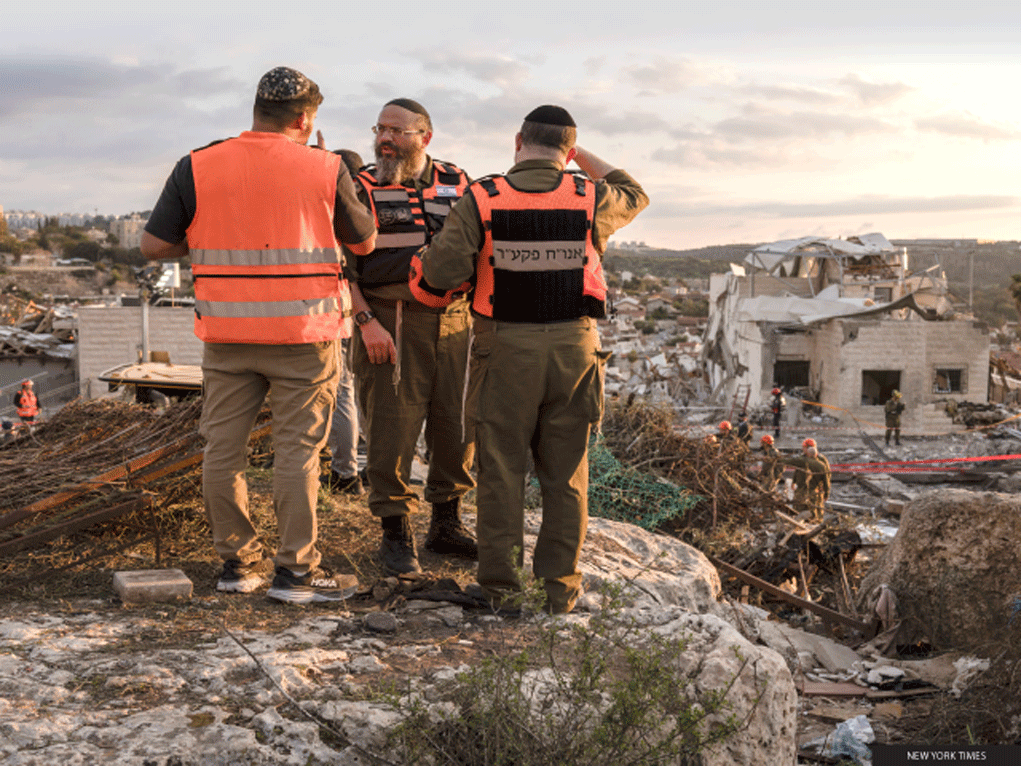
The second day of the war, Sunday, was many times more painful, as it gave us a stark reminder of what can happen when tragedy is decreed in Shomayim. Dozens of missiles were fired at Israel on Shabbos, and dozens more on Sunday, and one of those missiles hit a bomb shelter in Beit Shemesh containing many children. The result was a horrific tragedy: Nine people were killed, and dozens more were wounded and evacuated to hospitals.
After the devastating missile strike, Mayor Shmuel Greenberg of Beit Shemesh, a former aide to MK Gafni, was interviewed by every media outlet and spoke cautiously but with determination. On Sunday evening, he finally divulged a few details, and it was painful to hear. The missile had struck a shul building containing a bomb shelter, but the damage extended to the surrounding area as well. Forty apartments were damaged, some of them totally destroyed. My understanding is that this occurred in an older area of the city. Perhaps it was a miracle that the surrounding buildings were not high-rise apartment buildings. Another miracle was reported by the gabbai of the shul, who revealed that it had been completely empty at the time. The missile strike occurred after Shacharis and before Mincha, when the shul was not occupied.
This disaster filled the country with sorrow. The images of children being carried by paramedics were difficult to see, and the row of body bags reminded me of the aftermath of the Meron tragedy several years ago. President Herzog called Mayor Greenberg and offered his encouragement to the residents of Beit Shemesh, and the security council met in the wake of this painful incident. Meanwhile, President Trump has said that the war might continue for weeks, and the Iranians are likewise vowing to continue responding with force.
We daven to Hashem to have mercy on us and to continue protecting us.