

Mashy’s mother hears bawling from the playroom and goes to investigate.
“Why is Saralah crying?” she asks her daughter.
“Because I wouldn’t give her any of my nosh.”
“Mashy, don’t you know that we’re supposed to share? That’s a rule in our house, right?”
“Right,” Mashy says. “Except when it’s someone I’m mad at. Saralah wouldn’t let me play with her new doll!”
***
Yanky is home from yeshiva and working hard to catch up on his rest.
“Yanky!” his mother says, coming into the room just in time to see him turn over in bed. “Aren’t you supposed to daven Shacharis with a minyan?”
“Sure,” Yanky says with a yawn. “Except during bein hazemanim. I can take a little break then…”
***
Mr. P. is known as a man of integrity. Everyone knows that, when it comes to his business dealings, he’s honest as the day. He’d never dream of cheating anyone or making a commitment he doesn’t keep. When it comes to his own children, however, the story is different.
“They’re only kids,” he’d explain if anyone asked him. “You don’t have to keep your word to a kid…”
***
Mrs. D. doesn’t consider herself a gossiper. She’s usually pretty good about controlling herself in the area of lashon hara… except now. She just heard a story that she simply cannot keep to herself!
Without actually articulating the pros and cons in her own mind, she impulsively decides to change her usual rule. Just this once.
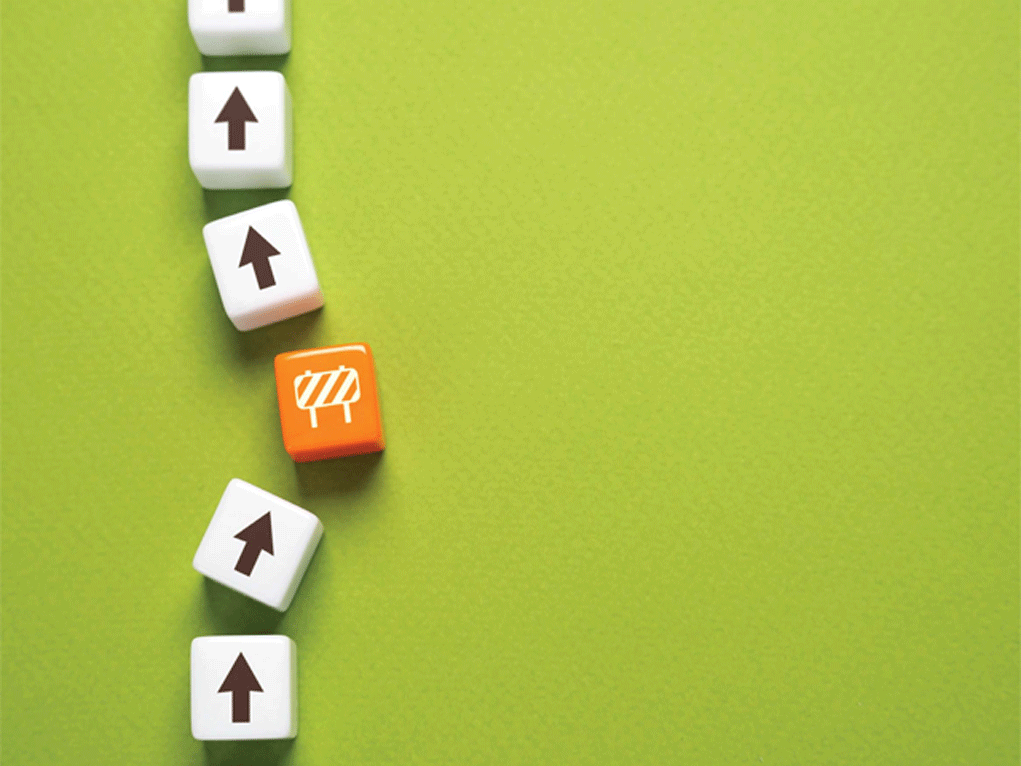
We all have our personal rulebooks. The rules may be conscious, or they may be so ingrained that we hardly even think about them.
I’m not talking about the objective “rule book” that we know as halacha. I’m not even talking about the more fleeting and arbitrary set of rules imposed by government and, in a different way, by society.
I’m talking about the things we demand of ourselves. The things we expect from ourselves. The red lines we’re resolved never to cross… and the ones we allow to waver and bend a little.
In the examples above, little Mashy is a good girl who understands that it’s a nice thing to share. But her sense of fairness, outraged when Saralah refused to let her play with her doll, prompts her to
rewrite the rule. In Mashy’s personal rulebook, it’s okay not to share if your playmate is being mean to you.
The same reasoning applies in the case of the sleepy yeshiva bochur. When it comes to his spiritual obligations, Yanky generally toes the line. He does what’s expected of him and, indeed, what he expects from himself.
But change in location and circumstance leads him to make an adjustment in his personal rulebook. Being at home instead of in yeshiva, and during bein hazemanim rather than during the zeman, offers him an opportunity to change the usual rule, to sleep late, and to daven by himself at home. Which he does, without much more than a slight pang of his conscience.
Why doesn’t his conscience bother him more? It’s because of a fallacy in his thinking. The same fallacy which Mashy embraced. The one which says that extraordinary circumstances give you permission to deviate from your usual rule.
in Mr. P’s personal rule book, honesty and integrity are an absolute must… when dealing with adult peers. Children do not fall into this category and are therefore subject to a less rigorous code. A promise made to a kid is the kind of “extraordinary circumstance” that allows him to break his own rule. And so, he fails to keep his word to them. In his rule book, that’s perfectly acceptable.
Then there’s the case of Mrs. D. Normally a conscientious practitioner of all the right things, she assumes on the spot that a greater than usual temptation to gossip, along with the discomfort this engenders, grants her permission to relieve the tension by breaking her rule just this once.
Only of course, it’s never once. Rules, once bent or broken, have a nasty way of becoming non-rules.
But Mrs. D. does not feel as guilty about her breach as you’d expect her to. That’s because, in her personal rulebook, discomfort is an excuse for all sorts of misdemeanors. The slightest irritation of her nerves can prompt her to speak in a way she normally avoids. Misconduct on someone else’s part, such as taking her intended parking space or cutting in front of her in line at the supermarket, in her rule book is justification for an unbecoming response on her part.
And because it’s okay in her personal rule book, she doesn’t even have to feel too bad about it afterward.
What gives us the right to make or change the rules? After all, we were all raised with a clear sense of right and wrong. Why, when it comes to the gray areas governing our interactions with others or our behavior in unusual circumstances, do we feel free and easy about adjusting our behavior?
I think it’s because we give a lot of power to our bodies and our emotions, at the expense of our souls. Let’s take a look at the four examples above and see how that works.
Little Mashy has no problem sharing with her friends when they’re nice to her. But let one of them act in a way that hurts or angers her, such as denying her the fun of playing with a new doll, and she instantly rewrites her own rule. Her feelings dictate her decision.
When it comes to the decision of whether or not to get up for minyan in the morning, Yanky, the yeshiva bochur, has his personal rulebook, too. His own unwritten rule is that he’s entitled to cut himself some slack when not in yeshiva. Basically, he’s letting his tired body decide for him.
Mr. P., the usually honest man who thinks it’s okay to break his word to his children, is letting himself be guided by a false premise. That premise says that grown-ups deserve the full exertion of his integrity, while kids deserve no such exertion. His reputation rests on the assessment of his peers; his kids have nothing to do with that. And so, on the integrity front, he cuts himself slack when it comes to non-adults whose good opinion he doesn’t feel the need to cultivate. In other words, his kids.
And Mrs. D., sizzling with eagerness to pour a great story into someone’s ear, is well aware of the big rule against speaking lashon hara. Unfortunately, she consults her personal rule book instead. And it tells her that bending the rules when the temptation is so great, and the discomfort of holding back so difficult, is acceptable. Just this once.
Ladies and gentlemen, it might be a good idea to take a peek into our personal rulebooks now and then. They may need a bit of dusting off. A little revision might be in order, to give us a chance to delete some of the excuses and justifications that may be lurking there. And which may have been there so long that we’ve forgotten to question them.
The more scrupulously we do that, the closer we’ll come to aligning our personal rule books with the big, objective one which we all try out best to live by. The one that’s eternal!