
 Vos Iz Neias
Should Influence Laundering Be Illegal? How It Works — and How It Involves Tucker Carlson
By Shira Miller
There is a concept in money laundering called a shell company: a legal entity that exists primarily to disguise the true origin of funds, insulating the actual beneficiary from scrutiny.
A similar dynamic, largely unaddressed in American law, operates in the world of foreign influence — Let’s call it influence laundering.
A foreign government pays a domestic consulting firm, which in turn arranges access to prominent journalists, commentators, or policymakers. The foreign government gets the media access it craves. The journalist can truthfully say he never took foreign money. And the public is none the wiser.
A close look at Qatar’s influence operations in the United States — and the swirling controversy around Tucker Carlson’s relationship with Doha — raises a pointed question: Should this kind of triangulated influence campaign be illegal? And does existing law, namely the Foreign Agents Registration Act (FARA), already address it?
What Is Influence Laundering?
Influence laundering refers to the practice by which a foreign government pays a registered intermediary — a lobbying firm, consulting company, or PR agency — to secure favorable media coverage, access to journalists, or narrative placement in the press, without those journalists ever directly receiving foreign funds or registering as foreign agents.
It is, in essence, a three-party arrangement:
Step 1: A foreign government hires a domestic consulting firm and pays it generously.
Step 2: That firm uses its Washington connections to arrange access to influential journalists, commentators, or policymakers, pitching story ideas, securing interviews, and shaping favorable narratives.
Step 3: The journalist or commentator, having received no direct foreign payment, can deny being an agent of the foreign government — even as the content of their coverage shifts in ways that happen to benefit that government.
This is not a hypothetical. It is, according to extensive reporting based on Department of Justice FARA filings, exactly what Qatar has been doing in the American conservative media ecosystem.
Qatar’s Campaign: The Documented Record
Following President Trump’s 2024 election victory, Qatar dramatically intensified its outreach to right-wing media. According to a Washington Examiner investigation based on DOJ records, before the election, just over 10% of communications sent by Qatari foreign agents to the media were directed to conservative outlets or commenters. After Election Day, that proportion surged to more than half of their total media correspondence.
The rationale is not difficult to understand. Qatar has long faced Republican criticism for its ties to Hamas — the terror organization whose political leadership lives in luxury in Doha — and for its relationship with Iran. With Republicans now controlling the White House and both chambers of Congress, Qatar needed friends on the right.
The means it employed were thoroughly modern and thoroughly legal, at least on paper.
Qatar retained two U.S. lobbying firms as registered foreign agents: Lumen8 Advisors and GRV Strategies. Both filed disclosures under FARA, which mandates that individuals or firms acting on behalf of foreign governments register with the Department of Justice and disclose their activities.
Lumen8 Advisors, according to its FARA contract, receives a fixed monthly payment of $180,000 from the Qatari Embassy in Washington for what it describes as “media and communication coaching and consulting services.” According to Ynetnews, the contract requires Lumen8’s president to travel to Doha 13 days per month, fly business or first class on Qatar Airways, and prohibits the firm from working with any other Middle Eastern government without Qatar’s explicit approval.
GRV Strategies, founded by Garrett Ventry — a former Republican congressional advisor deeply embedded in conservative Washington circles — receives $80,000 per month from the Qatari government, per the same Washington Examiner report.
The Story-Planting Pattern
The Washington Examiner documented what it called a “recurring pattern” in Qatar’s media campaign: outreach to journalists, a story pitch, and then the publication of a favorable article, sometimes within days.
One example: on February 20, 2025, a GRV Strategies representative texted a Fox News employee suggesting a “foreign policy story idea.” Three days later, Fox News published an article titled “Qatar Stands Firm Against Iranian Pressure,” citing an anonymous “source familiar with Qatar’s plans.” Similarly, on December 4, 2024, GRV flagged a story to a New York Post employee. Three days later, the Post ran a piece highlighting Qatar’s positive role in hostage negotiations between Israel and Hamas.
Note: It is impossible to prove based on public records alone whether these articles were directly caused by the Qatari pitches, or whether the journalists would have written similar pieces anyway. The Washington Examiner acknowledged as much in its investigation.
Tucker Carlson: The Central Case Study
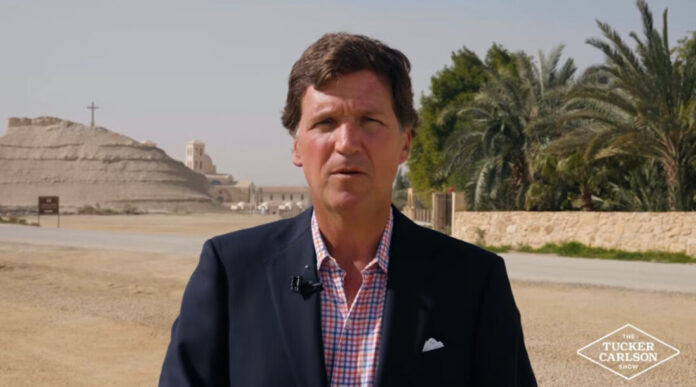
The most high-profile episode in Qatar’s conservative media campaign involved Tucker Carlson, the former Fox News anchor who now runs the independent Tucker Carlson Network (TCN).
The Interview
In March 2025, Carlson conducted an interview with Qatari Prime Minister Mohammed bin Abdulrahman Al Thani that accumulated nearly six million views across X and YouTube within hours of its release. The interview was, by all accounts, friendly — with Carlson praising the country and presenting Qatar’s perspective on the Iran conflict sympathetically.
According to the Washington Examiner, this interview was facilitated by Lumen8 Advisors, the firm receiving $180,000 a month from the Qatari Embassy. Anna Jacobs, a non-resident fellow at the Arab Gulf States Institute, told the Examiner: “Qatar wants to further cement ties with Trump and allies for many reasons, including to defend itself against Republican attacks for its relationship with Hamas and Iran.”
The “Paid Partnership” Disclosure
One detail attracted particular scrutiny. In promoting the interview on social media, Carlson himself included the phrase “Includes paid partnerships.” Critics argued this was a tacit acknowledgment that money had changed hands in connection with the interview. Supporters argued it was standard boilerplate for sponsored content that may have been entirely unrelated to Qatar.
Laura Loomer’s Allegation and TCN’s Denial
Conservative activist Laura Loomer subsequently alleged that FARA data showed Qatar had paid Carlson $200,000 for the interview. She wrote: “Tucker Carlson wants you to think his thoughts on Iran are based and original, but he’s literally participating in paid-for interviews by the Qataris.”
Tucker Carlson Network co-founder Neil Patel responded with a categorical denial, according to Barrett Media: “Allegations that Tucker Carlson or Tucker Carlson Network took money from any foreign country for an interview or for any other reason are categorically and definitively false and defamatory. Neither Tucker nor TCN has ever taken a penny from Qatar or any foreign country.”
Patel further explained that the document Loomer cited is a FARA filing for Lumen8 Advisors — not for Carlson or TCN. “This contract and filing has nothing to do with us,” Patel stated.
The Home Purchase Announcement
The controversy deepened when Carlson, speaking at the Doha Forum, announced his intention to purchase a home in Qatar. He framed the move defiantly, according to the Jerusalem Post: “I’ve never taken anything from your country and don’t plan to. I’m an American and a free man, and I’ll be wherever I want to be.” He added that he would be giving money to Qatar, not receiving it.
Observers noted the irony: in Qatar, publishing false information can carry a prison sentence of up to five years or a fine equivalent to approximately $28,000. Ryan Saavedra of the Daily Wire pointedly observed: “It will be interesting to see what Qatar does given that Tucker just bought a home there.”
The Mossad Bombing Claim — and Qatar’s Denial
In what many viewed as a painful irony, the Carlson–Qatar story took a sharp turn in early March 2026 when Carlson claimed on his show that Saudi Arabia and Qatar had “arrested Israeli Mossad agents planning bombings” in those countries. He offered no source for the claim.
Qatar’s foreign ministry issued a public denial. According to Middle East Eye, spokesperson Majed Al-Ansari stated that Doha had “no information on Mossad cells operating in the country.” Mark Dubowitz of the Foundation for Defense of Democracies offered a withering verdict: “Tucker Carlson’s mendacious propaganda is now even too much for Qatar. When Doha is swatting down your claims, you know you’ve drifted from commentary into fever-swamp delusions.”
What Does FARA Actually Require?
The Foreign Agents Registration Act, enacted in 1938 to counter Nazi propaganda in the United States, requires any person or entity acting as an “agent of a foreign principal” to register with the Department of Justice and publicly disclose their activities, funding, and the political or public relations work they perform on behalf of that foreign principal.
The key operative phrase is “acting as an agent” — meaning operating under the direction or control of a foreign government and engaging in political activities, lobbying, or public relations on its behalf. Journalists who independently choose to interview foreign leaders, or who accept pitches from registered foreign agent firms without receiving direct foreign payment, do not ordinarily trigger FARA obligations.
Lumen8 Advisors and GRV Strategies are already registered under FARA — they have complied with the law’s disclosure requirements. The question is whether the journalists they cultivate should face any legal obligation.
Complicating the picture further: Attorney General Pam Bondi, who herself formerly lobbied for Qatar, has announced that DOJ enforcement of FARA will be limited to “conduct similar to more traditional espionage.” Per the Washington Examiner, this policy grants countries like Qatar considerably greater latitude to engage in lobbying and media influence without public scrutiny.
The Core Legal Question: Should Influence Laundering Be Illegal?
The gap in existing law is not hard to identify. FARA was designed to ensure transparency about foreign influence, but it does not require the recipients of that influence — the journalists, commentators, and policymakers cultivated by registered foreign agents — to disclose that they were approached, that their access was facilitated by a foreign government, or that the interview they conducted was arranged at significant cost to a foreign embassy.
Several legal scholars and national security advocates have argued that this gap needs to be closed. A journalist who receives $200,000 directly from a foreign government would unquestionably need to register under FARA. But if a foreign government pays an intermediary $180,000 a month to “secure” that journalist’s access and favorable treatment, neither party faces any disclosure obligation to the public beyond the intermediary’s own FARA filing — a document buried in DOJ databases that almost no one reads.
The countervailing argument is significant, however: press freedom. Any law that requires journalists to disclose who pitched them a story, or that exposes them to registration requirements based on their editorial decisions, risks chilling legitimate reporting on foreign governments. The line between “influence laundering” and “diplomacy” or “public relations” can be genuinely difficult to draw. Ambassadors have always cultivated journalists. Foreign governments have always hired PR firms. The scale and systematic nature of Qatar’s operation may be unusual; the basic activity is not.
A more targeted reform might require disclosure — not registration — from journalists and media figures who conduct interviews or publish content that was arranged or facilitated by a registered foreign agent. This would stop short of imposing the full burden of FARA compliance on the press while ensuring that viewers and readers know when their news diet has been shaped, at least in part, by foreign money.
Conclusions: What We Know and What We Don’t
What is documented and not seriously disputed: Qatar ran a well-funded, systematic campaign to cultivate conservative American media following the 2024 election, paying registered lobbyists millions of dollars to secure favorable coverage and high-profile interviews. Tucker Carlson was, by Qatar’s own account via its intermediaries, a prime target and a significant success.
What remains disputed: Whether Carlson personally received any direct payment from Qatar. His team has categorically denied it. No independently verified documentary evidence of a direct payment to Carlson or TCN has publicly emerged. The “paid partnership” disclosure in his promotional post has never been conclusively linked to Qatar specifically.
The broader question: Even if Carlson received not a single dollar from Qatar, the influence laundering dynamic is real and troubling. A foreign government with ties to Hamas spent enormous sums to secure a sympathetic six-million-view interview with one of America’s most influential commentators. The viewers who watched that interview had no way of knowing, from the interview itself, that its very existence was the product of a $180,000-a-month influence operation.
That is the argument for reform. The argument against is that disclosure mandates on journalists carry real risks to press freedom. Threading that needle — transparency without censorship — is the legislative challenge. But the Qatar episode has made clear that the current system, which places all disclosure obligations on the foreign agents and none on the journalists they cultivate, is not adequate to the task of keeping the American public informed about who is shaping their news.
Sources
Ynetnews — Qatar lobby reaches deep into US conservative media (May 18, 2025)
Barrett Media — Tucker Carlson Network Denies Taking Money From Qatar (June 19, 2025)
Jerusalem Post — Carlson doubles down on Qatar controversy with home purchase claim
Jerusalem Post — Qatar denies Tucker Carlson claim that Mossad agents were arrested
Middle East Eye — Tucker Carlson claims Saudi Arabia and Qatar arrested Mossad agents (March 2026)
Mediaite / Yahoo News — Qatar Knocks Down Tucker Carlson’s Mossad Claim