

By Rabbi Yair Hoffman
Chazal tell us (Pirkei Avos 2:9) that we must always anticipate possibilities of what might happen and look for solutions.
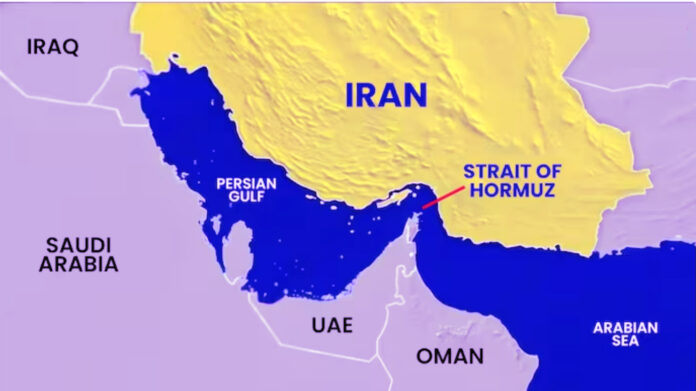
Iran — with a GDP smaller than the state of Texas — has pressed pause on the global economy. The Strait of Hormuz, barely 21 miles wide, carries 20 percent of the world’s oil supply every single day. And right now, it is closed.
Crude oil has surged past $100 a barrel. Kuwait, Iraq, and the UAE are shutting down their oil wells — not for lack of buyers, but because storage tanks are overflowing with oil that cannot move.
My father, zichrono livracha, Dr. Nate Hoffman z”l, whose yartzeit is coming up shortly, earned some of his degrees from the Colorado School of Mines. There are two basic and essential pieces of information that need to be known in order to understand both the underlying problem and it’s potential solution. Firstly, there is a basic essential of oil knowledge. Once an oil well goes dark, It cannot simply be switched back on. The laws of geology do not permit it. Each day the strait remains closed does not add to the damage. It multiplies it.
Secondly, there is something called LNG – which stands for Liquefied Natural Gas — it is simply natural gas that has been super-cooled to around -260°F (-162°C), which shrinks it to about 1/600th of its original volume, making it practical to transport by ship in massive insulated tankers.
This, of course, would be Iran’s preferred first target. LNG tankers are essentially floating bombs. Unlike crude oil tankers, which burn, a breached LNG tanker can cause a massive vapor cloud explosion. The Beirut port blast was caused by ammonium nitrate. It killed over 200 people and was felt hundreds of miles away.
An LNG tanker explosion in the crowded strait of Hormuz would be a catastrophe — both in human terms and in the psychological shock it would send through global energy markets.
The Mullahs of Iran have not left this to chance. The Revolutionary Guard has seeded the strait with mines, suicide boats, and shore-based missile batteries. Intelligence analysts believe Iran will target LNG tankers first — vessels that could, as one source grimly noted, “explode like the Beirut bomb” — followed by oil tankers to maximize global chaos. This is a trap, deliberately constructed. Iran wants America to send in the Navy. It wants the footage of a burning ship.
The conventional response — to tap the Strategic Petroleum Reserve, broker a ceasefire, rush the tankers through — is available.
It is also a missed opportunity of historic proportions. There is another path in which Sefer Bereishis can illuminate the path.
The Medrash Tanchuma (Mikeitz 4) explains that Yoseph HaTzaddik did not merely interpret Pharaoh’s dream — he presented an actionable plan, because wisdom without application is incomplete. Yoseph HaTzaddik used the seven years of plenty — while others were eating — to build the architecture that made Egypt the indispensable provider when crisis struck. “And all the earth came to Egypt to buy grain from Yosef, because the famine was severe in all the earth” (Bereishis 41:57). He did not eliminate the famine. He restructured who held the leverage when it arrived.
President Trump and the government of Israel can employ the same logic.
Instead of scrambling to reopen the strait as fast as possible, the United States can use this crisis — while the world is maximally motivated — to permanently restructure global energy architecture so that the Strait of Hormuz can never again hold civilization hostage.
Step One: The Announcement
The President can address the nation — not to manage expectations but to announce a transformation. Every pending domestic LNG permit can be fast-tracked. Every stalled offshore drilling license can be approved.
The message to global markets can be immediate and credible: a supply surge will be coming. Energy futures are driven by expectations. A believable announcement begins suppressing speculative crude prices before a single additional barrel flows.
Step Two: A Western Hemisphere Energy Compact
Canada holds the third-largest proven oil reserves on earth. Venezuela holds the largest. Together with surging American output, a Western Hemisphere energy compact — formalized now, while the world is watching — can create a parallel global oil architecture that flows entirely through the Atlantic. None of this oil passes near Iran.
The Gemorah (Brachos 60b) states that everything happens for a reason – and a good one. The Venezuela chapter is bashert. It should be implemented now.
This would not merely be a short-term fix. It would be a permanent construction of a second circulatory system for the global economy, one that bypasses the Iranian chokepoint forever.
Step Three: Split Russia From Iran
Treasury Secretary Bessent has already floated un-sanctioning stranded Russian oil. The instinct is sound, but the execution must be surgical. The United States could offer Moscow a targeted, time-limited swap: relief on specific stranded cargoes in exchange for routing that oil through non-Hormuz channels. The implicit message is stark: Iran’s closure is costing Russia money too. Every day the strait stays closed, Moscow bleeds revenue. The question is whether they prefer solidarity with Tehran or dollars in their accounts. Drive a wedge between them now, at the moment of maximum Iranian vulnerability.
Step Four: The Coalition of the Paying
Japan imports 90 percent of its energy. South Korea imports 80 percent. Europe is very exposed right now.
These nations have every incentive to become co-investors. Convene an emergency summit and offer them a proposition: jointly fund the naval escort operation in exchange for guaranteed priority access lanes and long-term American LNG supply agreements. Transform an American military burden into a multilateral investment with commercial returns.
Step Five: Let Time Work Against Iran
Iran closed the strait to inflict pain on America. What it failed to calculate is that its own economy runs on oil revenue — and the same closure is strangling Iranian exports too. Every week the Shock Doctrine operates — American production ramping, the Western Hemisphere compact solidifying, Russian oil finding alternative routes — is a week in which Hormuz becomes slightly less relevant and slightly more costly to Iran. The leverage Tehran thought it held depreciates daily. The military option remains ready. But the most powerful threat is one that has not yet been used.
The Political Transformation
Every prior administration caught in an energy shock has found itself on defense — managing, reassuring, pleading for patience.
This idea inverts this entirely. If we are given lemons – let’s turn it into lemonade. Every crisis carries within it the potential for new creation. The question is only whether the leadership has the wisdom to recognize what is being born, and the courage to midwife it into existence.
Conclusion: Two Doors
There are two doors. The first leads back to the status quo — strait reopened, prices fall, crisis forgotten. A tactical win. But in six months, the same chokepoint, the same Iranian leverage, the same crisis waiting to happen again.
The second door is harder. It requires absorbing short-term pain, communicating a vision under fire, and executing a multi-front transformation simultaneously. Let us create a world where the Strait of Hormuz has been structurally demoted — where American energy, Western Hemisphere solidarity, and allied burden-sharing have built something genuinely new.
Yosef HaTzaddik was not remembered because he survived the famine. He was remembered because he used it. Last week we read about Betzalel. Hashem endowed him with particular wisdom. History does not remember crisis managers. It remembers leaders who looked at the same thing everyone else was seeing — and created a remarkable work-around. The pasuk states, “And Yosef — he was the ruler over the land; he it was who provided grain to all the people of the earth.” We can do the same.
The author can be reached at [email protected]