

Shimon Cohen contacted me with a practical question: Did I happen to know the Bishop of Manchester?
ON
a recent winter evening in the House of Lords, close to ten o’clock at night, peers were still debating the government’s Children’s Wellbeing and Schools Bill when an unexpected voice rose to defend Britain’s yeshivos.
The speaker was not a rabbi or a Jewish communal leader, but the Anglican Bishop of Manchester.
In Britain’s constitutional system, senior bishops of the Church of England sit as members of the House of Lords, and their voices often carry particular weight when questions of religion and public policy arise.
Addressing peers during the debate, the Bishop warned that a proposed legal definition of “full-time education” risked misclassifying institutions devoted solely to religious instruction. In doing so, he suggested that Parliament might unintentionally force a centuries-old form of Torah education into a regulatory framework designed for conventional schools.
For Britain’s chareidi community, the moment was striking. After years of disputes surrounding chinuch, a new front had opened — this time over the future status of certain yeshivos ketanos.
For those familiar with long-running debates over the place of Torah education within Britain’s regulatory system, the government’s introduction of its Children’s Wellbeing and Schools Bill appeared to reopen questions many had hoped were already settled.
The controversy did not arise in a vacuum. In recent years, advocacy groups like Nahamu (not too dissimilar from groups in the US like Yaffed) have campaigned for greater regulatory oversight of certain yeshivos. These activists argue that stronger supervision is necessary to ensure educational standards. They helped bring the question of under-16 yeshivah education into the national debate and increased pressure on government to clarify how such institutions should be treated.
Against this backdrop, concerns began to grow within the chareidi community about the implications of the new legislation.
In March 2025, as the bill progressed through Parliament, a briefing prepared by the Yeshivah Liaison Committee began circulating among policymakers and religious leaders. Shortly afterwards, the Bishop of Manchester, Dr. David Walker, raised the issue during debate in the House of Lords on his own initiative, framing it as a matter of religious liberty.
At that stage, however, the chareidi community was still struggling to secure direct engagement with government. We could not get a meeting with the education minister responsible for the legislation.
Around the same time, I had begun working with well-known askan Shimon Cohen on the issue. Through my involvement with the Coalition for Jewish Values, on whose rabbinic board I serve as international liaison, I had recently begun participating in the All-Party Parliamentary Group on Freedom of Religion or Belief. I brought the question of yeshivah education to their attention as a matter of religious liberty, and a number of exploratory meetings were subsequently hosted in Parliament under the auspices of the APPG to examine our concerns.
In that context, Shimon Cohen contacted me with a practical question: Did I happen to know the Bishop of Manchester?
For many years, I’ve participated in the Greater Manchester Faith and Communities Leaders Forum, meeting regularly at the Bishop’s residence with senior representatives of the region’s faith communities to discuss issues of public concern. Through that forum I had come to know the Bishop.
A meeting arranged last May among the Bishop, Shimon Cohen, and representatives of the Stamford Hill yeshivah community proved to be a turning point. During the meeting, the Bishop asked simply how he could help. Shimon Cohen replied that the community had been unable to meet with the education minister.
“I will arrange the meeting,” the Bishop responded immediately.
For a community navigating the issue on its own, the Bishop’s willingness to intervene proved to be decisive.
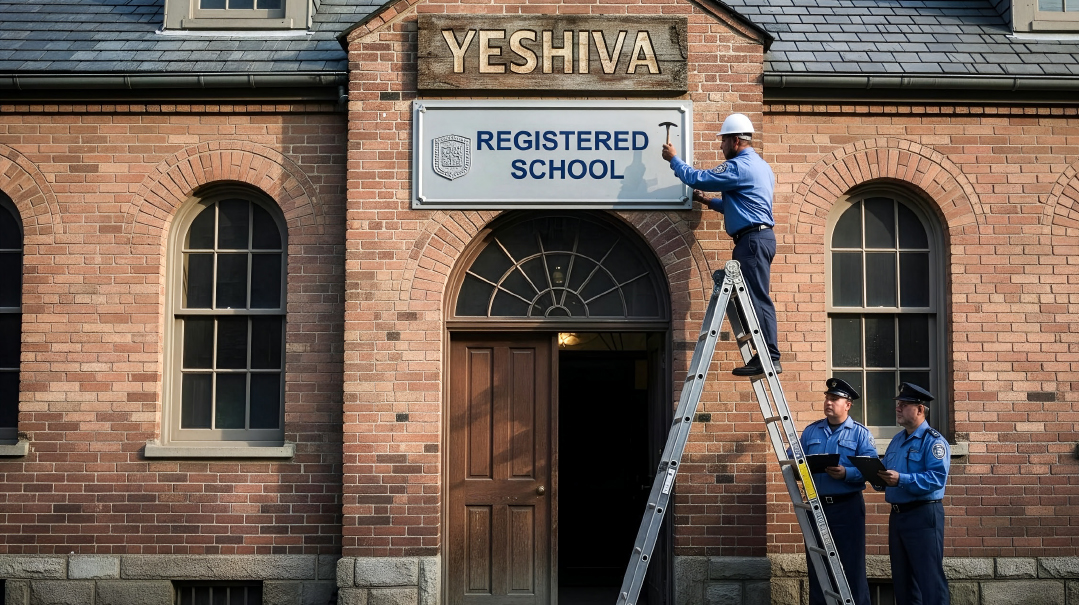
The debate centers on Clause 37 of the Children’s Wellbeing and Schools Bill. At first glance it appears to be a technical provision defining “full-time education.” In practice, however, that definition could have significant implications for parts of the yeshivah system serving boys under the age of 16.
The Torah community’s concern extended beyond regulation into the realm of classification. If a yeshivah is legally treated as a school, it becomes subject to an entire regulatory framework for institutions whose purpose is academic instruction. Yet the purpose of a yeshivah is to promote immersive religious learning, operating alongside the parental responsibility for education that British law has long recognized.
Here a brief transatlantic clarification is needed. In the United States, the term yeshivah usually refers to a full-day Jewish school combining Torah learning with secular studies. In the United Kingdom, however, the term typically refers to institutions devoted exclusively to Torah study. They are not structured as general schools and do not present themselves as such.
Within parts of the chareidi community, boys devote most weekday hours to intensive Torah study within a yeshivah framework.
At the same time, British law places responsibility for a child’s education primarily upon parents rather than on institutions. Elective home education is therefore lawful and widespread. The law does not prescribe a national curriculum for home-educated children, requiring instead that parents ensure their children receive a “suitable education,” leaving considerable flexibility in the form that education takes.
This reflects a longstanding principle of British education law: The state may set minimum expectations, but the primary responsibility for a child’s education rests with parents. Within the chareidi community, this legal framework has allowed parents to retain responsibility for their sons’ broader education while yeshivos provide intensive Torah learning.
While public discussion has often focused on the large chassidic communities of North London, where boys enter yeshivah ketanah immediately after bar mitzvah and devote themselves fully to Torah study from the age of 13, the picture across Britain’s Torah world is more complex. In many litvishe communities, boys typically remain in school until around age 15, often completing several GCSE examinations before entering yeshivah ketanah for full-time learning between the ages of 15 and 18.
Because of this difference, some litvishe yeshivos hoped the legislation might not affect them. However, the legal requirement that young people remain in full-time education until the age of 16 could still have implications for those yeshivos serving boys under 16.
As awareness of the legislation grew, discussions began to take place in Gateshead, Manchester, and Golders Green, bringing together roshei yeshivah, rabbanim, and askanim to hear detailed briefings from Shimon Cohen and to consider how the legislation might affect their institutions.
The question of “safeguarding” has also played a role in the debate. In recent years, some yeshivos in Stamford Hill have been reluctant to adopt “safeguarding” frameworks linked to the Ofsted inspection regime. Those frameworks are ostensibly designed to ensure children’s safety and well-being in mainstream schools; but they are often tied to expectations surrounding Britain’s “protected characteristics” legislation. For institutions devoted exclusively to Torah education, those requirements raised serious religious concerns.
Community representatives have consistently emphasized that safeguarding itself — i.e., keeping children safe — is essential and nonnegotiable. The challenge has been to develop frameworks that protect children while respecting the integrity of Torah education.
The potential consequences of the legislation were not merely theoretical. Under the Bill’s unamended provisions, those responsible for running a full-time educational institution for children under 16 that was not registered as a school could face criminal liability, including the possibility of a criminal record.
One conversation last December with a senior official in the British Jewish community showed me how stark the expectations had become.
“The government will pass the legislation,” he said matter-of-factly. “There will be arrests. And a few days later the community will come to the table.”
That illustrated the misunderstanding that had developed between policymakers and the chareidi community. For many in government, the issue appeared to be one of regulatory compliance. For the communities affected, however, it touched on fundamental questions about the preservation of the Torah way of life.
The conversations that followed gradually helped narrow the gap. The quiet intervention of a bishop in defense of Torah education carries a similar resonance — when a voice from outside the Jewish community recognizes that protecting Jewish learning is part of protecting the moral fabric of society itself.
The coming months will determine how Britain balances safeguarding, educational expectations, and religious freedom. Yet the dialogue that has begun suggests that a more constructive understanding may now be taking shape.
For the chareidi community, the objective remains clear: to preserve the integrity of Torah education while continuing to live responsibly within the framework of British law and the society of which we are a part.
Rabbi Jonathan Guttentag is the founder and principal of the Whitefield Community Kollel in Manchester. He serves as international liaison on the rabbinic board of the Coalition for Jewish Values and has been involved in parliamentary engagement on issues affecting Torah education in the UK.
(Originally featured in Mishpacha, Issue 1103)