
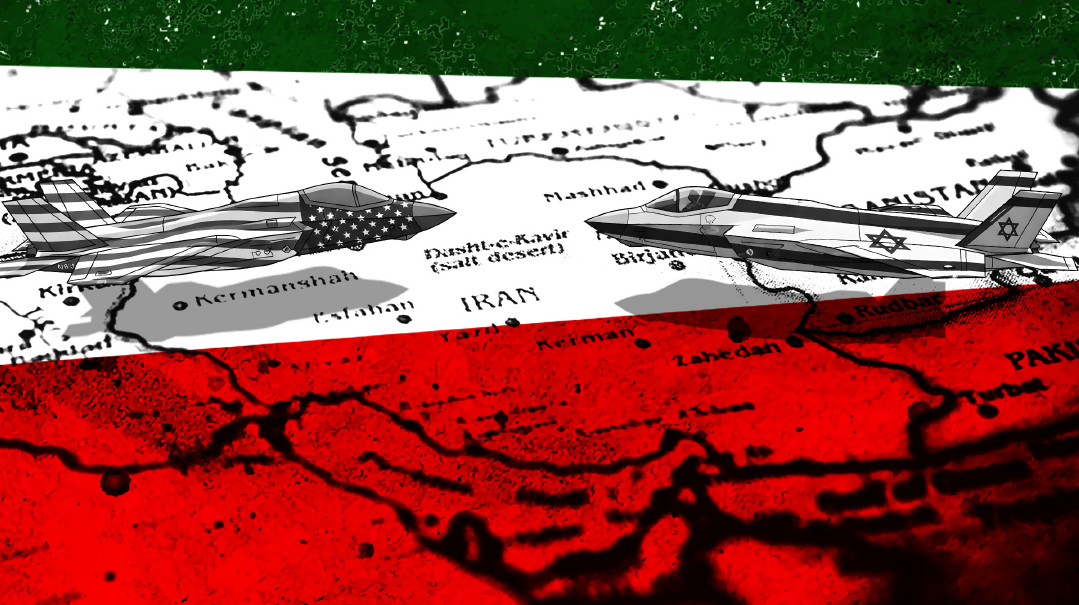

After ten days, it’s clear there is no knockout punch to take down Iran
Measuring success in the US-Israel military campaign against Iran is challenging when an average of 1,626 Red Alert sirens sound daily in the first ten days of fighting.
The initial exhilaration of the dramatic opening strike that took out Ayatollah Khamenei and his top aides faded quickly as Israelis repeatedly sought shelter, sometimes in pajamas and a bathrobe in the middle of the night, or interrupting the Megillah reading, Shema, or Shemoneh Esreh, to take cover.
Ultimately, only the outcome — not the initial blow — will determine victory. If the war concludes with Iran and its proxies unable to pose a serious threat to Israel again, and Israelis can once more sleep peacefully and carry on their routines without sky scanning, most will see the price as worth paying.
However, after ten days, it’s clear there is no single knockout punch that will send Iran reeling to the canvas. Instead, it has become a test of endurance, shaped by military limitations and political will on all sides.
Unanswered questions include whether the US and Israel can eliminate Iran’s remaining ballistic missile capabilities without depleting their interceptors; whether President Trump can maintain the backing of Congressional Republicans and voters worried that victory will prove elusive while spiking gas prices are a reality; and whether Iran has any last-minute surprises up its sleeve that could extend the war by causing chaos for US troops and Israel’s homefront.
Hunting for Launchers
The combined US-Israel military strength creates an overwhelming mismatch against Iran. Since the fighting began against the modern-day Haman on Shabbos Zachor, the IDF and forces under US Central Command (CENTCOM) have destroyed at least 70% of Iran’s ballistic missile capability and air defenses. This includes missiles intercepted in flight, buried in underground “missile cities” in Iran, and launchers Iran has positioned on its territory.
Israeli attacks on these missile cities are perhaps the biggest achievement so far, considering they’re built to be “indestructible.” Interesting Engineering (IE), an online publisher headquartered in New York and Istanbul, described these missile cities as built hundreds of meters deep inside rocky mountains, featuring multiple hardened tunnels, interconnected storage halls, and separate zones for warheads, fuel, and guidance systems.
“The tunnel design often includes blast-trap dead-end shafts aligned with the entrance axis,” writes IE’s Atharva Gosavi. “When a strike hits, the shockwave is channeled into these stub tunnels rather than penetrating the main complex. The overall setup allows the system to survive even when some entrances are hit or compromised.”
However, they have their weak spots. The Wall Street Journal reported that although these missile facilities are deep underground, both the Pentagon and Israel have used satellite photos to identify their above-ground buildings, roads, and entrances. The WSJ reports US and Israeli airstrikes have “entombed” Iranian missiles underground in some locations. India’s NDTV network reported that Iran may have moved some of its truck launchers and missiles out of the bunkers before the war started, hoping to protect them from strikes by dispersing them.
Which brings us to the next challenge, one that still causes fear among Israelis and other Arab nations, including the UAE, Qatar, Kuwait, Bahrain, Jordan, and Saudi Arabia: mobile launchers, also known as Transporter Erector Launchers or TELs, and the ongoing battle between missiles and interceptors.
A Numbers Game
Modern missile defense strategy has shifted from purely reactive interception to a proactive effort to destroy launch platforms before they can be used. For Israel and the US, this involves identifying and striking Iran’s TELs and their storage facilities before defensive interceptor supplies are depleted.
The logic is simple. Each launcher destroyed not only means one less missile fired — it can also save dozens, possibly hundreds, of interceptors. However, implementing this strategy is challenging. Mobile launchers can be hidden, moved quickly after firing, or concealed in a variety of hardened or underground facilities, even if most of the missile cities described above are put out of commission.
This results in a high-stakes race between Iranian launch crews and American-Israeli strike capabilities.
When the war began, Israel estimated Iran had an inventory of some 2,000 to 2,500 ballistic missiles, according to the Institute for National Security Studies (INSS) at Tel Aviv University. This figure may exceed the combined interceptor inventories of Israel and the US.
Defensive doctrine typically requires firing at least two interceptors against each incoming ballistic missile to ensure a high probability of success. The INSS estimates Iran fired more than 600 of its ballistic missiles in the first days of war. In practice, this means that even a modest missile barrage can rapidly drain defensive stocks, as advanced interceptors are expensive, complex, and slow to manufacture, compared to ballistic missiles.
Ultimately, success will depend on whether Israel and the US can outpace Iran’s missile launches and maintain enough interceptors before their defenses become overwhelmed. The outcome of this relentless struggle will probably shape the next phase of the war.
Doomsday Weapons
So far, the war has been fought on conventional terms, but perhaps not for long. The New York Times reported that after last June’s 12-day conflict, when the US and Israel attacked and severely damaged Iran’s nuclear facilities, Iran’s government devised “Operation Madman.”
Anticipating a future conflict, the late Ayatollah Khamenei ordered that in the event of his death, his successor should ignite the entire region to make the costs of war too high for Israel, the US, and its Arab allies.
So far, Iran has used missiles and drones against the UAE to target Dubai’s airport, coastal hotels, and Amazon data centers. Iran also attacked a desalination plant in Bahrain, Oman’s largest port, the US embassy in Kuwait, and an oil refinery in Saudi Arabia. It forced Qatar to shut down a refinery that supplies about 20% of the world’s liquefied natural gas (LNG) exports.
The war has disrupted oil tanker traffic through the Strait of Hormuz, south of Iran, along the Persian Gulf and Gulf of Oman, which handles some 80% of the world’s oil and LNG supplies, mainly the parts headed to Japan, India, China, and South Korea, which together account for more than 26% of the world’s economy. It’s no wonder that crude oil prices spiked by 45% in the last month as tensions built and war raged.
Perhaps the bigger threat from Operation Madman is if a desperate Iran launches hypersonic missiles, which fly at speeds up to 4,000 miles per hour and are much harder to intercept.
Last week, the Israeli open-source intelligence site Netziv.net posted a conversation with Vladimir Popov, a retired major-general in the Russian army. China has helped rebuild Iran’s defenses and offenses since the June 2025 war, and Popov alleges that Chinese military personnel are currently on the ground in Iran testing what they’ve provided under real combat conditions, much as Israel serves as a lab for American weapons systems.
Popov contends that the Iranians are saving their most lethal weapons, including hypersonic missiles, for the event that their situation becomes truly catastrophic, with China cheering them on.
Such claims cannot be verified independently and should be treated with caution.
We do know that Iran’s Fattah-1 missile, which they reportedly fired at Tel Aviv in June, has many of the characteristics of a hypersonic missile. Iran has nicknamed this its “Israel striker,” and it takes just seven minutes to reach Tel Aviv.
That said, many defense experts say the Fattah-1 is not exactly as advertised. The Nordic Defense Review says Fattah-1 does not behave like true hypersonic glide vehicles deployed by the United States or China. Its design matches that of a MaRV (maneuverable reentry vehicle) rather than a hypersonic glide vehicle (HGV). That distinction matters. True hypersonic glide vehicles fly at lower altitudes and maneuver extensively, exploiting gaps between traditional ballistic missile defenses and lower altitude air defense systems. The Fattah-1, by contrast, follows a more traditional ballistic trajectory, with limited course corrections during descent, which means it’s less evasive.
We can only pray that China and Iran never have the chance to use such weapons, but if they do, Israel’s military industry has a response. Defense contractor Rafael has developed Sky Sonic, which, according to its prospectus, can match the speed of an incoming hypersonic missile, accurately predict its trajectory, and respond instantly to mid-course alterations.
Fight, Fight, Fight
President Trump and relevant military and intelligence officials are definitely monitoring China. China has supported Iran in recent years by ignoring international sanctions and making its own deals, including buying up to 80% of Iran’s oil exports at deep discounts below market price. Cheaper oil has given China a competitive edge in manufacturing over countries that must pay the full market price.
Many analysts suggest that one reason Trump decided to strike Iran, knowing it would disrupt global energy markets, was to weaken China, and ultimately gain control over Iranian oil after defeating them, similar to his approach with Venezuela.
This is a topic of debate. The Atlantic, a publication ranked as politically “left” by AllSides, notes that in the first week of the Iran conflict, Trump did not mention seizing Iran’s oil, as he did with Venezuela. However, that might be because Trump does not want to upset other energy-producing Arab allies in the Middle East, at least for now.
Other analysts argue that Iran’s and China’s loss will be Russia’s gain. As oil prices rise, the US has just lifted sanctions on Russian oil already aboard ships, allowing it to be sold to India. Secretary of the Treasury Scott Bessent said that the US is considering lifting more sanctions on Russian oil due to its ongoing war with Ukraine. Increasing oil supplies would ease pressure on gas prices. According to AAA, the price of unleaded regular gas rose to a national average of $3.45 a gallon last week, up from $2.98 the week before — a 16% increase.
Trump has taken pride in the lower gas prices that have prevailed since the start of his second term. If turmoil continues and prices continue to rise, Trump will face political pressure to de-escalate the war with Iran.
Pundits continue to suggest that the war is unpopular with Americans, who don’t feel that Trump has clearly articulated his goals or what he sees as the endgame.
The poll numbers are not actually that dire for Trump.
The Real Clear Politics average poll shows just a 6-percentage-point gap (49% to 43%) between Americans who disapprove of the war and those who approve. A Fox News poll shows a 50-50 split, that 84% of Republicans favor Trump’s actions against Iran, and that 61% of all Americans consider Iran a “real national security threat” to the US. Just 40% of Independents support the war, with Democratic support at a paltry 20%.
America’s left may be anti-war, or perhaps just anti-Trump, but even Israeli Arabs support the war in higher percentages than US Democrats. An Israel Democracy Institute poll last week showed 26% of Israeli Arabs in favor, alongside 76% of Israel’s Jewish political left and 97% of the political right in favor.
Michael Singh, managing director of the Hudson Institute, suggests that the Trump administration could shore up support by increasing the pace and transparency of briefings by policy professionals that describe US progress against key goals and provide as clear a sense as possible of its theory of victory.
What could that victory look like?
Francis P. Sempa, an adjunct professor of political science at Wilkes University, wrote a piece for Real Clear Defense, quoting the book, War: Ends and Means, in which authors Angelo Codevilla and Paul Seabury note that “history’s clearest teaching about war is its utter unpredictability,” and that war’s winners are those “who combine flexible minds with inflexible will and who have luck on their side.”
Substitute G-d for the word luck, and you have the perfect quote and the best ending.
Notes from Underground (Apologies to Dostoevsky)
Rabbi Emanuel Feldman
Shabbos Zachor, February 28
In shul, we are about to read the Torah’s admonition to remember Amalek, the embodiment of evil, when suddenly a missile alarm sounds. How appropriate. The macabre parallels are obvious to us as we file out grimly to the underground shelter. Amalek strikes again. We all sit quietly, stoically, with no signs of nervousness or fear — at least not visibly.
As we wait and hope for the all-clear signal, a classic question flits through my head: The Torah states that we must remember the evil Amalek, and concludes the commandment by adding what seems to be a superfluous phrase: “Lo tishkach — Do not forget”(Devarim 25:19). But how can we be ordered not to forget, when forgetting is an integral component of being human?
There is still no all-clear signal; we pray silently that the missiles and rockets will fall harmlessly. My Amalek musings continue: In truth, it is hardly possible for Jews to forget Amalek, because Amalek’s hatred of G-dliness and Jews has never stopped. So perhaps the words Lo tishkach might be translated a bit differently: not as a commandment, “Do not forget” — but as a Divine statement of fact, “You will not forget.” Amalek will never cease his hatred for Jews, and thus you will never be able to forget him and his evil.
From across the shelter, I hear someone reciting Tehillim, the familiar Psalm 91. Verse 5 assures us that “you will not fear the nightly dread, nor the arrow that flies by day [mei’cheitz ya’uf yomam].” The words stun me. The word cheitz, normally rendered “arrow,” refers to a destructive implement that flies thru the air — like a missile. The Psalm assures us that we will have no reason to fear the missile that flies through the air.
The all-clear sounds. No more musings. Back in our places, the Torahs are removed from the ark, and we are ready to hear confirmation about the evil that we have just experienced.
Sunday, March 1
The missile alert just sounded again, and I enter our Jerusalem building’s large below-ground bomb shelter, crowded with huddled residents. I notice two women sitting by themselves in a far corner of the room, wearing full head-scarves and long, flowing robes. From across the room they look like chareidi women, but as I pass them, it is clear that they are Muslim women who evidently ran into our shelter when they heard the missile alert, and who, together with the rest of us, are waiting and hoping for the all-clear signal.
Just to be human, I nod politely to them. Mistake. They do not react, and as I glance at their eyes, I see cold hostility. I am not surprised, but the anomaly strikes me: Muslim women huddling in a Jewish shelter that protects them from missiles being fired by a Muslim country. I speculate about what they might be thinking. Were they praying for a missile to strike the shelter, killing everyone but themselves — or perhaps including themselves and turning them into heroic suicide martyrs? Such wild (maybe not so wild) fantasies fly through one’s mind when missiles are falling not far away.
The mind does not stop there. I am transported back a full 60 years, to the 1967 Six Day War, when my wife and I and our four little children also sat in a shelter — in Bnei Brak. There were no Muslim women with us, of course, but there were striking similarities between that shelter experience and the one we find ourselves in now: similar rumors about the progress of the war, similar recitation of Tehillim, similar singing of zemiros to lift our spirits, similar attempts at good cheer, similar stoic silence and worries alternating with optimism and bravado. Human nature does not change.
There are some dissimilarities as well. Then, we apprehensively huddled by the transistor radio, hungry for the news, which dribbled in only occasionally. Then, we feared mere bombs (mere?), not today’s overwhelmingly deadly missiles. Then, we felt more isolated, with no contact with the world outside: Then, unlike today, America was not wholeheartedly supporting us, which was a cause for worry.
The shelters are similar, but much else has changed. And as I dash to our shelter because of yet another siren, I realize more clearly than ever that one fact has nevertheless remained the same: Amalek still lives, and — despite Camp David and the Abraham Accords and other tasty and welcome goodies — his eyes are still cold and hostile.
I must stop here. The siren is saying that the cheitz ya’uf yomam, that arrow/missile of Psalm 91, might be on its way. But I am perfectly calm, because that same verse promises lo sira, “you will not be afraid.”
(Originally featured in Mishpacha, Issue 1103)