
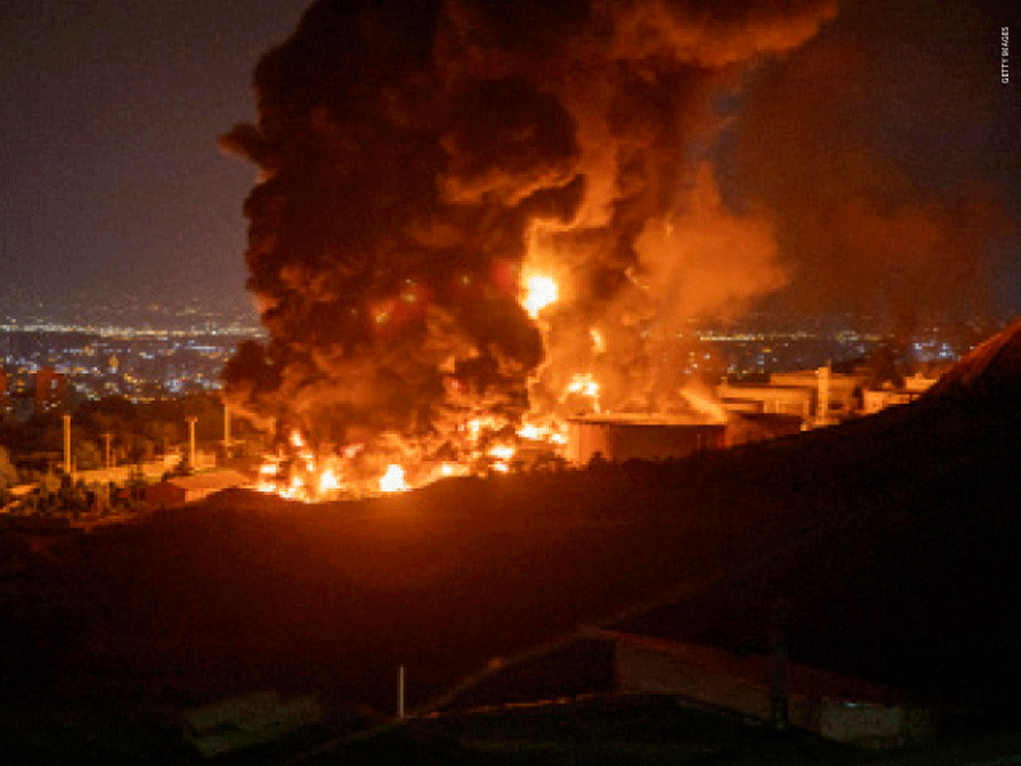

After having decapitated Iran’s political and military leadership in the opening minutes of the war, and then drastically reduced the rate of missile and drone fire from Iran, while systematically eliminating its air defenses during the first week of attacks, Israel and the U.S. have now shifted the targeting of their air strikes to Iran’s military and industrial infrastructure. Both the U.S. and Israel have further increased the unprecedented intensity of their attacks, and have announced their intentions to either force the Islamic regime to declare its “unconditional surrender,” or to establish the conditions necessary for the Iranian people to rise up and force regime change.
With Iran’s Russian-made anti-aircraft defenses no longer a concern, the U.S. has begun to use its B-52 and B-1 strategic bombers to increase the tonnage of the bombs it is dropping on an expanded list of Iranian targets, which it has shared with the Israelis. Meanwhile, Israeli and U.S. attack aircraft continue to attack and destroy the Iranian launching sites, which are revealed whenever Iran fires from its diminished supply of ballistic missiles and drones.
As a result, Admiral Brad Cooper, commander of CENTCOM, which controls all U.S. military forces in the Middle East, said last Thursday that Iran’s ballistic-missile attacks had decreased by 90% and drone attacks had dropped by 83% since the war began on February 28. While the vast majority of the reduced volume of Iranian missiles and drones are being intercepted by Israel’s multi-layered air defense systems, a few are still getting through. Some of the Iranian ballistic missiles have been carrying cluster warheads, designed to maximize civilian casualties by scattering explosive bomblets, potentially deadly shrapnel, across broad target areas.
While their explosions are not powerful enough to destroy large Israeli residential buildings, causing mass casualties, as happened on Sunday, March 1, when a large Iranian missile warhead hit Beit Shemesh, killing 9 people and wounding more than 60 others, the bomblets can still be potentially deadly. That was proven on Monday when the cluster warhead on an Iranian missile exploded high over central Israel, releasing bomblets that killed one man and seriously injured another at a construction site in the town of Yehud, and also seriously wounded a third man in the town of Or Yehuda. Two other bomblets from the same Iranian missile warhead also fell harmlessly in the towns of Holon and Bat Yam.
However, while the warheads of Iran’s ballistic missiles are capable of inflicting far more physical damage than the explosives carried by its much smaller drones, because the drones are much harder to detect and cheap enough to be deployed in large mass attacks, they present Israel and Iran’s other targets in the region with a far more difficult defensive problem.
U.S. Asks for Ukraine’s Help in Dealing With Iran’s Drones
It is therefore significant that Ukraine’s president, Volodymyr Zelensky, announced last week that, in response to an American request, he has sent Ukraine’s leading experts on neutralizing the drone threat to share their techniques and advanced technology with the U.S. military. Over the past four years, Ukraine has developed and proven in combat with the Russian army how best to detect and destroy the same model of Iranian-designed Shahed-136 attack drones that have been used against them on the Iranian battlefields. Zelensky has also received similar requests for help from the other Middle Eastern states that have come under attack from Iranian drones, including the UAE, Qatar, Bahrain, Jordan, and Kuwait.
Meanwhile, by reverse engineering the original Iranian Shahed drone as a model, the United States has developed its own one-way attack drones, and then improved on the Iranian design with more sophisticated counter-jamming technology, more lethal warheads, and extended flight endurance. The Russians had previously done the same thing. With Iran’s help, the Russians are also currently mass-producing 5,500 copies per month of their own improved version of the Shahed-136 drone for its use on Ukraine’s battlefields, at a factory located 600 miles east of Moscow, safely beyond the reach of Ukraine’s longest-range weapons.
The New York Times reports that Zelensky is also offering to supply the U.S. with the special interceptor drones that Ukraine has developed, which are specifically designed to counter the Russian version of the Shahed drones, in exchange for supplies of American-made interceptor rockets for protection against repeated attacks by the long-range Russian ballistic missiles that have badly damaged Ukraine’s vulnerable cities and civilian infrastructure over the past four years.
How Iran’s Attacks on Its Neighbors Have Boomeranged
Meanwhile, despite determined efforts by the U.S. and Israeli air forces to search out and destroy them, the Iranian regime has continued to launch dozens of ballistic missiles and hundreds of drones at its neighboring Persian Gulf states, including the United Arab Emirates (UAE), Kuwait, Qatar, Bahrain, Oman, and Saudi Arabia. Iran has also made more sporadic missile and drone attacks on military bases and civilian targets in Cyprus, Turkey, and Azerbaijan, in a deliberate effort to engulf the entire region in the war.
However, these attacks have boomeranged against Iran diplomatically by angering its Persian Gulf neighbors, who had refused to cooperate with the initial U.S. and Israeli attacks. Instead, some of these countries are now threatening to retaliate against Iran if it persists in attacking them, damaging their economies by attacking their oil-producing facilities, and causing random civilian casualties, some of them fatal.
The UAE, which is physically closest to Iran, has suffered the most intense attacks from Iran since the war started. According to the Emirati defense ministry, their country has come under attack from at least 221 Iranian missiles and over 1,300 drones, damaging Dubai’s iconic luxury tourist hotels, and killing one Asian man who was driving in the streets of Dubai last Saturday night.
In addition, flights to and from Dubai’s busy international airport have been sharply reduced due to the daily Iranian drone attacks, one of which injured four airport employees last week and damaged an airport passenger terminal. Bitter complaints about continuing Iranian missile and drone attacks were also issued over the weekend by government officials in Saudi Arabia, Kuwait, and Jordan, all of which are trying to avoid being dragged into the war between Iran and its terrorist proxies in the region and the attacking Israeli and U.S. military forces.
State Department Orders Its Middle East Diplomats to Evacuate
Since the war started, the Iranians and their Iraqi Shiite militia allies have also targeted U.S. diplomatic sites across the region, including in Dubai, Kuwait City, Riyadh, Saudi Arabia, Amman, Jordan, and inside the Green Zone in Baghdad, as well as a U.S. military compound inside the Baghdad International Airport. These attacks have prompted the U.S. State Department to order its personnel serving in diplomatic missions in Saudi Arabia, Turkey, Iraq, Jordan, Bahrain, Qatar, the United Arab Emirates, and Lebanon, and their family members to return immediately to the United States for their own safety. The State Department also reported that as of Monday, more than 36,000 American citizens visiting in the region who were stranded by the sudden outbreak of the war had managed to safely return to the U.S.
Israel’s Ben Gurion Airport has also remained only partially open, with its flight operations mostly limited to repatriation flights for the thousands of Israelis who found themselves stranded abroad when the war broke out. El Al Airlines has also notified its ticket holders that its flight operations would continue to give priority to repatriation flights until the security situation in Israeli airspace has improved.
Because Iran’s leaders have ignored the threats and have continued to attack their neighboring states, some Israeli officials believe that at least a few of those Gulf States are now on the threshold of joining the U.S. and Israel in their attacks on Iran in retaliation for their own losses, or at least by mounting an active military defense of their own against further Iranian attacks.
Great Britain and France Reluctantly Getting Involved
The indiscriminate Iranian attacks on countries throughout the region have also prompted America’s strongest European allies, Great Britain and France, which initially refused to cooperate with the U.S. attack on Iran, to reconsider their position. They are now sending their own military assets to the region to help defend their allies from the ongoing Iranian attacks. Great Britain has also re-opened its military bases for use by U.S. warplanes, including its large air base on the island of Diego Garcia in the Indian Ocean, but only for “limited defensive operations” in order to stop the ongoing Iranian attacks on its neighbors.
Iran has announced the closure of the Straits of Hormuz, through which 20% of the global supply of crude oil is exported to the rest of the world.
Iran has also targeted Persian Gulf oil production facilities, including an attack over the weekend that disabled and set fire to Bahrain’s only oil refinery, Saudi Arabia’s massive Shaybah oil field, and an oil facility in Fujairah, in the UAE. Authorities in the UAE also reported that falling debris from Iranian missiles had injured two people in the capital city of Abu Dhabi, and 32 people, including several children, were injured by another Iranian attack in a residential area in Bahrain.
Together, these Iranian actions briefly drove up the price of crude oil to almost $120 a barrel on global markets on Monday. Apparently, Iran’s strategy behind these attacks on other Persian Gulf oil sources and its threat to close the Straits of Hormuz is to increase the domestic political pressure on President Trump to bring the war to a swift conclusion by driving up the price of gasoline at the pump for American consumers.
However, President Trump has remained determined to pursue the war against Iran, in a close military partnership with Israel, to a successful conclusion. Trump has reacted to Iranian moves to close the Straits of Hormuz to oil tanker traffic by targeting the Iranian navy for swift destruction, while offering to provide commercial oil tankers in the Persian Gulf with U.S. Navy escorts to protect them against attack. At the same time, the White House is offering to provide substitute maritime risk insurance for Persian Gulf commercial oil traffic, after Lloyds of London canceled its insurance policies covering those ships. Trump has also been consulting with America’s G-7 global economic allies in order to release some of their ample reserve supplies of crude oil in order to end the current temporary supply shortage and calm the panic that has caused the price of oil to spike sharply on global oil markets.
In addition, some of the European powers have begun to discuss sending their own naval warships into the Persian Gulf to join the U.S. Navy in escorting commercial oil tankers safely through the Straits of Hormuz, in spite of Iranian threats, because European countries desperately need that oil to fuel their economies.
Trump Confident That High Oil Prices Will Be Short-Lived
Trump also sought to minimize the significance of the current spike in oil prices when he wrote on his social media account that, “Short term oil prices, which will drop rapidly when the destruction of the Iran nuclear threat is over, are a very small price to pay for U.S.A., and world, safety and peace.”
When asked by the New York Post on Monday about the spike in the price of oil over the weekend, Trump responded confidently by claiming, “I have a plan for everything, OK?” He then added, “You’ll be very happy.” He also said that Operation Epic Fury is progressing far more swiftly than the four to six weeks that American military planners had originally expected, implying that he expects the current spike in oil prices to dissipate quickly once Iran has finally been defeated.
As a result of these confident and calming statements by the president, including a comment to CBS News later Monday, calling the war in Iran “very complete, pretty much,” prices for crude oil fell back on global oil markets by about 25% to below $90 a barrel by the end of trading on Monday afternoon, at least temporarily calming fears of further increases in the price of gas at the pump beyond the roughly 50-cent per gallon increase already seen since the U.S. and Israeli launched their first attacks on Iran on February 28.
But some of Trump’s advisors remain deeply concerned about the spillover effects of the oil price increase on the rest of the American and global economies and his administration’s ongoing efforts to bring down the current roughly 3% rate of inflation. As conservative economist Stephen Moore said in a comment to the Wall Street Journal, “When the price of gas and oil rises, so does everything else. Given that affordability was already an issue, this leads to real challenges.”
President Trump addressed these concerns directly in his comments Monday afternoon to a gathering of Republican House members at his Doral golf club in South Florida. He tried to reassure both his audience in the room and many more watching him on cable news channels that Iran, which is in the process of being soundly defeated within the next few weeks, would not be permitted to disrupt global oil markets by interfering with the oil tankers seeking to exit from the Persian Gulf through the Straits of Hormuz.
Trump Insists He Won’t Permit Iran to Stop the World’s Oil Supplies
The president emphasized, “I will not allow a terrorist regime to hold the world hostage and attempt to stop the globe’s oil supply. If Iran does anything to do that, they’ll get hit at a much harder level.”
Trump described the joint U.S.-Israeli campaign against Iran as “a little excursion [we took] because we felt we had to do that to get rid of some evil.” He also said, “I think it’s going to be a short-term excursion,” and that it has already met many of its top military goals.
“[Their] missiles have been largely knocked out,” Trump declared. “The drones have been knocked out, and now we are hitting where they make the drones,” he continued.
The president added that “we’ve left some of the most important targets for later, in case we need to do it. If we hit [those targets having to do with energy production], it’s going to take many years for them to be rebuilt.”
Trump also noted that Iran has been threatening to disrupt the global oil supply and has been providing support for terror organizations for the last 47 years. The current military operation to end that threat should have been carried out by one of his predecessors as president many years ago.
“Almost every [terrorist] act, whether it’s [by] Hamas or Hezbollah, no matter what, you take a look and it’s [due to] Iran, or Iran-sponsored,” Trump said.
Trump also said that if he had not made the decision to strike Iran first, “Within a week, they [were] going to attack us, 100%, they were ready. They had all these missiles, far more than anyone thought, and they were going to attack us. . . [and] attack all the Middle East and Israel. And if they had a nuclear weapon, they would have used it in Israel.”
Trump declared that, “We’ve already won in many ways, but we haven’t [yet] won enough. We go forward more determined than ever to achieve ultimate victory that will end this long-running danger [from Iran] once and for all.” Trump also said that, “We’re way ahead of [the original U.S. military’s] schedule,” but refused to offer a more specific timeline for ending the war beyond the four to six weeks that he had mentioned earlier.
He also claimed that Iran no longer has a navy or an air force. “They [also] have no antiaircraft equipment,” he said. “It’s all been blown up.”
Trump issued a fresh warning to Iran’s current leadership that if they dare to interrupt Persian Gulf oil shipments, “We will hit them so hard that it will not be possible for them or anybody else helping them to ever recover [in] that section of the world.”
“The Strait of Hormuz is going to remain safe,” Trump declared. “We’re putting an end to all of this threat once and for all, and the result will be lower oil prices and oil and gas prices for American families.”
Trump said that he also knew the American and Israeli attacks on Iran would result in an immediate spike in crude oil prices, but said he that he also believed that the higher prices would be temporary.
He said of gas prices at the pump for American consumers, “They’ve gone up probably less than I thought they’d go up.”
Trump also warned that if Iran’s leaders try to “start up” their nuclear program once again, “they’ll be hit even harder” by the U.S. response.
Trump Disappointed With Iran’s New Leader Whose Future Is in Doubt
Trump admitted that he was “disappointed” with Iran’s decision to appoint assassinated Ayatollah Ali Khamenei’s hardline son Mojtaba as the country’s new supreme leader, “because we think it’s going to lead to just more of the same problem for the country.” But Trump refused to answer directly when he was asked directly whether the U.S. and Israel would try to kill Mojtaba Khameini as they did to his father.
Trump responded to that question, somewhat vaguely, “We want a system [in Iran] that can lead to many years of peace, and if we can’t have that [with Mojtaba Khamenei as the new supreme leader], we might as well get it over with right now.”
But Trump also made it clear that he won’t stop the continuing attacks on Iranian targets until he can claim a complete and politically satisfactory victory, especially in light of the overwhelming military advantage that the U.S. and Israel now hold over Iran.
During the question-and-answer session with reporters at the end of the Doral event, Trump refused to offer a clear response to Iranian accusations that a U.S.-launched Tomahawk cruise missile destroyed an Iranian school adjacent to one of Iran’s military complexes, killing 175 students and teachers. Contrary to the assumptions of the reporters, Trump initially suggested that the cruise missile responsible for the strike may have come from another source, and he then noted that the cause of the incident is still under review by Pentagon officials, and that he would be willing to accept their findings. However, nobody has accused the U.S. military of deliberately targeting the school, whereas Iran has not hesitated to deliberately target innocent civilians in its drone and missile attacks against Israel and its Arab neighbors.
Trump Pays Honor to American Soldiers Killed by Iran’s Attacks
In addition to its missile barrages and drone attacks against Israel, some of the Iranian attacks have focused on military bases across the region where U.S. military forces have been stationed. The most deadly of those attacks took place on Sunday, March 1, when six U.S. soldiers were killed in a drone strike on a makeshift command center in Kuwait, while a seventh U.S. soldier was seriously wounded during an Iranian strike on a Saudi Arabian military base the same day, and eventually died of his wounds on Sunday, March 8.
In his presentation at the Doral golf club, Trump recalled his sad visit to the Dover Air Force Base in Delaware over the weekend to pay tribute to the six U.S. soldiers who were killed by an Iranian attack in Kuwait the previous Sunday as their bodies were returned to the U.S. for a funeral with full military honors. Trump also expressed his “eternal gratitude” to the families of “those great heroes,” and noted that all of the same family members had told him the same thing, to “‘make sure you win [the war], sir, make sure you win.’”
Trump also warned, sadly, once again, that more American fatalities are likely before the war against Iran is ended.
As part of its efforts to retaliate effectively, Iran has attacked the most sophisticated U.S. early warning radar installations across the region, in an effort to reduce the effectiveness of U.S. THAAD and Patriot anti-missile systems. According to commercial satellite imagery, Iranian attacks have succeeded in damaging the American wide-aperture AN/FPS-132 radar system installed at Qatar’s Al-Udeid military base, which is designed to track multiple incoming targets at once, as well as the TPY-2 radar system, which guides the U.S. THAAD anti-missile battery stationed in Jordan. However, the Wall Street Journal reports that the damage to these high-tech U.S. air defense systems is being rapidly repaired, while their early warning function are being taken over by other advanced U.S. radar systems which have been brought into the region to provide redundancy.
Israel Responds Strongly to Renewed Attacks by Hezbollah
Meanwhile, after a significant delay, Hezbollah has stepped up its missile and drone attacks on Israeli towns near the northern border. So far, those Hezbollah attacks have done minimal damage inside Israel, but they have triggered a furious response from the IDF. Israeli troops have launched a major operation to drive infiltrating Hezbollah forces out of southern Lebanon while also stepping up attacks on the Hezbollah strongholds in southern Beirut.
An attack by Hezbollah Sunday using anti-tank missiles against members of an Israeli army engineering battalion trying to free a stuck tank in southern Lebanon did kill two Israeli soldiers, Or Demry, age 20, Hy”d, from the Liman moshav in the western Galil, and Maher Khatar, age 38, from the Druze town of Majdal Shams in the Golan Heights. In addition, it highlighted a significant IDF vulnerability in its renewed efforts to destroy the threat from Hezbollah in southern Lebanon that was rebuilt over the past year due to the transfer of a billion dollars in Iranian funding.
The latest expansion of attacks by Hezbollah under Iranian direction occurred on Monday night, when Syrian army officials reported artillery fire from Hezbollah fighters in Lebanon landing near the Syrian town of Serghaya, west of Damascus.
Trump and Netanyahu Still on the Same Page
Meanwhile, President Trump and Prime Minister Netanyahu have issued separate statements highlighting their determination to see the war against Iran through to a prompt and successful conclusion, resulting in either regime change or at least a permanent elimination of Islamic regime’s nuclear and ballistic missile threats, and its support for terrorist attacks against its non-Shiite neighbors throughout the region, including the Sunni government of Syria, which took power after the sudden collapse of the pro-Iranian Assad regime in December 2024.
Netanyahu promised that the joint U.S.-Israeli bombing campaign would continue unabated, and that the doomed Iranian government was rapidly approaching its “moment of truth.”
Netanyahu also declared that Israel “stands with” the other countries that have been attacked by Iran, and that “everyone now understands that the ayatollahs’ regime endangers the world.”
He also claimed that “many nations” are now turning to Israel for the first time, requesting cooperation, “because we are strong, because we are right, because we are fighting.”
At the same time, Netanyahu asked rhetorically, “Where was the U.N.? Where were many states in the West? And where was the international media that denounces us relentlessly with fake news?”
Answering his own question, the prime minister said, “They were nowhere; they simply disappeared.”
As a result, he continued, “many countries [can] see today exactly who they can count on… Israel [as] a beacon of power and hope.”
Netanyahu Calls for More Patience by Israelis for War
Netanyahu then suggested that thanks to Israel’s newly perceived power, “We can widen the circle of security, peace, and economic flourishing in the future to levels we have never seen.”
“But right now,” he said, addressing Israel’s citizens, “we are still in the midst of a hard campaign, [and] we won’t cease to hit the dictators in Iran… without compromise.”
Meanwhile, President Trump told reporters that the war “will continue for a while longer,” without suggesting any timeline for bringing it to an end.
In a brief telephone interview with the Times of Israel newspaper on Sunday, President Trump said the end of the war in Iran will be a “mutual” decision that he will make with Netanyahu “at the right time… and that everything’s going to be taken into account.”
Trump Insists on Making the Final Decisions for the U.S. and Israel
But he also said that while Netanyahu will have an opportunity to offer his input, the final decision on when to end the war will be Trump’s alone.
Trump also said that “Iran was going to destroy Israel and everything else around it… [but because] we’ve worked together, we’ve destroyed a country that wanted to destroy Israel.”
Trump also repeated his praise of Netanyahu for having done a “great job [as] a wartime prime minister,” as well as his claim that if “Bibi wasn’t around, Israel would not exist today.” He also once again called upon Israeli President Chaim Herzog to issue an immediate pardon to Netanyahu for the current criminal charges against him because “we want Bibi to be focused on the war, not on a ridiculous pardon,” Trump explained.
On Sunday, IDF Chief of Staff General Eyal Zamir issued a warning to the surviving leaders of Iran’s regime that Israel and the U.S. were determined to leave them “no safe place” to hide as long as they refuse to surrender or give way to regime change.
Noting that the Israeli Navy had carried out a successful overnight strike on a Beirut hotel that killed five members of the IRGC’s Quds Force who were providing leadership for Hezbollah attacks on Israel, General Zamir added, “I tell you that there is no safe place for Iranian evil, anywhere in the Middle East, not in Beirut and not anywhere else.”
IDF Chief of Staff Zamir Also Calls for More Israeli Patience
Zamir also warned the Israeli public that the end of the “prolonged state of emergency” under which it has lived since the October 7, 2023, Hamas attack is not yet in sight, and that continued “perseverance and patience” on their part will be required as the battle against Iran proceeds.
“It will take a long time yet; you need to be prepared for that,” Israel’s top military commander warned the public, but “however long it takes, it will take,” Zamir declared.
On Sunday evening, IDF spokesman Defrin told a press conference that the latest Israeli air strikes had targeted the headquarters of the IRGC’s air force, and destroyed 16 of its aircraft, which had been ferrying arms to Hezbollah terrorists in Lebanon. The IDF also attacked the headquarters of the Iranian Space Agency, whose Earth satellite, which was launched by a Russian-supplied rocket in 2022, had been providing the IRGC with militarily significant surveillance information on Israel and other countries in the region.
Other targets for Israeli warplanes Sunday included 50 underground bunkers used by Iran’s internal security forces to store ammunition, as well as one of its security headquarters, a base in the city of Isfahan used by the brutal Basij paramilitary force, and one of the IRGC’s own compounds.
Iran’s Protective Missile Bunkers Have Failed
According to a Wall Street Journal article published last week, the elaborate network of underground bunkers that Iran had spent decades creating in order to shield its large arsenal of longer-range missiles from Israeli and American air attacks had surprisingly become a liability, because all of their suspected locations had become obvious to the U.S. and Israeli observation drones and reconnaissance aircraft loitering overhead.
As a result of the U.S. and Israeli unchallenged air superiority over Iran, every time just one of those missiles was removed to be fired at Israel or an American target, it was immediately observed and reported to U.S. and Israeli military intelligence. The missile’s removal would then prompt an immediate air attack using American deep-penetrating bunker buster bombs designed to destroy the remaining missiles stored in the bunker and their launchers before they could be fired.
Satellite imagery of those areas of Iran taken since the start of the war has shown the smoldering remains of Iranian missiles and launchers destroyed by air strikes near the entrances to several of these large “missile cities,” as the Iranian officials like to call their underground missile bunkers.
Sam Lair, a research associate at the James Martin Center for Nonproliferation Studies, based in Monterey, California, explained to the Wall Street Journal reporter that Iran’s missile-city concept had backfired because it turned the hidden Iranian missiles, which were “once mobile and difficult to find [into missiles that were] no longer mobile, and easier to hit.”
To prove that point, Lair’s Martin Center released commercial satellite imagery of a cluster of Iranian missile bases near the city of Shiraz showing the remains of several mobile missile launchers in a canyon near one of the underground storage sites from which they had been removed, but which had been destroyed by air strikes before they could fire their missiles.
According to Lair, additional satellite images of the same area showed a reddish plume indicative of leaked nitric acid missile fuel near one of the destroyed missile launchers, as well as signs of a fire that swept through the same canyon when the nearby missile bunker was attacked and destroyed.
Lair also produced satellite imagery of another Iranian missile city near the city of Isfahan showing evidence of heavy bombing at the entrances to the underground storage facility, as well as the identifiable debris from American “bunker buster munitions [that] can be seen around both sets of tunnel entrances.”
Other Iranian underground missile cities, which appear to have been attacked and severely damaged or destroyed, have also been identified from recent satellite photos of sites near the cities of Tabriz, Khogo, Haji Abad, and Jam.
CENTCOM commander Admiral Brad Cooper was therefore able to boast last week during a video briefing that “We’re hunting Iran’s last remaining ballistic missile launchers to eliminate what I would characterize as their lingering [long-range] ballistic missile capability.” He also said that, “We’re seeing Iran’s ability to hit us and our partners [steadily] declining.”
However, Cooper also noted that the Iranian military appears to have moved some of those longer-range missiles and their mobile truck launchers out of their bunkers before the U.S. and Israel launched their first air strike of the war. That has enabled them to become among the relatively few of the thousands of missiles and hundreds of launchers with which Iran began the war, which still pose a threat to Israel and American targets scattered throughout the region.
Iran’s Decentralized Missile Authority Makes It Harder to Track
Before the February 28 onset of the war, Iran had decentralized and widely distributed the authority to fire its missiles to prevent a decapitating attack from paralyzing its command structure. Because of that, it is now difficult for Israel and U.S. intelligence experts to estimate exactly how much of its original missile arsenal still survives and poses a threat.
Also, last Sunday, the IDF reported its success the previous day in taking out the newly appointed military secretary to Iran’s supreme leader, Abolghasem Babaeian, who was also the head of its military emergency command, using “real-time emerging intelligence” to update the Israeli fighter pilots on the location of their target after their planes had taken off.
The assassination of Babaeian was also intended by the IDF to be a warning to his future boss, the newly appointed Supreme Leader.
Another significant change of emphasis in Israeli air strikes was indicated Sunday by the first Israeli attacks on Iranian oil facilities, igniting huge fires at three large fuel depots in the Tehran area, which, according to an IDF statement, served as primary fuel suppliers for the operation of Iran’s military infrastructure. According to a report from Israel’s Channel 12, while Israel had given the U.S. advance warning of its intention to begin attacking Iran’s oil infrastructure, American officials were taken by surprised and dismayed by the intensity of the attack, and fears that it could also make it more difficult for Iranian civilians to gain access to the fuel that they need to conduct their daily lives.
“We don’t think it was a good idea,” a U.S. official was quoted as saying in the Channel 12 report, adding that the U.S. military had expected Israel to conduct a largely symbolic strike on an Iranian oil site to serve as a warning of more serious attacks yet to come.
Similarly, President Trump’s Energy Secretary, Chris Wright, has publicly said that the U.S. would not target Iran’s energy infrastructure, but he also seemingly downplayed the Israeli strikes targeting oil tanks in Tehran by saying that they had targeted “local fuel depots [used] to fill up [individual] gas tanks,” rather than larger Iranian energy facilities.
Wright then emphasized that “The U.S. is targeting zero energy infrastructure. There are no plans to target Iran’s oil industry, their natural gas industry, or anything about their energy industry,” out of apparent concern for the economic viability of a future, hopefully much more benign Iranian government.
Iran Emulating Hamas Tactics by Hiding Among Civilians
Meanwhile, the CENTCOM U.S. military regional command reported Monday on a worrying new practice by the Iranian forces on Sunday. It accused Iran of taking a leaf out of Hamas’ Gaza playbook by launching ballistic missiles and drones from within some of Iran’s most heavily populated civilian areas in the cities of Dezful, Isfahan, and Shiraz.
The statement by CENTCOM said that this “dangerous decision risks the lives of all civilians in Iran since locations used for military purposes lose protected status and could become legitimate military targets under international law.
“The U.S. military takes every feasible precaution to minimize harm to civilians but cannot guarantee civilian safety in or near facilities used by the Iranian regime for military purposes.” As a result, CENTCOM’s statement urged “civilians in Iran to stay home” in order to remain safe from collateral damage due to U.S. attacks.
As of Sunday night, a total of 10 Israelis had been killed by Iranian attacks since the start of the war on February 28 (not counting the person killed in central Israel on Monday by an Iranian missile with a cluster warhead). In addition, 18 people, most of whom were foreign workers, had been killed by Iranian attacks on the Persian Gulf states, as well as the seven American soldiers who were killed in two separate Iranian attacks on bases in the region on March 1.
Israel’s Health Ministry also reported that 2,072 people had been hospitalized due to war injuries during that same period. Of those 155 war victims were still receiving intensive care, with nine reported to be in serious condition, 42 in moderate condition, and 98 in good condition.
Israel Believes That Iran’s Leadership Is Now Badly Divided
Last Saturday evening, Israeli Channel 12 reported that Netanyahu, as well as Defense Minister Israel Katz and other top Israeli security officials, were “optimistic” that the Iranian regime would soon collapse. That is because they have reportedly identified sharp disagreements between President Masoud Pezeshkian and the IRGC over Iran’s basic war strategy with regard to its attacks on its Persian Gulf neighbors, as well as an apparent disconnect between Iran’s military leadership and its forces in the field.
Channel 12 news also quoted an unnamed senior Israeli official saying that, “there is no deadline for the campaign . . . As long as the price paid by the [Israeli] home front keeps going down, and there aren’t [serious] U.S. losses, Israel and the U.S. are continuing with full force.”
Another security official was also quoted by the network as saying that “we’re optimistic about the ability to cause the regime to collapse.”
The official added that the regime’s fall “could come in an instant,” [because] it’s being hunted every day [and] it’s being slowly eaten from within. Inside the regime, there is confusion and power struggles that haven’t been there in decades.”
Meanwhile, since the war started, Iran has received little significant additional help from its allies, Russia and China, aside from issuing public statements criticizing the U.S. and Israel for initiating the attack.
IDF Now Targeting Iran’s Missile Production Infrastructure
IDF spokesman General Effie Defrin announced that the IDF’s air strikes are now targeting the main Iranian regime’s “production sites.” These included “factories for the production of explosives for ballistic missile warheads; complexes for the production of unique raw materials for missile engines; a facility for mixing and casting missile engines; and a complex used for research, development, assembly, and production of advanced cruise missiles.” The main targets of one of the more recent waves of Israeli Air Force attacks were the IRGC ballistic missile production sites at Parchin and Shahrud, where, Defrin said, “most of the missiles fired at Israel were manufactured,” and where Iran was in the process of ramping up the rate of production to hundreds of missiles per month.
Defrin also said that during the first eight days of the war, the Israeli Air Force had carried out a total of 3,400 strikes on Iran, dropping more than 7,500 bombs, twice the number of munitions Israel used during the entire 12-day war last June.
Meanwhile, the IDF Home Front Command said that it was continuing to enforce the limited restrictions on public events that it put in place late last week, when the initial high volume of Iranian missile and drone attacks drastically slowed down. Under those guidelines, educational activities are prohibited, except for a number of exceptions; while gatherings of up to 50 people and the operation of workplaces are permitted, provided that all of the participants can reach a nearby shelter in time in case a missile warning is sounded.
President Trump also told reporters in a Monday night update on the progress of the war that the U.S. had knocked out 46 Iranian ships, effectively destroying the entire Iranian navy in addition to the destruction of its air force and its anti-aircraft defenses. In a previous update, Trump said that just before the joint U.S. and Israeli attack, the Iranians “were very close to [obtaining] a nuclear weapon.” The president then added, “They are crazy, and they would have used it, so we did the world a favor” [by attacking Iran before they crossed that nuclear threshold].
Why the Attack on Iran Was an Unavoidable Necessity
Trump also referred to the sneak attack launched by Hamas from Gaza with Iran’s active support and encouragement as another justification for the joint U.S. and Israeli military operation against Iran. “When you look at October 7 and beyond October 7, when you look at all the killing they’ve done for 47 years, this had to be done,” said Trump. He also referred to the magnitude of the heinous atrocities committed by Hamas during the October 7 attack when he was asked about Iran’s accusation that Israel had attacked an Iranian water desalination plant, an attack which Trump said he knew nothing about.
“They [Iran and Hamas] are among the most evil people ever on earth. They cut babies’ heads off. They chop women in half — take a look at October 7. Take a look at [all of the attacks on America] they’ve done over the last 47 years,” Trump told reporters traveling with him aboard Air Force One.
The U.S. military has announced that it is cutting back on its use of expensive standoff weapons, such as Tomahawk cruise missiles. Instead, it will be relying more heavily on precision-guided bombs dropped by conventional B-52 and B-1 bombers to complete the destruction of Iran’s military and dual-use industrial infrastructure for the production of missiles and drones, including factories, assembly plants, and other critical elements of Iran’s military supply chain. The U.S. military will also be expanding its use of heavier 2,000-pound and penetrating “bunker buster” bombs designed to reach and destroy the portions of the Iranian military infrastructure, including its remaining ballistic missile stockpiles, that are heavily fortified or buried deep underground.
In addition, President Trump has ordered a third U.S. Navy nuclear-powered aircraft carrier, the USS George H.W, Bush to leave its patrol area in the waters off the coast of Venezuela and sail across the Atlantic Ocean and the Mediterranean Sea to join the USS Gerald R. Ford and the USS Abraham Lincoln whose warplanes are participating in the attacks on Iran and in the defense against Iranian drone attacks.
An Unprecedented Level of U.S.-Israeli Military Cooperation
Another unique element of the current war against Iran is the unprecedented level of cooperation between the U.S. and Israeli militaries from the highest levels down. That cooperation began several months ago at a meeting between the head of the IDF’s military planning directorate, General Hidai Zilberman, and the head of CENTCOM, Admiral Cooper, to review the lessons to be learned from their experiences during last June’s 12-day-long war against Iran.
The two military leaders soon realized that if either the U.S. or Israel were to strike Iran, it would immediately retaliate against both countries. As a result, the leaders concluded, it made sense for the two countries not only to plan for a joint defense but also for joint offensive operations as well.
The most significant outcome of that joint planning effort was the realization that the offensive potential of the Israeli air force against Iran could be magnified by the U.S. supplying Israel with many more midair refueling aircraft. As a result, there are now dozens of U.S. Air Force tankers operating routinely from Ben Gurion Airport. This greatly enhanced refueling capability has enabled hundreds of IDF warplanes to shuttle continually back and forth between their bases in Israel and their targets in Iran more than1,000 miles away. It also made it possible for the Israeli Air Force to fly as many combat missions against Iran during the first four days of the current war as it flew during all of last June’s 12-day war.
Who Is Iran’s New Leader?
Meanwhile, the Iranian regime responded with the defiant move of appointing the Mojtaba Khameini, the son of Supreme Leader Ayatollah Ali Khamenei, who was assassinated during the initial air strike which started the war, as his father’s successor. Mojtaba, age 56, who is also an Islamic cleric, has long been closely associated with the powerful Iranian Revolutionary Guard Corps (IRGC). He also served in recent years as the primary gatekeeper, controlling the access of other Iranian leaders to his father as Iran’s Supreme Leader. Mojtaba is also believed to be committed to perpetuating his father’s legacy by continuing the fight against the U.S. and Israel to the bitter end, regardless of the cost to the Iranian people.
Mojtaba’s appointment was confirmed by the Islamic regime’s Assembly of Experts, made up of 88 senior Islamic clerics, just nine days after the devastating opening Israeli air strike on his father’s executive office in Tehran. That same attack killed Mojtaba’s mother, wife, and son. Iran has also confirmed reports that Mojtaba was also wounded in that attack, but it has not confirmed other reports claiming that Mojtaba’s wounds required the amputation of one of his legs.
Mojtaba Khamenei is only the third leader of Iran’s Islamic revolution since its inception in 1979 under the leadership of Ayatollah Ruhollah Khomeini, who ruled until he died in 1989. Mojtaba’s father was then chosen by the Assembly of Experts to take over the post, even though he lacked his predecessor’s Islamic theological expertise, which qualified him to be designated as a “grand ayatollah.”
As a young man, Mojtaba Khamenei fought as an Iranian soldier during the Iran-Iraq war, which lasted from 1980 to 1988. He also studied to be a Shiite Islamic cleric in the seminaries of the town of Qom, which is still the center of Iranian theological scholarship.
However, despite his close connections to his politically all-powerful father, Mojtaba has never before held a formal position in Iran’s Islamic government and has rarely spoken in public. Nevertheless, during the first Trump administration in 2019, the U.S. government placed sanctions on Mojtaba Khamenei over his work to “advance his father’s destabilizing regional ambitions and oppressive domestic objectives.” Mojtaba was also accused of supporting the bitterly disputed 2009 re-election to a second term as president of Iran by hardliner Mahmoud Ahmadinejad, which sparked Iran’s nationwide Green Movement street demonstrations, which in turn sparked a violent government reaction to suppress the protests.
Immediately after Mojtaba’s appointment was announced, the leadership of the IRGC, which has long maintained day-to-day control over much of Iran’s economy as well as its military, pledged that it was “ready for complete obedience and self-sacrifice in carrying out the divine commands of the Guardian Jurist of the time, His Eminence Ayatollah Seyyed Mojtaba Khamenei.”
Trump Has Demanded a Veto on Iran’s Choice of a New Leader
The confirmation of the appointment of Mojtaba to succeed his father as Iran’s supreme leader was also an act of defiance against President Trump, who had previously publicly declared him to be a “lightweight.” In an ABC News interview Sunday, shortly before Mojtaba’s appointment was announced, Trump warned ominously that whoever is chosen to become Iran’s next leader, “If he doesn’t get approval from us, he’s not going to last long.”
Israel’s Defense Minister, Israel Katz, also issued a similar warning. Several days before Mojtaba’s selection Katz warned that “any leader appointed by the Iranian terror regime to continue leading the plan to destroy Israel, threaten the U.S. and the free world and the countries of the region, and oppress the Iranian people, will be an unequivocal target for elimination,” and that threat was echoed several days later by an official statement from the IDF.
However, in a televised NBC News interview Sunday, Iran’s Foreign Minister Abbas Araghchi defiantly insisted that Iran alone would choose its next supreme leader, and would “allow nobody to interfere in our domestic affairs.” Araghchi also demanded that President Trump must “apologize to the people of the region” for starting the war. But at the same time, Araghchi failed to acknowledge that it was his own country of Iran which was, in fact, terrorizing its innocent neighbors with repeated volleys of ballistic missiles and drone attacks, targeting both military and civilian targets, as well as their strategically critical oil production facilities.
The immediate reaction of the Iranian public to Mojtaba’s appointment was mixed. While state-controlled Iranian media outlets displayed video footage of people celebrating the appointment across Iran by waving flags and chanting “Death to America” and “Death to Israel,” the homemade video footage published on Iranian social media outlets portrayed people in Tehran yelling from inside their apartments, so that their faces could not be seen, yelling “Death to Mojtaba” out their windows for the benefit of their neighbors and people walking in the streets below.
Iran’s Missile and Drone Attacks Are Winding Down
Meanwhile, by Monday of this week, Iran was down to launching no more than 10-15 ballistic missiles a day at Israel as compared to 80 or more missile launches during each of the first few days of the war. About 90 percent of the missiles were still being shot down by the multi-layer Israel defenses, which fortunately still showed no sign of a widely feared shortage of missile interceptors. However, the few Iranian missiles that did get through were able to cause several scattered but often serious Israeli casualties on the ground due to the deadly cluster munitions released from their warheads. But for most Israelis, the repetitive missile alerts during the course of each day had been largely reduced to a series of annoying disruptions to daily life due to the need to rush each time a siren sounded to the nearest bomb shelter or reinforced room until the all-clear was announced by the IDF Home Front Command.
However, by the end of last week, the ballistic missile attacks launched by Hezbollah from southern Lebanon had become more disruptive and dangerous than the Iranian missiles, primarily because there was much less advance warning time for Israeli civilians to seek shelter, since the Hezbollah launch sites were so much closer to their Israeli targets.
In recent days, the Hezbollah missile attacks have seemed to coincide with those coming from Iran, even though, according to IDF spokesman Deffrin, there is no clear evidence of organized coordination between their attacks. However, some commentators have suggested that Hezbollah fighters have been able to coordinate their missile attacks by monitoring the Israeli cellphone missile alert signals that tell them when a new Iranian-launched rocket is on its way.
Lebanon’s President Finally Speaks Up Against Hezbollah
The Israeli military is eager to take this opportunity to permanently eliminate the presence of Hezbollah in South Lebanon and its viability as a military threat. Another encouraging development in that regard was a video conversation Monday between Lebanese President Joseph Aoun and two top European Union leaders in which talked about the Lebanese army disarming Hezbollah as part of a larger plan to re-instate the ceasefire agreement between Israel and Lebanon signed at the end of 2024, and putting an end to the continuing attacks on Hezbollah targets in Lebanon by Israel whenever it detects a Hezbollah violation of that agreement.
Under Aoun’s proposal, the heretofore largely dormant Lebanese army would immediately take control of the strategically sensitive area of Lebanon south of the Litani River, confiscate all Hezbollah weapons found there, and dismantle other Hezbollah weapons stockpiles known to be located in other parts of the country.
In their Monday video conversation, Aoun told European Council President Antonio Costa and European Commission President Ursula von der Leyen, “I speak to you now while more than 600,000 of my people are displaced. Some are in the streets, without shelter and even without the most basic necessities of life. More than 400 of my people have been killed in recent days [due to Israeli counterattacks on Hezbollah strongholds], including 83 children and 42 women. More than 1,100 have been wounded, all within just a few days.”
Aoun also clearly assigned the ultimate blame for these casualties to Hezbollah because of its decision on March 2 to open fire against Israel from Lebanese territory without the “authority” of the Lebanese state, in disregard for Lebanese national interests and the lives of its citizens.
The Lebanese president also accused Hezbollah of creating a direct military confrontation with Israel that would turn Lebanon into “another Gaza.” Aoun also said, “Whoever launched those rockets wanted to bring about the collapse of the Lebanese state.”
Meanwhile two senior Republican conservative political and economic advisors, former House Speaker Newt Gingrich and Trump’ first term director of the National Economic Council, Larry Kudlow, agreed during their televised conversation on the Fox Business Channel Monday that the top priority for Trump with regard to the war against Iran was the immediate restoration of the interrupted flow of crude oil to the rest of the world from the Persian Gulf through the Straits of Hormuz. Restoration of that flow is urgently needed to reassure the American public and to give the Trump administration the additional time and political space that it needs to bring the war in Iran to a successful close.
Trump Facing Unique and Historic Opportunities and Challenges
In addition, Gingrich said, the Trump administration also needs to face up to the likelihood that the new Iranian supreme leader and his IRGC supporters have no other choice but to continue to resist Trump’s efforts to remove them from power, regardless of the high cost of such resistance to the people of Iran and the best national interests of the country.
Gingrich also observed that there is still no direct government mechanism in Iran for its people who have risked their lives to protest against the hated Islamic regime and now urgently seek to free themselves from the devastating consequences of its overly aggressive and failed policies and its heinous human rights abuses.
Nevertheless, both Gingrich and Kudlow agreed that Trump’s unexpectedly bold decision to finally eliminate the longstanding threat to world peace from Iran’s Islamic regime represents a historic opportunity to fundamentally change the destructive political dynamics that have kept many of the countries in the Middle East mired in violence, government dysfunction, and poverty for decades. They also agreed that if Trump can succeed in overcoming the three most immediate challenges in dealing with the current situation with Iran, which Gingrich identified, his bold actions there could become the greatest foreign policy achievement of his presidency by making progress towards both peace and prosperity for the entire region an achievable reality.