
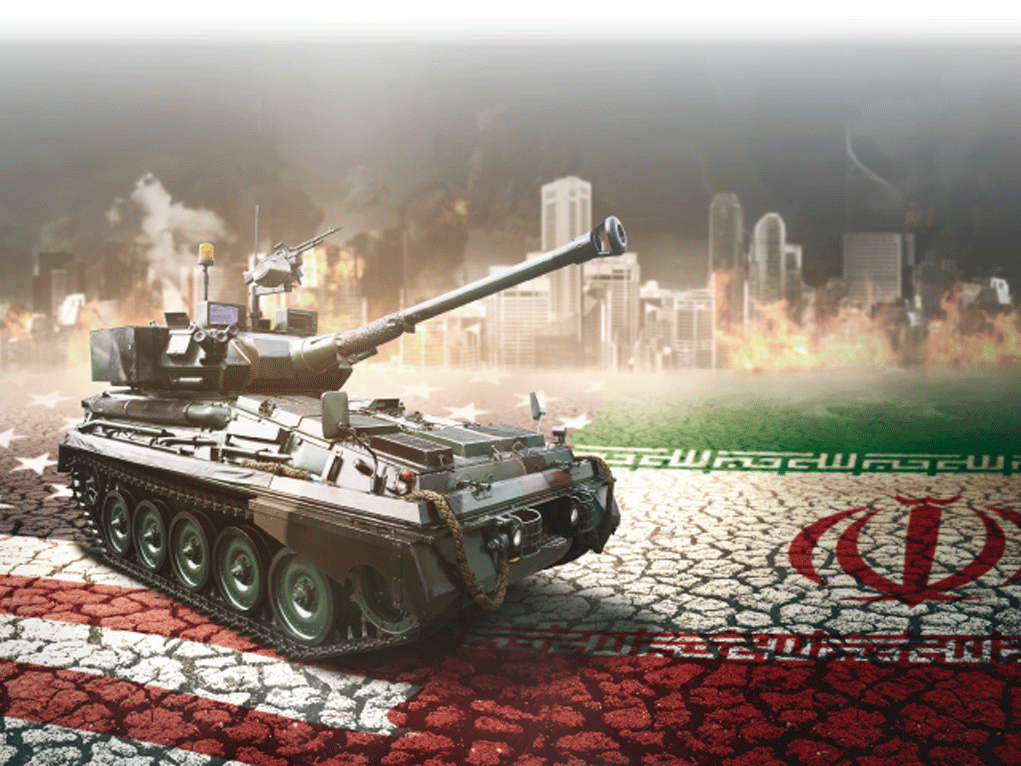

U.S. Trials Unravel Tehran’s Murder Plots
Last week’s trial of Iranian agent Asif Merchant—convicted of plotting the assassination of President Trump and U.S. officials—received little more than a flicker of media attention. Yet the testimony should have set off alarm bells across the country.
In stark detail, the trial exposed Tehran’s methodical campaign of murderous aggression against the United States and the Islamic Republic’s many critics. It laid bare efforts by operatives of Iran’s Islamic Revolutionary Guard Corps (IRGC) to arrange the killing of American political leaders and ordinary citizens on U.S. soil and abroad.
It’s hard for many Americans to believe that Iran poses a threat to the United States so great as to require military action. It can seem almost absurd that far-off violence across the ocean might make its way to our doorstep.
Living in a time when the vast majority of Americans have never experienced war between the world’s superpowers, one can begin to believe this is the norm.
“This notion is little more than a comforting illusion,” writes Commentary Magazine editor Abe Greenwald. “America is extraordinarily well-protected, but not impenetrable. We found that out on September 11, 2001.”
“It takes a lot of forgetting and a lot of ignorance to look at the Iranian regime’s heinous record, and determine that war is merely optional,” the author wrote.
The trial of Asif Merchant, with its abundance of exhibits and witness testimonies showcasing the regime’s ruthlessness, drove home this message. It comes at the same time that a federal alert has warned U.S. law enforcement of encrypted communications intercepted from Iran in recent days, which might serve as a signal for sleeper cells operating outside the Gulf country.
The trial tore away the façade concealing a series of barbaric Iranian plots—many foiled only at the last moment—to murder or kidnap U.S. officials, politicians, and others the regime branded “enemies.”
Trial proceedings, including testimony from Merchant himself, offered a chilling glimpse into how these operations were planned and carried out. Under questioning, Merchant admitted to being trained by the IRGC, Iran’s global terror force that is virtually a shadow Iranian government. [See Sidebar]
He was sent to the United States in April of 2024 and by June had recruited two accomplices—individuals who were in fact undercover U.S. law enforcement officers posing as hitmen.
Merchant tasked them with assassinating various government officials, including President Trump, Joe Biden and former South Carolina governor Nikki Haley. He paid the “hitmen” $5,000 advance, with the promise of hundreds of thousands more after their mission was carried out.
Under the plan, the hitmen would learn the identity of their first target only after Merchant had safely left the country at the end of July. But before he could board his flight, authorities closed in and arrested him.
“This man landed on American soil hoping to kill President Trump — instead, he was met with the might of American law enforcement,” said Attorney General Pamela Bondi. He now faces up to life in prison.
Recruiting ‘Kill Teams’
As revealed at the trial, Merchant, of Pakistani descent, began working for the IRGC in Pakistan in early 2023, when he received training in the tools of terrorism. He was then sent to the United States to recruit other IRGC operatives who would execute various missions, including surveillance of enemies of the regime.
Merchant testified that in 2024, he arrived in New York with a new recruitment mission; to find “Mafia” members willing to steal documents or USB drives, stage an anti-American protest, and arrange the murder of one of three designated U.S. government officials and politicians.
The aspiring assassin was promised up to $1 million if the hit was successful.
Merchant contacted an acquaintance, Nadeem Ali, whom he thought would collaborate with him. Ali chose, instead, to report Merchant’s conduct to law enforcement and began working with the government. As mentioned above, the plan was foiled and Merchant was arrested while attempting to leave the country.
At his sentencing earlier this year, prosecutors noted that Iran had previously paid “Russian mobsters, Mexican cartel hit men and a Canadian branch of Death’s Angels” as part of a campaign to silence dissidents.
Hiding Behind Foreign Hitmen
Far from the Merchant plot being the only attempt at assassinating the president of the United States, the Iranian regime has assembled multiple “kill teams” to assassinate President Donald Trump over at least the last five years, reports the NY Post.
The Islamist regime has repeatedly sought to kill Donald Trump after he ordered the drone attack that killed Iranian major general Qasem Soleimani in Baghdad in 2020. Senior Iranian clerics have issued repeated fatwas against Trump—religious “death sentences” urging Muslims to assassinate him.
Instead of using their own agents to carry out the death edicts, the IRGC has increasingly sought to execute the fatwas by recruiting killers with ties to the United States, including the above-mentioned operative Asif Merchant.
In that way, “by cloaking its terrorism in a veil of plausible deniability,” the regime seeks to escape reprisals, the NY Post writes.
In January, a month before the U.S. and Israeli forces launched strikes on the country, Iran issued a threat against Trump, broadcasting a picture of the commander-in-chief during the 2024 Butler rally assassination attempt, with the caption: “This time it will not miss the target.”
Months after the assassination attempt, U.S. investigators told Donald Trump they could not exclude Iranian involvement. They warned that multiple “kill teams,” operating under the direction of the IRGC, were believed to be actively plotting his assassination.
Aiming for Donald Trump on the Campaign Trail
In one meticulously planned assassination attempt, a spy was ordered by the regime to recruit a “kill team” and come up with a plot to assassinate Trump while he was still on the 2024 campaign trail. The spy, Farhoud Shakeri, recruited two US-based hitmen, both of whom were later caught.
Shakeri, speaking to the FBI from Tehran, said he was directed by his Iranian handlers to devise a plan for assassinating Trump, according to court papers. He agreed to be interviewed by the FBI in the belief that his testimony would reduce prison time for an acquaintance facing trial on terrorism charges.
Shakeri said he told an IRGC official that it “would cost a ‘huge’ amount of money. In response, the IRGC official reportedly said, “We have already spent a lot of money [to assassinate Trump] so the money is not an issue.”
The IRGC recruit was also told he had only seven days to carry out the murder plot. According to Shakeri’s FBI interview, he was told that if he couldn’t carry it out within the seven-day timeframe, his IRGC handler said the plan would be paused until after the 2024 election.
The regime had assessed that Trump would “lose the election and, afterward, it would be easier to assassinate” him, Shakeri testified.
He had previously served 14 years in prison on various crimes before being deported. While incarcerated, he made the criminal connections that allowed him to eventually recruit hitmen for the regime, the NY Post article detailed. The hitmen were an old prison buddy who went by the name of “Pop” Rivera and a man named Jonathan Loadholt, both residents of New York.
Before assassinating Donald Trump, the hitmen were given a trial mission and promised $100,000 if they could bring it off. They were ordered to assassinate a female Iranian known as an anti-regime activist living in the United States. They spent many hours surveilling her home and her movements, waiting for an opportunity to murder her.
Both ex-convicts were caught before they could carry out the assassination and found guilty of murder-for-hire. Rivera was sentenced to 15 years in prison in January. Loadholt is scheduled to be sentenced next month.
Shakeri was charged with murder-for-hire by the FBI in absentia, as he remained in Iran.
“They are killers. They have a list of the people they want dead and they have dispatched many of their spies to arrange to kill them,” Yigal Carmon, a retired Israel Defense Forces colonel who is an expert on terrorism, told the New York Post.
Last week, Pete Hegseth announced that U.S. and Israeli forces had eliminated the Tehran-based “mastermind” behind multiple assassination plots targeting Donald Trump. Speaking at the Pentagon, the defense secretary said coalition forces had “hunted down and killed” the architect of the plots. He declined to name the man who had been orchestrating Tehran’s campaign of murder against an American president.
According to Israeli journalist Amit Segal, the mastermind was Rahman Mokadam, the head of an IRGC special forces unit assigned to assassinate Trump. When told that Mokadam had been eliminated, President Trump was said to have grimly noted, “I got him before he got me.”
Murder Plots Against Critics
For decades, the Iranian regime, particularly the powerful IRGC, has used its capabilities and those of proxies and partners to plan attacks globally against Jews, Israelis, Iranian dissidents, and anyone branded “enemy of the regime,” including persons abroad and in the United States.
Iran’s principal partners and proxies are Lebanese Hezbollah, the Houthis in Yemen, and Shia militant groups in Iraq, Syria, and the Persian Gulf, as well as Palestinian militant groups, including Hamas, Palestinian Jihad and others.
This network enables Iran to expand influence throughout the Middle East at a relatively low cost while largely insulating itself from reprisals.
Iran supplies this network with weapons, training, and guidance, including advanced conventional weapons such as unmanned aircraft system (UAS). This arrangement gives Tehran the capability to strike throughout the region, exporting terror through its proxies, while denying any role in the attacks.
Since the Israel-Hamas war began in October 2023, Iran has continued to direct and support the plotting of its partners and proxies, and encouraged them to focus on destroying Israel and hurting U.S. interests. These interests include military bases and personnel in Iraq and Syria, and international maritime vessels in the Red Sea.
Prior to Feb 28, when U.S. and Israeli forces attacked Iran and began degrading its military capabilities, the regime was heavily involved in assassinating dissidents outside Iran, according to a report by the U.S. Dept. of Justice.
The report documented the jarring testimony of IRGC operative Farhoud Shakeri, who told the FBI in October 2024 that he was instructed to surveil a tourist location in Arugam Bay in Sri Lanka, frequented by Israeli tourists. He was tasked to orchestrate a mass shooting at that location.
According to Shakeri, the “kill team” would be supplied with AK-47s and other weapons for the mass attack. Due to suspicions that the plot had been leaked, the scheme was abandoned at the time.
“Iranian security services have also conducted kidnapping operations to transport dissidents to Iran,” a Department of Justice report stated. In one example from June 2025, Iran was accused of abducting the family members of journalists working for foreign-based media outlets such as Iran International, in retaliation for their negative coverage of the regime. Their fate is currently unknown.
Forced to Lead a Life on the Run
Salman Rushdie, an acclaimed Indian-born British author, is another prominent example of Iran’s efforts to murder dissidents.
Since 1989, he has lived under the “fatwa” death sentence imposed by Ayatollah Khomeini on Rushdie and his publishers for committing “blasphemy” in one of his award-winning books. A group of Iranian clerics even offered a $2.5 million bounty to whoever would fulfill the ayatollah’s decree.
The book’s Japanese translator has been stabbed to death, its Norwegian publisher shot, and its Italian translator knifed, while Rushdie himself was once was forced to lead a life on the run, protected around the clock by Scotland Yard’s Special Branch.
Rushdie subsequently relocated to the United States in 2000 and became a citizen in 2016. Six years later, while about to give a talk in upstate New York, about the United States as a safe haven for exiled writers, Rushdie was attacked and repeatedly stabbed by a radicalized Lebanese-born American citizen.
Hospitalized with severe injuries, Rushdie managed to survive. The perpetrator, Hadi Matar, was convicted of attempted murder to honor Iran’s fatwa as well as assault charges, and sentenced to 25 years in prison.
***
IRGC In its Death Throes?
The Islamic Revolutionary Guard Corps (IRGC) is far more than a conventional military force. It is both a shadow government and economic powerhouse that operates more or less independently of Iran’s civilian leadership, experts say.
Last week, Fortune reported that the IRGC, controls a sprawling business empire that dominates the economy— more than half of Iran’s GDP. It controls a vast swath of commercial interests through its network of front groups and subsidiaries. “This includes oil, banking, telecom, agriculture, real estate, transportation and shipping companies, and even Tehran’s international airport,” the article details.
The Jerusalem Post reported that Iran allocates a third of all oil revenue directly to the IRGC. The terror group shipped about 85,000 barrels a day to Syria, and sells the rest mostly to China through a so-called “shadow fleet” designed to avoid sanctions.
By blowing up the IRGC’s own refinery this week, Trump wasn’t just hurting “Iran” in a general sense, critics say— he was trying to bankrupt the IRGC specifically, by collapsing its parallel economy.
If such a collapse were to occur, it would almost certainly signal the endgame for the IRGC which some say is in its death throes, with its headquarters reduced to rubble, much of Iran’s naval and air forces crippled, weapons arsenals devastated and the country’s economy in ruins.
The terrorist group, however, continues to launch its remaining missiles at Israel, at its own Muslim neighbors, and U.S. military bases in the region. In a bid to burnish its hardline image, the IRGC has just installed Mojtaba Khamenei — the son of the Supreme Leader killed with his top advisors in a devastating Israeli airstrike — as his successor.
Despite its defiant posturing, analysts say it is only a matter of time before the IRGC’s resistance collapses and it is forced to surrender.
***
The Forgotten Slaughter of Marines in Beirut
On October 23, 1983, Iran-supported terrorists carried out the bombing of the Marine barracks in Beirut, causing the death of 220 Marines. What follows are excerpts from a reprint of an article in Front Page magazine, written by Daniel Greenfield on the 40th anniversary of that atrocity.
“‘The worst part for me is that nobody remembers,” Mark Nevells said on the anniversary of the Hezbollah bombing of the Marine barracks in Beirut.
“A Marine had thrown his body in front of the truck to try stop the vehicle’s advance. For five days afterward, Nevells and other Marines had dug through the rubble for the bodies of their friends,” Greenfield writes.
“In Washington, the murder of 220 Marines by Iranian terrorist Ismail Ascari, who drove the truck full of explosives that tore through their barracks, is barely remembered. It is the stuff of inconvenient truths and lost memories. And it has always been that way,” the article laments.
Mohsen Rafiqdoost, Khomeini’s bodyguard who helped found Iran’s IRGC boasted about the terrorist group’s role in the bloody attack. “Both the TNT and the ideology, which in one blast sent 400 officers, NCOs, and soldiers at the Marines headquarters to their deaths, were provided by Iran,” the IRGC founder bragged at the time.
“It may be tempting to dismiss all this as ancient history,” writes Greenfield, “but in nearly 50 years, the terror against America never stopped. In 1996, 19 U.S. Air Force airmen were killed in the bombing of the Khobar Towers in Saudi Arabia with another truck bomb.”
“The Khobar Towers bombing was planned, funded, and sponsored by senior leadership in the government of the Islamic Republic of Iran,” ruled a U.S. court presiding over a case brought by Khobar Towers victims.
Fawning Appeasement
President Clinton responded to the Iranian atrocity with a fawning, conciliatory message to newly elected Mohammad Khatami, who was playing the part of the “reformist” President of Iran.
“The United States has no hostile intentions towards the Islamic Republic of Iran and seeks good relationships with your government,” Clinton wrote, asking—not even demanding—“a clear commitment from you that you will ensure an end to Iranian involvement in terrorist activity.”
The commitment was not forthcoming and Clinton caved.
All subsequent atrocities against U.S. servicemen by Tehran were carried out “as a result of policies of appeasement” from Carter to Clinton to Obama to Biden, the article asserts. The more these presidents waffled, compromised and caved, the more the Islamic regime became convinced that America was impotent and that ayatollah was infallible.
Last June, Khamenei was still assuring his people that America “is powerless against us.” In Bushehr, a major site of Iran’s nuclear program, a cleric claimed that ‘the U.S. cannot do a single thing to stop Iran’s nuclear progress.”
The airstrikes that soon followed proved these psychopaths catastrophically wrong.
President Trump has taken the opposite approach from that of his predecessors, “punishing Iran’s intransigence, instead of rewarding it,” the article concludes. “He has shown how weak these totalitarian despots are underneath their arrogance and cruelty.”